At the end of a memorable year which has left many of us with a somewhat negative feeling about 2021 and hopeful for a better experience in 2022, it seemed appropriate to write about something which holds promise for the future. and what is more promising than the sight of an iconic bird in breeding mode.
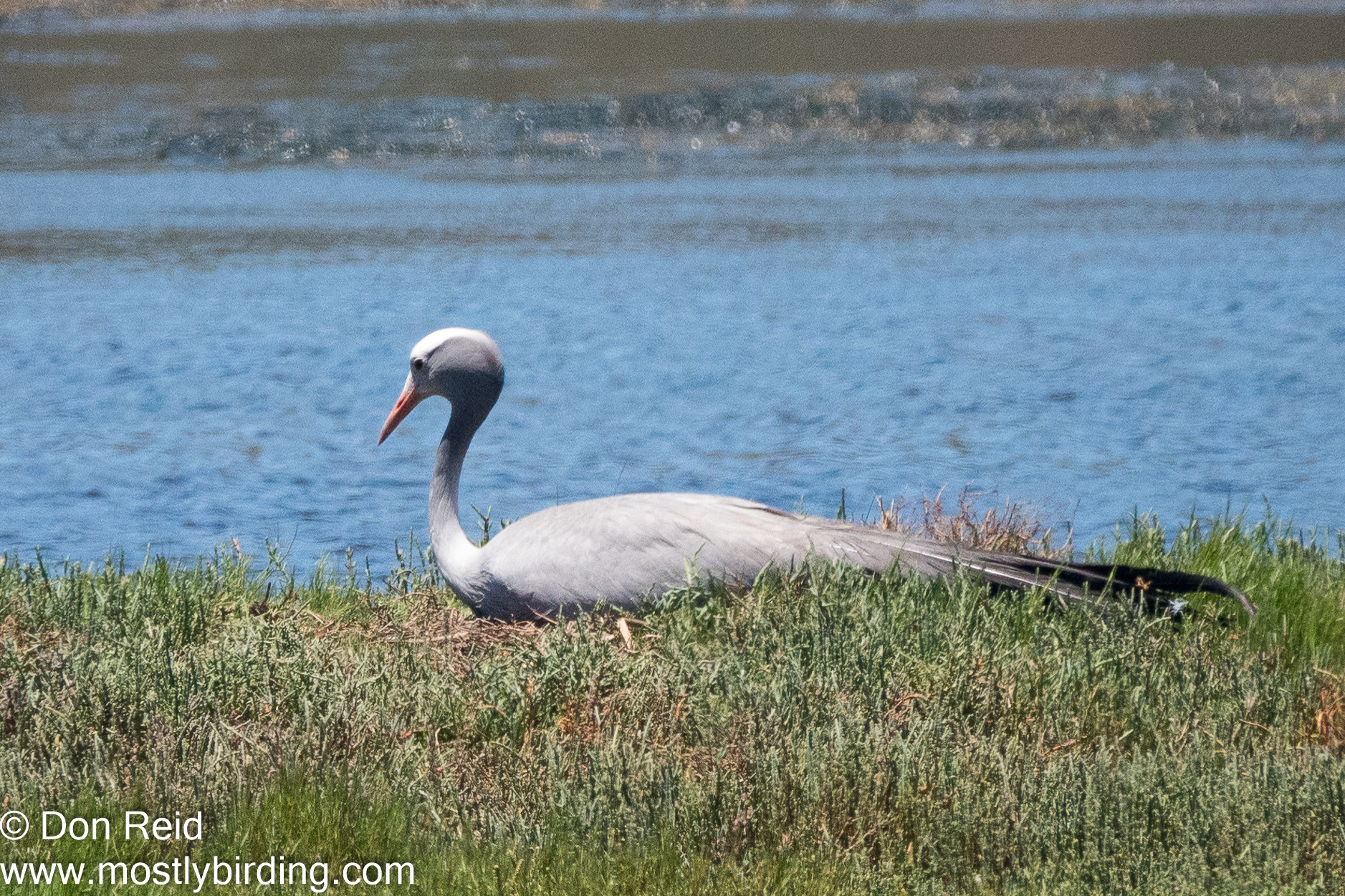
We were recently privileged to view a Blue Crane Anthropoides paradiseus (Bloukraanvoel) on its nest, something we have never seen before and our short ‘stay’ with this National Bird of South Africa was truly uplifting.
It happened purely by chance, as is often the case with special bird sightings, and only a few days into our latest stay in Mossel Bay over the December/January summer ‘season’
We had travelled to Plettenberg Bay from our Mossel Bay home (both part of the famous Garden Route of South Africa and some 150 kms distance from each other) to follow up on a sighting of a rarity that had been located at the Keurbooms River Estuary (more about that in a future post) and were on the road from the estuary back to the N2 National Road for our return trip home.
Gerda spotted a bird in a field and I duly stopped on the quiet road to see what it was. A car going in the opposite direction had also stopped almost alongside us and I wondered if they were also birding, whereupon one of the occupants got out and told us “There’s a Blue Crane on a nest if you are interested” and proceeded with a description of where we could find it. I didn’t pick it all up but thanked him and we set off in search of the spot he had described.
Fortunately between Gerda and myself we had understood enough of this thoughtful birder’s directions to find our way to the road along the Bitou River just outside Plett (which is how most South Africans refer to this Popular town) and after carefully scanning the river and vleis for a few kms we came to the spot he had described, with a pair of Blue Cranes in attendance a short distance from the road.
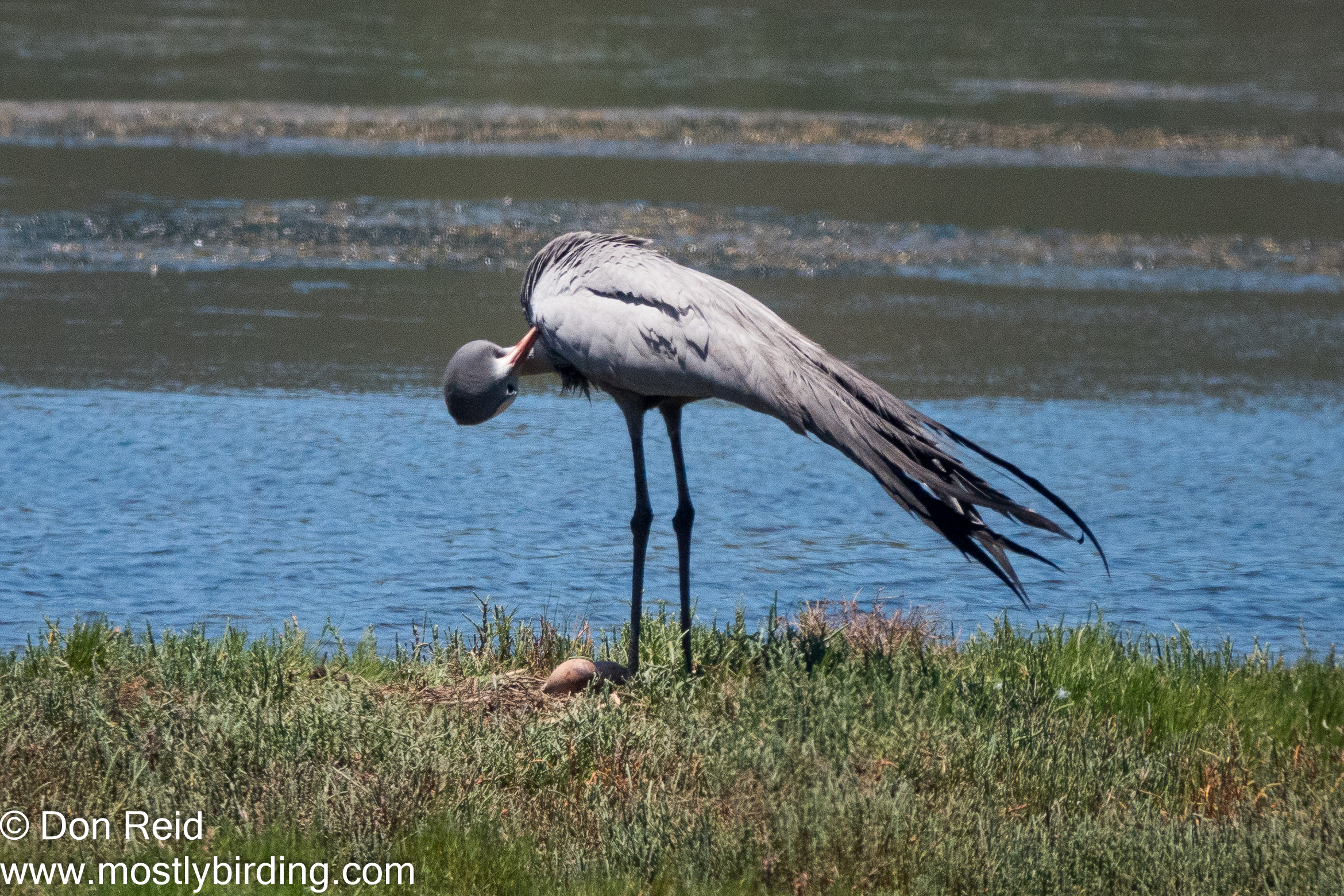
One was clearly on a nest and this was confirmed moments later when he/she stood up so that we could see at least one egg, which turned into two when I later studied the photos.
Blue Crane on nestBlue Crane at nest, two eggs visibleThe Blue Crane fussing over the eggs
The other Blue Crane was a short distance away in shallow vlei water, seemingly keeping an eye on the situation. According to Roberts VII the male and female spend almost equal amounts of time incubating the eggs over a period of around 30 days.
We had no way of knowing how long they had been incubating so it’s impossible to say when they may hatch – perhaps we will travel that way in a couple of weeks time and see if there has been a change in status.
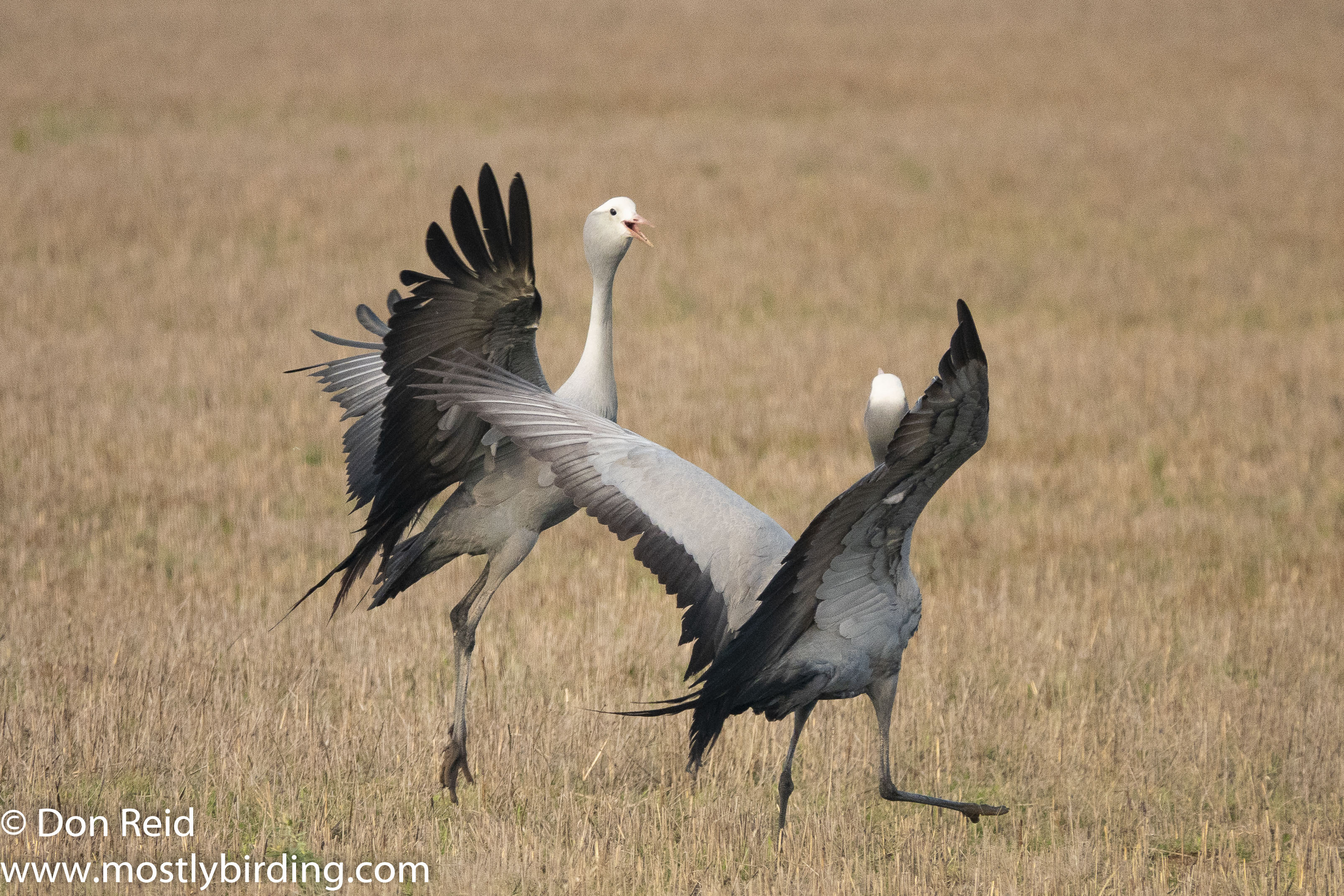
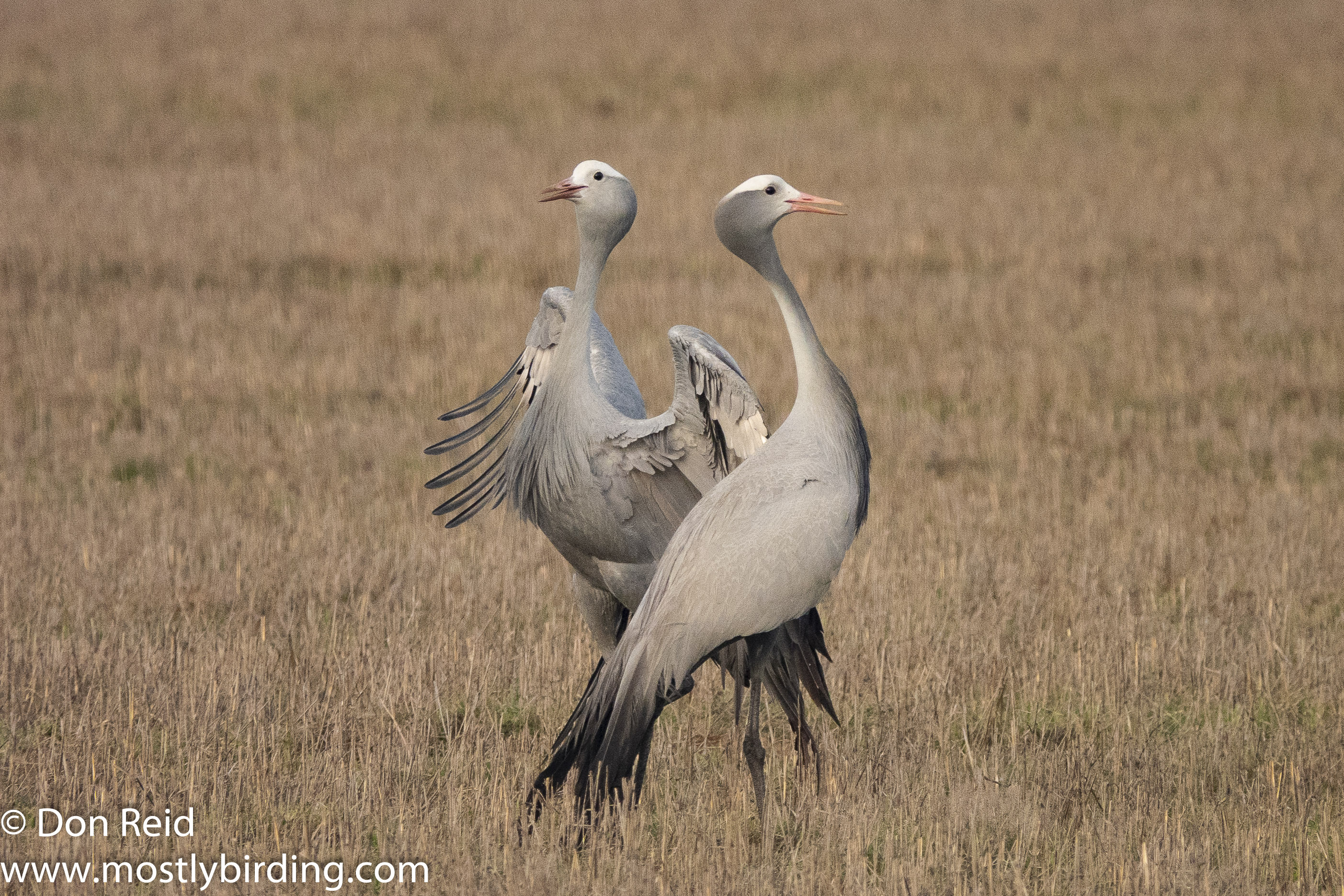
Blue Cranes form monogamous pairs when breeding and are well known for their spectacular pairing and courtship displays, which we were fortunate to witness some time ago and which I featured in an earlier post – a couple of the images from that post are repeated below
Blue Crane courtship dance, near Mossel BayBlue Crane courtship dance, near Mossel Bay
My last post for 2021 comes with best wishes for a peaceful and healthy New Year
After publishing a post this week, I happened to notice that I have published 250 posts so far – a nice milestone to reach. That got me thinking – not too deeply mind you – about how it started and where blogging has taken me since July 2013 when I set out on this blogging journey
It all started some time after retirement when I took on the part-time role of Consultant, which gave me more time to do things outside the work/office environment, amongst them birding, photography and writing. The beauty of blogging is that it combines all of these into one neat package.
I have had a lifetime habit of recording travels and trips in diary form and keeping birding lists for various localities, so blogging seemed like a natural progression for these activities.
Photography has been a hobby of mine since my youth, starting with a simple point and shoot film camera borrowed from my dad, progressing through various upgrades of cameras and lenses into the digital age, going full circle to today where most of my photography is done with either my Iphone or with my very capable and convenient point-and-shoot camera, albeit a very sophisticated one.
WordPress was a good choice as my preferred software provider and it was not too difficult to learn how to set up posts, create a library of images and set categories and tags so that the published post looked reasonably professional.
So, blogging has satisfied my “writing passion” beyond what I imagined – an estimated 250,000 words and 5,000 images later I find myself looking forward to many more – it is my hope that some of you will join me on the next part of the journey.
In celebration of the milestone I have selected a few images which have garnered the most “clicks” over the years….
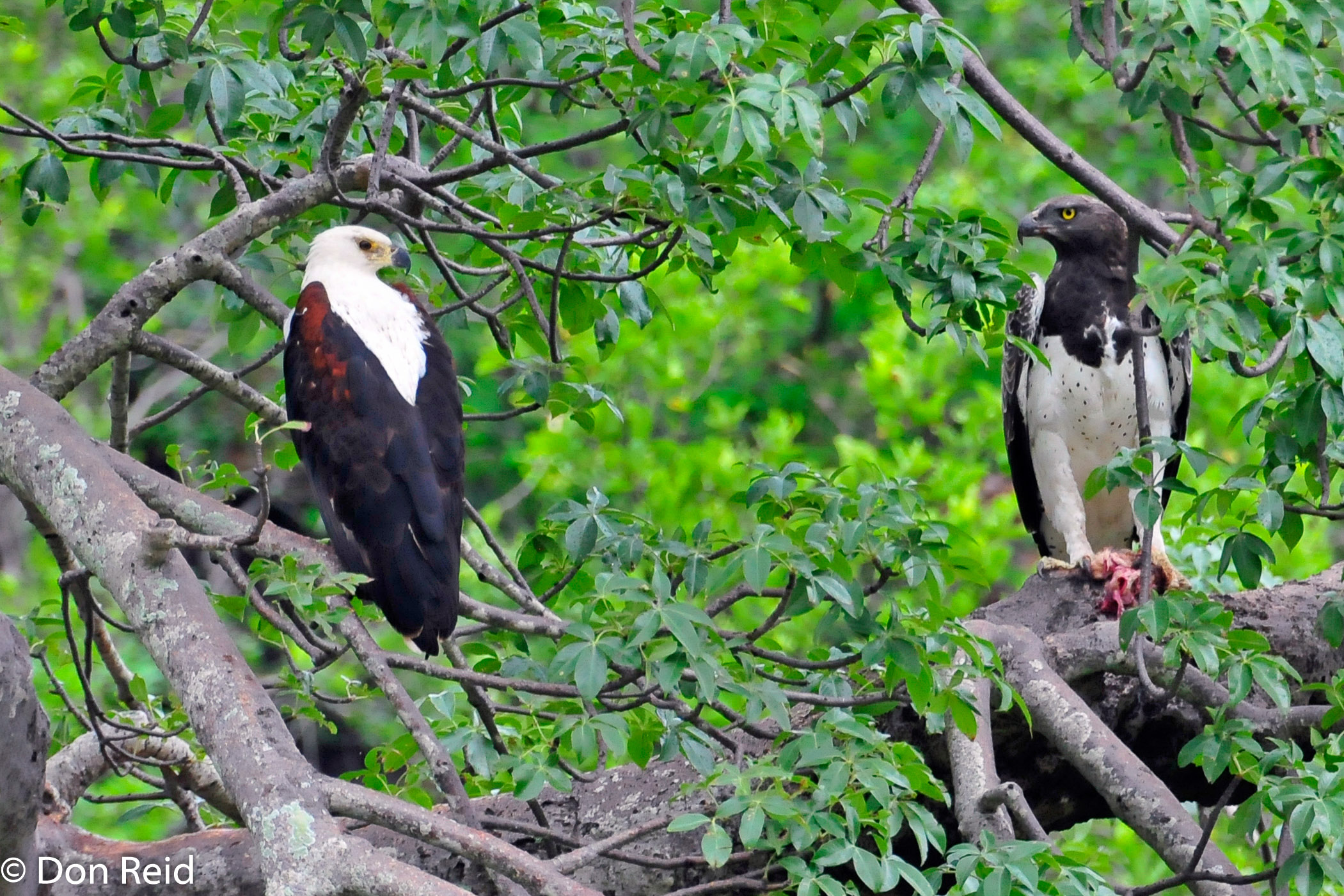
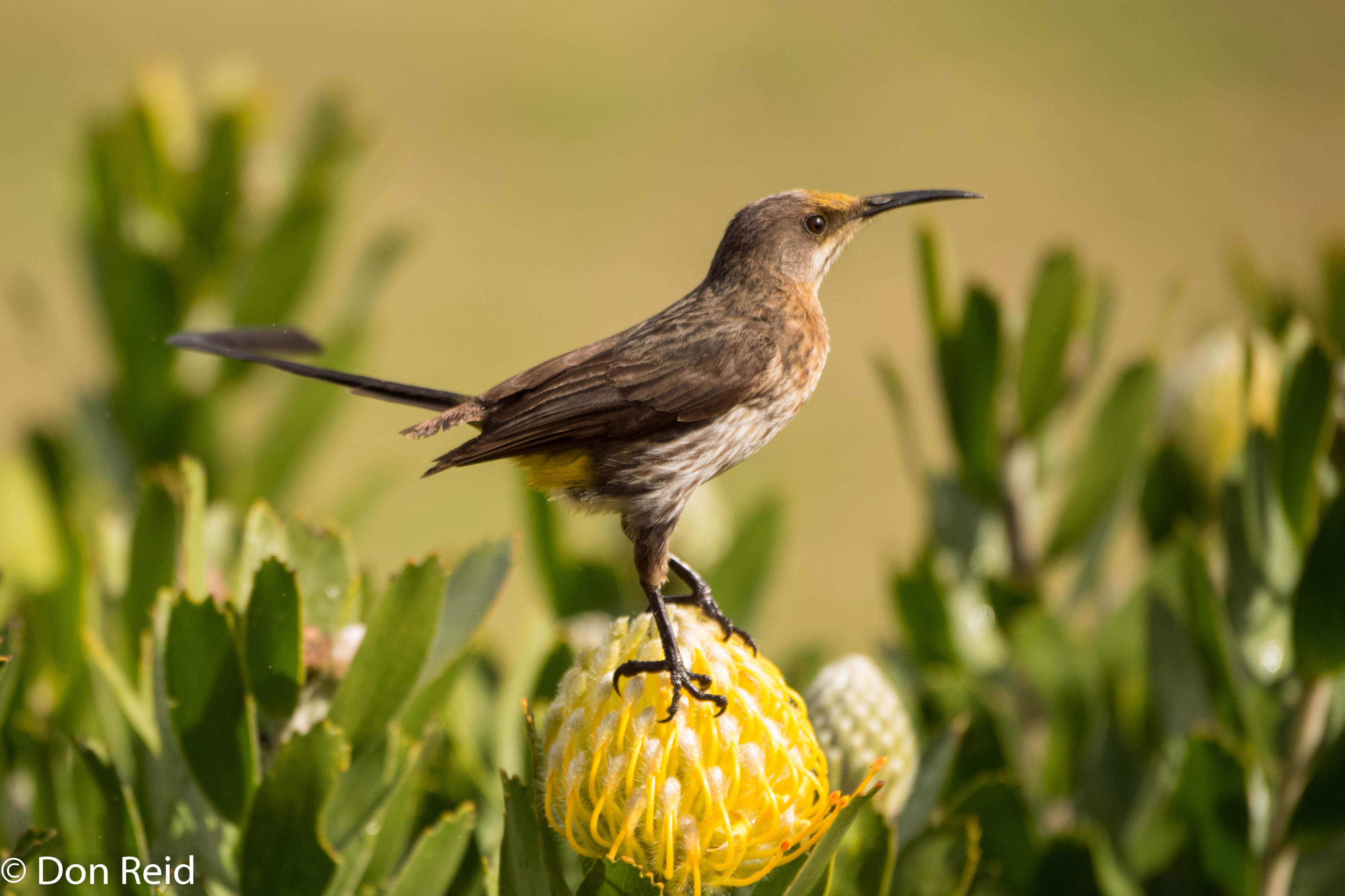
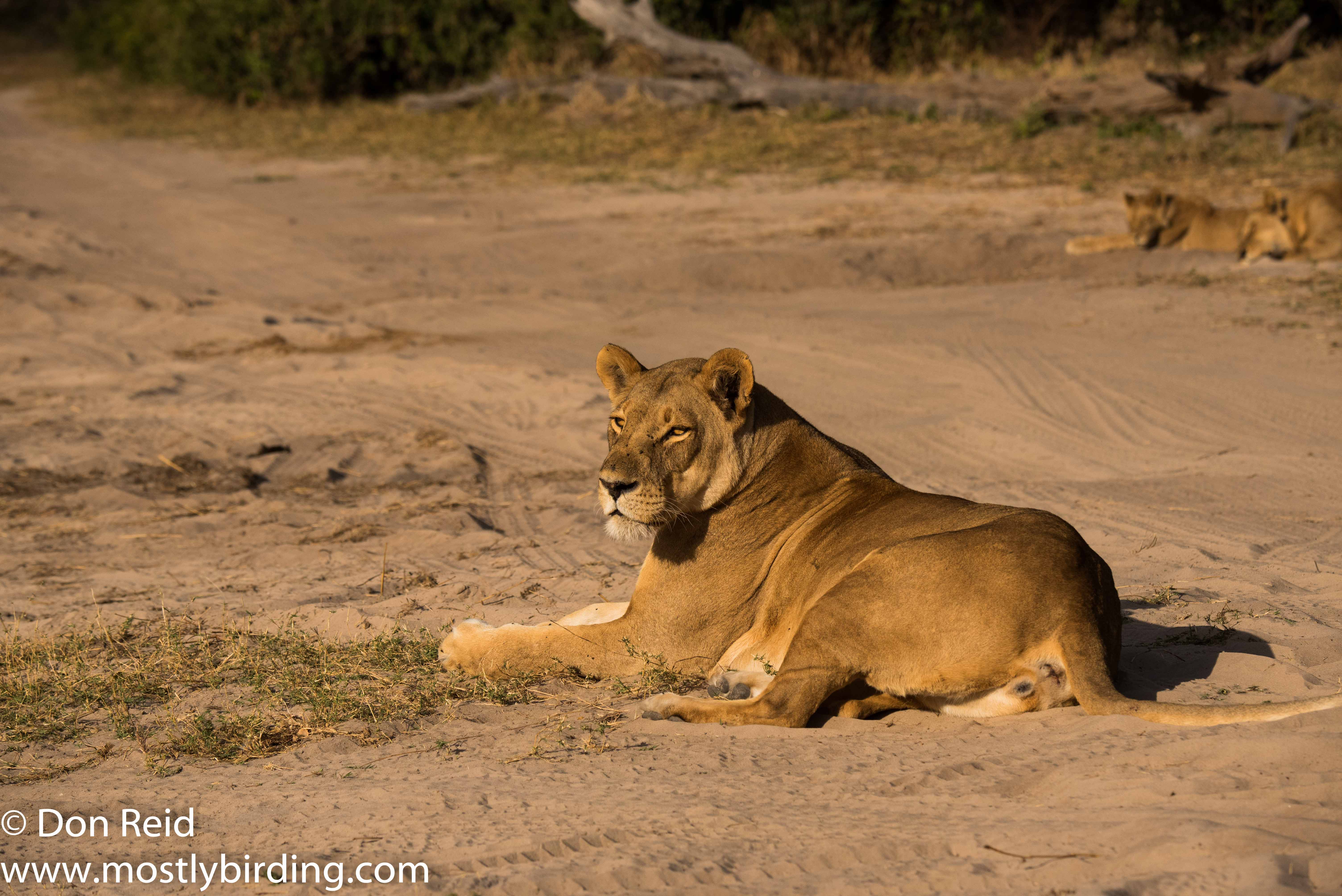
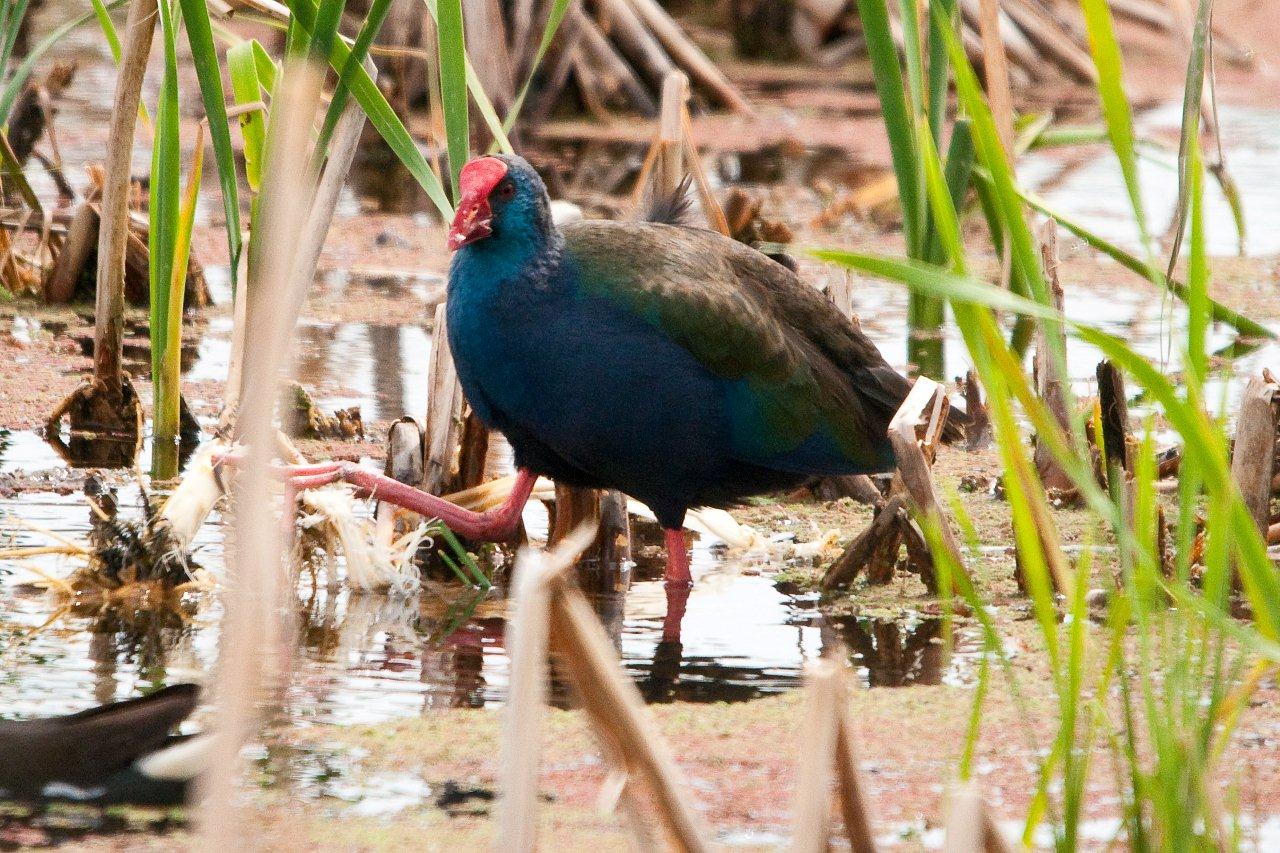
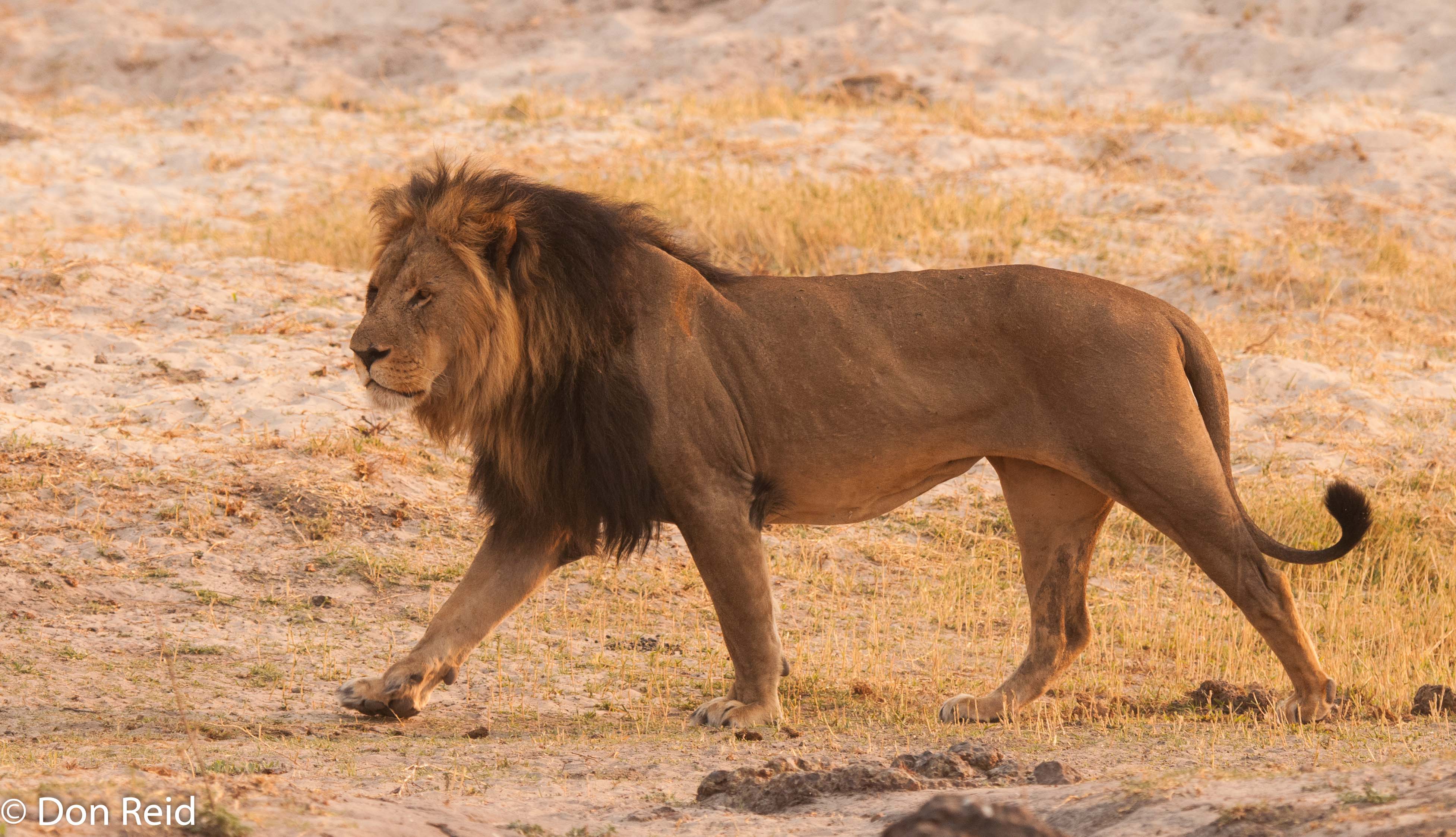
Red-billed Firefinch Fish-Eagle and Martial Eagle eye each otherCape Sugarbird, Mossel BayRed-faced Crimsonwing, ZimbabweLion, Chobe RiverfrontHerring Gull, at seaAfrican Purple SwamphenCape Long-billed LarkLion, Chobe RiverfrontGreater Flamingo
I hope you have a peaceful and restful holiday season!
Observing birds going about their daily business is often fascinating – when that business involves raising youngsters it becomes really special.
We were treated to a very special “show” during the late winter / early spring months of August and September this year while resident in our Mossel Bay home, which started with a casual comment from our neighbour (a non-birder who happens to be our brother-in-law).
My journal chronicles it as follows :
Day 1 : (1st August 2021)
Brother-in-law – let’s call him Tienie (mainly because that’s his name) – posed a question “what’s that bird in the garden with the long tail that likes the Protea bushes ?”. Well, there weren’t too many options so I surmised immediately that he was talking about the Cape Sugarbirds that frequent our garden almost year round.
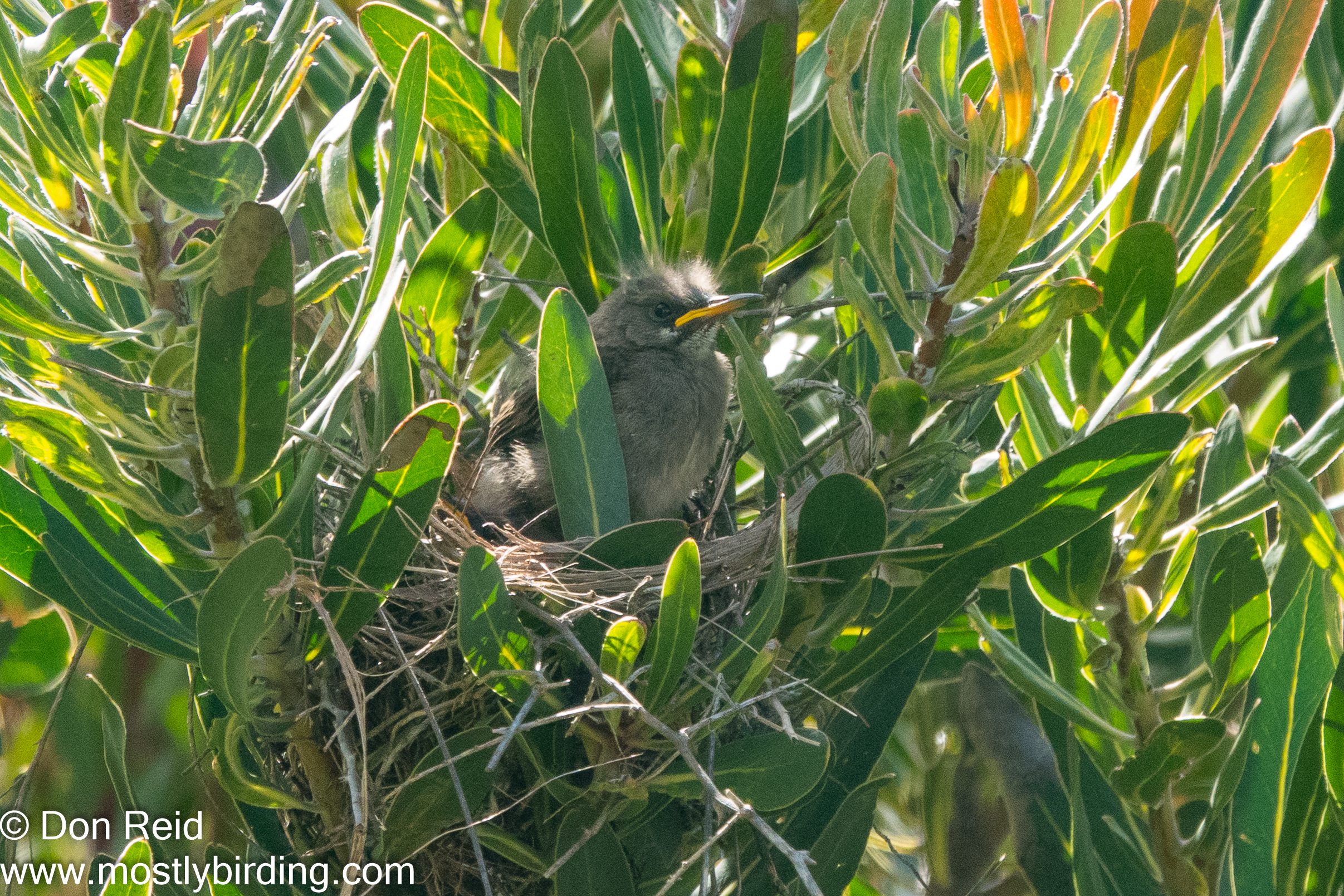
So I eagerly followed up with “why do you ask?” and it turned out he had noticed a nest in one of the Protea bushes in his garden, with said Sugarbird in attendance and when he investigated further he was able to spot what he thought were “two fluffy babies” in the nest. My guess is that the chicks had been born in the last day or so.
Day 2
Tienie’s comment had sparked my interest more than he could realise, even though he knows I am a keen birder, and Gerda and I commenced a daily check from our bedroom balcony, which has a good view of the Protea bush in his garden.
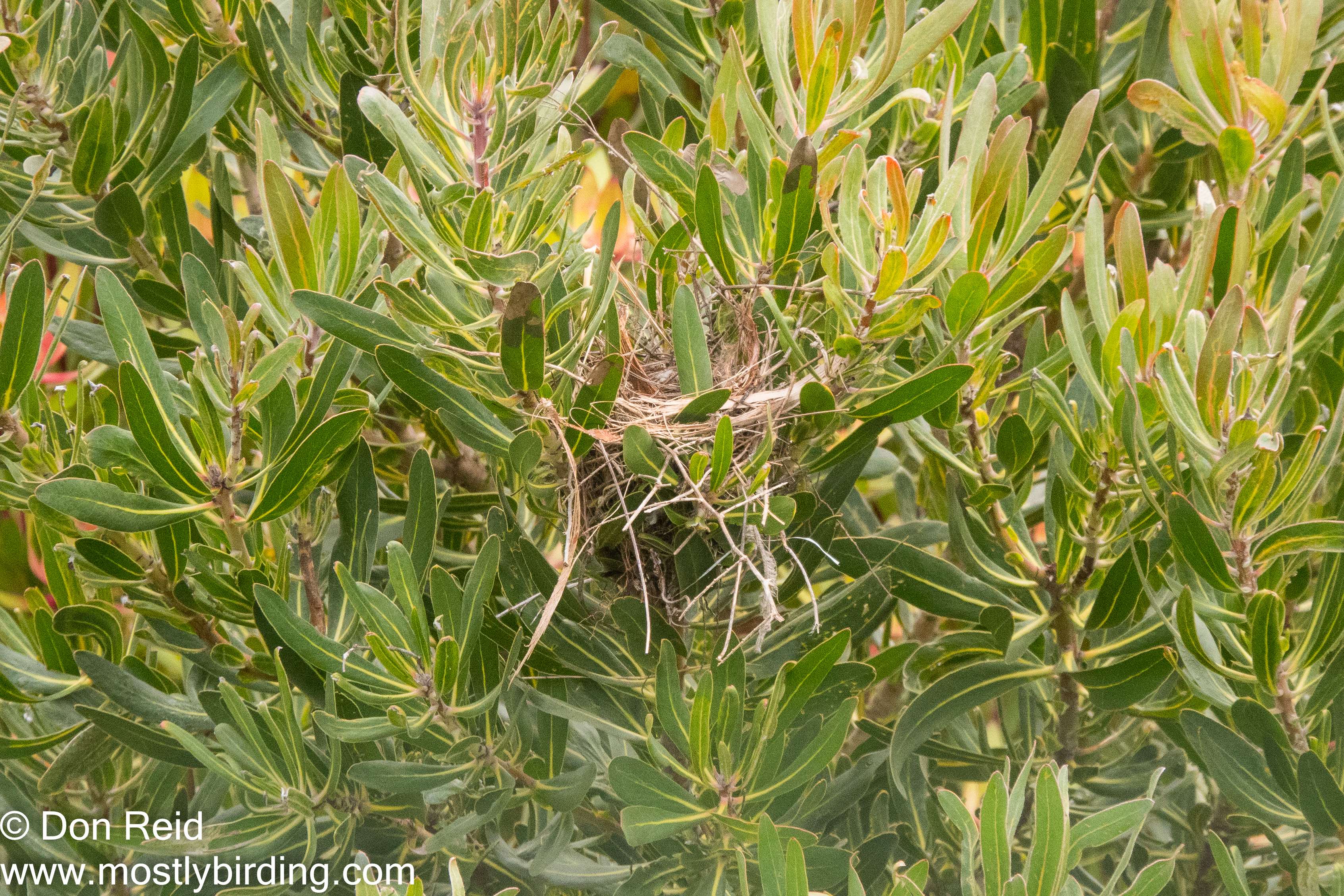
The nest was quite well concealed among the stems and leaves and it was not always easy to pick up details, so I started by doing a recce from Tienie’s garden, carefully approaching the bush on foot to confirm for myself that there were chicks in the nest.
The nest
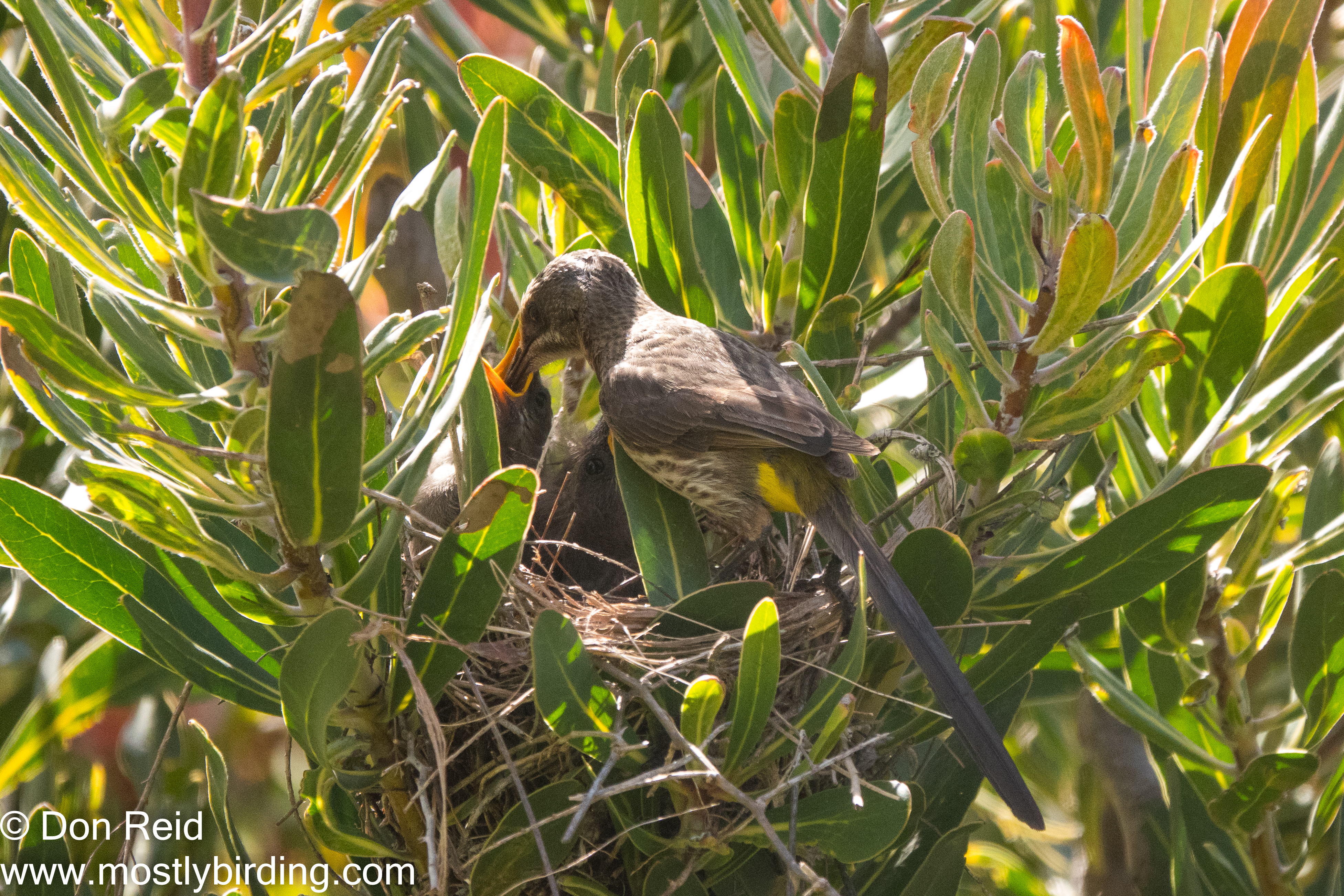
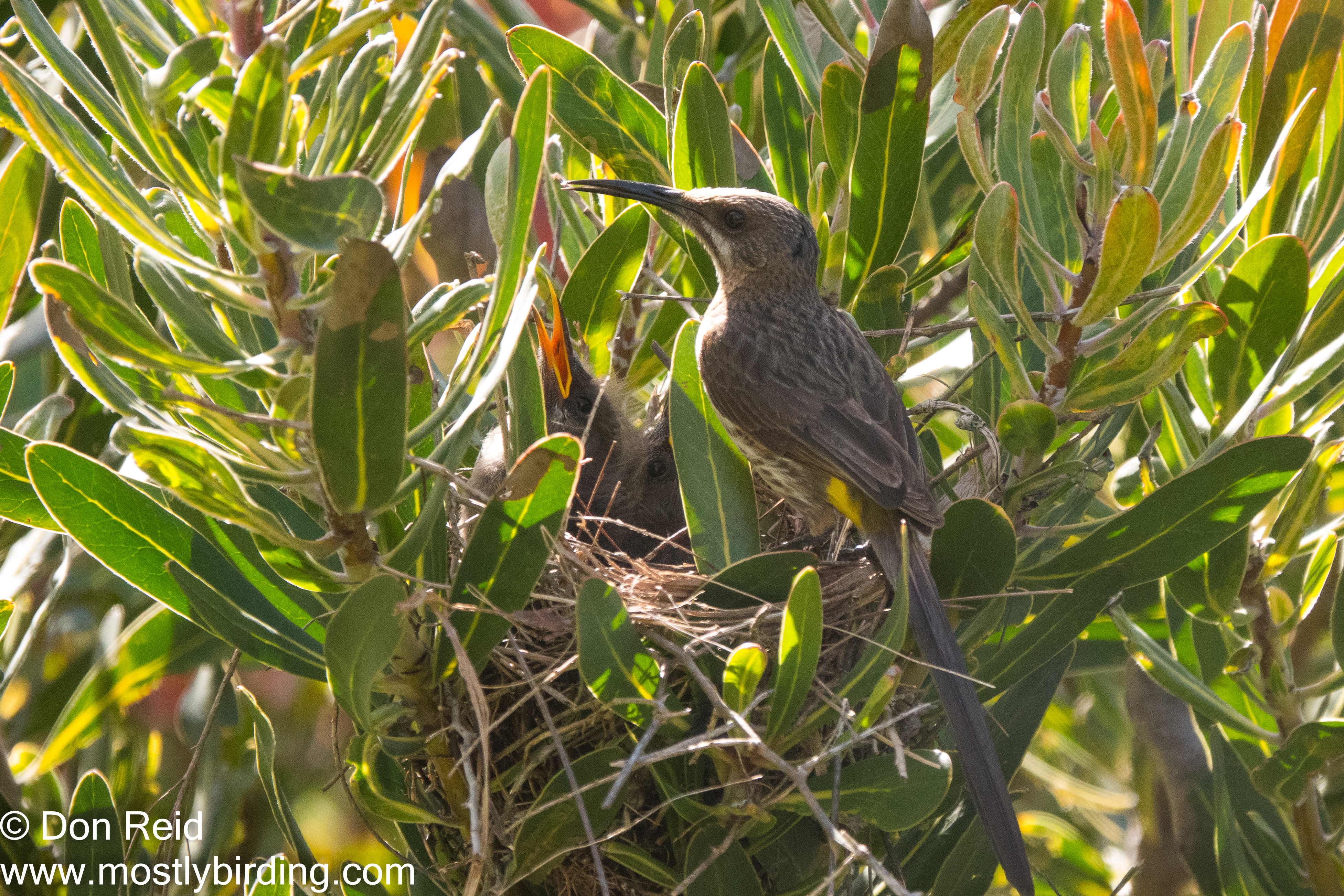
The only evidence I could pick up was an adult female apparently feeding the chicks which I could not see, while the adult male stayed in the vicinity, occasionally going to the nest himself.
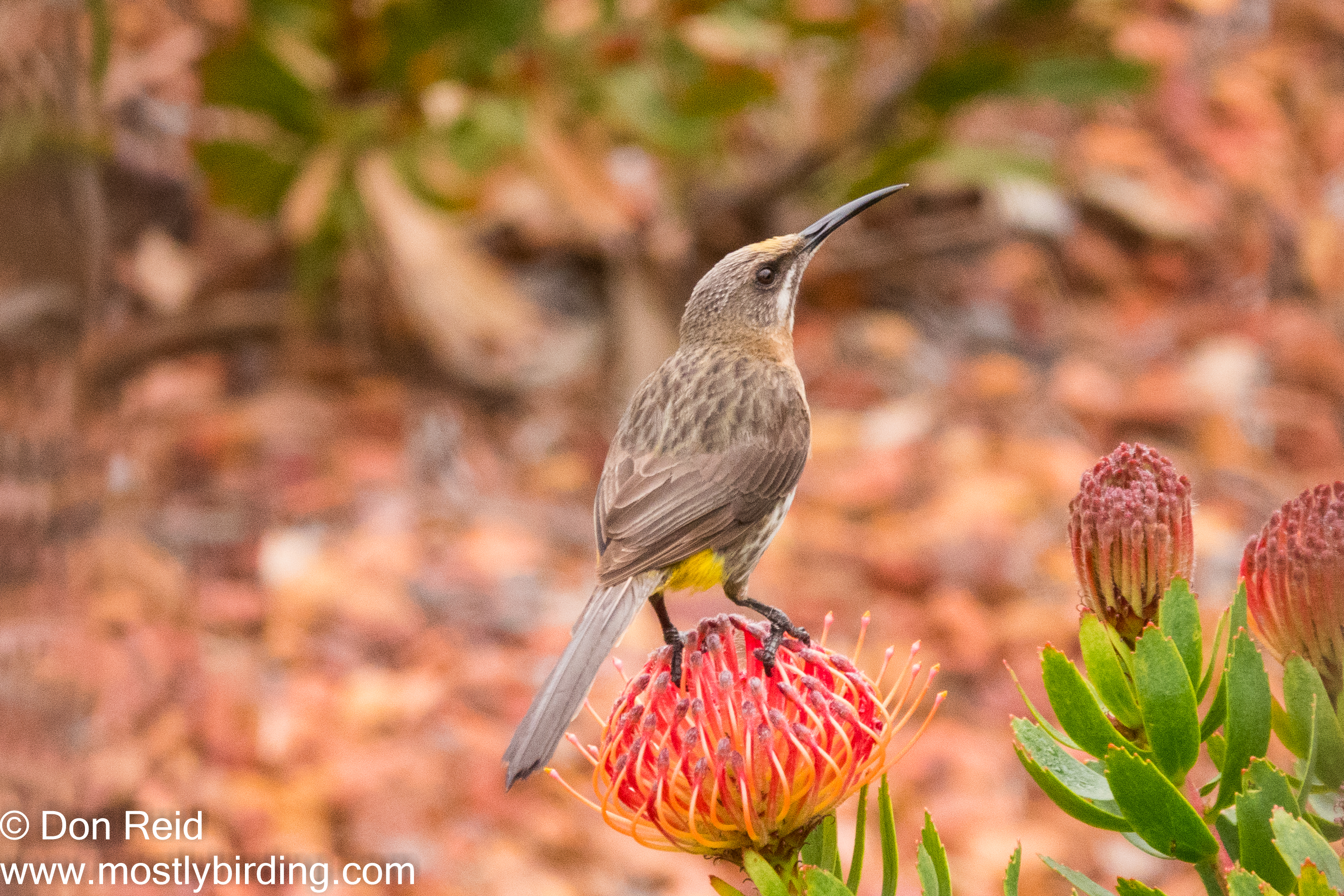
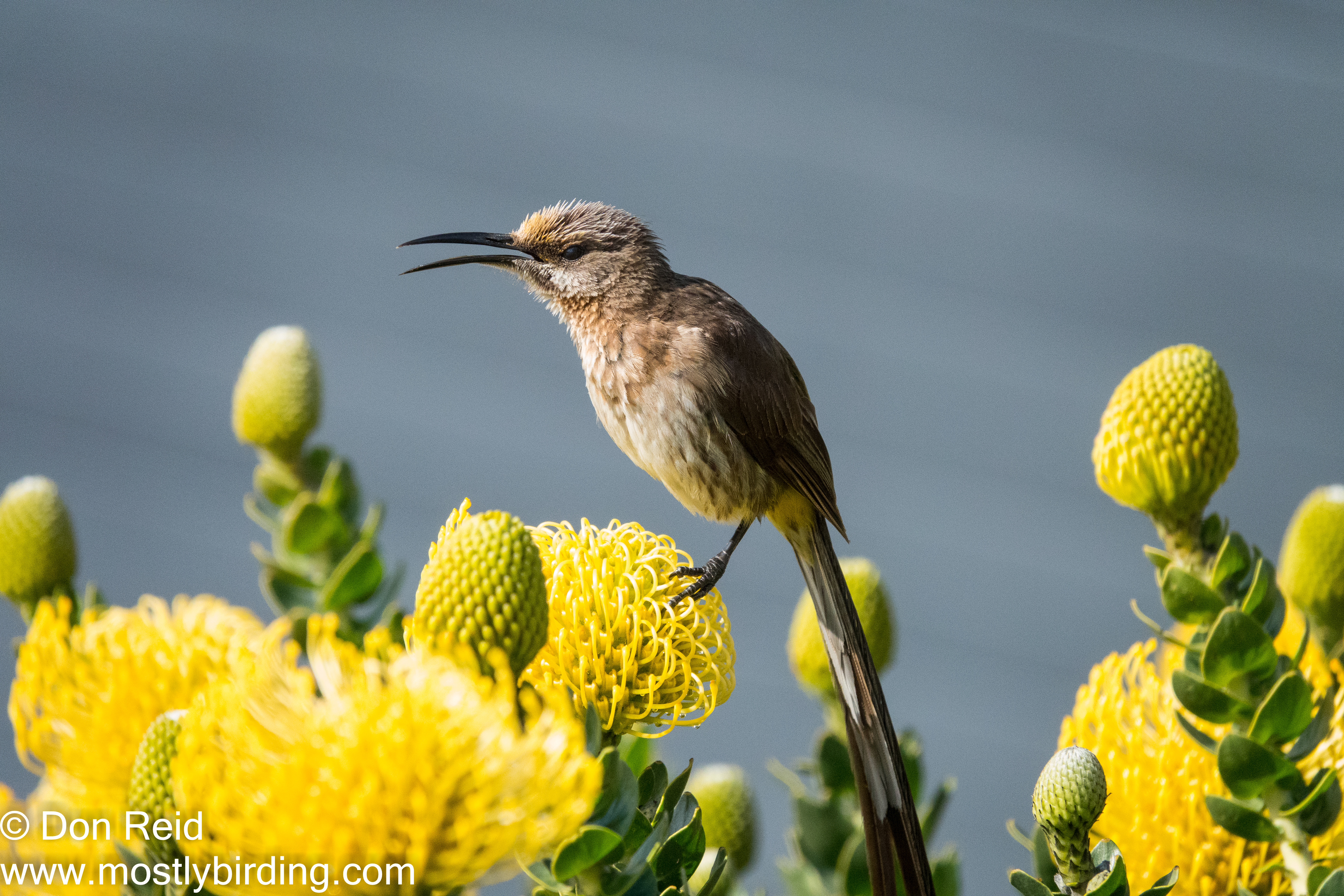
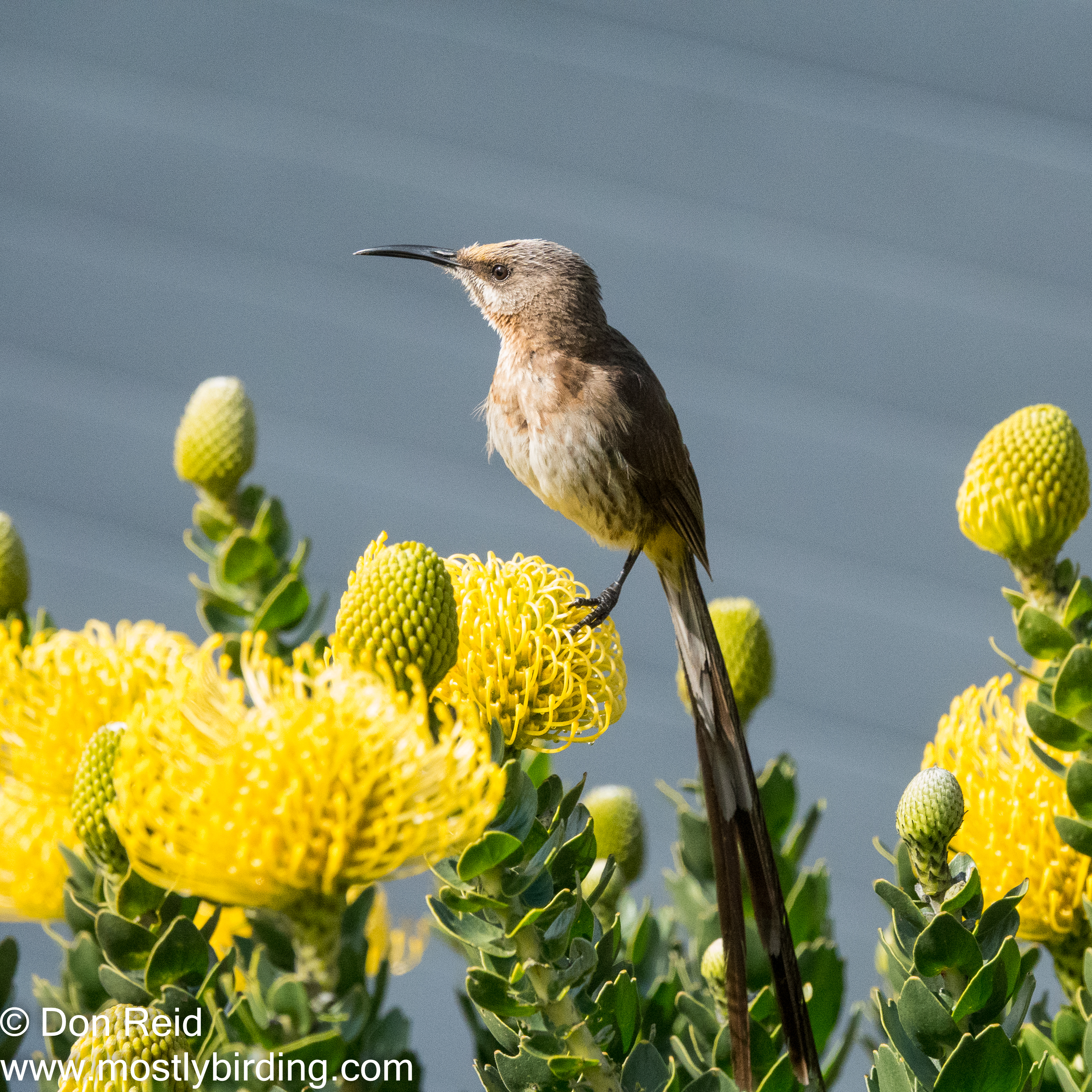
Cape Sugarbird adultCape Sugarbird adultCape Sugarbird adult at the nest
We continued to monitor their progress at various times during the following days, but had to interrupt our observations as we had booked a trip to Franschhoek from 6 to 11 August, after which we resumed keeping an eye on the activities around the nest.
Day 19
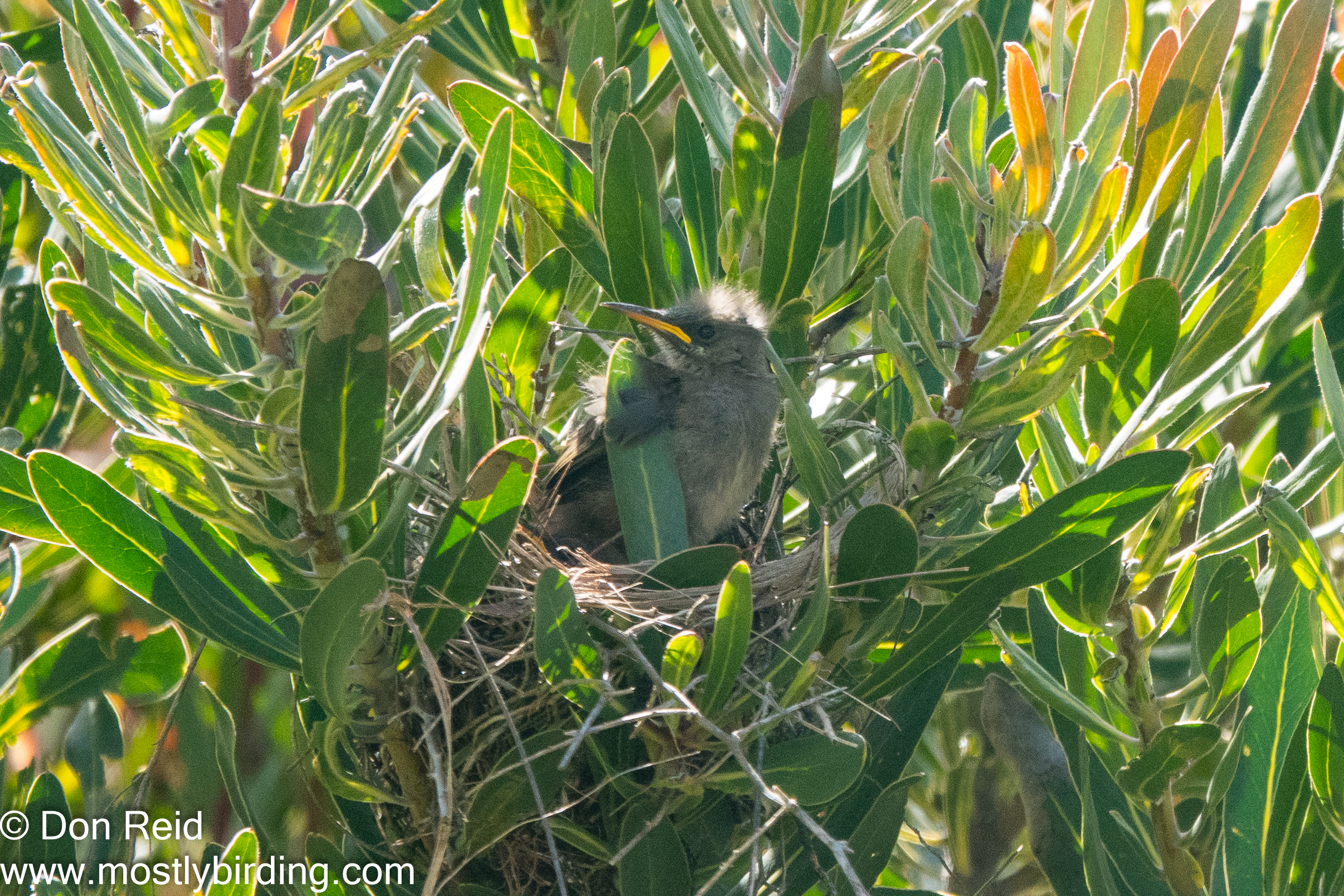
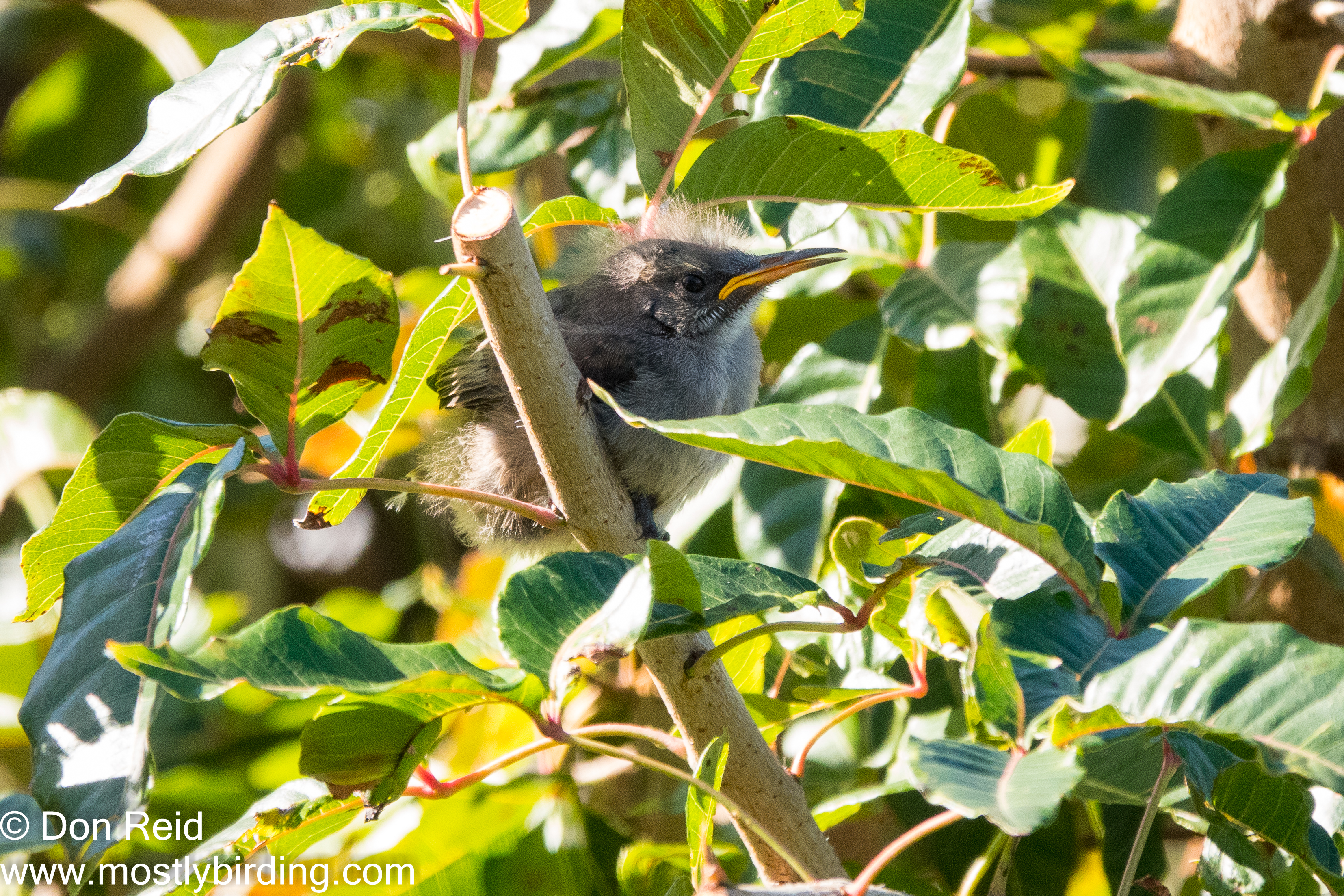
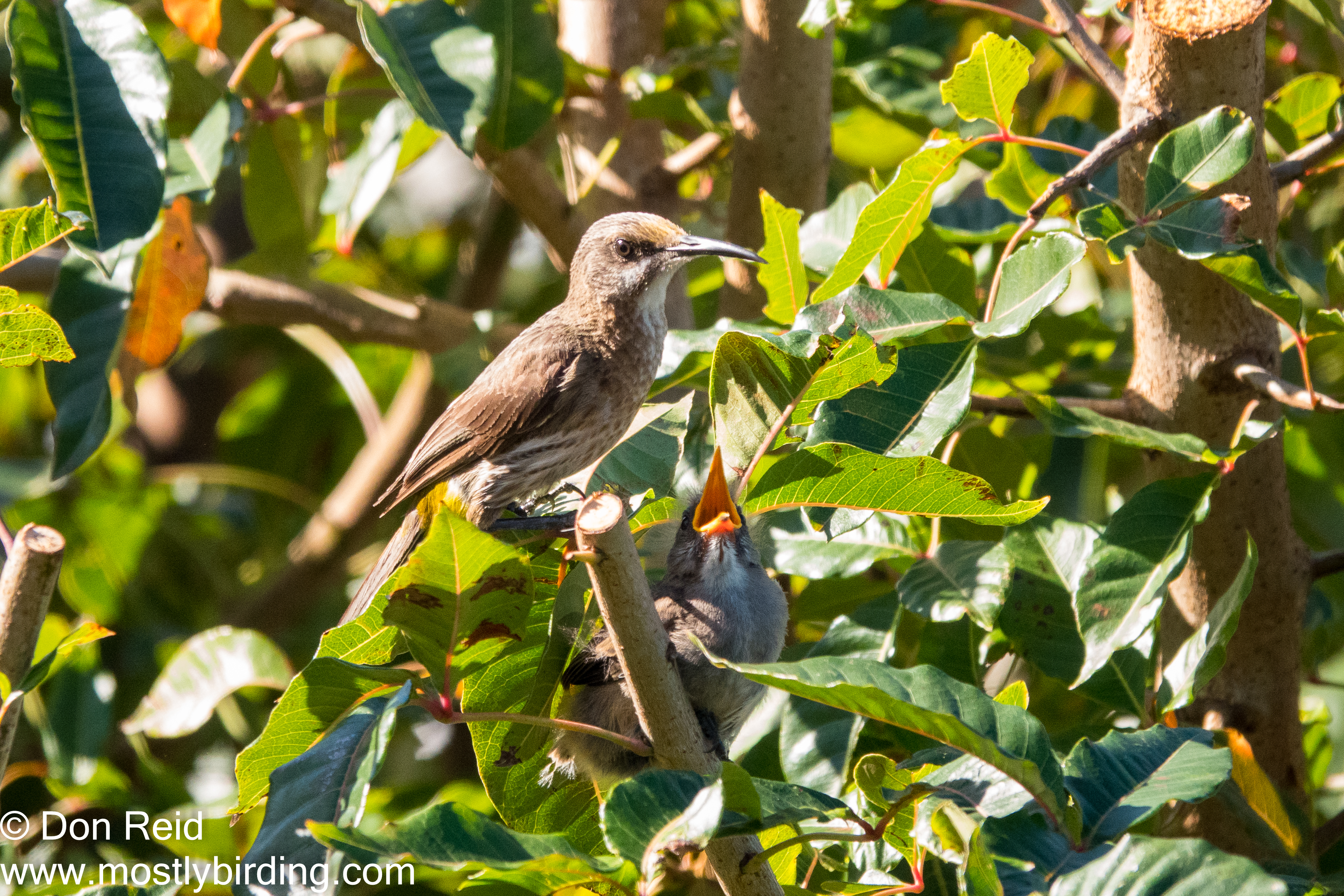
I was thrilled to see that the chicks were preparing to fledge as they were clearly visible in the nest and spent time perched on top of the nest, presumably working up the courage to explore the world around them.
Both adults were never very far from the nest, venturing out to forage for something and taking turns to feed the chicks, whose appetite had by now increased exponentially.
As I had suspected, the chicks had fledged and the great news was that they had chosen to spend their day in the trees right in front of our enclosed braai room which is almost level with the canopy of the trees, so we had the best views of the two young Sugarbirds.
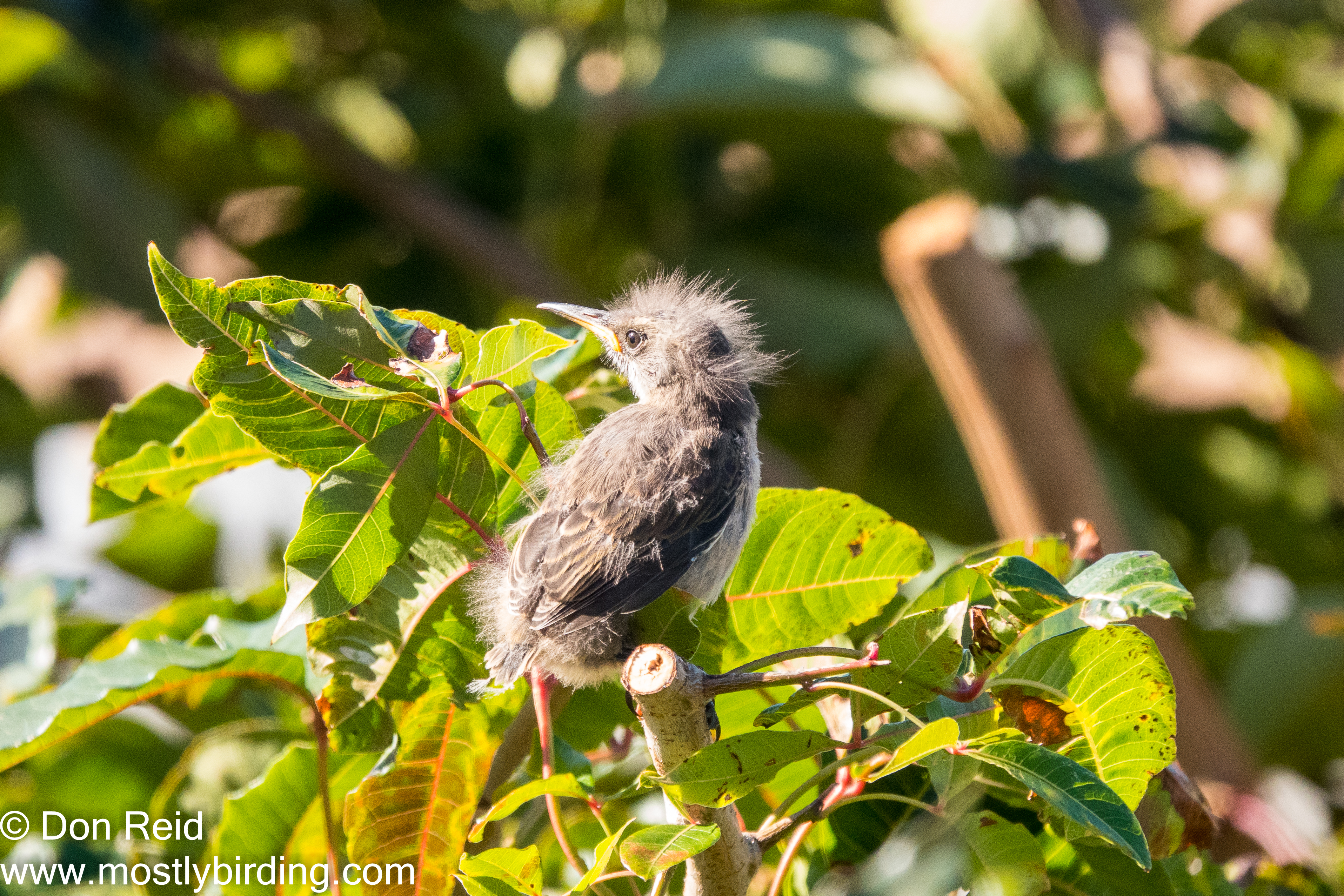
Cape Sugarbird fledgling
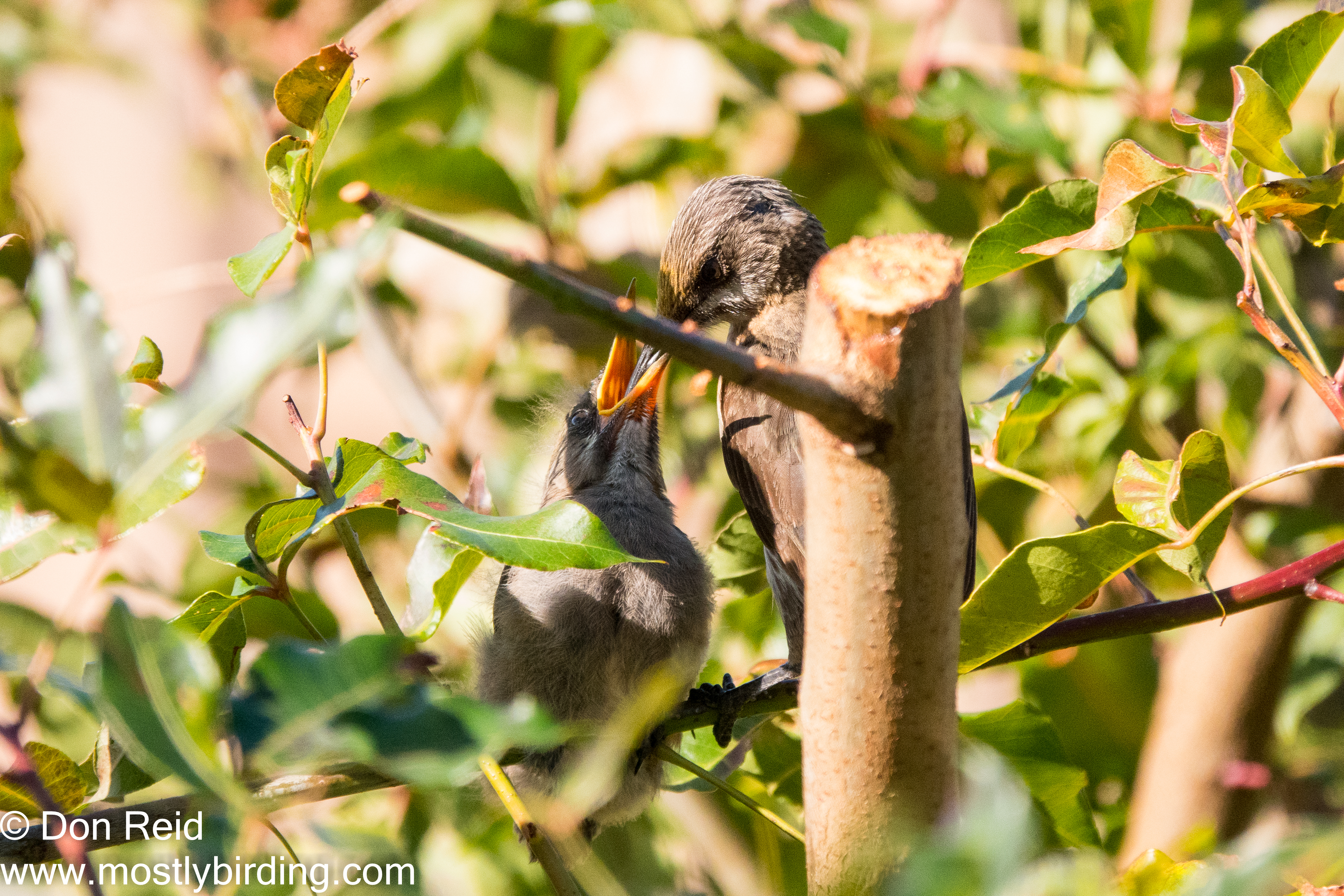
They were still being fed by both adults and were moving about now and again, but chose to spend most of their time on a small but sturdy branch, as the wind was strong and was testing their ability to balance themselves to the utmost.
The fledglings were getting stronger by the day and starting to lose their “baby fluff” but had no tail to speak of and were still dependant on the adults for food
They hung around for another day or two and soon we were not able to find them at all, so presumed they had moved elsewhere in the vicinity. We didn’t spot them again until –
Day 35
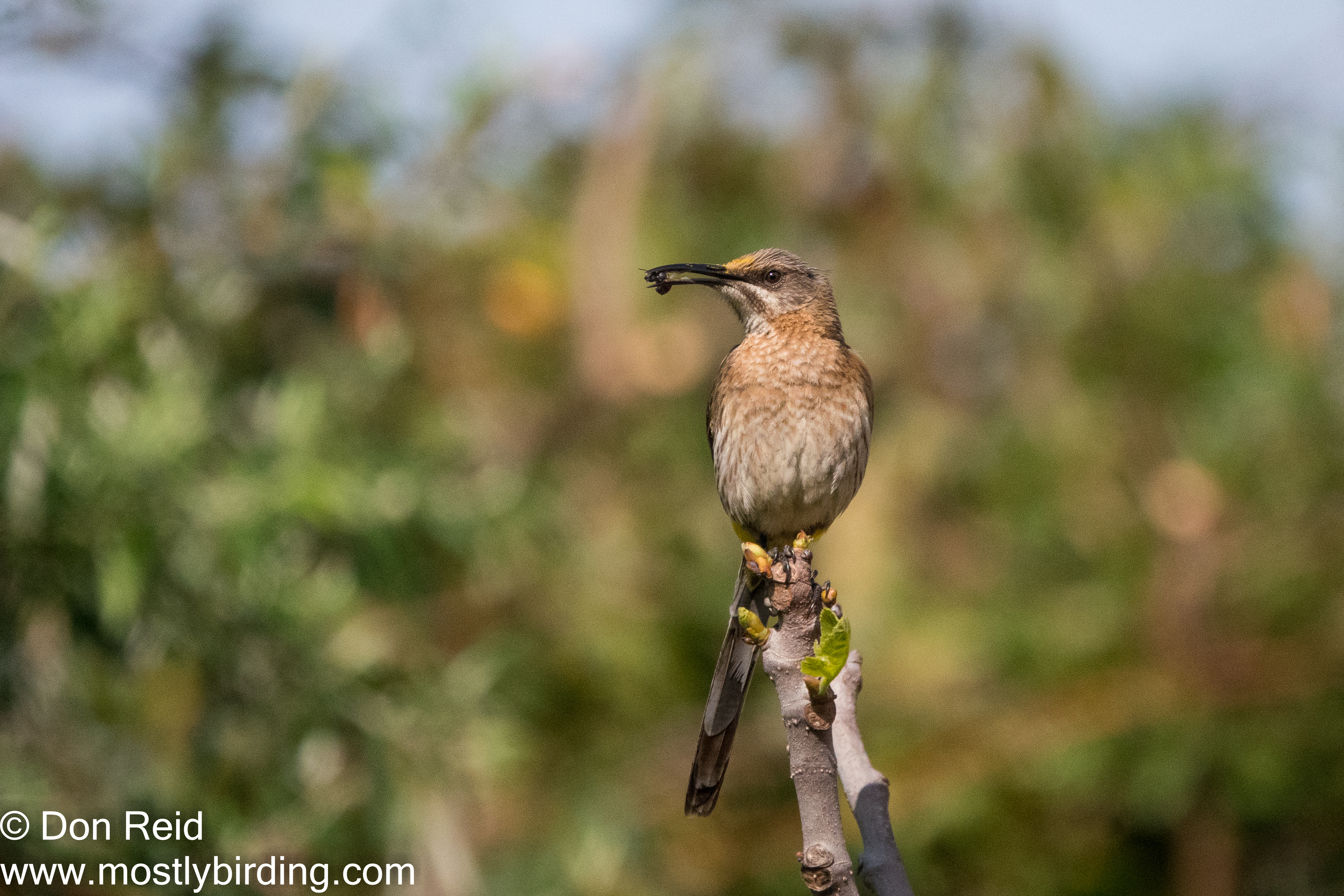
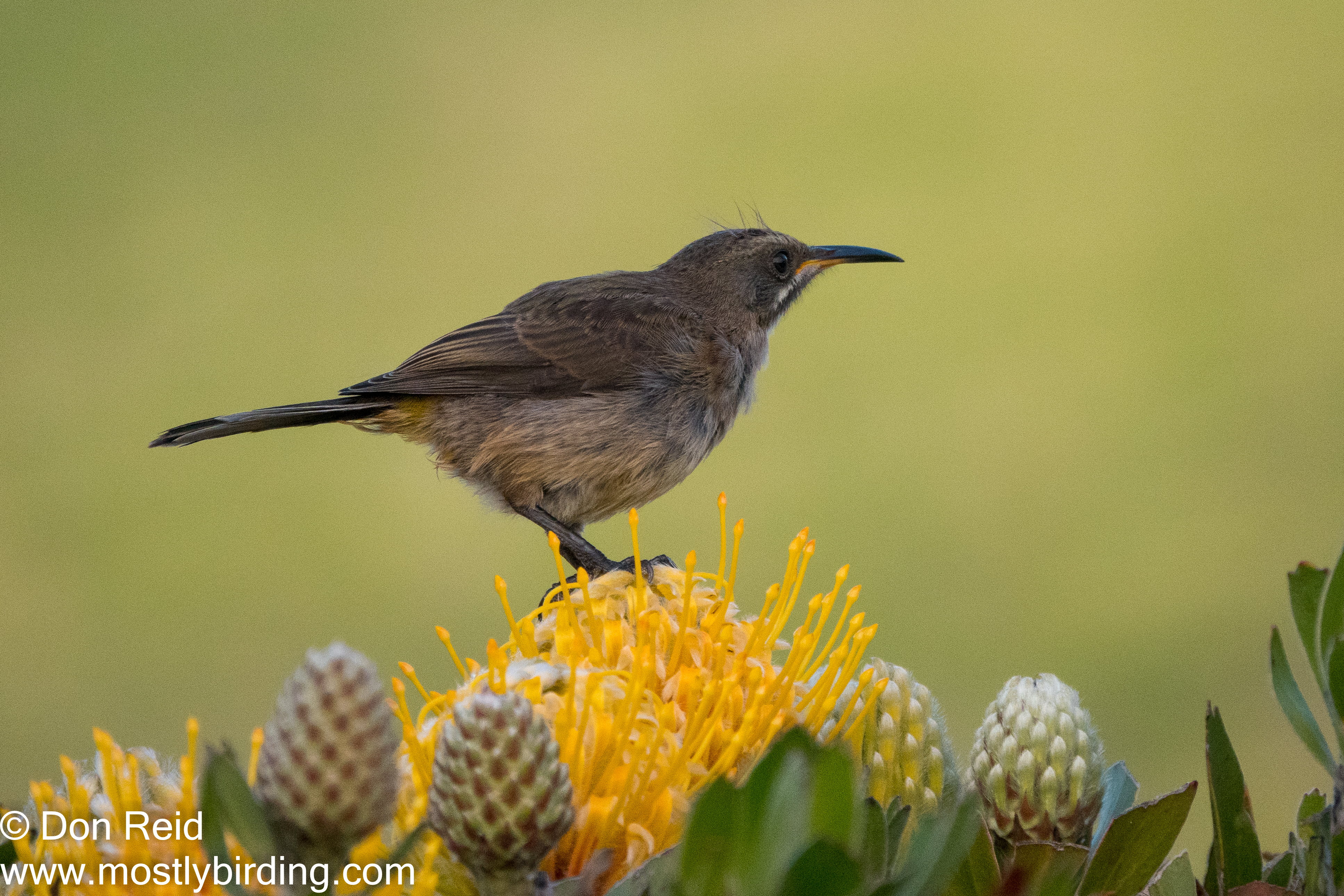
What a nice surprise to find one of the youngsters feeding itself on a Protea flower in our front garden, its tail now well developed and the young bird now confident and strong, which it displayed by flying quickly and directly from one bush to the other with none of the hesitancy of an inexperienced bird.
Cape Sugarbird juvenile
It was a real privilege to see these Sugarbirds develop from new-born chicks to their juvenile independence and to be able to observe them at such close quarters
Continuing the story of our trip to Bronkhorstspruit Dam Nature Reserve not far from Pretoria, where we were fortunate to find the rare vagrant Baird’s Sandpiper with relative ease ….
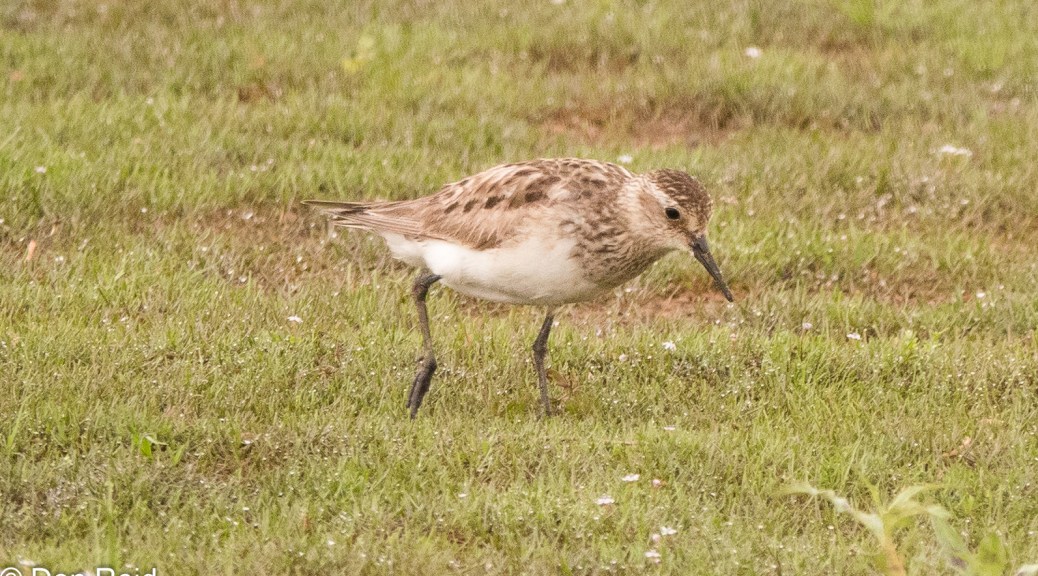
After locating the Baird’s Sandpiper and spending some time admiring this tiny adventurer all the way from the Arctic, we spent the next couple of hours driving slowly as close to the dam shoreline as we could, scanning every metre of it as we went.
This paid off with several more good sightings of waders and other birds, many of them the same species as I had recorded during an atlasing trip a few weeks prior, but with some exciting new additions –
Starting with an uncommon species which we found in the short grass which covers most of the open ground between the track and the shoreline of the dam …..
Western Yellow Wagtail Motacilla flava (Geelkwikkie)
Western Yellow Wagtail Motacilla flava (Geelkwikkie), Bronkhorstspruit Nature Reserve
The Yellow Wagtail is not a wader as such, but it favours similar habitat to some of the waders, particularly fringes of dams with short grass. It is not unusual to find the far more common Cape Wagtails pottering about in their perky fashion among small waders, but during the summer months it pays to check out all the wagtails as they could include this uncommon non-breeding migrant, which arrives in small numbers from its breeding grounds in eastern Europe and western Asia
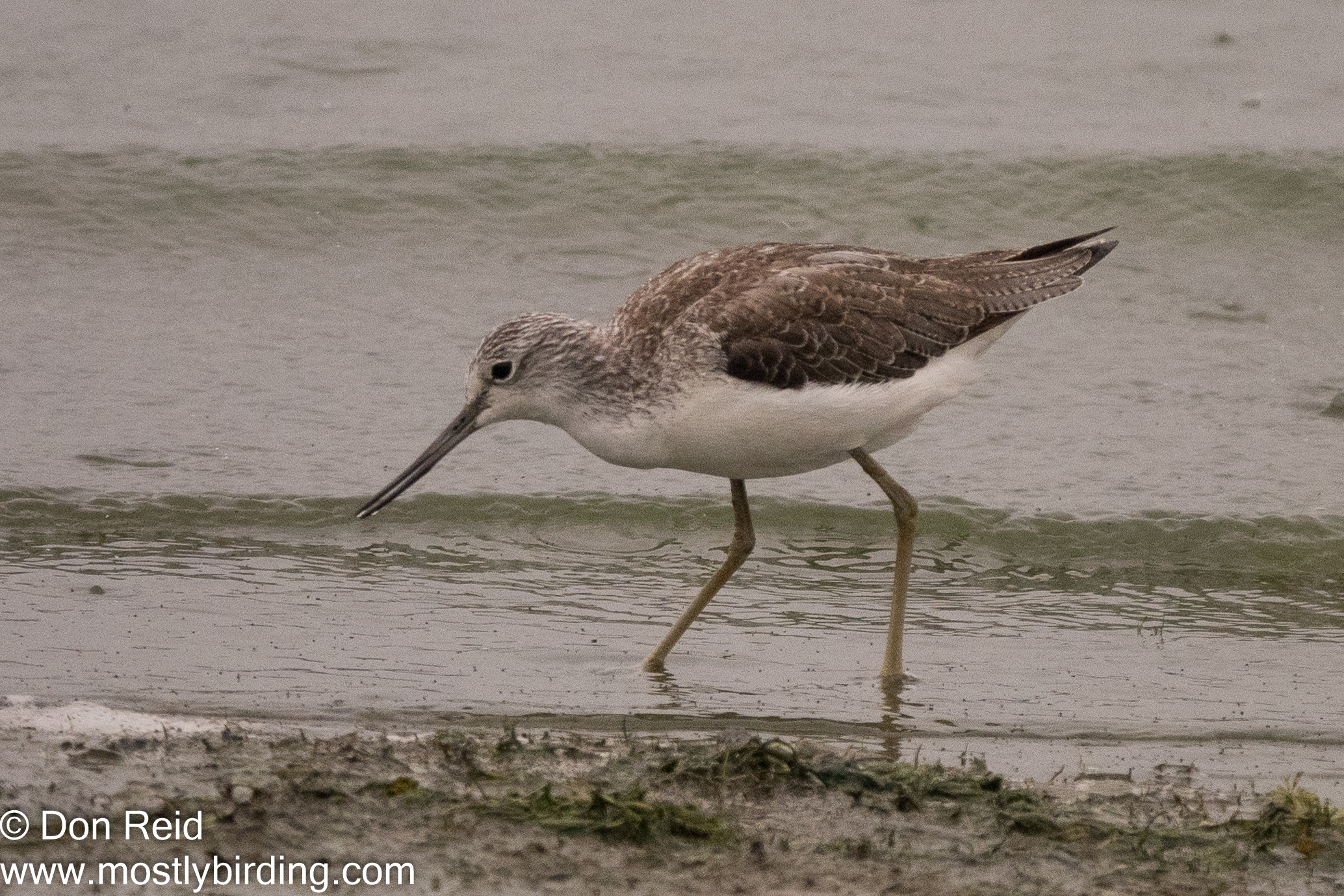
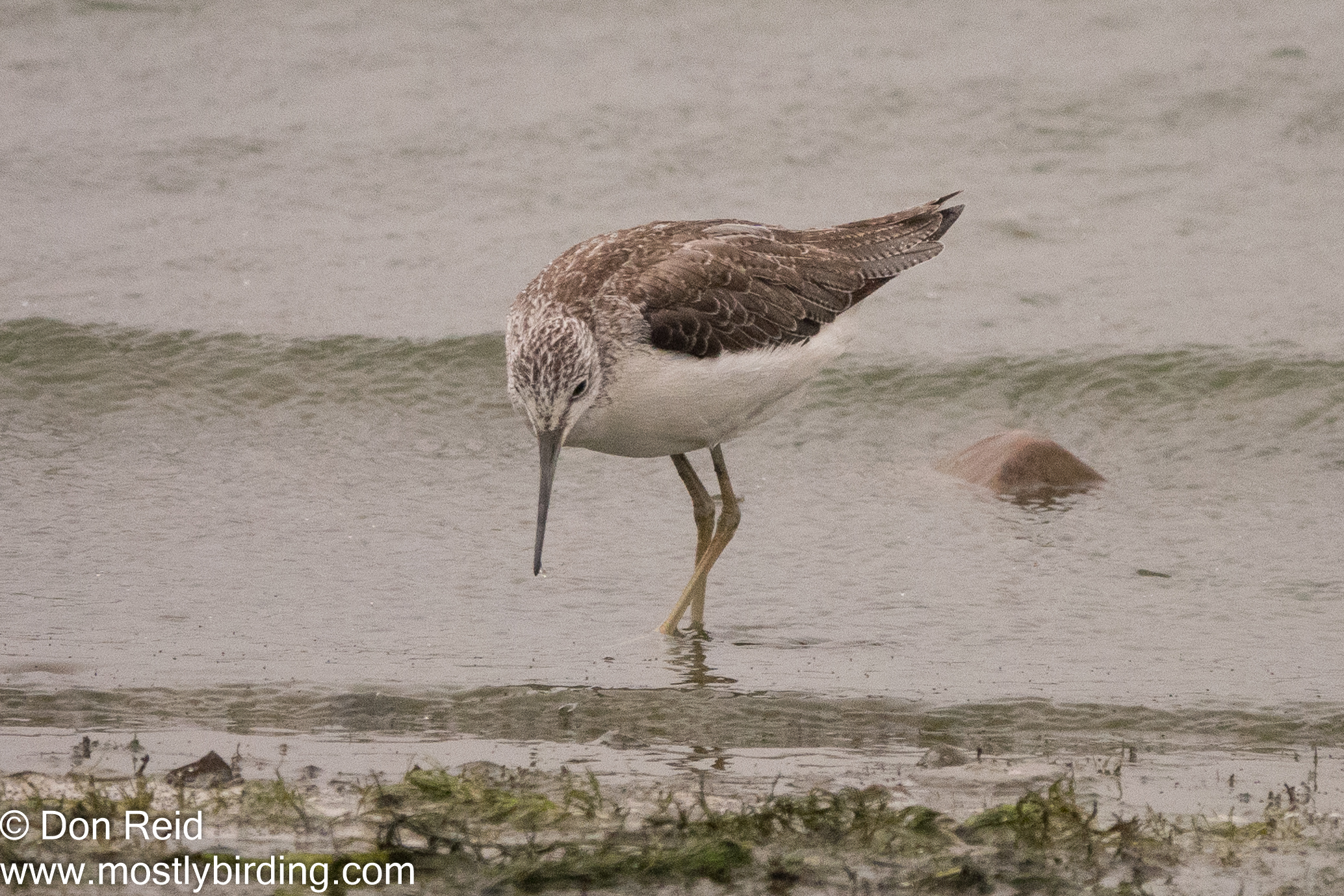
Common Greenshank Tringa nebularia (Groenpootruiter)
We also came across this fairly common wader which can be found right across southern Africa at inland and coastal waters, but seldom in numbers, often alone – we saw just the one during our couple of hours of careful scanning
Common Greenshank Tringa nebularia (Groenpootruiter), Bronkhorstspruit Nature Reserve
Generally one of the easier waders to identify and get to know, even at a distance, due to its long-legged appearance, relatively large size and slightly upturned bill
Common Greenshank Tringa nebularia (Groenpootruiter), Bronkhorstspruit Nature Reserve
The Greenshank is one of the longer-staying Palaearctic migrants, arriving from its “home” in European Russia and eastwards from as early as August and departing again between February and April
Common Sandpiper Actitis hypoleucos (Gewone ruiter)
Another wader that belies its name by not being particularly common, this was one of just a couple that we came across
Once you are “into” the intricacies of identifying waders, the Common Sandpiper soon becomes familiar, with its standout features being its uniform brown upper colouring contrasting with a clear white underside. The white gap between shoulder and breast band (not clearly visible in my photo) is often a clincher
Common Sandpiper Actitis hypoleucos (Gewone ruiter), Bronkhorstspruit Nature Reserve
It prefers firmer surfaces than other waders and can often be found alongside wagtails on rocks, firm sand and gravel rather than wading in the water itself
It is also a long-staying migrant from its “home” which stretches from Europe to Japan, arriving in southern Africa from August and departing from January to April
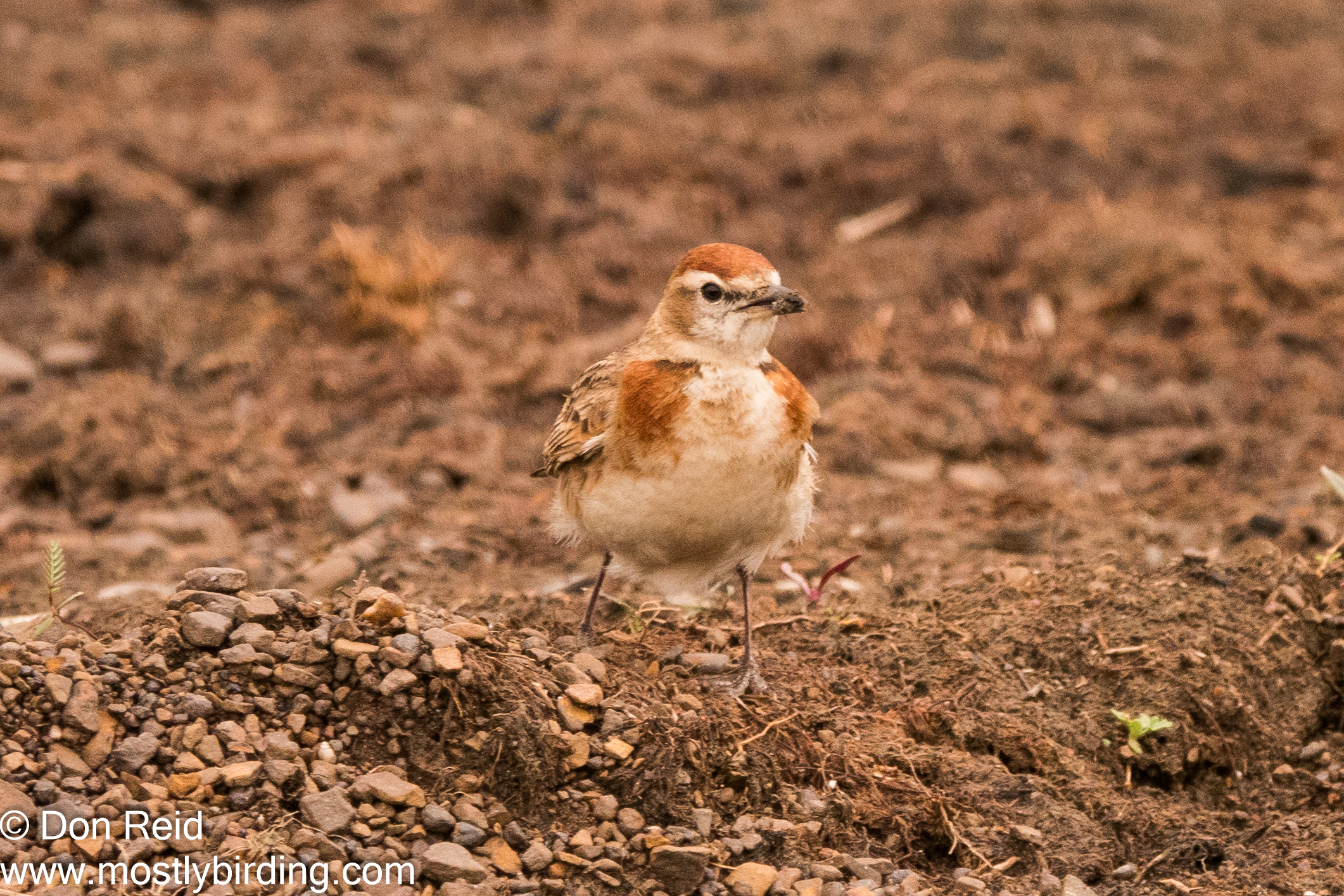
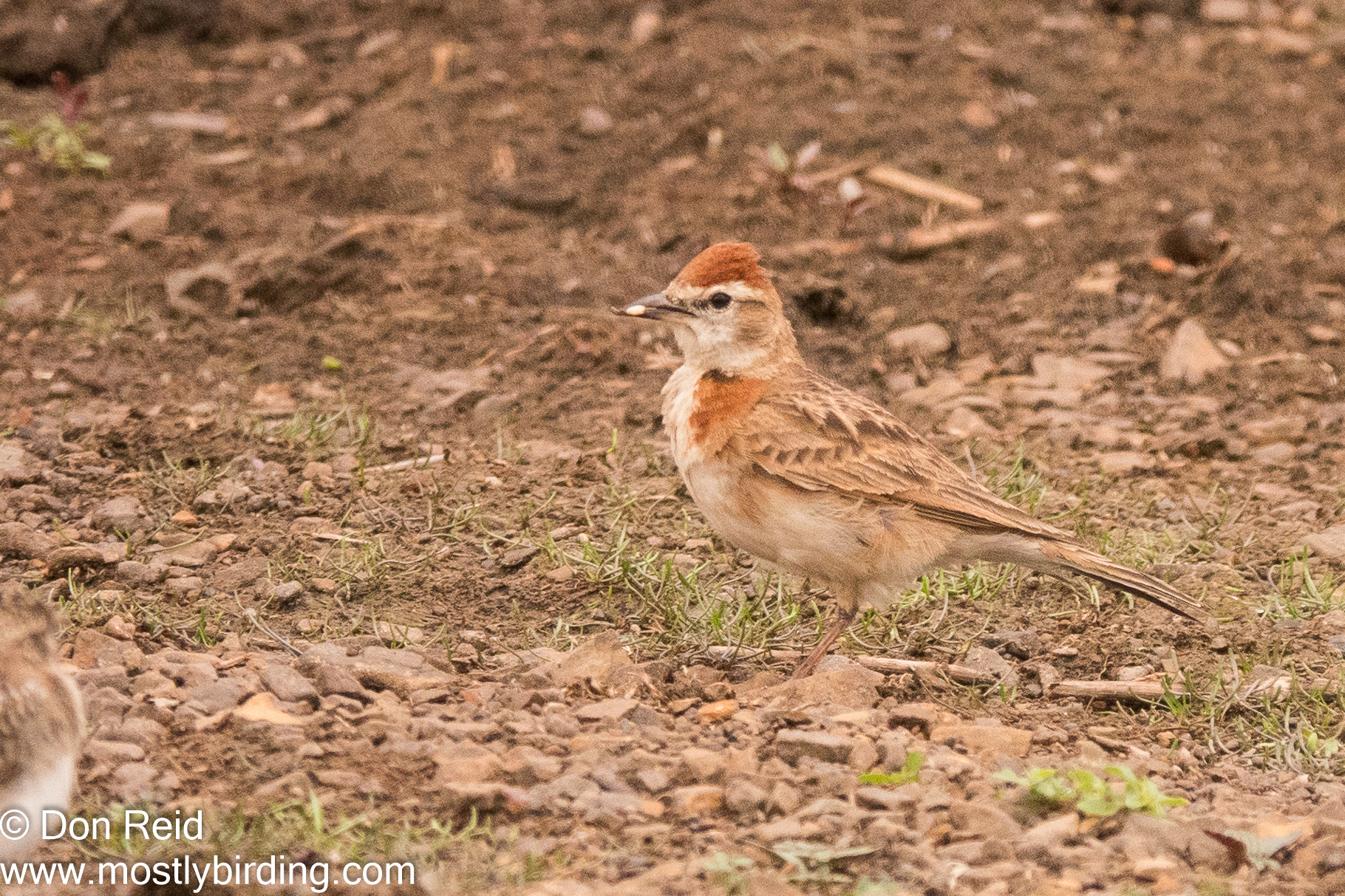
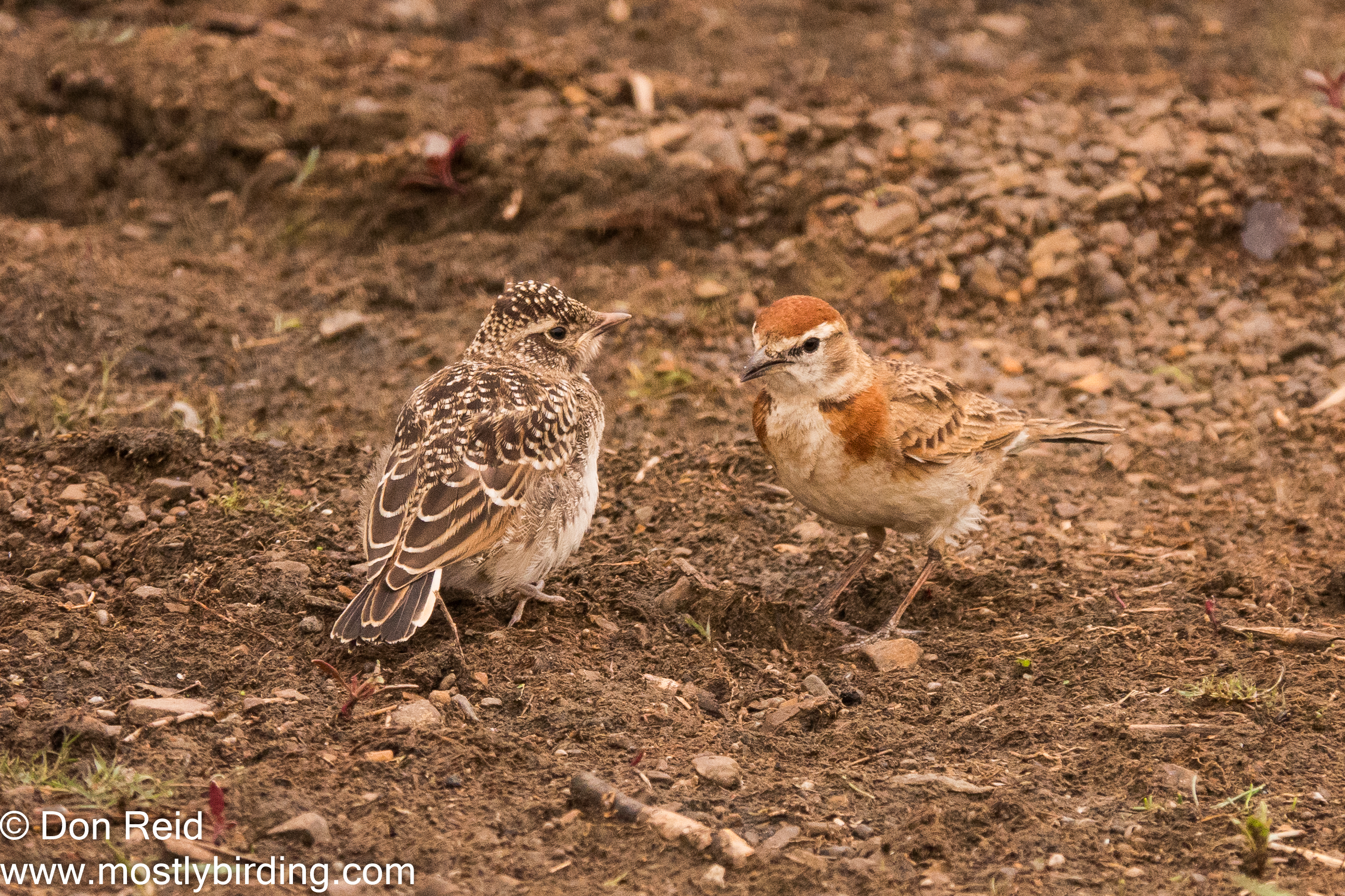
Arguably one of the better known larks, which otherwise get a lot of bad press by being called “little brown jobs” or LBJ’s by those new to birding, this one is hard to confuse with any other lark species due to its distinctive rufous crown and breast side patches
Their preferred habitats include bare ground and edges of wetlands so it wasn’t too much of a surprise to find one not far from the dam edge, nevertheless we were most pleased to find this individual with a tiny morsel in its beak.
Red-capped Lark (Adult)
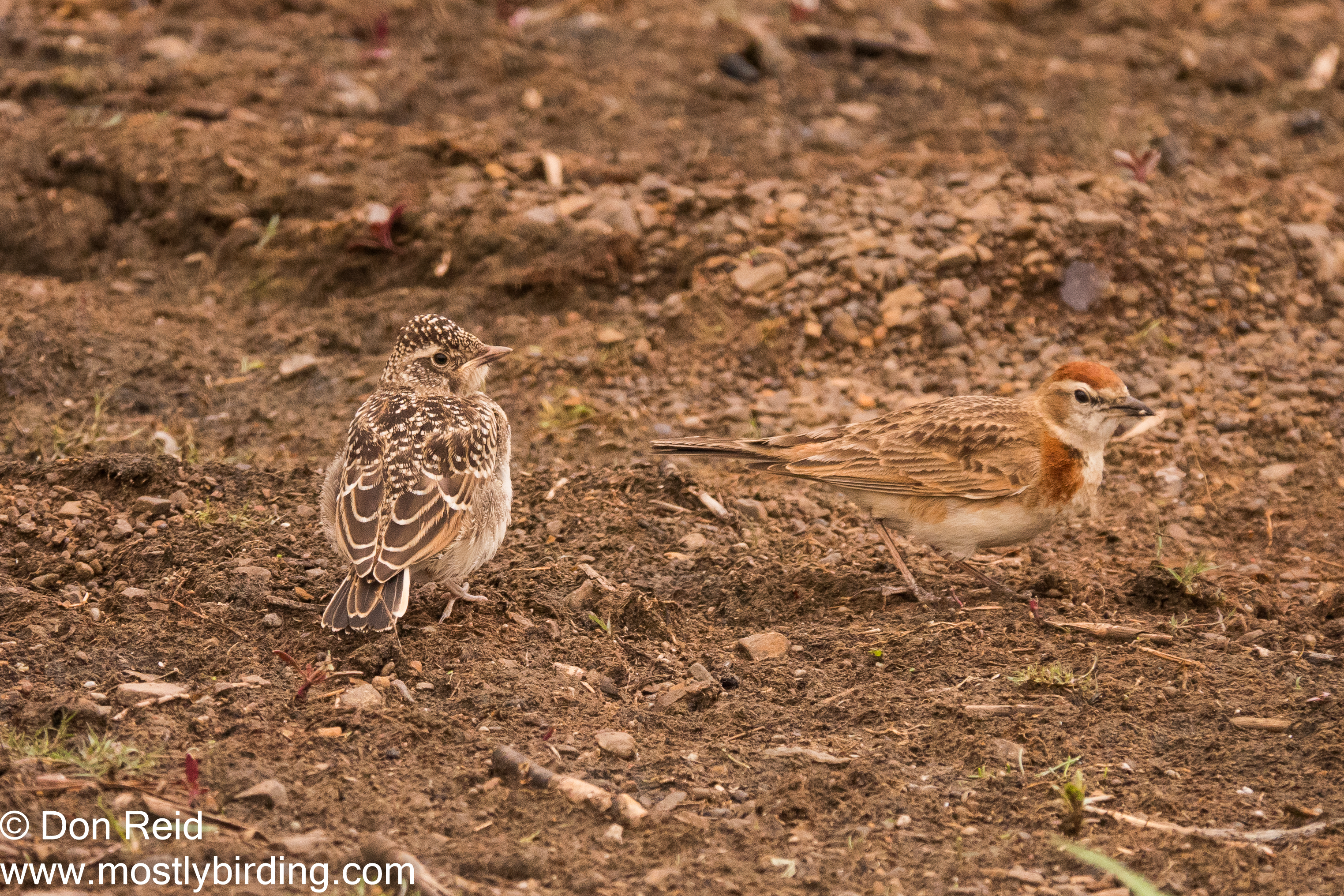
We immediately guessed that the morsel was intended for a juvenile being fed by the adult, and looked around – nearby was a well-camouflaged, inconspicuous bird with no matching features but there was no doubt of its lineage as we watched the adult feeding the morsel to it then rushing off to find more. Lovely to watch and a unique sighting!
Red-capped Lark (Juvenile with Adult) Red-capped Lark (Juvenile with Adult)
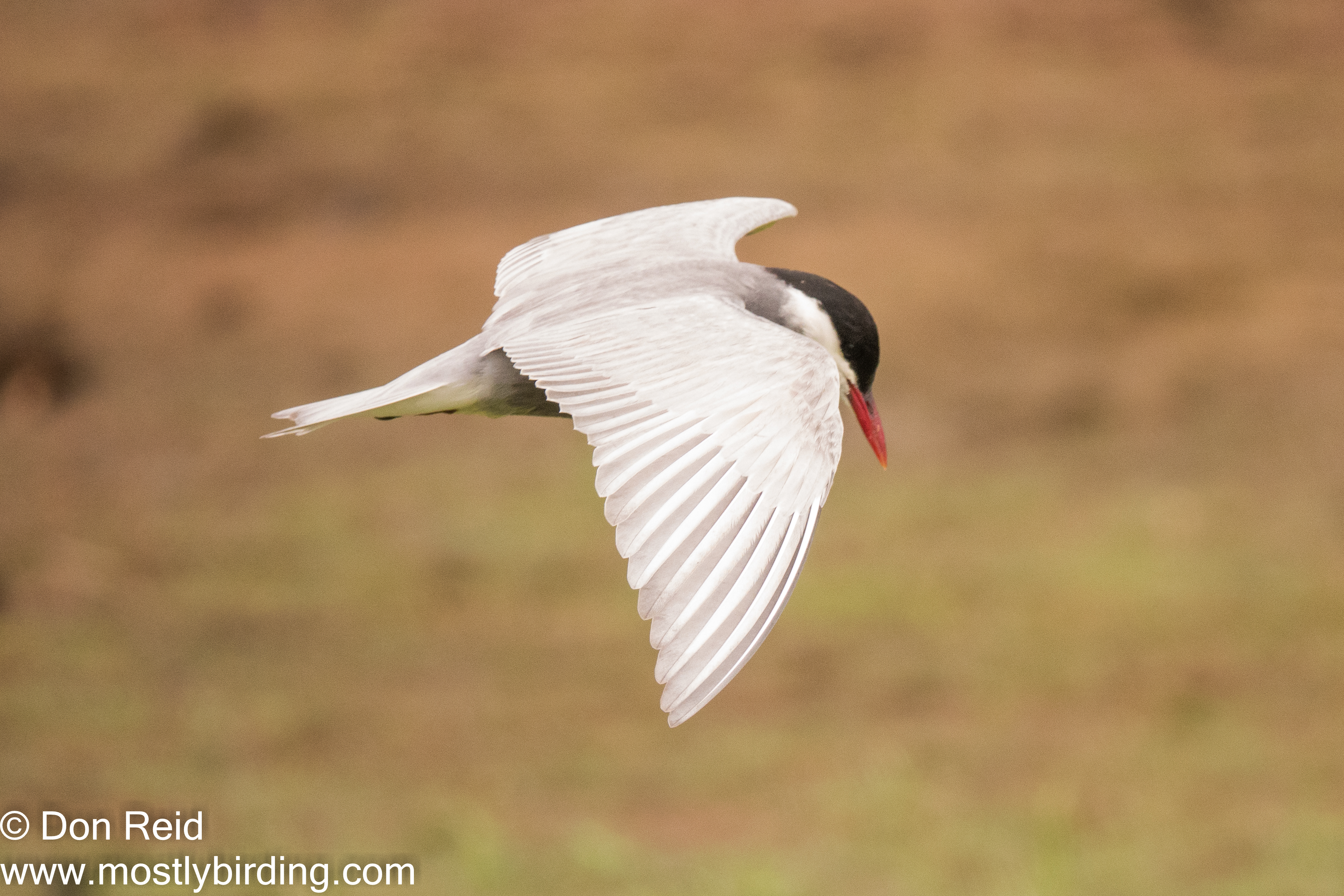
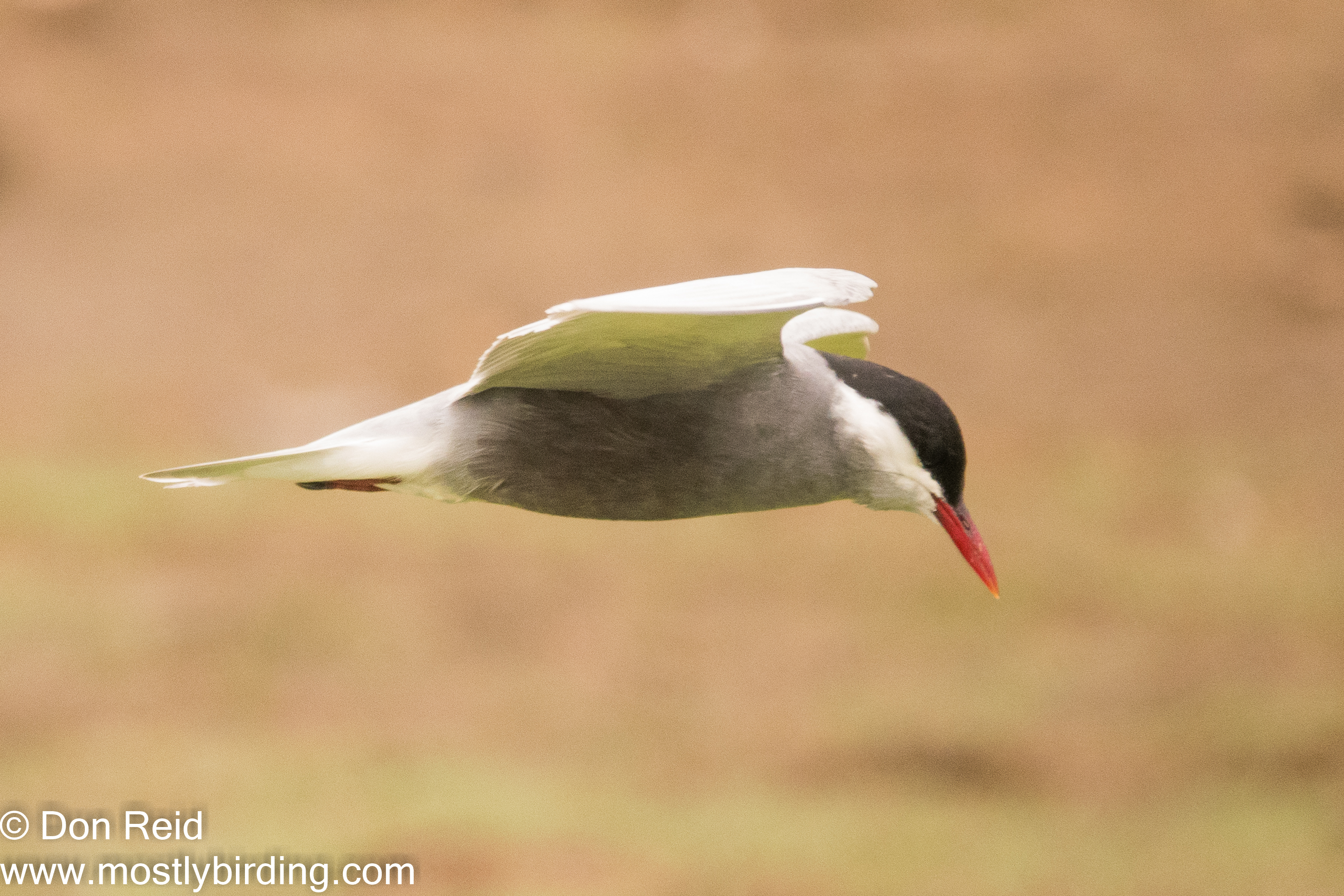
Now, sharp readers will quickly realise that terns are not waders – but I have other reasons for including these images …..
Firstly, terns commonly roost at water’s edge in between sorties over the dam close to the shoreline, floating in the wind, looking for prey and dipping down to grab it.
As we drove slowly along the shoreline at one point, I noticed a flock of about a dozen Whiskered Terns flying low in their usual fashion, heads down, floating in the light wind, looking for prey and dipping down to grab something then joining the flock again.
What was different was that they were flying above solid ground rather than the water, something I have not seen before – clearly there were enough small insects in the short grass or flying about just above it to persuade the terns to hunt away from their usual habitat.
They presented a beautiful sight as they flew towards our vehicle, veering away at the last moment, flying away for a distance, then turning back to repeat the circuit. They are such elegant birds in flight …..
A couple of weeks ago I posted about a selection of Waders (Shorebirds) and other water birds that I had encountered during an atlasing trip to Bronkhorstspruit Dam Nature Reserve not far from Pretoria.
Well, I wasn’t expecting to visit this nature reserve so soon again, but an alert received this past Saturday from SA Rare Bird News run by Trevor Hardaker (the second item in his alert below) had me reconsidering fairly quickly – a Baird’s Sandpiper would be a lifer for me and, having been spotted just 45 minutes drive from my home in Pretoria, it was an irresistible twitch.
The Twitch
I was not keen to join what I expected to be a twitcher scramble on the Sunday so I waited for Monday morning, when I picked up Koos Pauw at 6.30 am and we headed east along the N4 highway, then took the R25 and R42 turnoffs to take us to the nature reserve access road.
The many twitchers making their way to the dam the previous day combined with heavy overnight rain had turned the gravel access road and the nature reserve tracks into a muddy jumble in places – no problem for my Prado but we felt for the hardy twitchers in small sedans who we saw later in the reserve – no one got stuck while we were there but the road was worse on our way out, so those drivers would have had to use all their skills to get out without a problem.
More of a quagmire than a road – there’s already an ‘escape road’ forming on the right
We couldn’t help chuckling when we saw two Yellow-billed Ducks swimming in one of the larger puddles in the bumpy nature reserve track – how opportunistic, but it left us wondering why they chose a muddy puddle instead of the vast expanse of dam just 50 metres away.
From previous experience of twitches at popular, accessible birding spots such as this, I knew the best way of finding the target rare bird after an alert is to drive to the area where you expect to find it, then look for parked cars – this was my strategy and it worked, but only just!
As we approached the approximate position along the dam edge given in the alert, a vehicle was heading towards us – we stopped to chat and the friendly driver offered to show us “the Baird’s” as they had just come from its location, with no one else around at the time. We accepted with alacrity and a couple of minutes later we were at the right spot and watching the Baird’s Sandpiper ourselves – success! (cue the Beatles “With a little help from my friends”)
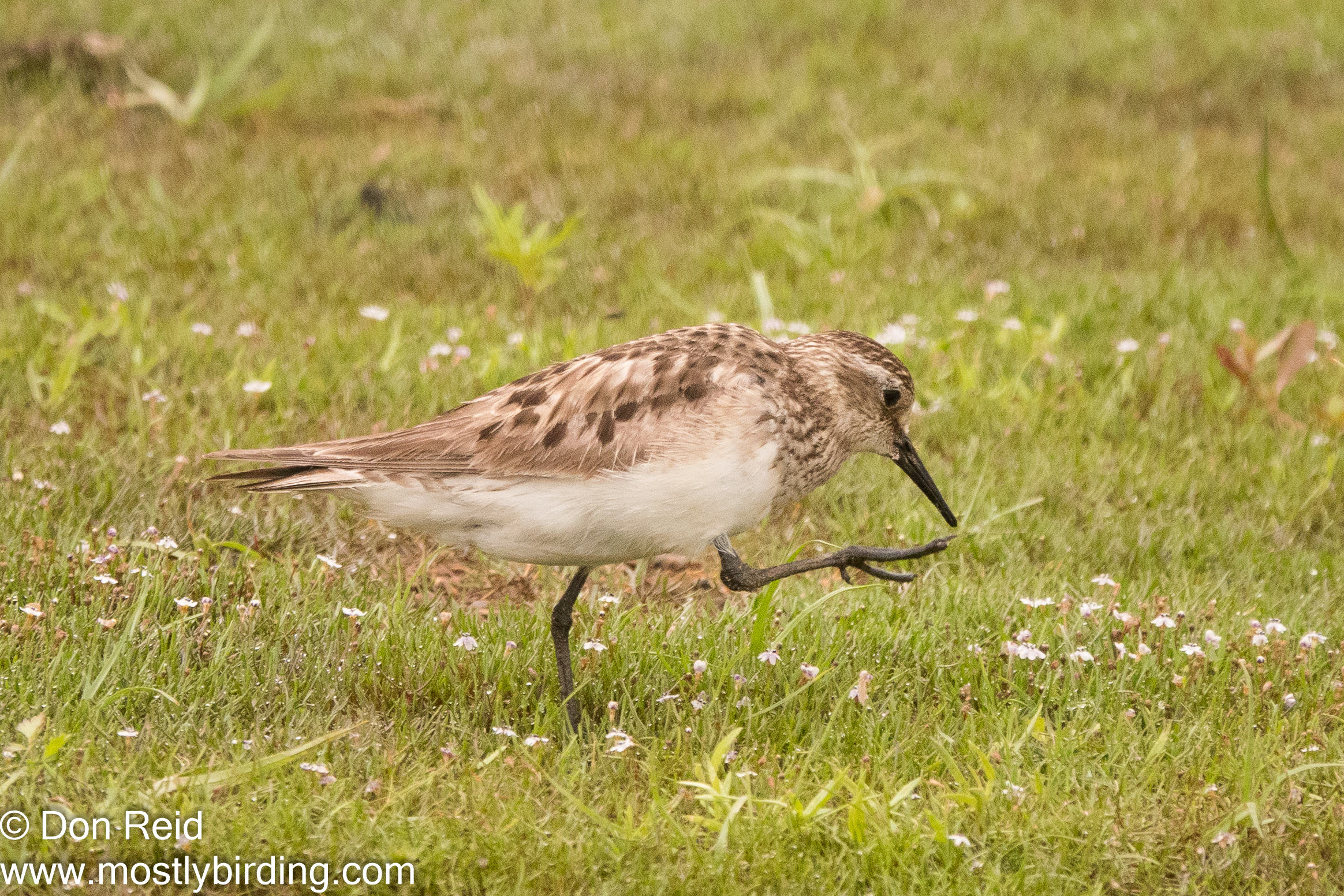
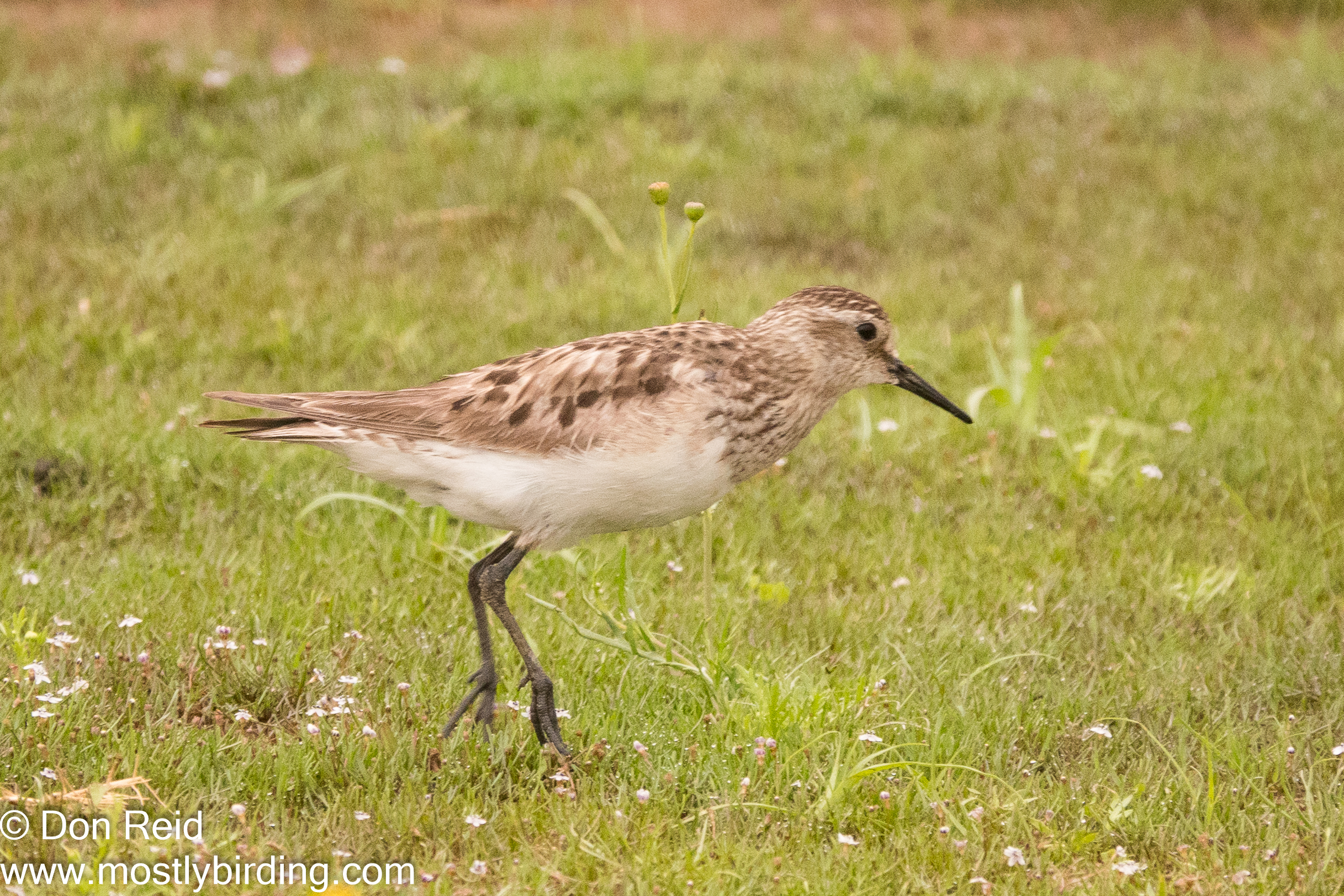
We had nevertheless armed ourselves with some knowledge of the species and its main identifying features, in case we were faced with finding and identifying it ourselves – but our newfound friend quickly informed us that we only had to look out for the ‘small wader with a limp’ as it seems it had injured its leg, so the task of picking it out among the other small waders was very simple. The video clip below shows just how pronounced its limp was
The Baird’s Sandpiper falls into the wader family known as the Calidrids, breeding at Arctic latitudes of Alaska and Canada and usually migrating to South America during the austral summer.
Occasionally, as with this one in all probability, a single bird is blown off course by adverse weather conditions, or its ingrained directional instinct goes slightly awry and they end up in southern Africa instead. Not without an almost unfathomable effort of course, for its journey would have taken it across the Atlantic Ocean at some stage.
Less than 20 records exist of sightings of this species in the southern African region, since 1984 – prior to that there is just one record from 1863! So its status is rightly given as a very rare vagrant
Each red dot represents an individual record over the last 37 years
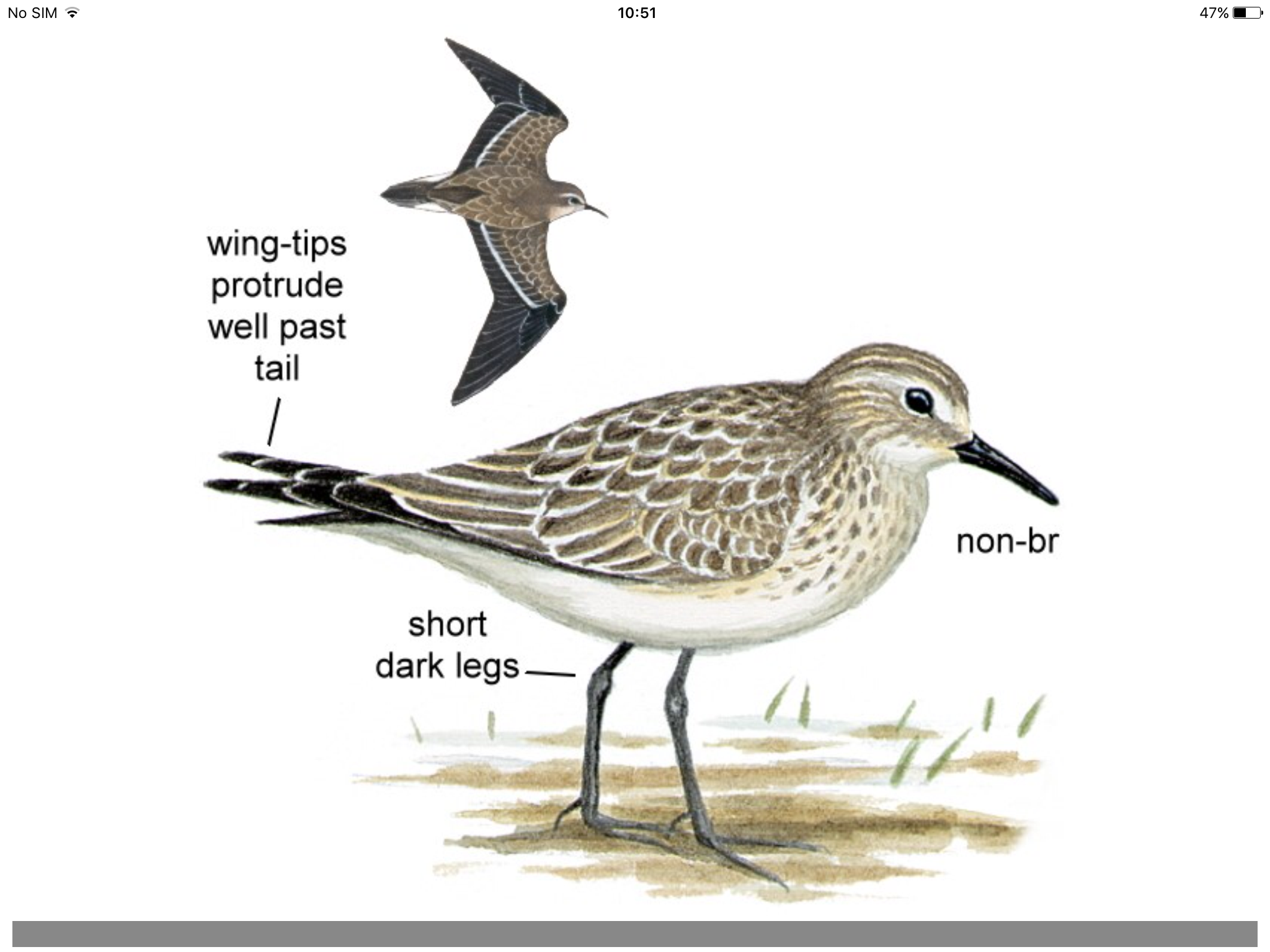
Waders without clear features which set them obviously apart from other similar sized waders can present a real challenge to birders and the Baird’s Sandpiper falls into that category. If it hadn’t had the distinct limp we would have had to resort to looking for the features given in the illustration below from the Roberts app
So that’s how I added the latest lifer to my Southern African list – simple really …….
As with my previous visit we spent the next couple of hours driving slowly as close to the dam shoreline as we could, scanning every metre of it as we went. This paid off with several more good sightings of waders and other birds, many of them the same species as I had recorded before, but with some exciting new additions – more about these in a follow up post
References
Finally, just a mention of the two outstanding sources that I have used for the information in this post :
Firstly, Roberts VII Multimedia Birds of Southern Africa – the go-to guide for detailed information on all of Southern Africa’s birds
Secondly, the more focused Chamberlain’s Waders – The Definitive Guide to Southern Africa’s Shorebirds by Faansie Peacock (No, that’s not a made up name!)
There are numbers of migrant birds to southern Africa that herald the start of the Austral (Southern Hemisphere) summer from September each year, but two stand out as the icons of summer’s arrival and become the subject of excited messages on the various birding chat groups as they are spotted or heard for the first time in the early summer months
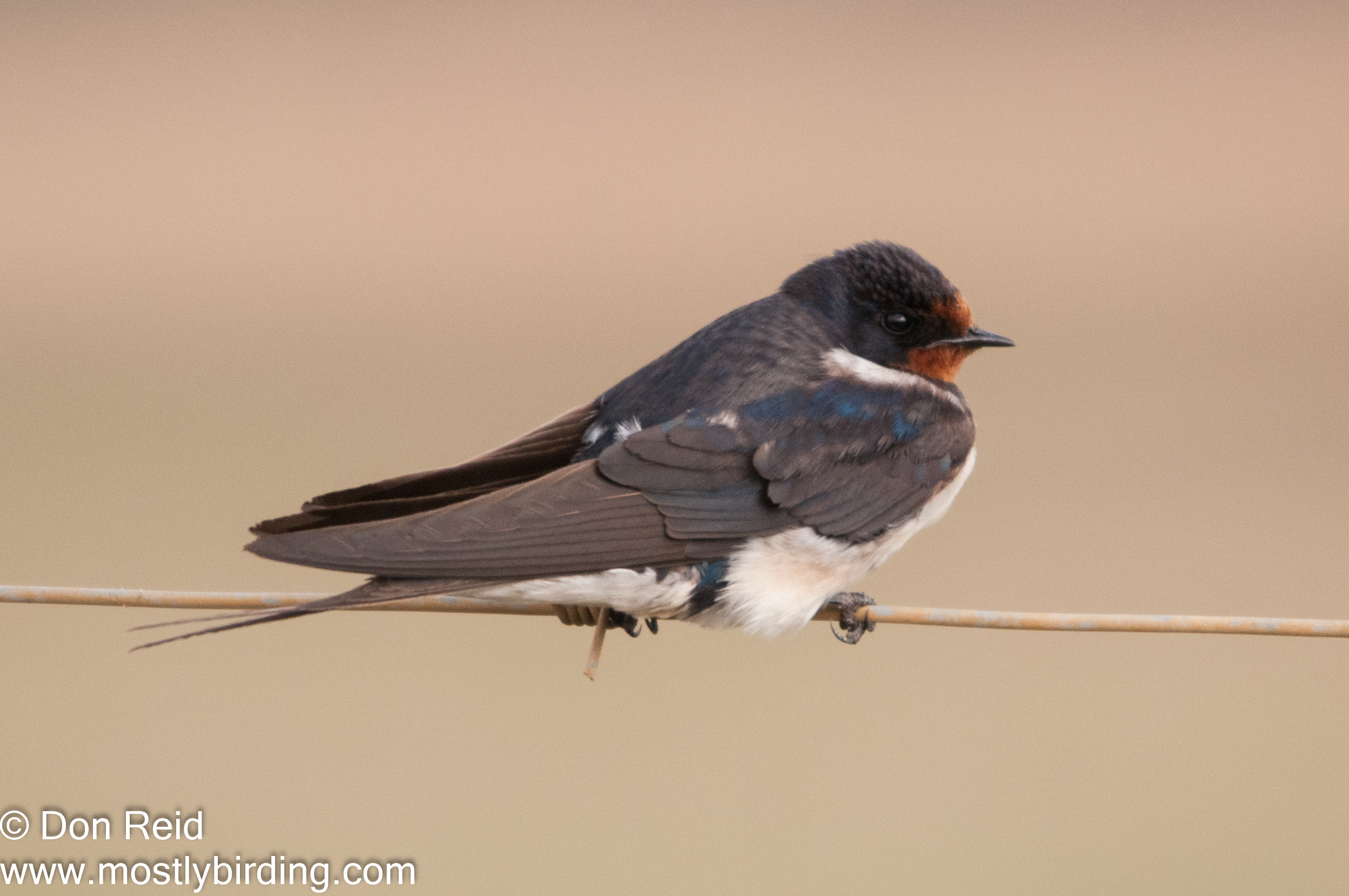
Barn Swallow Hirundo rustica (Europese Swael)
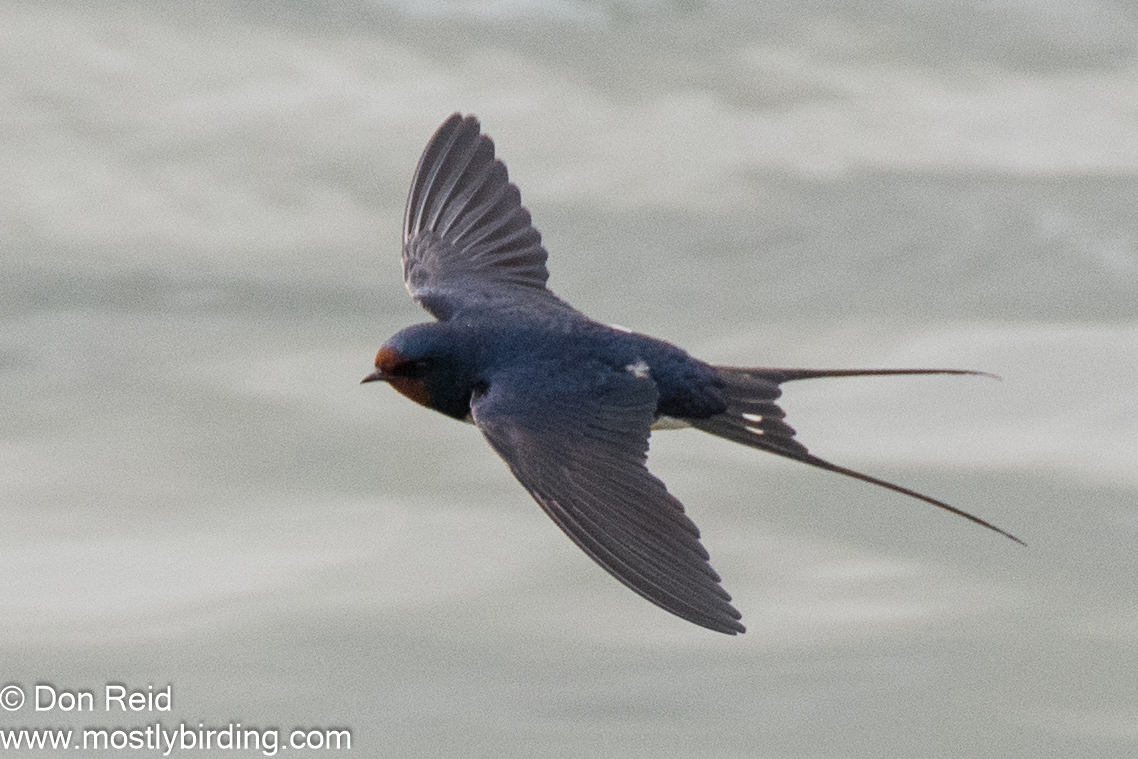
One is the Barn Swallow, which has become the best-known of the migrant swallows, certainly because it outnumbers the others, is highly visible and occurs virtually across southern Africa.
Barn Swallow, Kendal area, Gauteng, South Africa
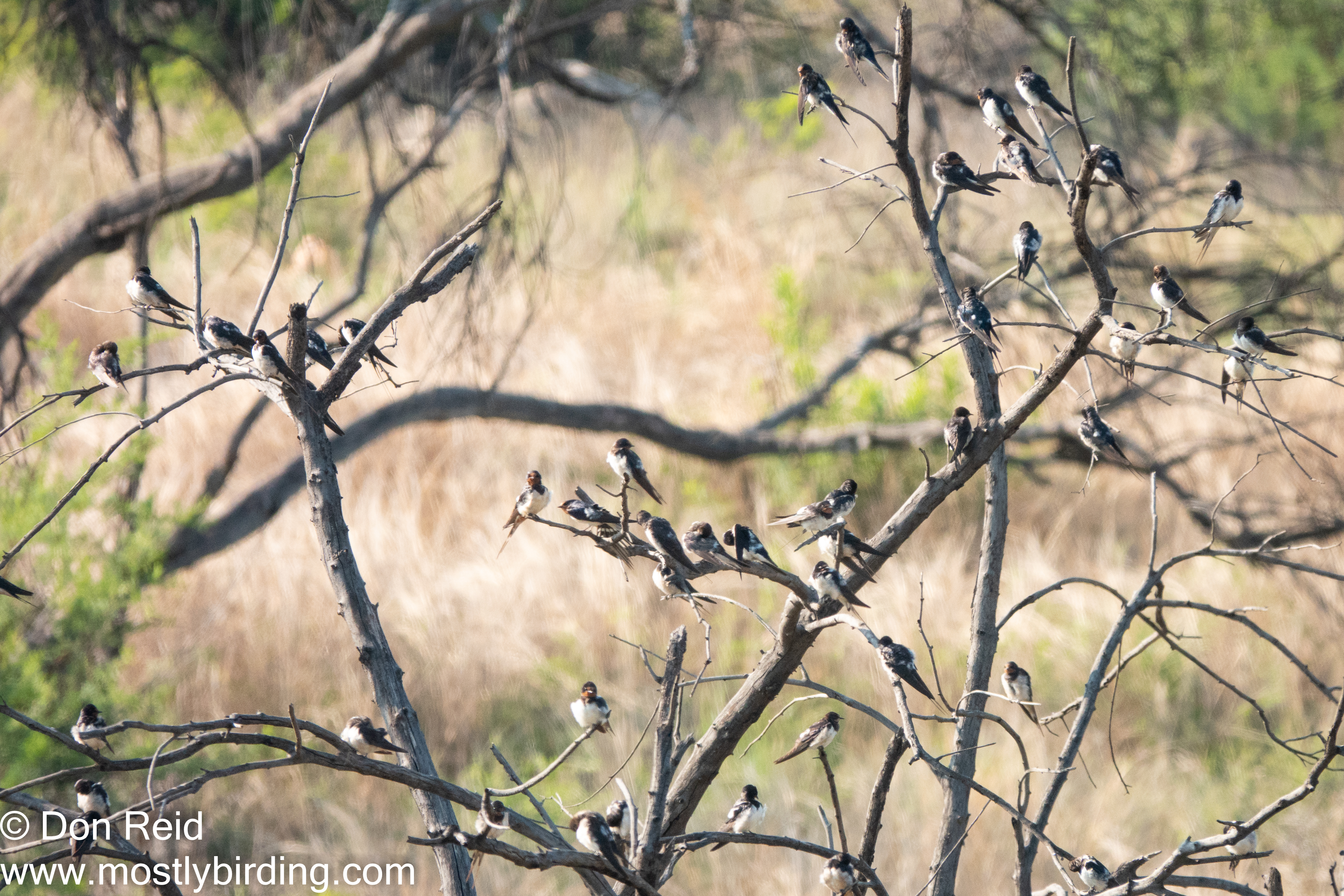
A staggering, estimated 20 to 40 million “Barnies” (as they are known to birders who like nicknames) migrate to Africa from western Europe and another 40 to 80 million from eastern Europe and Asia annually on their southward migration, many of which end up in southern Africa.
Barn Swallows, Roodeplaat Dam near Pretoria, South Africa
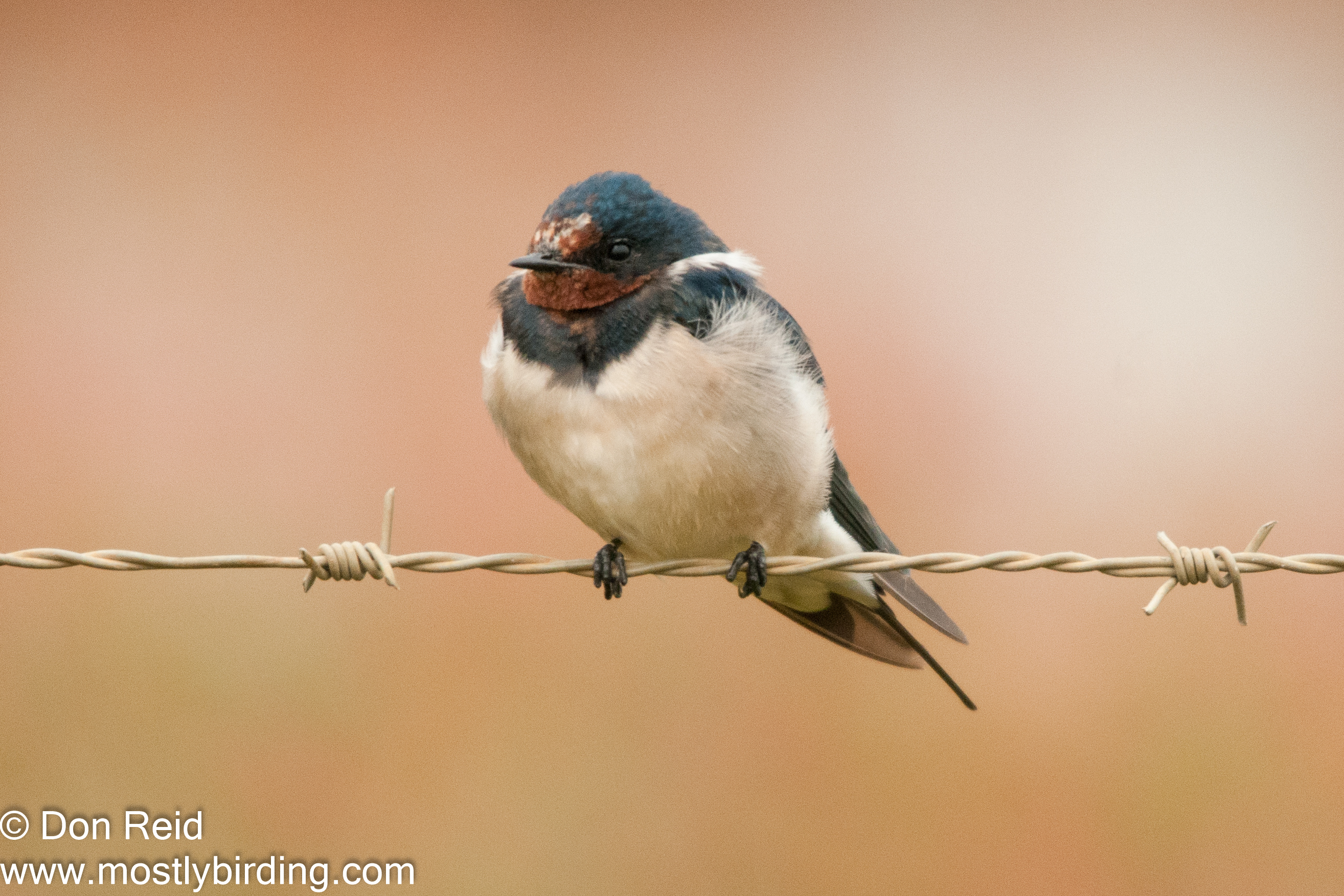
In southern Africa, during the summer months, they can be found just about anywhere outside the built up areas of cities, preferring moister, open areas such as grassland, pastures, cultivated fields and vleis and occurring in loose flocks of varying numbers.
Barn Swallow, Devon near Johannesburg , Gauteng, South Africa
Anyone who has witnessed Barn Swallows settling in their thousands into their roost at the end of the day, as we did many years ago near Umhlanga, will not forget this amazing sight.
I have been fortunate to see Barn Swallows in other parts of the world during our travels in the northern hemisphere summer, including Europe, Canada, Malaysia, Cuba and Egypt.
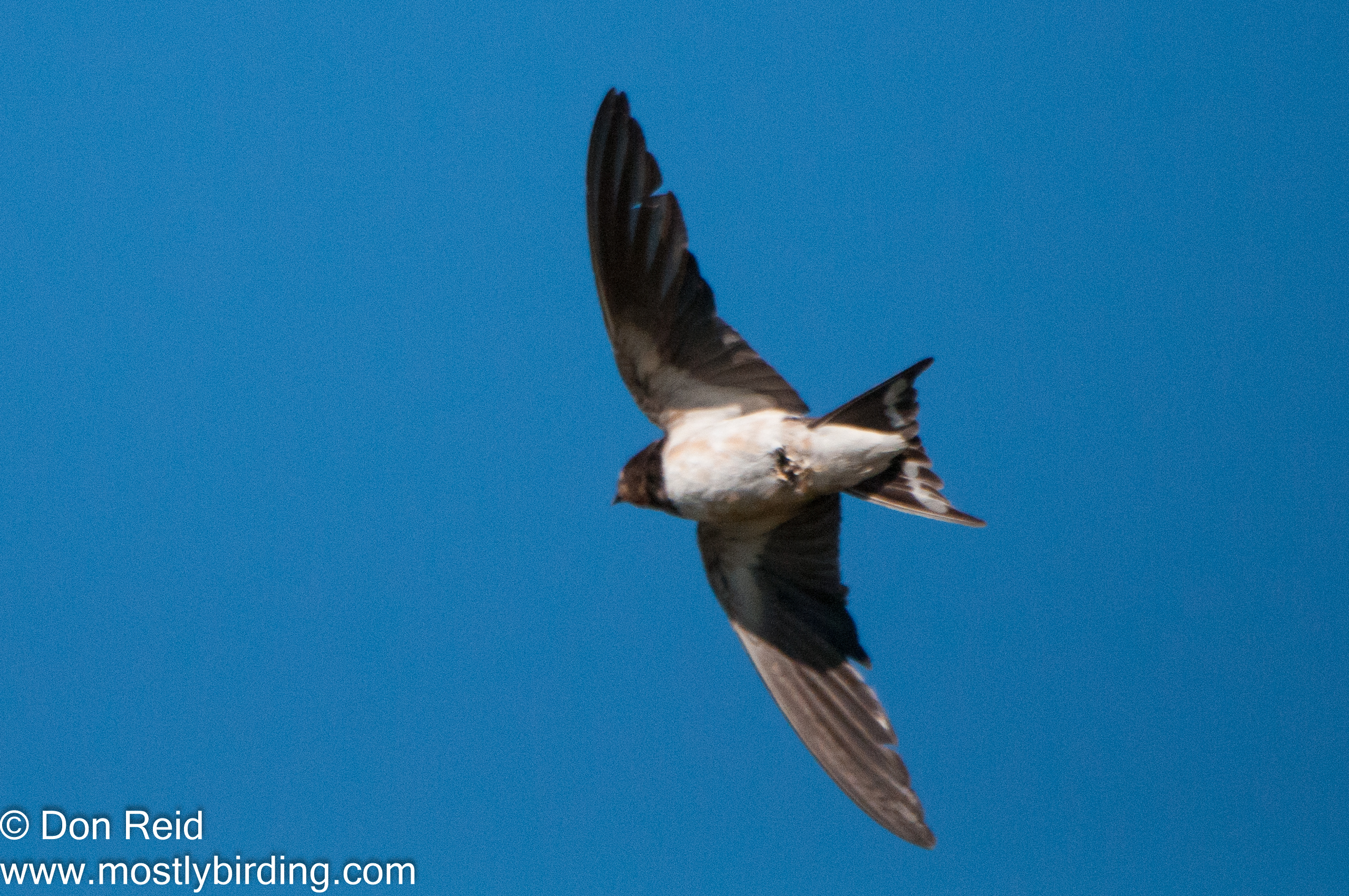
Barn Swallow, Annasrust farm Hoopstad, Free State, South Africa
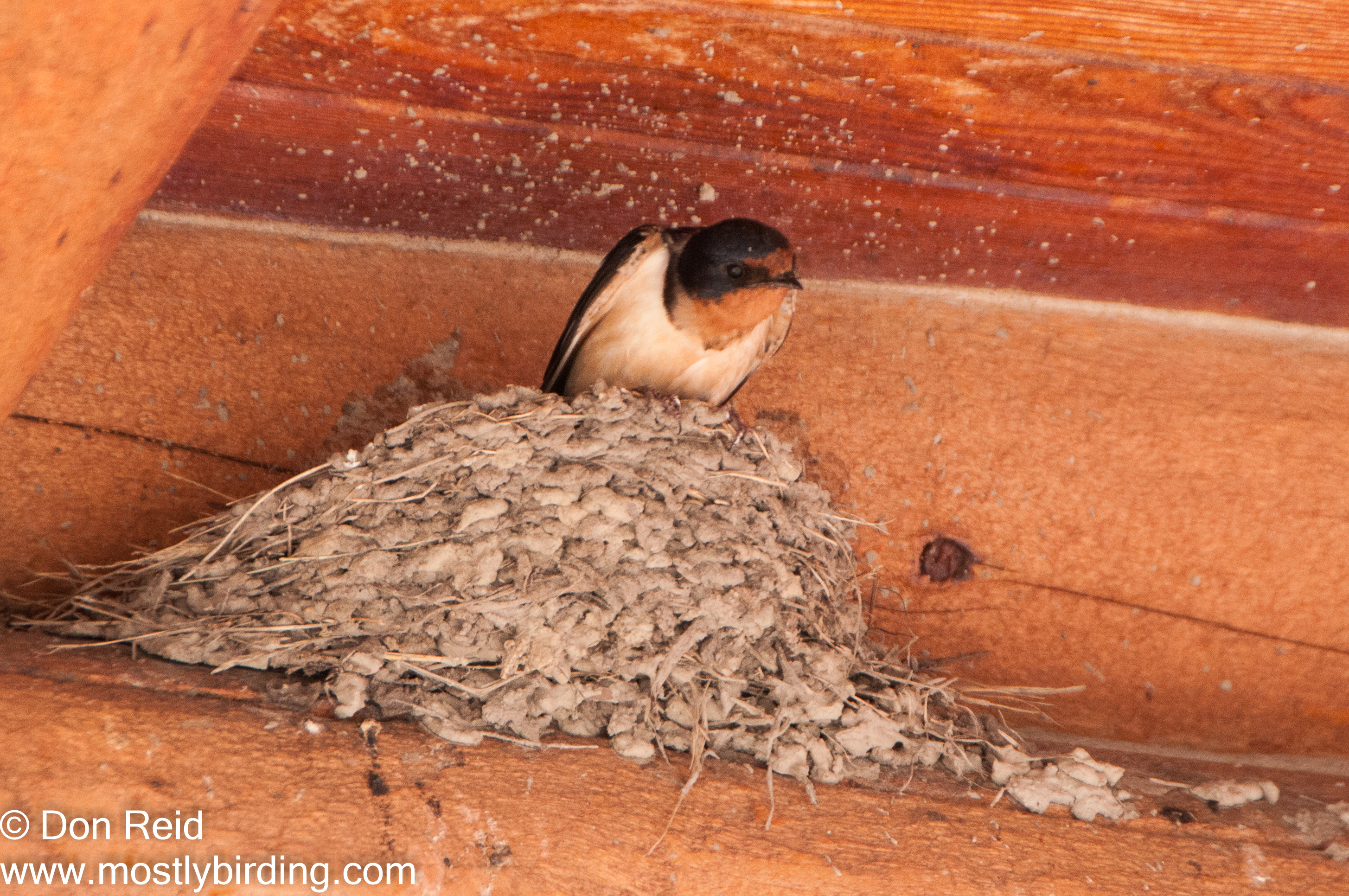
Their status in southern Africa is ‘non-breeding Palaearctic migrant’ which means they breed ‘at home’ in the northern hemisphere, so we do not see any nesting behaviour, which is why I was particularly excited to find a nest tucked under a roof overhang during a trip to western Canada some years ago.
Barn Swallow on nest, Bow Lake, Alberta, Canada
Interestingly, these Barnies looked a little different to what we are used to seeing in SA – clearly these particular swallows would not be seen in our country as their migration path southwards would take them to South America.
Another encounter on a different continent, during a cruise on the Danube River, had me equally excited – it was April and Barn Swallows were flying above the river right next to our river cruise boat and I realised that they must have just arrived back from their return migration at the end of the Austral summer, with anything up to 10,000 kms ‘under their belt’.
My bird atlasing trip this past week took me to Ezemvelo Nature Reserve some 70 kms north-east of Pretoria, a small nature reserve comprising mainly rolling grasslands. Before arriving at the entrance gate at the entry time for day visitors, I had managed to complete 2 hours of atlasing in the pentad immediately west of Ezemvelo and was looking forward to spending time in the reserve, which I had last visited in 2013.
After completing the gate formalities, I headed to the Reception a few kms from the gate, paid for my day visit and parked at the nearby picnic spot, nicely located under large trees near a low tree covered hill and overlooking a small dam.
I literally had the whole place to myself – I’m sure it gets busier over weekends but on a weekday the only visitors are probably keen nature lovers such as myself, of that rather pleasant age when you, rather than others, decide how you are going to spend your day.
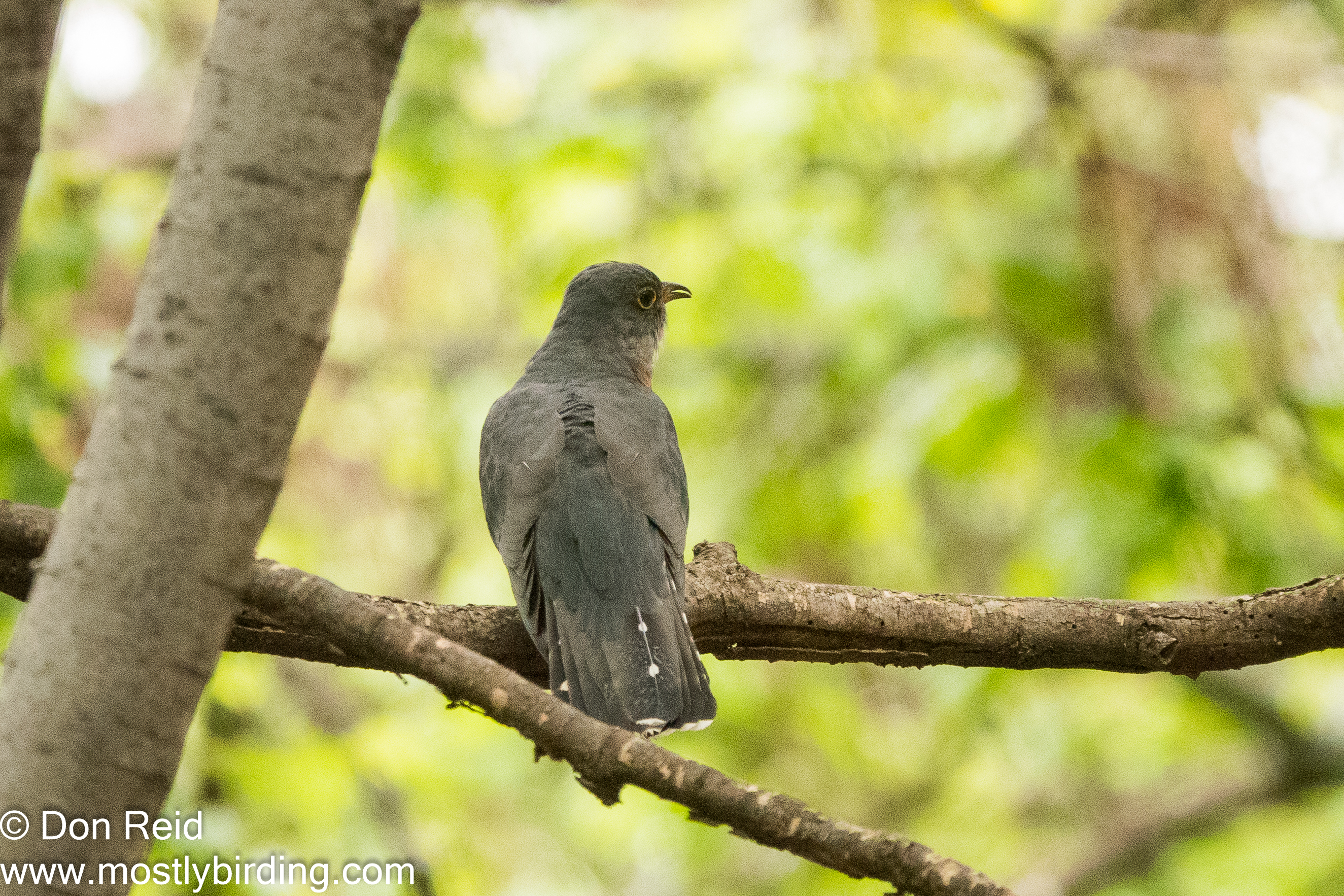
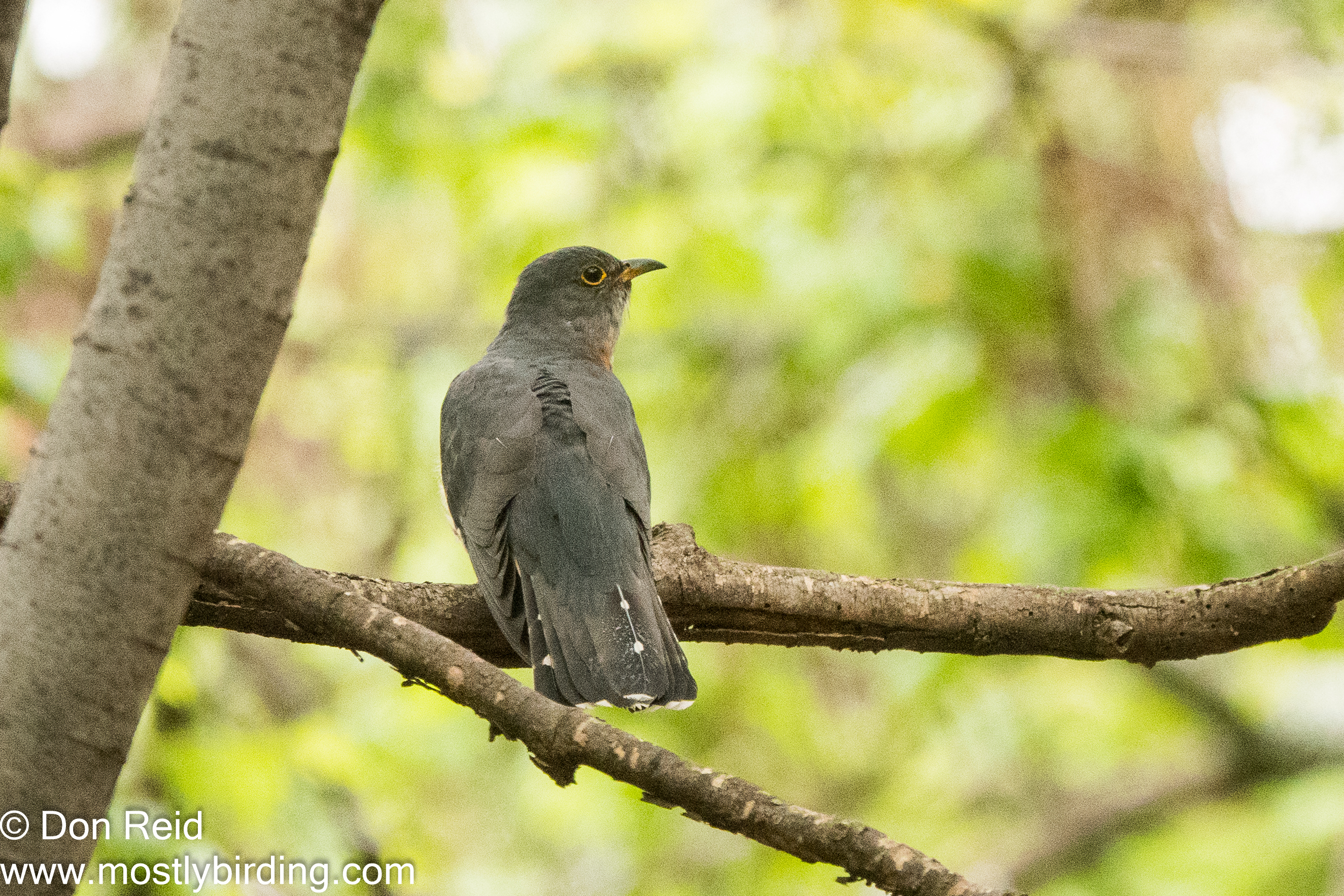
As I enjoyed coffee and rusks, I heard the familiar summer sound of a Red-chested Cuckoo – or Piet-my vrou (pronounced piet-may-frow) as most South Africans know it, a name based on the 3-syllable call which carries long distances and is often difficult to trace.
I would hazard a guess that, doves aside, this is one of the best known calls of all birds in South Africa, with farmers often referring to it, somewhat hopefully, as the “Rain Bird” because it’s arrival coincides with the hoped for start of the summer rains in large parts of SA.
The call I heard suddenly sounded very close and I walked to the nearby trees, camera in hand, to see if I could find it. This is a bird not easily seen as they tend to choose a branch in the depth of well-foliaged trees to perch on and call. I followed the call and was thrilled to find the Cuckoo after a short search and approached carefully, not wanting to scare it away.
I took a couple of photos, thrilled at getting this rare chance to photograph the species, but mildly disappointed that it refused to turn around and show its front. With a few photos under the belt I decided to try to get a video while it was calling and managed to complete a short clip before the bird flew off, leaving me very pleased with my first reasonable images of a Red-chested Cuckoo in 40 or so years of birding!
My atlasing trip last week included time spent in Bronkhorstspruit Nature Reserve, which lies on the southern side of the dam of the same name and is an easy 40 minutes drive east of Pretoria
Before reaching the reserve entrance, I had spent time recording species in the habitats that I was not expecting to find inside the reserve and had a pleasing list of 30 species by the time I reached the entrance, a number of which I had found at a bridge crossing the Bronkhorst Spruit on a quiet side road.
On entering the reserve I passed a few herds of antelope enjoying the long grassveld habitat of the dam surrounds before heading to the dam’s shoreline, which I knew from previous visits was ideal habitat for waders – or shorebirds as some prefer to call them.
Waders are notoriously challenging to identify in the early stages of birding, but time is on your side in this wonderful hobby/pastime, which usually becomes the dominant one for the rest of your life once you’ve got into it. As you progress and have more opportunities to watch waders in action, you learn to look for certain features and identification becomes easier, making you wonder why you battled so much in the beginning.
Here are the waders and a few other birds that I came across as I drove slowly as close to the shoreline of the dam as I could – I had to divert here and there to avoid disturbing the fishermen who also enjoy this environment ….
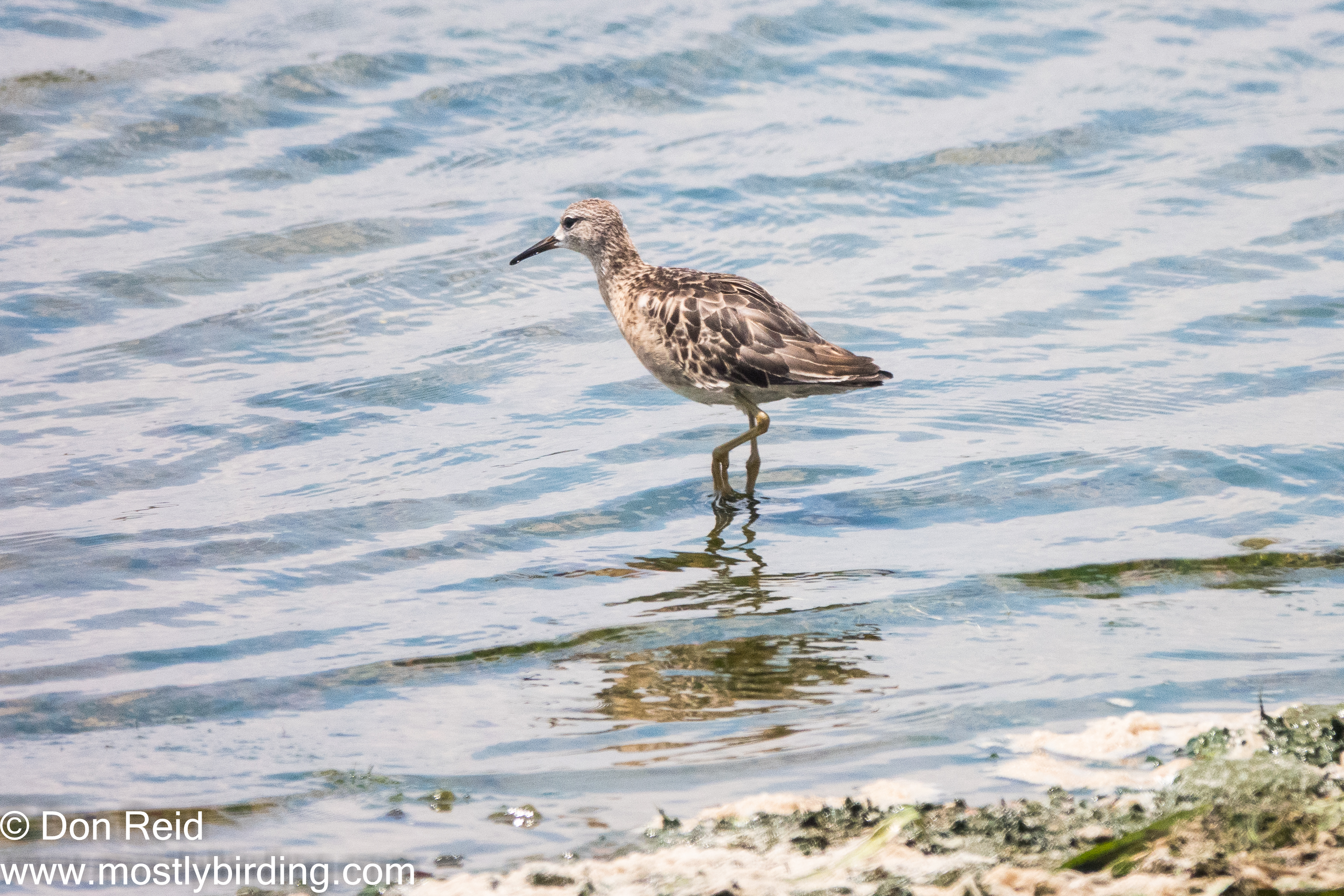
Ruff Philomachus pugnax (Kemphaan)
Ruffs fall into the wader family known as the Calidrids, breeding at Arctic latitudes and migrating to southern Africa during the austral summer. There would be no difficulty identifying Ruffs during the breeding season, as they take on a spectacular breeding plumage, but we see them in southern Africa in their drab non-breeding state, looking like many of the other waders. One of the most numerous summer waders
What to look for :
Size medium (M : 29-32cm F 22-26 cm)
Medium length bill, slightly drooping
Longish, usually orange legs
Scaled appearance on back
White feathers at bill base
Ruff Philomachus pugnax (Kemphaan), Bronkhorstspruit Dam
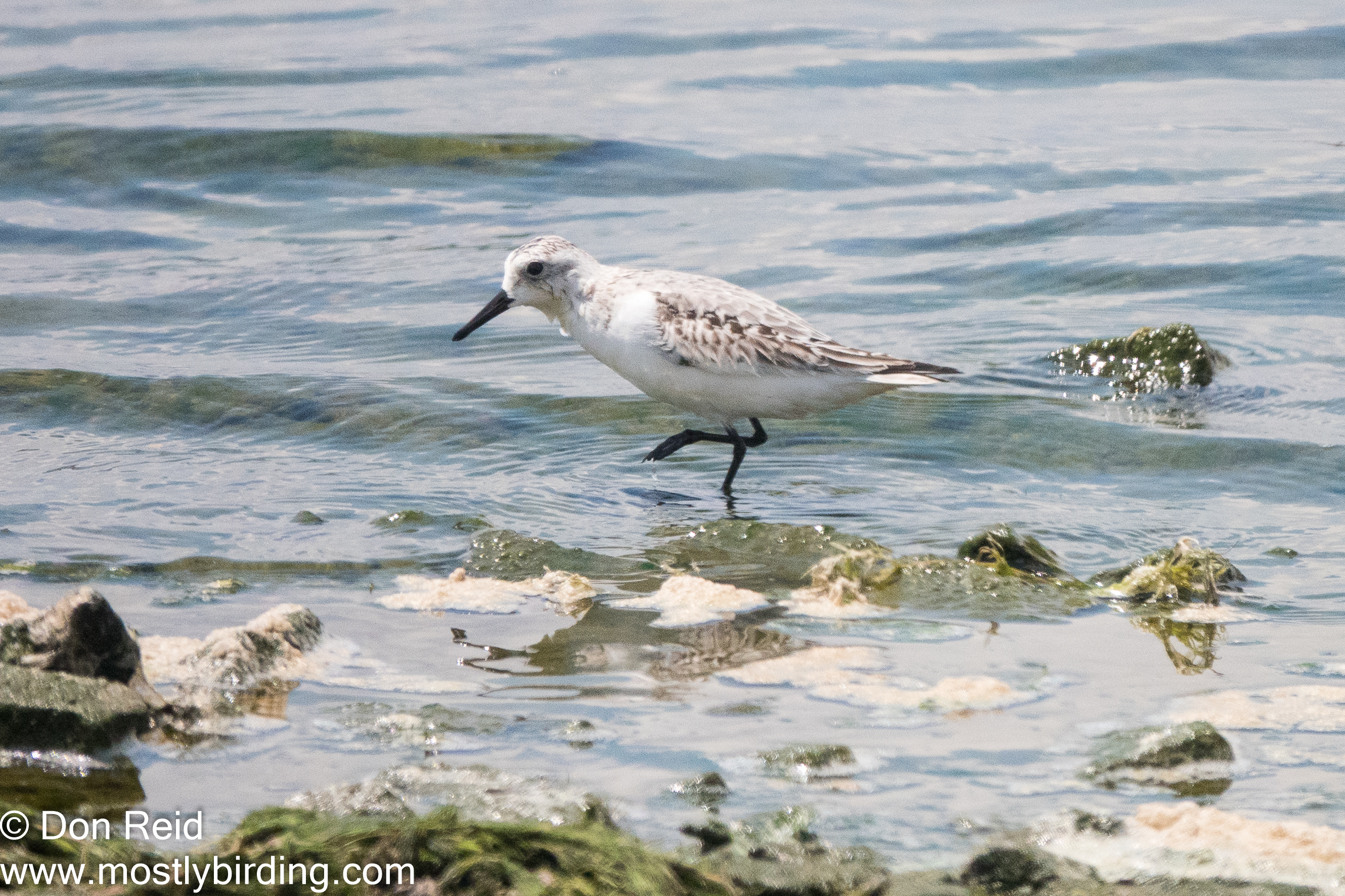
Sanderling Calidris alba (Drietoonstrandloper)
Sanderlings also belong to the Calidrids family, breeding in, and migrating from, Siberia and Greenland to southern Africa, where they arrive from September. Inland records are quite scarce as most head to coastal beaches, but Bronkhorstspruit Dam has seen some records of this species on an intermittent basis. This was the only one I saw during my visit and is only the 4th record for the pentad, out of 170 cards
What to look for :
Size : Small (18-21 cm)
Distinctive light colouring separates the Sanderling from most other waders
Short, stout bill
Dark shoulder patch (hidden by white feathers in my photo)
Sanderling Calidris alba (Drietoonstrandloper) Bronkhorstspruit Dam
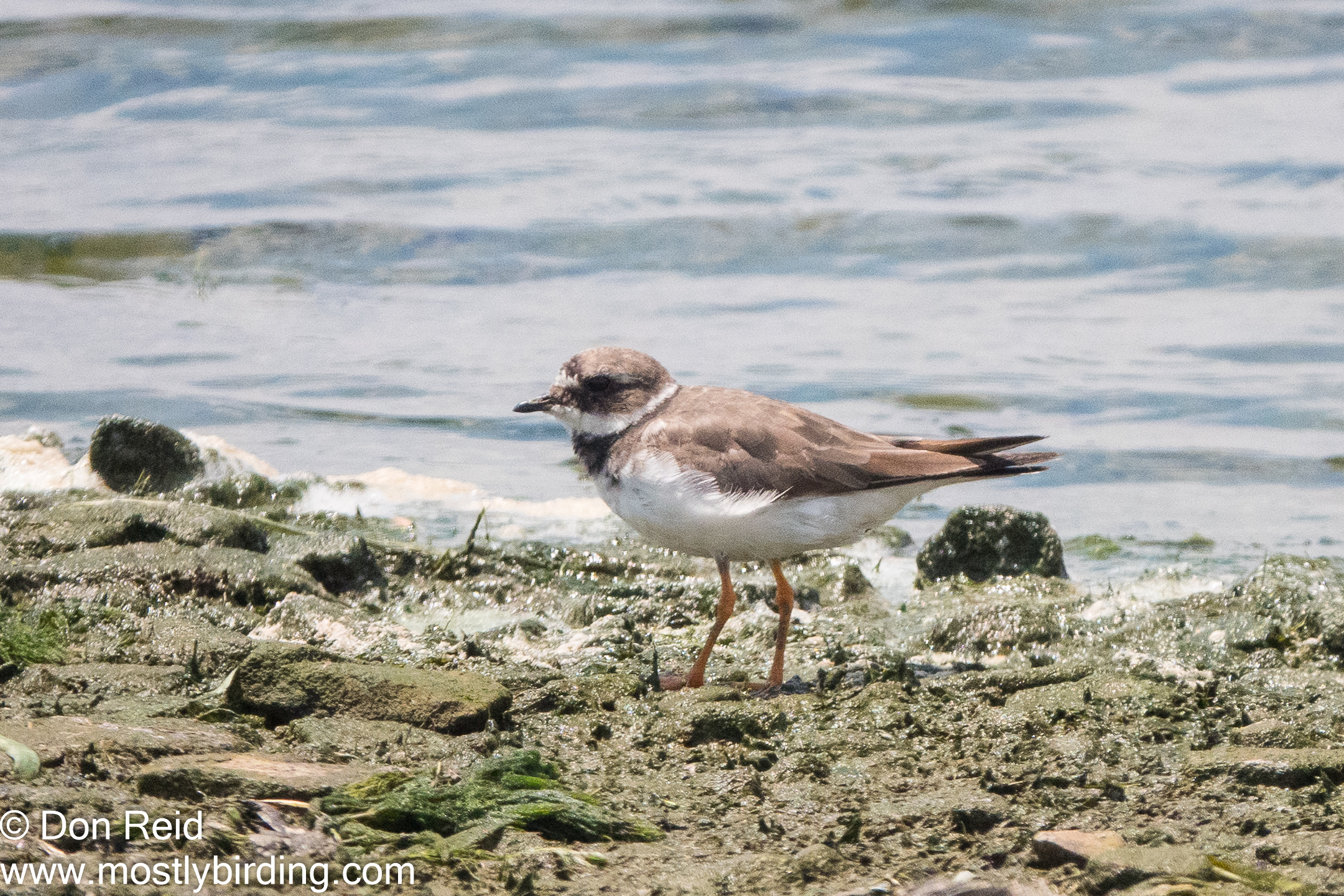
Common Ringed Plover Charadriushiaticula (Ringnekstrandkiewiet)
The first of the “Small Plovers”, this palaearctic migrant flies up to an amazing 18,000 kms from its breeding grounds to southern Africa
What to look for :
Size : Small (17-19 cm)
Relatively easy to identify with its broad black breast band contrasting with the white collar
Very short, stubby bill
Orange legs
Common Ringed Plover Charadrius hiaticula (Ringnekstrandkiewiet) Bronkhorstspruit Dam
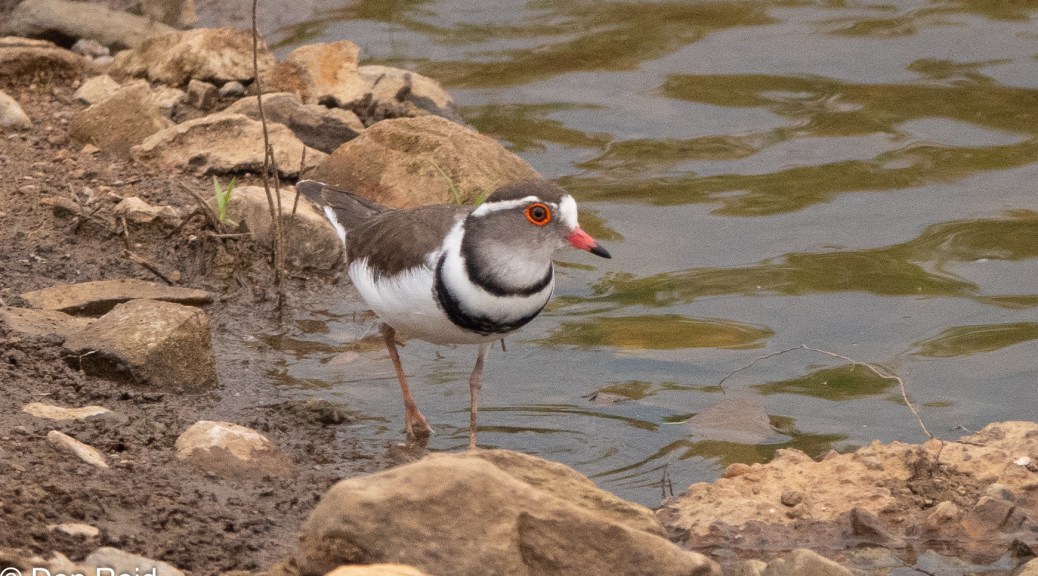
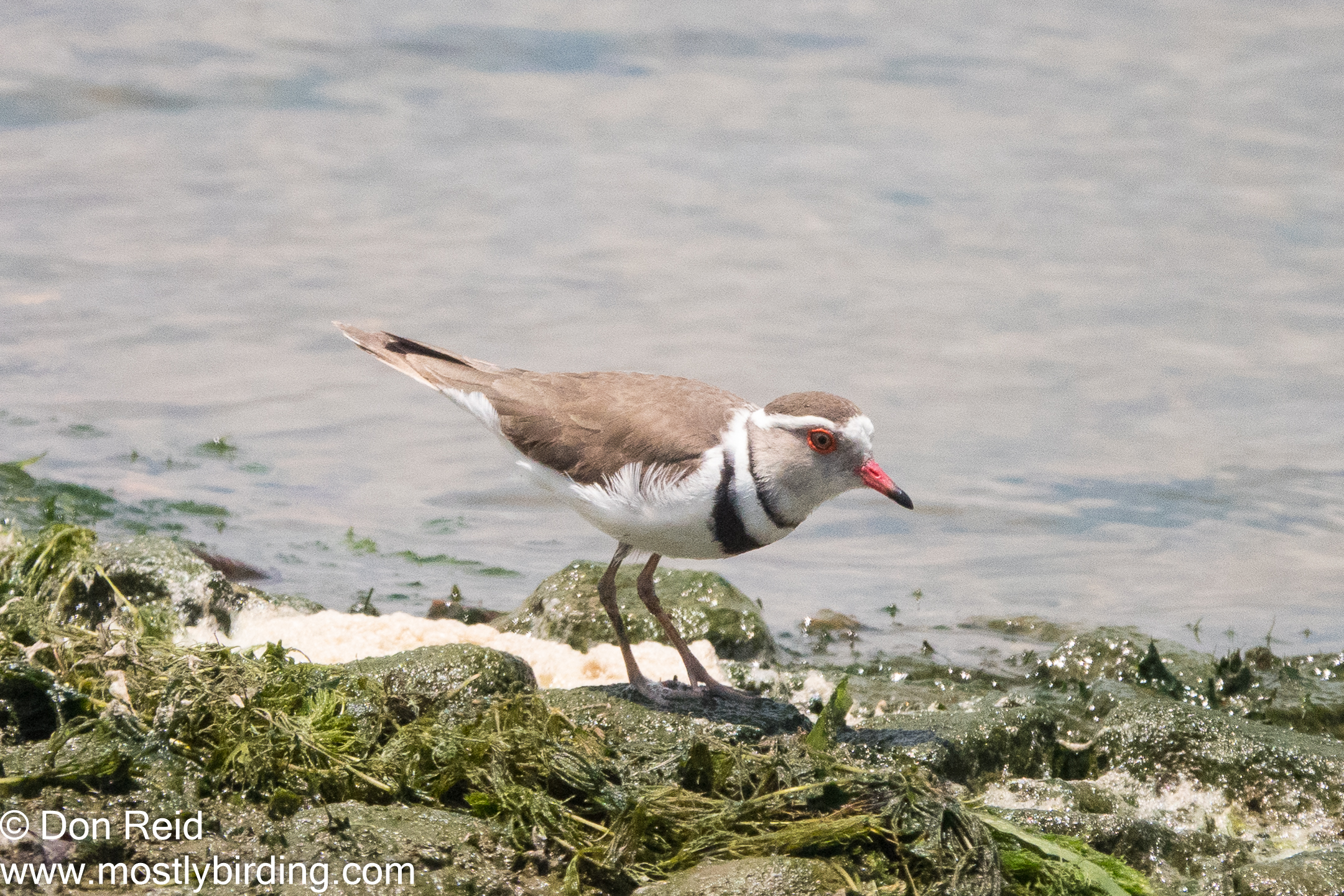
The second of the “Small Plovers”, this is a common freshwater wader in southern Africa, where it also breeds
What to look for :
Size : Small (17-18 cm)
Distinctive with its double breast band and red eye-ring
Bobs up and down in animated fashion
Three-banded Plover Charadrius tricollaris (Driebandstrandkiewiet) Bronkhorstspruit Dam
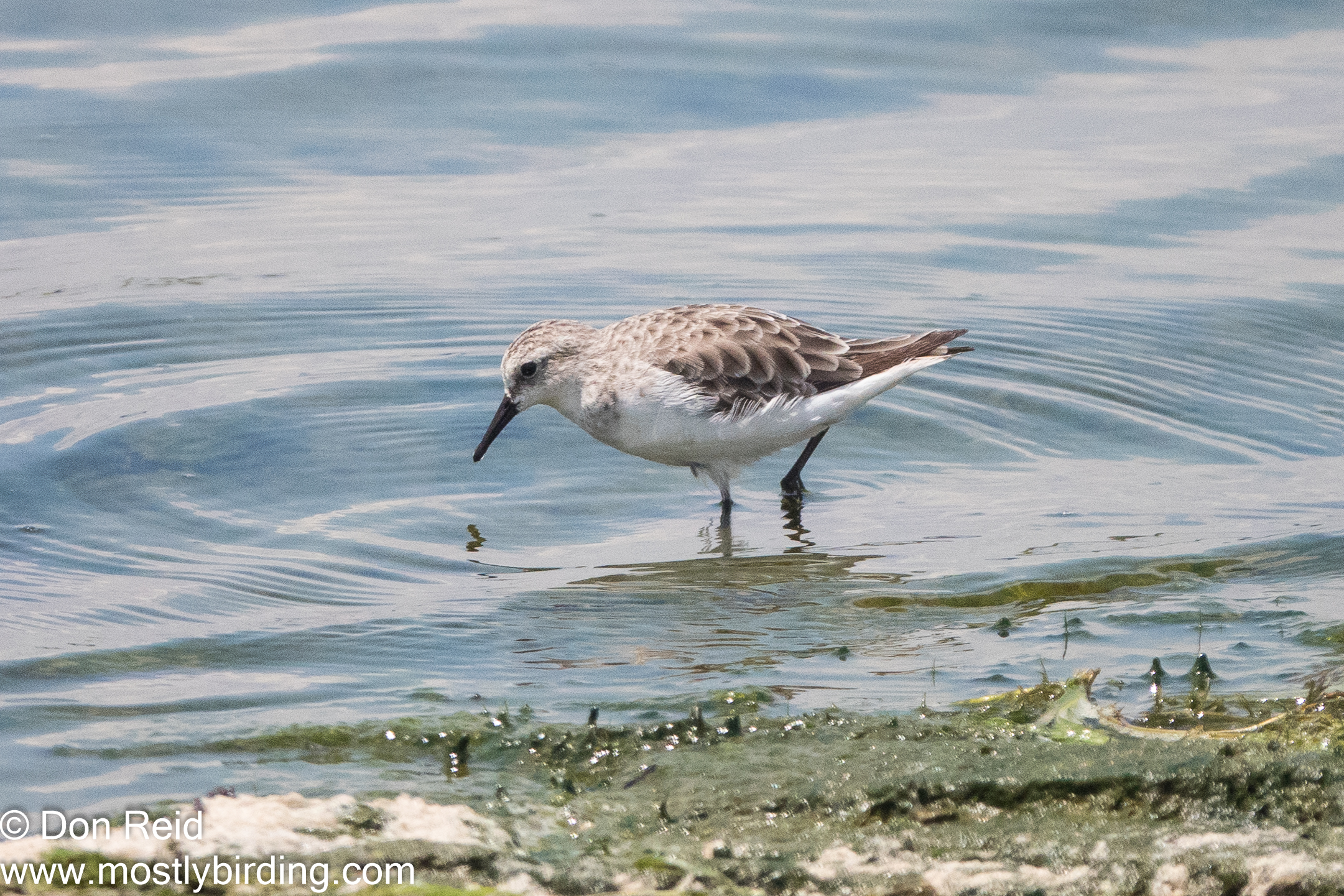
Little Stint Calidris minuta (Kleinstrandloper)
This smallest of waders always makes me think of an old gent in a faded brown overcoat – they habitually walk about with head bowed which, along with their small size, makes them easy to pick out among a group of waders. The Little Stint is a Palaearctic migrant. those arriving in South Africa from September are thought to breed in northern Europe
What to Look for :
Size : Very Small (12-14 cm)
Short, fine-tipped dark bill
Bowed posture while wading
Little Stint Calidris minuta Kleinstrandloper Bronkhorstspruit Dam
The Others
Some of the other birds occupying the shallow wading areas and margins of the dam that I came across –
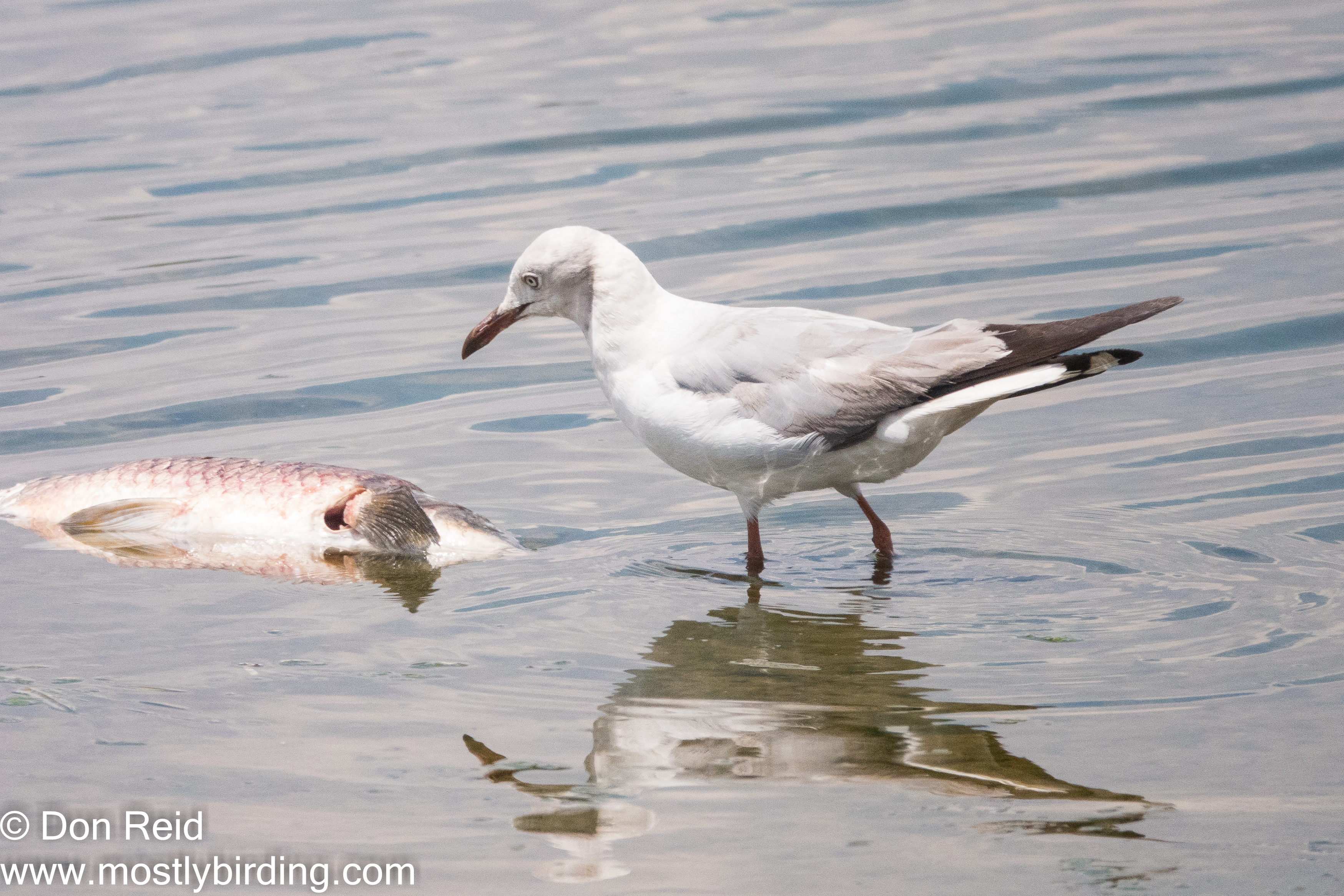
This fairly common inland Gull had been attracted to the shallows by a dead fish on which it was scavenging.
One of the easiest Gulls to identify inland as it is usually the only one. At the coast one has to be a bit more judicious in arriving at an ID – the Hartlaub’s Gull is of similar size and general appearance so a more detailed look will show the differences
Grey-hooded Gull Chroicocephalus cirrocephalus (Gryskopmeeu) Bronkhorstspruit Dam
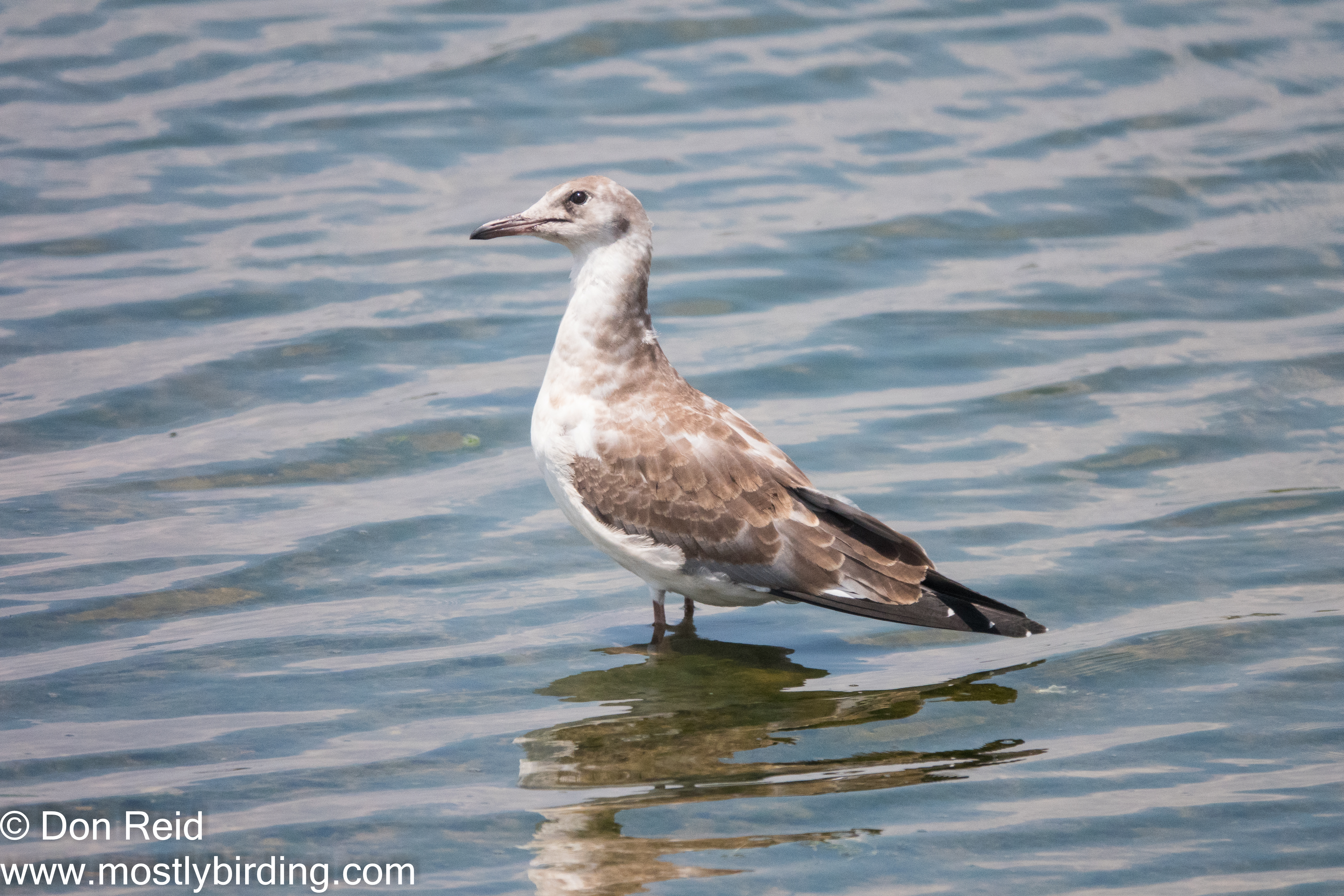
Juveniles are there for the sole purpose of confusing birders, or so it seems – they often look so different that it’s easy to imagine it may be a completely different species
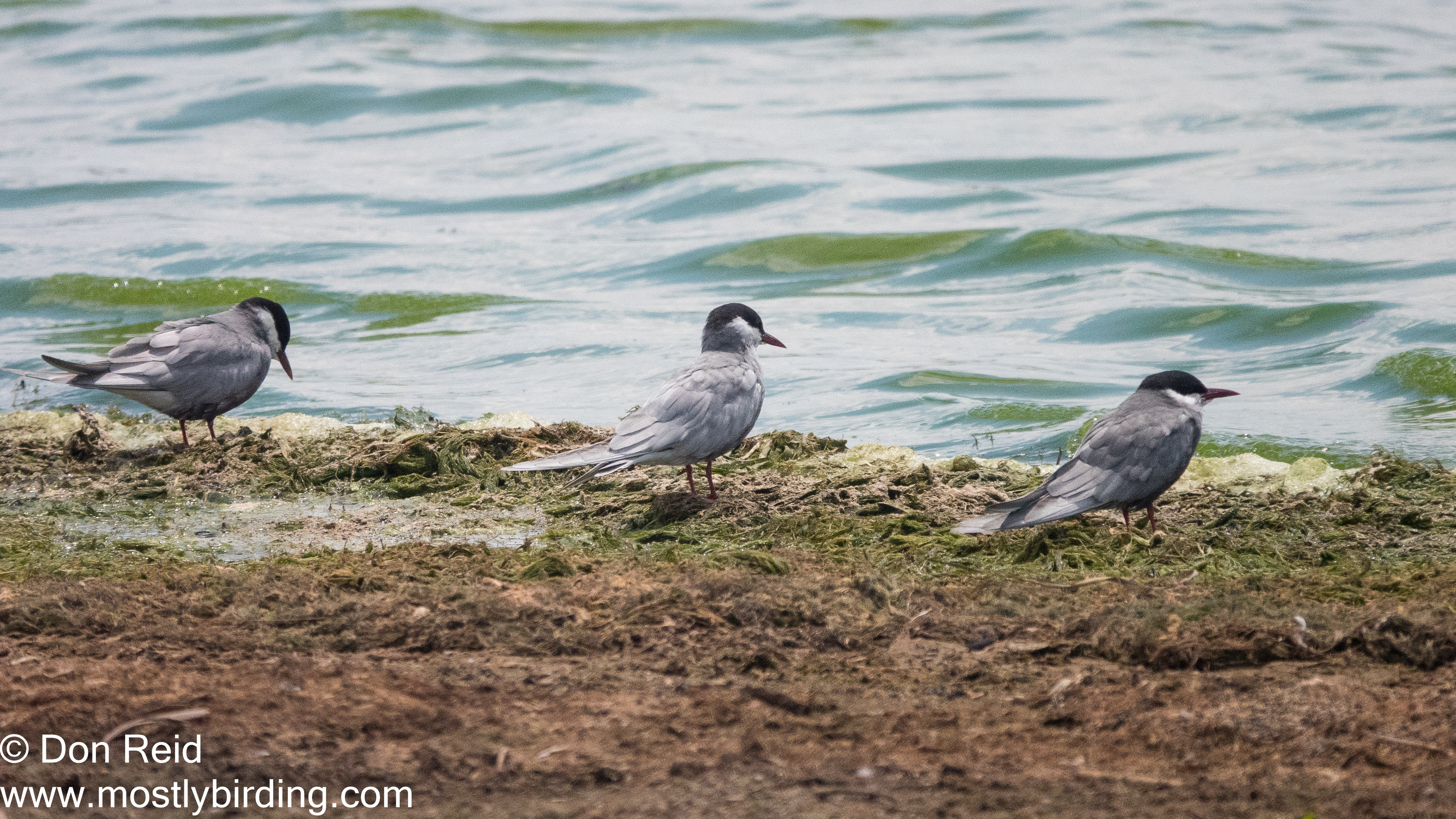
A small flock of Whiskered Terns were resting at the dam’s edge – any terns seen inland are likely to be one of two species – this one and the White-winged Tern. They can be difficult to distinguish in flight, but resting like this it is a fairly easy ID
Whiskered Tern Chlidonias hybrida Witbaardsterretjie Bronkhorstspruit Dam
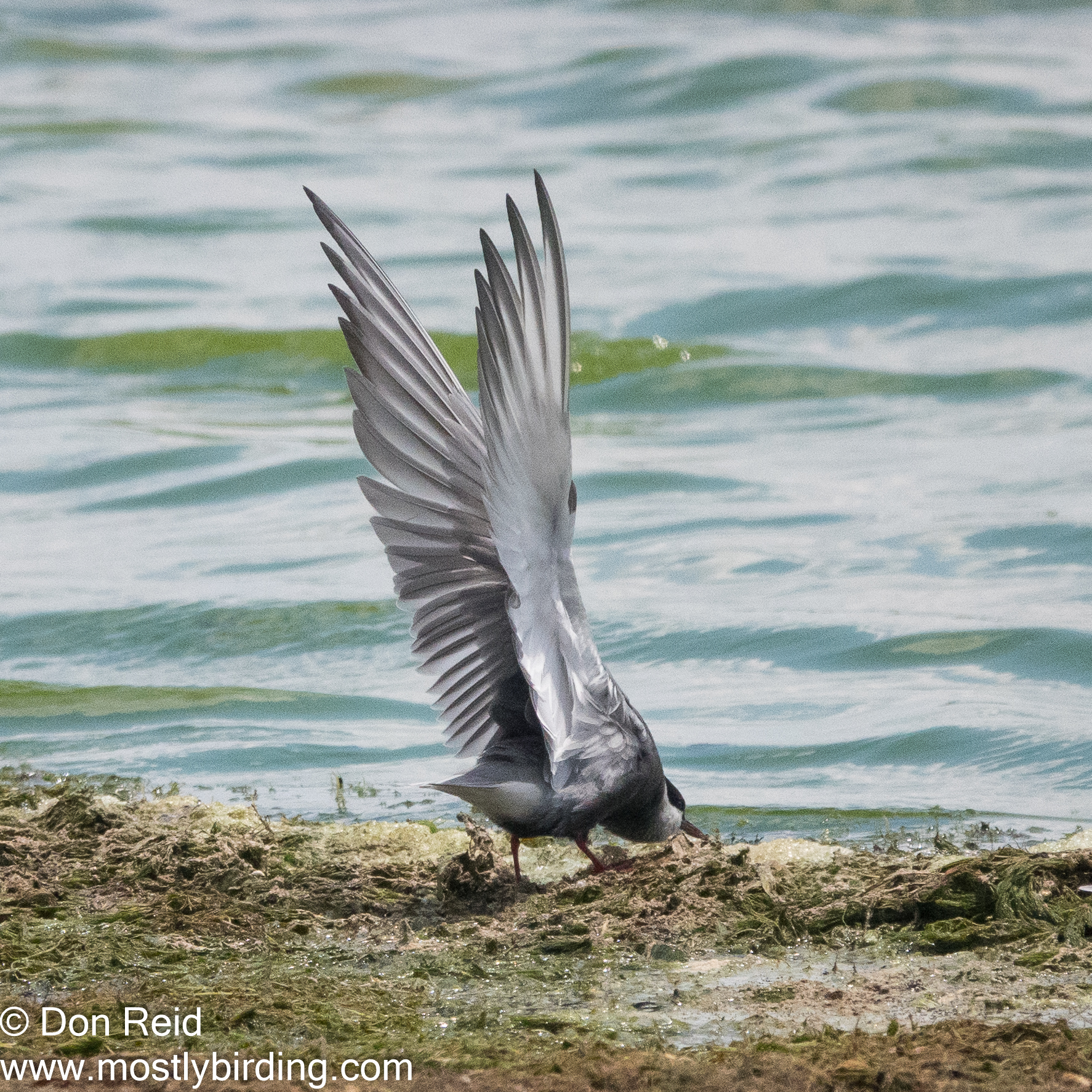
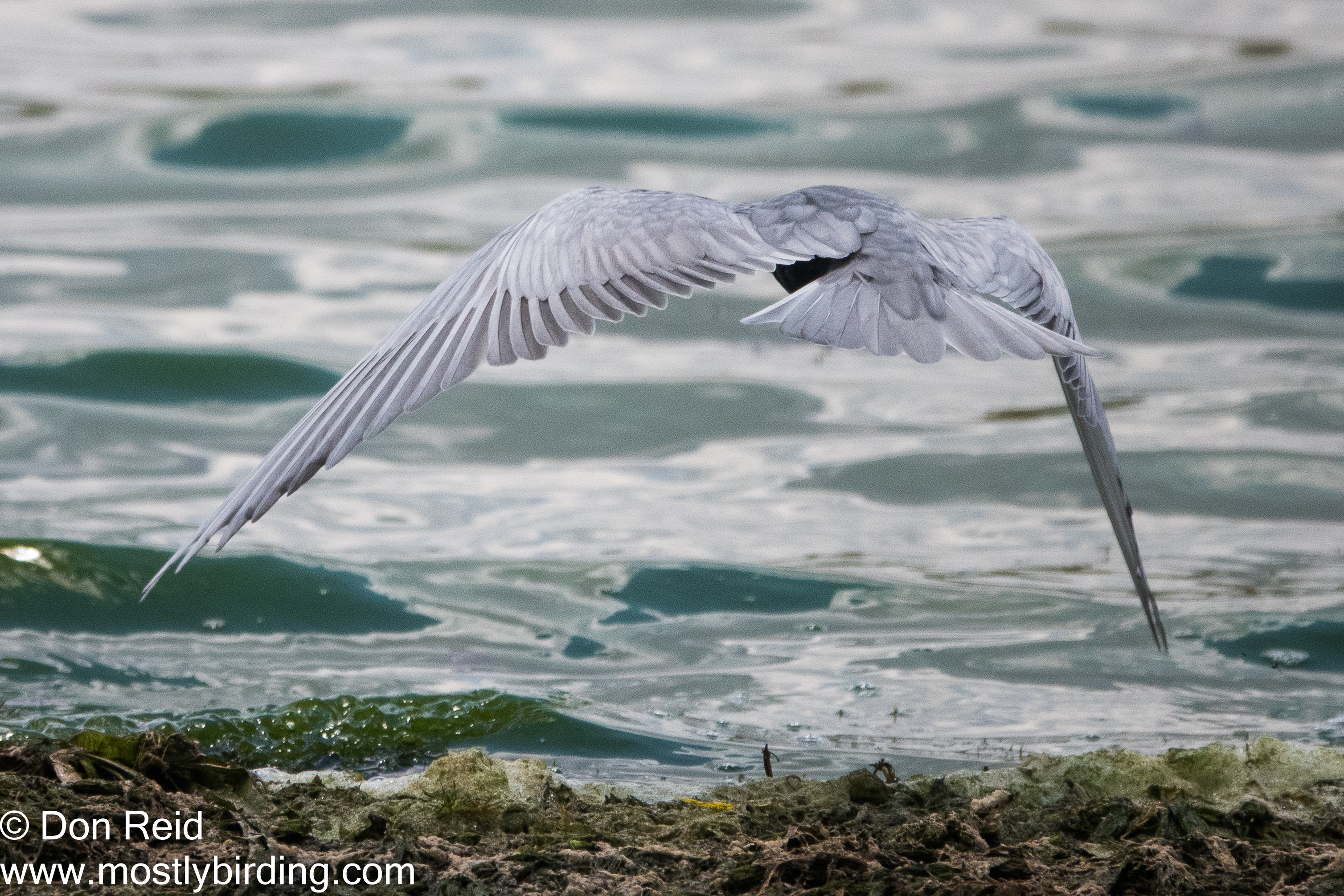
This one decided to stretch its wings then flew off, showing off the beauty of the feathers that make up the wings and tail
My favourite Tern was nearby, on its own – the Caspian Tern is the largest tern (at 51 cm) in the region and is a breeding resident. Apart from its size, the standout feature is its large red dagger-like bill.
Caspian Tern Hydroprogne caspia (Reusesterretjie), Bronkhorstspruit Dam
And these two waterbirds make it onto this post simply by sticking close to the shoreline, allowing me to get reasonable images as I studied the waders
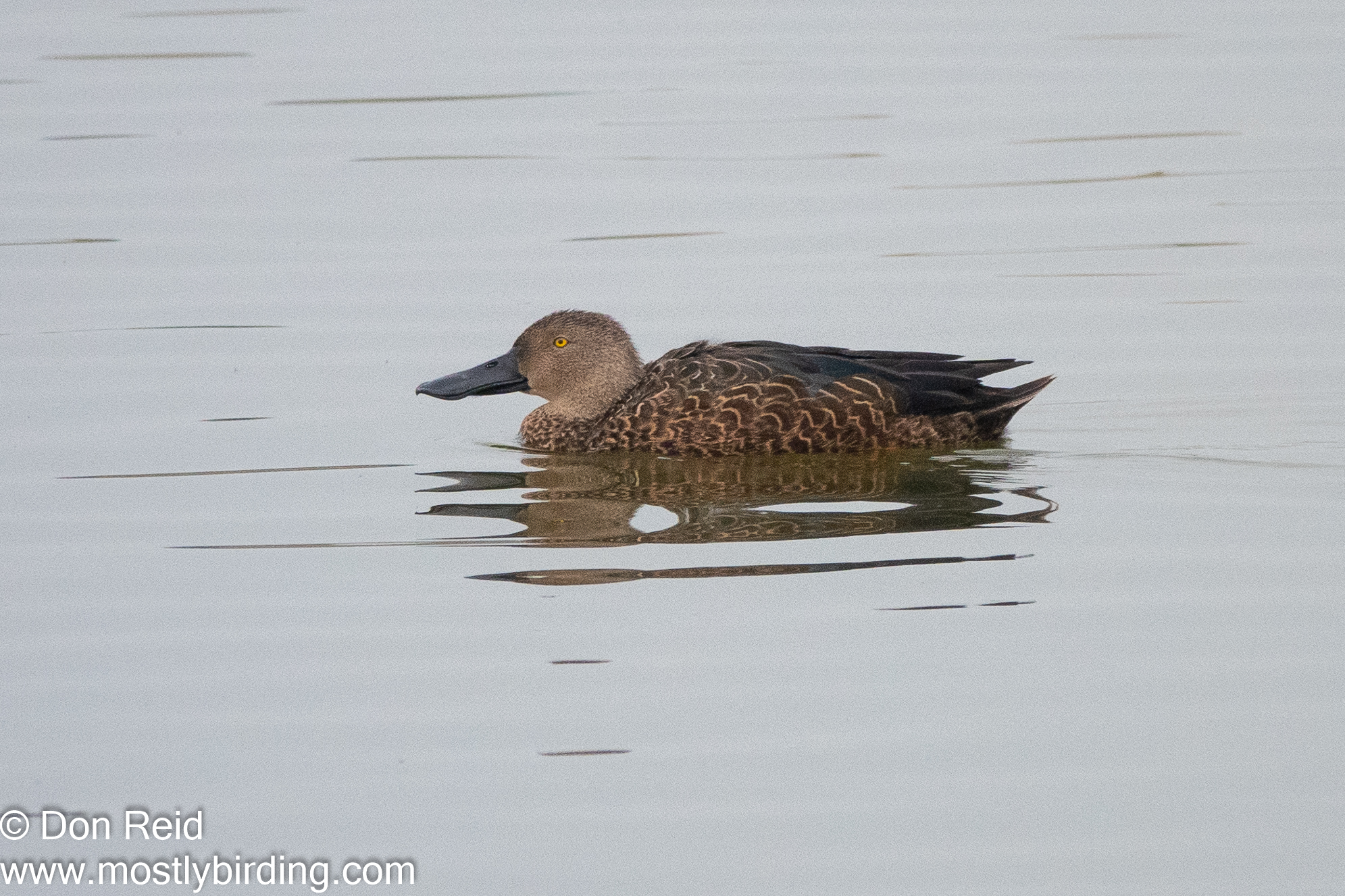
Cape Shoveler Anas smithii (Kaapse slopeend)
Cape Shoveler Anas smithii (Kaapse slopeend), Bronkhorstspruit Dam
Yellow-billed Duck Anas undulata (Geelbekeend)
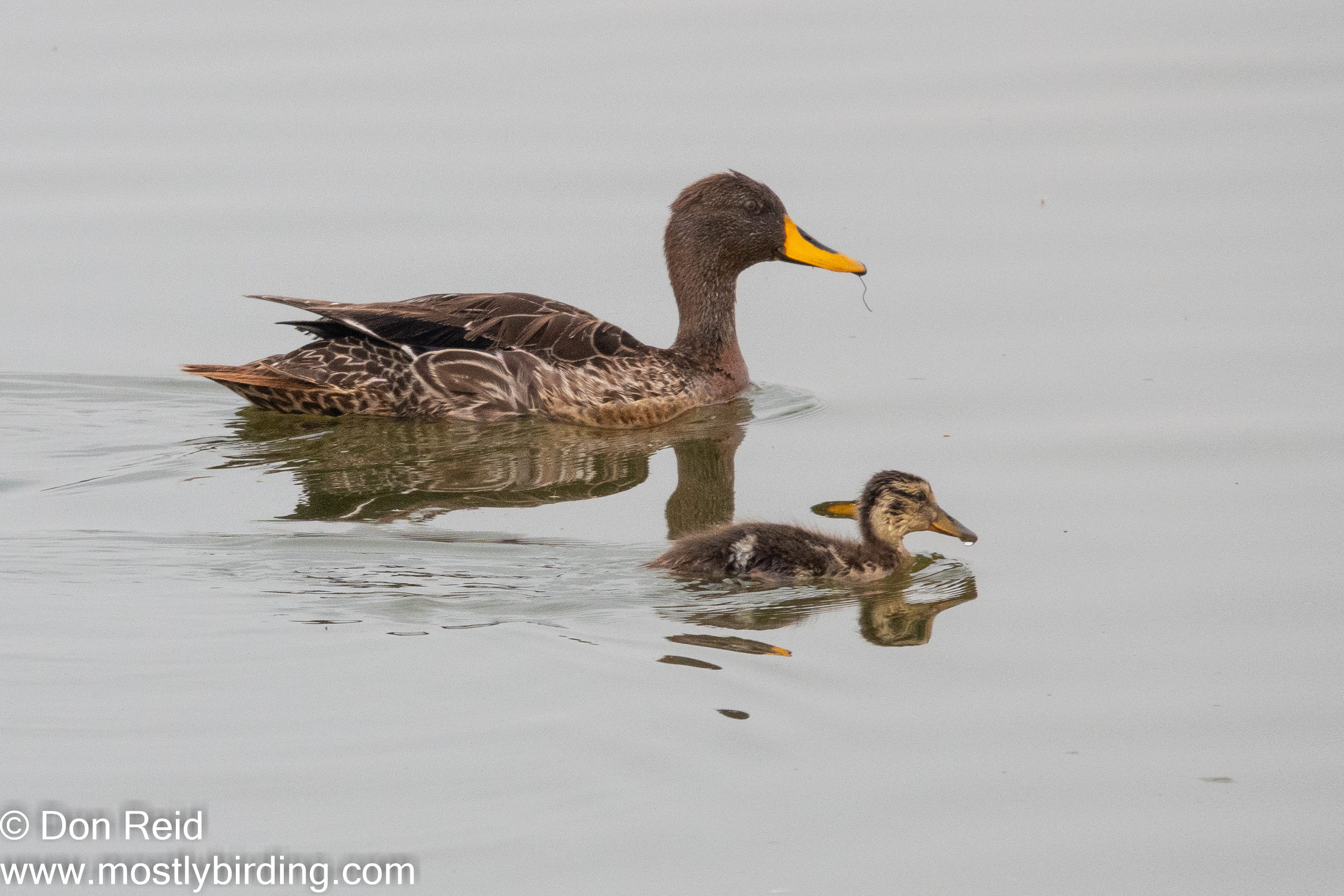
Yellow-billed Duck Anas undulata (Geelbekeend) (Adult with Juvenile), Bronkhorstspruit Dam
To end off – a mystery wader at water’s edge – extremely large and well feathered – definitely not a Stint……
We are getting back into our Pretoria routine after 3 months in Mossel Bay, and I decided to go out atlasing in Roodeplaat Nature Reserve one morning this week. Heading into summer the weather in Pretoria is already warm with temperatures in the low 30’s and the skies are clear – some rain has fallen but the ‘big’ summer rains accompanied by the typical highveld thunderstorms have not yet arrived – hopefully they are not far off.
It was a good morning’s atlasing with 71 species logged on the Birdlasser app, including one which put on a brief display for me (well that’s what I like to think) ….
I was out of the car listening to a Lesser Honeyguide calling near the nature reserve offices, when I saw what looked like a woodpecker fly from a tree to a bare wooden utility pole. I could not make out what it was as it seemed to be purposely hiding from me so I approached carefully until I had a partial view and took a few record photos.
It then started pecking at the pole in a rhythmic fashion creating a loud drumming sound and I immediately wondered why, as there was no hope of anything edible to be found and the pole was completely unsuitable for nesting or similar purposes.
Here’s the short clip I filmed of the woodpecker, which I later identified as a Bearded Woodpecker, in action – do excuse the shakiness of the images – I had to film it at a distance on full zoom so as not to scare it away and the wind blowing didn’t help matters.
A read through of the species habits on the Roberts app on my phone provided the following insights into this behaviour – nothing to do with food or nesting it seems –
Presence often given away by loud, distinctive call, or by loud tapping (while foraging), or drumming.
Moves out of sight behind a branch in response to danger.
Both sexes drum frequently, mostly early morning; used in territorial advertisement and to establish contact with partner.
Drums in bursts of ca 1 sec at ca 12 strikes/sec, beginning fast, then slowing; usually on a high dead branch (same branch often reused); audible to 1 km.
Roberts VII Multimedia Birds of Southern Africa
It flew off after a while and I continued with my atlasing, pleased at having witnessed this behaviour and at having everything one wants to know about birds available on my iphone.
Continuing the story of our ‘Wild Flower Season’ trip to the West Coast town of Paternoster…..
Getting there
After breakfast we left Klein Welmoed Farm near Stellenbosch, dropped granddaughter Megan off at her university hostel, then headed to Paternoster via Wellington, Malmesbury and Vredenburg.
The road runs through the wheat belt of South Africa – almost endless fields of dark green wheat with smaller fields of canary yellow canola providing a dramatic contrast.
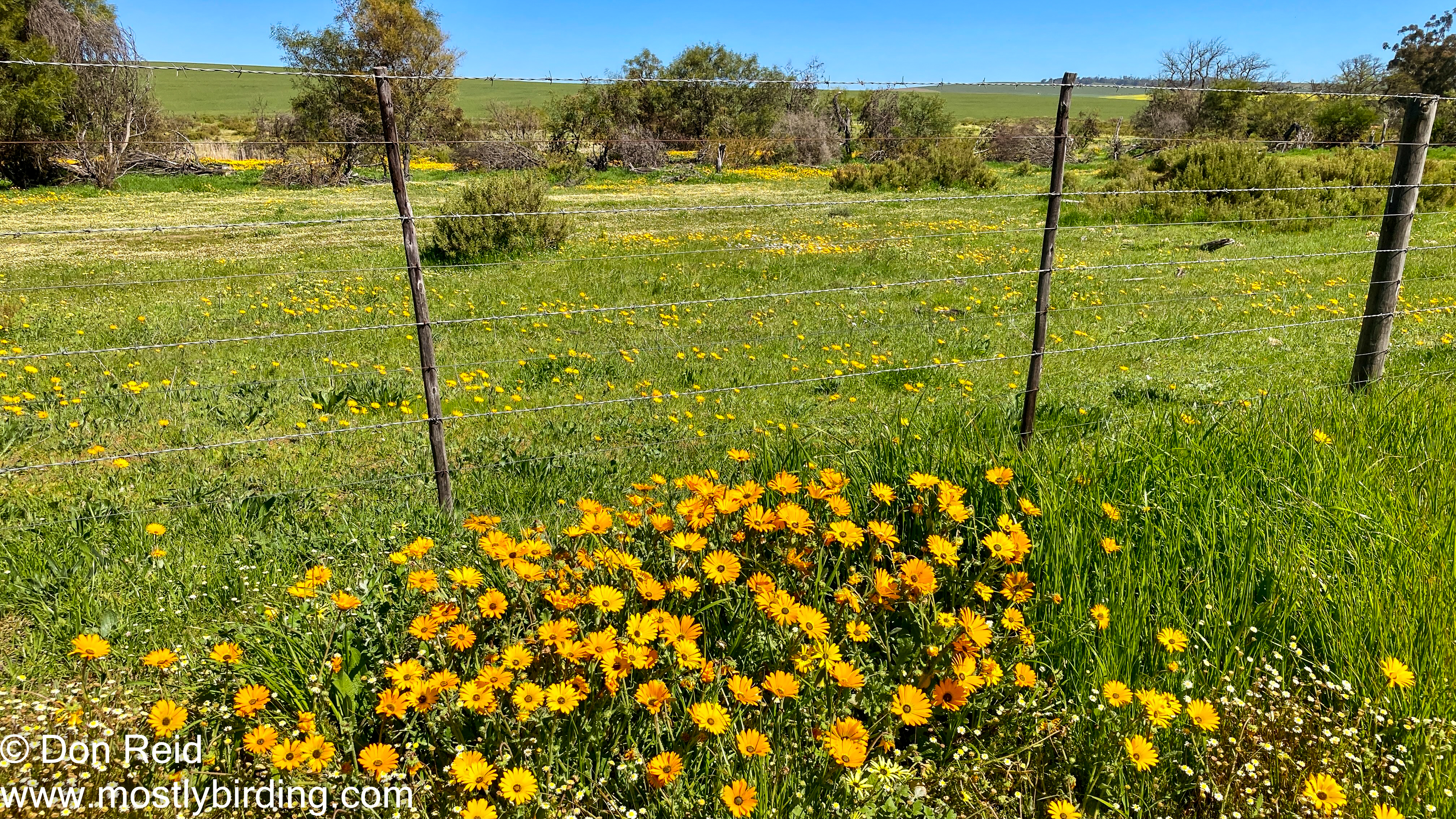
Occasional patches of ‘natural’ veld held colourful sprinklings of wild flowers to break the monotony of the cultivated fields and had me braking and reversing to get some photos.
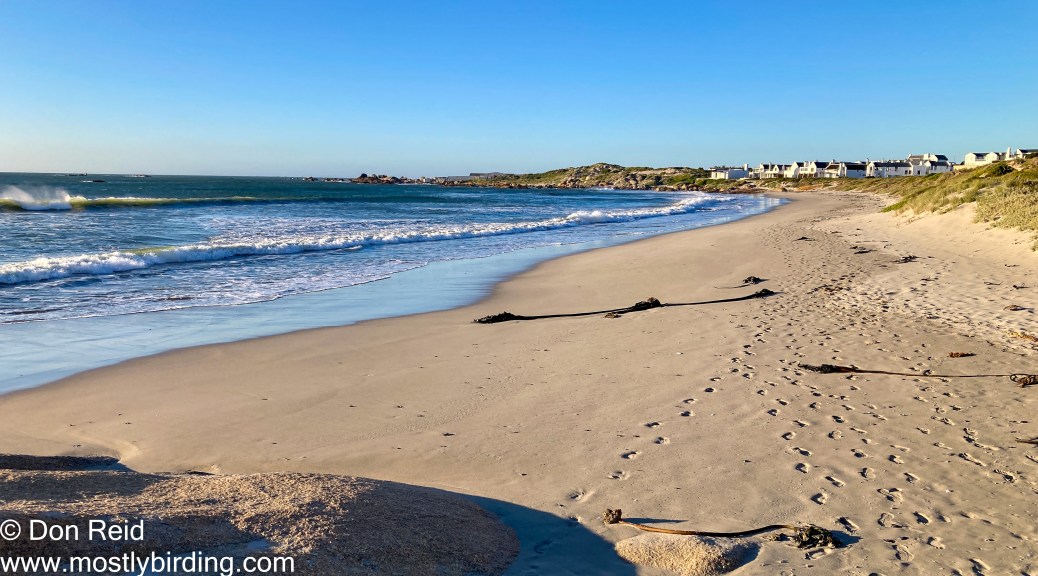
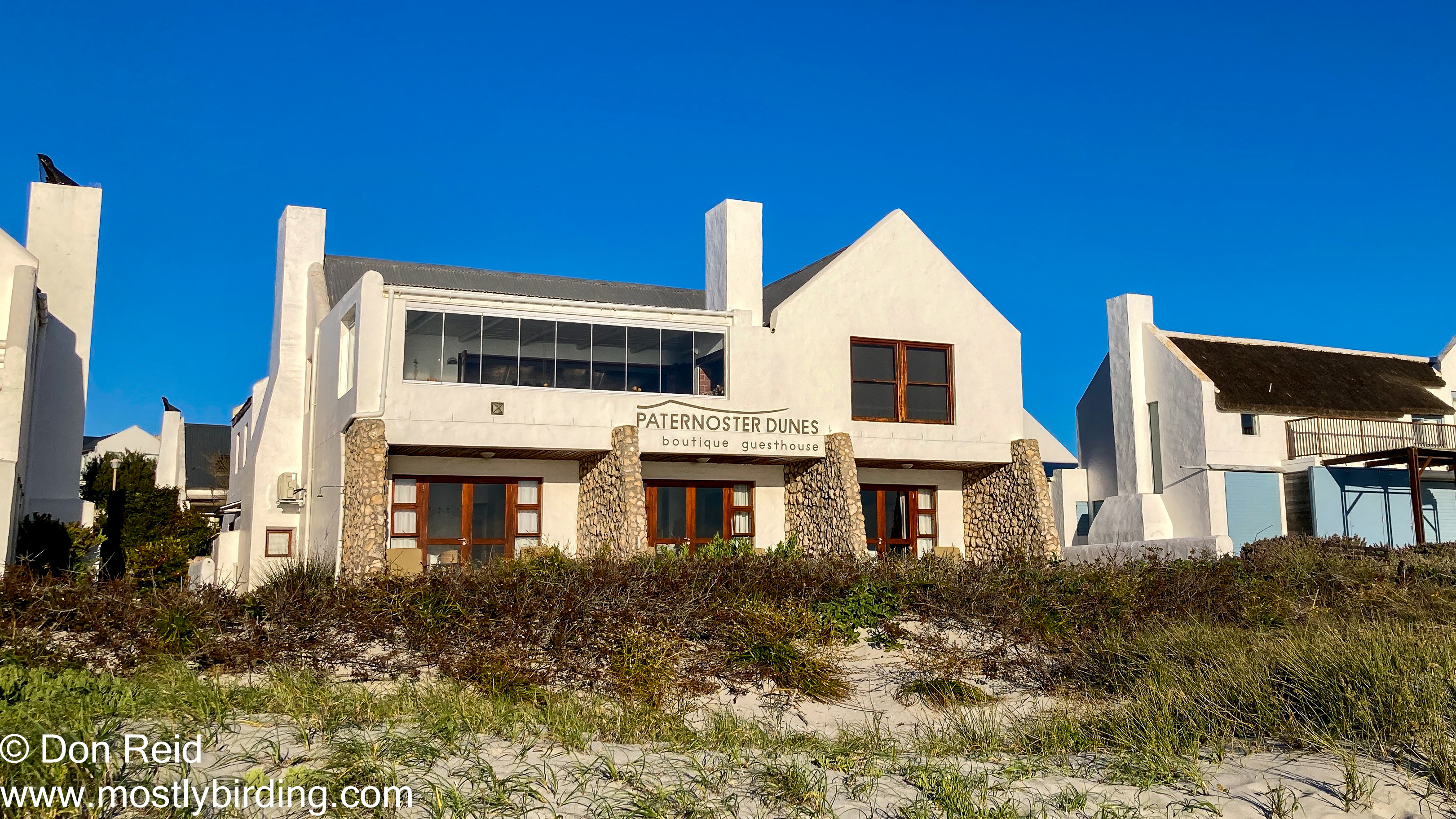
Then we were in Paternoster and soon found Paternoster Dunes Guesthouse which, as the name suggests, lies on the land side of the dunes overlooking a wide expanse of unspoilt beach
The view of the beachThe Guest House
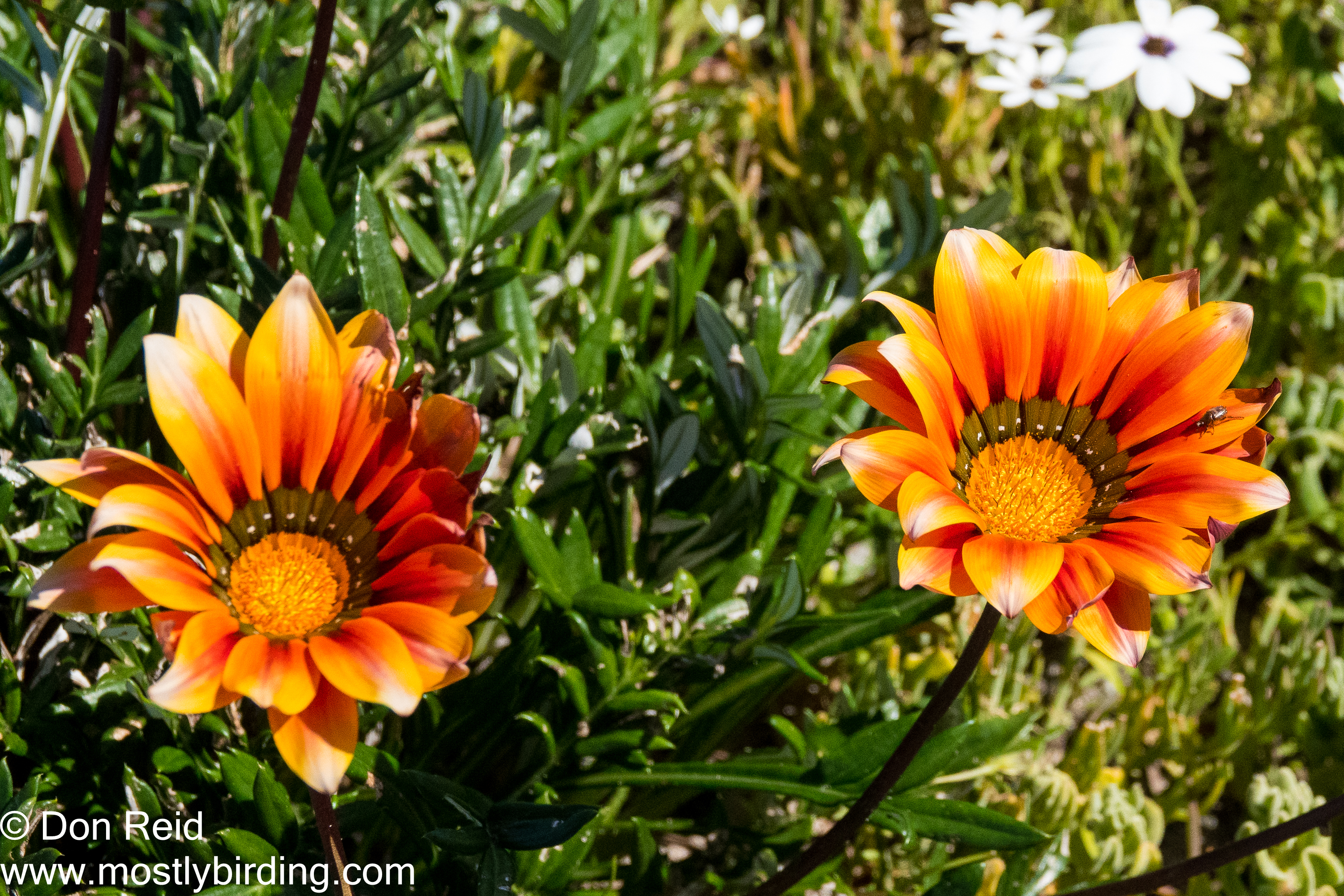
Just to get us further into flower appreciation mood, the patch in front of our room, the middle one in the image above, held some bright orange flowers
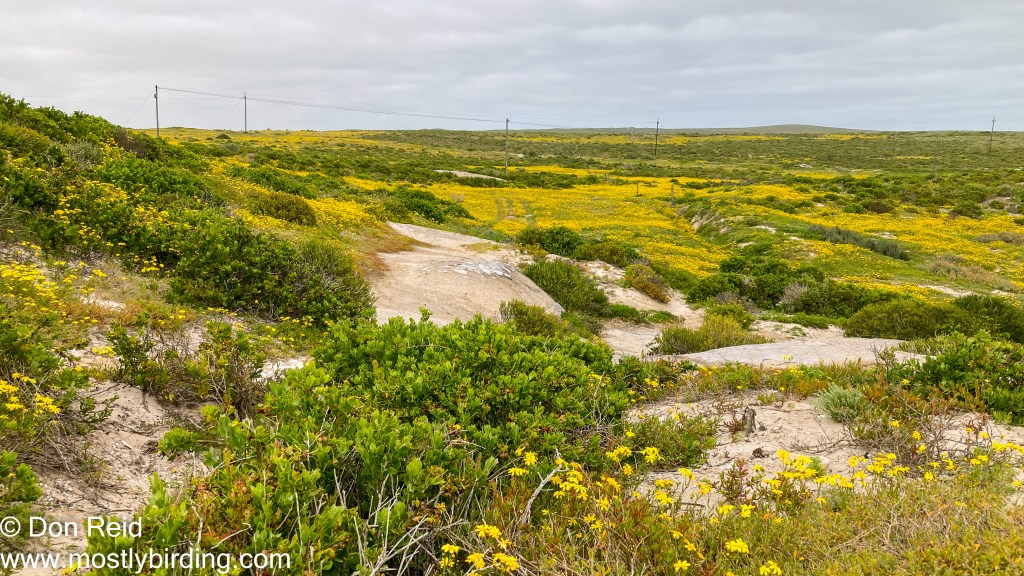
After a rest (we are pensioners after all) I took a walk along the beach to the end of the bay and looked up at the dunes which were covered in growth with a mass of yellow flowers
I climbed to the top of the dune and walked to where the houses stopped, finding a view into the distance with more yellow flowers in abundance
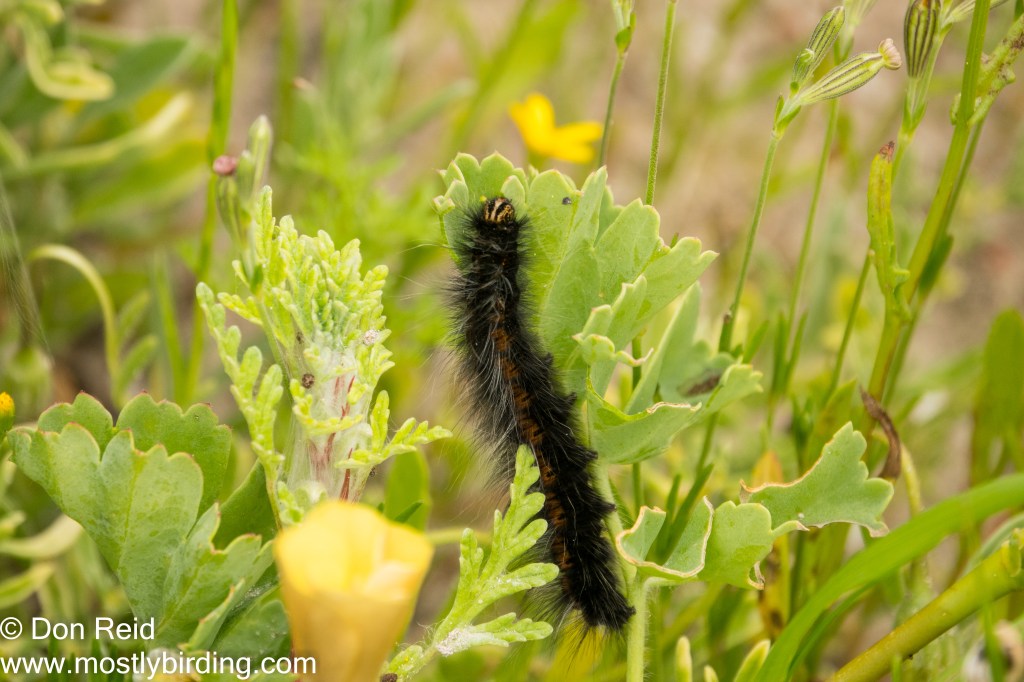
Caterpillar of unknown species, specific to the plant on which I found it by the looks of it as they were only in one small area
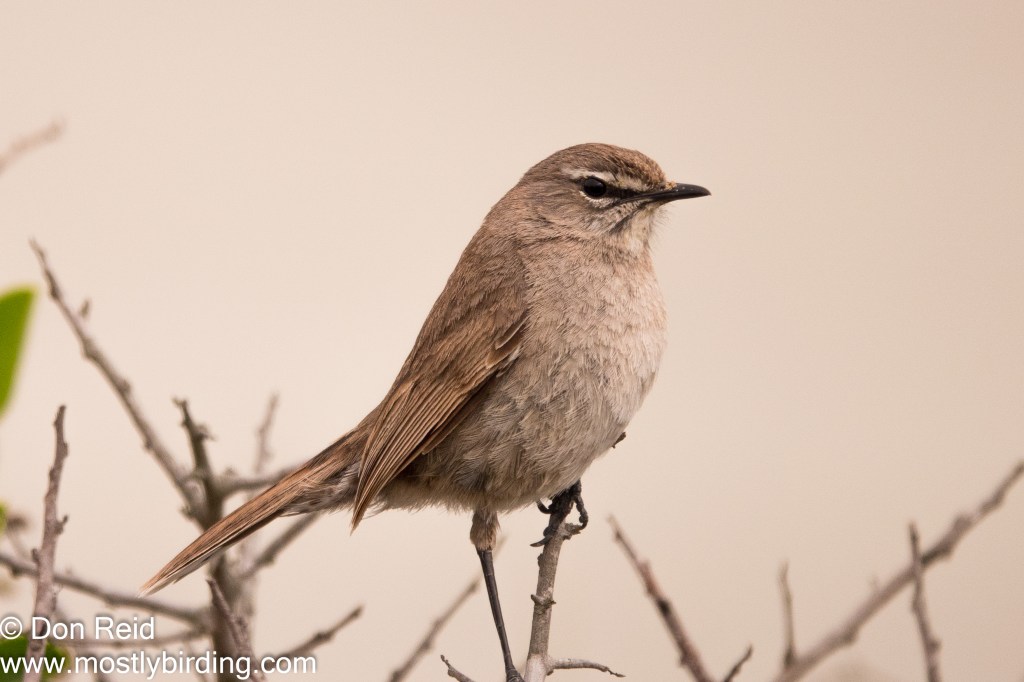
During our visit I discovered that there were a few bird species which found the patch in front of our room to their liking, including the Yellow Canaries and Karoo Scrub-Robin pictured below as well as Cape Bunting, Southern Double-collared Sunbird and many Common (European) Starlings
Yellow Canary (Geelkanarie) Crithagra flaviventris in full songKaroo Scrub-Robin (Slangverklikker) Erythropygia leucophrys scanning the surroundings from its favourite perch on a low bush
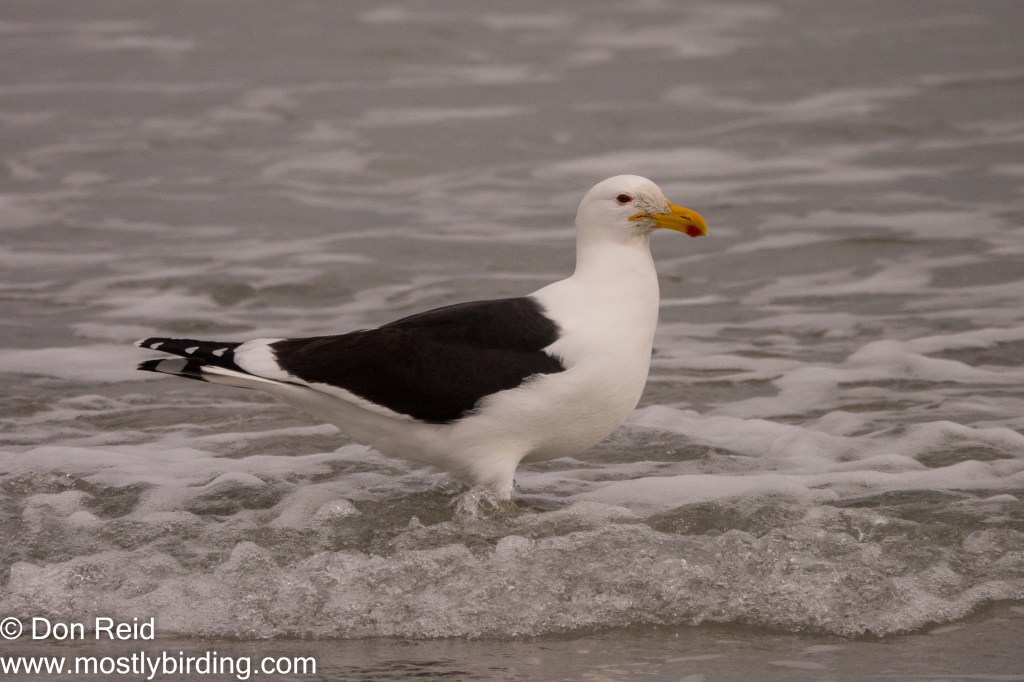
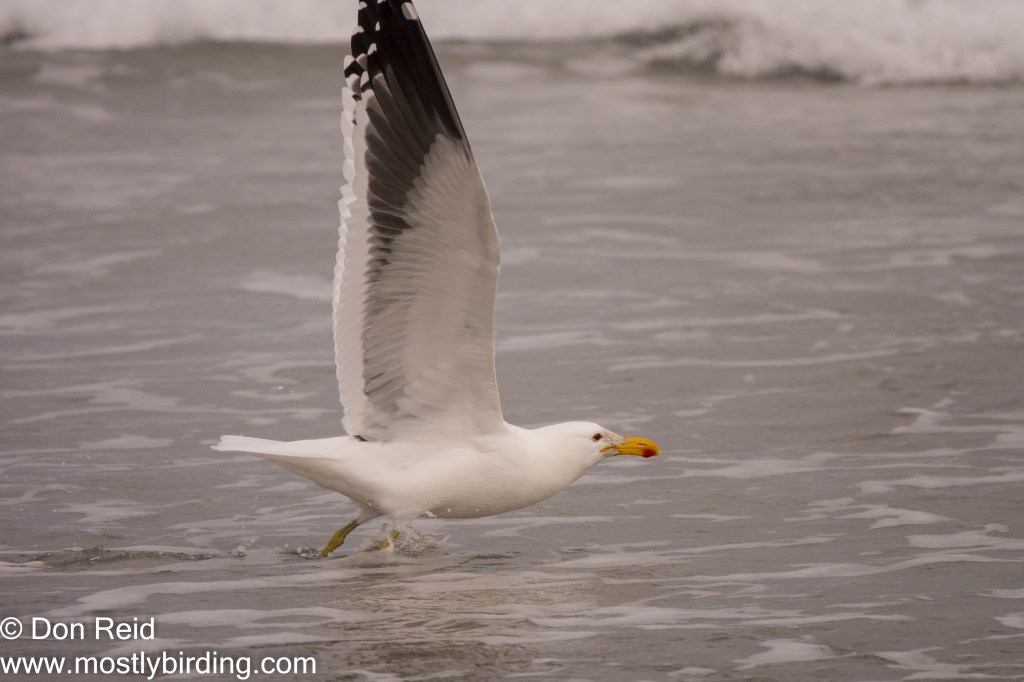
On a morning walk along the beach in front of the guesthouse, camera in hand, with the wind blowing the sea into a frothy jumble and overcast skies, several Kelp and Hartlaub’s Gulls wading in the shallows caught my eye and with some gentle persuasion lifted into the air, providing some nice photo opportunities in the soft, even light
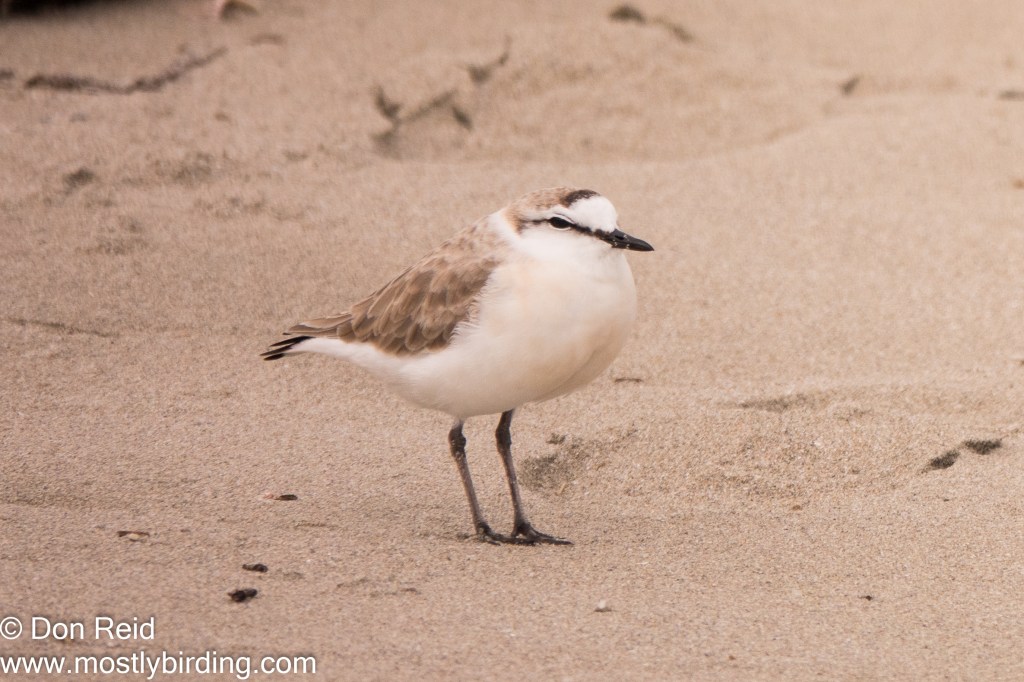
As I walked along the sand I spotted movement on the dry sand ahead and approached cautiously, knowing that the subject matter would race off if I got too near. Sure enough, three tiny White-fronted Plovers watched me carefully as I got closer, initially moving away in slow short bursts, then speeding off like top 100m sprinters, barely touching the sand between strides
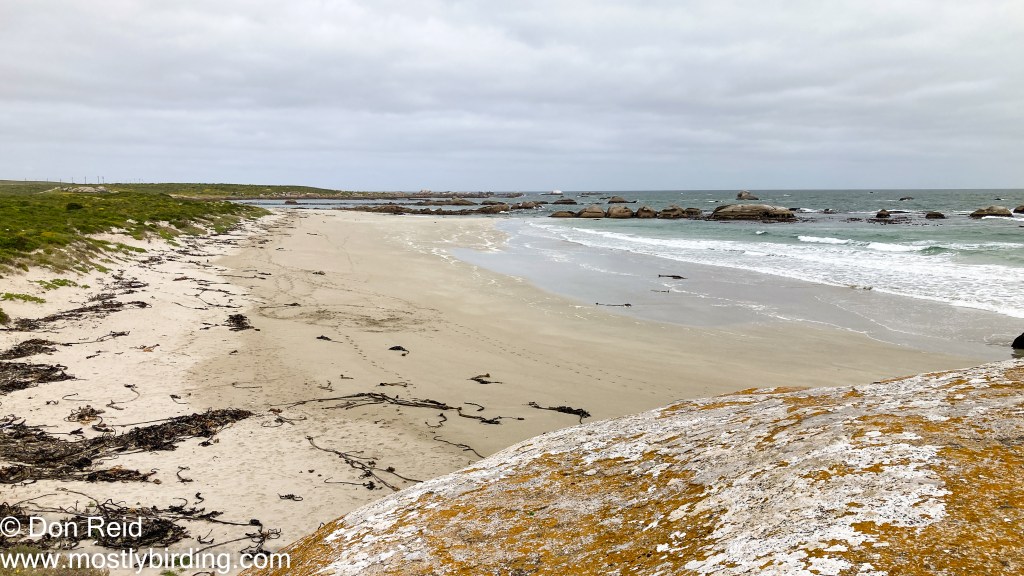
And a few more photos of Bek Bay at different times of the day
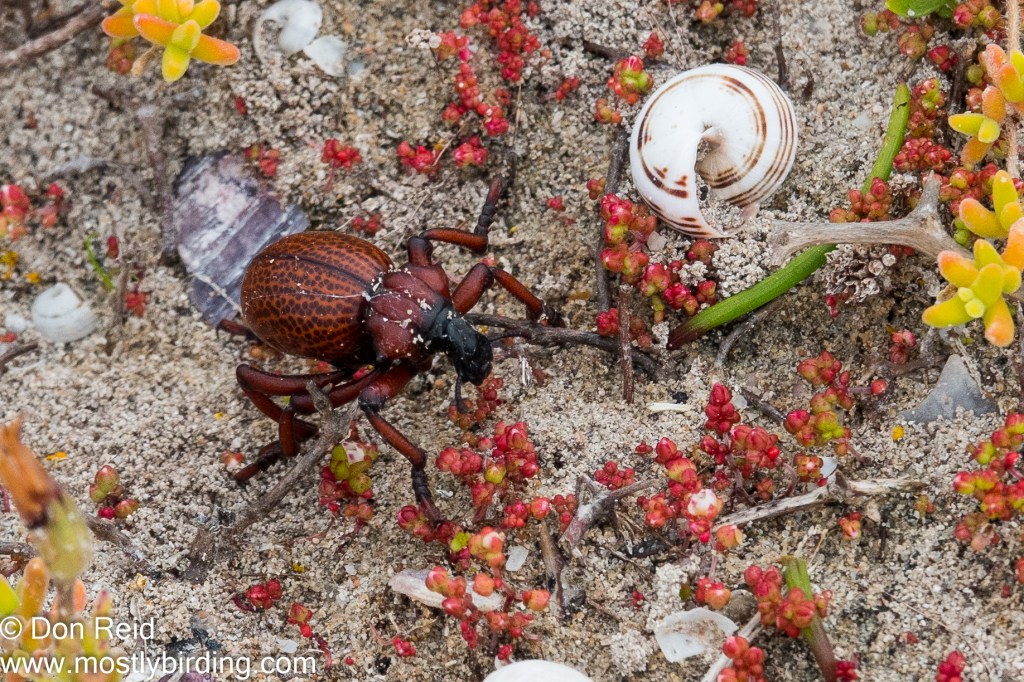
I came across this interesting beetle scavenging among the rocks
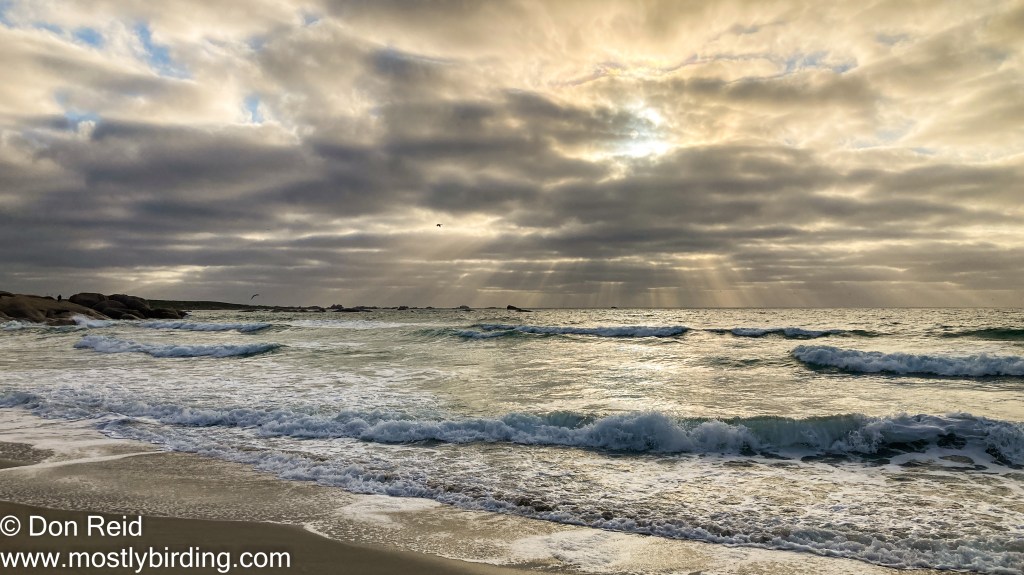
The last afternoon produced the most spectacular sunset of all as the cloud-filtered sun cast its rays on the choppy sea. Many Terns were plunging into the sea offshore – too far to differentiate between species until a Common Tern seemingly chased a much larger Caspian Tern so that they passed close to where I was watching from the beach
Paternoster turned out to be an excellent choice as our base for the short stay, being within an hour’s drive from West Coast National Park and literally next door to Cape Columbine Nature Reserve, both of which we visited – more about that in upcoming posts
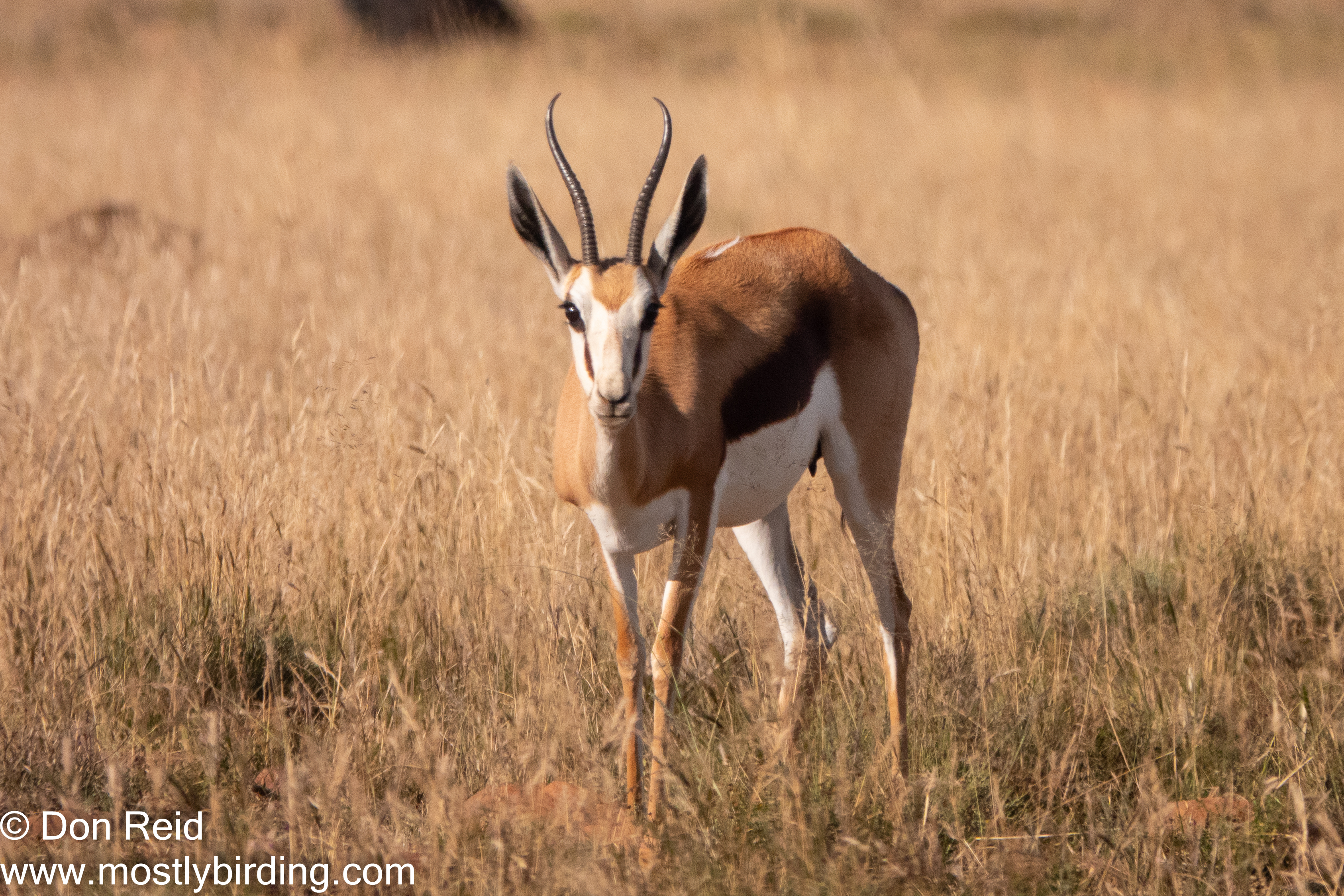
Our road trip to the Eastern Cape in March this year included a 3 night stay in Mountain Zebra National Park near Cradock, only our second stay in this “off the beaten track” National Park, but enough to cement it as one of our ‘new favourite’ parks to visit. What it lacks in Big Five game, other than some introduced lions which are not easily seen and a small herd of Cape Buffalo, it makes up with other animals not generally seen elsewhere including the Zebra after which the park is named and interesting antelope species.
On the birding front, the park is known for its drier habitat species and I was looking forward to doing some atlasing and adding to my year list without much expectation for anything unusual – but as all birders know – ‘always expect the unexpected’ and a bird that had eluded me for many a year was about to become the highlight of our visit ….
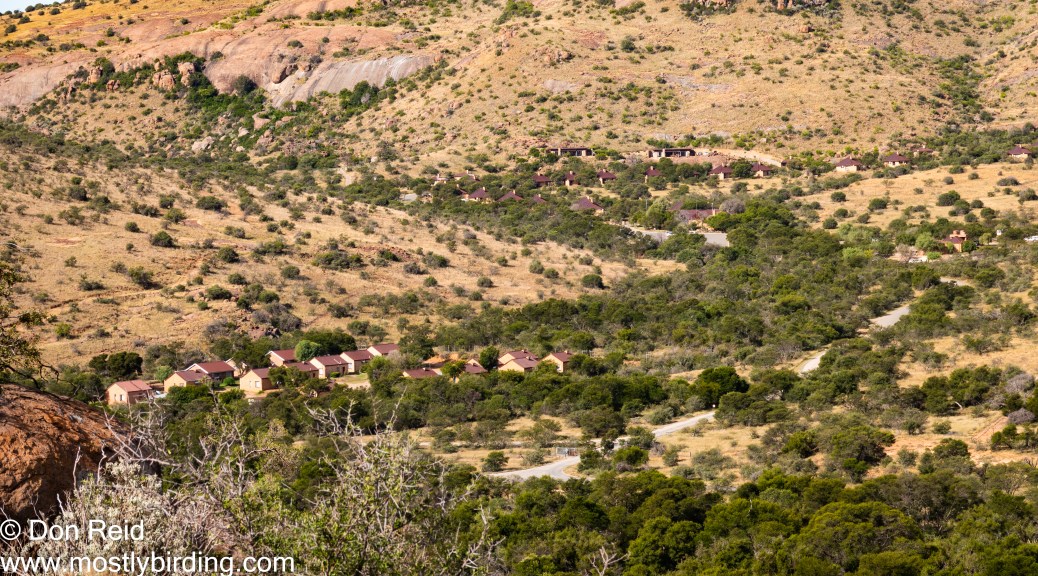
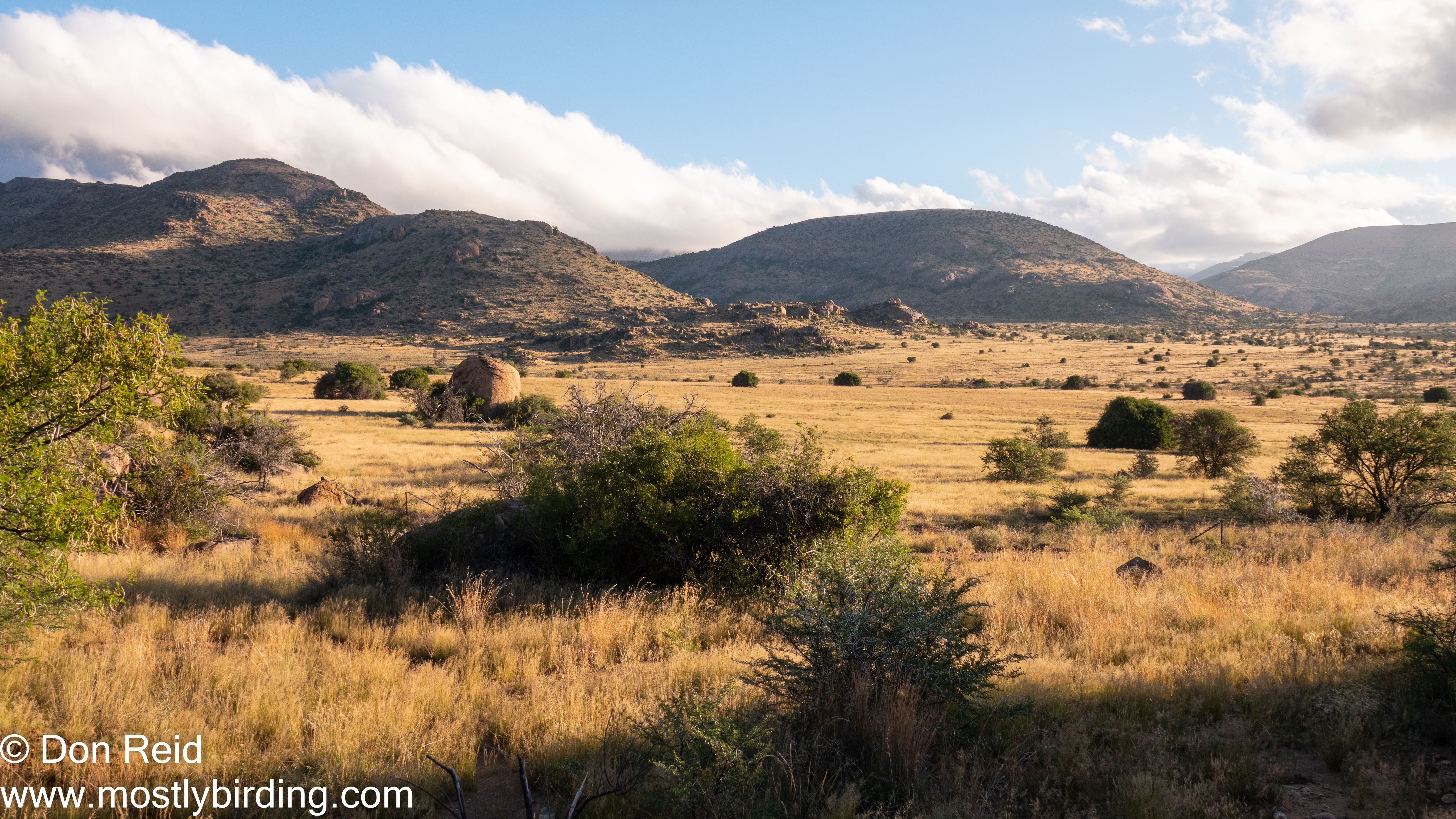
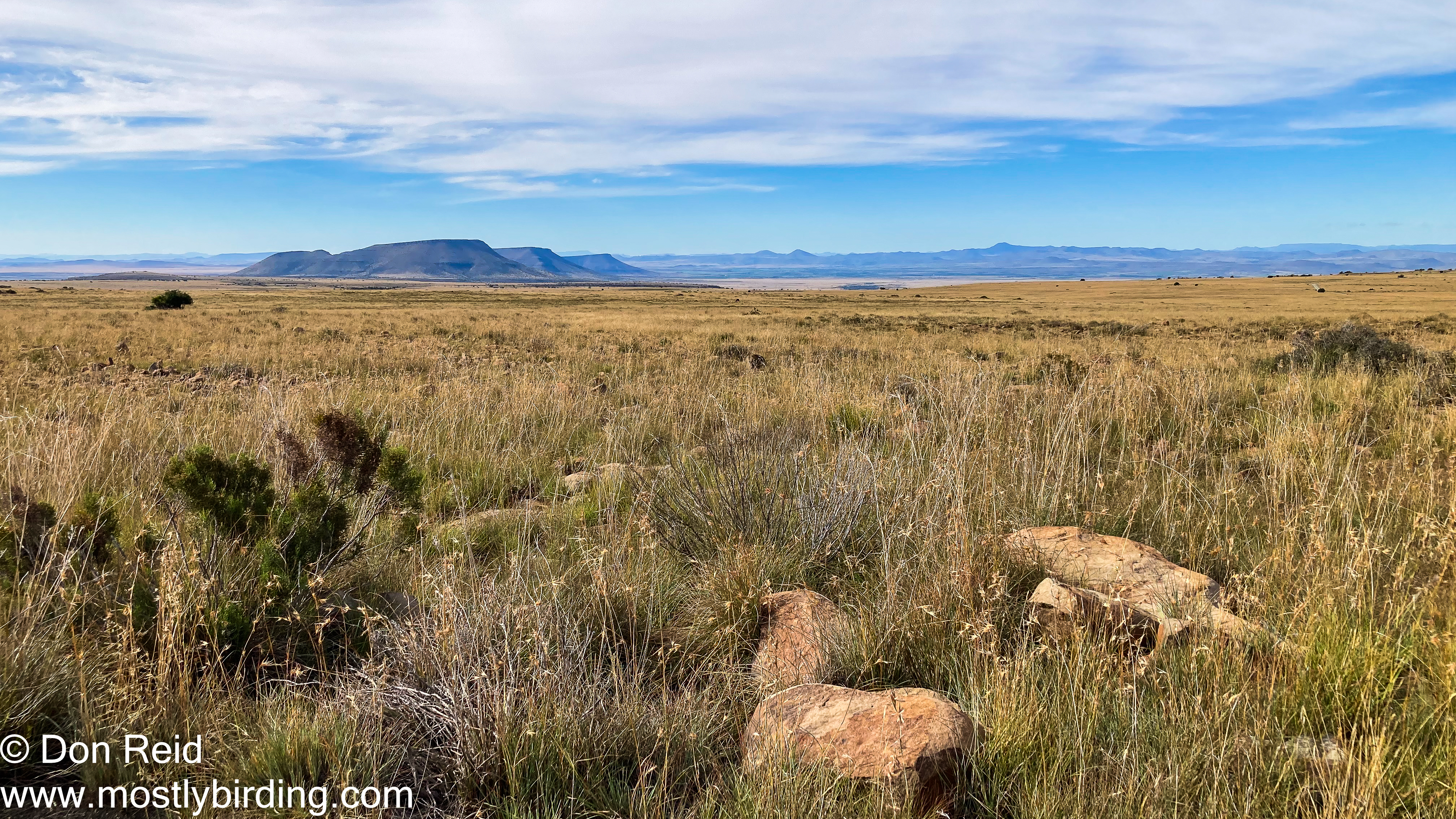
What also sets this park apart is the ambience – peaceful yet wild with panoramic views once you reach the plateau, which is at an altitude of about 1400 m, a couple of hundred metres above the main camp. The camp has around 25 comfortable chalets with patios which overlook the plains and distant hills, an ideal spot for some ‘stoepsitter’ birding.
We left Addo mid-morning, initially heading east towards Paterson and joining the N10 National Road heading northwards to Cradock, where we stopped at a coffee shop for a light lunch, then drove the last 12 km to the Mountain Zebra National Park gate. The main camp (pictured in the heading image) is another 12 km along a rather corrugated gravel road which thankfully changed to tarmac for the last stretch.
The reception was efficient and friendly and we soon found our chalet No 20 almost at the top of the gently sloping road that runs through the camp and got ourselves settled in.
After a brisk walk, the air was suddenly chilly with the sun setting behind the surrounding hills, so I donned a jacket and headed to the stoep for a bit of late afternoon birding. The stoep furniture did not match the rest of the chalet in terms of comfort – in fact I’ll go so far as to say the chairs are possibly the heaviest, most uncomfortable ones I have ever come across. However I didn’t let this small detail bother me and carried one of the living room cushioned chairs outside for that all important sundowner time.
Stoep chairs designed to keep you away from them !
The view made up in no uncertain terms for the furniture and with beverage in hand I scanned the surroundings, soon finding a few species typical of the more arid landscape
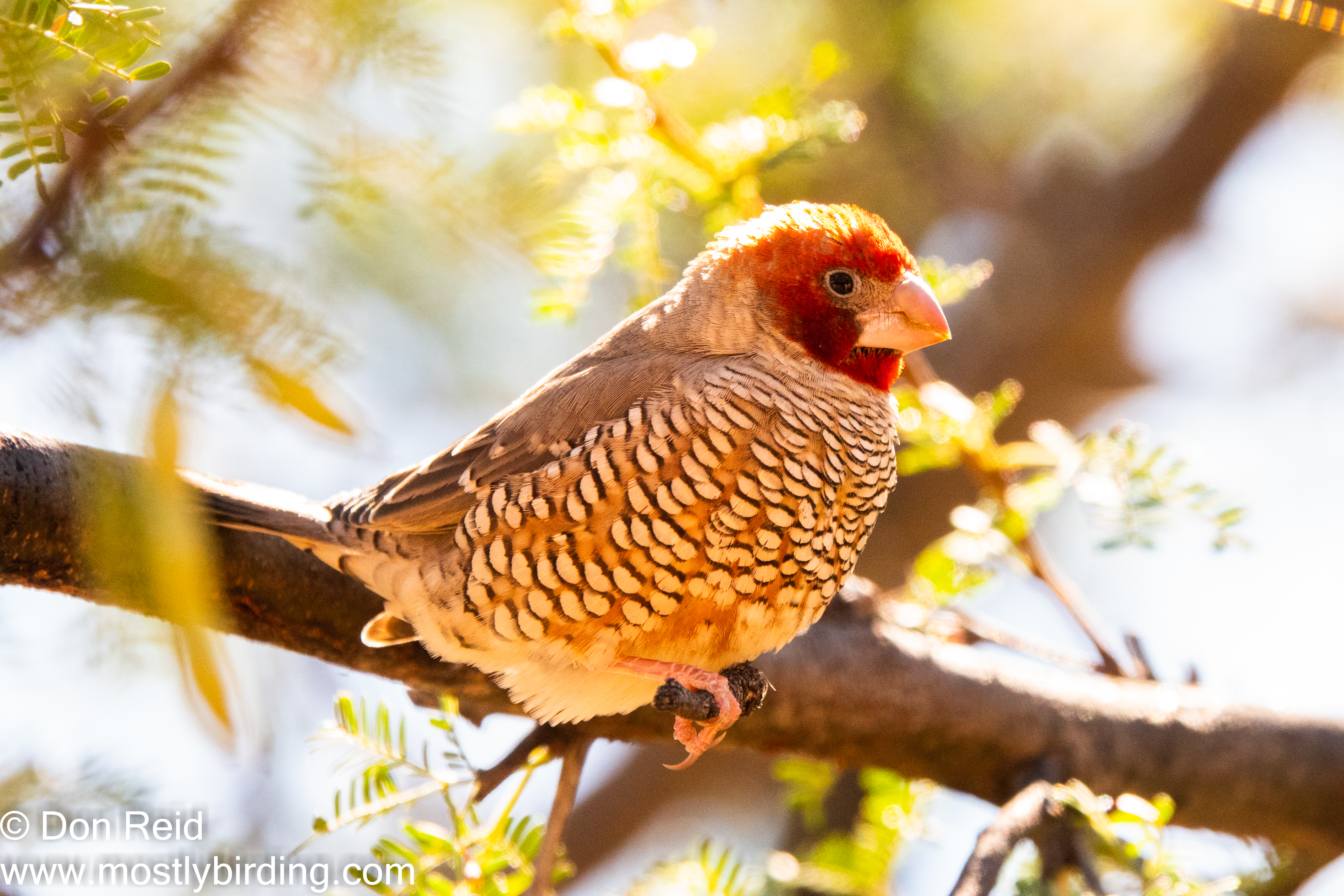
View from the stoep, Mountain Zebra NPRed-headed Finch (Amadina erythrocephala / Rooikopvink) (male race erythrocephala), Mountain Zebra NPWhite-browed Sparrow-Weaver (Plocepasser mahali / Koringvoël), Mountain Zebra NP
Next morning was very relaxed – being Sunday we were up late-ish and most of our morning was spent on the stoep. Apart from the species already shown, other prominent species were Familiar Chat, Red-eyed Bulbul, Red-winged Starling, Acacia Pied Barbet, Bokmakierie and several others.
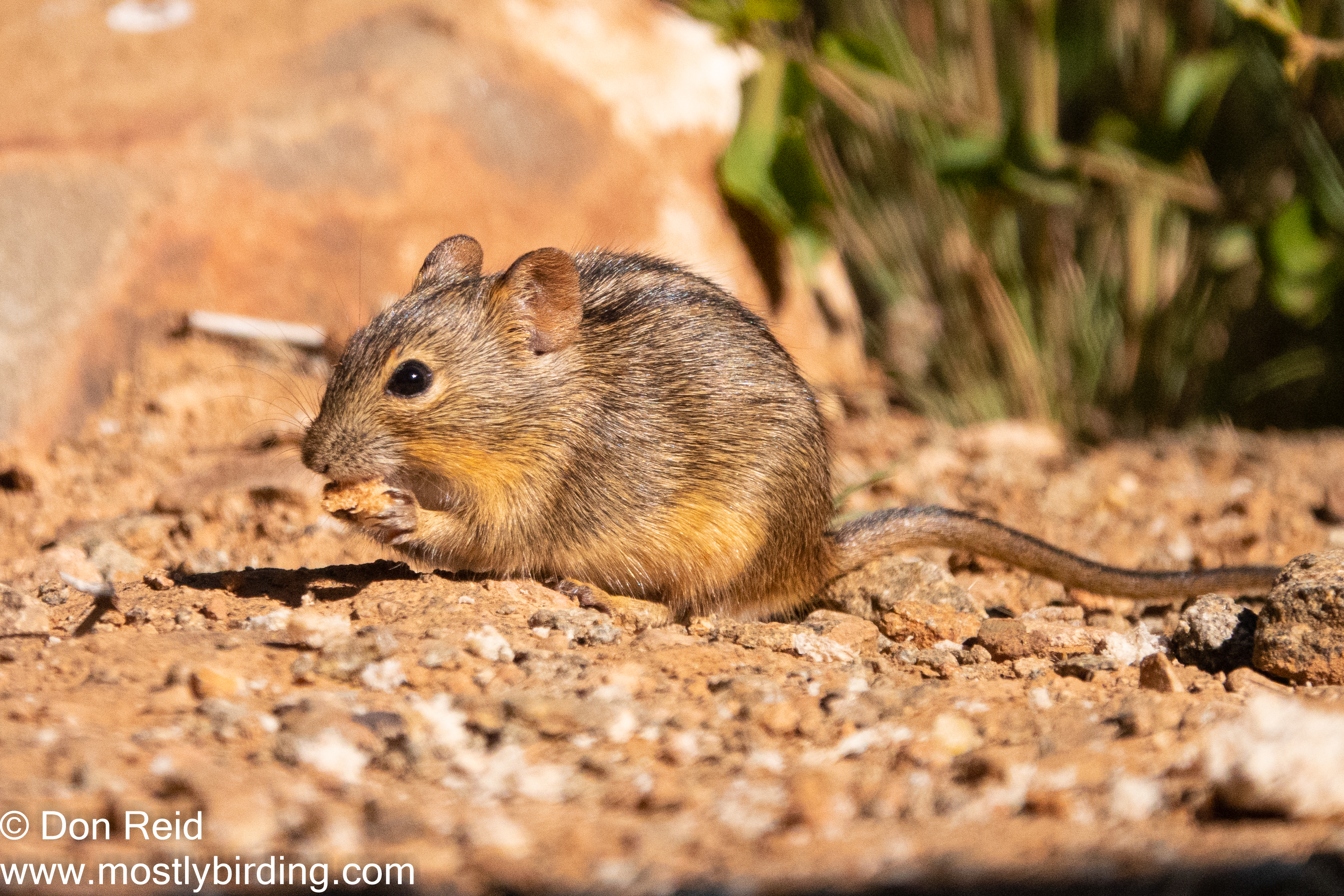
Striped Mice crept cautiously out of the low bushes to grab a morsel in front of the stoep, scurrying back to safety at the slightest movement. Using very slow hand/camera movements I was able to get a few shots of these cute creatures. They are also known as four-striped mice based on the four characteristic black longitudinal stripes down their back.
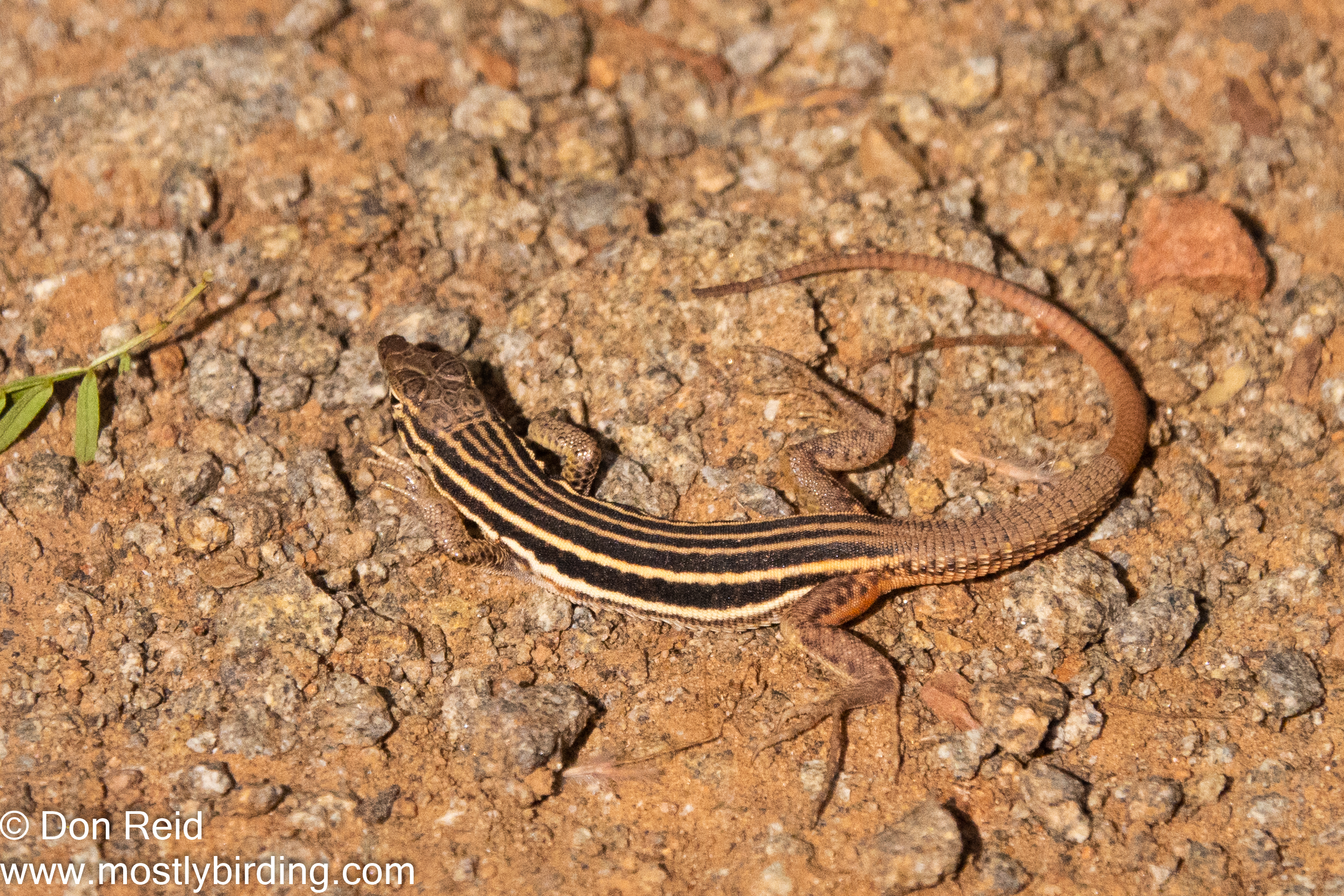
Another striped creature, this time a lizard, put in an appearance alongside the mice, each not taking much notice of the other, probably after small insects that wouldn’t necessarily be on the mice’s menu. With its distinctive stripes, I thought this would be an easy species to identify but the Reptile book I have groups lizards into a few main groups without providing photos of each regional one so I was only able to narrow it down to what I thought was a Mountain Lizard
Lizard – unsure of species but possibly a type of Mountain Lizard
After lunch we set off on a drive on the Rooiplaat Loop, the most popular circular drive and about 25 km out and back. Before ascending to the plateau we spent some time at the picnic spot near the main camp (also mentioned in my earlier post on the Honeythorn Tree) where a few birds were active, including a lone African Hoopoe – such a handsome bird and always a treat to see, even though they are quite common.
A short way further on we came across a group of Vervet Monkeys including a mother and youngster who posed like pros in the lovely shaded light – I am always drawn to their eyes which look so bright and intelligent.
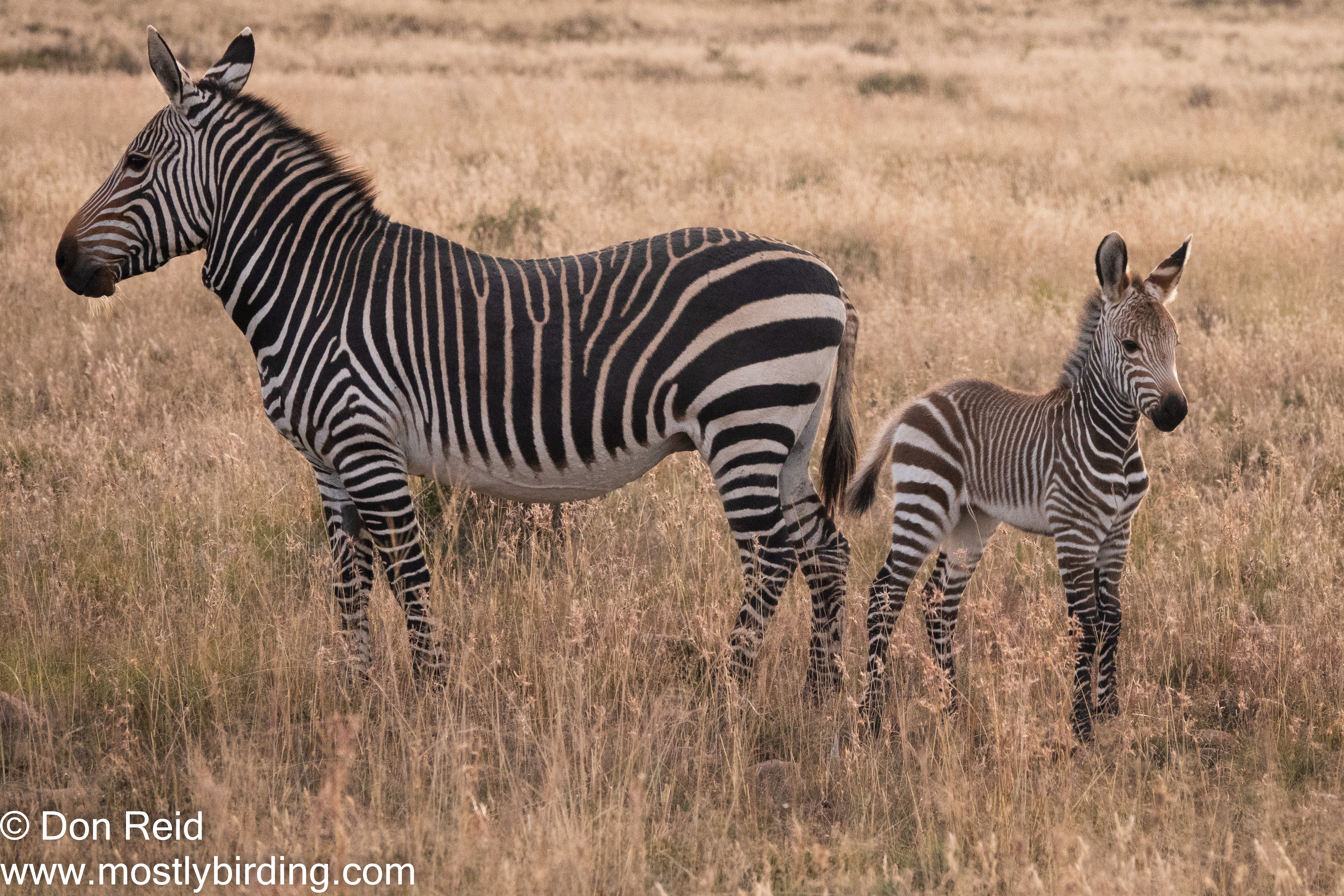
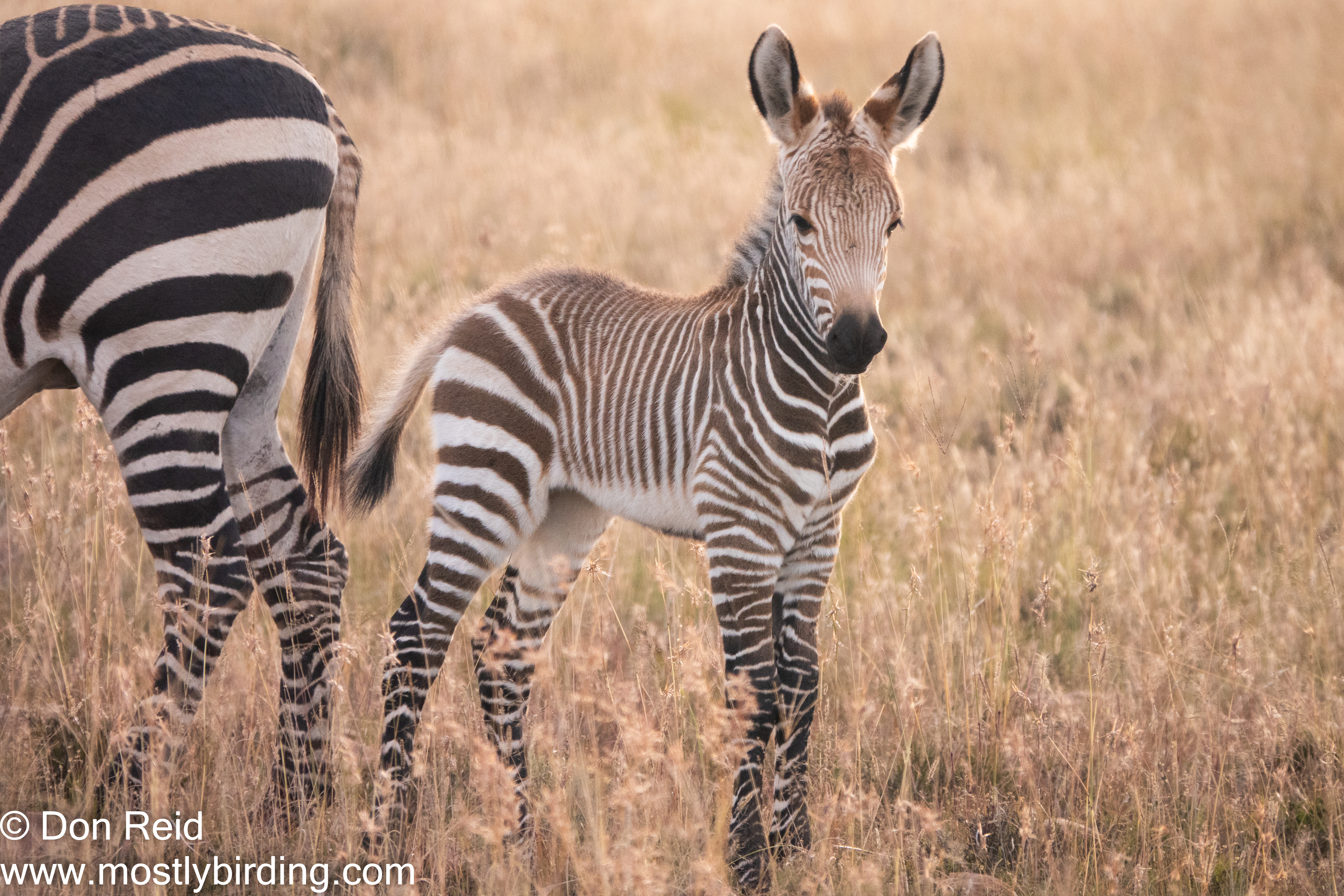
A short climb up the tar road took us to the plateau where the grassland stretched to the horizon, with pockets of game visible in the distance – the return leg took us closer to some of them so I used the opportunity to get some pleasing images, particularly of the Mountain Zebra foal with its parent.
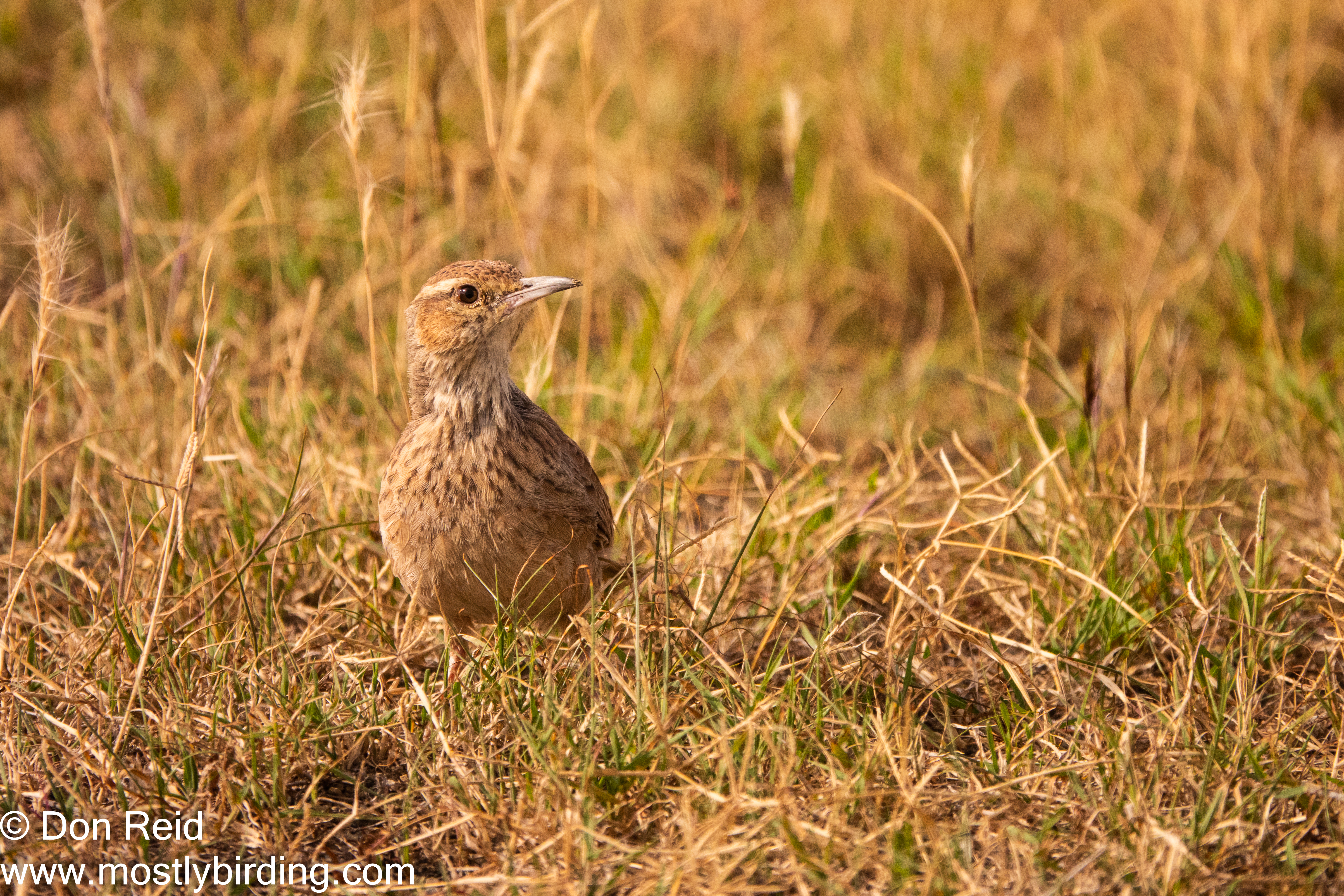
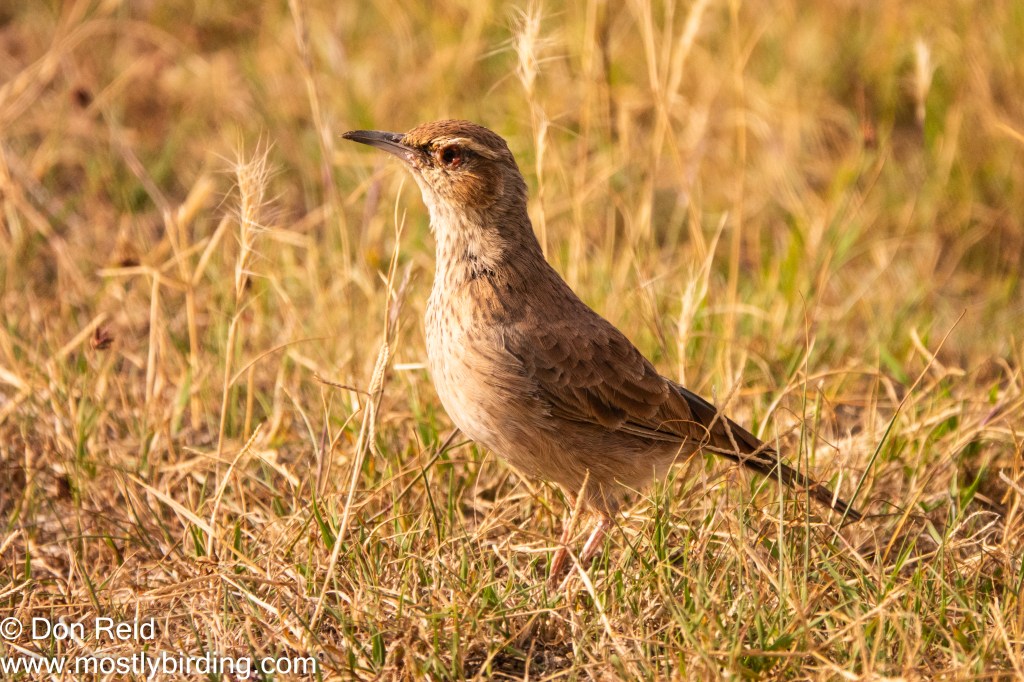
The birds were not plentiful but several of those we came across were species not regularly seen outside of this particular habitat – three species of Lark on the ground (Eastern Long-billed, Spike-heeled and Red-capped Larks), Scaly-feathered Finch and Neddicky in the few trees and a glimpse of Grey-winged Francolin just showing in the long grass.
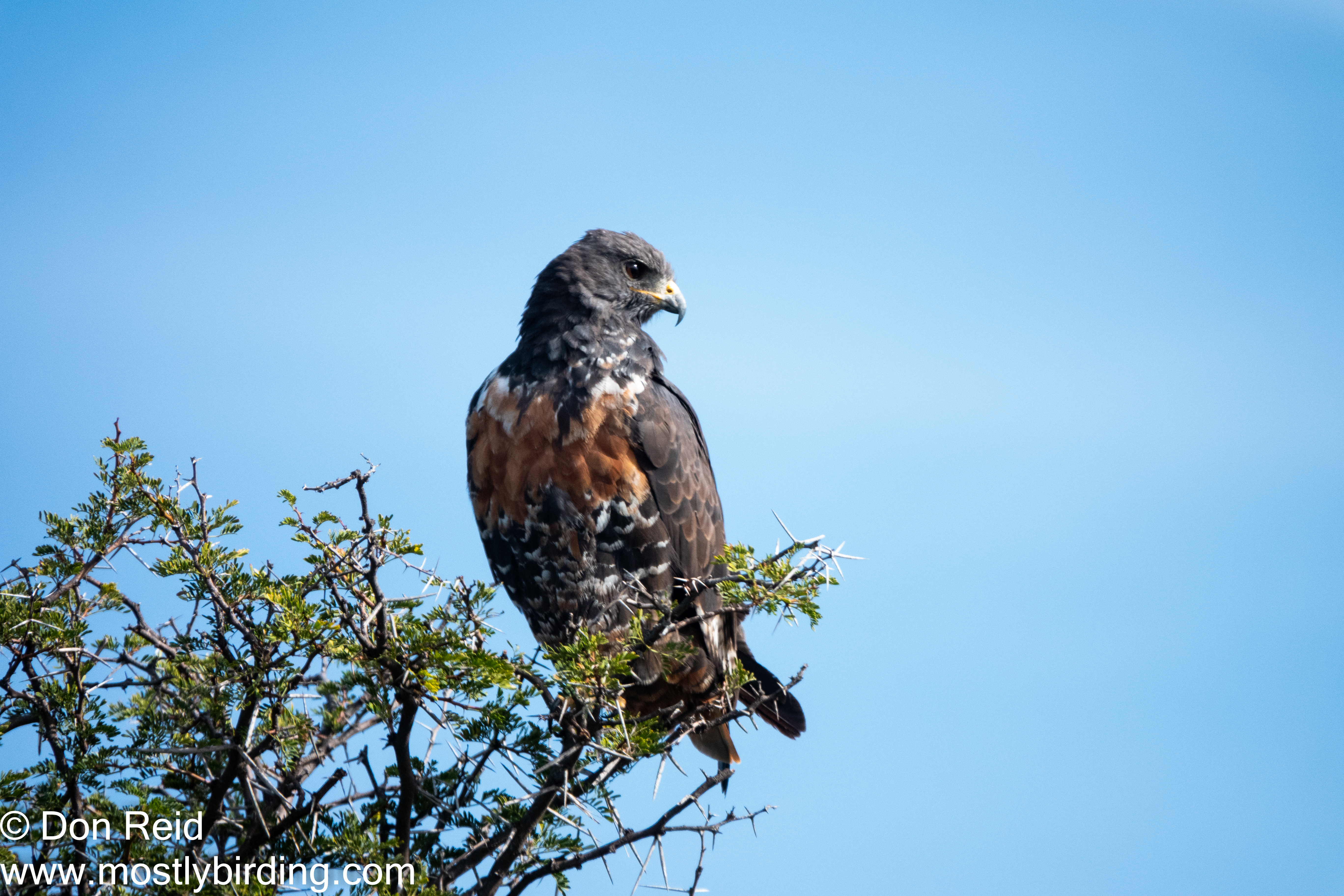
This handsome Jackal Buzzard was no doubt on the lookout for prey –
Larks are a favourite of mine – not the most striking of birds, in fact just the opposite, but that is their attraction and finding them in grassland habitat feels like a real accomplishment, often followed by some serious research to confirm the ID.
We had completed the full circuit of Rooiplaats Loop and started descending the road which winds down from the plateau when I heard a call which caused me to brake sharply – it went like this
Gerda said “what is it, why did you stop so suddenly” – my reply, in an elevated state of excitement, was something like “oh boy, this is a bird I’ve been trying to find for a looooong time”
We were into perfect habitat for what I thought it was – rocky hillsides with large boulders – and after a quick scan I found it on one of the boulders – African Rock Pipit!
Rock Pipit habitat, Mountain Zebra NP
The Pipit. a lifer for me, was perched on the boulder and emitting its distinctive, repetitive call every few seconds and I was doubly pleased to be able to get a few decent photos of it in action
African Rock Pipit (Anthus crenatus / Klipkoester), Mountain Zebra NPAfrican Rock Pipit (Anthus crenatus / Klipkoester), Mountain Zebra NP
To celebrate we went to the park’s restaurant for dinner that evening and, unsure what to expect, were very pleasantly surprised to find brisk service, good food and friendly personnel to round off an outstanding day.















































 Mostly Birding