Atlasing Tales 2 – Little Karoo near Oudtshoorn

Excuses, excuses…

Firstly, regular readers of this blog (yes, both of you) may be wondering why it’s been more than 3 weeks since my last post. I do try and post at least once a fortnight and have more or less managed to keep it up, but these past few weeks have been extra-busy with both Gerda and myself celebrating a milestone birthday. We decided early in the year to take our family – kids and grandkids, numbering 15 altogether including ourselves, to Mauritius for a week, which is where we were during the first week in October. More about that in a post very soon but for the time being this post is a further episode of Atlasing Tales (cue – loud clapping and cheering!!)

Back to Mossel Bay

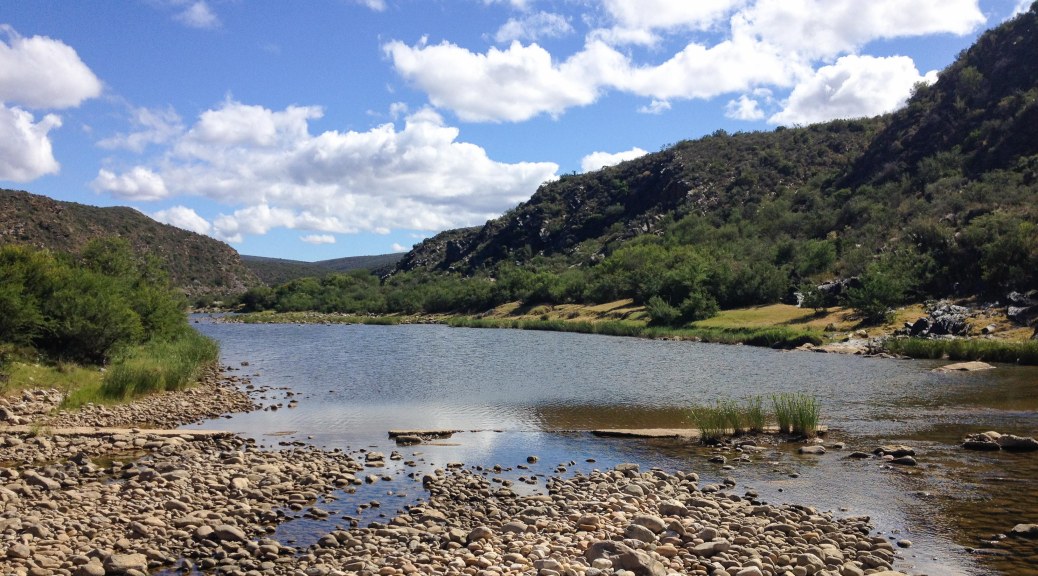
During our late winter visit to Mossel Bay this past August, I was keen to do some atlasing of a couple of the pentads not yet visited in 2017 by any atlasers and eventually settled on two pentads in the Little Karoo near Oudtshoorn, with the added hope of adding some Karoo species to my year list. (For a further explanation of atlasing have a look at my earlier posts on the subject eg Atlasing Tales – Herbertsdale and beyond)

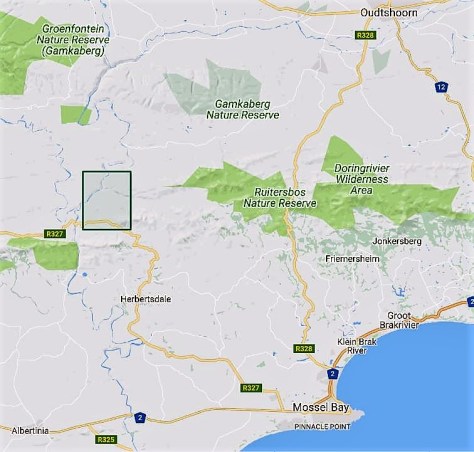
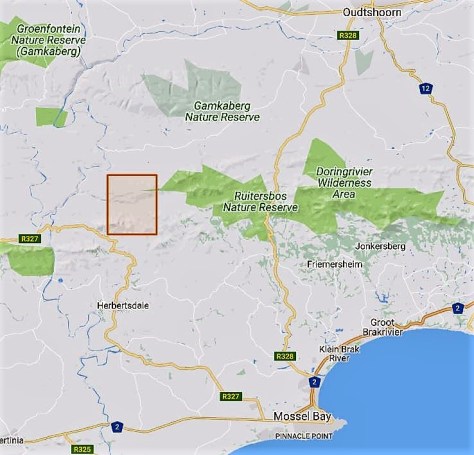
The location of the first pentad is shown on the map below, the second one is directly west of it –

The Little Karoo (better known in South Africa by the Afrikaans name “Kleinkaroo”) is separated from the Great Karoo (“Grootkaroo”) by the Swartberg Mountain Range which runs east-west almost parallel to the southern coastline of South Africa, from which it is separated by another east-west range called the Outeniqua-Langeberg Mountains. The Karoo is a semi-desert natural region of SA, with low rainfall, arid air, cloudless skies and extremes of heat and cold.

Getting there

It was raining lightly when I set off early morning from Mossel Bay and the wet roads had me making my way very carefully up the twisty Robinson Pass, which peaks out at 860 m above sea level and typically has a thick layer of mist or low clouds in the upper parts, as it did today.

Cresting the pass I glanced at the car’s temperature gauge which showed a chilly 5°C, so I welcomed the warmth of the car’s heater, but knew that I would be feeling it once I started atlasing, which one can only effectively do with the car’s windows open in order to be able to hear the birds calling, often the only way of identifying the species if you don’t see them. It was hard to imagine though, that the temperature would be the same 5° C on my way back through the pass at around 1.30 pm that afternoon!

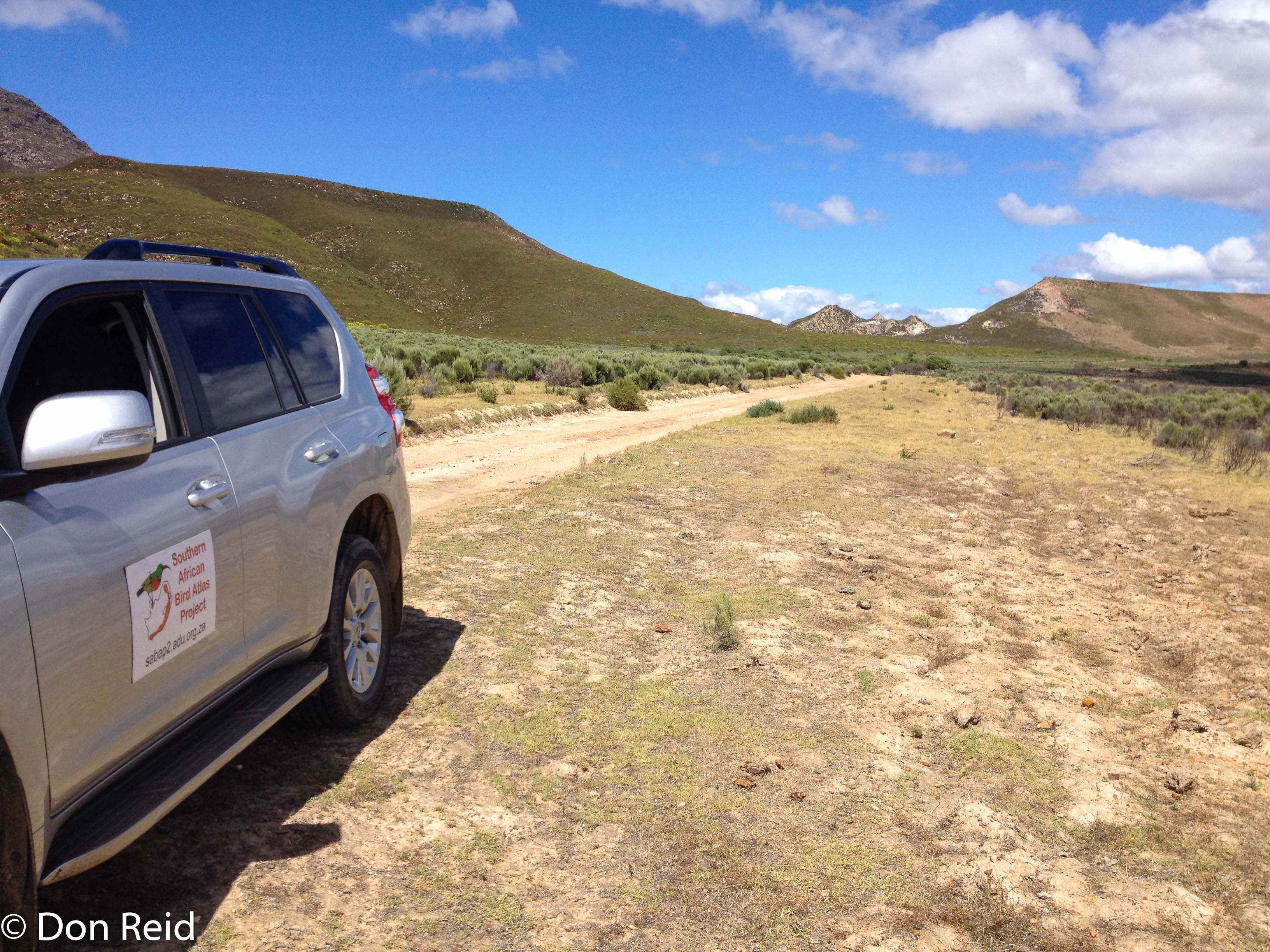
By 7 am I was through the pass and the habitat changed rapidly to that of typical Little Karoo – few trees, many small shrubs and bushes and not much else.

Oudtshoorn south
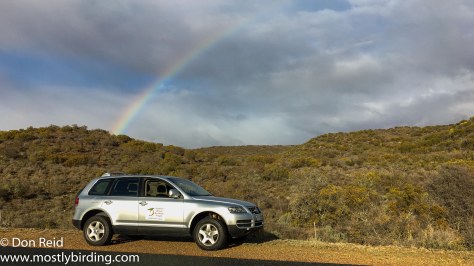
A rainbow appeared when I made my first stop

Atlasing starts

Compared to other parts of the country, birding in the Karoo is slow and measured but immensely rewarding at the same time. When birds are scarce there is a certain pleasure in looking for and finding whatever may cross your path, very different from the abundant birds that other more bird-friendly habitats may provide. It’s a bit like sipping a special wine, taking your time and appreciating each drop, knowing there’s a limited amount and plenty of time.

A Karoo Lark (Karoolewerik ; Calendulauda albescens) drew my attention at my first stop, calling from a fence post then dropping to the ground. Its call was bright and cheerful despite the rather gloomy weather, but I suppose when you live in an arid area such as the Karoo, a bit of rainy weather is worth singing about!

Karoo Lark, Oudtshoorn south

Karoo Lark, Oudtshoorn south
Karoo Lark

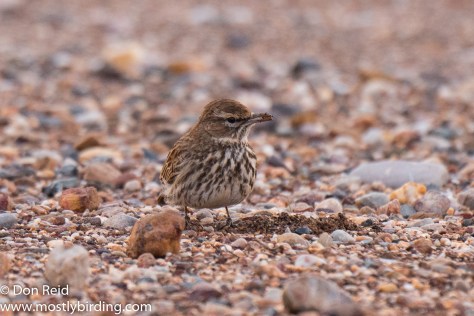
Another Lark sitting on a small bush at a distance from the road had me wondering and I studied it as best as I could at that range, not being close enough to pick up the finer details that are important when trying to identify one of the LBJ’s (Little Brown Jobs). It was streaky brown on the back, seemed to have  some light streaking on the breast – features that most of the larks possess so I was no closer to an ID. However when it turned its head the long decurved bill was a prominent feature, almost Bee-eater like in appearance which pointed towards Karoo Long-billed Lark (Karoolangbeklewerik / Certhilauda subcoronata) – some later study of Faansie Peacock’s excellent book on LBJ’s clinched the ID for me. When I submitted the card for the pentad it generated an ORF (Out-of-range form) for this species, which I still have to complete and submit in order to get the ID verified – all part of being a “Citizen Scientist”

The photo was taken previously in the Karoo National Park –

Karoo Longbilled Lark, Karoo National Park
Karoo Long-billed Lark

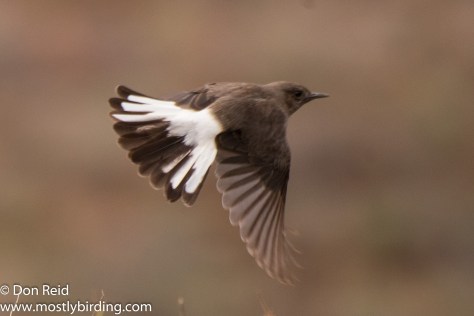
A gravel side road, signposted Kandelaarsrivier proved to be an interesting diversion and I followed it for a few kms not far from the mostly dry river course and past several farmsteads. Along the way I came across a group of Mountain Wheatears (Bergwagter / Oenanthe monticola) which were quite accommodating, allowing a close approach in my vehicle for some pleasing photos of this species which is usually at a distance.

Mountain Wheatear (female), Oudtshoorn south
Mountain Wheatear (female)
Mountain Wheatear (female), Oudtshoorn south
Surprising how much white is visible in flight

Both Speckled and White-backed Mousebirds (Gevlekte en Witkruismuisvoëls / Colius striatus and Colius colius) showed themselves at a spot further on – it’s interesting how they sometimes seem to stick close together yet don’t occupy the same tree.

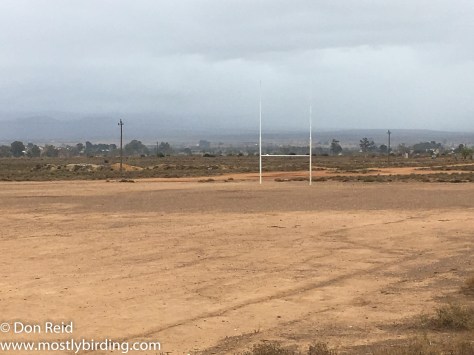
I continued along the back roads past small villages and settlements, stopping to have a closer look at a handsome stone country church and exploring a side road which looked interesting but only took me to a rugby field, which could surely only be found in the Karoo – no grass, just a hard gravel surface. I had to wonder how they played such a physical game on this surface – they obviously breed some hard players in the area or they have very good medical care.

Rugby field, Oudtshoorn south

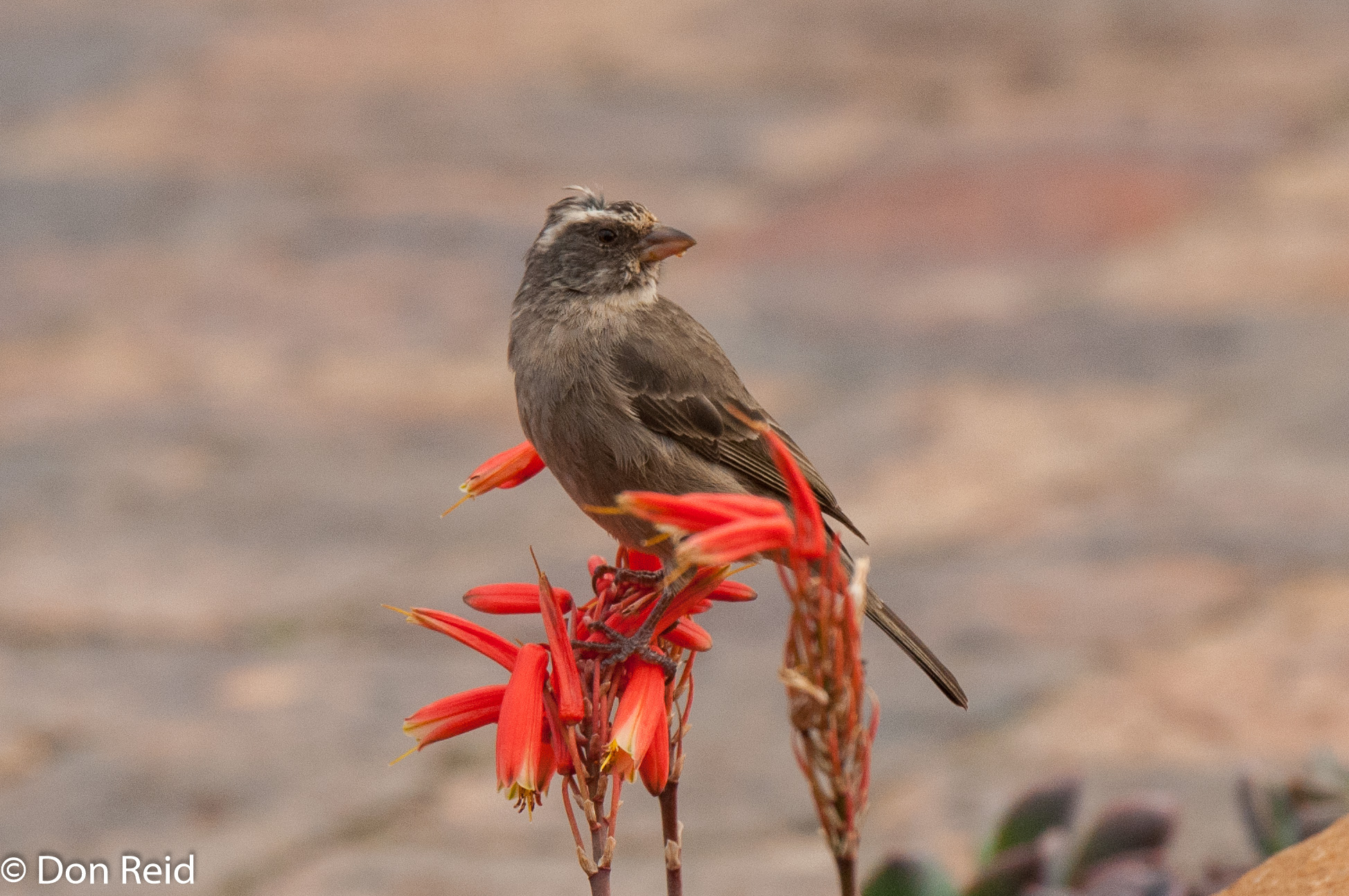
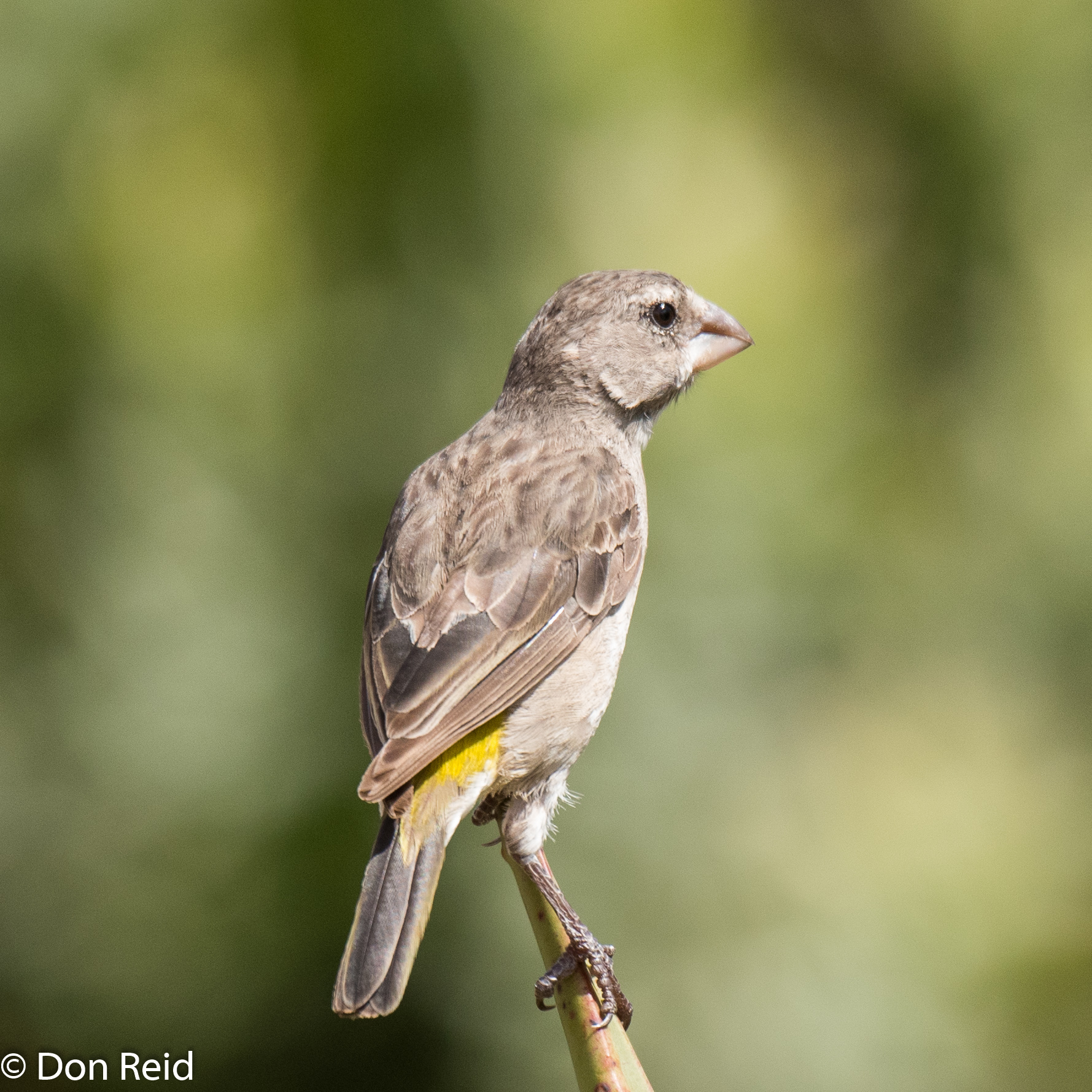
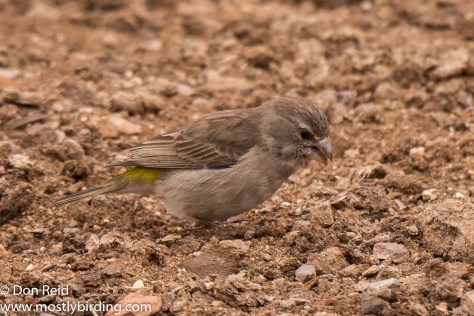
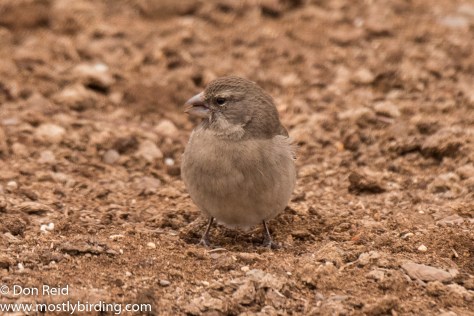
At another farmstead a group of White-throated Canaries (Witkeelkanarie / Crithagra albogularis) was busily gathering seeds from the ground, possibly spilled or perhaps from a nearby tree.

White-throated Canary, Oudtshoorn south
White-throated Canary – note the hint of yellow rump showing

White-throated Canary, Oudtshoorn south

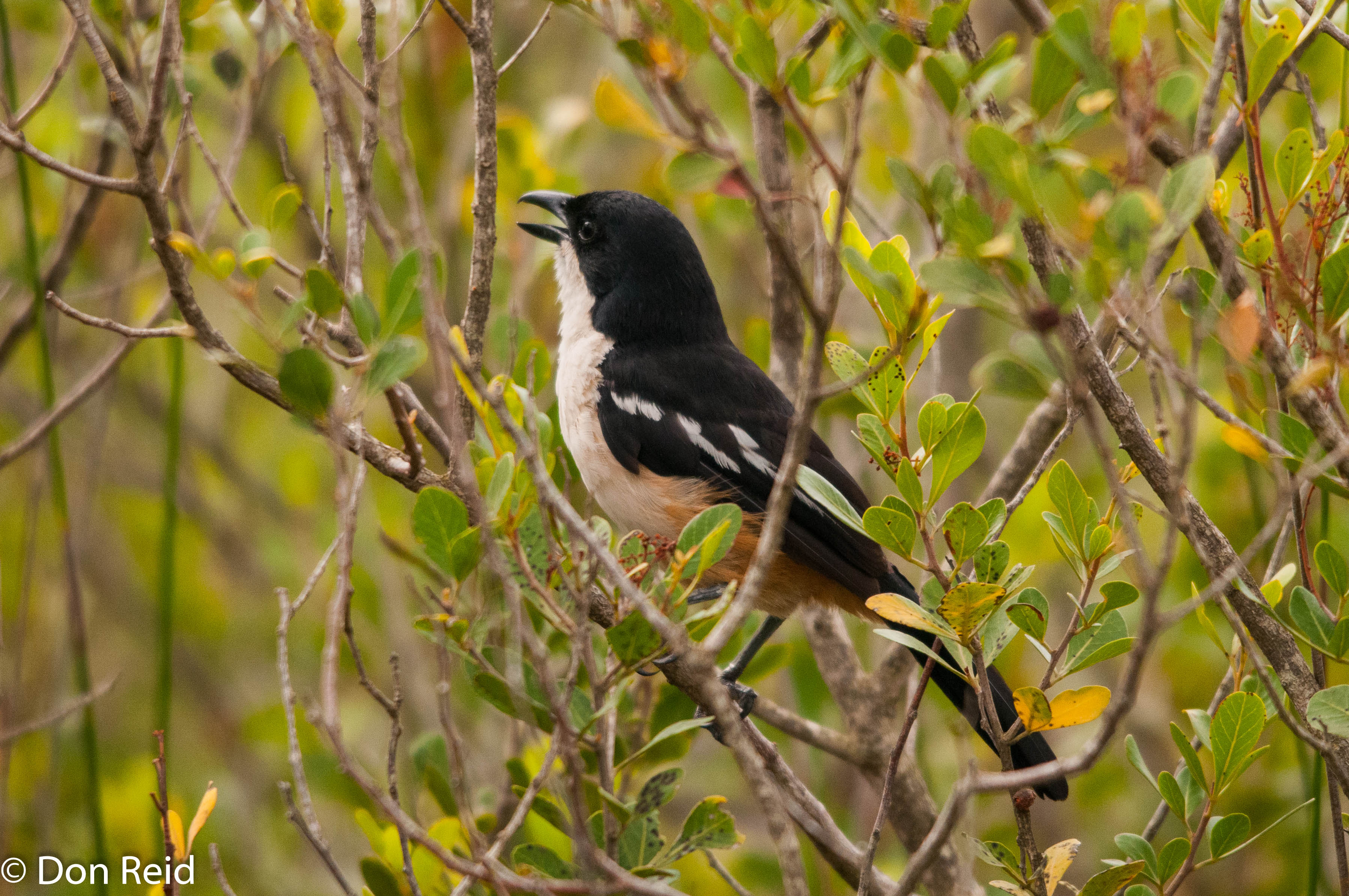
Heading back towards the Robinson Pass I was soon into my second target pentad for the day … 3340_2200 and added Pied Starling (Witgatspreeu ; Lamprotornis bicolorCommon Starling (Europese spreeu ; Sturnus vulgaris) and Bokmakierie (Bokmakierie ; Telephorus zeylonus)fairly quickly. Another gravel road wound its way past a quarry, which also happened to be the destination of several lorries which kicked up clouds of dust each time they passed, making the conditions unpleasant for a while. Nevertheless between dust clouds I found a Karoo Chat (Karoospekvreter ; Cercomela schlegelii)and Pale Chanting Goshawk (Bleeksingvalk ; Melierax canorus)and heard the distinctive call of a Pririt Batis (Priritbosbontrokkie ; Batis pririt)

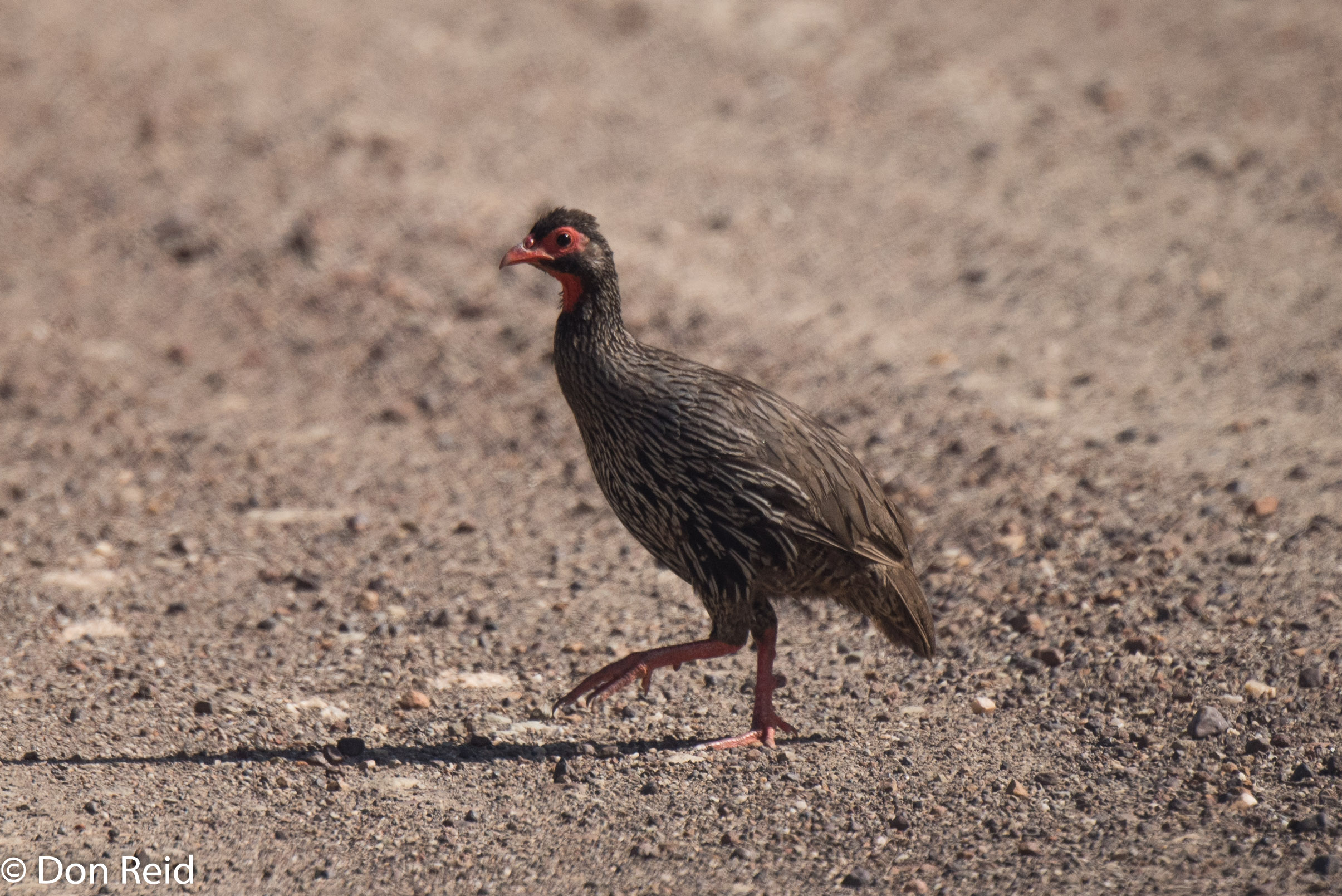
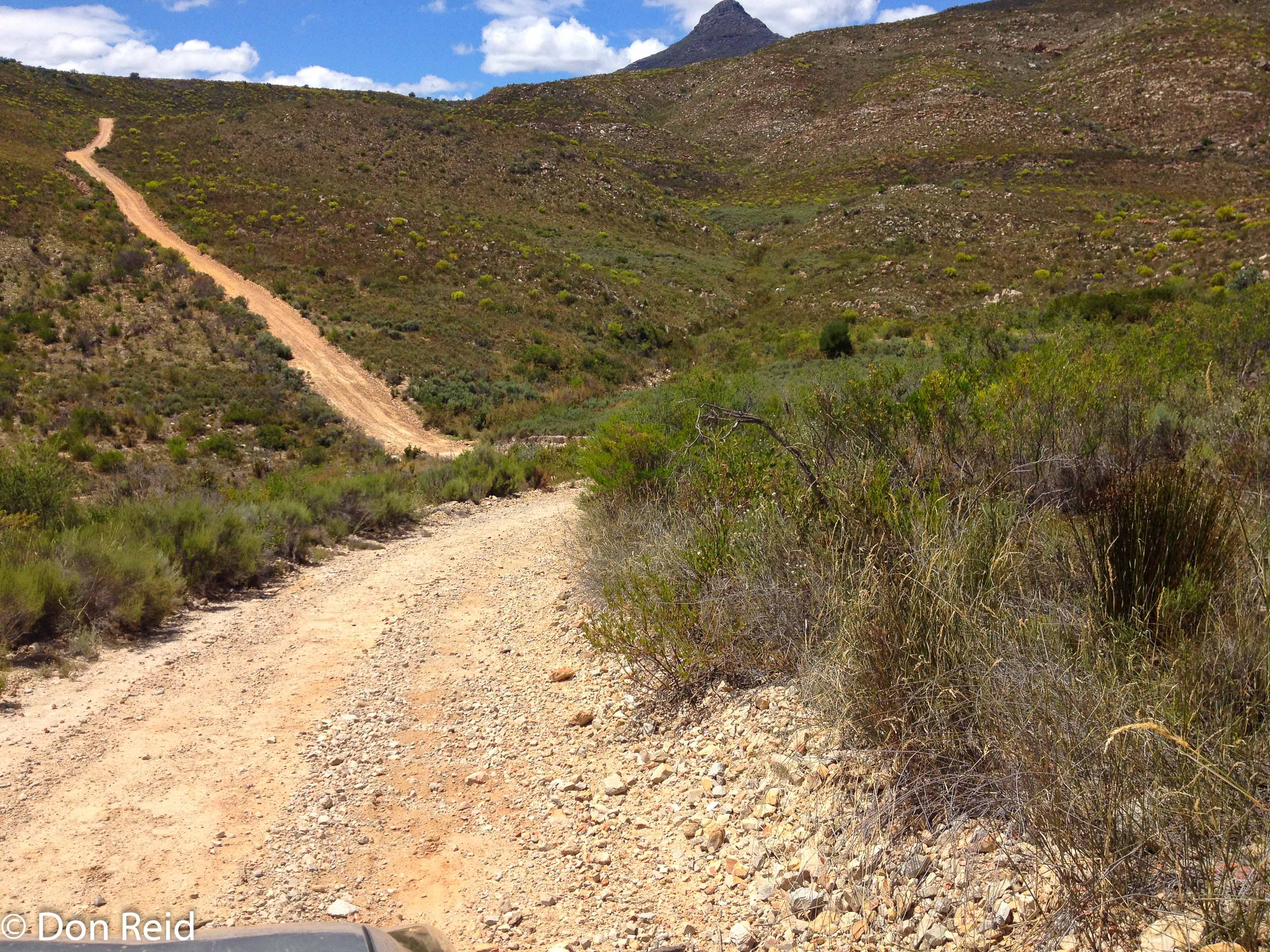
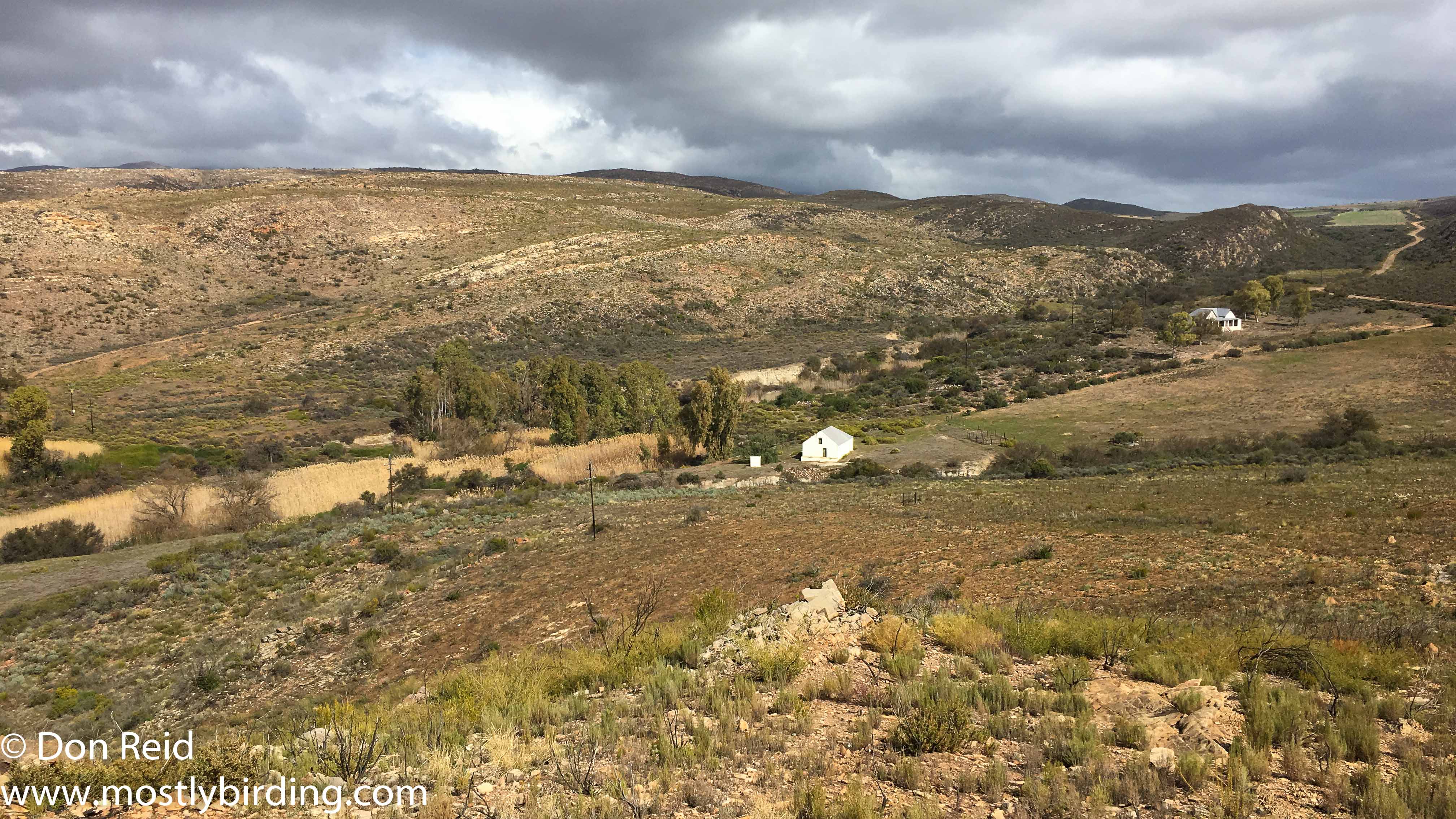
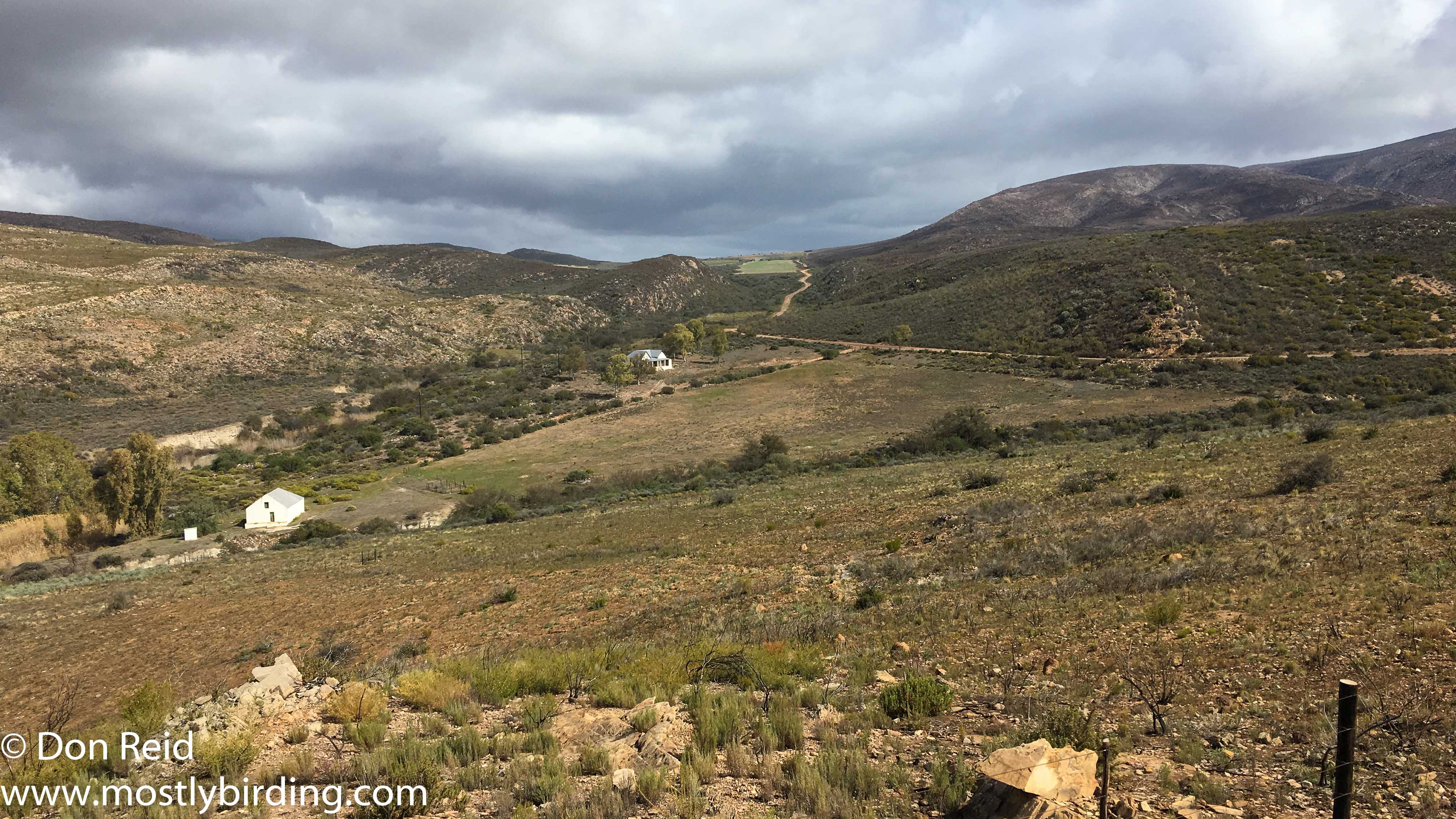
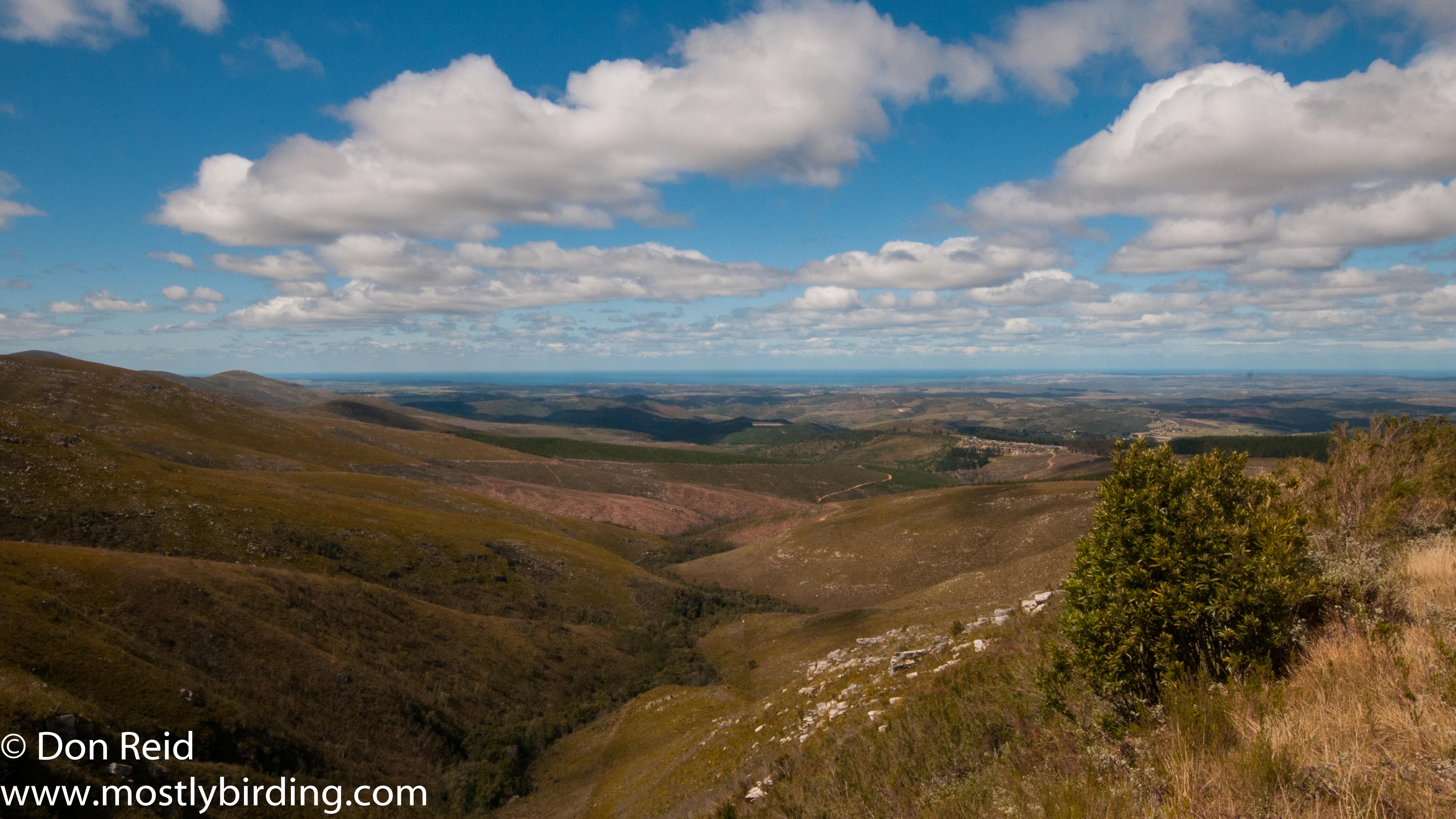
Once past the quarry I could stop and enjoy the peace of the surroundings again and soon added Cape Bunting (Rooivlerkstreepkoppie ; Emberiza capensis), Acacia Pied Barbet (Bonthoutkapper ; Tricholaema leucomelas)and Namaqua Warbler (Namakwalangstertjie ; Phragmacia substriata). Just before exiting the pentad Cape Crow (Swartkraai ; Corvus capensis)and Cape Spurfowl (Kaapse fisant ; (Pternistis capensis) were welcome additions. The landscape changed to more hilly country, providing some magnificent views….

From there it was a question of finding the shortest route back to the main road to Mossel Bay, which turned out to be a “gated” road through rolling hills, necessitating the “stop, open gate, drive forward, stop, close gate” procedure repeated four times along the way. Not at all onerous when your travelling through such rugged and handsome countryside with no other vehicles to be seen, it just adds to the “getting away from it all” feeling. I eventually got back to the tar road at the Paardebont turn-off where I turned right onto the road back home.

Gate along a wet road

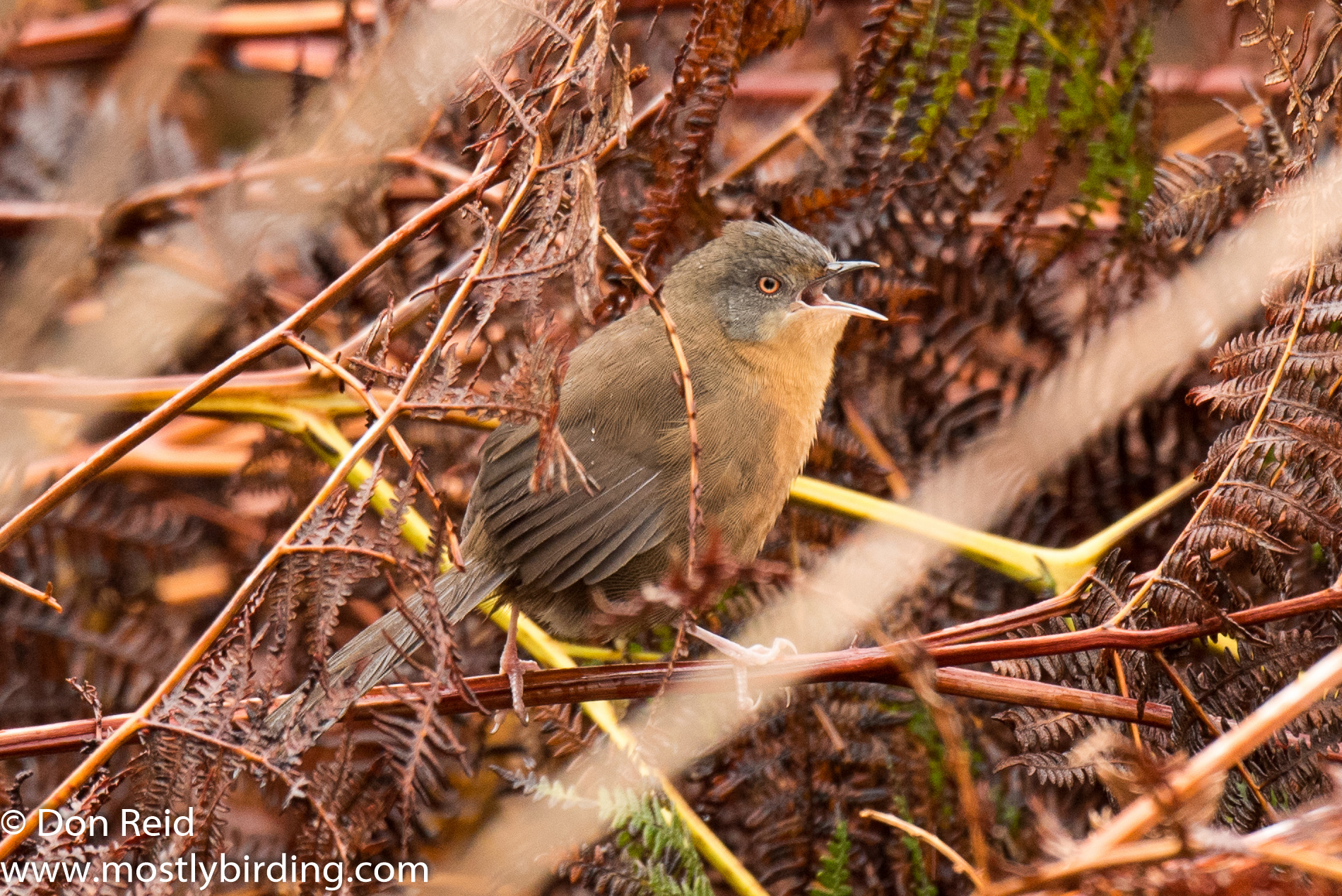
The day’s excitement wasn’t done yet however – heading down the Mossel Bay side of the Robinson Pass, I stopped at the roadside picnic spot where I had found my first Victorin’s Warbler (Rooiborsruigtesanger ; Cryptillas victorini) a few years ago – as luck would have it I almost immediately heard one in the bush just below the road and soon found it threading its way through the dense undergrowth which is their preferred habitat.

After a couple of frustrating misses with my camera, I surmised which direction it was heading and went up ahead to wait for it to appear. This strategy worked as it briefly emerged from the bush and I rattled off a few shots while it called loudly. Eureka!

Victorin’s Warbler, Robinson Pass
View of Mossel Bay from Robinson Pass (taken on a sunnier day)

Well satisfied, I headed homeward

The Atlasing statistics

Pentad 3340_2205

21st Full Protocol card for the pentad ;    Out of Range form received for Karoo Long-billed Lark ; Total species for the pentad now 141 ; my total for the 2 – 3 hours was 31 or 22% of the pentad total

Pentad 3340_2200

12th Full Protocol card for the pentad ;   Total species for the pentad now 111 ; my total for the 2 hours was 23 or 21% of the pentad total


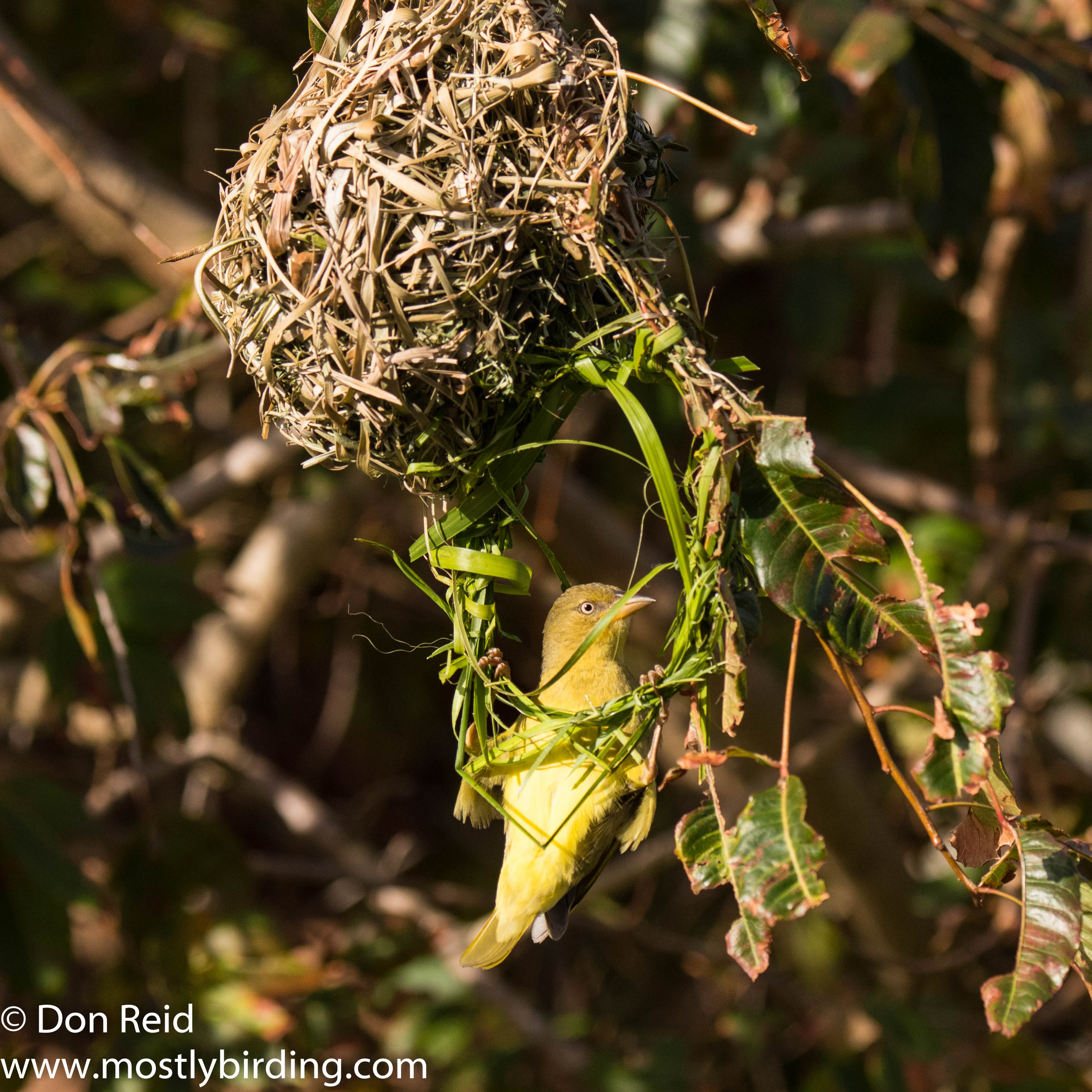
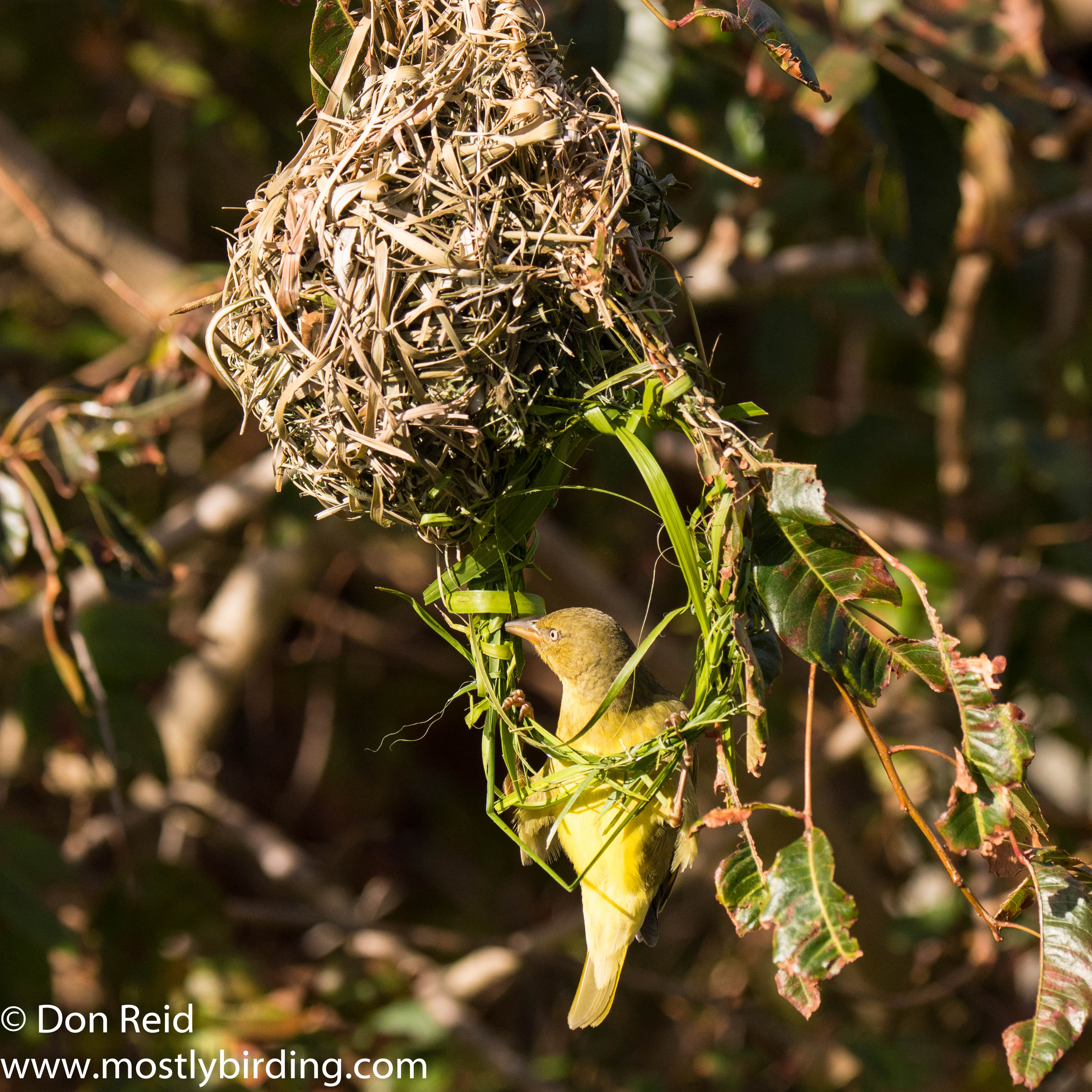
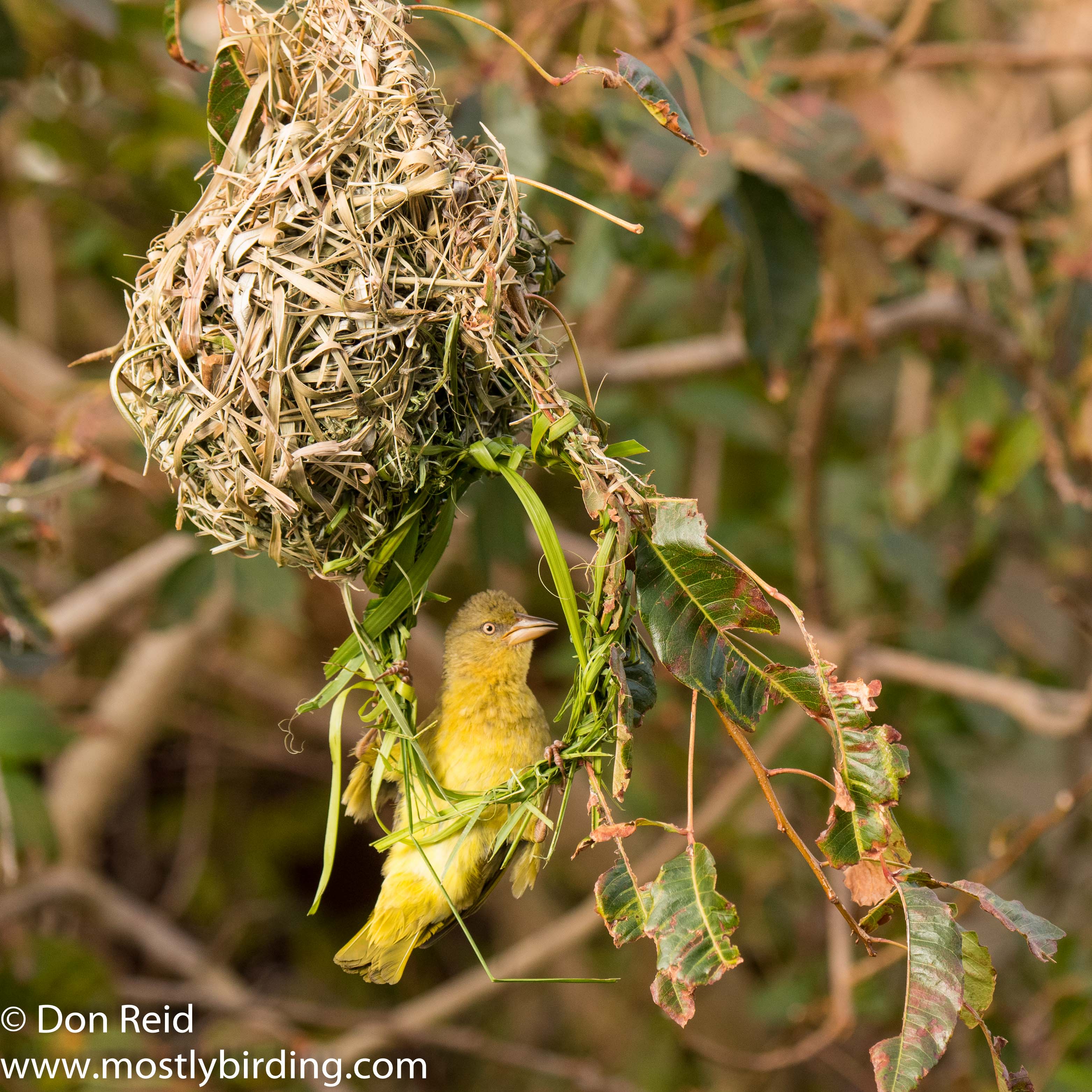
Nest building 101 – Cape Weaver does his thing

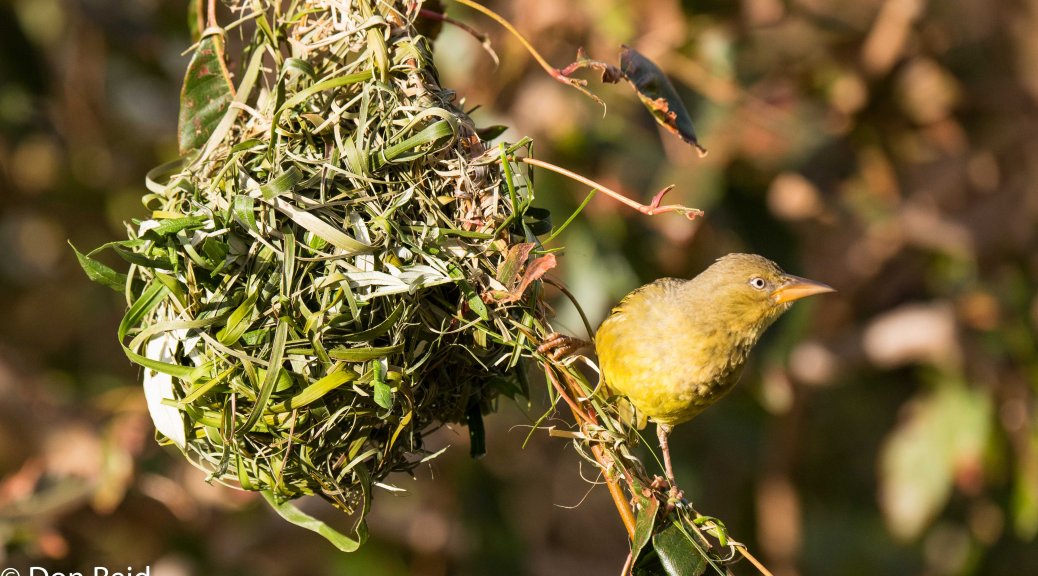
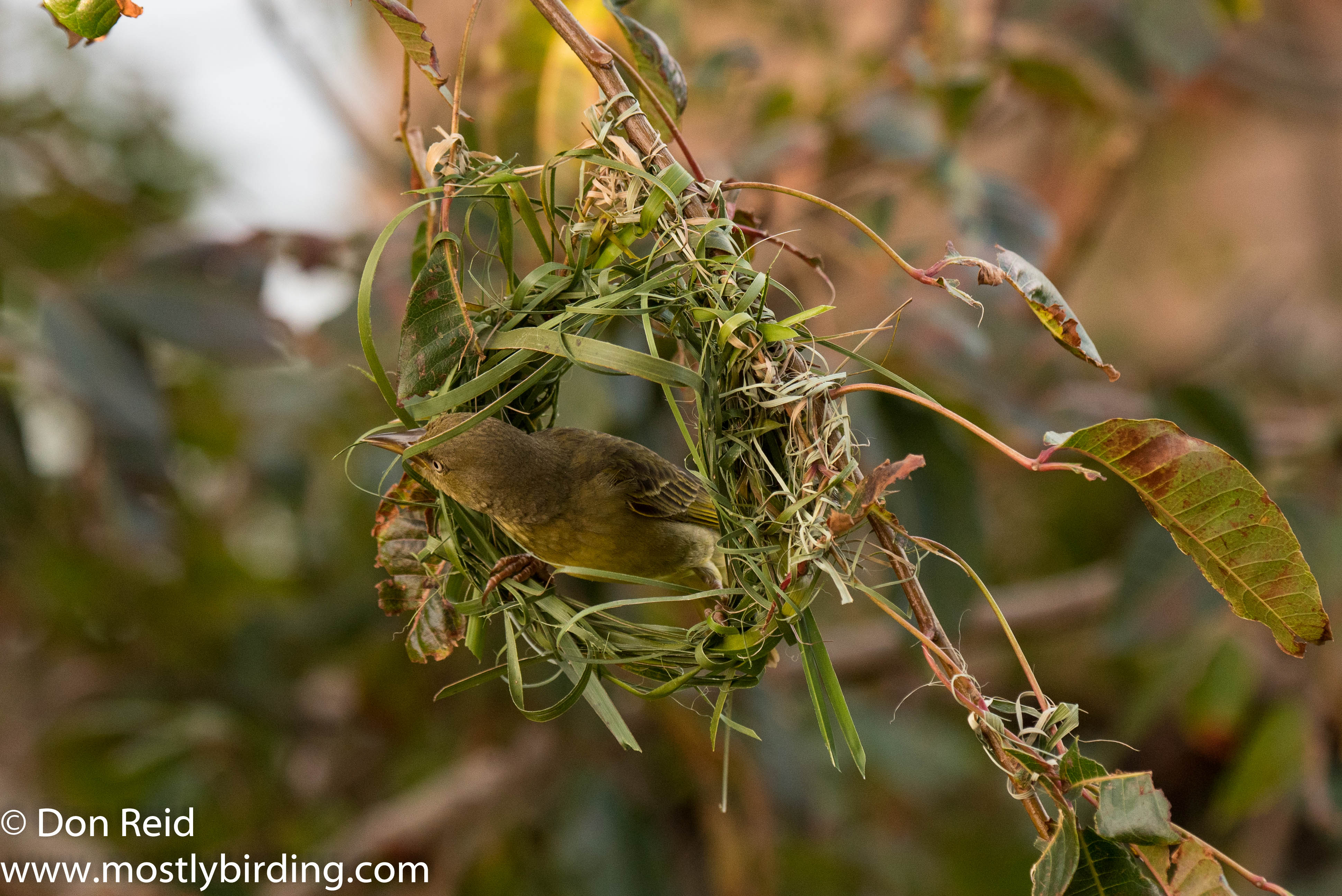
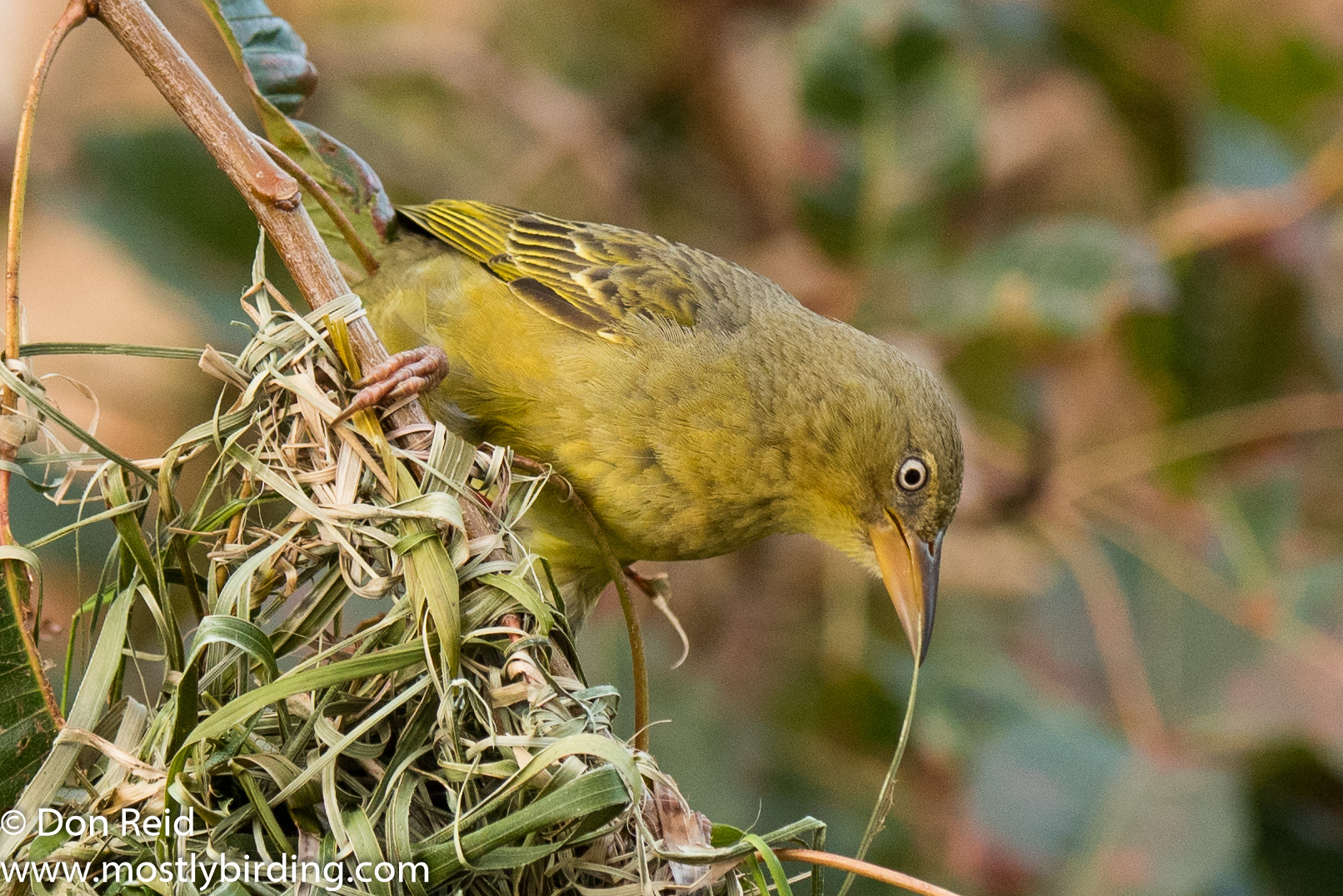
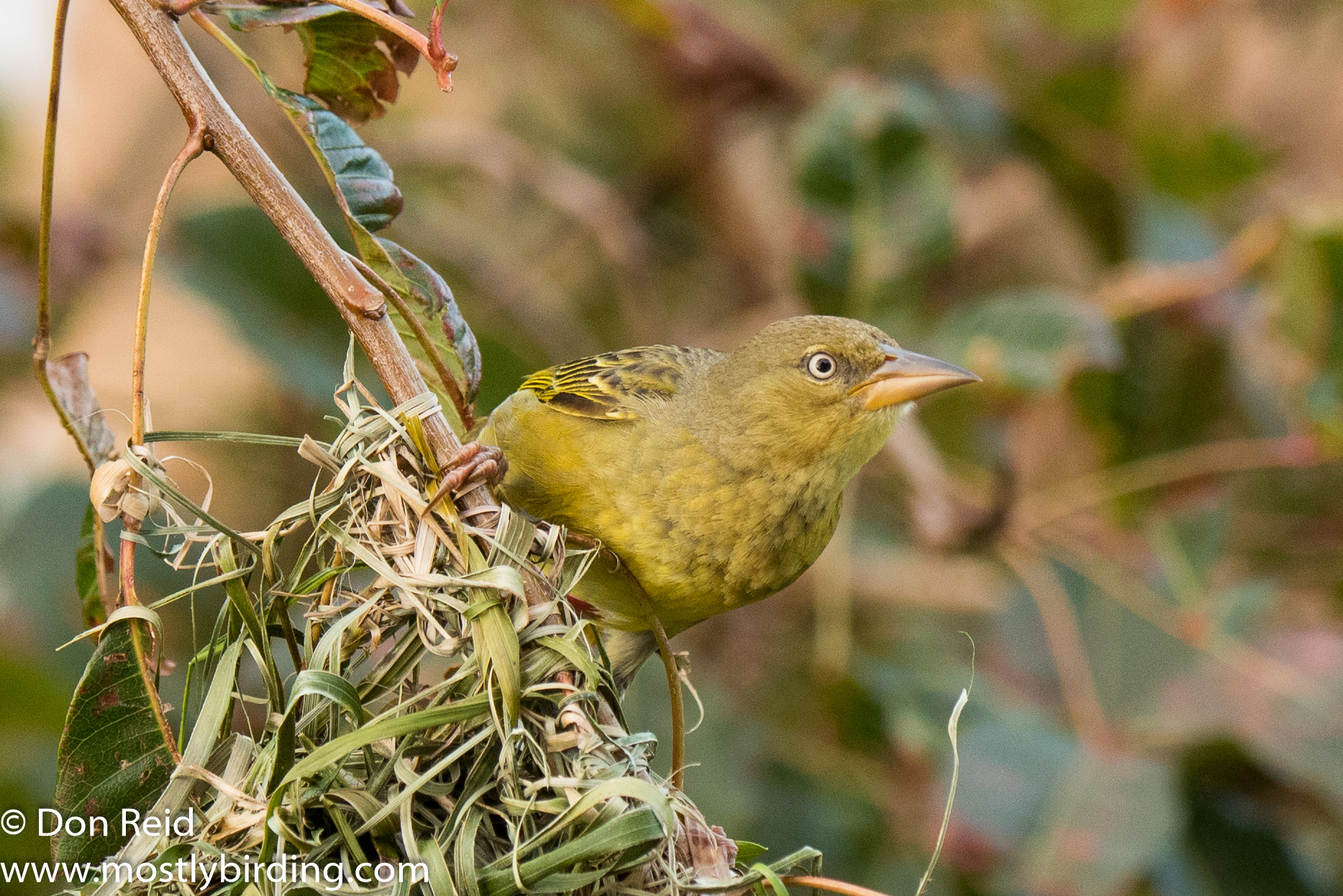
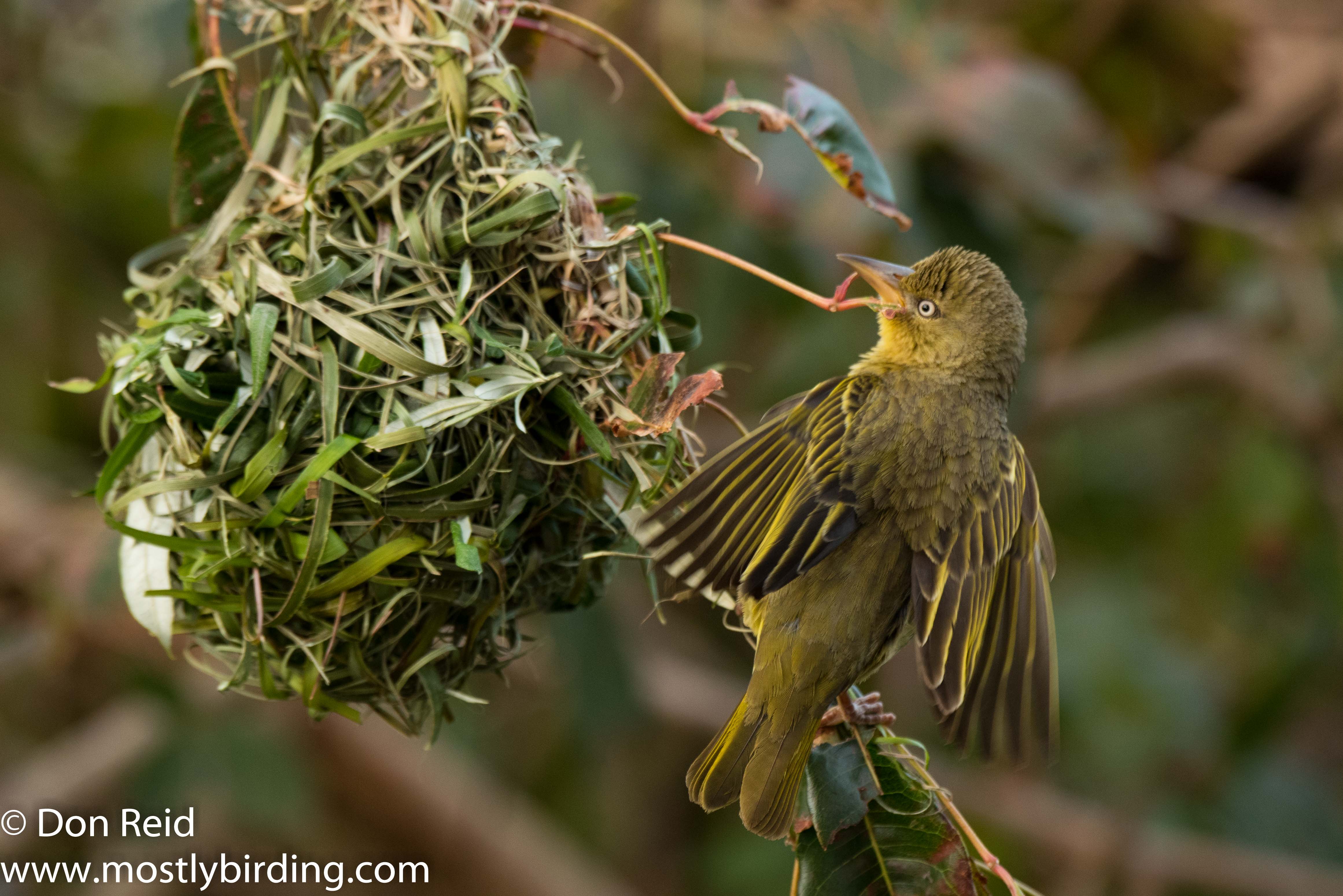
Our recent short ‘end-of-winter’ visit to Mossel Bay was made interesting by a Cape Weaver (Kaapse Wewer / Ploceus capensis) who had chosen the neighbour’s tree for his nest for the new breeding season. Although not in our garden, the tree overhangs our small lawn and as luck would have it the branch that was chosen by the Weaver was no more than 2 m from our bedroom window and marginally more from our balcony.

By the time we spotted it, the initial ring had already been woven by the busy Weaver and I promptly set up my camera at our bedroom window, linked it to my iphone (using the clever Nikon app and the built-in wifi connection of my Nikon camera), then sat in the lounge where I would not be seen by the bird and clicked away whenever the Weaver appeared on my iphone screen. I love it when technology comes together!

This technique produced some clear shots of it arriving at the partial nest with a length of grass or piece of leaf and as it set about the intricate task of weaving it into the growing structure. Fascinating to watch as the nest slowly grew and took shape. Once the nest was more or less complete and well-shaped the Weaver shifted his attention to the thin branch to which it was attached, stripping it of leaves – we could only guess this was a strategy to prevent unwanted “visitors” from using the foliage to conceal their approach.

After a couple of days of frenetic activity the bird seemed satisfied – except nothing happened, no female took occupation and the nest just hung there, unoccupied. A very windy day tested the nest structure to the limit and it seemed to withstand the battering without damage.

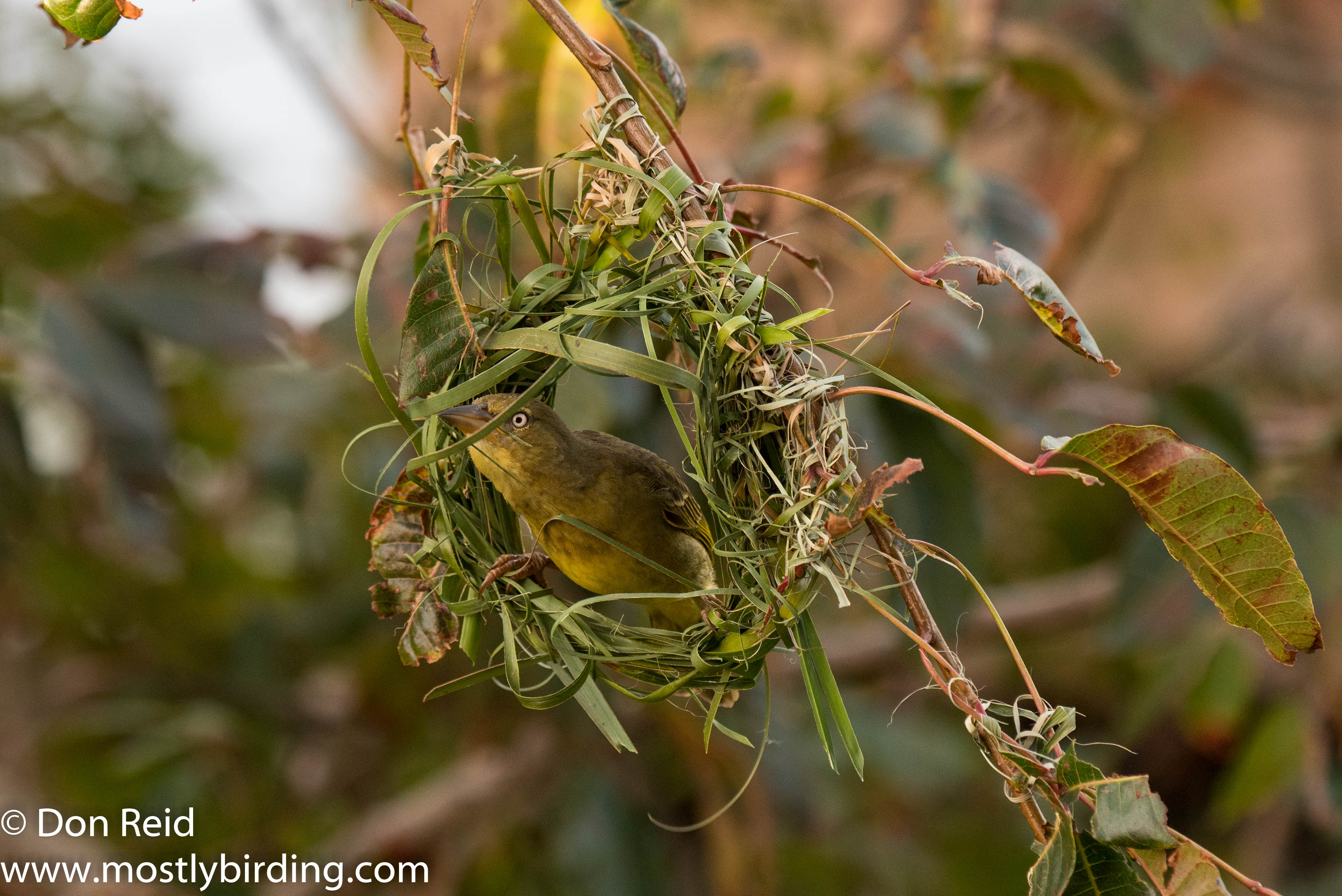
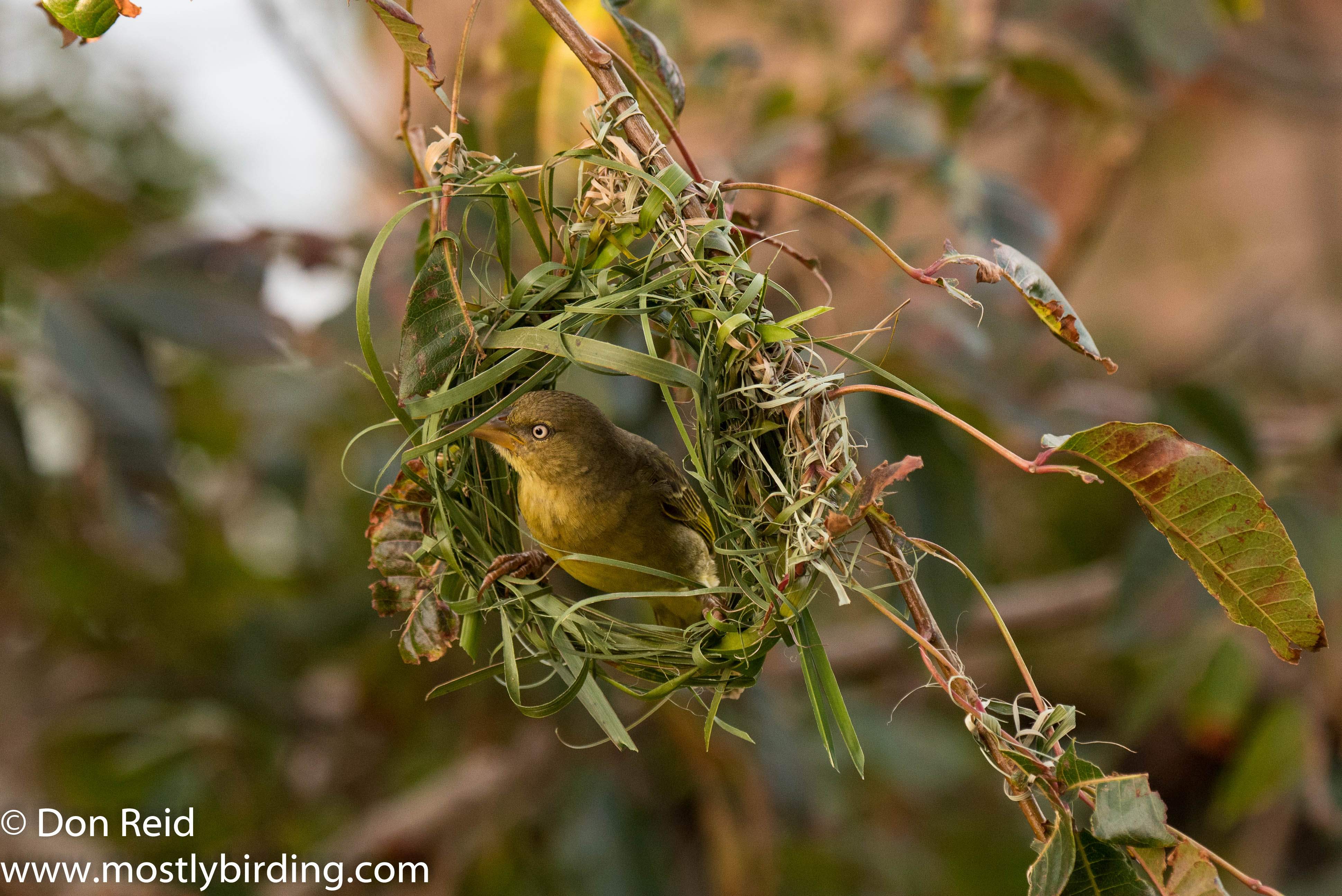
Then a day before we were to leave, a second ring frame appeared, attached to the outer wall of the first nest and we once again watched fascinated as the same Weaver set about building a “semi-detached” extension to the nest. This is not something I have seen before although Weavers are known to build more than one nest, often several, usually in different locations in the same tree, before the female of the species indicates her acceptance and takes occupation. (Right now I am resisting the temptation to make some further comment about this behaviour, relating to the female of another species that I am familiar with….)

Unfortunately we could not stay to see the outcome of this new development – perhaps there will be some evidence of the outcome when we return in November.

Anyway, here is a selection of the photos I took surreptitiously of the Weaver

Monday

Arriving at the nest with fresh grass strand

Starter ring being constructed

Friday

Finishing off

Busy Weaver

A bit of displaying might impress her

Saturday, one week later

You think semi-detached will work better? – Yes, of course dear!

Now where does this one go again?

I really don’t like being watched while I’m weaving

Wonder if this one is going to be good enough?

Can’t wait to see what happened!


Spring Day in Mossel Bay

Spring Day is celebrated in South Africa (and the southern hemisphere) on 1st September, which is when the seasons ‘officially’ turn and the days are supposed to get warmer as winter comes to an end and we head towards summer again. No public holiday has been declared (yet?) but it’s just a day when many businesses encourage their staff to dress casually and people forget some of their problems or relegate them to the back of their mind for a while.

We were in Mossel Bay for two weeks leading up to the day and knowing how the weather can vary – up to 4 seasons in one day as our mother used to say of Cape Town –  I wasn’t expecting anything different from the typical August weather we had experienced so far. Chilly overcast days were followed by a chilly sunny days, followed by rainy, windy days and then the cycle more or less repeated itself.

So if you had the choice, what would your perfect day look like, weather-wise? If it was possible to choose the perfect Spring Day weather, I would make sure it was pleasantly sunny, the temperature would be not too hot, not too cold – say about 20 to 25 degrees C, there would be a whisper of a breeze to keep things fresh and there would be at most a few fleecy clouds to break the cobalt blue sky.

Well, apart from being a cloudless  day, Spring Day in Mossel Bay ticked all my boxes and turned out just about as perfect as it is possible to be.

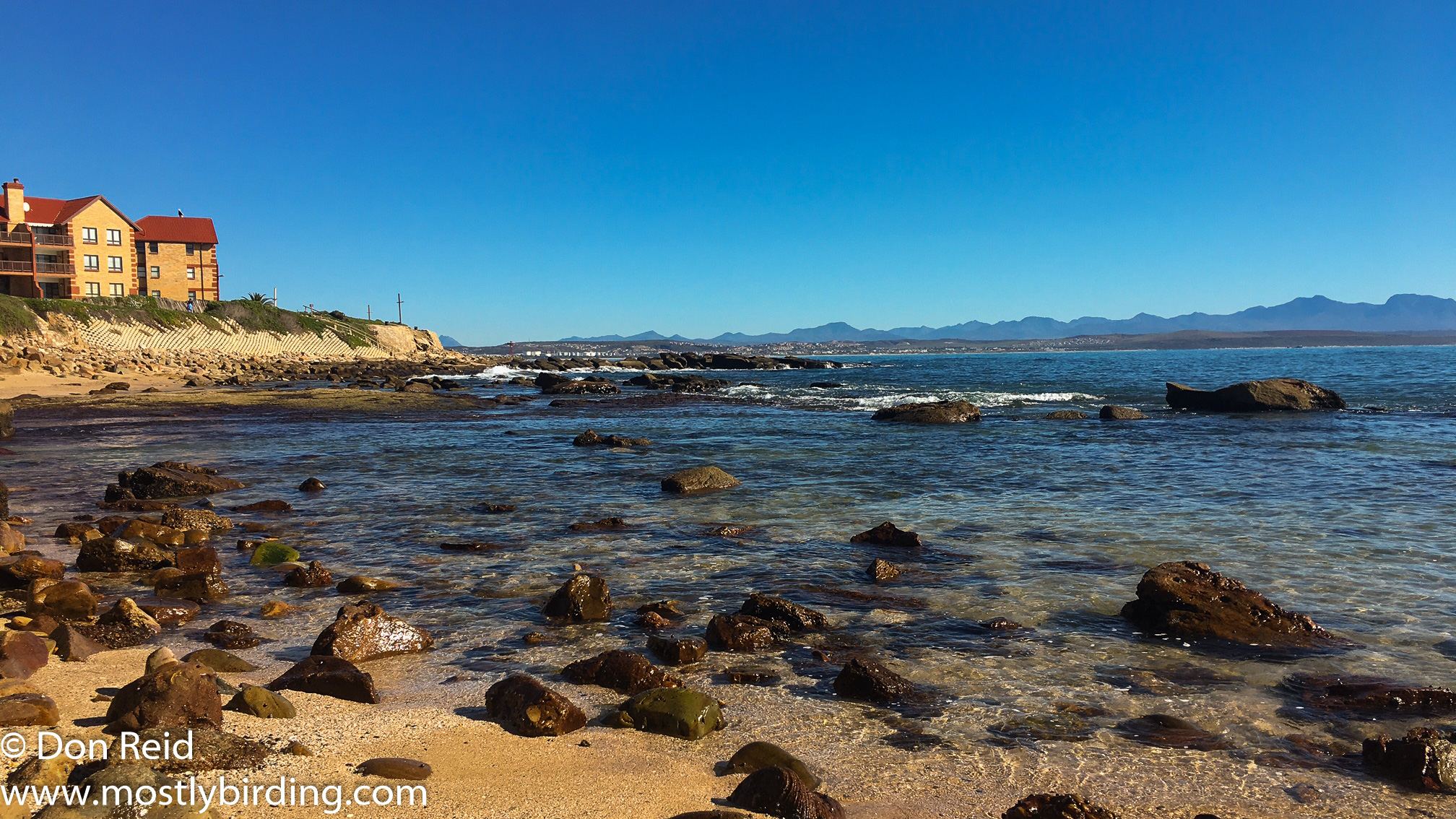
Gerda had an appointment at the hairdresser in town mid-morning (all of 5 minutes from our house) so after dropping her off, I drove to the “Point” just a short distance away, parked and set off for a walk along the pathway which winds its way past seafront houses and apartments back towards the harbour.

The path leading from the tidal pool towards the harbour

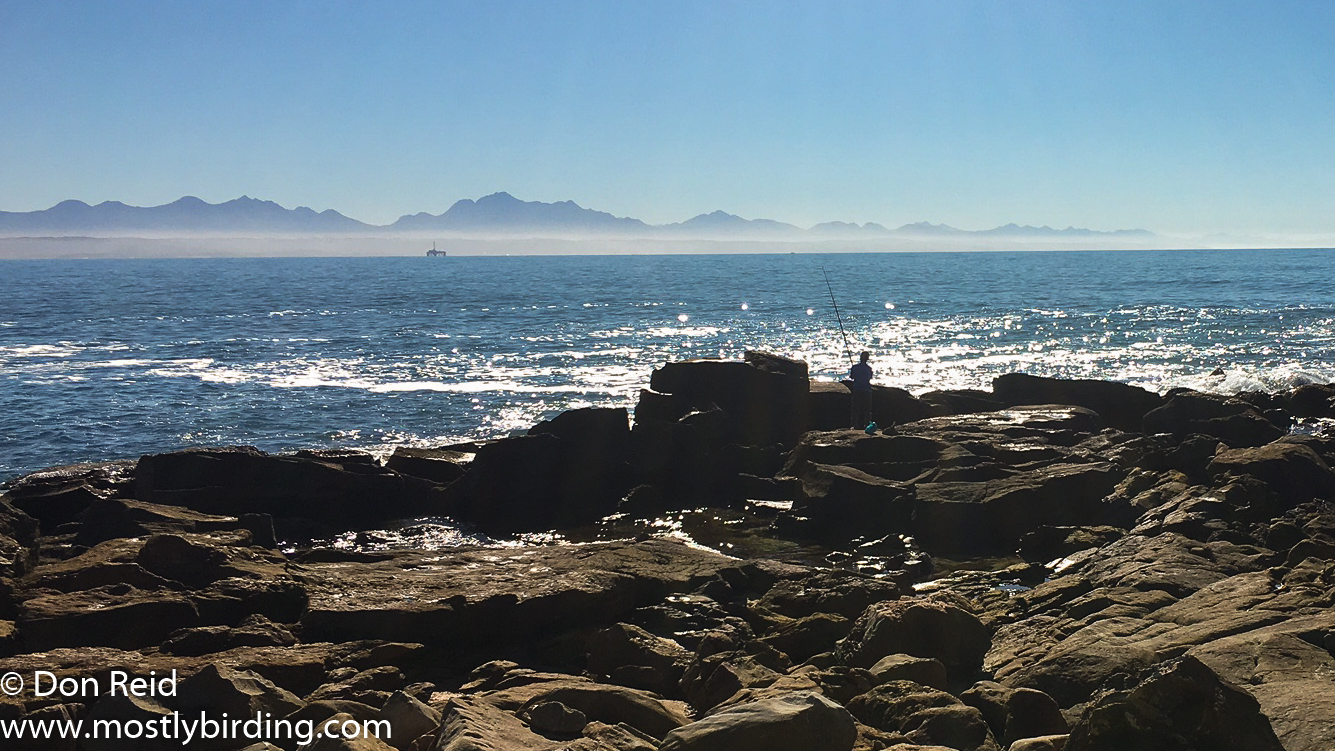
Being the middle of the morning and out of season, it was quiet and I had the seafront virtually to myself, other than a few people walking their dogs,  a mother with her small kids at the swings and a lone fishermen on the rocks.

A lone fisherman enjoys the conditions

Scanning the seas I could make out two seals lazily swimming and flopping about just off the rocks, while a couple of surfers in black shiny wetsuits that matched the seals coats almost exactly were catching the smooth breaking swells, expertly guiding their boards along the line of rocks.

The tidal pool had hardly a ripple, the surface reflecting the historic St Blaize lighthouse in the background

The tidal pool which is crammed with kids in season
St Blaize lighthouse reflected in the tidal pool
The tidal pool
Looking back along the seafront pathway

I had my binoculars with me but didn’t really need them as all the birds I could see were large, familiar and easy to identify with the naked eye – Kelp Gulls wheeling overhead, skeins of Cape Cormorants flying close inshore and just above the waves, Swift Terns making their way to and from the harbour area and African Black Oystercatchers searching for food out on the rocks.

African Black Oystercatcher

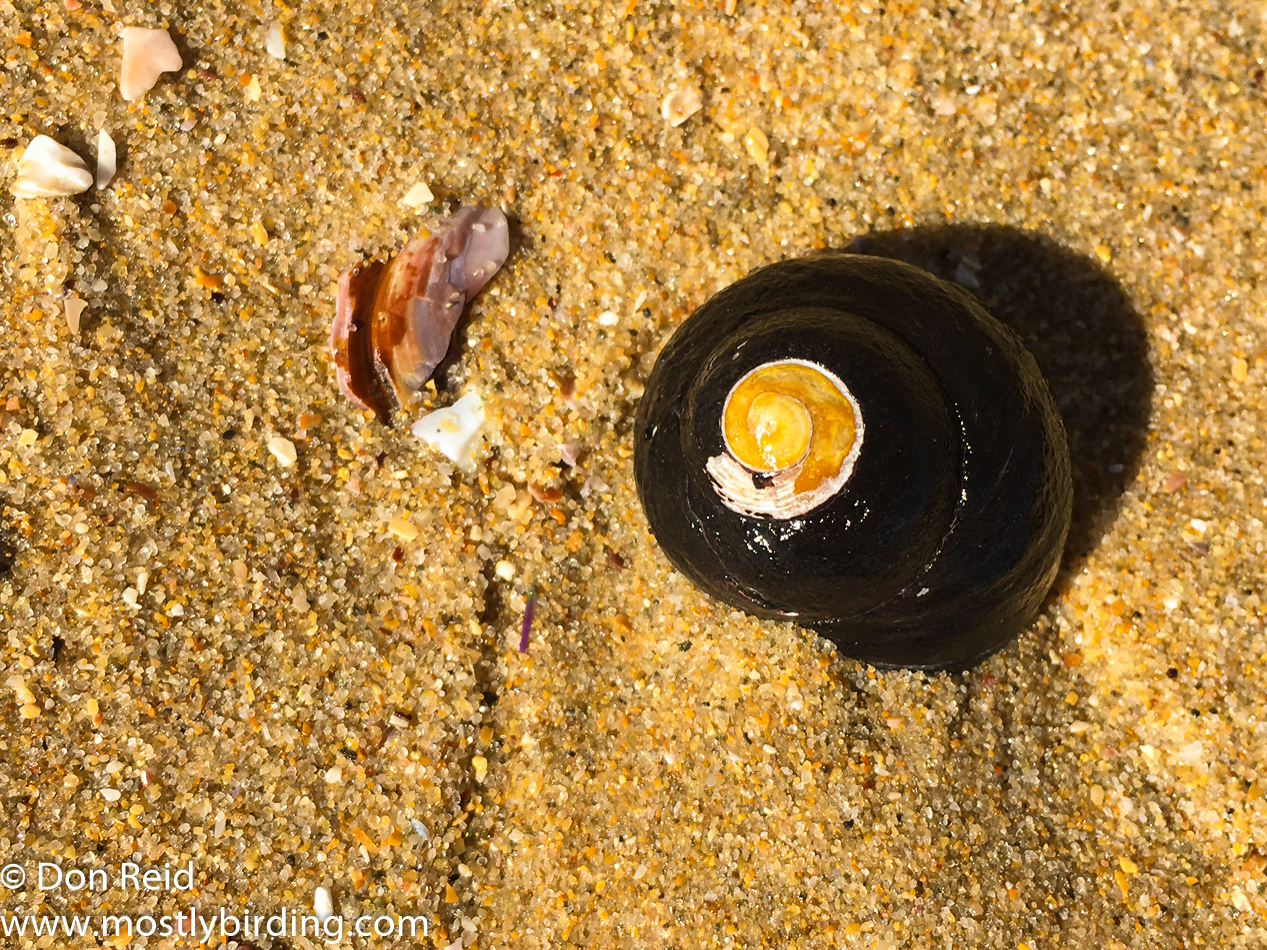
The small stretch of sand between the rocks – I would hesitate to call it a beach – had a few newly washed up shells scattered about.

The views along the way were as perfect as the weather – Mossel Bay at its best – and my soul felt refreshed and calm just from taking in the natural beauty of the scene.

By the way, the photos (other than the Oystercatcher which was taken a day earlier with my “proper camera”) were all taken with my IPhone.

Spring Day in Mossel Bay

A memorable Spring Day walk!


Lions by the dozen – A Chobe encounter

Lions by the dozen?  Now that’s not your every day sighting!

Being in Kasane, northern Botswana in early July this year, with no specific commitments for the afternoon and with Chobe Game Reserve a stone’s throw away, it seemed like a good idea, to say the least, when my colleague Stuart suggested an afternoon game drive along the Riverfront section of Chobe.

Later in the day it’s preferable to first head west along the tar road towards Ngoma gate and then make your way back from there, which puts the setting sun behind you and makes it a lot easier for spotting, which we duly did.

By about 3 pm we were in Chobe, travelling along the river road in an easterly direction back towards Sedudu gate, the sun comfortably behind us and happy about the prospect of a couple of hours of prime game viewing ahead.

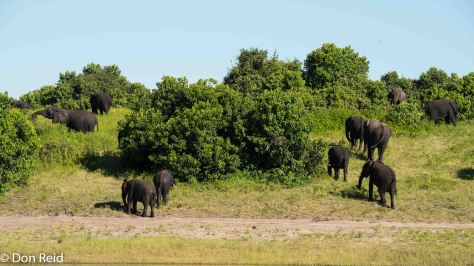
We were immediately rewarded with a group of elephants drinking in the river shallows, then making their way up the bank towards the bush.

Travelling along the sandy track, we encountered constant bird life in numbers that I cannot recall having seen before – the bumpy track was abuzz with Doves, Spurfowl, Guineafowl and others, to the point of almost running over them, while the pools formed by the receding river were crowded with waterfowl. But this drive was not about birding, for a change, so I had to suppress my desire to shout “STOP!” each time I spotted an interesting bird, hoping that my restraint would be rewarded with  exciting game sightings.

The “usual suspects” were all present – Kudu, Giraffe, Zebra, Impala, some groups of Banded Mongoose, plenty of Elephants and around 400-500 Cape Buffalo on the opposite side of the river, where they know they are safe from marauding lions.

But the sighting of the day, or even the year, belonged to a pride of Lions that we first saw in the distance, almost a kilometre away, when we stopped to check why a lone vehicle was stationery and what those beige blobs nearby may be.

Binoculars were raised to eyes in a flash and high fives ensued when we saw that they were indeed lions, prompting us to make our way along the riverside track with subdued haste, excitement building all the while.

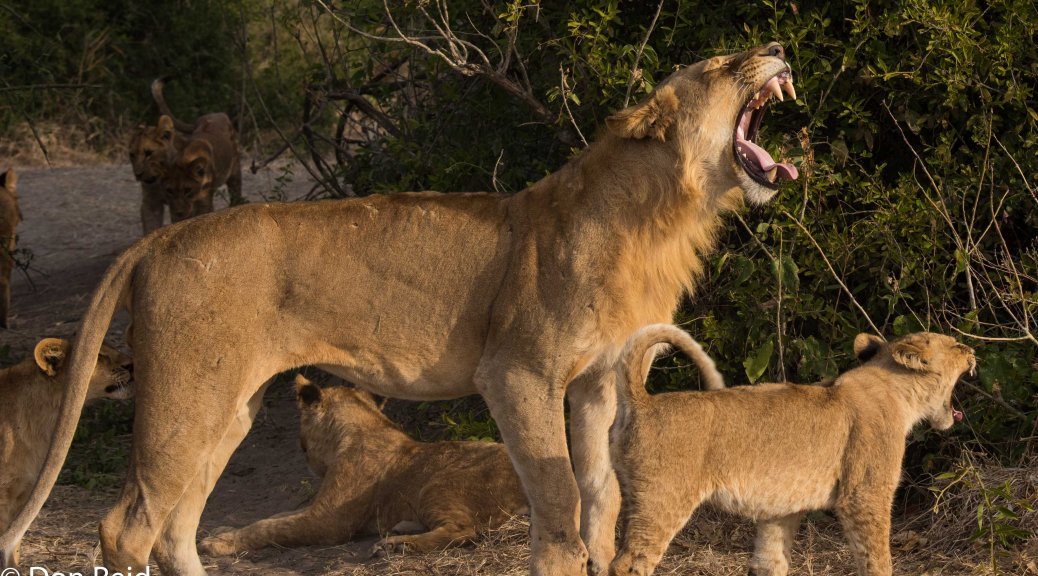
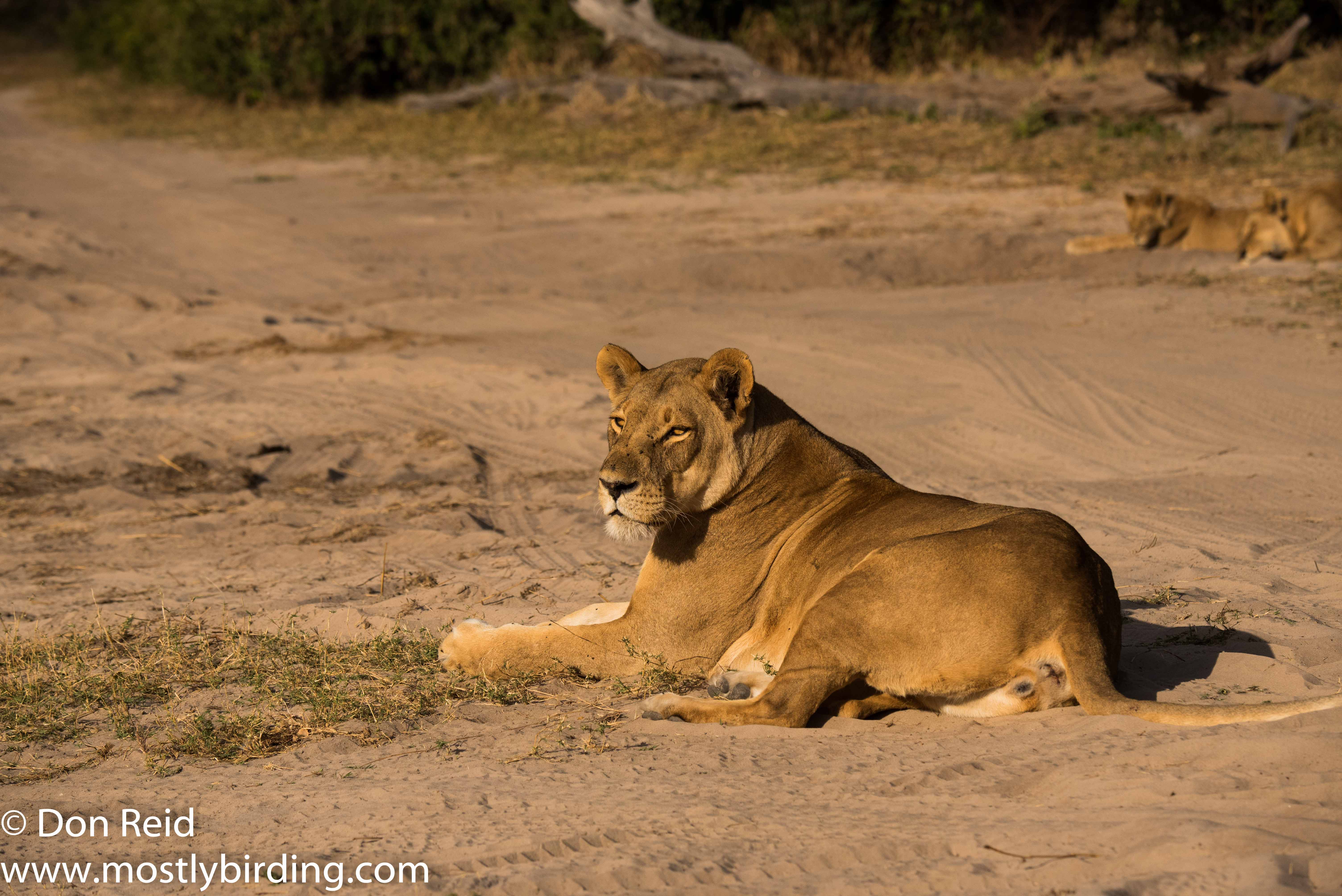
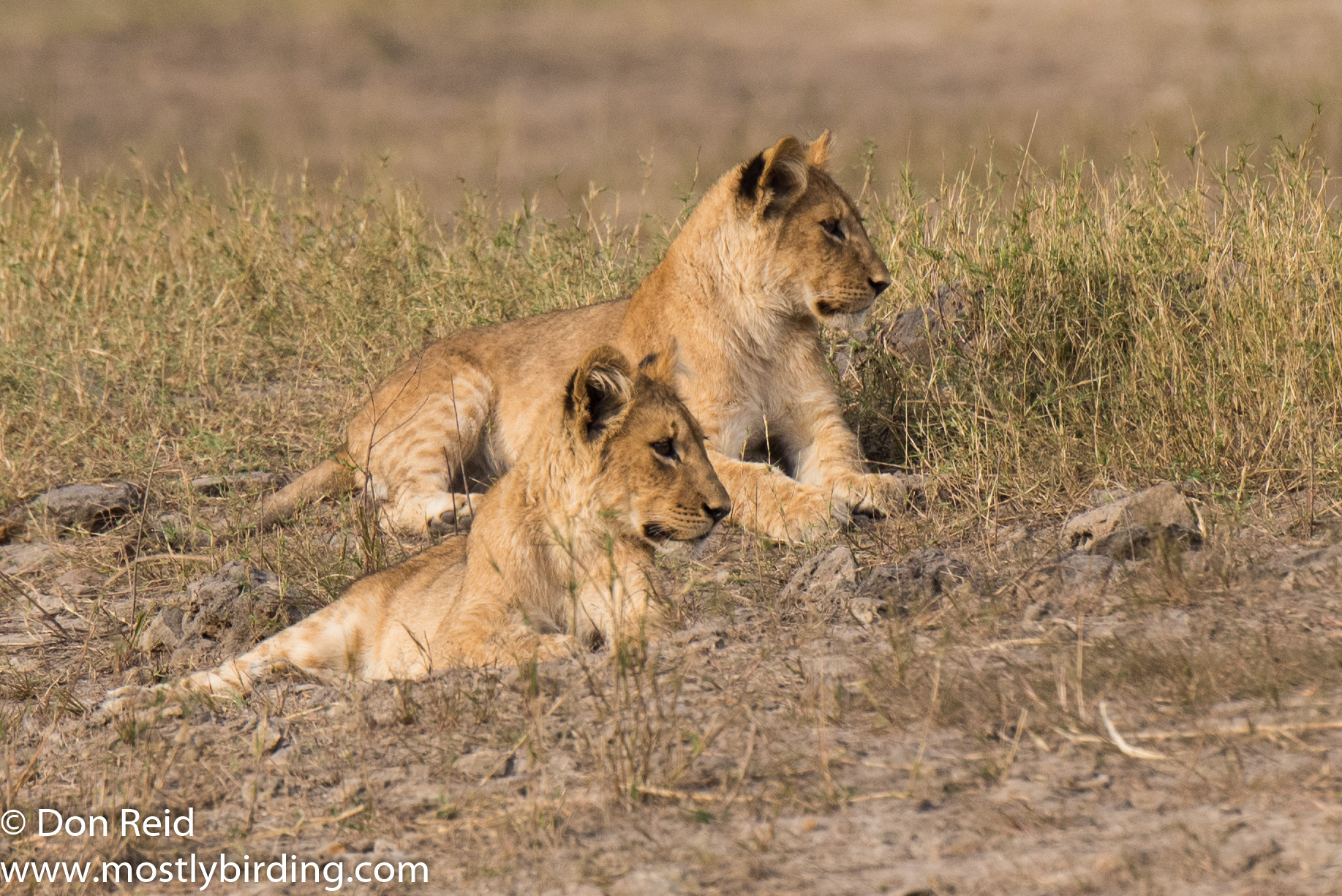
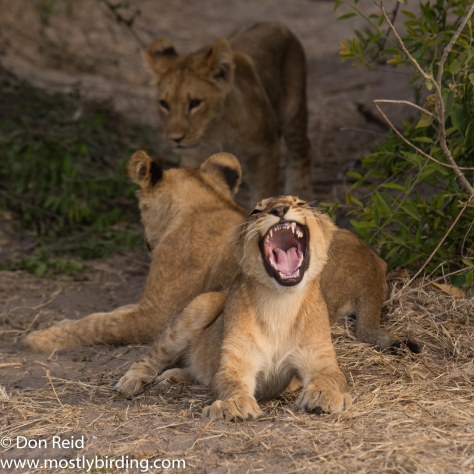
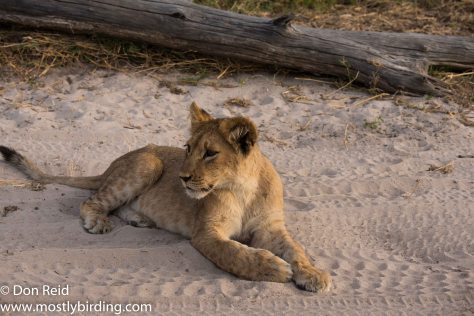
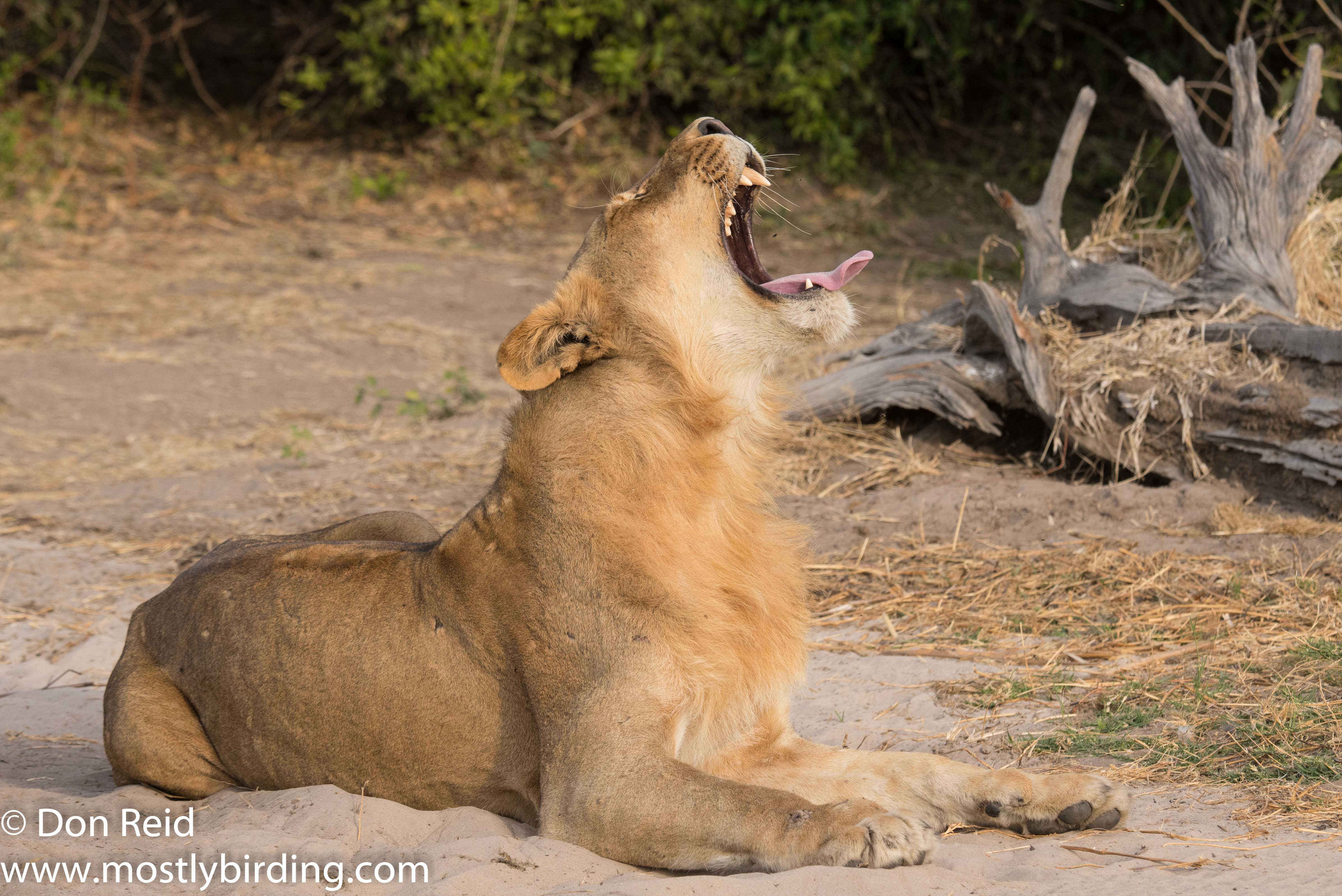
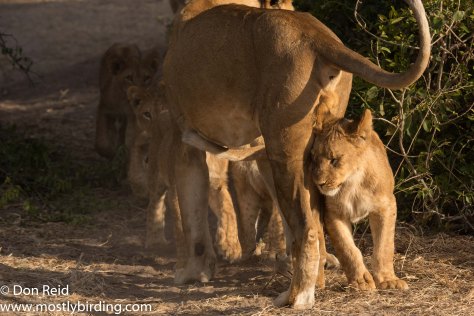
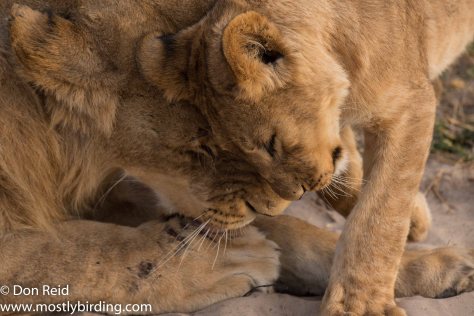
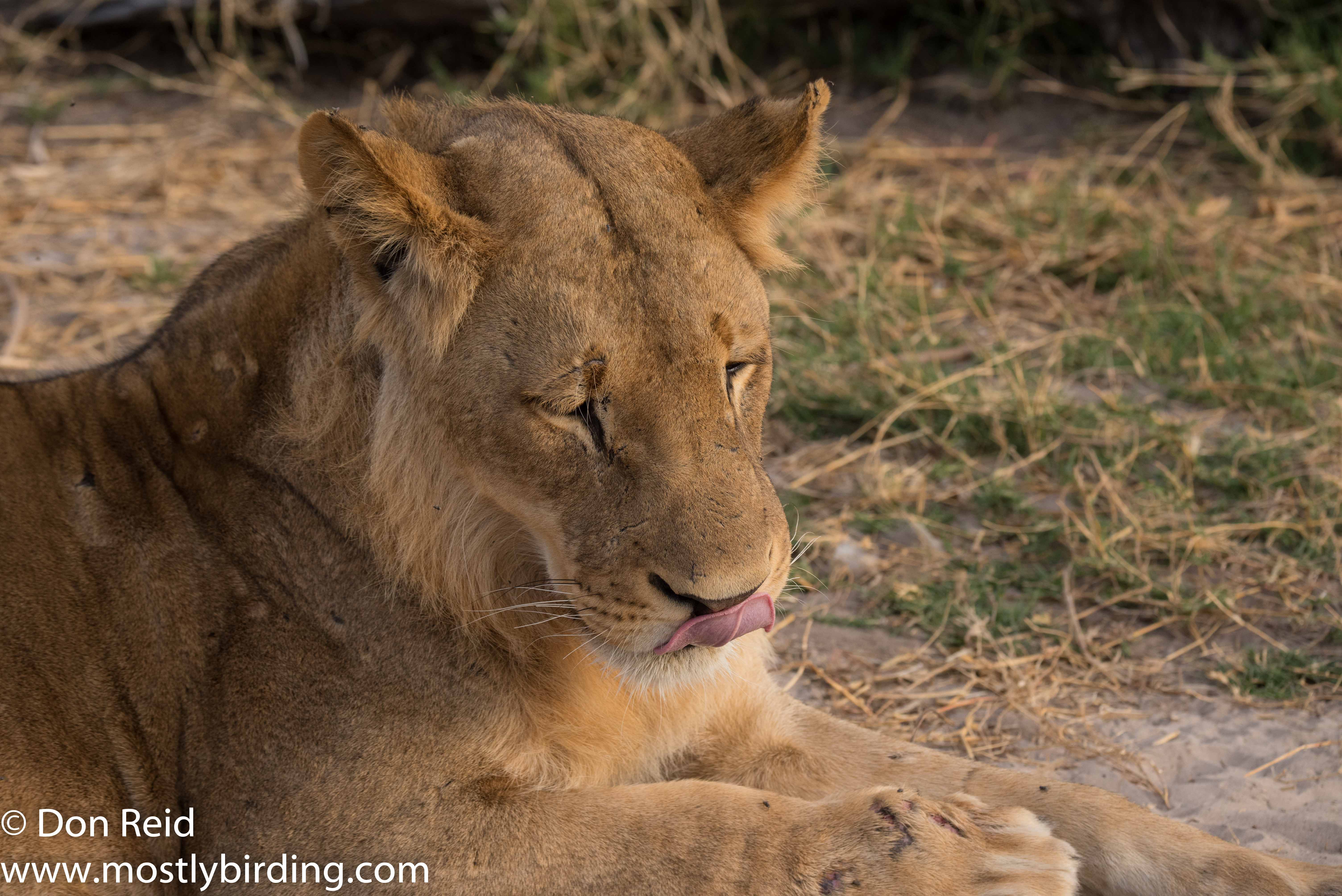
We approached carefully so as not to disturb the scene and for the next 20 minutes enjoyed the sight of 4 adult lions and 8 juveniles interacting.

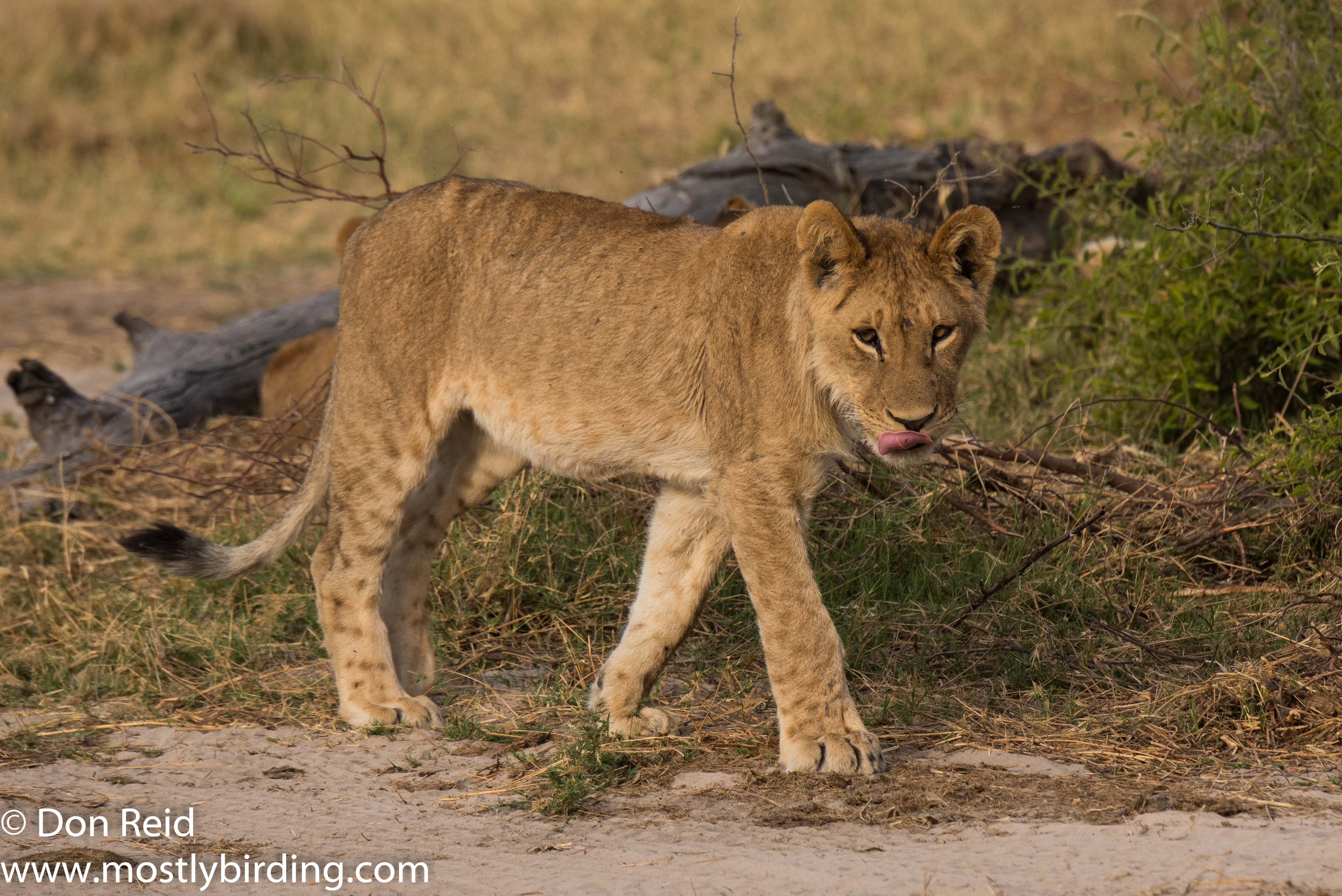
The adults were quite relaxed and lying around while the juveniles walked about trying their best to look like fierce lions but only succeeding in drawing a few ‘aaahs’ from us.

Lion cubs have white spots on the lower parts, while their initial greyish woolly coat changes to the adult tawny colour at about three months and the white spots gradually fade as the youngster ages. My guess is these cubs were between 6 and 12 months old.

A dozen lions, Chobe Riverfront July 2017

A dozen lions, Chobe Riverfront July 2017

A dozen lions, Chobe Riverfront July 2017

A Giraffe poking his long neck above nearby bush added a frisson of tension to the scene and moments later the lions sensed its presence as first one adult female then the others moved in its direction.

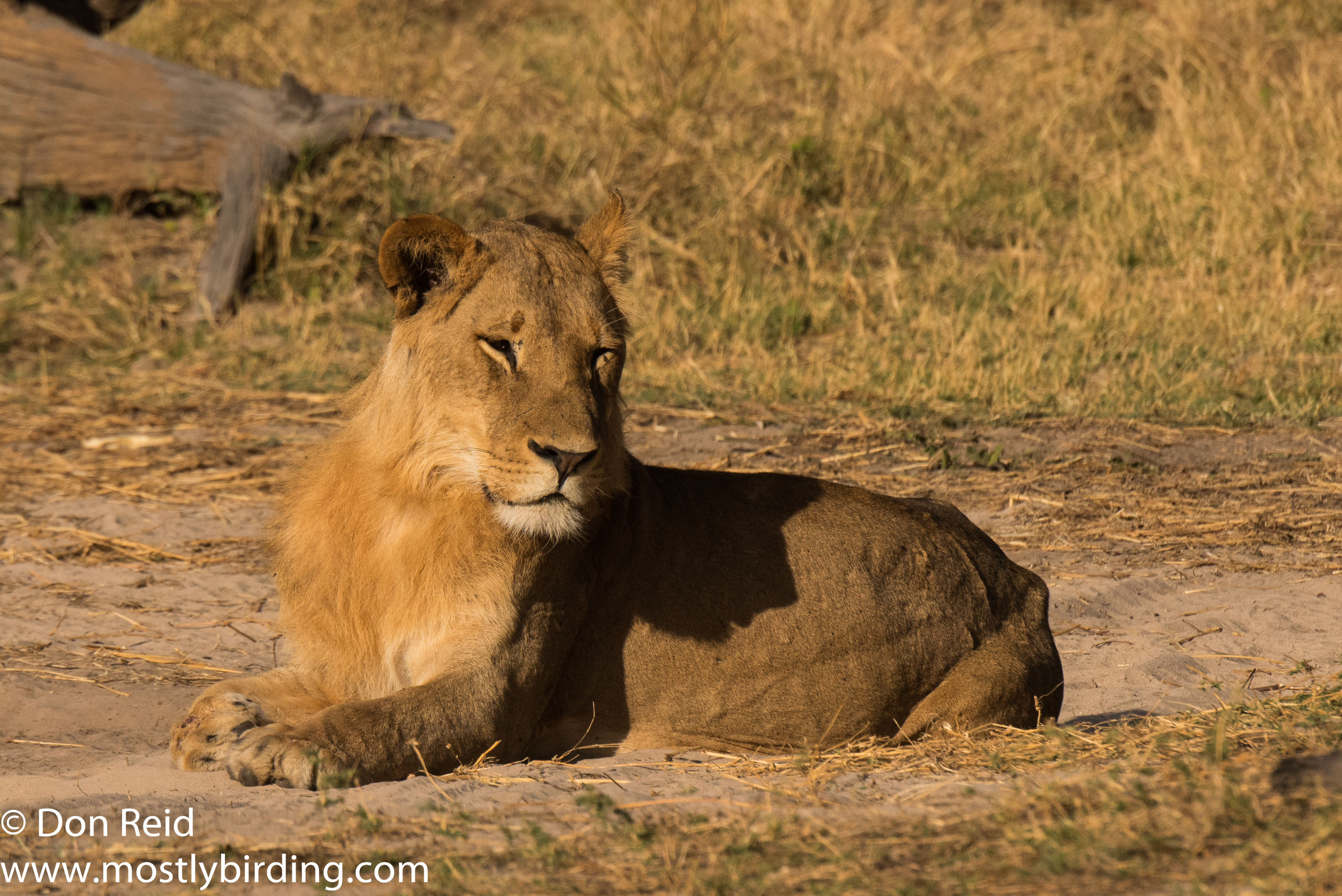
When the young male stood up as well, we noticed it had a pronounced limp from some previous injury to its leg – he gave a low growl and immediately the youngsters, eager to follow the adults, were “called back” and stayed near the limping male, who seemed to have been left in charge while the other adults went to suss out the chances of a giraffe dinner.

A dozen lions, Chobe Riverfront July 2017

A dozen lions, Chobe Riverfront July 2017

A dozen lions, Chobe Riverfront July 2017

A dozen lions, Chobe Riverfront July 2017

After a while, the adults returned, possibly having assessed the opportunity and decided against pursuing it further. By this time the day was starting to run out as the sun headed towards the horizon and we moved away to leave the scene to the several safari vehicles that were approaching, sated with one of the best lion sightings we have ever had.


Touring with Canadians – Part 5 : Chobe

The Story so far..

The previous posts on this “Trip of a Lifetime” to Southern Africa by our Canadian family, covered the time spent in Kruger National Park, the nearby Panorama route and the first leg of our trip to Victoria Falls and Chobe Safari lodge in Kasane, Botswana.

Kasane lies in northern Botswana just 80 kms west of Vic Falls and has become well-known to me after a dozen or more visits over the last couple of years for a project in which I’m involved.

With our visit to Victoria Falls behind us, the transfer to Kasane including the Zimbabwe/Botswana border formalities at the border post just outside Kasane went fairly quickly and smoothly and we found ourselves settled in at Chobe Safari Lodge with time to relax for the rest of the afternoon at poolside.

Chobe Safari Lodge
Chobe Safari Lodge
Chobe Safari Lodge
Chobe Safari Lodge
Chobe Safari Lodge
Chobe Safari Lodge

Sundowners

One of my favourite “sundowner” spots is the riverside bar deck in the Chobe Safari camping area right next to the lodge and this is where I took our small group late afternoon.

Sundowner spot
Sundowner spot
Sundowner spot
Hit me again, barman

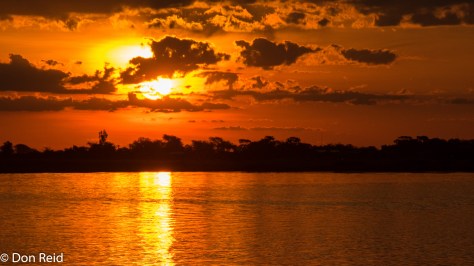
The weather obliged, making for a sensational sunset and the chance to savour our G and T’s while we watched the spectacle unfold.

Sundowner spot
Sundown
Sundowner spot
Gone but not forgotten

Later we made our way to the restaurant for the buffet dinner which was more than pleasant.

Chobe Game Drive

The game drive we had booked for the following morning started at 6 am when we met Bogatsi, our driver and guide for the morning, at the reception. With a vehicle to ourselves, we had plenty of room and we set off to the Sedudu gate just a few kms from the lodge.

Entering the reserve, we headed down the sandy, bumpy track (some call it the “African massage”) towards the river, through pristine woodland, which opens up at one point to allow a wide vista of the river in the distance. Just driving along the Chobe Riverfront route is an experience in itself, particularly for visitors from the northern hemisphere, with any game being a bonus.

Naturally, game sightings are welcome and there was enough to keep everyone interested, despite not having the added excitement of any big cat sightings, which were more than likely close by but hidden by the bush, still quite dense at the tail end of summer.

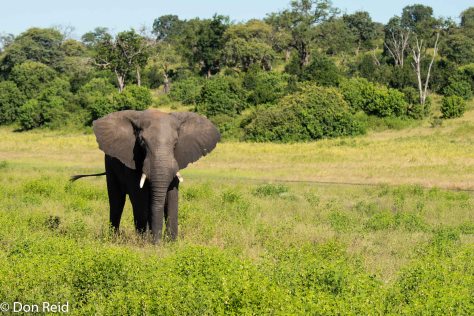
African Elephant, Game cruise Chobe
African Elephants

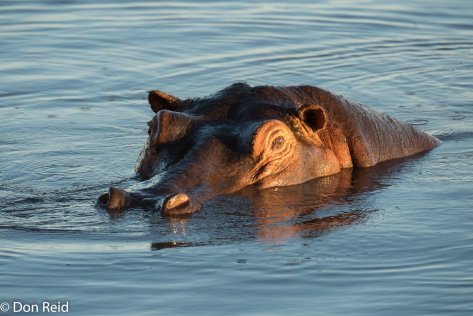
Hippos were plentiful in the pools adjoining the main river, munching on the partly submerged grasses as only hippos can do, giving us the eye and an occasional yawn or two.

Hippo, Chobe game drive

Hippo, Chobe game driveHippo, Chobe game drive

Other game we came across –

  • the inevitable and numerous Impalas, still enjoyable to see after so many sightings
Impala, Chobe game drive
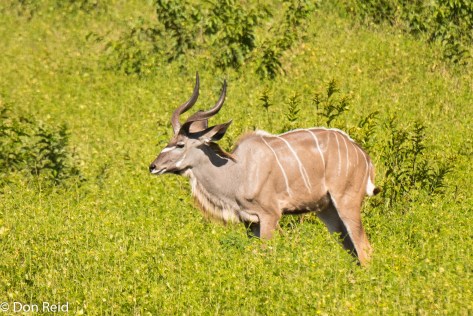
  • Kudu
Kudu, Game cruise Chobe
Kudu, Chobe game drive
  • numbers of Baboons
Chacma Baboon (Juvenile), Chobe game drive
sChacma Baboon (Juveniles), Chobe game drive
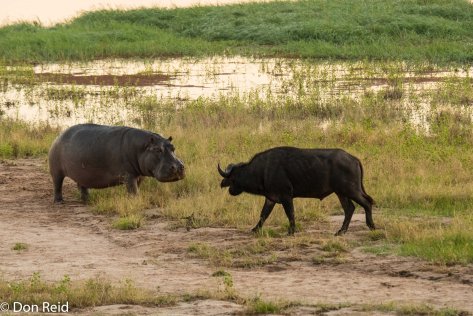
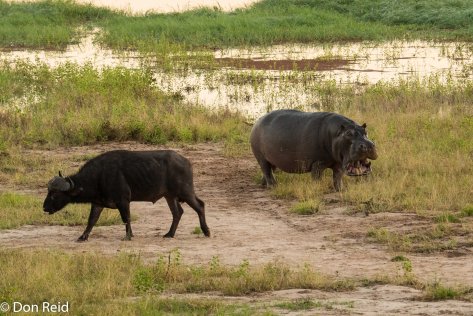
  • Buffaloes, one of which had an interesting interaction with a Hippo emerging from a pool, the two eyeing each other cautiously before passing by and continuing with their lives.
Hippo meets Buffalo, Chobe game drive
That hippo has big teeth, think I’ll keep going

Our guide made a point of showing us the distinctive marking on the rear end of Impalas, intimating that this was where McDonalds got the inspiration for their famous “M” logo.

Impala, Chobe game drive
Cheeseburger with fries please

There was no shortage of bird sightings, but the birding tends to take a back seat (where I happened to be as it turned out) when on a game drive such as this, unless the majority on the vehicle are into birding. Nevertheless we chalked up a few special sightings :

  • a majestic Verraux’s Eagle Owl high in the branches of a tall tree
  • Long-tailed Paradise Whydah with its spectacular tail
Long-tailed Paradise-Whydah, Chobe game drive
  • African Fish Eagles seemingly every km or so along the riverfront
  • Red-backed Shrikes
  • Black Heron performing its “umbrella” shading act to help it find aquatic prey
  • Little Bee-eaters hawking insects in a small clearing

We continued along the river at a slow pace until we reached the picnic spot at Serondela, where coffee was served, after which we returned along the upper road to the exit gate and back to the lodge. It was time for lunch, some time to relax at poolside while the kids swam and before we knew it, it was time to board the river boat for the sun downer cruise.

Chobe Game Cruise

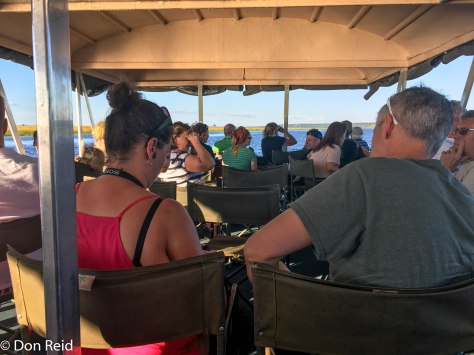
The cruise turned out to be more than I expected – having had the experience of small boat trips along the river in the past, I imagined a large boat with 40 or so passengers would not be anything like as enjoyable. Well, I was pleasantly surprised, with the boat hugging the banks of the river wherever possible and stopping for up close and personal views of everything from birds to crocodiles and hippos, as well as a group of elephants.

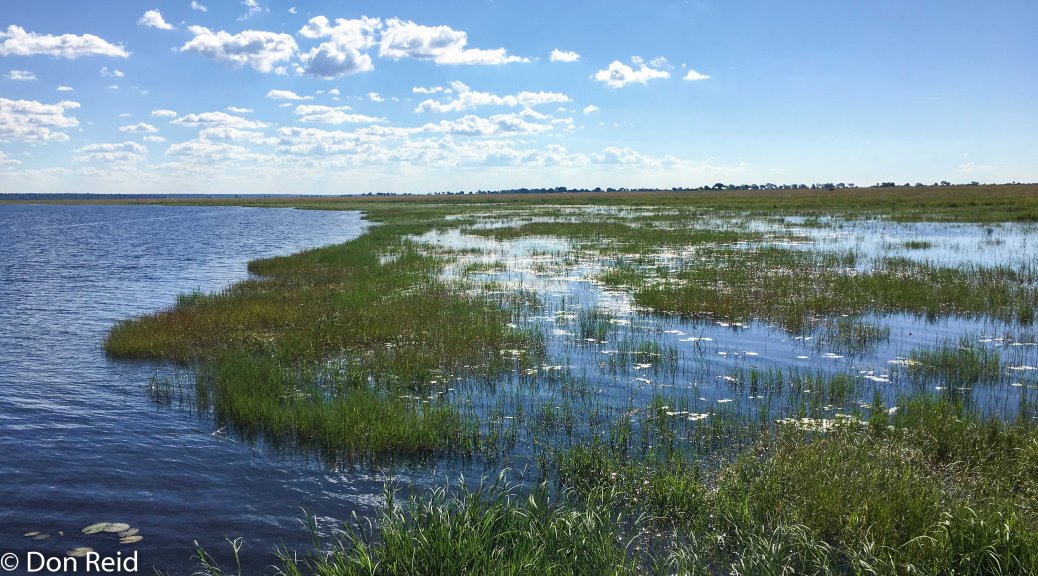
The weather played its part, with warm rather than hot conditions and just a light breeze causing hardly a ripple as we cruised gently along and into the Chobe game reserve, wending our way through the channels between the grassy flood plains which attract herds of animals during the winter months.

Here is a portfolio of some of the sightings ……..

Game cruise Chobe
Just cruisin …..
Crocodile, Game cruise Chobe
African Elephant, Game cruise Chobe
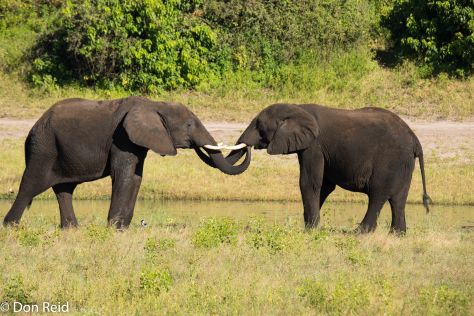
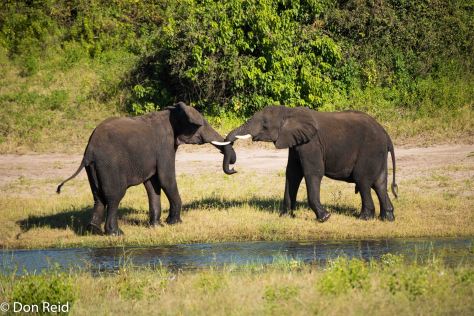
African Elephant greeting each other

African Elephant, Game cruise Chobe

Buffalo, Game cruise Chobe
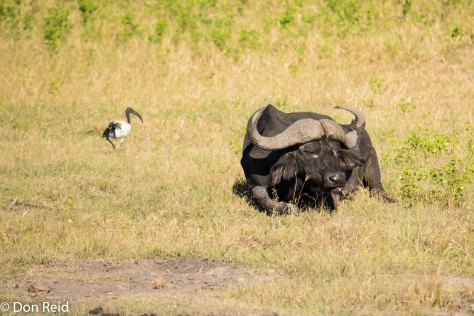
Sacred Ibis and Cape Buffalo, Game cruise Chobe
Hippo, Game cruise Chobe
African Fish-Eagle, Game cruise Chobe
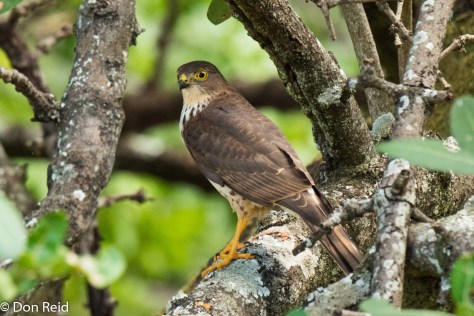
Little Sparrowhawk (Juvenile), Chobe Safari Lodge
Little Sparrowhawk (Juvenile), – Not on the cruise, this one was a great find in the gardens of the Chobe Safari Lodge
African Harrier-Hawk, Game cruise Chobe
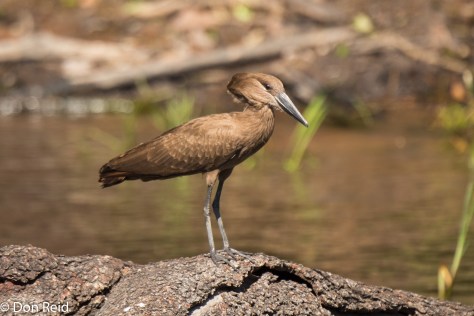
Hamerkop, Game cruise Chobe

The stay at Chobe Safari Lodge was just two days in extent but seemed much longer, with lovely game experiences on land and on water and enough time in between to relax by the pool. A fitting conclusion to a successful couple of weeks touring with “the Canadians”


Pigeon Valley – Forest birding in the suburbs

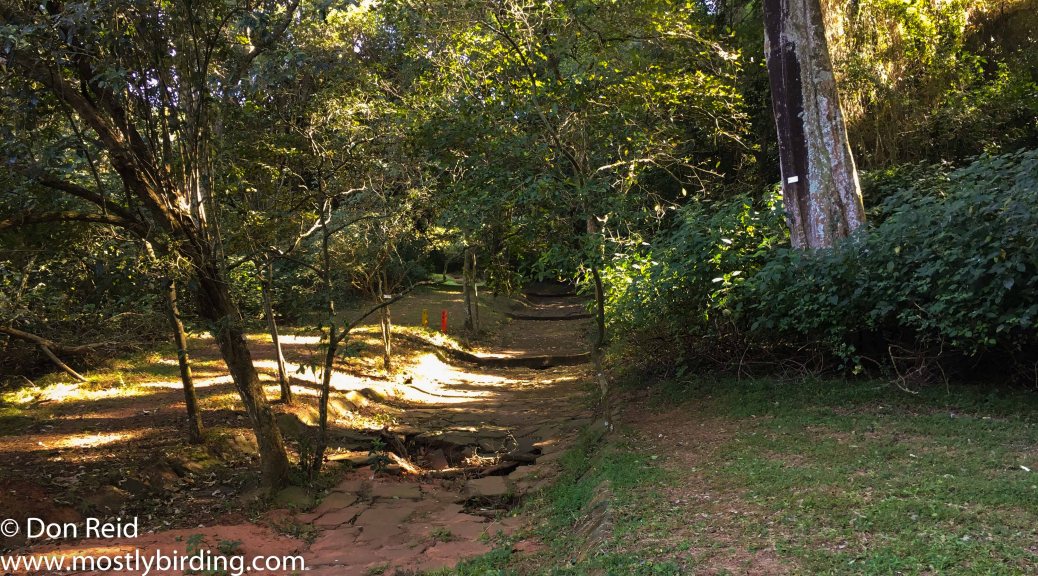
After the excitement and effort that went into the Malagasy Pond Heron ‘twitch’, a relaxing morning’s birding / atlasing seemed like just the ticket to bring me down to earth, gently. We were back in our timeshare apartment in La Lucia near Durban and one of my favourite birding spots became my next focus of attention – Pigeon Valley Park, which is a small forested reserve of about 10 hectares in the middle of Durban’s older suburbs on the Berea Ridge.

Pigeon Valley is located in the middle of old Durban suburbs

I entered the gate around 10 am (talk about relaxed birding … none of this crack of dawn stuff this time) and within a couple of minutes had an Olive Sunbird (Olyfsuikerbekkie / Cyanomitra olivacea) fluttering about in the branches above my head and heard the drawn out, repetitive call of a Tambourine Dove (Witborsduifie / Turtur tympanistria) from deep in the forest.

Pigeon Valley Durban

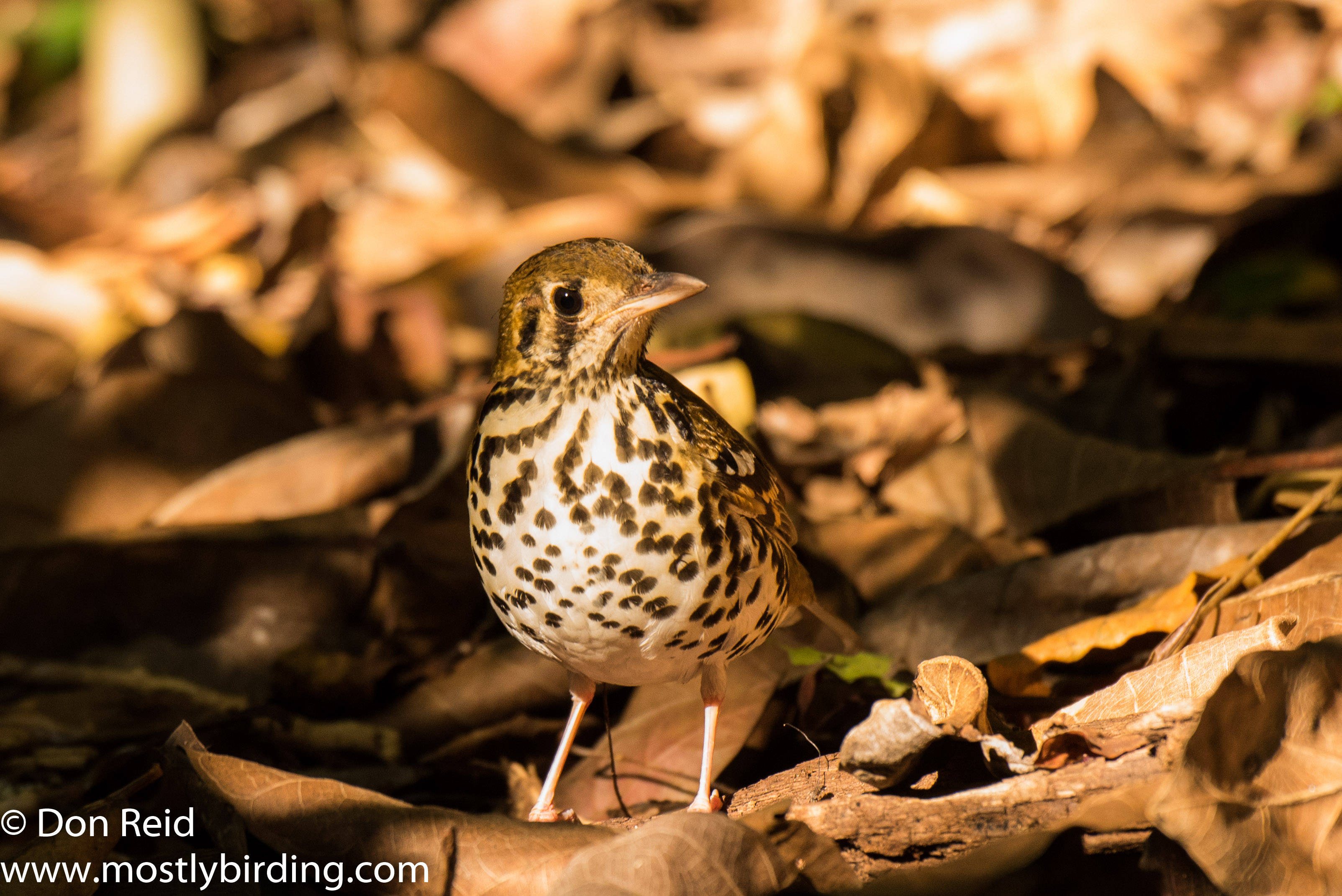
This reserve is famous amongst birders for the reliability of seeing  Spotted Ground Thrush (Natallyster / Zoothera guttata) here during the winter months and I can attest to that, having seen it on two out of three of my previous visits. I was on the lookout for it as soon as I entered, scanning the ground between the trees and just 50 metres from the gate I found it in deep shadow, scratching amongst the brown leaf litter.

Spotted Ground Thrush, Pigeon Valley

I approached quietly and fired off a number of shots but could see that they were not coming out very well due to the poor light. Using a large tree as a concealment between myself and the Thrush, I edged closer and poked my head carefully around the side of the tree to observe its movements, hoping it would move into one of the tiny patches of sunlight filtering through the dense foliage above.

The Thrush obliged, briefly moving into a patch of sunlight as I crouched to get closer to the bird’s level, then got in a few shots when it looked up and directly at me for a second – success! If there had been someone else with me it would have been high fives, but I had to make do with a triumphant smile.

Spotted Ground Thrush, Pigeon Valley

Buoyed by this wonderful start I made my way slowly up the main path, where I briefly met two other birders who were on their way out – as it turned out they were the only other visitors that I came across in the two and a half hours I was there, so effectively I had the reserve to myself for that time – apart from those tending to the park.

I had the constant accompaniment of birds calling as I walked, most of which I could ID and many of which I saw during the walk. Those heard only included the ubiquitous Sombre Greenbul (Gewone Willie / Andropadus importunus ), Black-backed Puffback (Sneeubal / Dryoscopus cubla), Tambourine Dove, Bar-throated Apalis (Bandkeelkleinjantjie / Apalis thoracica), African Fish-Eagle (Visarend / Haliaeetus vocifer)- probably from a nearby dam – and Black Sparrowhawk (Swartsperwer / Accipiter melanoleucus ), which are known to breed in the reserve.

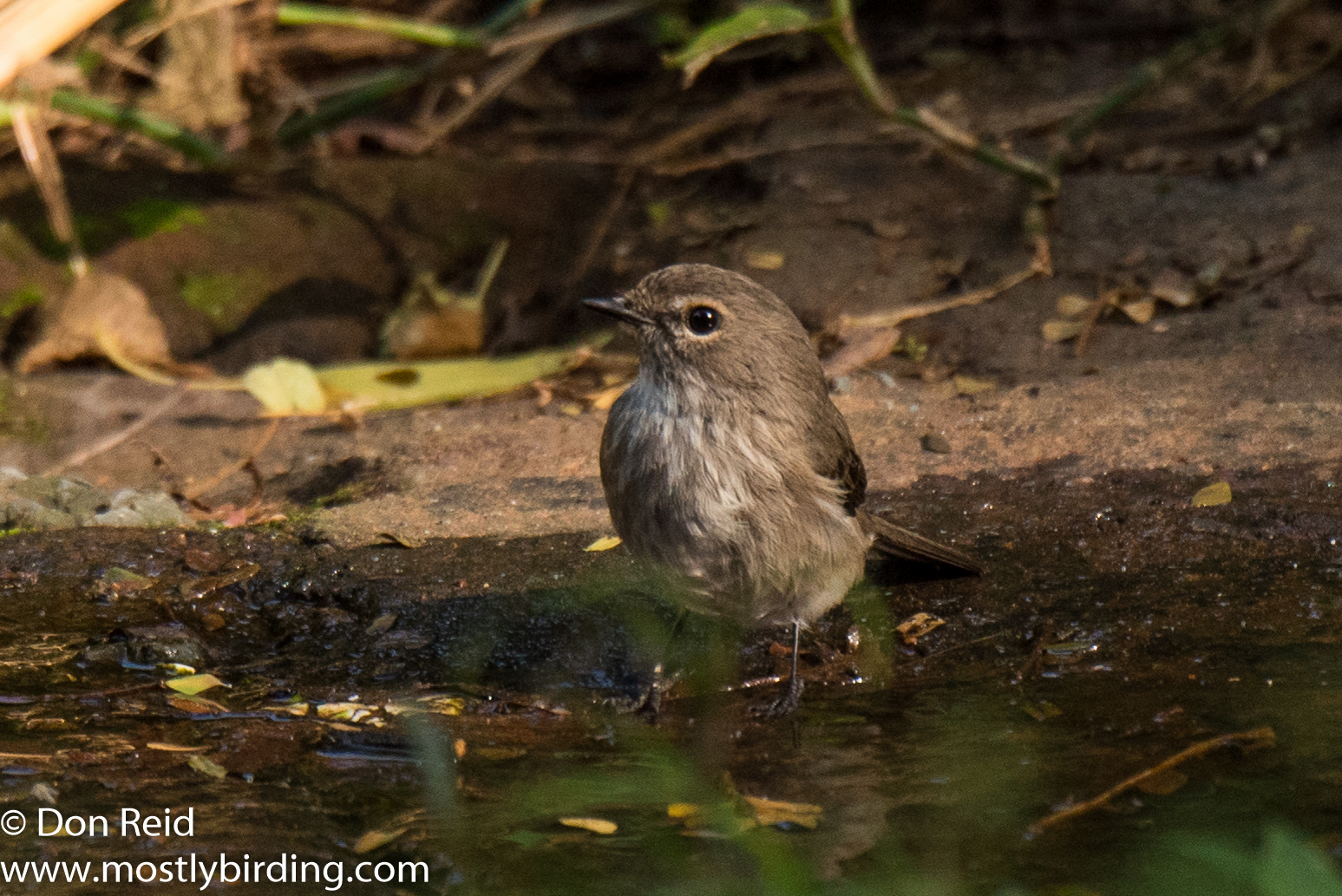
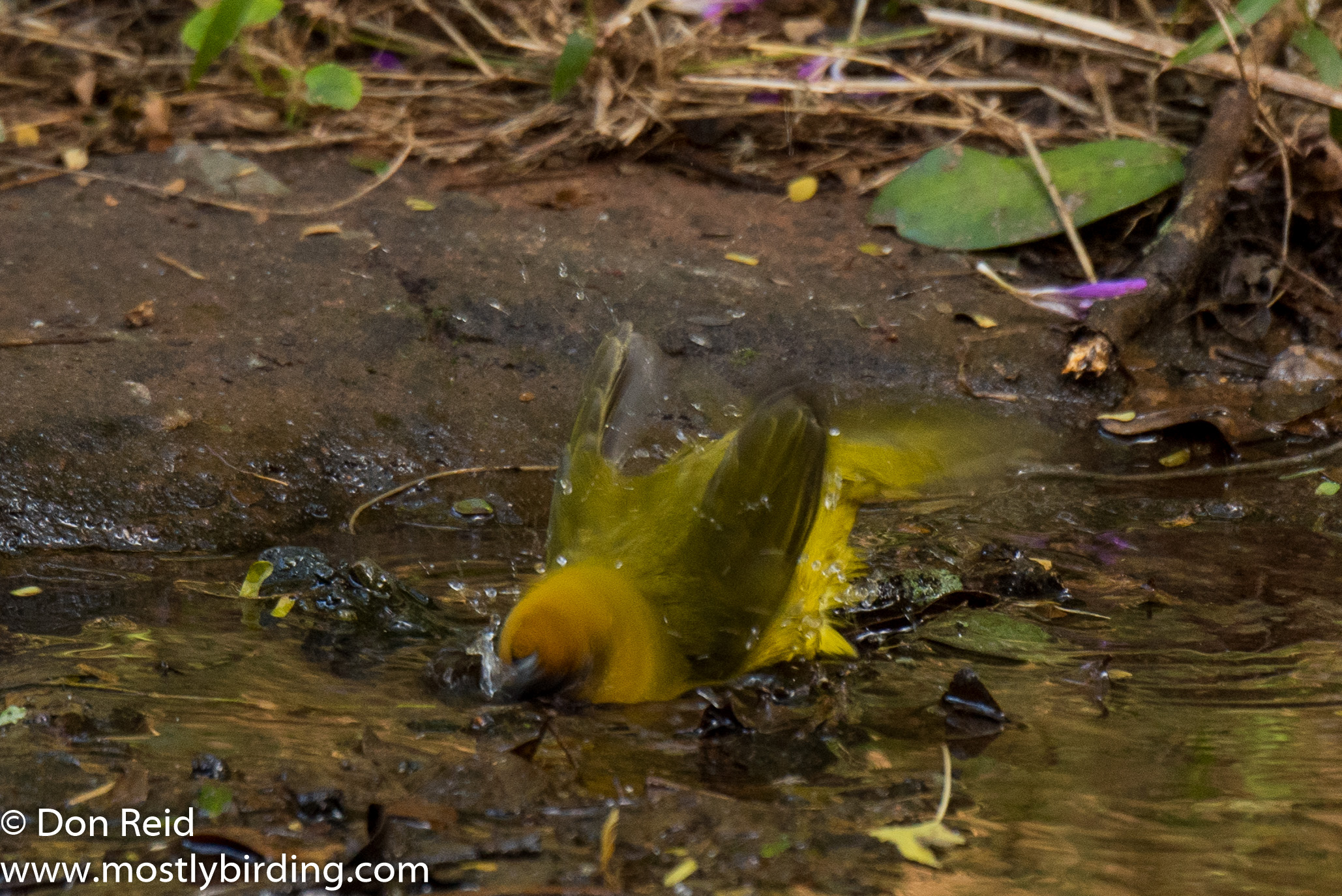
I spent some time at a tiny pool near the top of the main path, fed by a little stream trickling down from a source outside the reserve. As I sat quietly to one side, there was a constant movement of small birds coming and going, sipping the clear water, some bathing as well – lots of Cape White-eyes (Kaapse glasogie / Zosterops capensis), a pair of Cape Batises (Kaapse bosbontrokkie / Batis capensis), Red-capped Robin-Chat (Nataljanfrederik / Cossypha natalensis), Tawny-flanked Prinia (Bruinsylangstertjie / Prinia subflava)and an unexpected but very welcome surprise in the form of a Grey Waxbill (Gryssysie / Estrilda perreini), which I had only seen once before in Zimbabwe.

Red-capped Robin-Chat
Tawny-flanked Prinia
Grey Waxbill

All of this activity was observed by an African Dusky Flycatcher (Donkervlieëvanger / Muscicapa adusta) hawking insects from a nearby branch, then popping down to the water for a drink.

Dusky Flycatcher

Spectacled Weavers (Brilwewer / Ploceus ocularis), which I had heard earlier, also came to the stream for a bathe.

Spectacled Weaver
Spectacled Weaver

The bird I was hoping for, Green Twinspot, did not appear so I continued my walk along the perimeter of the reserve, then back to the entrance gate with regular sightings to keep it interesting –

  • Terrestial Brownbul (Boskrapper / Phyllastrephus terrestris) skulking in the lower stratum of the dense bushes, as they like to do
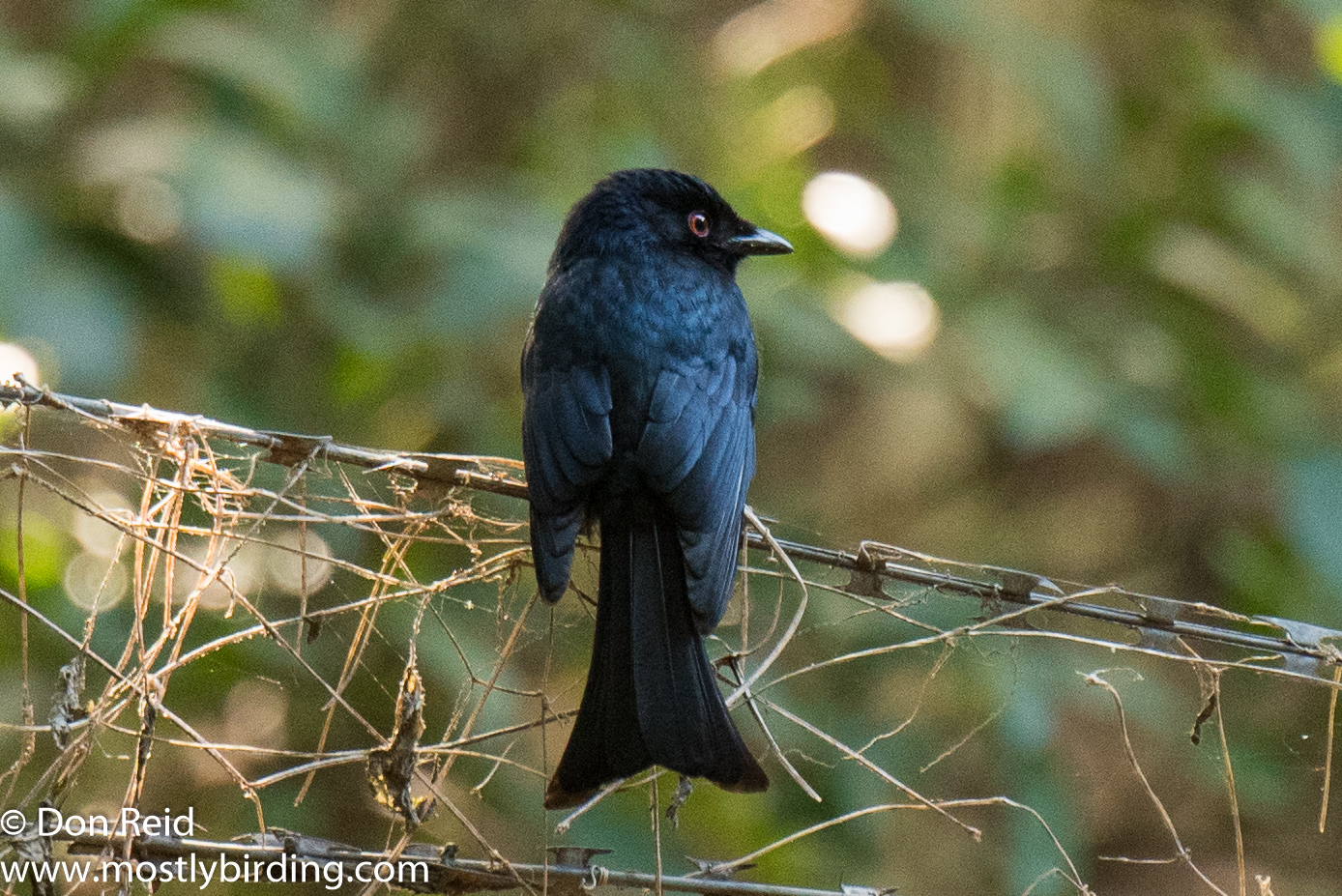
  • Southern Black Flycatchers (Swart vlieëvanger / Melaenornis pammelaina) and Fork-tailed Drongos (Mikstertbyvanger / Dicurus adsimilis) trying their best to confuse my ID abilities by appearing in the same trees, but a check of the tail tip and eye colour was enough to sort them out
Fork-tailed Drongo
  • Surprisingly, for me anyway, numbers of Thick-billed Weavers (Dikbekwewer / Ambliospiza albifrons) in the lower and upper stratum – I am used to finding them near water in reeds, but later reference to the Roberts app showed that they inhabit forests in the non-breeding season, a new discovery for me
  • Grey Sunbird (Gryssuikerbekkie / Cyanomitra veroxii) showing briefly
  • Several White-eared Barbets (Witoorhoutkapper /  Stactolaema leucotis) high up in the trees
White-eared Barbet
  • Golden-tailed Woodpecker (Goudstertspeg / Campethera abingoni)
Golden-tailed Woodpecker

And, just before leaving, a bevy of Bronze Mannikins (Gewone fret / Lonchura cucullata) huddled together on a branch made a charming sight

Bronze Mannikins – knit one, slip one, knit one

Without fanfare or wild expectations, the morning had turned into something memorable, to be savoured for days after. This is the sort of experience that makes birding the amazing pastime that it is.

A Sudden Twitch – Malagasy Pond-Heron

Malagasy Pond-Heron?

Sounds exotic …. and indeed it is, if you are a South African birder.

This is how I came to see this bird and put to rest a certain entry on my life list that has gnawed at my birding conscience for many years.

Rare birds have, for the last couple of years, made a habit of crossing my path, making themselves difficult to ignore if not irresistible.

I have this very arbitrary “rule” with regard to twitching rare birds which says that I only consider it if the bird is within 2 hours travelling time from wherever I am based at the time. I have had an incredible run of luck over the last two years in that I have been positioned to twitch rare bird species in places such as Katima Mulilo in Namibia (I was in nearby  Kasane Botswana at the time), Strandfontein Sewage works in Cape Town (I was visiting Cape Town), Stilbaai on the Southern Cape Coast (I was in Mossel Bay) and Mkombo dam in Limpopo Province (I was at home in Pretoria), all without breaking my rule.

When news broke via the SA Rare Bird News (SARBN) report produced so expertly by Trevor Hardaker, of a Malagasy Pond-Heron at Phinda Private Game Reserve in Kwazulu-Natal province (KZN) , I initially ignored it, Phinda being well beyond my travel limit at around 6 hours drive from Pretoria. But as the weeks passed and the Pond-Heron was still being seen, on top of which our timeshare week in Durban was approaching, I realised that Phinda, near the town of Hluhluwe in Zululand, would be a lot closer if we travelled from Durban – some 2 and a half hours drive by my estimate.

Suddenly it became do-able without exceeding my travel limit by much, and in any case we would be on holiday, so what better time to fit in a side trip to northern KZN, which we had last visited 15 or more years ago.

What made this twitch different was that it was only possible to look for the bird if you joined one of the game drives that various birders were booking through AndBeyond, who run a few lodges at Phinda and had permission from the concession owners at Mziki to access the dam where the Pond-Heron was seen.

I started looking out for a game drive opportunity that coincided with our first weekend at our timeshare unit ie 24 – 25 June. I soon found that the weekend drives were fully booked, but it seemed that no one had got as far as booking the Sunday afternoon drive…..

After some serious should I / shouldn’t I thoughts and with our Friday drive to Durban looming, I decided at the last moment to phone Phinda reservations, made a provisional booking and the game was on! Trevor Hardaker kindly sent out an email note on Friday morning to all SARBN subscribers and the calls started coming in as we commenced our drive on the N3 to Durbs. Some time after our halfway lunch stop at Harrismith, the game drive was fully taken up, Phinda’s invoice received and paid and details had been sent to the 5 other participants. It’s amazing what can be achieved with a smart phone on the go!
Off to Phinda

We were glad of the Saturday to recover at our timeshare apartment in La Lucia so that, come Sunday, we were ready to travel again – this time northwards up the N2 National road to Richards Bay, then on to Hluhluwe where we had a burger lunch before heading to the Phinda gate some 20 kms further.

Durban La Lucia to Phinda Game Reserve

I dropped Gerda off at the Phinda Mountain Lodge, on the way to Mziki Private camp where we were to be collected. Along the way game was plentiful including a Rhino family, one of them de-horned as an anti-poaching measure as is the trend nowadays, also Nyala, Zebra and Warthogs.

How do you like your Rhino – horned or de-horned?

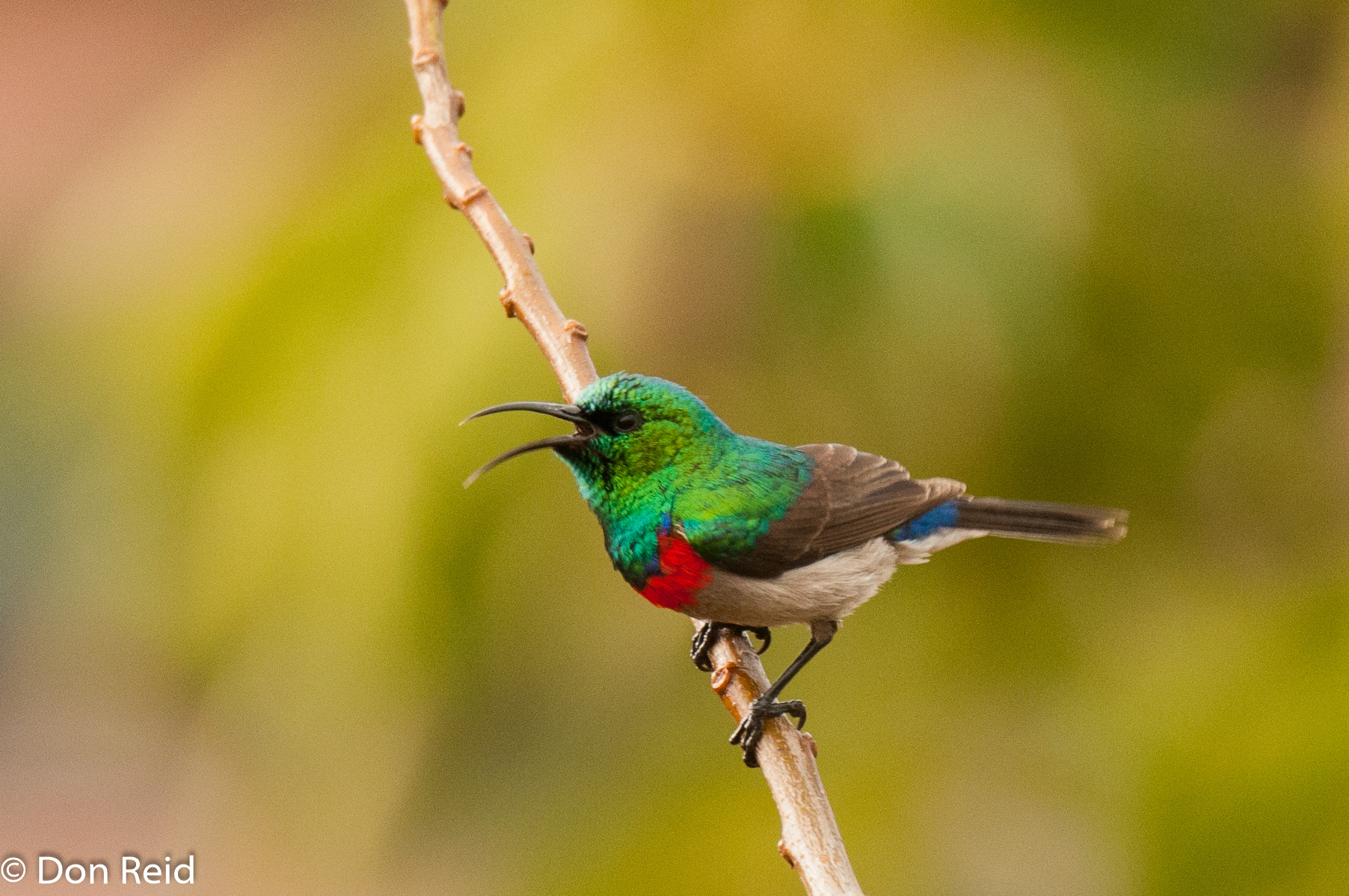
Some interesting birds caught my eye, the pick being a Long-tailed Paradise Whydah with its impressive tail feathers almost too long to fit into the frame, followed closely by a striking Scarlet-chested Sunbird in the Aloes at the lodge.

When I arrived at Mziki camp entrance and parked in the demarcated spots (these Phinda folk are organised) the other twitchers were all there – not twitching as such, in fact quite calm, but looking forward to finding the bird that had brought us all to this place – Dave Minney, Johan Boshoff, Jon de Guisti, Trish Jonsson and Ken Jarvis. Just a few minutes later our game drive vehicle arrived with Zandri Benade at the wheel – the vehicle looked far too large for this petite young lady to handle, but as it turned out she drove it like a pro.

And so we set off, excited, to Mziki dam – which was literally “just down the road” and we reached it a few minutes later, where Zandri found the Pond-Heron a further few minutes later! Other groups had looked for up to two hours to find the Pond-Heron, but in our case – there it was – almost before we had a chance to build up some tension and excitement!

At least we could all relax in the knowledge that our long journeys had paid off and now we could just enjoy the bird. And enjoy it we did, for close to two hours, watching its every move while enjoying the peaceful setting and beautiful surroundings.

Initially the Pond-Heron was engrossed in its search for prey along the grassy edge of the dam, probing now and then in the shallow water then moving in stalker fashion, veeeerrrryy slllooowwwly and deliberately, hardly causing even a tiny ripple which may warn the fish, frogs and aquatic insects of its approach.

Zandri edged the vehicle closer, trying for better views and camera angles to take advantage of the lighting. The Pond-Heron played along nicely, posing in various positions and actions :

  • Stalking mode

  • Coy behind grass fronds

  • A short flight to show off its “whiter than white” OMO advert wings

  • Moving into the open with perfect light conditions, showing off its heavy streaking and yellow legs

  • Preening at water’s edge

  • Sipping water

  • Moving cautiously past a crocodile near the water, eyeing it in the process, while we all held our breath wondering if this would be the Pond-Heron’s last hurrah
Hmm who’s this then
Best keep away – those jaws look fearsome
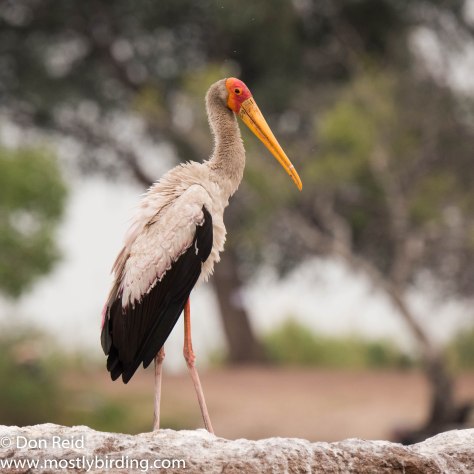
  • Joining a Yellow-billed Stork and African Spoonbill foraging in the shallows


Threesome

While this was happening we were also entertained by other visitors to the water :

  • A handsome Nyala bull coming to drink, joined later by a female and a younger male
Nyala Bull
Nyala


  • Yellow-billed Stork flying in and joining the lone Spoonbill
Here I come
Arghhh .. brakes on
Made it
Oh oh here comes a stranger


  • Pied Kingfisher flying by with fish prey just caught, later continuing its familiar hovering search for the next one
Fuzzy photo but nice catch
Looking for the next one

The afternoon concluded with a celebratory drink and a toast, where after we all went our separate ways, thoroughly happy about the outcome and a very special lifer.

Oh and that bit about my birding conscience at the start of this post …

In fact my life list already included this rare species, based on a sighting 23 years ago at a small pond at Tshipise in the far north-east of SA. Can one trust a sighting from your early years of birding, when I had no appreciation of rarities as such? There have only been a handful of sightings in our region, mostly in Mozambique with just one previous sighting in South Africa itself, also in KZN at Ndumo July 2005 (according to Roberts) so what are the chances that I indeed saw this species in July 1994? Actually I am still mostly convinced that I did record the species at the time, but am glad I could put all doubts about including it in my life list to rest with this sighting.


Touring with Canadians – Part 4 : Victoria Falls

The Story so far..

The previous posts on this “Trip of a Lifetime” to Southern Africa by our Canadian family covered the time spent in Kruger National Park and the nearby Panorama route .

Now for the real Africa!

I had booked a package a few months prior for our small group, which seemed to meet their desire of experiencing Victoria Falls and Chobe Game Reserve. The package included the flight from Jo’burg to Vic Falls and 2 nights in the Kingdom Hotel, followed by a road transfer to Kasane for a further 2 nights in the Chobe Safari Lodge`, ending with a flight back to Jo’burg from Kasane.

Kasane lies in northern Botswana just 80 kms west of Vic Falls and has become well-known to me after a dozen or more visits over the last couple of years for a project in which I’m involved.

The Trip

In years gone by it would have been a major undertaking to get to the north-west corner of Zimbabwe in order to experience this natural wonder of the world – nowadays regular flights from Jo’burg to the modern airport some 20 kms outside town get you there in just one and a half hours flying time.

We left home in Pretoria on Monday 13th March 2017 with time to spare, so once we had made our way through check-in and the security and passport formalities at OR Tambo, we could enjoy a Mugg and Bean breakfast before boarding the flight.

We landed at 1.15 pm at Vic Falls airport and our transfer was waiting to take us to the Kingdom hotel, where two comfortable rooms awaited us.

Relaxing at the Kingdom Hotel

On the way we made a short stop to organise bookings for the afternoon excursion – a sundowner cruise on the Zambezi.

Sundowners on the Zambezi

There was time to chill before our 4.30 pm pick-up to take us to the river cruise dock upstream from the falls, where we boarded the Zambezi Royal for a “luxury cruise”, which turned out to be “super cool” in Sarah’s words. It’s worth paying the extra for the luxury of your own table and personal service on the spacious, smooth-riding boat, with drinks and gourmet snacks included ( canapés is what the grand people call them, I think).

Boarding the Zambesi Sundowner cruise

As the boat departed we sipped sparkling wine, nibbled on the canapés and tried our best to look the part – there were a couple of other, somewhat more crowded boats passing by at the time, so we had to let them know what they were missing.

Zambezi Sundowner cruise – the spacious boat
Zambezi

The boat headed upstream along Africa’s fourth longest river, with Siloka island on the right, skirting the riverside vegetation. The cruise manager kept us informed on what we were seeing and I was pleasantly surprised at his bird knowledge and spotting ability, with good sightings of White-fronted Bee-eater, Water Thick-Knee, Purple Heron, Pied Kingfisher and others. At each sighting he got the captain to take us close to the river bank for a close-up view.

Purple Heron
White-fronted Bee-eater
African Pied Wagtail

It did not take long to find the first Hippos and they obliged with their trademark big yawns,  showing us their massive jaws and fearsome looking teeth as we approached. We found more pods of hippos as we made our way up river, some with Red-billed Oxpeckers in attendance.

Hippo giving us the eye
Hippo
Hippo

These avian scavengers are tolerated by a variety of animals due to the ‘service’ they provide of  taking care of irritating ticks and other parasites. One Oxpecker was determined to stay put, clinging to the nose of a hippo despite its “customer” opening its jaws wide  , but eventually it got too uncomfortable for him and he flew off, only to land on the next available hippo.

Hippo with Oxpeckers taking a ride
Too much jaw for this Oxpecker!

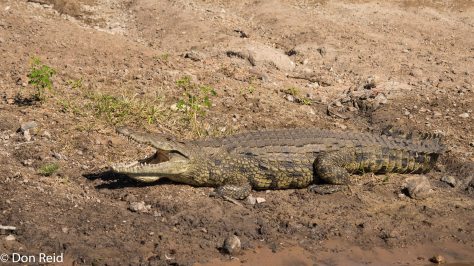
A large Crocodile, resting on the bank and partly concealed by the long grasses, caused some excitement amongst the passengers as the captain edged the boat up to the bank to allow everyone to get a good view.

Crocodile
Crocodile
Zambezi Cruise

We continued for an hour or more until all that remained was to watch the sun slowly set as the sky turned different shades of orange and grey over the Zambezi as we enjoyed a beer of the same name.

Zambezi
Zambezi Cruise, Zambesi beer

All in all, a great way to start our visit to this world-famous corner of Zim! Just not sure how we can keep up the high level of excitement that the sightings and doings have caused amongst the Canadians.

A Walk in the Rain Forest

If it’s Tuesday it must be ….  time to ‘do’ the Falls, which is what the Canadians had come to see, after all.

After a good hotel breakfast in the large, open air dining room, we first walked to the nearby shopping area for a couple of essentials (a hat and sunscreen for me) trying not to make eye contact with the vendors with their billion dollar notes and wooden bowls etc. From there we headed back down the road past our hotel and along a pretty flower lined pathway that ended near the Falls entrance.

Kingdom Hotel Vic Falls
On the way to the Falls – something’s caught their eye
Flower along the path to the Falls

You would think that entrance to one of the seven ‘natural wonders of the world’ would be quick and automated, but no, the cashier laboriously writes out an invoice in long hand for each purchase of a ticket. Just a tad frustrating, but nothing could spoil the experience that awaited.

Victoria-Falls-Footpath-Guide

 The views were as breath-taking as my previous visit 18 months ago, more so for our visitors seeing it for the first time, but compared to my earlier visit there was a lot more water gushing in shiny brown torrents over the edge and into the steaming turmoil below. What power!

Devil’s Cataract (2 on the map)
Livingstone’s statue (1 on the map)
All the Canadians
Vic Falls

We meandered along the pathways, with the spray from the falls varying between barely noticeable droplets to the equivalent of a light summer rainstorm and by the time we reached the bridge at the furthest end of the walk we were pretty much drenched.

The rain forest
Viewpoint

There are a number of viewpoints along the way, each one numbered and each presenting the falls from a different perspective, all of them spectacular. The roar of the falls accompanies you as you make your way from one viewpoint to another.

Main falls

Birds were rather scarce other than a few in the rain forest, such as White-browed Robin-Chat, Tropical Boubou and Paradise Flycatcher. Butterflies made for a splash of fluttering colour amongst the greenery of the rain forest and a group of Mongoose moved through the undergrowth.

Garden inspector butterfly
Poplar leopard butterfly
Banded Mongoose

Our last stop before turning back was at the bridge viewpoint with its grand view of the man-made structure from the colonial era that is still impressive.

The bridge (16 on the map)

Back at the entrance, tired after the longish walk, we enjoyed a thirst quencher and Alex ordered a toasted sandwich which a beyond cheeky monkey decided to plunder, appearing out of nowhere and giving us all quite a fright. The restaurant brought a replacement and the “monkey guard” appeared with a catapult which settled things down again.

The afternoon was spent relaxing and for the evening meal we decided to try the nearby (nothing’s very far in this town) Mama Afrika restaurant which had a delightful African flavour and atmosphere enhanced by a jazz band and a short power outage.

Mama Africa restaurant

Some Birding

The next morning was our last in Vic Falls – I decided to take an early morning walk through the extensive gardens of the hotel and along some of the paths that lead to the Falls. It turned into an interesting walk when one William, curio seller, decided he had nothing better to do and accompanied me, showing me the quieter paths, where he also spotted and pointed out a few birds, although he didn’t know their names. In return I told him some of the names, showed him their illustrations on my Roberts App and played the calls – I could see he showed an interest and I suggested he learn more about the local birds so that he could perhaps help tourists with a birding bent in future. He asked that, if I came back to Vic Falls, I bring him a bird book to learn from – who knows, maybe that will happen – I would certainly love to help him.

William – prospective bird guide

The hotel grounds were good for Emerald Cuckoo which called frequently during our stay, Black-collared Barbet, Red-winged Starlings aplenty and Pied Wagtails at the pool. Village Weavers were nest-building in the reeds at one of the hotel ponds – at first I thought they were Lesser Masked-Weavers as the black on their heads extended well down their necks, unlike any Village Weaver I had seen before.  Checking my Roberts app I realised that they were a sub-species of the Village Weavers (Ploceus cucullatus) we are accustomed to in South Africa, with the scientific name ploceus cucullatus nigriceps and occurring in the northern parts of our region.

Path to the Falls
The smoke that thunders
Village Weaver (Male race nigriceps)

After joining the others for another sumptuous, relaxed breakfast, we had some time to kill so walked to the adjoining Vitoria Falls Hotel, still magnificent in its colonial splendour. You almost expect Rhodes himself to appear on the verandah at any moment in his pith helmet and join you in gazing at the classic view of the bridge in the distance, framed by the gorge and forever shrouded by the misty spray.

Vic Falls Hotel
Bridge view from Vic Falls Hotel

Soon after our bus arrived to transfer us to Kasane for the next leg of our trip……..  more about that soon.


A family of Bateleurs

During a visit to Chobe Game Reserve in April this year, I saw many of the birds that I have become accustomed to in this special slice of African wilderness. After substantial summer rains Chobe Riverfront was greener and more lush than I have ever seen it, and with the river in flood from the rains in the catchment area in Angola, the “River road” was slightly more river than road….

Road meets river in Chobe

This meant I had to stick to the upper road for most of the way, not that this detracted from the experience in any way.

The highlight of the morning was being treated to a fly past by a family group of Bateleurs – male, female and juvenile – which swooped by in a great circle above my vehicle. They were good enough to repeat this a couple of times, allowing me the opportunity to view them from my vehicle and take a few in flight shots which perfectly showed the differences between them.

What a graceful picture they present when in their element in the air, making small adjustments to their wing’s plane in flight, flying with such precision and elegance that it is like watching a cirque de soleil performance.

This species is one of the delights of visiting the larger game reserves in the northern part of our region, particularly Kruger Park where they are relatively common and often the most numerous raptor in the air.  However in all my years of birding I have never seen a “complete set” in one spot before.

The male is distinguished in flight by the broad, black trailing edge to its wings :

Male Bateleur with broad black leading edge to wings

The female can be told by the much narrower, black trailing edge to its wings :

Female Bateleur with narrow black trailing edge to wings

The juvenile has the same short tail and overall “giss” as the adults, but the plumage is in several shades of brown, seemingly designed to throw you off the track when identifying them, unless you see them in the company of the adults as I was fortunate to do.

Juvenile Bateleur

I left Chobe with the sighting of these elegant birds imprinted on my mind.

Touring with Canadians – Part 3 : Panorama Route

The Story so far..

The previous post on this “Trip of a Lifetime” to Southern Africa by our Canadian family covered the short time spent in Kruger National Park .

With Kruger Park “done and dusted” and still on a high from the special sightings we enjoyed during our two night stay in Satara, our next destination was Thaba Tsweni Lodge near Graskop in Mpumulanga for a further two nights. The intention was to use the lodge as a base for some exploratory drives along the Panorama Route.

Bourke’s Luck and Graskop

After the excitement and long drive of the previous day, we decided to take it easy and limit our exploration of the Panorama Route, while still fitting in a celebration of niece Sarah’s birthday somewhere along the way.

Thaba Tsweni lodge
Thaba Tsweni lodge near Graskop

Starting with a late breakfast at the lodge, we left around 10 am and headed up the R532 to Bourke’s Luck Potholes, which lies at the confluence of the Blyde and Treur rivers (Blyde translating to “happy” and Treur translating to “sad” – one can only wonder what events led to those names).

At Bourke’s Luck we had a walkabout along the pathways leading to the various viewpoints, which were quite busy as a couple of busloads of tourists had arrived just before us.

Bourkes Luck
Bourke’s Luck Potholes

This didn’t detract from the experience of seeing this unique natural occurrence – potholes scoured into the bedrock of the river by waterborne sand and rock over millions of years, creating huge cylindrical holes and exposing the variously coloured layers of rock.

Bourkes Luck
Bourke’s Luck Potholes
Bourkes Luck
Alex and kids at Bourke’s Luck
Bourkes Luck
Bourke’s Luck
Bourkes Luck
Bourke’s Luck
Bourkes Luck
A fellow tourist

There was time to check out the curio stalls before returning along the same road, with its beautiful landscapes around every corner, to Graskop in time for a pancake lunch at the famous Harrie’s Pancake restaurant to celebrate Sarah’s birthday. Harrie’s did not let us down and we enjoyed a variety of their pancakes amongst us.

Bourkes Luck
Bourke’s Luck Curio shops
Bourkes Luck
Bourke’s Luck – getting the low down on curios
Sarah's birthday, Harries Pancakes, Graskop
Sarah’s birthday, Harries Pancakes, Graskop

Some light shopping followed then we headed back to the lodge where everyone chilled in their own way, before getting the evening braai up and running.

Graskop
Graskop entrepreneur
Graskop
The ladies got stuck in this shop
Thaba Tsweni lodge
Thaba Tsweni lodge lawns

A cabbage bought for all of R5 from a farmer was transformed into a delicious fried dish by Sarah and became the perfect accompaniment to the braai-ed wors.

Another memorable day!

God’s Window, then homewards

 Another full day of travelling lay ahead so we girded our loins (and some other parts too) with a full lodge breakfast. One place that we had to see before heading back to Pretoria was God’s Window – so named for the panoramic views it offers of the lowveld more than 900 m below the escarpment and beyond to the Kruger Park and even, on a clear day, to Mozambique a 100 or so kms distant.

We managed a quick walk to the viewpoints and up the steep-ish path to the rain forest, then down again.

Gods Window
God’s Window viewpoint looking down onto the lowveld
Najms at Gods Window

Then it was just a question of getting back to Pretoria, interrupted only by a stop at Milly’s for lunch, arriving home by late afternoon to allow time for a ‘meeting of the cousins’ at home.

Sunday was reserved for a family day with all getting to know each other, interspersed with some of Gerda’s home cooking and much excitement amongst the grandkids and their new-found family.

More to Come

Next we do a 4 night trip to Victoria Falls and Chobe Game Reserve – more about that in the next Part of the story….


Adventurous Birding, Atlasing and Travel