And here it is once again (About time did you say?) – a selection of photos that appealed to me for various reasons, not just the quality of the photo but also for the memory it left with me. I hope you enjoy scrolling through them as much as I have enjoyed taking, editing and selecting them.
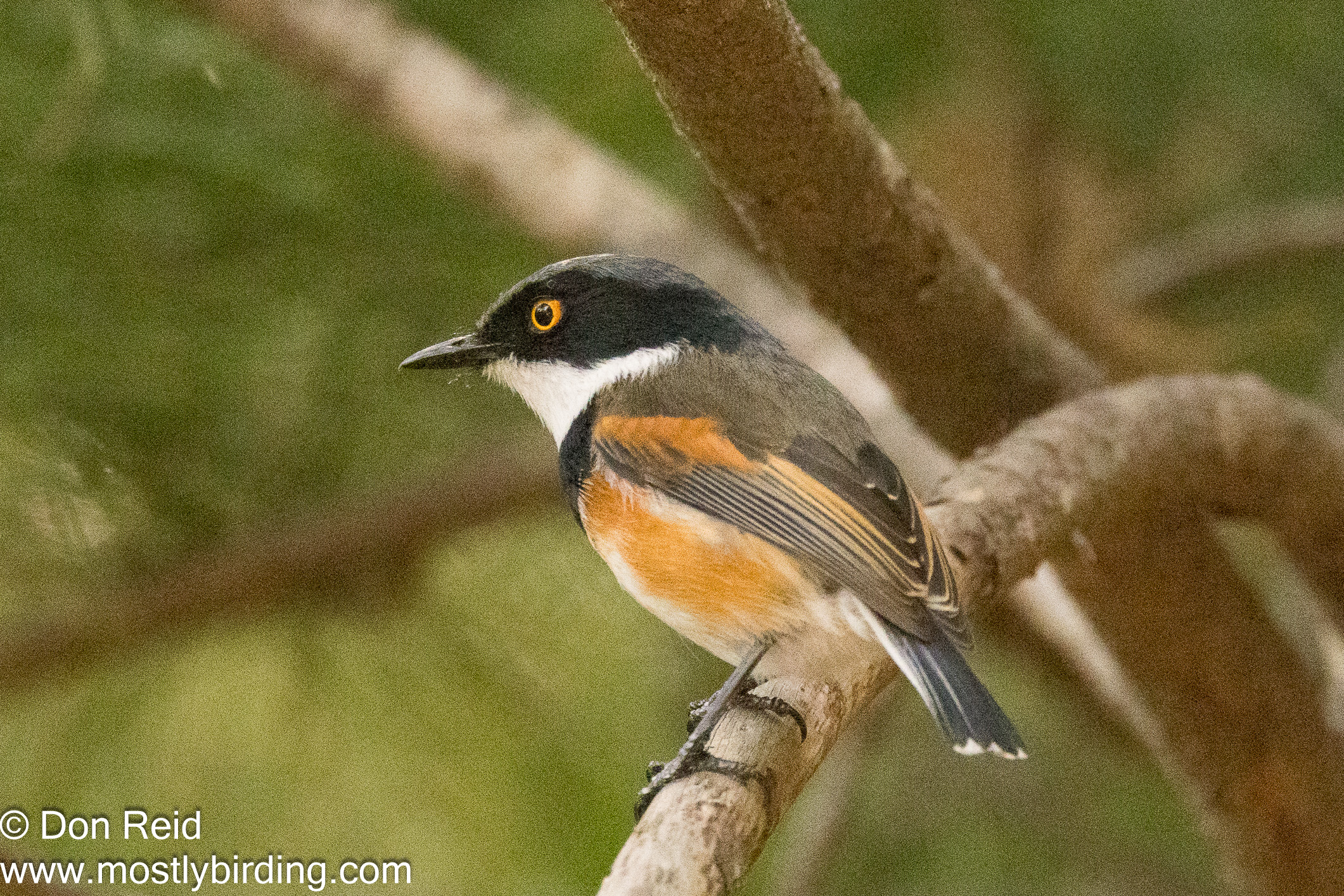
I have not included the many birds I photographed during our visit to Australia as they have been included in the posts on that visit, but chose one of my favourites for the Heading photo – a pair of perky Red-backed Fairywrens that entertained me on one of my many walks
The Places
A random selection of the places we visited during the year….
Starting with Australia and the iconic Sydney Opera House
Opera House, Sydney Harbour Cruise
Back home, I never tire of the late afternoon views while walking the golf estate and adjacent nature trails
Mossel Bay Golf Estate
A Powervan, used in the past to check and maintain train tracks, was our transport one Saturday morning, taking us high up into the mountains above George
Powervan trip from George
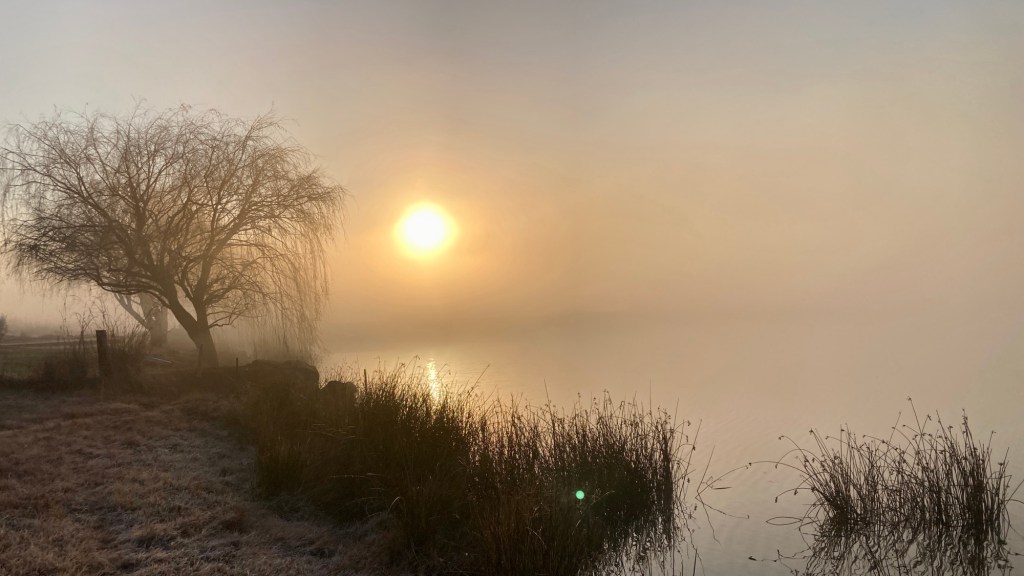
An early morning atlasing outing took me to Herbertsdale where the low-lying mist added to the beauty of the area
Herbertsdale southwest
Hartenbos beach is a favourite dog-walking spot, especially at low tide
Hartenbos
This was the scene as the Cape Town Stadium gradually filled up for the memorable Andrea Bocelli concert we attended there
Andrea Bocelli Show
A view to the end of the world from the Robinson Pass on the road between Mossel Bay and Oudtshoorn
Robinson Pass
Contrasting colours, a lone tree and several ostriches made for a unique opportunity on a mid-year atlasing trip
Canola field with Ostriches, Albertinia north area
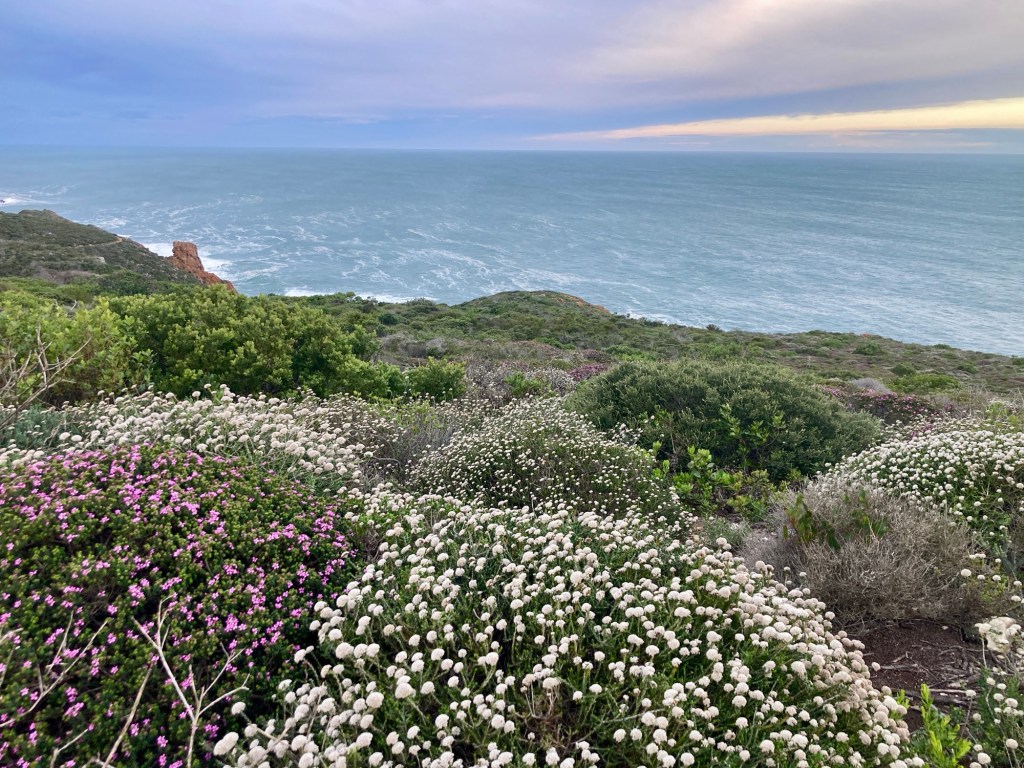
A unplanned visit to the West Coast town of Yzerfontein not far from Cape Town was a fortunate one
Yzerfontein West Coast
The Birds
As before, I have placed them under groupings ‘borrowed’ from Firefinch which is the excellent birding app produced by Faansie Peacock (his real name!) and his team.
Faansie has a way of making birding interesting and fun and the way he categorises bird species in his app is a good example of his practical approach.
Raptors
Seeing a raptor at the roadside is always exciting and a reason to stop and have a better look – most will fly off the moment you stop, so it requires a bit of stealth to keep the car moving slowly while approaching the target and to have the camera at the ready for the moment you come to a standstill – if they do take off there’s always the chance of freezing that moment, capturing the underwing patterns and colours
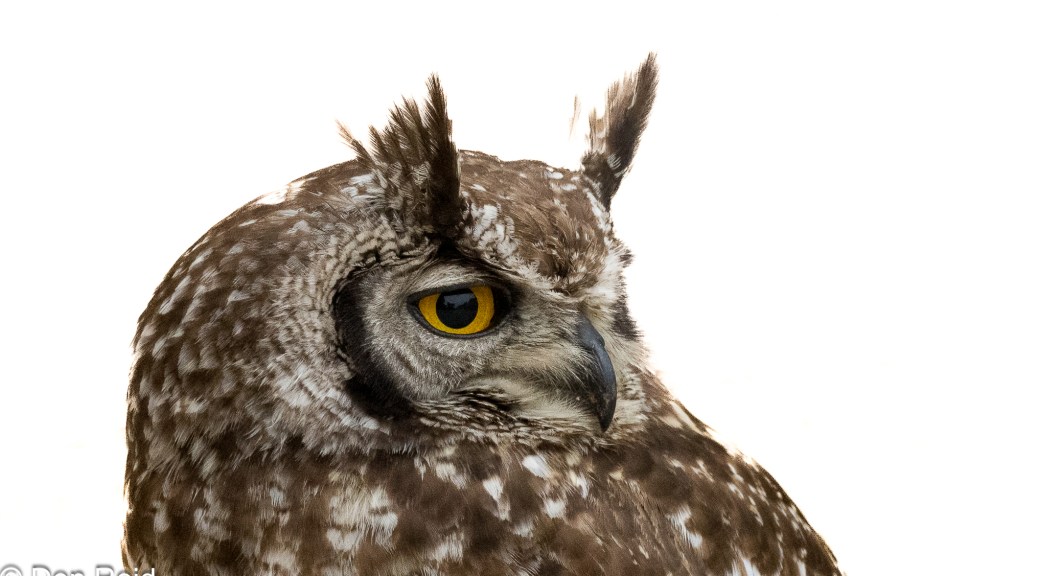
Spotted Eagle-Owl Bubo africanus Gevlekte ooruil, Mossel Bay Golf Estate
Perchers
This category covers a variety of birds normally seen perched on a tree or bush or other suitable spot
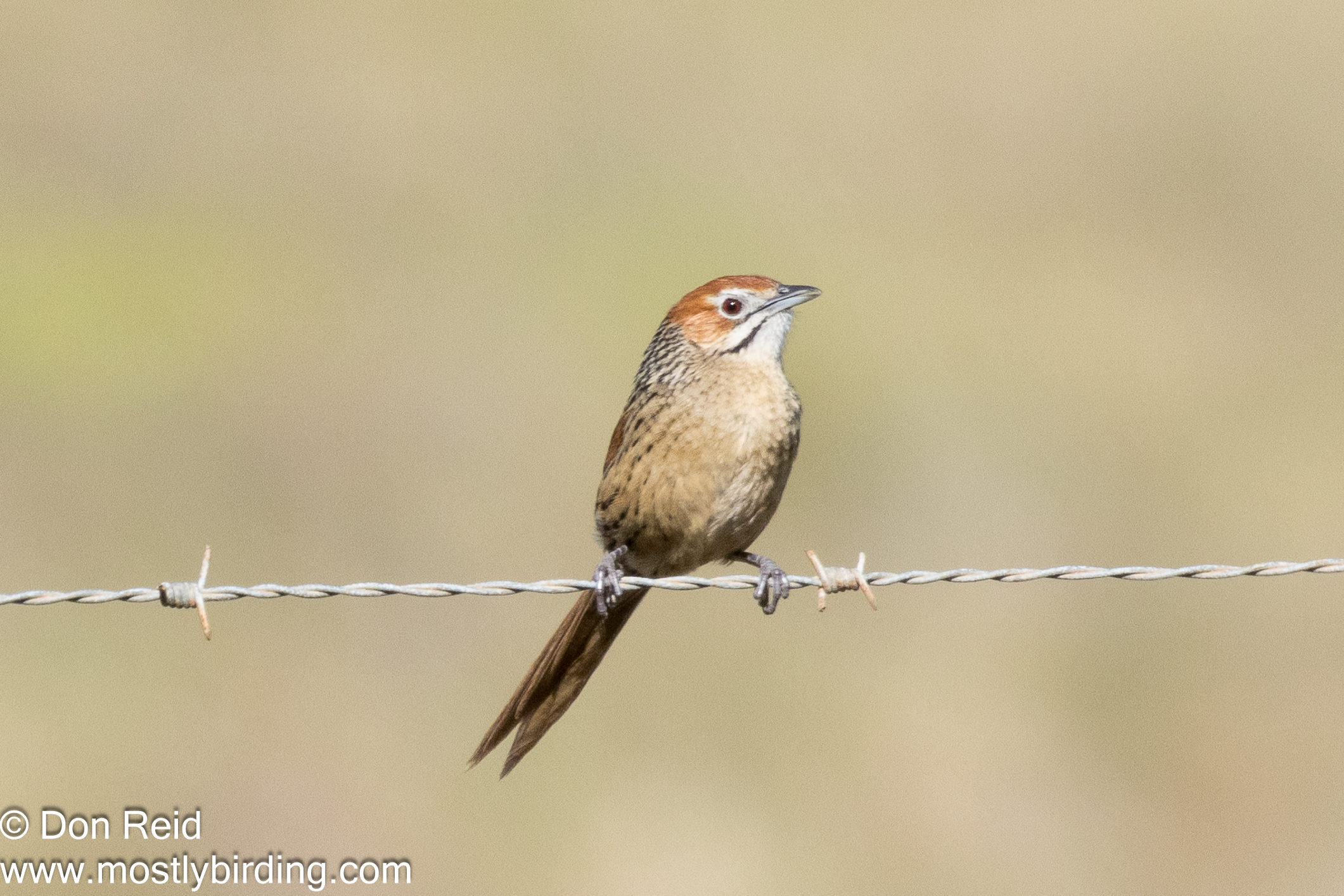
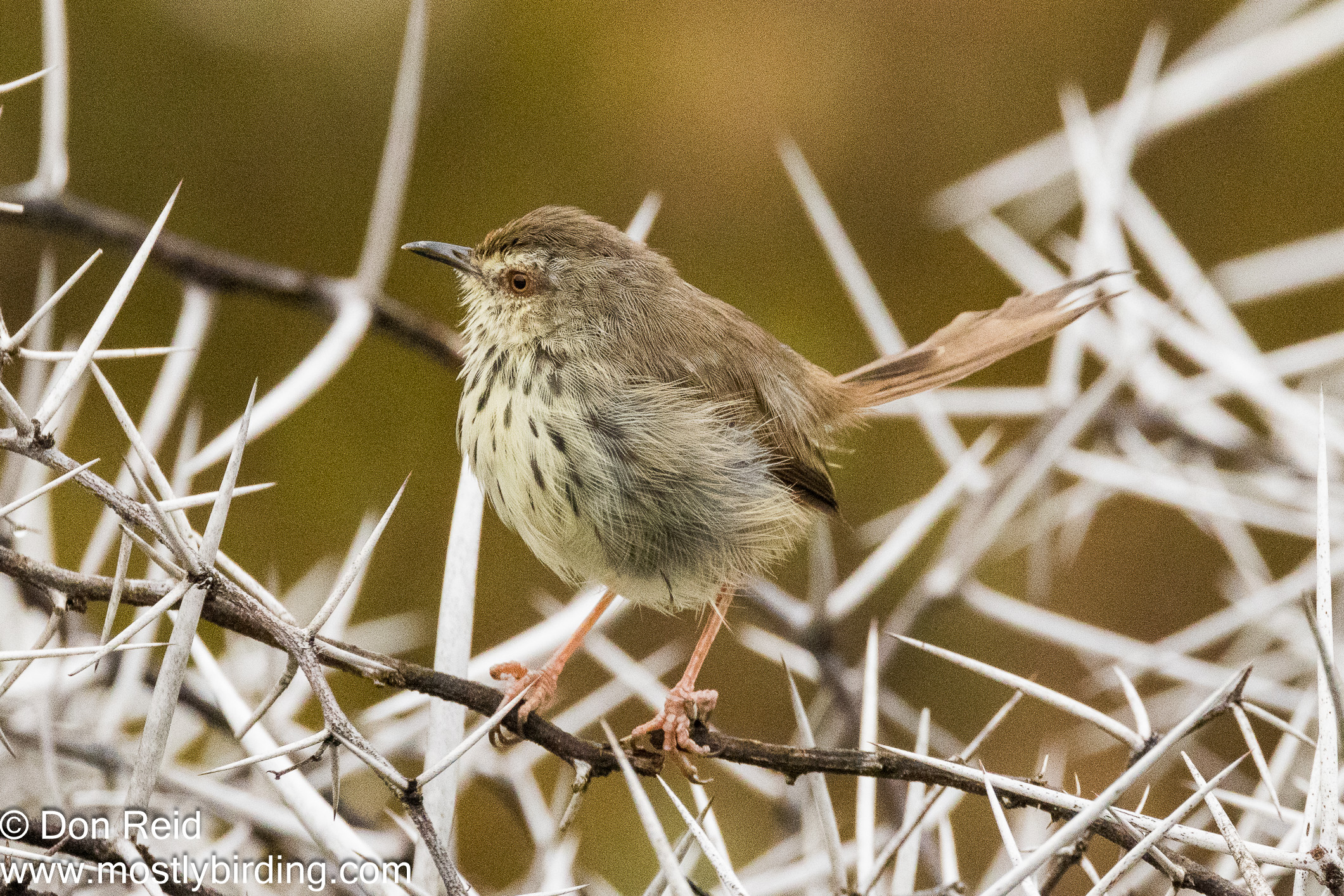
Rufous-eared Warbler, Paardebont areaAfrican Dusky Flycatcher Muscicapa adusta Donkervlieëvanger (juvenile), Hoekwil forestKaroo Prinia Prinia maculosa Karoolangstertjie, Mossel Bay Golf EstateLesser Swamp Warbler, Old R62 Road near Oudtshoorn
Suckers
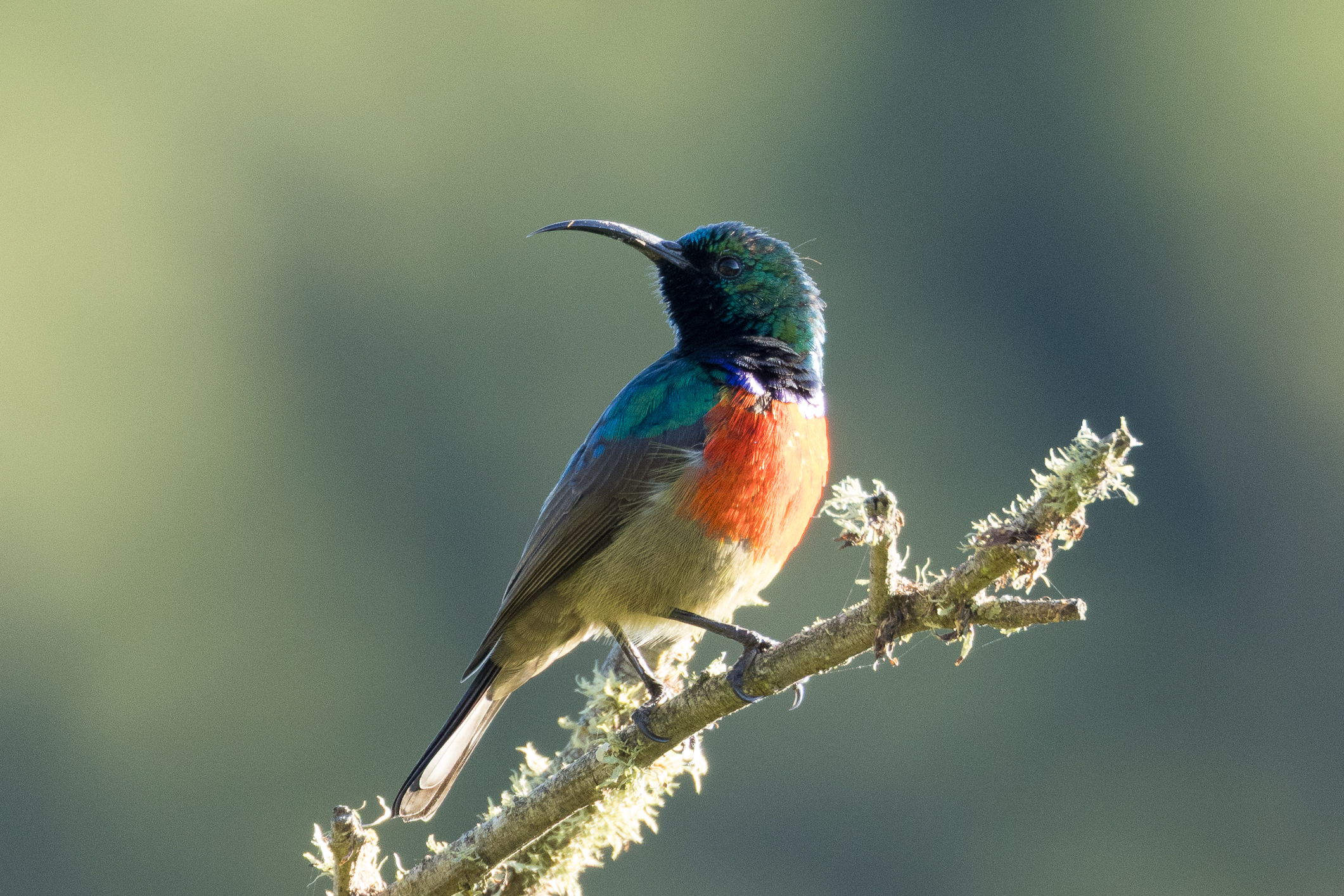
The curve-billed nectar-suckers
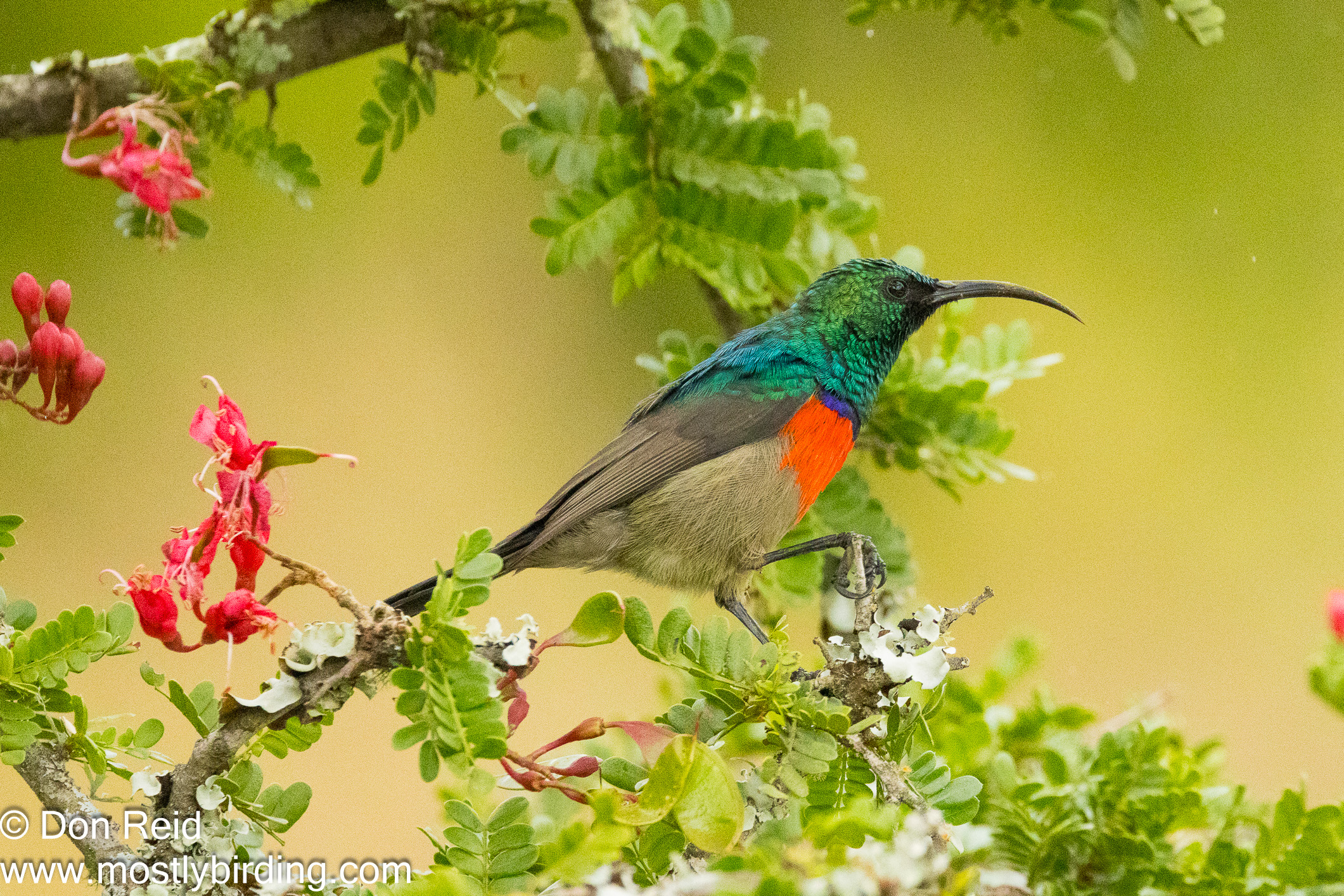
Greater Double-collared Sunbird, Mossel Bay Golf Estate
Seed-eaters
All have short, strong triangular bills suited to their main diet of seeds.
Streaky-headed Seedeater, Mossel Bay Golf Estate
Favourites
A random mix of familiar birds, often colourful and with well-known calls. Here are three Kingfishers that fall into this grouping….
Brown-hooded Kingfisher, Old R62 Road near OudtshoornGiant Kingfisher, Gouritzmond CoastalPied Kingfisher Ceryle rudis Bontvisvanger, Klein Brak
Flyers
Swifts and swallows – the aerial feeders – also the most challenging to photograph unless they are resting between sorties
Brown-throated Martin Riparia paludicola Afrikaanse oewerswael, Herbertsdale southwestBarn Swallow Hirundo rustica Europese swael, Herbertsdale southwest
Plungers
Mainly seabirds that forage over water – and under water
At certain times during the year terns frequent the estuaries west and east of Mossel Bay where they move about in large flocks, usually requiring an energy-sapping walk across soft sands to get into position for photography
Terns, Klein Brak RiverGreater Crested Tern heading to the roost with fish catch, Klein Brak River
Runners
Small to medium-sized birds that forage on the ground
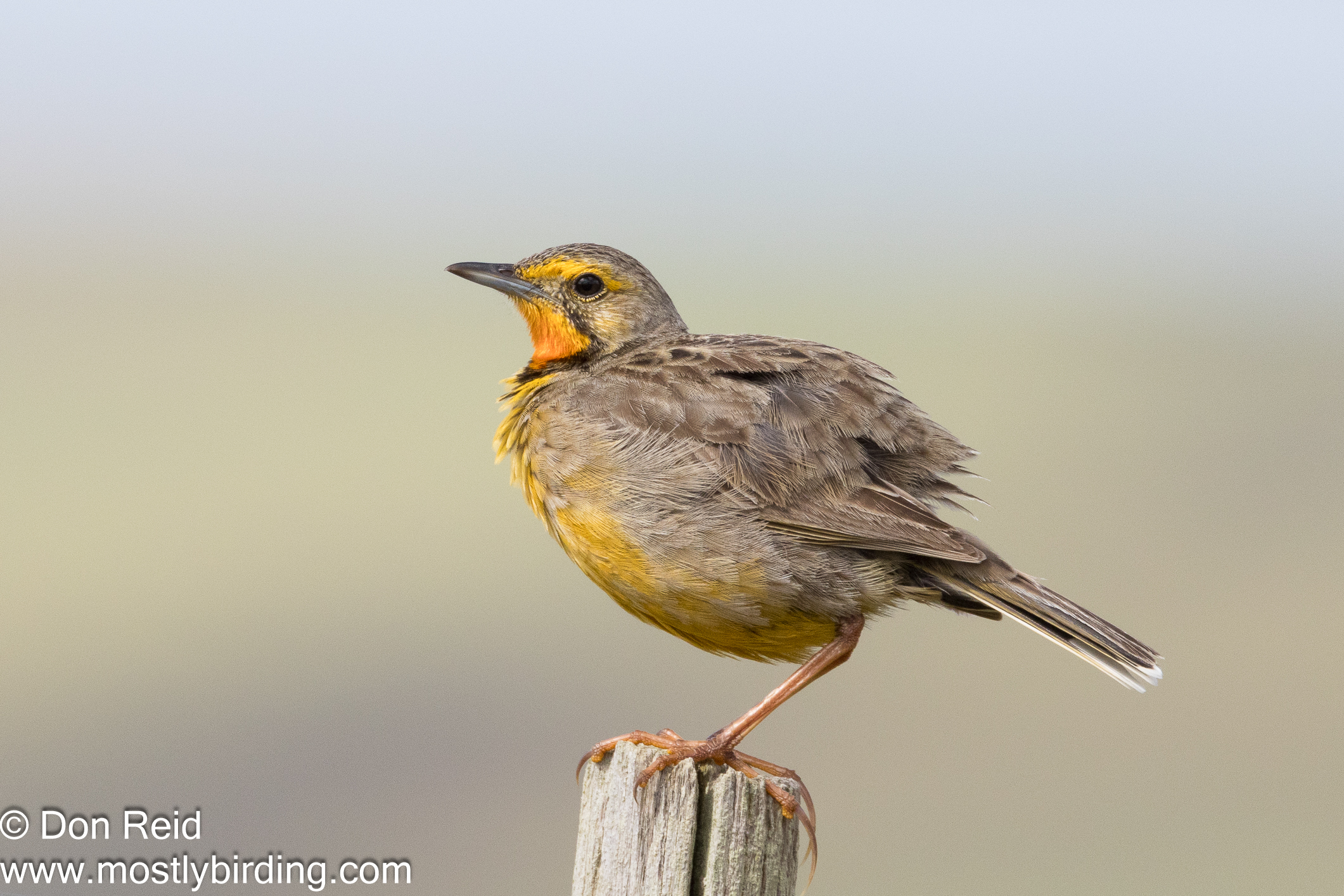
Pied Starling, Herbertsdale north beyond mountainLarge-billed Lark, Herbertsdale north beyond mountainAgulhas Long-billed Lark, Albertinia north areaChorister Robin-Chat Cossypha dichroa Lawaaimakerjanfrederik, Hoekwil forestCapped Wheatear Oenanthe pileata Hoëveldskaapwagter, Herbertsdale road
Swimmers
Birds with webbed or lobed toes for swimming
Crowned Cormorant Microcarbo coronatus Kuifkopkormorant, Yzerfontein West Coast
Walkers
And to end off – the group of large birds with long legs that feed and nest on the ground
Blue Crane, Vleesbaai areaWater Thick-Knee, Gouritzmond
Having enjoyed our time in July 2024 at The Baths near Citrusdal immensely, it was an easy decision when Andre and Geraldine (our daughter) invited us to join them again for a 10 day winter holiday visit to this most pleasant and relaxing resort set amongst hills with hot pools fed by a natural spring. Our two eldest granddaughters, both at Stellenbosch University, were ‘part of the deal’, making it extra special.
26th JUNE TO 7th JULY 2025
Getting there
With my webinar presentations (CPD for Quantity Surveyors) behind me on the Wednesday afternoon, we could start our packing and preparation in earnest for a Thursday departure – most of that was left for Thursday morning so I accepted that we wouldn’t be getting away until midday – fortunately our first day’s drive was around 300kms so not too onerous.
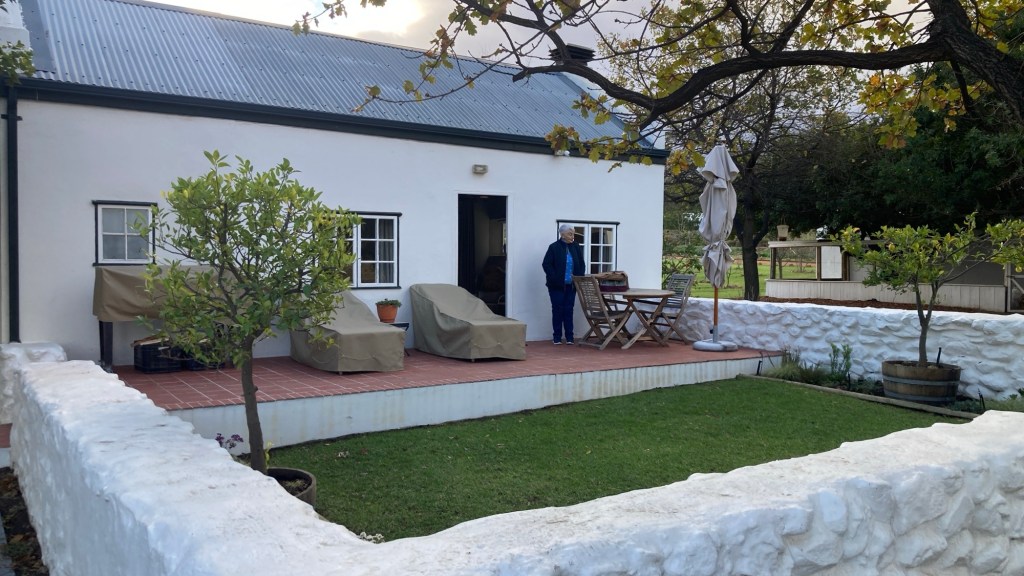
The roads were not too busy but light to heavy rain was the order of the day all the way to our overnight stop at Eikehof Farm near Worcester.
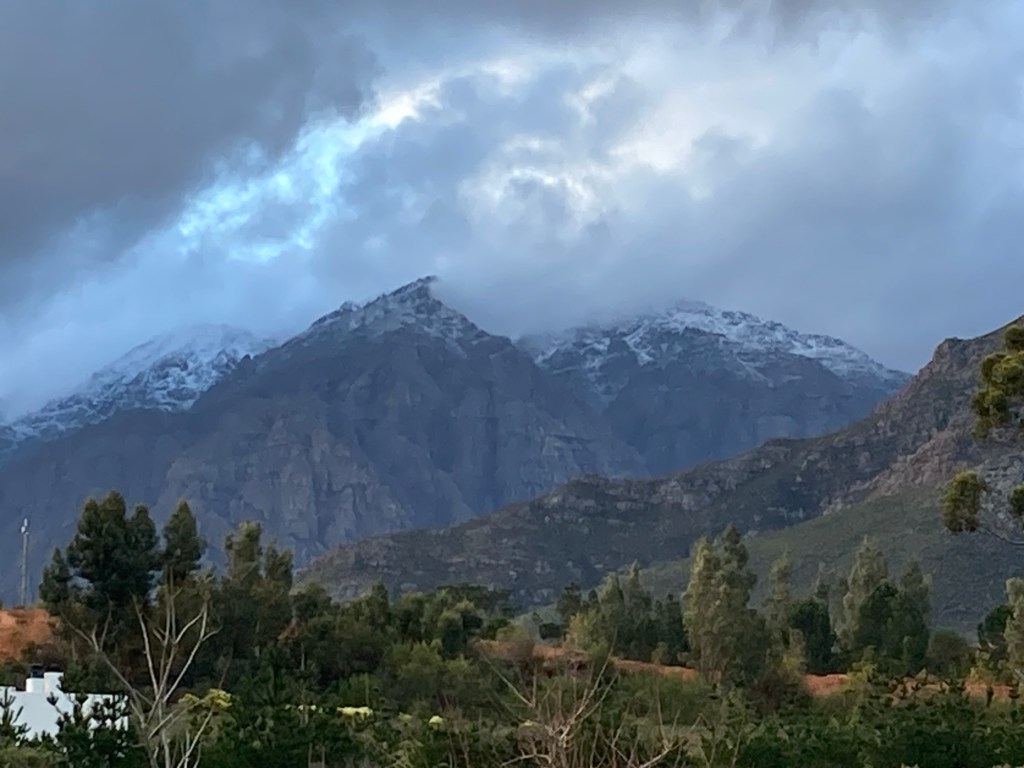
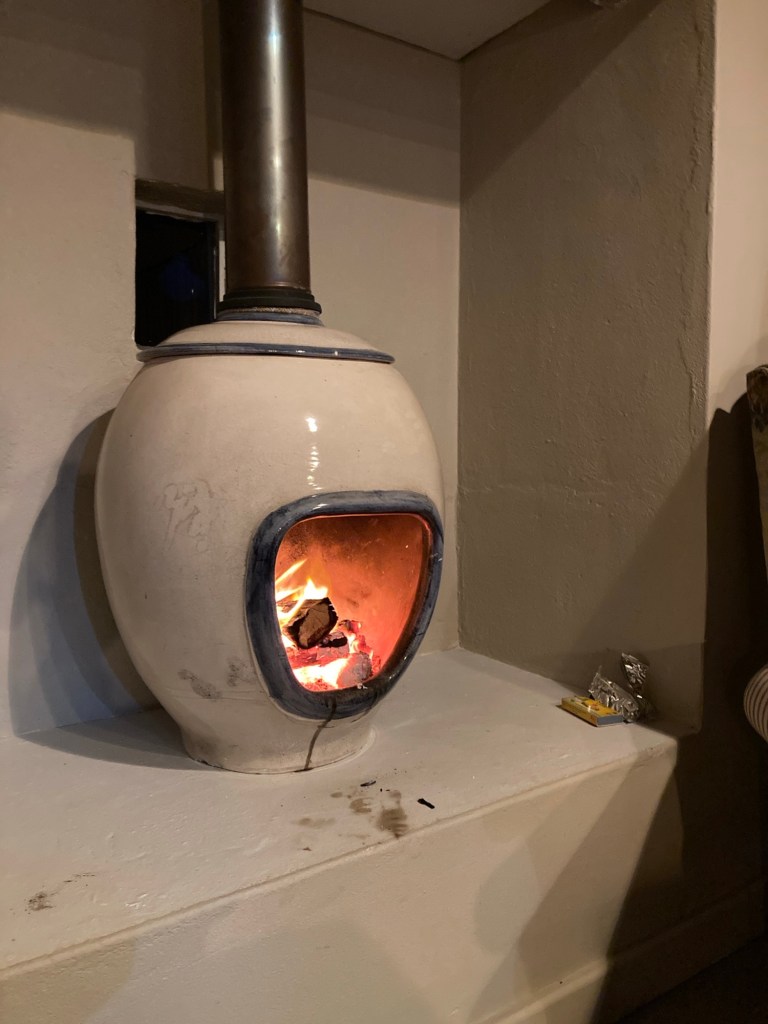
Snow on the surrounding mountains said just one thing – we were in for a chilly stay, but fortunately the chalet had a ceramic hearth and I at once set about getting a wood fire going before taking a short walk around the property.
Snow bedecked mountains around Worcester, Cape
Next morning we left at 10am with just 160 kms left to travel to The Baths so we took it super slow, ambling along at 90 or so and stopping twice, to make sure we arrived after check in time of 2pm.
Our first stop was in the charming town of Tulbagh, decided on the spur of the moment as we approached the turn-off. We were curious when we discovered that it happened to be a “Christmas in July” weekend organised by the town, so the place was buzzing with people and parked cars.
Tulbagh, Cape main road
We chose Kole & Deeg restaurant for a coffee and Pasteis de Nata, which were so good we bought 6 more to take away. The drive itself was through beautiful scenic countryside and the traffic quiet until we reached the busy N7, the main road from Cape Town to Namibia.
Our second stop was at Kardoesie Padstal where we had lunch, before reaching Citrusdal and the last stretch of the trip to The Baths.
We had plenty of time to settle in and get our provisions and clothes sorted, leaving time to relax and get used to the feel of the place again.
The Daily rhythm
Our first full day at the resort was a template for the rest of the stay as we settled into a comfortable rhythm with some variations here and there.
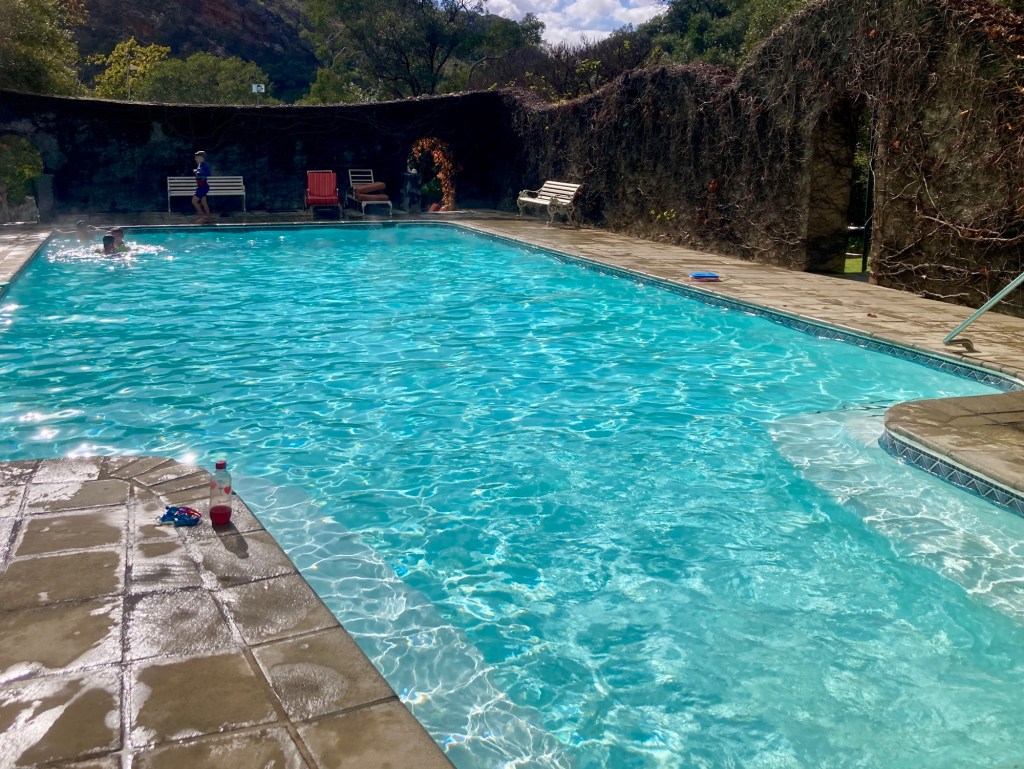
A late lie in before making our first tea and coffee of the day accompanied by rusks. Then a visit to the hot pool for a relaxing ‘swim’ – if you can call standing neck deep in hot water and occasionally paddling about slowly ‘having a swim’. Very relaxing and takes away some of the aches and pains of senior life.
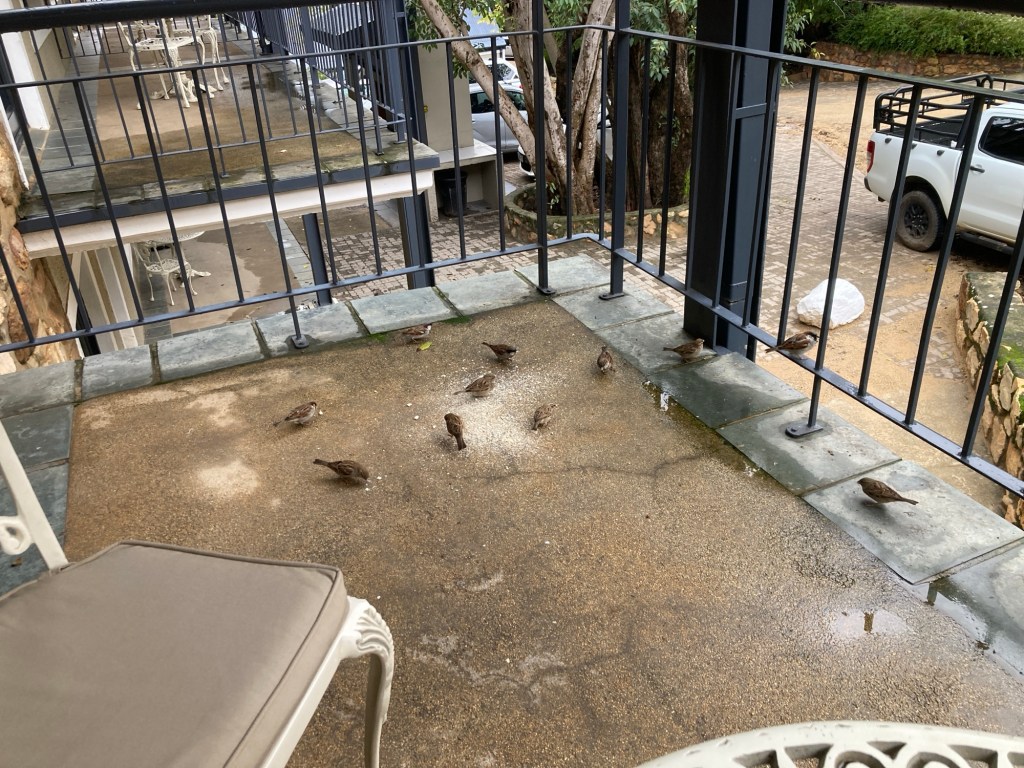
Morning tea and a light lunch out on the balcony, while watching the birds going about their own version of life in a resort – seems they have caught onto this relaxing thing as many of them seem quite laid back and accustomed to the presence of people around them.
Mid to late afternoon we head to the chalet ‘Willy’ just over a km away on the other side of the resort for some family time and the evening meal – mostly a braai – along with watching some Wimbledon tennis.
The Birding
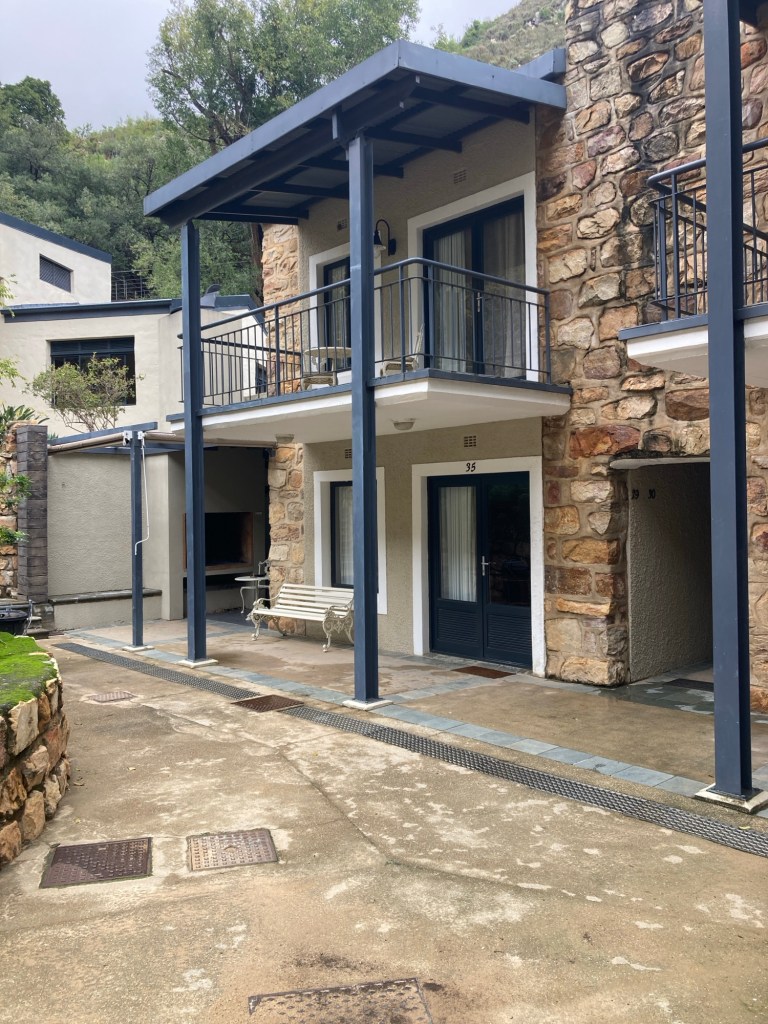
Most of my birding was done while ‘stoepsitting’ on the balcony of our apartment which looks over a busy part of the resort where most of the accommodation is found.
Our apartment on the upper floor, with balcony
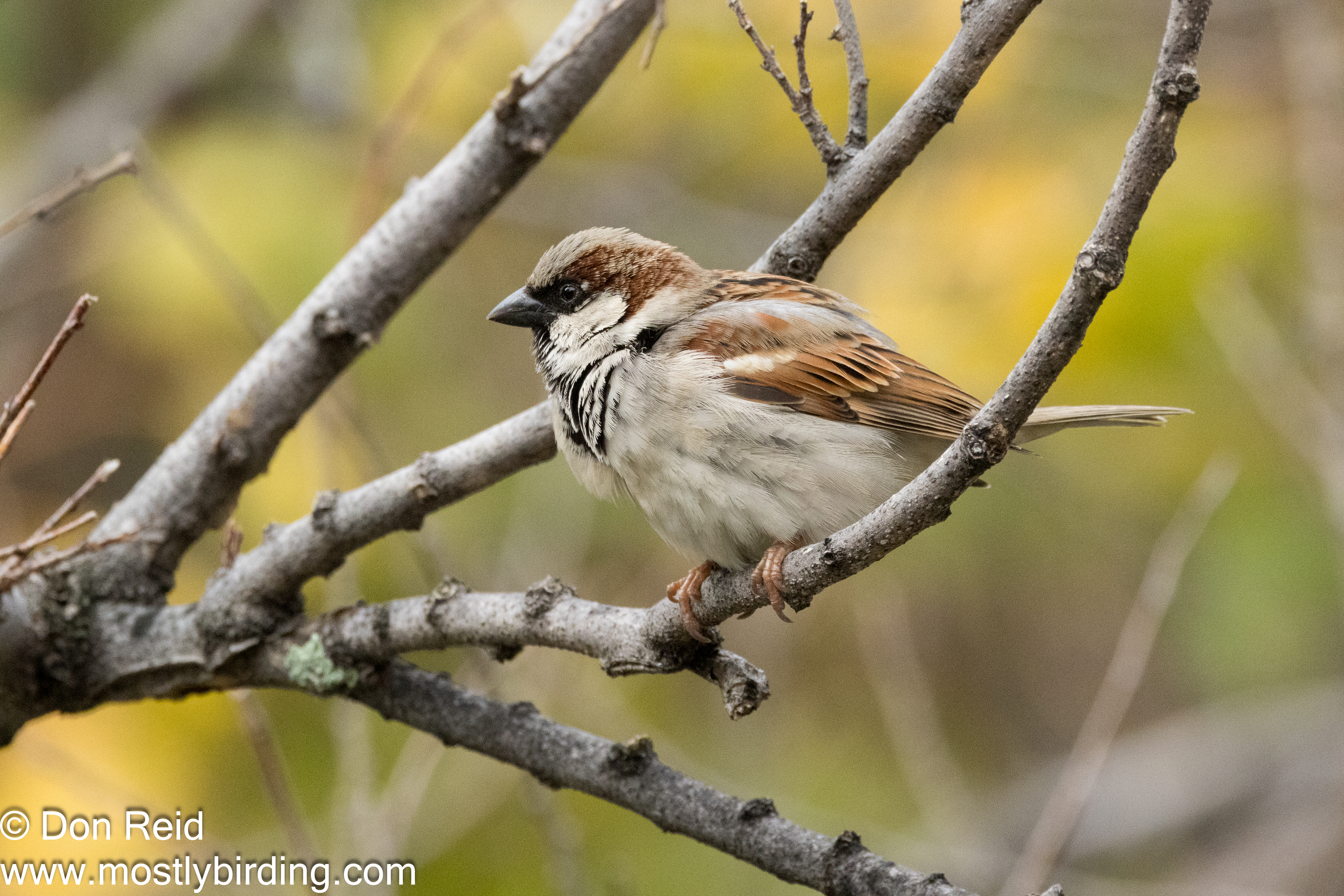
Each time I went to sit on the balcony a few House Sparrows would arrive, looking for a dropped crumb or other morsel. Okay, so maybe I created a few crumbs with a slice of bread.
House Sparrow, The Baths Citrusdal
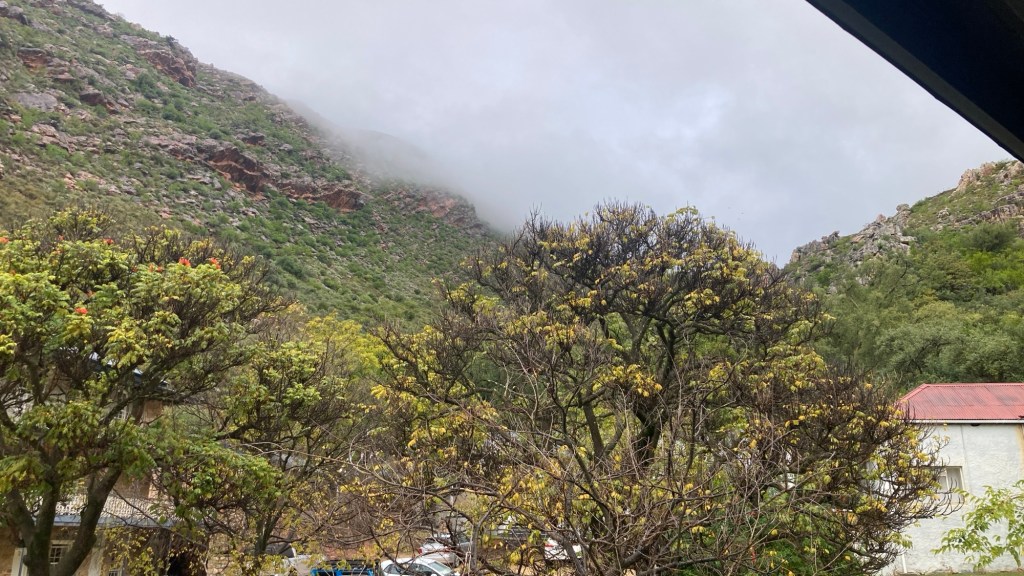
The balcony is flanked by trees and bushes on both sides and across the road the mountain dominates the view with a couple of large trees at the base.
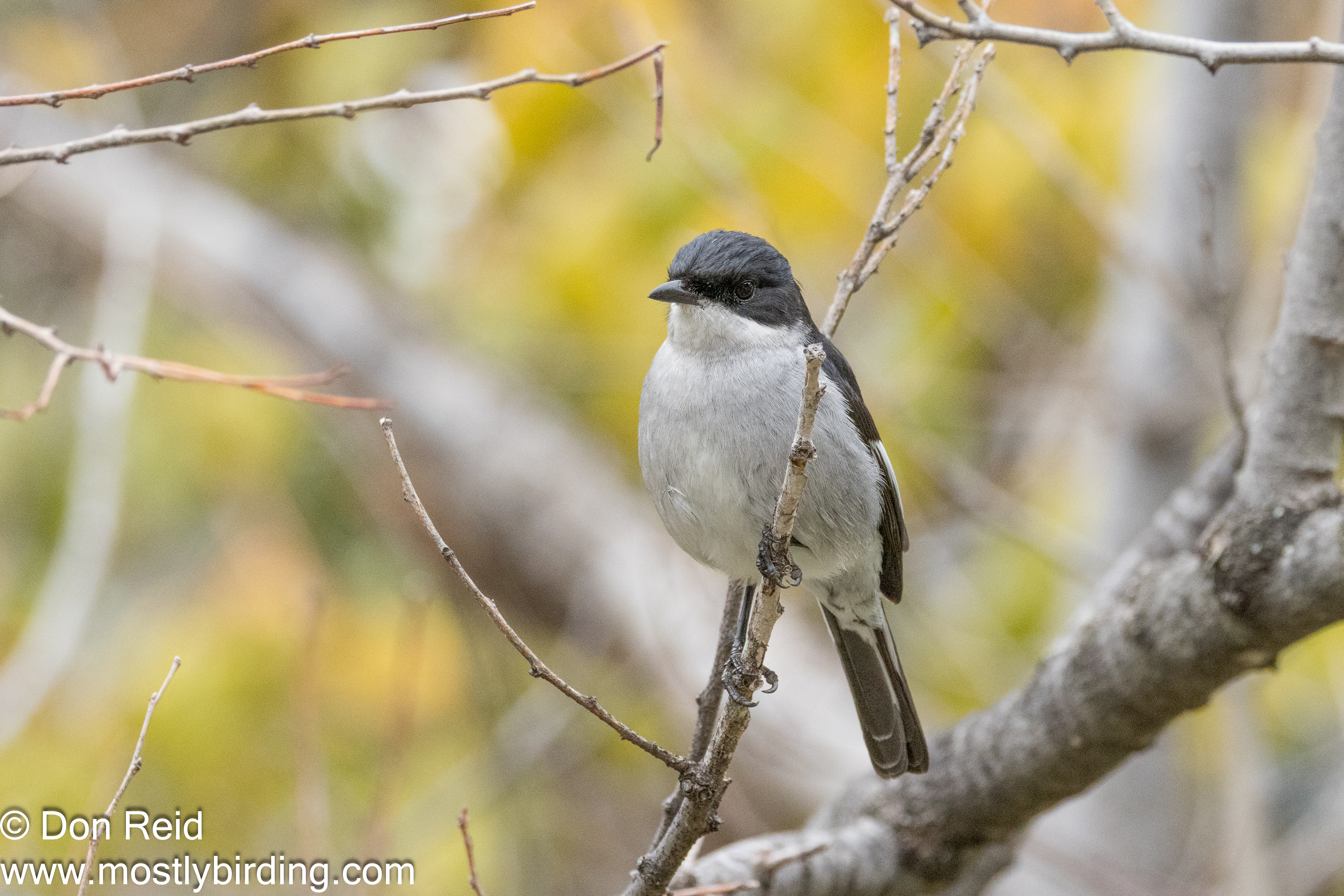
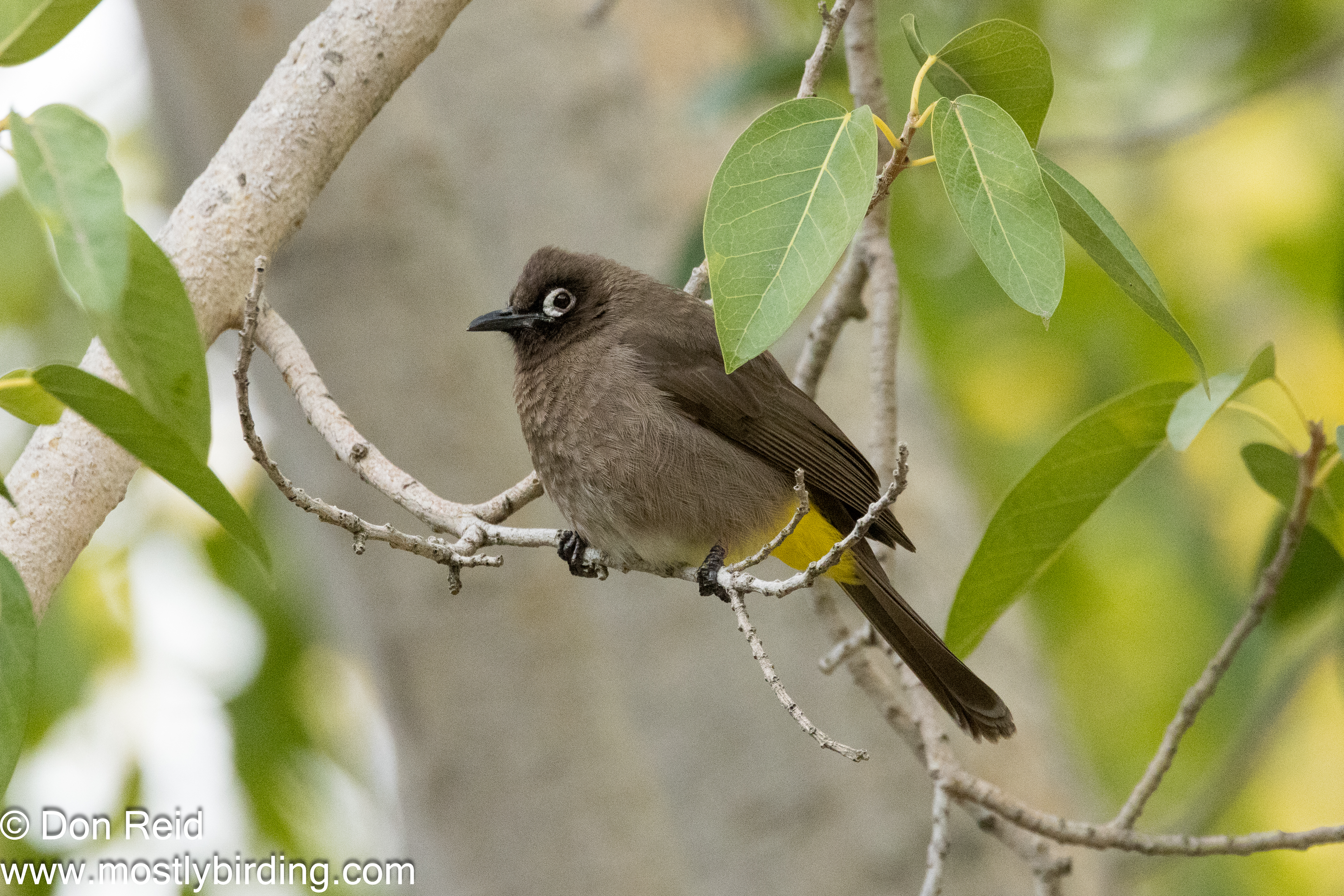
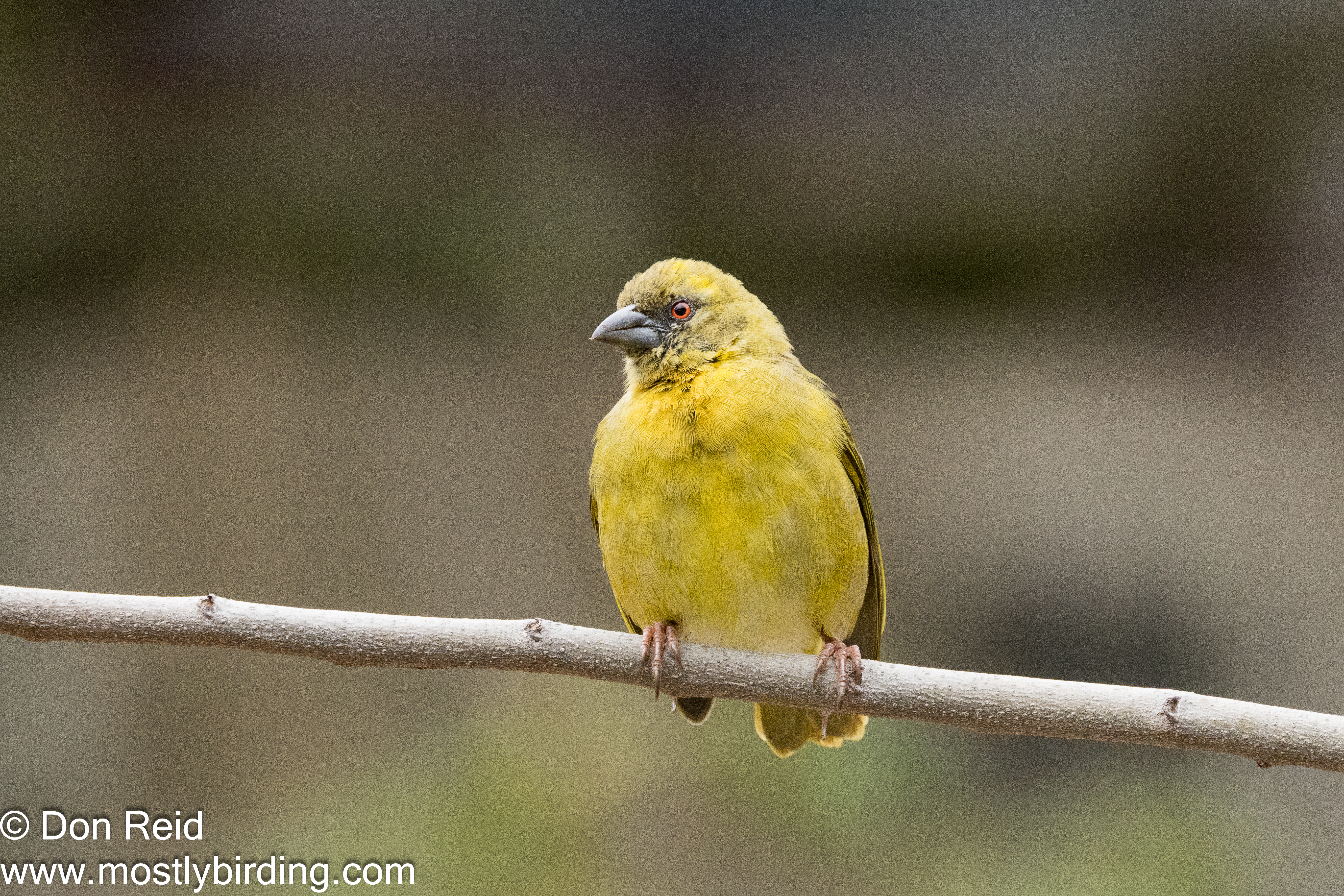
Fiscal Flycatchers were next, followed by the regulars such as Cape Bulbul, Southern Masked Weaver
Fiscal Flycatcher, The Baths CitrusdalCape Bulbul, The Baths CitrusdalSouthern Masked Weaver, The Baths Citrusdal
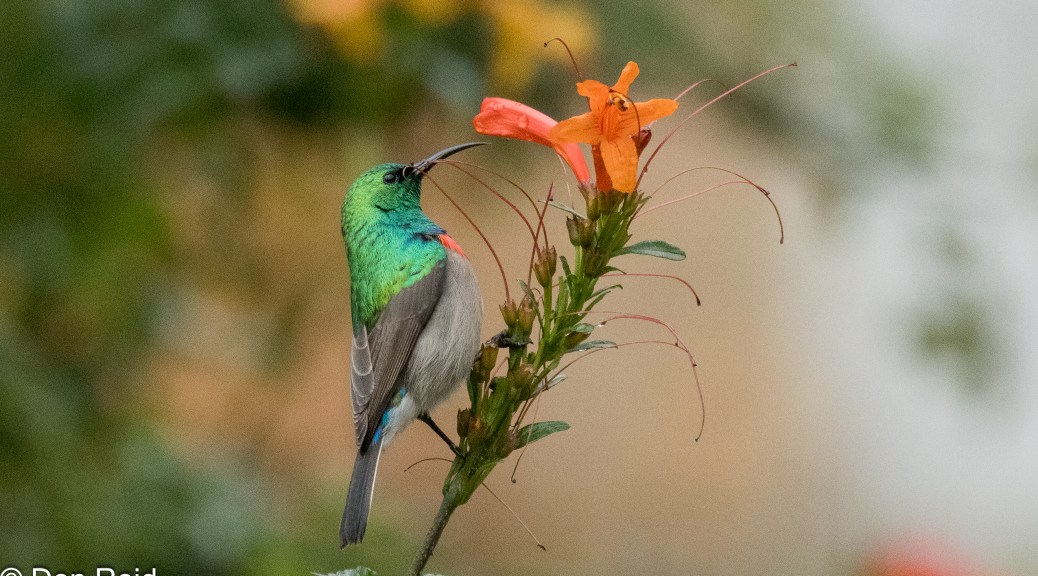
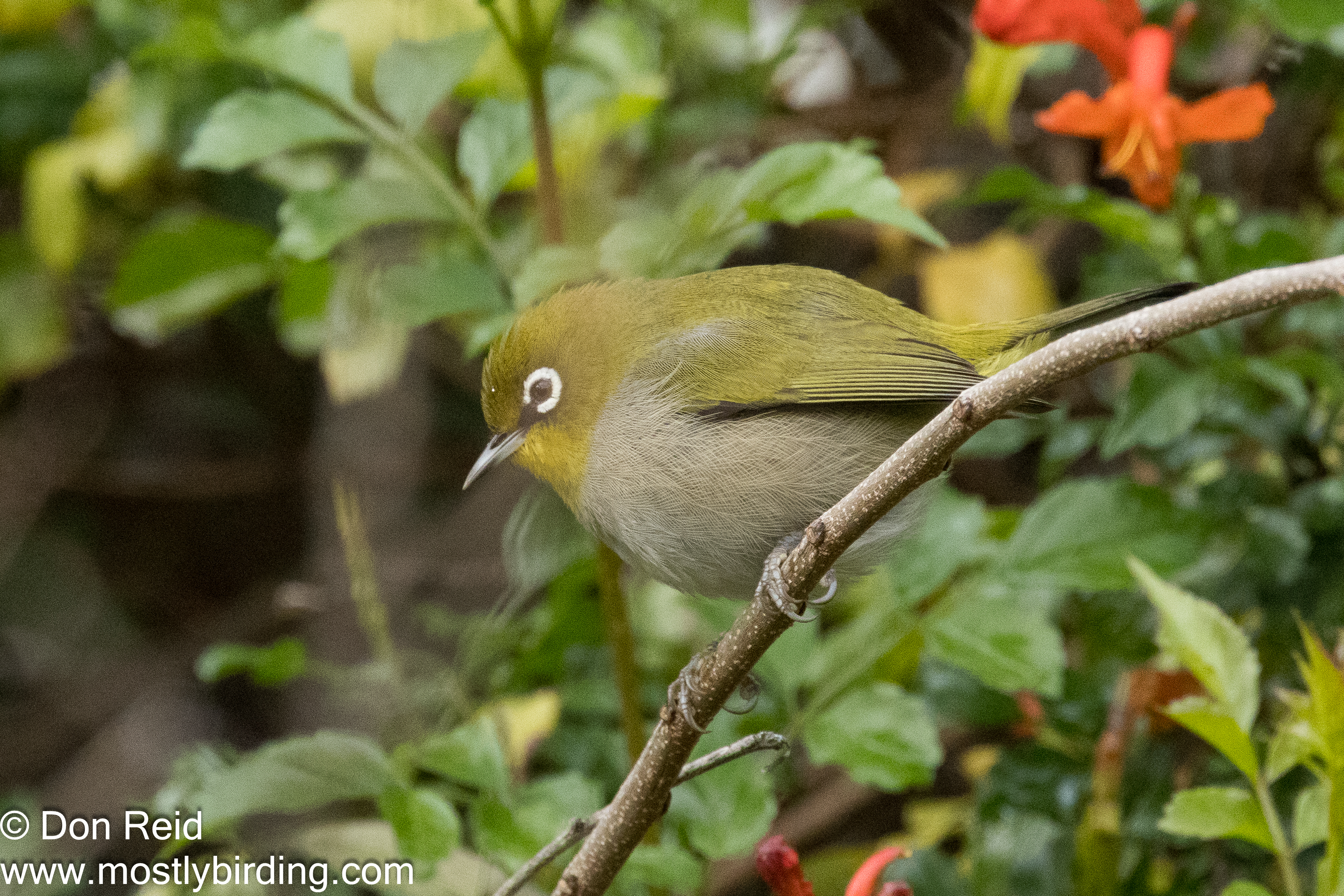
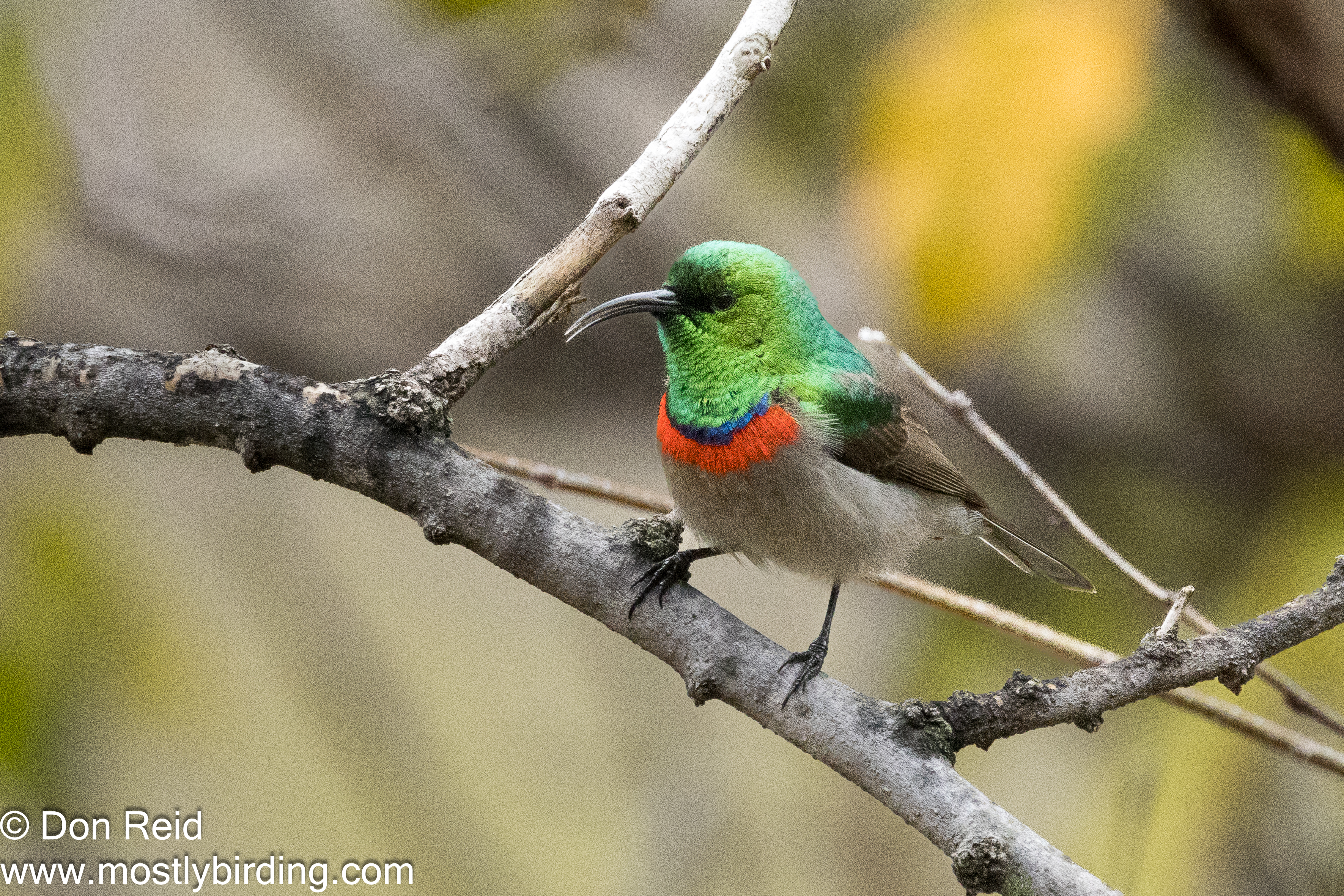
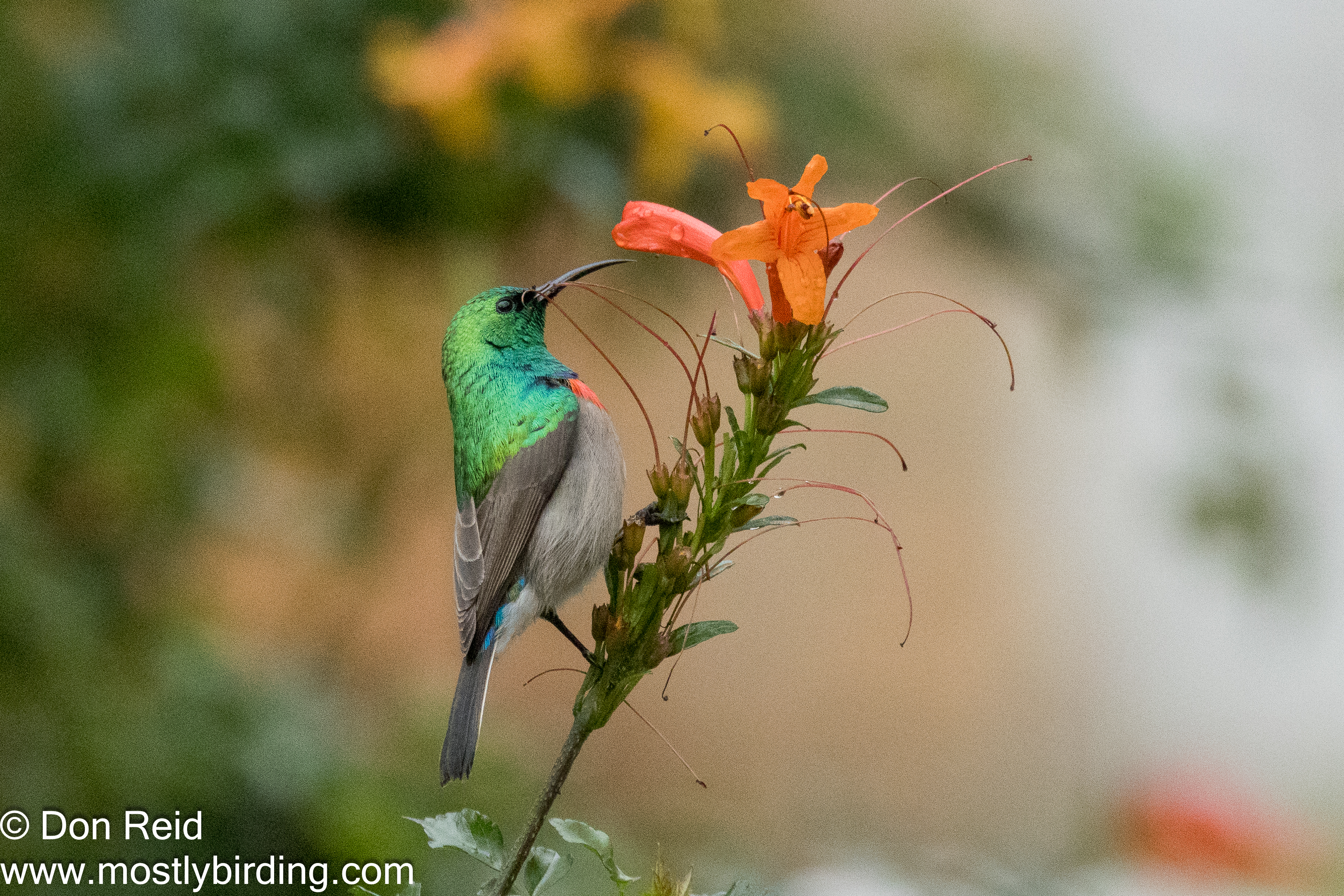
The African Flame Tree and Honeysuckle bush were draw-cards for the Cape White Eyes, Southern Double-collared Sunbirds and Streaky-headed Seedeaters.
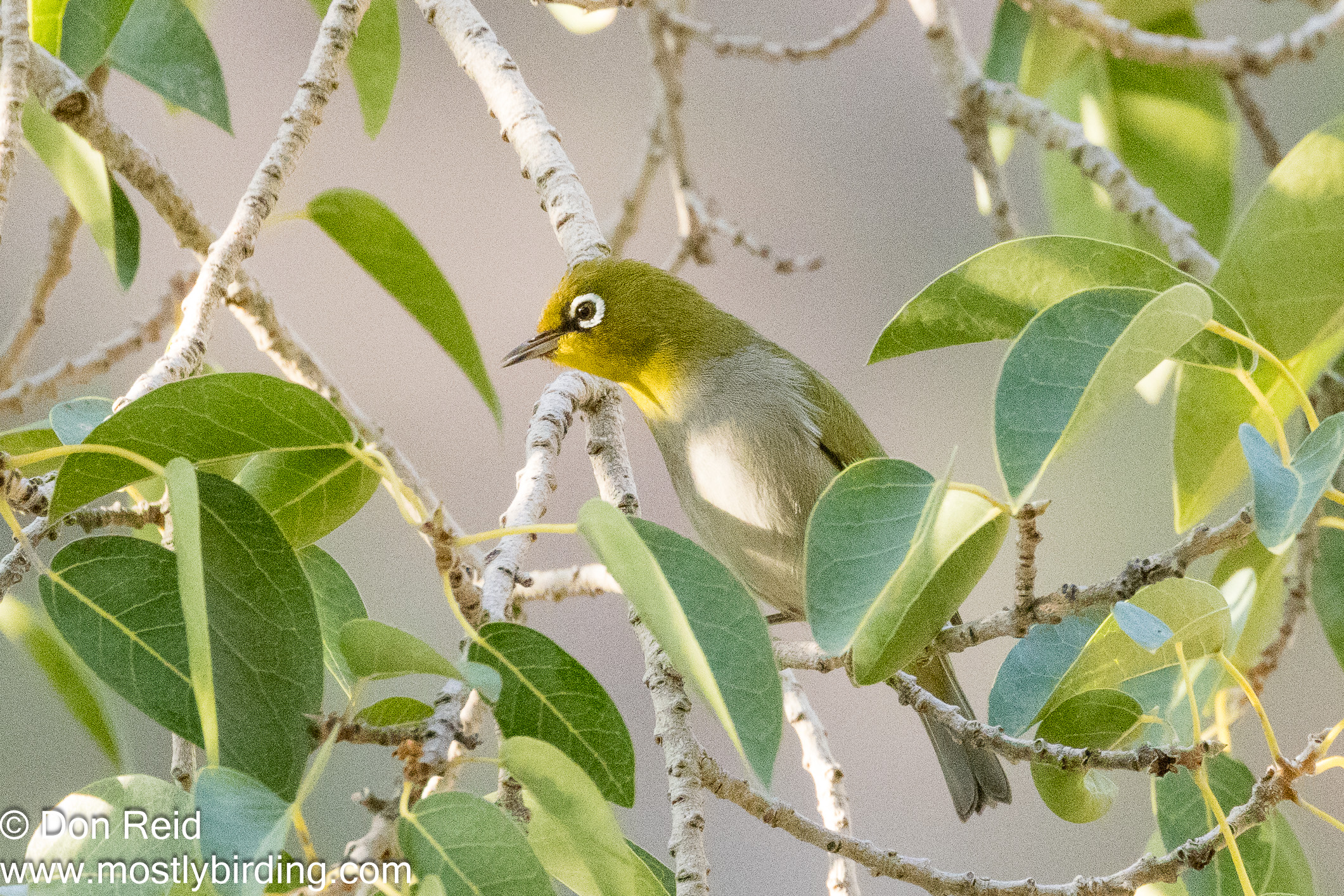
Cape White-eye, The Baths CitrusdalSouthern Double-collared Sunbird, The Baths CitrusdalSouthern Double-collared Sunbird, The Baths CitrusdalStreaky-headed Seedeater, The Baths Citrusdal
Southern Boubous and Cape Robin-Chats were a bit more wary and the Familiar Chats kept their distance as well, ever on the lookout for a tiny insect to pounce on from a low branch or rock.
Southern Boubou, The Baths CitrusdalCape Robin-Chat, The Baths CitrusdalFamiliar Chat, The Baths Citrusdal
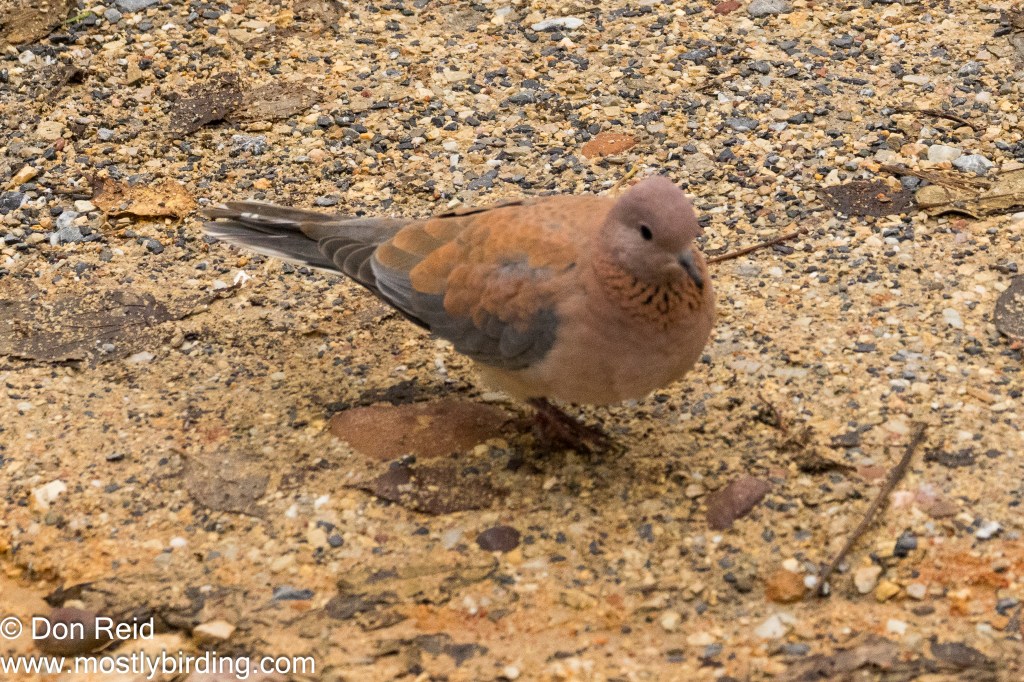
A Laughing Dove got into the act in its own gentle way
Laughing Dove, The Baths Citrusdal
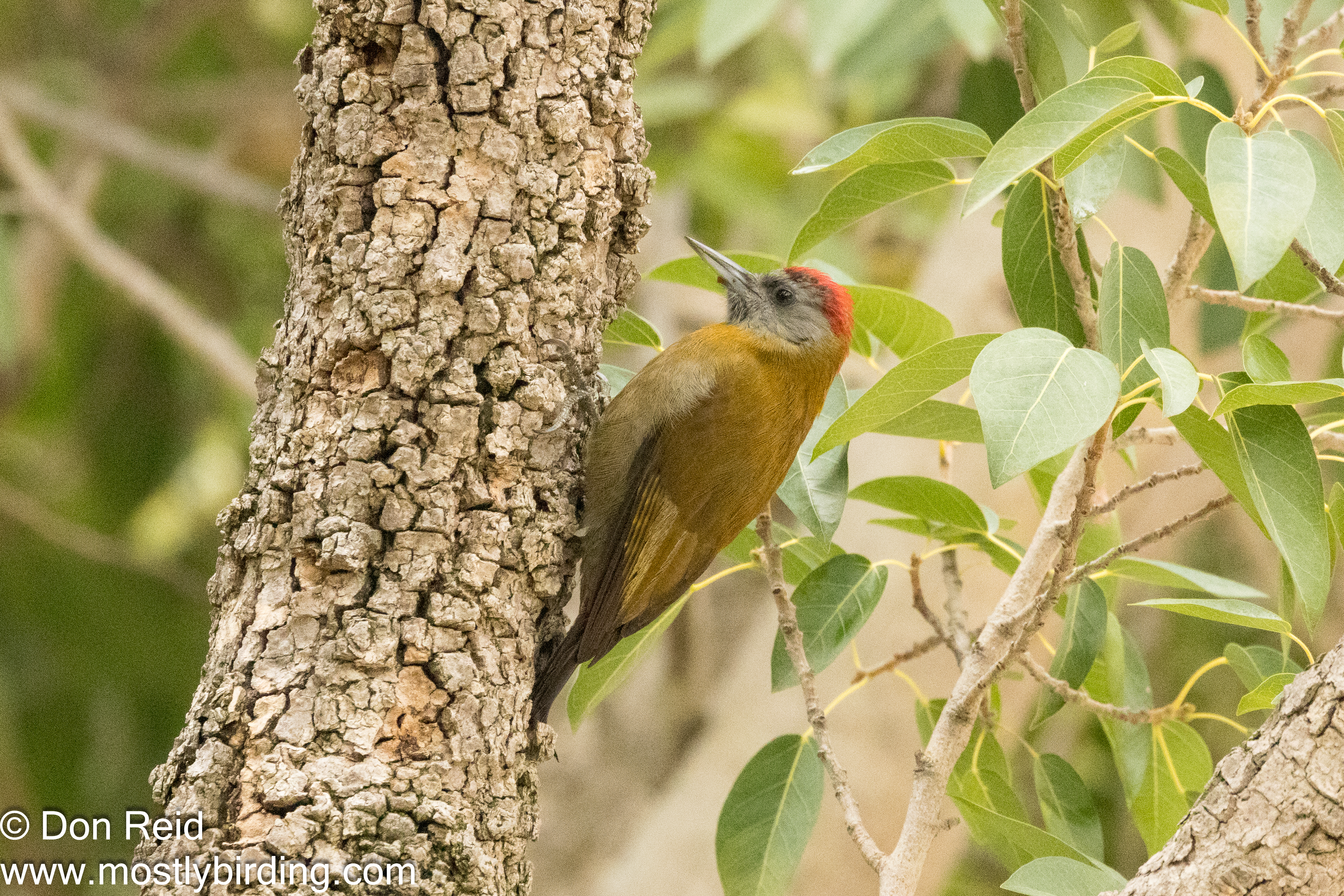
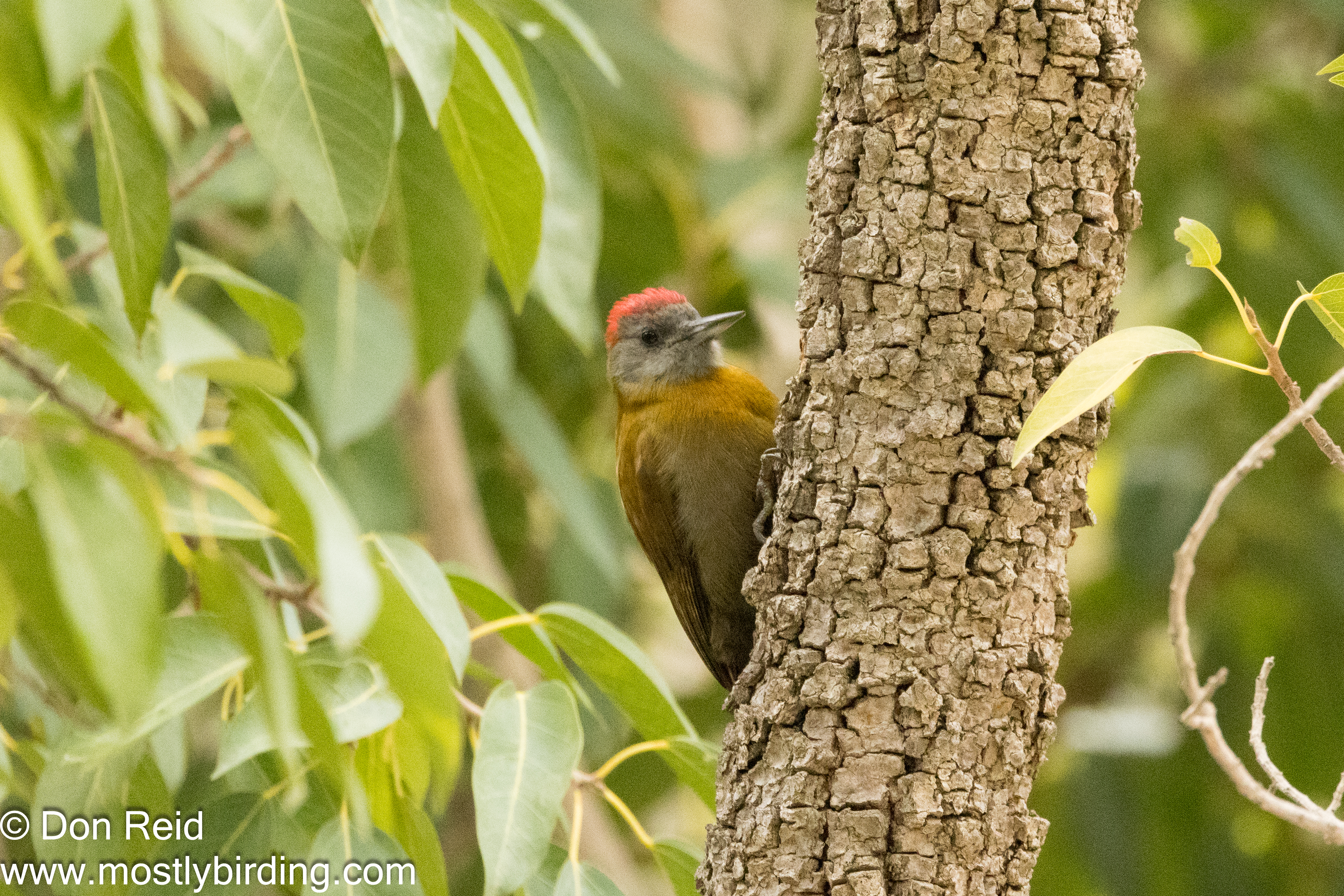
Passing birds added to the mix – an Olive Woodpecker chose the Namaqua Fig Tree to clamber through the branches, gleaning insects from the cracks in the bark and displaying its fine colouring.
Olive Woodpecker, The Baths CitrusdalOlive Woodpecker, The Baths Citrusdal
An Outing into the Cedarberg
A chance meeting with old friends just before our trip, who recommended a visit to an area of the Cedarberg not too far from the resort, led to us undertaking a day trip to see for ourselves.
The route from The Baths took us initially back to the N7 near Citrusdal, then northwards towards Clanwilliam, taking a turnoff signposted Algeria (not the country!).
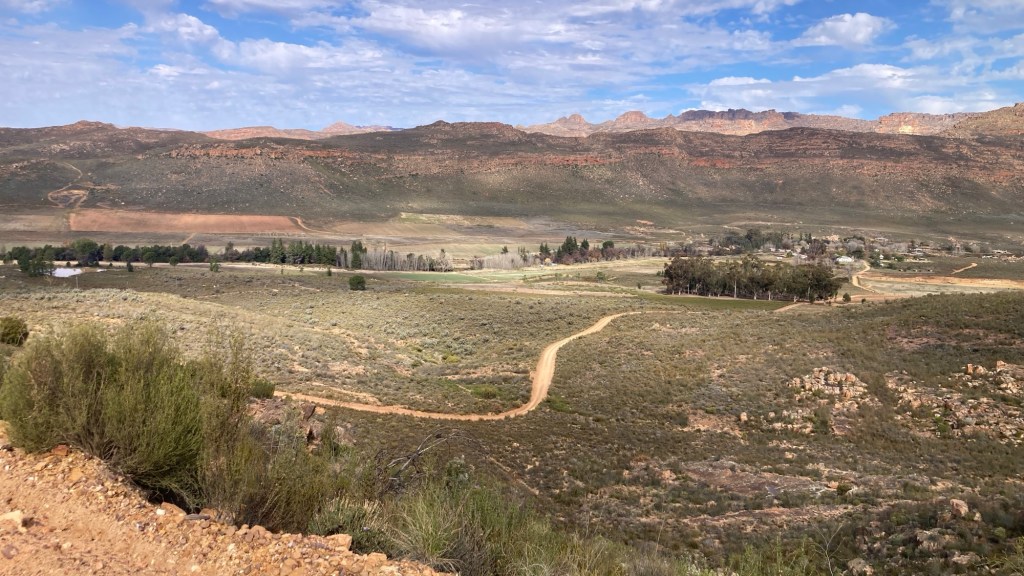
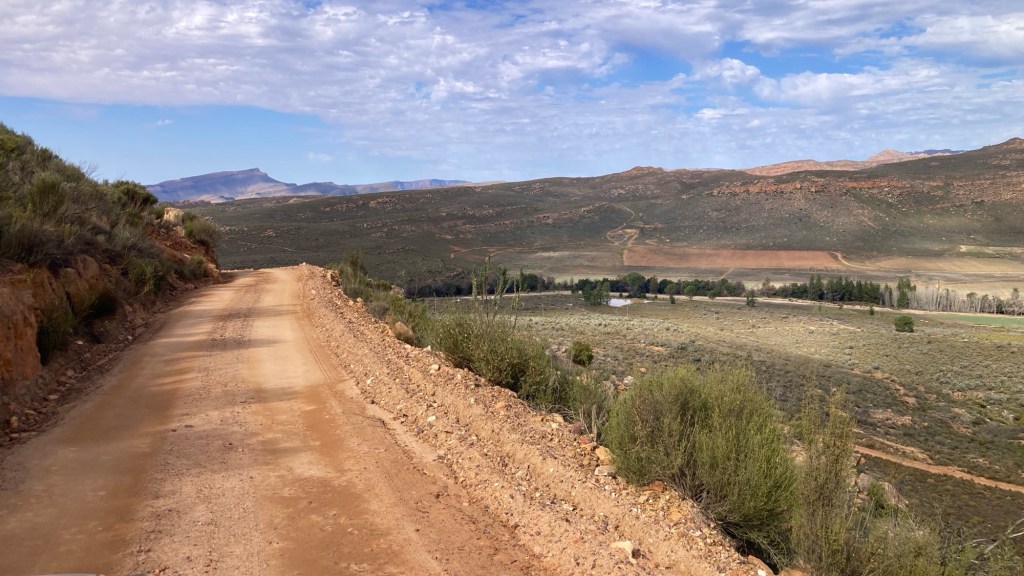
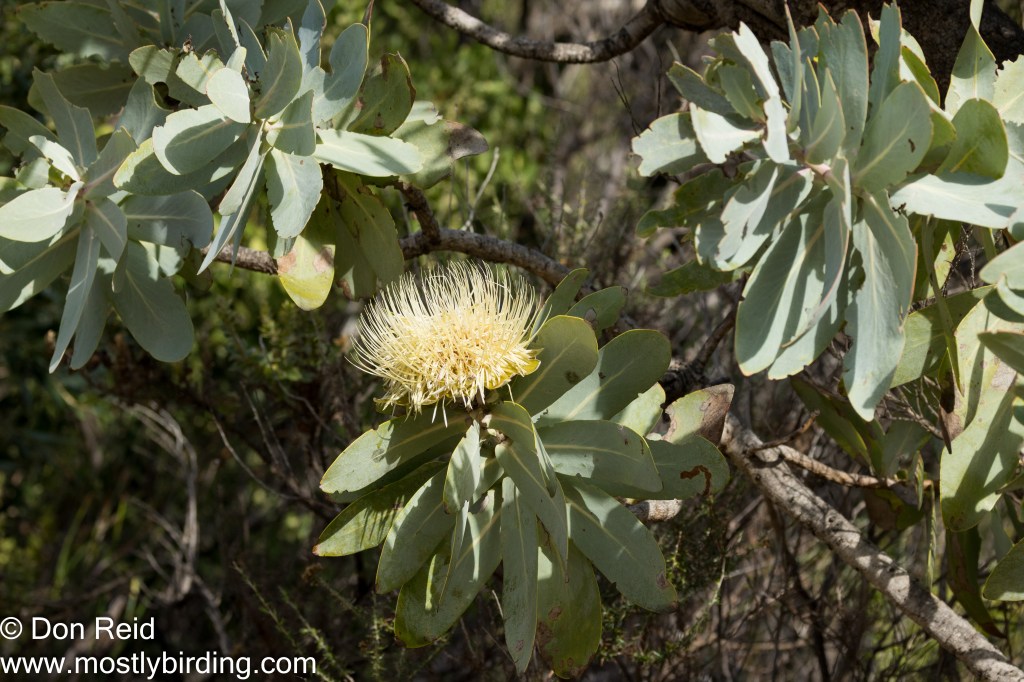
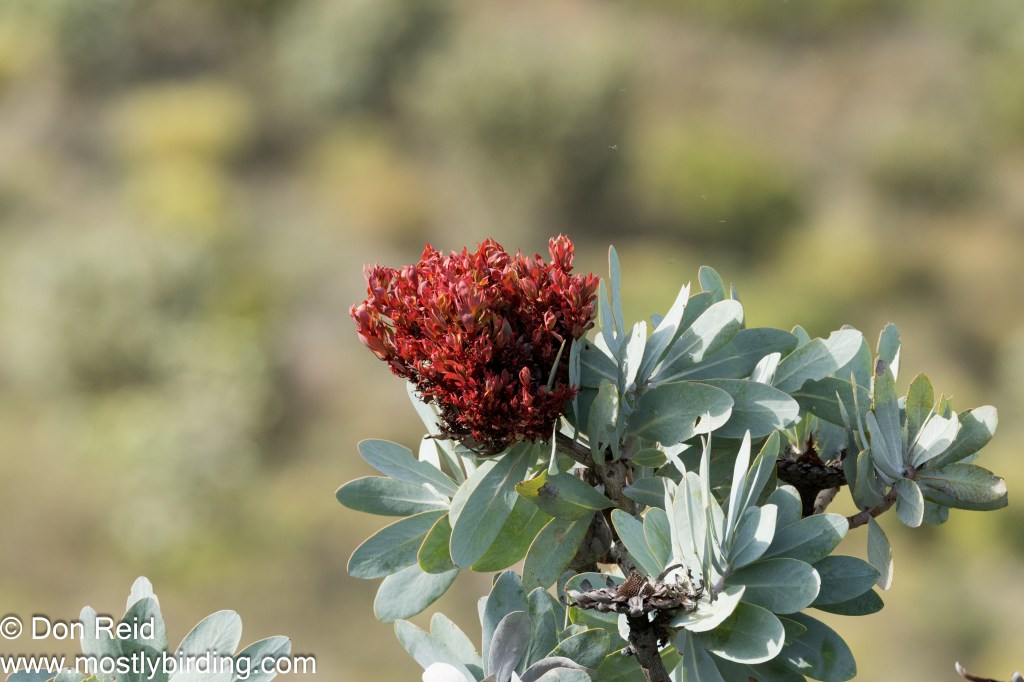
From there the road changed to dirt – good in parts, single track and bumpy in others, so the going was slow. Nevertheless, it was an interesting drive through the Cedarberg Wilderness area that we have heard many people talk about but have never experienced ourselves – mostly high mountains with rock and boulder strewn hills and an abundance of Proteas and other fascinating flowers.
After what seemed like a long drive but was just 20 kms we stopped at the Cape Nature offices at Algeria (a small settlement) for permits for the Caves we wanted to visit further on.
Moving on we headed through another pass and down into a long valley which surprisingly had planted vineyards alongside the road – they belonged to Cedarberg Wines which was our next stop to have a look around.
Cedarberg Winery
The wines on offer were mostly at premium prices – I like buying wines from places we visit so chose the more affordable Merlot-Shiraz blend on offer after a brief tasting session.
Having taken more time to get there than planned and being lunchtime, we decided to head to the restaurant that our friend had recommended as part of the visit. The turnoff to Kromrivier, where the restaurant is uniquely located was shortly after the winery and the road there followed a circuitous route across the ridges and into the next valley.
The road became single track in places with little visibility of oncoming vehicles due to sharp bends and scary drop-offs, so I was happy to reach the open valley without meeting any other vehicles.
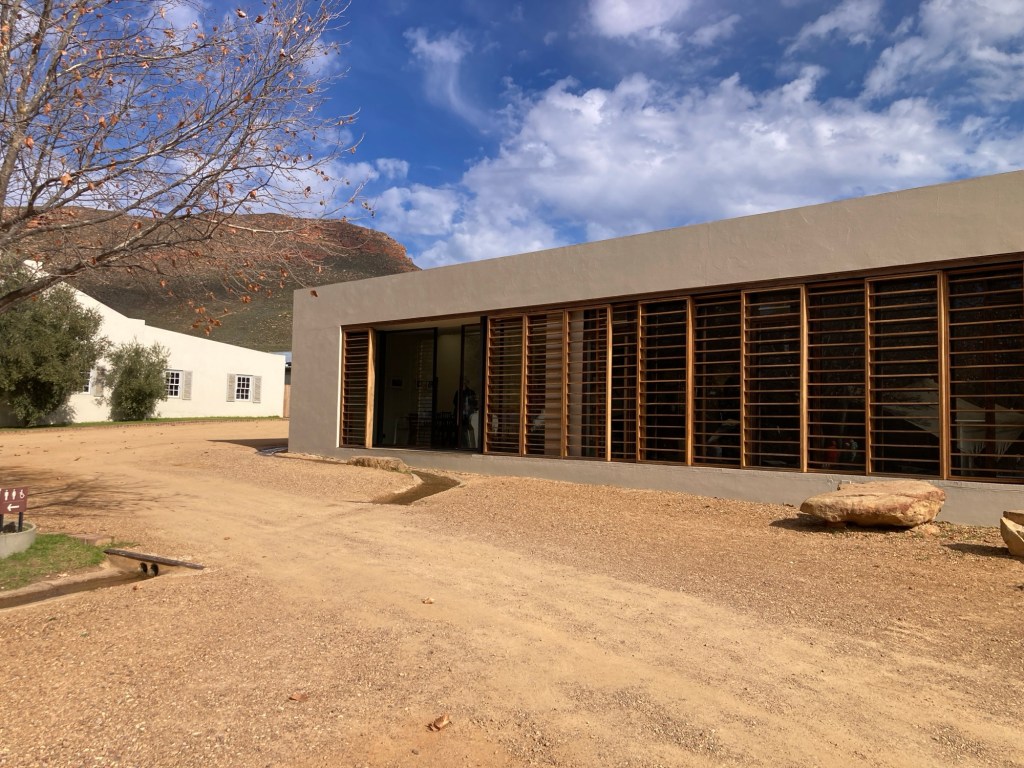
The restaurant is part of a resort and the design immediately spoke of quality and attention to detail, which was borne out by the meals we ordered and enjoyed – quite amazing to find such a place in this very remote spot which apparently can be cut off for a week at a time by excessive rain. (One of the low water bridges we crossed had water lapping at the edges so would be impassable a day or two later after heavy rain fell over the whole region)
With lunch done it was close to our cutoff time of 3pm to make sure we got back to base before sunset, so we had to skip visiting the caves which had been the original idea – maybe next time! In any case we were all happy to have seen this part of the Cedarberg Wilderness before the forecast wet weather descended over the region the next day.
And just to end off, back at the resort a couple of winter blooming flowers caught my eye
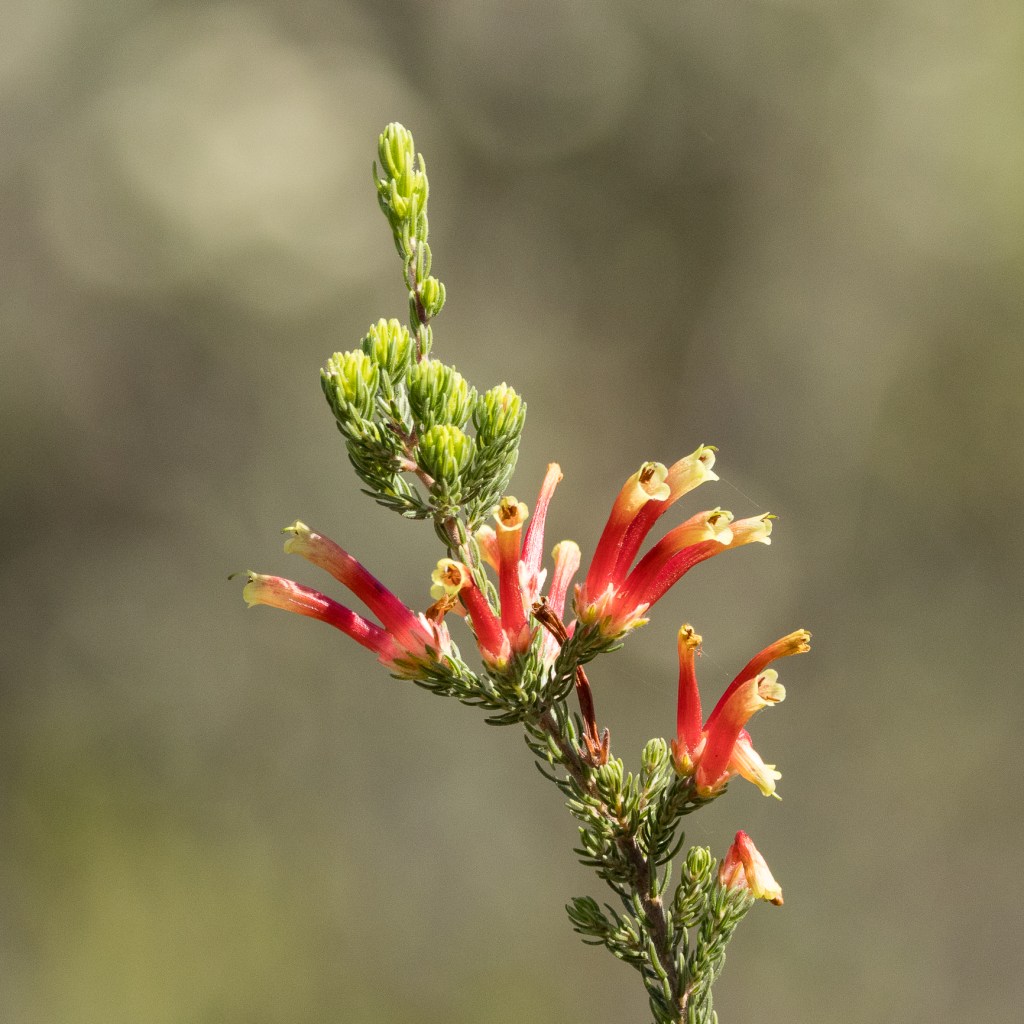
Flowers, The Baths CitrusdalFlowers, The Baths Citrusdal
View of Voëlvlei after substantial rains (photo from whatsapp group)
Firstly, a few facts about this well-known birding spot near Mossel Bay – well-known if you are a birder that is, particularly one who has explored the birding delights of the southern Cape.
‘Voëlvlei’ can be directly translated from Afrikaans as “Bird wetland (or pan)”, although no one would ever call it that in South Africa. ‘Voël’ is of course the Afrikaans term for ‘Bird’ and ‘Vlei’ is a widely used term for any shallow body of water such as a seasonal wetland, shallow pan or marshy depression where water collects during the wet season.
The pan at Voëlvlei only retains water during very wet years, which can be anything from 7 to 15 years apart, so when the vlei has water it very quickly becomes a magnet for waterbirds and waders, followed closely by many a keen birder out to find a variety of birds, with a strong possibility of a rare migrant wader or two during the summer months.
Voëlvlei lies about 35km south-west of Mossel Bay and is on privately owned farming ground – the owners have generously allowed access to the vlei for birders as long as they behave in a respectful way.
Voëlvlei straddles three pentads
A track skirts the vlei on one side with entry possible from two farm gates at the northern and southern extremes (after entering or exiting it is good form to close the gate again).
My Atlasing Visits to Voëlvlei
SABAP2 Records
The table above shows all my atlasing records since my first visit in December 2015 – green indicates that it was a “Full Protocol” card, which requires a minimum of two hours of intensive atlasing, the grey is for “Ad hoc” cards.
The good (or bad news depending on your inclination) is that I still have my journal records of all of the “green” cards, so join me as I return to those journals and select some of the highlights of the visits. You can, of course, skip the words and just look at the pictures, but I believe my readers are made of sterner stuff than that and are not afraid to plough through the verbiage.
14 and 18 December 2015
My first visit was 10 years ago, long before we moved permanently to Mossel Bay…
I had long read about the vlei as being a top birding spot when conditions were right. With reports trickling through of favourable water levels after good winter and early summer rains, I stopped at Voëlvlei on my way back from atlasing Gouritsmond, to find that it indeed had plenty of water and what appeared to be thousands of birds.
I did a quick list of some of the obvious birds, without going through the gate into the vlei area itself. A few days later Gerda joined me for a late afternoon visit to the vlei, when we entered Voëlvlei proper and followed the track around the east flank, then returned along the same route. The atlasing protocol allows a maximum of five days for one ‘card’ so I could add to the short list I had started on the 14th.
Birding was excellent and plentiful, the only downside being the sun in the west which created a sharp glare, making it difficult to see the birds clearly. We added 36 species to the initial 10 taking the total to 46, including ..
Pied Avocet – notable for being a ‘Year bird’ for me (Birders are such nerds)
This first visit was particularly memorable – little did I know it would be eight years before I would experience something similar at Voëlvlei…
I did atlas the pentad in the intervening years but did not include Voëlvlei itself as it had dried up completely
30th November and 2nd December 2023
Having moved to Mossel Bay in October 2023 and seeing the reports of increasing water and bird presence at Voëlvlei, I was keen to visit the spot and see for myself. Reports of rarities made it even more imperative so I set off on the last Thursday of November, the day in the week that I have tried to keep open for atlasing.
I started my pentad list along the road past Vleesbaai with a Black Harrier which I chased down the road to try and get level with it as it hunted low over the fields in true Harrier fashion, stopped quickly and rattled off a few shots – with limited success but lovely to see it in hunting mode.
Black Harrier Circus maurus Witkruisvleivalk, Vleesbaai area
Further on I took the turnoff to Voëlvlei and after passing through the gate I spent the next three hours carefully scanning the vlei from the track along the east flank, particularly the muddy margins which were teeming with birds.
The open waters towards the middle of the vlei as well as the surrounding dry land were equally busy with their particular species all enjoying a cornucopia of edible life.
Once again the waterbirds dominated my list …
Waders – Black-winged Stilt, Three-banded, Kittlitz’s and Common Ringed Plovers, Little Stint (lots), Ruff, Wood Sandpiper, Grey Plover, Pied Avocet, Greenshank, Blacksmith Lapwing, Grey Heron, African Spoonbill and Little Egret
Rarities – This visit was excellent preparation for the annual Birding Big Day just two days later when many of the same birds were recorded by our team. An added thrill was seeing two rarities which had been spotted by some of the keen birders already present –
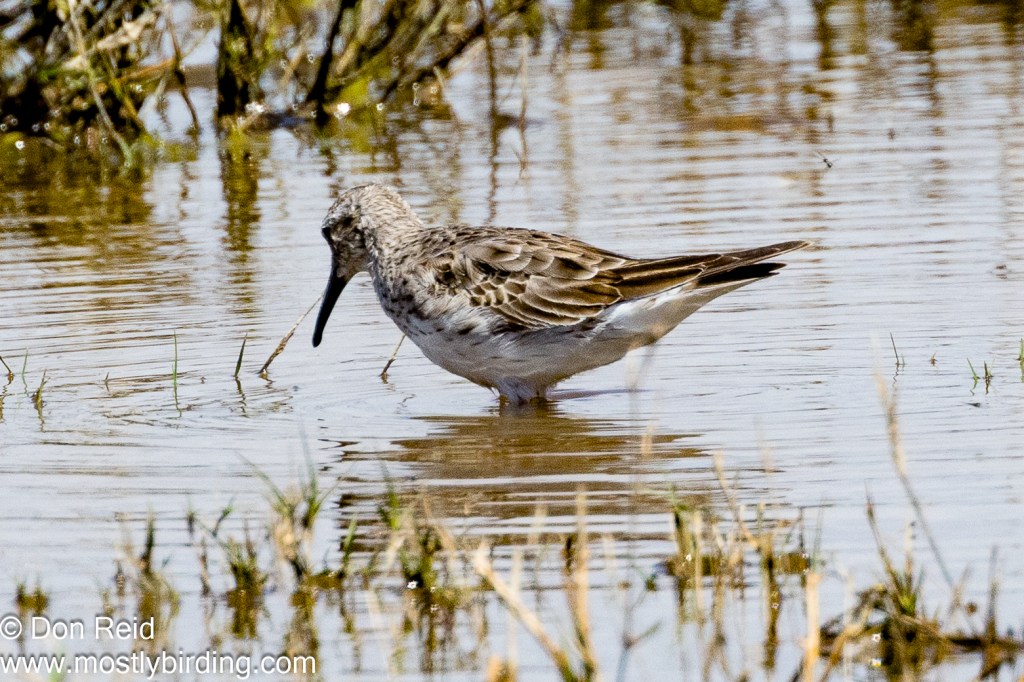
White-rumped Sandpiper – a low-slung, longish-winged sandpiper, difficult to distinguish among the many small waders except when close to the many Little Stints present
With Voëlvlei still attracting a lot of attention from birders and with reports of another rarity – Buff-breasted Sandpiper – being seen there, I couldn’t resist another visit just a week later.
It was a Sunday and Gerda agreed to join me, so after a traditional Sunday lunch at a country restaurant on the way (meat and three veg with rice plus a pudding) for not much money, we headed to Voëlvlei and joined several vehicles and birders with the same idea.
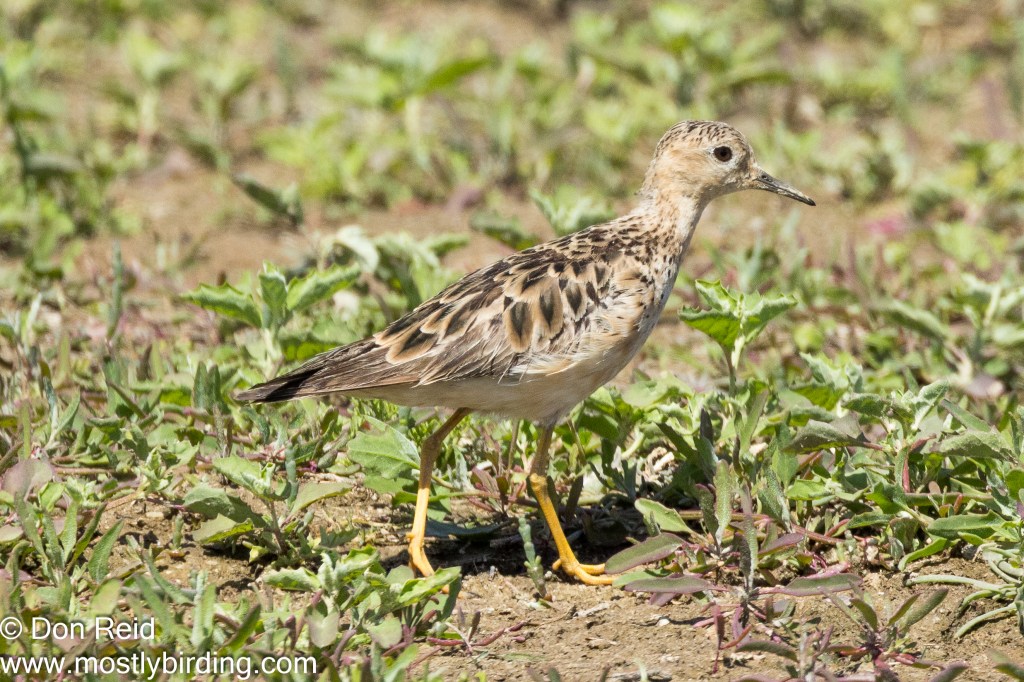
The Buff-breasted Sandpiper was quickly pointed out by those already present – on its own foraging in the dry, lightly grassed area away from the water – clearly a loner not interested in mingling with the many other waders in the vlei itself.
I spent a while scoping the sandpiper and taking photos of it from a distance, while recording all the other species present as they came into view.
We headed home with 34 species recorded. Feeling that the list needed boosting, I decided to include Voëlvlei in my next atlasing session on the following Wednesday, which would fall in the allowed 5 days for a “Full Protocol” card.
I arrived at the vlei mid-morning and spent three more enjoyable hours viewing the multitude of birds, adding a further 16 species to take my total to a nice round 50 for the pentad.
The White- rumped Sandpiper was still present and I spent some time trying to get better photos of this rarity – with limited success. It was difficult to get close enough to the bird, which remained among short grass tufts in the shallows of the vlei, intermingling with other waders and probing the mud constantly so that it was nigh on impossible to isolate it for a decent photo.
Waders – Black-winged Stilt, Kittlitz’s and Common Ringed Plovers, Little Stint (lots), Ruff, Pied Avocet, Blacksmith Lapwing, Grey Heron, African Spoonbill, Little Egret, Cattle Egret, Glossy Ibis and Sacred Ibis
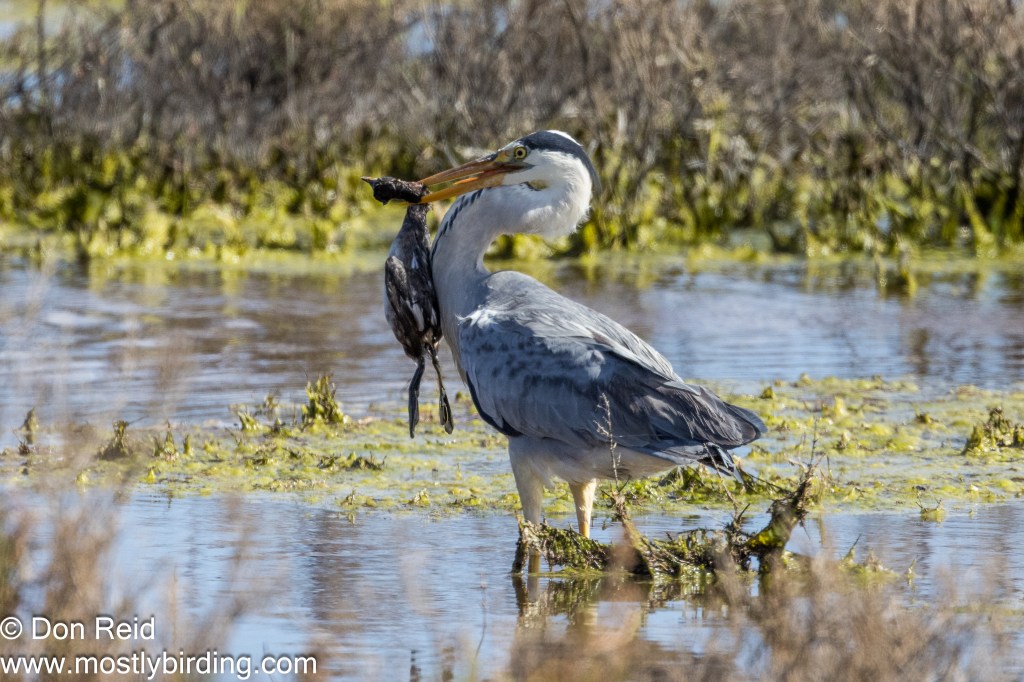
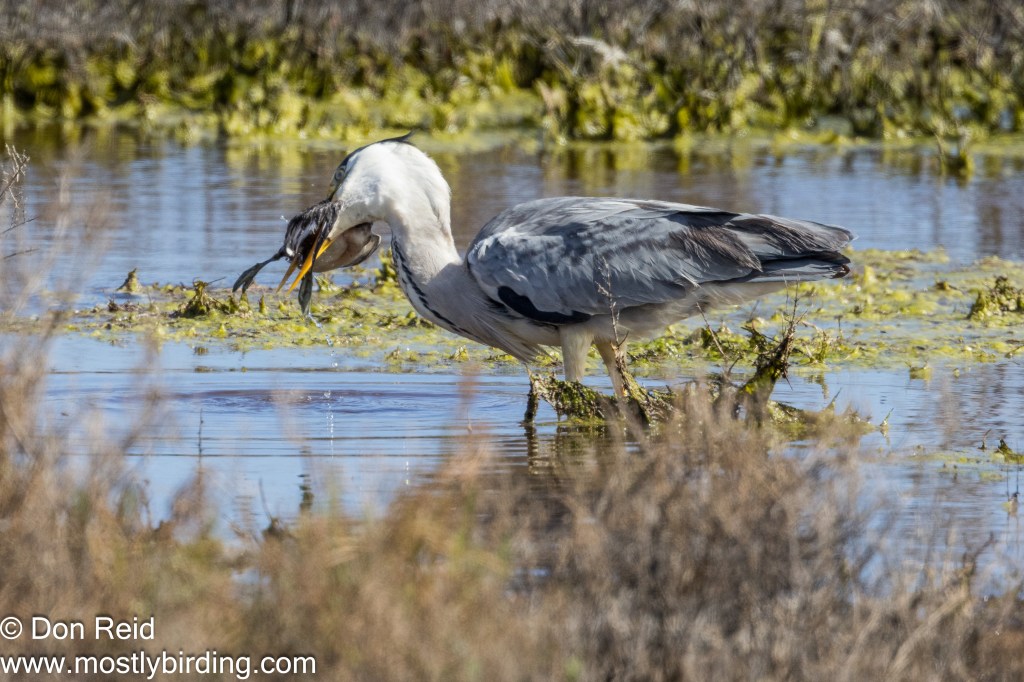
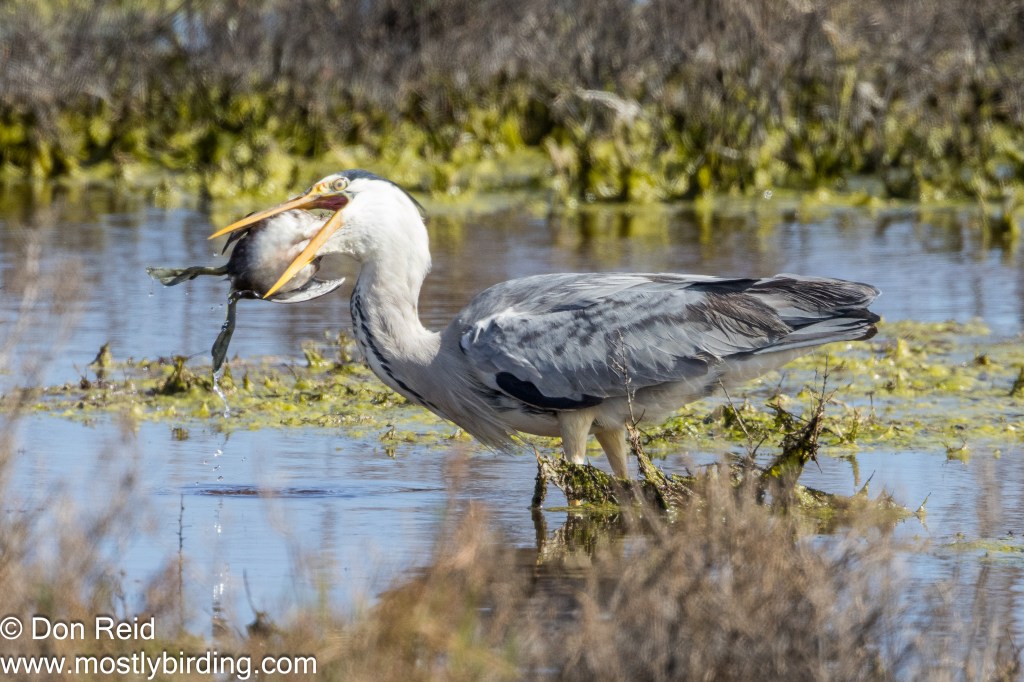
Most Surprising Sighting? – most certainly seeing a Grey Heron with what looked like a Reed Cormorant (possibly a juvenile) in its bill, which it proceeded to manoeuvre into position and swallow whole! I wasn’t able to capture the final swallow as the Heron moved behind some reeds.
The vlei remained partly inundated during the most of 2024, with water levels gradually decreasing as inflow dried up.
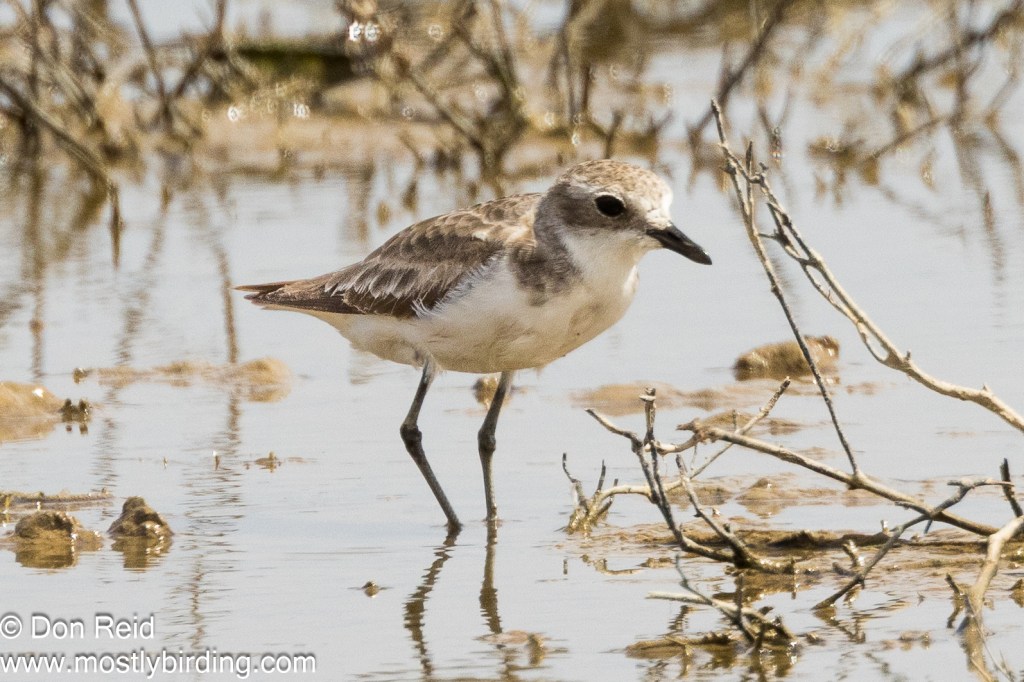
During February reports appeared on the local birding groups of a Greater Sand Plover at Voëlvlei – I had seen this species before but just once, so at the end of my next atlasing trip I took a detour to the vlei to see if I could find it.
At Voëlvlei I was able to find and photograph the Greater Sand Plover without too much effort and to record numbers of other waders which were still plentiful.
Thereafter the vlei gradually dried up, leaving ever wider margins. This did not come as a surprise for those living in the Southern Cape as it has been a particularly dry year for the area.
The photo below was taken in July this year, with just the northern section having any water – a couple of weeks after this photo the vlei was bone dry.
That just raises the question that is impossible to answer – when will Voëlvlei have water again? If average statistics are anything to go by it may be 7 or more years before that happens, a sobering thought at my age, I have to say, but I am thankful to have enjoyed two bountiful birding seasons during the last 10 years.
These tales record some of the more memorable experiences while atlasing – in this case two atlasing outings 4 months apart in time and 1250 kms apart in distance –
And in case you’ve forgotten or have not heard of Atlasing, there’s a brief synopsis at the end of the post
North in Winter
One of my last atlasing trips in Gauteng, before our move to Mossel Bay in October 2023, was a mid-winter outing to the farming area about 30kms south-east of Pretoria, not far from the town of Bapsfontein.
Good friend Koos, also an avid atlaser, had suggested the outing and he picked me up around 6.15 am with 40 minutes to go before sunrise. We headed east along Lynnwood road extension, which was already busy with Saturday morning commuters and keen cyclists heading out along their favourite route.
At the T-junction with the R25, we turned southwards towards Bapsfontein, then east again at the Witpoort road. The road changed to gravel and heavy mist enveloped the car, slowing our progress considerably until we reached the northern boundary of our target Pentad
Pentad 2600_2830
A side road signposted “Knoppiesdam“ invited exploration and after turning off we came to a ‘gate’ – one of those unique rural designs consisting of strands of barbed wire attached to thin poles each side, one side fixed, the other side secured by loops of strong wire (known in Afrikaans as ‘bloudraad’ or “bluewire”) which allow the gate to be detached and secured as needed. The ‘gate’ has no frame so you have to pull it over to the side and lay it flat on the ground while the vehicle drives through, then attach it again before moving on.
While I was opening the gate to let Koos drive through and closing it again, an Ostrich (of the farm variety, so not recorded) approached and started doing a mating dance of sorts – this is not the first time I have experienced this when stopping near Ostriches – Koos reckoned it was my woollen beanie that caused the unwanted attention this time around!
A short distance after the gate we came to the dam where we found a group of fishermen setting up for the day and a substantial body of water largely hidden by the heavy morning mist.
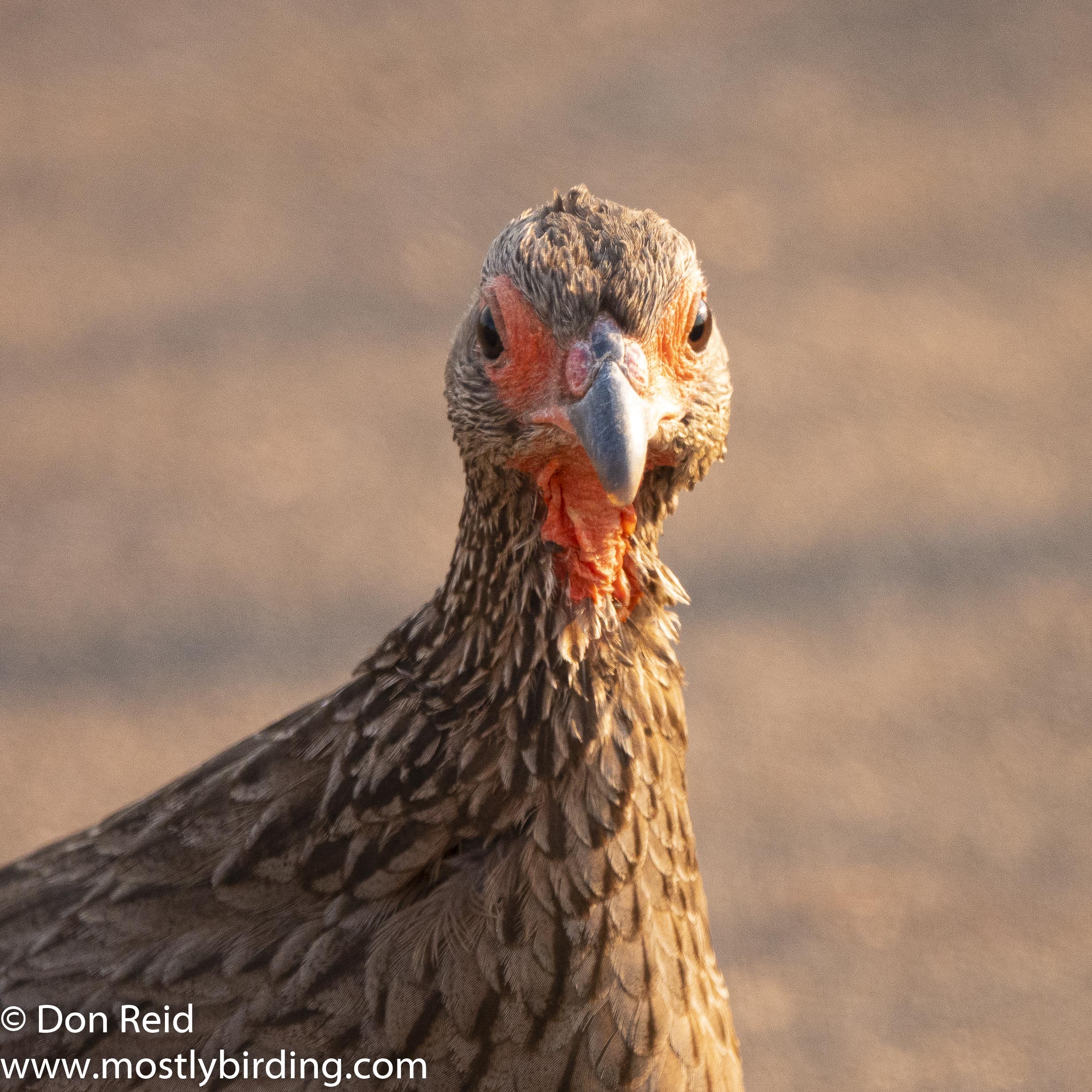
As usual the first birds listed were those calling in the early morning, some visible others not – Swainson’s Spurfowl has a particularly raucous call that carries a long way in the relative peace and quiet of the countryside and was my first record of the day. That was followed quickly by several other species – Kurrichane Thrush, Red-eyed and Laughing Dove, good old Hadada Ibis and a few others.
Swainson’s Spurfowl Pternistis swainsonii Bosveldfisant), (taken in Kruger Park)
We lingered and listened intently while walking the shoreline of the dam as the mist slowly dissipated, revealing a few Red-knobbed Coots and Common Moorhen as well as a Little Grebe.
Little Grebe Tachybaptus ruficollis Kleindobbertjie
As we headed to the car Koos spotted a pair of large birds flying overhead but away from us – clearly Flamingoes! But which species – Greater or Lesser ? Fortunately they changed direction while still visible and gave us a view of their large bills, which were light coloured compared to the dark colour of the Lesser Flamingo, confirming that they were indeed Greater Flamingoes.
On the way back to the main road, more fine spotting from Koos produced two Little Bee-eaters high up in the trees.
Little Bee-eater Merops pusillus Kleinbyvreter, (taken in Kruger Park)
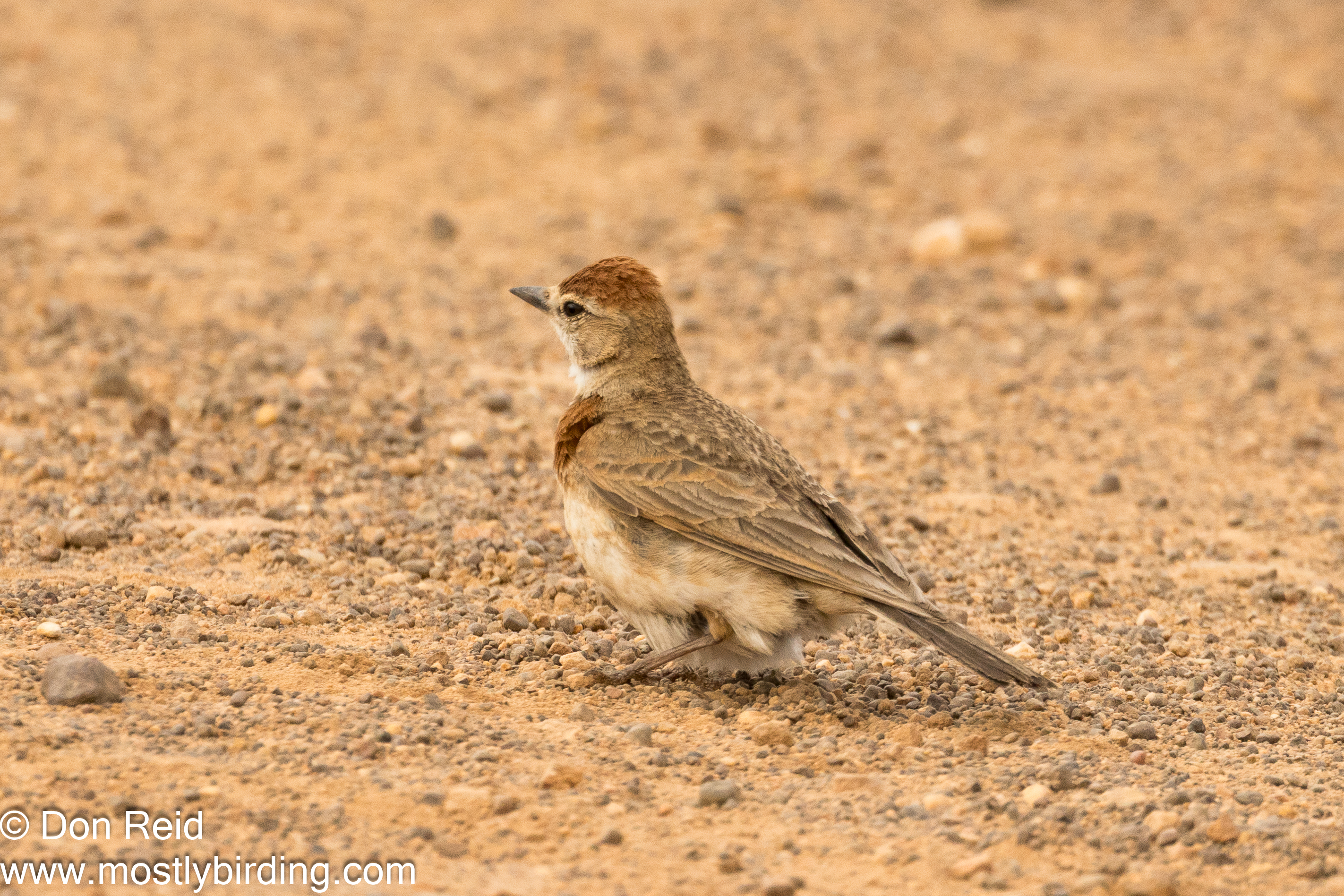
Back on the main road, the habitat of open fields with short grass and stones prompted me to comment that ‘this is Wheatear territory’ – my words were barely cold when the first Capped Wheatear was spotted, along with Red-capped Lark, Crowned Lapwing, Wattled Lapwing and African Pipit – all species that share a fondness for this habitat.
The road left the pentad so we headed quickly southwards to join up with the R50 Delmas road which took us back to the pentad. The R50 is a busy road with heavy trucks that rumble back and forward constantly, making it awkward, even dangerous to try and pull off onto the verge to check for birds. At the first opportunity we turned off onto a gravel side road to escape the traffic and were soon back into a more relaxed atlasing mode.
Long-tailed Widowbirds (almost unrecognisable in their drab winter non-breeding plumage) were next up – the males lose their long tails and most of their black colouring (summer plumage shown in the first photo below), but retain their colourful ‘epaulettes’ to differentiate them from the all-brown females (the second photo below)
Long-tailed Widowbird Euplectes progne Langstertflap – male in full breeding plumageLong-tailed Widowbird Euplectes progne Langstertflap – female
White-winged Widowbirds (equally drab females and non-breeding males) were encountered .
Just after finding a Namaqua Dove, always a pleasing species to encounter, we saw a large dam some distance from the road and found a track leading to it. Hoping that we were not intruding on someone’s farm we headed a short distance down the track to the dam only to find that a few large trees had been chosen as a roost by numbers of Black-headed Herons. We watched their comings and goings for a while and picked up a few other species before heading back to the road.
Black-headed Herons at heronry, Bapsfontein AreaBlack-headed Heron Ardea melanocephala Swartkopreier
Smaller roadside pans and dams that we stopped at further along the road held a few species such as Reed Cormorant, Malachite Kingfisher, African Snipe and Lesser Swamp Warbler, to close out the morning’s atlasing with a total of 39 species recorded in the pentad
For my first atlasing trip proper since arriving in Mossel Bay permanently, I chose a pentad in the area between the Oudtshoorn and Herbertsdale roads.
Pentad 3405_2155
Bang on 6am I stopped in lovely rolling country with a few small farm dams and with many birds calling and I spent the next half hour listing those I could identify along with some that showed themselves.
Most prominent were the first of dozens of Common Quail that I was to hear (and encounter as described below) throughout the morning, along with Cape Spurfowl, Little Rush Warbler calling from the reeds of one of the dams and Common Moorhen.
Cape Spurfowl Pternistis capensis Kaapse Fisant
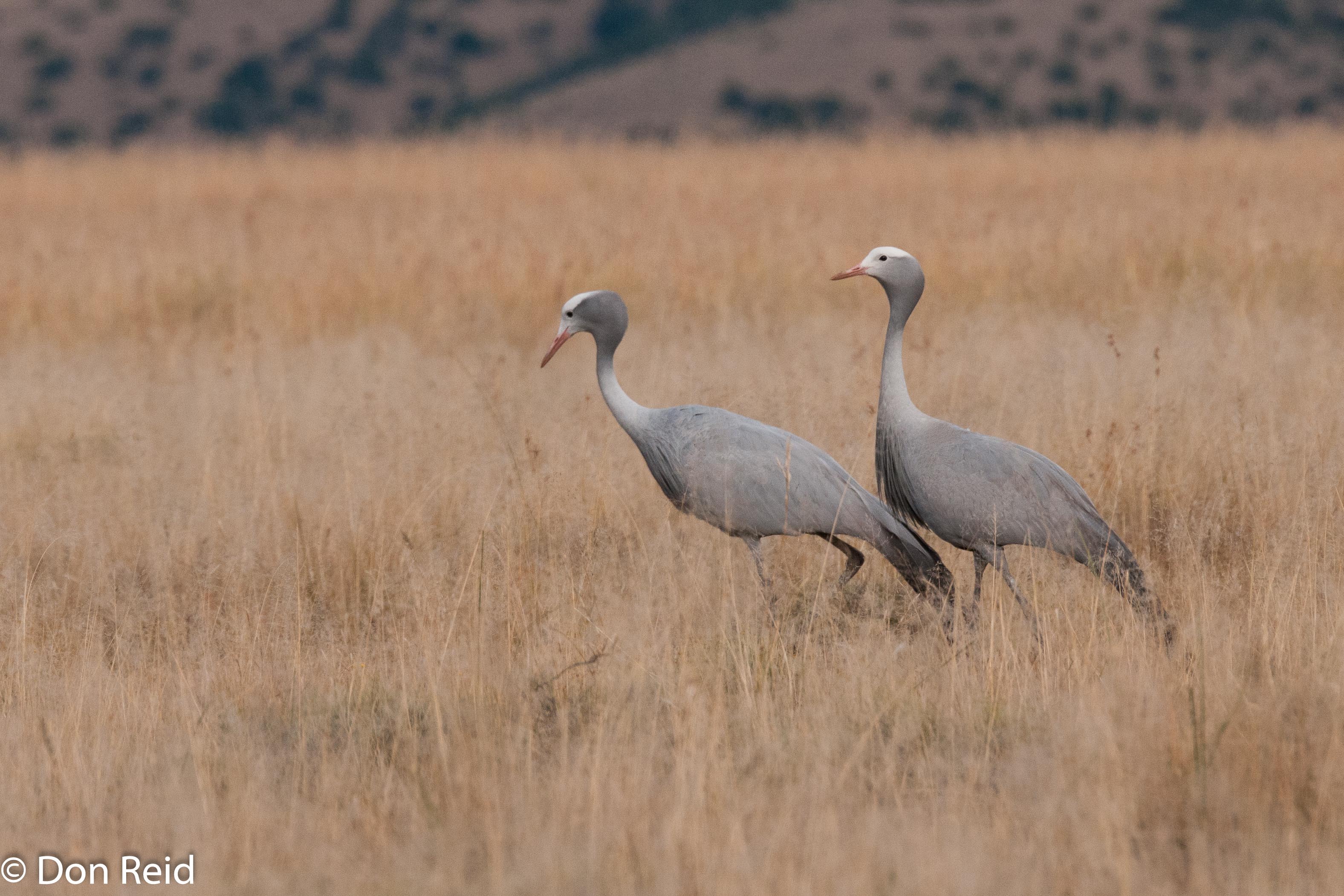
I could pick out Blue Cranes in a distant field – a common bird in the southern Cape but always a pleasure to see.
Blue Crane Anthopoides paradiseus Bloukraanvoel
Knysna Warbler calling from dense bush – I didn’t bother to try and see it as it hardly ever shows – was species number 22 after as many minutes of atlasing, after which the pace slowed somewhat, nevertheless I kept adding new species regularly.
Moving on from my first stop, the habitat changed from farming land to short grassveld, which produced three Larks in quick succession – Long-billed Lark, Large billed Lark and Cape Clapper Lark, the latter calling and displaying beautifully.
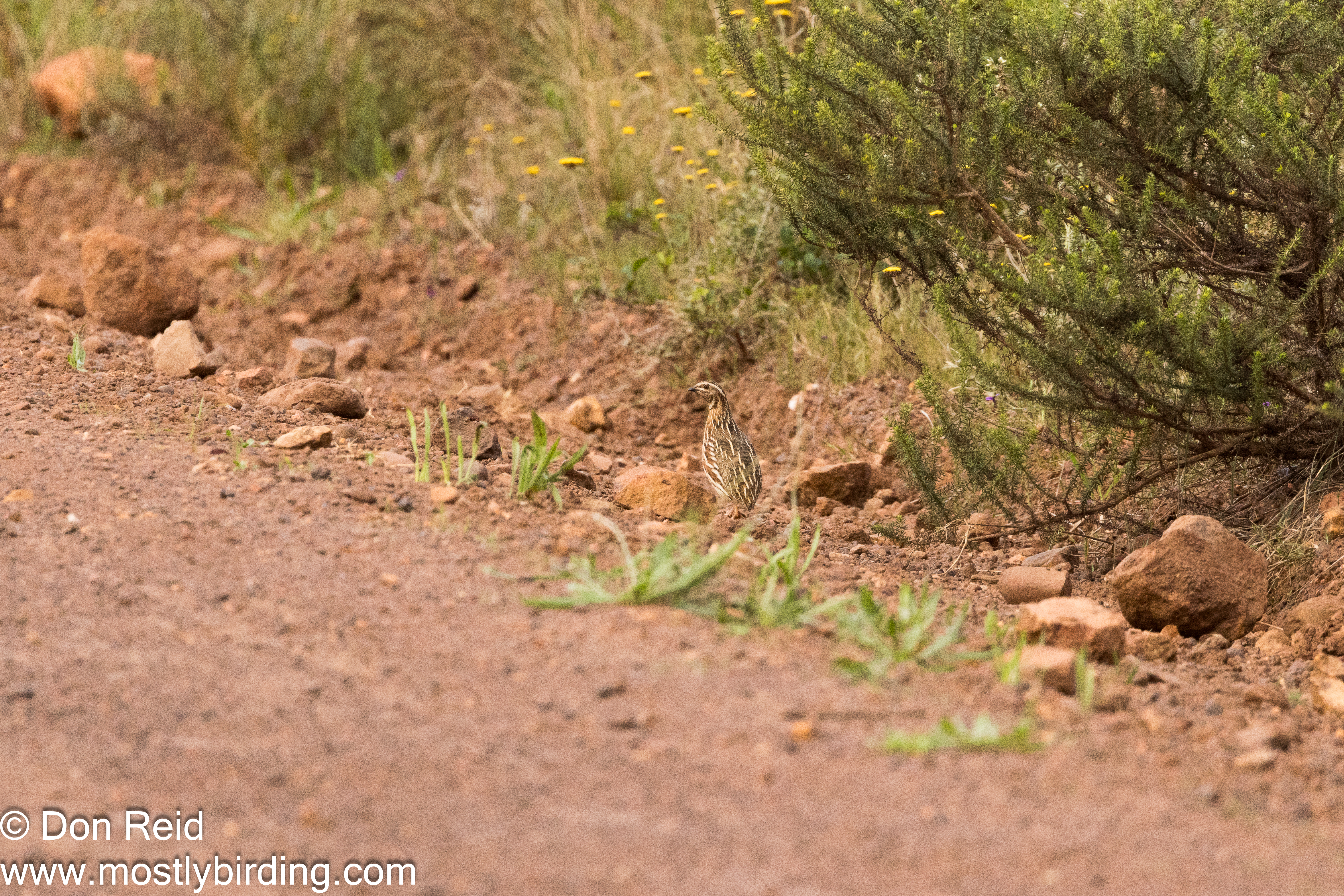
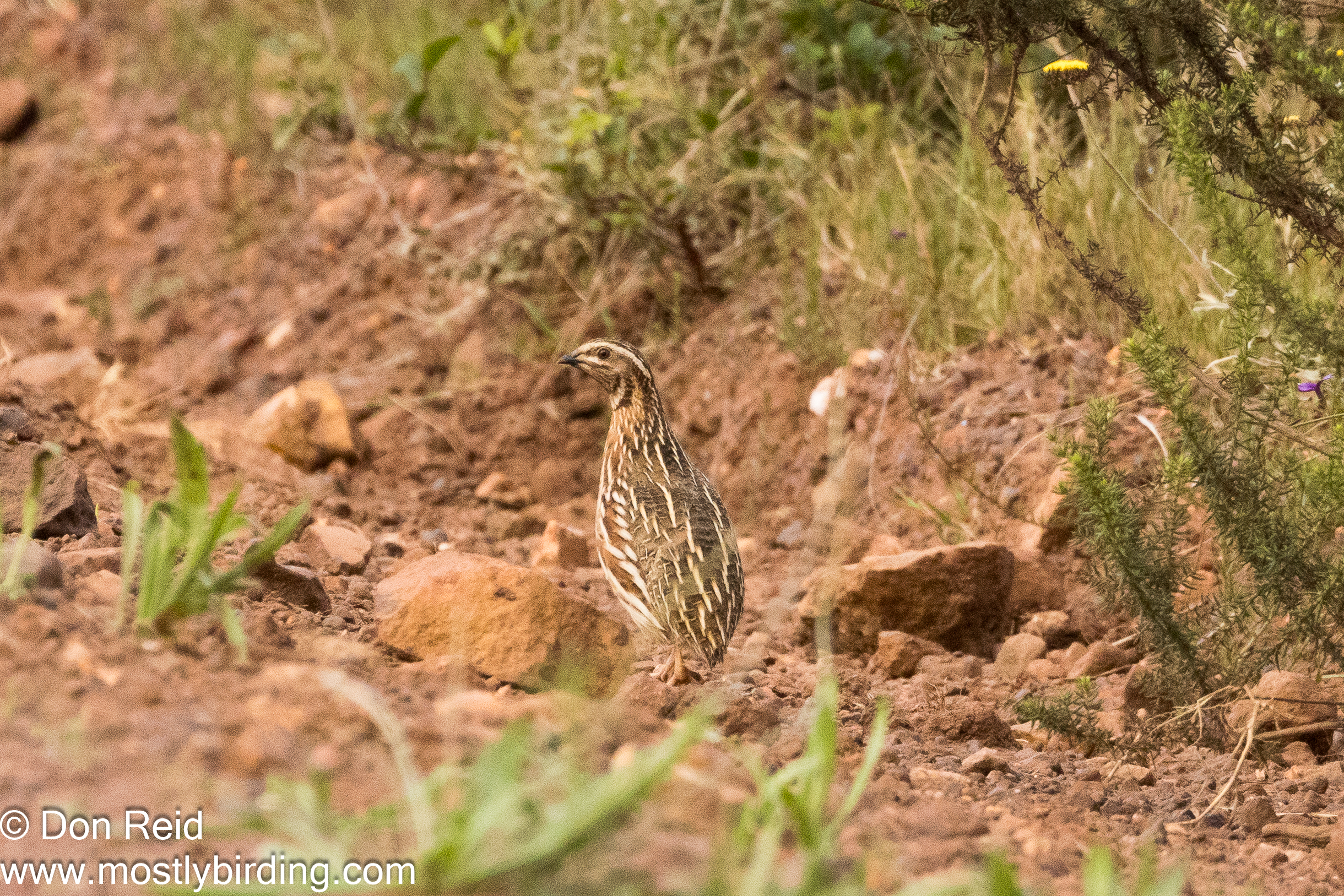
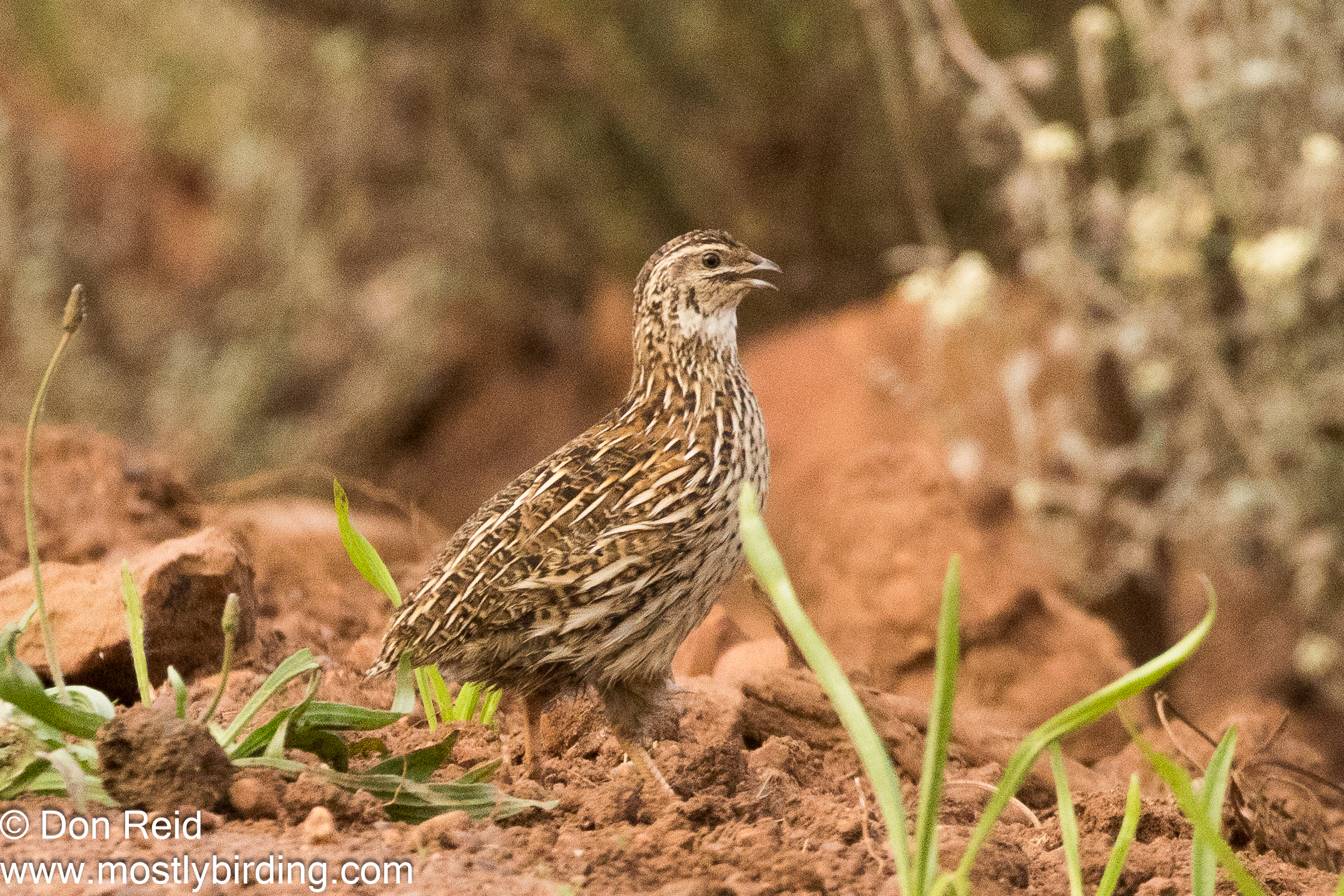
Up ahead small birds at the edge of the road attracted my attention and a look through the binos had me grabbing my camera – there were two Common Quails pottering about in the grass tufts at roadside! This is a species which I have heard dozens of times but have only had one short glimpse in all the years of atlasing, so this was an opportunity not to miss.
Common Quail Coturnix coturnix Afrikaanse kwartel
I was still some distance from the quail, which is a small bird about the size of a Lark, so I tried to edge the car closer for a better photo opportunity. However they were on to me and moved further along at the same pace as the car, so I turned the car slightly sideways to get a view with the camera and took as many shots as I could. Fortunately, I managed to get a few reasonable shots – my first ever photos of this species in the bag!
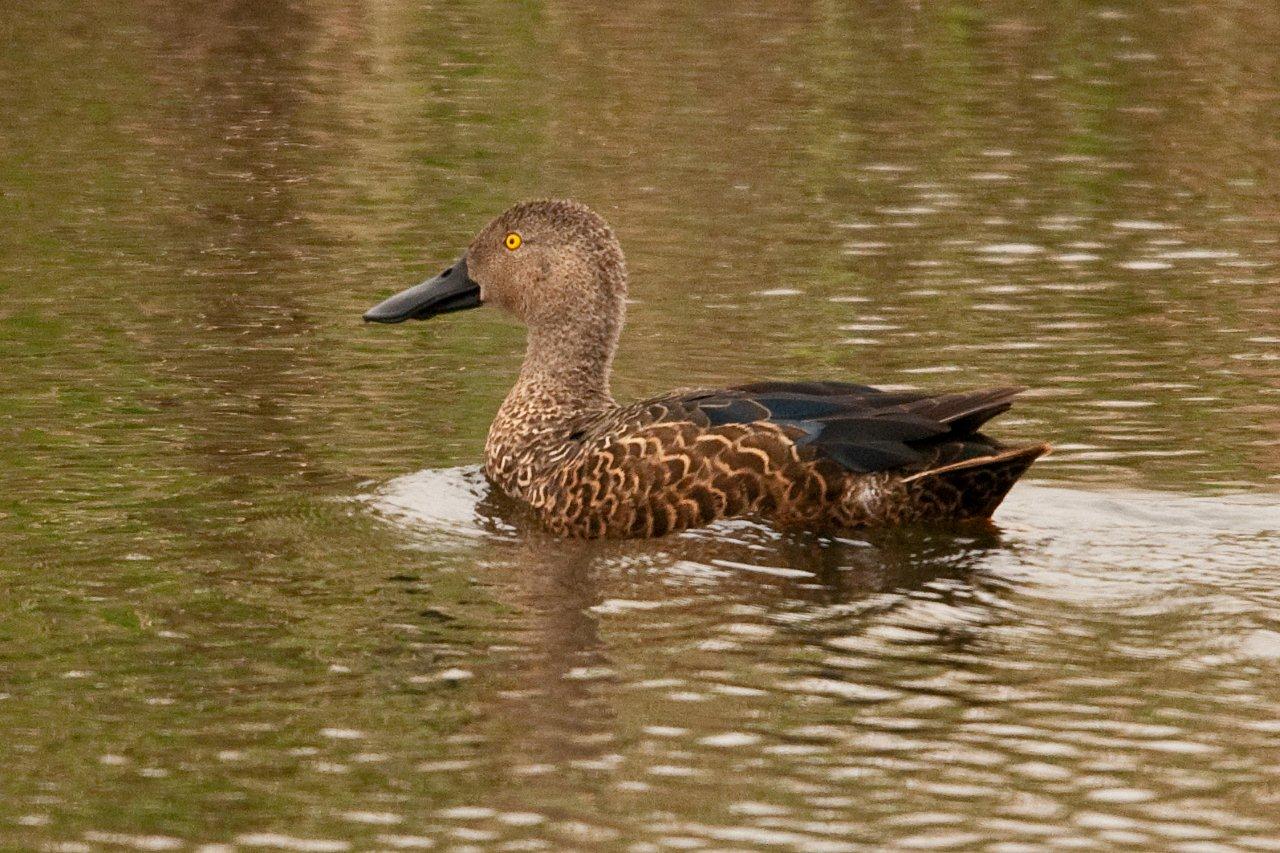
After crossing over the R327 I proceeded on the Kleinberg Road and soon stopped to scan a large farm dam which lies some distance from the road. I set up my spotting scope and used the maximum zoom (60 X) to identify the many waterfowl on the dam, which included Red-knobbed Coot, Cape Shoveler and Little Grebe – all common in the area.
Cape Shoveler Anas smithii Kaapse Slopeend
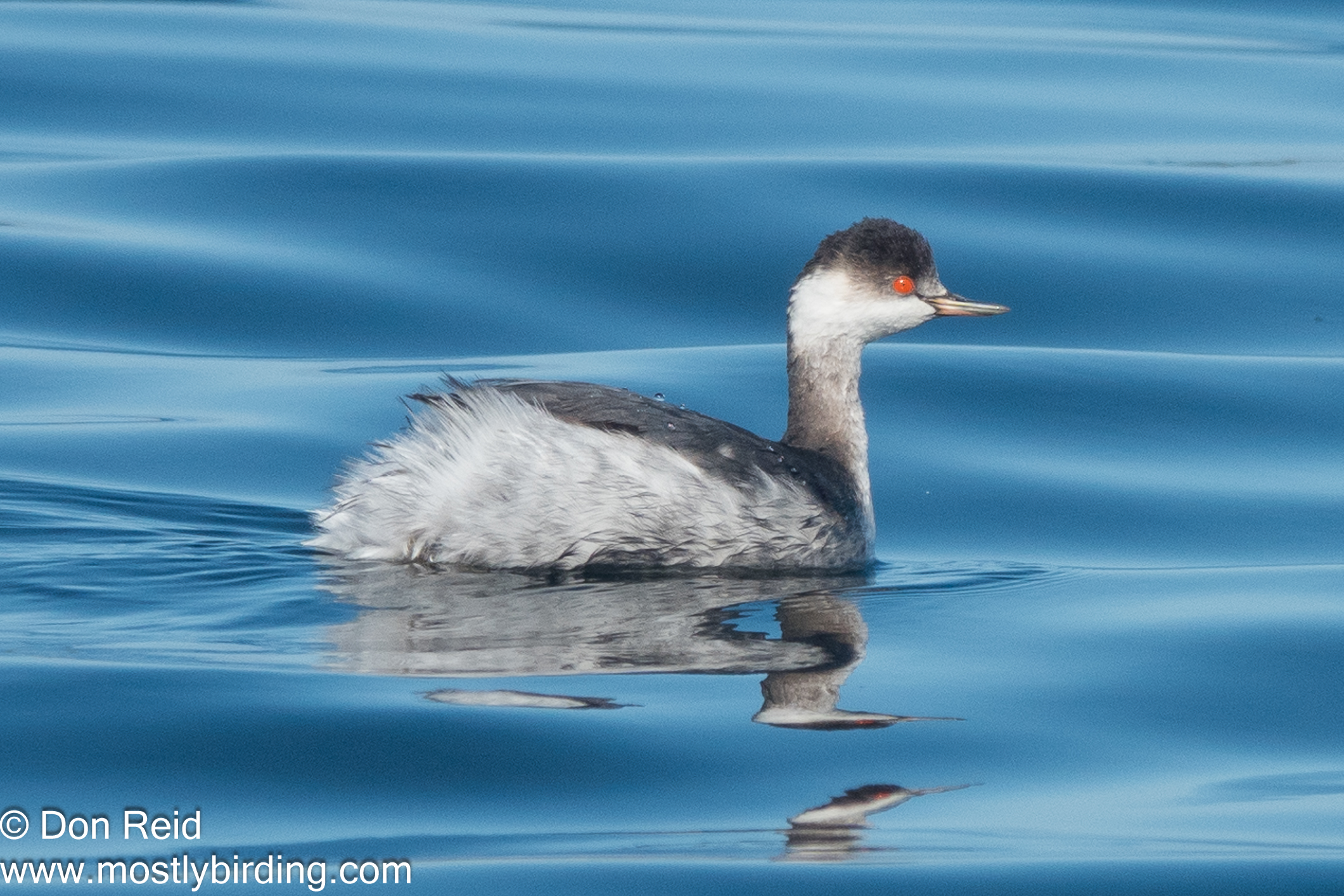
Less common, in fact it turned out to be a new species for the pentad, was a pair of Black-necked Grebes, swimming in the middle of the dam. I have only ever found them further east at the lakes beyond the village of Wilderness so was really pleased to record them so close to Mossel Bay. They were way beyond my camera’s reach so the photo below is from a visit to Strandfontein near Cape Town.
The dam edges had both fresh water Cormorants present – White-breasted and Reed Cormorant as well as Blacksmith Lapwing.
I continued along the road adding Red-capped Lark and Capped Wheatear before entering the next pentad, which signalled the close of the atlasing of the pentad with a total of 53 species.
Atlasing is the regular mapping of bird species in a specific area called a “pentad”. Each pentad has a unique number, based on its geographical position according to a 5 minute x 5 minute grid of co-ordinates of latitude and longitude, which translates into a square of our planet roughly 8 x 8 kms in extent.
As a registered observer / Citizen scientist under the SABAP2 program (SA Bird Atlas Project 2), I record all of the species I see or hear in a particular pentad over a period which can be anything between 2 hours and 5 days, for submission to the project database at the ADU (Animal Demography Unit) based in Cape Town.
These tales record some of the more memorable experiences while atlasing – in this case during March 2023 while we were at our ‘other’ home in Mossel Bay (where we now reside permanently)
And in case you’ve forgotten or have not heard of Atlasing, here’s a brief synopsis –
Atlasing is the regular mapping of bird species in a specific area called a “pentad”. Each pentad has a unique number, based on its geographical position according to a 5 minute x 5 minute grid of co-ordinates of latitude and longitude, which translates into a square of our planet roughly 8 x 8 kms in extent.
As a registered observer / Citizen scientist under the SABAP2 program (SA Bird Atlas Project 2), I record all of the species I see or hear in a particular pentad over a period which can be anything between 2 hours and 5 days, for submission to the project database at the ADU (Animal Demography Unit) based in Cape Town.
George – Country roads west of town
Gerda’s last treatment, taking up most of the day at the clinic in George, meant I had a chance to do some atlasing in the area once again. I didn’t want to travel too far from George so chose a pentad directly west of the town.
Pentad 3355_2215
I headed west out of George, taking Charles street which winds through country farmland and hills before descending into Great Brak. Just after the start of the pentad the road – which is gravel most of the way – descends to the single lane bridge over the Maalgate River
Bridge over Maalgate River
There I spent some time on both sides of the river, recording Fork-tailed Drongo, Black Saw-wing, Common Quail, Little Rush Warbler and several Swallows and Swifts.
Add to that a number of waterfowl at a large dam further along the same road and I had recorded a quick 25 species in as many minutes, including a lone Purple Heron at the dam.
Purple Heron Ardea purpurea Rooireier
One of the ‘hazards’ of atlasing the country roads is encountering the occasional ‘road block’ – fortunately not of the policed kind, rather one that adds to the experience as gentle farm animals pass by the car.
Great Brak inland
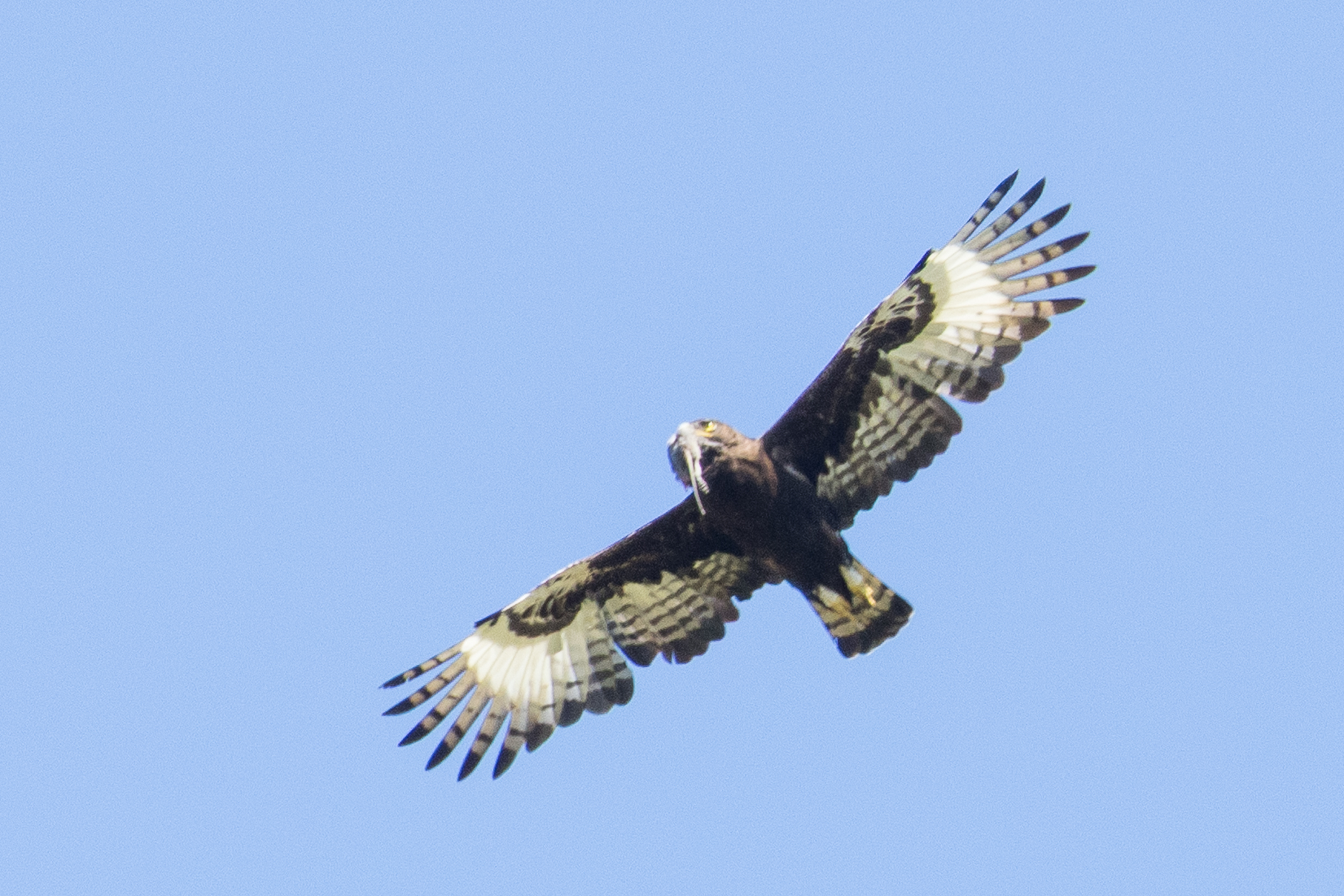
After crossing the river again, a Long-crested Eagle flew over to fill my heart with pleasure – later in the adjacent pentad another (or possibly the same one) soared high above with some sort of prey gripped in its beak – this time I had my camera handy for a quick photo as it passed over me
After that great start, the birding slowed somewhat as I followed the road through farmlands, then headed back in the direction of George along roads that took me through the adjacent pentad.
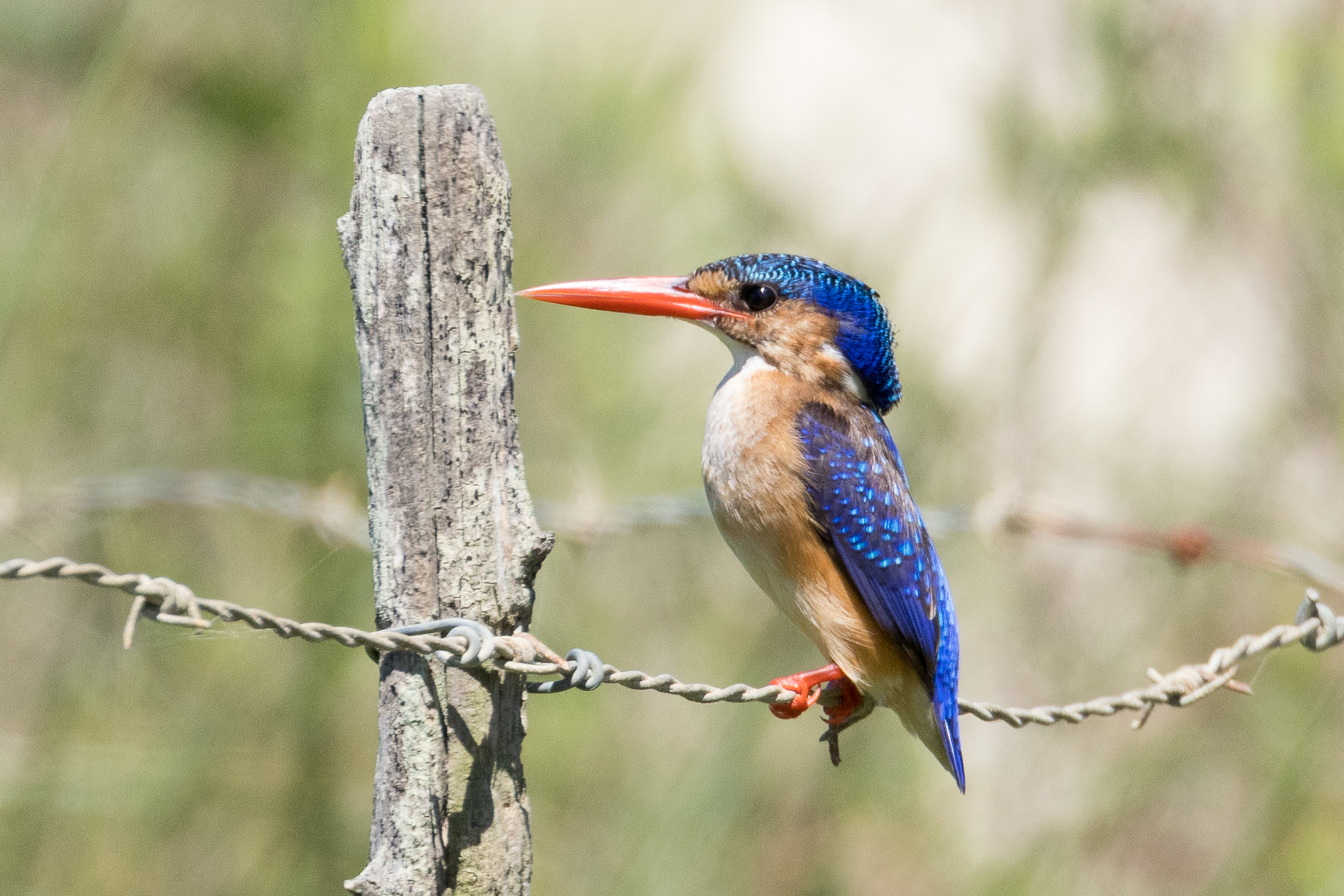
That led to an unusual encounter with a Malachite Kingfisher, which flew across the road in front of the car, then settled on a fence – unusual because there were no dams or rivers in the vicinity. It perched long enough to allow me to take a few photos in this out of character environment.
Looking to further ‘fill in’ my MBMA Project block of pentads for the year (MBMA is my acronym for Mossel Bay Municipal Area which covers 42 pentads over a wide swathe of the southern Cape from Gouritz River in the west to Glentana in the east and northwards up to the Klein Karoo), I decided to tackle the pentads covering the village of Friemersheim itself and to the west and east of it.
Pentad 3355_2210
I started in the pentad to the east of Friemersheim at 7am on the dot, travelling along Amy Searle Street northwards out of the town of Great Brak River, initially through farmland with a sprinkling of small dams on either side of the road.
First bird was a calling Burchell’s Coucal – their soft bubbling call often advertises their presence long before they show themselves – later I had a surprise close encounter with the species.
I spent some time at the first roadside dams, looking with some difficulty into the low morning sun – a Malachite Kingfisher was already active, perched on a convenient branch and plunging to catch small prey.
Several waterfowl were present, such as the ubiquitous Yellow-billed Duck, a few Red-billed Teals and a Little Grebe.
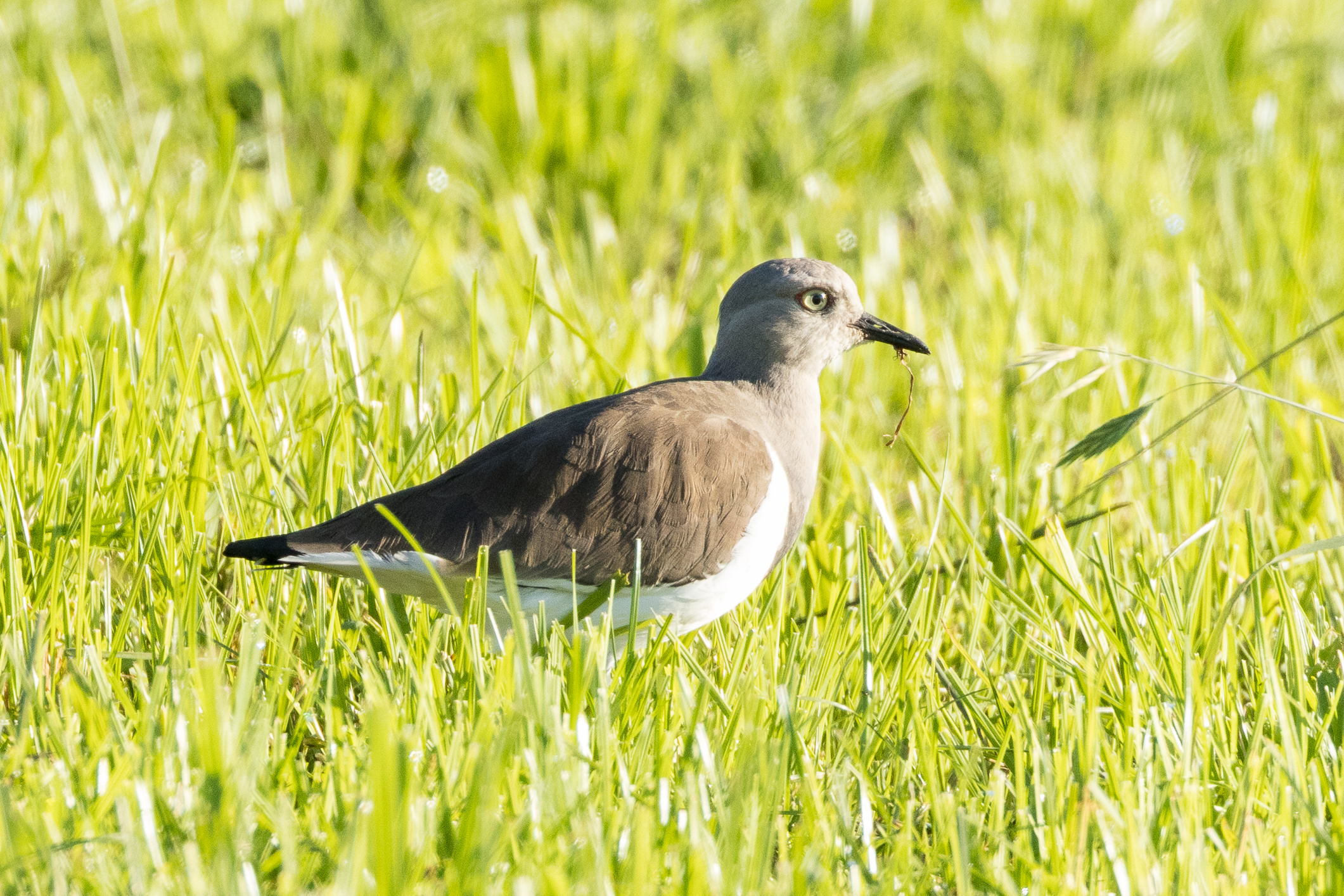
Carrying on, a field with shortish grass was the right habitat for Lapwings and produced the similar looking Black-winged Lapwings and Crowned Lapwings, the former a scarcer, sought after species, the latter far more common.
I turned off the tar road eastwards along a nondescript gravel side road, but one I had previously explored with some success. The first stretch travels through more farmland with shortish grass, which was good for Zitting Cisticola and Cape Longclaw, plus many Barn Swallows flying low and scooping flying insects out of the air.
Thereafter the road turns steeply downhill into a wooded valley with a strong river flowing at the lowest point. Halfway down I stopped for coffee and rusks and added 8 species in the 15 to 20 minutes spent listening and looking out for birds, including several forest species –
Collared Sunbird – my first record of the species for the Western Cape
Dusky Flycatcher
Fork-tailed Drongo
Olive Bushshrike
Emerging from the valley, I continued along the road through more farmlands and rolling hills, steadily adding species to the card, which included a few more special sightings –
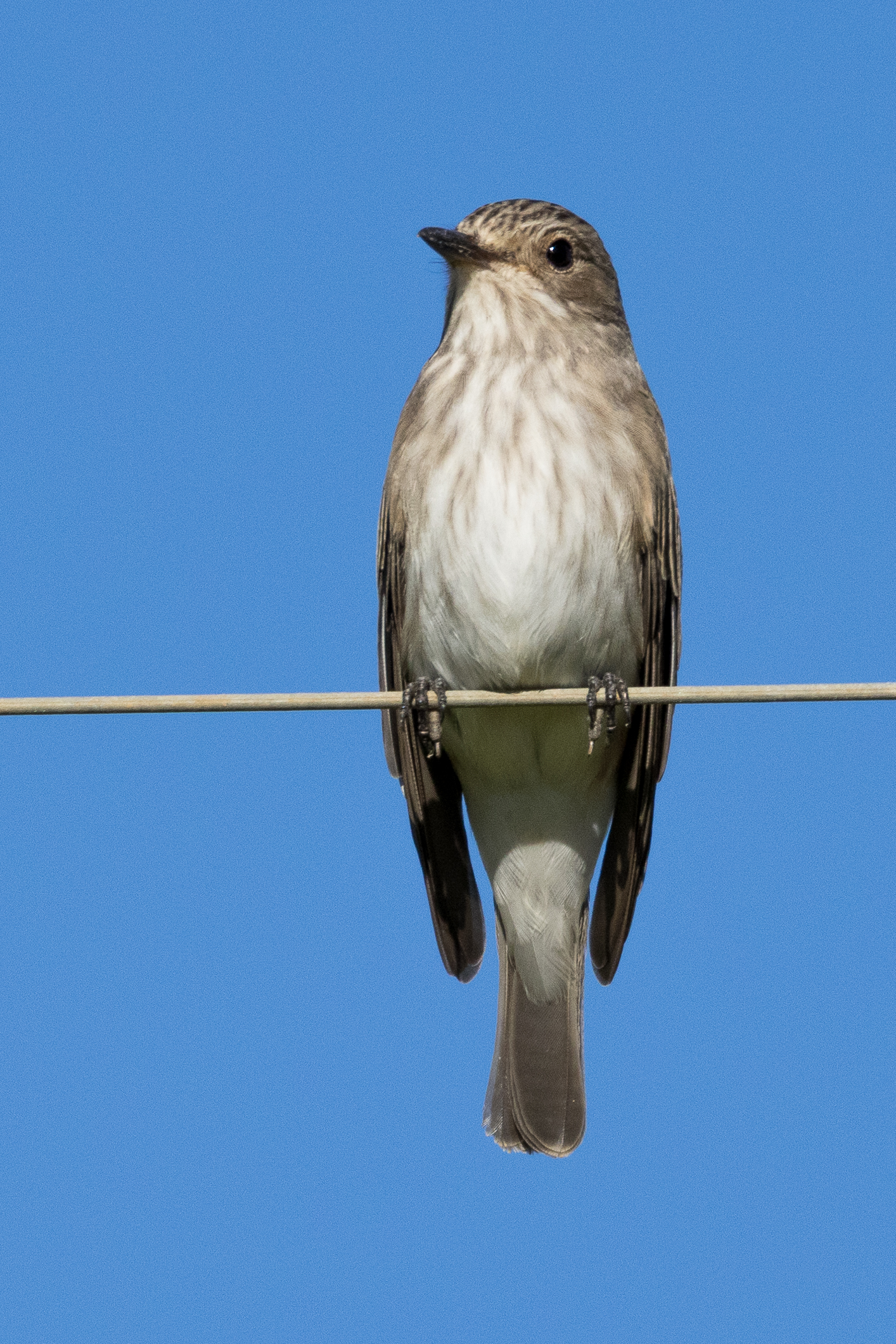
Spotted Flycatcher perched on a fence, allowing me to take several photos (another first record for my Western Cape list)
Spotted Flycatcher Muscicapa striata Europese vlieëvanger
Terrestrial Brownbul calling from dense bush – krrr – krrr – krrr is the best way I can describe this secretive species’ call
The close encounter with a Burchell’s Coucal mentioned above – I followed its progress through a tangle of long grass and bushes
The second pentad for the morning was far less productive, probably because it was close to midday when birds tend to be temporarily absent until the late afternoon ‘rush hour’ starts
My route was through Friemersheim (which has been the subject of several of my posts about the mural artwork that is a feature of this interesting village) then a circular route on the northern side of the village.
There were few highlights, but I found hundreds of Barn Swallows feeding over the fields. My last stop in the forested section produced several Cape Batises and a Butterfly gathering moisture from a puddle in the road
To repeat the intro to my previous posts on this subject …. Many of the migrant waders – or shorebirds as they are also known – display the most Jeckyll and Hyde characteristics of all birds, living two dramatically different lives and spending time in habitats which are far removed from each other.
Separating these two lives are amazing journeys that take these small yet hardy birds halfway across the world – and back again.
South African birders get to know migrant species during their stay in the southern hemisphere, typically during the months from October to April, so let’s find out a bit more about their ‘other’ lives by delving (again) into the typical annual life cycle of these waders.
This time it’s the –
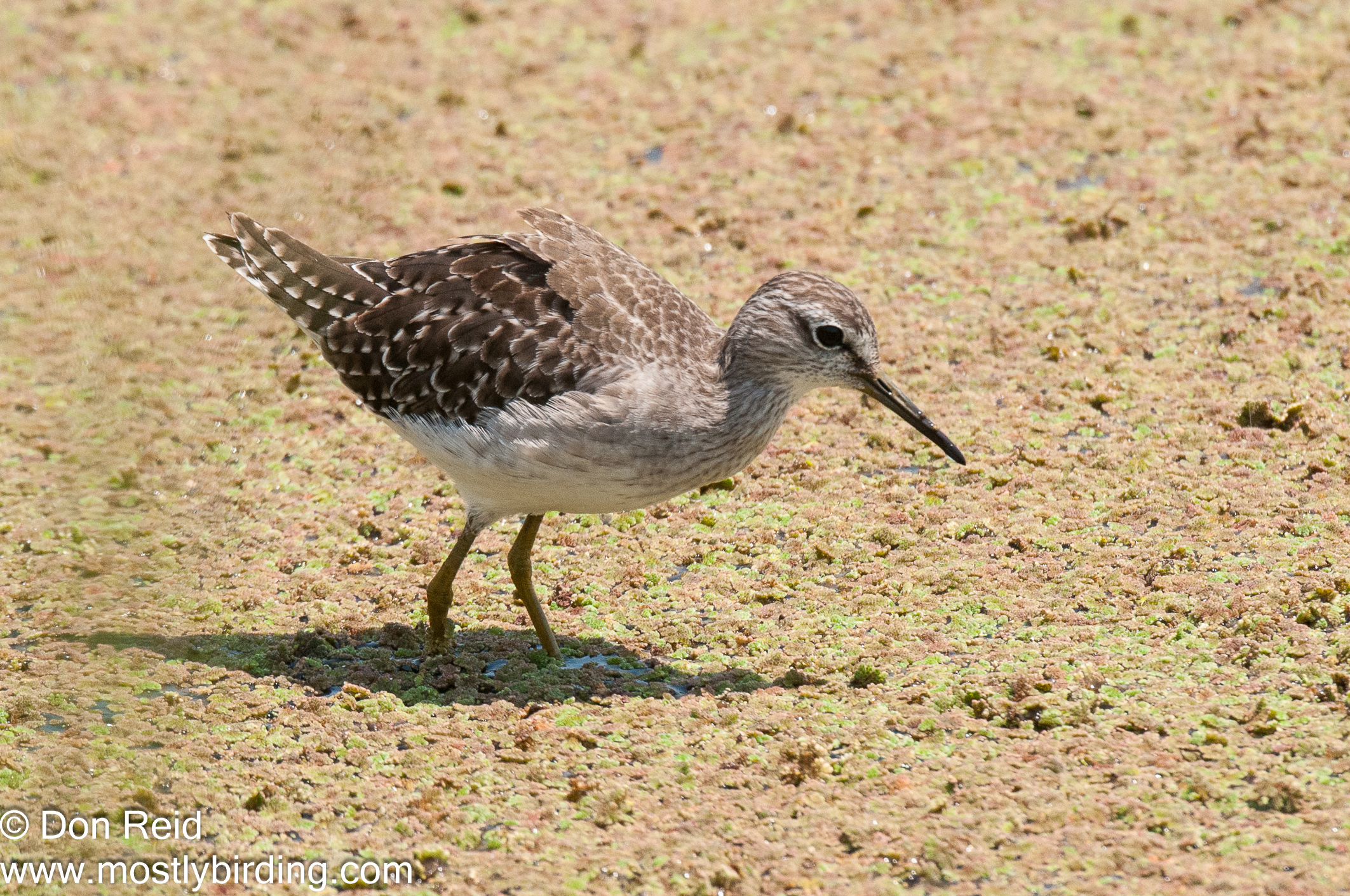
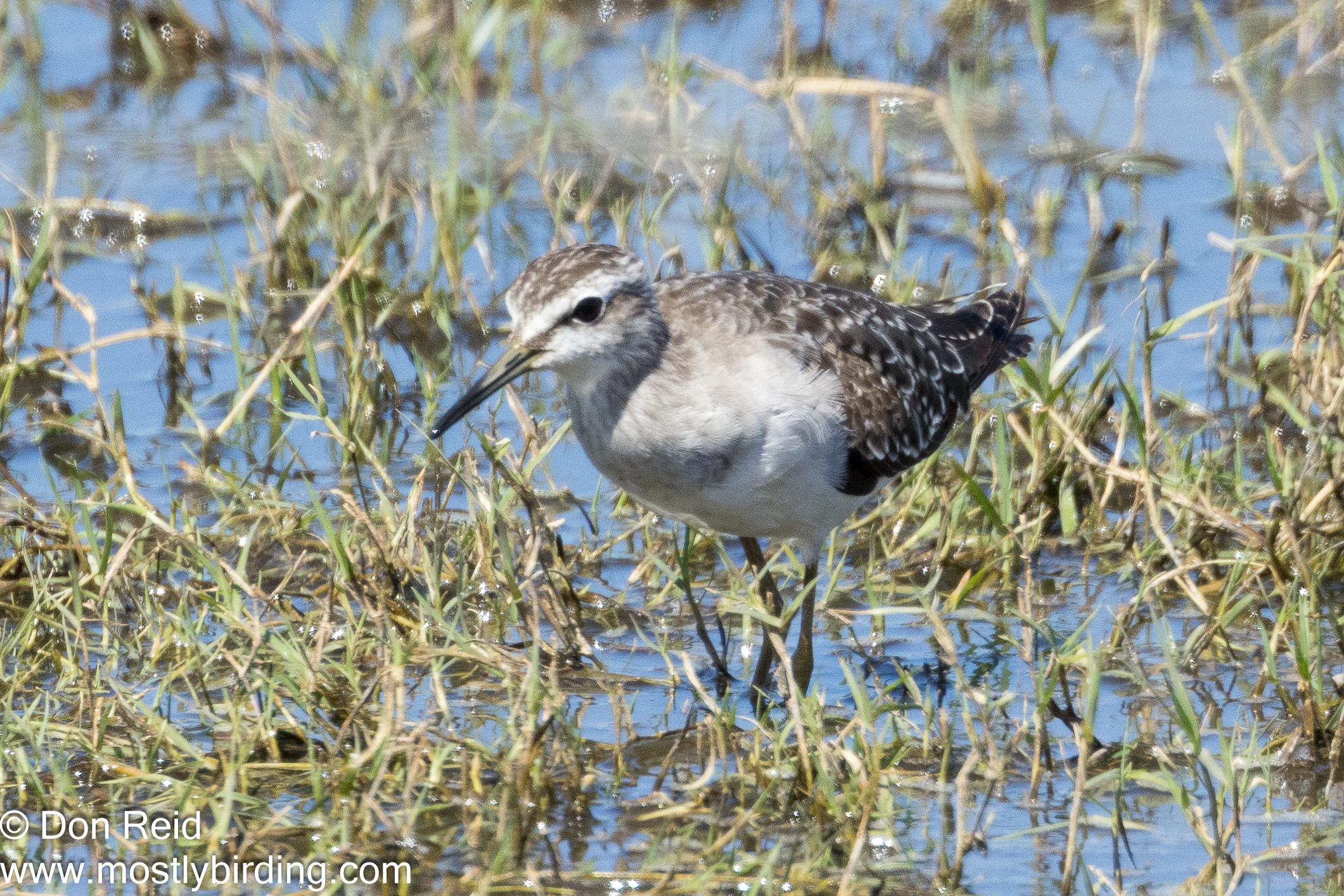
Wood Sandpiper (Bosruiter) Tringa glareola
Affectionately called ‘Woodies’, this species is so named because they breed on swamps and peat bogs in the coniferous taiga forests of the Northern Hemisphere – who would have thought this is also a ‘Forest bird’ !
Identification and Distribution
Identification of the Wood Sandpiper is relatively easy – compared to some of the other LBW’s (Little brown waders) – and is often the first wader that novice birders will get to know as it is one of the most common freshwater waders
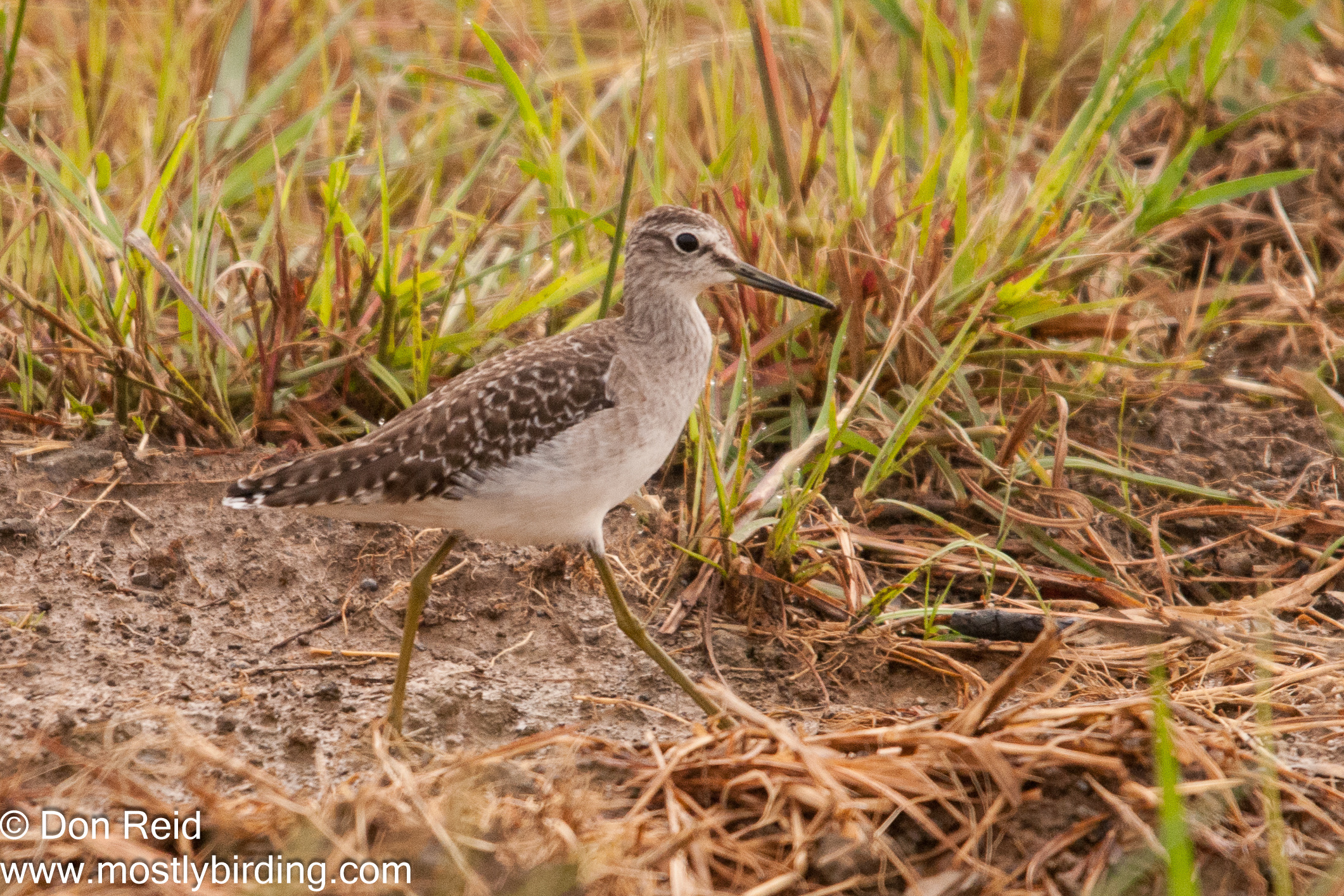
straight bill about the same length as the head, white brow extends behind eye
grey-brown above with eye-catching white ‘spotting’ , grey below
Wood Sandpiper, Devon
Distribution –
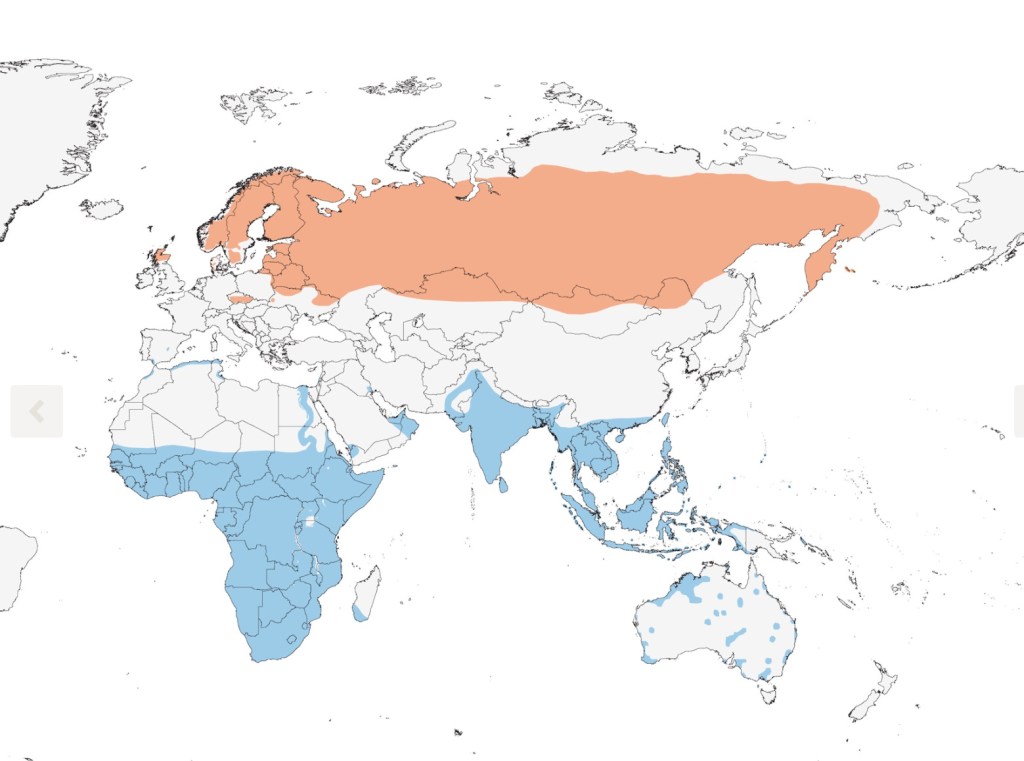
The orange area on the global distribution map (from Cornell Birds of the World) shows where breeding occurs in the Northern Hemisphere while the blue area, mostly in the Southern Hemisphere, is where they go to ‘get away from it all’ and prepare themselves for the next round of raising a family.
Wood Sandpiper, Marievale
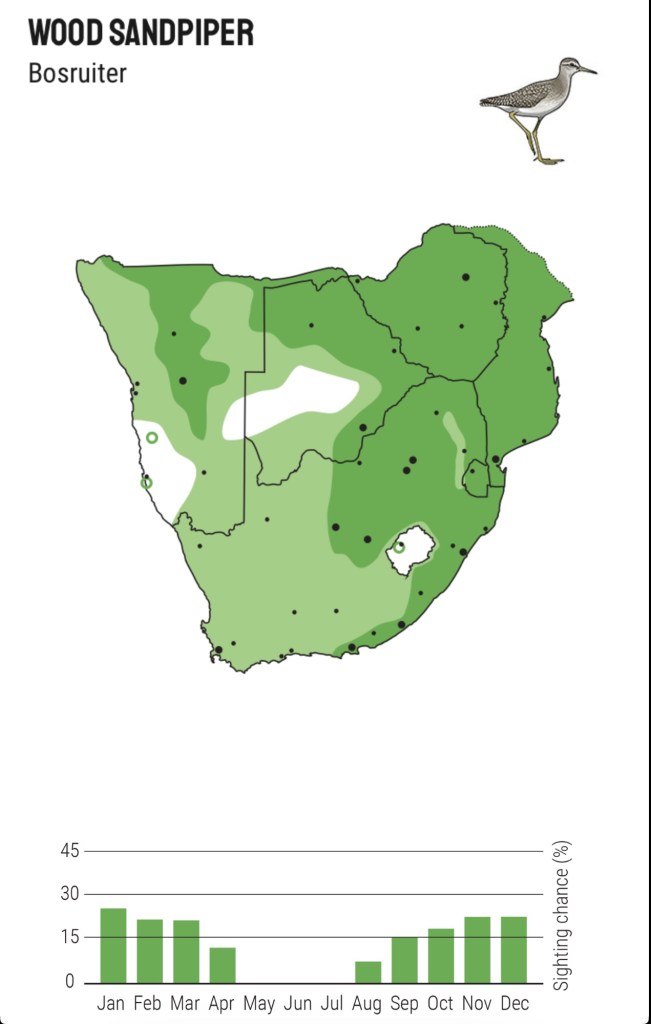
The southern African distribution map (from The Firefinch Birding app) shows the species presence across most of the region but absent from the Kalahari and arid west.
Life in the North
The preferred breeding habitat is the open swampy area and peat bogs in coniferous forests, scrubland between those forests and tundra
Their diet is mainly small aquatic insects, caught by pecking or probing while walking in shallow water
Wood Sandpiper, Marievale Bird Sanctuary
Breeding
The nest is usually a small scrape on the ground lined with moss, stems and leaves, in dense vegetation, but also frequently in trees in old nests of other species
Eggs (usually 4) are laid and incubated for about 3 weeks – from 7 to 10 days after hatching the male cares for the young on its own
Fledging some 3 to 4 weeks later, the fledglings are independent soon thereafter, facing the many dangers that young birds are subject to.
Wood Sandpiper, Kasane Botswana
Migration
The birds we see in Southern Africa are thought to originate from Russia, first adults leave early July, arriving in the south from late July / August with juveniles following mainly in September and October.
Migration is undertaken at night with birds capable of single flights of up to 4000km. Overland routes are followed by small flocks or singly, mainly via the Rift Valley
Wood Sandpiper, Kasane Botswana
Life in the South
Of the 3 million+ Woodies that head to Africa, some 50 – 100,000 end up in southern Africa, where they seek out suitable freshwater habitats. These can be anything from shallow sewage ponds to marshes, flood plains and muddy edges of streams and rivers, down to the size of a puddle.
Wood Sandpiper, Punda Maria
Sometime after arrival, adults start a post-breeding moult which continues for up to 4 months, during which time all feathers are replaced with new ones.
Generally, a solitary bird except where food is abundant when they may gather in loose groups
Wood Sandpiper with Little Stint, Leeuwfontein Pan near Belfast
They start departing from late February with the majority having left by end April, heading north to their breeding grounds where the cycle will start all over again…
Wood Sandpiper, Bredasdorp
References : Cornell Lab of Ornithology Birds of the World; Roberts VII Birds of Southern Africa; Firefinch app, Collins Bird Guide; Waders of Southern Africa
I have mentioned previously the pleasure of living in an estate which adjoins a nature area, which I can access by walking a couple of hundred metres from our front door and which has an abundance of fynbos and other flora, plus enough birdlife to keep me going back several times a week.
Until last Friday I could not think of a downside to having a nature area on our doorstep, but just as we can visit the nature area with ease, so can inhabitants of the nature area just as easily visit us by heading in the opposite direction, if they are in the mood for a bit of adventure.
That last fact was brought home loud and clear by a Puff-adder that decided to come to our front door during the afternoon. Fortuitously, our son is visiting us and was in the guest bedroom close to the front entrance – he noticed that the estate’s security personnel were standing in the street looking at our house. Then he realised why – a 1m long Puff-adder was slithering across our driveway towards the front entrance!
It turns out the security people had been keeping track of the snake after it was spotted in a garden three houses down and had called the Mossel Bay Fire Brigade who have a small team that deal with such events.
We joined the security people on the driveway – via our back door of course – and watched and waited for the snake catchers to arrive. We couldn’t help thinking what might have happened if we did not get the warning and went out by our front door!
They were there within 15 minutes (Mossel Bay is fortunate to have a very well run municipality) and had the Puff-adder in a container within minutes, ready for relocation to a spot away from suburbia.
This is the second part of my photo pick for 2024 – a selection of bird photos that appealed to me for various reasons, not just the quality of the photo but also for the memory it left with me. I hope you enjoy scrolling through them as much as I have enjoyed taking, editing and selecting them.
If you have already glanced at the ‘categories’ I have placed them under and are wondering how I arrived at these – well, I didn’t but I did ‘borrow’ them from Firefinch which is the excellent birding app produced by Faansie Peacock (his real name!) and his team.
Faansie has a way of making birding interesting and fun and the way he categorises bird species in his app is a good example of his practical approach.
Raptors
Seeing a raptor at the roadside is always exciting and a reason to stop and have a better look – most will fly off the moment you stop, so it requires a bit of stealth to keep the car moving slowly while approaching the target and to have the camera at the ready for the moment you come to a standstill
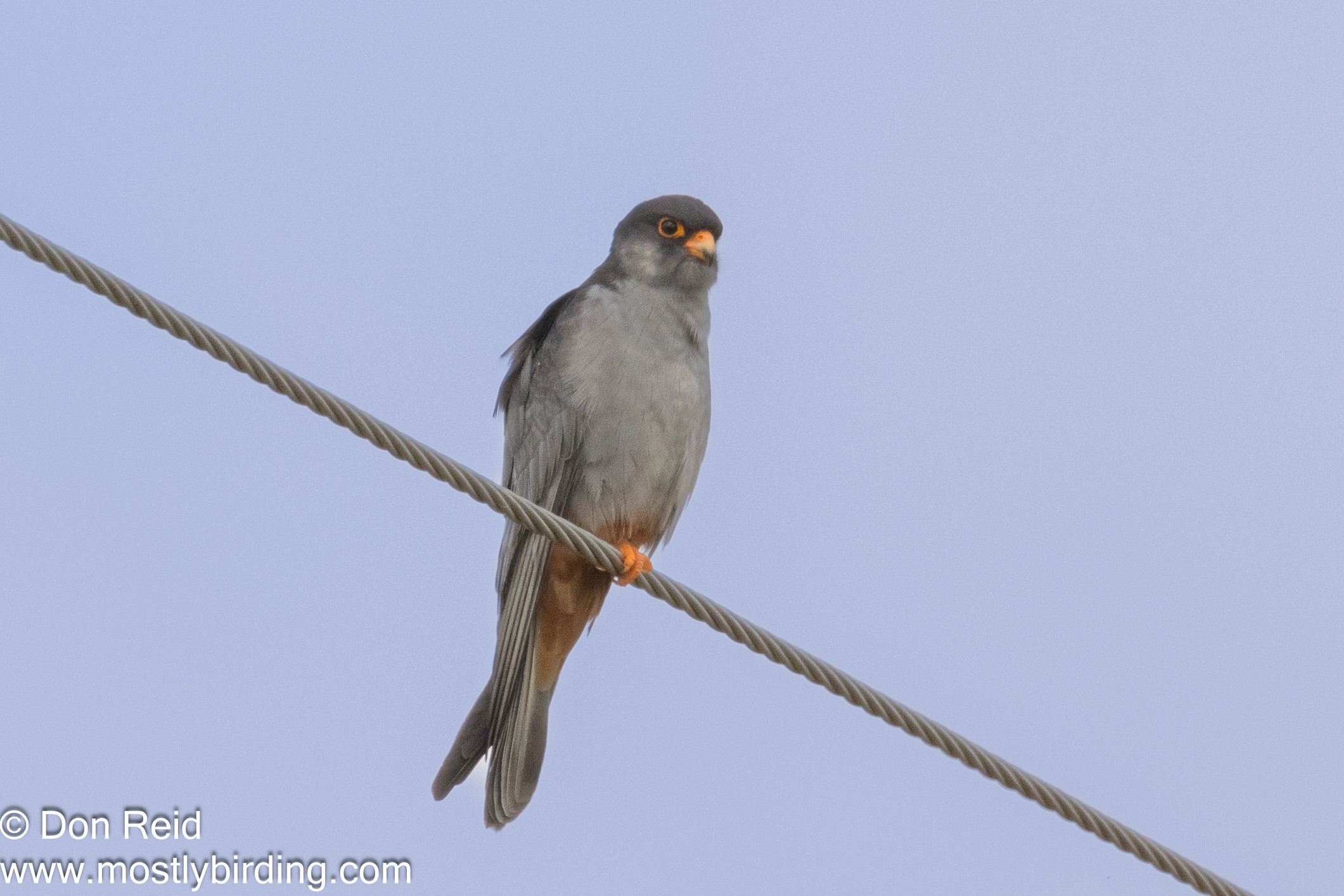
This is not a particularly good photo of an Amur Falcon that I came across but I include it only because it is a scarce sighting in the Southern Cape
Amur Falcon Falco amurensis Oostelike rooipootvalk (male), Kleinberg area
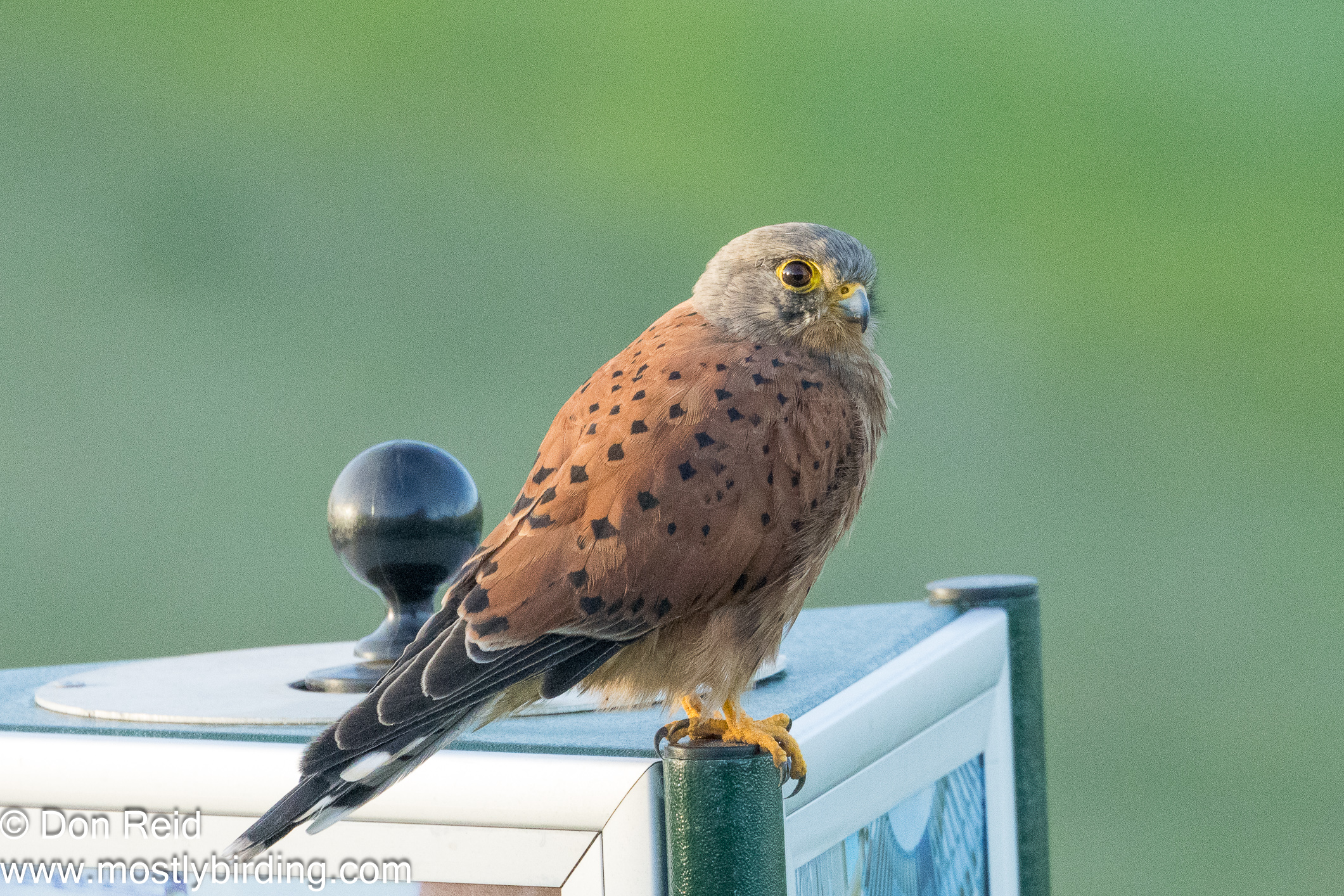
Rock Kestrel is a regular species in the estate where we live. This one chose the 15th tee, just 100m from our house, as a convenient spot for some hunting one morning
Rock Kestrel Falco rupicolus Kransvalk, Mossel Bay Golf Estate
Perchers
This category covers a variety of birds normally seen perched on a tree or bush or other suitable spot
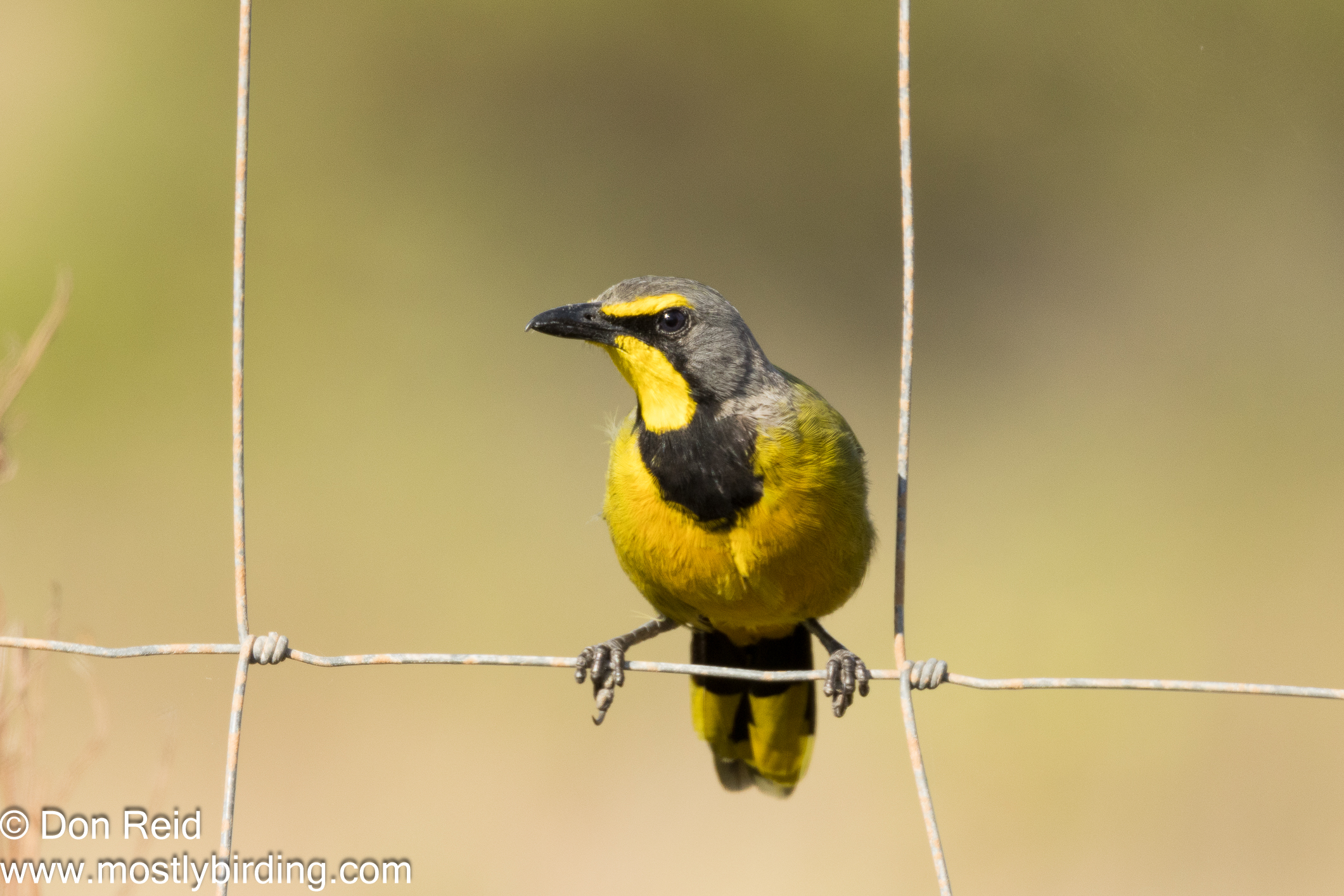
Bokmakieries are often one of the first species to be encountered when atlasing in the Southern Cape, as they greet the new day with vigourous calls. Getting them to pose is not always easy but this one eyed me from a wire fence, inviting me to take its photo
Bokmakierie Telophorus zeylonus Bokmakierie, Brandwag south
Cape Batis is a common forest bird – parts of the Bonniedale road heading west from the R328 are heavily forested and that’s where I found this one
I had stopped in the mountains beyond Herbertsdale to check for birds when this Grassbird – or perhaps it’s better to call it a Fencebird in this case – drew my attention with its familiar trilling call
Cape Grassbird Sphenoeacus afer Grasvoël, Herbertsdale north
Karoo Prinia is common in suitable habitat across its distribution range. I saw one while stoepsitting in the Addo NP and stalked it until it settled in a thorny bush for long enough to get this image
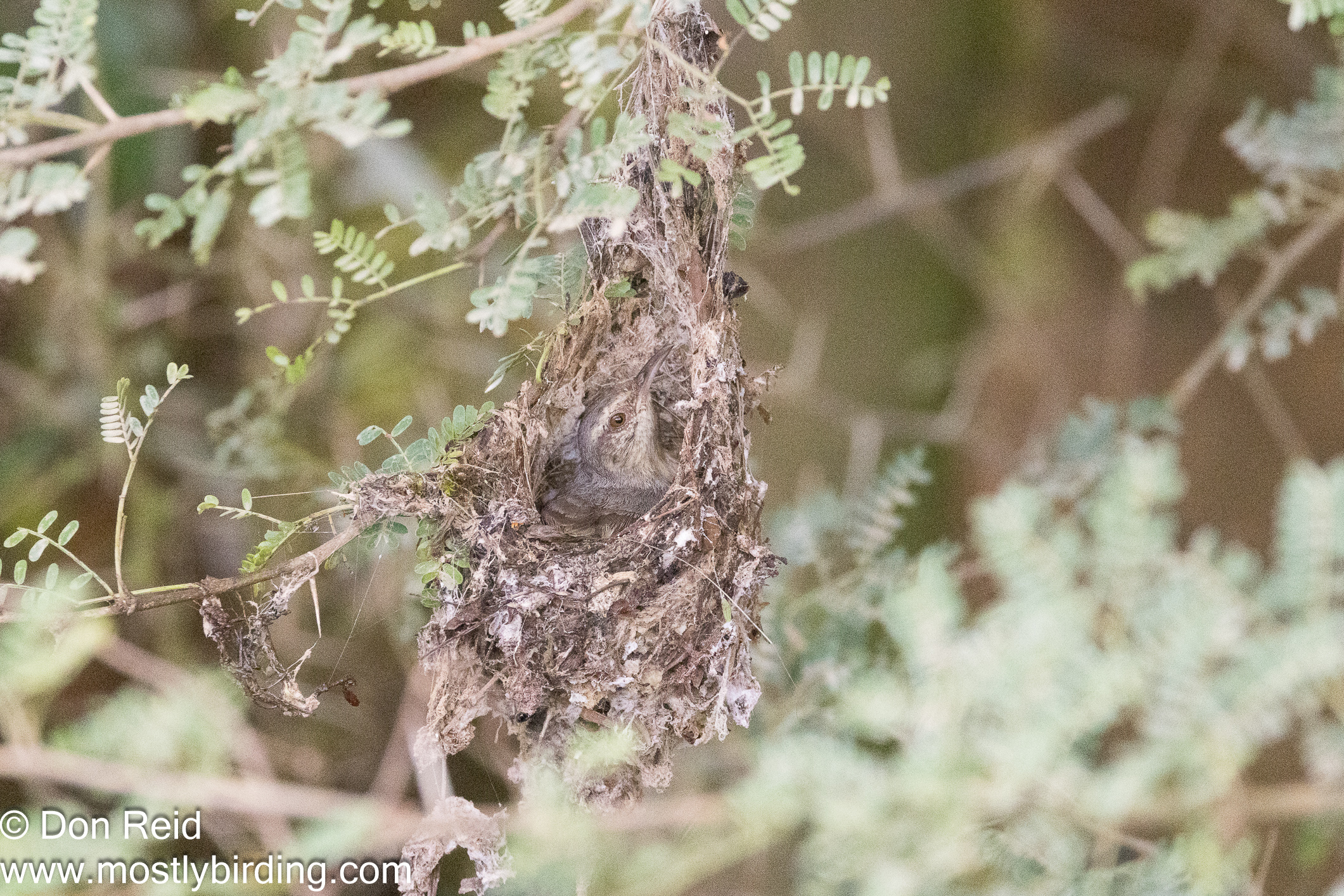
One of my favourite photos of the year, I came across this Long-billed-Crombec while atlasing and was thrilled to see it drop down and take up position in the mouth of the nest low in the tree, which I had not noticed
Long-billed Crombec Sylvietta rufescens Bosveldstompstert (race diverga), Herbertsdale north east
Suckers
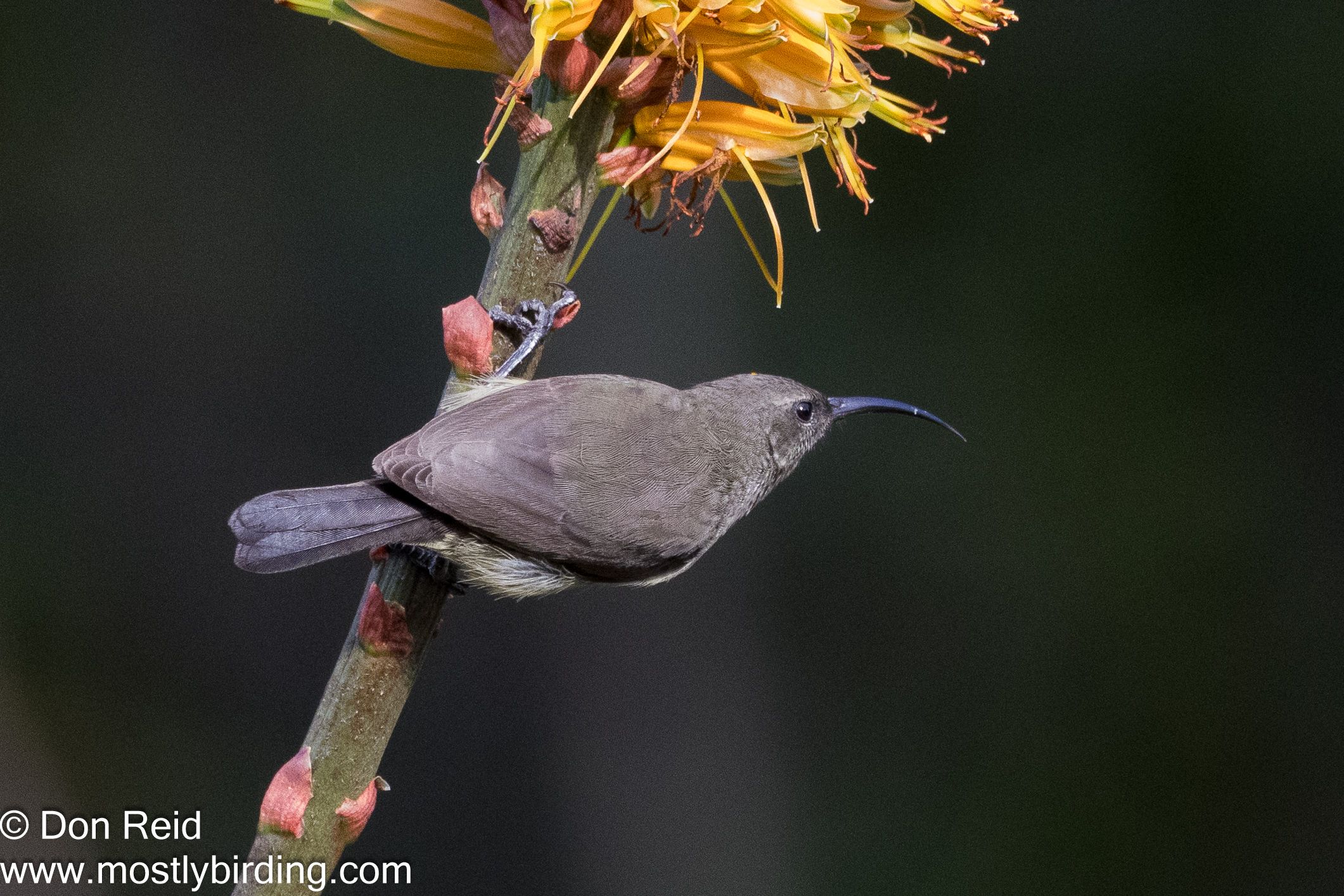
The curve-billed nectar-suckers
The photos illustrate the colourful male and the rather drab female of the species that I often come across while atlasing, and at home
All have short, strong triangular bills suited to their main diet of seeds.
The Bishops were both photographed in winter non-breeding plumage.
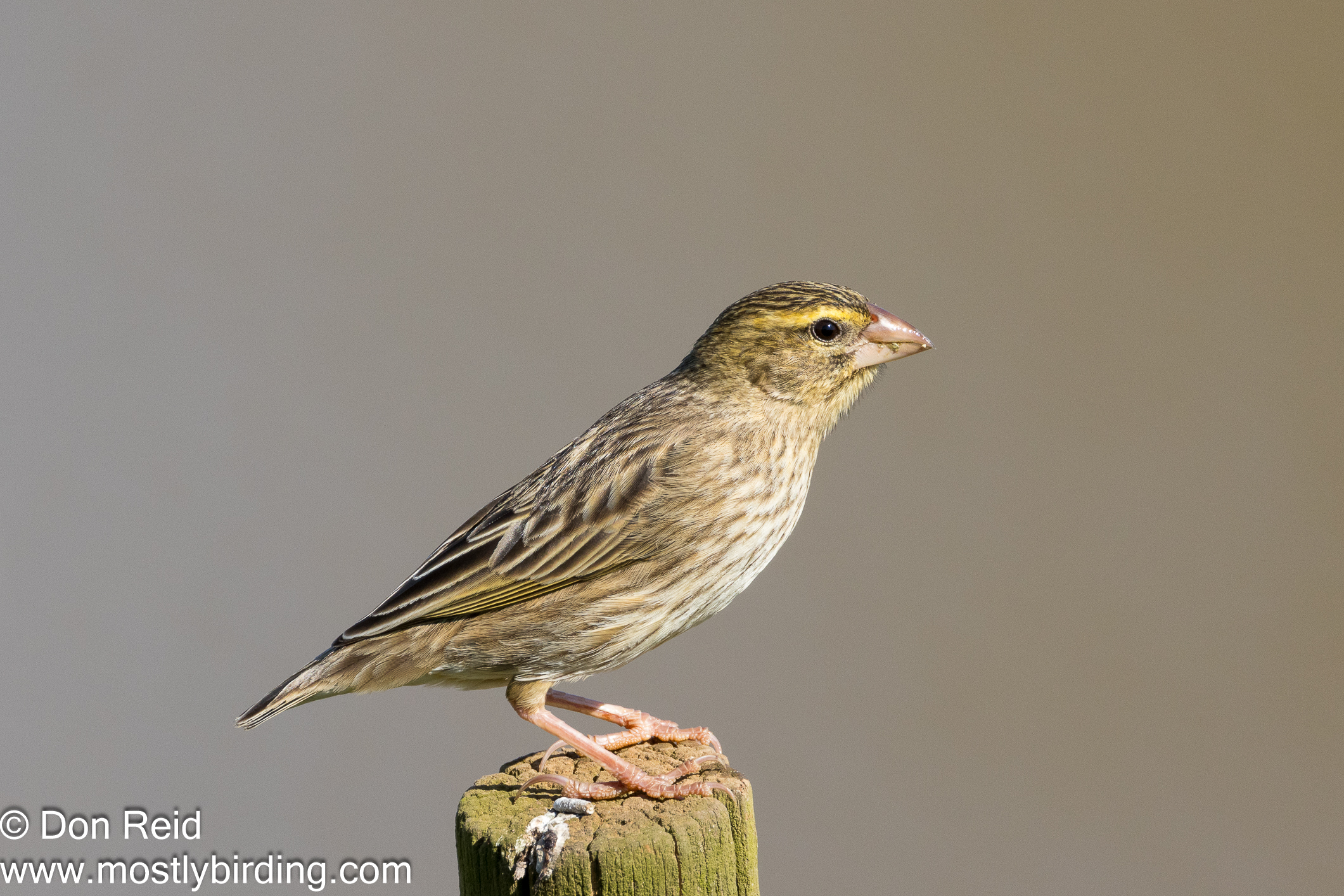
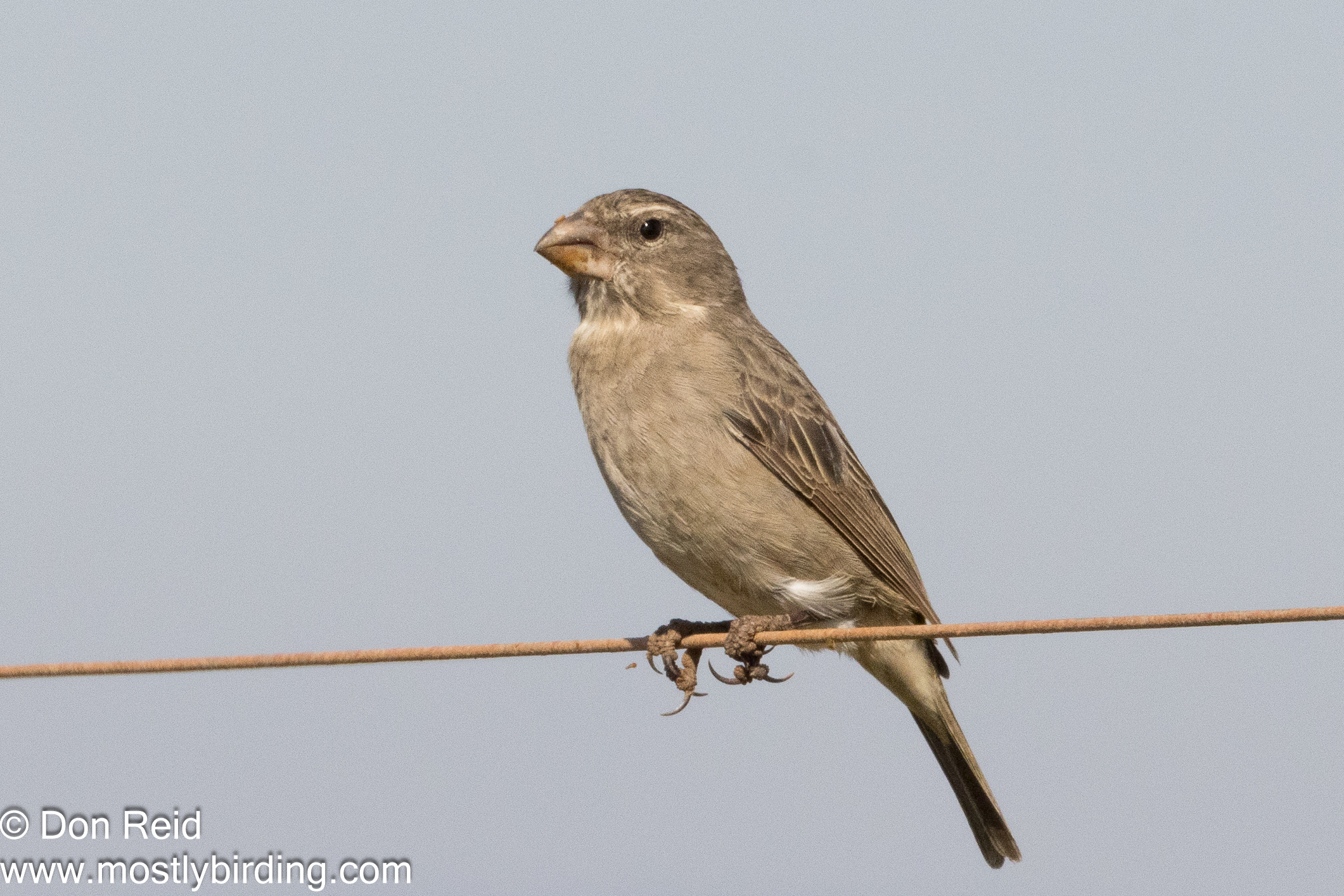
Yellow Bishop Euplectes capensis Kaapse flap (non-breeding male), Klein Brak areaSouthern Red Bishop Euplectes orix Rooivink (non-breeding), Bland’s DriftWhite-throated Canary Crithagra albogularis Witkeelkanarie, Herbertsdale area
Cape Canaries always seem to be on the go, not waiting for an anxious bird photographer to get his act together, so I was happy that this one hung around a bit.
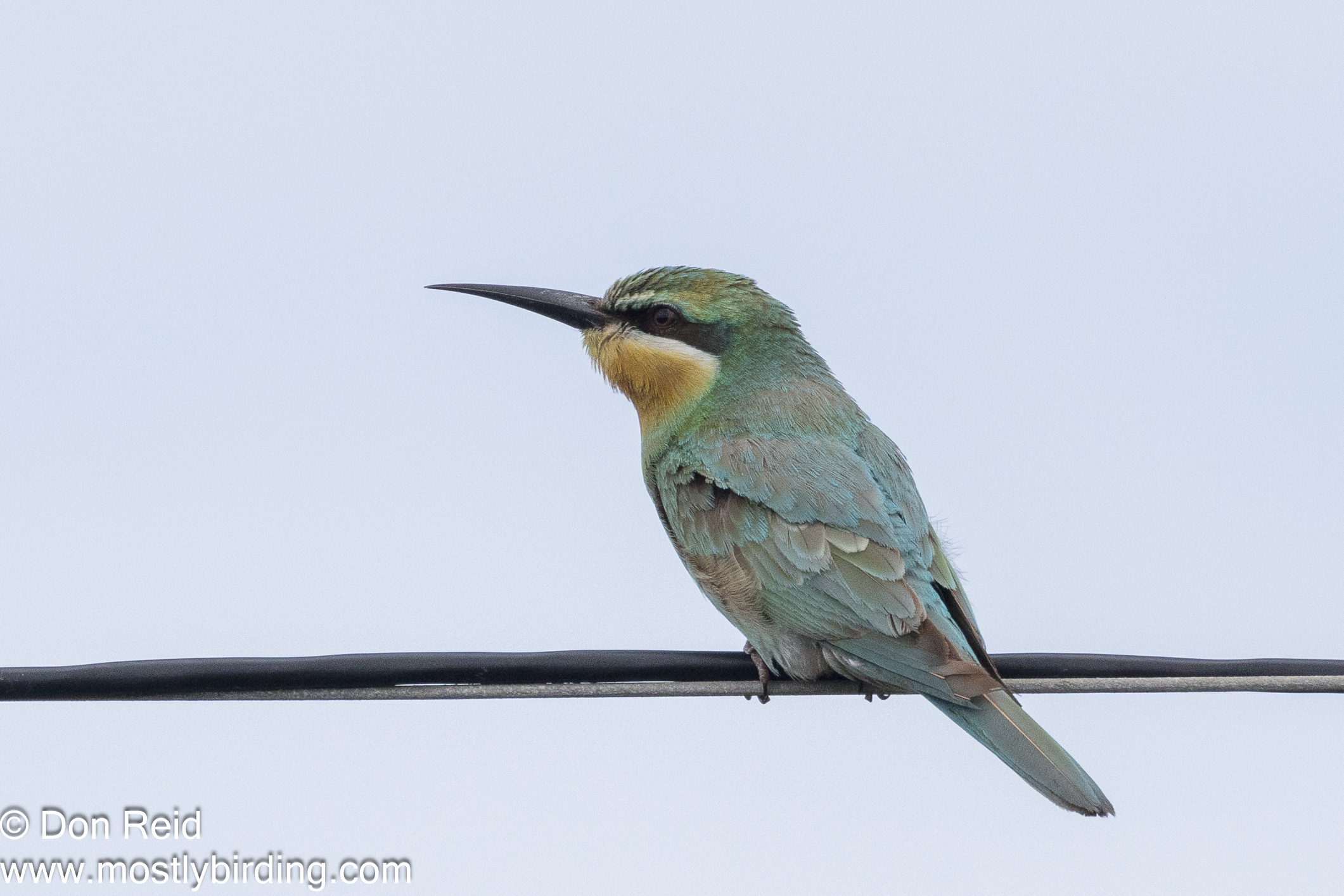
The Blue-cheeked Bee-eater is a Palearctic migrant, regarded as a rarity in the Western Cape, which is why I have included it in my pick. However they have been seen during summer near Gouritzmond for a few years now.
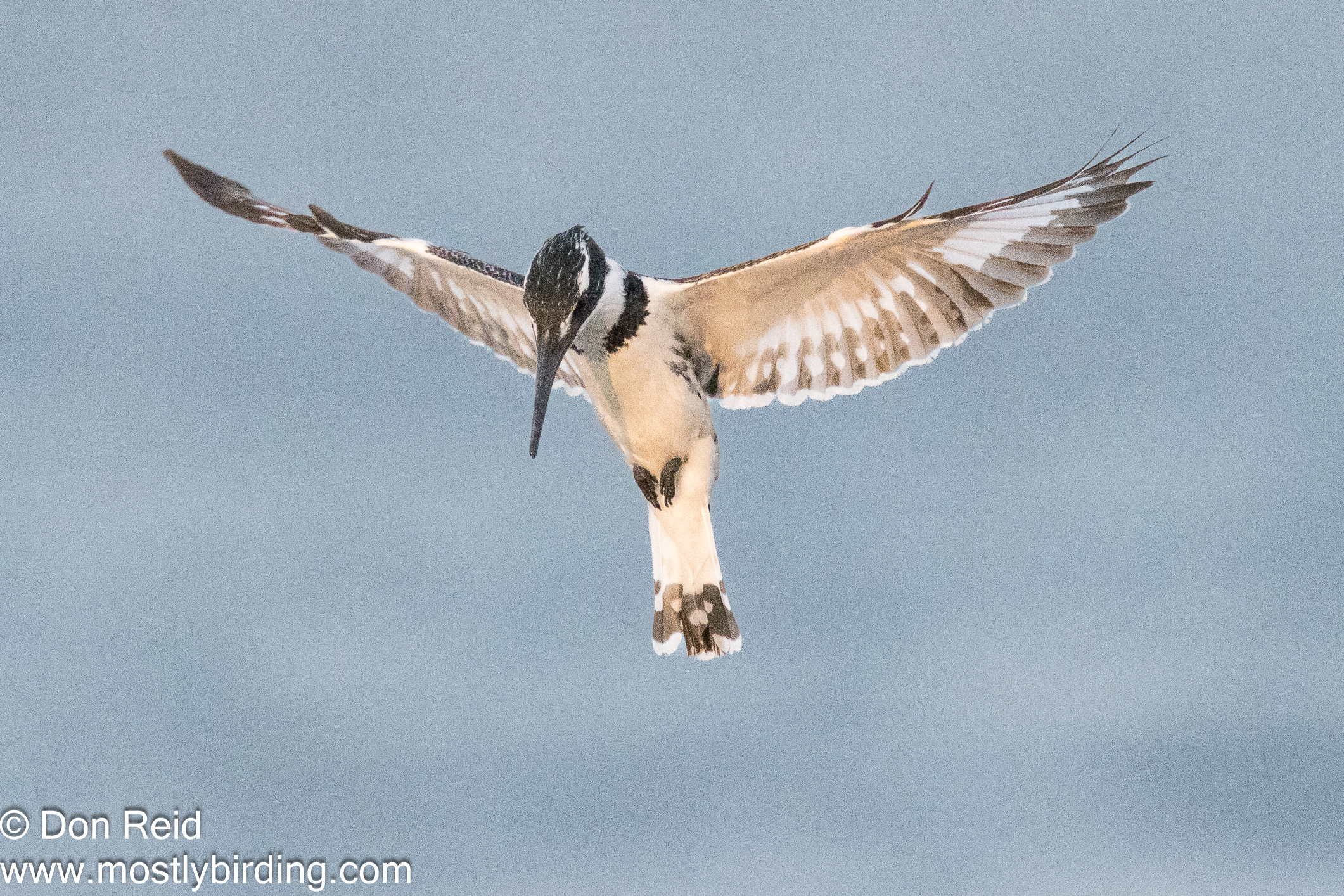
Pied Kingfishers are known for their habit of hover-hunting – this one did so at The Point in Mossel Bay while we were parked there enjoying our customary coffee one late afternoon just before sunset, with perfect lighting to enhance the beauty of the bird.
Pied Kingfisher Ceryle rudis Bontvisvanger (female), Mossel Bay Point
Flyers
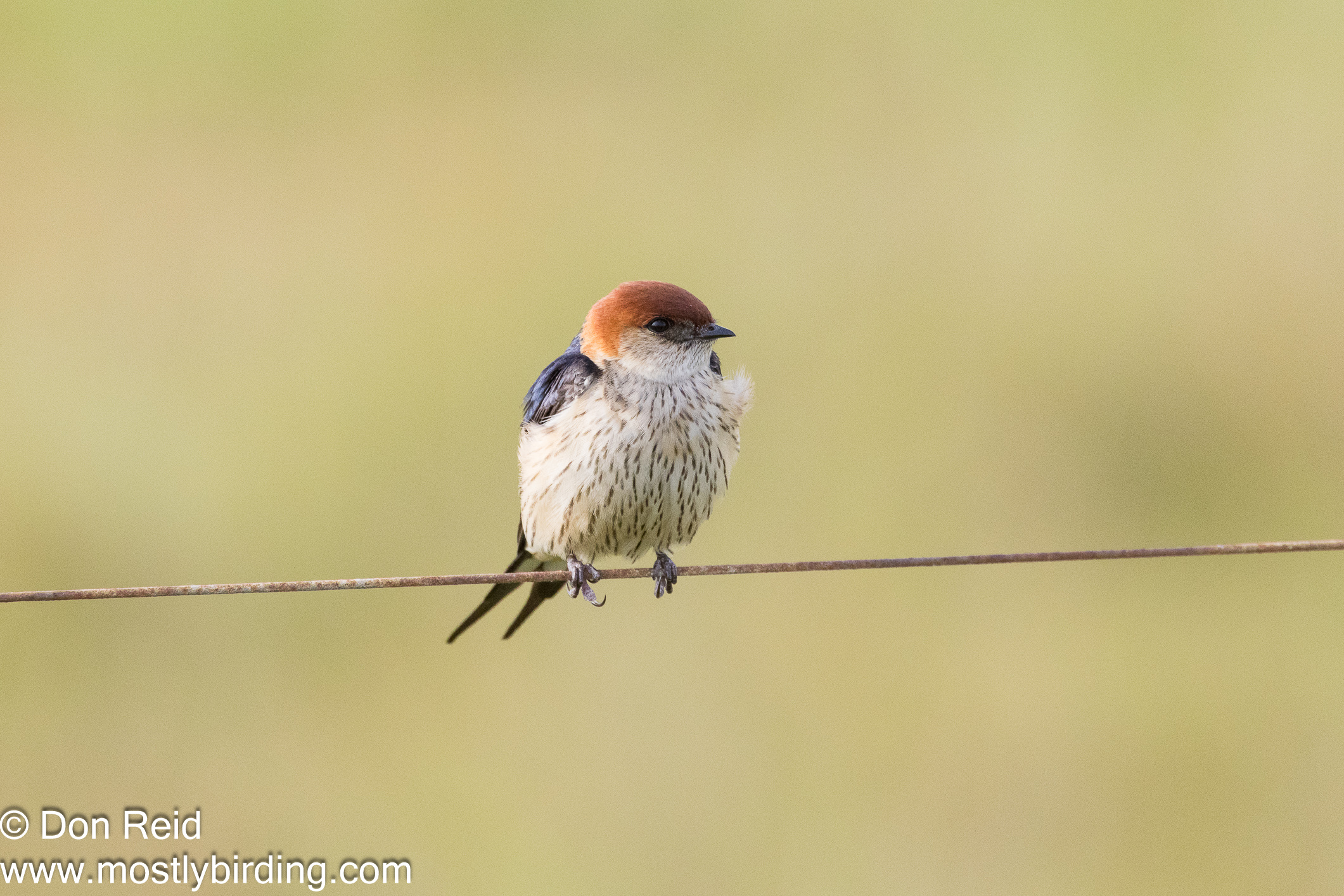
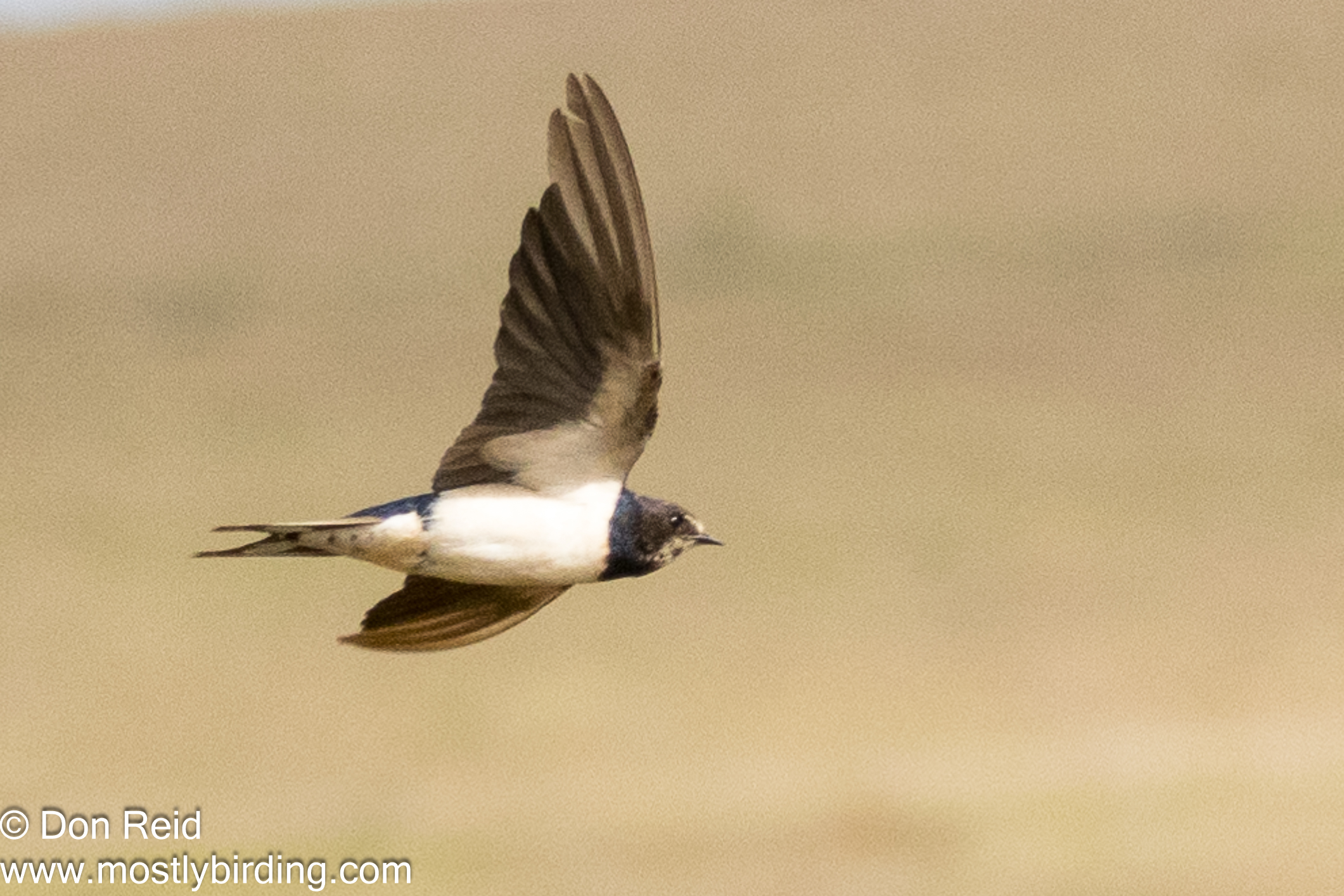
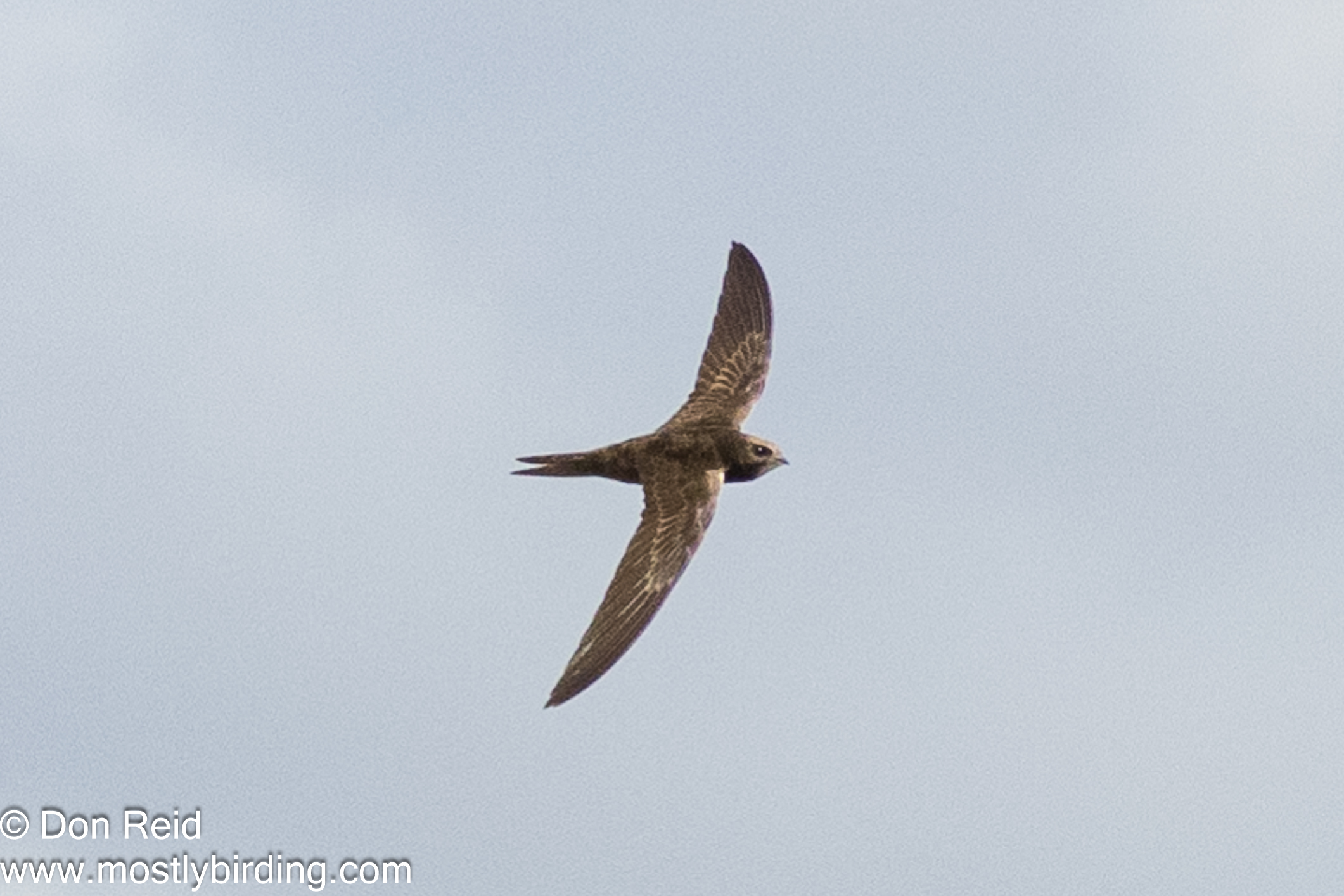
Swifts and swallows – the aerial feeders – also the most challenging to photograph unless they are resting between sorties
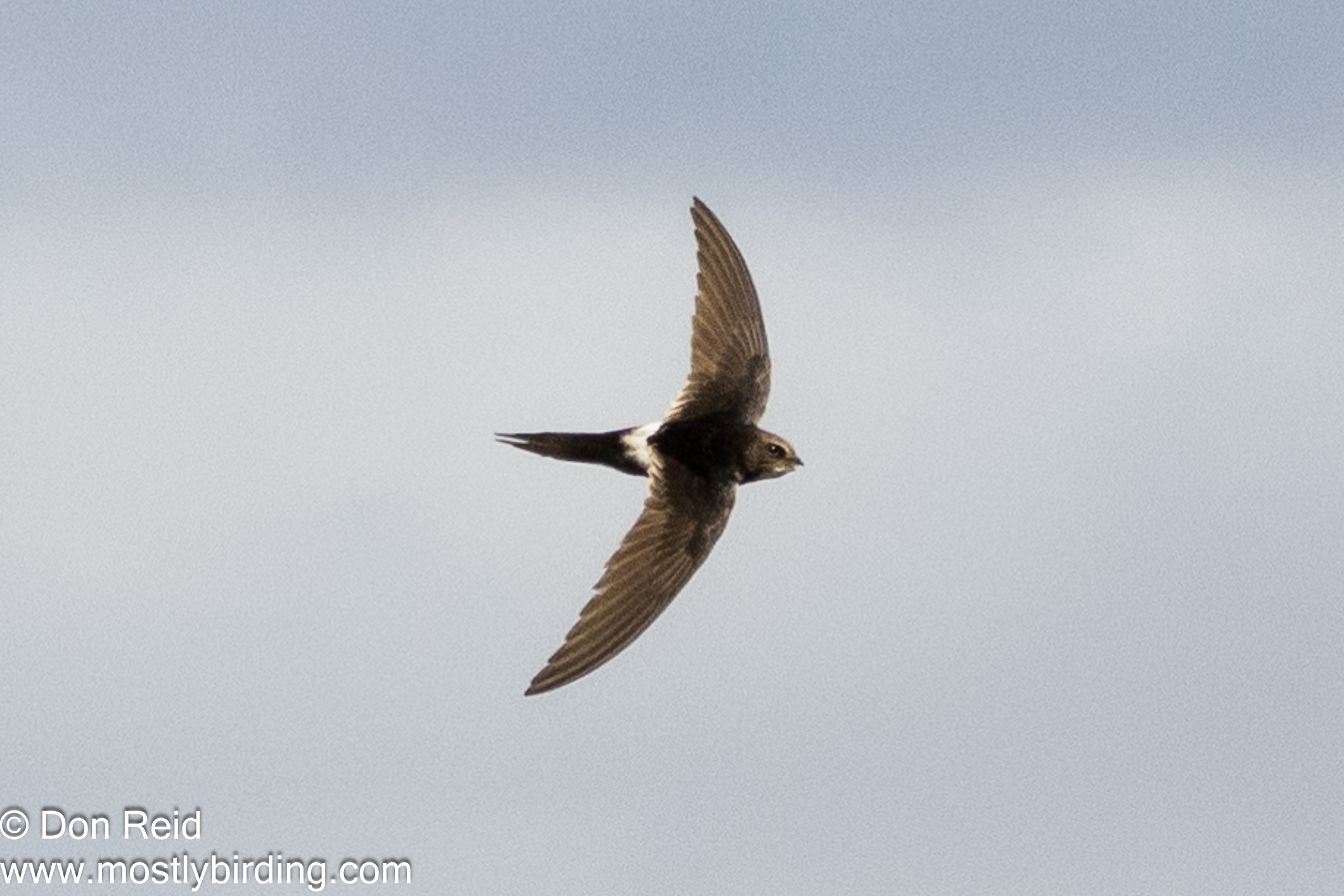
Greater Striped Swallow Cecropis cucullata Grootstreepswael, Kleinberg areaBarn Swallow Hirundo rustica Europese swael, Kleinberg areaCommon Swift Apus apus Europese windswael (race pekinensis), Kleinberg areaWhite-rumped Swift Apus caffer Witkruiswindswael, Kleinberg areaBrown-throated Martin Riparia paludicola Afrikaanse oewerswael, at nest burrow, Maalgate area
Plungers
Mainly seabirds that forage over water – and under water
At irregular times during the year terns roost in numbers at The Point in Mossel Bay, providing good photo opportunities as the rocks are relatively close to the viewing area
Sandwich Tern Thalasseus sandvicensis Grootsterretjie, Mossel Bay Point
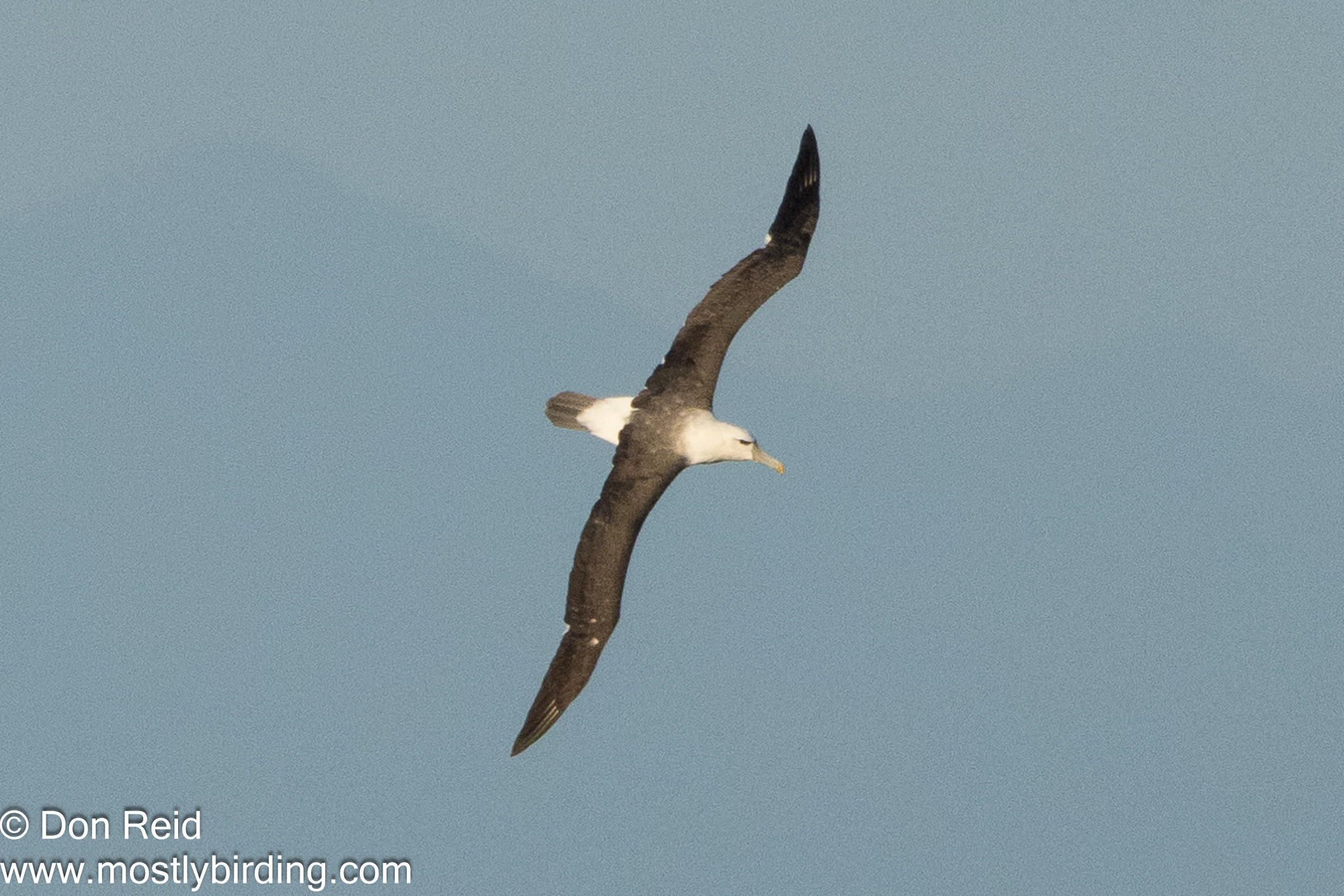
The Point is also a great spot for seabird watching when the winds are strong and in the right direction. One such day I was fortunate to be there when the seabirds were closer than usual and I was able to capture this image of a magnificent Shy Albatross – one of more than a dozen that passed by while we were there.
Shy Albatross Thalassarche cauta Bloubekalbatros, Mossel Bay Point
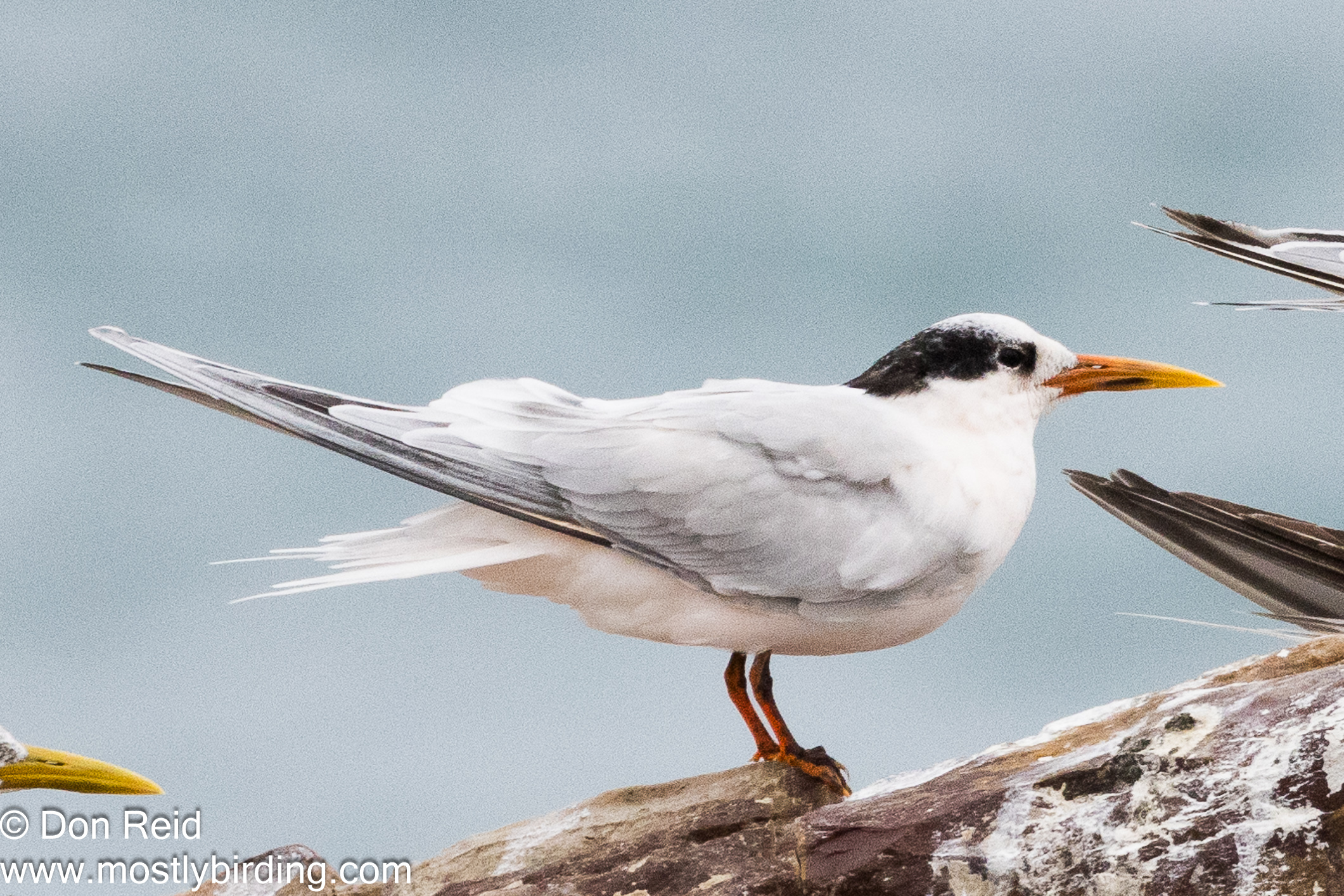
Another Tern that visited The Point was this rare hybrid – not a separately countable species but interesting nevertheless
Hybrid Elegant / Sandwich Tern, Mossel Bay Point
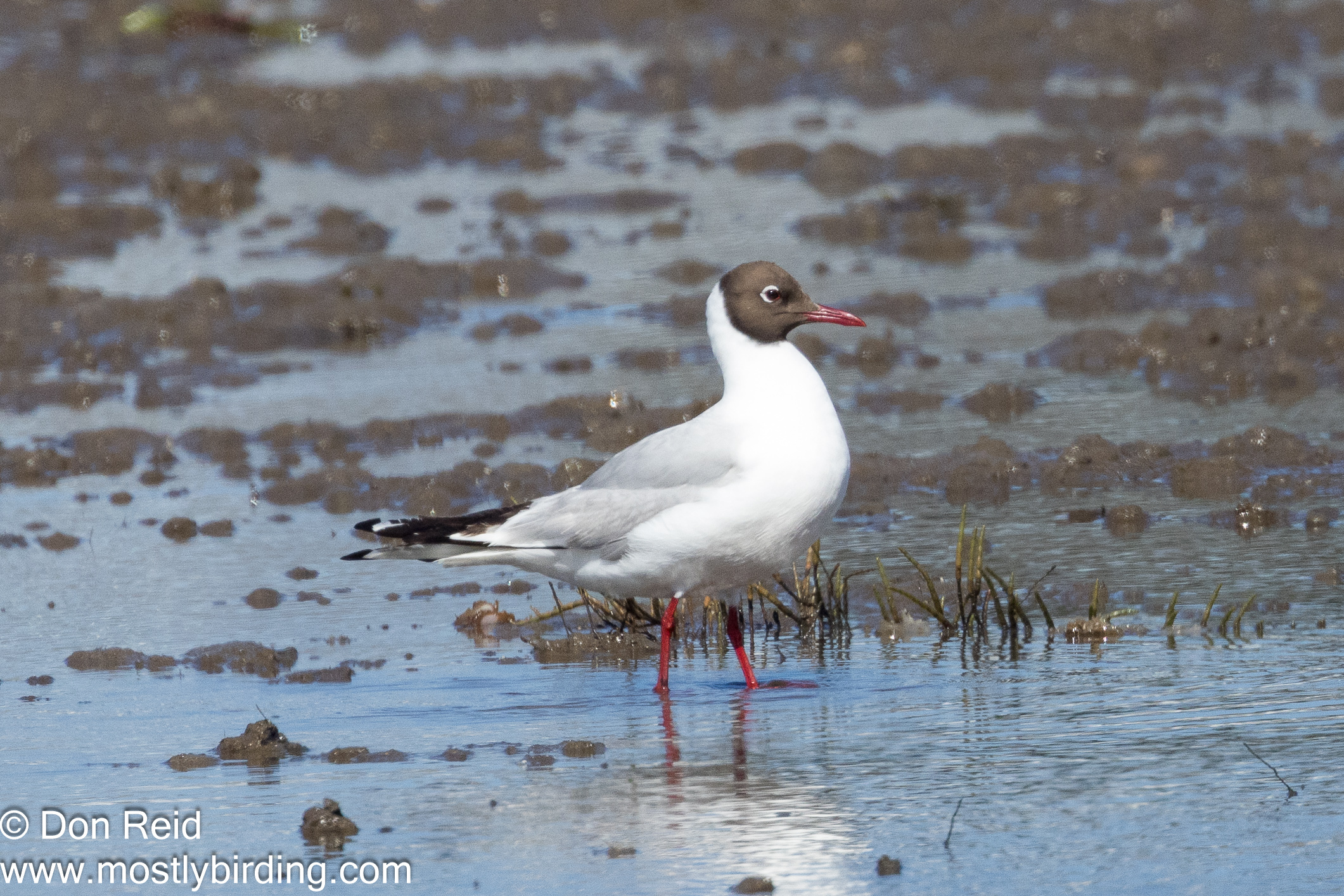
I was pleased when keen birder Estelle called me from Klein Brak to inform me about a Black-headed Gull that was present. I couldn’t resist heading out and was lucky enough to capture some images of this rarity, which I have seen in Europe and elsewhere but never in Southern Africa
Black-headed Gull Chroicocephalus ridibundus Swartkopmeeu (Breeding plumage), Klein Brak estuary
Runners
Small to medium-sized birds that forage on the ground
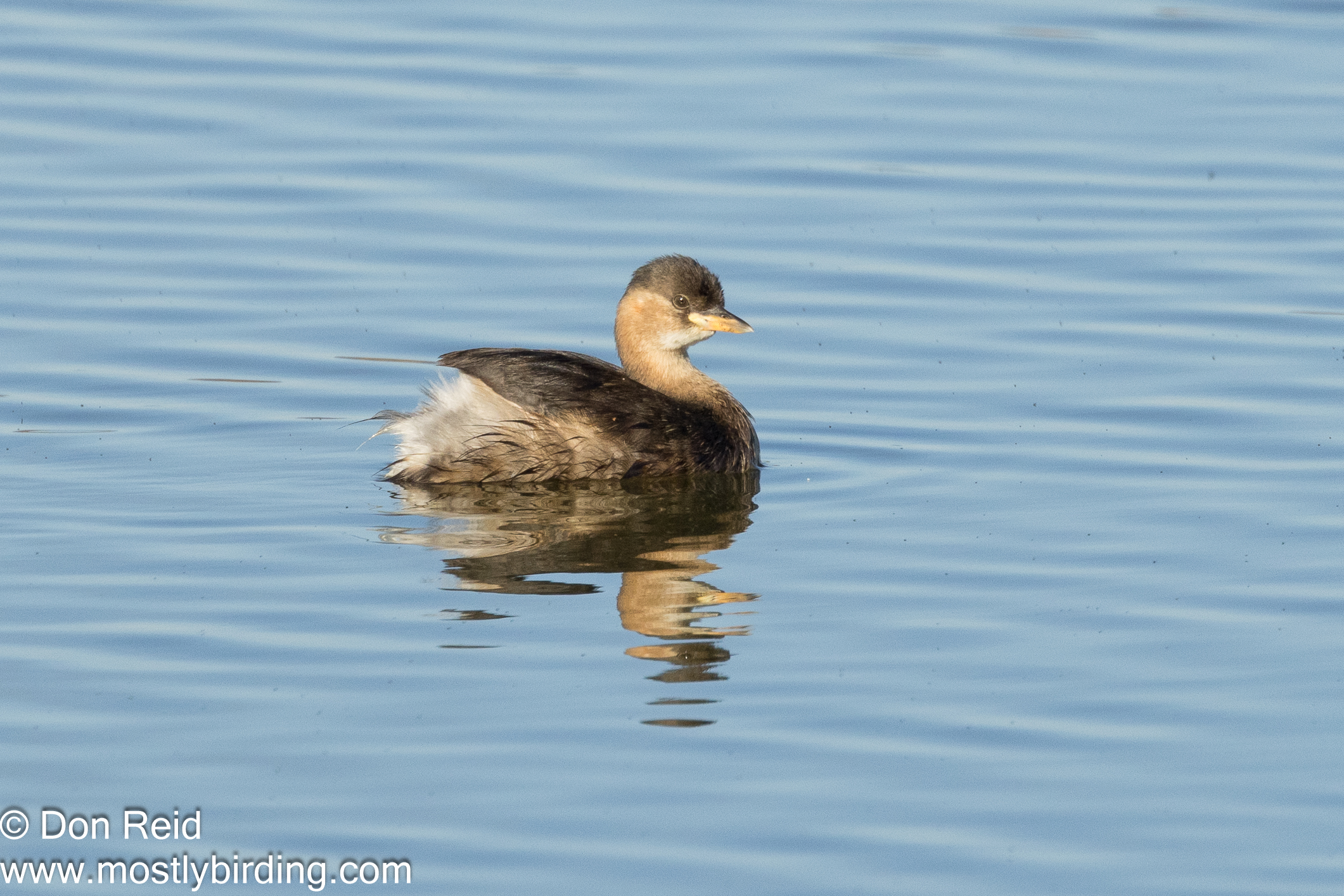
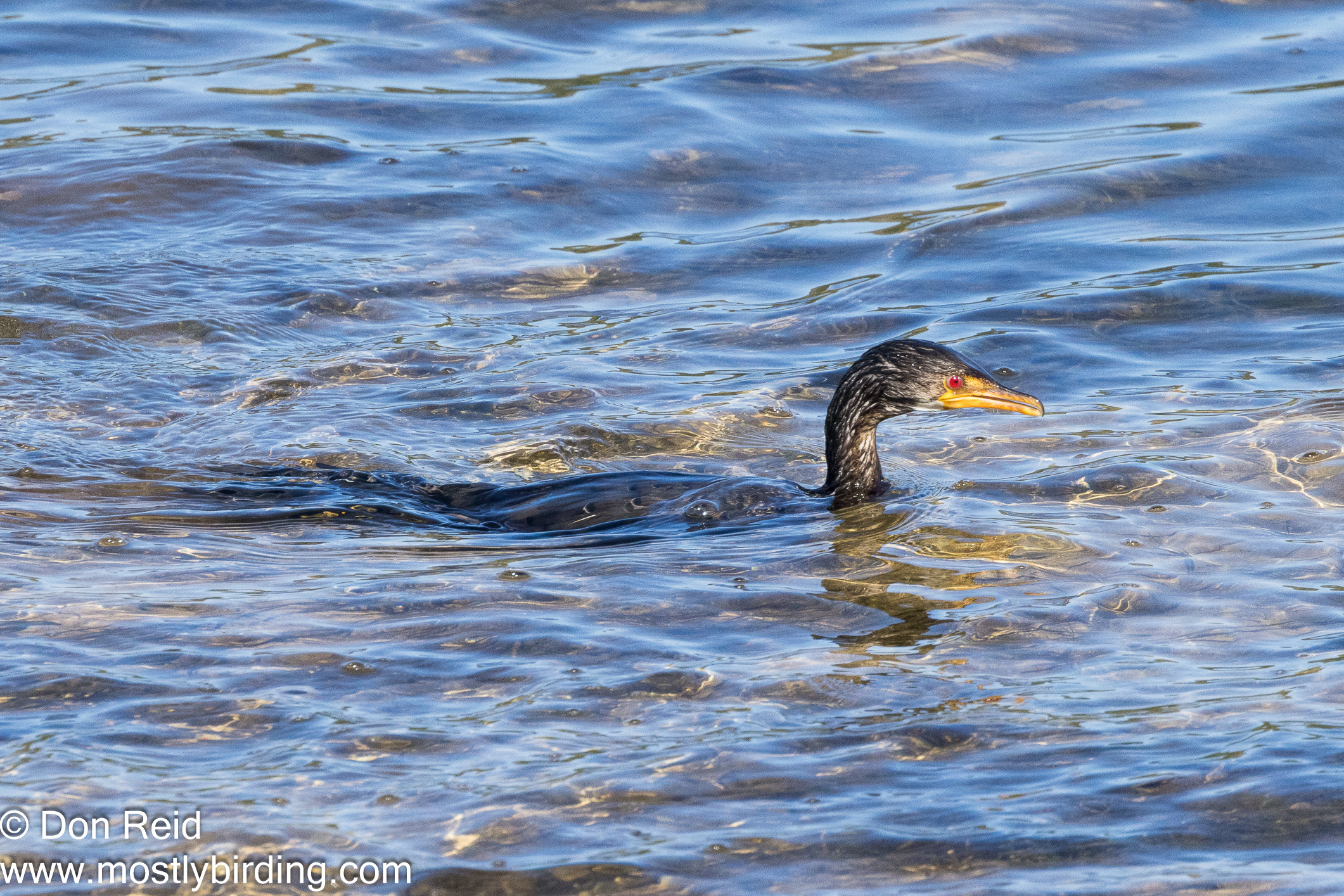
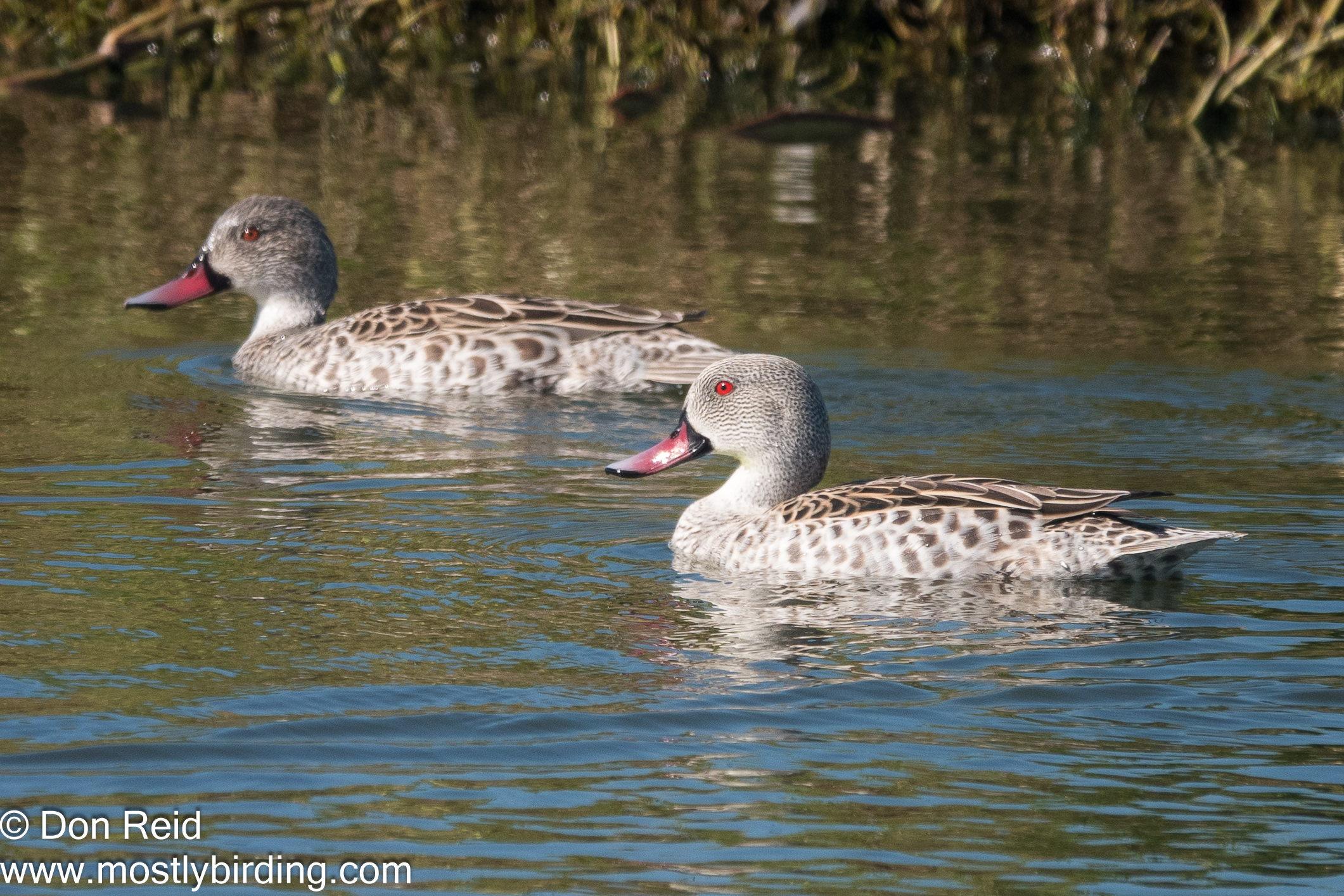
Little Grebe Tachybaptus ruficollis Kleindobbertjie, VoelvleiReed Cormorant Microcarbo africanus Rietkormorant, SedgefieldCape Teal Anas capensis Teeleend, Strandfontein sewage works
I was particularly pleased to photograph this Black-necked Grebe at reasonably close quarters during a visit to Strandfontein sewage works as my previous photos were all too far off to achieve any sort of detail of this striking swimmer
Black-necked Grebe Podiceps nigricollis Swartnekdobbertjie, Strandfontein sewage works
Waders
Those attractive waterbirds that don’t dive or swim but forage by wading in suitable shallow water
Also challenging to photograph at the best of times – often moving constantly, hiding behind vegetation, dipping into the mud and generally frustrating attempts to get a clear shot
Always on the lookout for a chance to get away for a few days, Gerda’s birthday seemed like a good excuse and Prince Albert a good option being just a couple of hours away yet much more in terms of “a change being as good as a holiday”
Wednesday 11th September 2024
Packing was left to the morning of our departure and went smoothly albeit slowly and by midday we were heading to our first stop – no prizes for guessing – our favourite Eight Bells Inn for a light lunch in the enclosed patio (bit too windy and cool for outside) with the familiar views and friendly staff.
On the way to the R328 we stopped at the Hartenbos Vleis for a quick scan of the birdlife and came up with an African Jacana – still a Western Cape Rarity – and African Swamphen among the usual Teals and Ducks. A Ruff was an interesting sight being one of the early palearctic migrant arrivals.
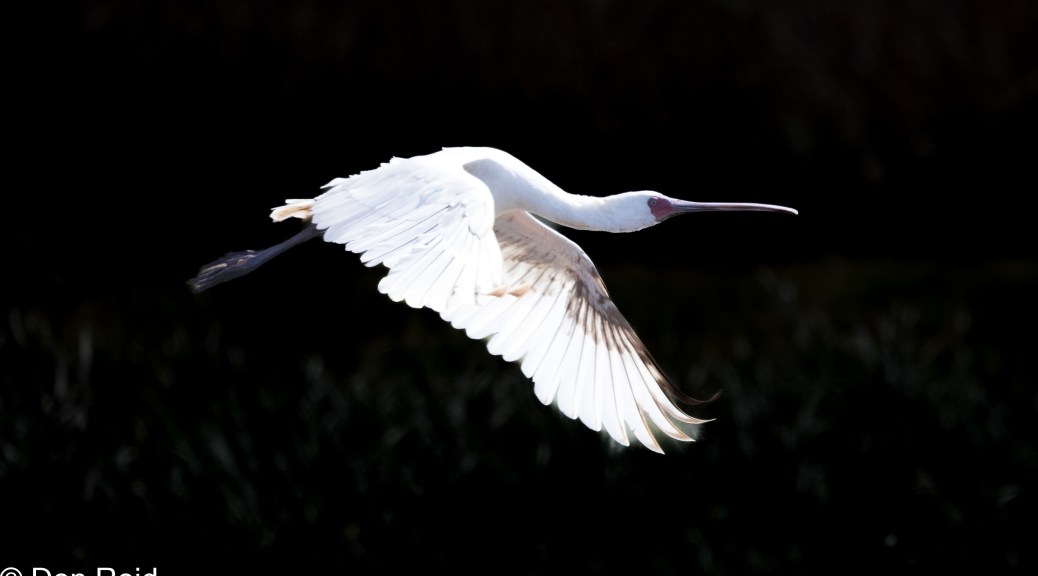
A number of Spoonbills on the far side of the vlei took to the air, providing an opportunity for some in flight photos, one of which I used for the heading image above after tweaking it to darken the background.
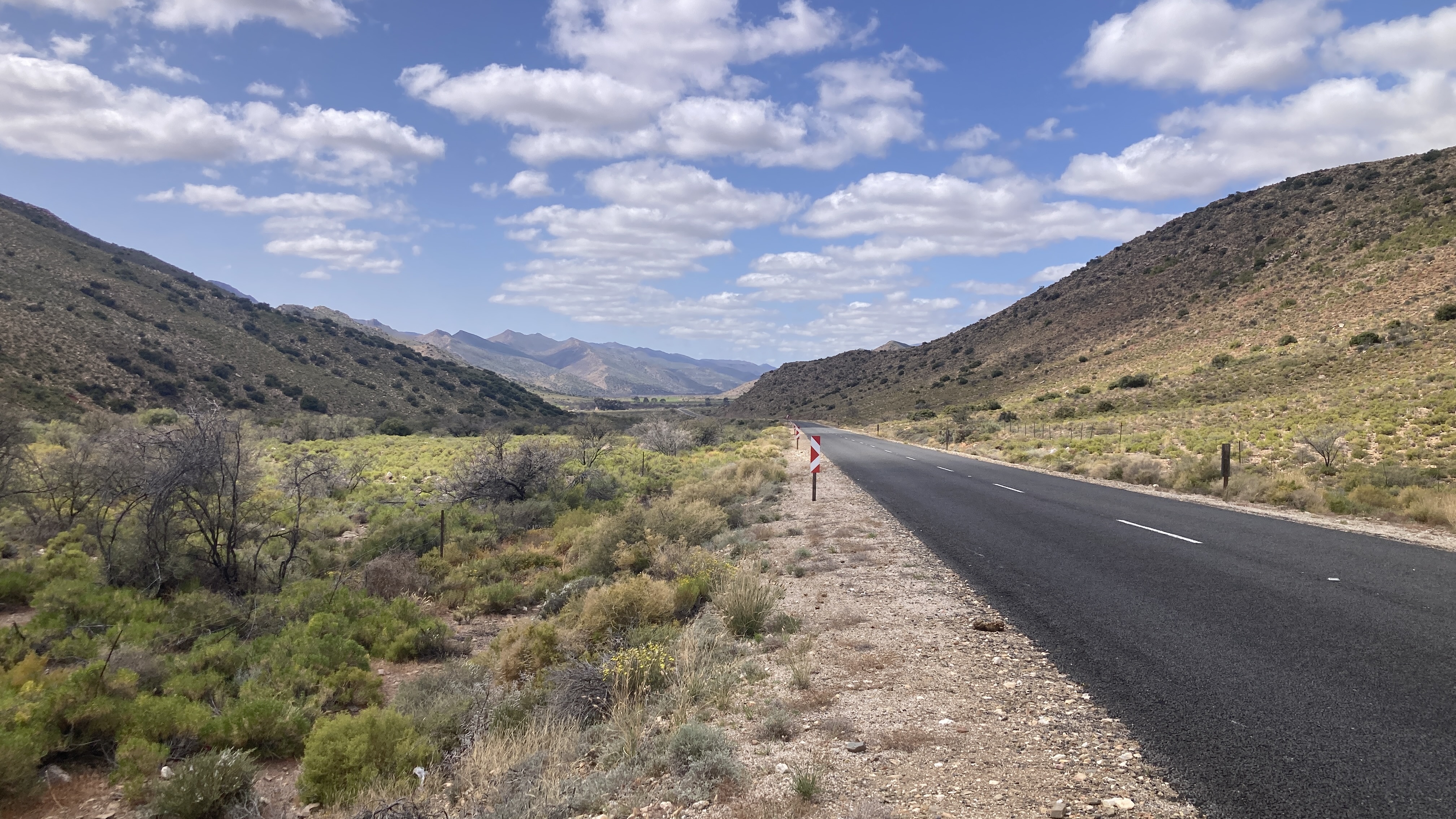
Back on the road after Eight Bells, we enjoyed the rest of the classic road trip through the Robinson Pass and Meiringspoort then along the hills and dales of the beautiful stretch of road heading to Prince Albert through the Kredouw Pass and the Prince Albert Valley
Prince Albert Valley
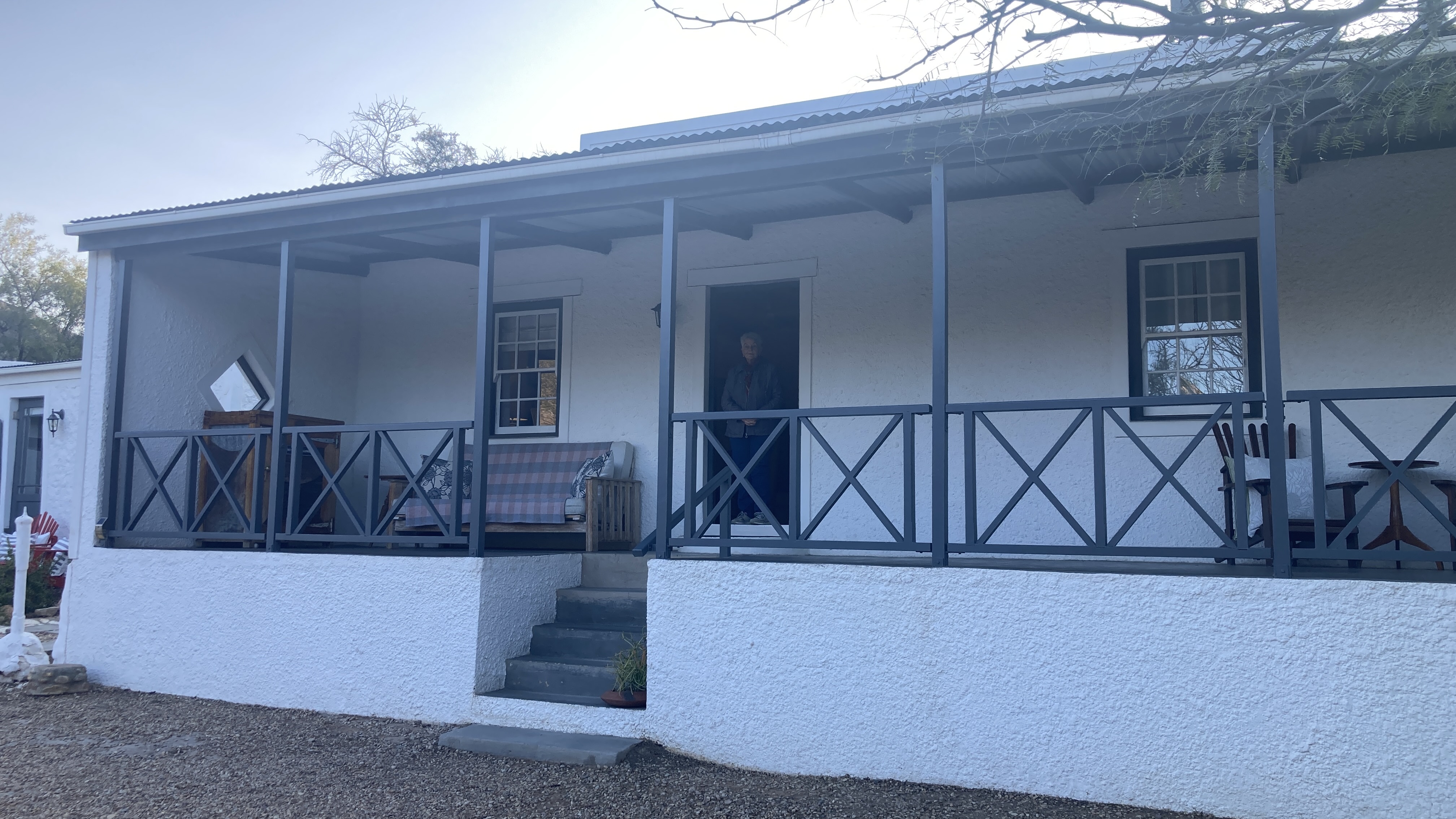
We hadn’t been to Dennehof Guesthouse before, but it was easy to find on the main road just before reaching the town proper and we were met by Albert (not the Prince) who showed us the room and provided info on dining options and things to do.
Dennehof – our room
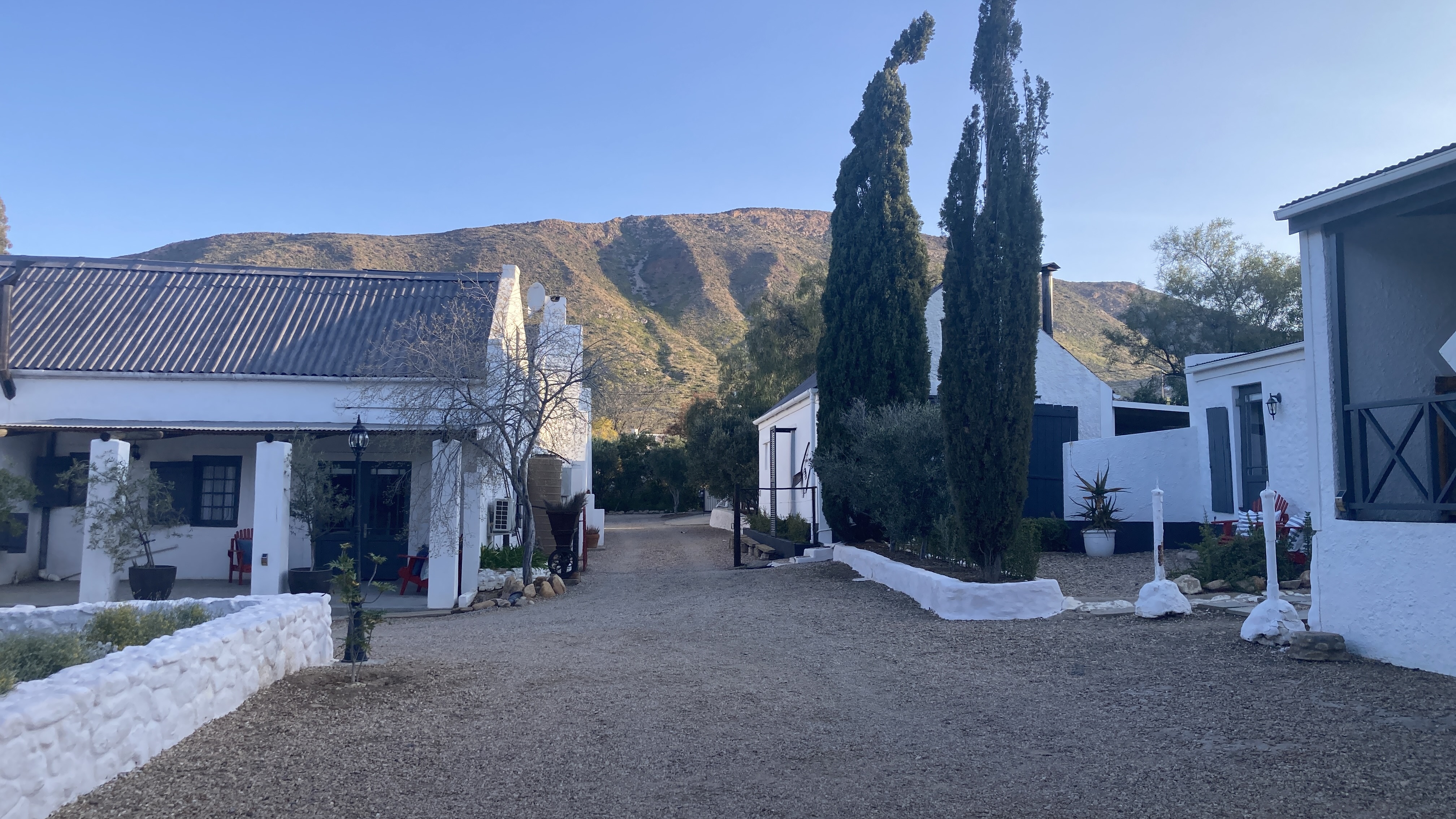
We have been to Prince Albert many times but there are always new places and eateries to hear about in this quiet yet dynamic Karoo dorp. Dennehof has a nice feel to it – not too pretentious with a mix of simple whitewashed buildings in the Karoo style making up a pleasant complex.
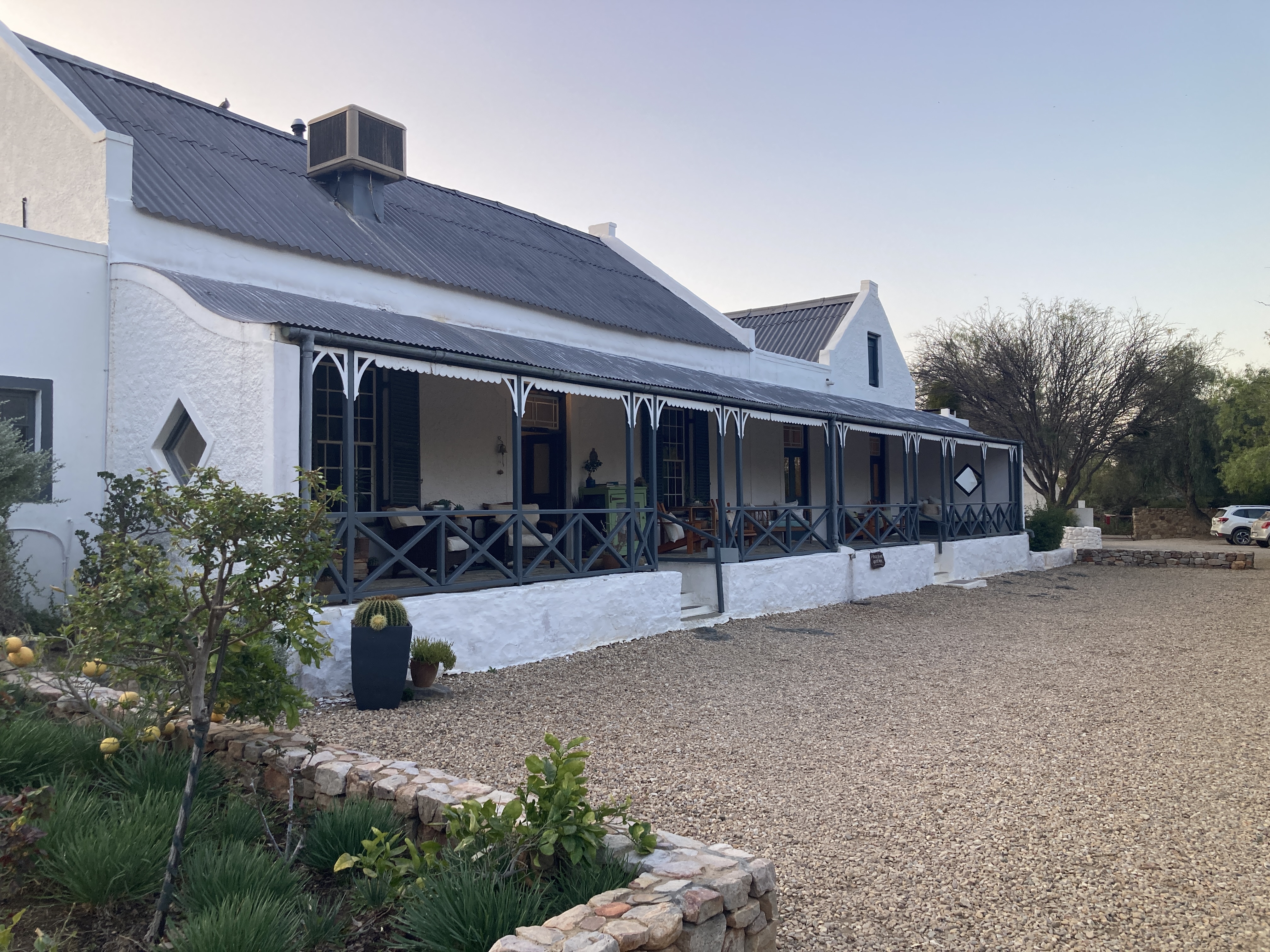
Dennehof
There was time before dusk to sit on the stoep and soak up the atmosphere, watched by the resident Spotted Eagle-Owl
Spotted Eagle-Owl, Prince Albert
The passing bird life included –
White-backed Mousebird
Purple Heron flying overhead probably to its roost
Sparrows, Cape and House, flitting about energetically
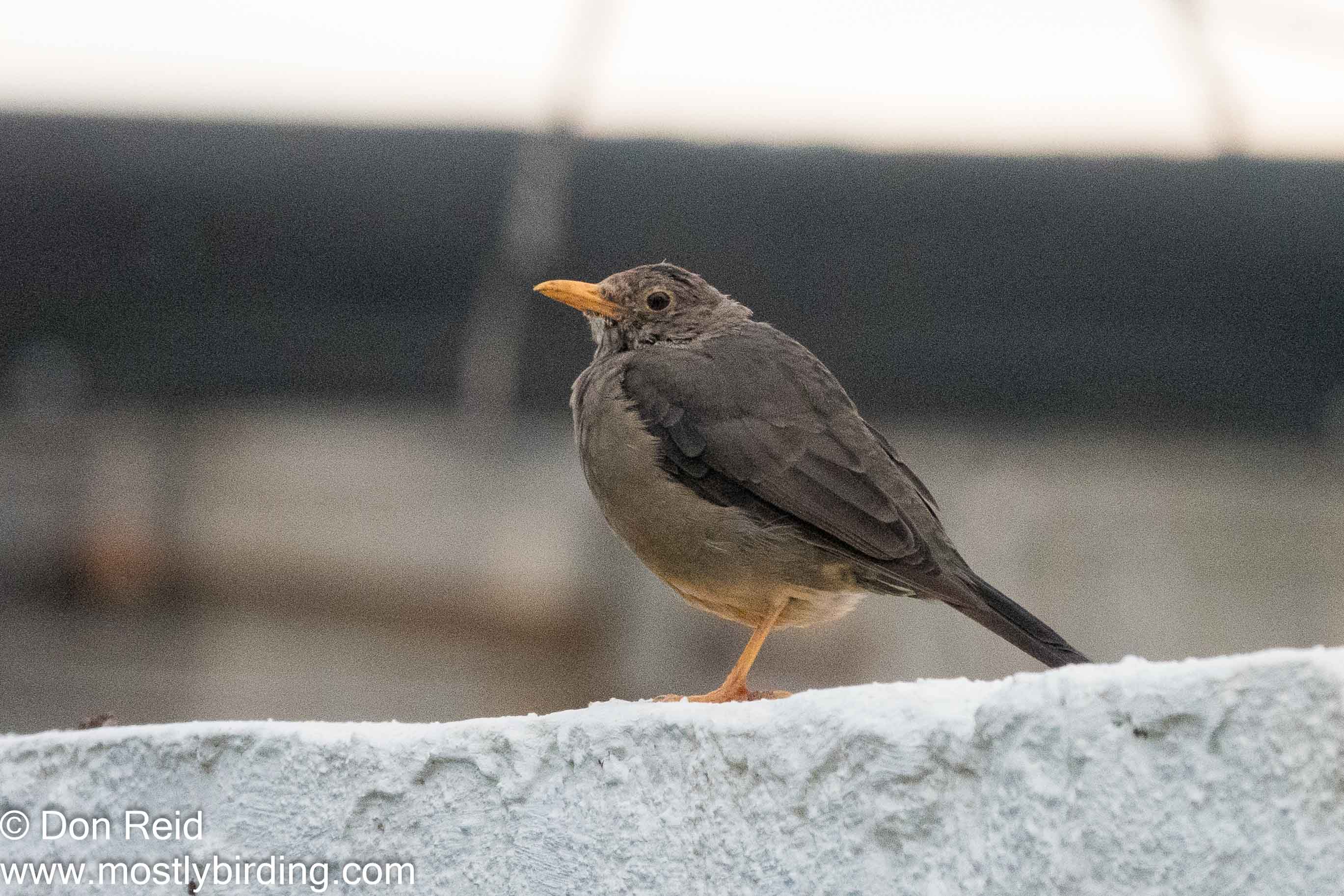
Karoo Thrush singing its cheerful song at close of day
Karoo Thrush
Pied Barbet calling plaintively
Dinner was chicken and salads that we brought with us.
Thursday 12th September 2024
Albert had said we could arrive for breakfast up to 9.30 am so being Gerda’s birthday we did exactly that. The setting is a delight – out in the garden in a glazed conservatory (where so many murders happen apparently) with a view of the adjoining wetland busy with Red Bishops and Masked Weavers doing their thing.
Dennehof Main houseDennehof – the breakfast Conservatory
The breakfast was above average and imaginative with a fruit and muesli mix that had us licking the bowl, followed by a herby omelette as good as they get – if for nothing else, I will return for that omelette. The coffee wasn’t half bad either.
That set us up nicely for the day which we planned as we went, starting with a slow drive down the main street of Prince Albert, followed by a short trip to the Olive farm north of the town which took us through some of the greenest Karoo countryside we have ever seen.
Along the way we stopped at the sewage works (as birders are wont to do) and at the low water bridges which, for the first time in our experience, had water flowing over them. The first of the two was productive for my atlasing list, adding half a dozen species in quick time –
Chestnut-vented Titbabbler
Karoo Scrub-Robin
Pririt Batis
Pririt Batis
Fiscal Flycatcher
White-throated Canary that came to drink from the shallow stream
White-throated Canary
Even a Three-banded Plover unexpectedly dropping in for a wade
We were treated to the unusual sight (for this arid part of SA) of water flowing over the low water bridges on the outskirts of the town
Just after the second bridge we turned into the Olive farm and, as it was lunchtime, we ordered tea and a waffle which we enjoyed outside under the trees (all part of the birthday celebration of course).
View from the Olive Farm
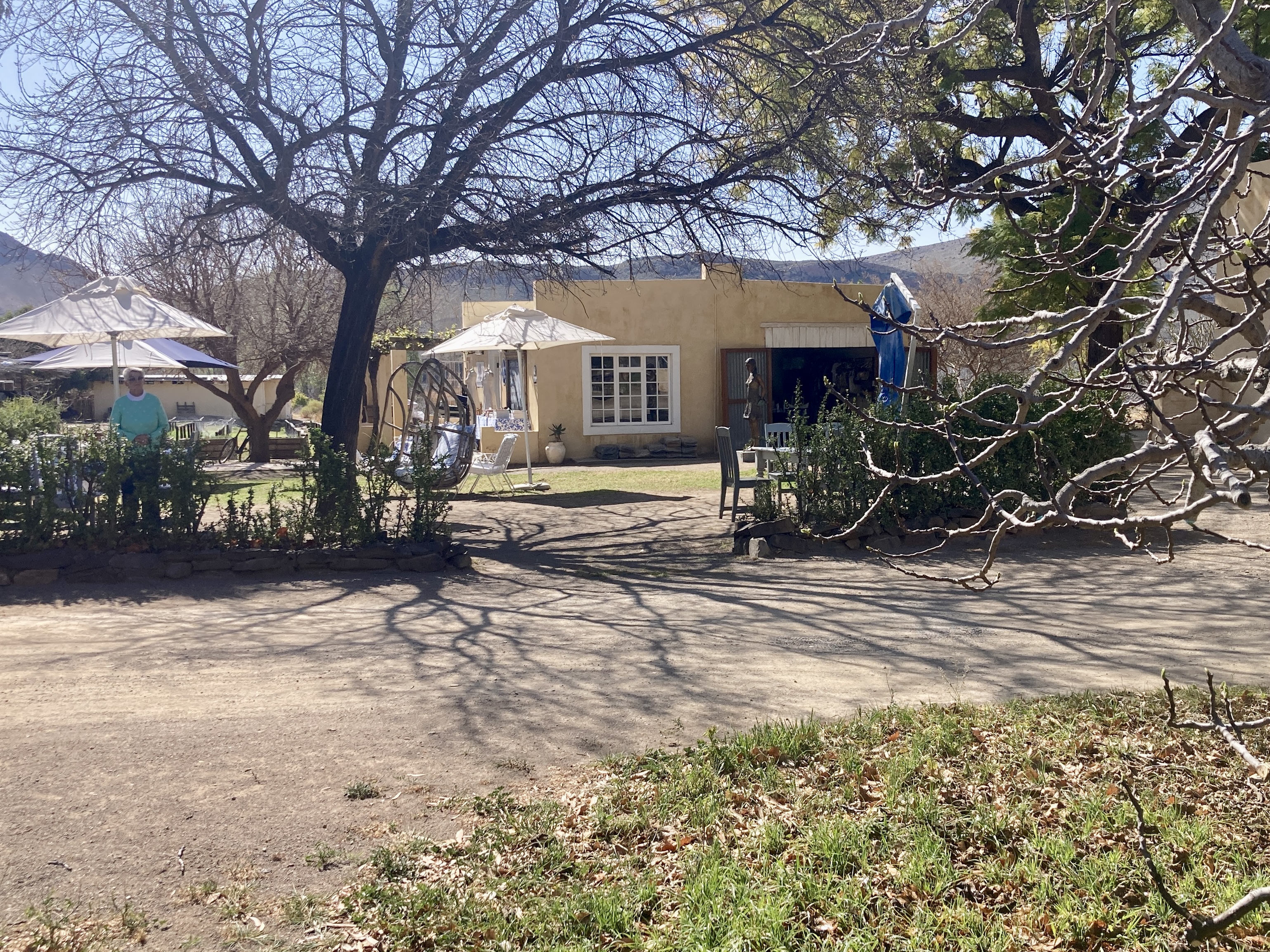
On the way back we turned off at the Karoo View signpost and drove a few kms to see the remnants of the flowers still in the open veld, then made a short stop at Karoo Souk which is a small group of craft shops, before heading back to Dennehof for a welcome rest.
Later, still in celebratory mode, we ventured out for a meal at the Yellow House restaurant which was up to the occasion and provided a nice ending to a very pleasant day.
Friday 13th September 2024
Another nice breakfast although we didn’t go for the full monty after last night’s big meal. After breakfast I added a few species to the atlas card including Alpine Swifts and Palm Swifts flying by and a Long-billed Crombec moving through the garden. That made four Swifts in all after seeing Little and White-rumped Swifts on the first day.
We had decided to drive to the fig farm at Weltevrede but first followed Albert’s suggestion of a drive along the ‘Bush pub’ road in search of a Karoo Eremomela. The bird eluded us but we did see a few other area specials such as –
Mountain Wheatear
Mountain Wheatear, Prince Albert
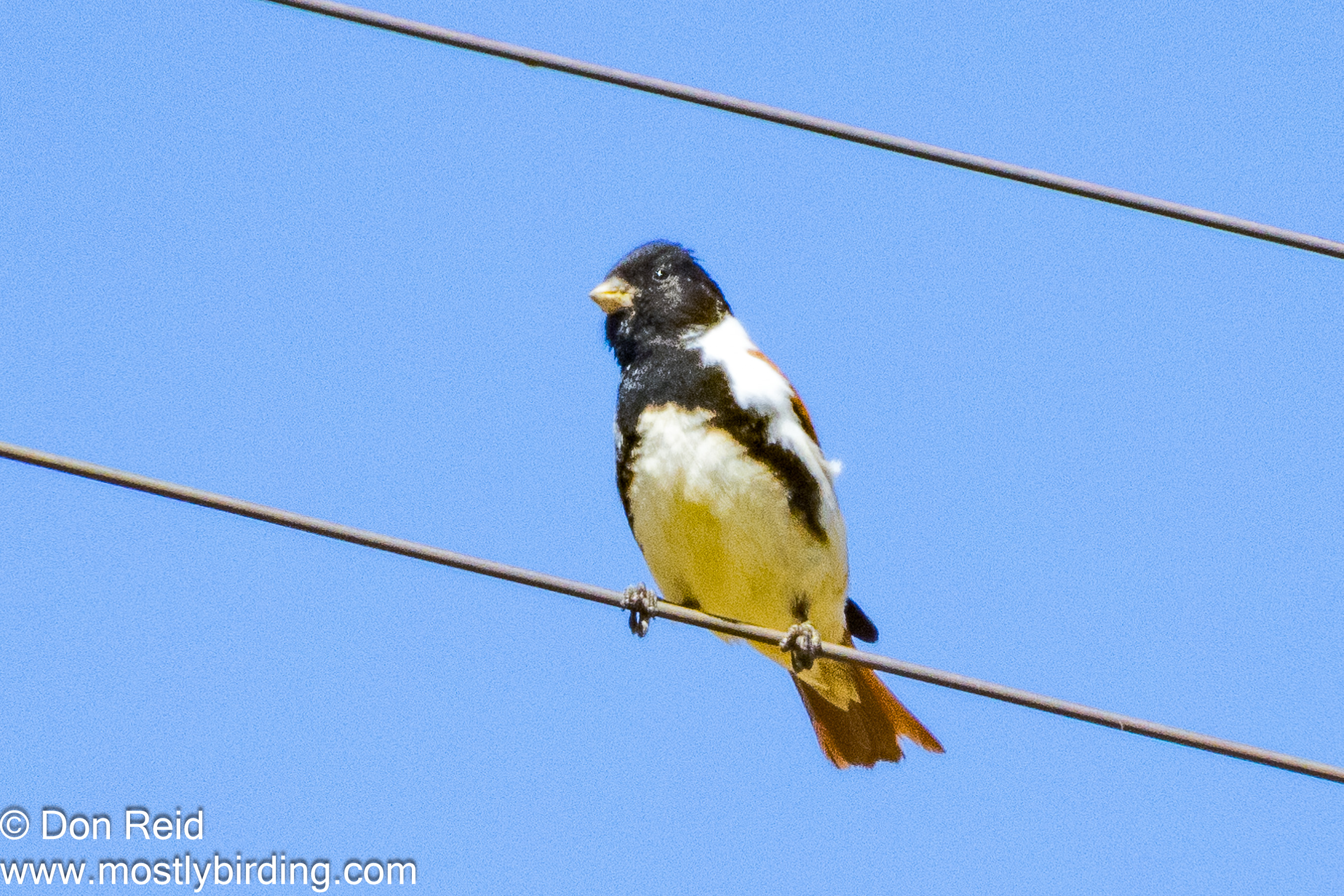
Lark-like Bunting
Dusky Sunbird
Rufous-eared Warbler
Rufous-eared Warbler
And no less than three species of Canary –
White-throated Canary
Black-throated Canary
Black-headed Canary
It was time to head to the fig farm, so we turned back to town and took the road past the cemetery signposted ‘Weltevrede 25 km’.
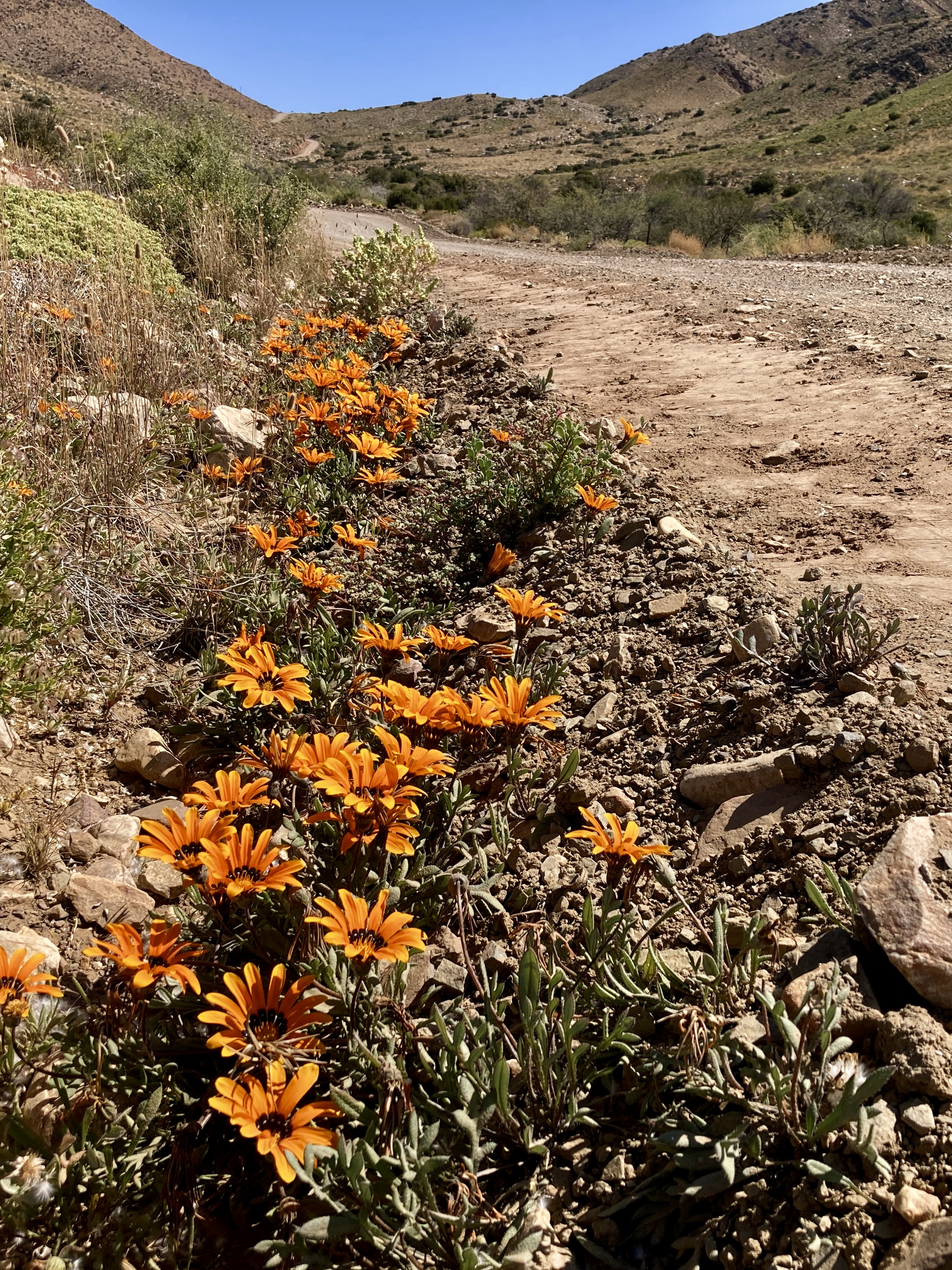
We took it slow, stopping for birds – and flowers – and there were plenty of both to attract our attention.
At around 6 kms the road passes between tall rocky cliff faces which, according to Albert and Inge, is a site where Ground Woodpecker has been seen.
We spent some time stopping to scan the rocks carefully for any sign of the Woodpecker and even more so on the way back, to no avail. The spectacular drive made up for that mild disappointment and we arrived at the farm where we found we were the only visitors – very different from our previous visit which was during the peak of fig picking and drying.
Weltevrede Fig Farm
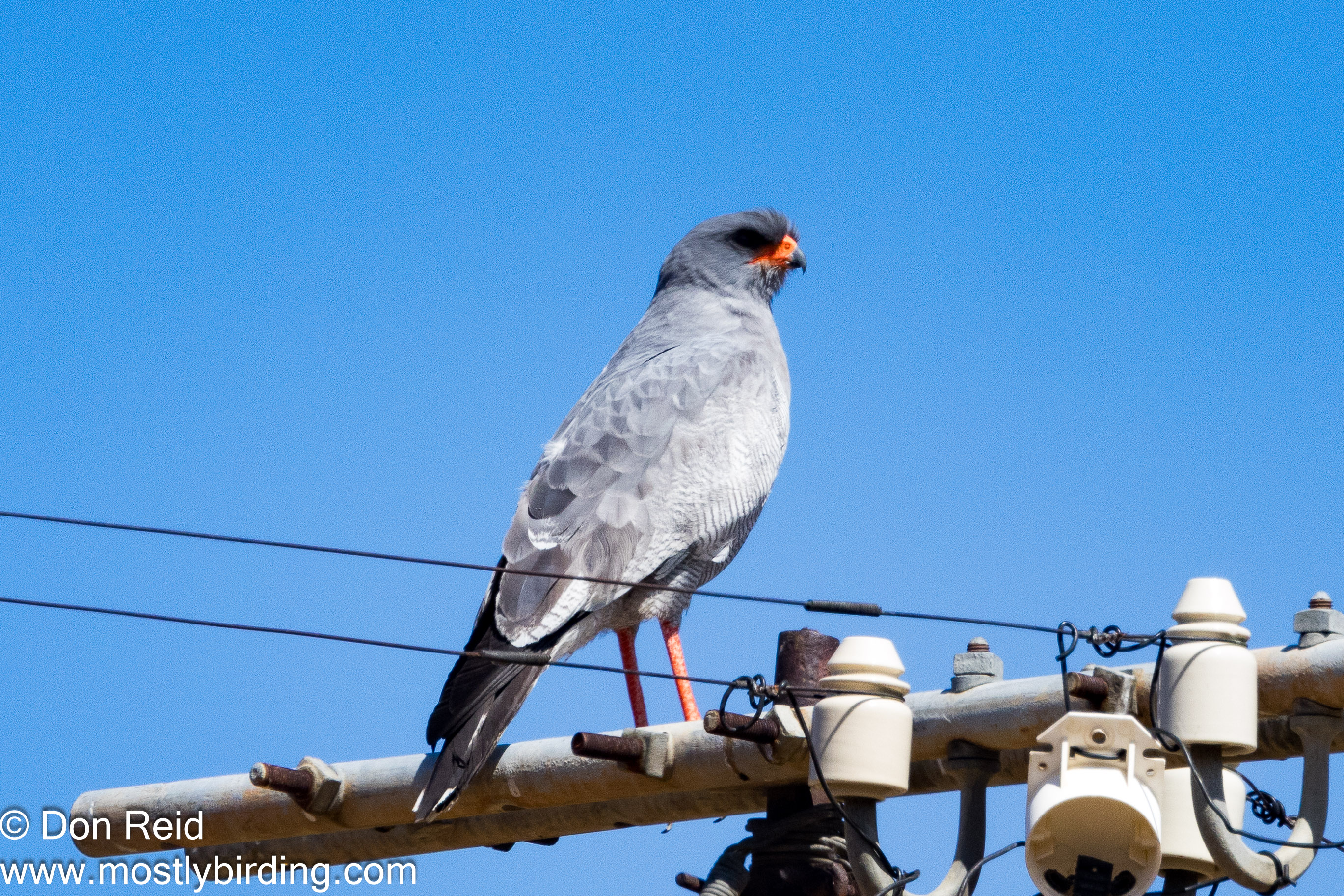
After treating ourselves to fig tart we headed slowly back – Black-headed Canaries were the most frequent sightings along with Pale Chanting Goshawk and Karoo Chat.
Black-headed Canary, near Prince AlbertPale Chanting Goshawk, near Prince Albert
We weren’t particularly keen to go out that evening but after a relaxing time at the room we had a bit more energy and ‘lus’ for Jeremy’s Restaurant which was a great choice and suited to our reduced appetite. We both had Taglietelle puttanesca not having ever had it and it was wonderfully simple and delicious, cooked by Jeremy himself. We treated ourselves to Spekboom ice cream which was different but not overly so and we left in a good frame of mind.
Saturday 14th September 2024
Up a bit earlier to fit in packing and breakfast before checkout time, we enjoyed the fruit and omelette once again, then greeted Inge and Albert like family and set off through town to Gays dairy for some of their lovely cheeses before heading out on the road back. This time we had time to stop and savour the flowers and birds – often both at the same spot.
Lunch venues are limited on this route so we looked for a place in De Rust, ending up at Herries which is the local pub and turned out to be a good choice even though we just had tea and a sandwich in a venue that almost demands you have at least a beer or two if not a klippies and coke.
The rest of the trip was uneventful with stops in George at the nurseries and a ‘koffie vir oulaas’ at Elvis Brew, a favourite coffee spot near the George Airport, before heading homewards, well satisfied yet again with our choice of Prince Albert for a short breakaway.
To repeat the intro to my previous posts on this subject …. Many of the migrant waders – or shorebirds as they are also known – display the most Jeckyll and Hyde characteristics of all birds, living two dramatically different lives and spending time in habitats which are as far removed from each other as can be imagined.
Separating these two lives are amazing journeys that take these small yet hardy birds halfway across the world – and back again.
The majority of South African based birders get to know migrant species during their stay in the southern hemisphere, typically during the months from October to April, so let’s find out a bit more about their ‘other’ lives by delving (again) into the typical annual life cycle of these waders.
This time it’s the –
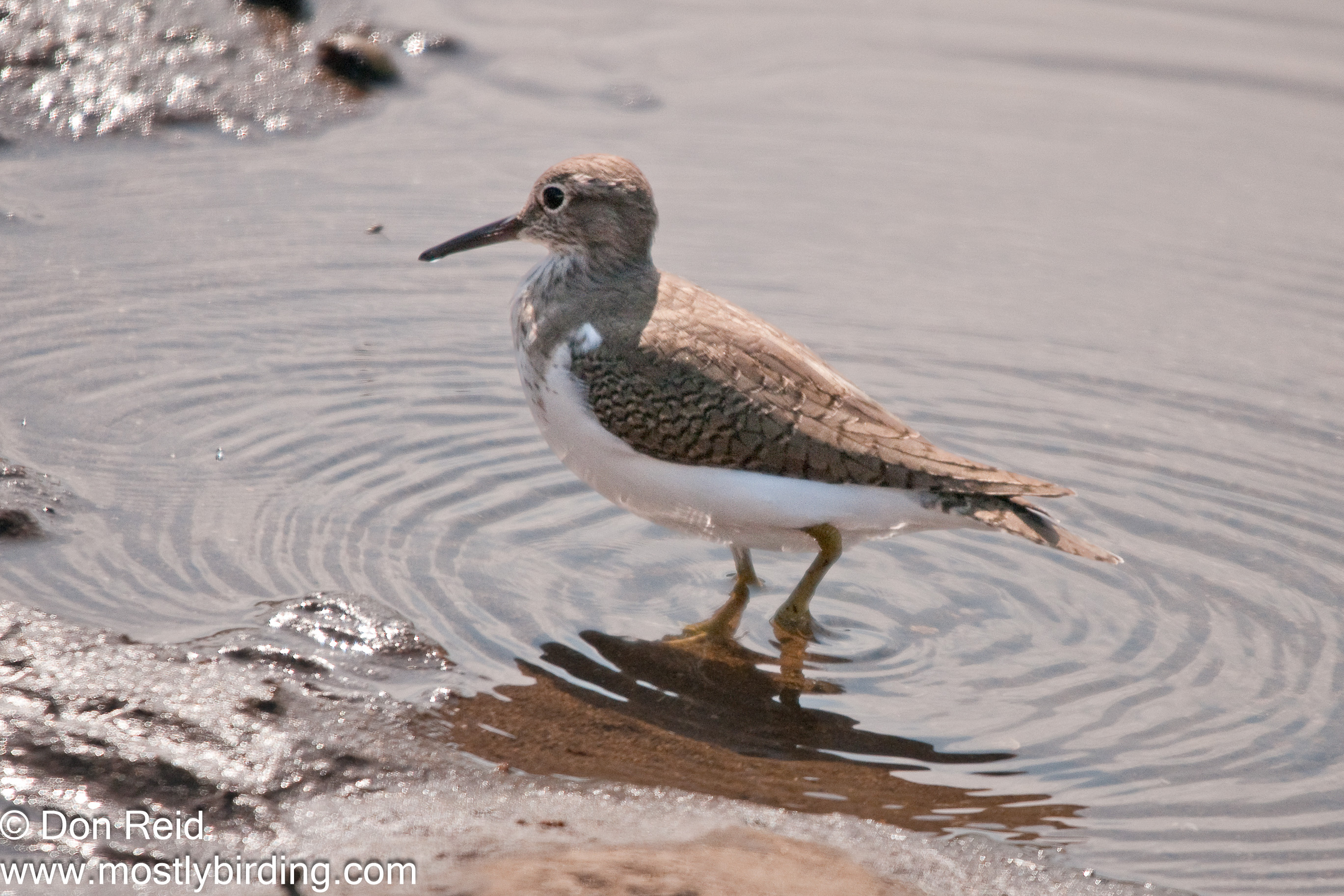
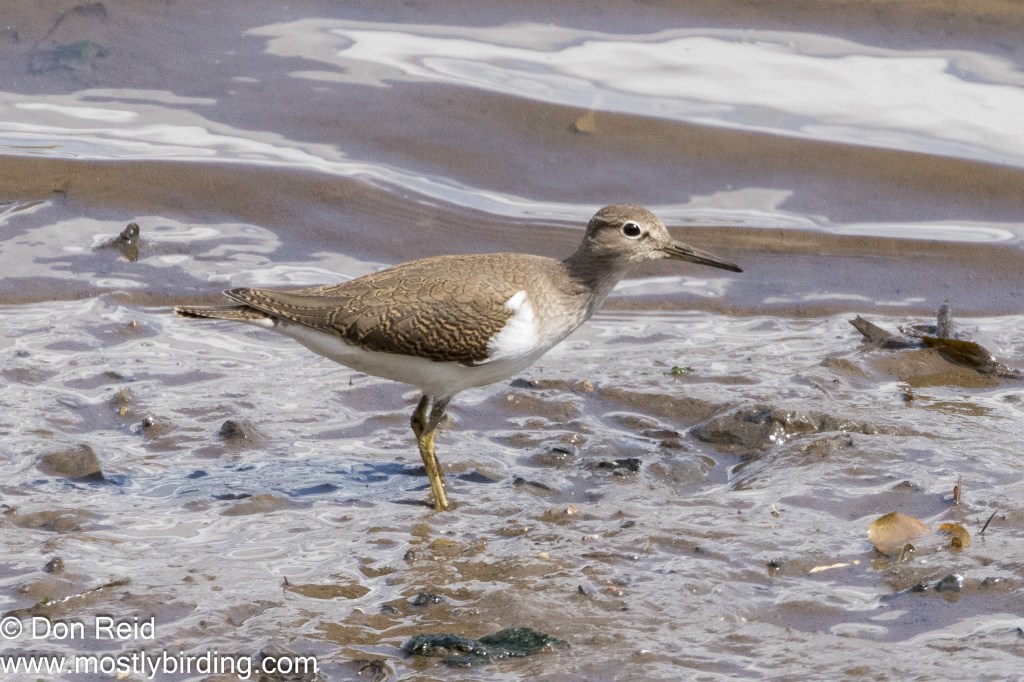
Common Sandpiper (Gewone Ruiter) Actitis hypoleucos
Hypoleucos is Greek for white below, in reference to the species white underparts, which the detergent adverts of old would no doubt have described as ‘whiter than white’. Which leaves you wondering how they maintain that whiteness, considering that they spend a lot of their time in muddy or near-muddy conditions.
Identification and Distribution
Identification of the Common Sandpiper is often possible while the bird is still distant, based on behaviour and giss, even before being able to see the specific plumage features which will confirm the identification.
What you may see at a distance is –
medium-small wader (19 – 21cm; 45 – 50g) with a semi-crouched appearance,
long-tailed, rather short-legged,
moves in short quick movements and habitually bobs its rear body.
Common Sandpiper, KNP Satara
In flight it is just as distinctive, flying low over water with quick bursts of shallow wingbeats interspersed with glides on bowed wings.
Once close enough, the standout feature of this wader is the white underparts extending up in front of the shoulder to form a distinct crescent.
Common Sandpiper Actitis hypoleucos River Eden Estuary
The differences between breeding and non-breeding birds are subtle – greenish-brown upper parts of breeding adults change to faintly barred olive-brown upper parts, with less streaking on the head.
Distribution –
The orange area on the global distribution map (from Cornell Birds of the World) shows where breeding occurs in the Northern Hemisphere while the blue area, mostly in the Southern Hemisphere, is where they go ‘on holiday’ to unwind and prepare themselves for the rigours of the next breeding season.
The southern African distribution map (from The Firefinch Birding app) shows the species presence across most of the region but absent from the Kalahari and arid west.
Screenshot
Life in the North
The preferred breeding habitat is stony or gravelly shores, most commonly at margins of waterbodies in forested areas.
But, the preferred habitat doesn’t have to be at low altitude – they have been recorded breeding up to 1700m in the Pyrenees, 2600m in Turkey and up to 4000m elsewhere.
Their diet includes all manner of delicious things (for them, anyway) including beetles, spiders, molluscs, crustaceans, sometimes frogs, tadpoles or small fish. During breeding, adults and young chicks frequently feed on grassland.
Common Sandpiper Actitis hypoleucos River Eden Estuary
Prey is located visually, feeding is mainly by pecking and stabbing rather than probing, with insects often caught from surface, or pulled out from rocks or mud.
Breeding
The nest is simple – set in a sheltered depression, sometimes among shrubs and trees, usually close to water.
Eggs (usually 4) are laid from April and are incubated for 20 to 23 days by both parents, but one parent, often the female, leaves before the young fledge (imagine the consternation if humans did that!)
Fledging some 3 to 4 weeks later, the fledglings are independent soon thereafter, facing the many dangers that young birds are subject to.
Once the young have fledged and can look after themselves, they start migrating south, often after the adults have already departed – now that is brave!
Migration
The birds we see in Southern Africa are thought to originate from Russia, first adults leave early July, arriving in the south from late July / August with juveniles following mainly in September and October.
Migration is undertaken at night with birds capable of single flights of up to 4000km. Overland routes are followed by small flocks or singly, mainly via the Rift Valley
Life in the South
In southern Africa they seek out suitable aquatic habitat, favouring streams, rivers and dam shores with sandy, gravelly, stony or rocky substrate, estuaries and, especially, filtration ponds of sewage works (a favourite spot for keen birders as well, as it turns out)
Prefers wet conditions adjacent to water rather than wading in the water and is known to venture into woodland and even gardens.
Common Sandpiper Actitis hypoleucos Gewone ruiter, Bronkhorstspruit Nature Reserve
Some time after arrival, around October, adults start a post-breeding moult which continues for up to 4 months.
Common Sandpiper ( Actitis hypoleucos / Gewone ruiter), Great Brak River
Foraging is done in similar fashion as ‘back home’ but they are also known to perch and wait for waterborne insects at a concrete weir or other convenient spot next to running water – something I have witnessed myself during atlasing trips near Pretoria.
Common Sandpiper, Delmas area
The plovers start departing from late February with the majority having left by end April, heading north to their breeding grounds where the cycle will start all over again…
References : Cornell Lab of Ornithology Birds of the World; Roberts VII Birds of Southern Africa; Firefinch app, Collins Bird Guide





























































 Mostly Birding