
To repeat the intro to my previous posts on this subject …. Many of the migrant waders – or shorebirds as they are also known – display the most Jeckyll and Hyde characteristics of all birds, living two dramatically different lives and spending time in habitats which are as far removed from each other as can be imagined.
Separating these two lives are amazing journeys that take these small yet hardy birds halfway across the world – and back again.
The majority of South African based birders get to know migrant species during their stay in the southern hemisphere, typically during the months from October to April, so let’s find out a bit more about their ‘other’ lives by delving (again) into the typical annual life cycle of these waders.
This time it’s the –
Common Sandpiper (Gewone Ruiter) Actitis hypoleucos
Hypoleucos is Greek for white below, in reference to the species white underparts, which the detergent adverts of old would no doubt have described as ‘whiter than white’. Which leaves you wondering how they maintain that whiteness, considering that they spend a lot of their time in muddy or near-muddy conditions.
Identification and Distribution
Identification of the Common Sandpiper is often possible while the bird is still distant, based on behaviour and giss, even before being able to see the specific plumage features which will confirm the identification.
What you may see at a distance is –
- medium-small wader (19 – 21cm; 45 – 50g) with a semi-crouched appearance,
- long-tailed, rather short-legged,
- moves in short quick movements and habitually bobs its rear body.
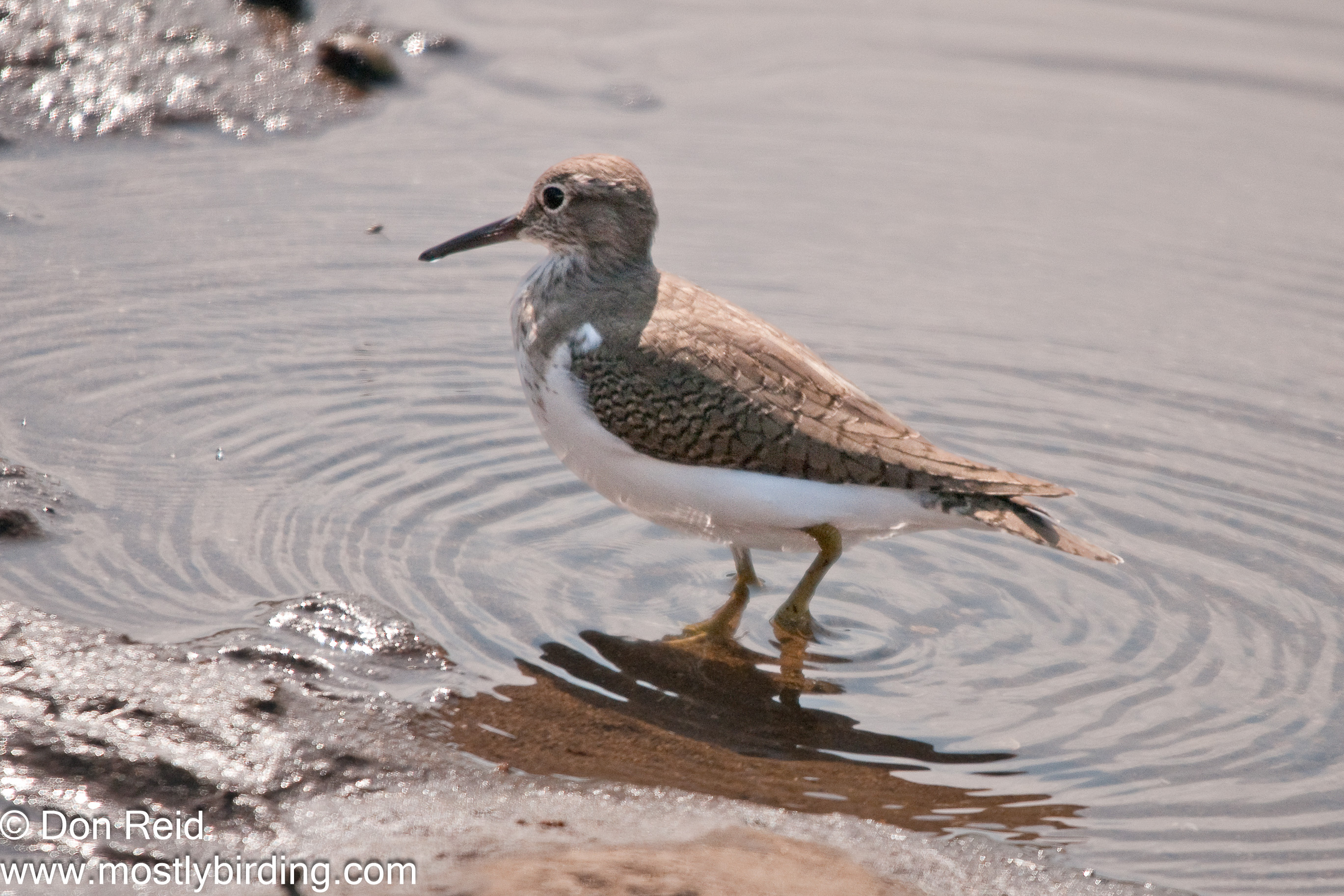
In flight it is just as distinctive, flying low over water with quick bursts of shallow wingbeats interspersed with glides on bowed wings.

Once close enough, the standout feature of this wader is the white underparts extending up in front of the shoulder to form a distinct crescent.
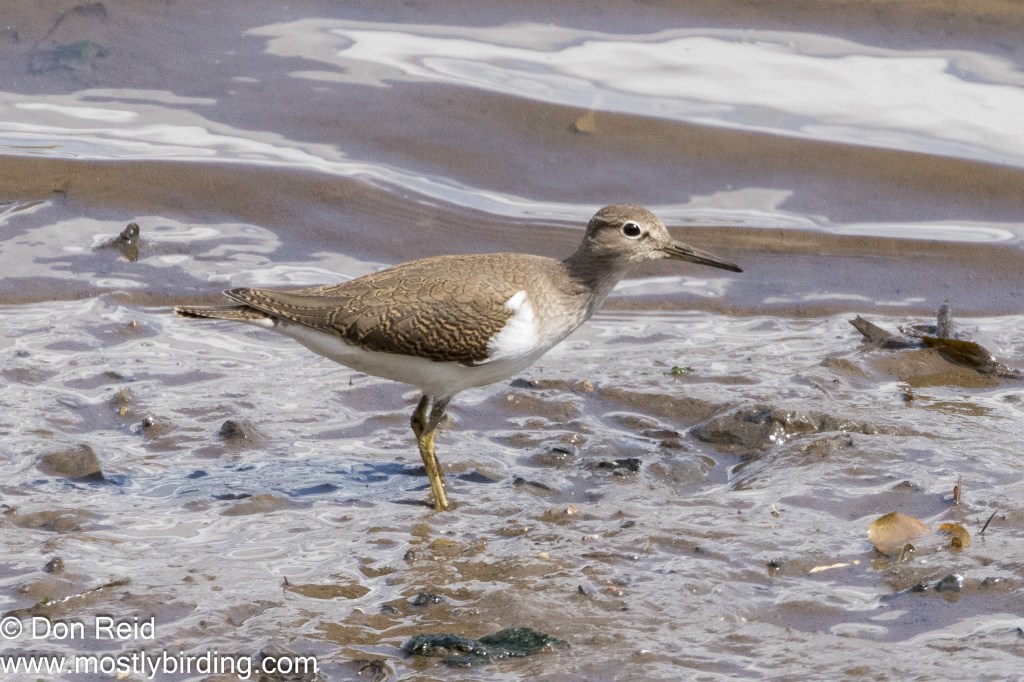
The differences between breeding and non-breeding birds are subtle – greenish-brown upper parts of breeding adults change to faintly barred olive-brown upper parts, with less streaking on the head.
Distribution –
The orange area on the global distribution map (from Cornell Birds of the World) shows where breeding occurs in the Northern Hemisphere while the blue area, mostly in the Southern Hemisphere, is where they go ‘on holiday’ to unwind and prepare themselves for the rigours of the next breeding season.

The southern African distribution map (from The Firefinch Birding app) shows the species presence across most of the region but absent from the Kalahari and arid west.

Life in the North
The preferred breeding habitat is stony or gravelly shores, most commonly at margins of waterbodies in forested areas.
But, the preferred habitat doesn’t have to be at low altitude – they have been recorded breeding up to 1700m in the Pyrenees, 2600m in Turkey and up to 4000m elsewhere.
Their diet includes all manner of delicious things (for them, anyway) including beetles, spiders, molluscs, crustaceans, sometimes frogs, tadpoles or small fish. During breeding, adults and young chicks frequently feed on grassland.

Prey is located visually, feeding is mainly by pecking and stabbing rather than probing, with insects often caught from surface, or pulled out from rocks or mud.
Breeding
The nest is simple – set in a sheltered depression, sometimes among shrubs and trees, usually close to water.
Eggs (usually 4) are laid from April and are incubated for 20 to 23 days by both parents, but one parent, often the female, leaves before the young fledge (imagine the consternation if humans did that!)
Fledging some 3 to 4 weeks later, the fledglings are independent soon thereafter, facing the many dangers that young birds are subject to.
Once the young have fledged and can look after themselves, they start migrating south, often after the adults have already departed – now that is brave!
Migration
The birds we see in Southern Africa are thought to originate from Russia, first adults leave early July, arriving in the south from late July / August with juveniles following mainly in September and October.
Migration is undertaken at night with birds capable of single flights of up to 4000km. Overland routes are followed by small flocks or singly, mainly via the Rift Valley
Life in the South
In southern Africa they seek out suitable aquatic habitat, favouring streams, rivers and dam shores with sandy, gravelly, stony or rocky substrate, estuaries and, especially, filtration ponds of sewage works (a favourite spot for keen birders as well, as it turns out)
Prefers wet conditions adjacent to water rather than wading in the water and is known to venture into woodland and even gardens.

Some time after arrival, around October, adults start a post-breeding moult which continues for up to 4 months.

Foraging is done in similar fashion as ‘back home’ but they are also known to perch and wait for waterborne insects at a concrete weir or other convenient spot next to running water – something I have witnessed myself during atlasing trips near Pretoria.

The plovers start departing from late February with the majority having left by end April, heading north to their breeding grounds where the cycle will start all over again…

References : Cornell Lab of Ornithology Birds of the World; Roberts VII Birds of Southern Africa; Firefinch app, Collins Bird Guide
 Mostly Birding
A fascinating account – thank you!
Thanks! It’s fascinating doing the research into these incredible little birds
Birds are amazing. Lovely post, thank you, Don
Thanks so much!
Very informative thank you. The immense migrations of birds never ceases to be amazing.
Thanks – I find it fascinating to research the lives of these incredible birds