Tag Archives: Southern Cape Birding

The Magic of Voëlvlei (After the Rains)

Voëlvlei

View of Voëlvlei after substantial rains (photo from whatsapp group)

Firstly, a few facts about this well-known birding spot near Mossel Bay – well-known if you are a birder that is, particularly one who has explored the birding delights of the southern Cape.

  • ‘Voëlvlei’ can be directly translated from Afrikaans as “Bird wetland (or pan)”, although no one would ever call it that in South Africa. ‘Voël’ is of course the Afrikaans term for ‘Bird’ and ‘Vlei’ is a widely used term for any shallow body of water such as a seasonal wetland, shallow pan or marshy depression where water collects during the wet season.
  • The pan at Voëlvlei only retains water during very wet years, which can be anything from 7 to 15 years apart, so when the vlei has water it very quickly becomes a magnet for waterbirds and waders, followed closely by many a keen birder out to find a variety of birds, with a strong possibility of a rare migrant wader or two during the summer months.
  • Voëlvlei lies about 35km south-west of Mossel Bay and is on privately owned farming ground – the owners have generously allowed access to the vlei for birders as long as they behave in a respectful way.
Voëlvlei straddles three pentads
  • A track skirts the vlei on one side with entry possible from two farm gates at the northern and southern extremes (after entering or exiting it is good form to close the gate again).

My Atlasing Visits to Voëlvlei

SABAP2 Records

The table above shows all my atlasing records since my first visit in December 2015 – green indicates that it was a “Full Protocol” card, which requires a minimum of two hours of intensive atlasing, the grey is for “Ad hoc” cards.

The good (or bad news depending on your inclination) is that I still have my journal records of all of the “green” cards, so join me as I return to those journals and select some of the highlights of the visits. You can, of course, skip the words and just look at the pictures, but I believe my readers are made of sterner stuff than that and are not afraid to plough through the verbiage.

14 and 18 December 2015

My first visit was 10 years ago, long before we moved permanently to Mossel Bay…

I had long read about the vlei as being a top birding spot when conditions were right. With reports trickling through of favourable water levels after good winter and early summer rains, I stopped at Voëlvlei on my way back from atlasing Gouritsmond, to find that it indeed had plenty of water and what appeared to be thousands of birds.

I did a quick list of some of the obvious birds, without going through the gate into the vlei area itself. A few days later Gerda joined me for a late afternoon visit to the vlei, when we entered Voëlvlei proper and followed the track around the east flank, then returned along the same route. The atlasing protocol allows a maximum of five days for one ‘card’ so I could add to the short list I had started on the 14th.

Birding was excellent and plentiful, the only downside being the sun in the west which created a sharp glare, making it difficult to see the birds clearly. We added 36 species to the initial 10 taking the total to 46, including ..

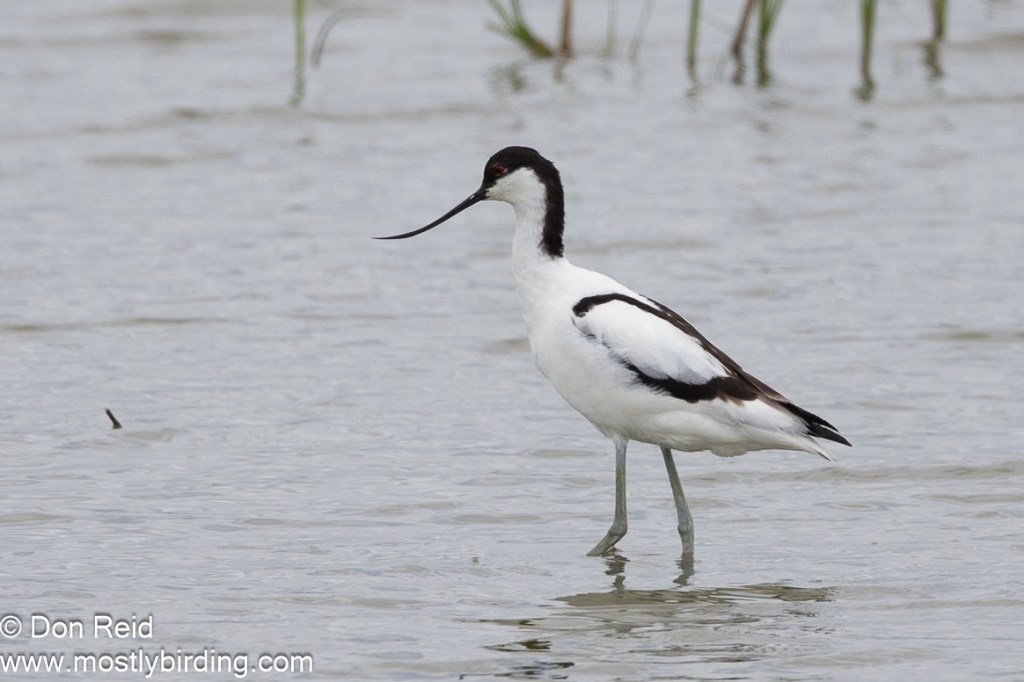
  • Pied Avocet – notable for being a ‘Year bird’ for me (Birders are such nerds)
Pied Avocet Recurvirostra avosetta Bontelsie, Voëlvlei
  • Hundreds of Whiskered Terns
Whiskered Tern Chlidonias hybrida Witbaardsterretjie, Voëlvlei
  • Waders such as Little Stint, Black-winged Stilt, Wood Sandpiper, Three-banded Plover, African Spoonbill and Greenshank
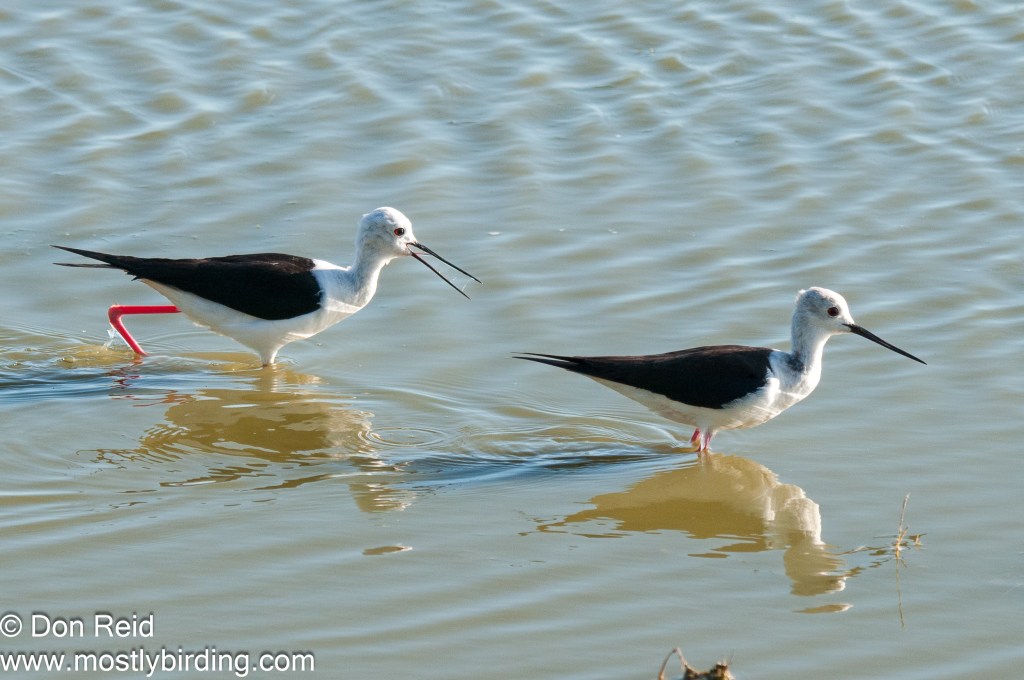
Black-winged Stilt Himantopus himantopus Rooipootelsie, Voëlvlei
Wood Sandpiper Tringa glareola Bosruiter, Voëlvlei
African Spoonbill Platelea alba Lepelaar, Voëlvlei
  • Swimmers – Yellow-billed Duck, Red-billed Teal, Cape Teal, Southern Pochard, Cape Shoveler and Great Crested Grebe
Southern Pochard (female) Netta erythrophthalma Bruineend, Voëlvlei
  • Booted Eagle soaring overhead
  • White Stork

This first visit was particularly memorable – little did I know it would be eight years before I would experience something similar at Voëlvlei…

I did atlas the pentad in the intervening years but did not include Voëlvlei itself as it had dried up completely

30th November and 2nd December 2023

Having moved to Mossel Bay in October 2023 and seeing the reports of increasing water and bird presence at Voëlvlei, I was keen to visit the spot and see for myself. Reports of rarities made it even more imperative so I set off on the last Thursday of November, the day in the week that I have tried to keep open for atlasing.

I started my pentad list along the road past Vleesbaai with a Black Harrier which I chased down the road to try and get level with it as it hunted low over the fields in true Harrier fashion, stopped quickly and rattled off a few shots – with limited success but lovely to see it in hunting mode.
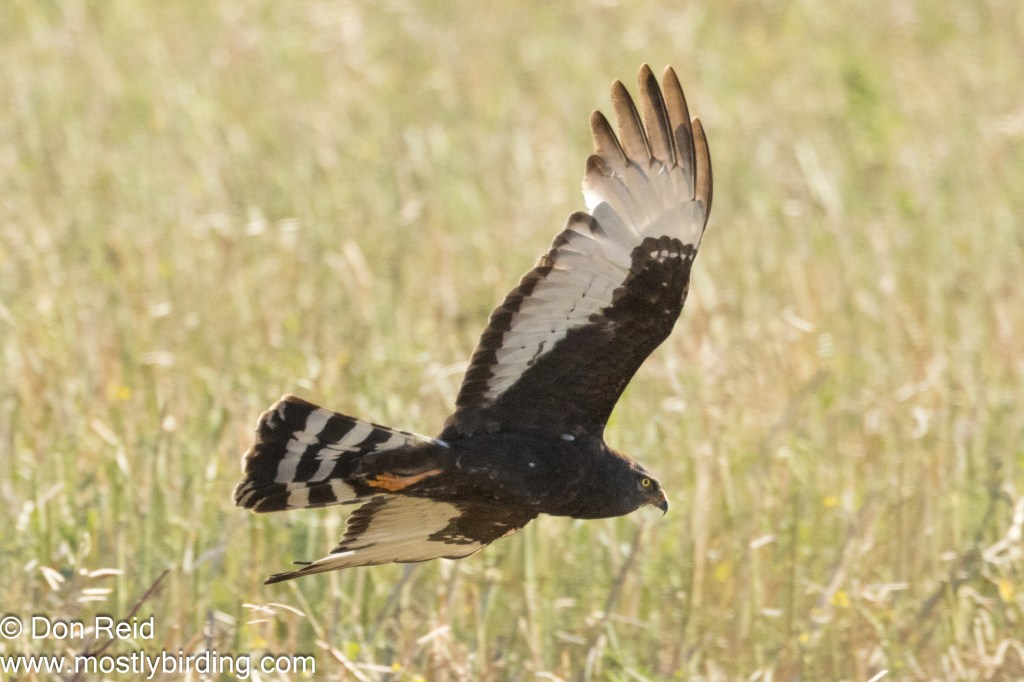
Black Harrier Circus maurus Witkruisvleivalk, Vleesbaai area

Further on I took the turnoff to Voëlvlei and after passing through the gate I spent the next three hours carefully scanning the vlei from the track along the east flank, particularly the muddy margins which were teeming with birds.

The open waters towards the middle of the vlei as well as the surrounding dry land were equally busy with their particular species all enjoying a cornucopia of edible life.

Once again the waterbirds dominated my list …

  • Waders – Black-winged Stilt, Three-banded, Kittlitz’s and Common Ringed Plovers, Little Stint (lots), Ruff, Wood Sandpiper, Grey Plover, Pied Avocet, Greenshank, Blacksmith Lapwing, Grey Heron, African Spoonbill and Little Egret
Three-banded Plover Charadrius tricollaris Driebandstrandkiewiet, Voëlvlei
Kittlitz’s Plover Charadrius pecuarius Geelborsstrandkiewiet, Voëlvlei
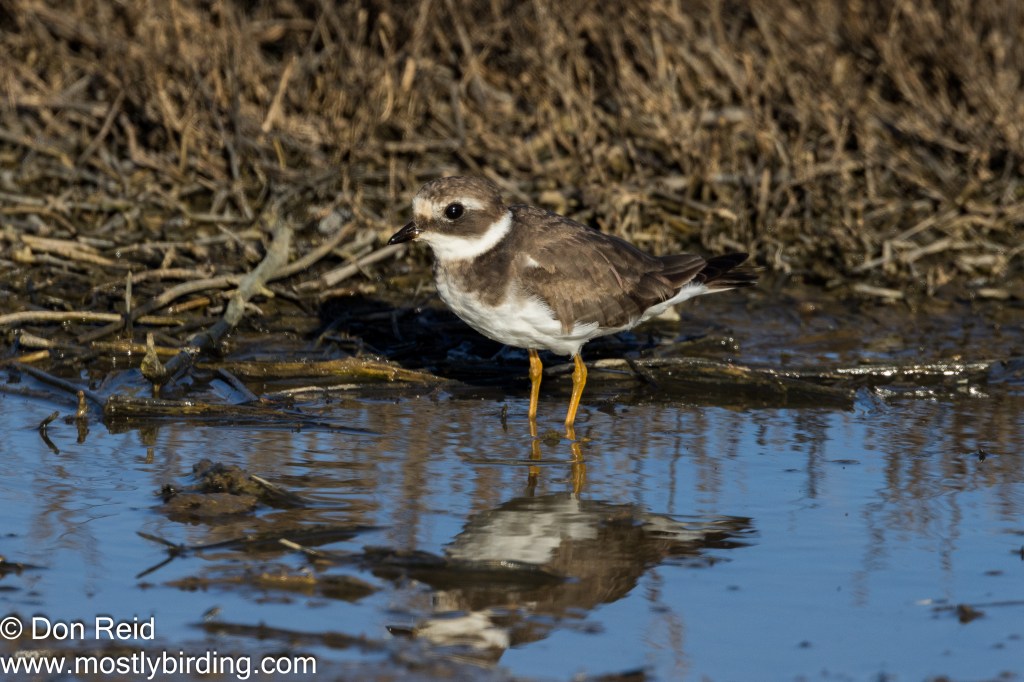
Common Ringed Plover Charadrius hiaticula Ringnekstrandkiewiet, Voëlvlei
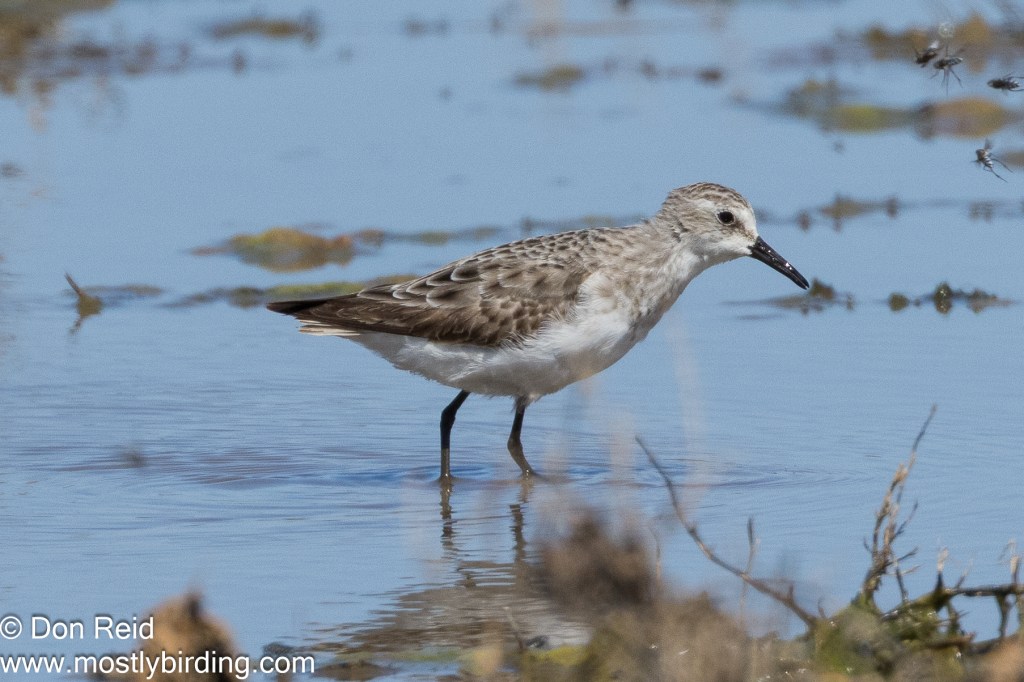
Little Stint Calidris minuta Kleinstrandloper, Voëlvlei
Ruff Philomachus pugnax Kemphaan, Voëlvlei
Grey Plover Pluvialis squatarola Grysstrandkiewiet, Voëlvlei
Pied Avocet Recurvirostra avosetta Bontelsie, Voëlvlei
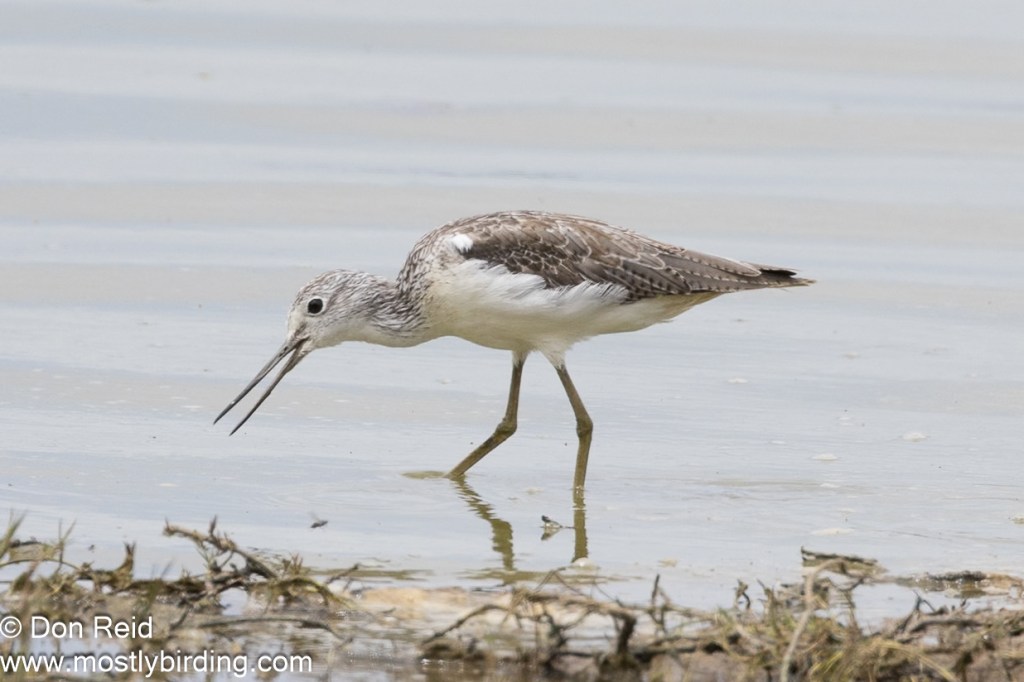
Common Greenshank Tringa nebularia Groenpootruiter, Voëlvlei
Little Egret Egretta garzetta Kleinwitreier, Voëlvlei
  • Swimmers – Red- billed Teal, Red-knobbed Coot, Grey-headed and Hartlaub’s Gull, Cape Shoveler, Little Grebe and South African Shelduck.
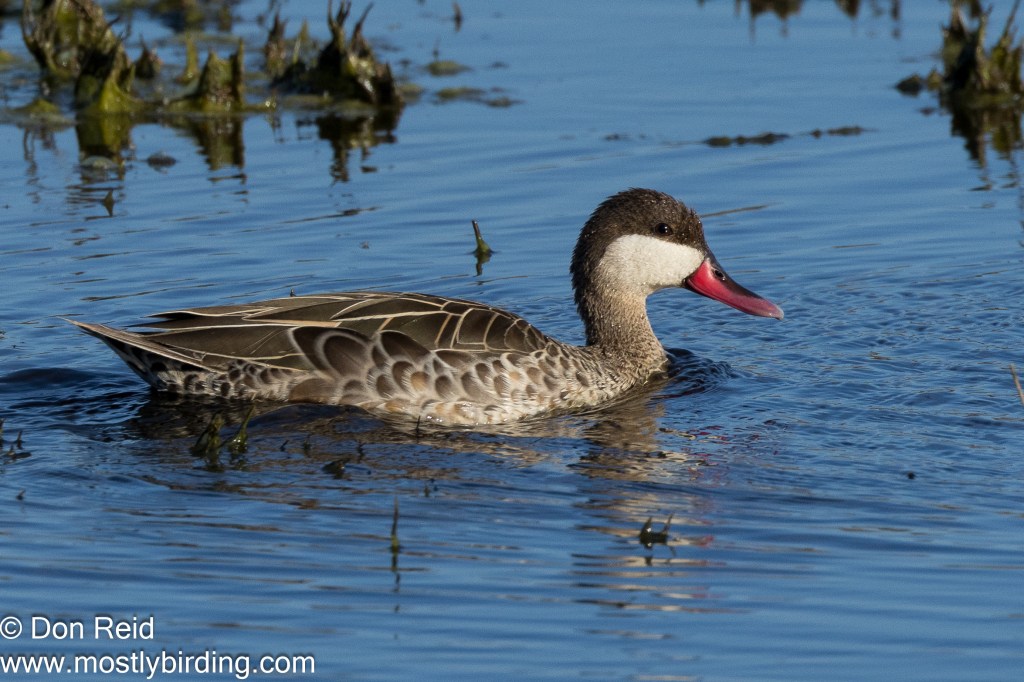
Red-billed Teal Anas erythrorhyncha Rooibekeend, Voëlvlei
Red-knobbed Coot Fulica cristata Bleshoender, Voëlvlei
Little Grebe Tachybaptus ruficollis Kleindobbertjie, Voëlvlei
  • Rarities – This visit was excellent preparation for the annual Birding Big Day just two days later when many of the same birds were recorded by our team. An added thrill was seeing two rarities which had been spotted by some of the keen birders already present –
  • White-rumped Sandpiper – a low-slung, longish-winged sandpiper, difficult to distinguish among the many small waders except when close to the many Little Stints present
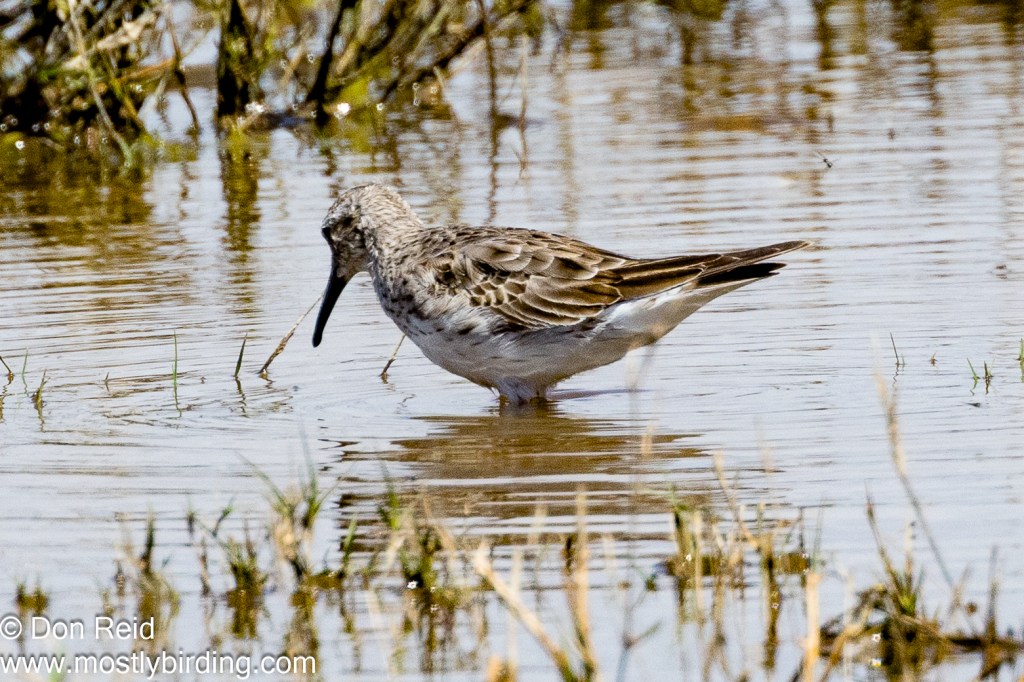
White-rumped Sandpiper Calidris fuscicollis Witrugstrandloper, Voëlvlei
  • Western Yellow Wagtail – courtesy of one of the other teams who had it in their scope view and allowed us a quick look but it was too far for photos

An added pleasure was seeing a large flock of Greater Flamingos on the far side of the water –

Greater Flamingos Phoenicopterus roseus Grootflamink, Voëlvlei

10th to 13th December 2023

With Voëlvlei still attracting a lot of attention from birders and with reports of another rarity – Buff-breasted Sandpiper – being seen there, I couldn’t resist another visit just a week later.

It was a Sunday and Gerda agreed to join me, so after a traditional Sunday lunch at a country restaurant on the way (meat and three veg with rice plus a pudding) for not much money, we headed to Voëlvlei and joined several vehicles and birders with the same idea.

The Buff-breasted Sandpiper was quickly pointed out by those already present – on its own foraging in the dry, lightly grassed area away from the water – clearly a loner not interested in mingling with the many other waders in the vlei itself.

I spent a while scoping the sandpiper and taking photos of it from a distance, while recording all the other species present as they came into view.

We headed home with 34 species recorded. Feeling that the list needed boosting, I decided to include Voëlvlei in my next atlasing session on the following Wednesday, which would fall in the allowed 5 days for a “Full Protocol” card.

I arrived at the vlei mid-morning and spent three more enjoyable hours viewing the multitude of birds, adding a further 16 species to take my total to a nice round 50 for the pentad.

The White- rumped Sandpiper was still present and I spent some time trying to get better photos of this rarity – with limited success. It was difficult to get close enough to the bird, which remained among short grass tufts in the shallows of the vlei, intermingling with other waders and probing the mud constantly so that it was nigh on impossible to isolate it for a decent photo.

  • Waders – Black-winged Stilt, Kittlitz’s and Common Ringed Plovers, Little Stint (lots), Ruff, Pied Avocet, Blacksmith Lapwing, Grey Heron, African Spoonbill, Little Egret, Cattle Egret, Glossy Ibis and Sacred Ibis
Kittlitz’s Plover Charadrius pecuarius Geelborsstrandkiewiet (Juvenile), Voëlvlei
  • Rarities – Buff-breasted Sandpiper, White-rumped Sandpiper
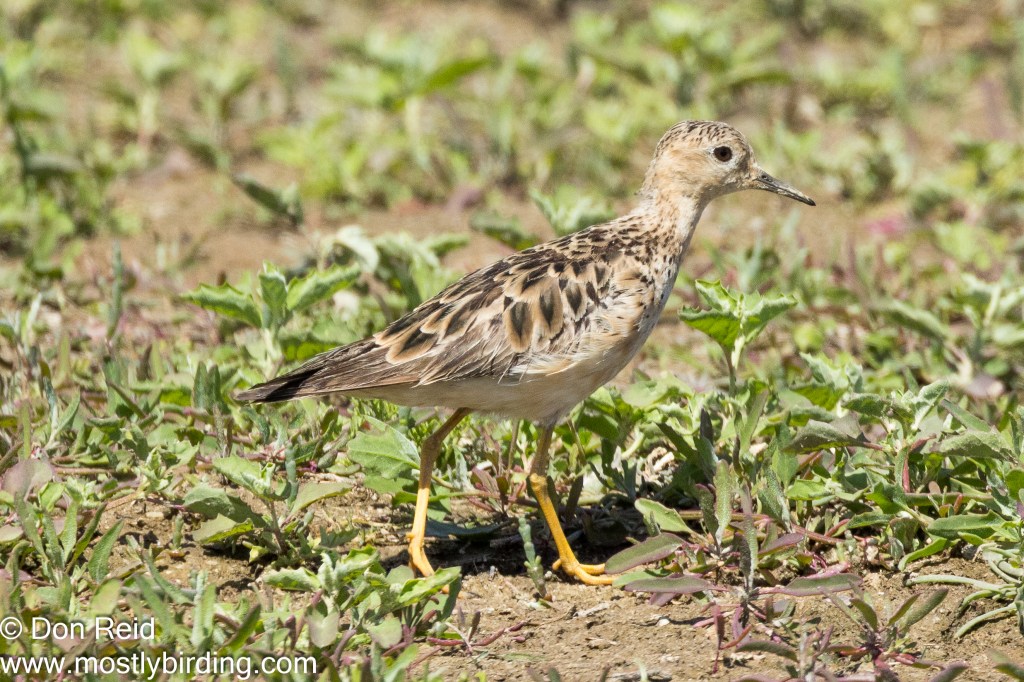
Buff-breasted Sandpiper Tryngites subruficollis Taanborsstrandloper, Voëlvlei
  • Swimmers – Red-knobbed Coot, Red-billed Teal, Cape Teal, Cape Shoveler, South African Shelduck
  • Others – Brown-throated Martin, Barn Swallow, Large-billed Lark, Red-capped Lark, Agulhas Long-billed Lark, Grey-backed Cisticola, Blue Crane, African Pipit, Capped Wheatear
Capped Wheatear Oenanthe pileata Hoëveldskaapwagter, Voëlvlei
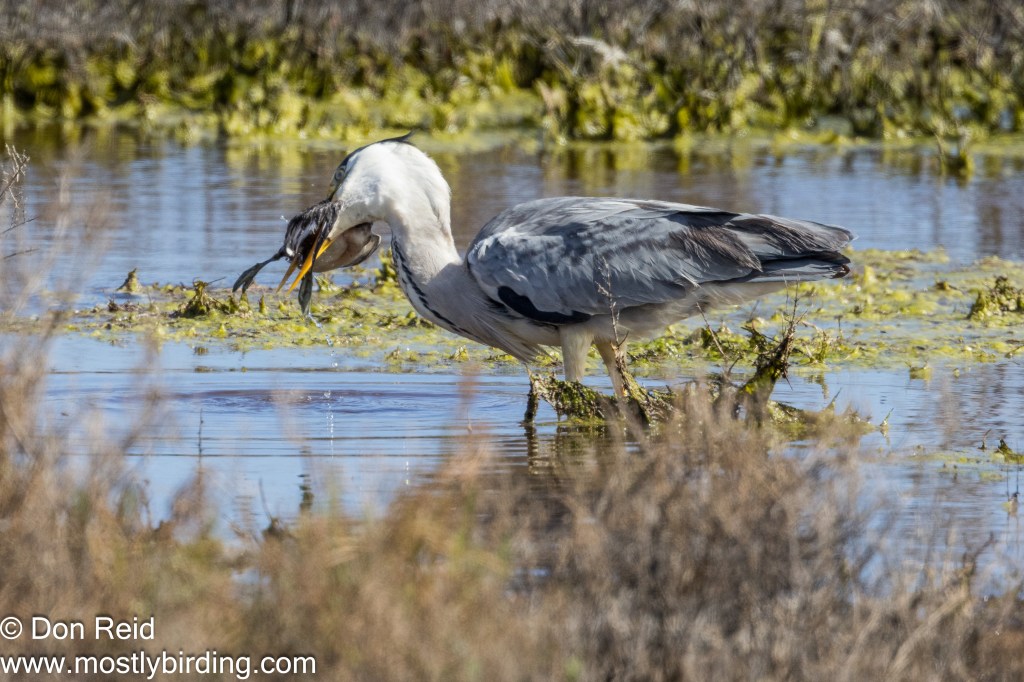
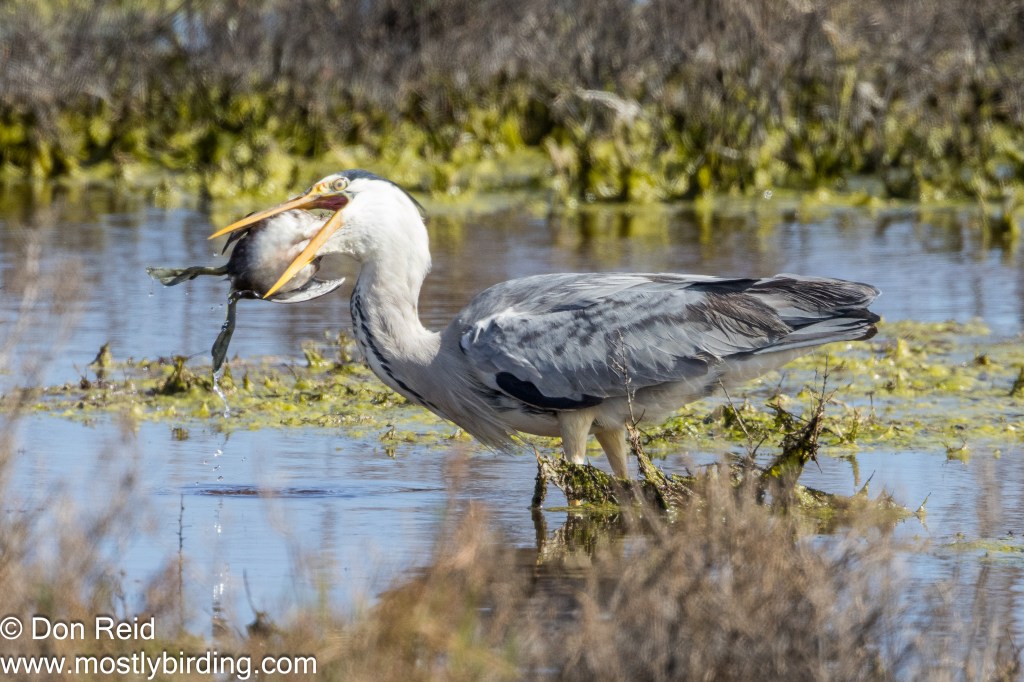
  • Most Surprising Sighting? – most certainly seeing a Grey Heron with what looked like a Reed Cormorant (possibly a juvenile) in its bill, which it proceeded to manoeuvre into position and swallow whole! I wasn’t able to capture the final swallow as the Heron moved behind some reeds.
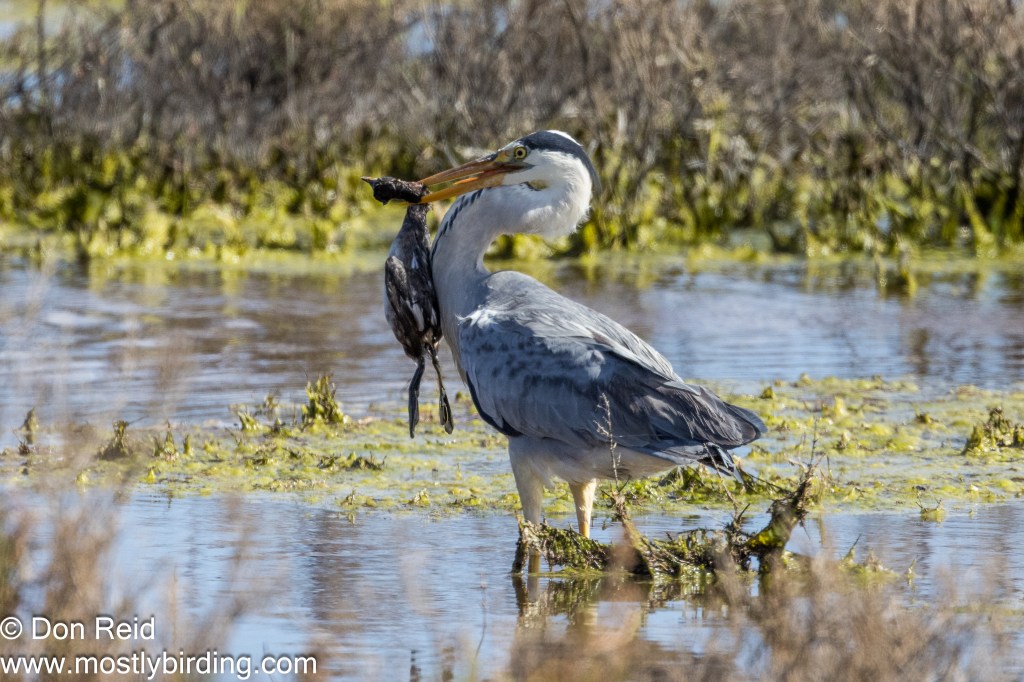
Grey Heron Ardea cinerea Bloureier, (with Reed Cormorant prey) Voëlvlei

February 2024

The vlei remained partly inundated during the most of 2024, with water levels gradually decreasing as inflow dried up.

During February reports appeared on the local birding groups of a Greater Sand Plover at Voëlvlei – I had seen this species before but just once, so at the end of my next atlasing trip I took a detour to the vlei to see if I could find it.

At Voëlvlei I was able to find and photograph the Greater Sand Plover without too much effort and to record numbers of other waders which were still plentiful.
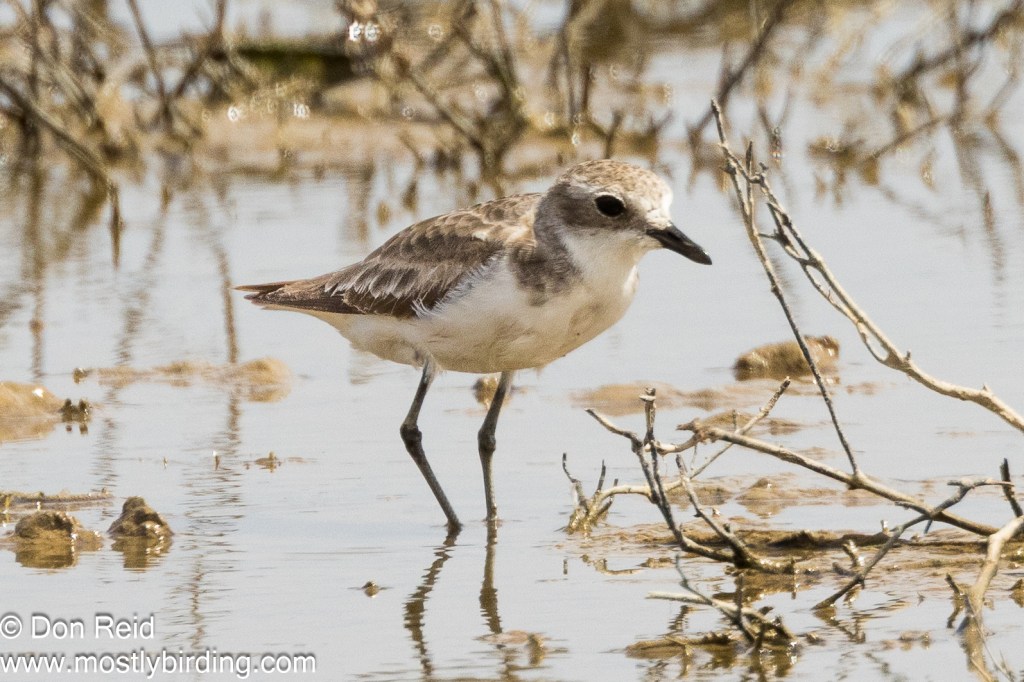
Greater Sand Plover Charadrius leschenaultii Grootstrandkiewiet, Voëlvlei

Thereafter the vlei gradually dried up, leaving ever wider margins. This did not come as a surprise for those living in the Southern Cape as it has been a particularly dry year for the area.

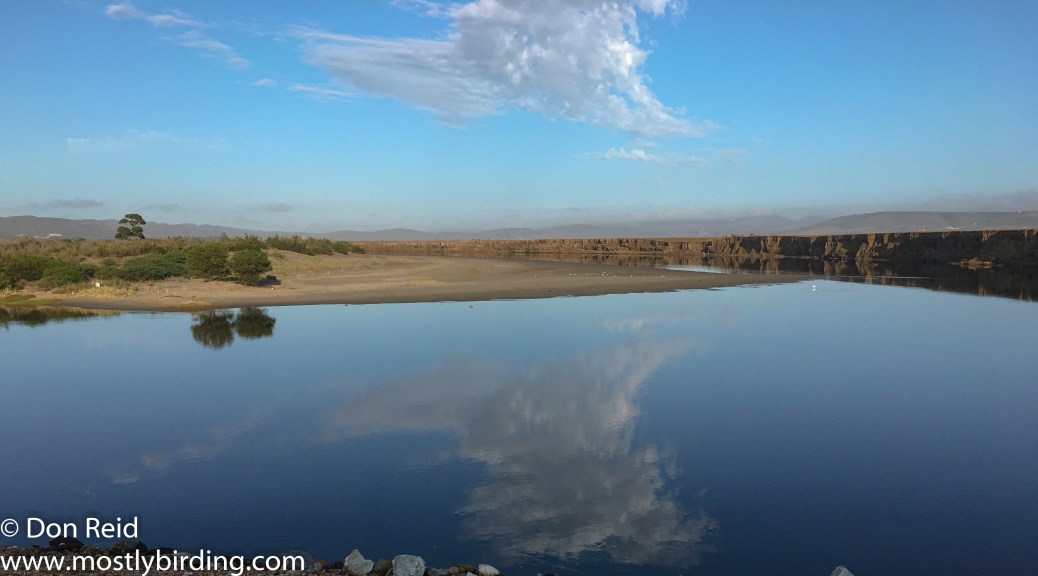
The photo below was taken in July this year, with just the northern section having any water – a couple of weeks after this photo the vlei was bone dry.

That just raises the question that is impossible to answer – when will Voëlvlei have water again? If average statistics are anything to go by it may be 7 or more years before that happens, a sobering thought at my age, I have to say, but I am thankful to have enjoyed two bountiful birding seasons during the last 10 years.
My Atlasing Month – January 2020

Atlasing, or Birdmapping as it is also known, is the mapping of distribution and relative abundance of birds in a given area, using data gathered by a group of several hundred volunteer “citizen scientists” across southern Africa. Volunteers select a geographical “pentad” (roughly 8 x 8 km and based on co-ordinates) on a map and record all the bird species seen within a set time frame. This information is uploaded to the database managed under the Southern African Bird Atlas Project (SABAP2) and is used for research and analysis. I have been a volunteer Citizen Scientist since 2010.

That’s the formal description of what takes up most of my birding time nowadays and I thought it is time that I included more of my atlasing activities in this blog. I have previously made the mistake of being over-optimistic about the frequency of posting on a particular subject, so I won’t fall into that trap – the title of this post may provide a clue to my intentions but let’s see how it goes….

So, let’s have a look at where atlasing took me in the first month of 2020…

Klein Brak River

Klein Brak River is a small village close to Mossel Bay in the Southern Cape and was my choice for my first formal atlasing outing for the year on 8th January, given the luxury of having an open pallete of pentads not yet atlased in 2020 to choose from. The pentad includes the village, the road to Botlierskop game farm and the Geelbeksvlei road, all of which had provided good birding in the past.

Starting in Klein Brak village at 6 am, my list grew rapidly in cool conditions, ideal for both bird and man (armed with binos). I drove through the residential area checking out the gardens and ended up at a wide section of the river which gives the town its name – there I set up my scope and scanned the river. Birds were not plentiful but those that were visible were interesting waders and waterbirds with Cape Teal, Common Greenshank, Common Ringed Plover, Little Egret and a Grey Plover that, for a while, had me hallucinating about Golden Plovers until I came to my senses.

Grey Plover / Pluvialis squatarola / Grysstrandkiewiet, Klein Brak River

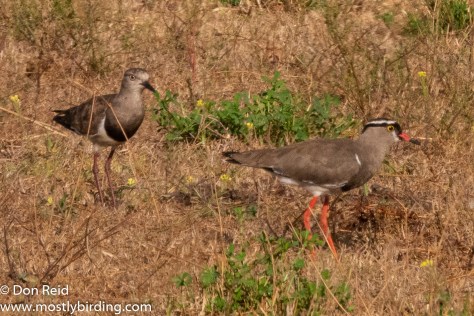
A Pied Kingfisher was active over the water and his Brown-Hooded land-based cousin could be heard nearby in a garden. Moving on, I left the village behind and passed through cultivated farmland, where a short grassed area held both Crowned and Black-winged Lapwings moving about together. Both are Vanellus species and share looks and habits, seeming to enjoy each other’s company.

Lapwings – Black-winged and Crowned, Klein Brak River
African Stonechat / Saxicola torquatus / Gewone bontrokkie (Juvenile), Klein Brak River

The road led to the Gannabos road where I turned right towards Botlierskop and spent some time stopping at every shady tree (it was heading over 30 degrees C) to explore the surroundings and the bush, as this stretch has proven to be good for forest birds. Olive Bushshrike and Paradise Flycatcher obliged by calling first then showing themselves fleetingly, Common Waxbills twittered in the roadside bush and even an African Fish-Eagle called from somewhere close by.

The road to Botlierskop – welcoming shady spots to stop and bird
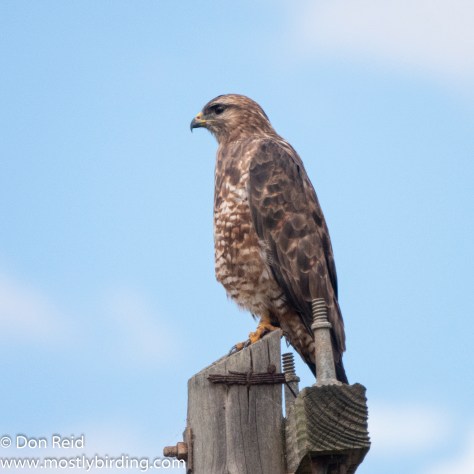
Common Buzzard / Buteo buteo / Bruinjakkalsvoël, Klein Brak River

At the Botlierskop farm dams I found a lone Spoonbill and several White-faced Ducks and heading back a handsome Jackal Buzzard watched me pass by. The Geelbeksvlei road was fairly quiet except for a popular fishing spot where I used the scope to ID a Little Stint and Kittlitz’s Plover, while a Yellow-billed Kite did its low-flying thing overhead. taking my total to a pleasing 67 species for the pentad.

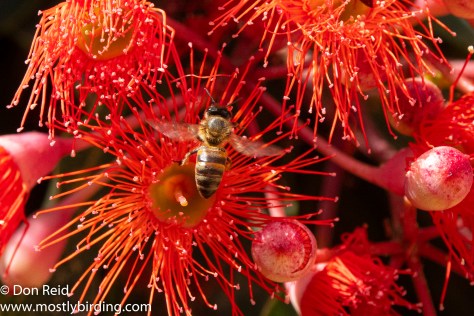
Bee on red flower, Klein Brak River
Fiscal Flycatcher / Sigelus silens / Fiskaalvlieëvanger, Klein Brak River

Gouritsmond Area

When I checked my pentad map, I noted that I had never atlased the pentad west of the town of Gouritsmond at the mouth of the Gourits River, so it became my main target for the day.

Gouritsmond lies south-west of Mossel Bay and I set off early on the 24th January – the journey was slowed by several “not to be missed” birding and photo opportunities along the road, including –

  • ponds alongside the road formed by recent rains – my first stop to view one was opposite the PetroSA refinery plant and attracted a grave looking official who stopped behind me, got out and walked to my car to enquire as to what I was doing while checking what I had in the car, and “did I know PetroSA is a National Key Point so no photography is allowed”. I responded that I was observing the birds and he looked me over and walked off again, presumably happy that my profile was not that of a threat to the National Key Point. Many Gulls and Sacred Ibises were present and a Little Stint was pottering about amongst them.
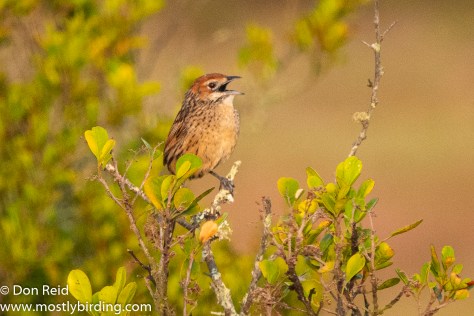
  • .Cape Grassbird on top of a roadside bush, singing away near a small pond before the Vleesbaai turnoff.
Cape Grassbird / Sphenoeacus afer / Grasvoël, Gouritsmond road
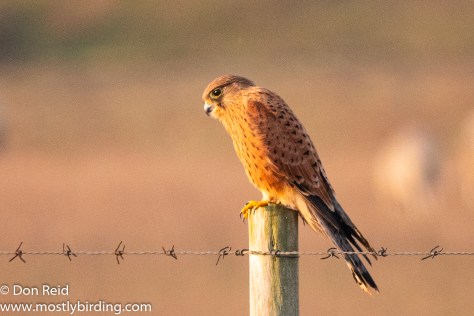
  • Rock Kestrel (Immature) in perfect morning light on top of a fence post.
Rock Kestrel / Falco rupicolus / Kransvalk, Gouritsmond road
  • Agulhas Long-billed Lark on a small rock in a field, close enough for some fine photos
Agulhas Long-billed Lark / Certhilauda brevirostris / Overberglangbeklewerik, Gouritsmond road

Once I entered Gouritsmond I drove along the Beach road to the start of pentad 3420_2145 and followed the coastal road, bounded on the one side by wide stretches of rugged rocks, lapped by the green ocean beyond, and on the other side by coastal bush and grassed fields.

Scene along the Beach Road west of Gouritsmond

Seabirds were few – Kelp Gull, African Black Oystercatcher and Ruddy Turnstone (just visible through the scope), the balance were birds of the bush, fields and sky. It was slow going and with the minimum 2 hours done and no prospect of adding many more to my modest total of 32 species, I proceeded back to the town to pentad 3420_2150 and commenced atlasing once again.

Scene along the Beach Road west of Gouritsmond

I made a good start along the coastal road with similar species to the first pentad, them made my way slowly through the town’s residential area and out to the waste water treatment works, which has been upgraded with neat ponds and easy viewing from the surounding fence. Numbers of waterbirds had made this their home and Cape Teal, Yellow-billed Duck and Egyptian Goose were all prominent.

My next and final stop was the boat launch site up river from the mouth and I set up the scope to scan the distant banks for waders, coming up with Whimbrel, White-fronted Plover, Ruff and Common Ringed Plover.

There was no sign of the Kittlitz’s Plover that had entertained me at this same spot in 2018 -see my earlier post https://mostlybirding.com/2018/12/15/kittlitzs-plover-a-winning-performance/

West of Mossel Bay along the N2

My last chance for atlasing out of Mossel Bay, before returning to Pretoria, came up on the 29th January and I targeted two pentads directly west of Mossel Bay, both never atlased by me before.

I started with pentad 3410_2155 which is bordered by PetroSA on the north side and stretches to the sea on the south side, although various private estates block access to the coastal area itself and I had not made any arrangements for such access so I was limited to the inland areas. I started along the N2 National road which runs east-west through the pentad and was predicably busy but has a wide tarred shoulder which allowed me to stop with relative safety.

Mossel Bay west

After the recent good rains there was enough water in farm dams and shallow pans, especially on the south side of the N2, which had attracted a variety of waterbirds – Yellow-billed Duck, Red-billed Teal, Spurwinged Goose, Cape Shoveler and Little Grebe.

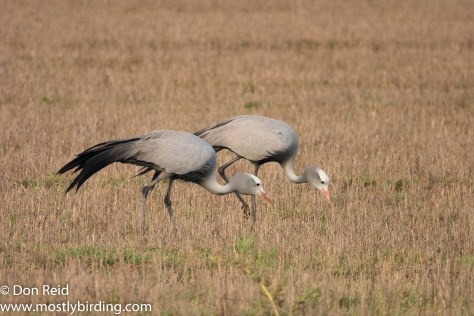
Shortly after, I turned south onto the Gouritsmond road, which had less traffic but the road is a narrow one with a gravel shoulder sloping off at an angle that makes it difficult to pull off comfortably, so I had to look for farm gate turn-offs to be able to stop safely. There was enough to see at each stop to keep my list growing and at one stop my attention was drawn to a pair of Blue Cranes walking in a grassy field and, for a change, close enough to the road to allow for some reasonable quality photography of these elegant birds.

Blue Cranes, Mossel Bay west

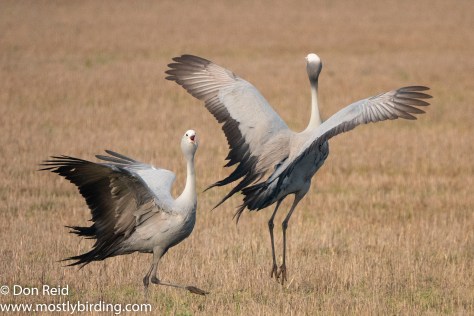
Suddenly they started a courtship dance that left me entranced but determined to record as much of it on my camera – it was so special that it deserves a separate post, suffice to say it was a birding highlight of our lengthy stay in Mossel Bay!

Blue Crane courtship dance, Mossel Bay west

Further on, where the road bends away to the west, I stopped to view a small pond and the surrounding bush and found a variety of birds such as Yellow Canary, White-throated Canary, Red Bishops and Levaillant’s Cisticola, Red-capped Lark in the road (as is their habit) was my 3rd Lark for the day, after Large-billed and Agulhas Long-billed.

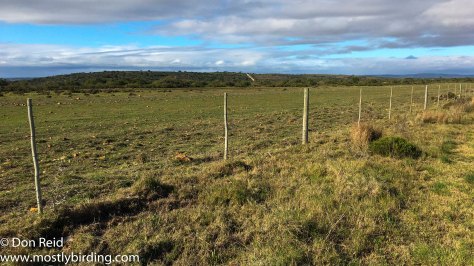
Back on the N2, I proceeded further west to pentad 3410_2145, where I turned off at the first gravel road heading south – the road cuts through the pentad and reaches its southern bounday at the bone-dry Voelvlei, which last had water a number of years ago – when it does have water it is a spectacular birding spot but in times of drought is a rather depressing sight.

The route there proved to be less bird friendly with farmland and hills and I worked hard to get to a modest list of 26 without a single waterbird, but a trio of Denham’s Bustards flying over was an exciting highlight.

Denham’s Bustard

What makes birding/atlasing special is coming across other wild life in the process – these beetles were attracted to a flowering bush and caught my eye with their tan colouring –

Brown Monkey Beetle

All in all, a satisfying start to my atlasing for the year…..

Atlasing Tales 7 – Herbertsdale and surrounds, January 2019

This series of “Atlasing Tales” posts sets out to record some of the memorable experiences and special moments that I have enjoyed while *atlasing. (see end of post for more info on atlasing)

The Atlasing Destination

With an open palette of pentads not yet atlassed in 2019  I chose two pentad blocks around Herbertsdale in the southern Cape with the least Full Protocol cards to date – one covering Gondwana Game Reserve and the other including the village of Herbertsdale and the surrounding countryside.

The location of the pentads – the red shaded block on the map below and the block to its left :

Getting there

My route was planned to be a circular one, heading out and back on the R327 to this by now familiar area that I have atlassed frequently over the last several years.

I had put my faith in the usually dependable YR weather App which forecast that the overnight rain would clear up by early morning. Heading out at 5.30 am from Mossel Bay, I had a few doubts as the gloomy, rainy weather persisted until after 7 am, an hour into atlasing the first pentad, but then cleared up into a beautiful sunny day.

Pentad 3400_2150

Soon after entering the pentad block, I stopped at the Gondwana Game Reserve gatehouse to check if there were any restrictions on driving through the reserve on what is still a public road. The reply was “Yes you can drive through, but  you are not allowed to stop”. Now I am a birder and we like to stop frequently and unexpectedly, so I nodded vaguely and proceeded on my way through the reserve, not expecting to come across any other traffic at this early hour and on this rather remote road.

I saw a few animals but as it turned out, with rain still falling steadily, I did not have much reason to stop for birds, until I came across a small roadside dam with a Grey Heron standing like a statue in hunting mode, watching the water very intently. I could not resist stopping, whereupon two things happened almost simultaneously – a Black-crowned Night-Heron flew gracefully in and settled in the shallow water near the Grey Heron – and a Gondwana ranger in a bakkie (utility vehicle) appeared over the rise behind me slightly less gracefully and stopped next to my vehicle – with a smile on his face,it must be said.  He reminded me of the ‘no stopping’ request and suggested I move on, which I did after asking permission to take a quick photo of the Night-Heron and receiving same.

It’s quite understandable that reserves such as Gondwana are nervous or even slightly paranoid about potential poaching, having passed a grazing Rhino with full horn just a little earlier, however I’m sure the profile of the average poacher does not include meek, pensioner-age birders in SUV’s armed only with long-lens cameras. In any case, next time I will contact Gondwana beforehand for permission to bird.

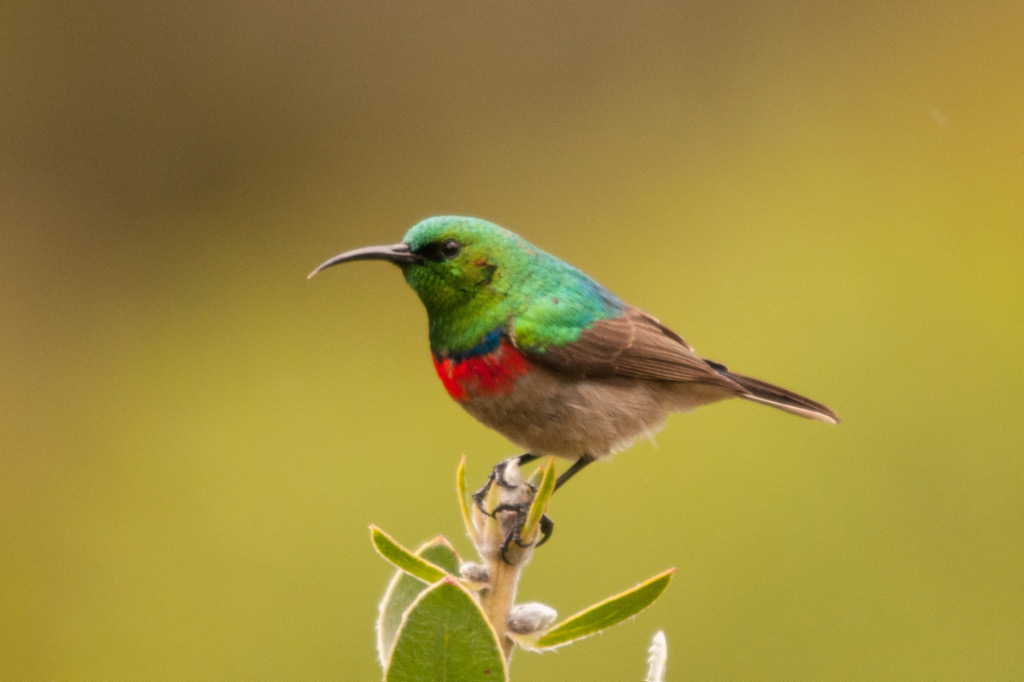
Exiting the reserve a short while later through the northern gate, a subtle change in habitat – more bush and trees for a starter – resulted in a change in bird life in terms of numbers and almost immediately Malachite and Southern Double-collared Sunbirds were added to my list.

Southern Double-collared Sunbird

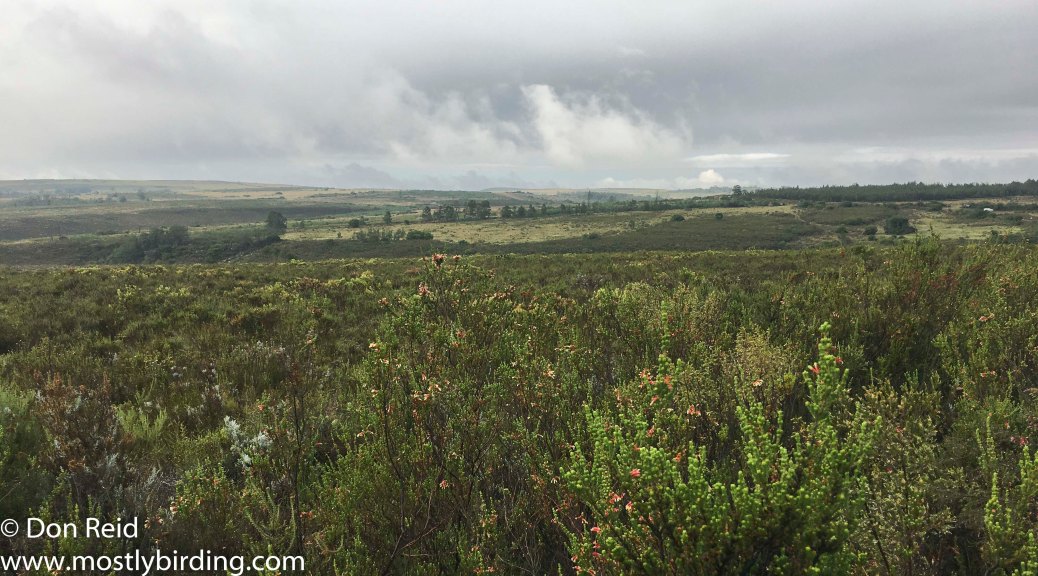
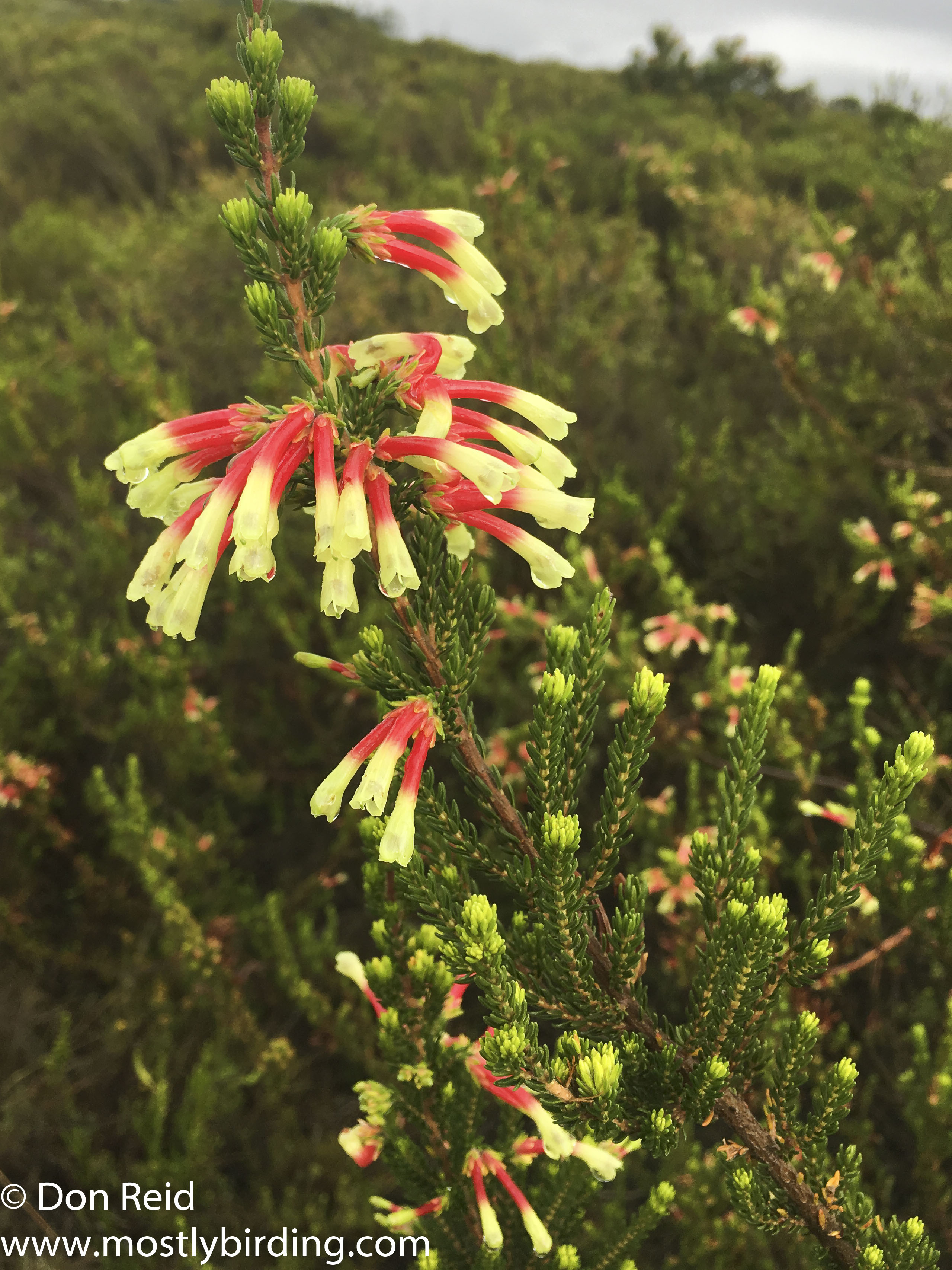
Further along the road I stopped to look around, only to be enticed to walk up an inviting track leading through a field filled with fynbos and protea species.

Gondwana area

The ericas were abundant and made extra attractive by drops of moisture clinging to leaves and flowers

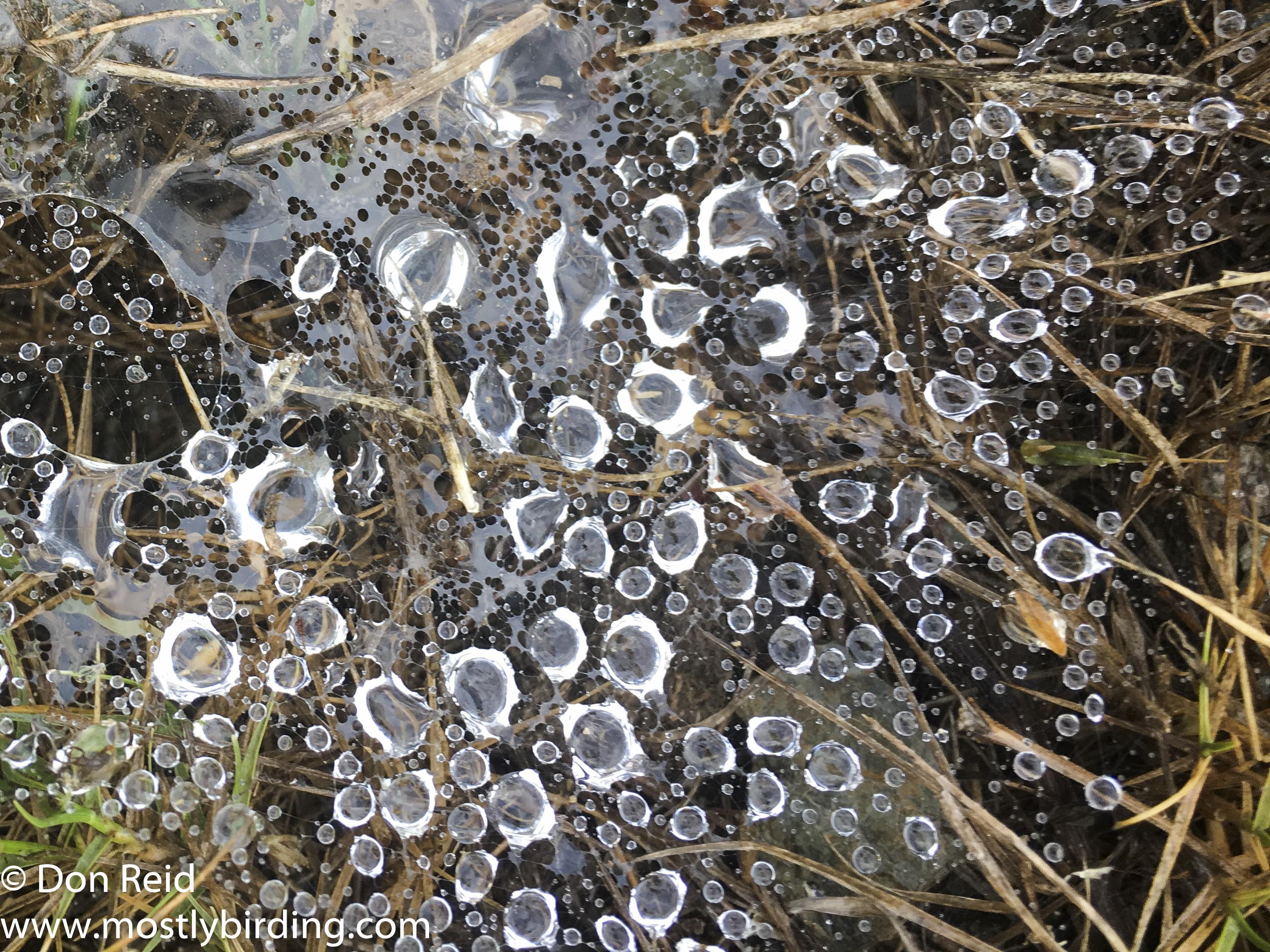
Even the spider’s webs had gathered lots of rain drops

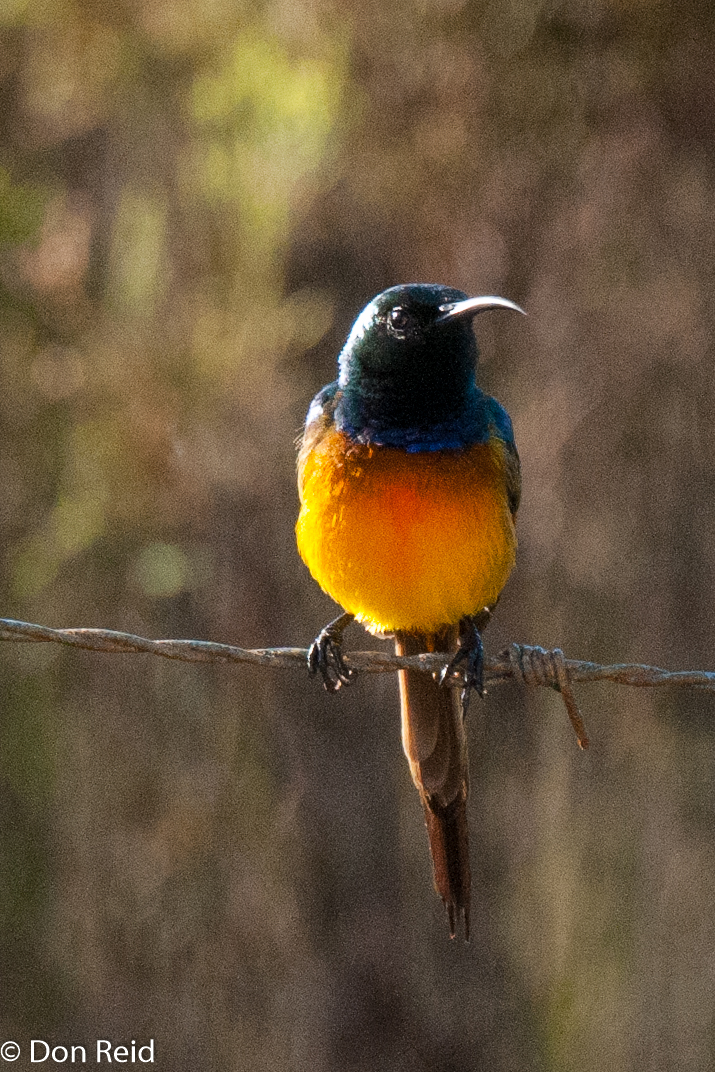
Southern Tchagra and Orange-breasted Sunbirds delighted me with their presence while a “Murder of Crows” – White-necked Ravens by name but also part of the Corvus genus along with all the other Crows – flew over and settled in an adjoining open field.

Orange-breasted Sunbird

Soon after, I reached the eastern boundary of the pentad and turned around with 29 species recorded so far, then took a branch road which headed into the more hilly northern section with another subtle change in habitat – still quite bushy along the road verge but more open fields and grassland behind. Suddenly I could hear Cape Clapper Lark displaying and saw the perpetrator soon after, furiously clapping its wings as it ascended, producing a loud, fast clapping sound followed by a drawn out sharp whistle on descent.

Competing with the Clappers and soon winning the “most prominent call” competition were Victorin’s Warblers, seemingly every 50 m or so for a few hundred metres – definitely a hot spot for this loud but elusive bird that just refused to show when I stopped to search for it, allowing nothing more than a brief glimpse through dense foliage.

Victorin’s Warbler, Herbertsdale area

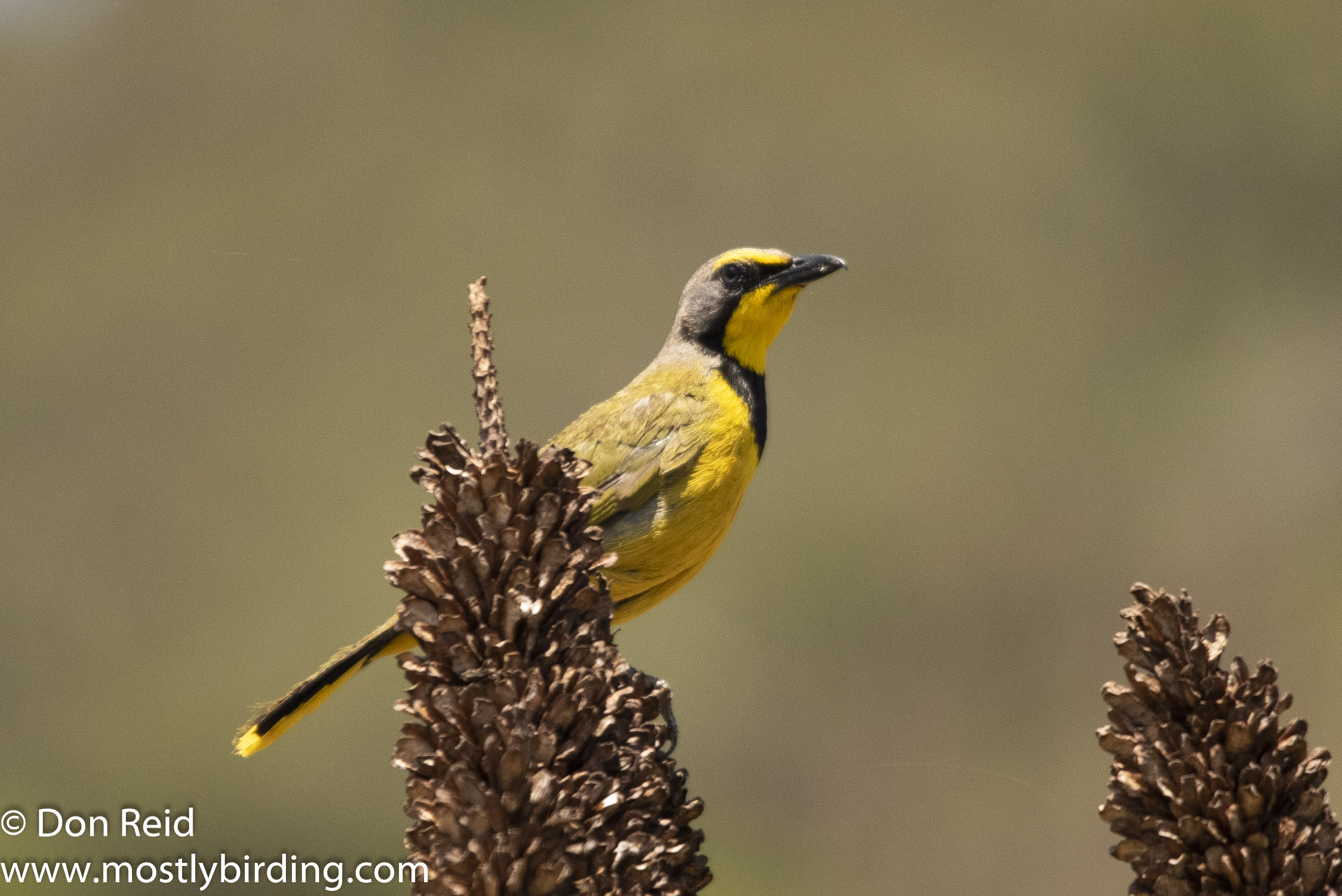
More cooperative was the Bokmakierie I came across shortly after

Bokmakierie

Pentad 3400_2145

Although this pentad lies directly west of the first one, the lack of direct roads meant a longish drive  via the R327 to get to the northern boundary just outside the tiny but charming Herbertsdale village. The birding was immediately lively and the views from the hill leading into the village spanned the fertile valley below, albeit suffering under the drought that has so much of the country in its grip.

Herbertsdale area

Herbertsdale area

Driving slowly through the village a group of swifts and swallows were circling busily overhead, no doubt feasting in mid-air on the thousands of flying insects.

Barn Swallow

A couple of Alpine Swifts flew by,  big-bodied and lightning fast compared to the White-rumped and African Black Swifts that made up the majority of the flock,  so distinctive with their white underparts.

It’s a challenge getting a photo of the Alpine Swift, so this is the best I could manage on the day

Alpine Swift

Beyond Herbertsdale the road heads back towards Mossel Bay, past roadside farm dams which held a selection of water birds, including Black Crake, Yellow-billed Duck, Red-billed Teal while the call of Lesser Swamp-Warbler emanated from the fringing reeds. An irrigated field was literally swarming with low flying Barn Swallows  crisscrossing in the air while tens of Red Bishops searched the ground below them.

Patrolling the field at a height was a fierce-looking Peregrine Falcon – I imagined some doem-doem-doem music building up in the background to heighten the drama of the situation, but the Falcon was not in a hurry to hunt and I carried on after watching it for a while.

Peregrine Falcon

In contrast, this little guy – less than 10 cm long – was crossing the road so I helped him/her on its way, as you never know when a car might come by and people often do not see them in the road, causing unnecessary fatalities

Tortoise

Further stops produced Tambourine Dove calling and a group of Common Waxbills, then I came across a tree at the side of the road full of bright red flowers which was clearly irresistible for the sugar freaks of the bird world, drawing numbers of Malachite, Greater Double-collared and Southern Double-collared Sunbirds. That also signaled the end of the morning’s atlasing

The Statistics

Pentad  3400_2150 : A total of 30 Full Protocol (Minimum 2 hours) cards have been done to date with a low/high card count of 25/77 and a total of 154 species recorded to date; This was my first card for the pentad and my 42 species represented coverage of 27% of the total species. The only notable species was White-rumped Swift (7% reporting rate)

Pentad 3400_2145 : A total of 21 Full Protocol cards have been done to date with a low/high card count of 26/65 and a total of 144 species recorded to date; This was my fourth card for the pentad and my 51 species represented coverage of 35% of the total species. My total for the 4 cards increased to 90 species. New species recorded for the pentad were Black Crake, Peregrine Falcon and Lesser Swamp-Warbler

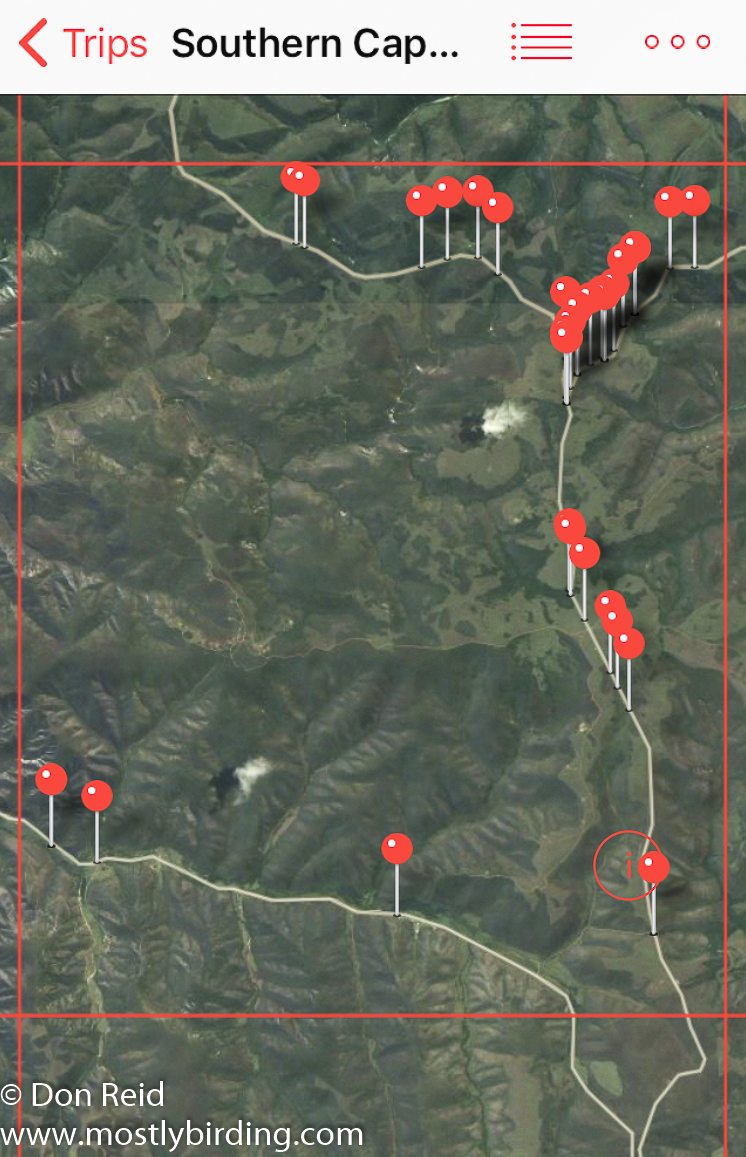
The Birdlasser pentad maps below show the route and sightings –

Gondwana area

Herbertsdale area

* Atlasing

Simply put, it is the regular mapping of bird species in a defined area  called a “pentad”. Each pentad has a unique number based on its geographical position according to a 5 minute x 5 minute grid of co-ordinates of latitude and longitude, which translates into a square of our planet roughly 8 x 8 kms in extent.

As a registered observer / Citizen scientist under the SABAP2 program (SA Bird Atlas Project 2), all of the birding I do nowadays includes recording the species for submission to the project database at the ADU (Animal Demography Unit) based in Cape Town.

Atlasing has brought a new dimension and meaning to my birding as it has to many other birders. The introduction a couple of years ago of the “Birdlasser” App has greatly simplified the recording and submission of the data collected.