Bird atlasing outings often produce a surprise or two, which can be anything from a common bird doing something unusual, or crossing paths with an uncommon species – perhaps one regarded as a rarity for the area – but could even be as simple as a species that you have not atlased for some time.
Let’s face it – birders have a myriad ways of making the seemingly ordinary something to get excited about…. which is just one of the reasons that birding is so addictive.
I like to plan an atlasing trip once a week, depending on other commitments (which are variable at our age and usually driven by family demands), and I leave it to a day or two prior to my ‘atlasing day’ to decide where to go and which pentads to atlas.
My choice of pentad for this trip in May last year was inspired by reports during the week leading up to it describing the presence of hundreds of seabirds at Klein Brak River estuary,
The pentad which covers it includes the bulk of Hartenbos, a chunk of Bayview and Voorbaai, all of which fall under Mossel Bay, and is a pentad that produces a good variety of species, both land and sea-based.
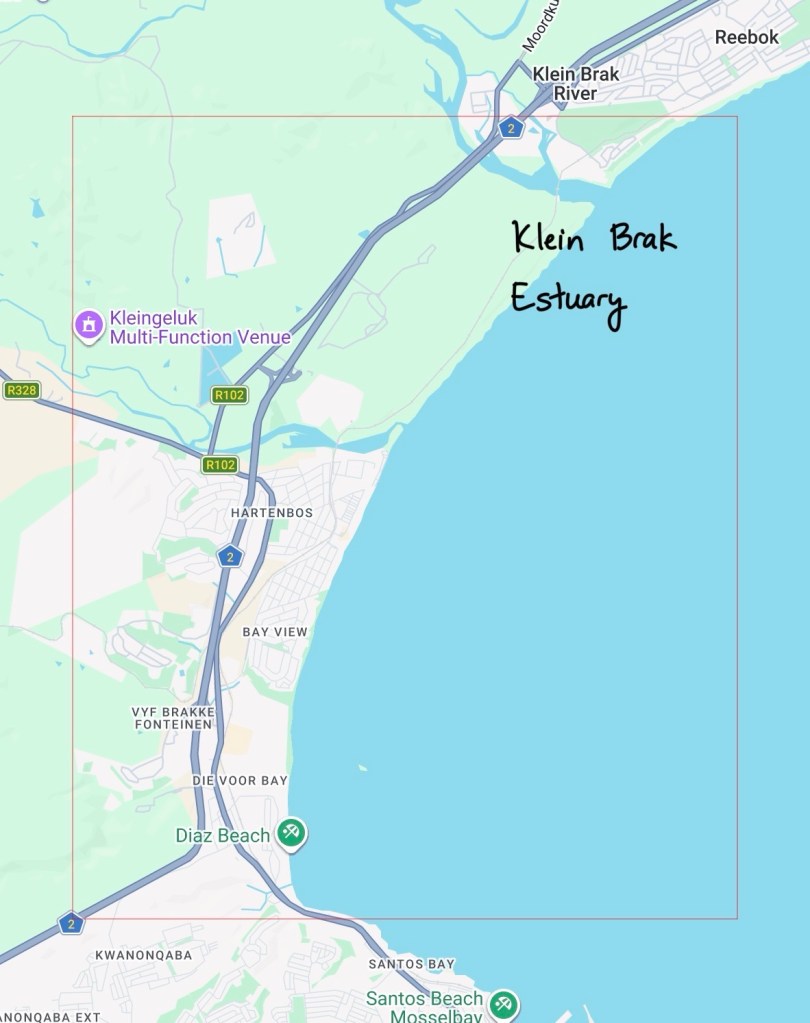
On the morning, I headed straight from home to the estuary, in busy early morning traffic (Mossel Bay is no longer the quiet village we got to know), with an initial detour to the shallow vleis further up the river where I started recording on the Birdlasser app at around 7.30 am.
Twenty minutes later I had recorded 20 species, mostly common ones but including African Black Swift, Yellow-billed Duck, Three-banded Plover and both Black-headed and Grey Herons.
Pleased with the quick start, I headed to the estuary itself, found a convenient parking spot and walked across the sand, still damp from the recent tides, to where I could see bird activity in the distance.
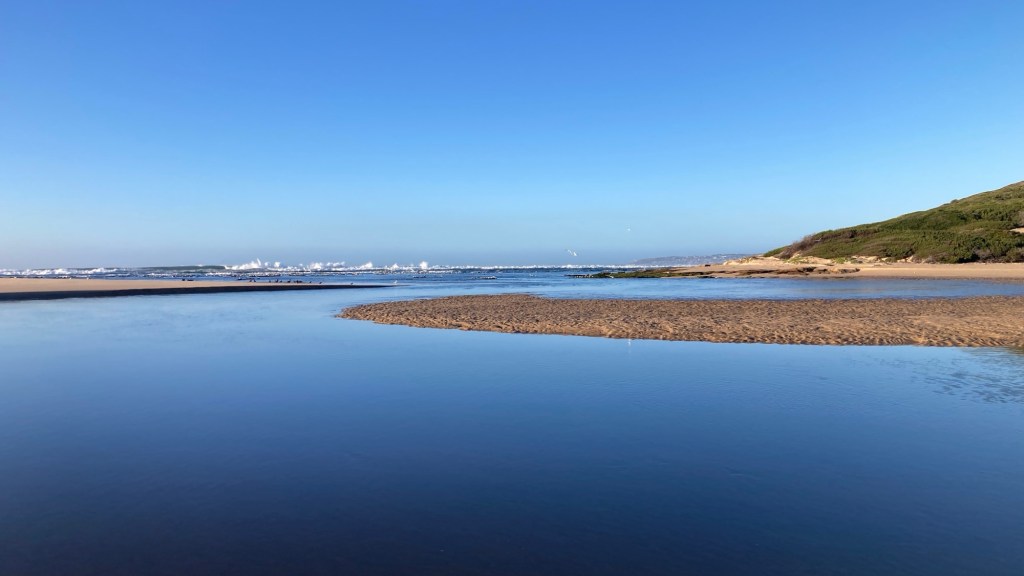
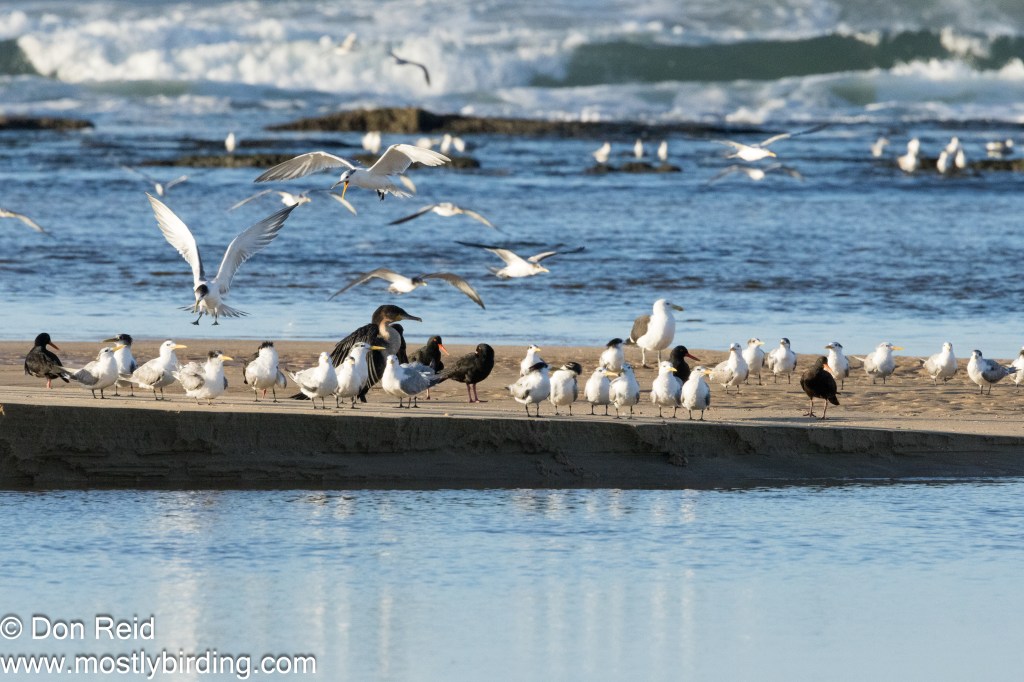
There were hundreds of seabirds, mostly terns, on the exposed sand banks at the river mouth and wheeling about in the air above.
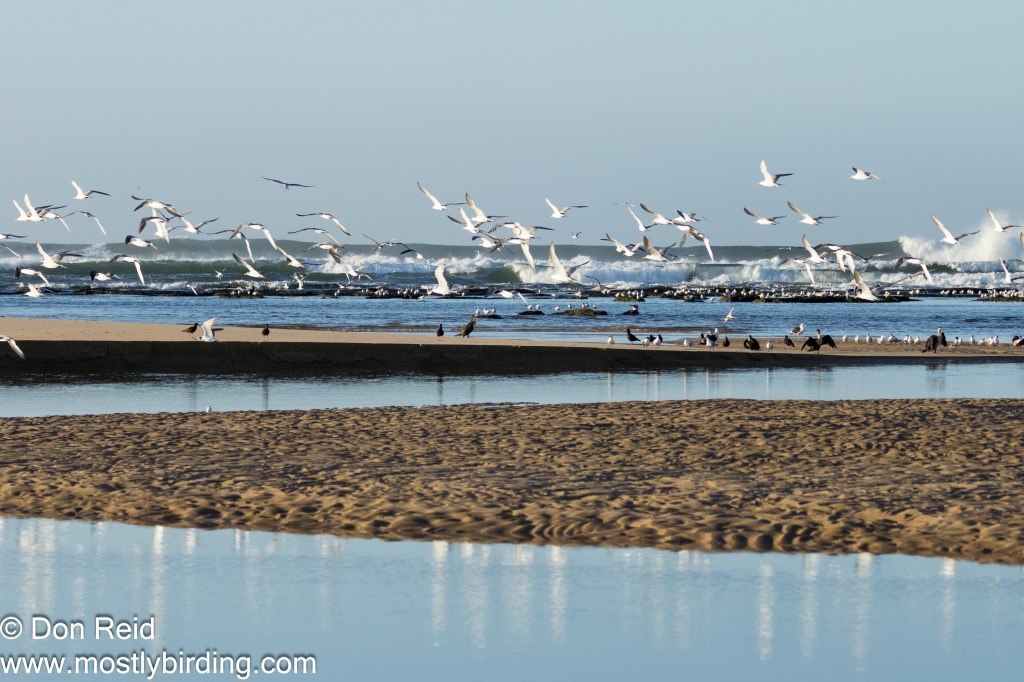
Moving closer, I could start identifying individual species ….
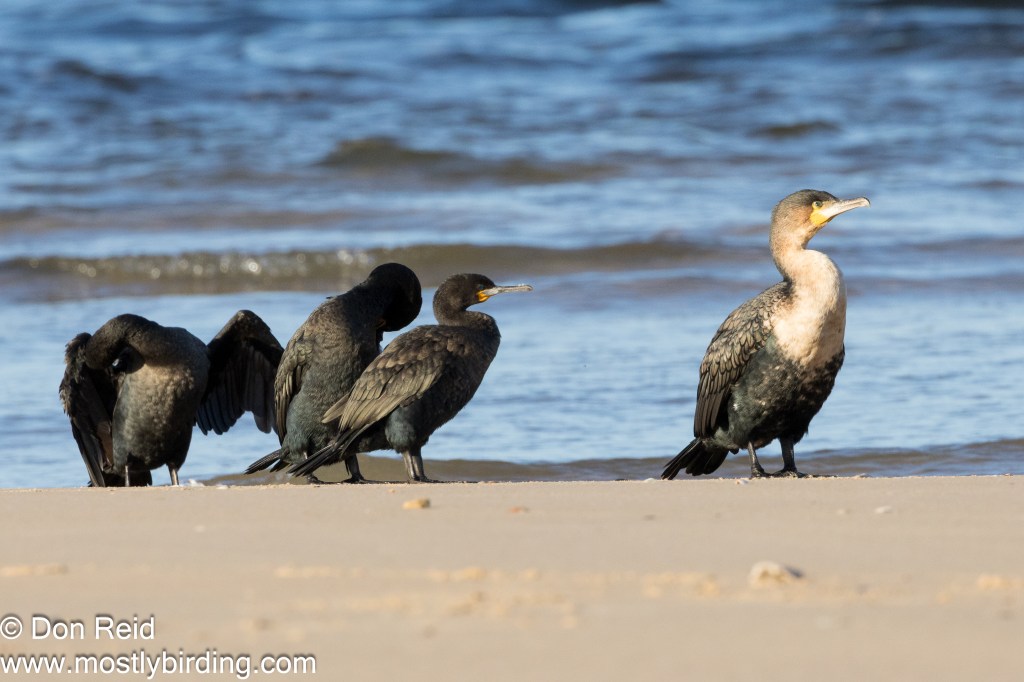
Cormorants were well represented and easy to identify as there are just two regular species in the area – Cape Cormorant (Trekkormorant) Phalacrocorax capensis and White-breasted Cormorant (Witborsduiker) Phalacrocorax lucidus
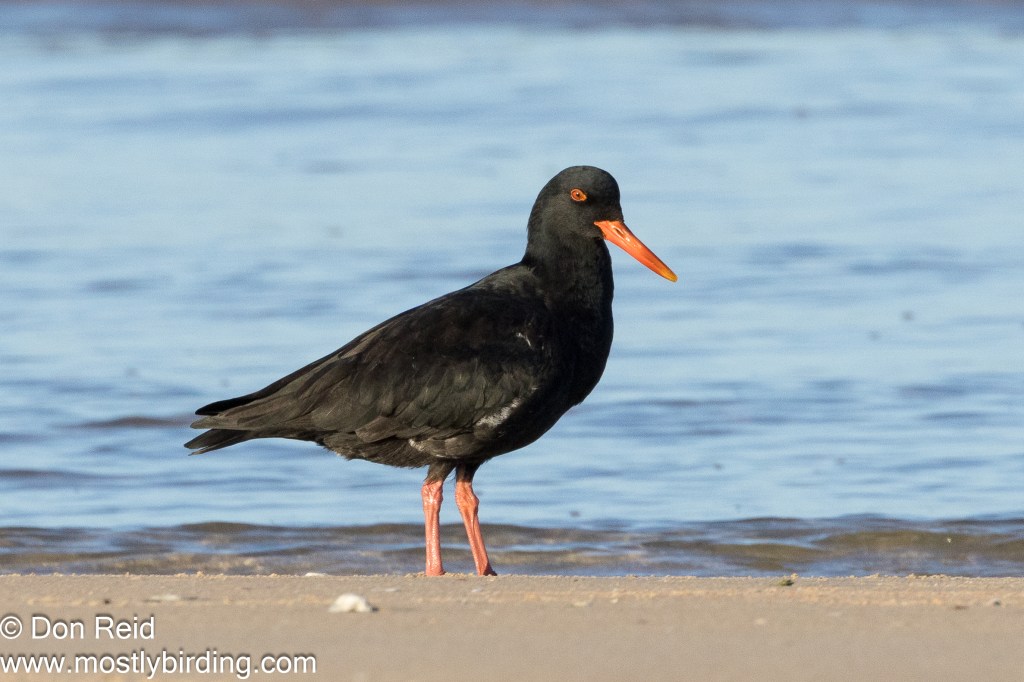
Another regular at the estuaries and rocky shorelines, and one of my favourite birds, is the African Black Oystercatcher (Swarttobie) Haematopus moquini
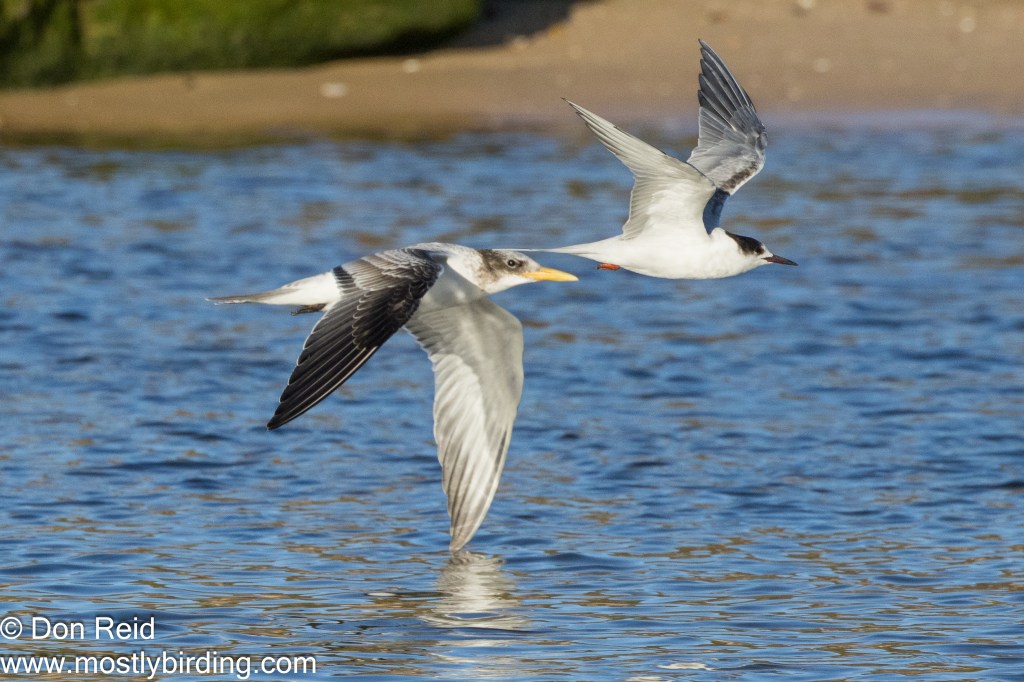
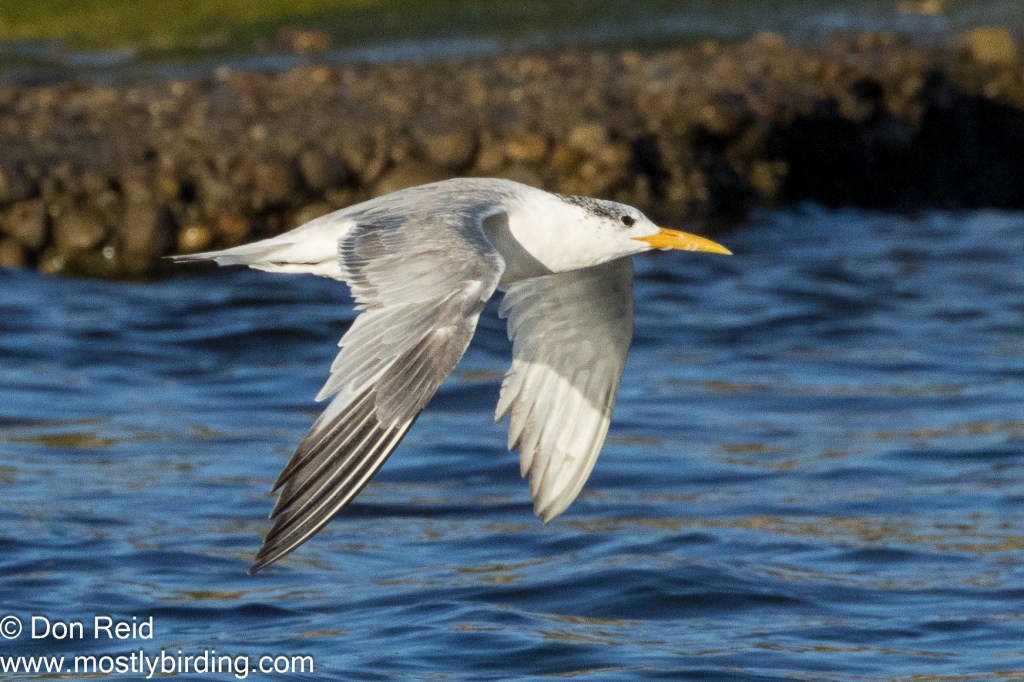
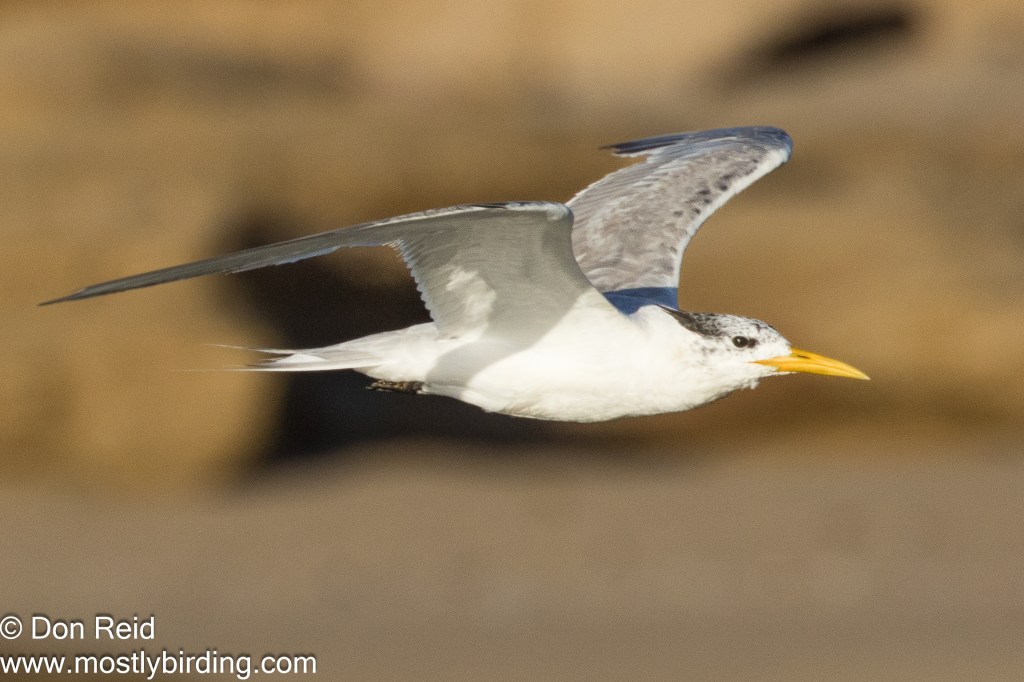
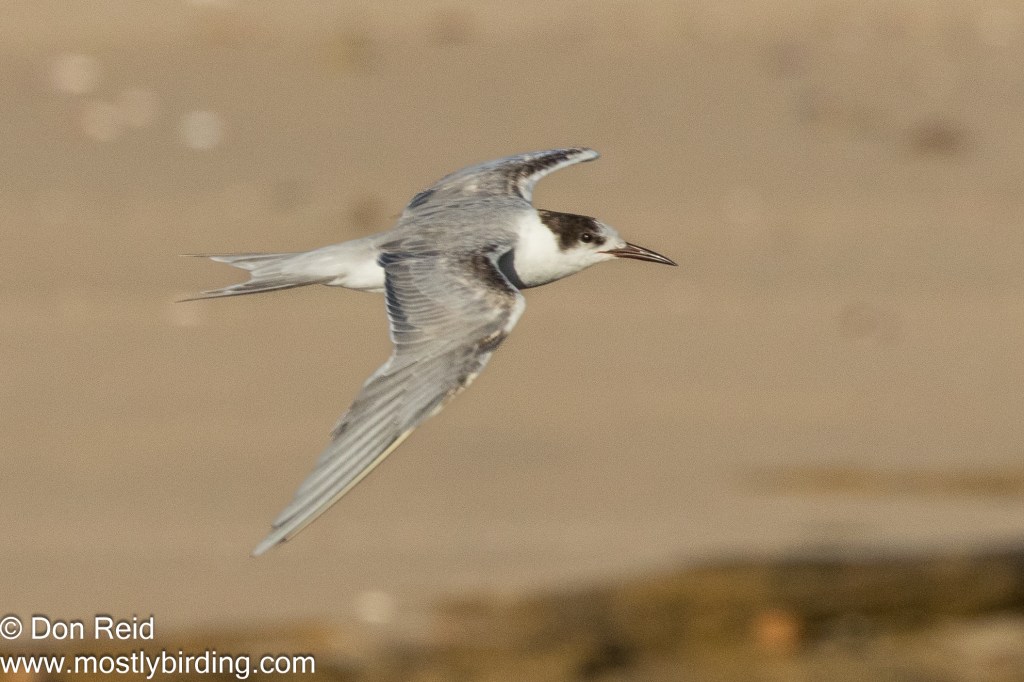
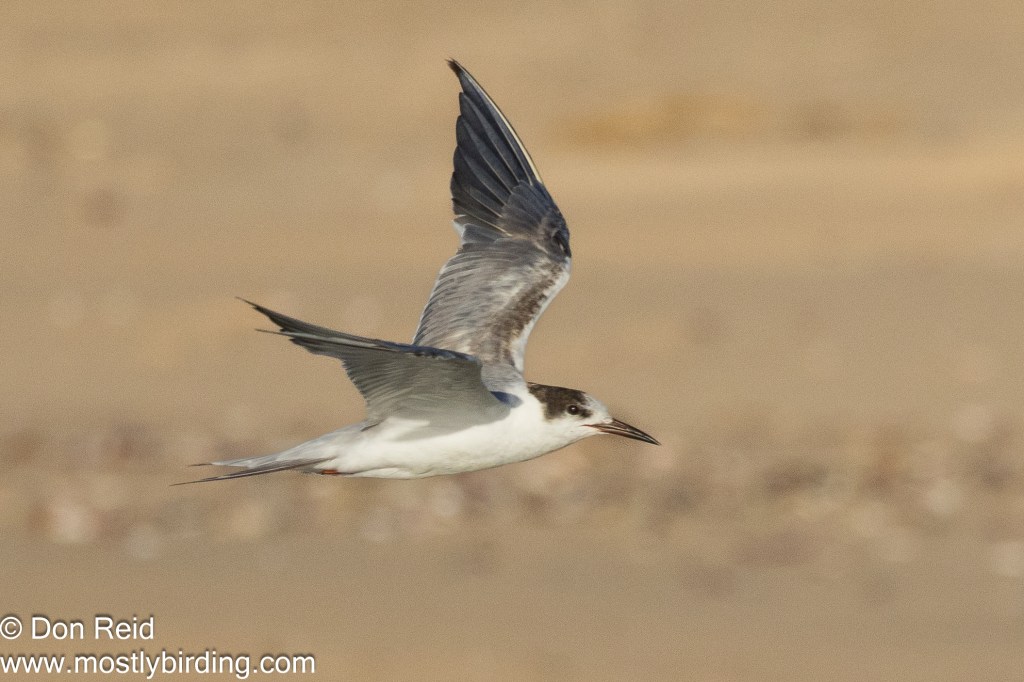
I could make out two species of Terns present – the Greater Crested Tern (Geelbeksterretjie) Thalasseus bergii – by far the most abundant tern in the area, and the Common Tern (Gewone sterretjie) Sterna hirundo, conversely less common but frequently encountered during our summer months from August through to May.
The terns were too distant for reasonable photos, but fortuitously, they started flying up river singly and in small groups, passing not far from where I was standing. The light was very favourable as I had the low sun at my back, perfect for capturing crisp photos.
That was my cue to grab my camera, adjust the settings for birds in flight, track each passing tern in flight and press the shutter button repeatedly, letting the camera’s eye- tracking technology do the rest.
This tactic usually ensures that some of the shots will be successful but does mean wading through hundreds of photos at home and selecting those that are and deleting the majority that aren’t.
This photo of the two tern species flying together was particularly pleasing as it shows the significant differences in size, plumage and bill, between the species.
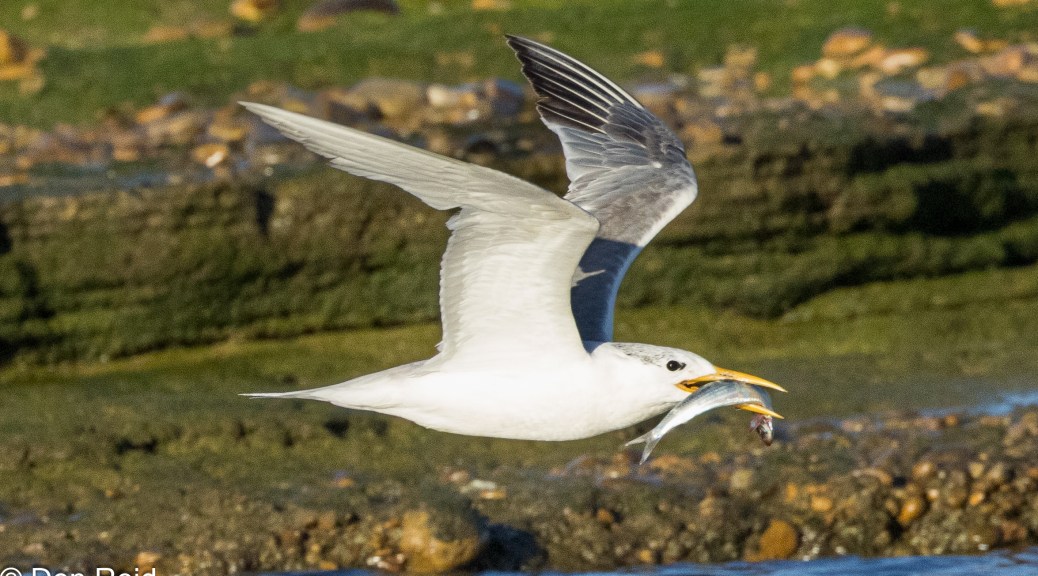
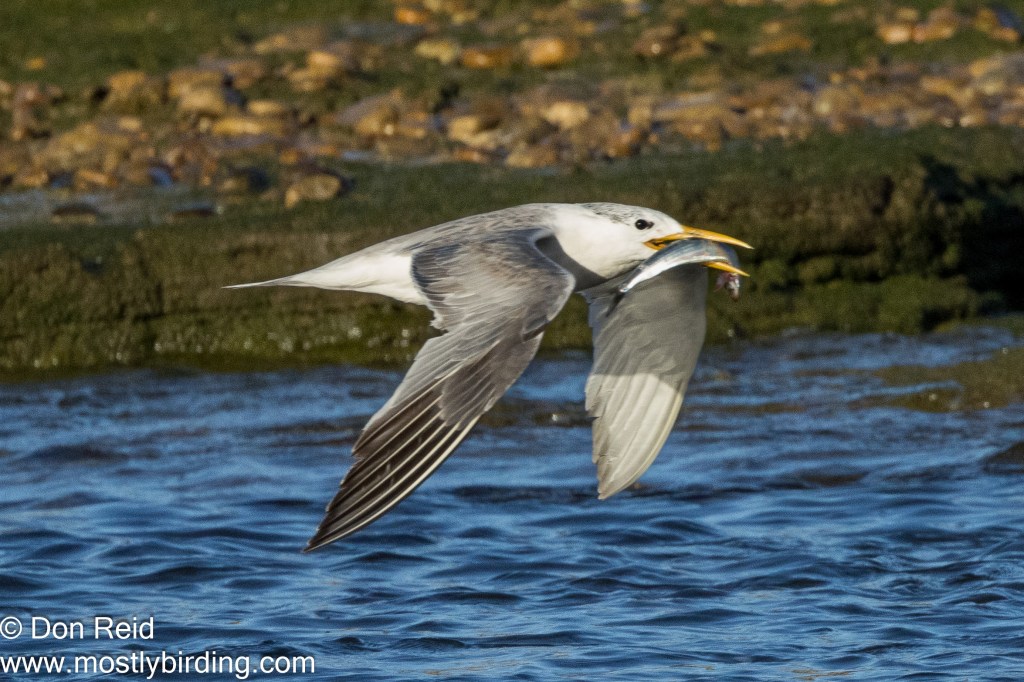
Another photo that I was thrilled to capture was this one of a Greater Crested Tern with a fish catch, no doubt on its way to feed its young one.
The terns that had headed up river had settled on exposed sand bars, so I followed their example and walked along the sand until I was closer, then scanned with my binos to see if there were any other species present.
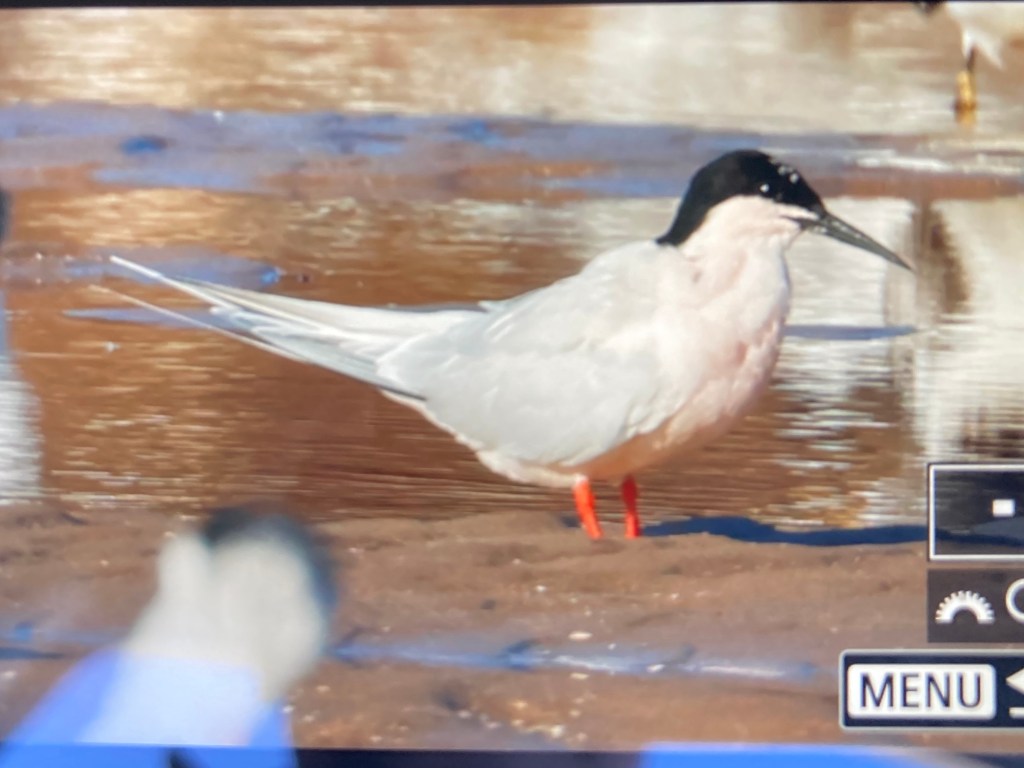
A smaller tern amongst the tens of Greater Crested (Swift) Terns drew my attention, as it seemed sleeker than the similarly sized Common Terns and had a pale pinkish wash over the breast, leading me to wonder if it could be a Roseate Tern.
I managed to get a usable photo which I posted on the local birding group and very quickly had agreement that it was indeed a Roseate Tern (Rooiborssterretjie) Sterna dougallii, which is regarded as a rarity in the Western Cape.
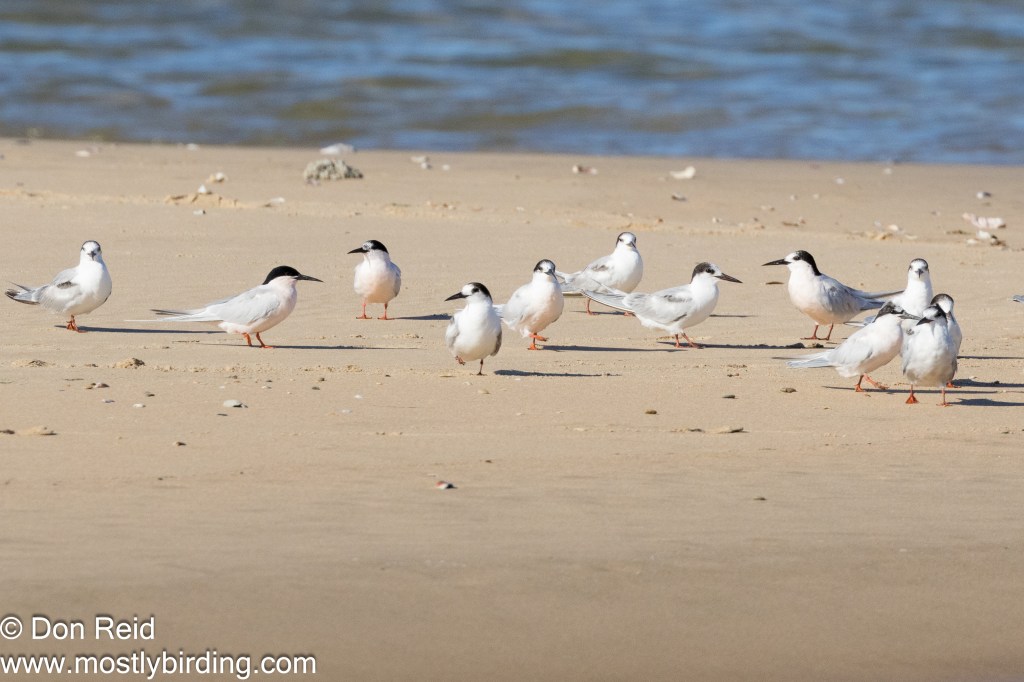
I hung around for a while longer, keeping an eye on the Roseate Tern, and was joined by another birder who had reacted to the post. It wasn’t long before a couple more Roseates joined the first one and was followed by yet more until there were a dozen or more gathered on the sand bank.
This was the first sighting of Roseates for the year for the area and was followed in the week thereafter by sightings of multiple Roseates by several birders at the same spot and at The Point.
In between all this excitement, I continued scanning the estuary for other species to add to my growing atlas card.
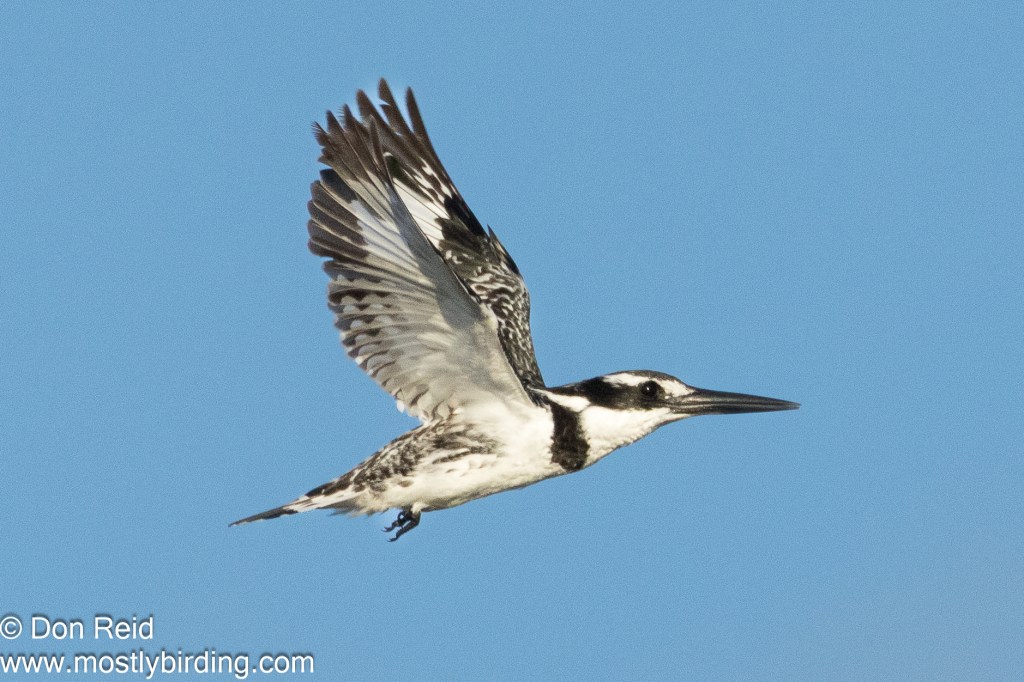
All three ‘local’ Kingfishers were present – Pied Kingfisher (Bontvisvanger) Ceryle rudis hovering over the river, Giant Kingfisher (Reusevisvanger) Megaceryle maxima flying about on the far side of the river and Brown-hooded Kingfisher (Bruinkopvisvanger) Halcyon albiventris calling in the distance.
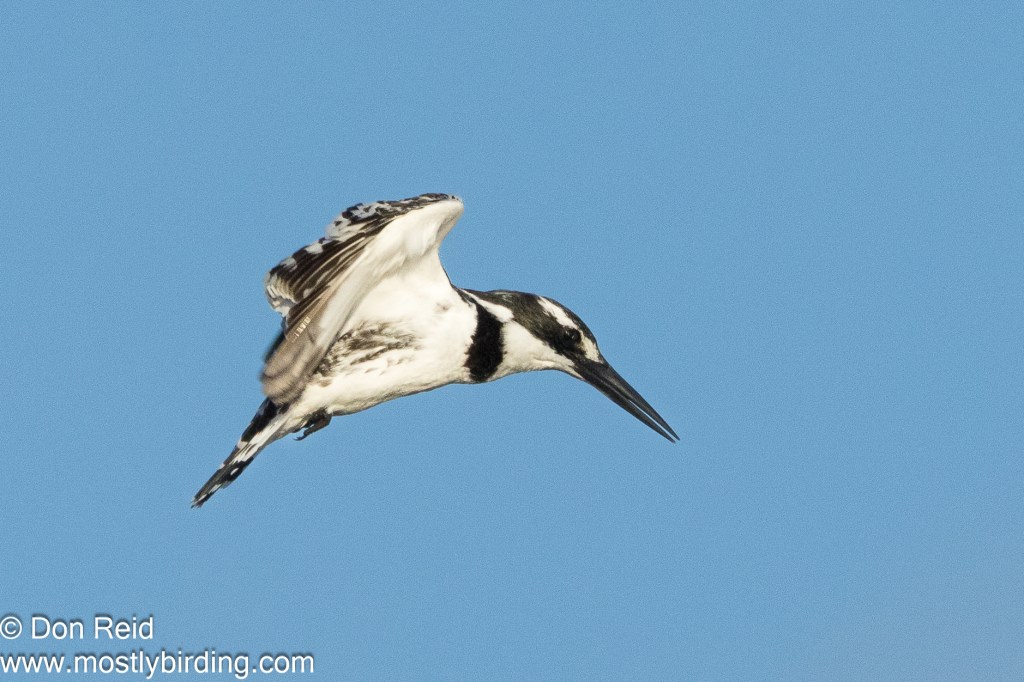
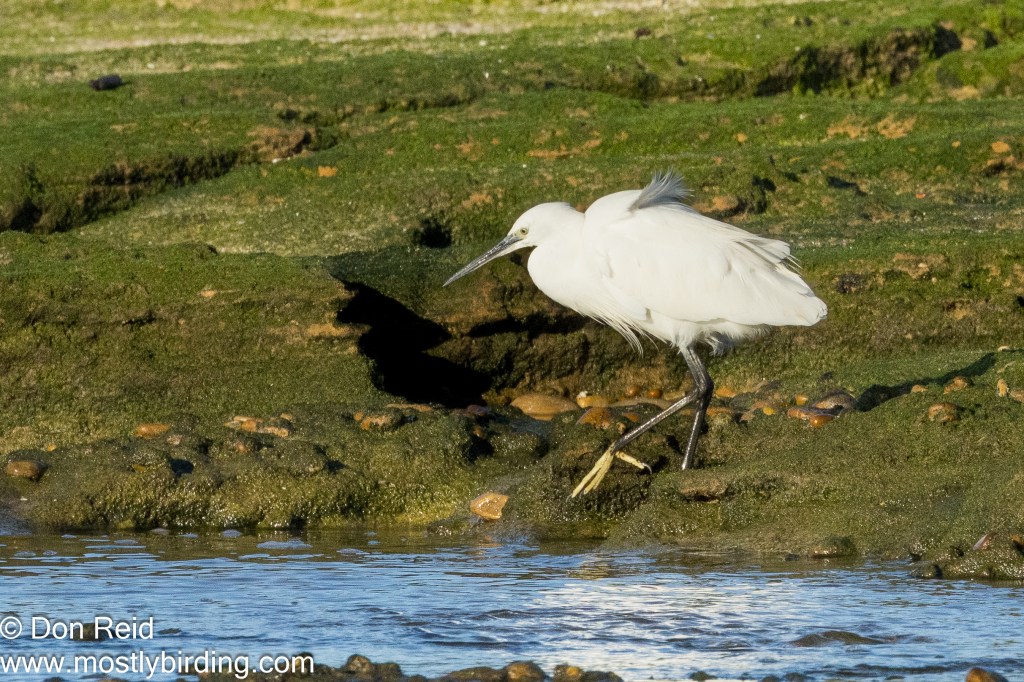
On the opposite bank of the river I could make out two birds – both all white but with very different features. One had the unmistakeable, spatular-shaped bill of an African Spoonbill (Lepelaar) Platalea alba the other was a Little Egret (Kleinwitreier) Egretta garzetta – identified by its black bill and trademark yellow feet.
I still had a few other spots in the pentad to visit, so made my way back to the main road and headed to the Hartenbos River estuary which, if you are energetic enough, is a pleasant 3,5 km walk along the beach from Klein Brak estuary in the direction of Mossel Bay (I know that because my daughter and son-in-law recently did exactly that and measured the distance)
I added a number of birds in the process, including Caspian Tern (Reuseserretjie) Hydroprogne caspia and Little Grebe (Kleindobbertjie) Tachybaptus ruficollis at Hartenbos River estuary and African Fish-eagle (Visarend) Haliaeetus vocifer calling to take my pentad total to a satisfying total of 57 species
Job done, rarity found – another great morning of atlasing!

