Ever wondered what it would be like to have your own private Nature Reserve – one you can explore at your leisure, with a major African river on its doorstep?
That seems to be part of the deal when you visit the Seboba Nature Park in Kasane, northern Botswana. Introduced to it by a colleague, I have been fortunate to visit this idyllic spot a few times this year and each time I have been the only visitor. Clearly it is not always as quiet, particularly when school and other groups visit – it was probably a question of being lucky in choosing the times we did.
Seboba Nature Park is a small nature reserve located on the outskirts of Kasane, bordered on the one side by a stretch of the Chobe River and on the other by the tarred road into Kasane, and was developed by the Botswana Government to support tourism in the area – by all accounts it has proved to be successful up to a point, but I would say it needs the support of tourism companies to persuade more tourists to visit.
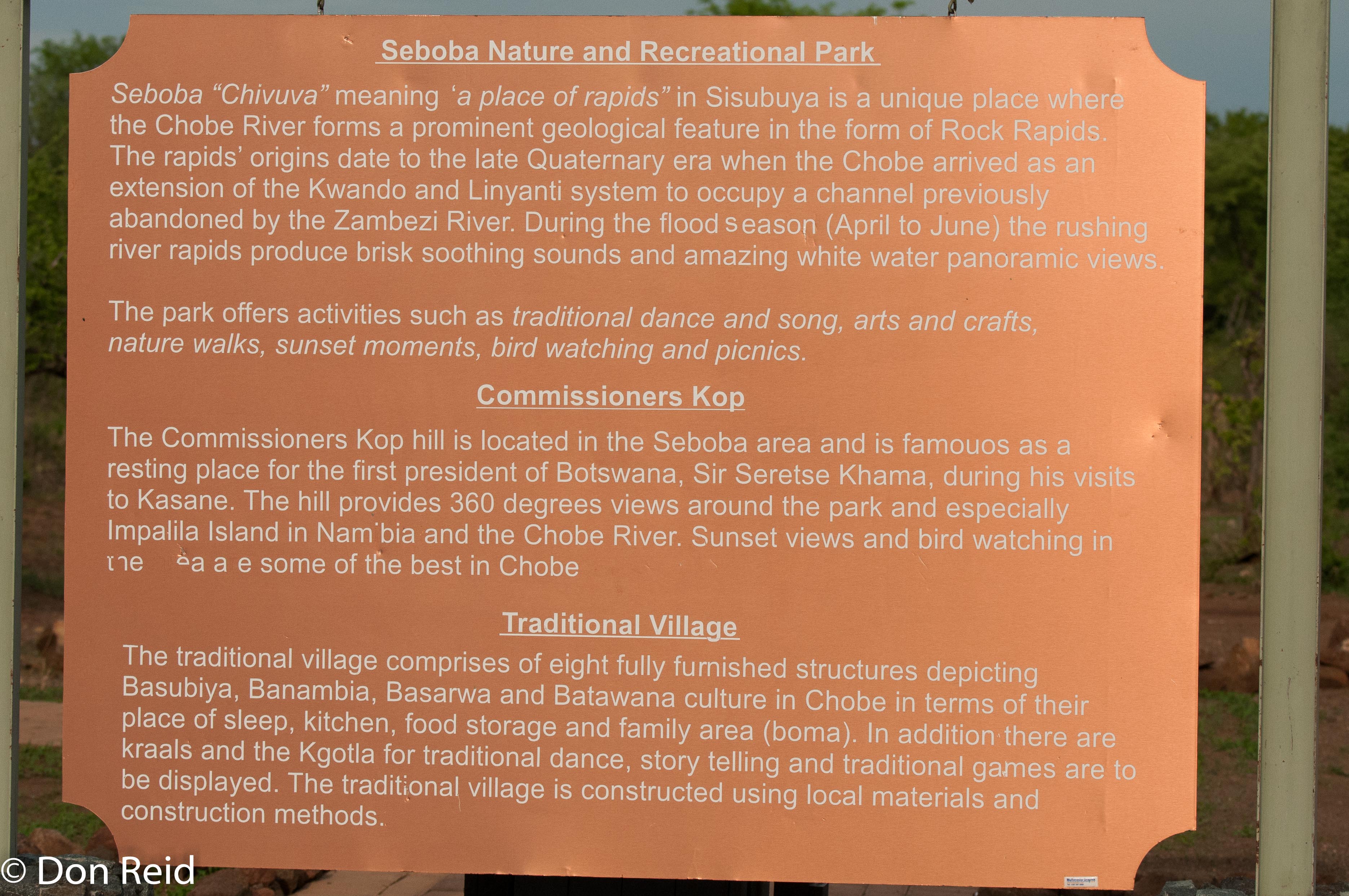
The notice board and map near the entrance spells out its origin and some of the attractions, which include cultural villages, information centre, curio shop, dance arena and walking trails :
Map of Seboba Nature Park, Kasane
There are paths from the parking area that meander down to the river’s edge and to the top of a low hill, called Commissioner’s Kop, which has a deck with tables and chairs and magnificent views up and down the river.
Deck on Commissioner’s KopView from deck on Commissioner’s Kop
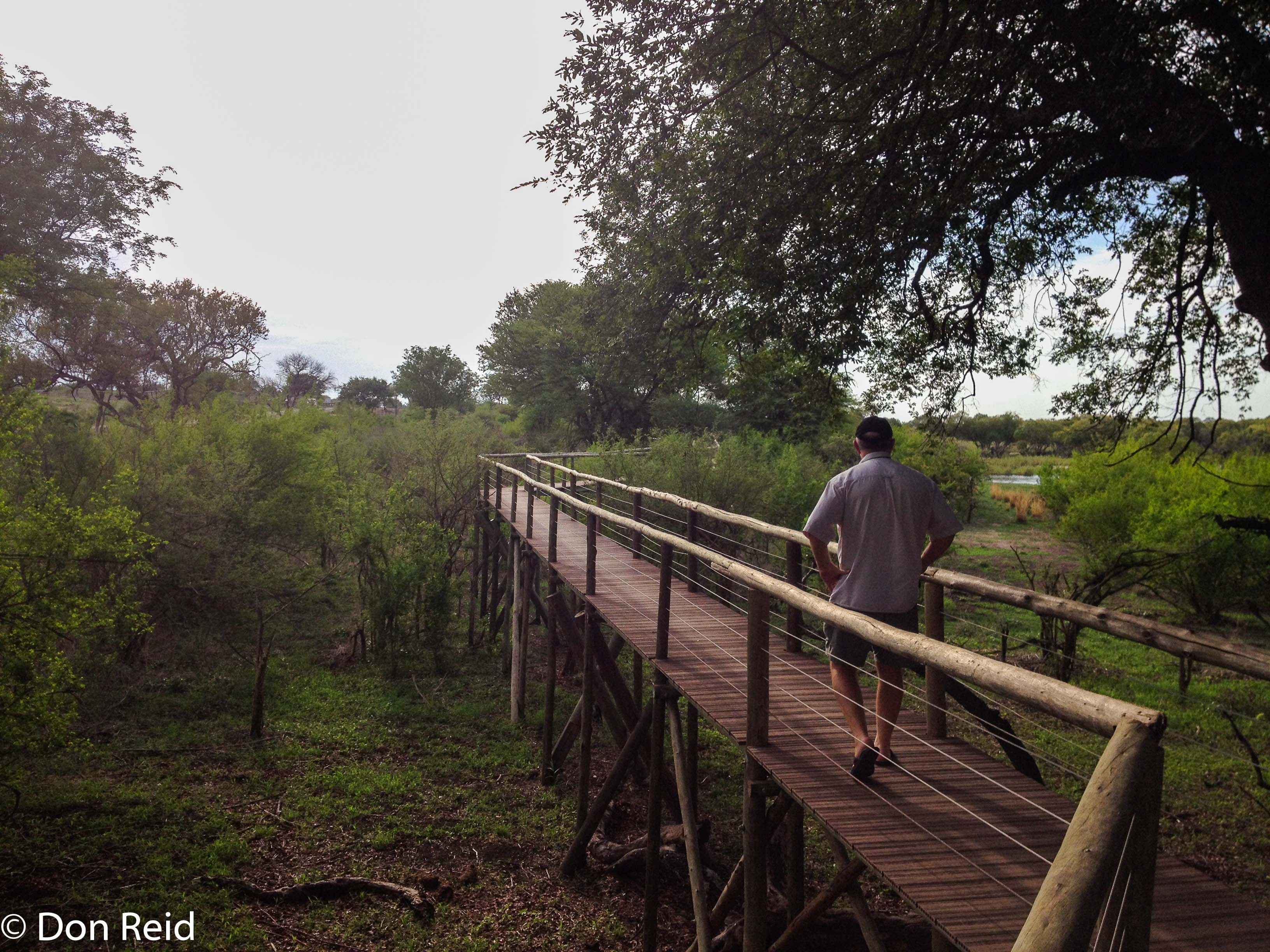
A raised boardwalk leads off the reception area and meanders through the riverine forest and bush, creating opportunities to see some of the variety of bird life and a few animals.
The boardwalk
The boardwalk ends at the picnic site, but paths take you further through the dense bush should you want to be a little adventurous – it’s best to have a ranger accompanying you from here as the chances of “bumping into” wild life increase.
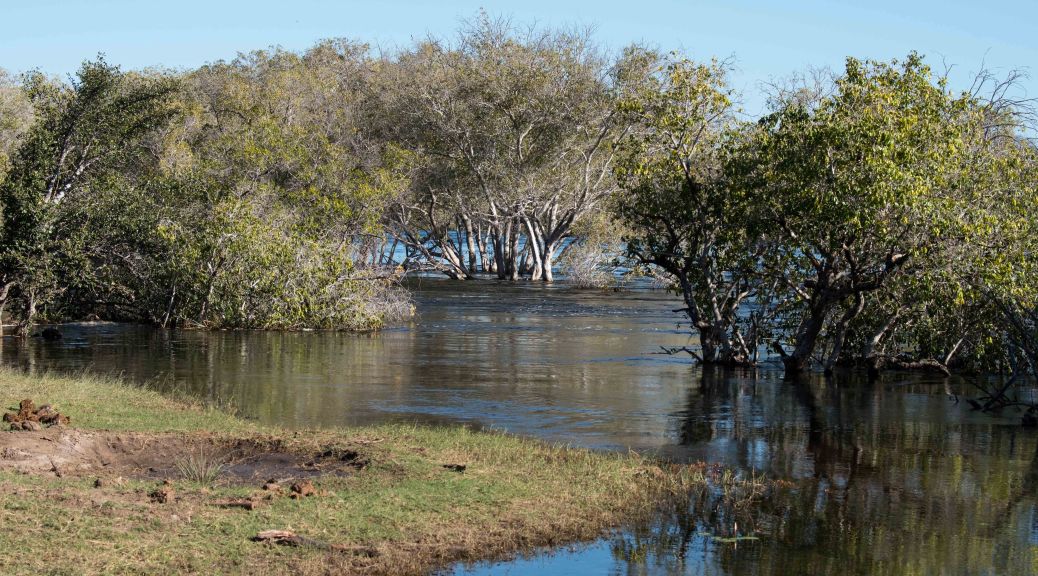
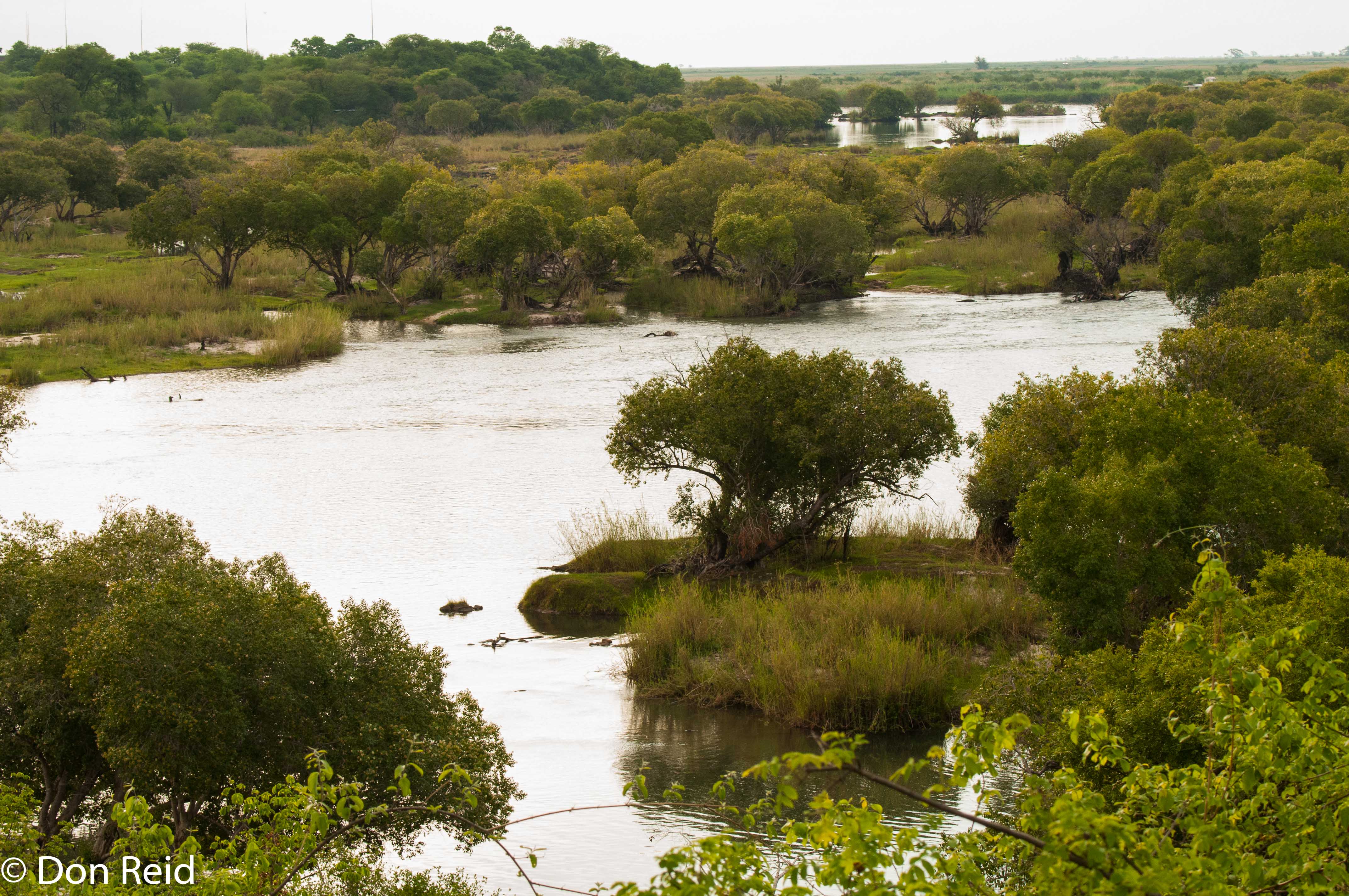
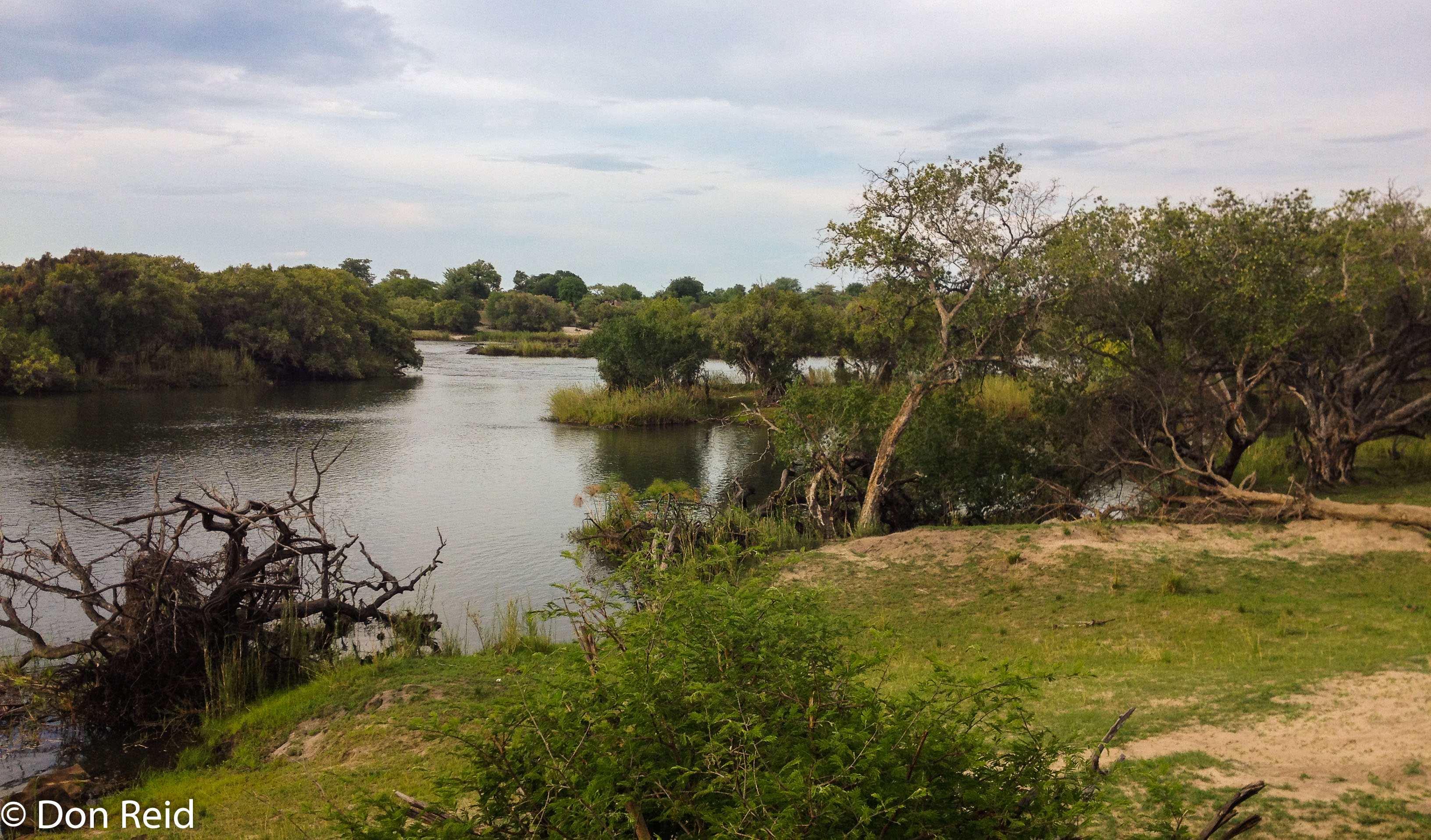
A small deck at the end of the boardwalk allows you to view the part of Chobe River known as the Seboba Rapids – a section of river with faster flowing water and small islands, some bedecked with trees and favoured by hundreds of birds for roosting and nesting.
Chobe RiverChobe River
Seboba is not a game park as such, but a wildlife corridor to the river has been maintained by leaving openings in the fence between the adjoining road and the park, which is regularly used by elephant and other wild life to gain access to the river, as they have for millennia in all likelihood.
One of my visits turned into a bit of an adventure and reminded me that the area is very much “Wild Africa”…….
After parking near reception, I slung my binoculars around my neck and my camera over my shoulder (two items which have become part of my outfit when birding) and headed down the track to the river. I could not help noticing the fresh-looking elephant tracks in the sand and equally fresh-looking elephant dung, which I had to step around in places, bush signs which had my senses on high alert.
The river was not far, so I carried on to the river bank and started birding, while looking around carefully all the while. Just then, one of the rangers came down the track to tell me there were elephants in the bushes to my right and suggested, with a hint of urgency, that I move away . I could see the elephants through a gap in the trees and decided the ranger had a point, so I followed his further suggestion that we head along the river, the ranger in front and me behind. We stuck to the river’s edge, which was flowing high, wide and strong from the rains in Angola some weeks prior.
We were now walking away from the elephants, so I was feeling a tad more relaxed and enjoying the solitude of the river and the adjoining thick bush – until I started thinking about crocodiles, having seen the warning notices. Besides that, we were now literally on the edge of the Chobe River, even treading in the water where the steep bank caused my shoes to slip here and there.
At least they warn you
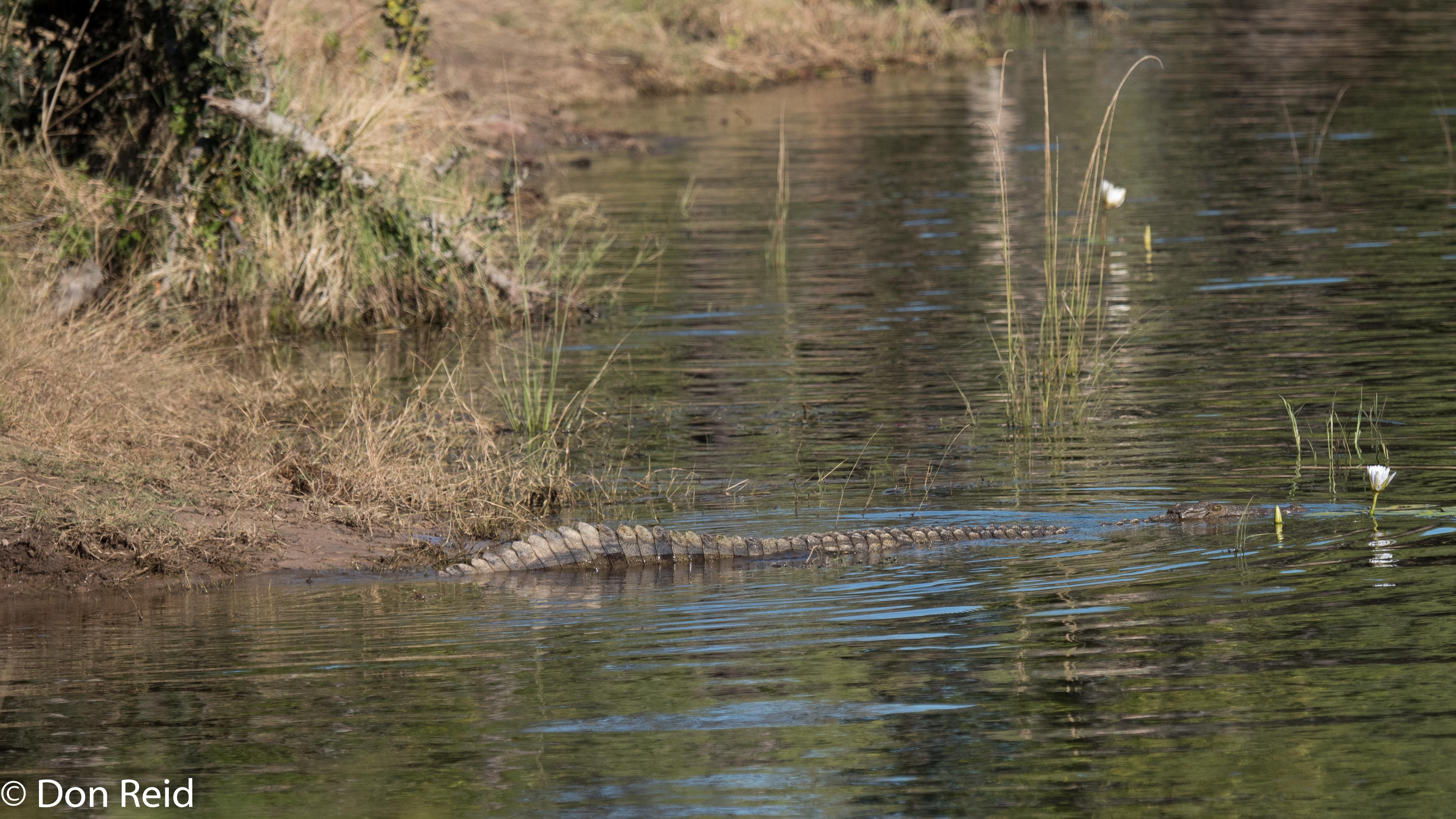
I casually asked the ranger whether crocodiles were present and he nodded to say yes – not a minute later a loud splash ahead of us announced the first croc as he was scared off by our approach. Further ahead we spotted a croc about 50m away, lying in the shallows next to the bank – we approached slowly and cautiously and as we got closer the croc slid silently into the river, swam behind a partly submerged tree and eyed us as we passed.
A croc is spotted not far aheadHe has not seen us yetThe croc slides into the river as we get closer
All in all, an eventful and exciting walk that I had not planned for at all – Africa can make you feel very small and vulnerable at times!
The Birding
My primary purpose in visiting Seboba was, of course, to do some birding and the park did not disappoint. My first sighting on my first visit was Collared Palm-Thrush on the reception building’s roof – a most desirable species for Southern African birders. This set the tone for what could be expected and as I explored further the list grew, including a pleasing number of “specials” –
Along the boardwalk –
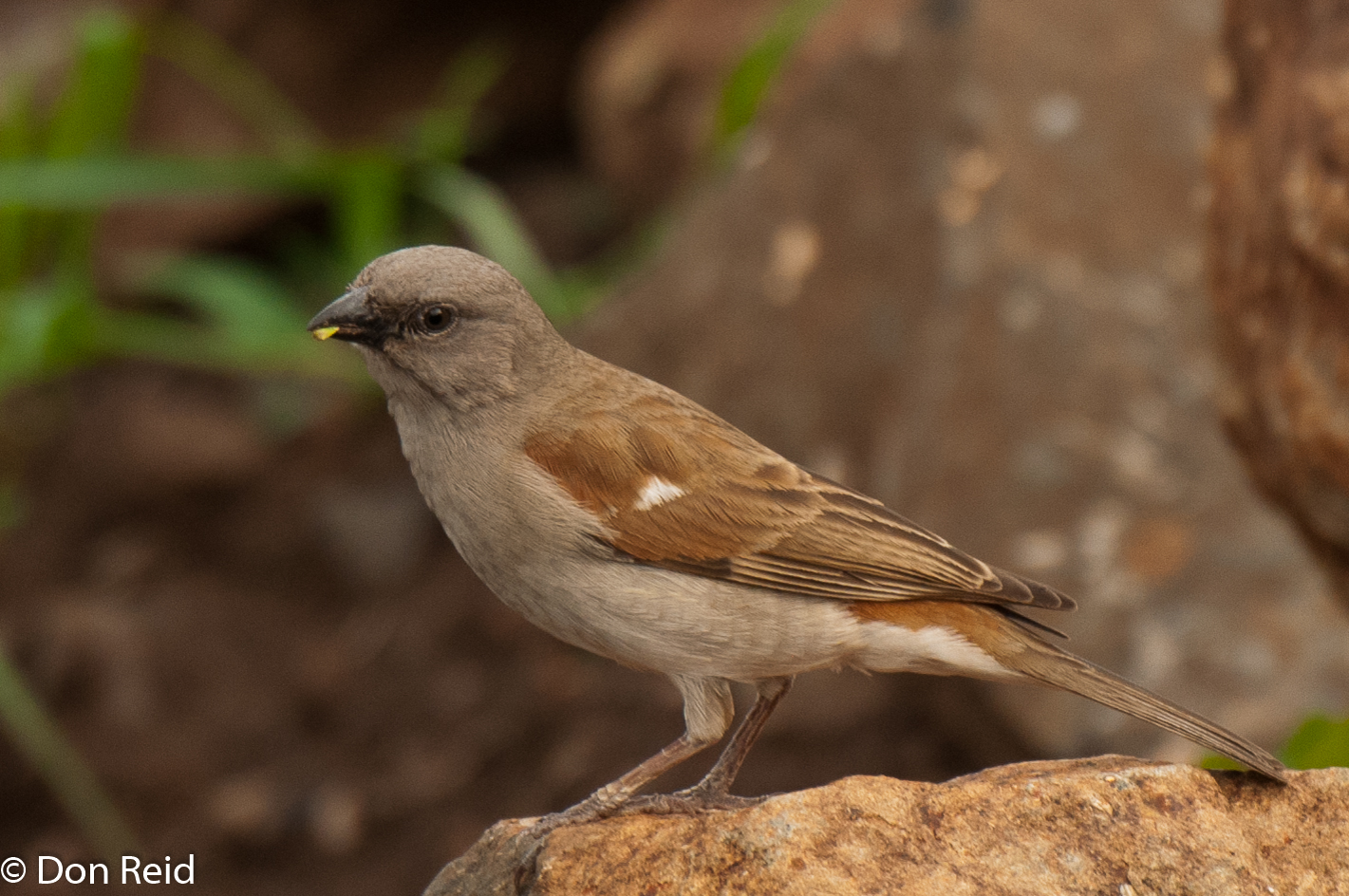
Grey-headed Sparrow, not scarce by any means but interesting because Kasane is one of the few places in Southern African region where both Southern and Northern species occur. This one turned out to be the Southern species
Noisy Arrow-marked Babblers
Trumpeter Hornbills with their eerie “crying-baby” calls echoing through the woodland
Bradfield’s Hornbill
Broad-billed Roller
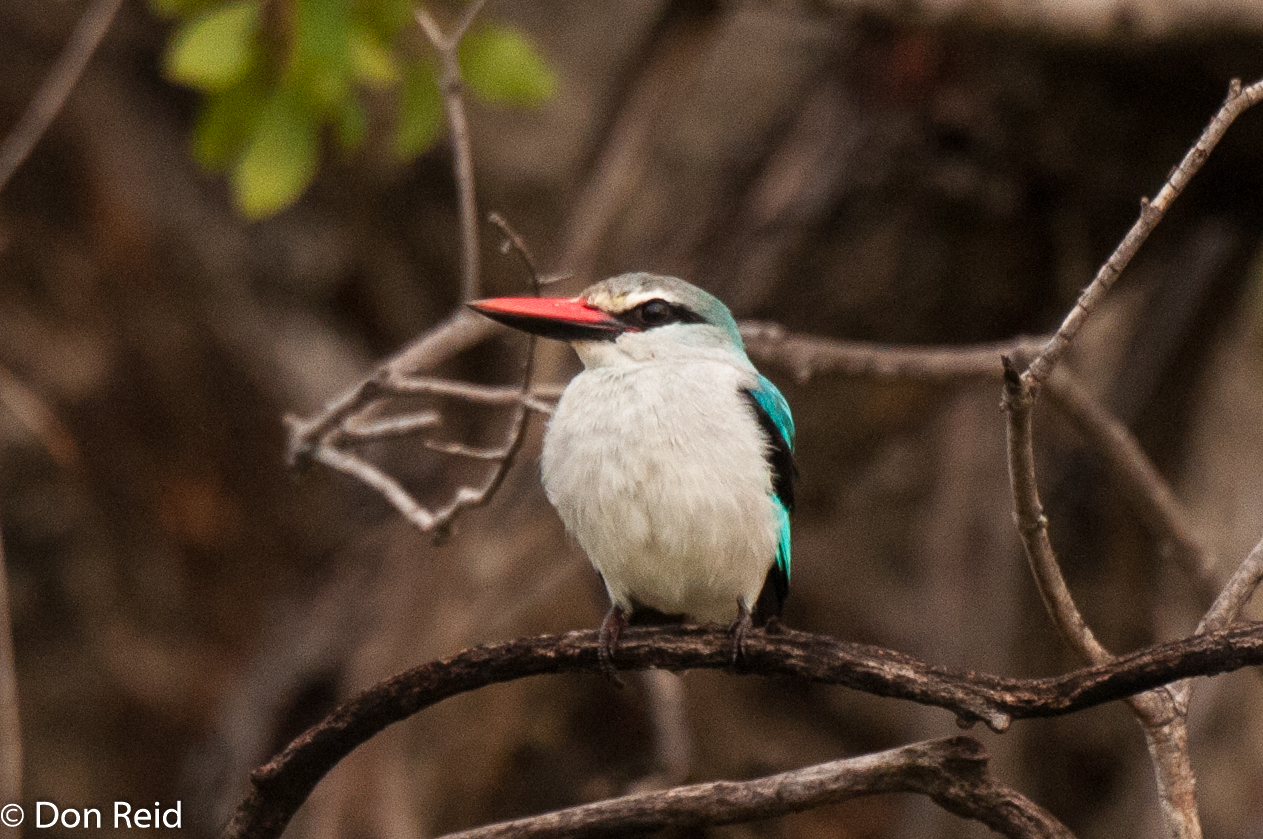
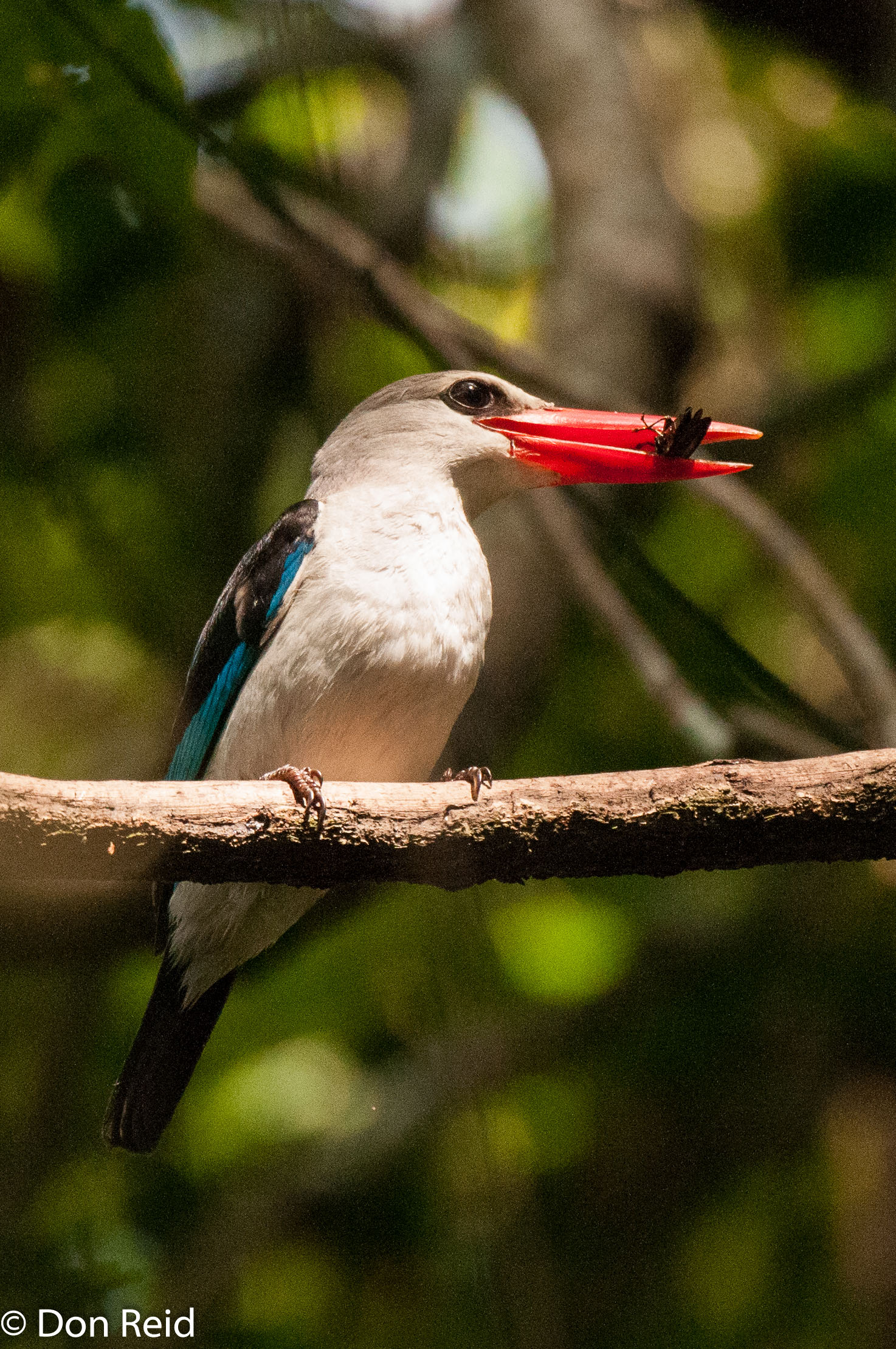
Woodland Kingfisher, its position given away by its trilling call
Southern Grey-headed Sparrow, Seboba Nature Park KasaneWoodland Kingfisher, Seboba Nature Park – Kasane
Commisioner’s Kop viewing point –
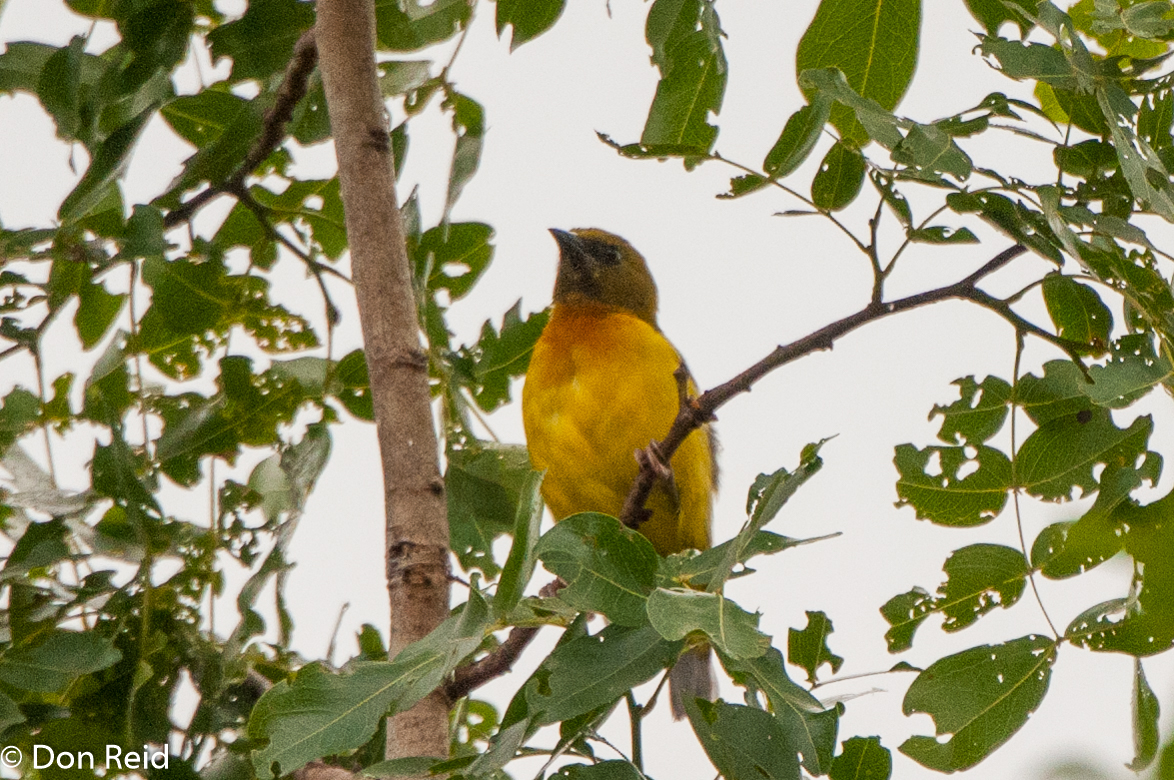
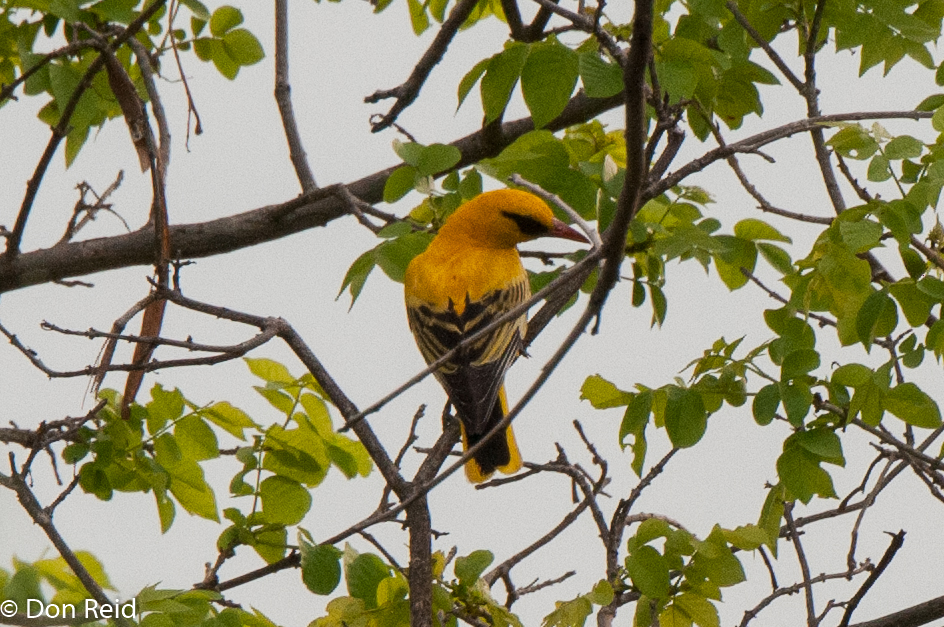
African Golden Oriole in its bright yellow plumage
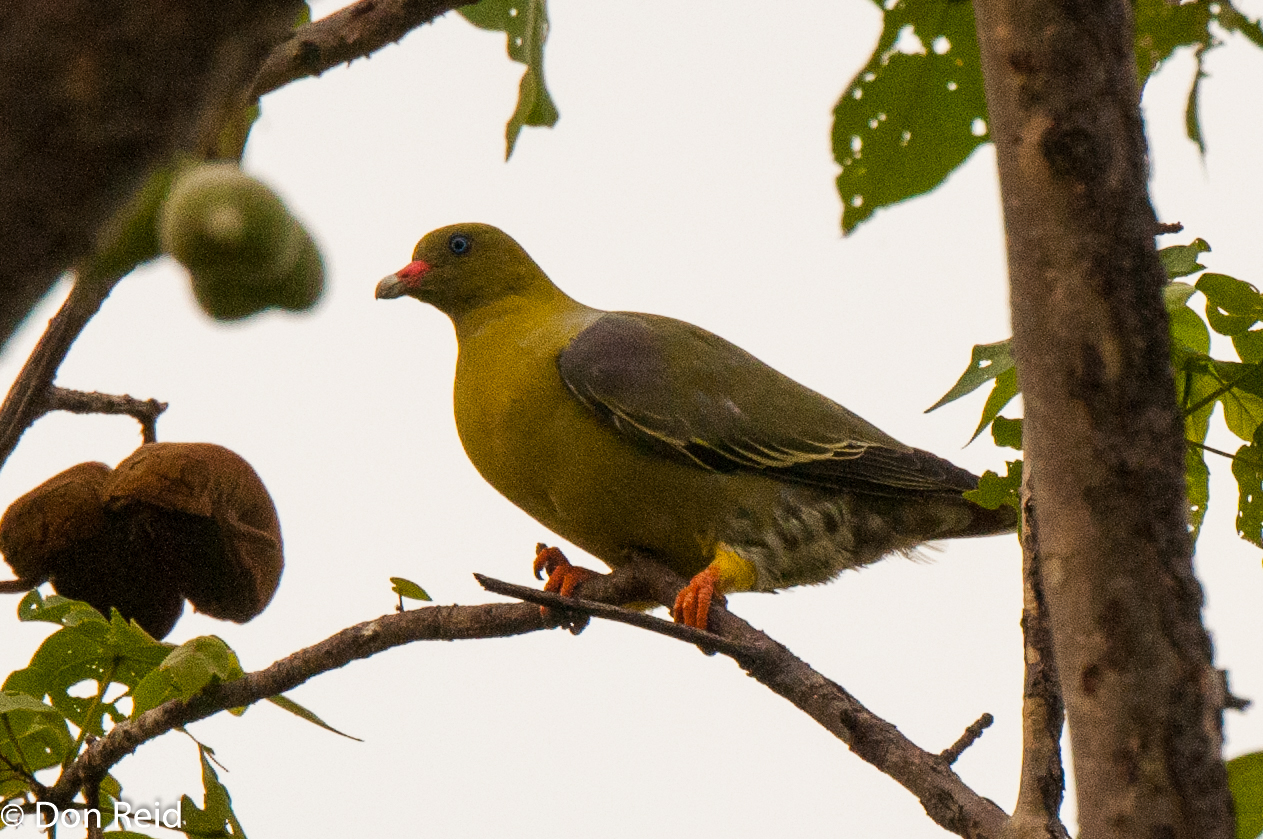
African Green Pigeon – good at hiding behind foliage
Emerald-spotted Wood-Dove
African Golden Oriole, Seboba Nature Park KasaneAfrican Green Pigeon, Seboba Nature Park Kasane
Down by the riverside –
African Jacana
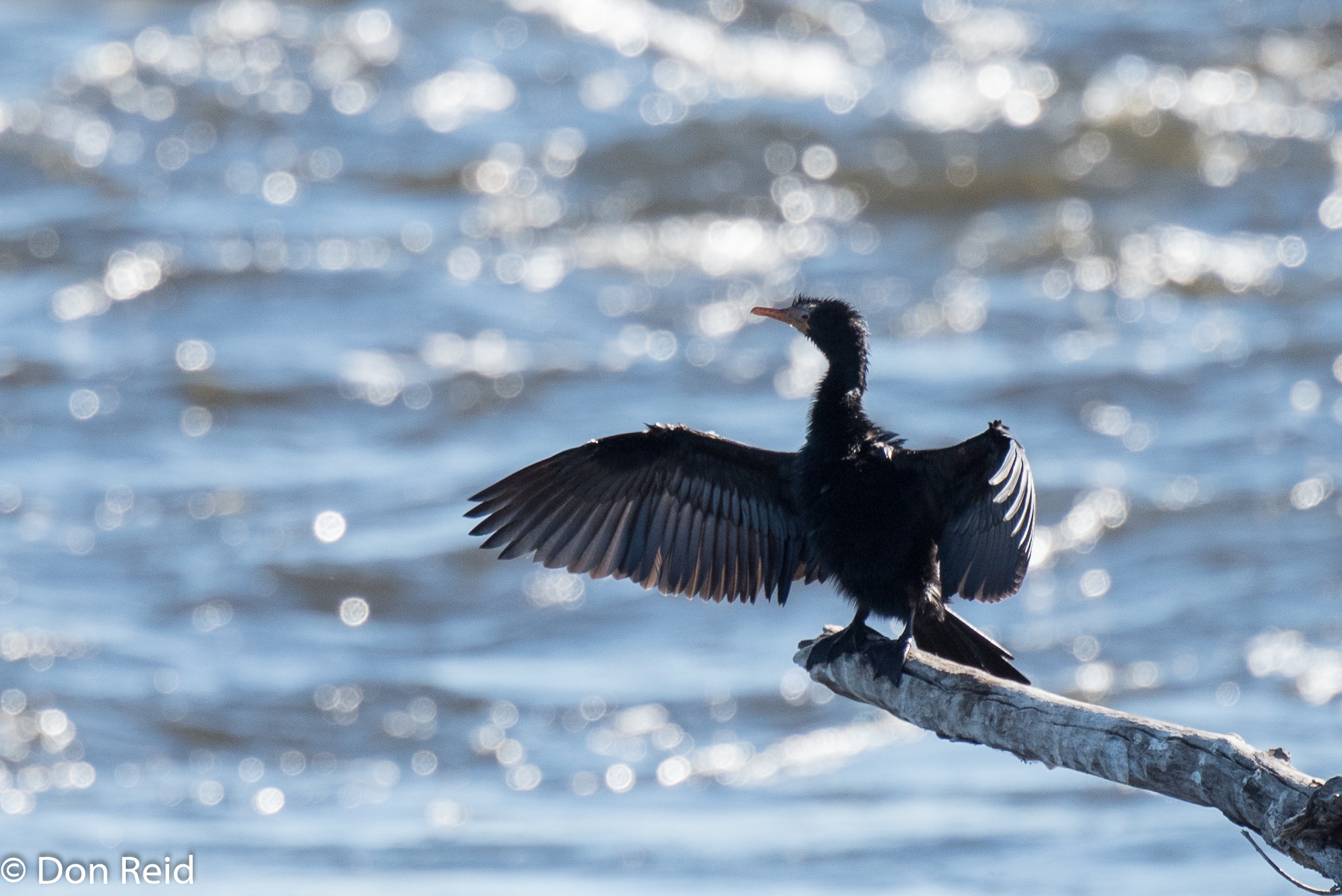
African Darter
Yellow-billed Stork
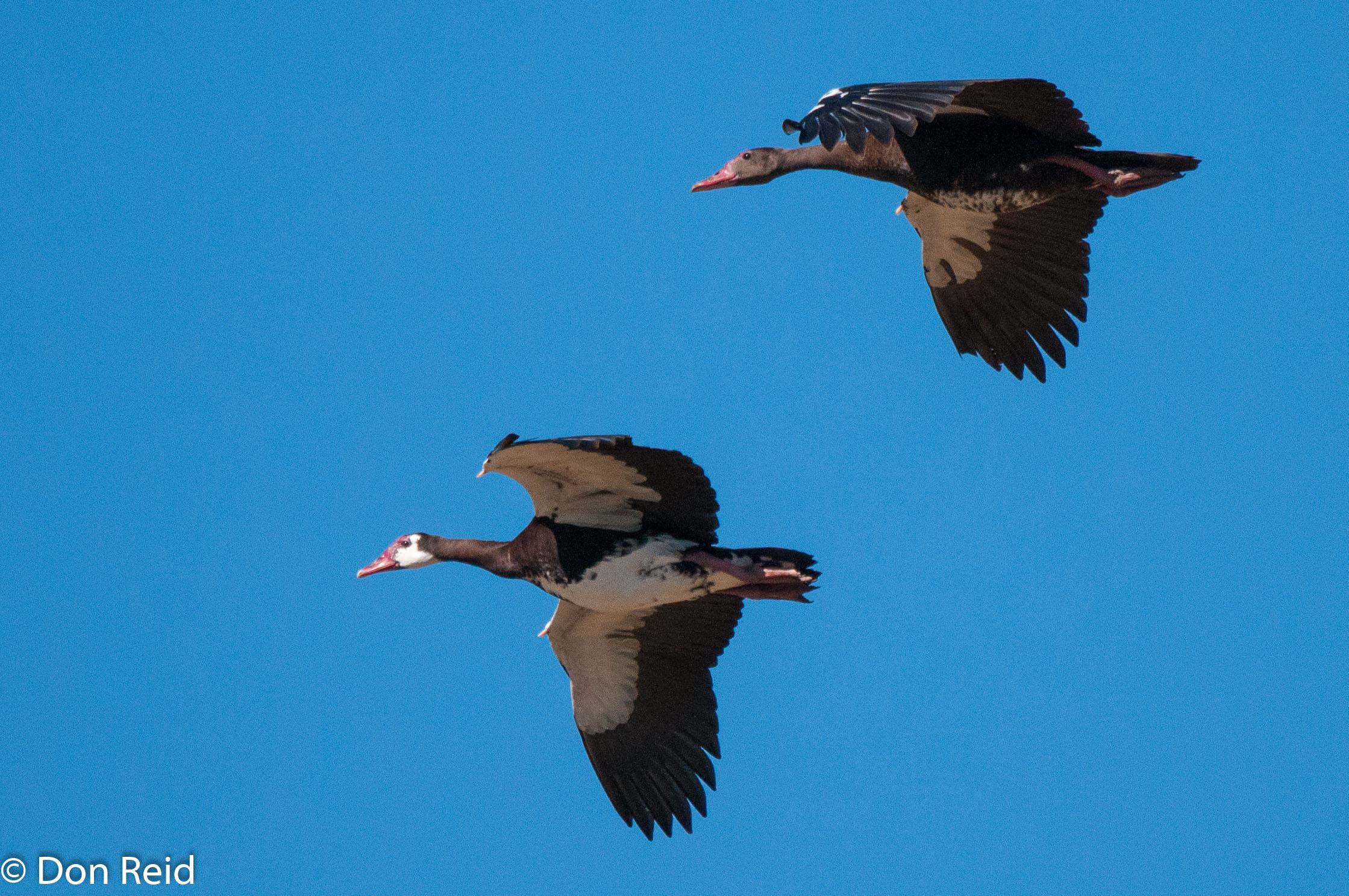
Pygmy Goose
African Openbill in the shallows, probing for molluscs
Reed and White-breasted Cormorants in numbers
Water Thick-knee, flying away low over the river when disturbed
White-crowned Lapwing, also prone to flying off but often landing a short distance further
Water Thick-knee, Seboba Nature Park KasaneWhite-crowned Lapwing, Seboba Nature Park – KasaneReed Cormorant, Seboba Nature Park Kasane
Hillside and open areas –
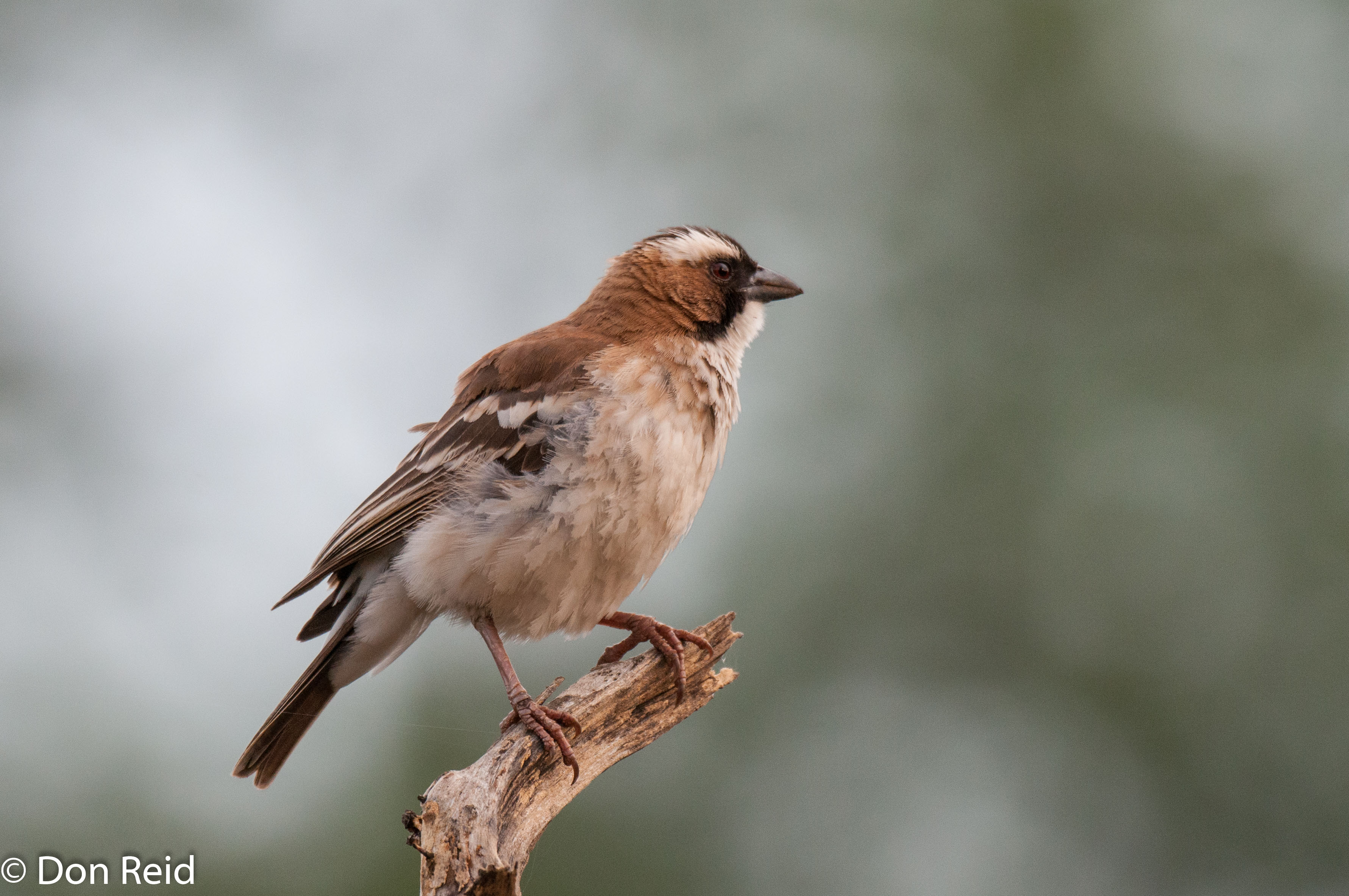
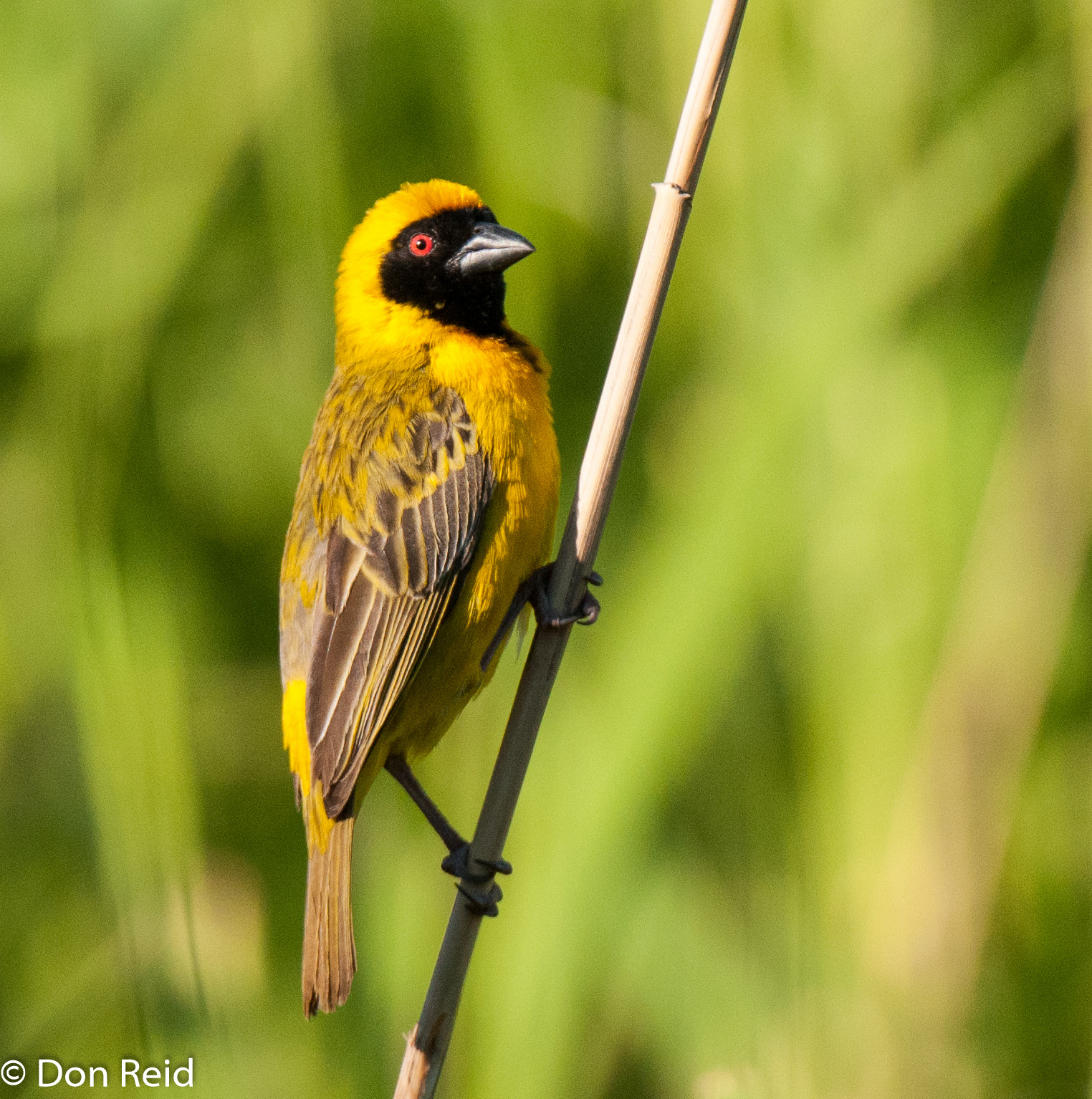
White-browed Sparrow-Weaver
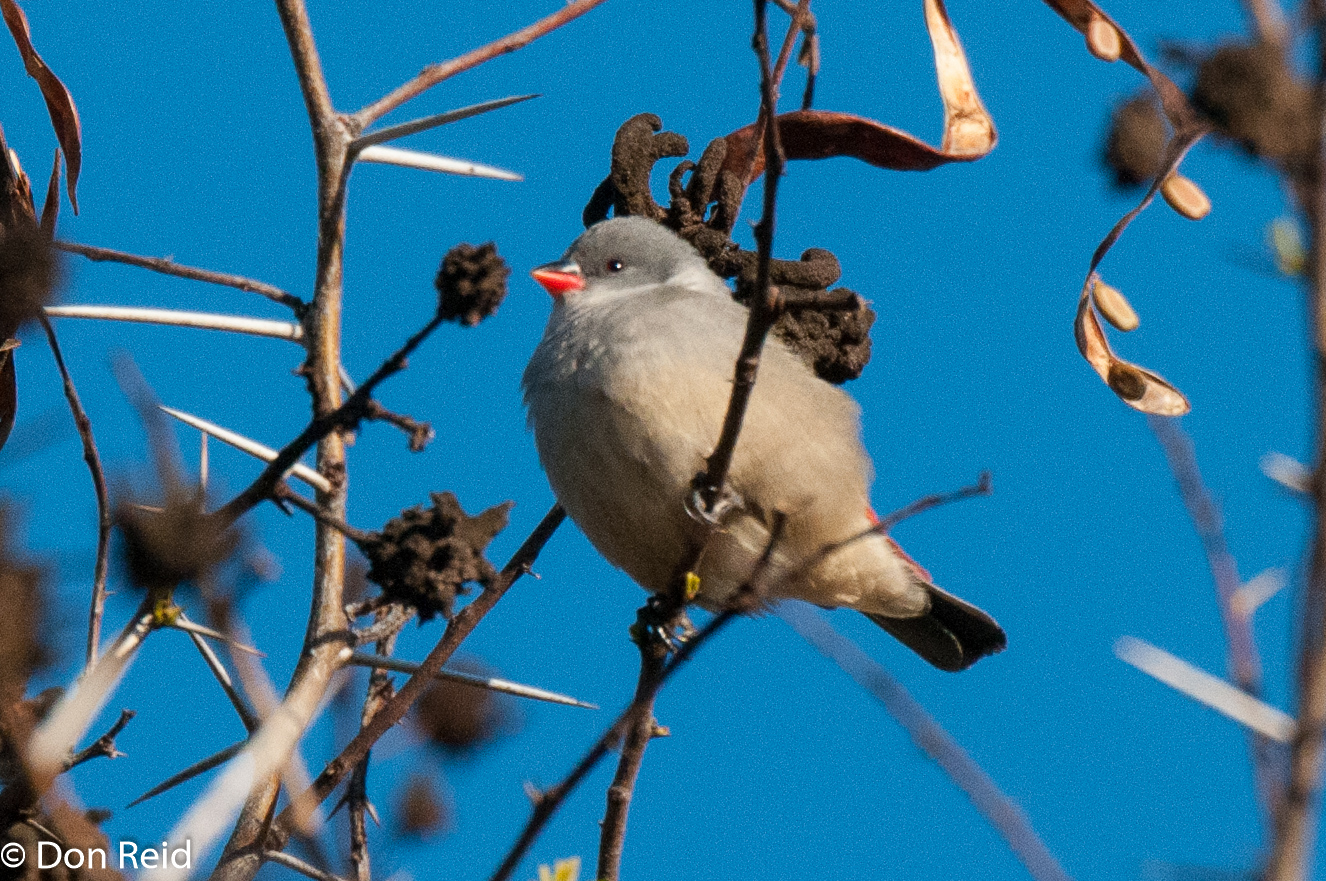
Blue Waxbill
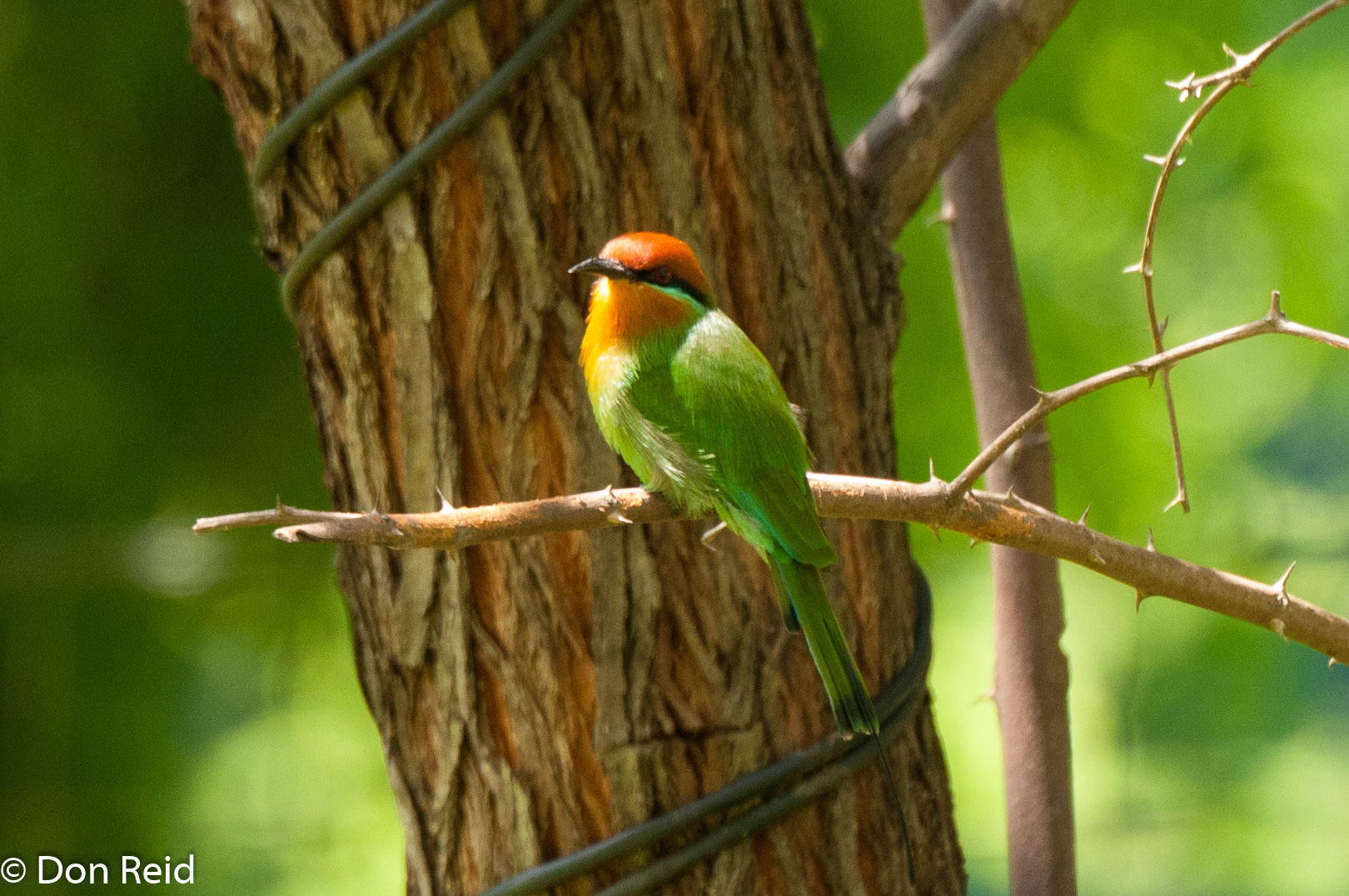
Little Bee-eater
White-browed Sparrow-Weaver, Seboba Nature Park – KasaneBlue Waxbill, Seboba Nature Park Kasane
This small park is well worth a visit even if for just an hour or two – the variety of habitats in a concentrated area can be covered in a short time, although the longer you can stay the better … oh and don’t wander around too much unless there’s a ranger nearby (which they tend to be)
Special thanks to Derek Thomas for showing me this spot, and others, in Kasane.
As I mentioned in my previous post about twitching (https://mostlybirding.com/2016/02/23/a-twitch-or-two/), I hardly consider myself to fall into the category of keen twitchers, those hardy, sometimes mildly bonkers birders who let nothing stand in the way of seeing rare birds that turn up in Southern Africa.
Such was the case when a pair of Yellow-throated Leafloves (interesting name!) turned up and started nesting at a riverside lodge near Katima Mulilo in Namibia, some 200 kms south of their normal distribution in Zambia and northwards. Suddenly the Southern African region had a brand new bird added to the regional list!
The reports started coming through in mid February 2016 of this unexpected pair of birds in the gardens of the Caprivi Houseboat Safari Lodge near Katima Mulilo and there was soon a gold-rush like invasion of keen twitchers heading to this remote part of Southern Africa via plane and car from various places in South Africa and Namibia.
The Twitch
I watched with interest the messages coming through from Trevor Hardaker and the SA Rare Bird Facebook page, knowing that I would be going to Kasane in northern Botswana for a project I am involved in, during the 1st week in March. I also had a look at the map and realized that Katima Mulilo fell nicely within my “twitch limit” of around 2 hours drive, being about 120 kms from Kasane with a border crossing from Botswana to Namibia to negotiate along the way. So, if the Leafloves hung around until then, I planned to “pop over” the border for a quick visit and hopefully a new tick on my life list for Southern Africa.
Tuesday 1st March
Come Tuesday, I caught the daily flight from Joburg to Kasane – a day early for my site visit so that I could spend a night in Katima Mulilo (KM) and be back in time for the project commitments the following day. I had arranged for a bakkie (pickup) to be available and shortly after landing I set off for KM via Ngoma border post. The border formalities went smoothly, perhaps because I was the only customer in an hour or two.
From Kasane to Ngoma the public road (tarred) bisects the northernmost section of Chobe Game Reserve and the landscape is pristine woodland all the way.
The road to Katima Mulilo
Once into the Caprivi in Namibia, the scenery changes to more open, patchy woodland interspersed with small settlements and small-scale agriculture.
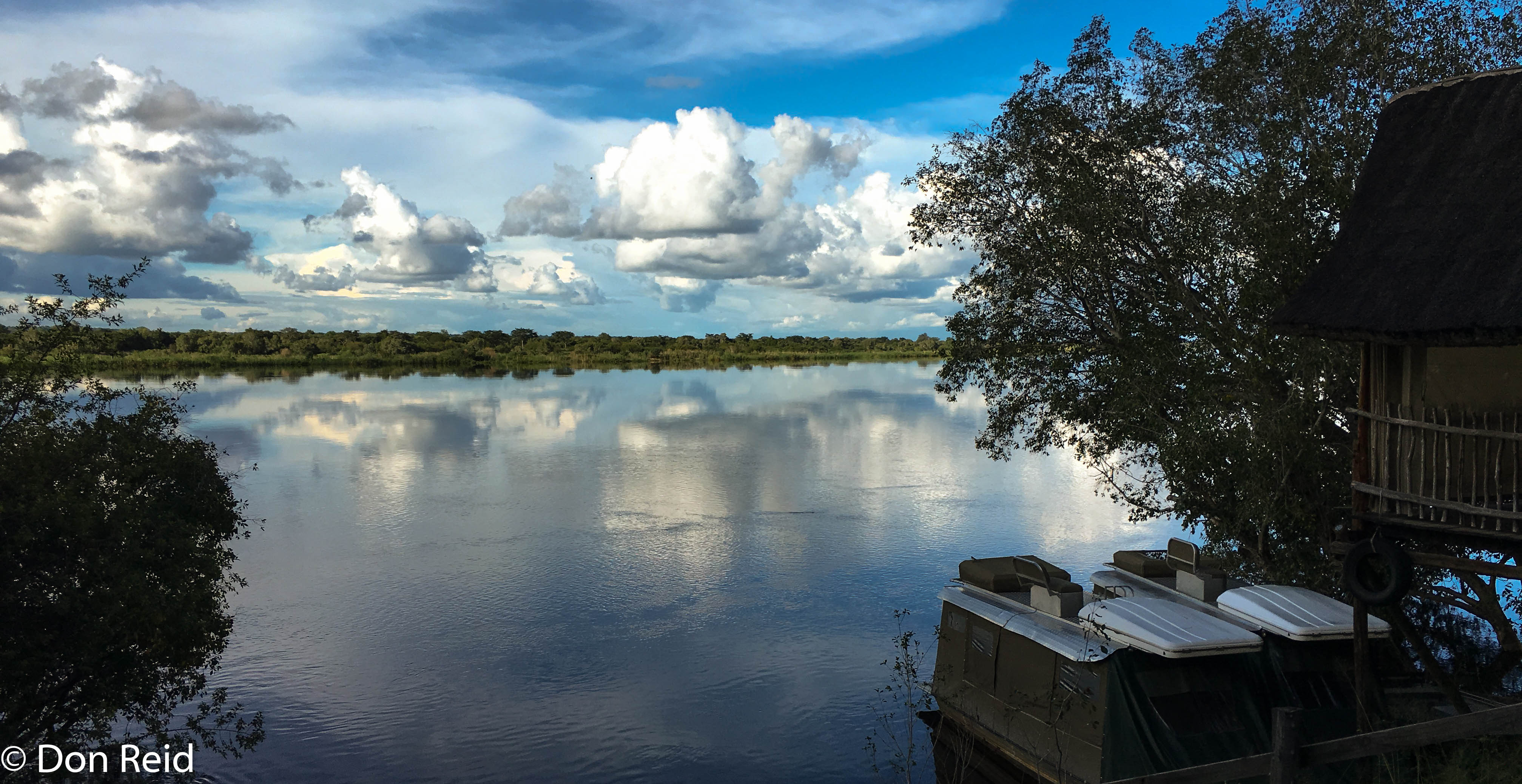
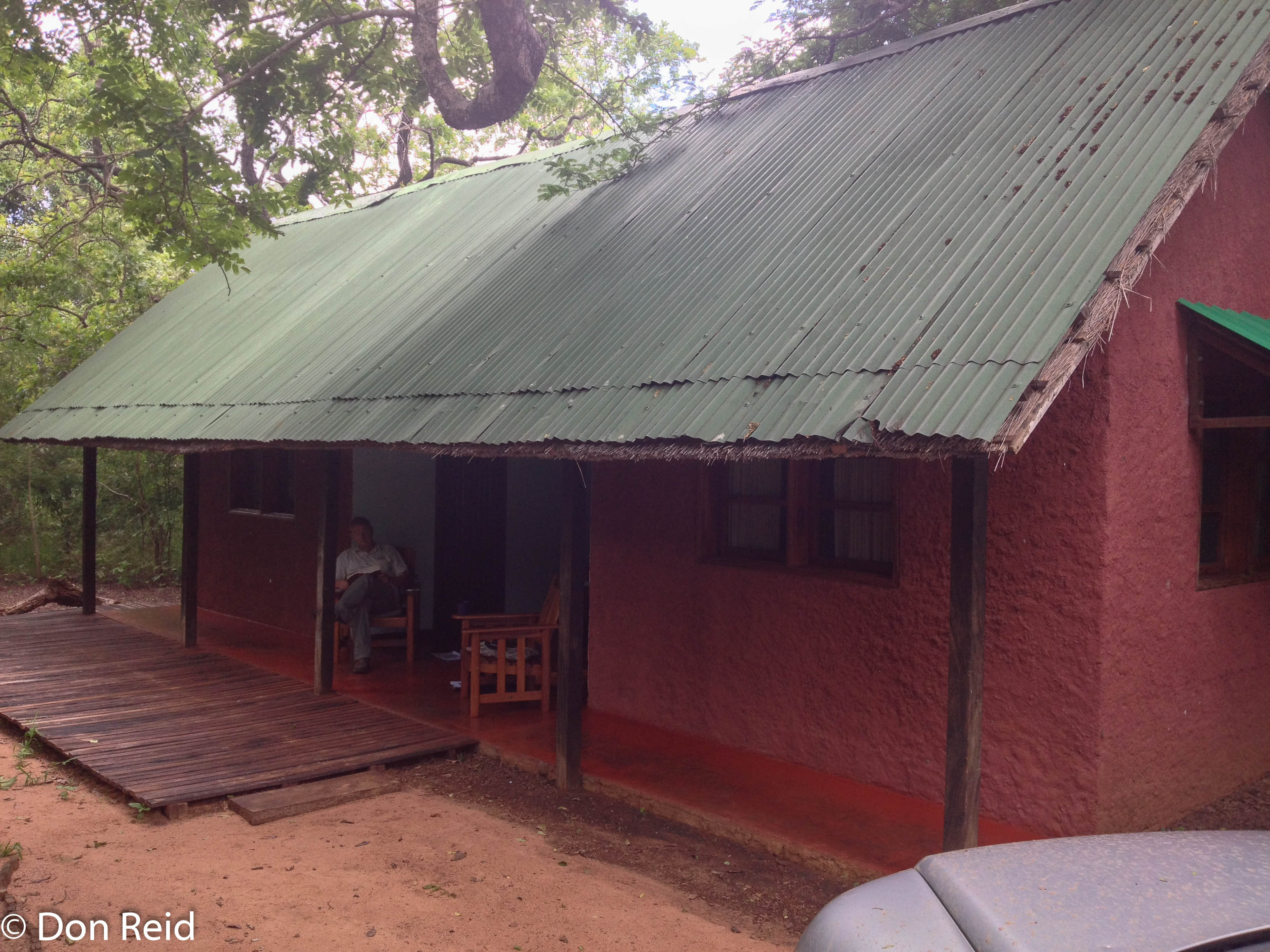
I arrived at the lodge by 4.30 pm and settled into the rustic accommodation on the river in unit No 5, which is right alongside the tree where the Leafloves were nesting.
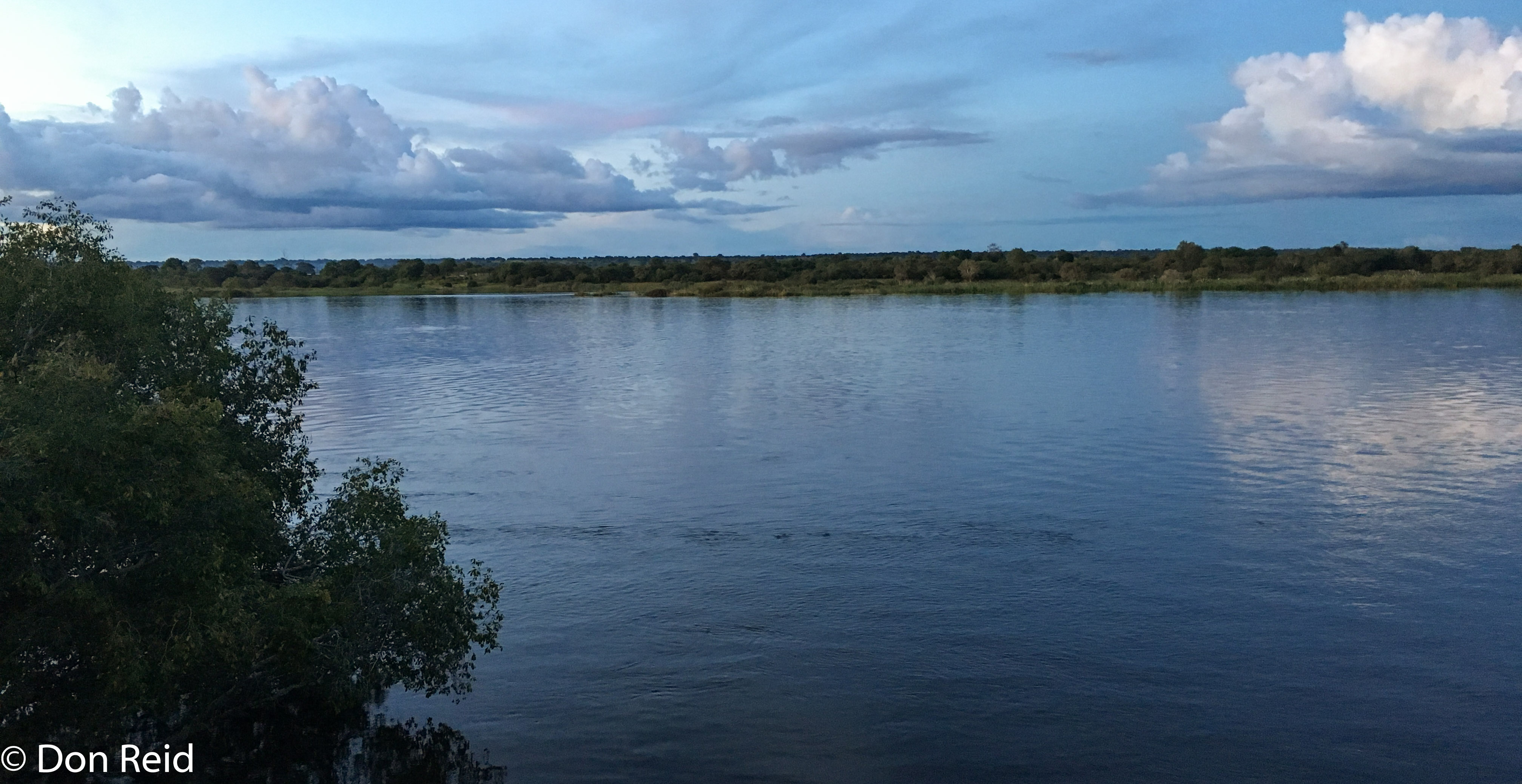
Caprivi Houseboat LodgeThe rustic cabin at Caprivi Houseboat LodgeView from the cabin
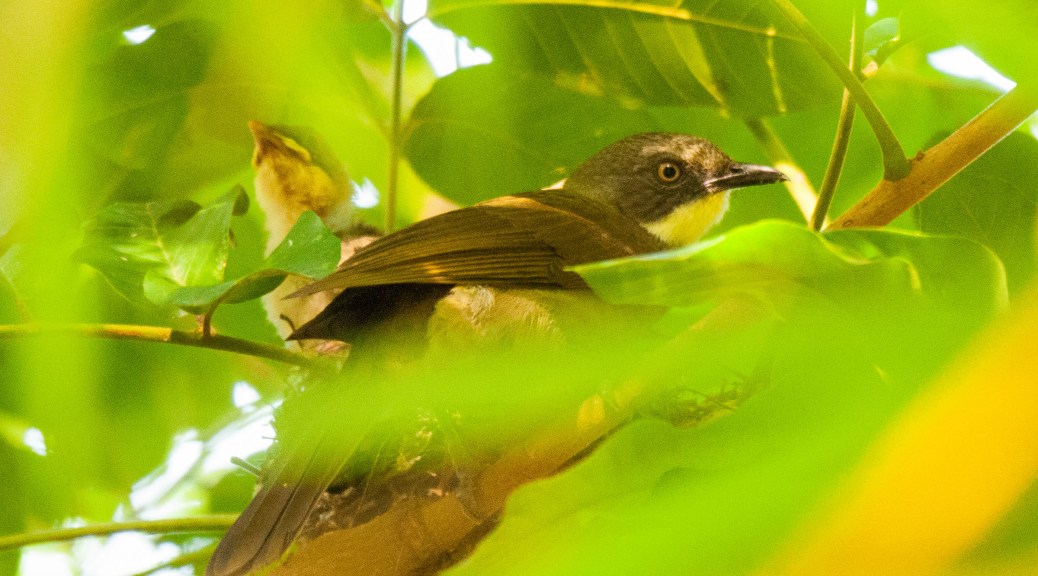
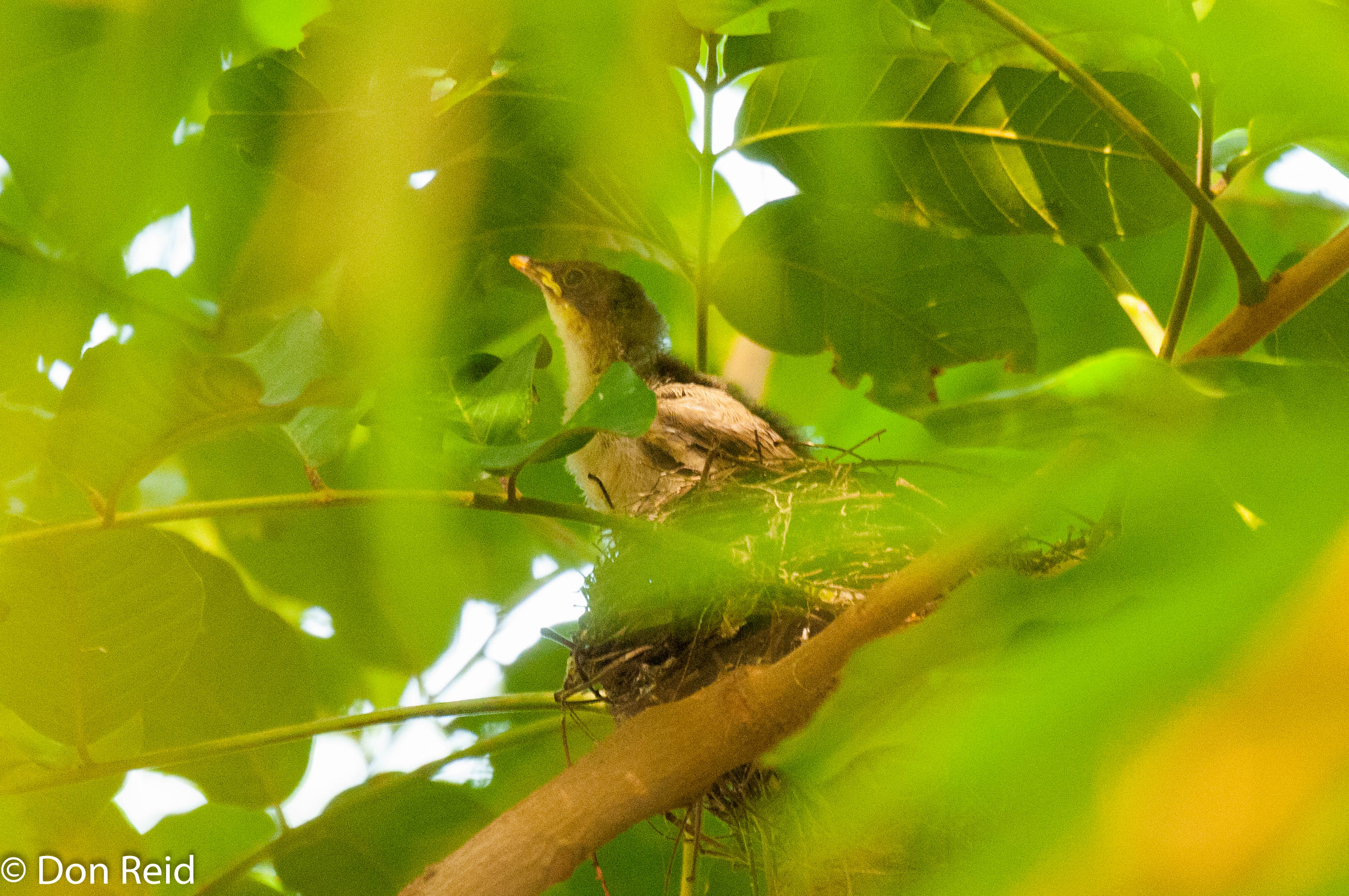
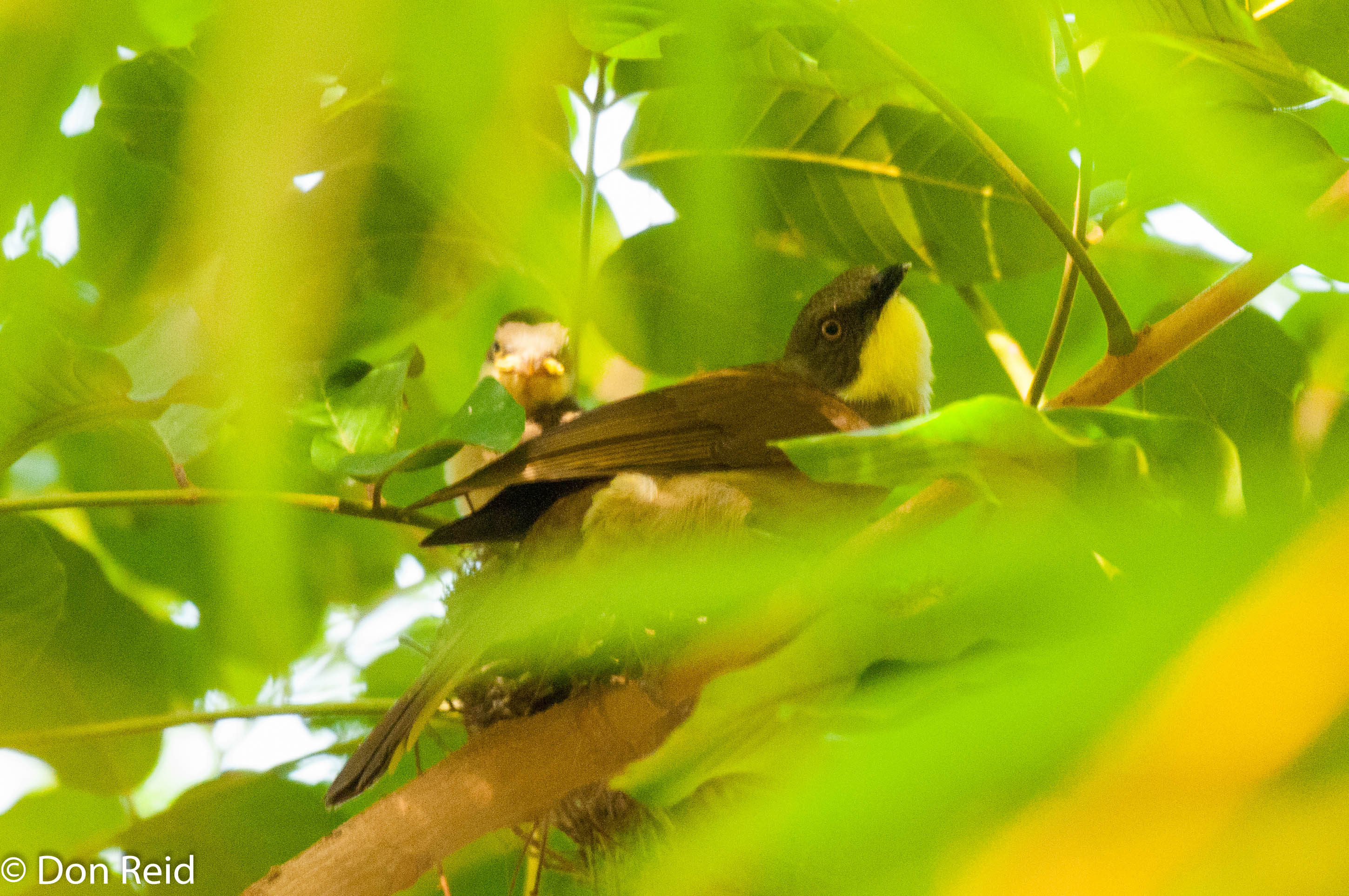
I immediately saw one of the young chicks peering over the edge of the nest and within minutes the parents were in the vicinity and at the nest, bringing morsels and calling in a Babbler-like manner although less harsh.
The rest of the afternoon was spent re-visiting the nest site in the hope of getting better views / photos and exploring the small property with its jungle-like gardens and river views.
River views, Caprivi Houseboat LodgeRiver views, Caprivi Houseboat Lodge
It proved to be really challenging trying to get the Leafloves in my camera’s viewfinder for long enough to get a decent photo, as they seemed intent on hiding in the shadiest part of the foliage at every opportunity and when they did show themselves briefly, it was in an opening high up in the trees with bright light behind them.
Yellow-throated Leaflove
Other birders had arrived earlier and a few more arrived after me – we enjoyed a good evening meal together and then made our way to mosquito-netted beds in the rustic cabins, happy to be able to add the Leaflove to our life lists.
Wednesday 2nd March
In the morning the others were already gathered at the coffee and rusks and I tagged along with the small group as they set off for a birding walk along the dirt road outside the lodge, which turned out to be quite busy with early morning commuters on their way to places unknown.
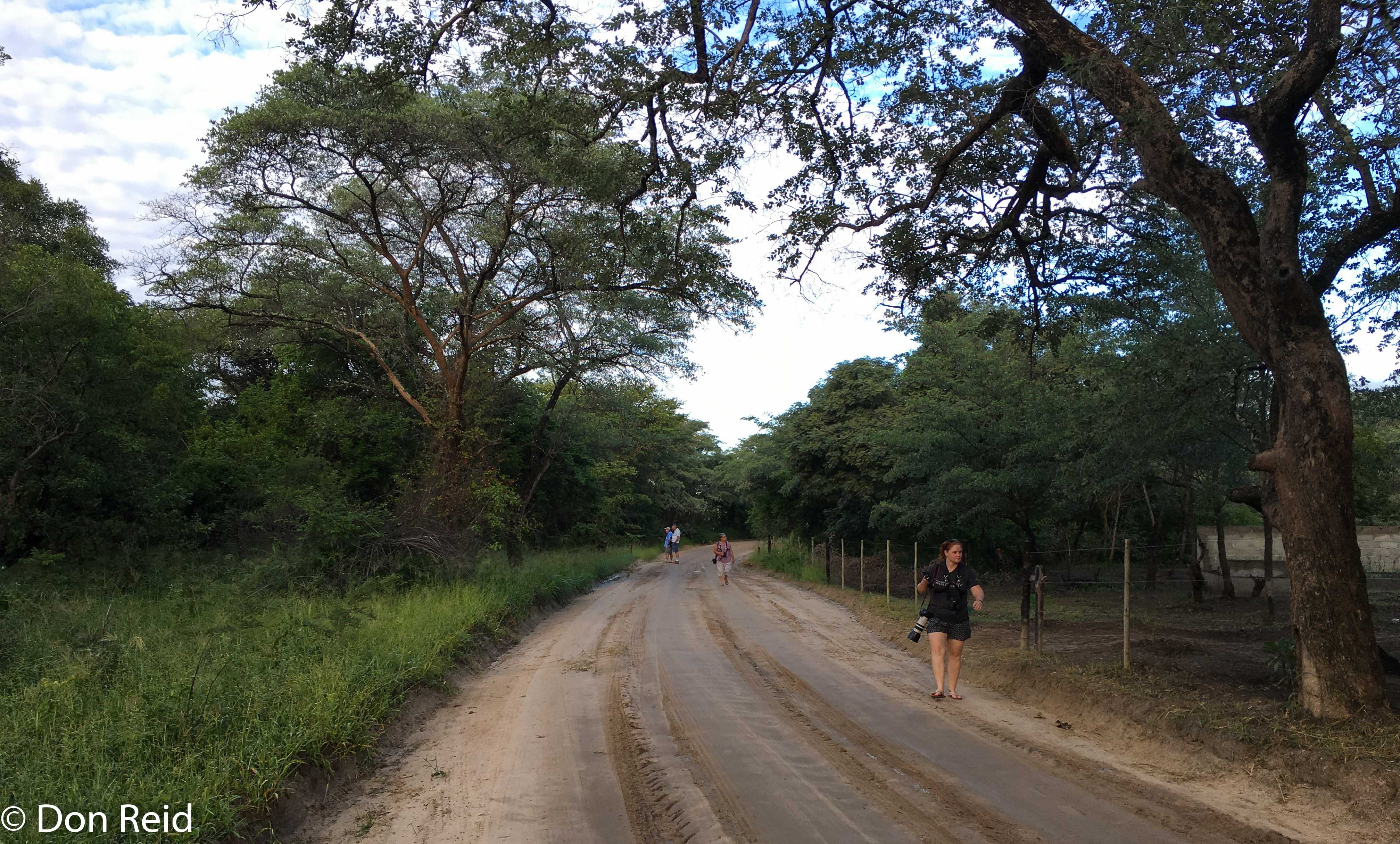
Morning walk near the lodge
White-bowed Robin-Chat and Tropical Boubou were competing for loudest call as we walked and there was no shortage of other interesting species, such as :
Paradise and Grey-tit Flycatchers
Village Indigobird on the very top of a tree
Namaqua Dove perched on overhead wires
Brubru working its way through the foliage of a large tree
Little Sparrowhawk perched on an open branch
Copper Sunbird female peering from its nest in the roadside bush
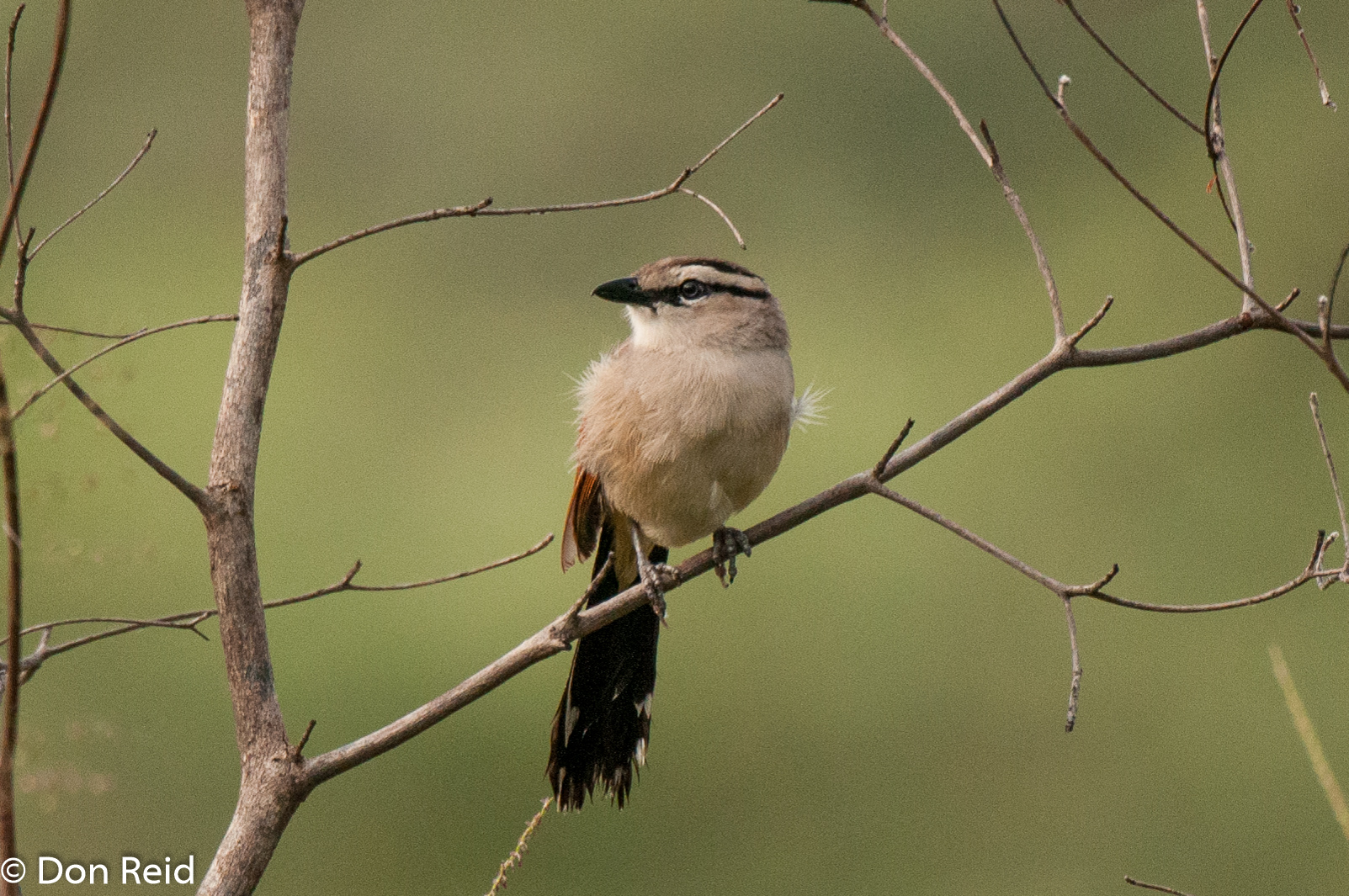
Brown-crowned Tchagra posing beautifully on a nearby branch
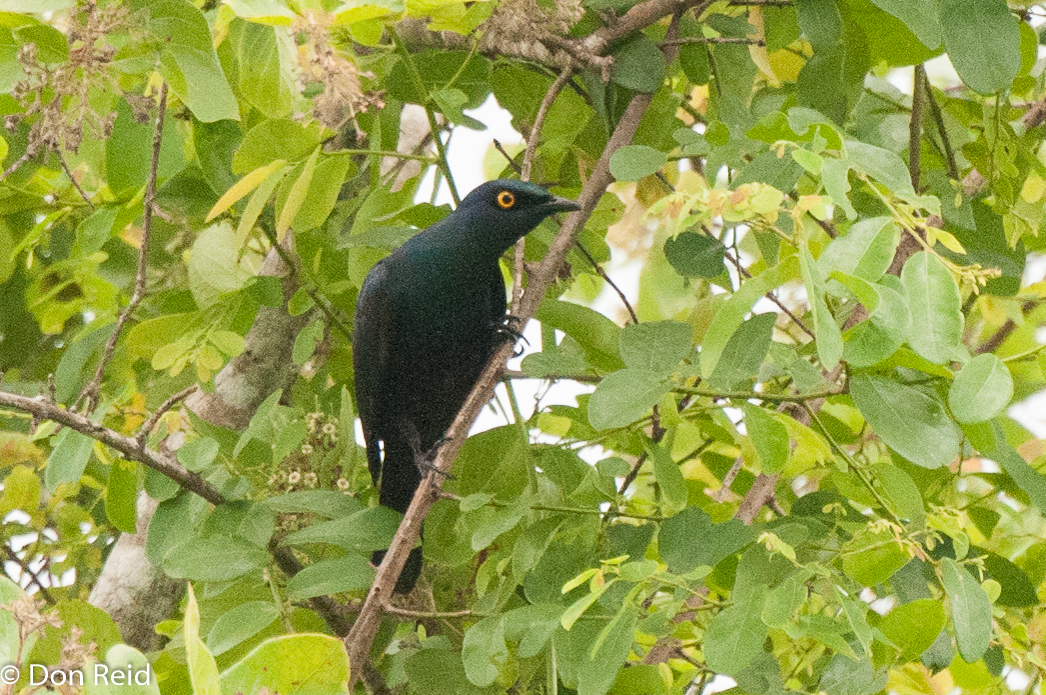
Greater Blue-eared Starlings
African Golden Oriole – bright yellow against the green foliage
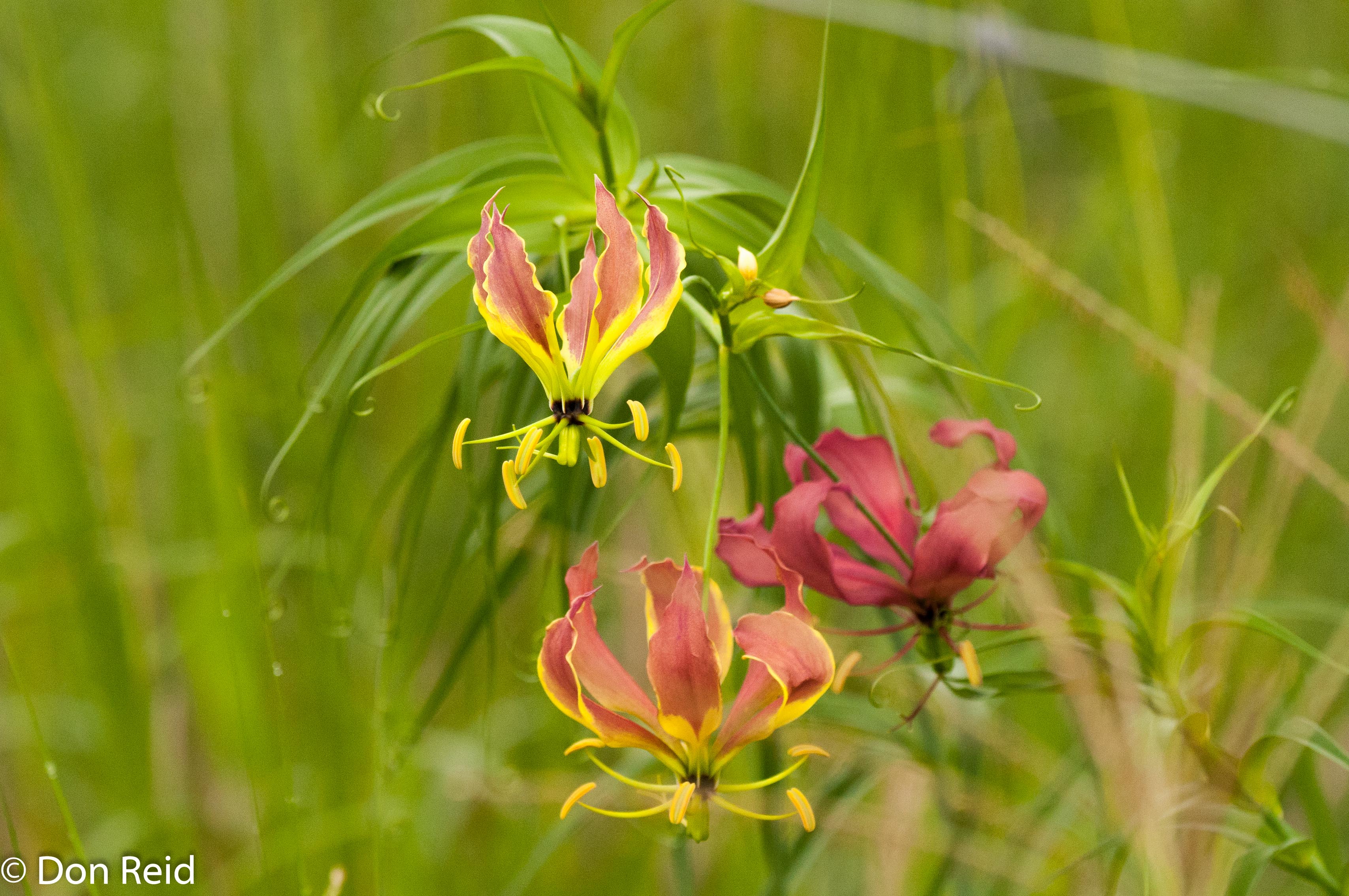
Copper Sunbird (Female) at nestFlame LilyBrown-crowned Tchagra
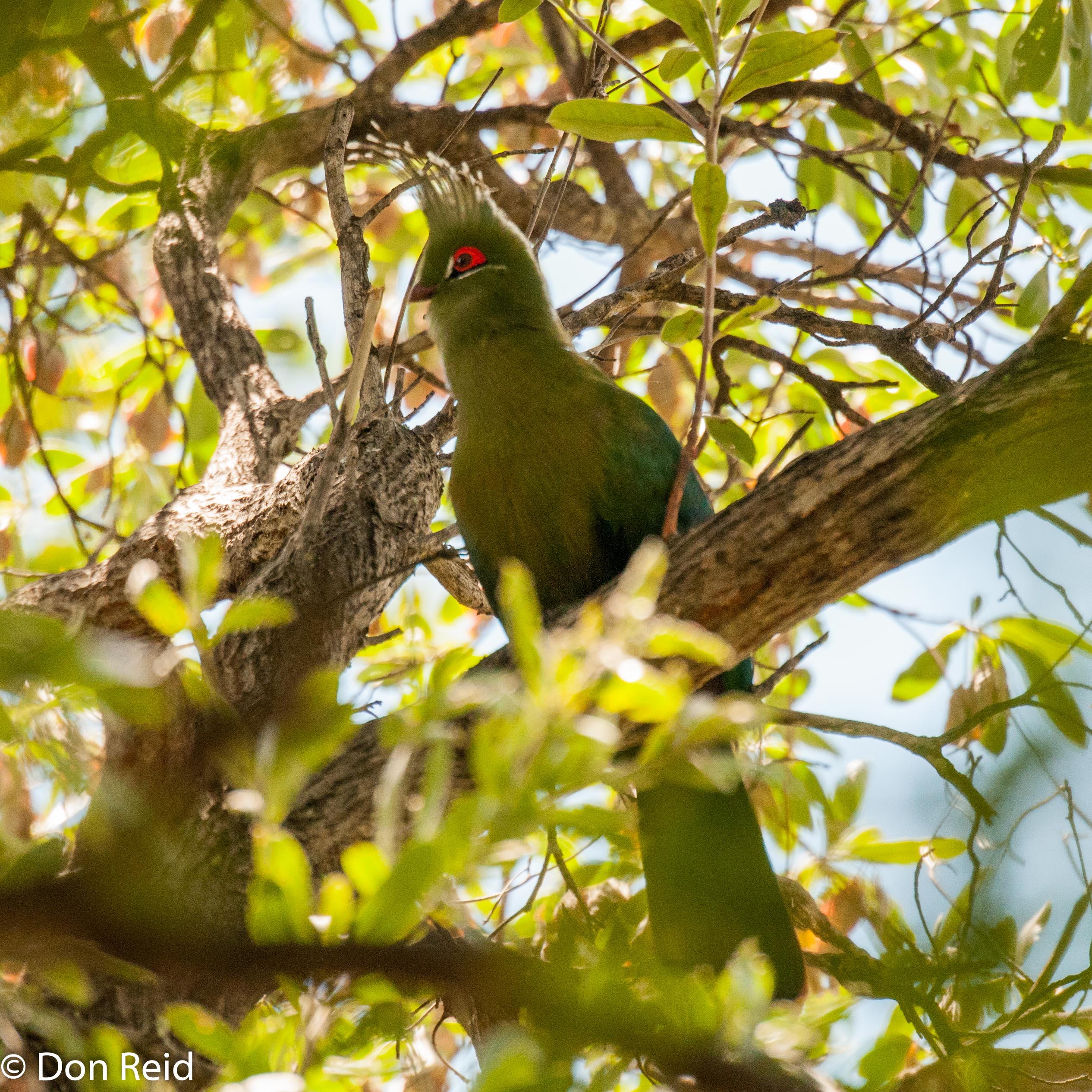
After the walk it was breakfast time followed by some further garden birding. A Schalow’s Turaco was calling and I followed the sound to find this lifer – a pair were moving about in the dense foliage of a tall tree, making it challenging to get a decent view or a photo. Fortunately I heard them again as I was leaving and found one on an open branch, almost inviting me to photograph this handsome species.
Schalow’s TuracoSchalow’s Turaco
The trip back to Kasane was uneventful, other than coming across a trio of elephants along the road traversing Chobe.
The road through Chobe
Another successful twitch and memories of a brief but busy trip that will stay with me for a long while.
I was overly optimistic when I started a series of blogs titled “Bird of the Week” – what was meant to evolve into a weekly study of a specific bird species has seen me publish just two such blogs in the past few months. No excuses other than being too busy working, birding and blogging on other subjects that I felt compelled to get down in writing.
The caption I have now adopted is more flexible and I will be producing a series of similar “Bird in the Lens” blogs from time to time (now that’s vague enough not to be accused of misleading anyone). So here goes with the next species…….
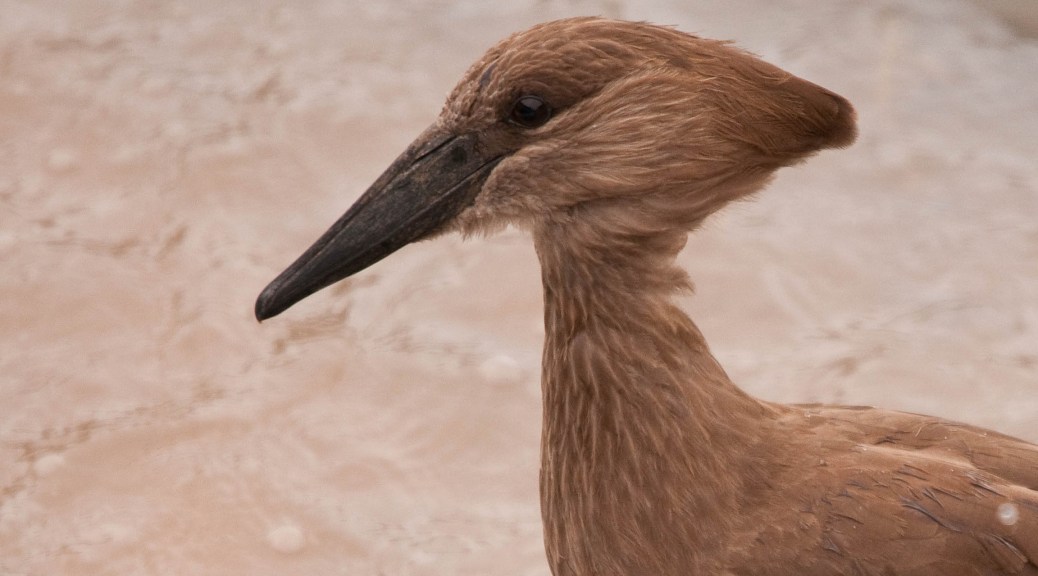
HAMERKOP
Species Names
Hamerkop (English and Afrikaans) One of just two SA species with the same name in English and Afrikaans. (The other one? Bokmakierie) Sometimes translated to the English equivalent “Hammerhead” but no one I know uses that name
uThekwane, Uqhimgqoshe (Indigenous)
Hammerkopf(German)
Ombrette d’Afrique (French) – rather nice sounding name
Hamerkop (Dutch)
Scopus Umbretta (Scientific) The beauty of scientific names is that they are common throughout the world no matter what country or the language spoken. The first part – Scopus – is the Genus which is derived from the latin for “broom of twigs” – so named for the huge nest of twigs that the Hamerkop builds, up to 1,5m across . The second part – Umbretta – is the species name which in this case means shade or shady, probably to describe its uniquely shaped crest, head and bill, which give it an umbrella-like appearance.
Where to find it
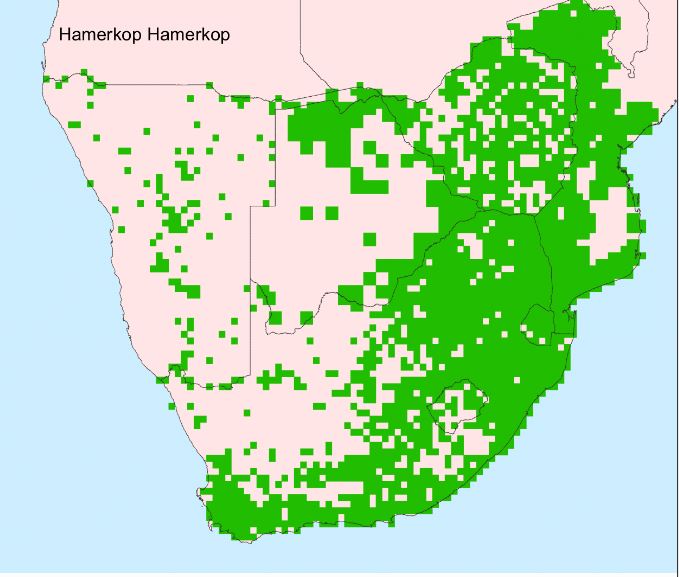
The Hamerkop is found right across Southern Africa with the exception of the very arid areas. Distribution is also widespread in the rest of Africa, but it is never common and always elicits a “hey look, there’s a Hamerkop” when seen.
My first sighting was in Kruger National Park in the late 1970’s, long before I took up birding seriously.
It is usually found near water and hunts at the water’s edge, sometimes venturing into the shallows to snatch its prey from the edge of the water. Prey is mostly toads whose distribution is very similar to the Hamerkop, suggesting that Hamerkops depend on toads for food.
The distribution map below is from SABAP2
Look …….. and Listen
There is very little chance of confusing this species with any other, although I have been misled once or twice by a Hadeda flying over at a distance. The anvil-shaped head and overall brown colouring are instantly recognisable as belonging to the Hamerkop.
This is a medium-sized bird, up to 56cm long and weighing up to 500g.
The call is not an identifier as it is mostly silent.
Punda Maria
Photography
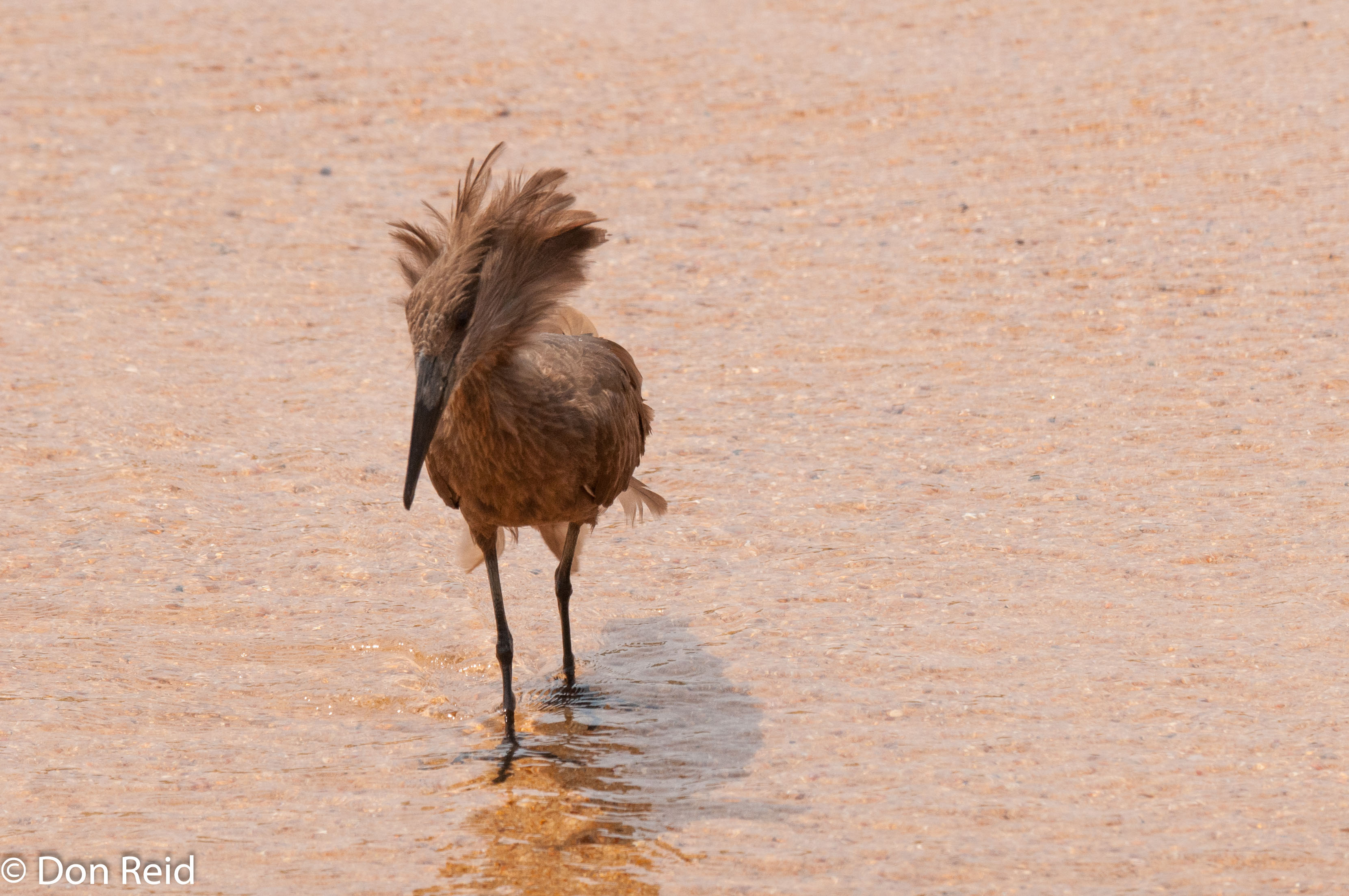
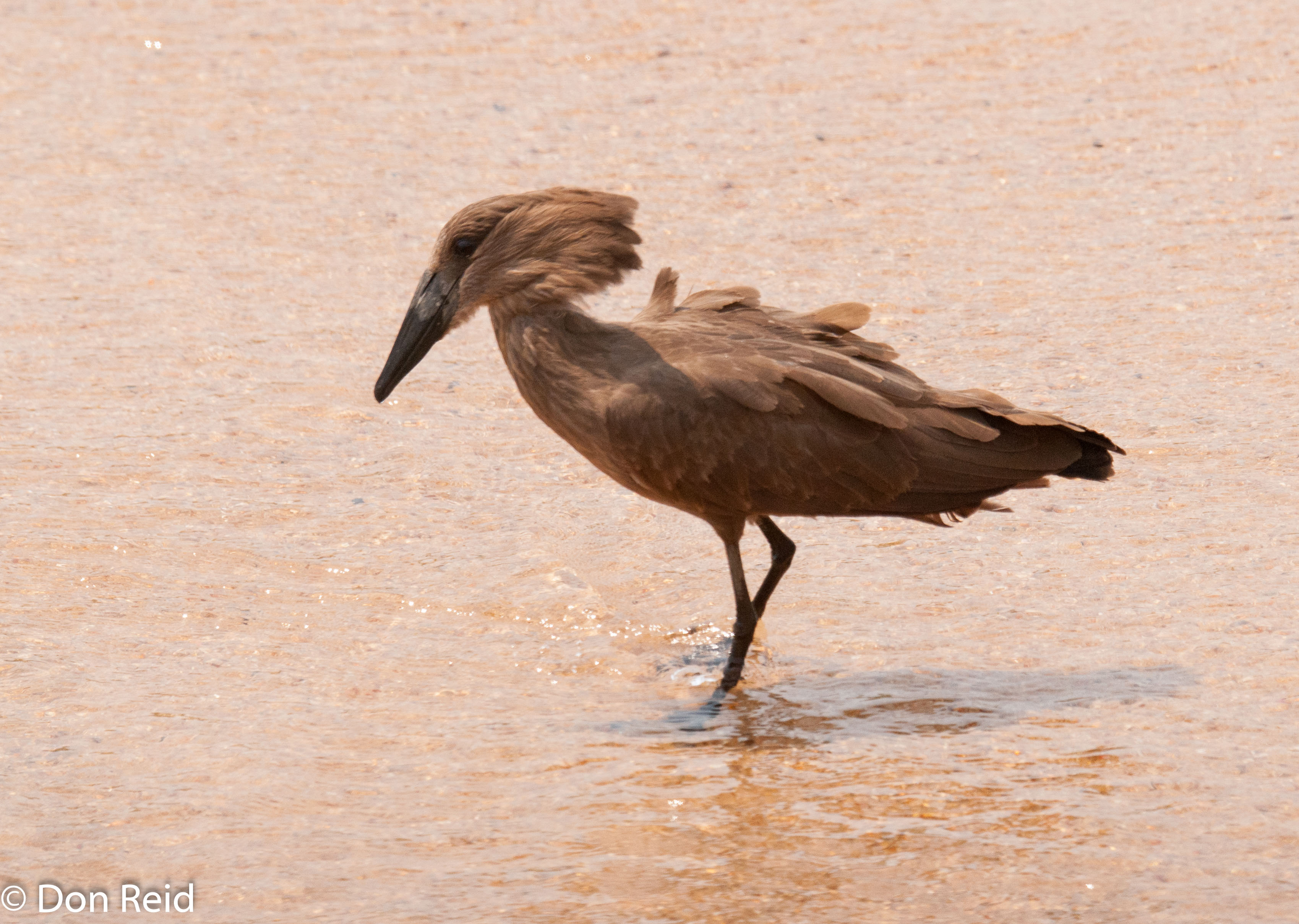
Not a difficult bird to photograph, once you have found one near water, as it will not move around much if engrossed in hunting for a frog or other small prey.
Photos taken from the low water bridge between Skukuza and Tshokwane in Kruger National Park :
Other Stuff
Conservation status is listed as “Not threatened”. Where many species are suffering due to habitat loss, the Hamerkop is actually benefiting from irrigation schemes in arid areas. This is a survivor amongst bird species. It also features prominently in indigenous folklore, is regarded in awe and is generally unmolested.
Lifespan is 20 years or more.
Nests are massive structures built up out of hundreds of sticks and when completed they are decorated with anything that comes to hand …….. or beak – from cattle manure to dish cloths. One of my colleagues had the nickname Hamerkop given to him by the office general assistant, apparently due to his habit of hoarding all kinds of things at his home.
References
Roberts Birds of Southern Africa
Birdlife International
Birds of Africa South of the Sahara
SABAP2 (Maps)
Latin for BIrdwatchers (Roger Lederer and Carol Burr)
Just when you thought it was safe to go into 2016, here is another of those pesky “looking back at 2015” stories. Apologies but I just have to do it – so here is my review of my birding year, for what it is worth.
It has been another busy year of travel for Gerda and myself, in between maintaining our normal home routines, however this time around we did not do any “overseas” trips but confined ourselves to travel within South Africa. In addition my birding took me to Mozambique for a dedicated 2 week birding extravaganza and work-related trips took me to northern Botswana, where I was able to fit in some wonderful birding and game viewing – all in all it made for another interesting year…….
January
The year started, as it has over the past couple of years, in Mossel Bay where we have a second home and I used the opportunity to do some atlasing in the Golf Estate where our house is located and in the surrounding area. (reminder : “atlasing” is the recording of bird species in an area called a Pentad, defined by coordinates, about 8 x 8 kms in extent, with the data collected going to a database at the University of Cape Town)
Gerda joined me for a morning of atlasing near Albertinia, with breakfast and coffee stops to make it a pleasant outing for both of us.
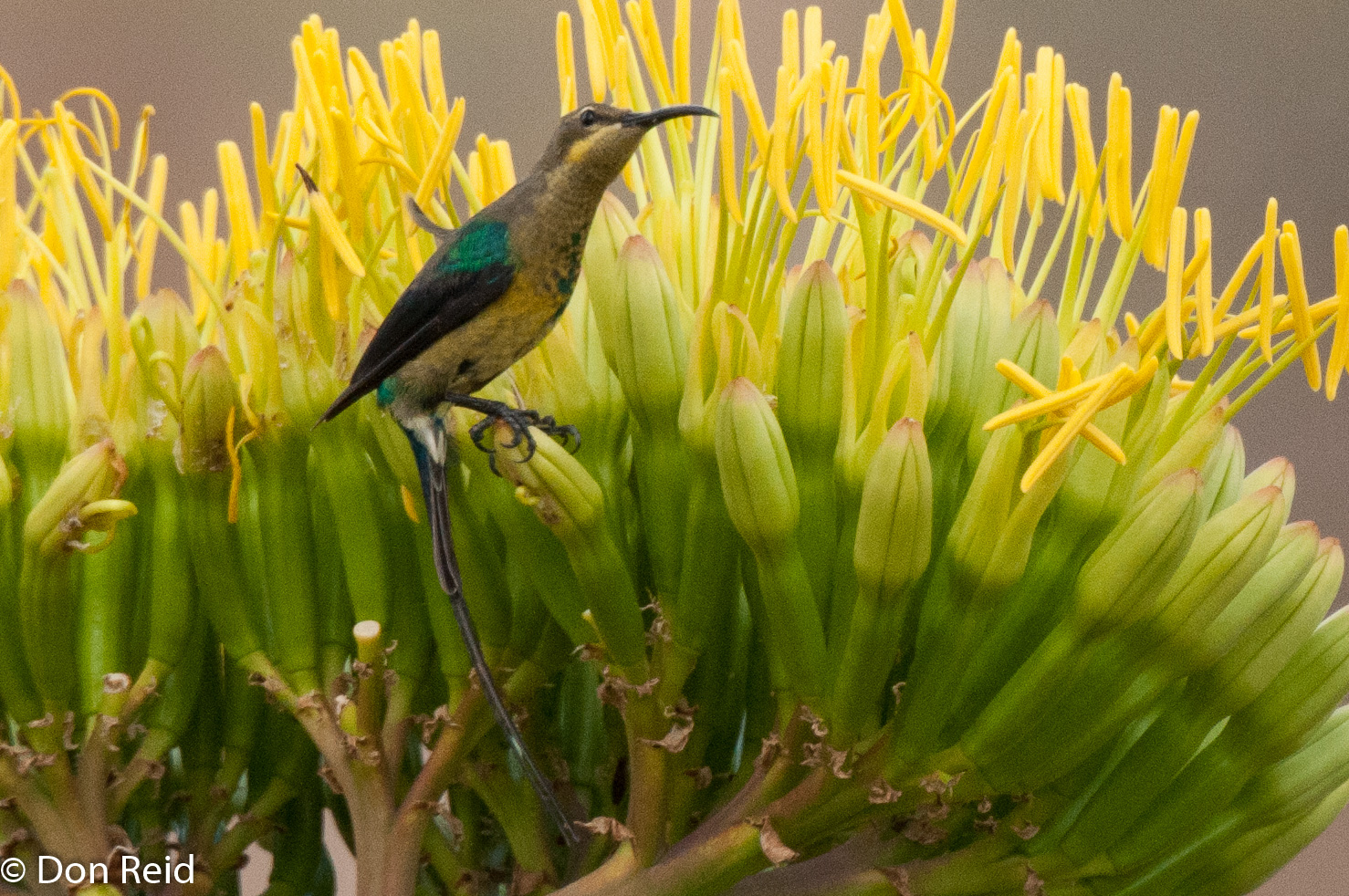
Malachite Sunbird on flowering sisal trees, near Albertinia
From the 9th to 12th we did a short trip through the Western Cape, spending one night in Swellendam and two more visiting Johan and Rosa in Worcester. I managed to sneak in some atlasing as we went without turning up anything of note.
On the 16th it was time to leave Mossel Bay and return to Gauteng but not without making the most of the journey – two nights in Prince Albert in the Karoo and one in Hoopstad in the Free State made sure of that.
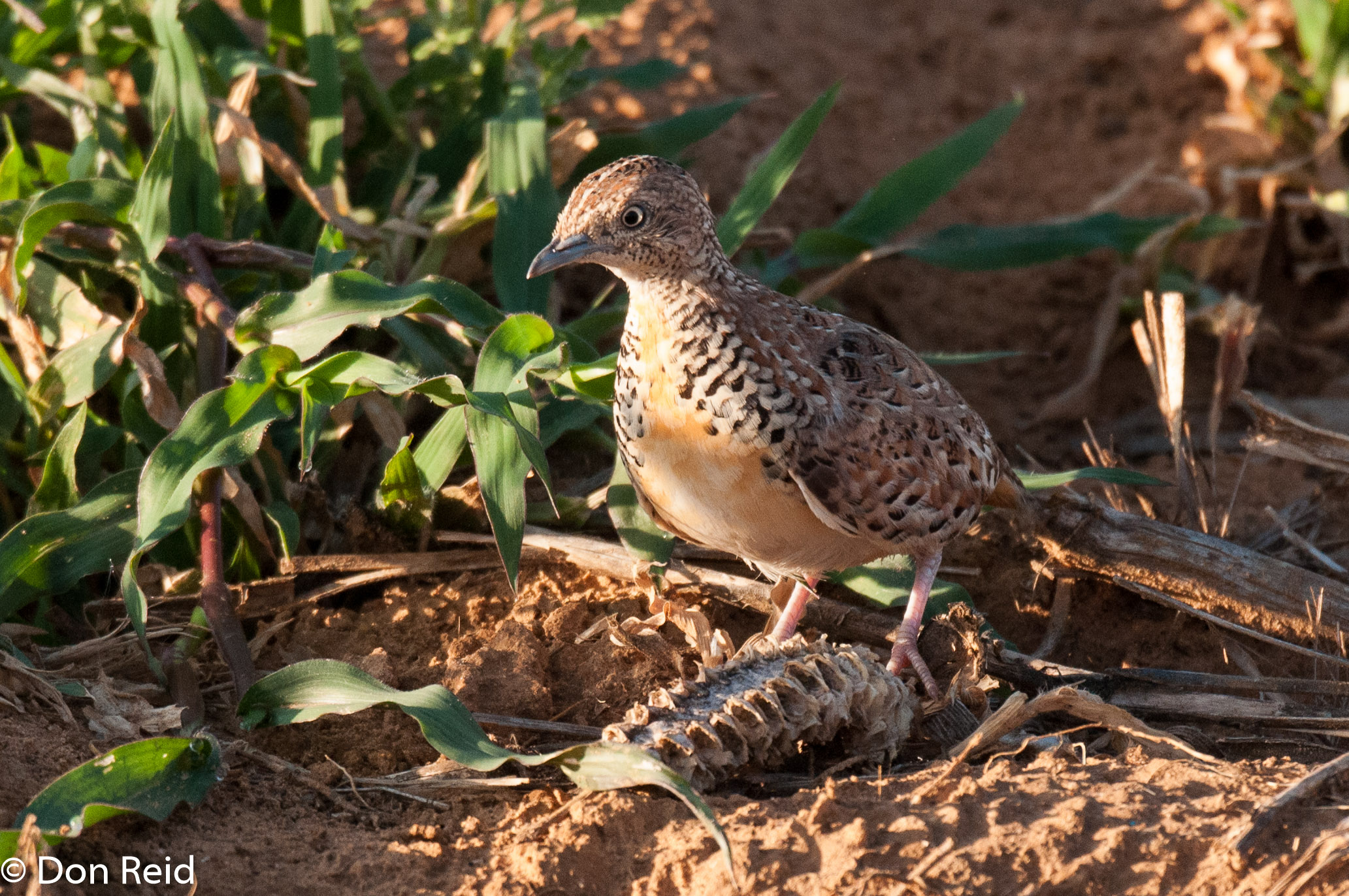
Karoo Chat (Juvenile), Prince AlbertKurrichane Buttonquail in mielie (corn) fields, Hoopstad
February
Undoubtedly the highlight of my birding year started on 29th January with a two week birding trip through Mozambique as part of a group of 10 in four vehicles. The full report appears in my posts from earlier in 2015 and it is difficult to isolate the highlights as every day was full of them, but here are a few that were really special and the “Lifers” that went with them :
Early morning on the Limpopo floodplain with Sedge Warblers and Rufous-winged Cisticolas
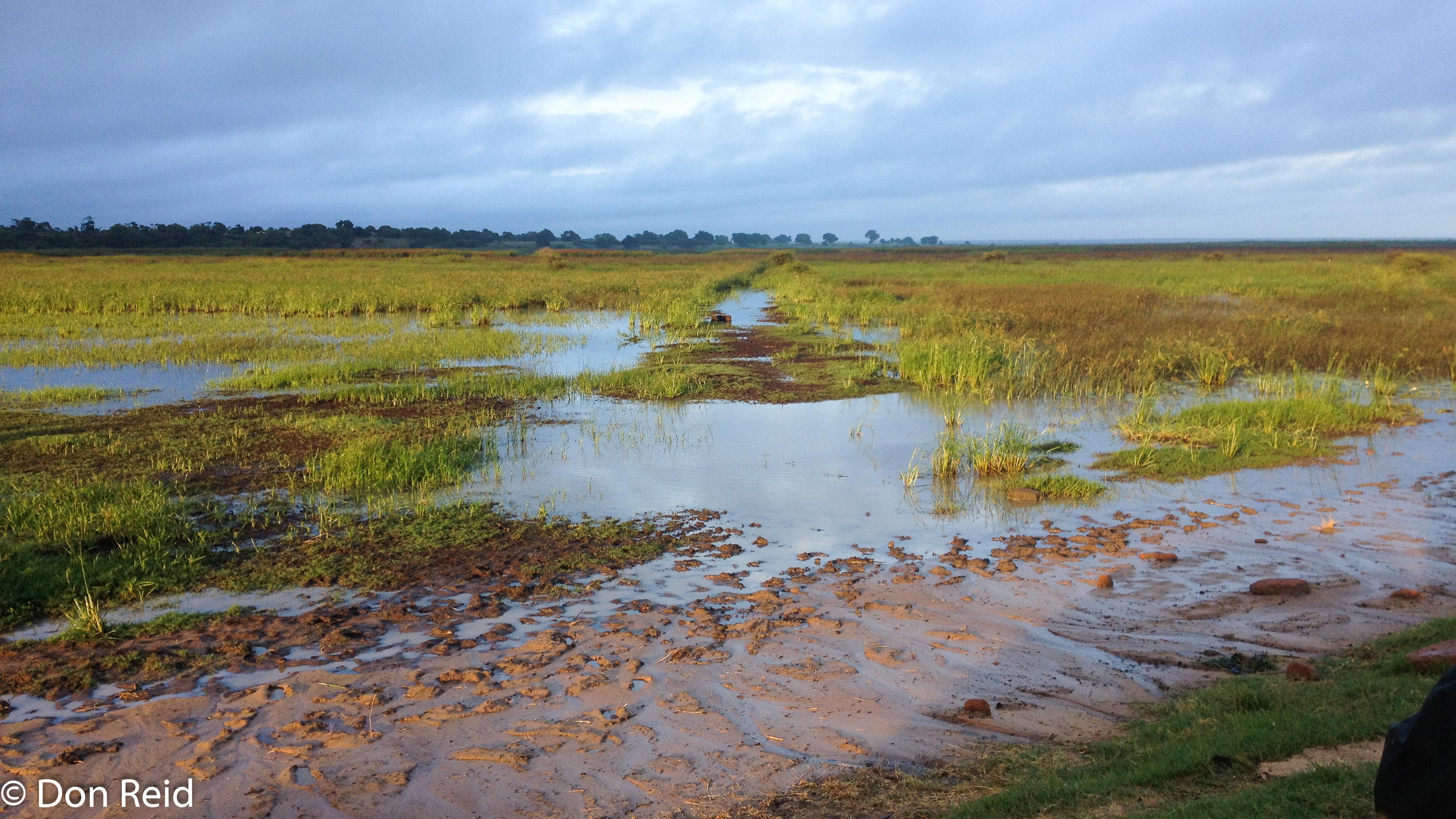
Limpopo floodplain near Xai-Xai
Birding on the mudflats at Imhambane and Lighthouse beach nearby – Lesser Sand Plover, Lesser Crested Tern and Crab Plover
The mudflats, InhambaneLesser Sand Plover, InhambaneMixed Terns, Lighthouse beach Barra
Driving through dense woodland to the Panda area to view Olive-headed Weaver, Green Tinkerbird, Woodward’s Batis and Livingstone’s Flycatcher, amongst a plethora of other desirable species
Panda WoodlandOlive-headed Weaver, Panda Woodland
Lunch stop in more dense woodland which was alive with bird life, adding Red-winged Warbler
Dragging a rope across pristine floodplains of the Rio Savane near Beira in hot, humid weather, hoping to flush some of the specials – Great Snipe was one reward
Rio SavaneRio Savane (Photo ; George Skinner)
Photographing a warbler in the Rio Maria area, which turned out to be Basra Reed Warbler, a southern Africa megatick
Basra Reed Warbler, Rio Maria Beira
Mphingwe camp and the surrounding pristine forests of the Catapu area which produced a multitude of magnificent lifers – Ayre’s Hawk-Eagle, Barred Long-tailed Cuckoo, Mangrove Kingfisher, Tiny Greenbul, White-crested Alethe, East Coast Akalat, Black-headed Apalis, Plain-becked Sunbird, and Broad-taled Paradise Whydah
Black-bellied Starling, Mphingwe campMangrove Kingfisher, Coutada 12 area
A memorable trip to the Zambezi to view Bohm’s Bee-eater and several other special birds (not to mention the atrocious road and the failed propshaft bearing of my vehicle)
Collared Palm-Thrush, in palm grove on the Road to SenaSouthern Banded Snake-Eagle, Road to SenaBohm’s Bee-Eater, Rademan’s Farm on Zambezi River
Chestnut-fronted Helmetshrike, Coutada 12 areaBush driving (Photo ; George Skinner)
Mphingwe camp – enforced longer stay due to car repairs but also time to explore the surrounds and home in on some beautiful butterflies
March
A weekend in Cape Town revolved around the Cape Town Cycle Tour which I had entered – no time for any intensive birding but we did enjoy a walk through Kirstenbosch Botanical Gardens and some lightweight birding in Stellenbosch where we stayed in the Devon Valley Hotel
On the 14th I joined Koos Pauw for some interesting atlasing at the Baviaanspoort Water Treatment works (ie Sewage farm) where a pale form Steppe Buzzard had us postulating for some time.
Common (Steppe) Buzzard (Pale), Baviaanspoort
27th saw us heading to Mossel Bay for the Easter holidays, with a stop over at Prior Grange near Springfontein – a favourite overnight spot in the Free State with some excellent birding on the farm and the surrounds
April
During our stay in Mossel Bay I confined my birding to the immediate area with one atlasing trip to Albertinia.
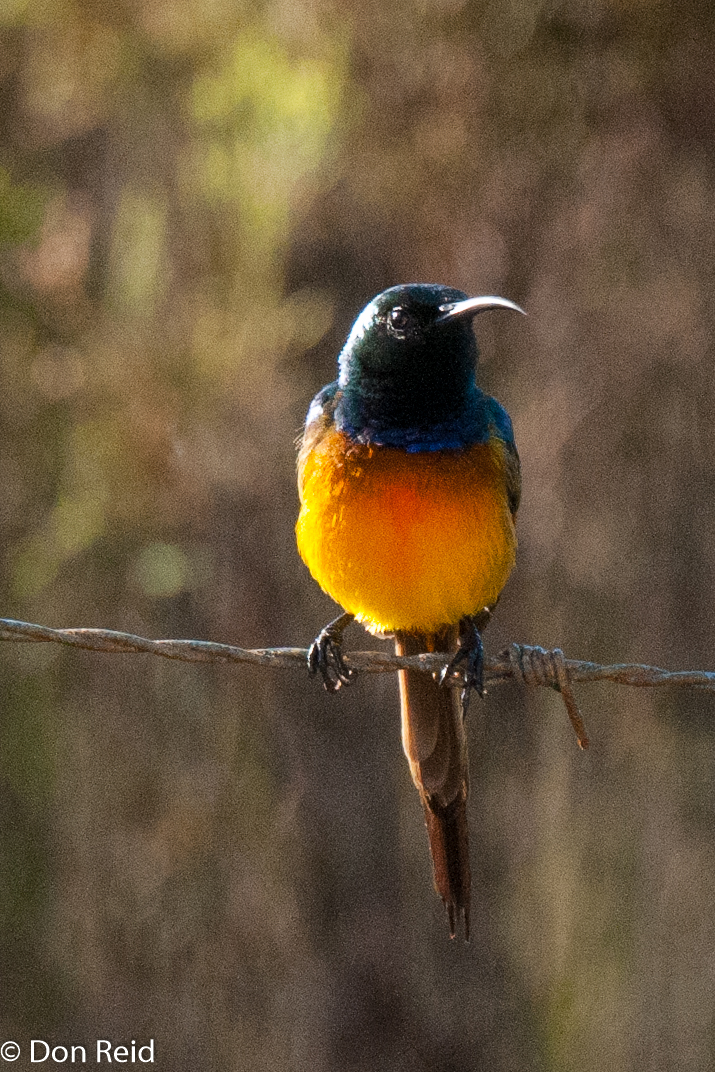
Orange-breasted Sunbird, near Albertinia
A short trip to the Western Cape included a stay in McGregor on the 12th and some exploration of the Robertson area and Greyton – I squeezed in some atlasing as we went
Back in Pretoria Koos and I atlased in the Kwamhlanga area on the 25th, which produced some surprisingly good birding – near a vlei we saw Lanner Falcon, African Quail-Finch and heard African Rail in quick succession. Soon after, in a hilly, rocky area along a side road, I was thrilled to find Short-toed Rock-Thrush posing beautifully in a dry tree, a lifer for me.
Short-toed Rock-Thrush, Kwamhlanga
May
My first trip to Kasane in northern Botswana from 5th to 7th for a project I am involved in, was the first of many for the year and a chance to explore the natural delights of Chobe National Park in between work commitments. This trip was all about excellent game viewing experiences with enough birding to whet my appetite for later visits.
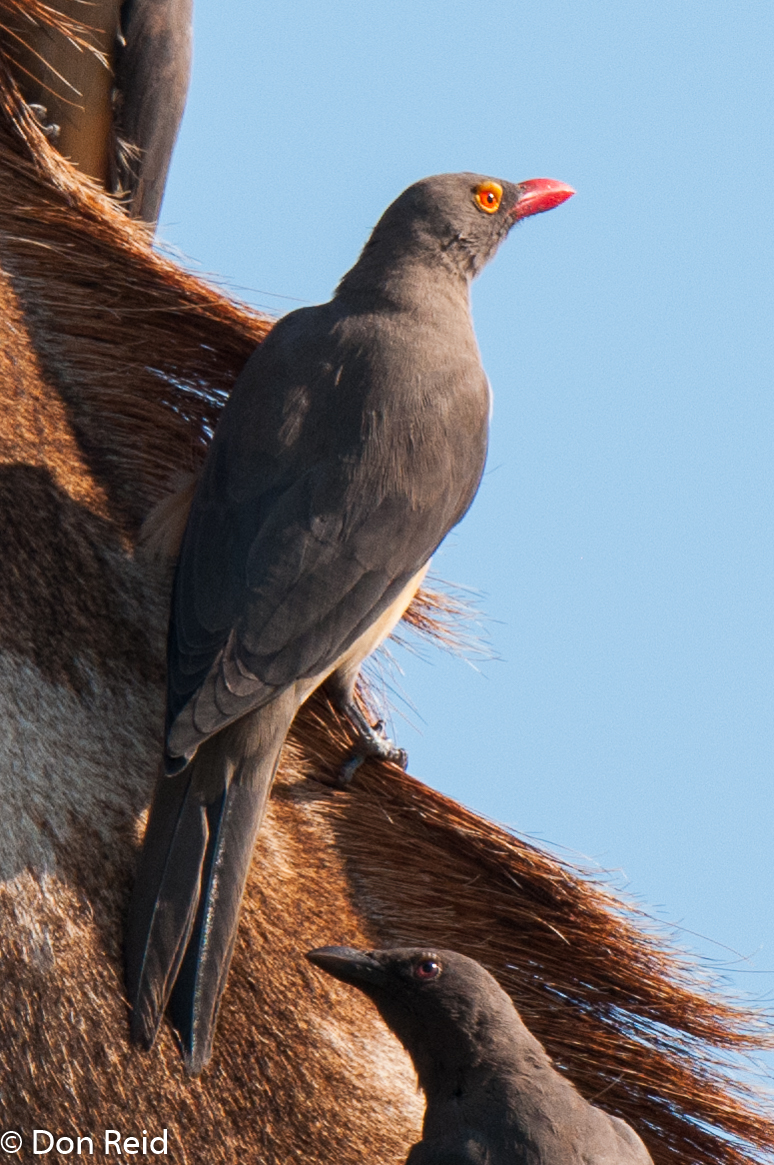
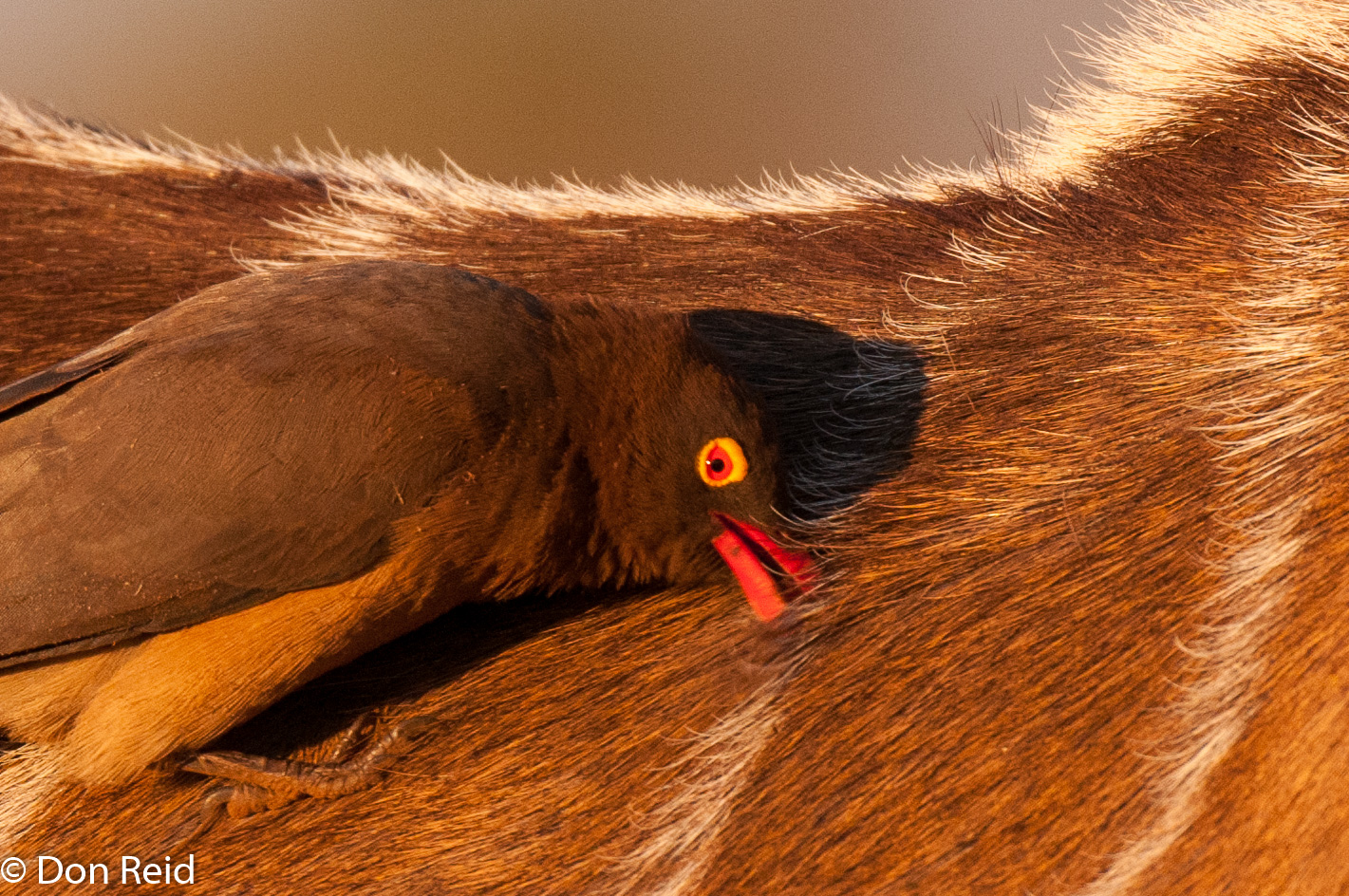
Bateleur (Juvenile), Chobe Game ReserveRed-billed Oxpecker, Chobe Game Reserve
More atlasing on the 16th (Kwamhlanga area) and 25th (Delmas area) and 30th (Coalfields around Ogies), produced some memorable species.
Ogies AreaCape Longclaw. Ogies area CoalfieldsLevaillant’s Cisticola, Delmas area
June
Winter atlasing in the dry grasslands near Bronkhorstspruit on 6th was followed two days later by atlasing near Balfour after a two hour drive through early morning traffic.
The same day I visited Marievale Bird Sanctuary for some relaxed birding and photography at this wonderful venue, which I had all to myself, it being a Monday.
18th to 25th was Koos and Rianda’s timeshare week at Verlorenkloof, which we were once again invited to share with them, unquestionably our favourite place for superb birding and relaxation and it produced many highlights as usual.
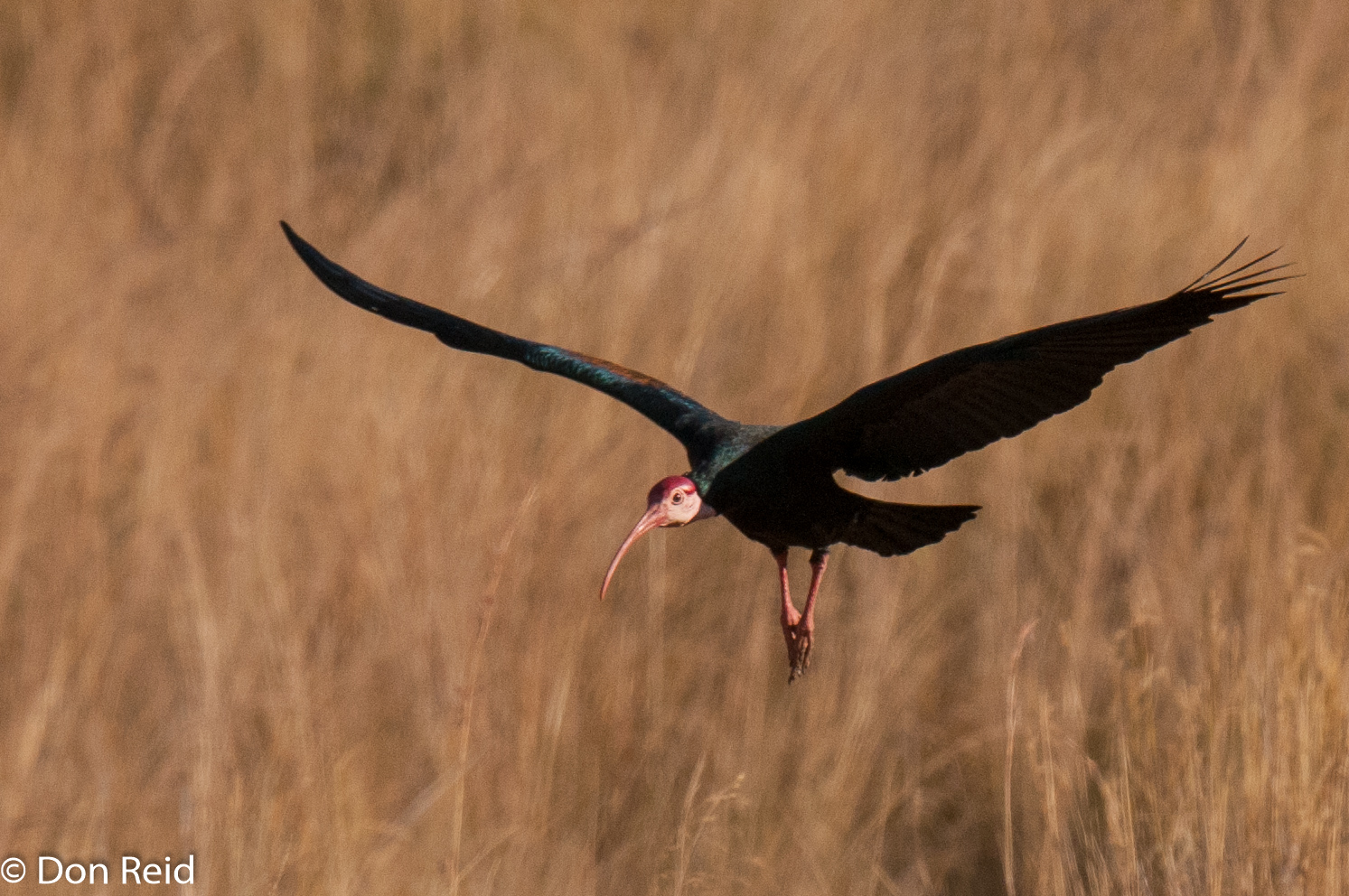
Bald Ibis, VerlorenkloofBlack-winged Lapwing, VerlorenkloofCape Rock-Thrush, VerlorenkloofChorister Robin-Chat, VerlorenkloofAfrican Golden Weaver, Verlorenkloof
July
Saturday 4th was time for more winter atlasing, this time south of Balmoral with the challenge being ID’ing the seed eating species in their drab winter plumage – the watchword is definitely “practice makes perfect”.
Orange-breastsed Waxbill, Balmoral area
Another trip to Kasane, another chance to visit Chobe, followed on the 7th to 9th.
Yellow-billed Stork, Chobe Game ReserveSenegal Coucal, Chobe Game Reserve
Our winter trip to Mossel Bay started on the 12th and we only returned on the 1st of August. Birding was confined to Mossel Bay for the first 10 days due to cold, wet weather which gave me the chance to atlas the Golf Estate thoroughly and watch the birds coming to our feeder.
Gerda joined me for a short trip to Klein Brak and the beautiful countryside, green and lush after the substantial rains
My only specific atlasing trip was along the Herbertsdale road with some good birding in the two pentads.
Cape Robin-Chat, Mossel Bay-Herbertsdale
Our trip to Robertson to taste the culinary and birding delights followed – see my separate post on this trip.
Swee Waxbill, Orange Grove Guest farm near Robertson
August
A late winter trip to Kasane on the 4th to 6th produced some memorable game and bird sightings once again.
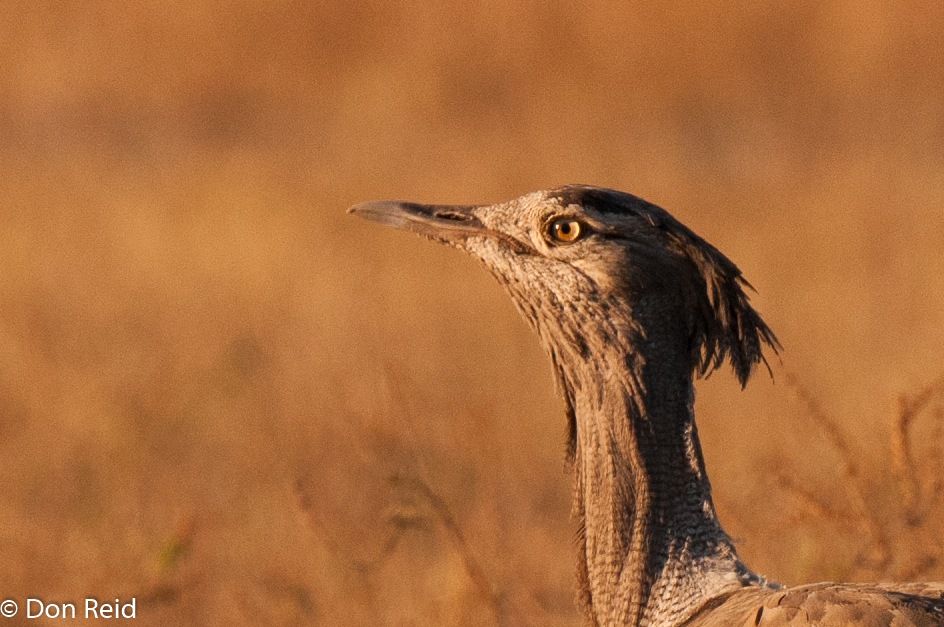
Marabou Stork, Chobe Game ReserveKori Bustard, Chobe Game ReserveRed-billed Oxpecker, Chobe Game Reserve
Koos and I atlased the De Wildt area on the 8th with some interesting sightings
September
Another Kasane trip on the 8th to 11th included a day trip to Victoria Falls to view the new airport under construction and an afternoon visit to the Falls
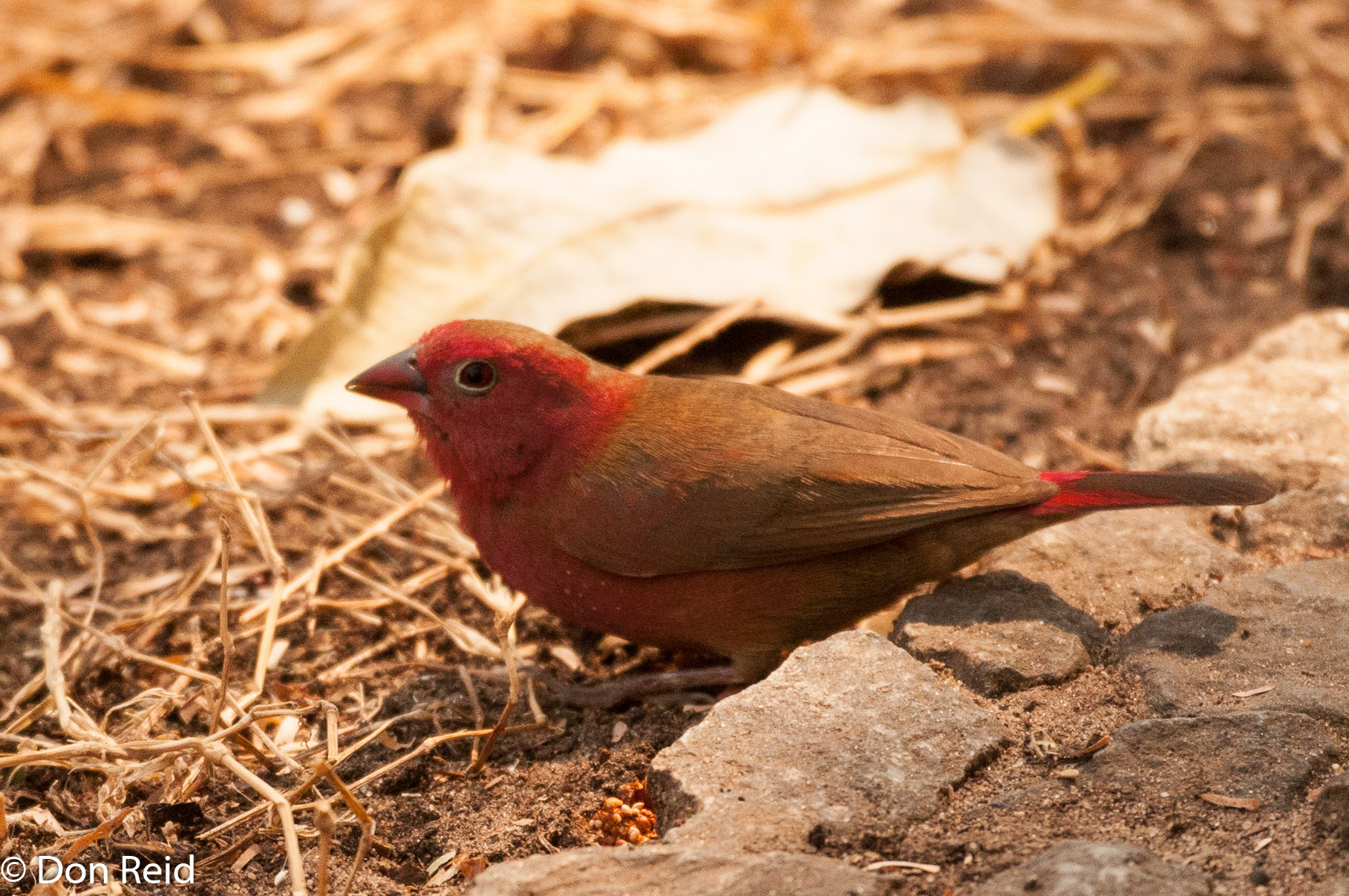
Red-billed Firefinch (Male), Victoria Falls
We managed to squeeze in a Chobe Riverfront drive with some stunning sightings being the reward
An atlasing trip on the 19th to dusty, sprawling Garankuwa north of Pretoria produced more than expected with lovely sightings of Fairy Flycatcher, Striped Kingfisher and others
Golden-breasted Bunting, Lethlabile North WestFairy Flycatcher, Lethlabile North West
October
One of the year’s highlights came up in October with a week long visit to Satara camp in Kruger, documented in several separate posts, followed by another highlight when our timeshare week at Verlorenkloof came up just afterwards from 16th to 20th, producing some of the best birding ever in this superb locality
Back to Kasane on 6th to 8th and more of Chobe Riverfront, but this time, accompanied by another keen birder – Derek Thomas, we did some proper atlasing in this amazing slice of Africa and in a new (for us) location – Kasane Water Treatment Works
The 13th saw me heading to Mkhombo dam area for an atlasing session, with a visit to the dam to see if some of the special birds seen during the preceding weeks were still around.
Before we knew it, we found the year was rapidly running out as we packed once again for the trip down to Mossel Bay for our end-of-year long visit. On the way we stopped over in Hoopstad for two nights, one on the farm where I was able to fit in some good birding walks and drives.
Our second stopover was at Karoo National Park where we enjoyed the quiet Karoo atmosphere and some good birding.
Southern Masked-Weaver, Karoo National ParkSouthern Red Bishop, Karoo National Park
In Mossel Bay my first atlasing trip was to the area west of the village Ruiterbos in beautiful rolling countryside
December
The last visit to Kasane on 2nd to 4th was another opportunity to atlas in Chobe and in Kasane itself at some spots located by Derek
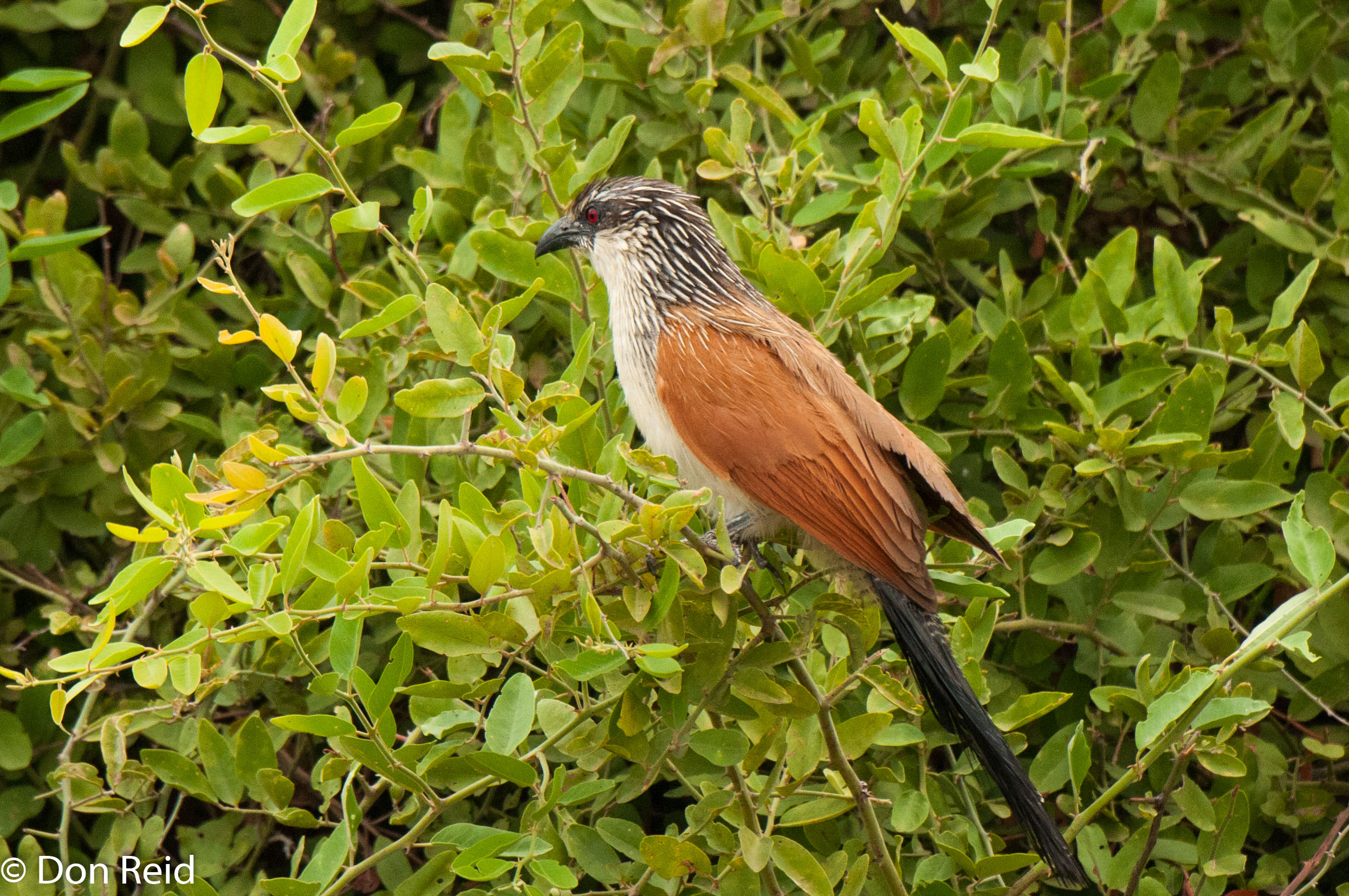
Broad-billed Roller, Seboba Nature Park KasaneAfrican Golden Oriole, Seboba Nature Park KasaneCommon Sandpiper, Chobe RiverfrontWhite-browed Coucal, Chobe Riverfront
Back in Mossel Bay I saw the year out with some fine atlasing around Herbertsdale, Vöelvlei and Gouritzmond
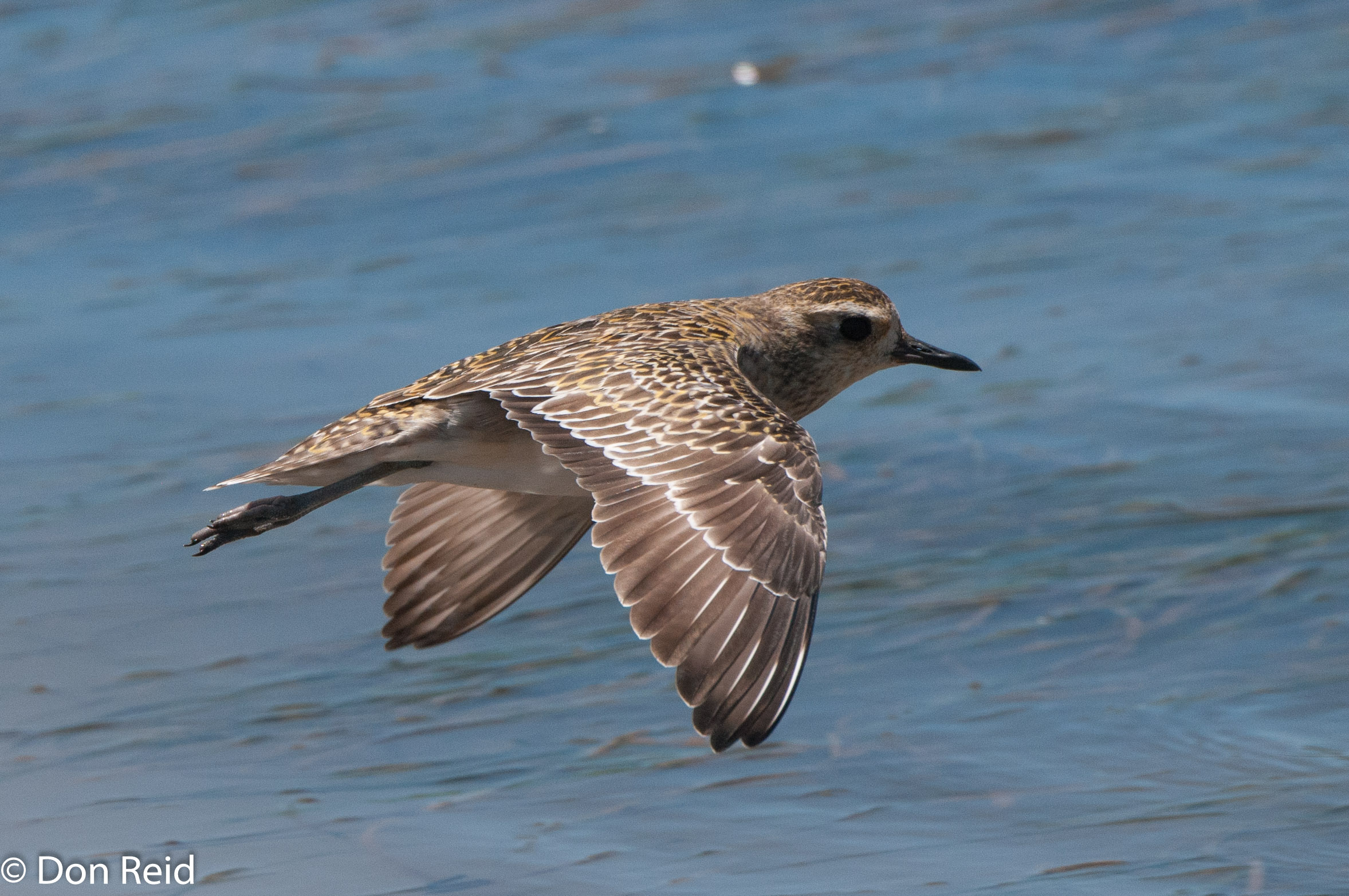
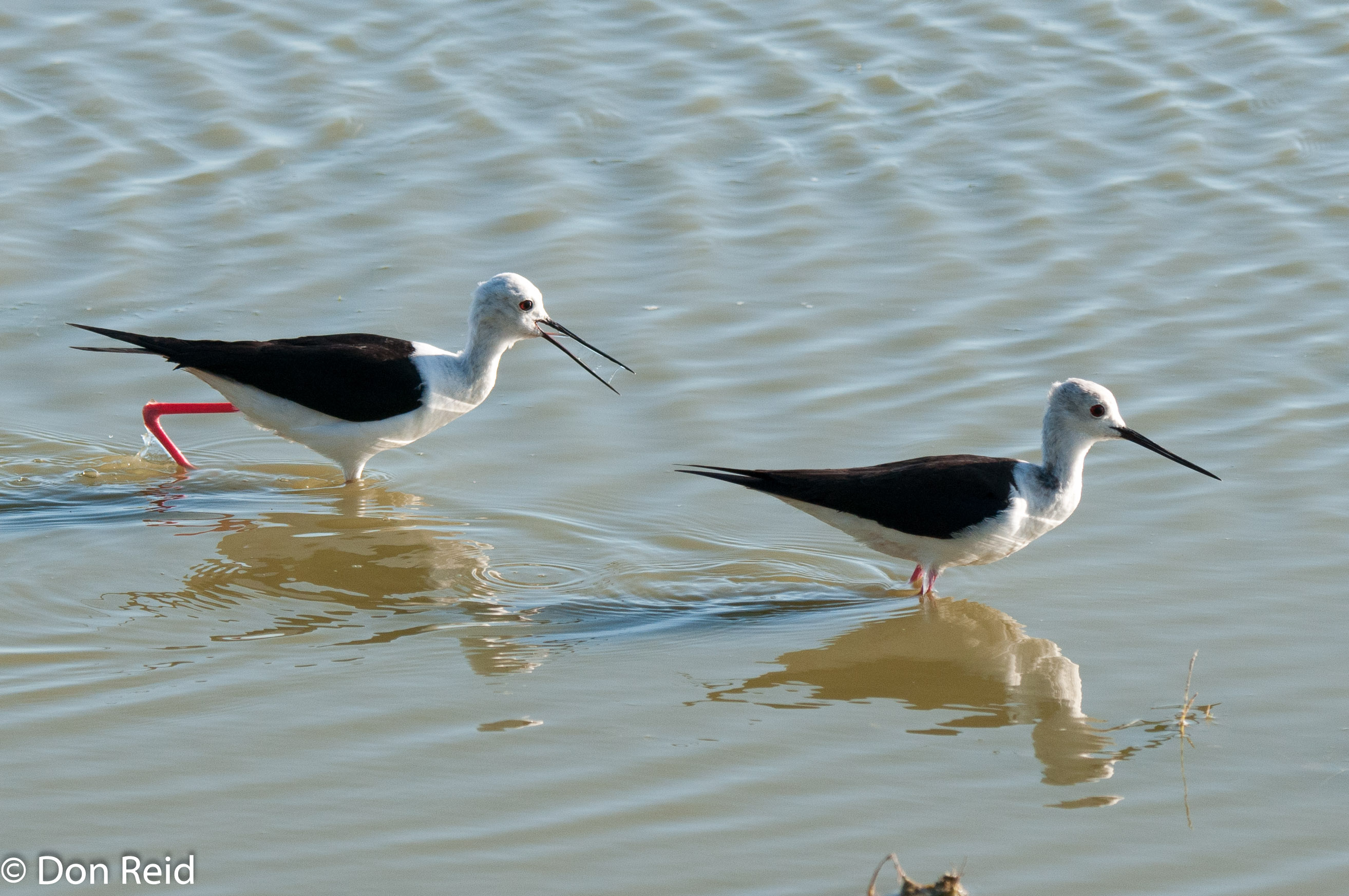
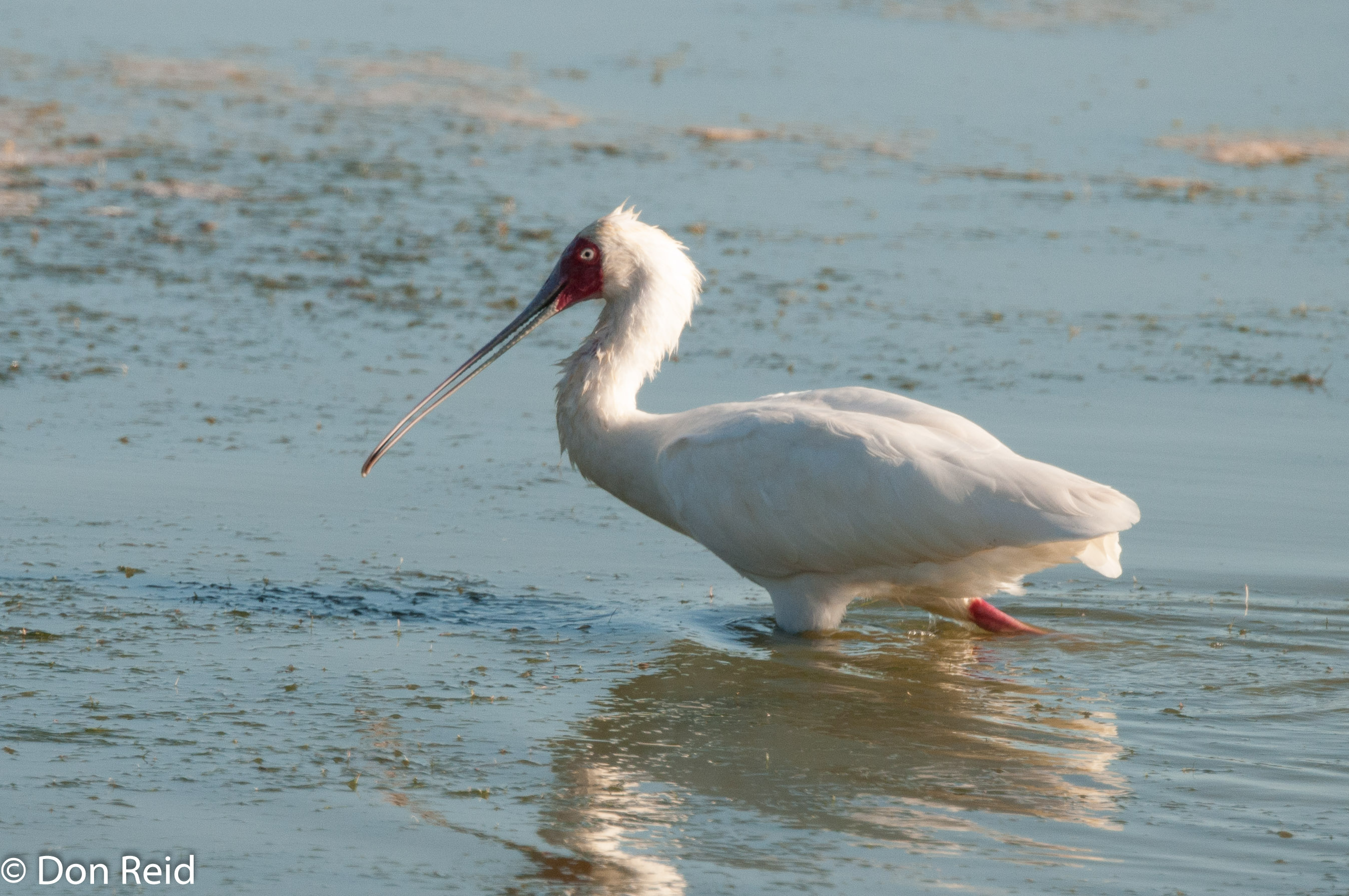
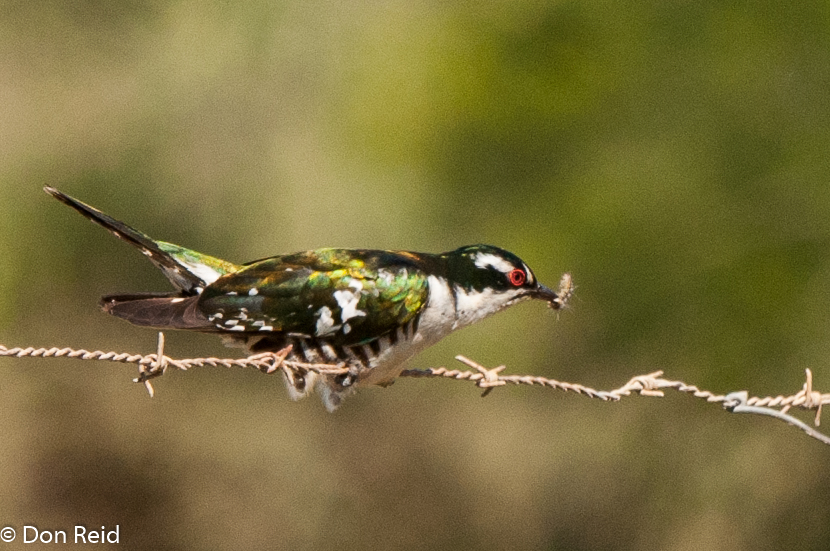
Pacific Golden Plover, GouritzmondBlack-winged Stilt, Voëlvlei near GouritzmondAfrican Spoonbill, Voëlvlei near GouritzmondDiderik Cuckoo, Herbertsdale south
Here’s a selection of my photos from places visited in 2015 – mostly from places that support my favourite pastime of birding.
The Places
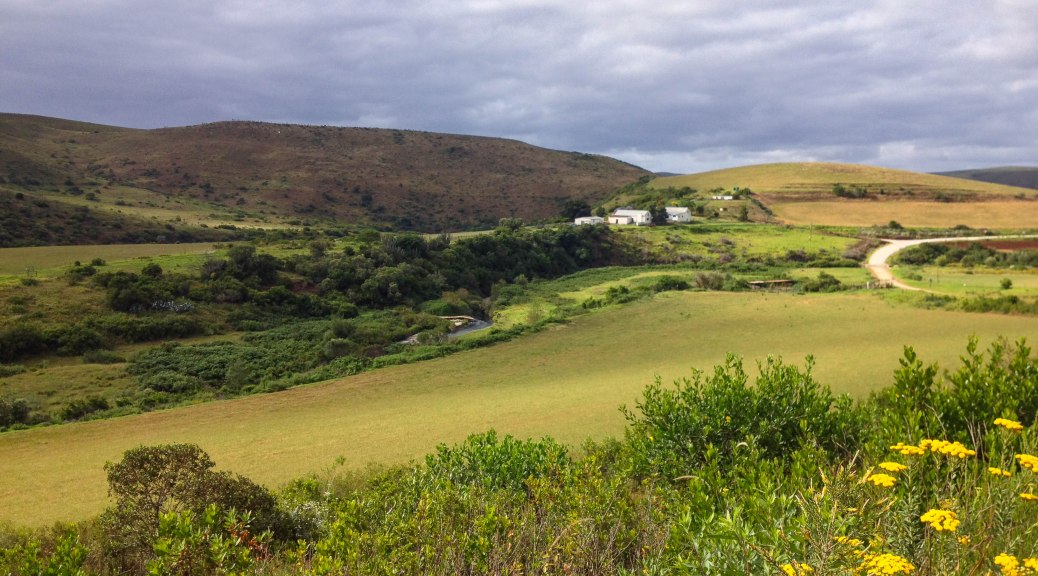
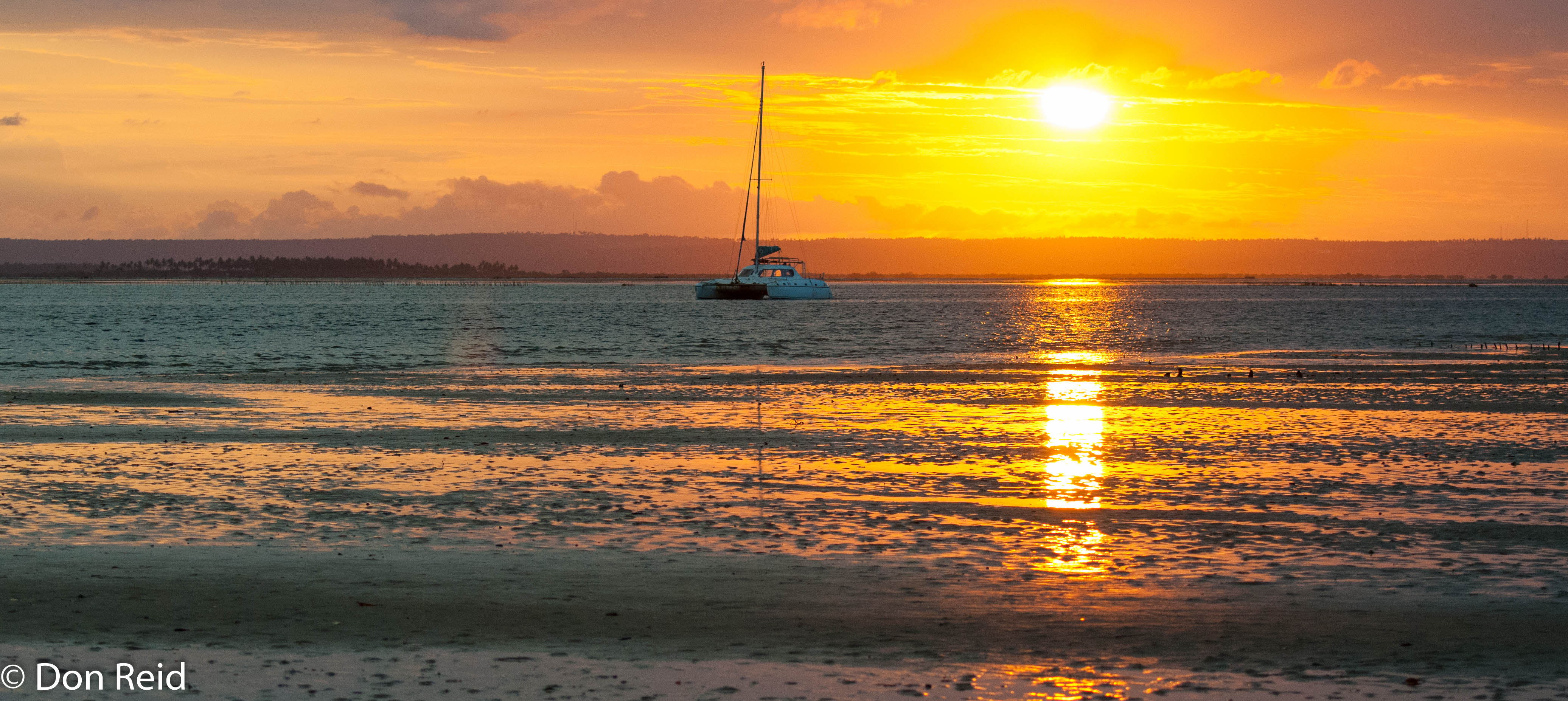
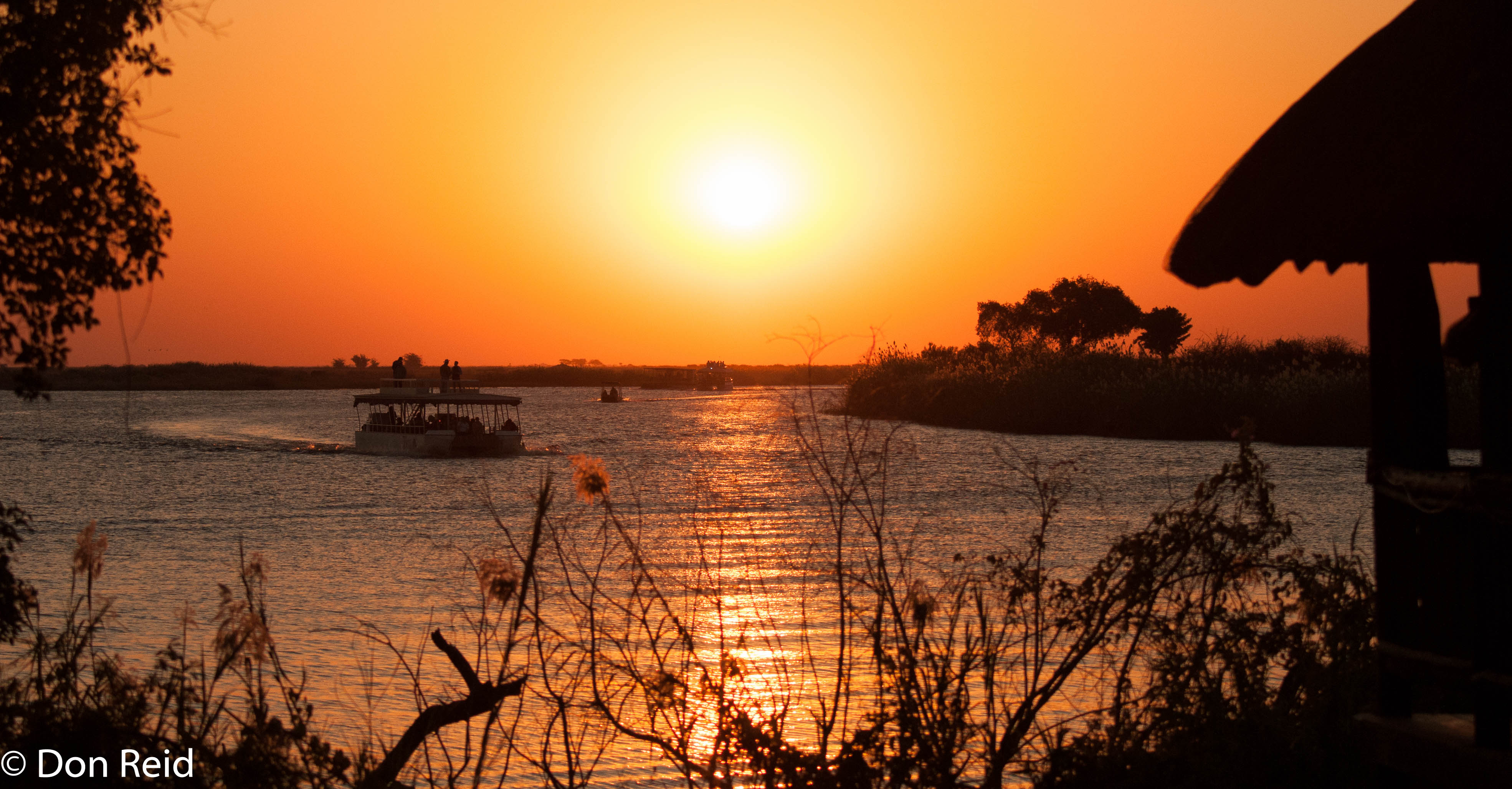
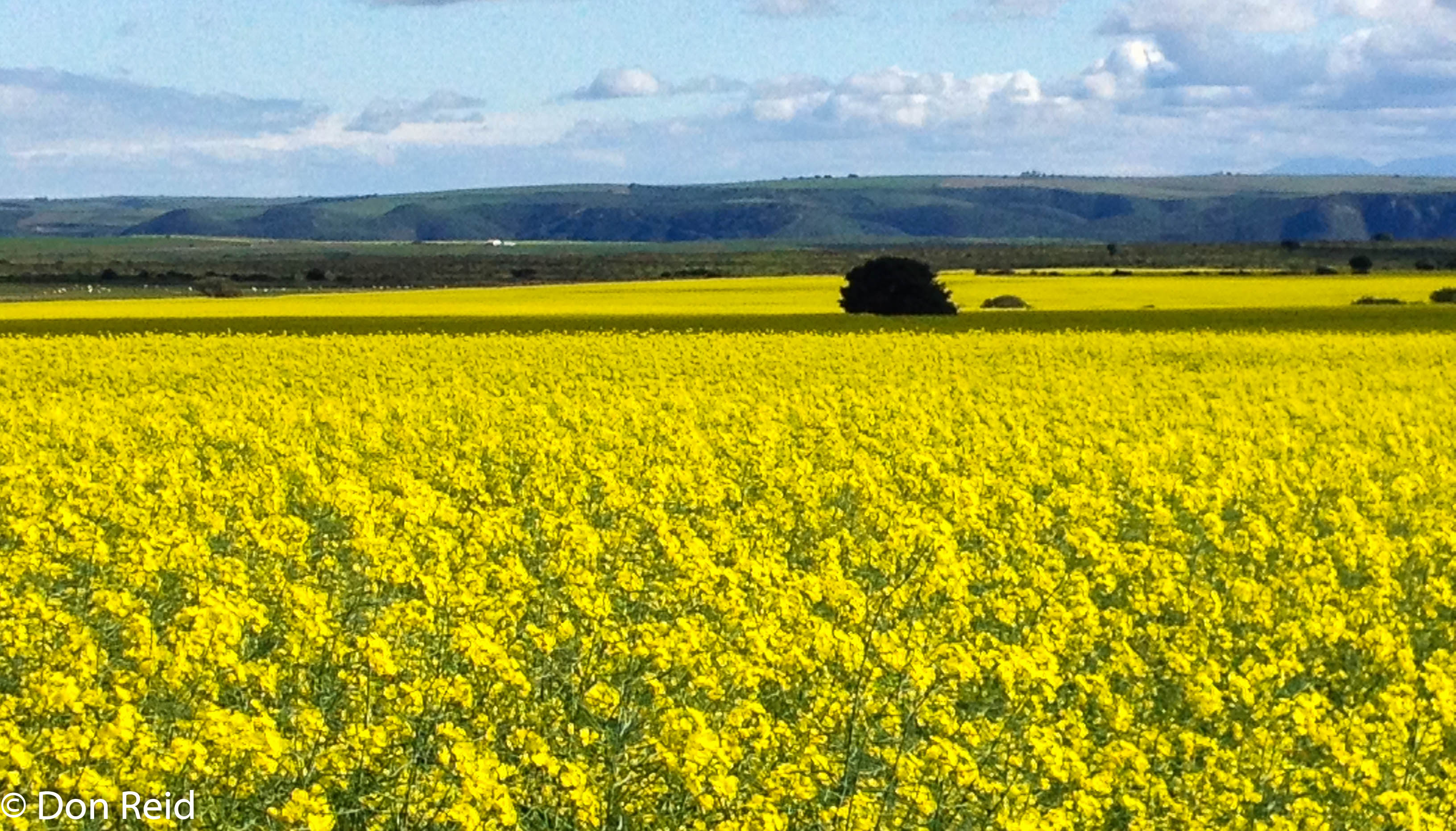
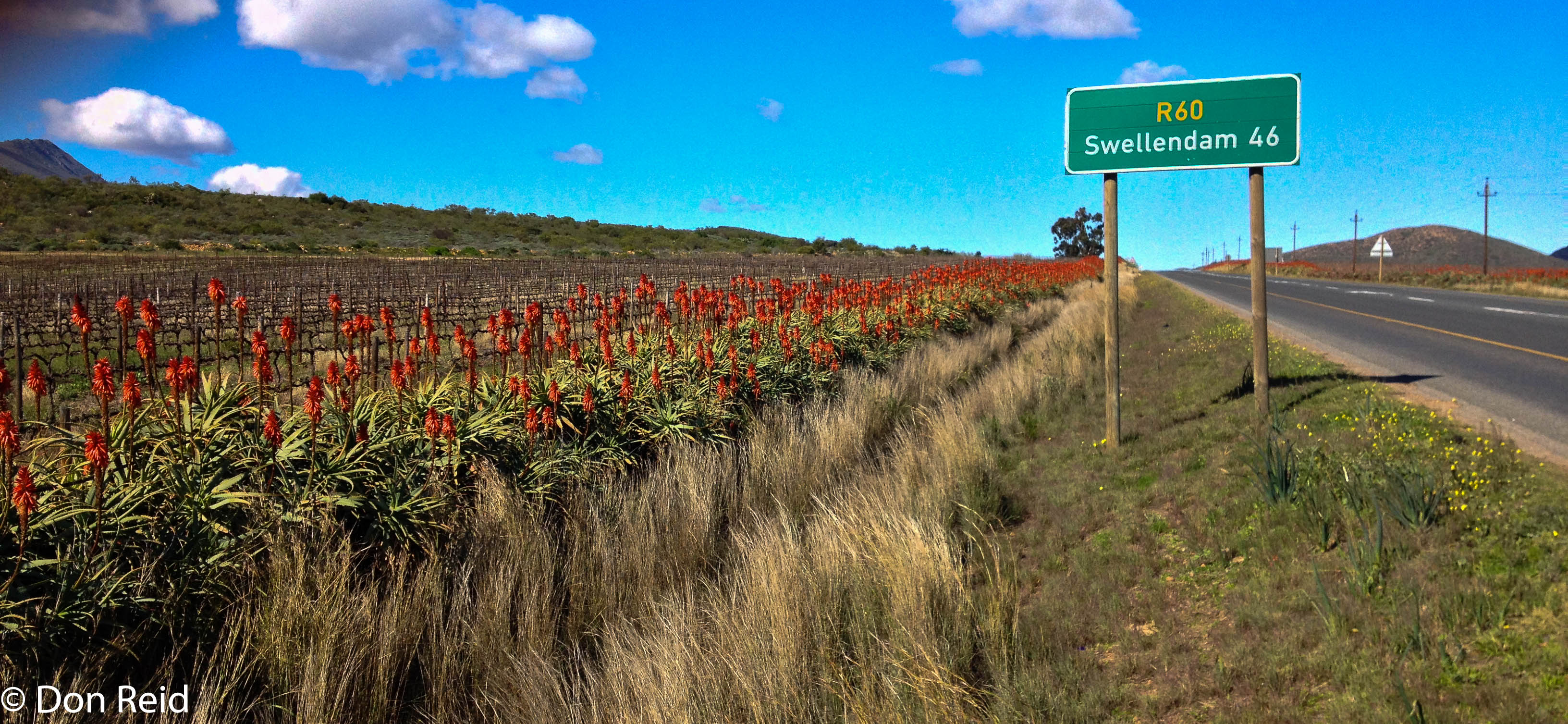
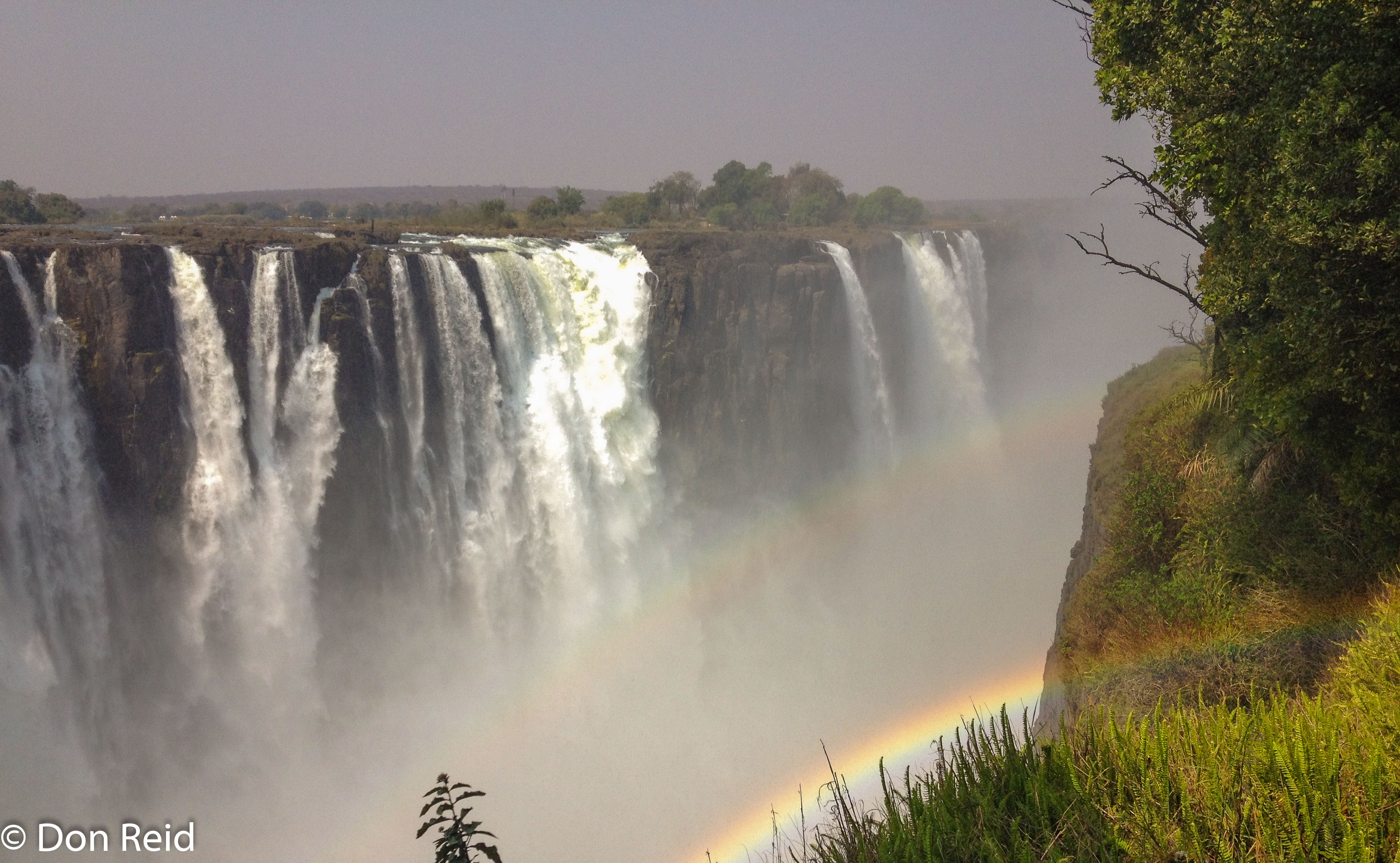
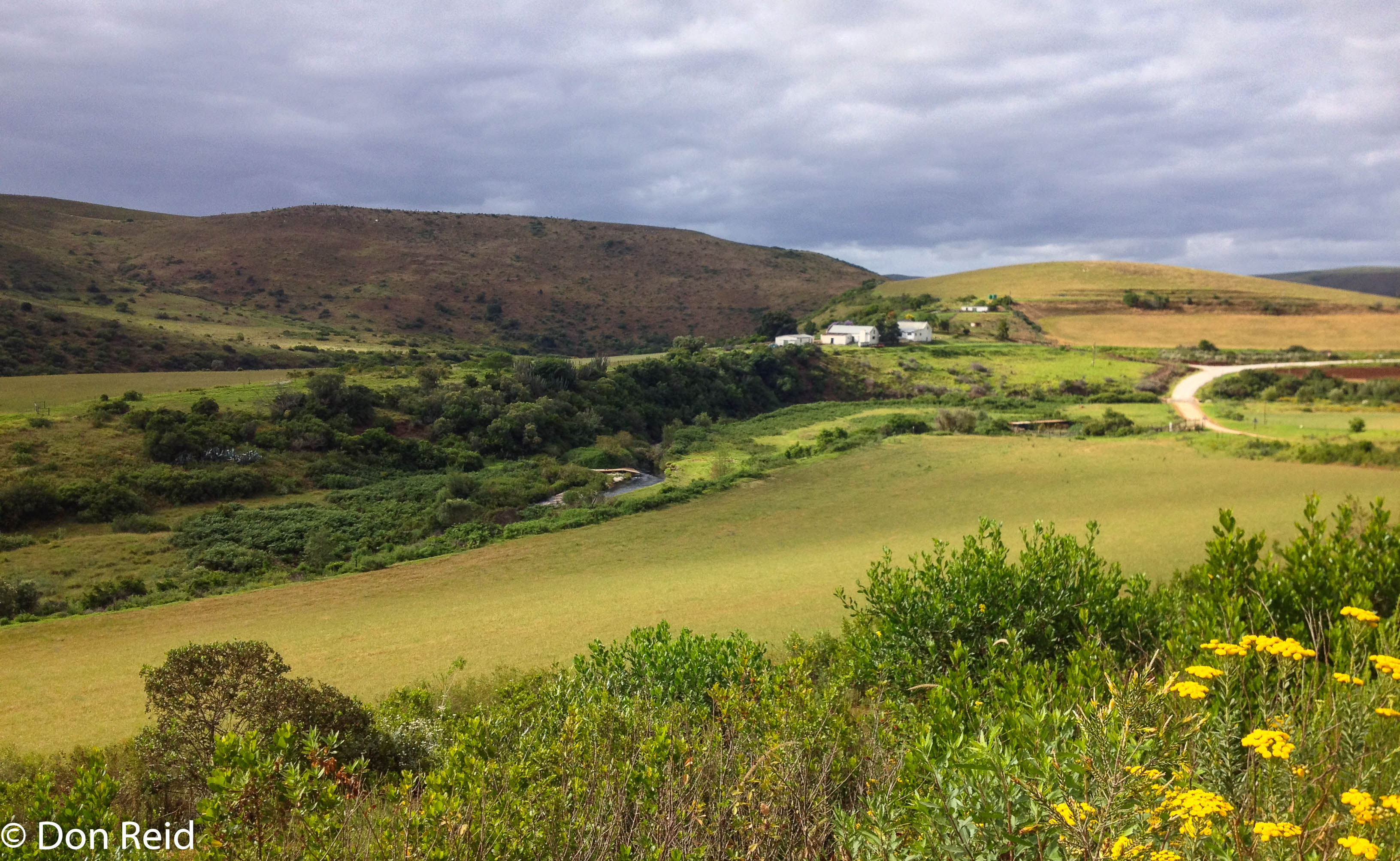
Sunset, Inhambane – MozambiqueNear Springfontein Free StateMcGregor, Western CapeSunset, Chobe RiverCanola fields along Herbertsdale road near Mossel BayAloes along the Ashton-Swellendam roadVictoria Falls, ZimbabweRuiterbos area near Mossel Bay
The Animals
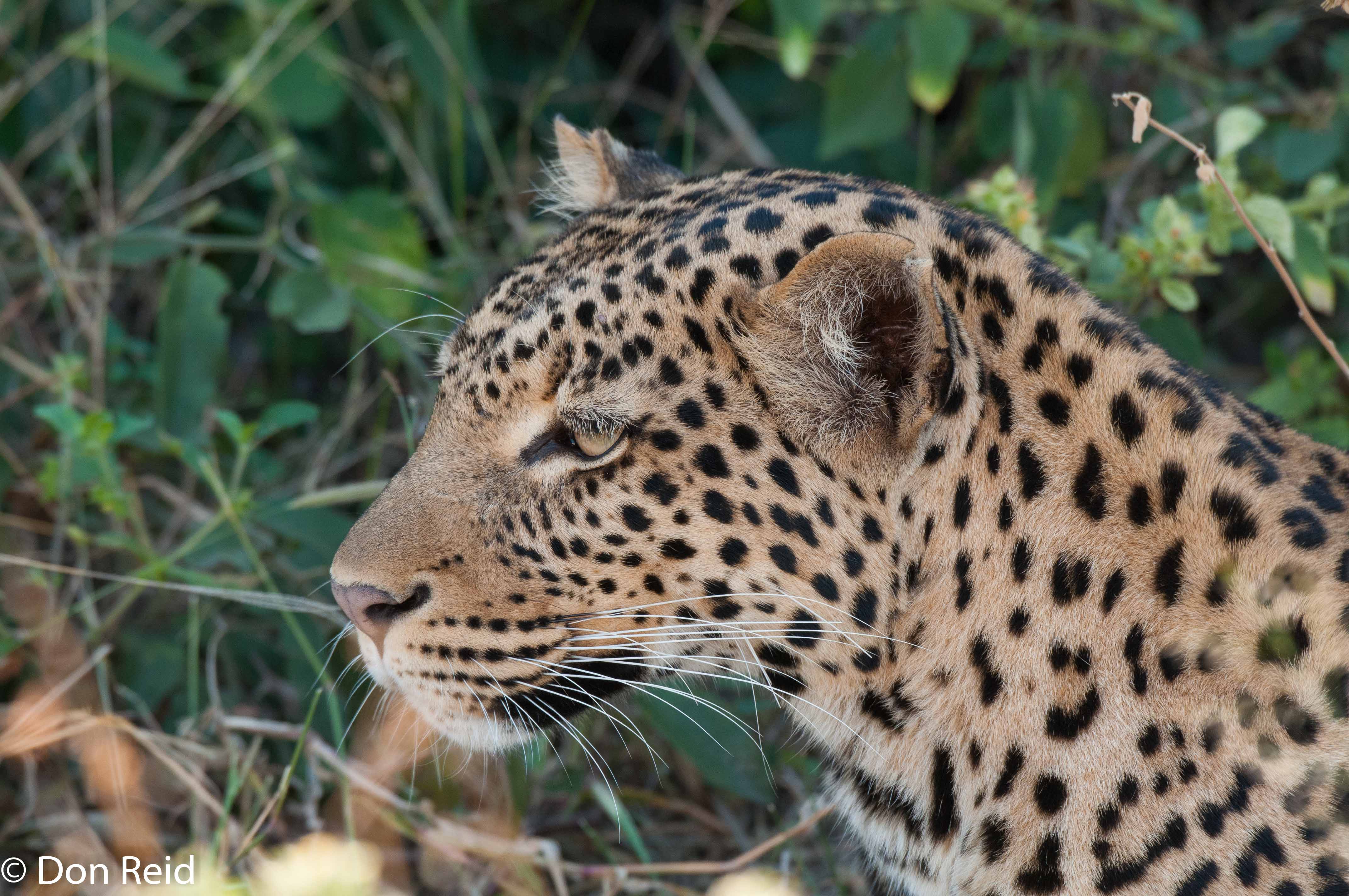
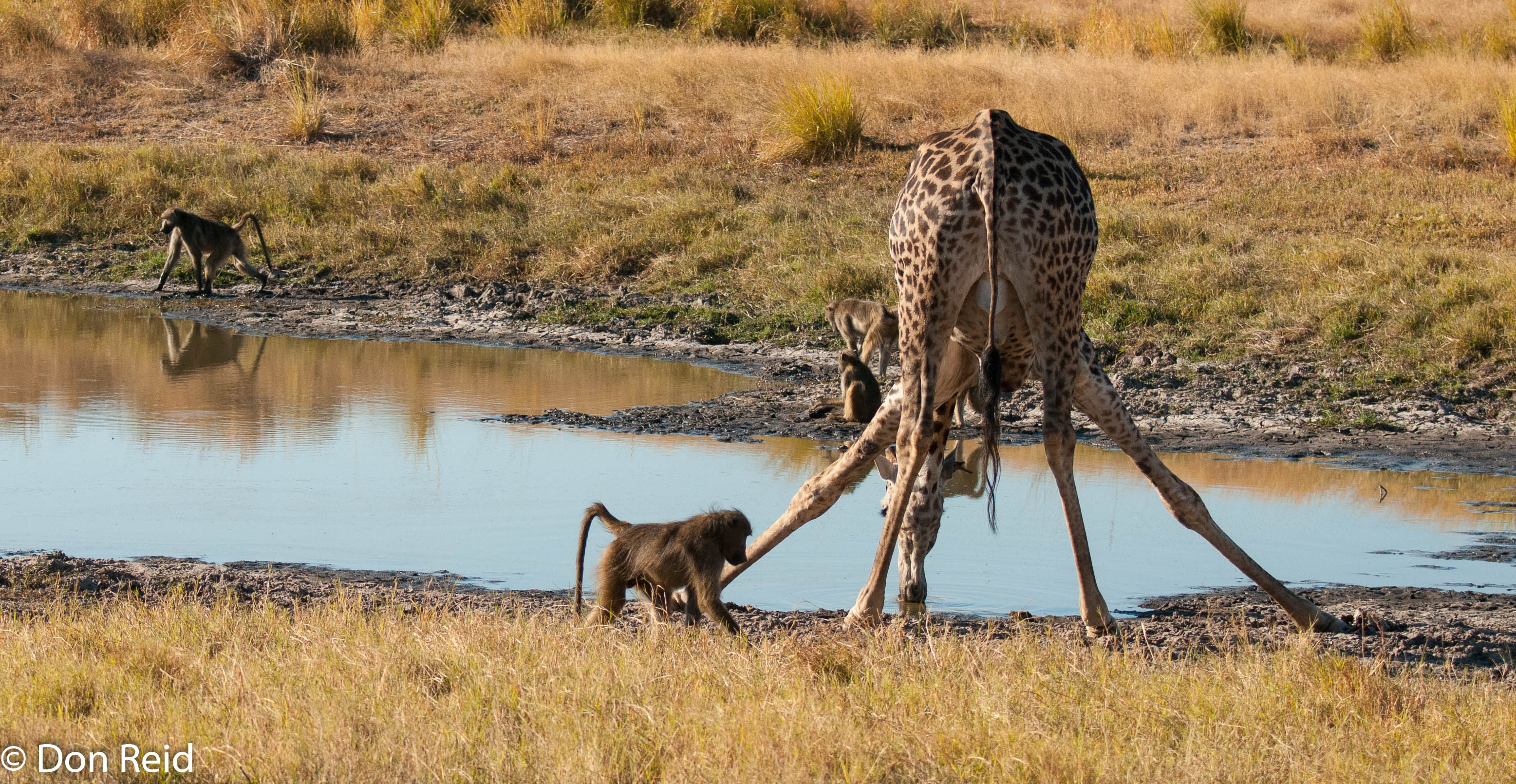
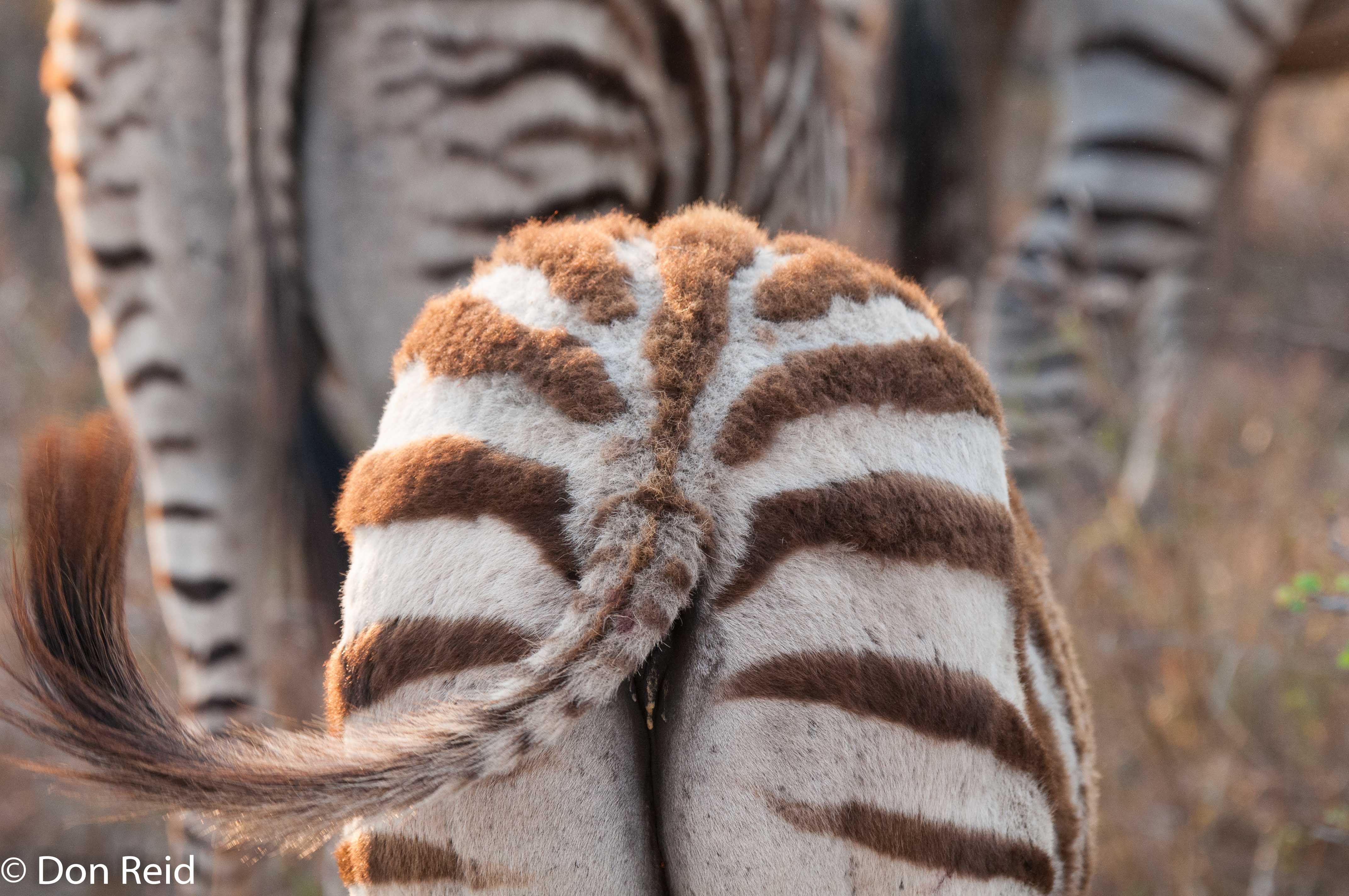
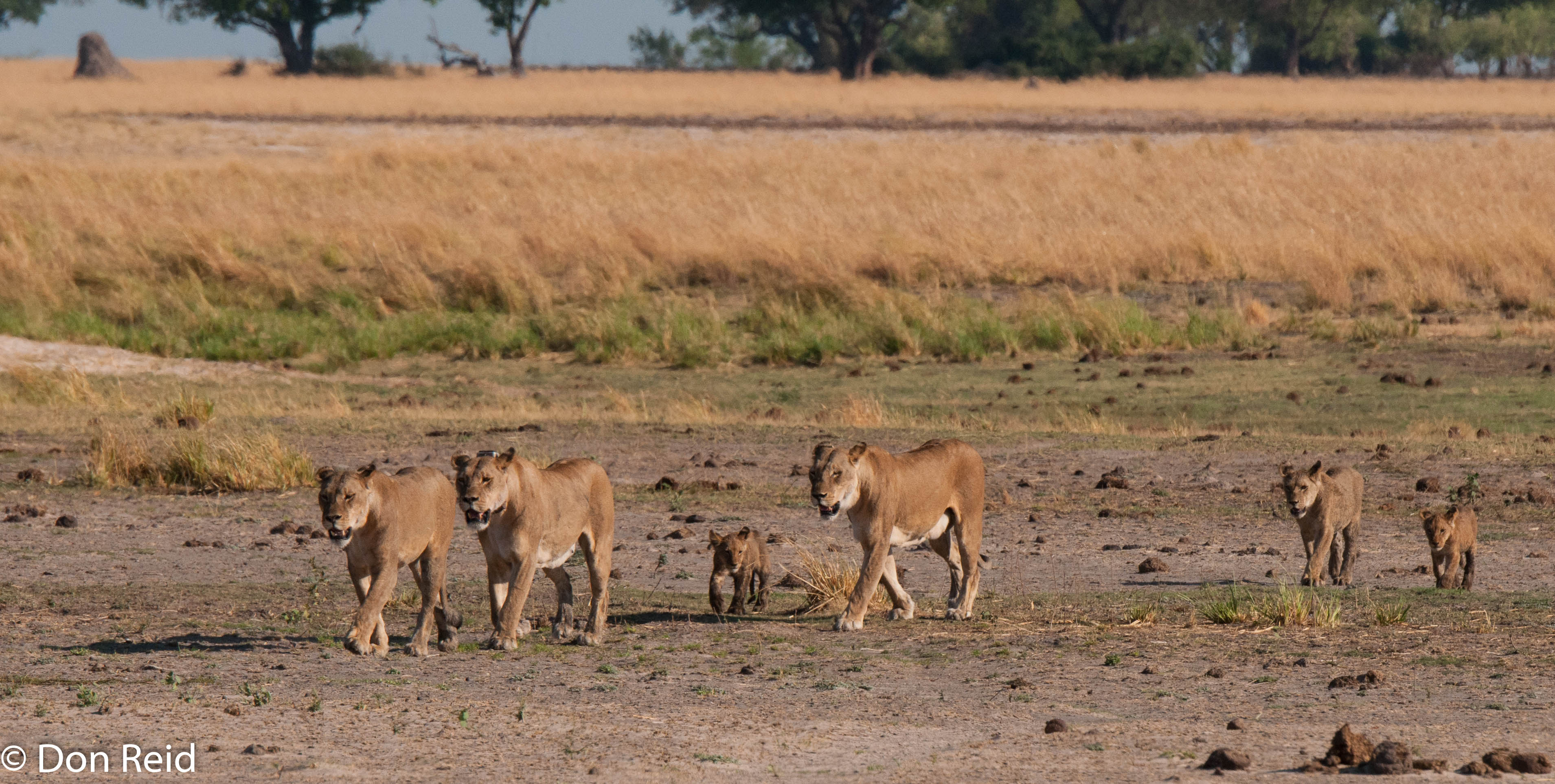
Leopard, Chobe Game ReserveGiraffe at waterhole, Chobe Game ReserveAfrican Wild Dog, Kasane areaElephant at sunset, Chobe Game ReserveAfrican Lion, Chobe Game ReserveOlifants camp viewpointBurchell’s Zebra, Satara – Nwanetsi S100Zebra juvenile, SataraPride of Lions, Chobe Riverfront
The Birds
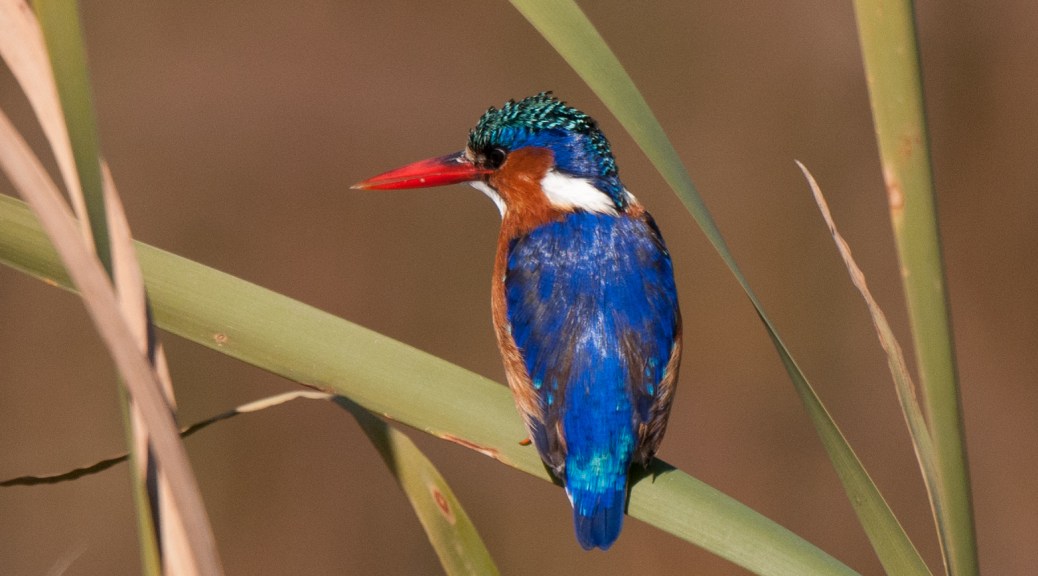
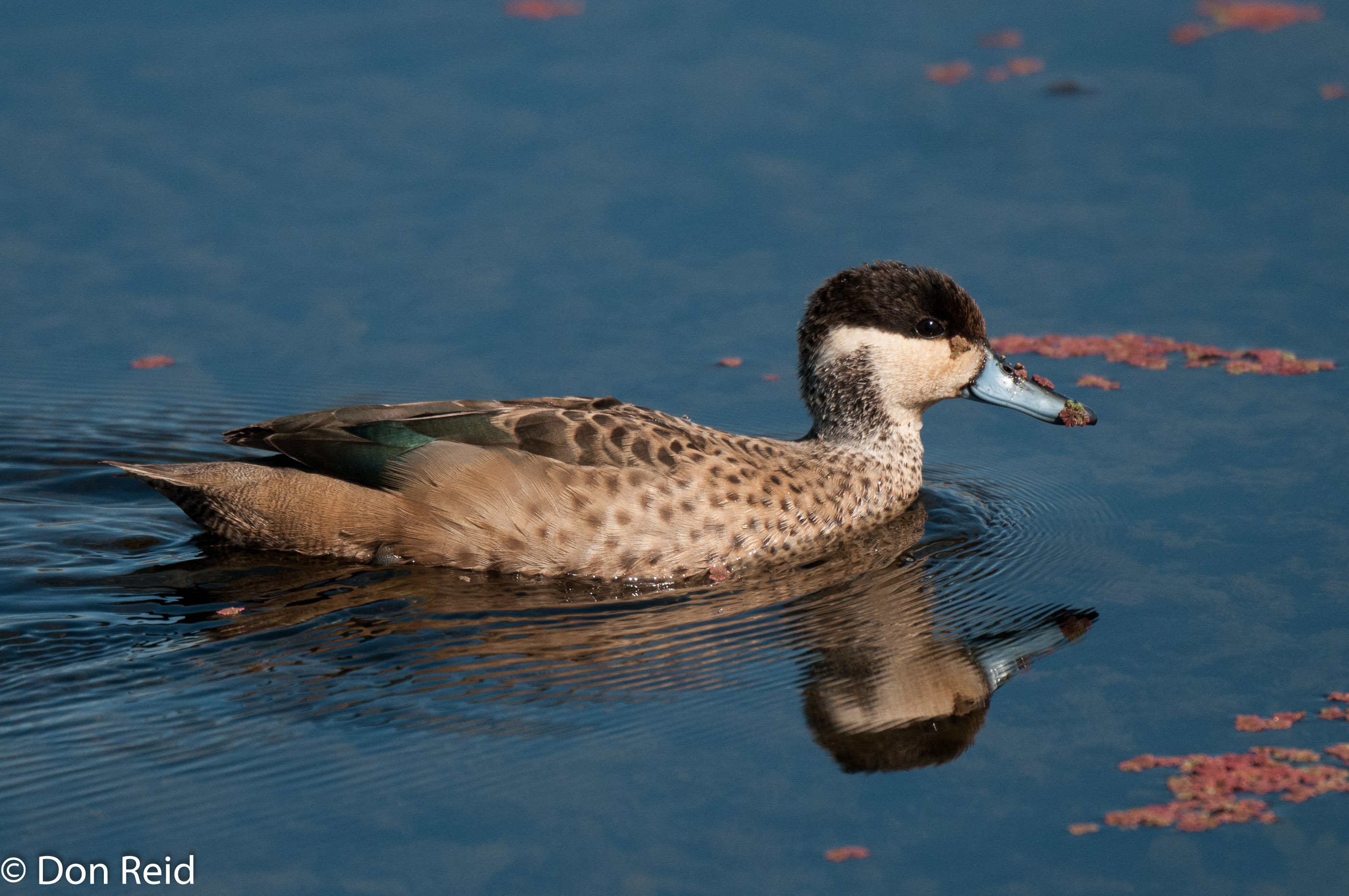
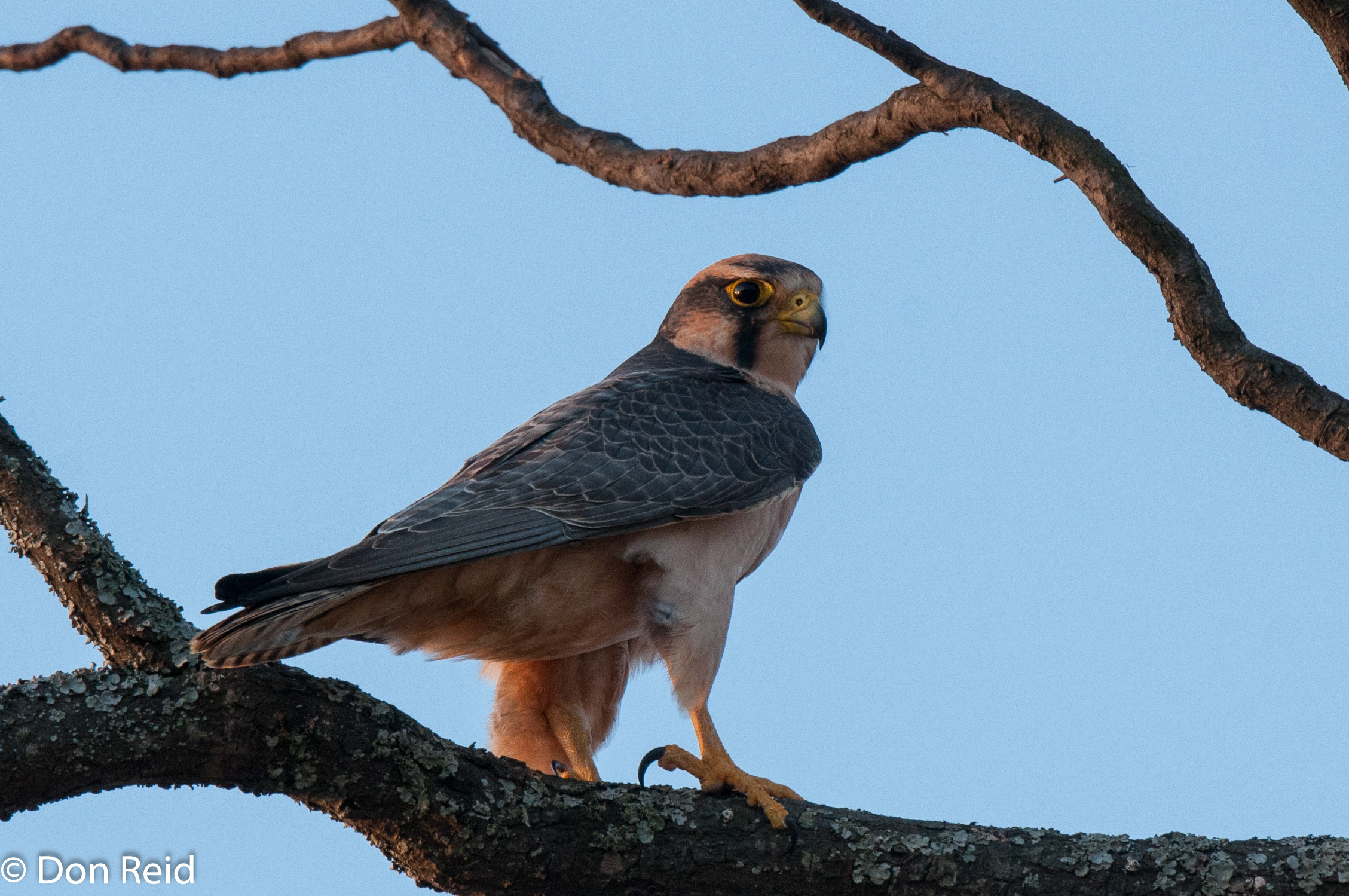
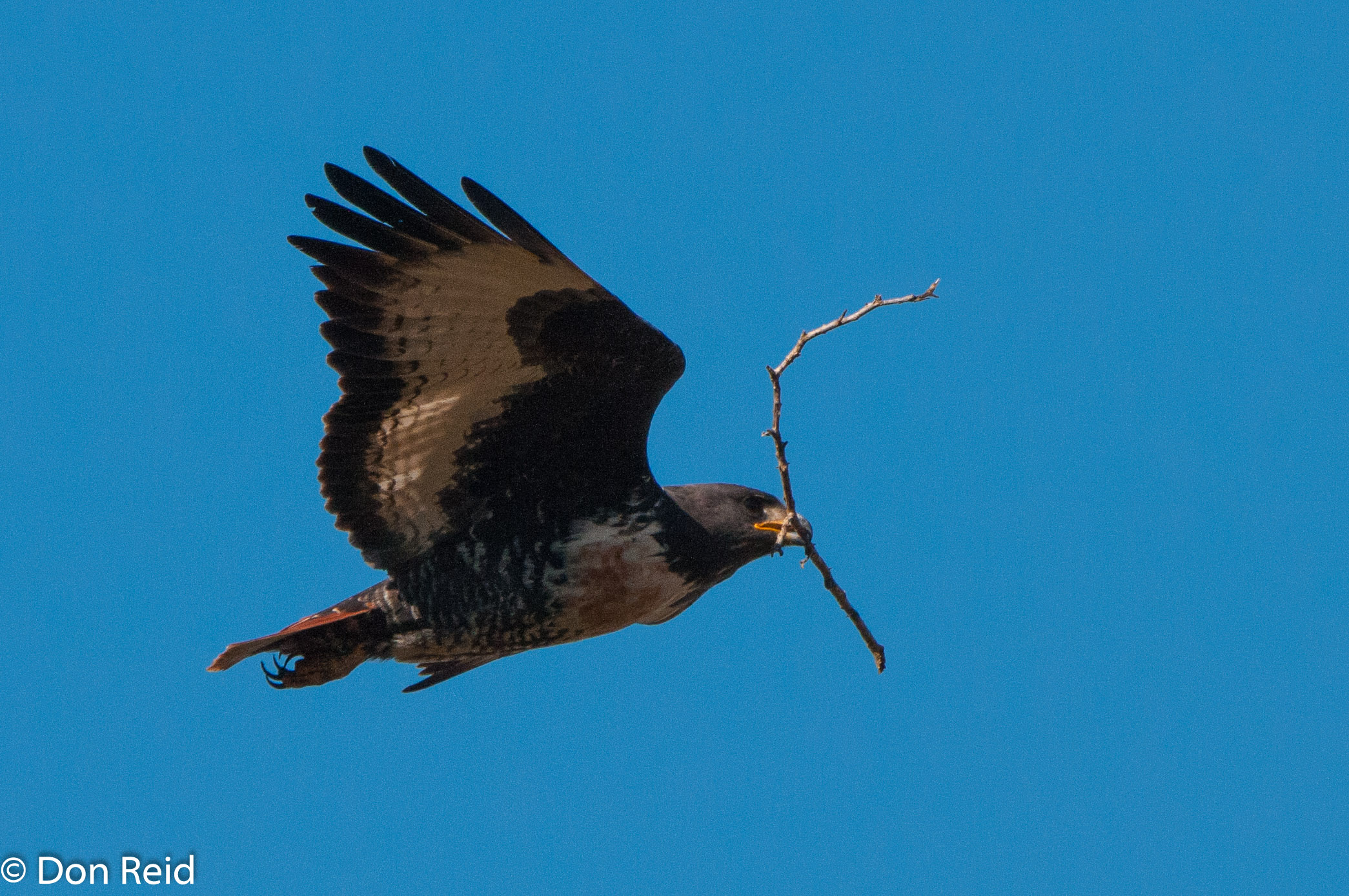
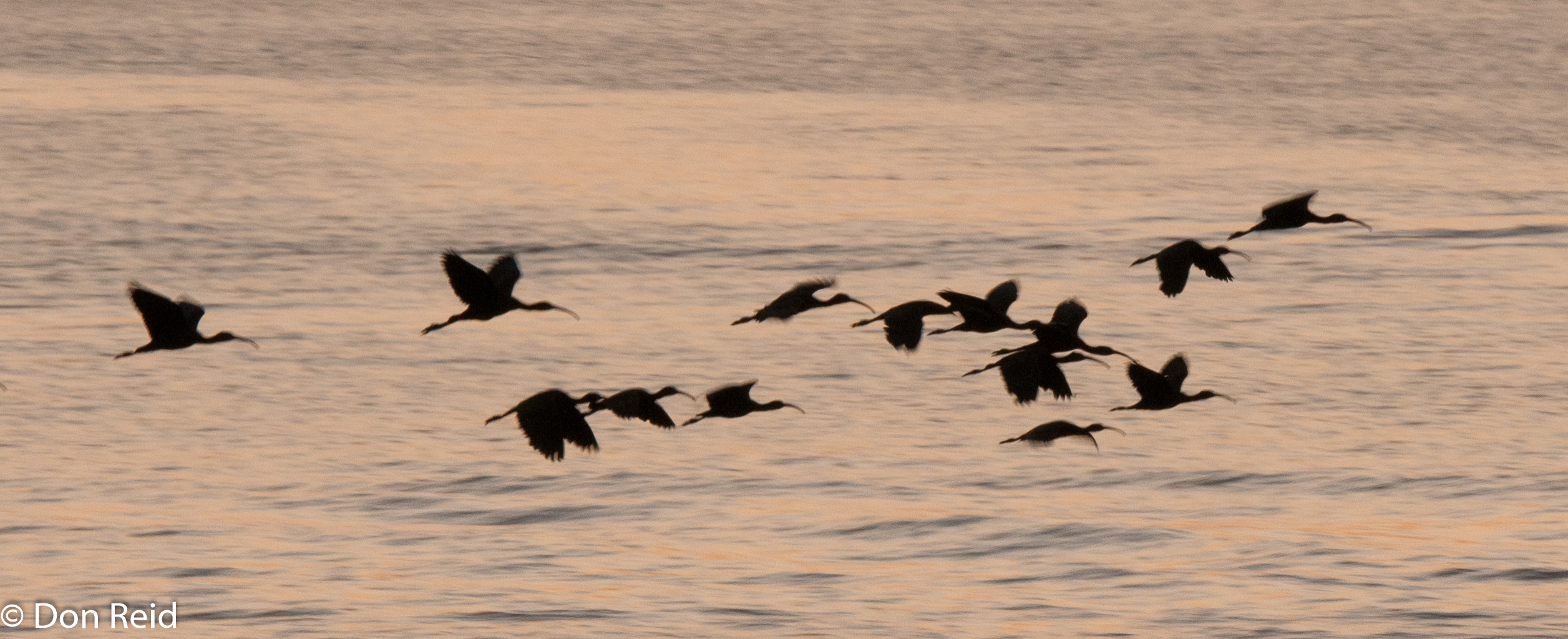
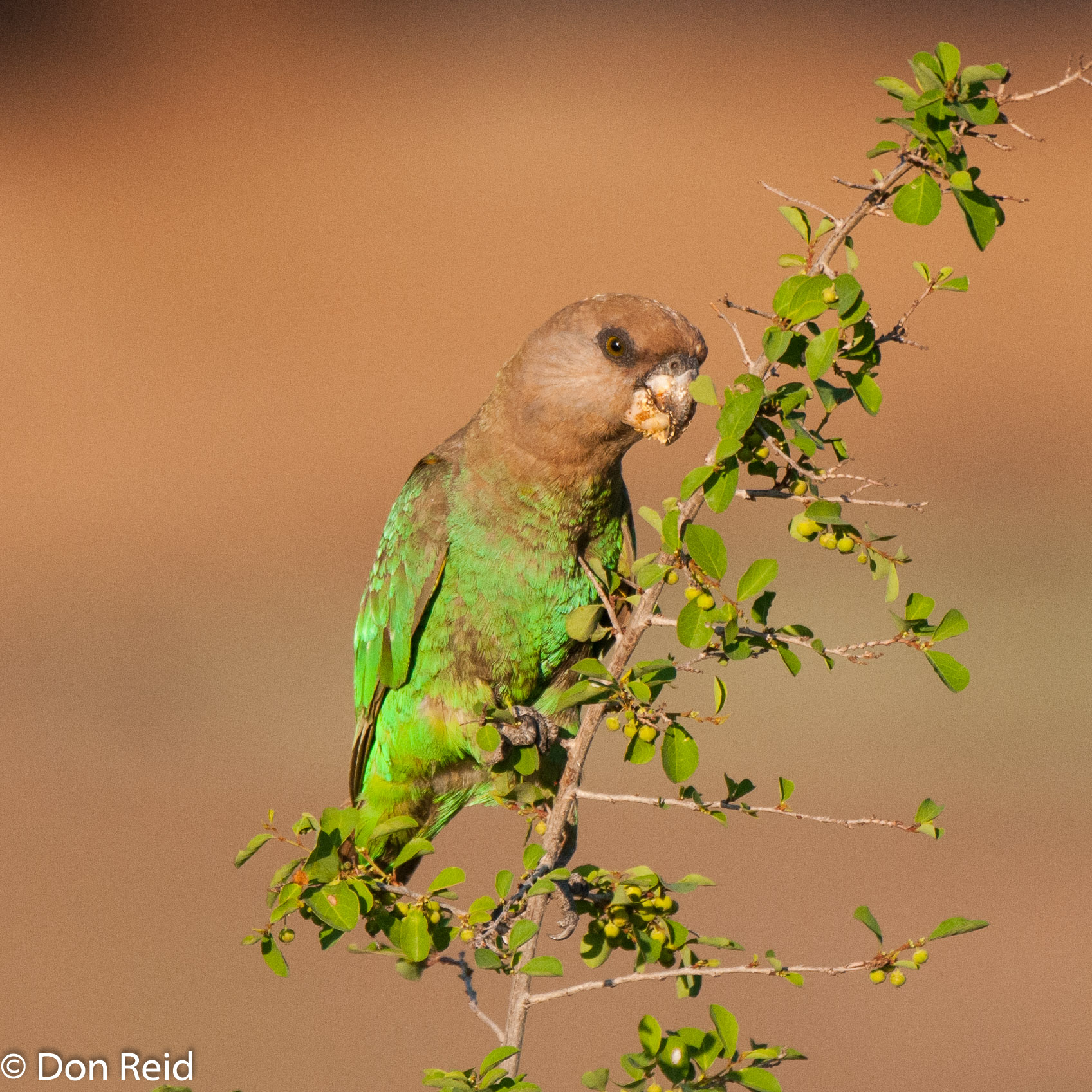
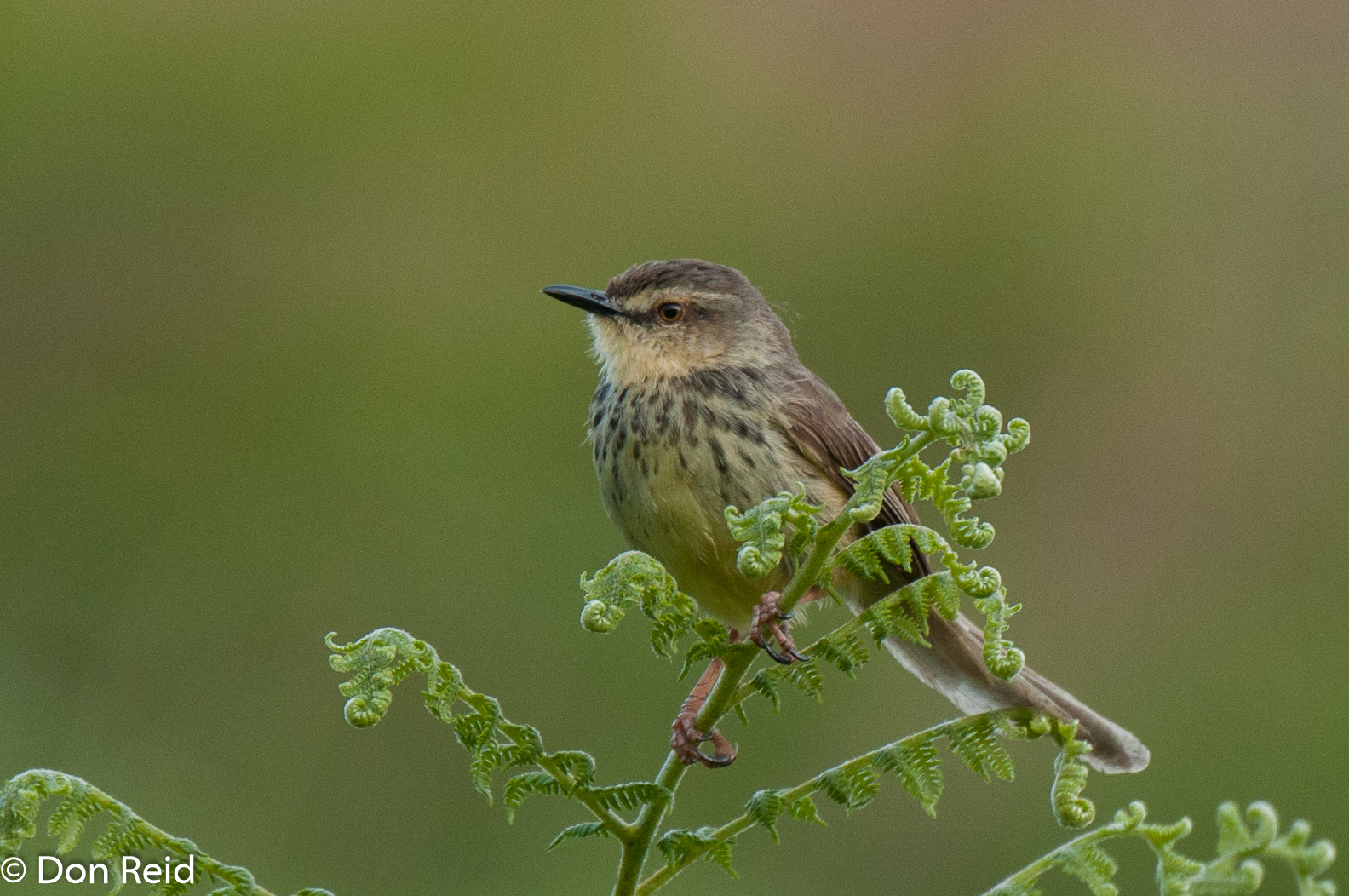
Hottentot Teal, MarievaleMalachite Kingfisher, MarievaleLanner Falcon, VerlorenkloofJackal Buzzard with nest material, Mossel Bay-HerbertsdaleGlossy Ibis, Chobe Game ReserveRed-billed Oxpecker, Chobe Game ReserveTrumpeter Hornbill, Victoria FallsBrown-headed Parrot, Satara – Orpen H7Orange-breasted Bush-Shrike, SataraDrakensberg Prinia, VerlorenkloofMalachite Sunbird, Valsriviermond
Others
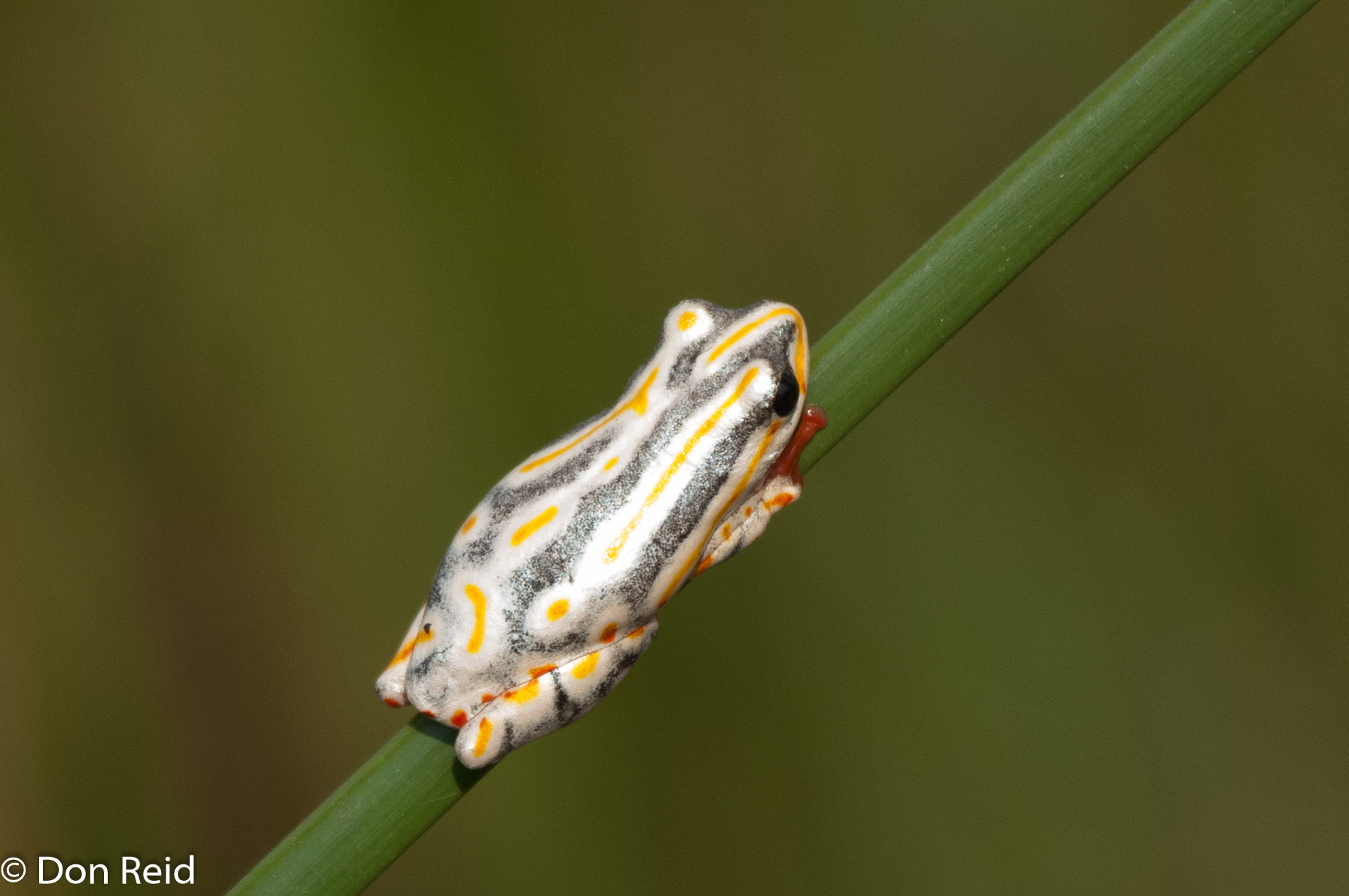
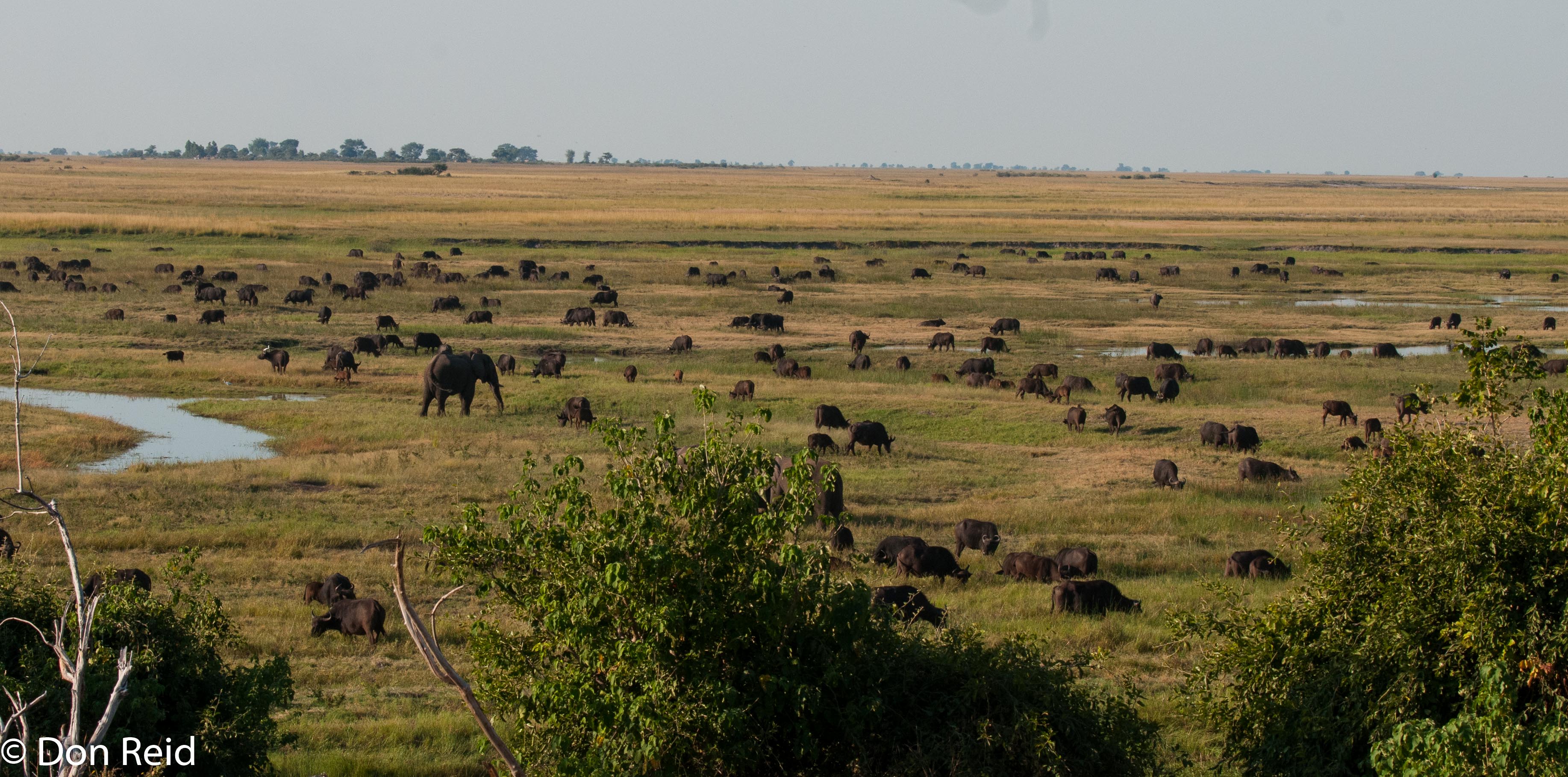
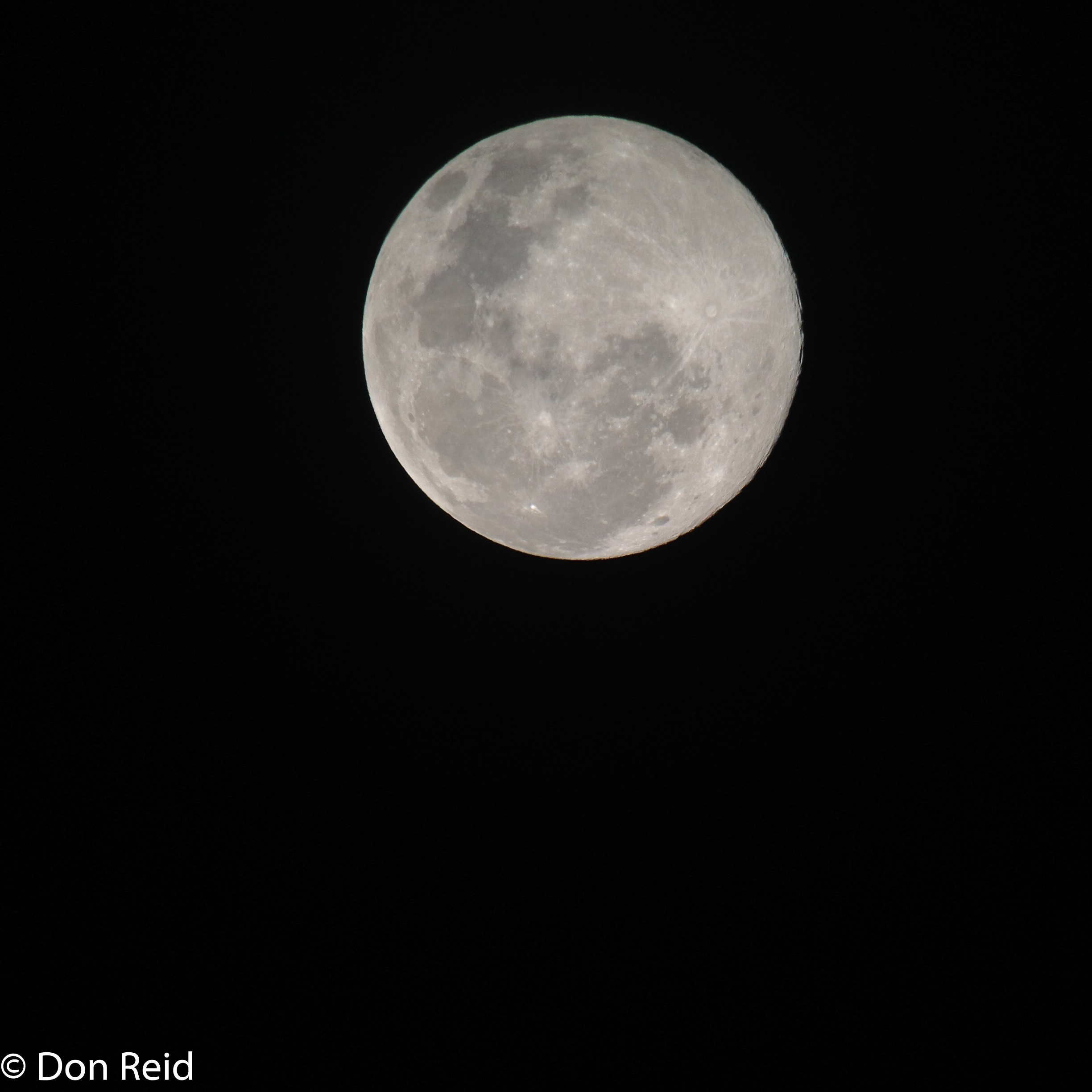
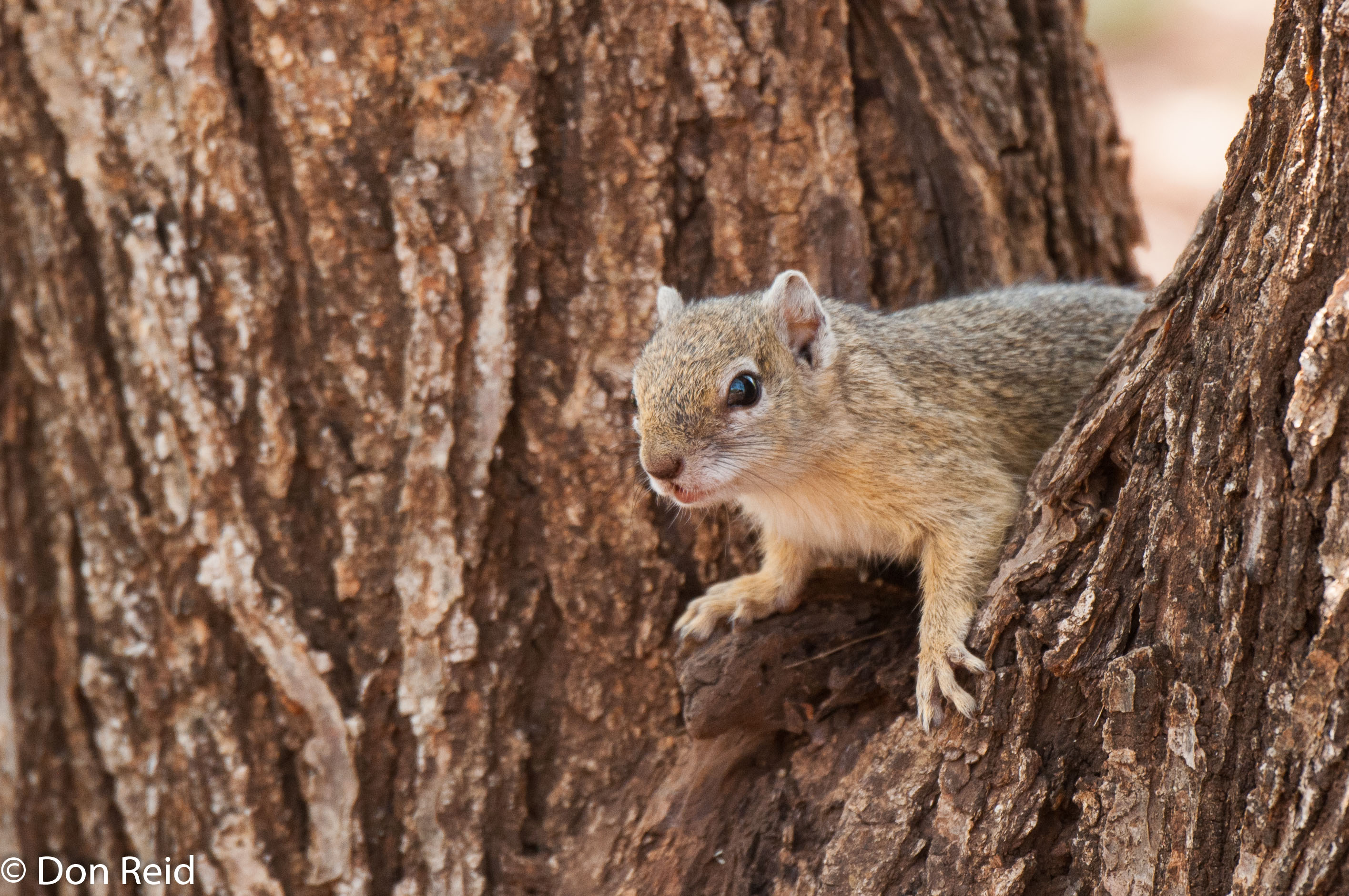
Painted Reed Frog, MozambiqueGold-banded forester, MozambiqueMostly Buffalo, Chobe Game ReserveMoon shot with I-phoneTree Squirrel, Satara
Best wishes to all for 2016 and hope you enjoy my ramblings as much as I enjoy recording them in words and photos!
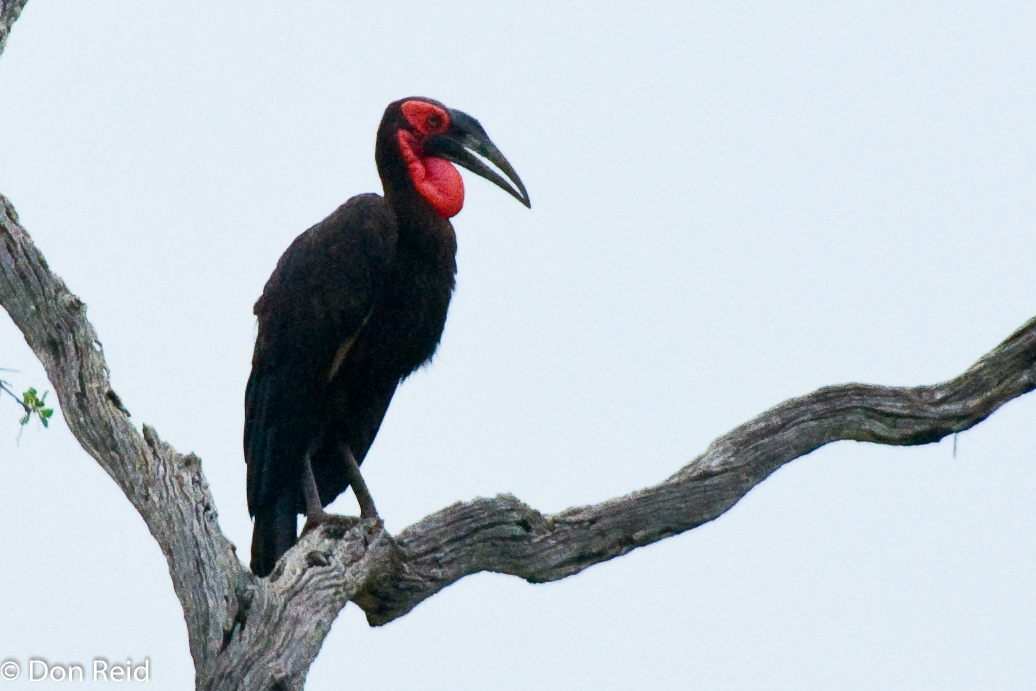
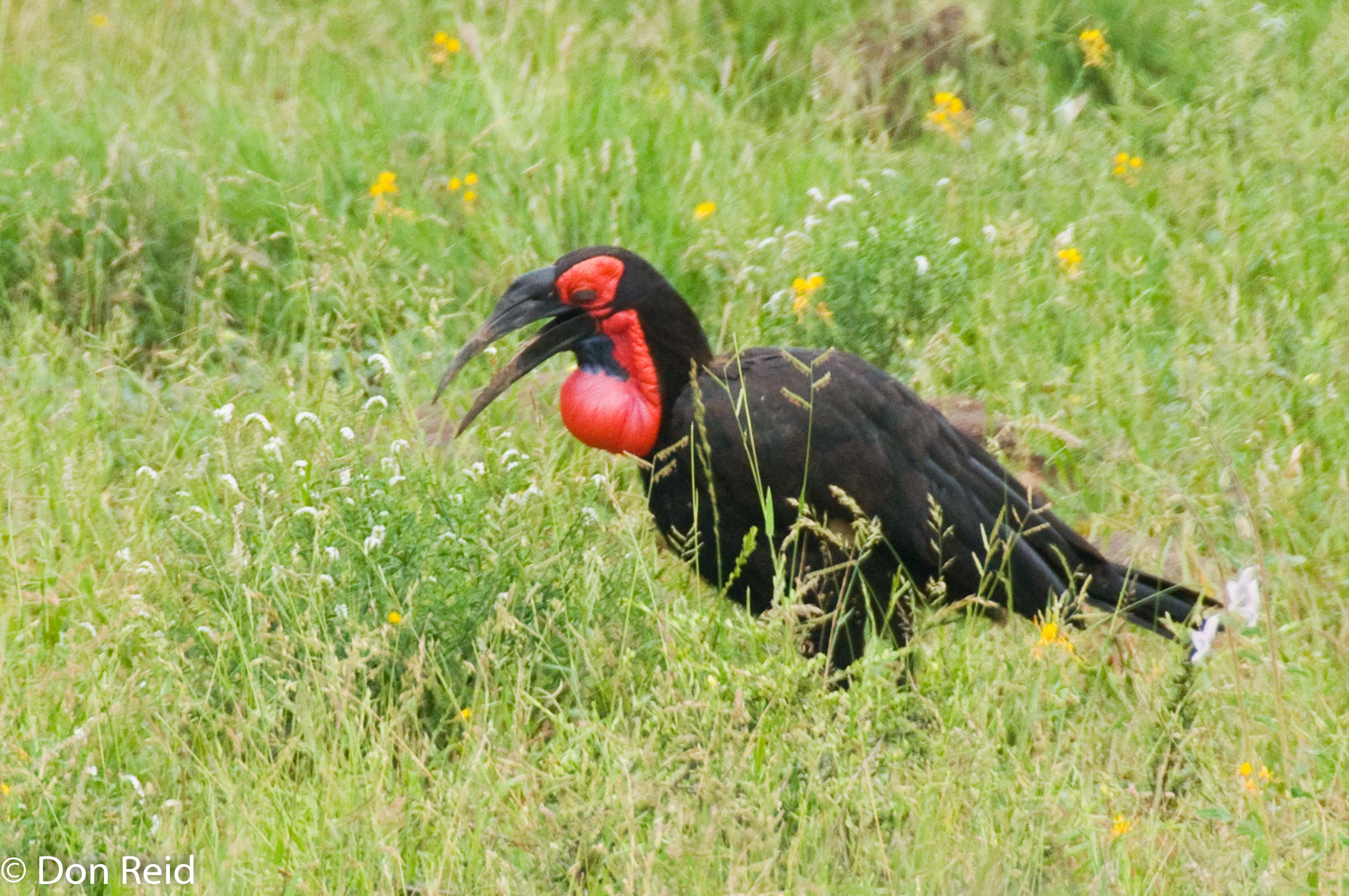
Southern Ground-Hornbill (the name includes “Southern” only because there is a related “Northern Ground-Hornbill” which occurs further north in Africa as per the extract from Birds of Africa below)
Bromvoël (Afrikaans) as with many Afrikaans names this one is most appropriate, “Brom” translating directly as “drone” , “grumble” or “grunt” which describes their early morning call
Ingududu, Intsikizi (Indigenous)
Hornrabe (German)
Bucorve du Sud (French)
Zuidelijke Hoornraaf (Dutch)
Bucorvus Leadbeteri (Scientific) The beauty of scientific names is that they are common throughout the world no matter what country or the language spoken. The first part – Bucorvus – is the Genus which is derived from the Greek Bu- meaning ox and Latin Corvus being the fairly well known term for Crow – so literally “large crow”. The second part – Leadbeteri – is the species name which in this case is named after the British taxidermist and ornithologist Benjamin Leadbeater
Tamboti KNP
Where to find it
This is another species that is easier to find in protected areas such as the National Parks in the north-eastern parts of Southern Africa. Most likely place in South Africa would be in Kruger Park.
My first sighting was during my first visit to Kruger in the early 1970’s and I still recall my surprise when we came across a small group of Ground-Hornbills on the first stretch of road as you leave Skukuza camp and head towards the Lower Sabie road. They were right next to the road and, it seemed, accustomed to the attention of passing visitors and clicking cameras (they still clicked in those days)
The distribution map below is from SABAP2
Look …….. and Listen
There is absolutely no chance of confusing this species with any other, except if you mistake it for an escaped turkey, which it does resemble up to a point with its black colouring and vivid red throat patch. In fact, it has in the past been referred to as a Turkey Buzzard. (Not to be confused with the Turkey Vulture which we encountered in Cuba)
This is a large bird, up to 120cm long and weighing up to 6 kg and largest of all the world’s Hornbills by a long way.
They move around in small family groups, waddling slowly as they search for food – anything from reptiles, frogs, snails, even small mammals such as hares.
The call is a low-pitched booming sound, not typically bird-like at all. My first encounter with calling Ground-Hornbills was early one morning in Kruger – a group was perched in a tree, silhouetted by the morning sunlight, sounding every bit like a rock-band warming up as they called in varying tones in a rhythmic fashion. Males and females call in different tones (much like humans)
Early morning calling from tree
Punda MariaChobe Game Reserve
Photography
Probably one of the easiest birds you will get to photograph, because of its large size, vivid colouring and the fact that they are often found not too far from the road in places such as Kruger National Park
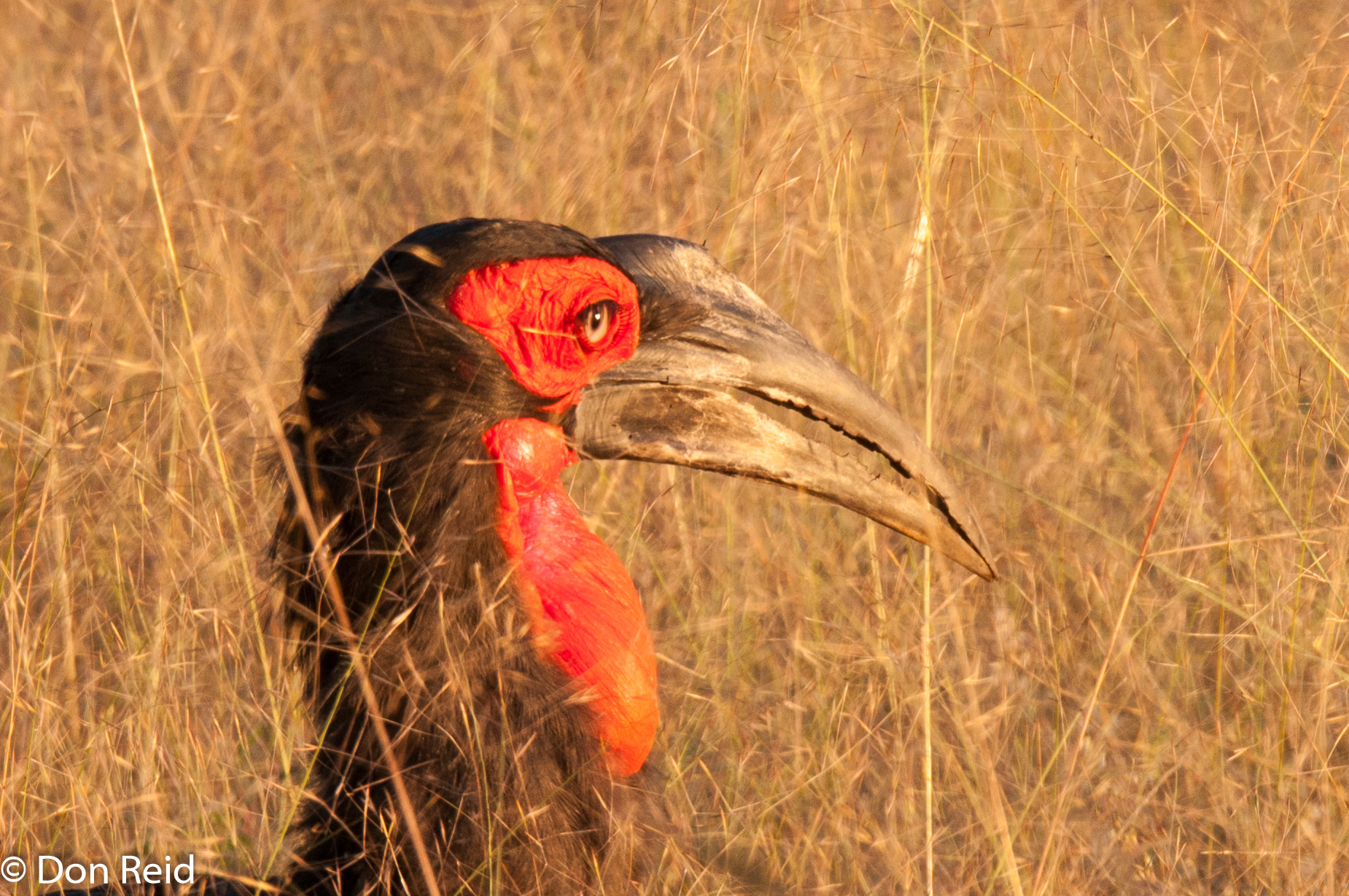
It is always pleasing if you can get close enough for a detail shot of the head with the long eyelashes often prominent and the bright red throat pouch
Chobe Game Reserve
Other Stuff
Conservation status is listed as “Vulnerable” on the Red Data list – in SA it is considered “Endangered” and may soon meet the Red Data criteria as being “Critically Endangered”. Loss of habitat is the reason for their decline coupled with the fact that on average one chick is raised to adulthood every nine years by an adult pair.
Lifespan is 30 years or more and in captivity some have lived to 70 years
Nesting is generally in deep hollows in large trees or occasionally in clefts in rock faces
In Africa it has been a focal point of some traditional cultures and is a symbol of the arrival of the rainy season, thus the taboo against killing of the species.
An older version of Roberts mentions the indigenous interpretations of the booming calls, such as the female saying “I’m going, I’m going, I’m going home to my relations”, and the male responding “You can go, you can go, you can go home to your relations!”
References
Roberts Birds of Southern Africa
Birdlife International
Birds of Africa South of the Sahara
SABAP2 (Maps)
Latin for BIrdwatchers (Roger Lederer and Carol Burr)
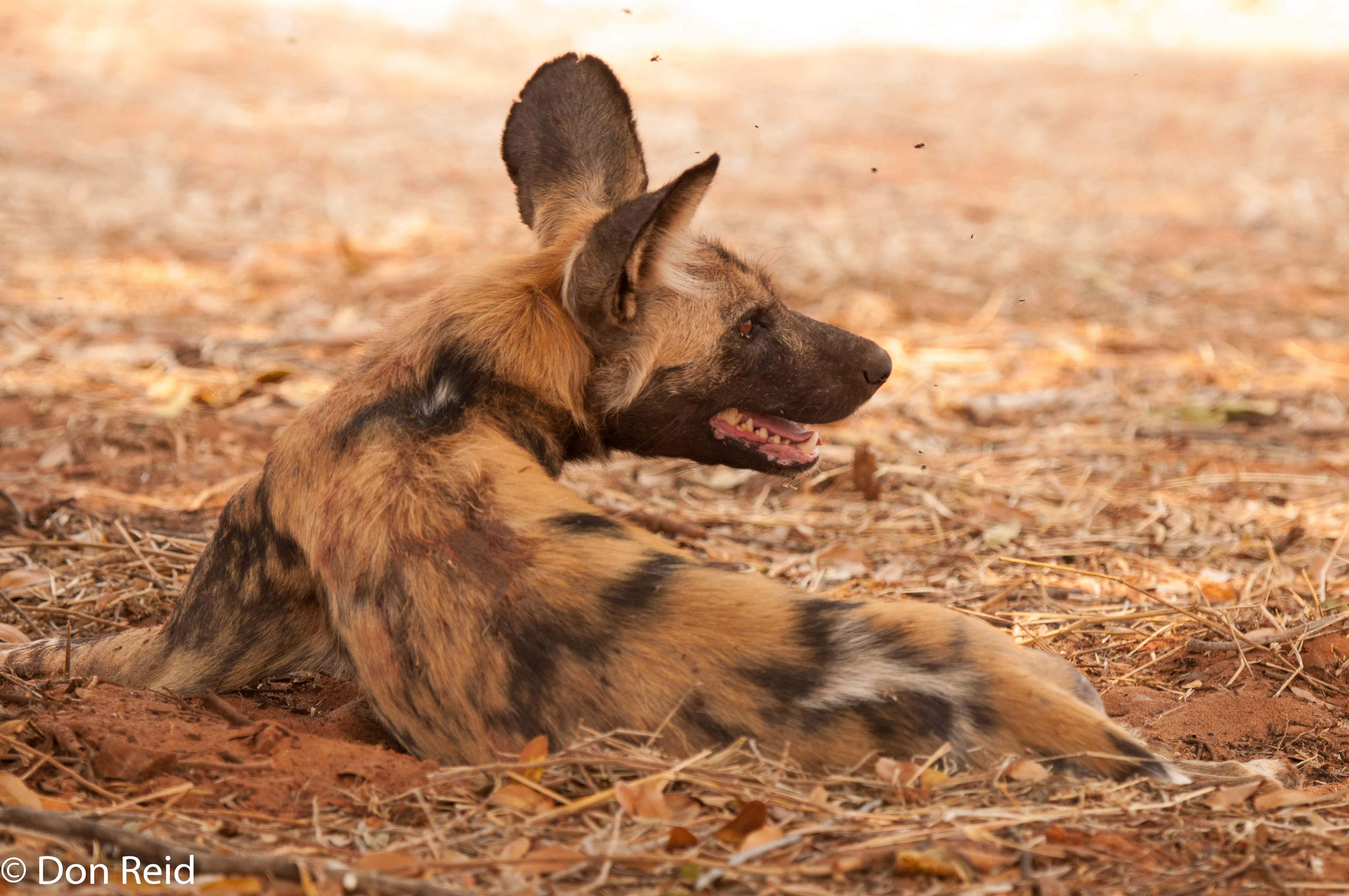
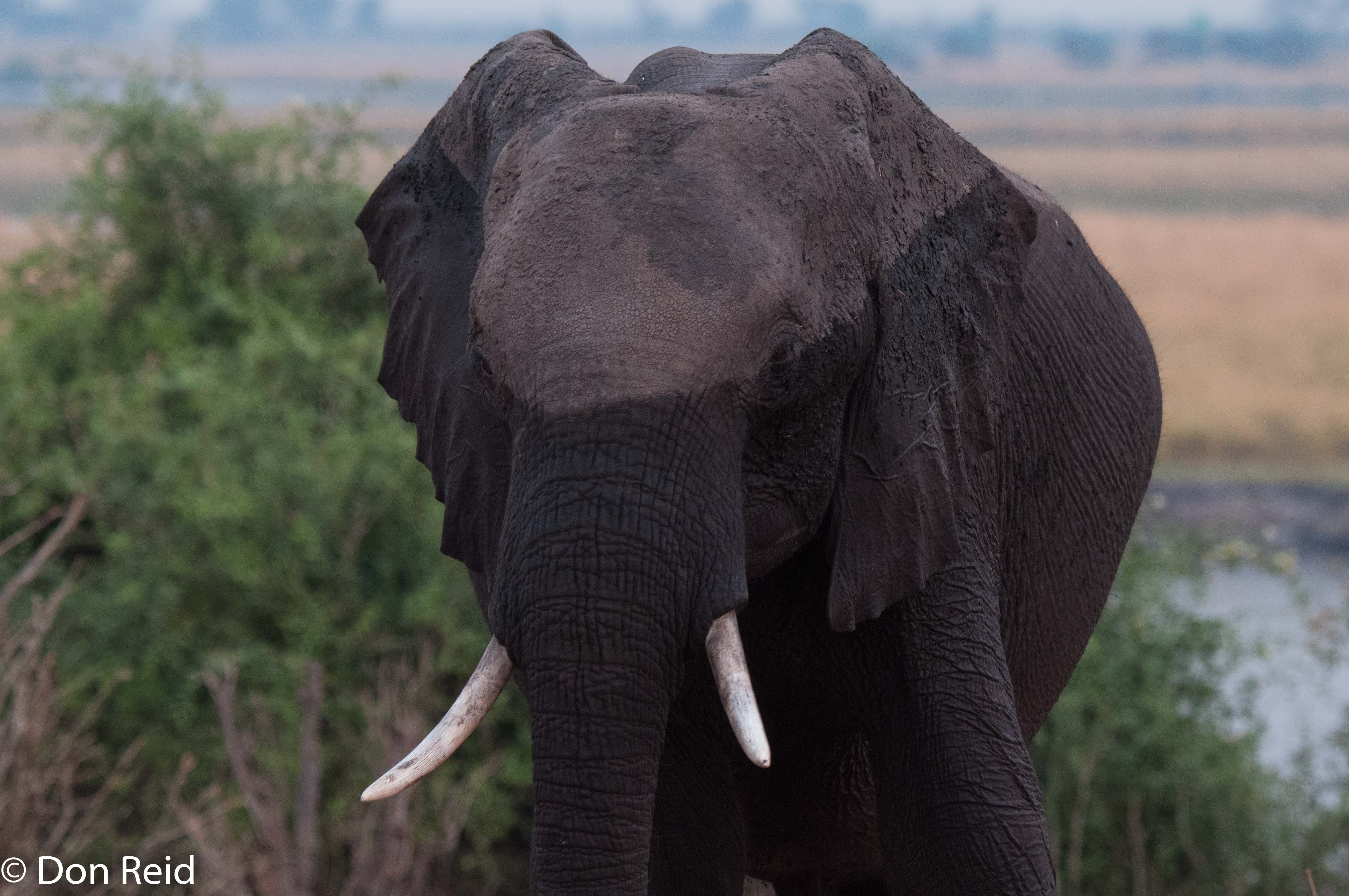
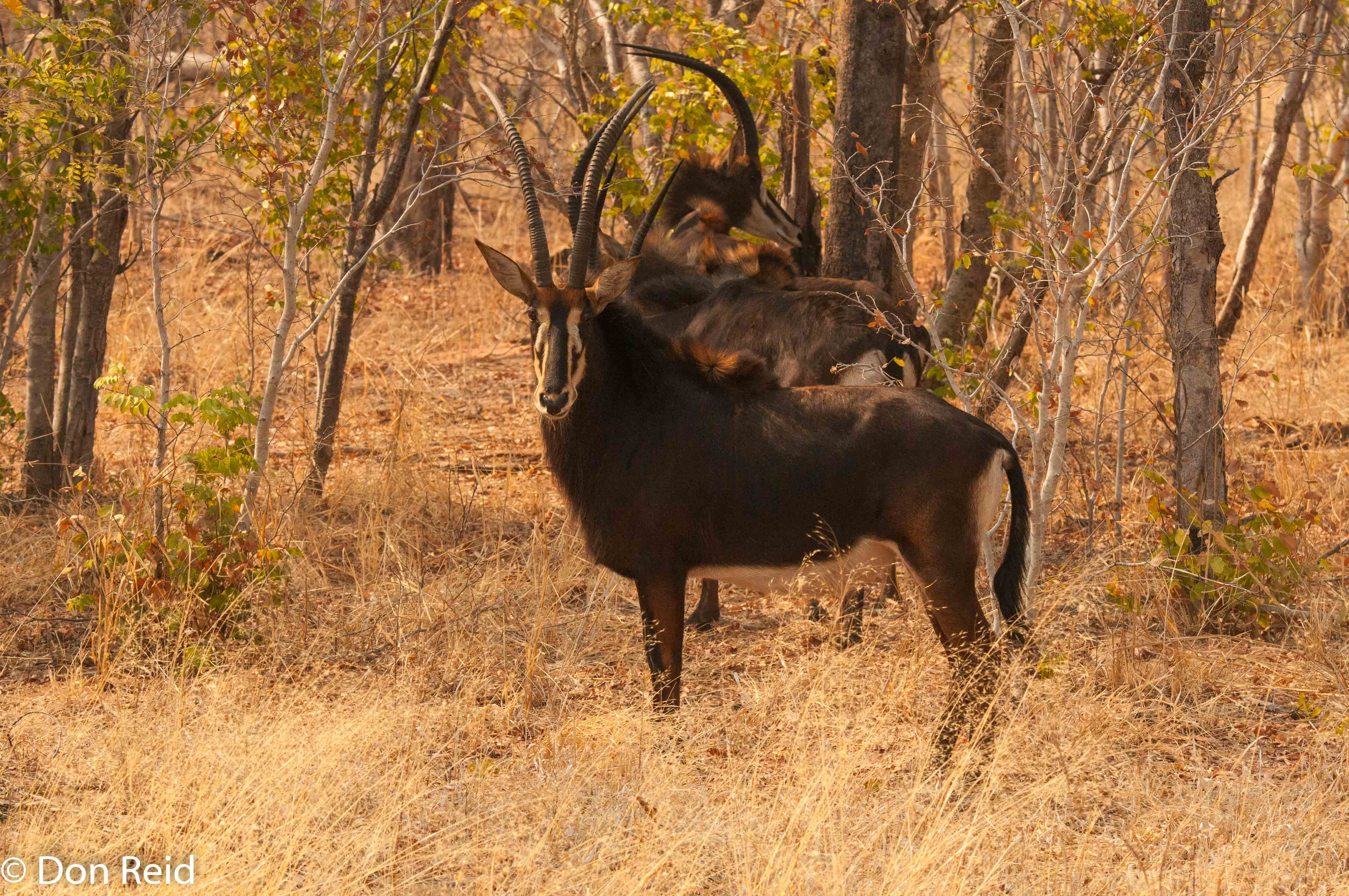
We came across Elephant, Buffalo, Jackal, Sable Antelope and a pack of Wild Dogs …….. and that was before we entered Chobe National Park!
Kasane is a small town on the far northern border of Botswana, its claim to fame being that it is the gateway to Chobe, one of the great African game reserves. It is also an unpredictably wild town – elephants and other wild animals occasionally wander through the residential area, often at night and the locals are in the habit of setting off thunderflashes to scare them off.
Another visit this month to Kasane to visit the project in which I am involved, meant another opportunity to squeeze in a visit to Chobe – this time we set out to do an early morning drive through the Riverfront section, before the day’s business began.
Chobe Riverfront
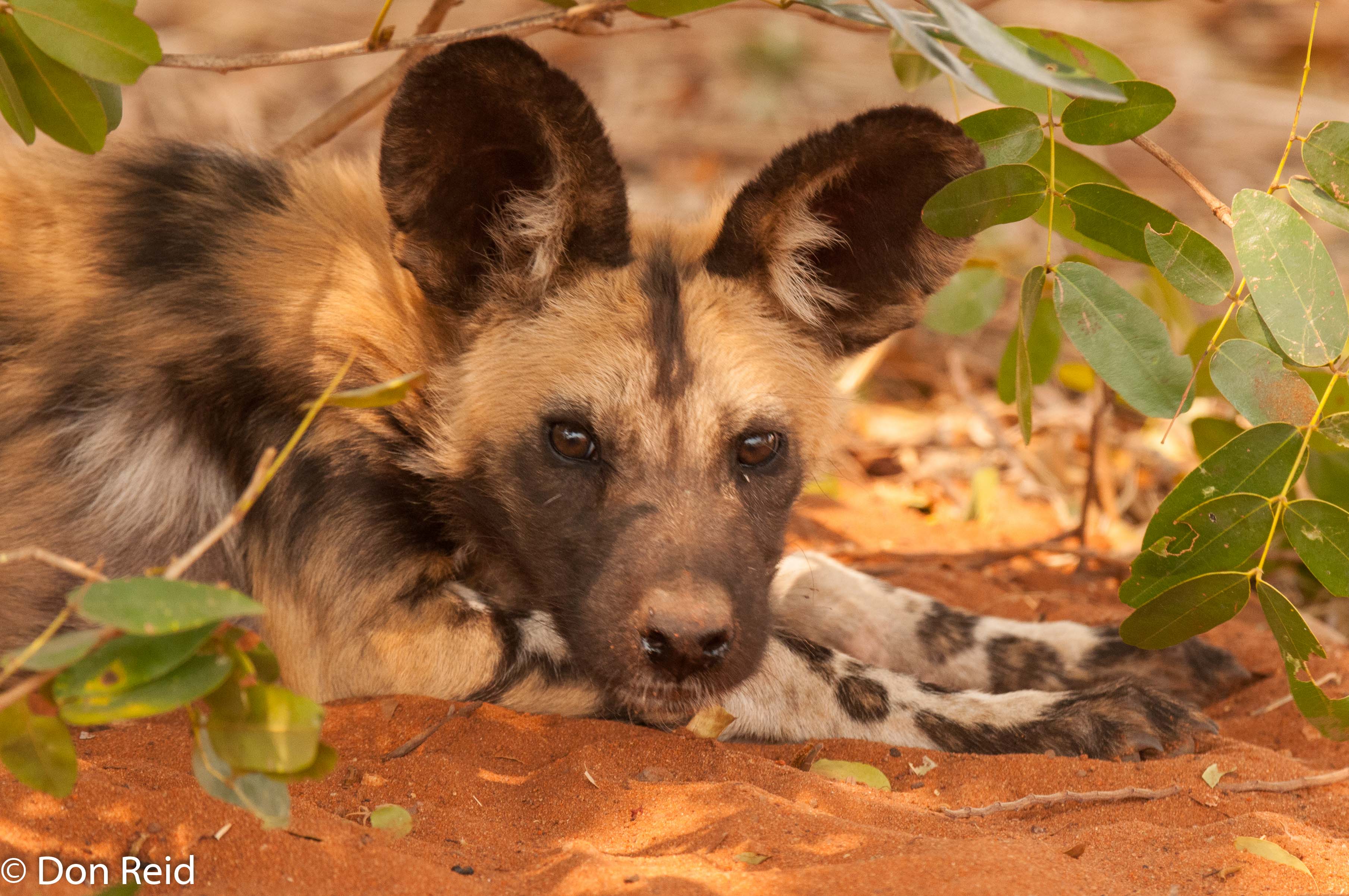
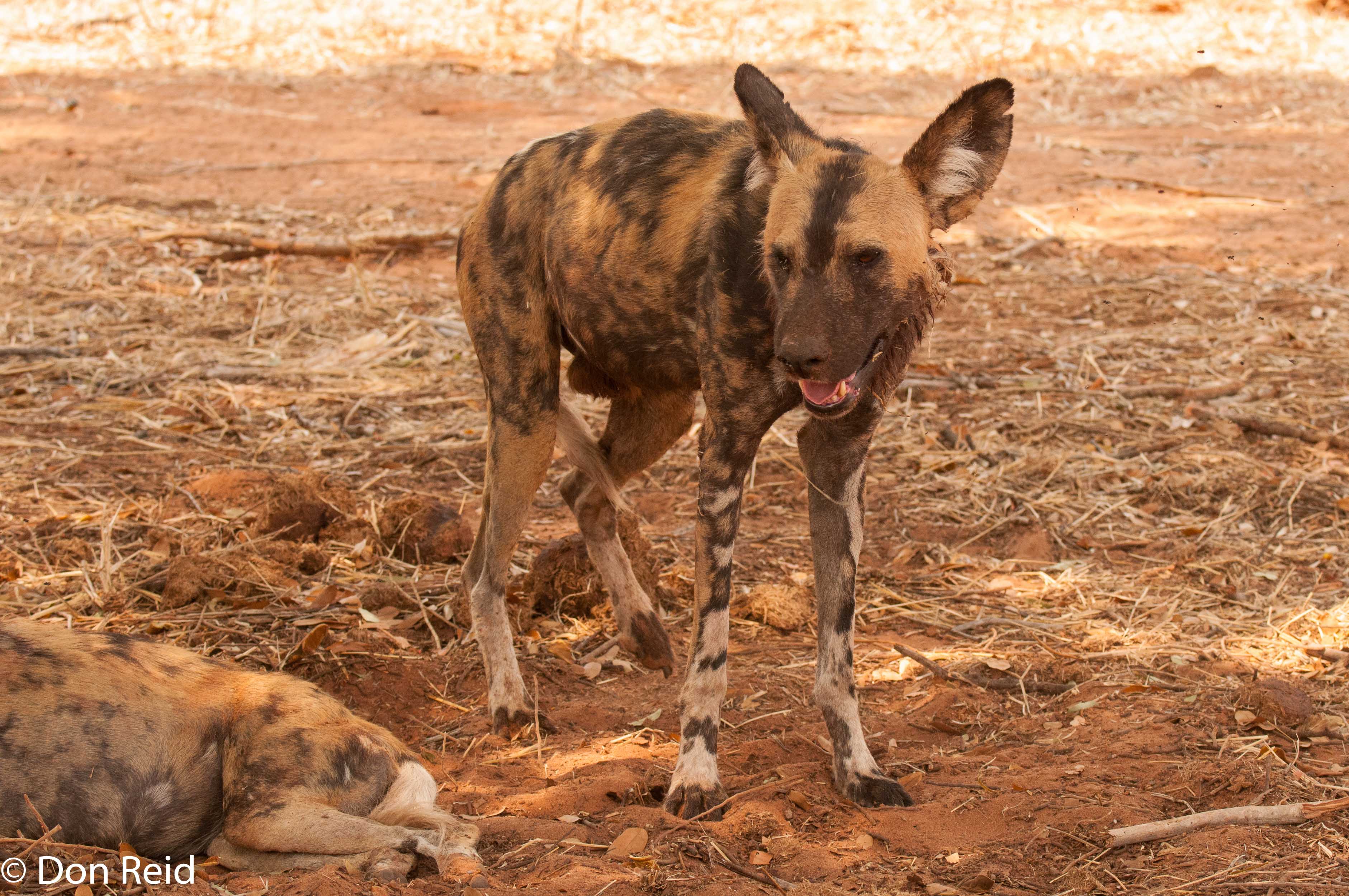
We set off as the sky was starting to lighten and on the short drive to the entrance gate we came across a pack of Wild Dogs, who were seemingly on a mission as they trotted along the road. Being pack hunters they would be looking for prey that they could pursue in their relentless fashion, wearing it down until the prey becomes exhausted and vulnerable to the attacks of the pack. We had seen the same pack the previous afternoon, not far from the airport and were able to get really close to them as they lazed the afternoon away in the shade of a large roadside tree, which provided some relief from the hot sun but not from the many flies that were buzzing around their heads.
Cute? They may look it but these are expert predators when hunting in a pack
Entering Chobe, we proceeded along the sandy, bumpy track with regular sightings of the animals we have become accustomed to finding –
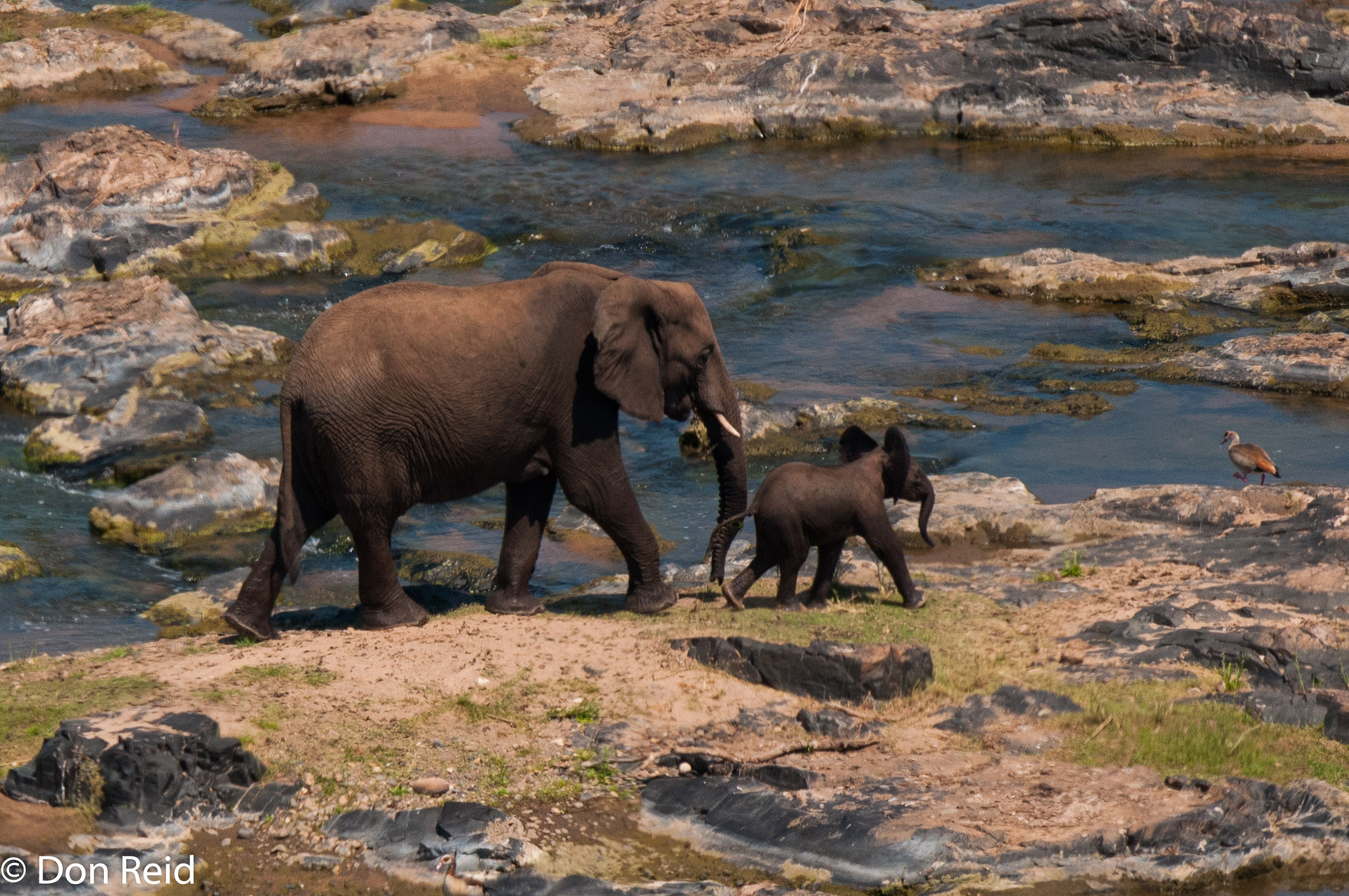
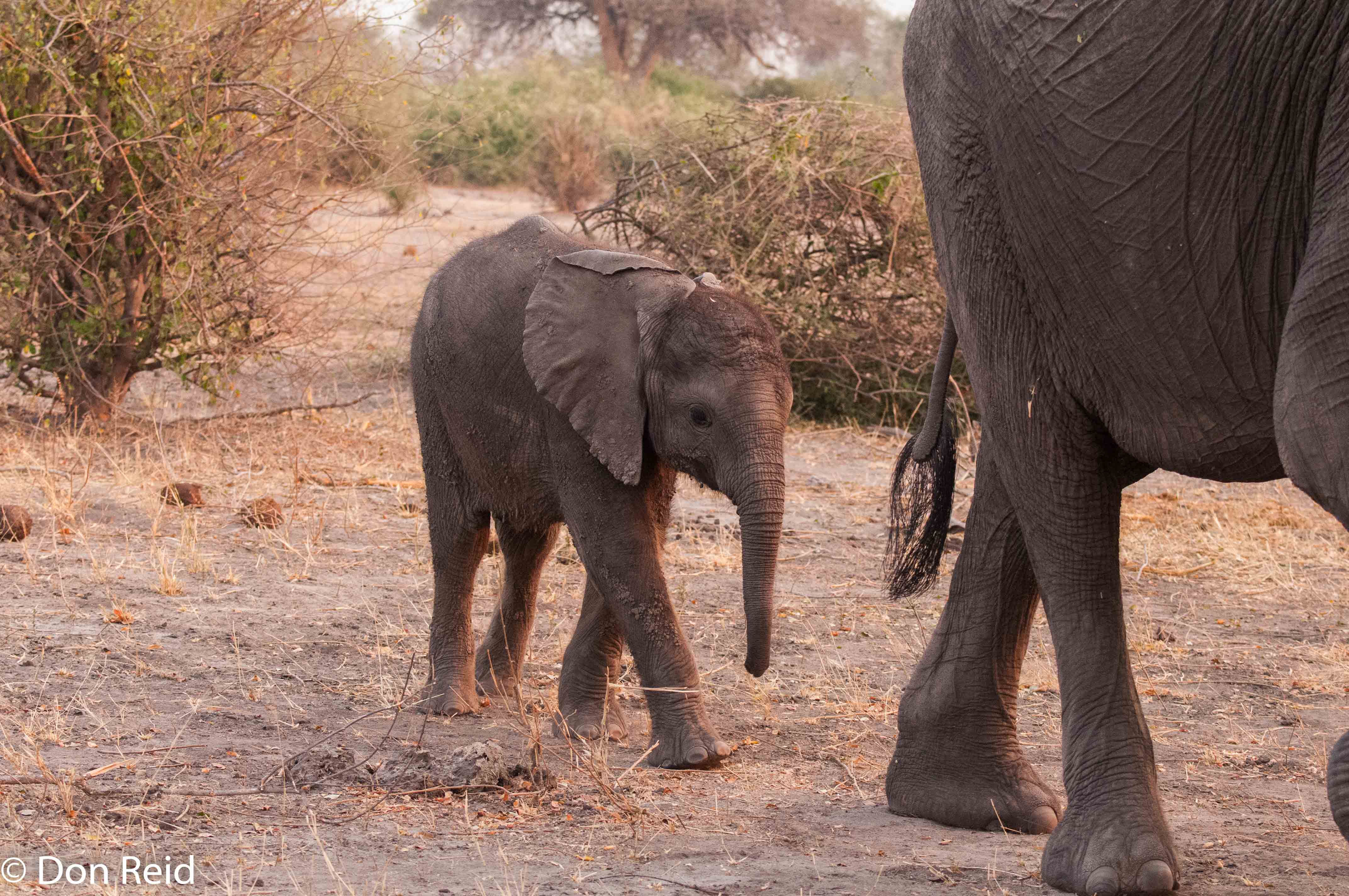
Elephants aplenty, including quite a few youngsters, not wandering far from Mom
Fresh from a dunking in the Chobe riverYoung elephant sticking close to Mom
Sable Antelope
Sable Antelope
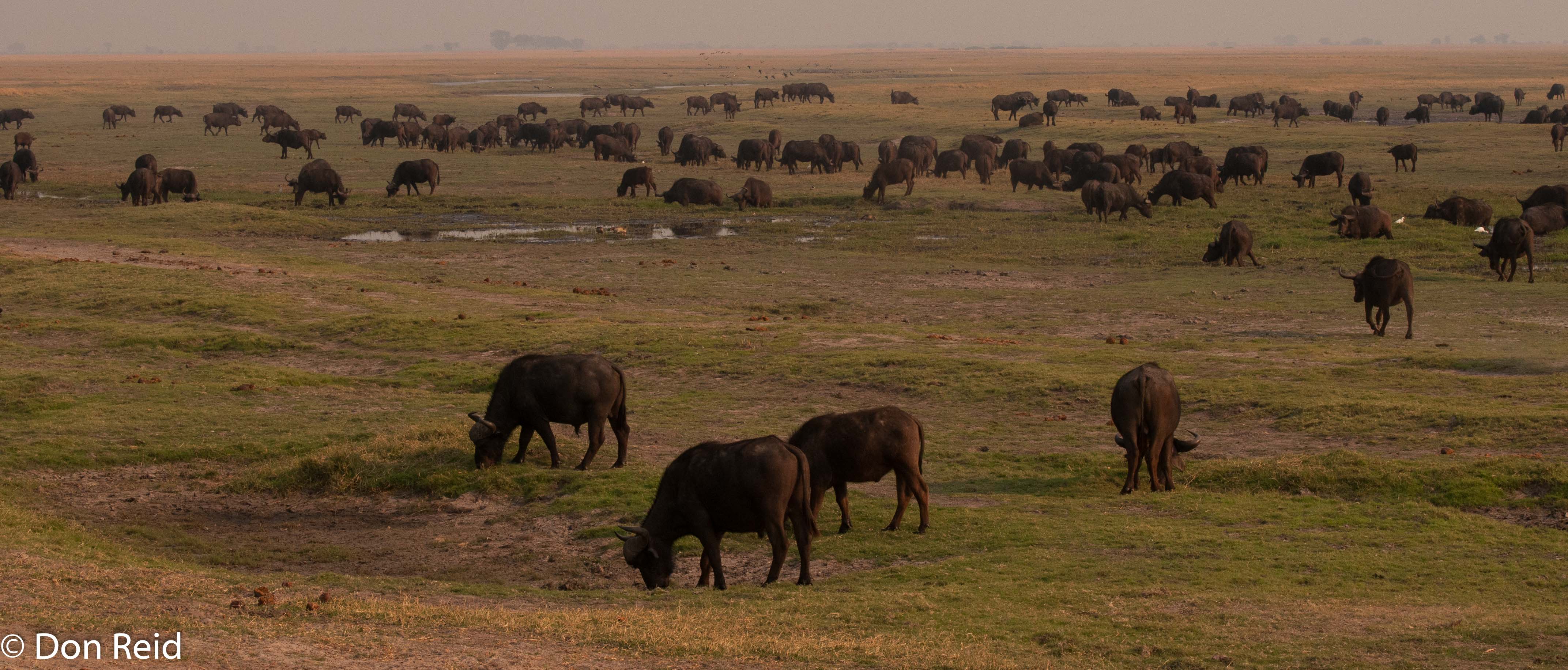
Buffalo – circa 500+ on the Lechwe Flats
Waterbuck
Jackal
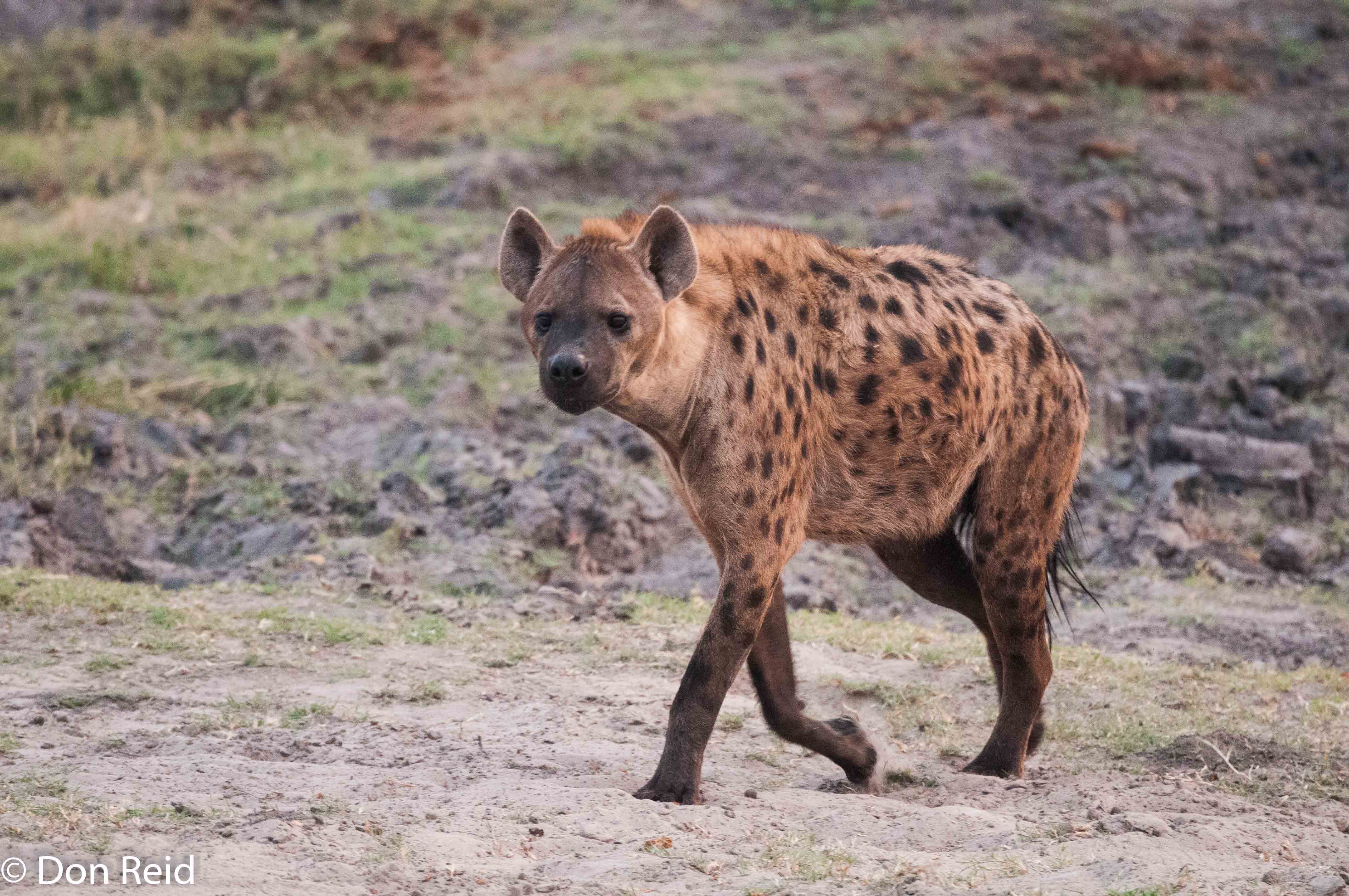
Hyenas – a pair were making their way back from the river into the bush as we passed by
Spotted Hyena
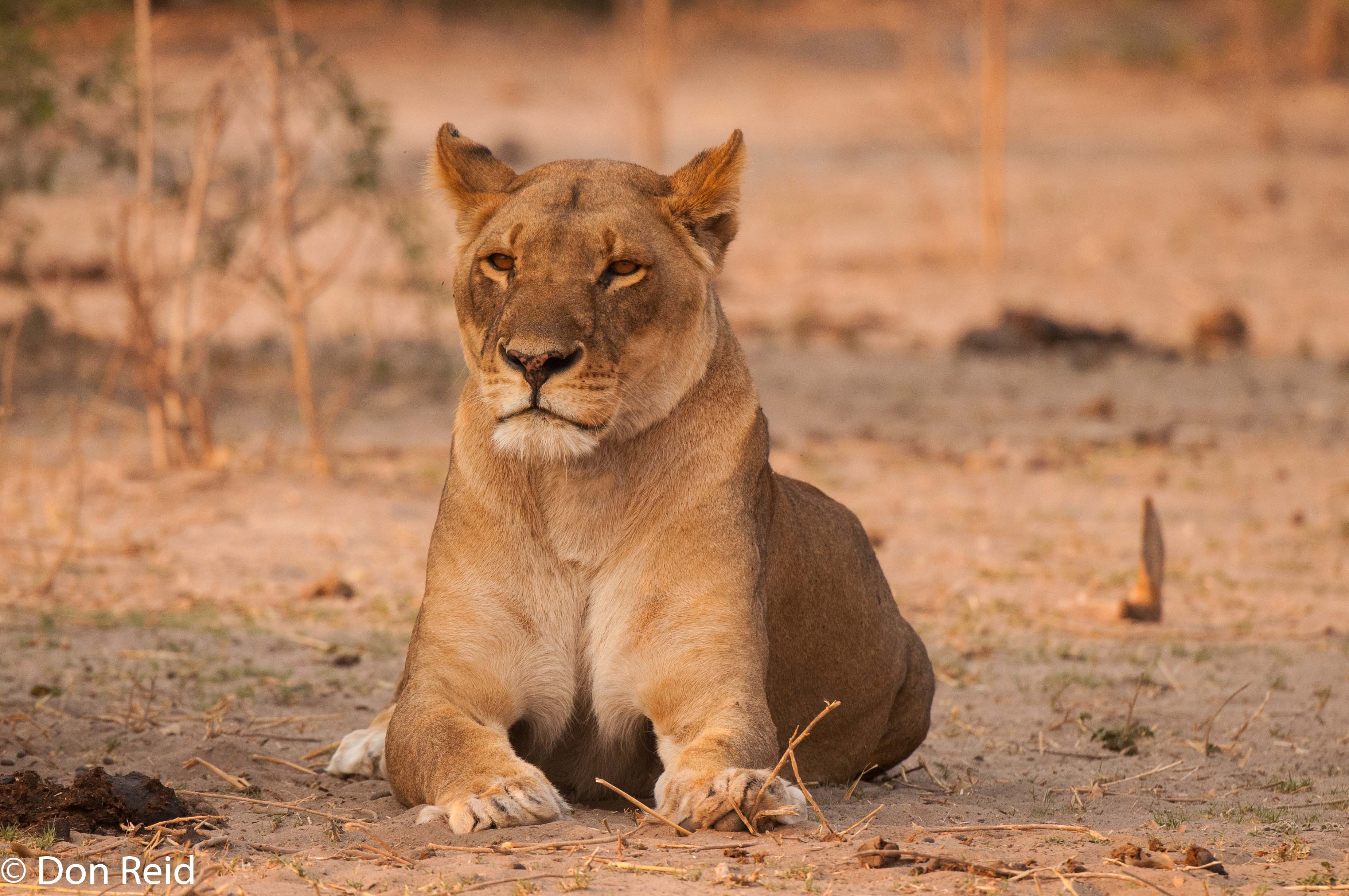
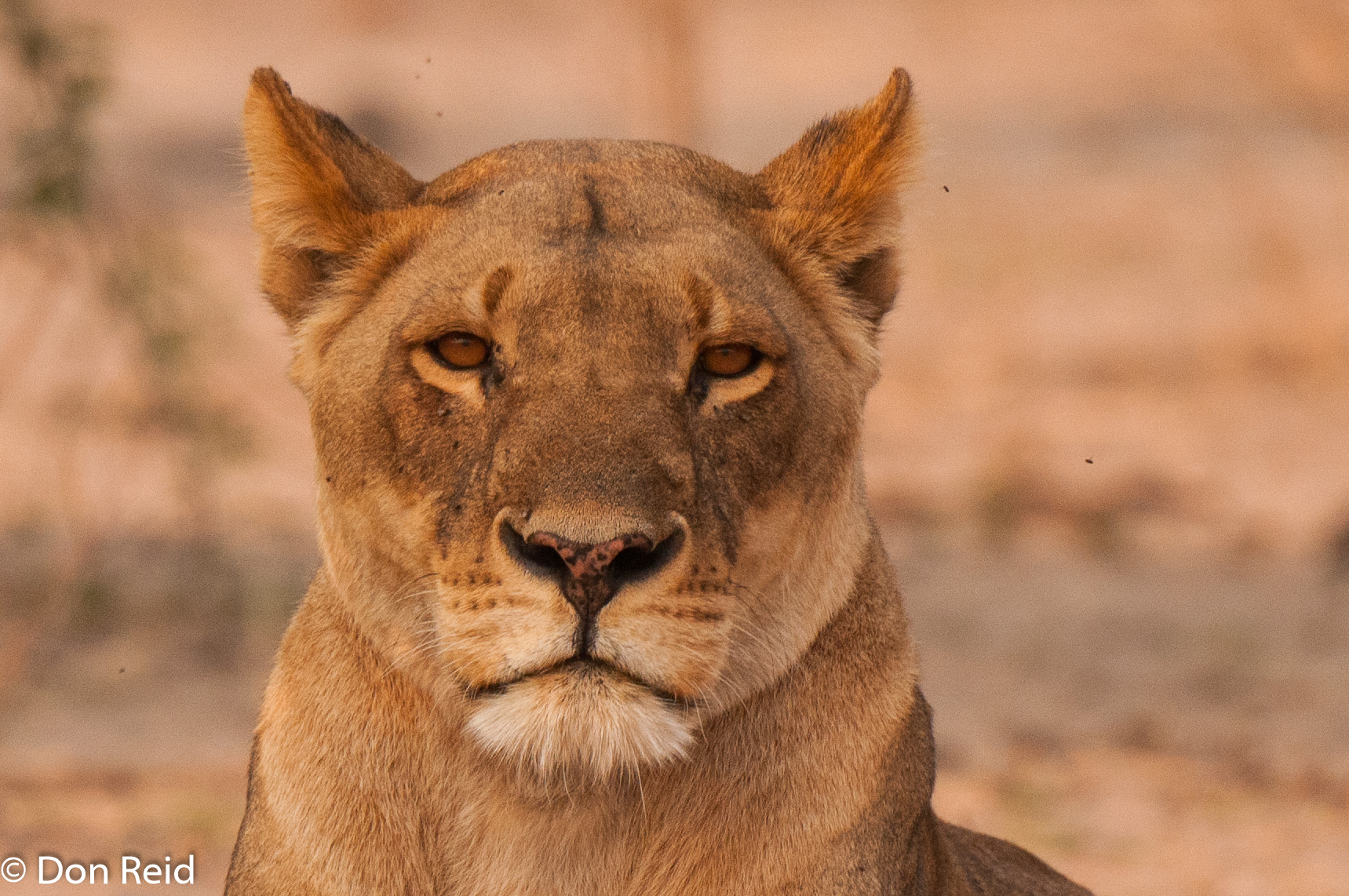
Lions!
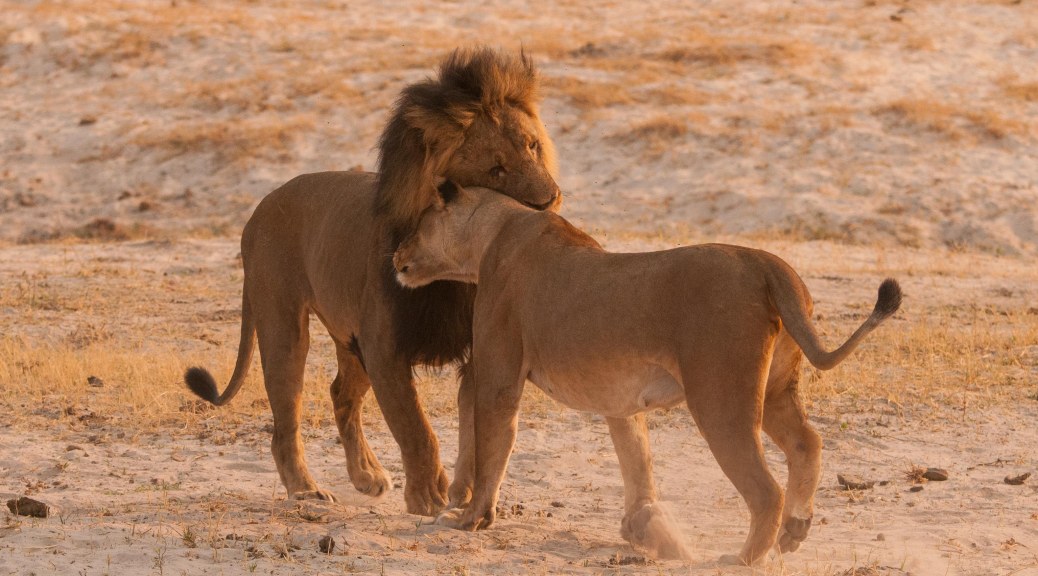
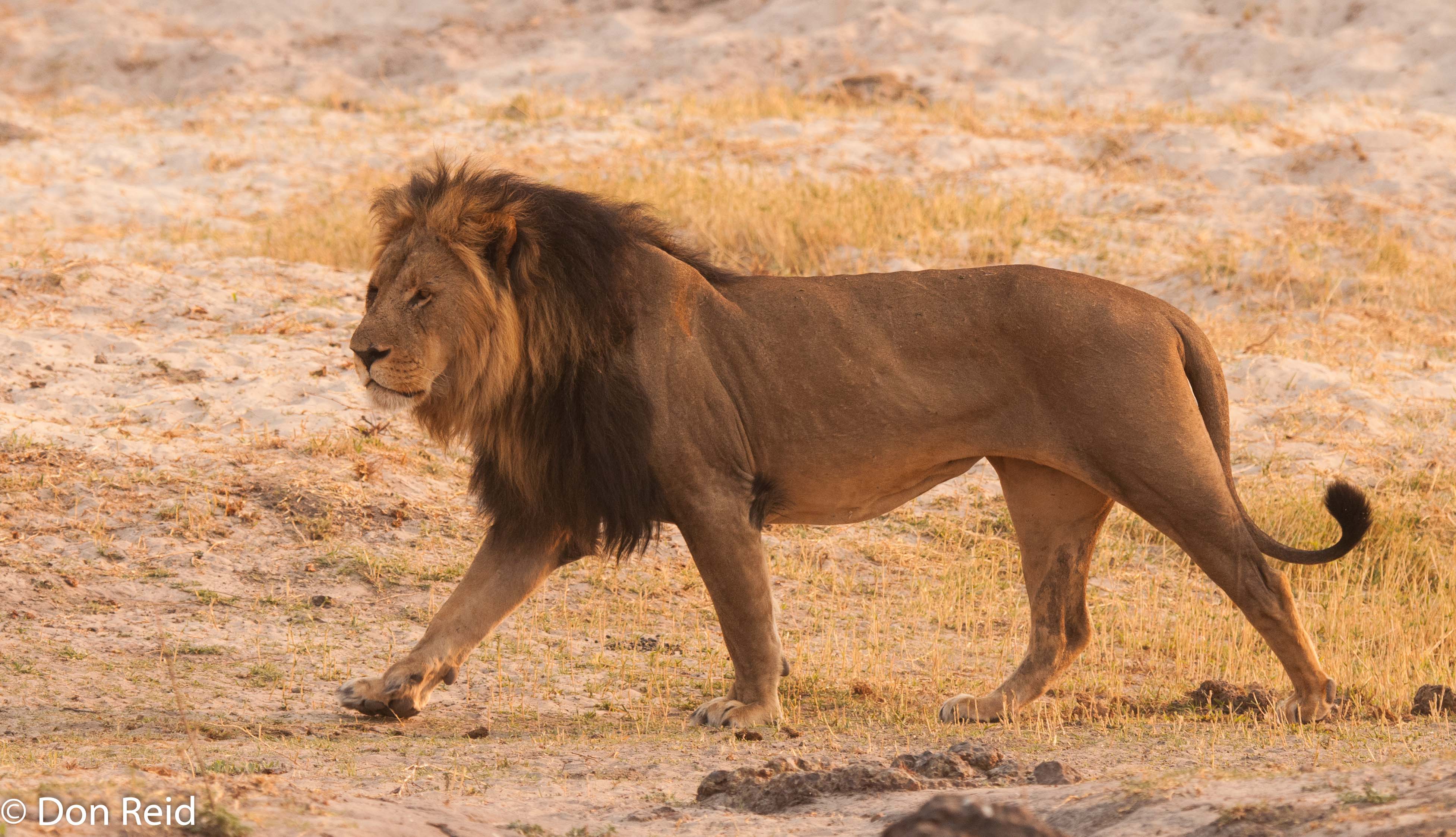
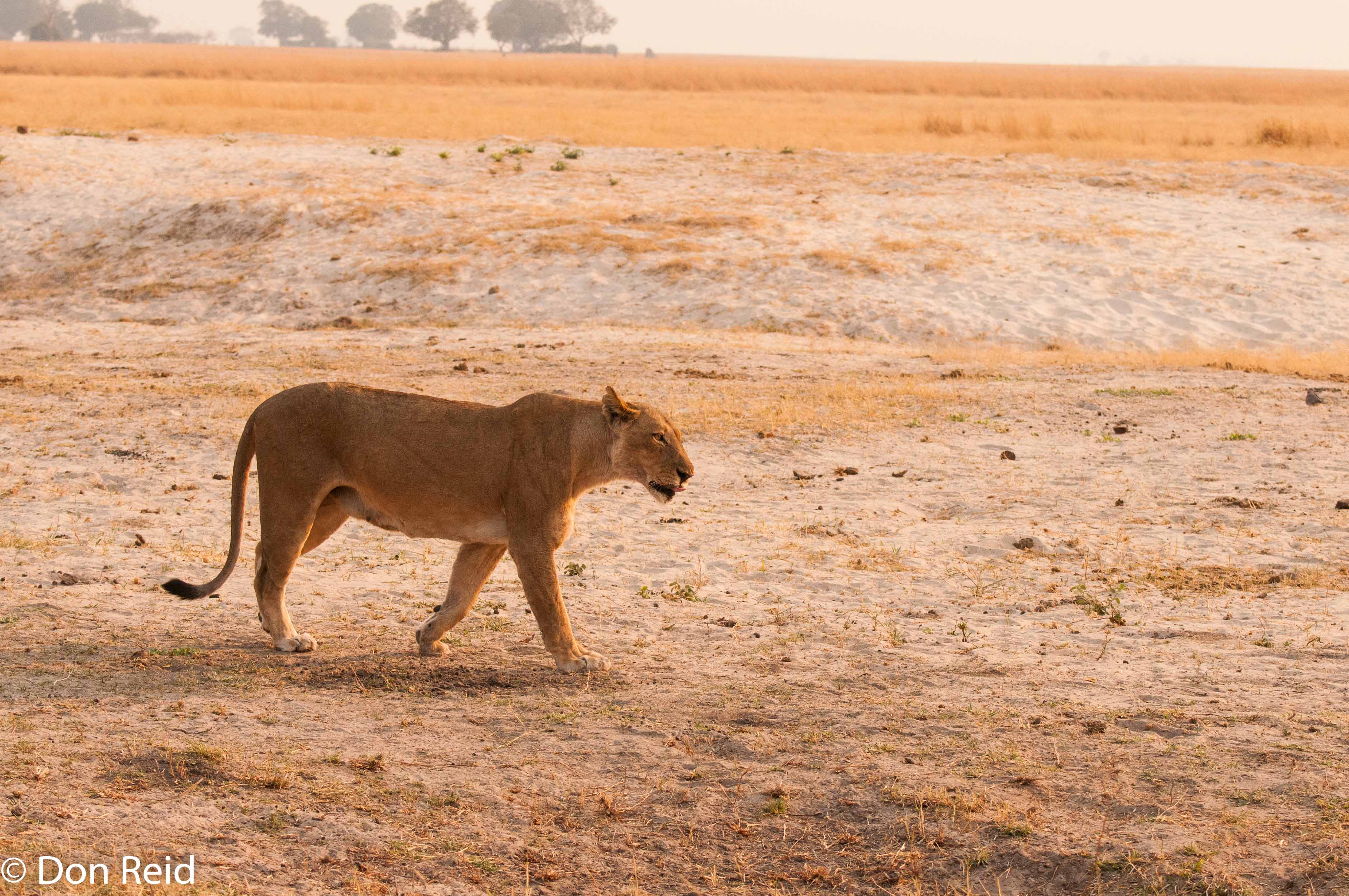
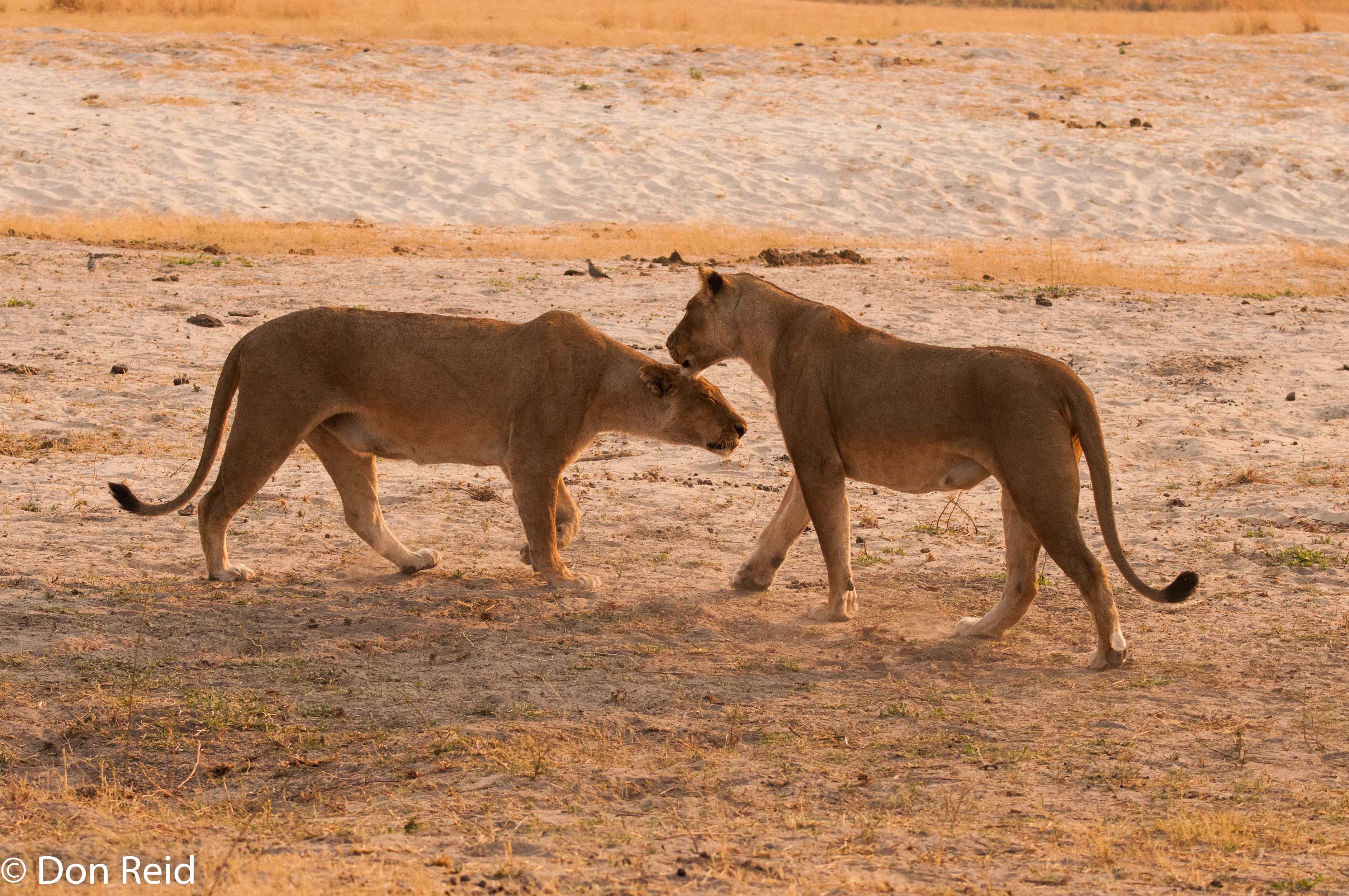
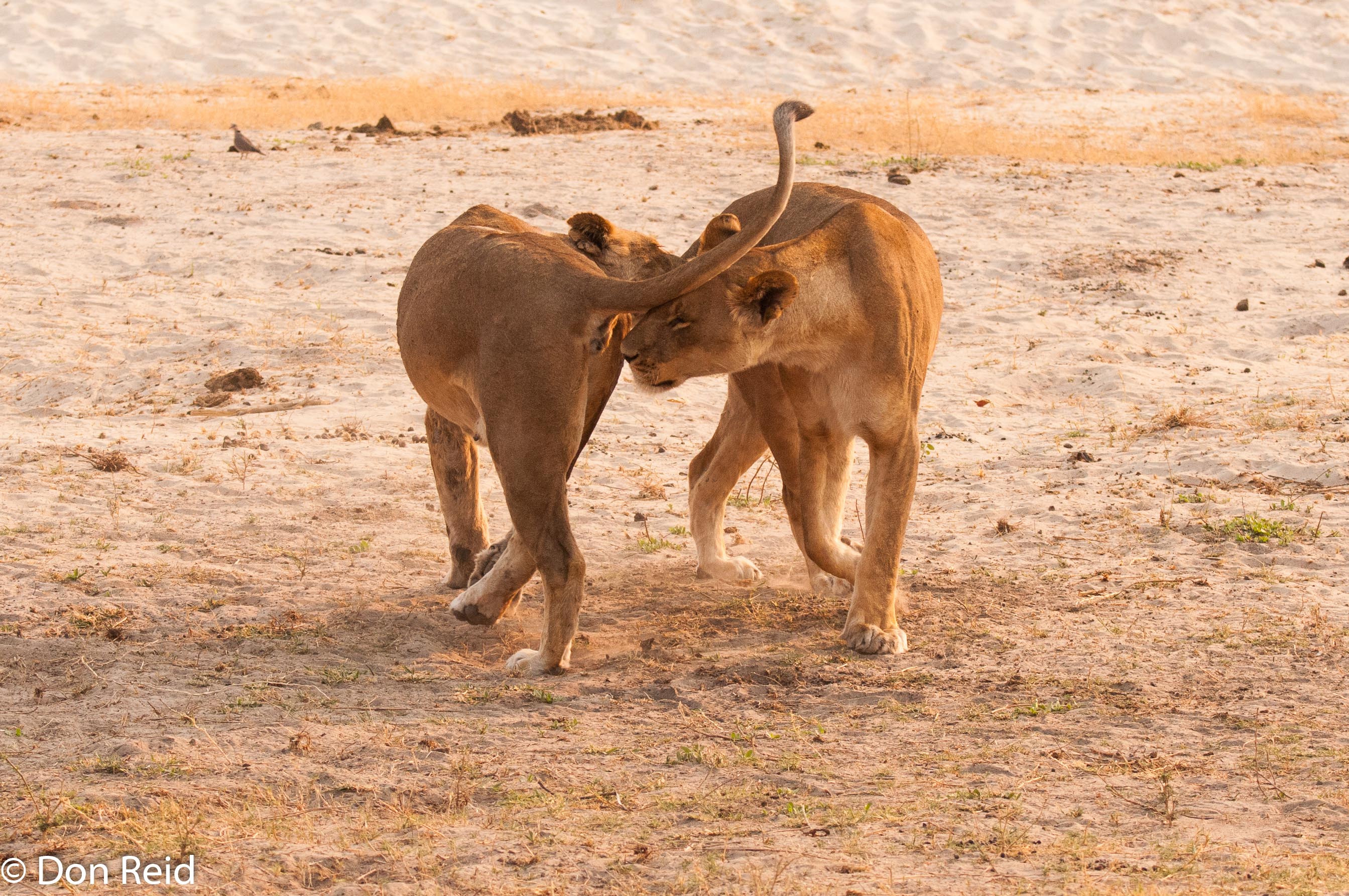
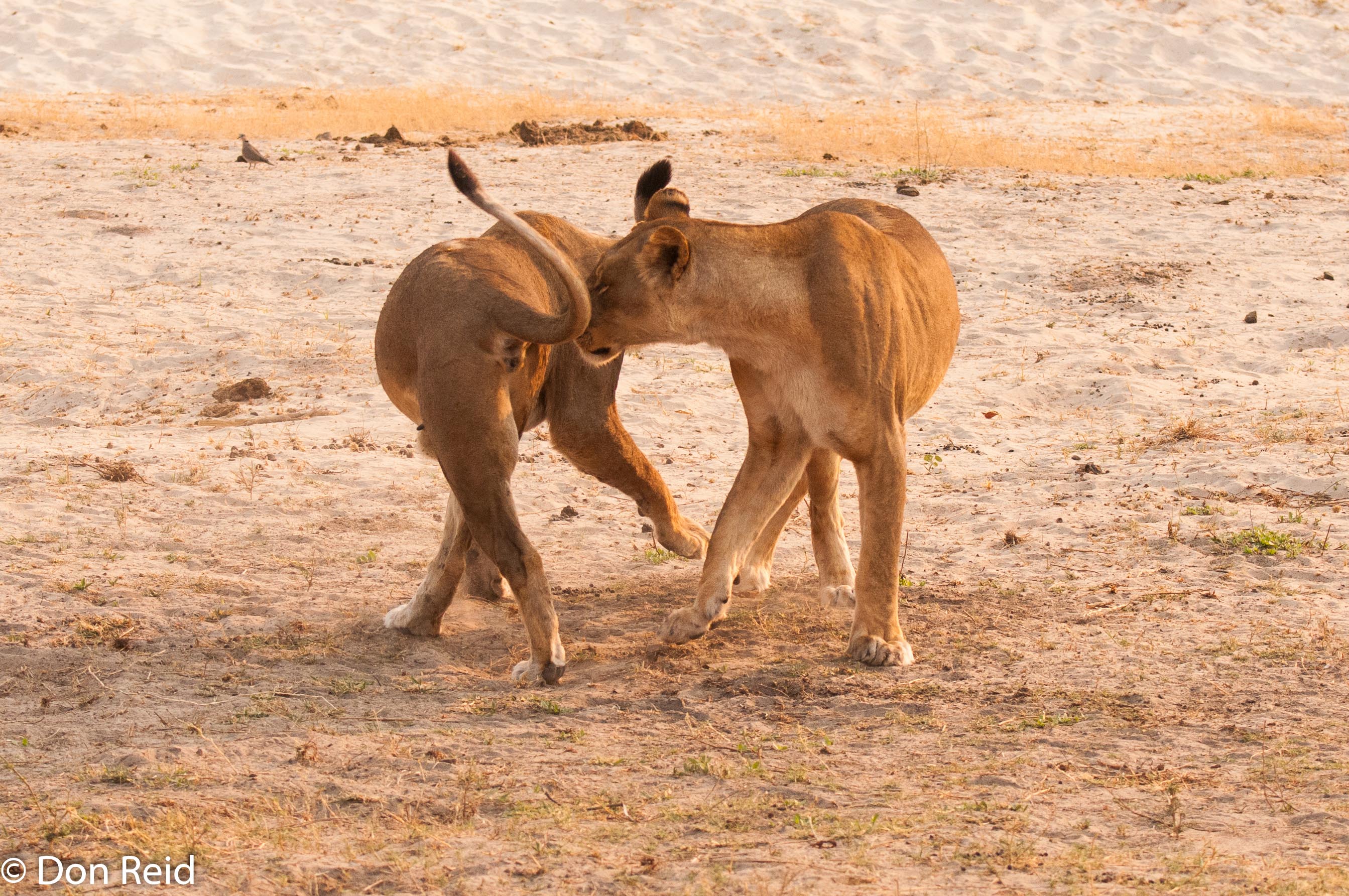
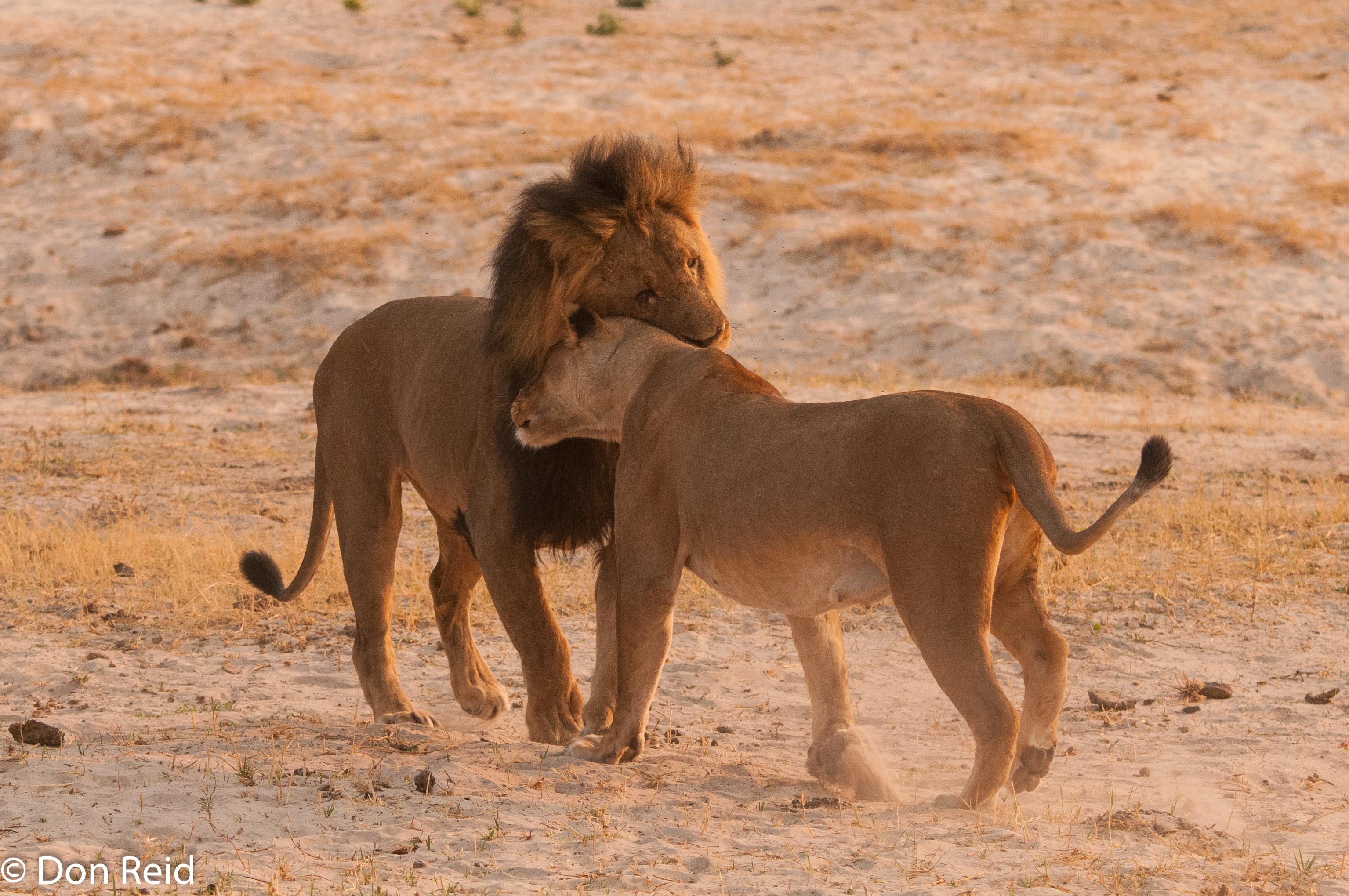
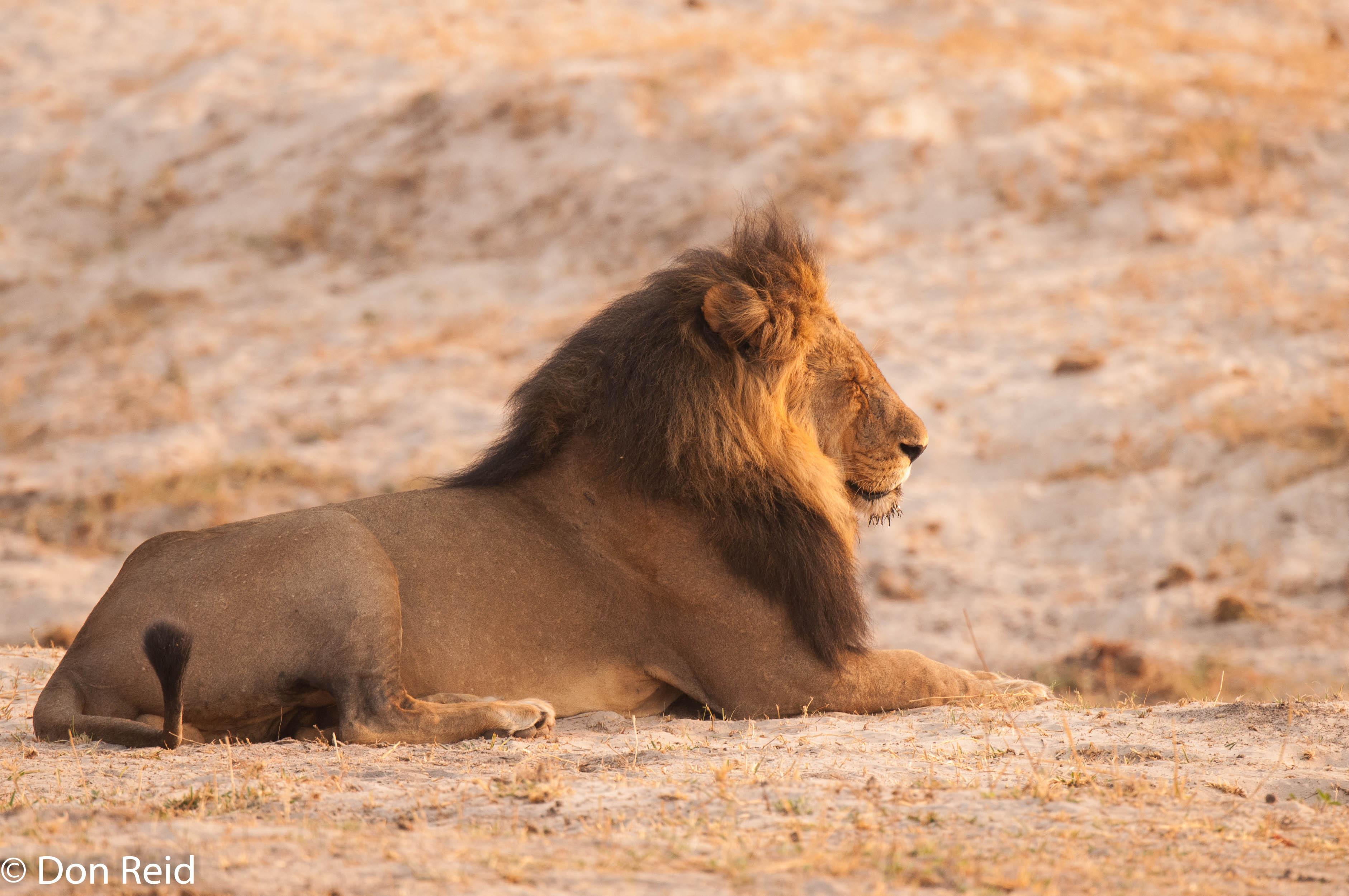
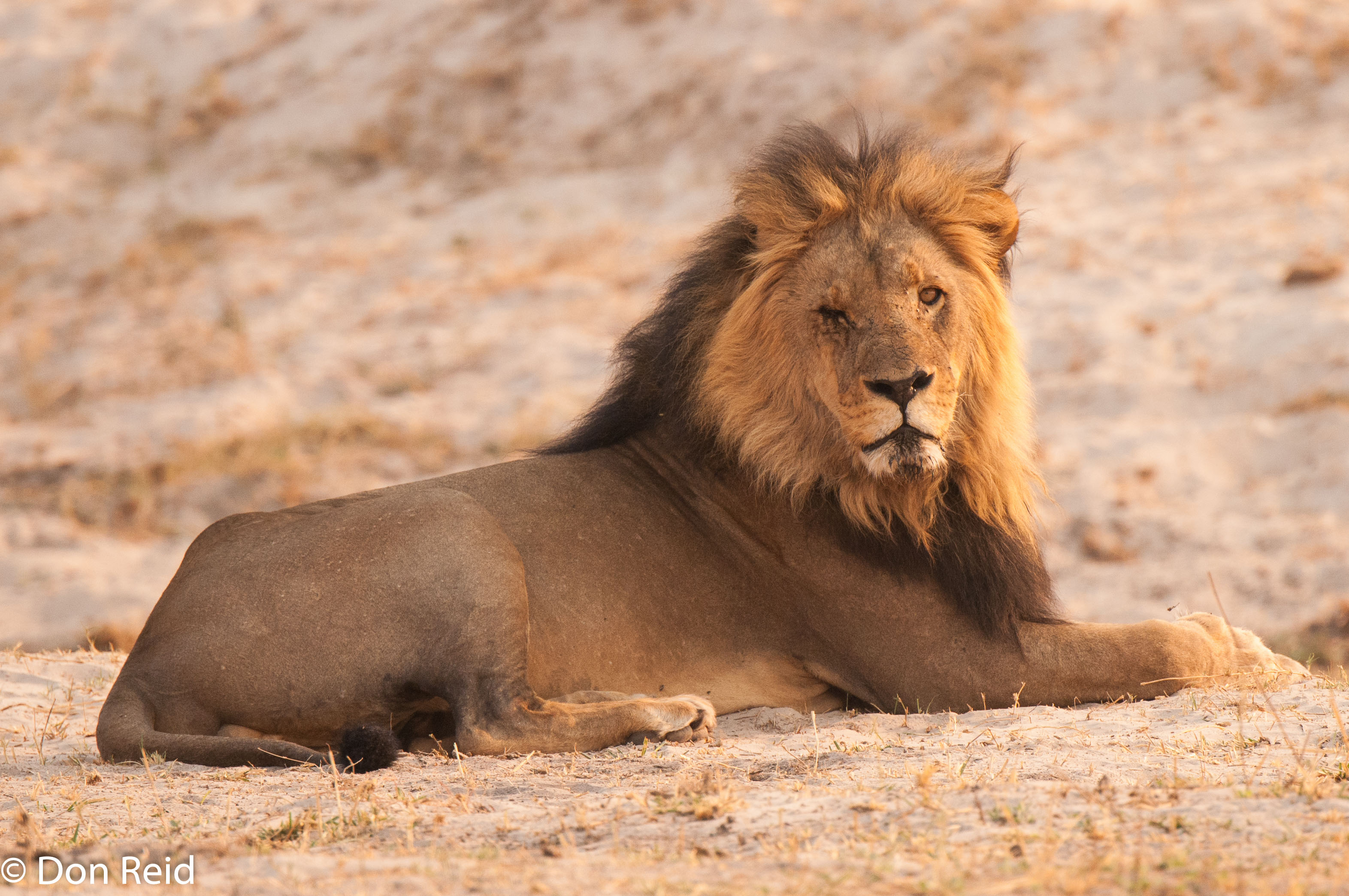
The best sighting of the morning was reserved till last. We encountered two Lionesses, strong and healthy looking individuals, as they made their way to a pool to drink (although we could not see the pool which was concealed by a deep donga) and moments after discussing the possibility of a male being nearby, a handsome male with a full mane of hair appeared and also headed towards the donga.
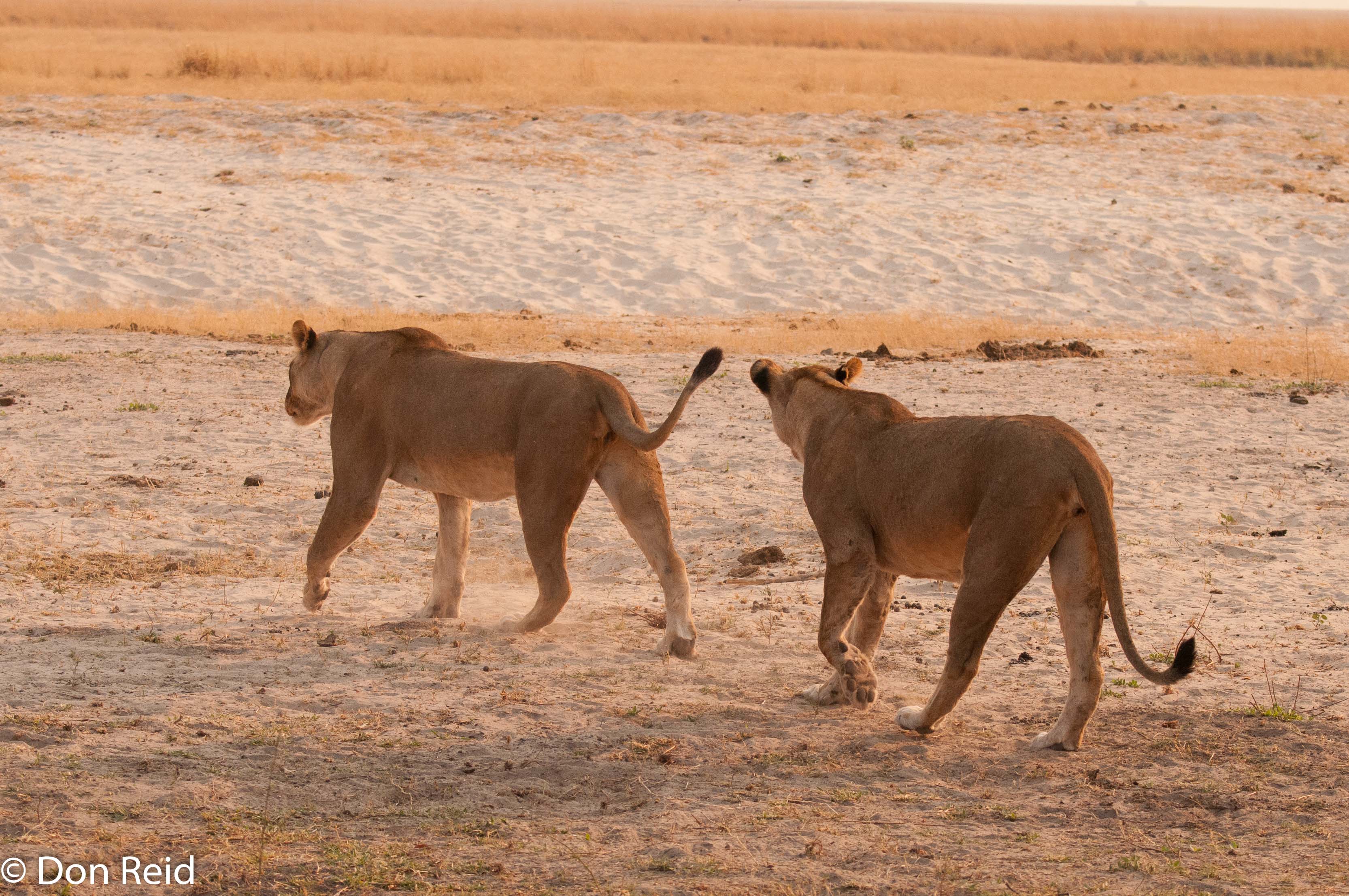
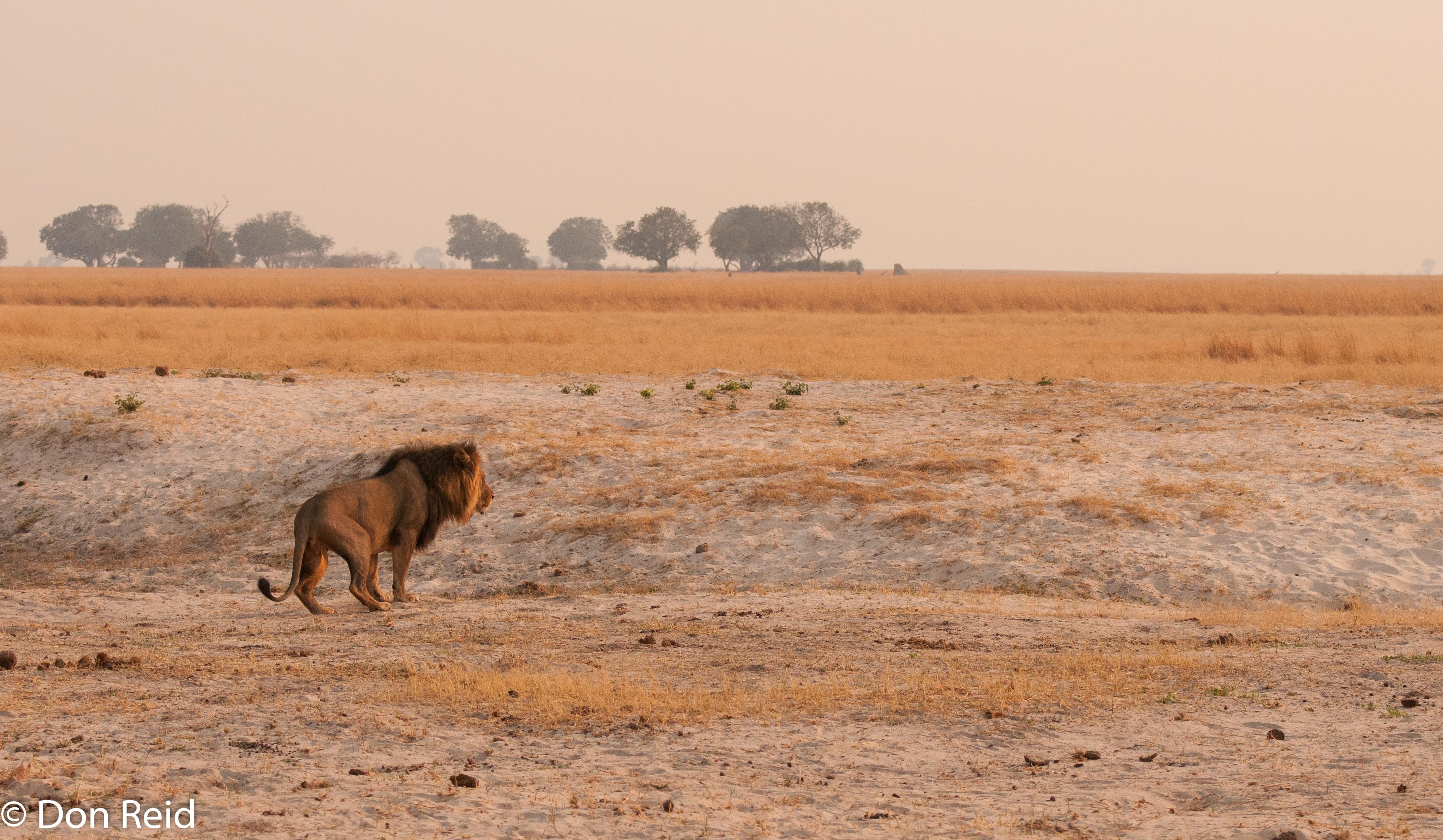
What followed was without doubt one of the more interesting Lion encounters I have had the privilege of experiencing, as the two Lionesses and the Lion played out a brief but fascinating series of moves. Initially the two Lionesses did a circular dance-like move in unison, as if sizing each other up, then one of them walked off slowly to the water and disappeared into the donga, The remaining Lioness and the Lion seemed to greet and gently caress each other before she too moved off towards the water, leaving the male to rest on the sandy ground and regally take in his surroundings.
Both Lionesses eventually returned and settled in different spots a distance from the male, who studiously ignored both of them as if in a huff.
The morning light lent a pleasant glow to the scene and created perfect conditions for photography as the Lions performed, oblivious to their excited audience, which by now had grown to 5 or 6 safari vehicles which arrived a short while after we spotted the first one. The photos are in the sequence taken –
Birding
The birding was limited to the “large and obvious” species for the most part –
Plenty of Guineafowl
Francolins and Spurfowl – Crested, Swainson’s and Red-billed were present in numbers
Hornbills – Red-billed, Yellow-billed, Bradfield’s and Ground all well represented
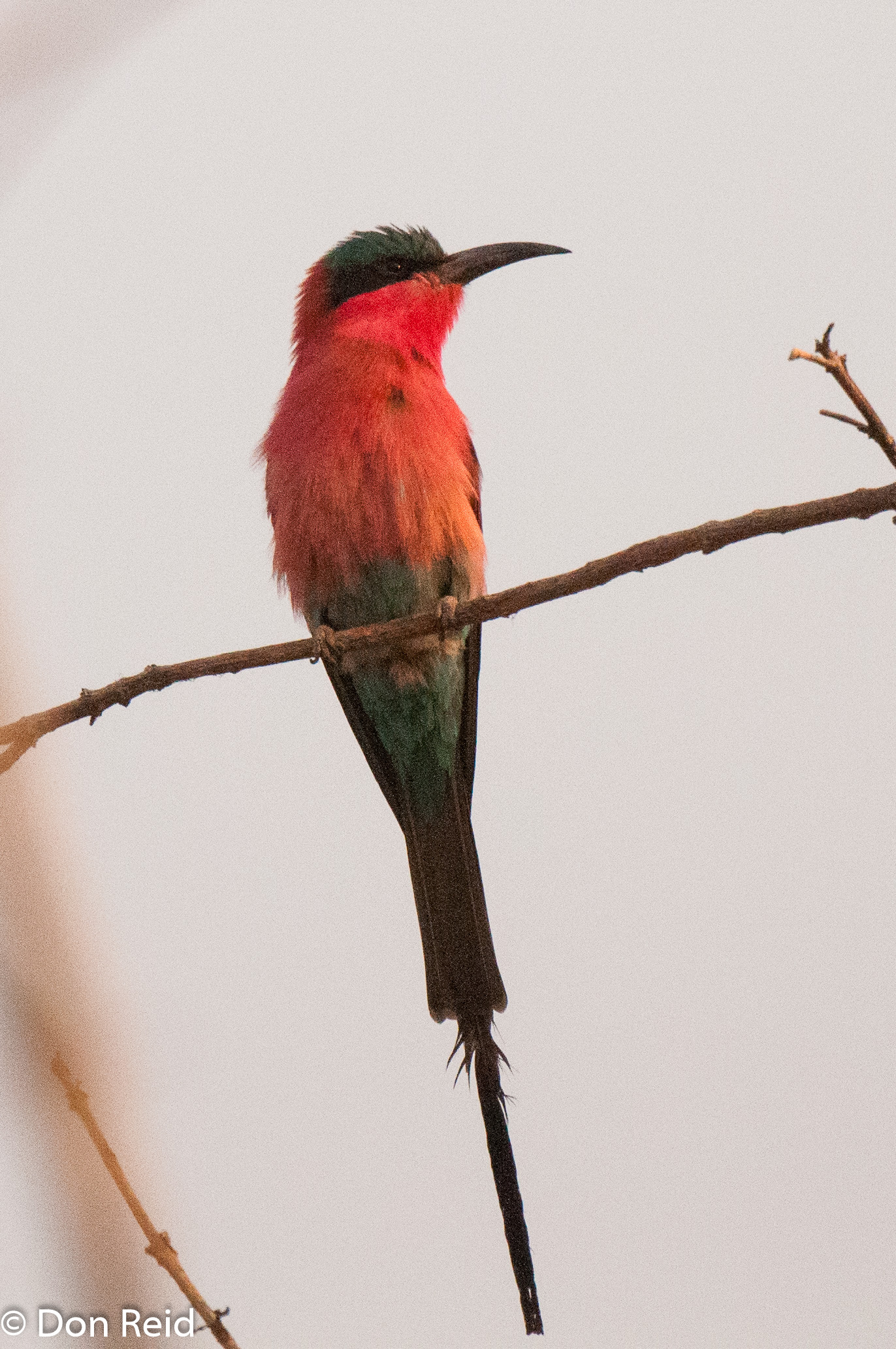
Carmine Bee-eaters are back in numbers and prominent in the sky or perching in bare trees at a few spots
Carmine Bee-eater
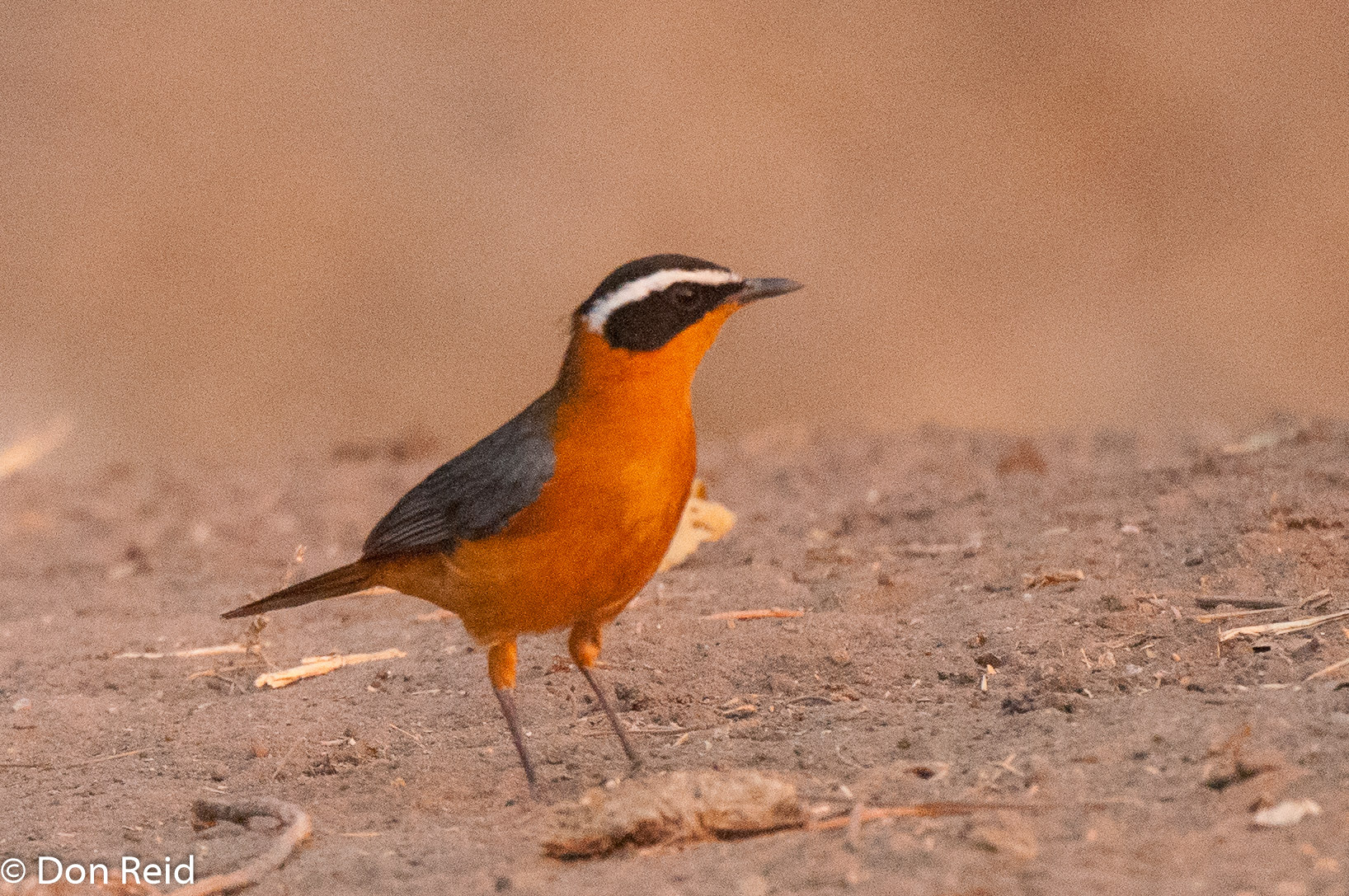
White-browed Robin Chat, extra bright in the golden early morning light
White-browed Robin-Chat
A family of Orange River Francolins was a pleasant surprise and I was able to get my first photos of the mostly secretive species before they scuttled off into the bush
Orange River Francolin, well camouflaged in the dry grass
A truly wonderful morning’s game and bird viewing in this magical part of Southern Africa!
For the last 2 years my blogging has been about birding trips, birding spots, holidays etc which has been very rewarding for me – I love recalling some of the great moments and places we have been. Now I believe it’s time to broaden the scope of my ramblings to include my take on particular birds that I have become familiar with over the years.
There are plenty of birding books out there and a number of Apps that make it simple to access a mountain of detail information on every species in your locality, so I will be taking a more informal, down-to-earth look at a random selection of birds, on a regular basis. A sobering thought is that, if I manage to do one species per week, it will take me 16 years to cover the 850-odd “regular” species in Southern Africa (excluding the vagrants that drive twitchers crazy every now and then). By that time I will have had my 84th birthday – if I’m lucky enough to still be around – talk about long-term planning!
Where to start?
I wasn’t sure what species to kick off with, then I had a moment of clarity (happens infrequently when you reach pensioner age) and decided that I would start at the beginning …………… of my birding career. So I went back to my very first records, written into my first copy of Roberts Birds of South Africa, which I purchased during one of our early visits to Kruger National Park. This was around 1978 and it was only about 10 years later that I started listing birds with any regularity – 3 kids growing up and a busy professional career tend to keep you busy and don’t leave time for much else.
The very first bird recorded was noted in the margin of my Roberts : “Woodland Kingfisher, 27 August 1978, seen KNP”. Well it seems I managed to start with an incorrect ID, as the Woodland Kingfishers are migrants that only arrive in Southern Africa from October…… so it was probably a Brown-hooded Kingfisher that I saw that August.
The next one was more likely to be a correct ID, particularly in Kruger, and hard to confuse with any other bird – the note in the margin says “Saddle-billed Stork, 28 August 1978, seen KNP” – so that’s where I am going to start.
SADDLE-BILLED STORK
Species Names
Saddle-billed Stork
Saalbekooievaar (Afrikaans)
Kandjendje, Hukuinihlanga (Indigenous)
Sattelstorch (German)
Jabiru d’Afrique (French)
Zadelbekooievaar (Dutch)
Ephippiorhynchus senegalensis (Scientific)
That scientific name is very long-winded but if you break it down it starts to make sense : the first part is the Genus which is derived from the Greek words “ephippos” for “Saddle” and “rhyncos” for “bill” and refers to the frontal shield which “saddles” the bill. The second part is the species name which in this case is based on where it was discovered
Photography
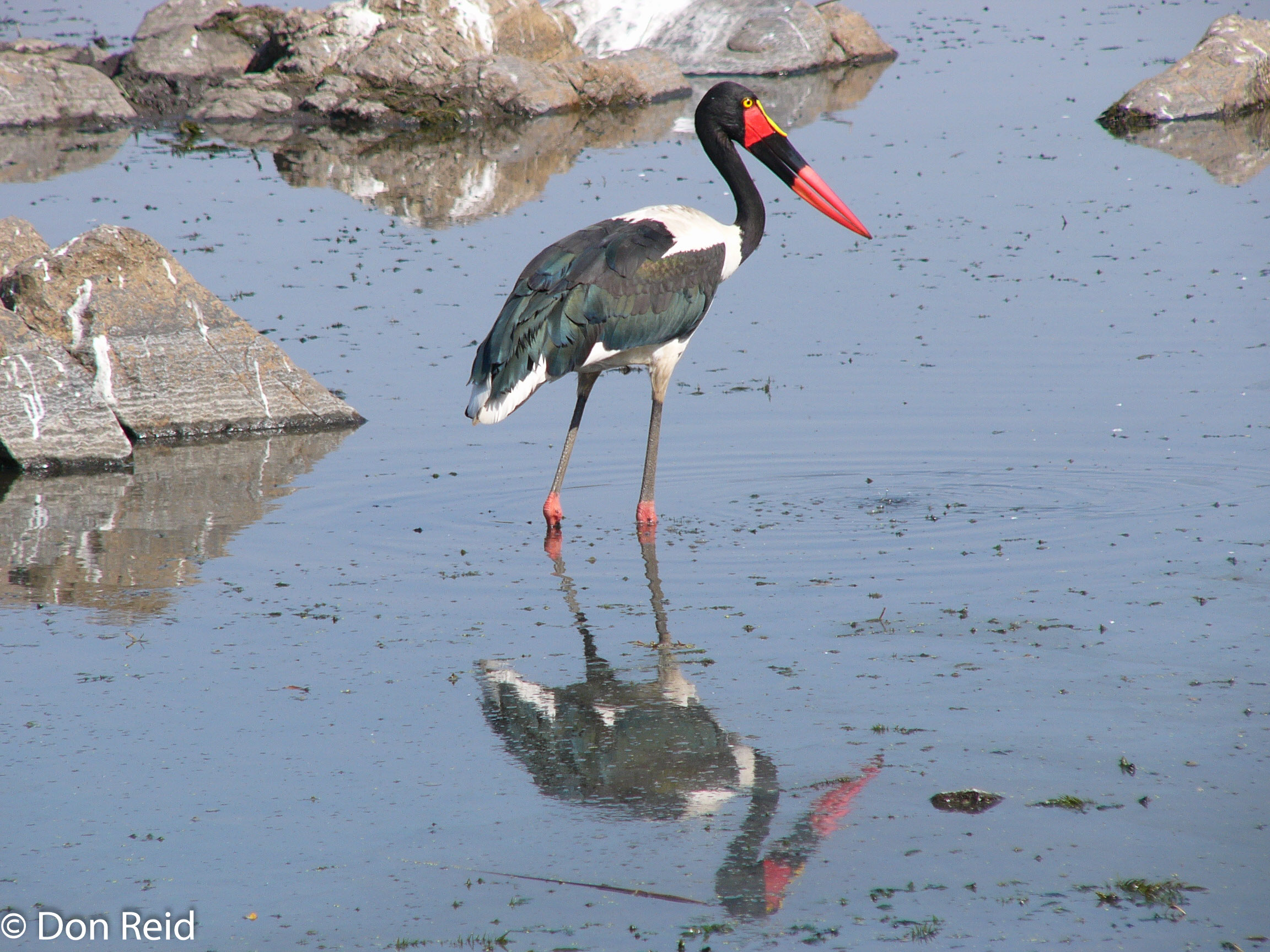
Despite their large size, they are seldom close enough for a finely detailed photo, unless you are lucky enough to come across one near a hide.
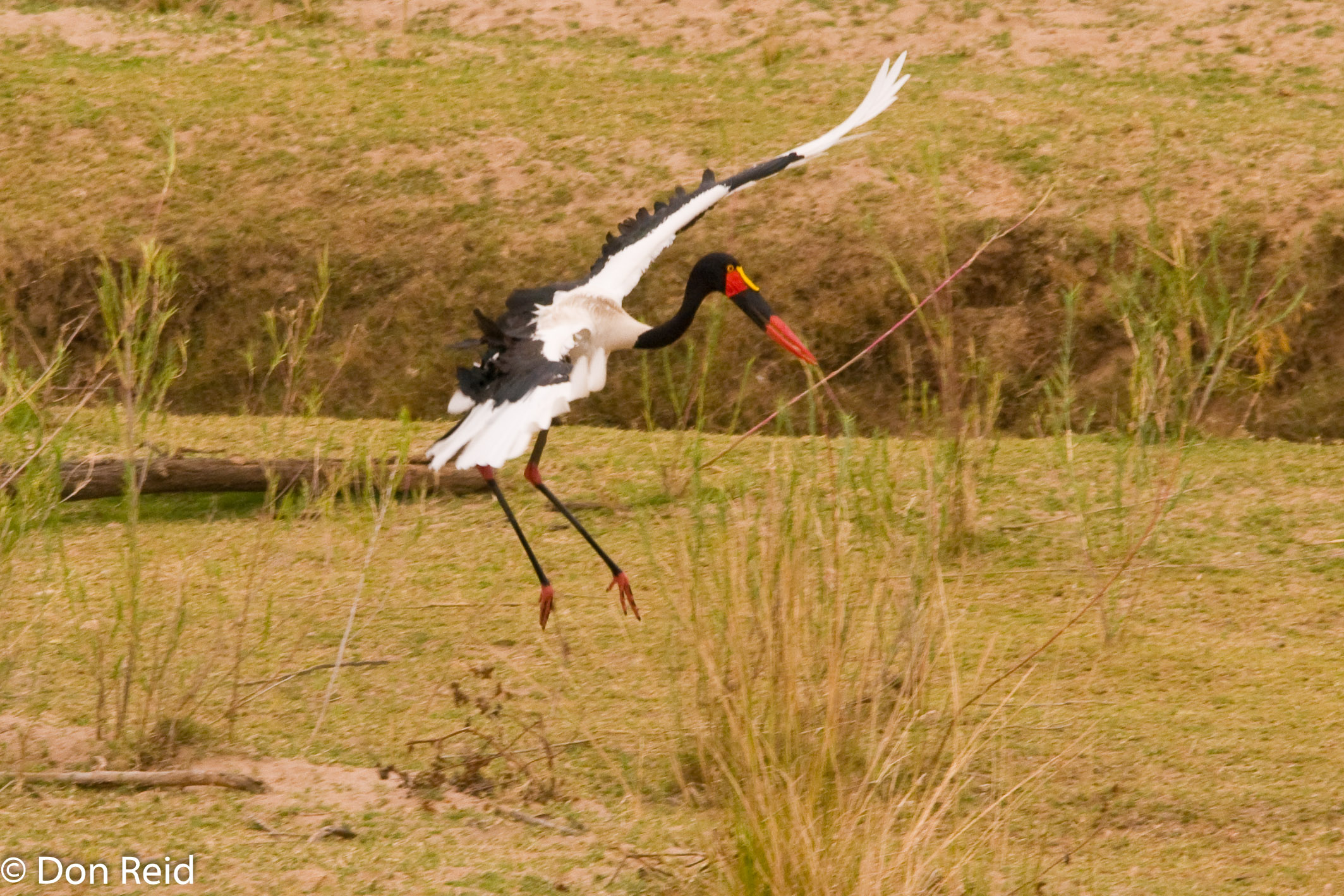
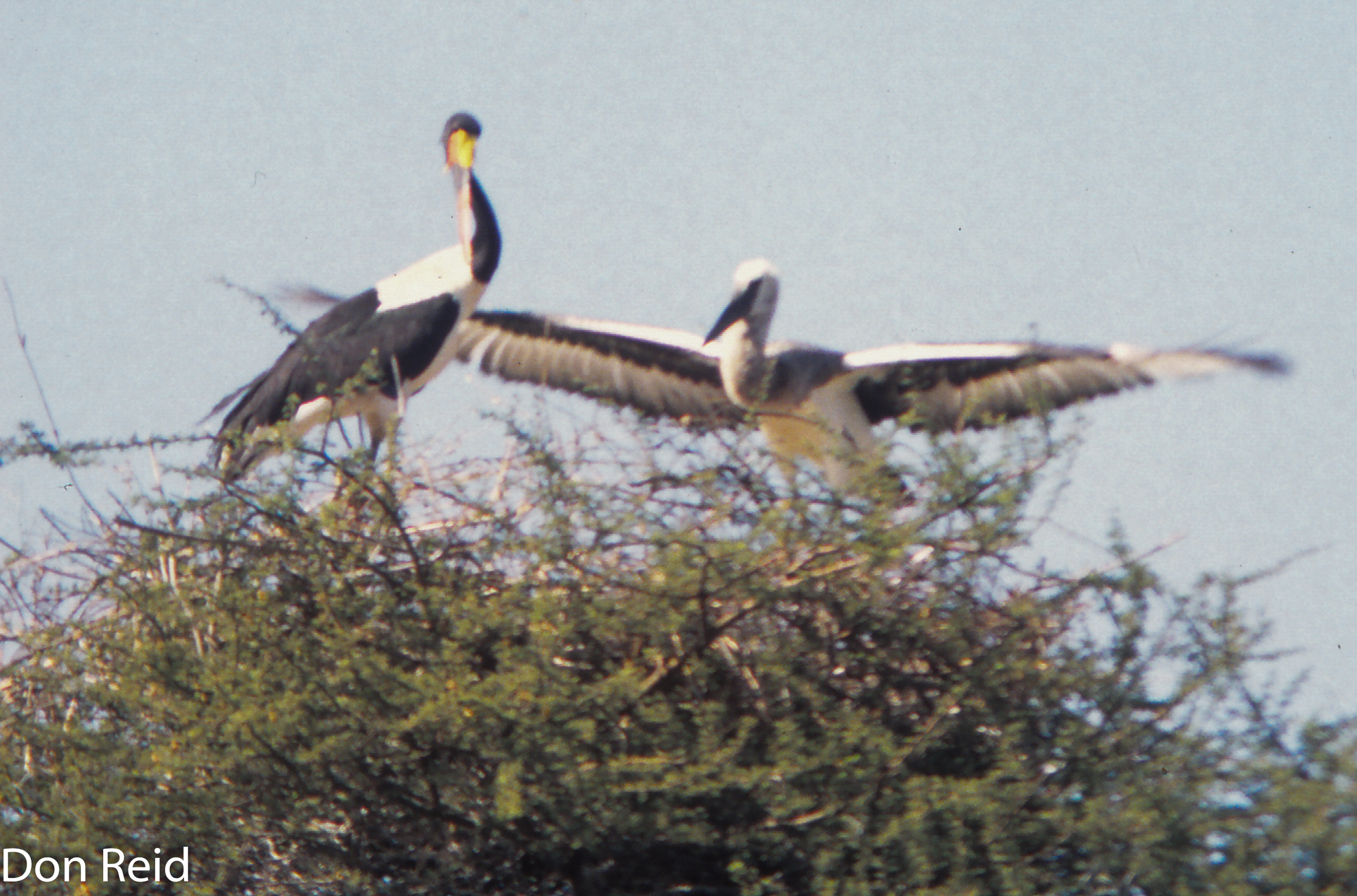
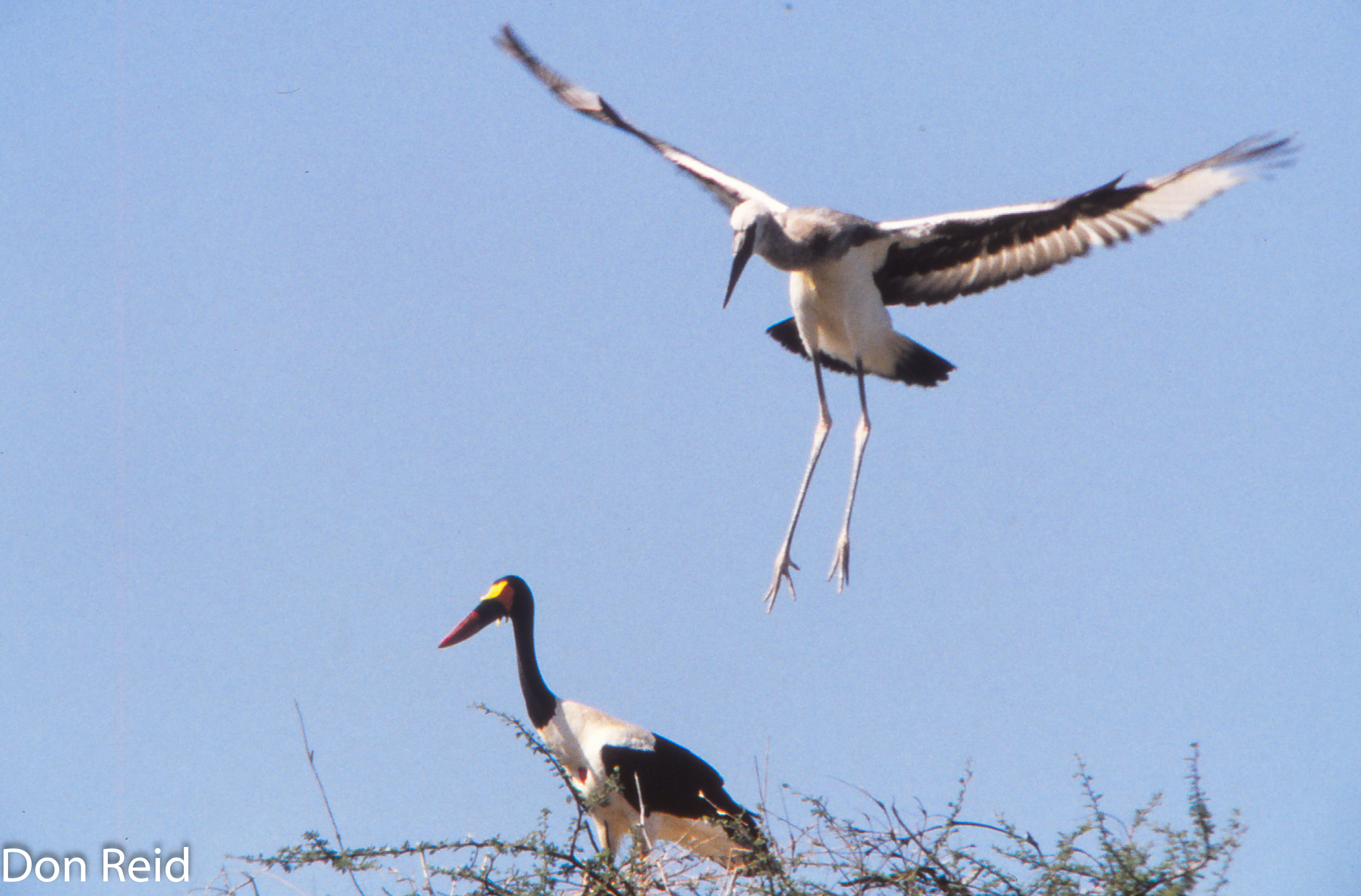
Most of my photos have been taken at a fair distance, but I did once get some shots of a pair in flight as they came into land on the river bed just below where we had stopped, near Letaba in Kruger National Park.
Where to find it
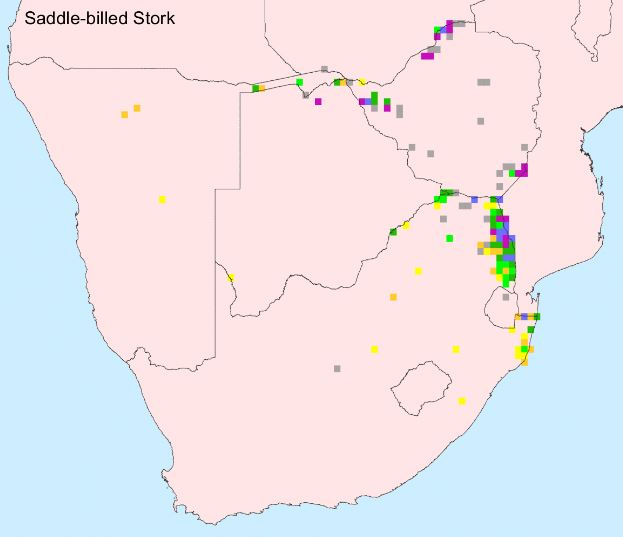
This is one species that is almost exclusively found in protected areas such as the National Parks and then only those in the northern parts of Southern Africa. Most likely place to find this species is in Kruger Park, along the larger rivers, such as the Shingwedzi, Letaba and Sabie Rivers. They may also be found in wetlands in savannah areas.
The didtribution map below is from SABAP2
Look …….. and Listen
This is such a stand-out bird that it is unlikely to be confused with any other.
It will be standing on its own or with a partner on the river bed or in the shallows. It stands about 1,2m tall so a 7 year old child is going to be looking it straight in the eye, although it won’t compete on weight, being just 6kgs or so (it’s those long thin legs, you see). Adults have a wingspan of some 2,5m which is as wide as a Smart Car is long. In flight they fly with neck outstretched, like all Storks, compared to Herons which fly with necks drawn in
Most noticeable feature is the massive bill, from which it gets its name and which is bright red with a black “saddle” in the middle. Other than that they are, like most storks, a combination of black and white. Oh, and they have red knees (actually their ankles) and feet , just to make them look really cool
The Saddle-billed Stork is not known to call so don’t bother trying to listen for it!
Other Stuff
Conservation status is listed as “Least Concern” on the Red Data list – it is reducing in numbers gradually due to loss of wetland habitat (which affects a lot of species) but is still widespread over most of tropical Africa
Nesting is done on the top of a tall tree – we once came across a nest in Kruger with a young Saddlebill doing short jumps on top of a nest of large twigs, seemingly testing its wings before taking the big plunge – quite comical but very serious if you are a young Stork about to head into the world.
The following photos are of that event but please forgive the poor quality – scanned from negatives taken 25 years ago!
The Riverfront section of Chobe National Park – one of the finest Game Reserve experiences in Southern Africa, if not the whole of Africa.
Map of the Riverfront section of Chobe
I count myself fortunate to still have a part-time consultancy job as a QS, and doubly fortunate to be involved in a sizeable building project at Kasane in the far north of Botswana, on the doorstep of Chobe National Park. The project requires monthly site visits and during the few days we – that’s the professional team – spend there, we have managed to squeeze in a quick trip through the Riverfront section of the Park – all part of team building, you understand.
Prior to these recent visits, I was last in Chobe (pronounced Cho-bee) in 2000 and had good memories of this unique Park, although the intervening years had rendered my memories a bit fuzzy. So I was more than eager to renew my acquaintance with this part of Botswana and the first trip through the Riverfront section in May 2015 brought those memories from 15 years ago flooding back.
Chobe Background (courtesy of Wikipedia)
Chobe National Park, in northern Botswana, has one of the largest concentrations of game in Africa. By size, it is the third largest park in the country, after the Central Kalahari Game Reserve and the Gemsbok National Park, and is the most biologically diverse. It is also Botswana’s first national park.
One of four main areas in Chobe,The Serondela area (or Chobe riverfront), situated in the extreme Northeast of the park, has as its main geographical features lush floodplains and dense woodland of mahogany, teak and other hardwoods now largely reduced by heavy elephant pressure. The Chobe River, which flows along the Northeast border of the park, is a major watering spot, especially in the dry season (May through October) for large breeding herds of elephants, as well as families of giraffe, sable and cape buffalo. The flood plains are the only place in Botswana where the puku antelope can be seen. Birding is also excellent here.
Flying in
The flight from Jo’burg is about an hour and a half and takes you over the Mkgadikgadi pans, an amazing sight from the air.
Makgadikgadi Pans from the air
Approaching Kasane, there is usually a good view of the Chobe River and it’s quite possible to spot Elephant even before you have landed.
Chobe River from the air
So How much Game is there?
Chobe tends to exceed all your expectations – yes there are patches with not much going on, not visible anyway, but there are parts that take your breath away, like the lush floodplains filled with game almost as far as the eye can see – dominated by Elephant and Buffalo. Elephants occur here in such numbers that there are real concerns about the survival of the woodland, but Botswana has a strict anti-culling policy and so Elephant herds grow and spread unabated. Perhaps nature will intervene as it often does.
Mostly Elephant and Buffalo on the floodplain
Apart from the frequent Elephant sightings, there are some other very special animals to be seen – (some of the snippets of information are from the excellent maps/brochures on Botswana by Veronica Roodt which I originally obtained for my 2000 visit)
Sable Antelope, one of the most beautiful antelope in Africa with their perfectly curved horns, which are used to defend themselves. Glossy black colouring means it is a bull, while cows and juveniles are brown
Sable Antelope
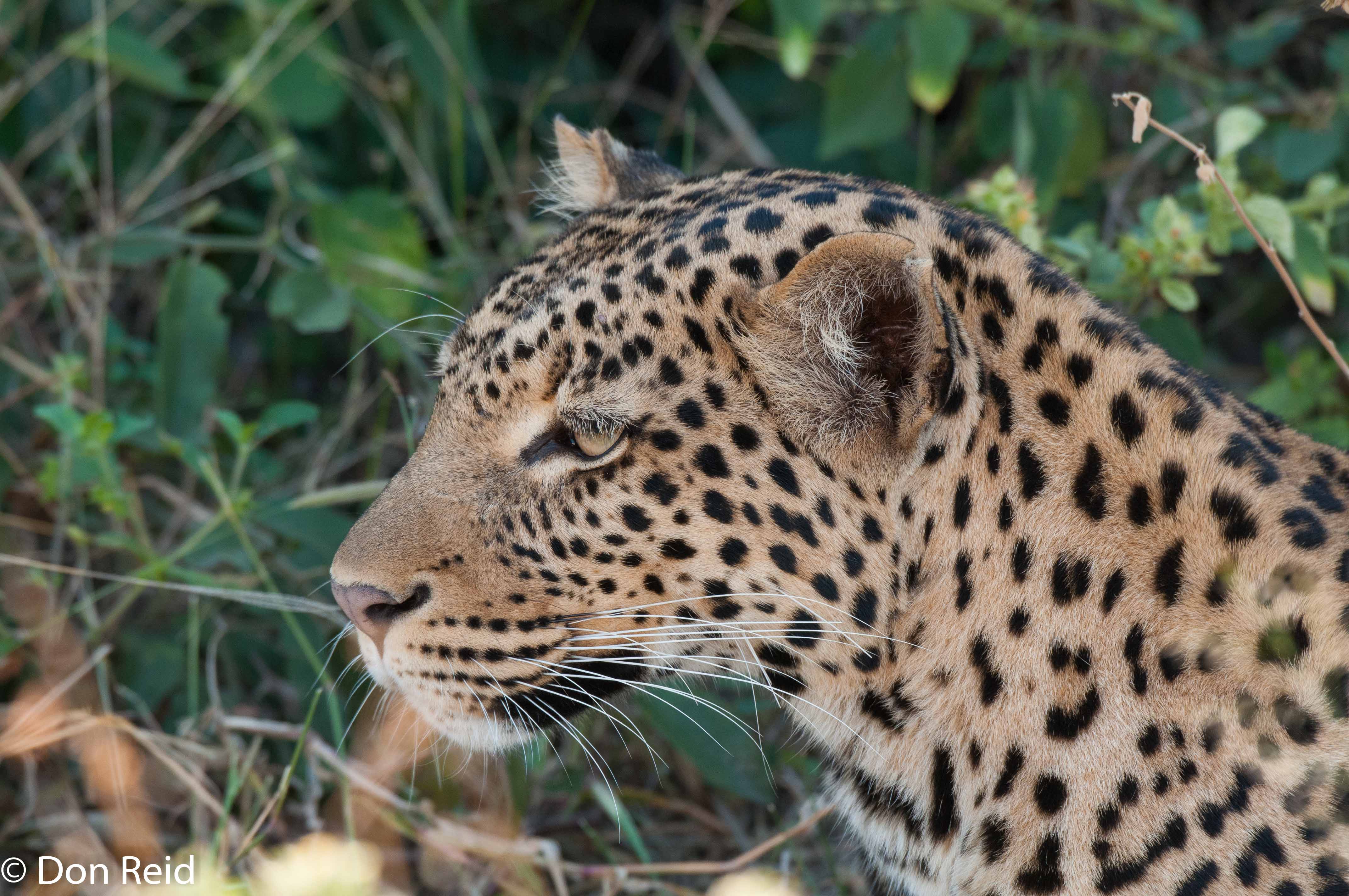
Leopard – we have been very fortunate in finding a young Leopard on two of our three visits so far, quite possibly the same individual which, on our last visit, had dragged its Impala meal into a tree. This is to prevent Hyena and other predators reaching it.
Leopard
Kudu – males have those impressive twisted horns, females are hornless so the ears are more prominent
Kudu
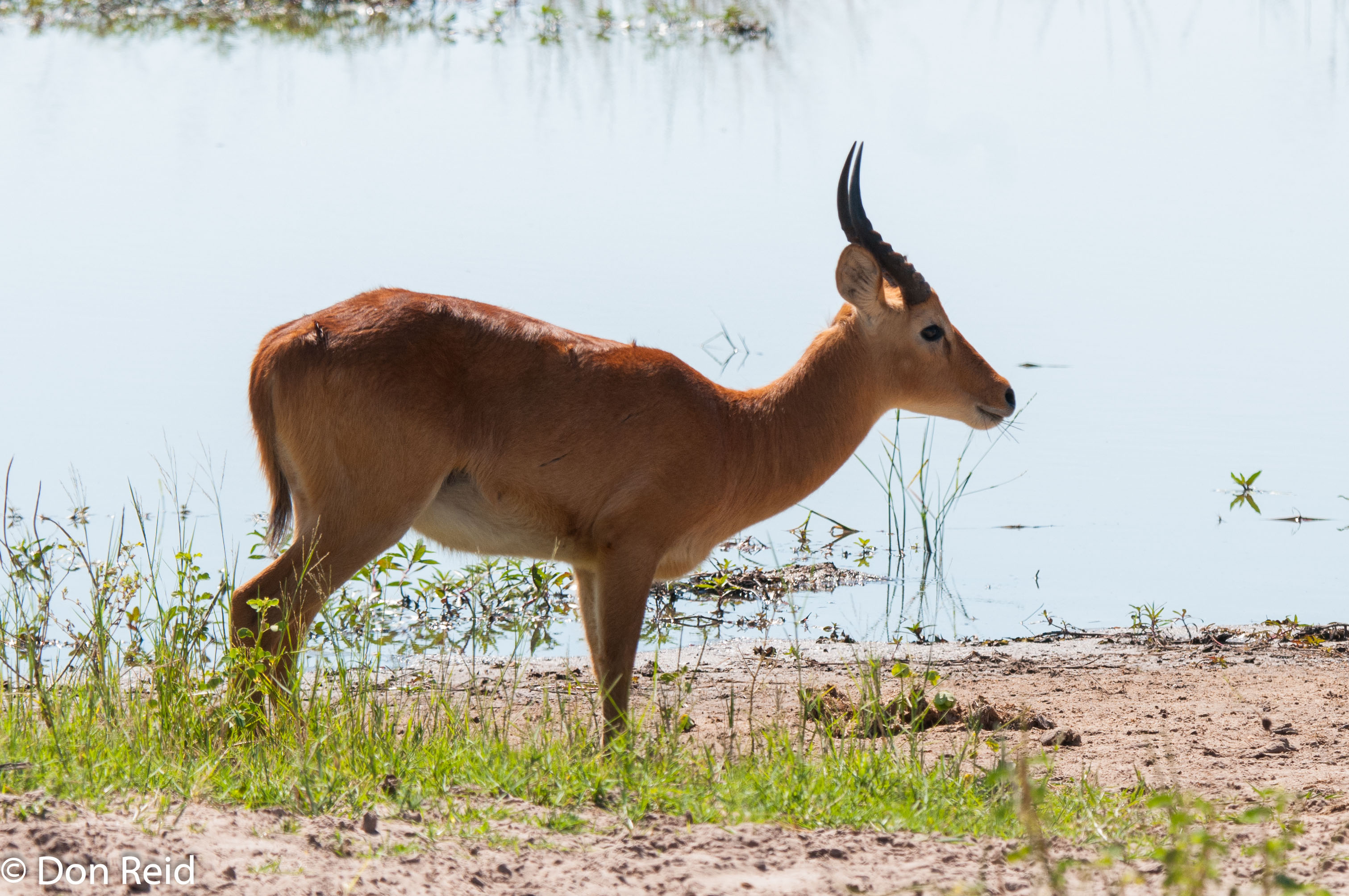
Puku – Chobe is the only place in Southern Africa where this uncommon species occurs, in small herds. Mostly found near water
Puku – unique to Chobe
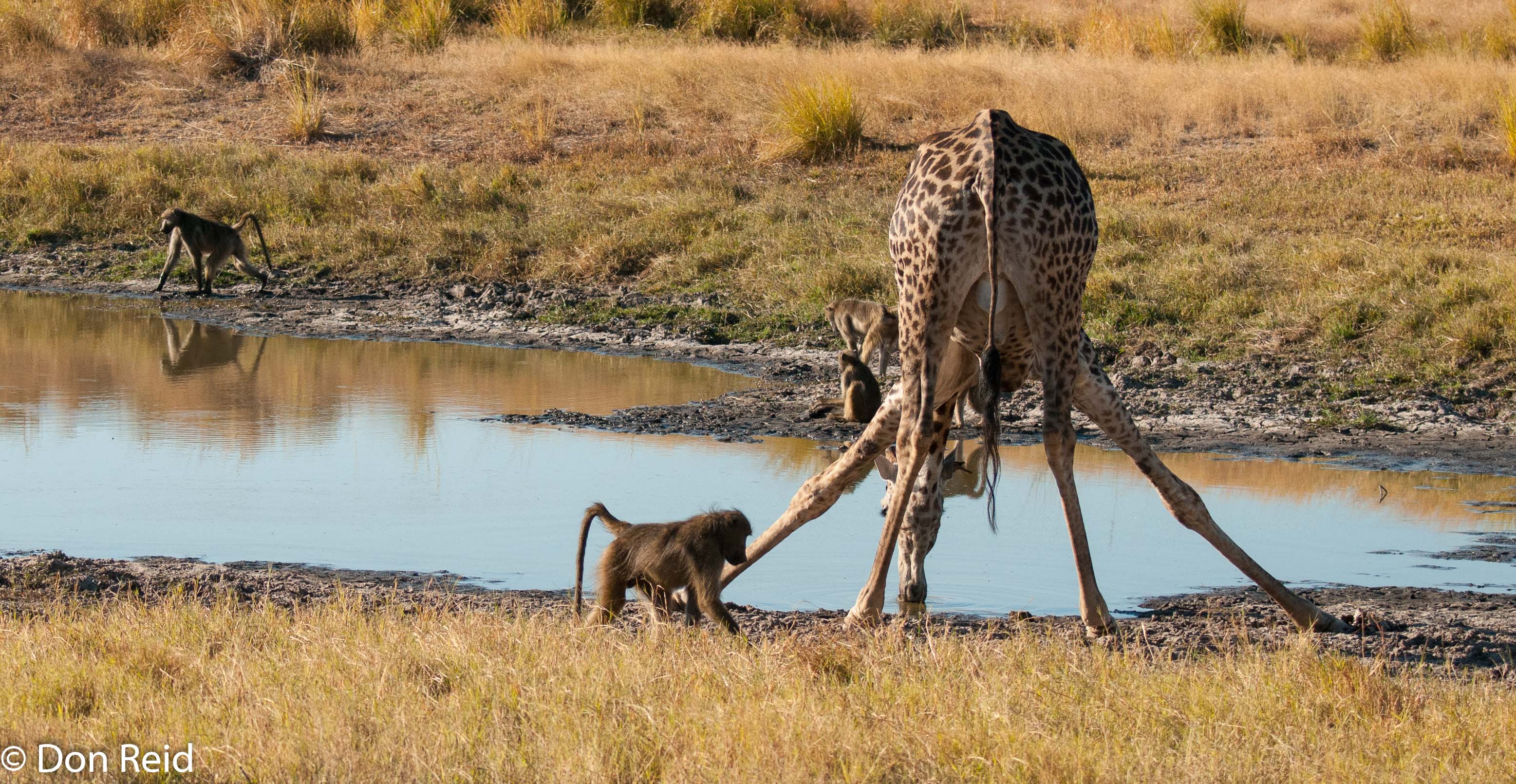
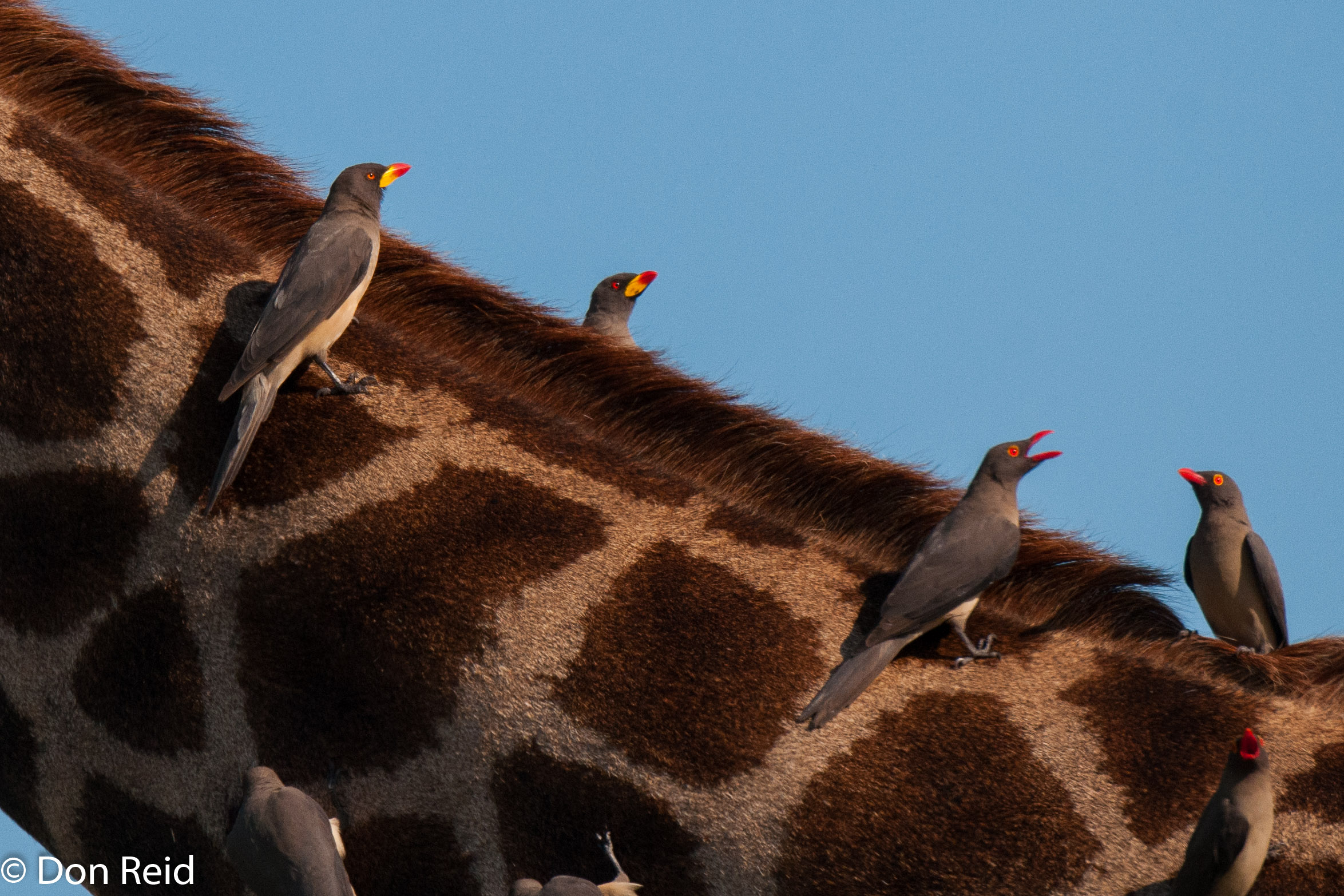
Giraffe – tallest animal in the world at 5,5m. Valves in the jugular vein help to control blood pressure when they bend down to drink water. The oxpeckers love them, gathering in numbers on their long elegant necks
Giraffe at waterholeRed-billed and Yellow-billed Oxpeckers taking a ride
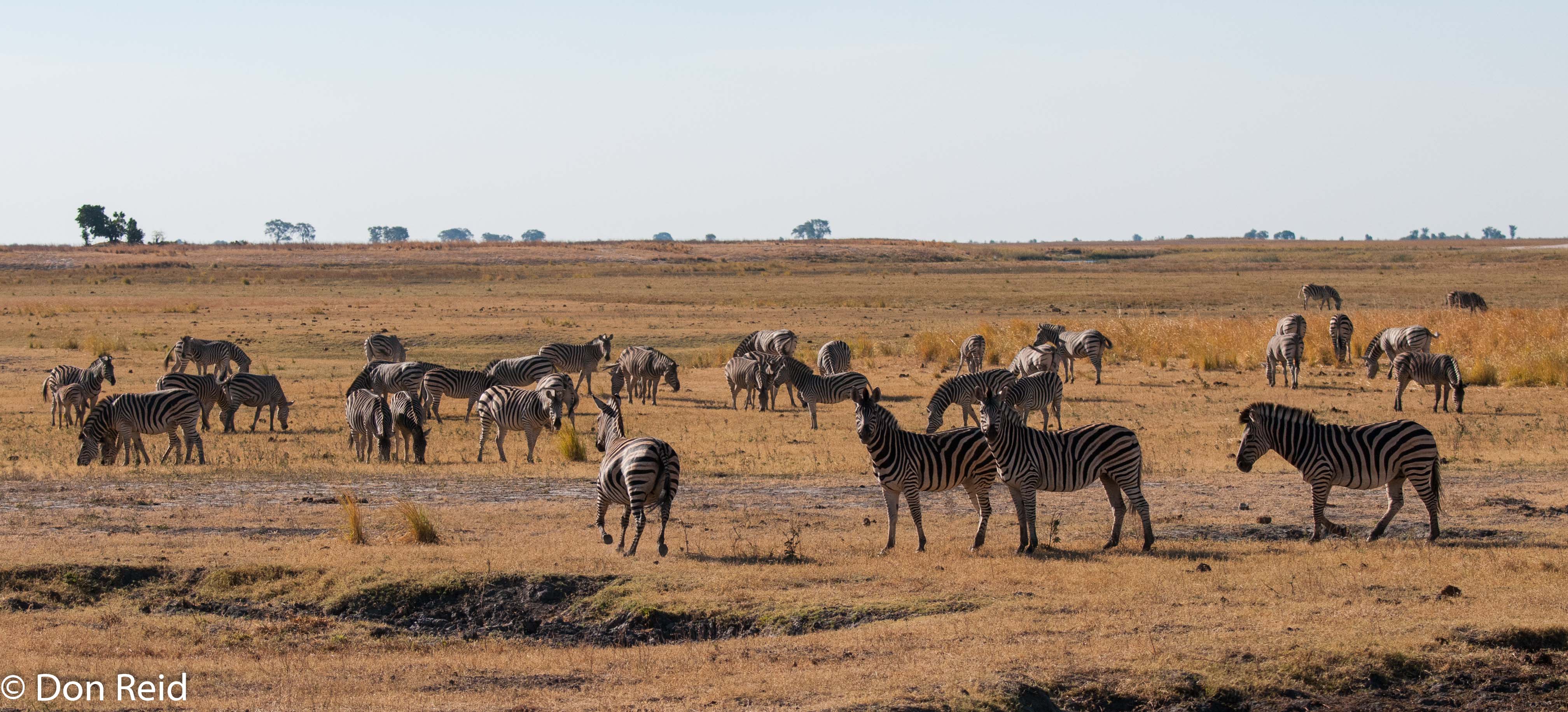
Zebra – no African Game Reserve would be complete without them – our kids loved to call them pyjama-donkeys when they were small, now the grandkids do it
Zebra on the plains
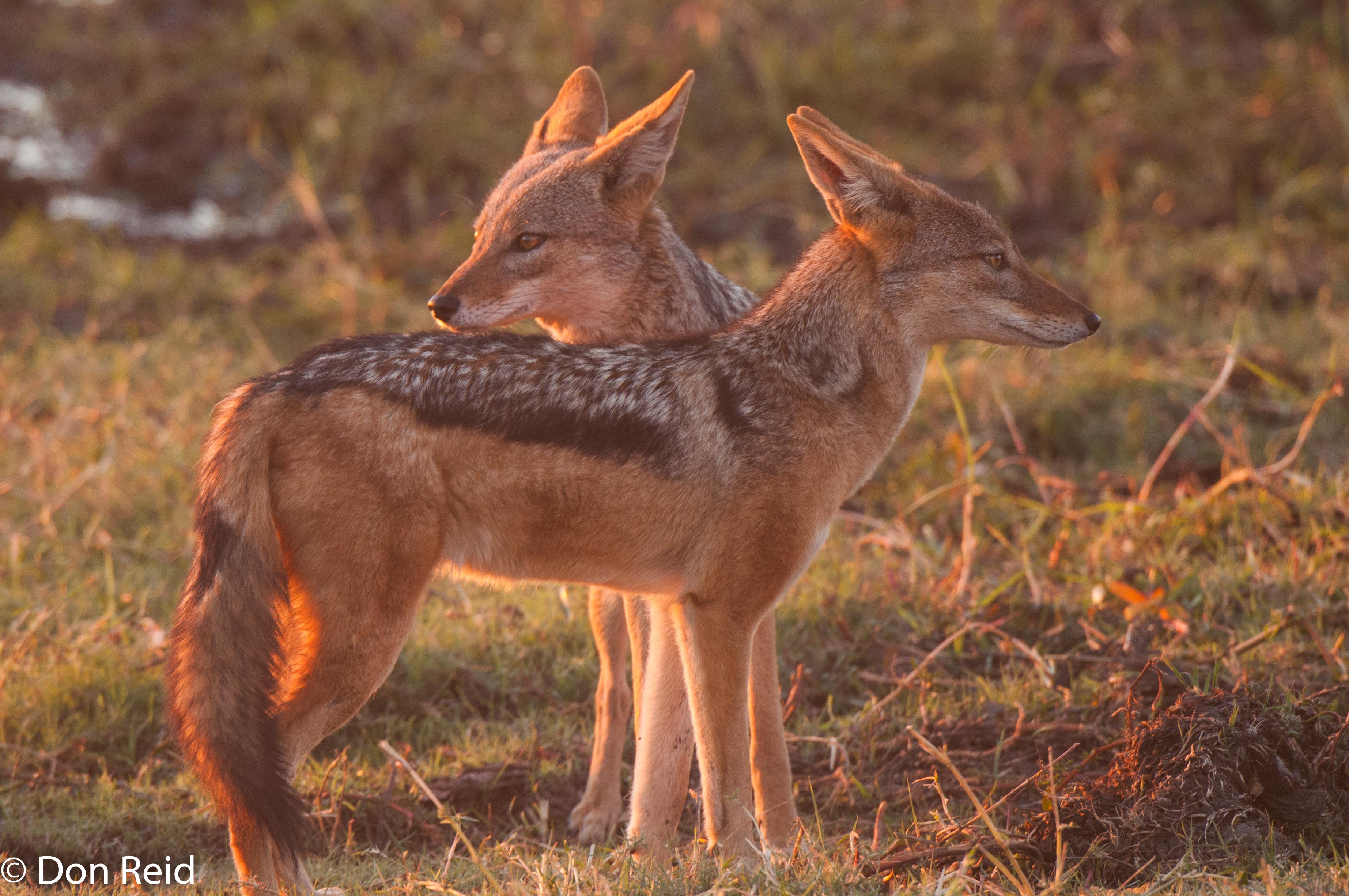
Black-backed Jackal – Pairs form long-term bonds, as these two seem to have done
Black-backed Jackal
Wild Dog – if you are very lucky you may encounter one as we did, crossing the tar road in front of us, then dashing off as we slowed down. They usually move around and hunt in packs.
Wild Dog dashing across the road
And the Birding?
For anyone starting birding, this must rate as one of the best places to visit – there are many larger species that are easy to see and even photograph if that is your thing. Identifying them is also fairly straightforward if you have one of the birding Apps or one of the many birding books available.
The short trips through Chobe that I have done so far have been exciting but too short and rushed to do any in-depth birding and I look forward to getting to grips with some of the more difficult to see species during future visits. Nevertheless there have been some very good sightings and photo opportunities of some of the “obvious” species – here’s a selection :
Ground Hornbill – no other reserve I have visited can boast as many of this iconic species
Ground Hornbill
Red-billed Hornbill – there is a good chance you will encounter five Hornbill species during a visit – the one above plus the four smaller species being Red-billed as this one below, Yellow-billed, African Grey and Bradfield’s.
Red-billed Hornbill
Yellow-billed Stork – occur regularly among the myriad birds that frequent the pools of the Chobe floodplain
Yellow-billed Stork
Yellow-throated Petronia – an uncommon and not at all obvious species, this one happened to be perched near the Leopard with its half-eaten Impala
Yellow-throated Petronia
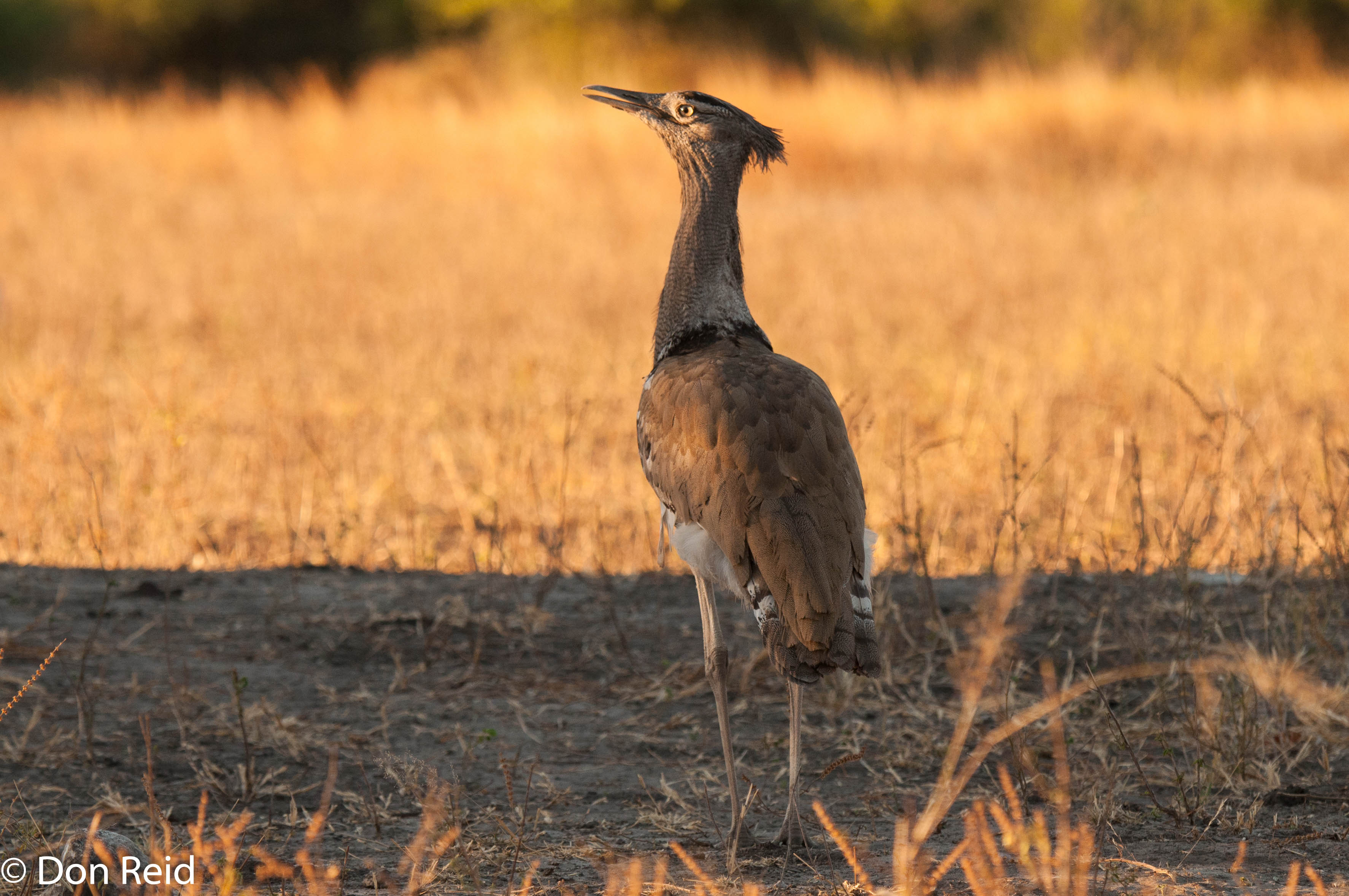
Kori Bustard – another species with a more than good chance of being spotted in the open areas with grass
Kori Bustard, said to be the heaviest flying bird in the world (5,5kg)
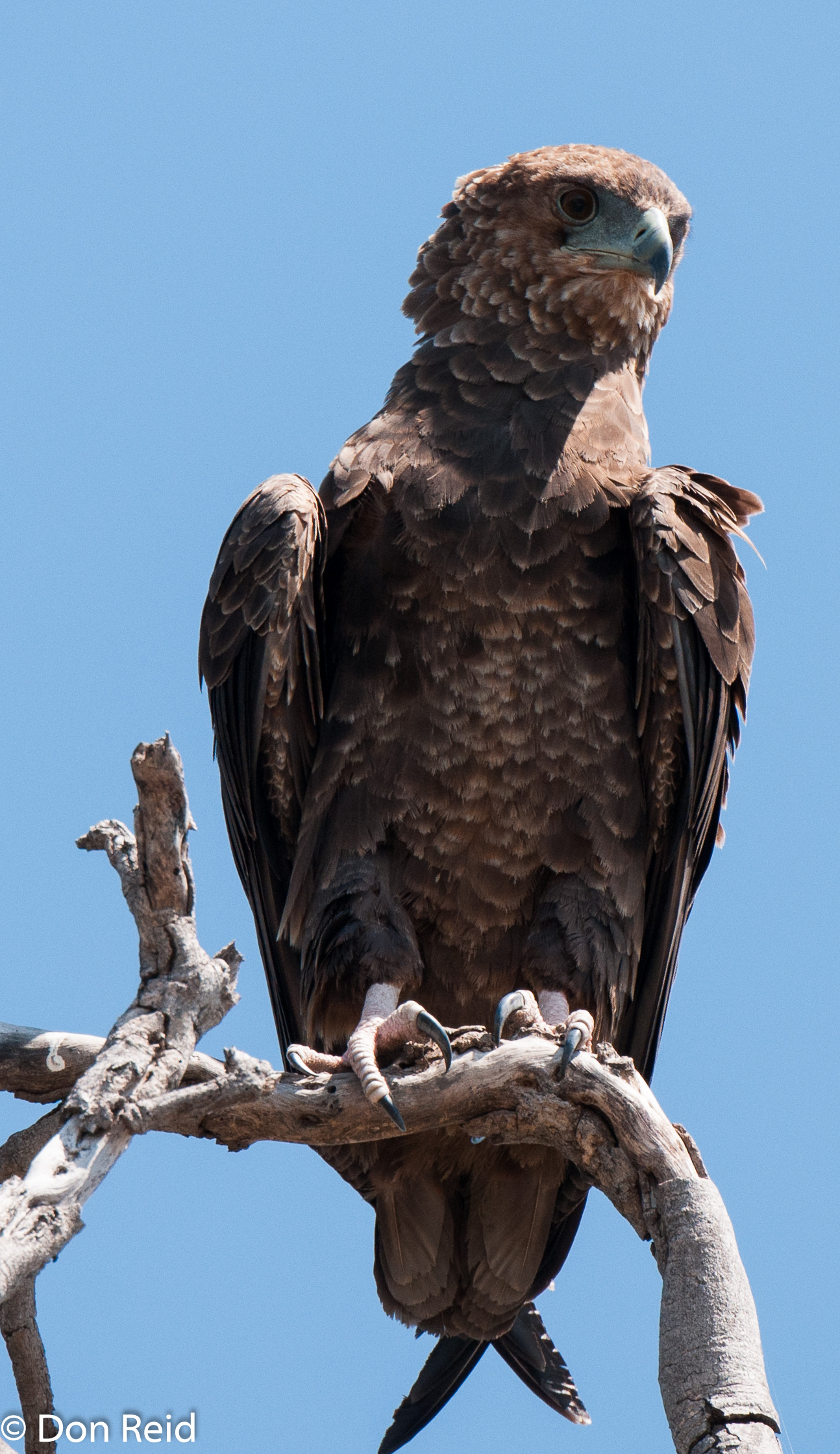
Bateleur – often seen soaring high in the air, this juvenile was perched in a dry tree near the track. One unique feature is their short tail which allows it to walk backwards – useful when trying to catch a snake!
Bateleur (Juvenile)
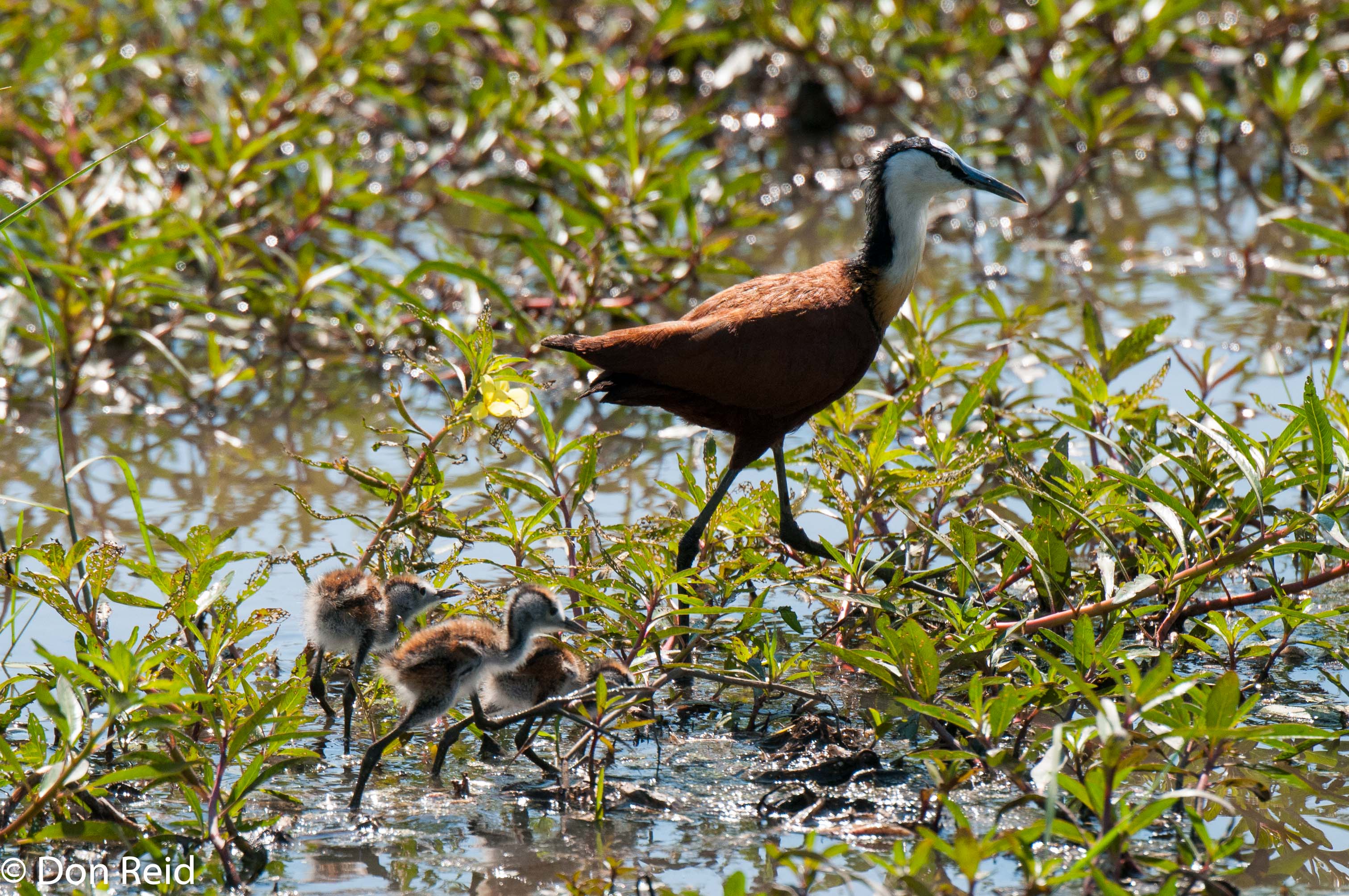
African Jacana – this one had a few youngsters in tow, cute little fluffy chicks with outsize legs
African Jacana with little ones
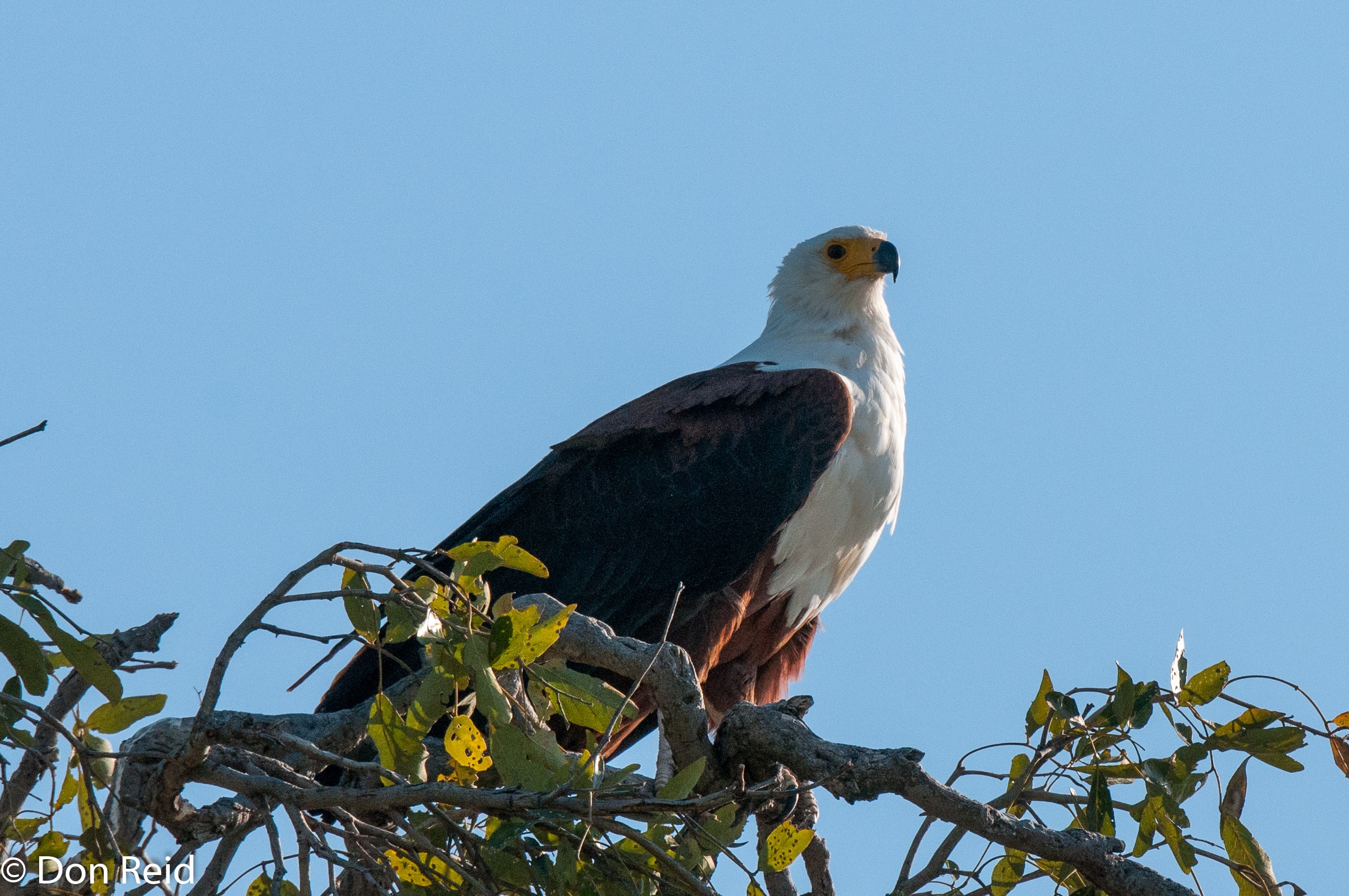
African Fish-Eagle – no great river in Africa is worthy of the name unless it is frequented by these magnificent birds of prey and Chobe has its fair share of them
African Fish-Eagle
Oxpeckers – the giraffes seem to attract the most oxpeckers but they are just as likely to be found on buffalo, kudu, impala
Red-billed and Yellow-billed Oxpeckers
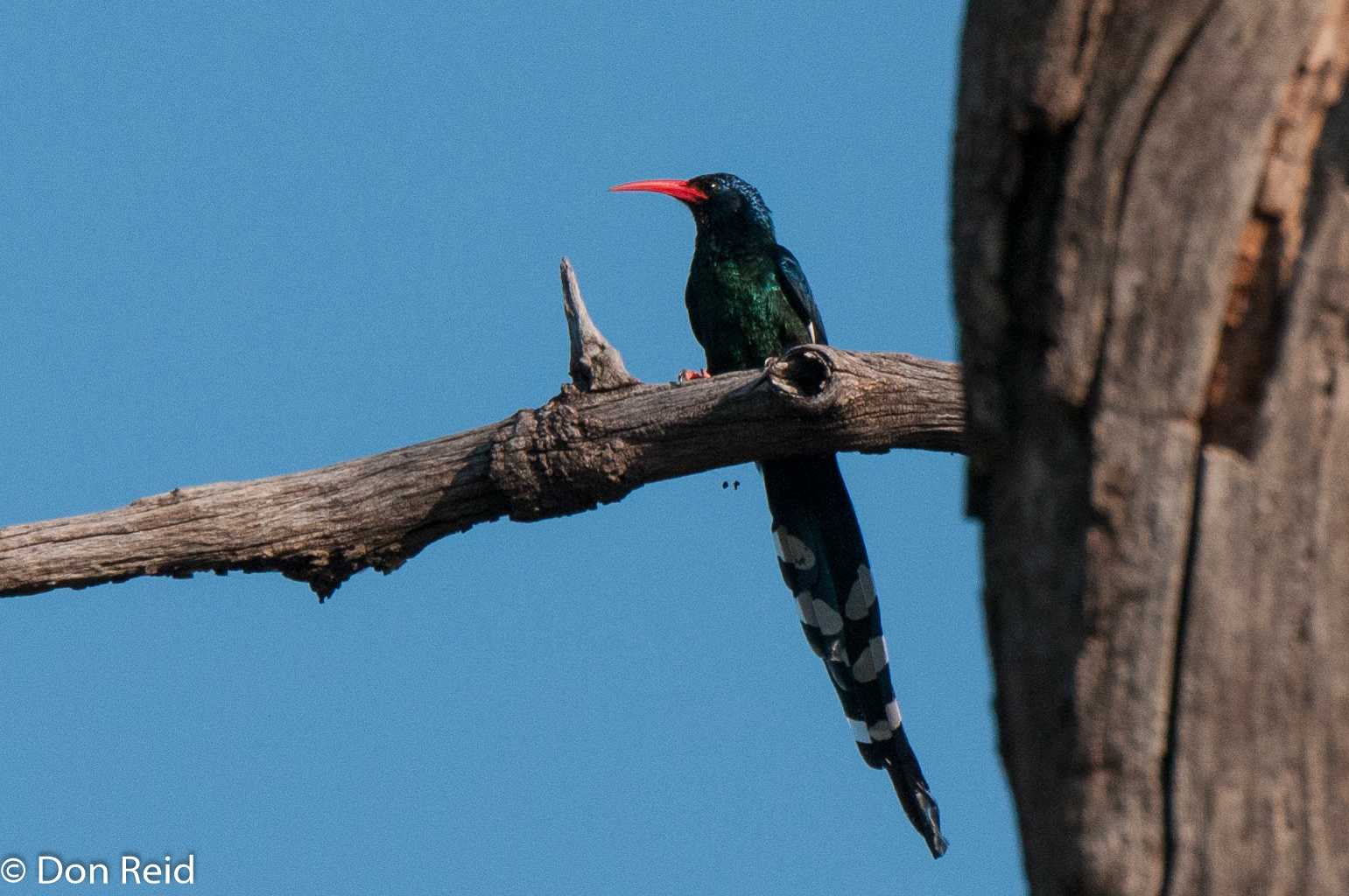
Green Woodhoopoe – often heard before they are seen, this species is less common
Green Woodhoopoe
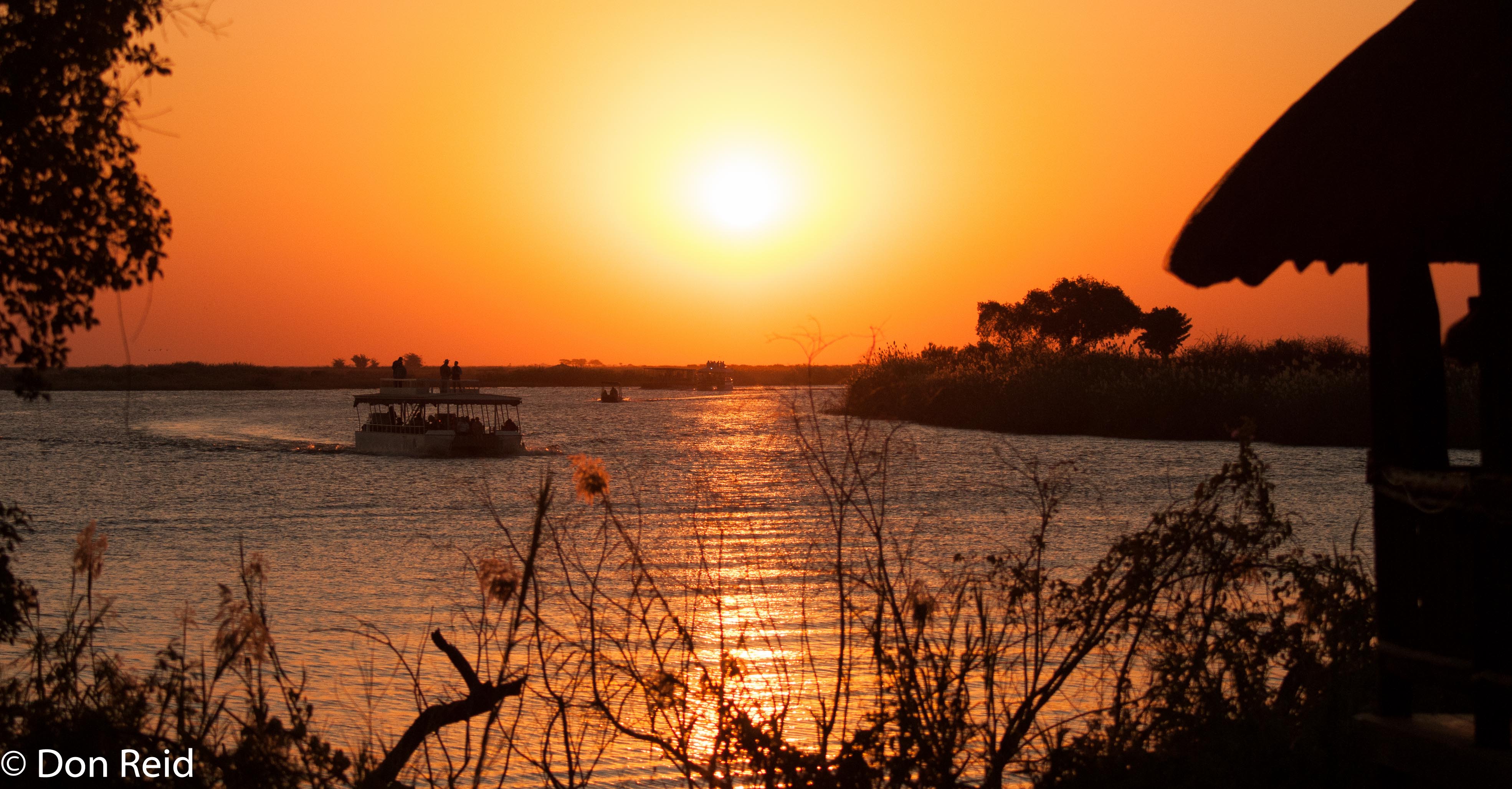
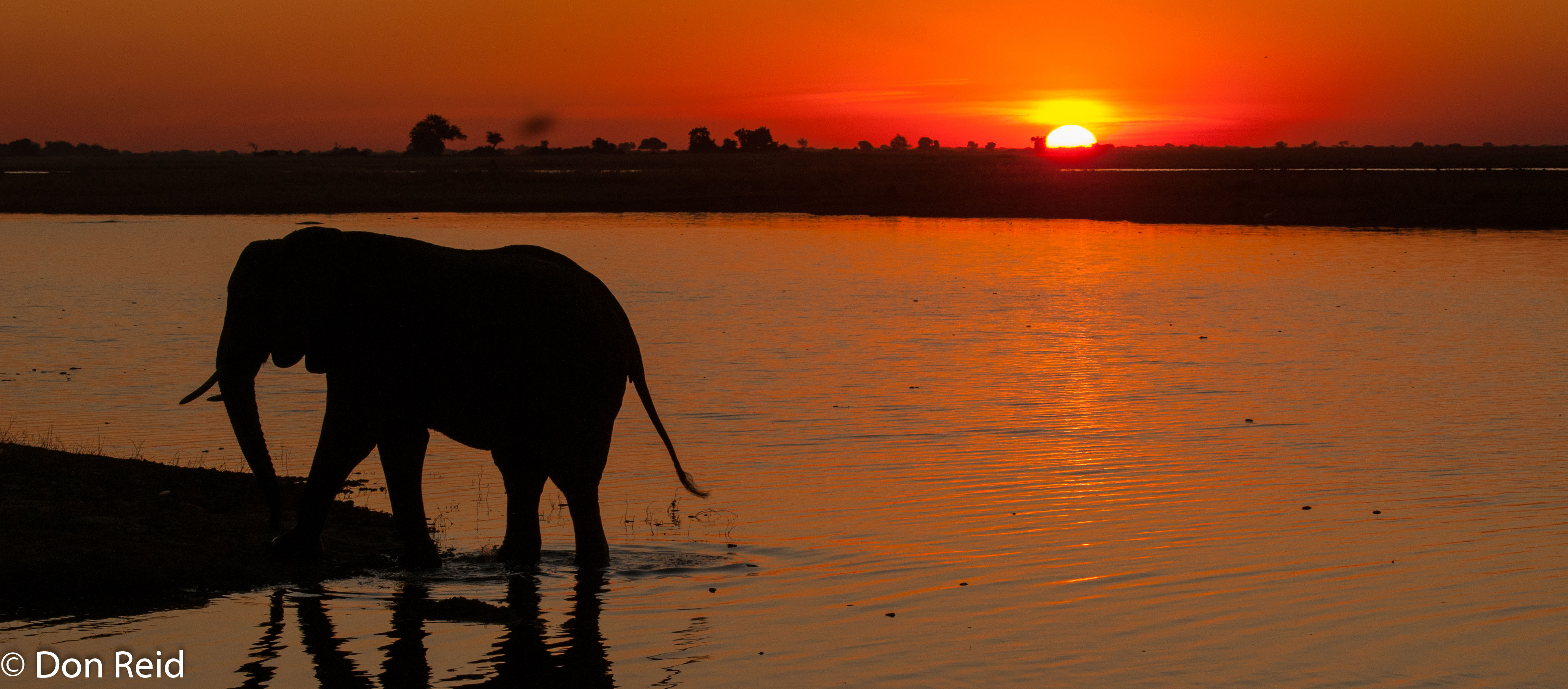
The Close of Day – Sunsets for Africa
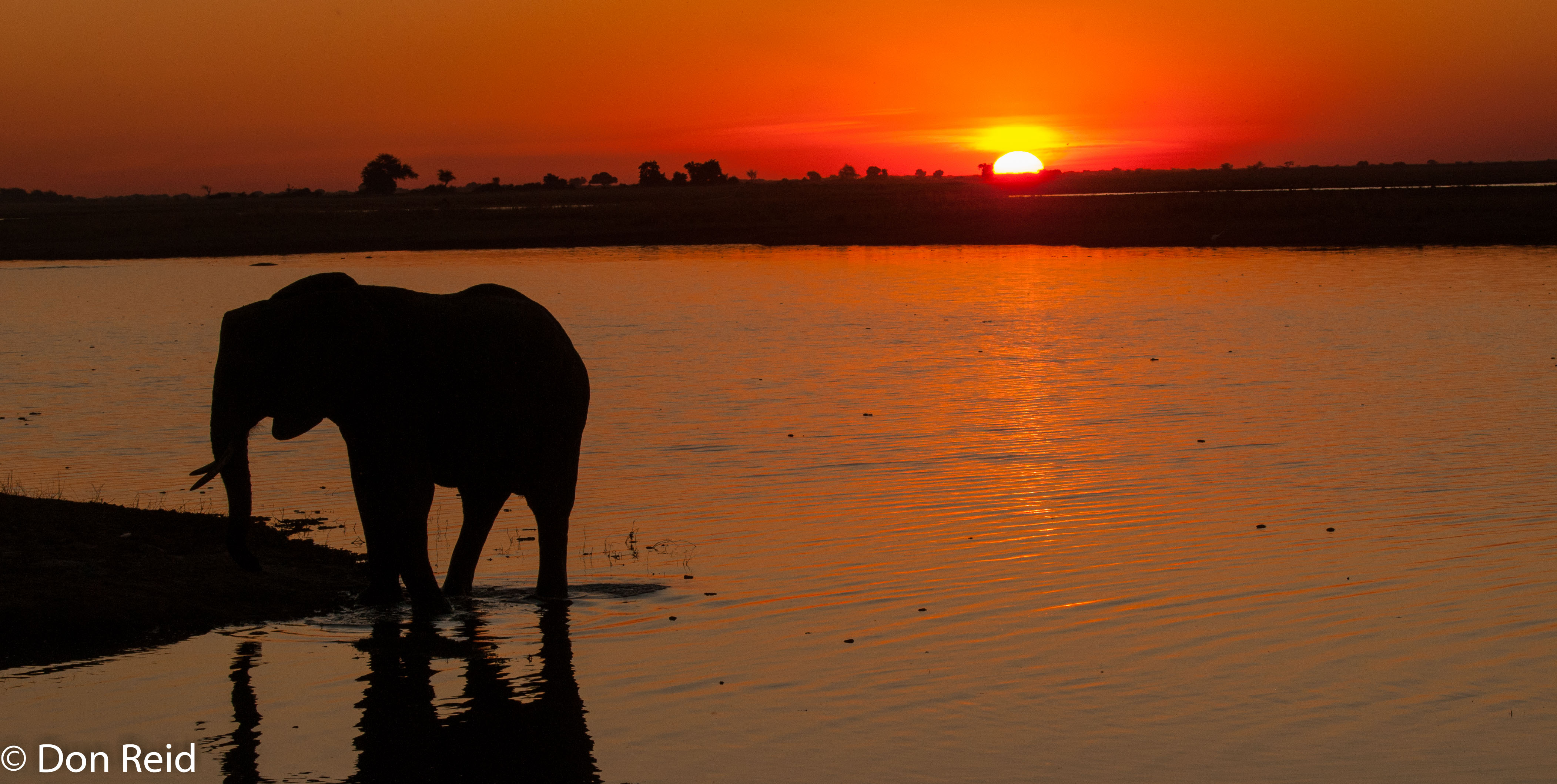
I don’t think I have seen sunsets anywhere in the world that can compete with those over the Chobe river – tell me if you agree!
Those brave souls who have read the 3 part story of our trip through Mozambique, will know that we had to cut it short due to a propshaft bearing that collapsed under the punishment meted out by a certain rutted road, leaving us temporarily stranded at Mphingwe camp, just south of the Zambezi river. This is the conclusion of the story – how we got the vehicle repaired, our enforced longer stay at Mphingwe and our experiences getting home. Finally, I have included my overall Impressions of Mozambique.
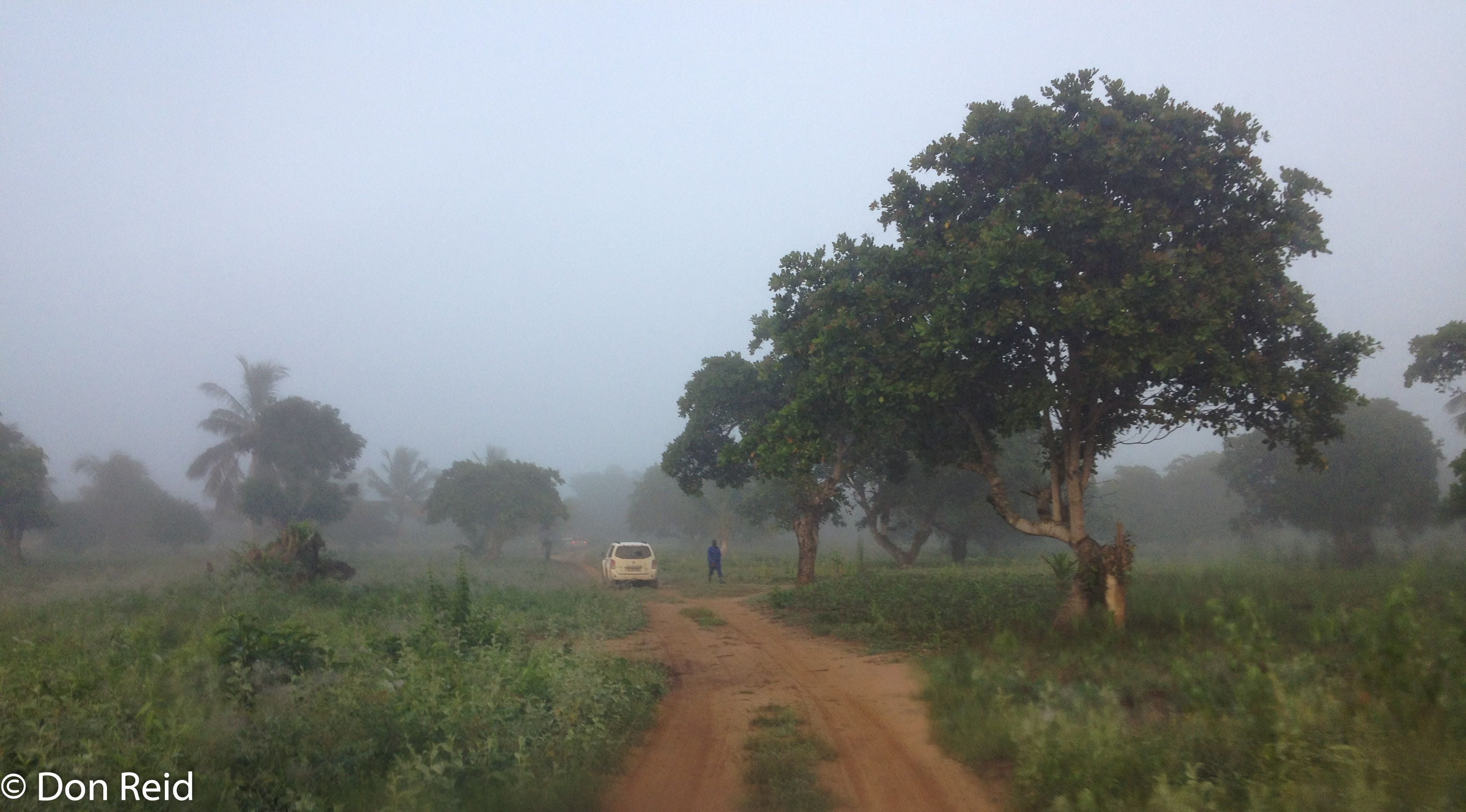
Day 11 : Coutada 12 Birding (Squeezing in)
I woke up early and rather despondent this Sunday morning, not knowing how we were going to get ourselves and the vehicle back home. There seemed to be just 2 options – fix the car here and drive home or get home by other means and arrange to repatriate the car – neither would be simple but it would be a lot easier if we could just drive the car back ourselves.
To take our minds off the problem and encouraged by the others in the group, we squeezed the whole team into the remaining 2 vehicles and set off to do mostly forest birding in the Coutada 12 area, along with some woodland birding, hoping to clinch some of the difficult (for the time of year) specials. Thanks are due to Owen and Sue for making room for us in their vehicle, which turned a potentially depressing day into another great day of birding. In fact I was able to add another 3 lifers to my list :
Short-winged Cisticola perched high up on a dry tree
The very distinctive and colourful Chestnut-fronted Helmetshrike, which was followed moments later by a group of their close cousins, Retz’s Helmetshrike
Orange-winged Pytilia in woodland
Chestnut-fronted Helmetshrike – not pleased for some reason
Other significant birds we came across (any one of them would be a great sighting for the average SA birder) :
Martial Eagle circling overhead
Common Scimitarbill
Green-backed Woodpecker
White-breasted Cuckooshrike
Blue-mantled Crested Flycatcher
Cabanis’s Bunting
Narina Trogon – flying right over our heads
In the forests we tried the “waiting for the bus” routine again, hoping that some of the shy species would be curious and come and join us, but we only came up with Tiny Greenbul, which called frequently and then played hide-and-seek with us, affording a brief glimpse or two
Back at Mphingwe we enjoyed a last dinner with the full group, as those still mobile would be heading to Zimbabwe the next day. Our fate lay squarely in the hands of Joe, the resident mechanic looking after the sawmill, who would look at the Touareg in the morning and confirm our options. We had a date with him for 6.30 am at the sawmill.
Day 12 : Solving the Car Problems and Time for Contemplation
We took the car to the sawmill just after 6 am for Joe to have a look and once we had it up on the ramp, his recommendation was simple and quick – get the part and he will fix it.
So we set about getting the part, which meant driving cautiously and slowly up to the tar road – anything over 30 km/h and the knocking would start – and towards the nearest tower for a cellphone signal, where I spent some time phoning various people in SA to arrange for the part to be supplied and paid for. That was the easier part – getting the part to Mphingwe seemed to be a real problem until Pat, the wife of Mphingwe’s owner Ant White, suggested her daughter, based in Johannesburg, would be prepared to collect the part from Pretoria and fly to Beira the following day, where after Pat would arrange for it to be transported by “Runner” (one of their employees from Beira) on a “Shapa” (local min-bus taxi) to Mphingwe. These people are nothing short of amazing! With luck the part would be here in two days. The only proviso was that I would pick up the cost of her air ticket to Beira and back, which I did with alacrity and relief. The benefit to them was an opportunity for mother and daughter to have a day or two together in Beira, so definitely a winning solution all round.
At the same time Neithard was making arrangements to get both his damaged vehicle and himself and Kathrin back to Pretoria, which was looking like a lengthy affair.
By lunchtime our arrangements were done and we could relax for the rest of the day. I took a walk along the Suni Trail which winds through the forest and had a magical time with the many butterflies, which posed for some beautiful photos in the soft dappled light of the forest.
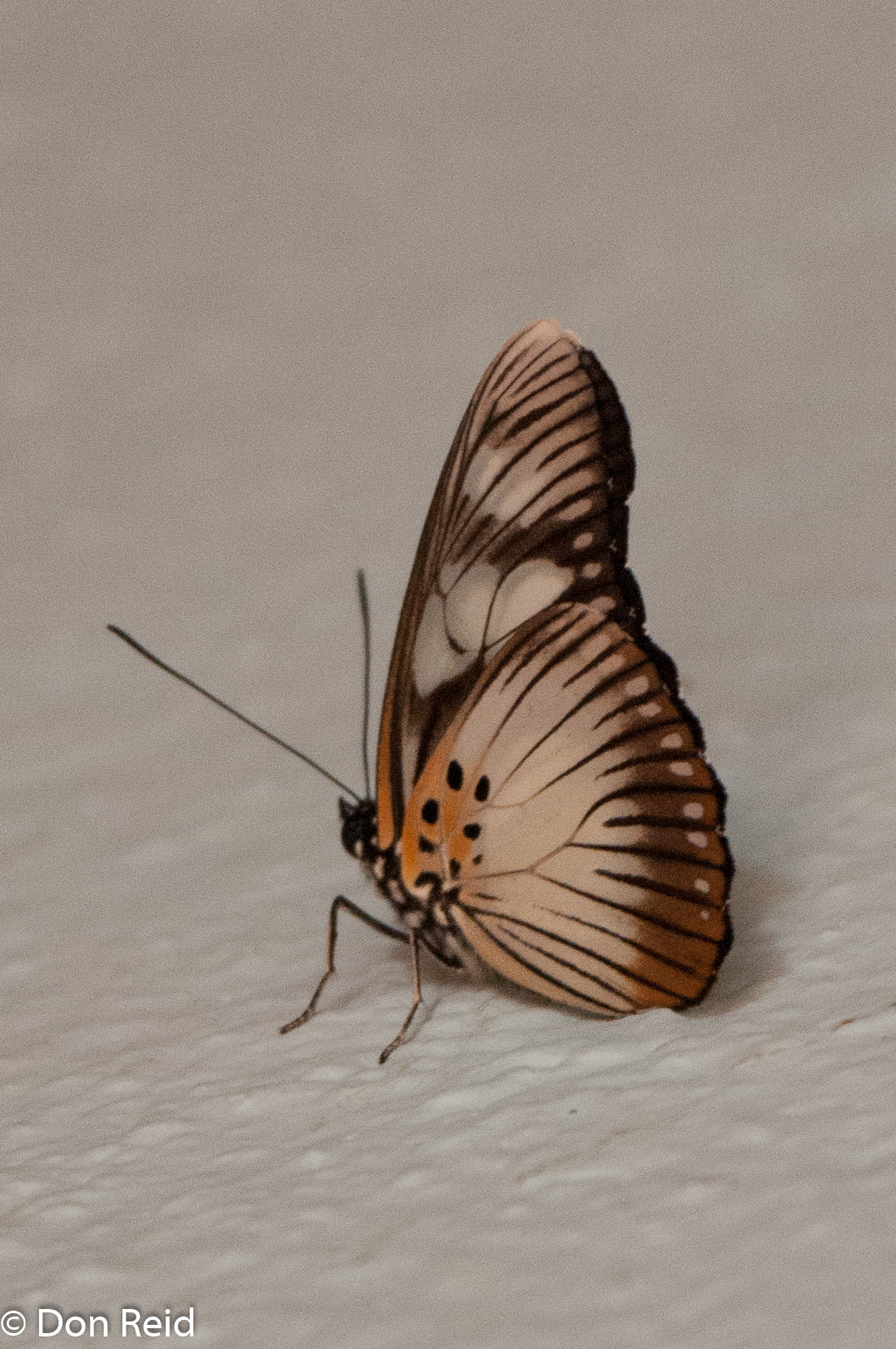
Suni TrailArmy ants on the marchGold-banded forester / skaduweedansertjie (Euphaedra neophron neophron)False dotted-border / valsvoelentwitjie (Belenois thysa thysa)Eyed bush brown (henotesia perspicua)
Birds were not plentiful in the immediate vicinity of the camp but some nice specials occur including Crested Guineafowl (aka The Rockers – which will make sense if you’ve ever heard a group of them doing their call, which sounds like a rock band warming up, plus their wild hairstyle), Black-bellied Starling and Yellow-bellied Greenbul. The resident Emerald-spotted Wood-Doves and Tambourine Doves provide a constant soothing background sound with their calls right through the day.
Our equally stranded camp-mates Neithard and Katherina, with Mandy (part-time emergency nurse), Mphingwe campHeading to fire up the donkey for the hot water, Mphingwe campBlack-bellied Starling, Mphingwe camp
The evening meal was memorable for a great sirloin steak and good conversation with Neithard and Kathrin, all of us in the same boat at that stage, in rough waters and no paddle in sight.
Day 13 : Waiting for the Part and some birding at Mphingwe
A day of waiting, while the vital spare part travels from Pretoria to Mphingwe near Caia in Mozambique via Jo’burg (by plane to) Beira (by Shapa to) Mphingwe all courtesy of Pat and her daughter Carrie, or Wonder Woman as I was now regarding her. Our hopes were that it would arrive the next morning and be fitted without a problem – what if it was the wrong part?
To pass the time George and I took a long birding walk along the Suni Trail, diverted to the track down to the sawmill and returned via the main dirt road back to the camp.
This helped to push the pentad total (I hadn’t given up atlasing) up to 31 with some exciting species such as
All in all some excellent birding and plenty of Butterflies
The rest of the day was relaxed with another good dinner to close out the day.
Day 14 : Replacing the part – an all day event
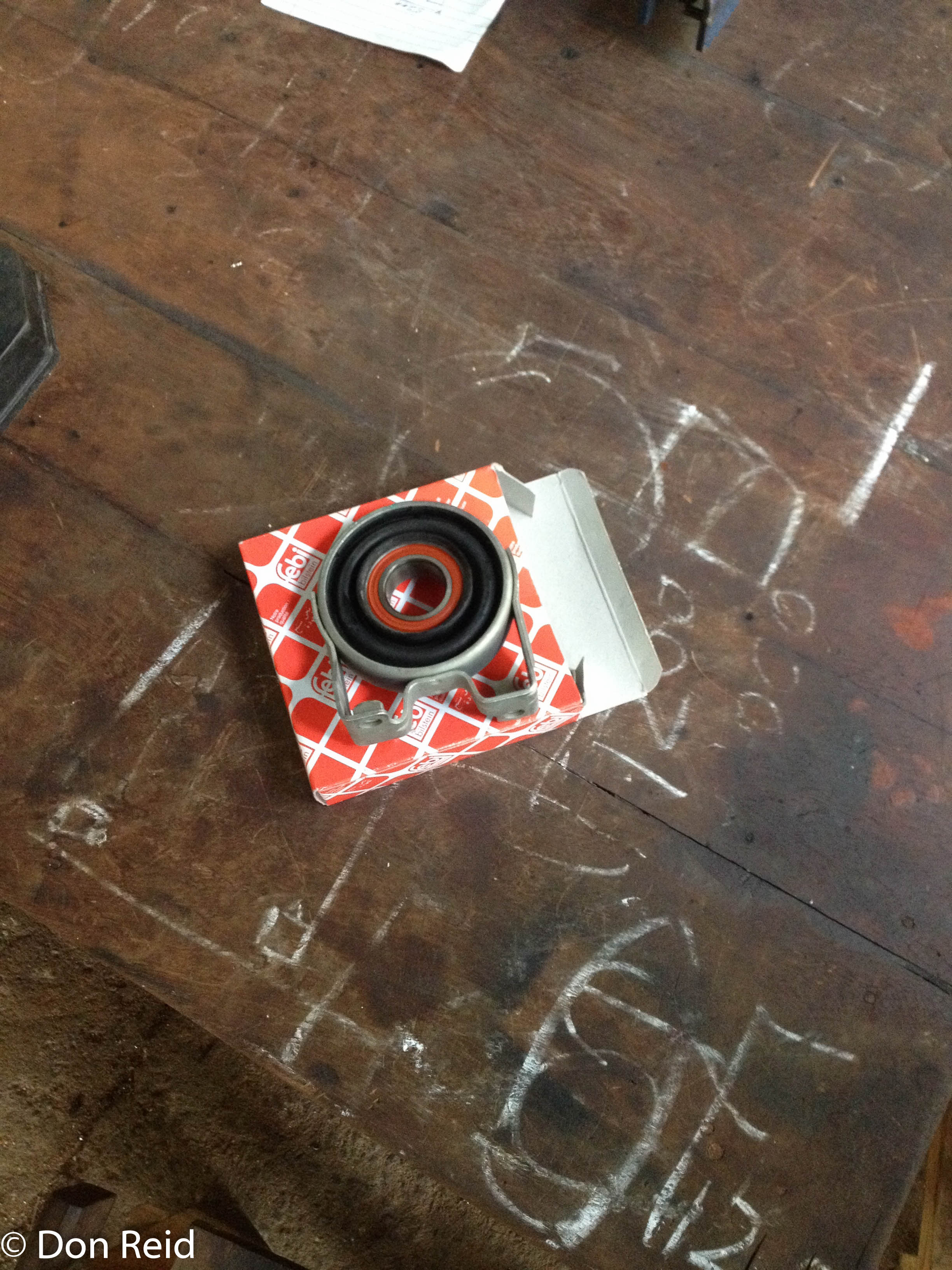
The bearing arrived
We took the Touareg down to the sawmill just after 6 am and left it with Joe who had assured us it would be a quick job. Well it didn’t turn out that way as an “hour or so” job turned into a whole day affair as Joe and his men had to dis-assemble and re-assemble the propshaft bearings to get the centre carrier bearing in place, in the process having to fashion special tools to fit the VW components.
So we postponed our departure until the next day, hoping an early start would get us to Beit Bridge in the day.
We got through the day with much sitting around, reading and contemplating – the only birds that raised any interest were a pair of Crested Guineafowl making their way through the camp and a Bateleur and what looked like a Long-crested Eagle soaring high overhead.
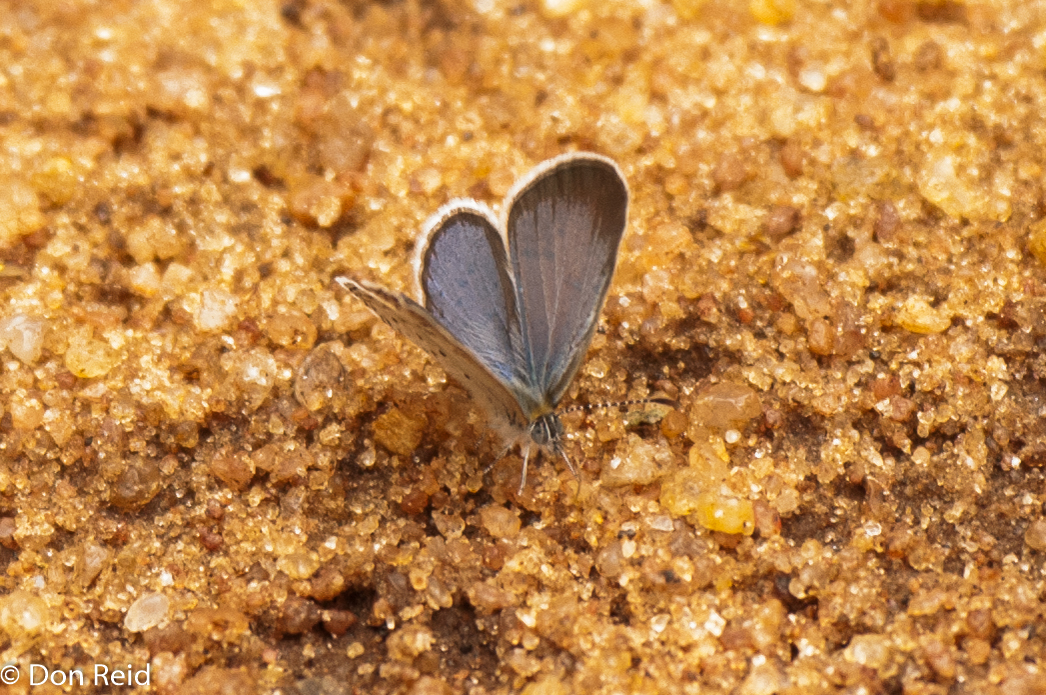
Mphingwe campOur home for an extended stay, Mphingwe campCrested Guineaufowl, Mphingwe campGaika blue (Zizula hylax hylax)False chief / bontvalsrooitjie (Pseudacraea lucretia tarquinia)
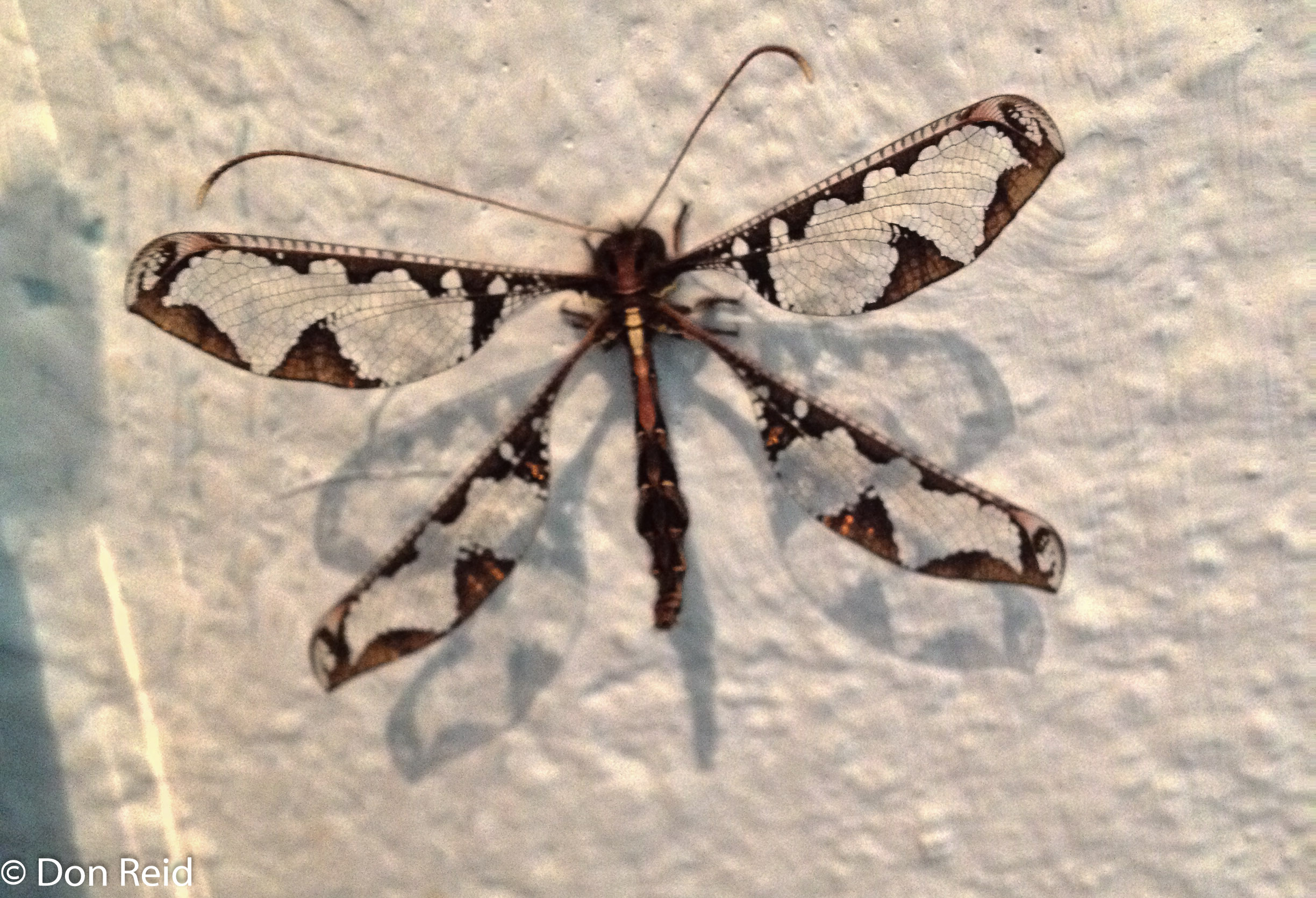
With plenty of time on our hands, there was a chance to appreciate the smaller wildlife and the camp was full of interesting lizards, bugs, ants and others – the shower and toilet block was a magnet for them and I counted over 20 species of insects, moths and dragonflies during one “sitting”. A couple of small black snakes had to be persuaded to leave the toilet including one which was curled up under the hollow seat!
Transparent Dragonfly, Mphingwe campFurry little caterpillar, Mphingwe campMphingwe campMillipede, Mphingwe camp (as long as my middle finger)Ants on a cracker, Mphingwe camp
Day 15 and 16 : The long and winding road home
We set off at our planned time of 5 am in near dark, gradually getting lighter as we progressed slowly along the potholed road to Inchope. The first 260 km took all of 4 and a half hours as I drove gingerly around and through the badly potholed sections.
From Inchope to the Zimbabwe border was a little better, but there was a constant stream of trucks to contend with and some hazardous overtaking manoeuvres were the only way to make some progress. It was a relief to get onto the Zim roads which are generally in a good condition, albeit narrow.
We proceeded through Mutare and Masvingo (Fort Victoria in the “old days”) where we decided to carry on to the Lion and Elephant Motel another 2 hours away, as it was only 4.30 pm. With the light fading, I didn’t see a 60 km/h sign along the way and was stopped by a cop who tried the by now familiar scare tactics – according to him we would have to appear in court the next morning and he was clearly looking for some “persuasion” to help us avoid this fate. I stood my ground refusing to play along and eventually he wrote a R200 fine which I paid and we proceeded on our way. I was only too glad to get away from that spot, having smelt alcohol on his breath.
The motel was a welcome sight some time later, after 14 hours of driving the 950 kms from Mphingwe.
Next morning we were up early and at the Beit Bridge border post where yet another pair of cops looked for some reward for letting us through, after a veiled threat of having to search the vehicle for drugs – “but the guy who does the search will only be here at 10 am” implying a 4 hour wait for us.
Once again we refused to play along but “rewarded” them with a couple of our remaining snack bars which they took in disgust and waved us on.
The rest of the trip home was uneventful other than another speeding ticket – think I was just too tired to spot the signs by then – and we got back to Pretoria around 1 pm, thankful that Joe had done a good job on the Touareg, which had made it without further problems.
The end of the tripThe end of the trip
Impressions of Mozambique
The Birding
With our trip cut short by car trouble we spent about 10 days birding in a diverse range of habitats and places including
Wetlands and floodplains
Forests
Tidal flats and estuaries
Beaches
Woodland
Roadside spots
Bridges
Birds were plentiful and the Moz specials were there, although it proved quite difficult to get a good view at times. I was very pleased with the 30 lifers that I chalked up and with the general quality of birding overall.
The Roads
On a long trip like this the quality of the roads becomes important and this is where Moz is a less attractive birding destination, unless you are prepared to risk damage to your vehicle, don’t mind dodging potholes for long stretches and can remain relaxed despite some atrocious road conditions. We drove many different roads and experienced every imaginable road condition :
Good tar roads limited to the south of Moz
Severely potholed tar roads further north with the Inchope – Caia road being the worst
Sand roads varying from reasonable to poor, but still preferable to potholed tar
Rutted, rock hard gravel roads – such as the one that caused 2 of the vehicles damage
Rain in places added to the stress of driving
Villages and towns we passed through often have hawkers both sides of the road and buses, trucks and cars parked anywhere and everywhere so require particular caution
The People
The vast majority of people are obviously poor but friendly and we saw some back-breaking tasks being performed for probably very little compensation. I did not pick up any feeling of aggression from the “have-nots” in the way we often experience it in SA.
Bicycles are an important form of transport and we were amazed to see the loads that get transported – 3 or 4 heavy bags of charcoal and in one case cement get transported long distances in this way.
Strings of people along the roads near towns are a common sight as taxis are few and money tight.
The Food
Chicken is a popular item on menus and often the safe choice. Surprisingly fish was scarce, even at the coast. Our best meals were at Mphingwe where we had superb sirloin steaks and all meals were tasty. The local beers were good – Manica and 2M (Dosh M). Our other meals were self-prepared and simple – rusks early morning with coffee, snack bars in between and tuna, pork in tins, sardines, cheese etc on cracker bread and the like for lunch. Being able to boil water for coffee/tea wherever we stopped long enough was a real boon.
The Weather
We expected hot and humid and we got exactly that – winter may be a better option as being in a constant bath of sweat is not enjoyable and can detract from the pleasure of the surroundings and bird life.
Occasional rain brought some respite from the oppressive heat, but not for long.
The Accommodation
The tour is not about luxury accommodation – what you get is fairly basic but comfortable in rustic surrounds – a clean bed, simple bathroom (communal at Mphingwe) aircon (except Mphingwe) and the important mosquito nets
The Guide
There is no question that having a guide with the expertise in birding and the knowledge and experience of Mozambique is invaluable and trying to do this trip without Etienne would have resulted in dipping on many of the special birds.
Personally, I would have liked to have spent more time photographing some of the birds, but this would only be possible if a specific photography trip was arranged, as it requires a very different approach – ie spending a lot more time in certain locations rather than trying to cover as much ground as possible.























































































 Mostly Birding