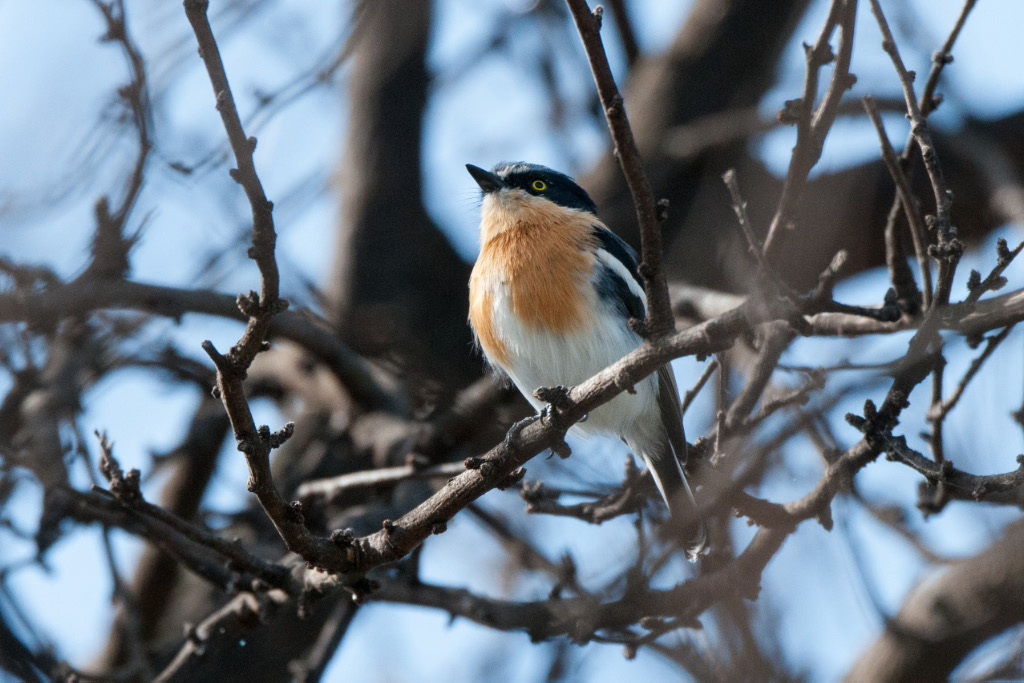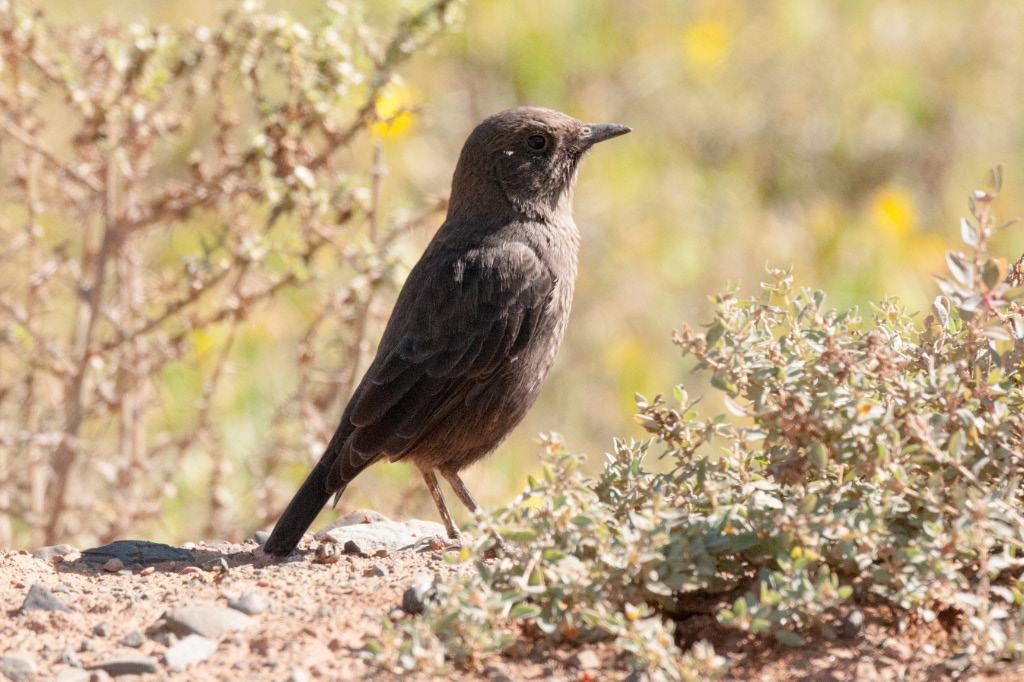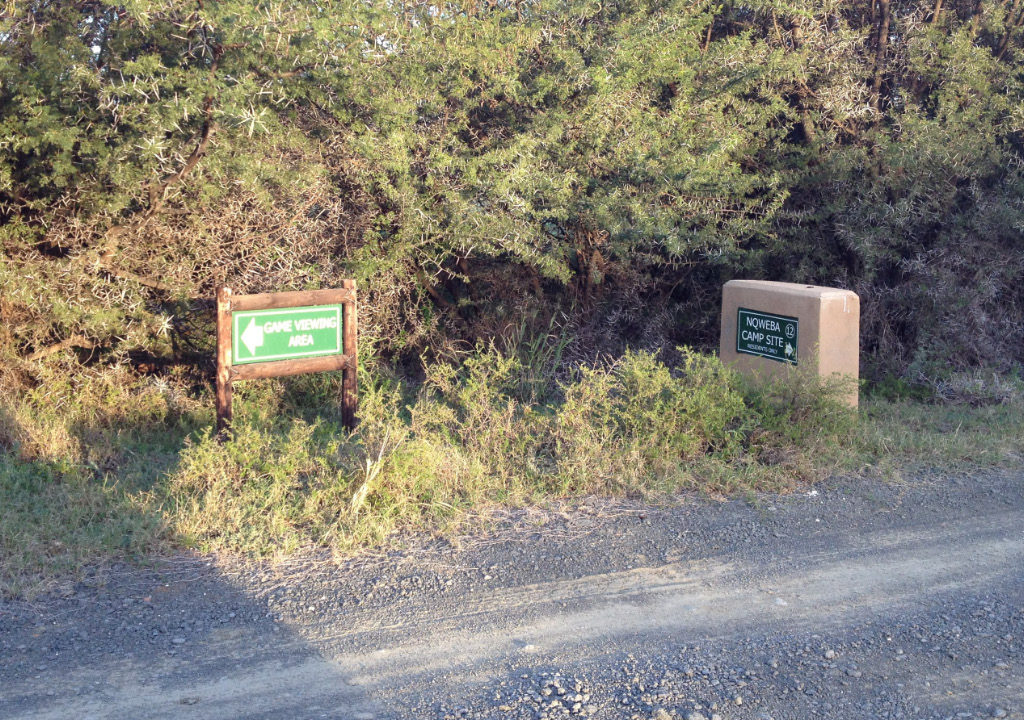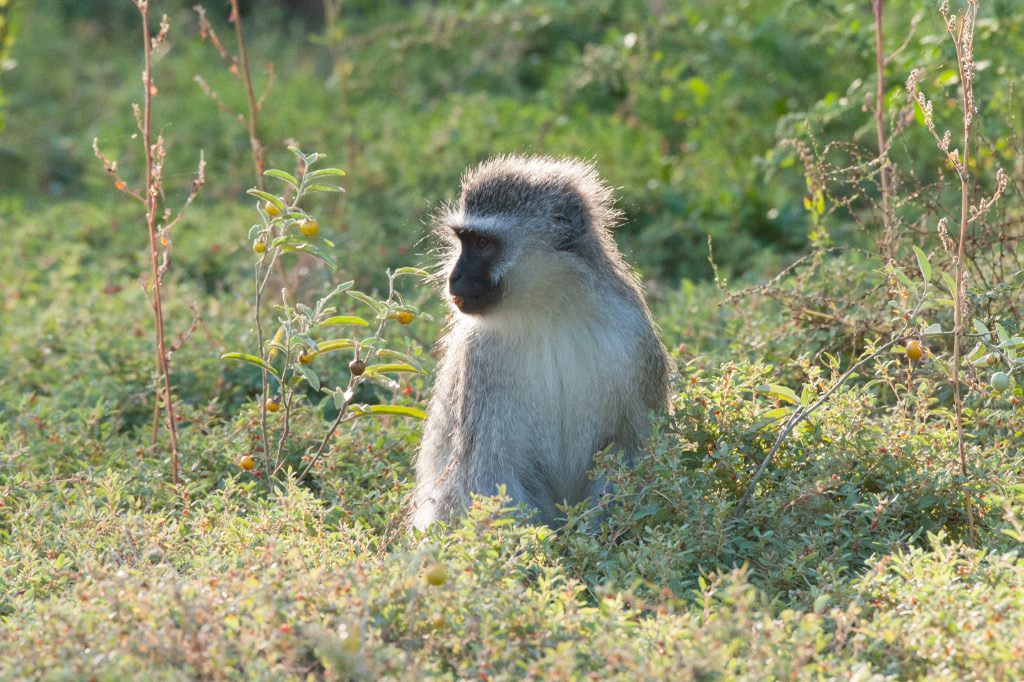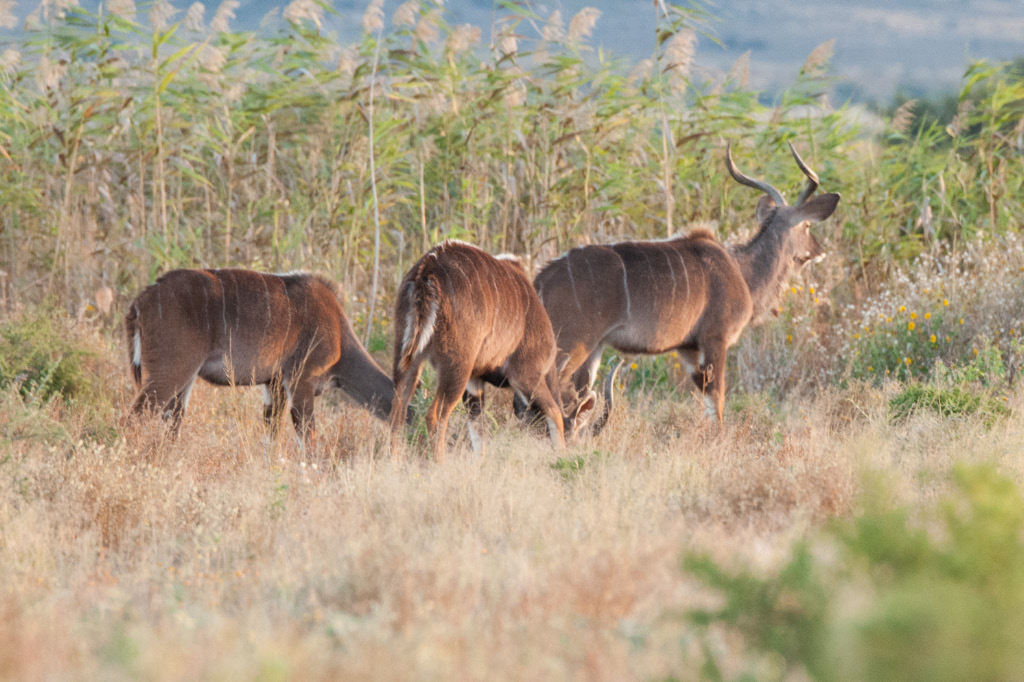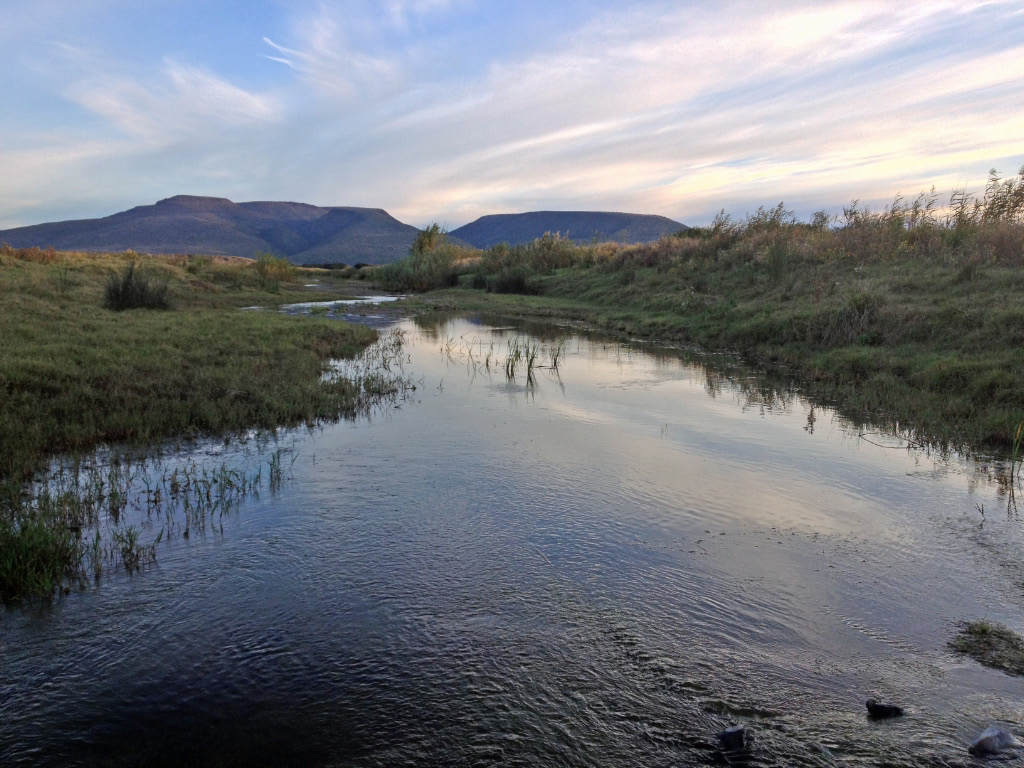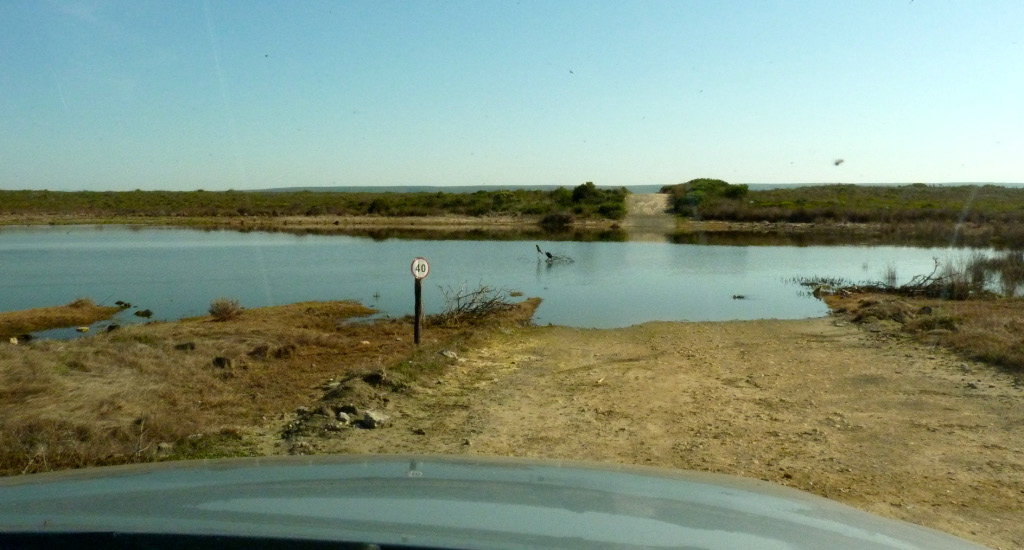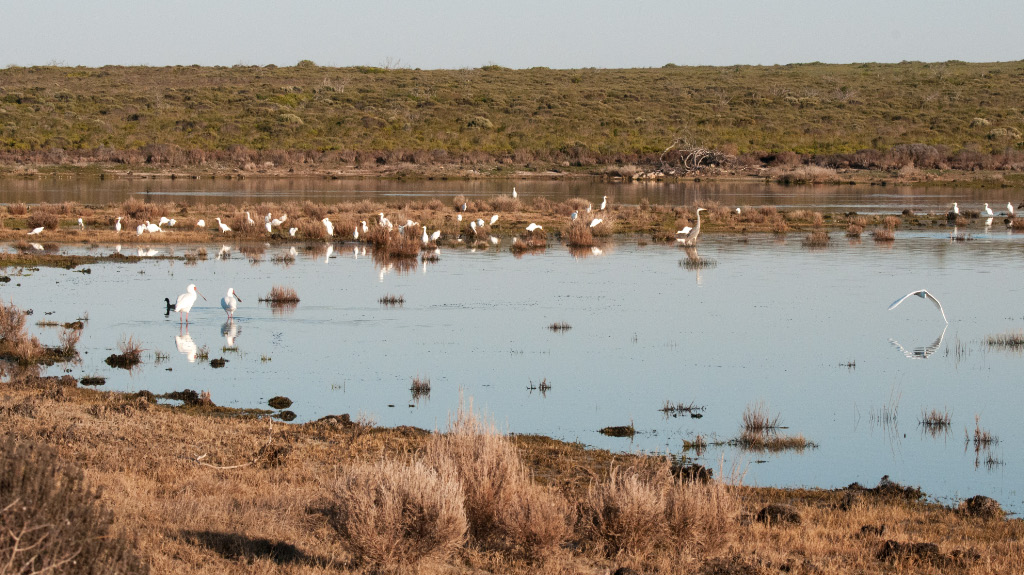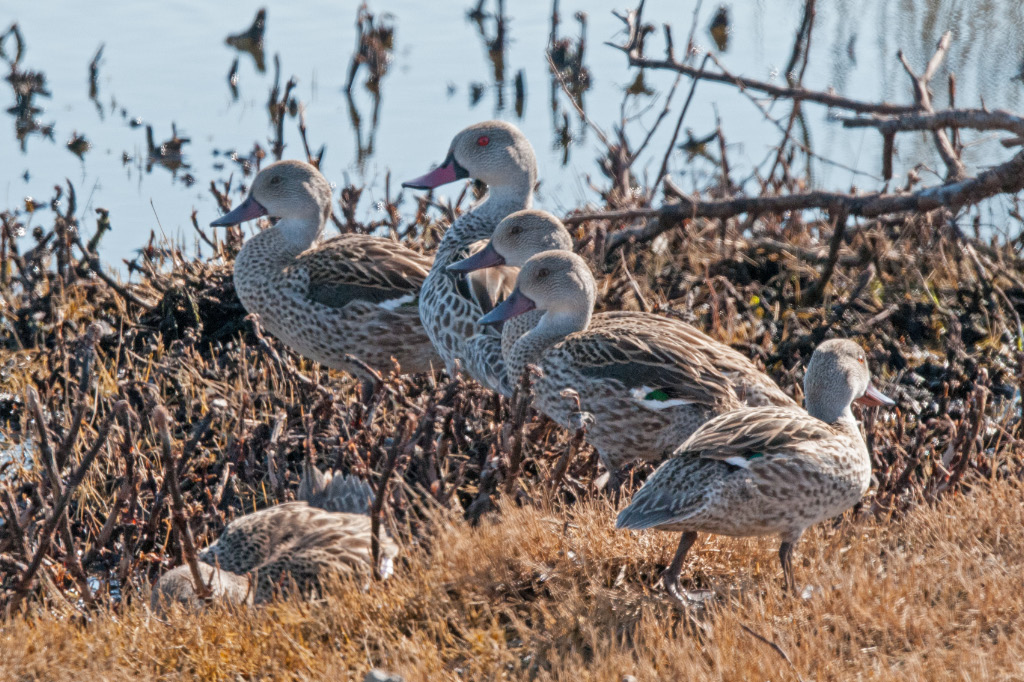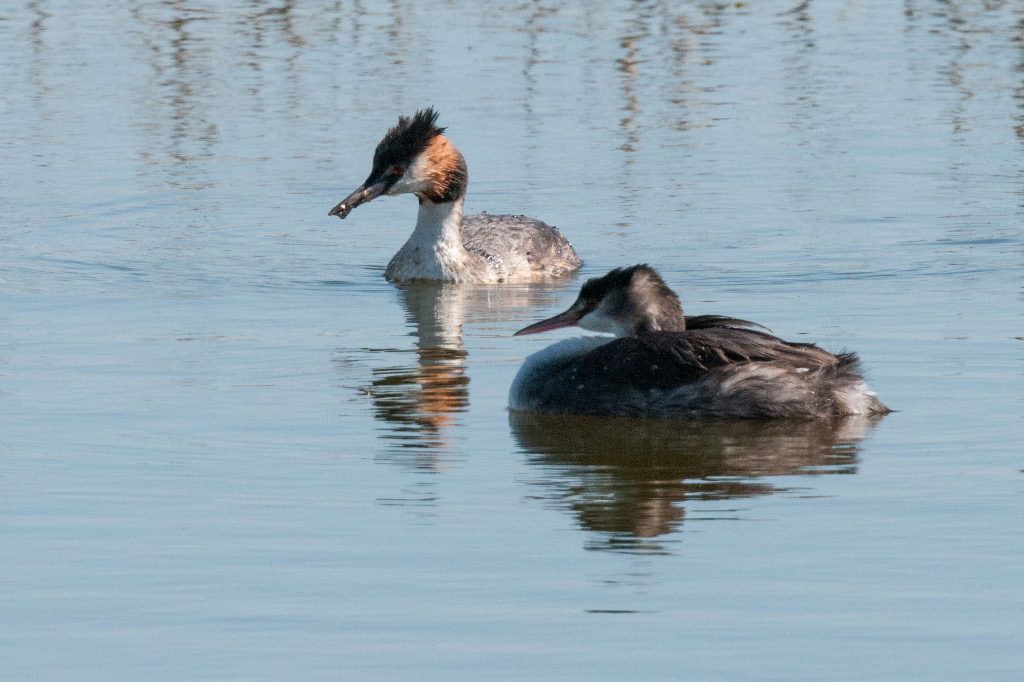
Four Parks and a wedding (Part 4) – Addo Elephant Park

The Story so far….

Having spent a few nights at Camdeboo and Mountain Zebra National Parks on this current trip, following our earlier visit to De Hoop Nature Reserve, we were  looking forward to a further 3 nights at Addo National Park to complete the quartet of parks. So far we had found each one most enjoyable in its own way, with Mountain Zebra National Park top of our list for having provided the most “African” experience of the three.

The road to Addo – Thursday 1 May 2014

Leaving Mountain Zebra National Park behind us after checking out around 11 am, we headed for nearby Cradock to stock up at the local Spar, followed by a coffee at True Living cafe accompanied by the best carrot cake we’ve had in a long time (they bake on the premises so it’s as fresh as it can get)

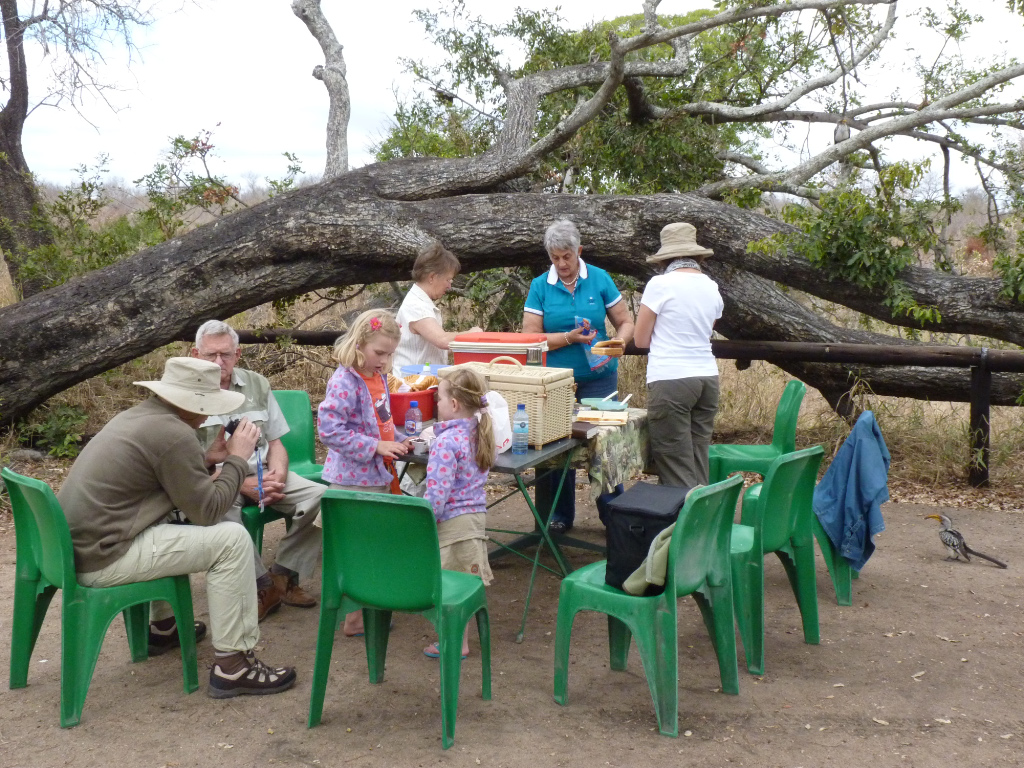
From there we headed down the N 10 with a diversion to Somerset East to check out the local museum, which we discovered was closed on the public holiday, but it was interesting just to drive through this small historical Eastern Cape town that we would not otherwise have seen. By now it was lunchtime, so we found a roadside spot with large blue gums to provide some shade and ate our “padkos” rolls.

Roadside lunch stop
Roadside lunch stop

The next stop was a short one to view the Slagtersnek monument, just off the road beyond the small town called Cookhouse. The monument commemorates the spot where a number of Dutch rebels surrendered after being confronted by British forces on 18 November 1815, however we were disappointed to find the surrounds unkempt and apparently not cared for in a long time.

Slagtersnek monument

The road continued in winding fashion with lengthy road works making our progress slow, resulting in us only reaching Addo around 5 pm, but the scenery along the way was rewarding, reminding us of the lowveld in places with lush growth and fruit farms

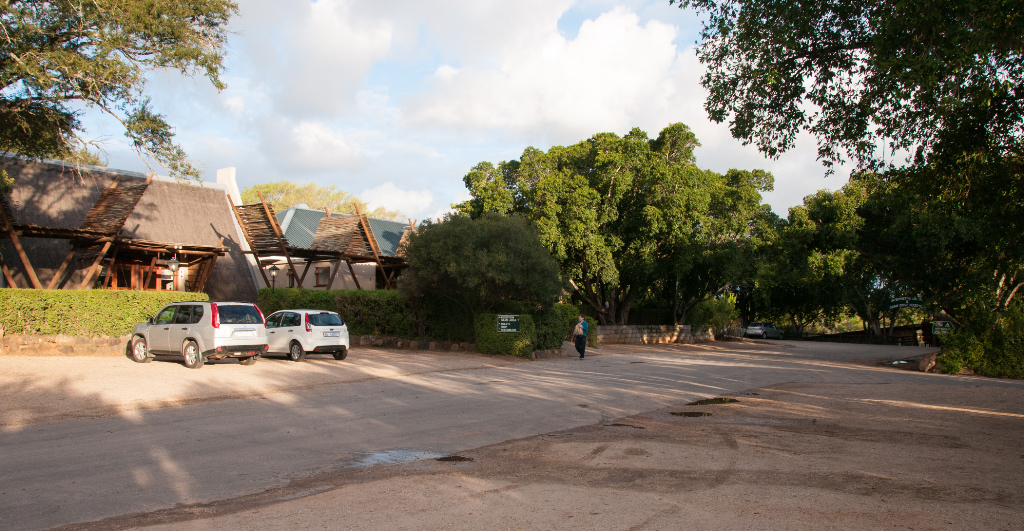
Addo Reception
Addo Reception

Back in Addo

Our first visit to Addo was just over a year previously when Gerda and I had enjoyed a few days in the park after visiting PE, so we were familiar with the layout. Some of the photos and descriptions I have used in this post are from that visit.

IMG_1242

We had booked a few months before but by then it was already close to full so we had to accept one night in a chalet followed by 2 nights in the Forest Cabins – not ideal but it meant we could try out the different accommodation units.

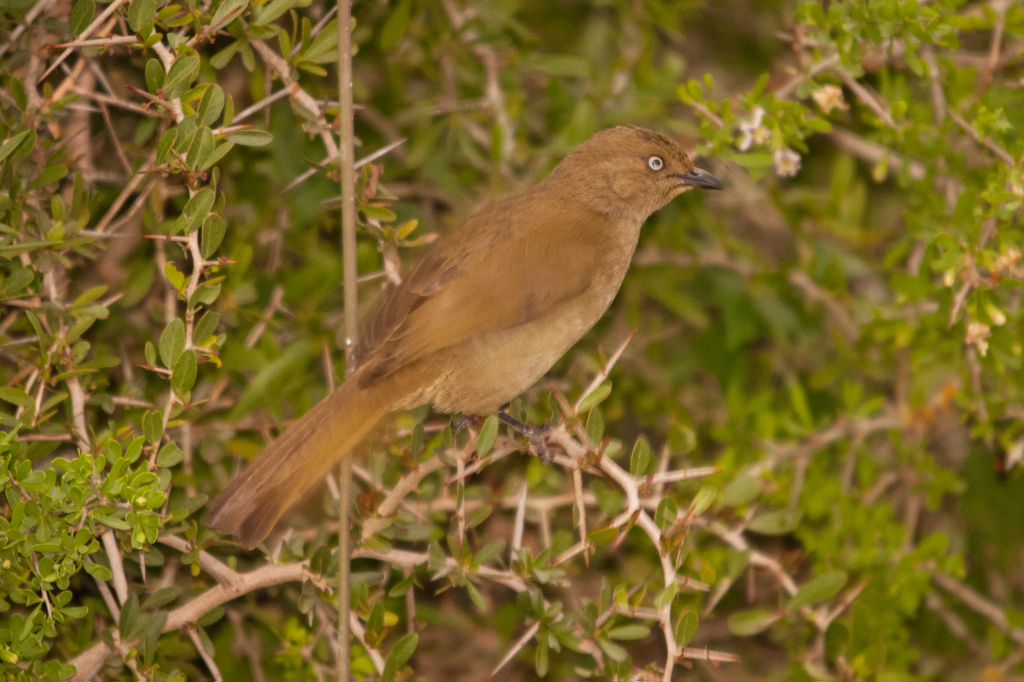
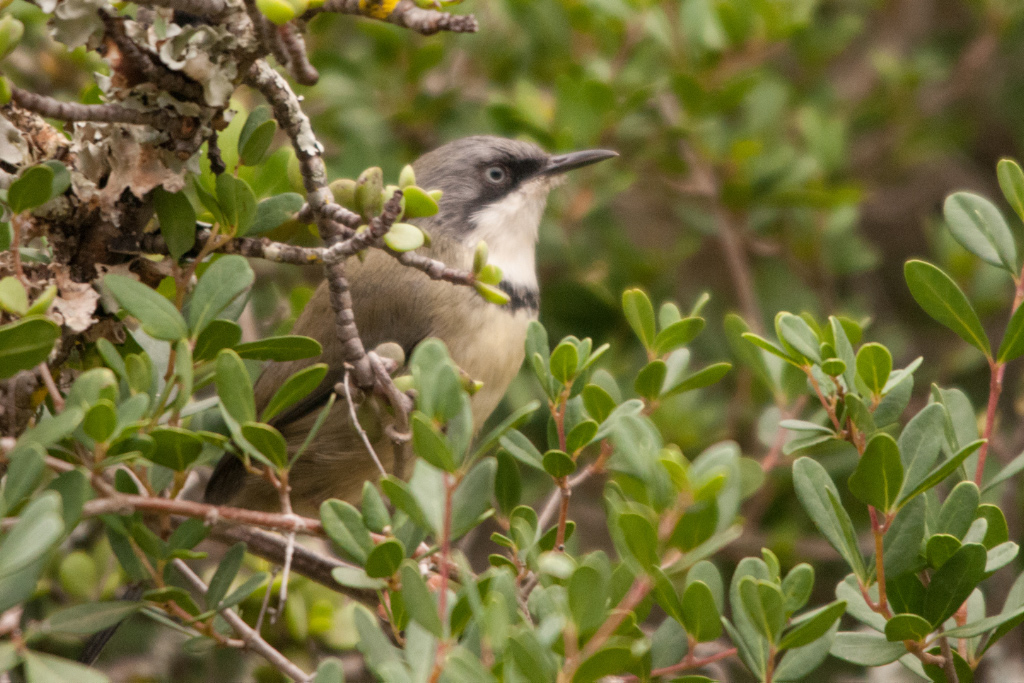
Settling into our chalet, some familiar calls resounded in the fading light – Sombre Greenbul with its piercing whistle, the loud “chip – ing” of Bar- throated Apalis and a pair of Bokmakieries performing a duet. A little later as it darkened a Fiery – necked Nightjar started its “Lord please deliver us” call – so evocative wherever you hear it but especially so in the bush.

Sombre Greenbul, Addo NP
Bokmakierie, Addo NP
Bar-throated Apalis, Addo NP

Exploring Addo and beyond

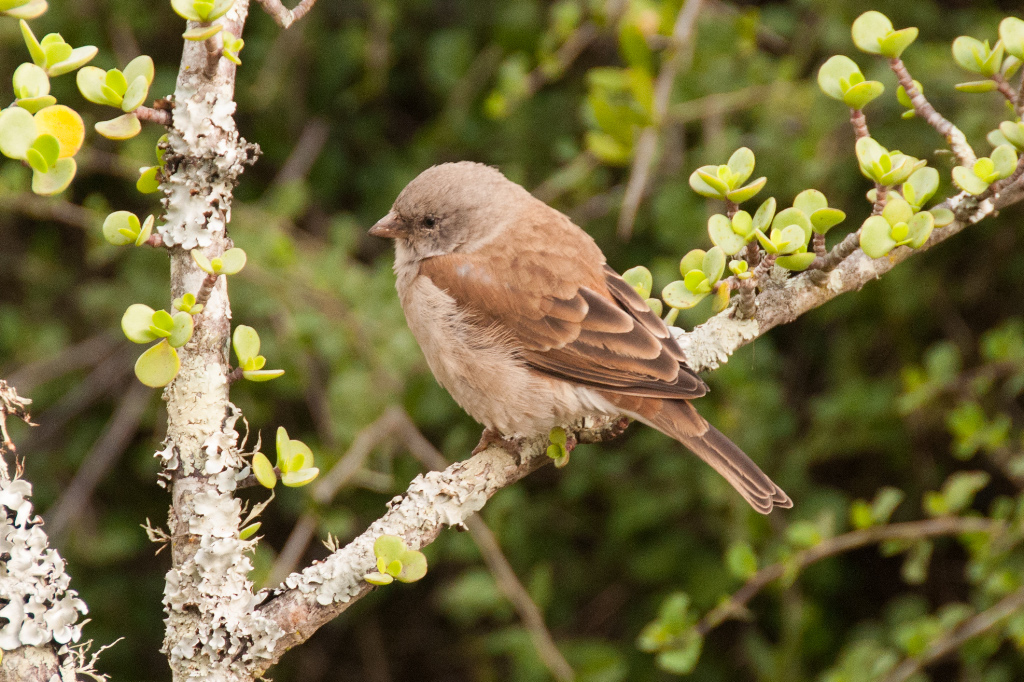
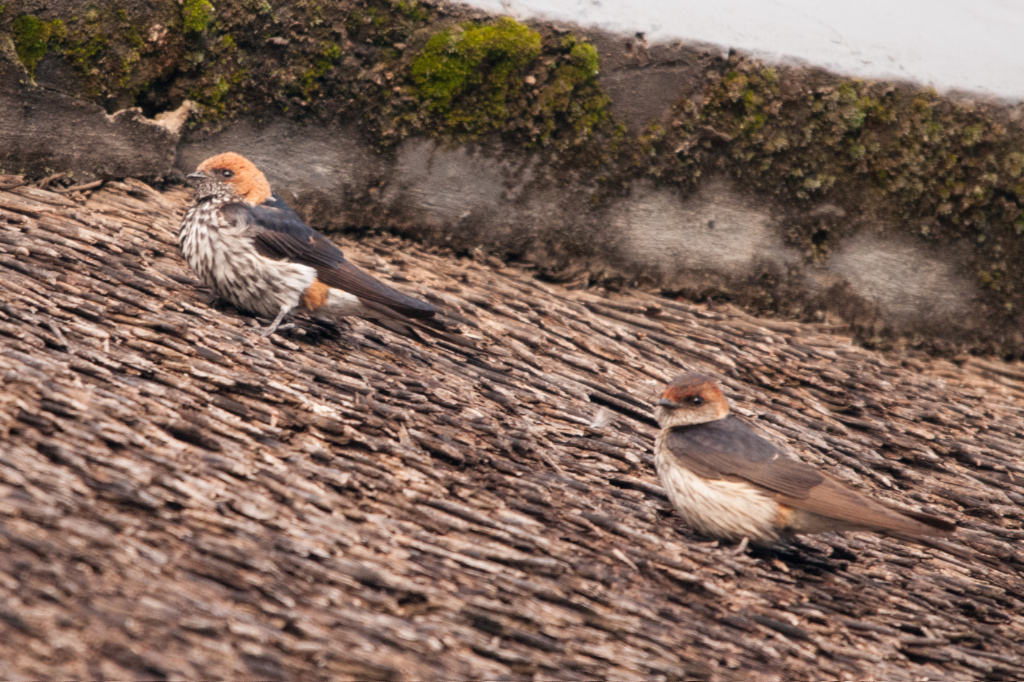
While having our customary early morning coffee on the patio, a pair of Cardinal Woodpeckers made a noisy appearance in a nearby tree, followed by Grey-headed Sparrow and a Fiscal Flycatcher, the latter looking debonair in its crisp black and white plumage – about to ask for a ‘Martini – shaken not stirred’. Soon after, a Lesser-striped Swallow settled on the roof, making it easy to ID as opposed to when they are in the air, when it is more of a challenge to separate them from the Greater-striped Swallows.

Grey-headed Sparrow, Addo NP
Striped Swallows, Addo NP

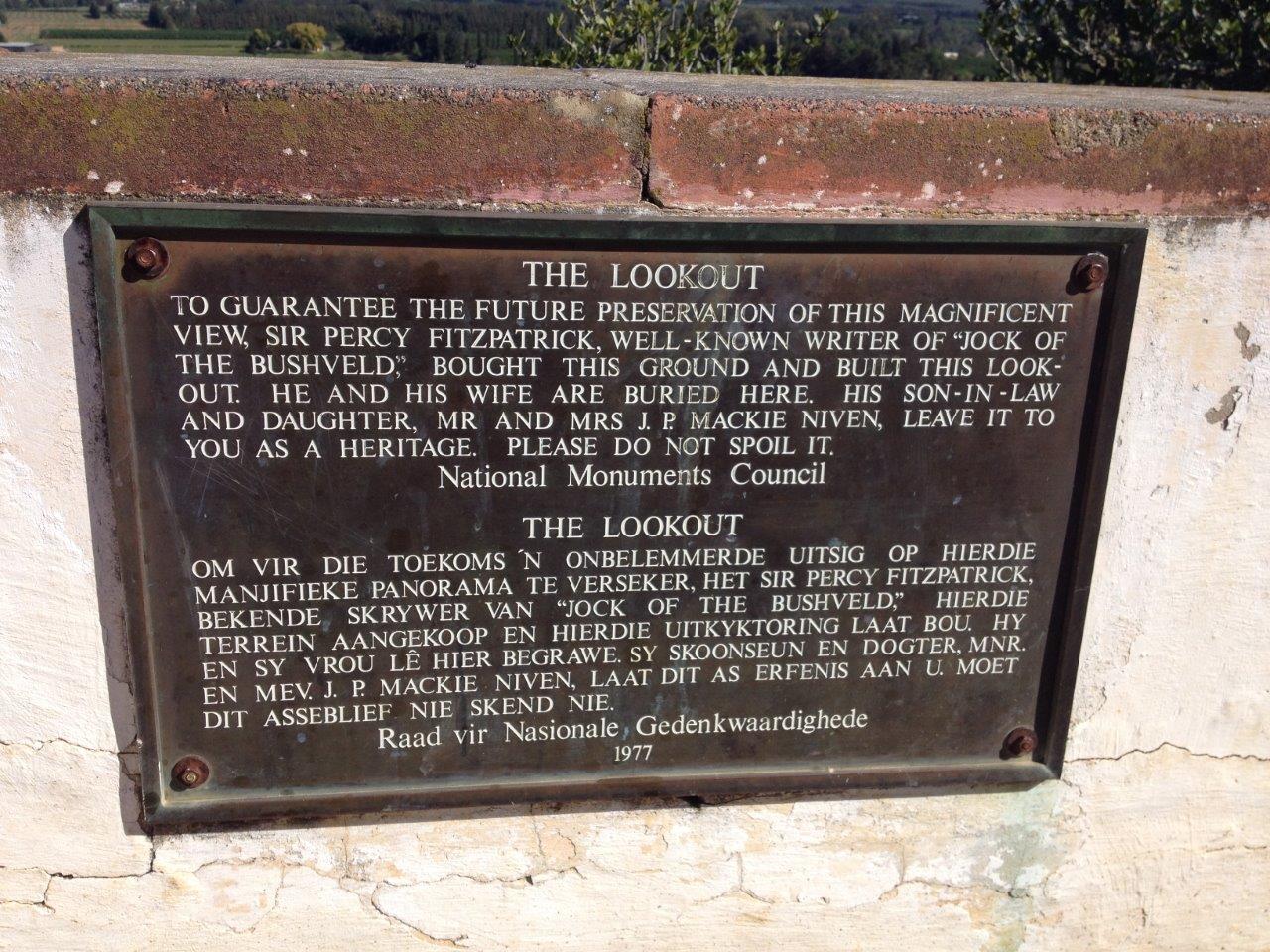
Having a 3 hour gap before we could move into our Forest cabin, we decided to go in search of the grave of Percy Fitzpatrick, author of the classic story of Jock of the Bushveld, which we had heard was not far from Addo Elephant Park, off the road to Kirkwood. Passing through the village of Addo we spotted a building with the name ‘Percy Fitzpatrick Library’ and immediately stopped to find out more – good thing because the very helpful librarian was more than willing to chat about the library, the area and showed us a portfolio of historical photos in a large album kept by the library. She also pointed us in the right direction to the grave site and ‘Lookout’.

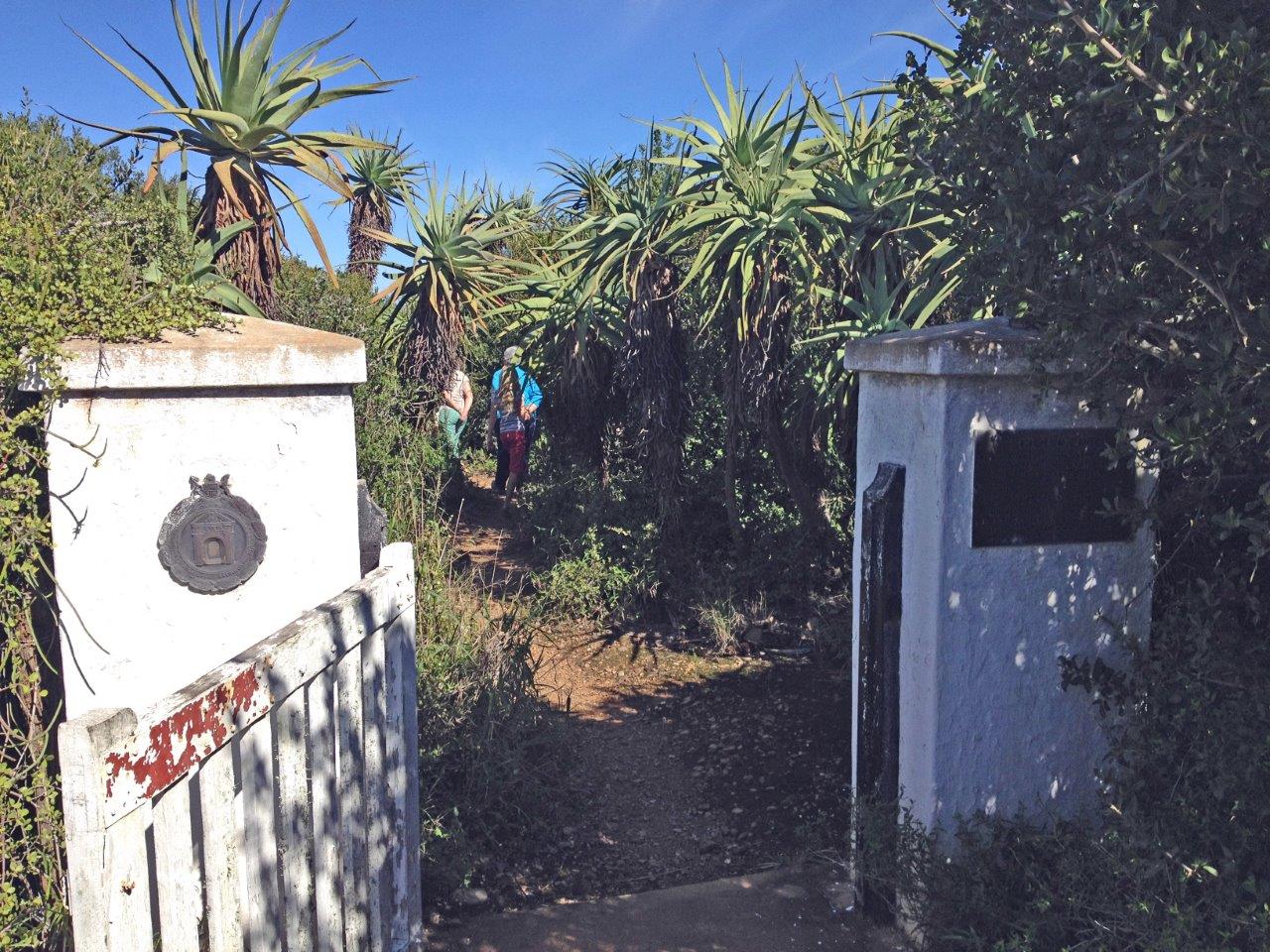
It didn’t take long to find both at the end of a dirt road with heavy encroaching bush both sides (bit nerve-wracking for those who don’t like getting the car scratched) and it was clear that not much is done to look after the site, which was completely overgrown and in a sorry state – another neglected opportunity to create something which I’m sure many tourists would enjoy visiting.


Entrance to site where Percy Fitzpatrick and his wife are buried - the garden has run wild
Entrance to site where Percy Fitzpatrick and his wife are buried – the garden has run wild
The grave of Percy Fitzpatrick

The ‘Lookout’, built to honour their son, turned out to be a stone structure with a short stair to take you to a lookout deck, with wonderful views across the countryside and the Sundays River below, but this too was in need of some TLC.

IMG_1229


View over the countryside from 'The Lookout'
View over the countryside from ‘The Lookout’
View from The Lookout


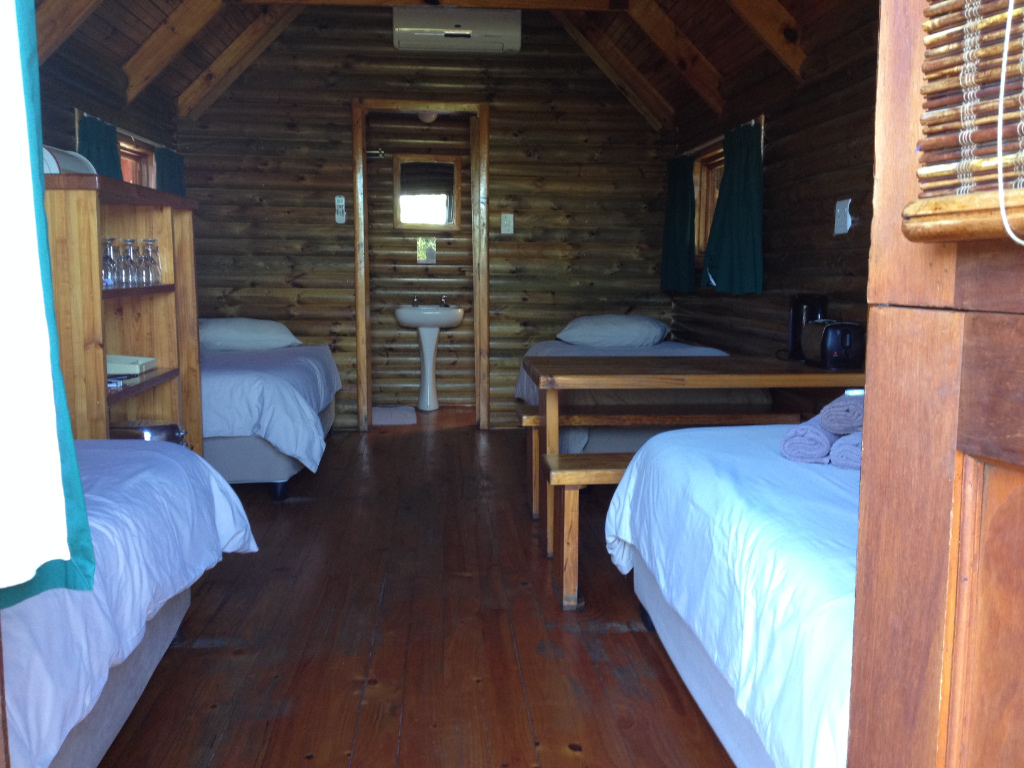
By the time we got back to the rest camp, it was past 1pm so we could move into our Forest Cabins, which turned out to be comfortable and cosy with a small bathroom, a private deck and use of a communal kitchen.

Forest Cabin, Addo NP
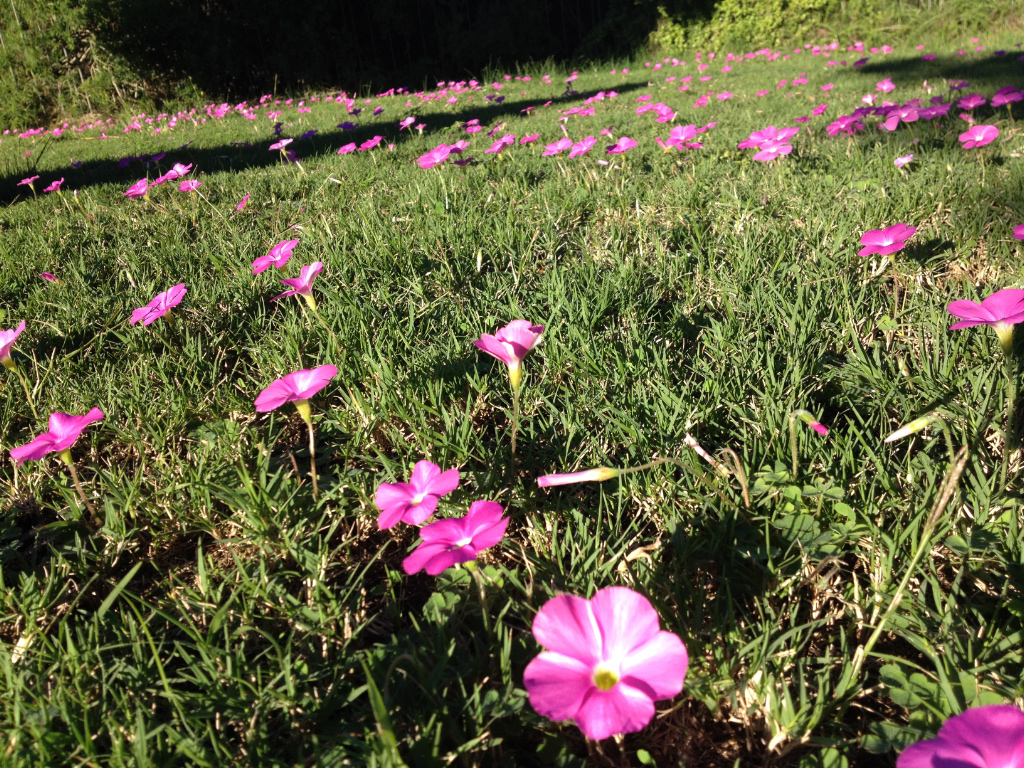
Poolside flowers, Addo NP

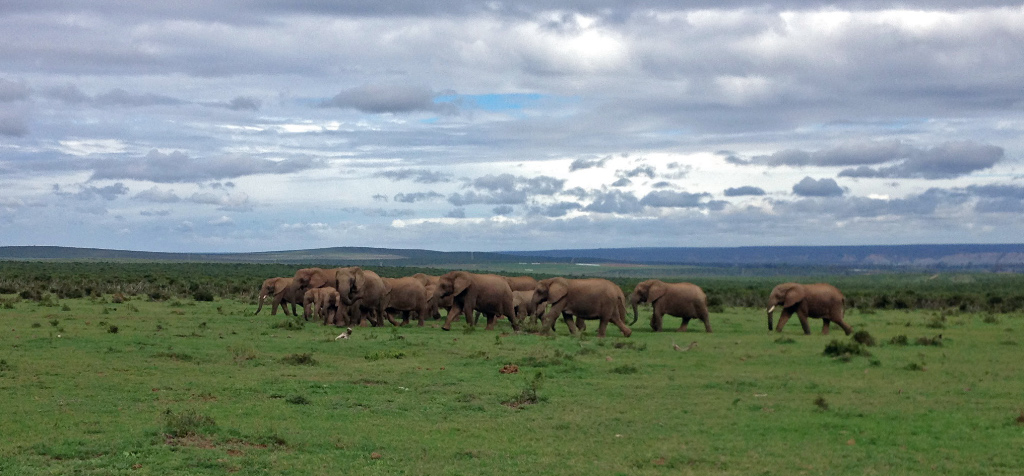
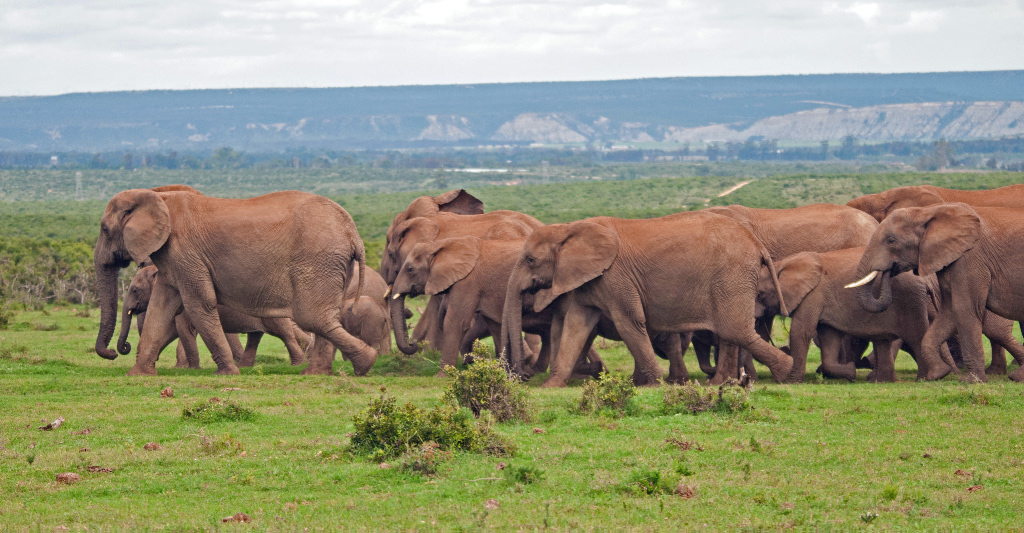
There was time for a swim at the pool, cold but invigorating, before setting off on a late afternoon drive. The thick bush on the route we followed wasn’t conducive to spotting any of the pachyderms that Addo is named and famed for, but at a viewpoint high up on a hill we looked down on a classic scene of more than a hundred Elephant in the distance.

Elephant, Addo NP
Elephant, Addo NP

Elephant, Addo NP

African Elephant, Addo NP

Along the way the bush was good for several common species such as Cape Weaver, Common Fiscal in numbers, Bokmakierie and Karoo Scrub-Robin. A Denham’s Bustard in the more open area was a nice surprise.

Karoo Scrub-Robin, Addo NP
Denham's Bustard, Addo NP
Denham’s Bustard, Addo NP

I spent the next day mostly at Cape Recife in Port Elizabeth, looking for a Bridled Tern that had been seen there during the week, unfortunately without success.

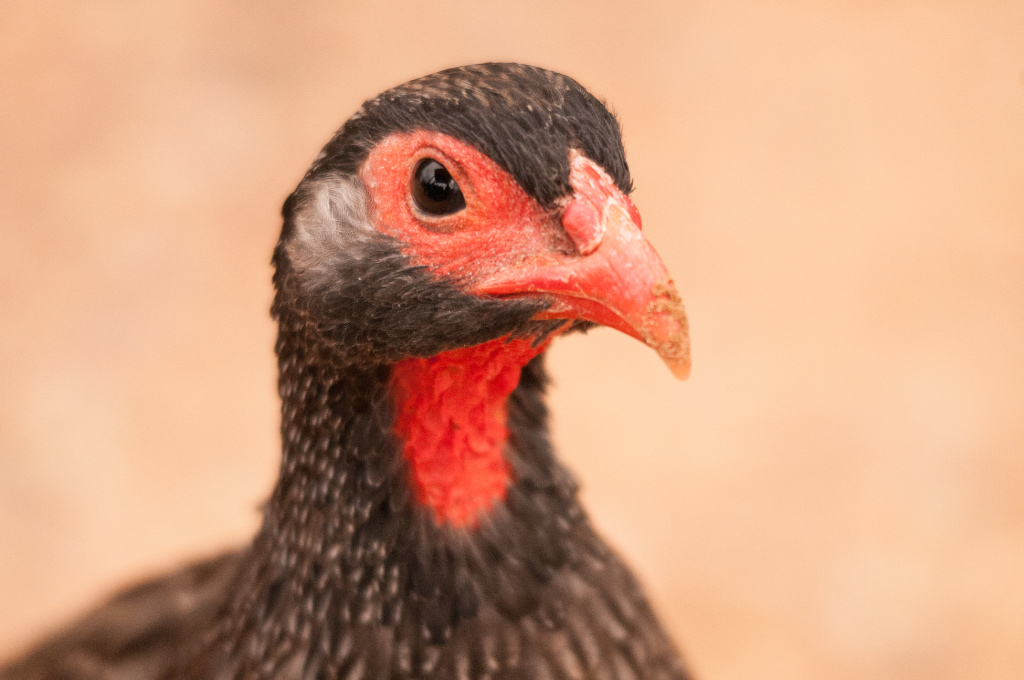
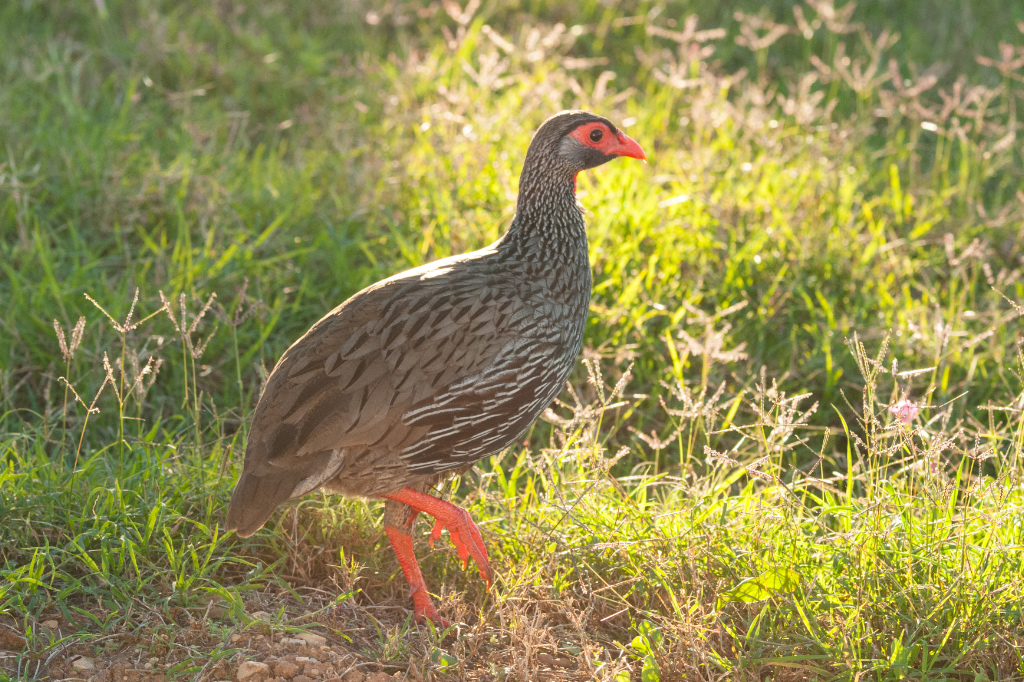
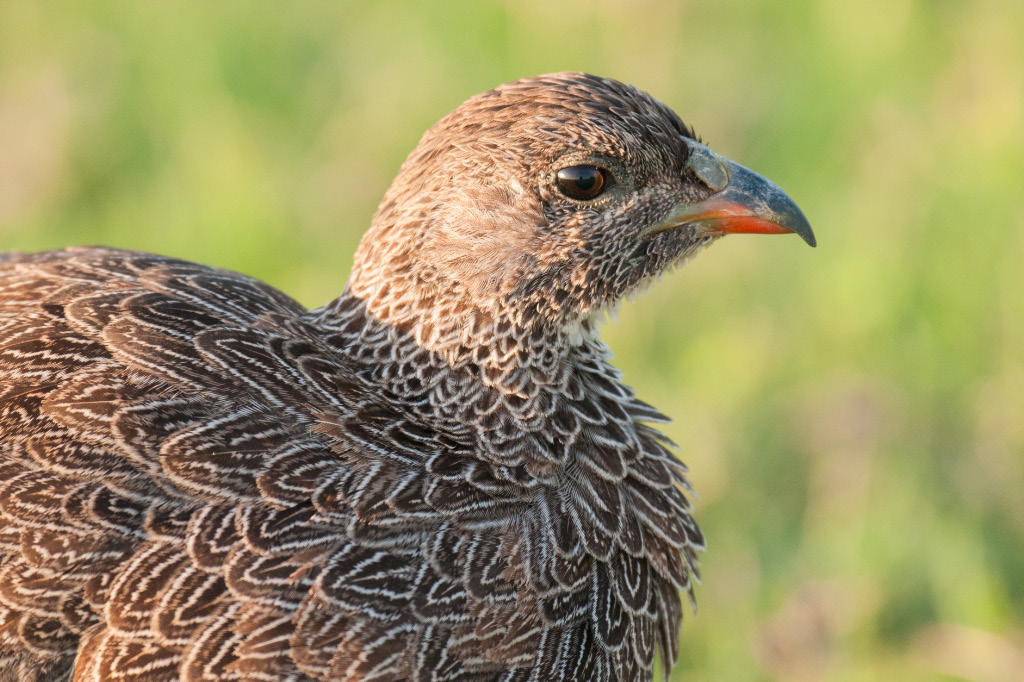
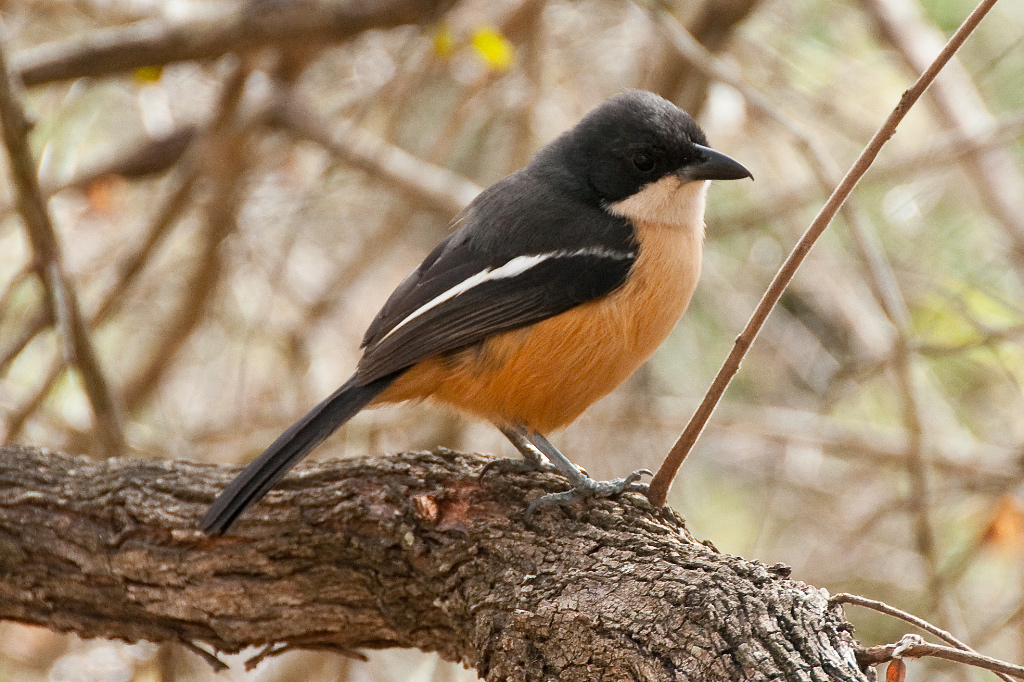
Back at Addo there was time to relax before doing a last drive along the route where most of the dams and waterholes are and we came across numbers of game as well as a few new ‘trip birds’ such as Southern Tchagra, as always skulking in the bushes, and a far more brazen pair of Red-necked Spurfowl, common to Addo.

Southern Tchagra, Addo NP
Red-necked Spurfowl, Addo NP

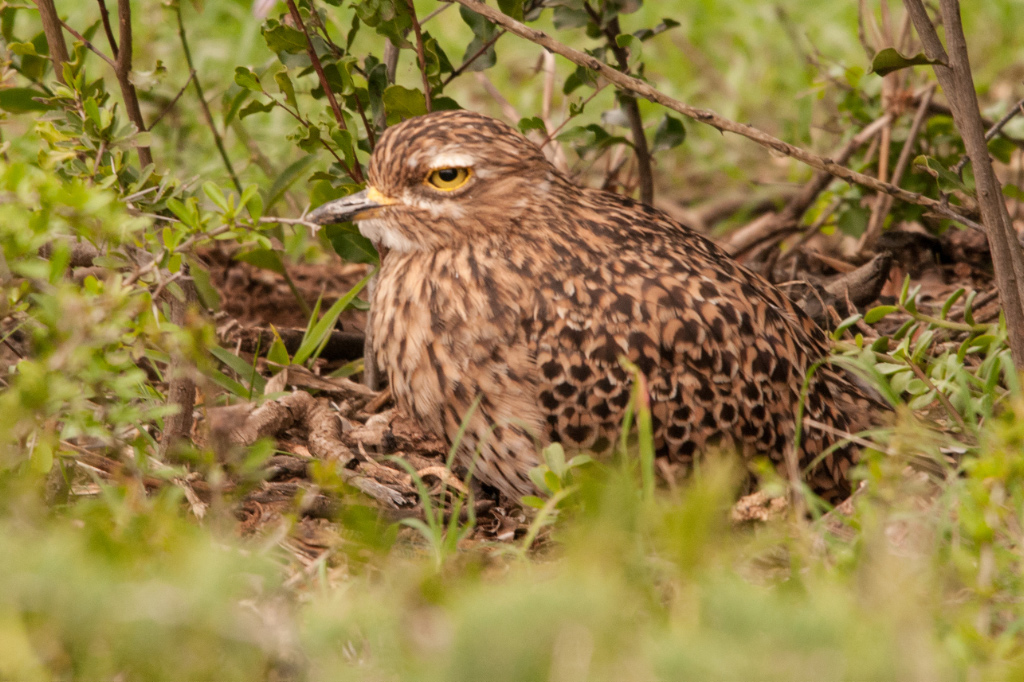
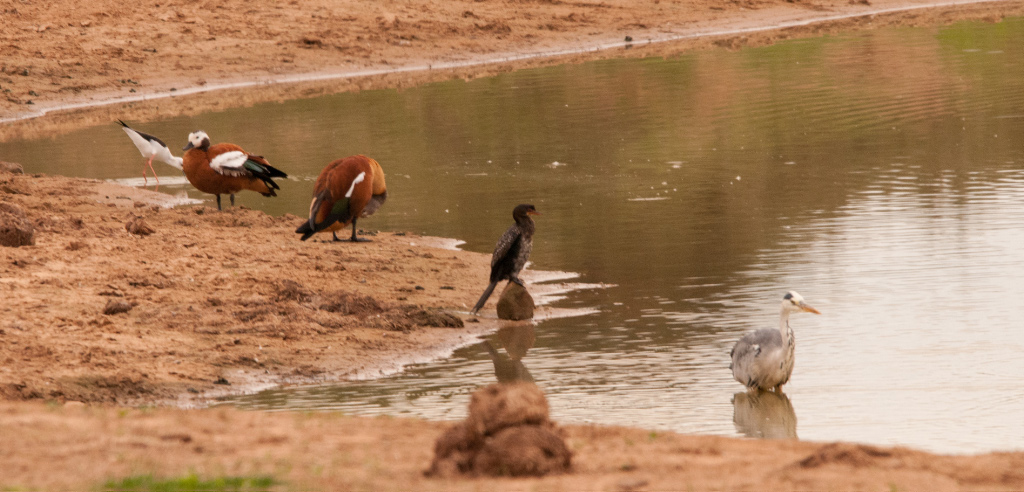
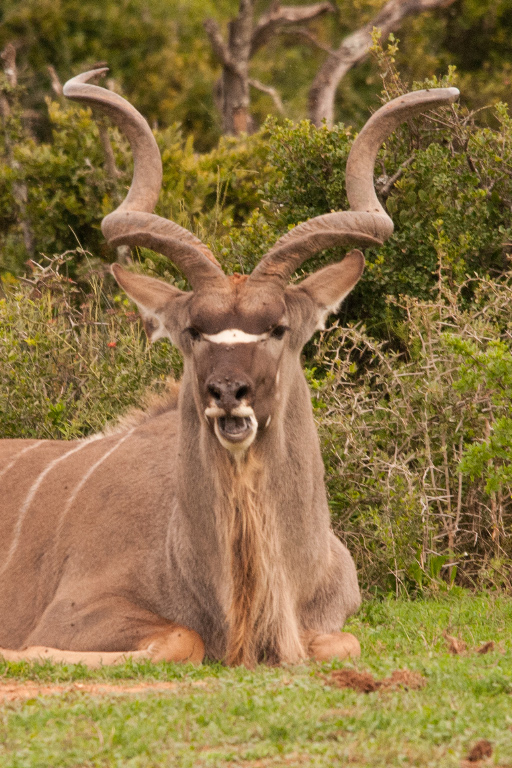
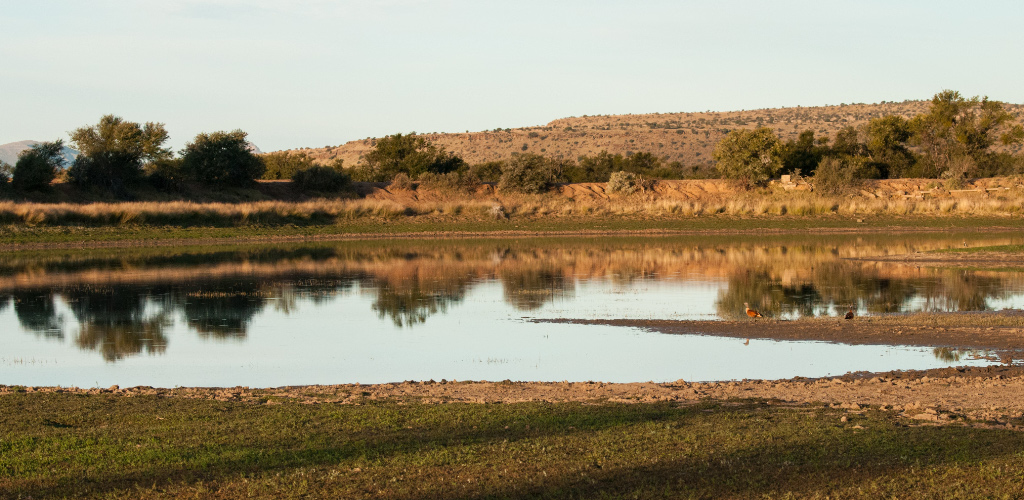
At the dams, SA Shelducks showed once again as did Little Grebe and some Thick-Knees (Dikkop is still a much better name). Hapoor dam, named after a famous elephant with a chunk of its ear missing, was a welcome sight with its wide open spaces surrounding the dam, ideal for game including Kudu and favoured by some Crowned Lapwings.

Spotted Thick-Knee (Dikkop), Addo NP
4 in a row, Addo NP
4 in a row, Addo NP
Kudu, Addo NP
Kudu, Addo NP
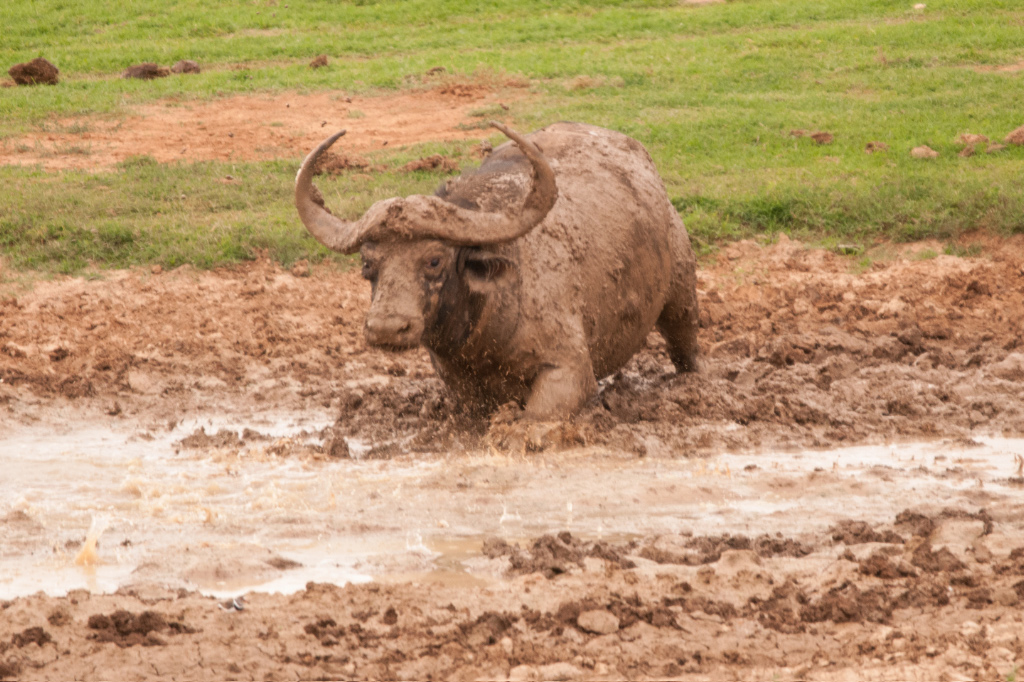
Buffalo getting the spa treatment (on our previous trip)

We hadn’t allowed ourselves much time so had to make haste (barely sticking to the 40km/h speed limit) back to the game area gate before it closed at 6 pm. The lone guard at the gate gave us a stern look but we had seen the same look each time we entered the game area so weren’t too fazed.

Jack’s Picnic Spot

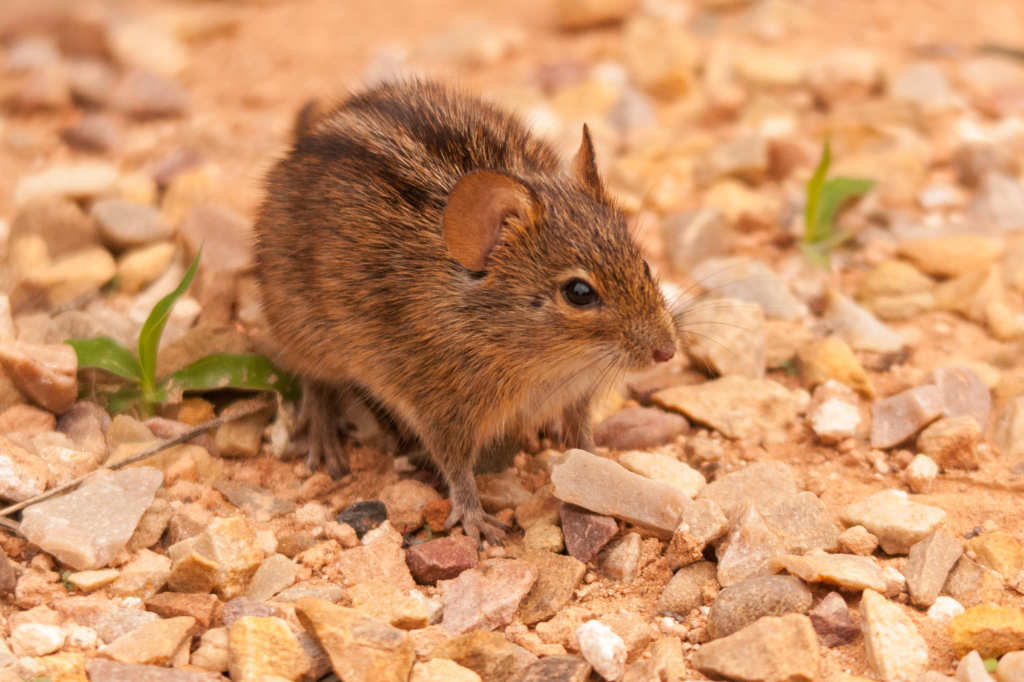
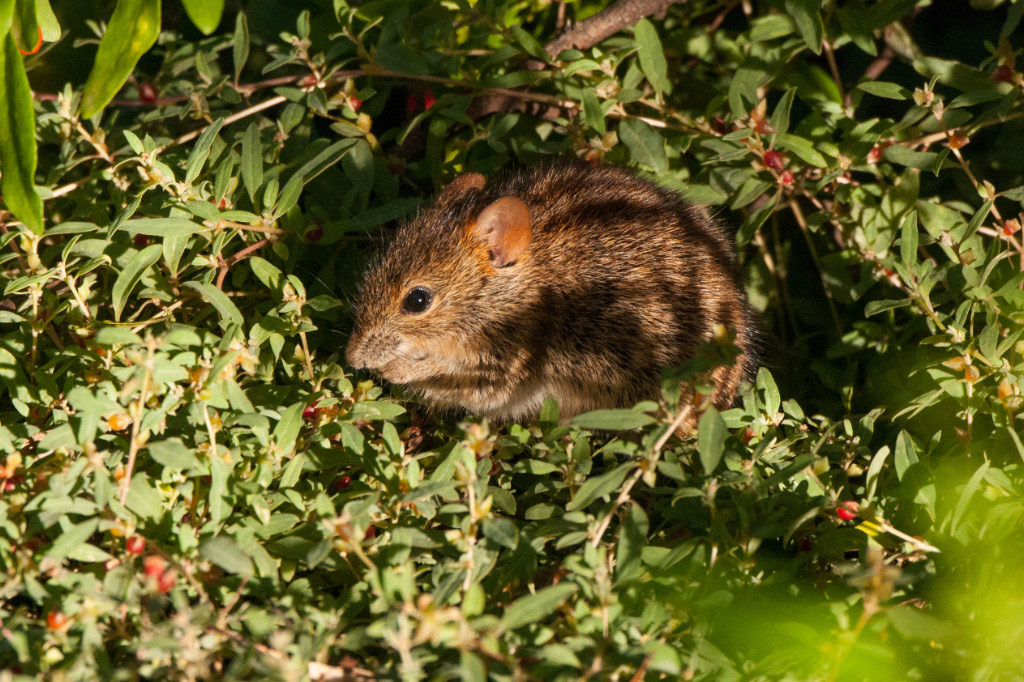
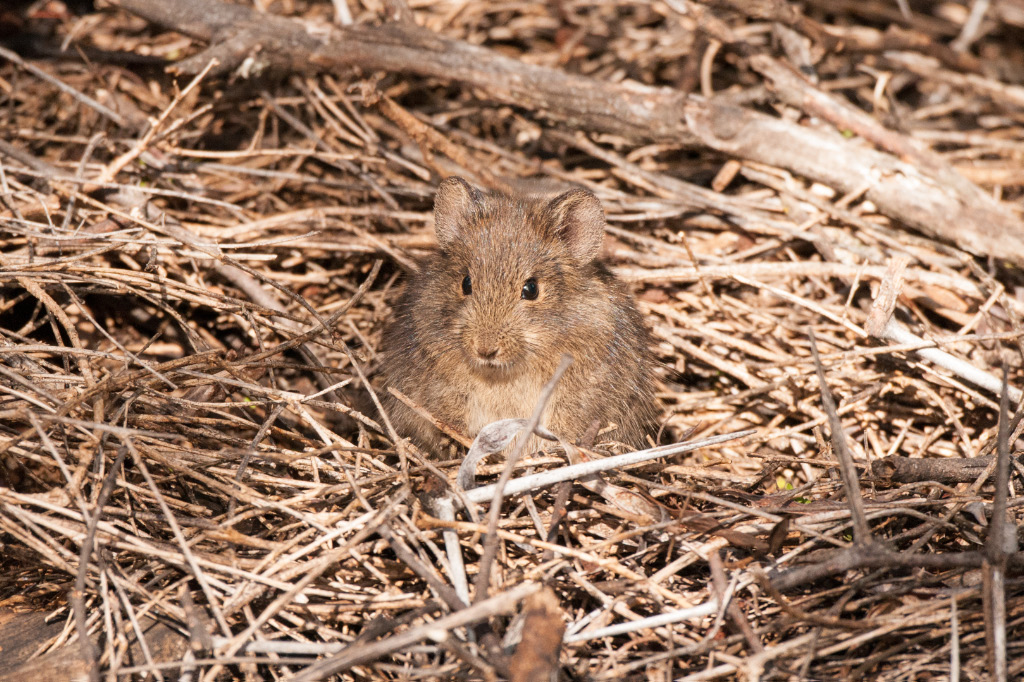
We had visited this spot on our previous visit and found it to have a special charm with tables set into alcoves created in the bush, visited by cute little Four-striped mice and Red-necked Spurfowl, both of which latched onto any errant crumbs from our cheese and crackers picnic – not our usual style but we were in a rental car after flying to PE, so had to make do with a plastic shopping bag to carry our humble provisions. This picnic spot gets its name from an ailing Rhino which spent its last years at this spot in a protected environment – little did he know how vulnerable the next generations of Rhino would become with rampant poaching in our country to feed the Far East obsession with Rhino horn.

Striped Mouse (Rhabdomys pumilio), Addo NP
Striped Mouse (Rhabdomys pumilio), Addo NP
Striped Mouse
Striped Mouse
Striped Mouse
Striped Mouse


Red-necked Spurfowl
Red-necked Spurfowl
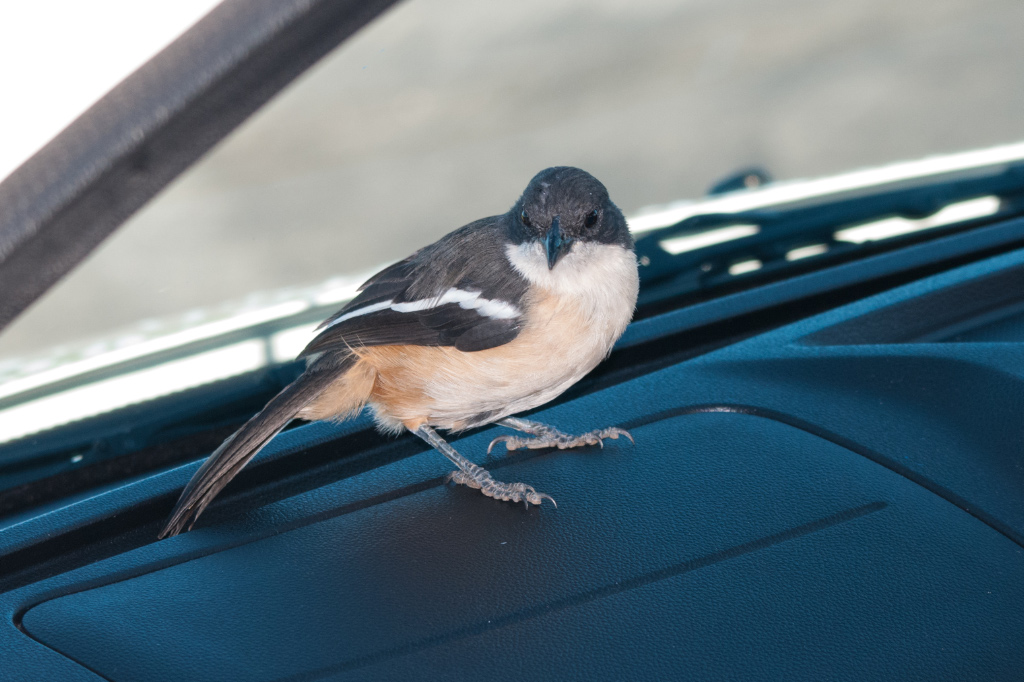
Southern Boubou - took a liking to our rental car (on our previous trip)
Southern Boubou – took a liking to our rental car (on our previous trip)

Stoep Sitting

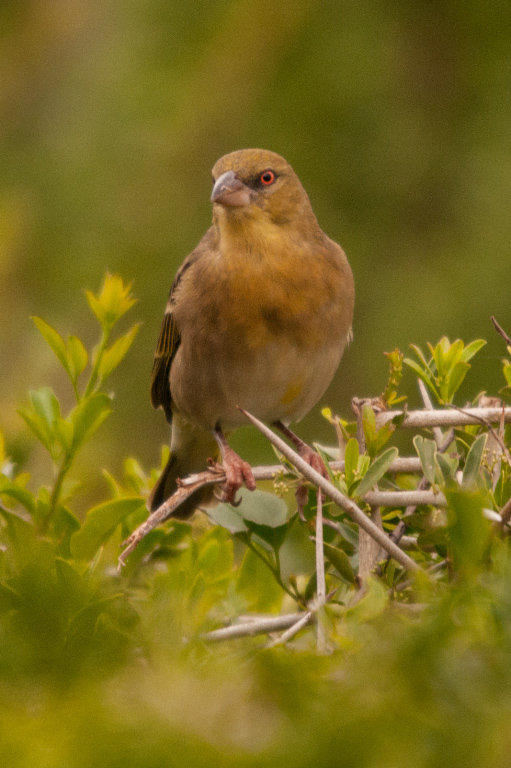
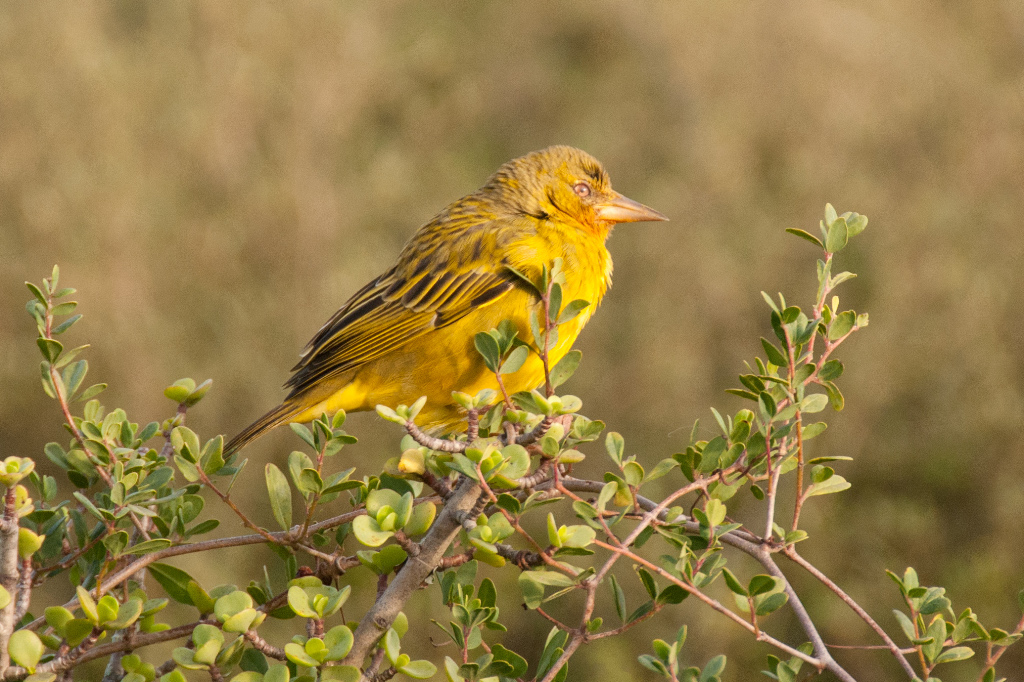
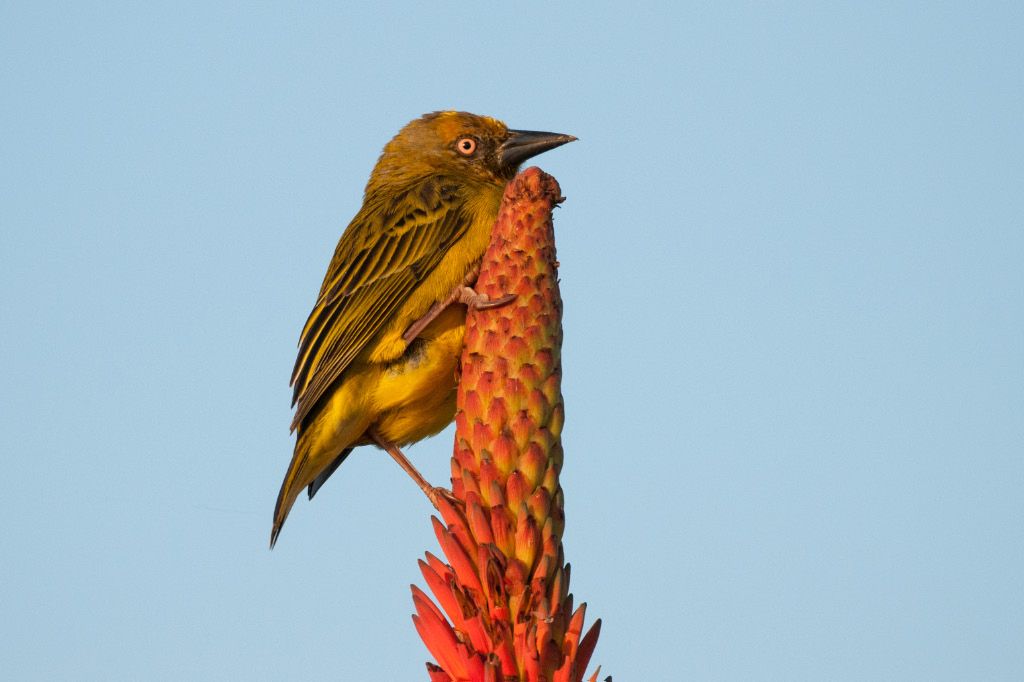
Southern Masked-Weaver, Addo NP
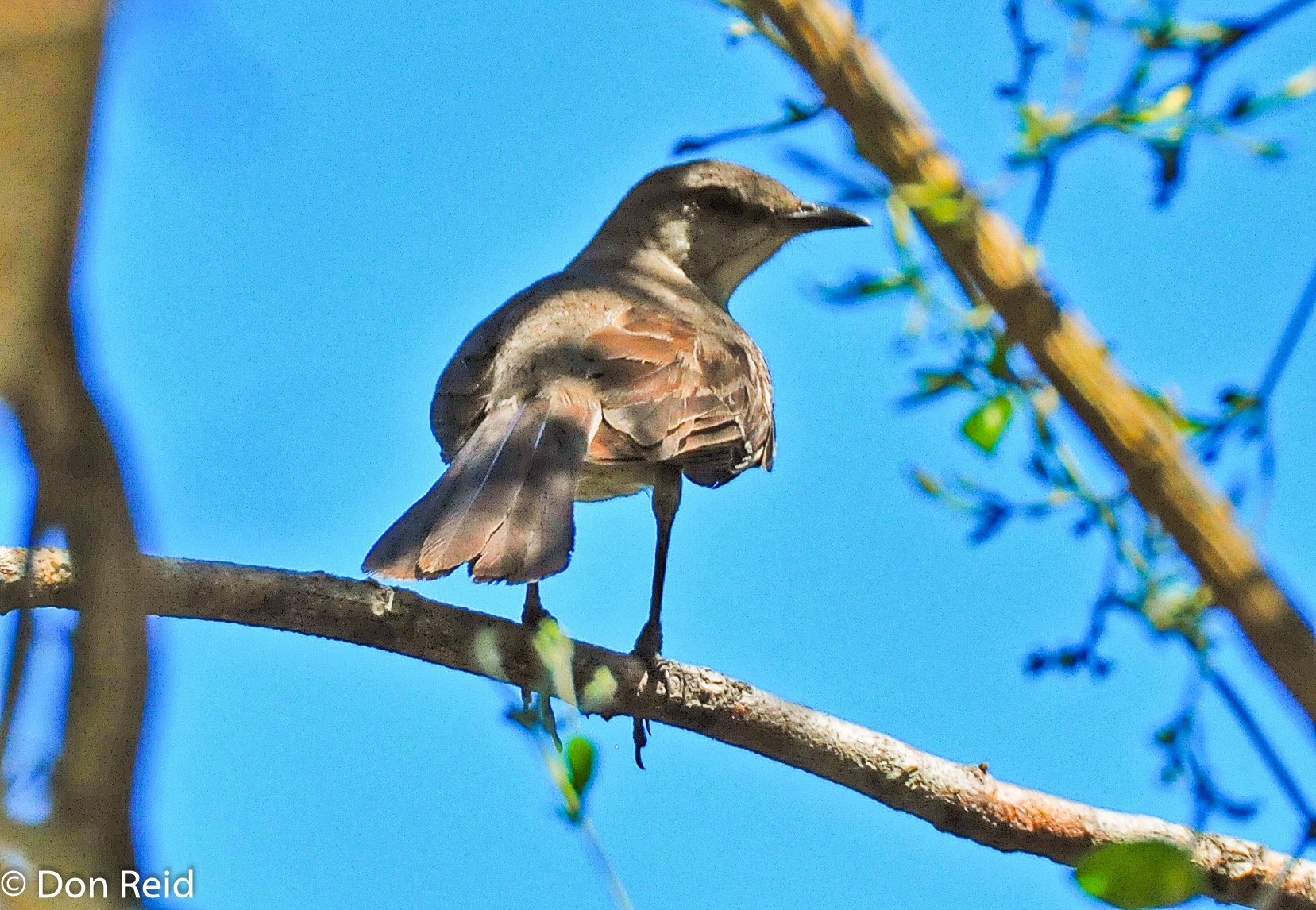
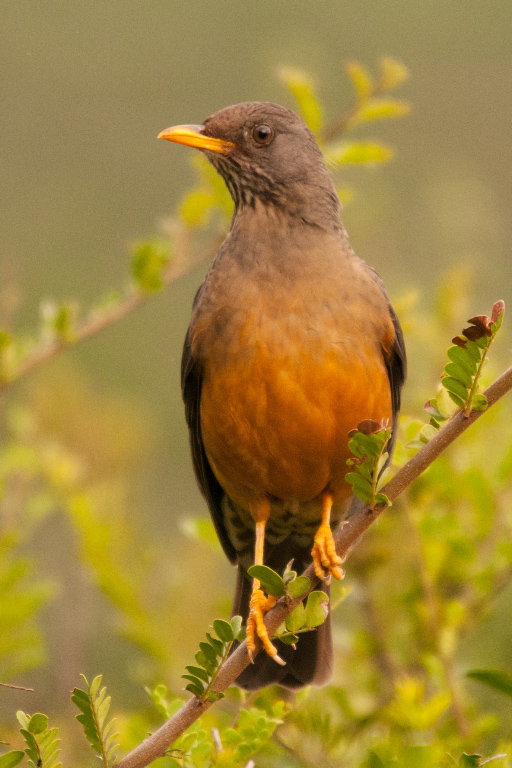
Olive Thrush, Addo NP

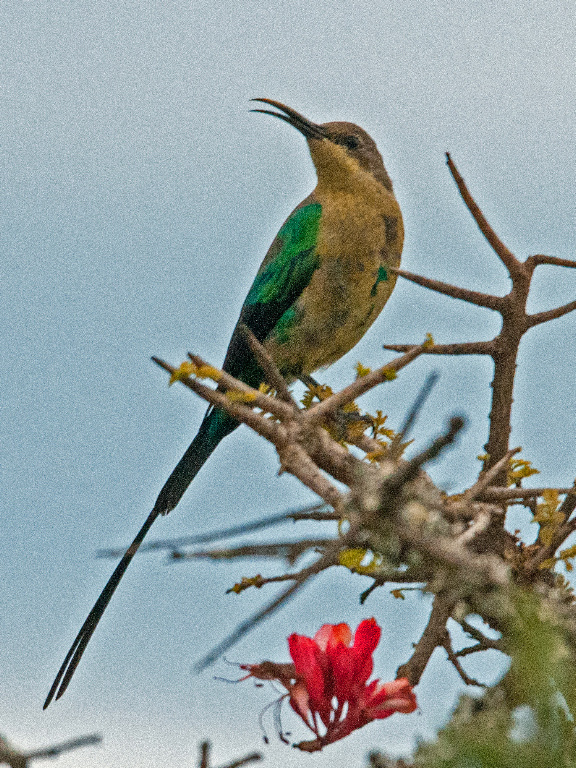
Most of the chalets and cabins have stoeps (patios) with views over the bush and are a great place to relax in the early morning and evenings – there is a constant stream of passing bird life to enjoy, most of which are tame and easy to photograph – Weavers (Cape and Southern Masked), Bulbuls (Cape and Dark-capped), Olive Thrushes and Bar-throated Apalises are most common with Malachite Sunbirds not far behind

Cape Weaver, Addo NP


Cape Bulbul, Addo NP
Malachite Sunbird, Addo NP

The Small Stuff

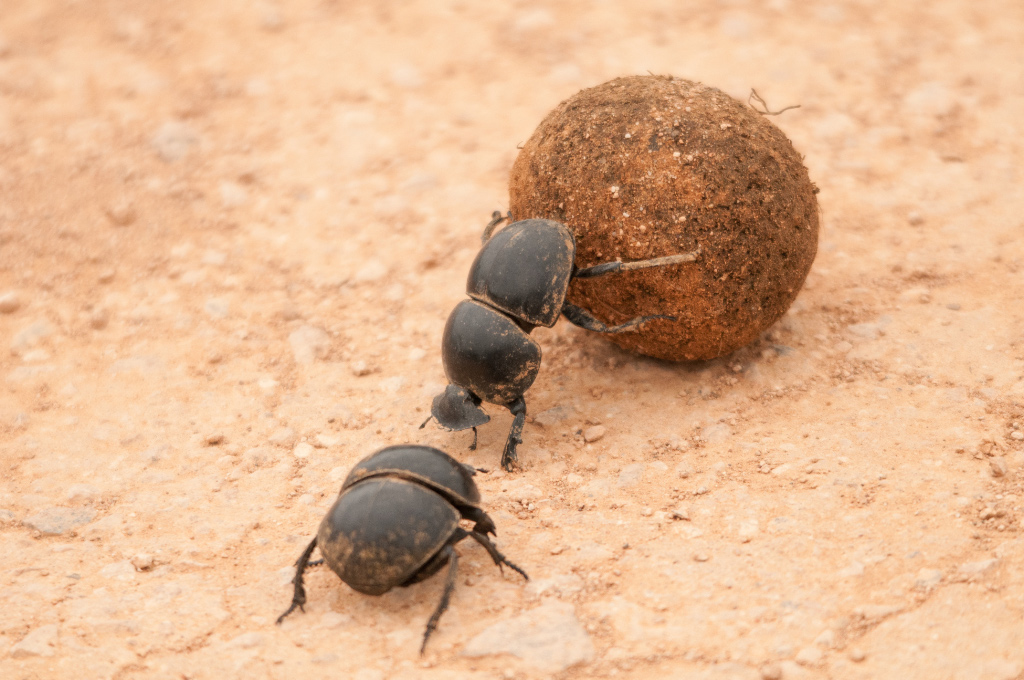
Addo is famous for its elephants but we were fascinated by some of the smaller creatures and insects which make this park special and provide great entertainment. Several times we came across the Flightless Dung-beetle – one particular beetle was crossing the dirt road with his meticulously formed dung ball with a ‘Supervisor’ in close attendance all the way across, seeming to guide him and even assisting to get him back on his legs when he toppled onto his back at one point.

Flightless Dung-Beetle with 'Supervisor'
Flightless Dung-Beetle with ‘Supervisor’ – the ball is almost golf ball size and they roll it with their hind legs while facing backwards, thus a supervisor helps a lot

Such a pity that other visitors ignore the many signs asking them to watch out for Dung beetles which are so vulnerable when crossing the road, resulting in a lot of crushed beetles.

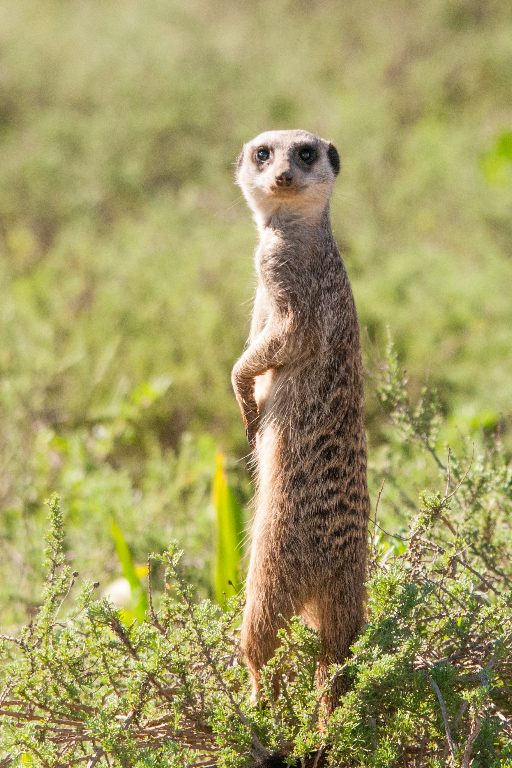
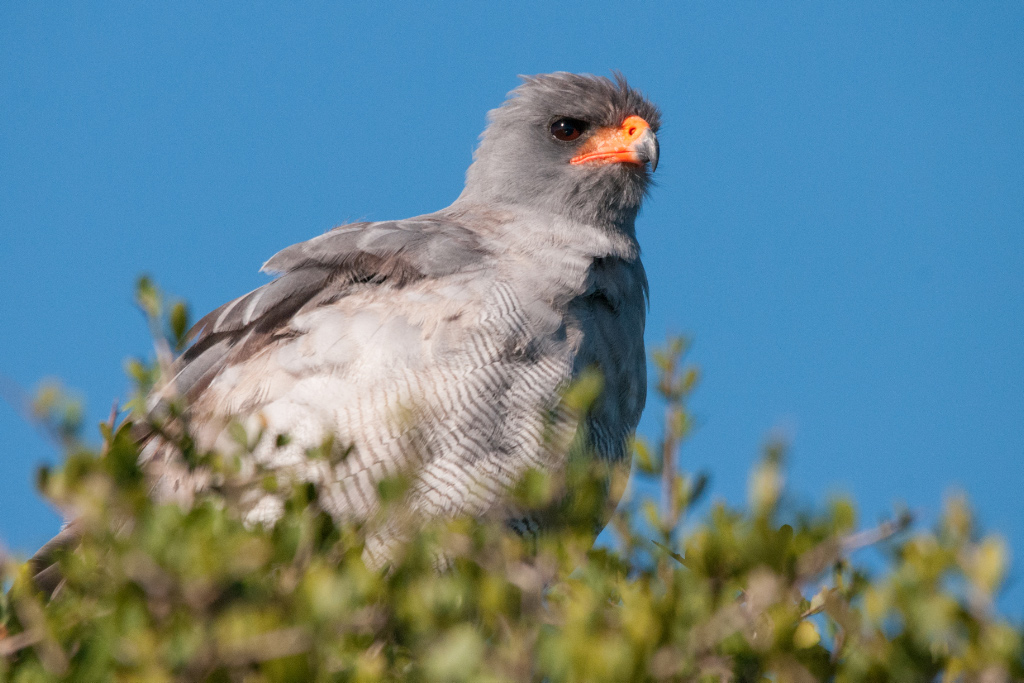
At another spot we watched a group of Meerkats as they scurried after food while their lone sentry stood watch like a Royal guardsman – right under the nose of a Pale Chanting Goshawk not 3 m above them, which they chose to ignore completely

Suricate / Meerkat (Suricata suricatta), Addo NP
Suricate / Meerkat (Suricata suricatta), Addo NP
Pale Chanting Goshawk (Juvenile), Addo NP
Pale Chanting Goshawk (Juvenile), Addo NP
Pale Chanting Goshawk, Addo NP

The Bulbul puzzle

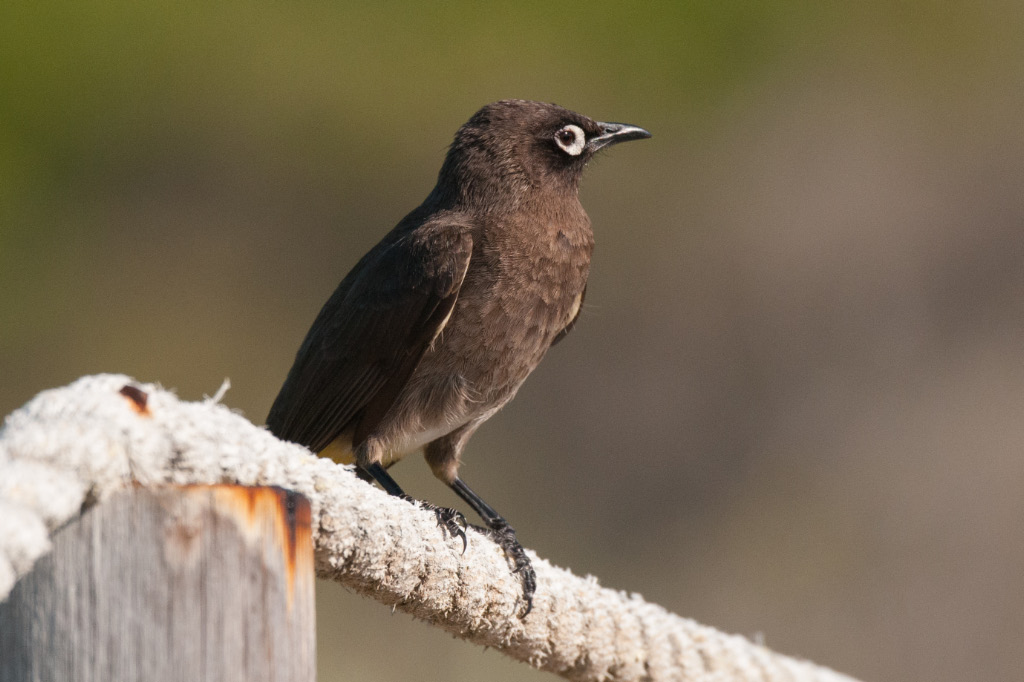
I mentioned seeing both Cape and Dark-capped Bulbuls, once side by side in the same tree – apart from the white ring around the eye of the Cape Bulbul, they are virtually identical but don’t seem to interbreed – how do they know?

Heading back home

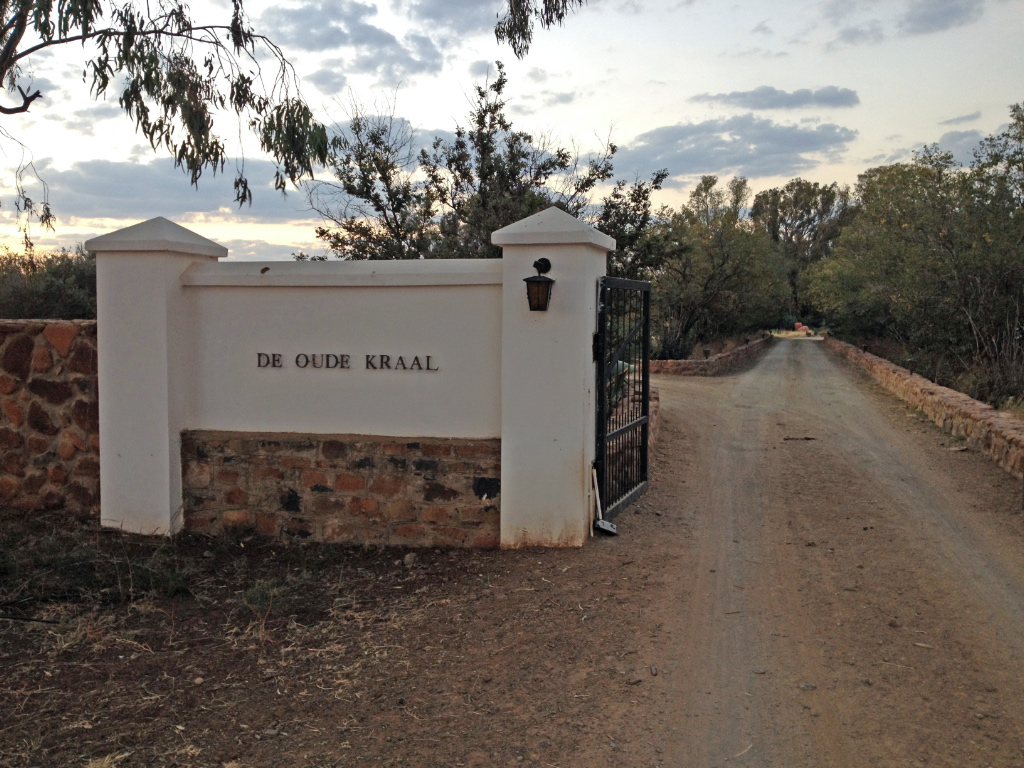
We had enjoyed our month of much travelling and many highlights, but as always we were now looking forward to getting back home and settling into our normal routine. The trip back was once again spread over two days of about 600 km each, with an overnight stop at Oudekraal guest farm just south of Bloemfontein. It turned out to be a pleasant place with excellent food but somewhat overpriced compared to other guest houses we have tried over the years.

Oudekraal guest farm

Oudekraal guest farm
De Oude kraal guest farm

One thing I can never understand about guest farms is why the front house, gardens and rooms are well looked after, yet take a walk (as I always do) around the farmyard and surroundings and it’s often a mess – old scrap everywhere and generally untidy. This is the case with a number of places we have visited and again with Oudekraal. The overgrown tennis court was sad to see – even if no one uses it, just keep it looking decent.

Final surprise

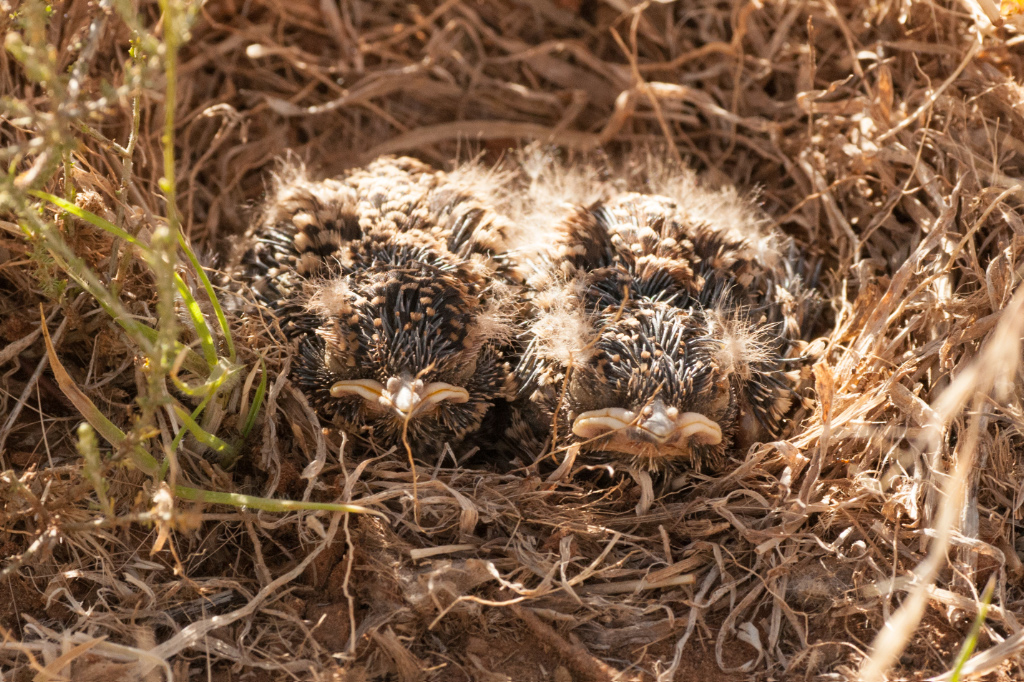
As we left Oudekraal we spotted a Spike-heeled Lark alongside the road and stopped to view it, noticing with interest that it had a juicy insect in its beak. As we stopped it walked off quickly and we followed it for about 100m until it suddenly stopped and ducked towards a hidden nest where two very young chicks were waiting to be fed – what a lucky find! The nest was so well camouflaged that when I got out to take a photo (from a distance using the telephoto lens) I had to search for it again, despite being a few metres away.

Spike-heeled Lark, De Oude kraal guest farm
Very young Spike-heeled Larks on the nest

And so we came to the end of a memorable month of traveling – can’t wait for the next trip!

Four Parks and a wedding (Part 3) – Mountain Zebra

The Story so far…

Parts 1 and 2 covered our visits to De Hoop Nature Reserve and Camdeboo National Park. The latter was enjoyable from many points of view, not least having the small tented camp virtually to ourselves, but our overall impression was that it did not have the “feel” of a National Park, probably due its relatively small size and being in close proximity to the town of Graaff-Reinet. Our next destination – Mountain Zebra National Park, on the other hand, proved to be everything we look for in a major National Park and has the potential to become a major tourist attraction, especially when the current plans to extend it, and eventually have a protected area running from Camdeboo all the way to Mountain Zebra, come to fruition.

Getting there – Monday 28 April 2014

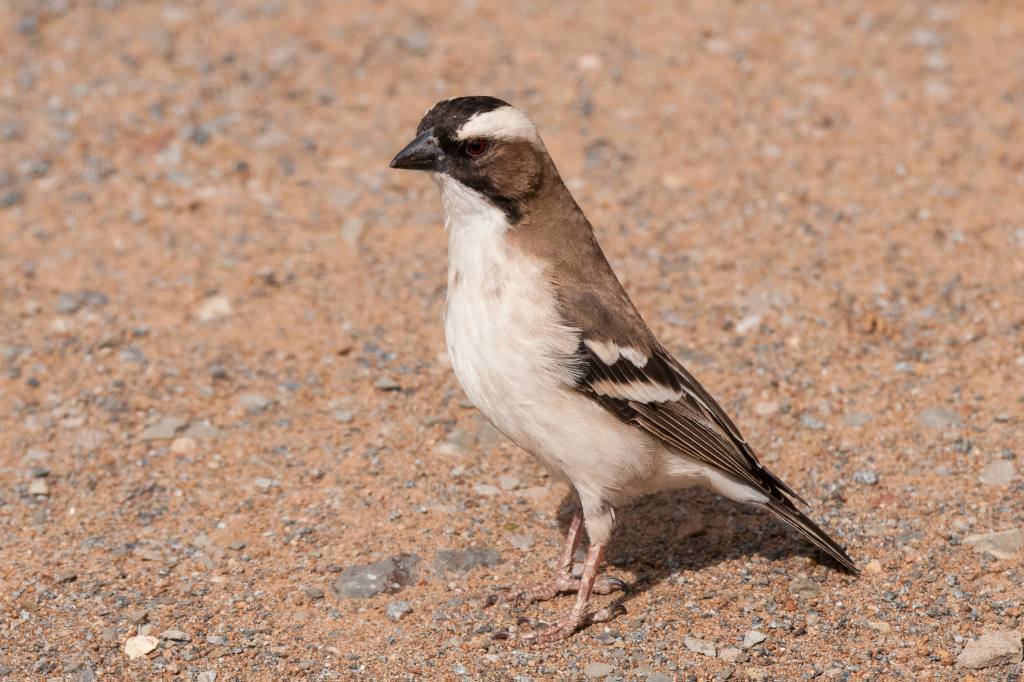
The park lies west of Cradock in the Eastern Cape and we reached the main gate off the R 61 road around 4.30pm, giving enough time for an unhurried drive of the remaining 12 kms to the main rest camp before the camp gates closed at 6 pm. On the way we had sightings of African Spoonbill, alone in a large pond, Familiar Chats and Ant-eating Chats at regular intervals and old “Fumanchu” aka Scaly-feathered Finch in small groups looking almost too small and cute to survive in an environment such as this. White-browed Sparrow-Weavers were chattering in small flocks not far from their scruffy looking nests, but a real surprise awaited as we found a Secretarybird perched in the top of a tree, perhaps on a nest.

White-browed Sparrow-Weavers are plentiful


Secretarybird perched in tree, Mountain Zebra NP

We had only ever seen Secretarybirds on the ground, usually striding through long grass in search of a tasty lizard or snake (their scientific name sagittarius serpentarius hints at this dietary preference), so had never imagined them taking to a tree. My Roberts birding app mentions that they do indeed nest on top of thorny trees and pairs may roost on a prospective tree for several  months before using it to build a nest – so I suppose in this instance it was simply getting ready to roost for the night. And that answers a question that has no doubt troubled you for a long time….

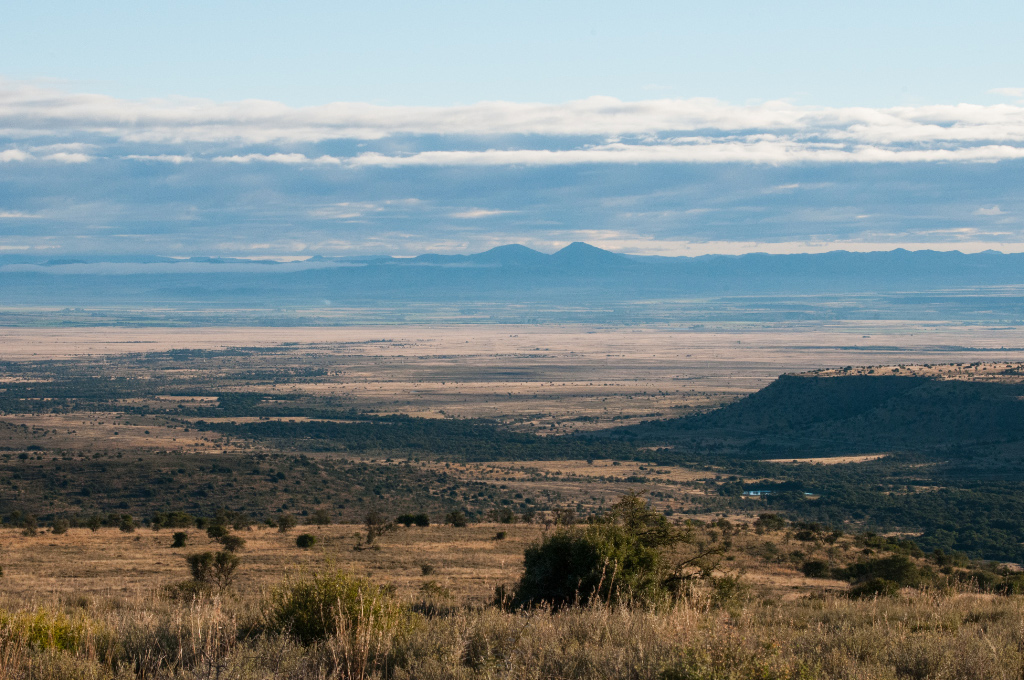
The landscape we travelled through was quite different to any other National Park we knew and we looked forward to seeing more of it the next day

The chalets were a welcome sight with comfortable beds and all the necessary facilities for self-catering. A fireplace meant we could make a wood fire for the cold evenings and enjoy a glass of red wine in the small lounge.

The chalet
The chalet


The chalets have a small stoep with braai

Tuesday 29 April – exploring the Park

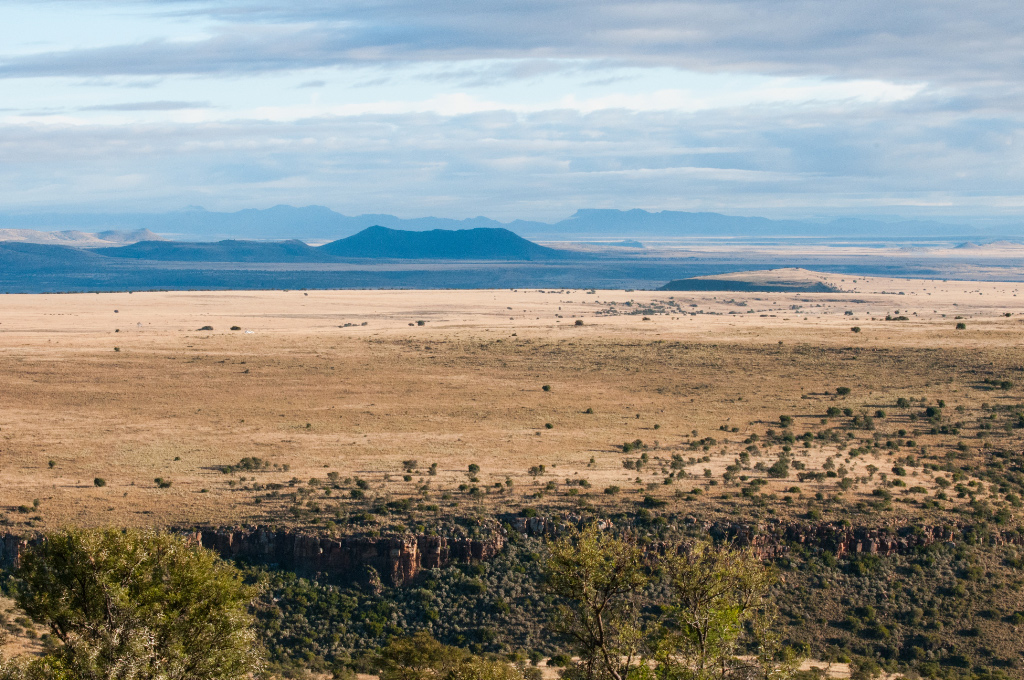
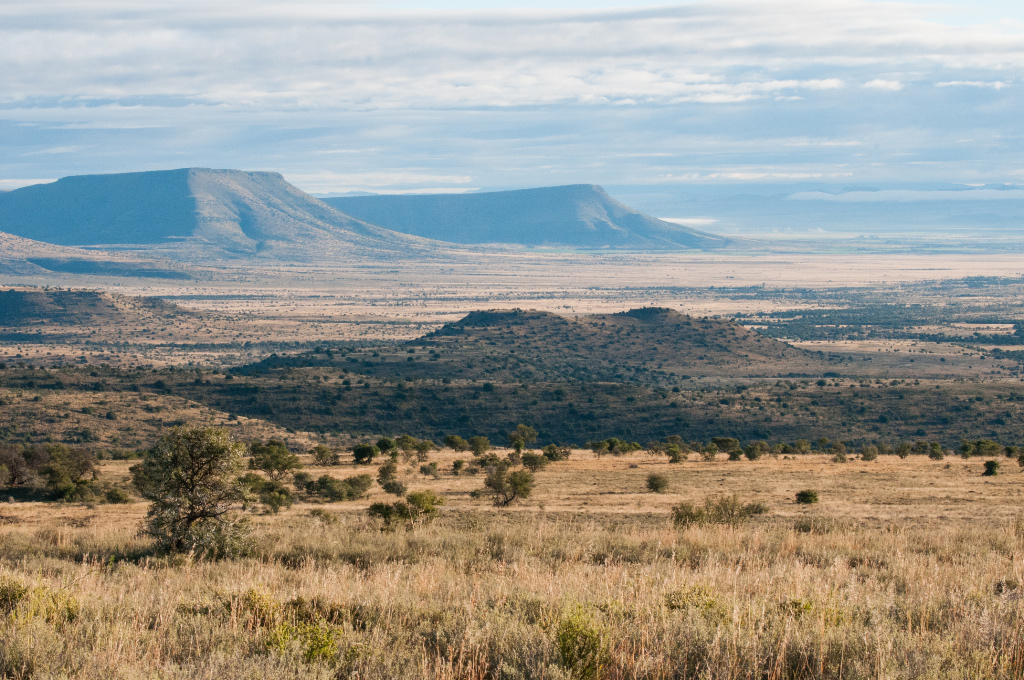
Up early-ish for a game drive on the Rooiplaat Loop, starting with a steep climb up to a plateau where the views stretched forever.

Looking down at the rest camp from the plateau


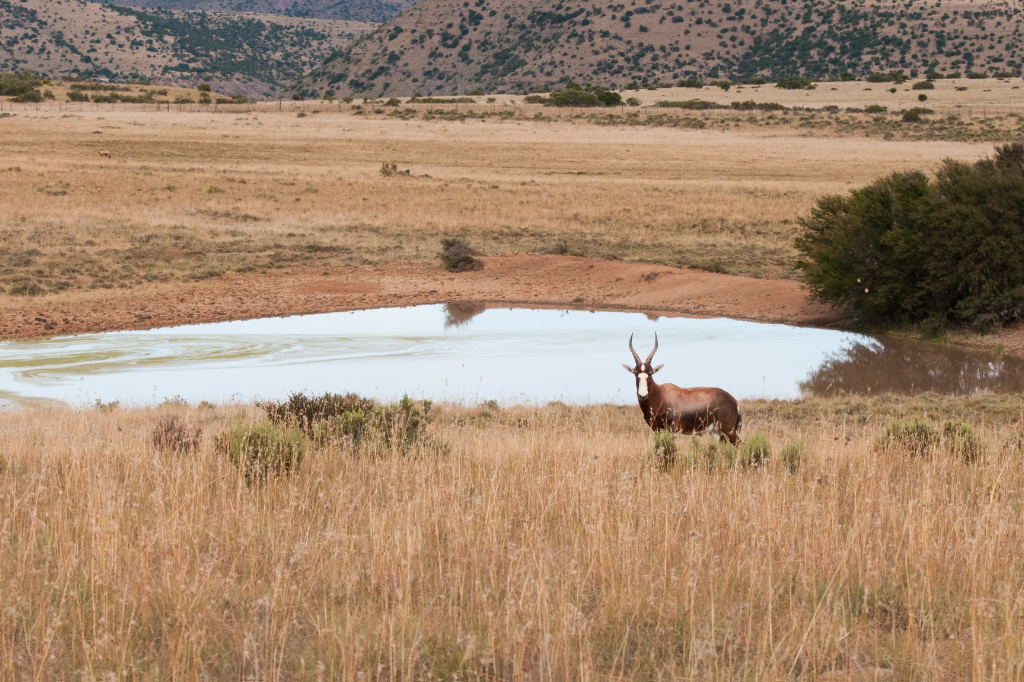
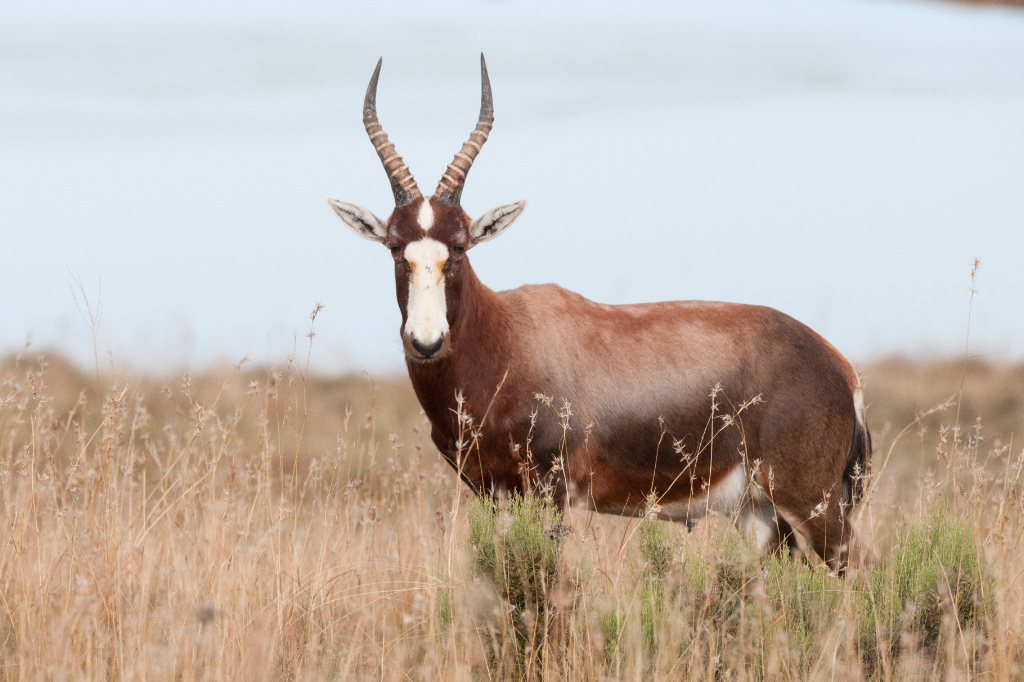
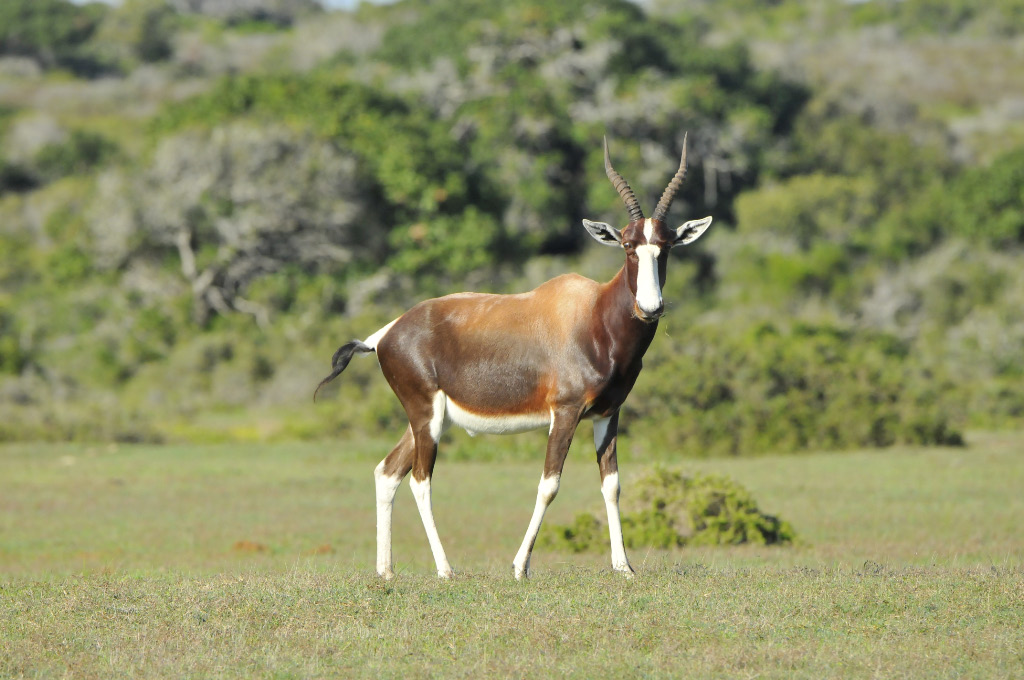
View across the grassland with Bontebok
Heading up the hill
Heading up the hill

The grassy slopes were home to several  Sickle-winged Chats, flying between low bushes, wings flicking as they landed.

Sickle-winged Chat
Sickle-winged Chat

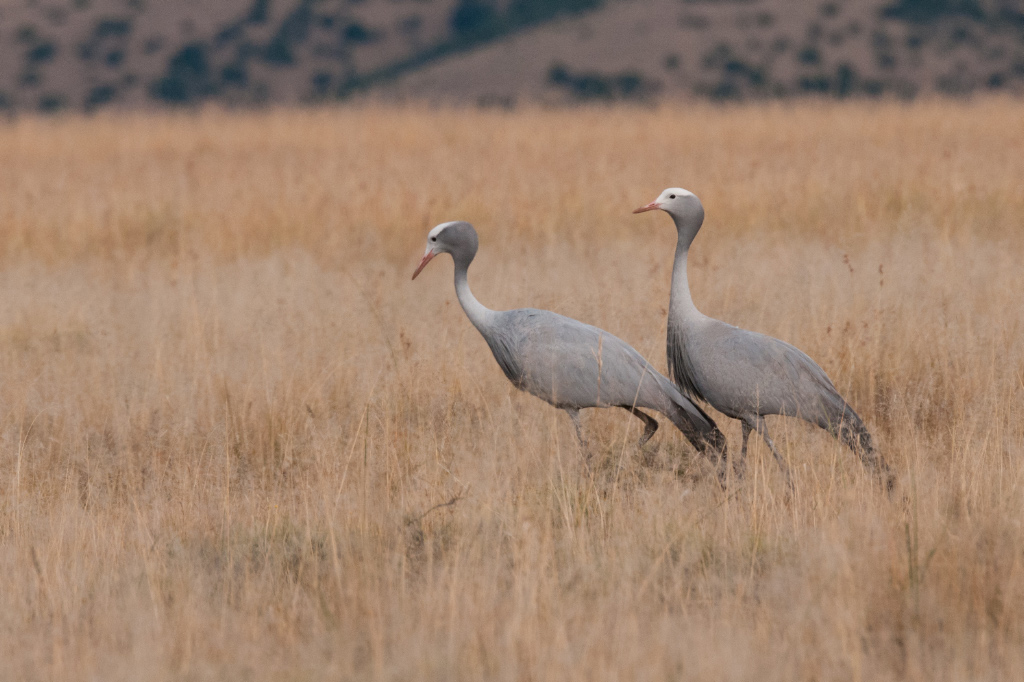
Blue Cranes seemed very much at home in the long wheat-coloured grass while overhead White-necked Ravens cruised the skies emitting their raucous cries.

Blue Cranes at home in the grass, Mountain Zebra NP
Blue Crane, Mountain Zebra NP

Back at the rest camp, I added Streaky-headed Seedeater and Neddicky, both frequent visitors to the bush adjoining the camp roads, then a Chinspot Batis paid our chalet a visit and Pied Barbet called from a distant tree. Southern Double-collared Sunbirds kept busy as usual, twittering (the real kind, none were bent over cellphones) loudly and flashing their brightly coloured plumage in the midday sun.

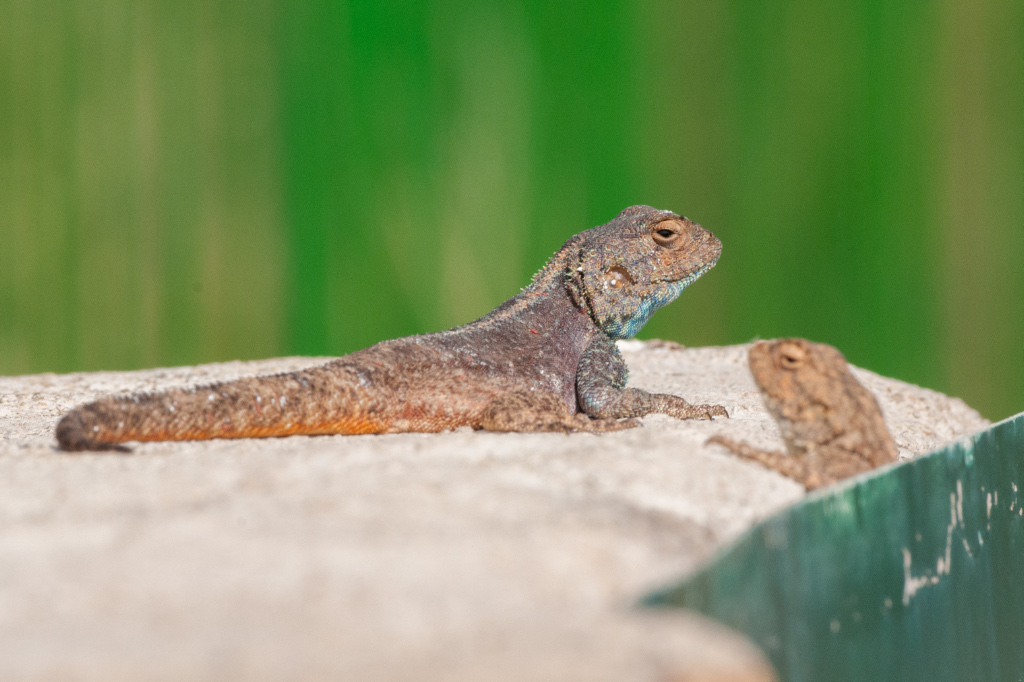
The camp has a large swimming pool which the grandkids tried but the water was just too cold for their liking nevertheless the walk there was pleasant and a Rock Agama stood guard at the gate.

The pool in the rest camp
Rock Agama
Rock Agama

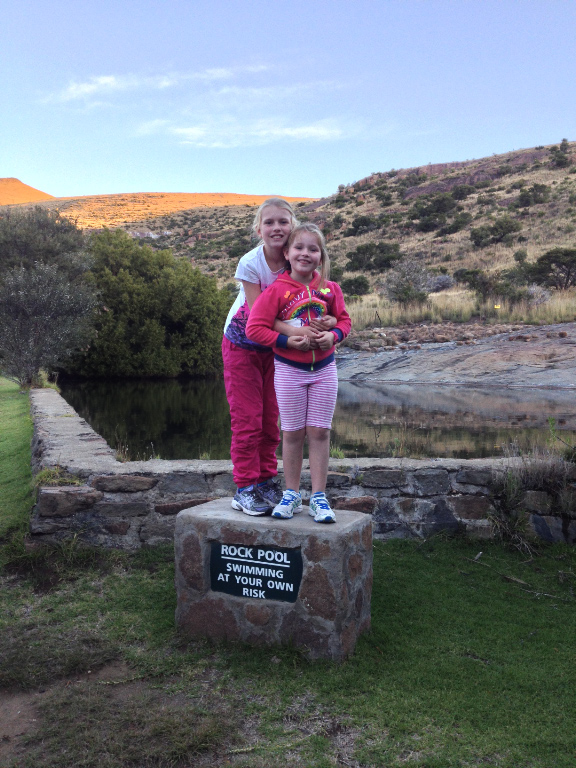
Later we took a short drive to the nearby picnic spots, set amongst big shady trees, the one with a formal swimming pool and the other with a rock pool fed from a mountain stream – both looked extremely inviting and perfect for a late morning brunch visit. Sadly time caught up with us and we didn’t get around to trying this out.

Leonardii Mosselbayi discovered at the picnic spot - clearly expanding their distribution to the Eastern Cape
Leonardii Mosselbayi discovered at the picnic spot – clearly expanding their distribution to the Eastern Cape

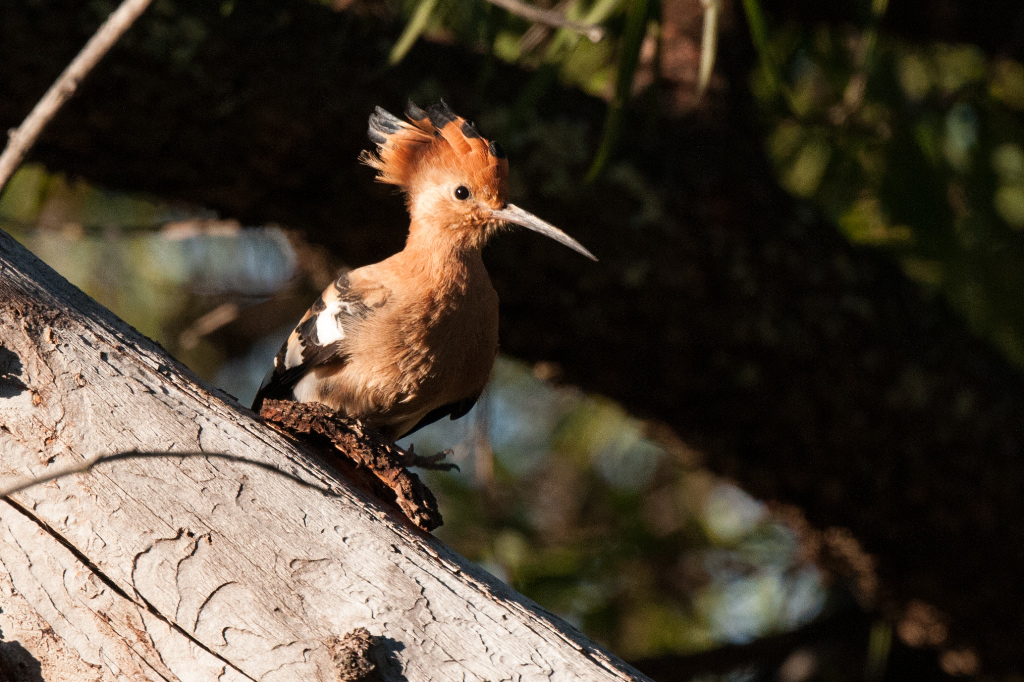
a Hoopoe in the late afternoon sunlight made a nice picture

African Hoopoe at the picnic site

On the way there a large flock of Pied Starlings made themselves known and at a large dam a lone Brown-hooded Kingfisher sat in the shade on a convenient branch, waiting for a meal opportunity to pass by – which despite its name would be a grasshopper or suchlike rather than something fishy.

Brown-headed Kingfisher

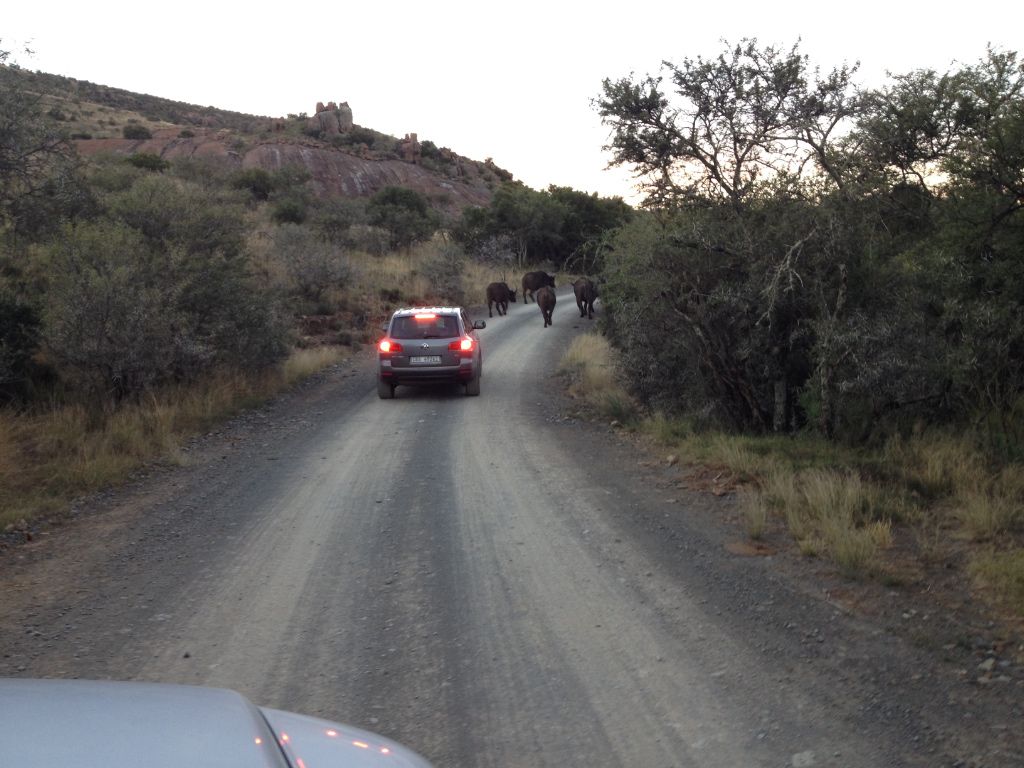
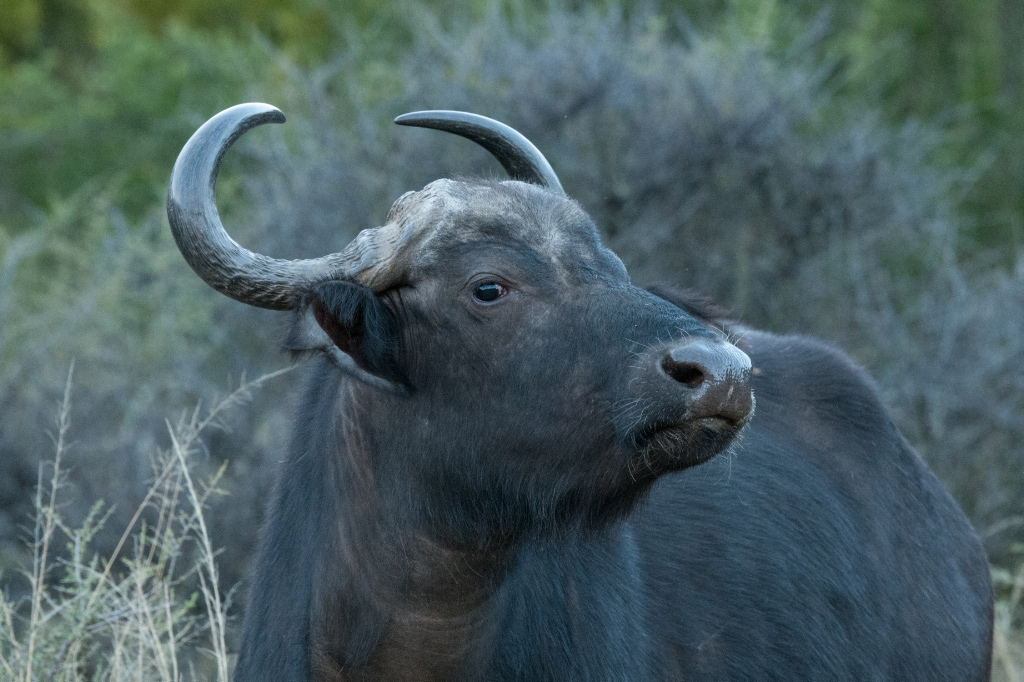
On the way back a small herd of Buffalo caused a mild traffic-jam, one which is a lot easier to bear than the dreaded City kind.

African Buffalo traffic jam
African Buffalo, Mountain Zebra NP
Who, me? African Buffalo, Mountain Zebra NP

Back at our chalet a braai on the stoep made a nice end to the day, with the call of a Spotted Eagle-Owl in the distance adding to the atmosphere.

Wednesday 30th April – last day

The last day of our short stay, so an early morning birding and game drive was in order, this time taking the route along the Kranskop Loop, but part of the way along the road was under reconstruction and I had to turn around. Views across the park were even more magnificent than the previous day and I stopped several times to take them in. Sometimes I’m tempted just to bear such views to memory and not spoil the moment taking photos, but hey, I’ve got a blog to think about, so I “forced myself”  to take a few record shots.

Mountain Zebra National Park


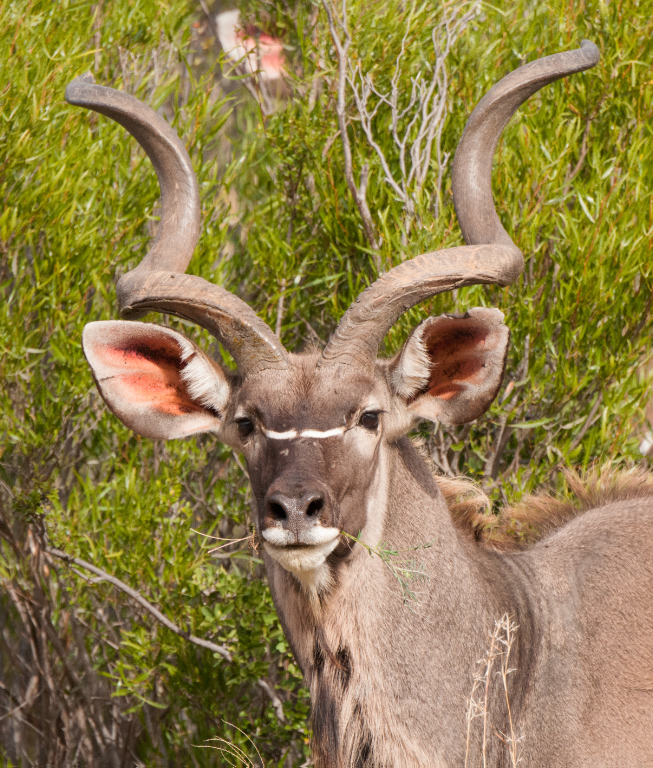
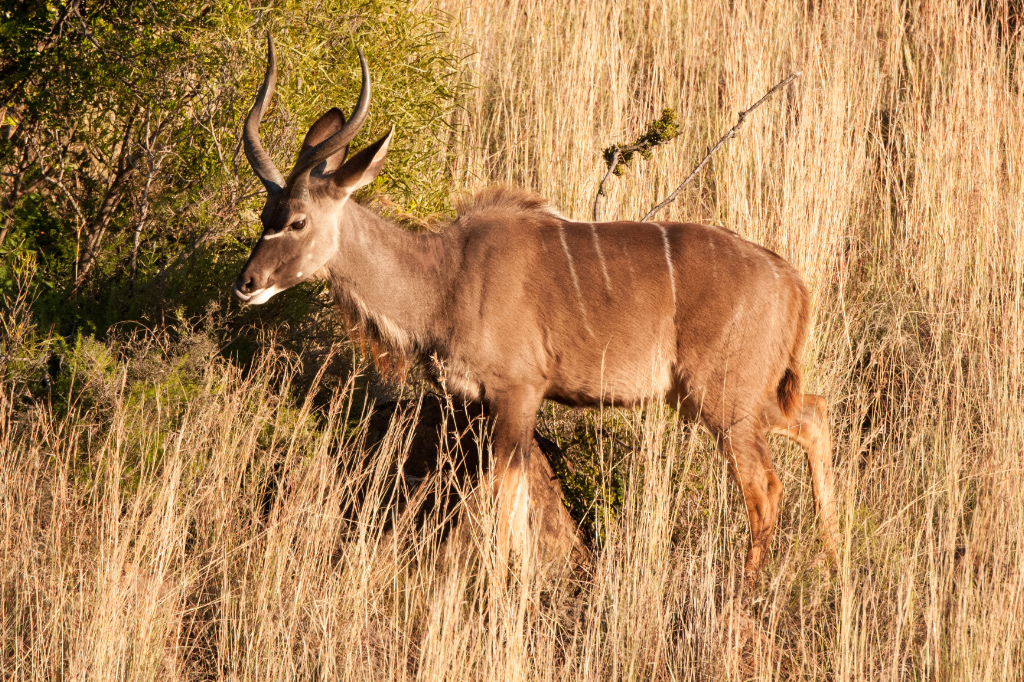
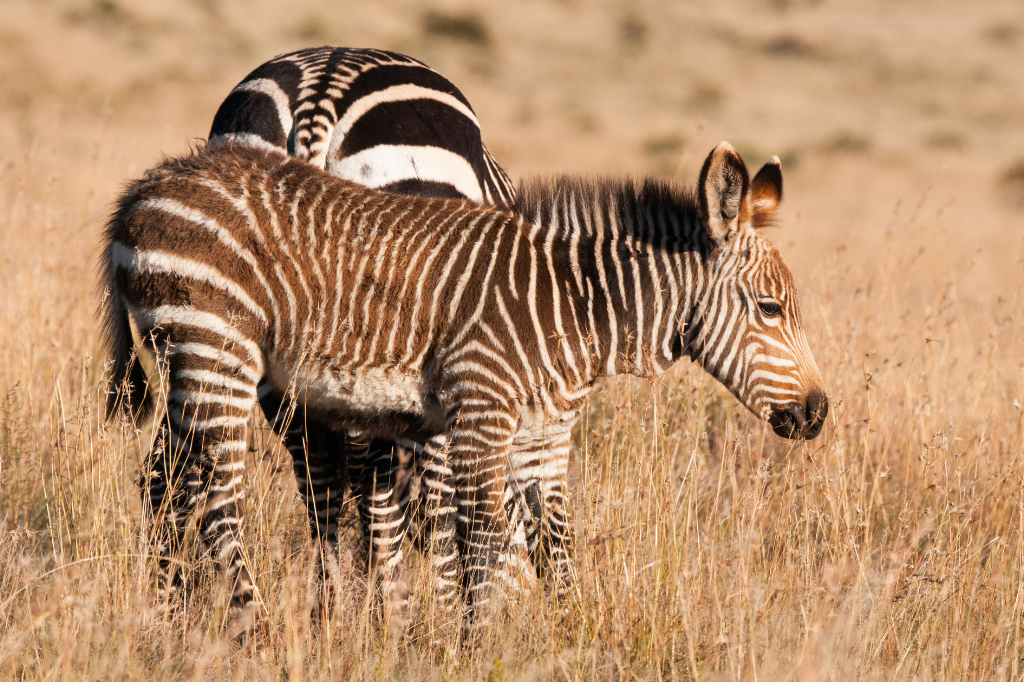
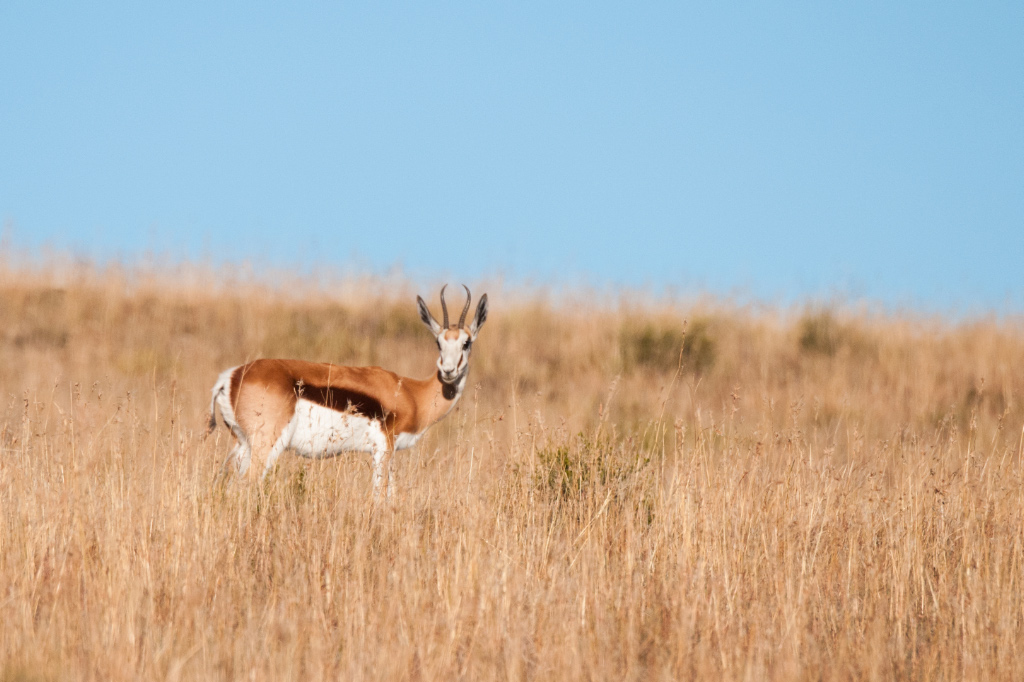
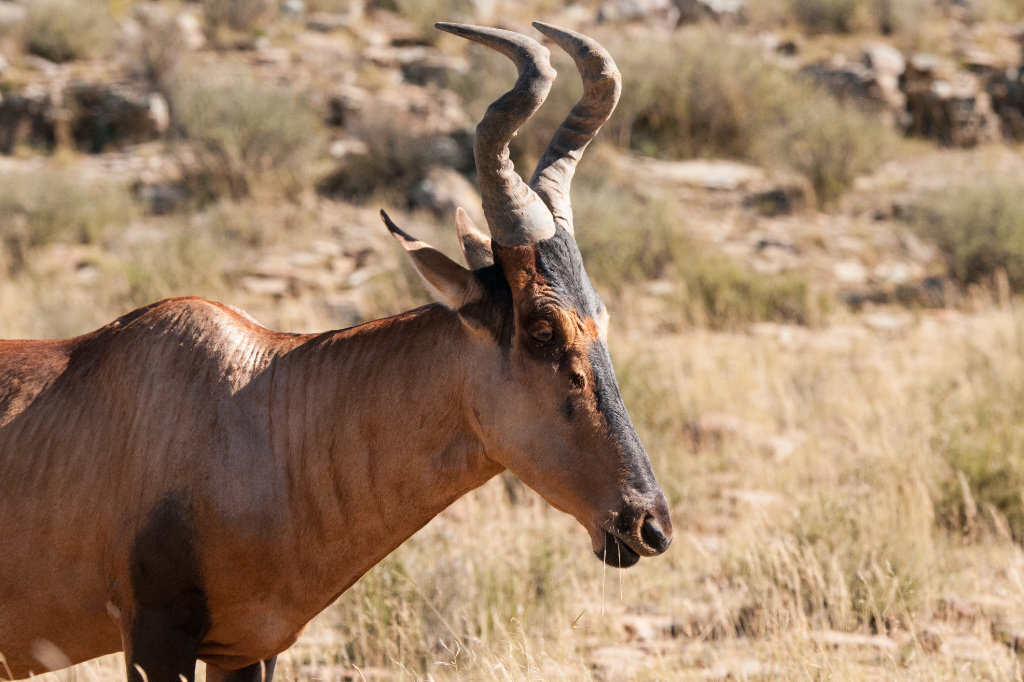
Along the stretch that I was able to access, and despite a few construction lorries passing in both directions, birding was good and game plentiful, with some lovely sights of Kudu, Mountain Zebra, Springbok and Red Hartebeest.

Look at my horns! Kudu
Look at my horns!
Kudu
Kudu, Mountain Zebra NP
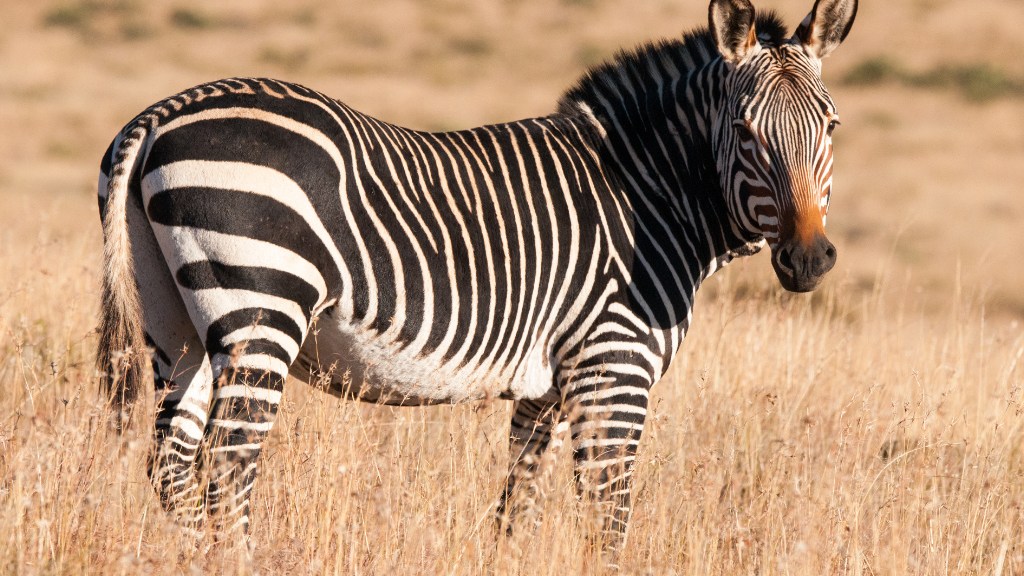
Mountain Zebra, in the Park created for them
Mountain Zebra foal (aaaaaaaah)
Springbok, Mountain Zebra NP
Red Hartebeest, Mountain Zebra NP
Bontebok
Bontebok

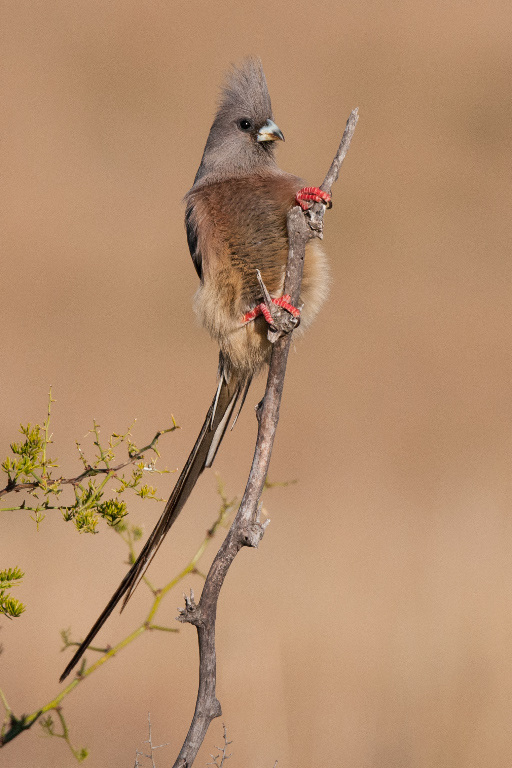
Special birds in the grasslands, such as Eastern Long-billed Lark and Plain-backed Pipit made the birding exciting, with a sighting of a Verraux’s Eagle on a mountain-top radio mast a bonus. White-backed Mousebirds made up a “full house” of all the mousebirds (adding to the Speckled and Red-faced Mousebirds already ticked earlier in our visit).

White-backed Mousebird

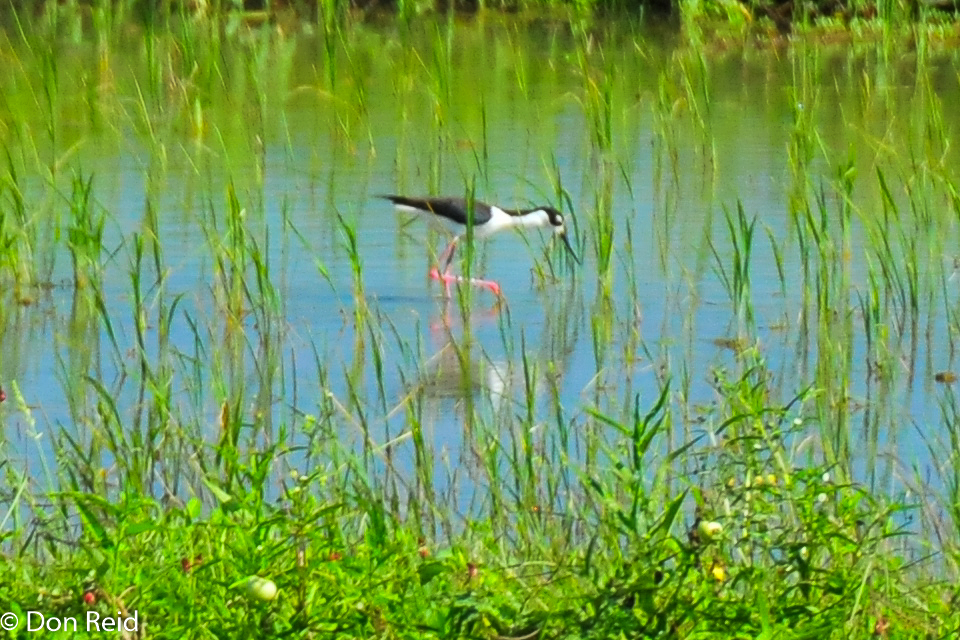
After lunch we covered the open plains along the Ubejane Loop not far from the main gate, stopping at the pans and dams along the route. There we found Spoonbill again, patrolling the shallows with its typical stooped posture, constantly sweeping the water with its unique spatula shaped bill to pick up small organisms. Nearby SA Shelducks showed off their handsome plumage, while Black-winged Stilts busied themselves prodding the mud along the shallow edges.

Vlei, Mountain Zebra NP

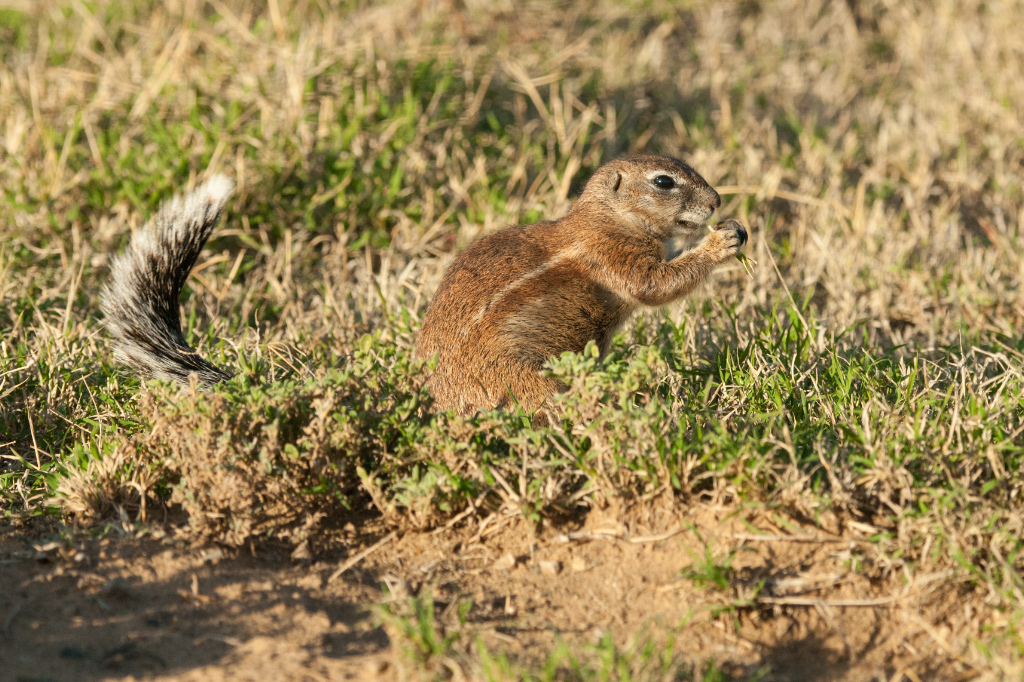
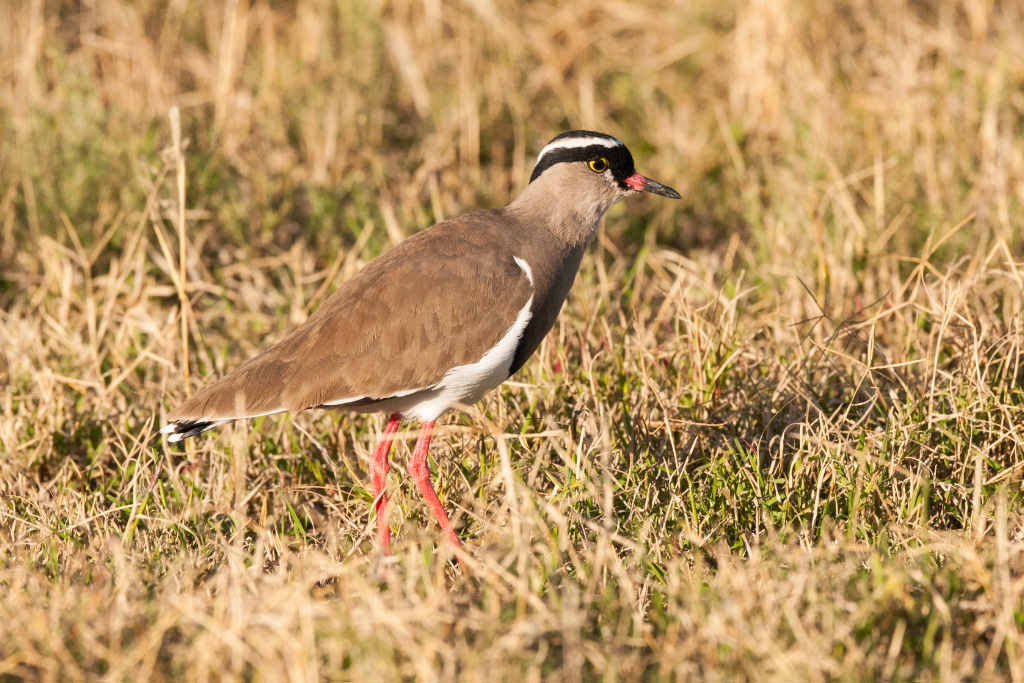
Nearby a family of Ground Squirrels entertained us as they pranced around close to our vehicle, waving their long bushy tails every now and then – do they know how cute they are I wonder? Crowned Lapwings found the short grass to their liking as well.

Ground Squirrel (Xerus inauris), Mountain Zebra NP
Ground Squirrel
Ground Squirrel
Crowned Lapwing, Mountain Zebra NP

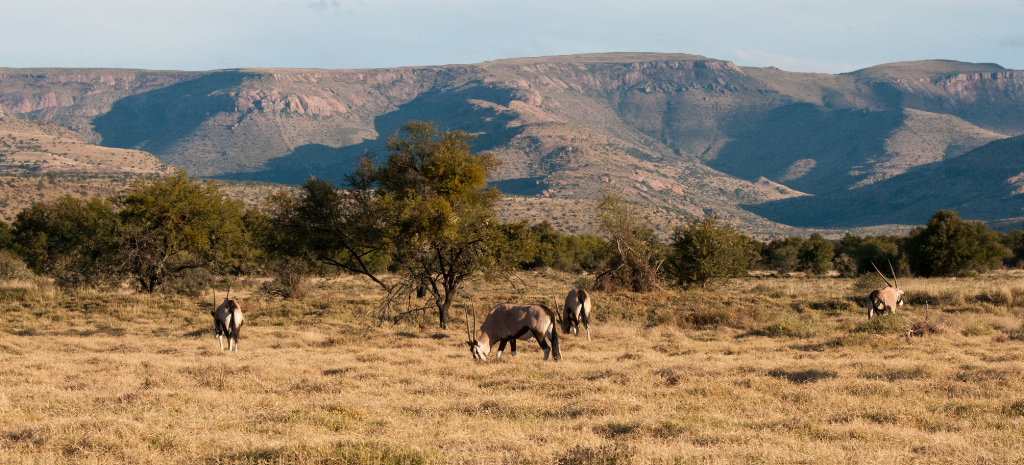
This part of the park also held a number of Gemsbok which reminded us just how handsome these antelope are with their long straight horns. A couple of them were in a frisky mood, chasing each other around.

Gemsbok, Mountain Zebra NP
Gemsbok
Gemsbok

On the way back a pair of Pale-chanting Goshawks drew our attention as they defended their territory vigorously against a lone Pied Crow invader and soon saw him off.

What a nice Park!

The Mountain Zebra National Park has a lot going for it, not least the magnificent scenery and sweeping views across the valleys and plains that give it a real “Out of Africa” feel. It probably won’t satisfy the “Big five at all costs” visitors but will provide enough interesting sightings to keep the nature enthusiast happy during a 3 or 4 day stay – longer if you just want to relax in the pleasant surroundings.

Mountain Zebra National Park
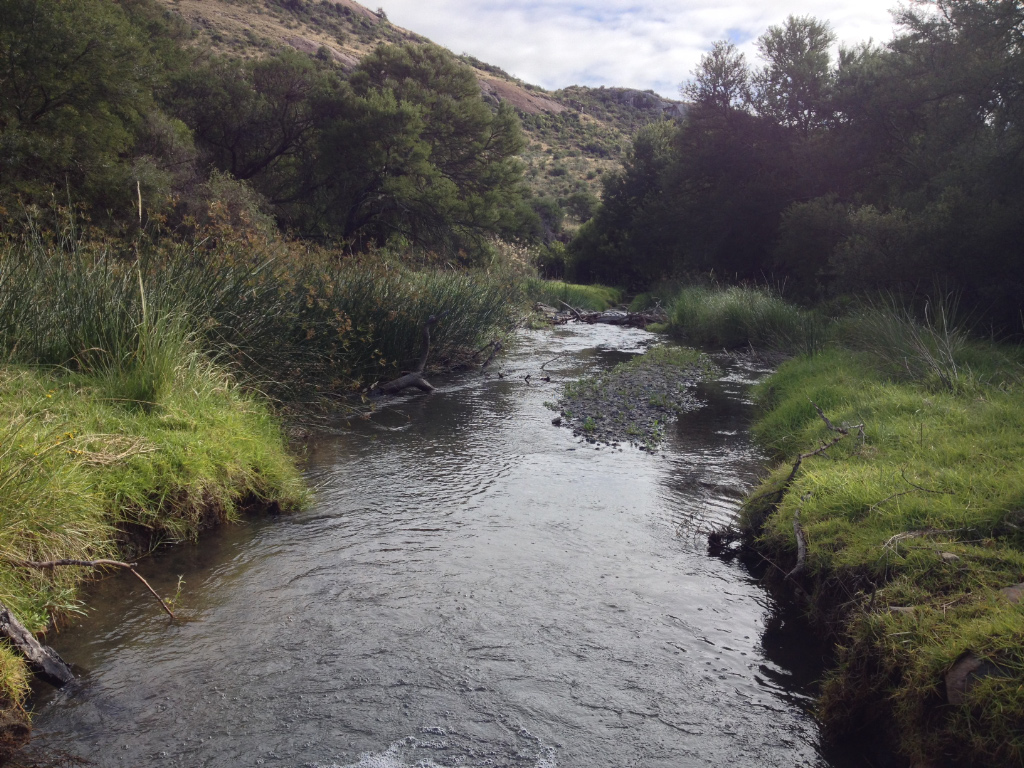
Mountain stream
Mountain stream
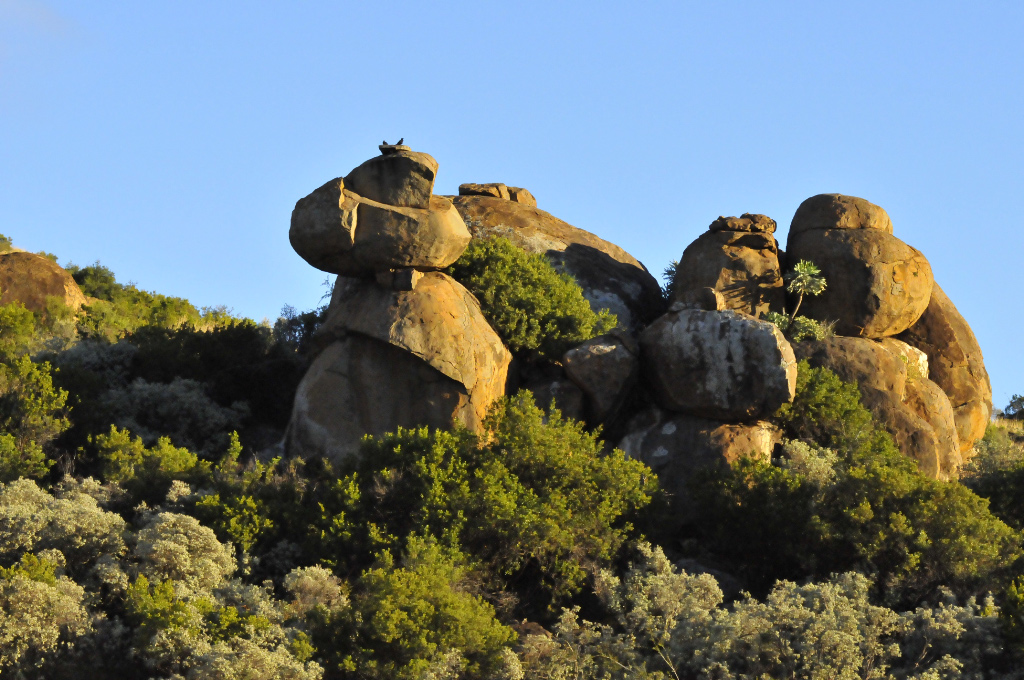
The rock formations are a feature of some parts of the park
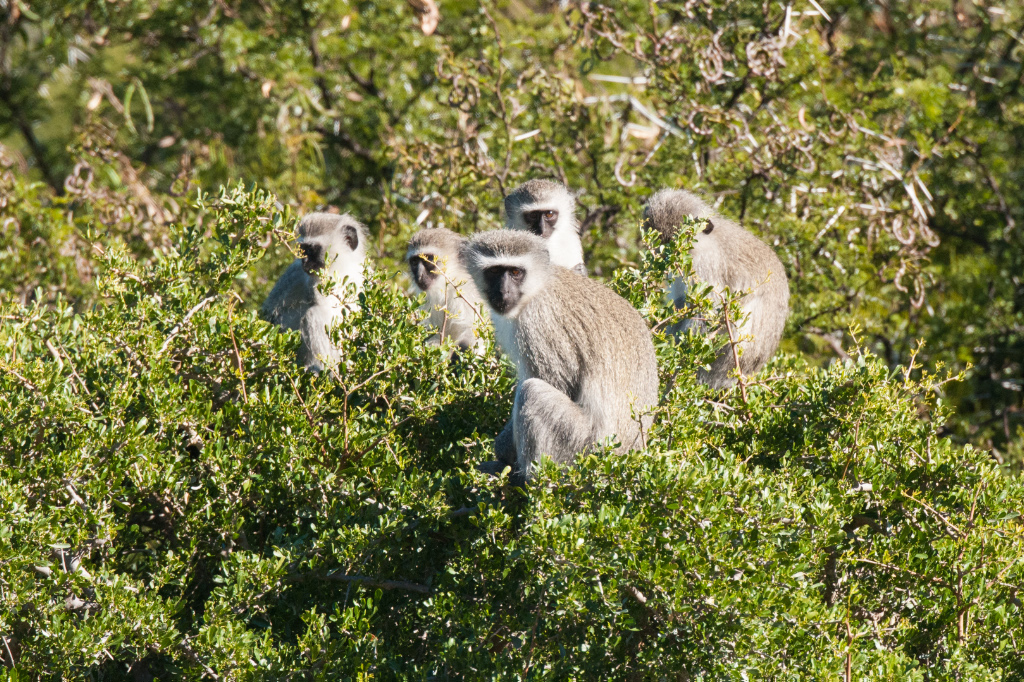
I swear this meeting is like a bunch of monkeys

Next stop Addo Elephant National Park!


Four Parks and a Wedding (Part 2) – Camdeboo

The Story so far

Having “done” De Hoop and the wedding that took us there, we spent time at our home in Mossel Bay until Saturday 26th April 2014, when we took to the road again, this time to Camdeboo National Park which lies close to and almost surrounds the town of Graaff-Reinet in the Eastern Cape province.

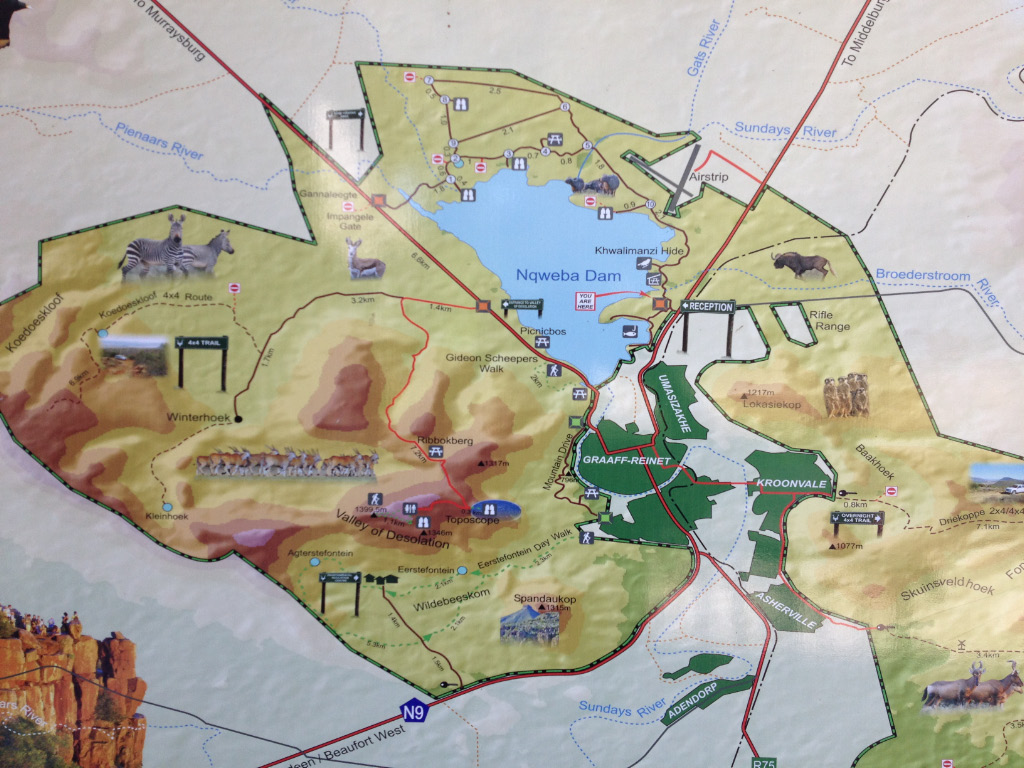
Camdeboo NP map
Camdeboo National Park

Graaff-Reinet

Graaff-Reinet is full of historical buildings, being the fourth oldest town in South Africa – in years past we made a point of booking a night or two in the town  when on our way to the Southern Cape, but more recently we have limited our stops to a lunch or snack and coffee at the popular Polka cafe, which also has an array of bric-a-brac which women love to browse – and it’s a good place for the trainee women (aka the granddaughters) to spend some of their pocket-money.

Getting there – Saturday 26 April 2014

Leaving around midday in light rain, we took a slightly longer route from Mossel Bay, via Robinson Pass, Oudtshoorn and the small town of De Rust, where we stopped for a good coffee at the coffee shop followed by our padkos (a lovely South African word and habit, literally “road food”) of home-made chicken buns – padkos is always best when eaten by the side of the road in the shade of a big tree. Just after De Rust a right turn took us onto the R 341 which links the N 12 and N 9 National roads, then on to Graaff-Reinet with no further stops, as it was getting near to gate-closing time. After a fuel and fast-food stop (sometimes we cheat) we arrived at Camdeboo National Park with 15 minutes to spare and enjoyed our Steers burgers in the communal area before getting ourselves organised in our homely tents – compact living but cosy and equipped with a small fridge, kettle etc. Canvas is a poor insulating material so the night was cold outside and inside the tent, but the beds were comfy and a duvet and fleecy blanket kept us nice and warm both nights – with the exception of the obligatory middle of the night toilet excursion.

Camdeboo NP - entrance
Camdeboo NP – entrance
Camdeboo NP - Nqweba dam
Camdeboo NP – Nqweba dam
Camdeboo - Lakeview tented camp
Camdeboo – Lakeview tented camp

Sunday 27 April

Canvas is also not effective at sound insulation so you hear everything going on close by, which is a bit worrying when the creepy-crawlies get moving at night but only a pleasure when the morning chorus wakes you up – I lay in bed in the dawn hour “ticking” a few in my mind, including Cape Robin-Chat with its happy tune, Brown-hooded Kingfisher sounding excited, Pied Barbet calling nasally, Bar-throated Apalis “chipping” loudly as it moved through the bush and Hadeda Ibis doing its “bird with a fear of heights” imitation.

After this early chorus we drifted back to sleep, thinking it was still dark outside – that’s another thing about canvas,  it doesn’t let light in and the window flaps were closed, so we ended up rising at the “gentleman’s hour” of 8.30am. Time to put some serious effort into birding and atlasing the camp and so I took an extended walk around the small camp and the adjoining caravan camp. The Lakeview Camp comprises just 4 tented units with a communal kitchen and ablutions – a setup we found much to our liking as it felt as if we had the whole place to ourselves (which we did save for one tent occupied by others). Importantly, the facilities are kept clean and neat at all times.

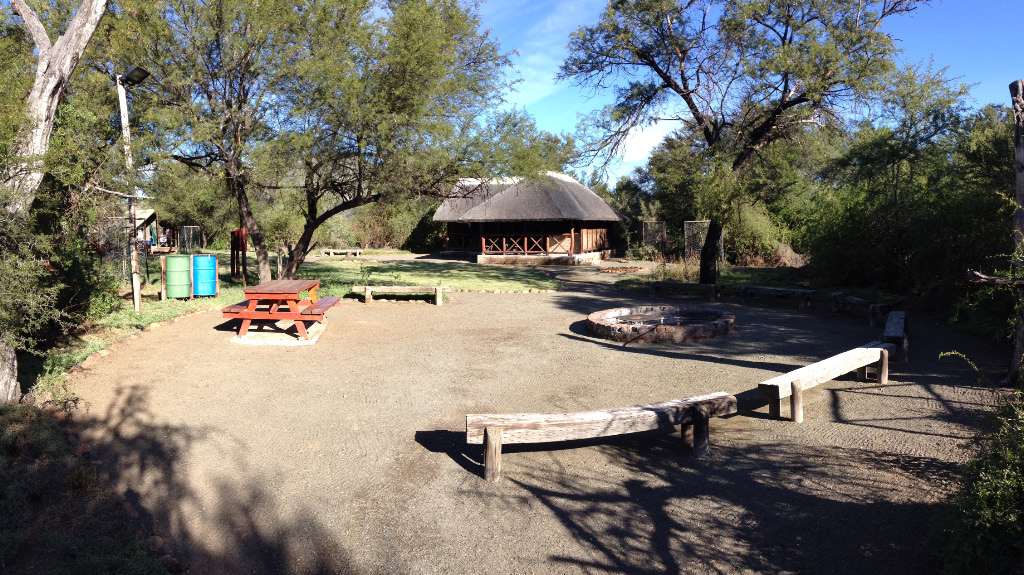
Camdeboo - Lakeview camp communal area
Camdeboo – Lakeview camp communal area
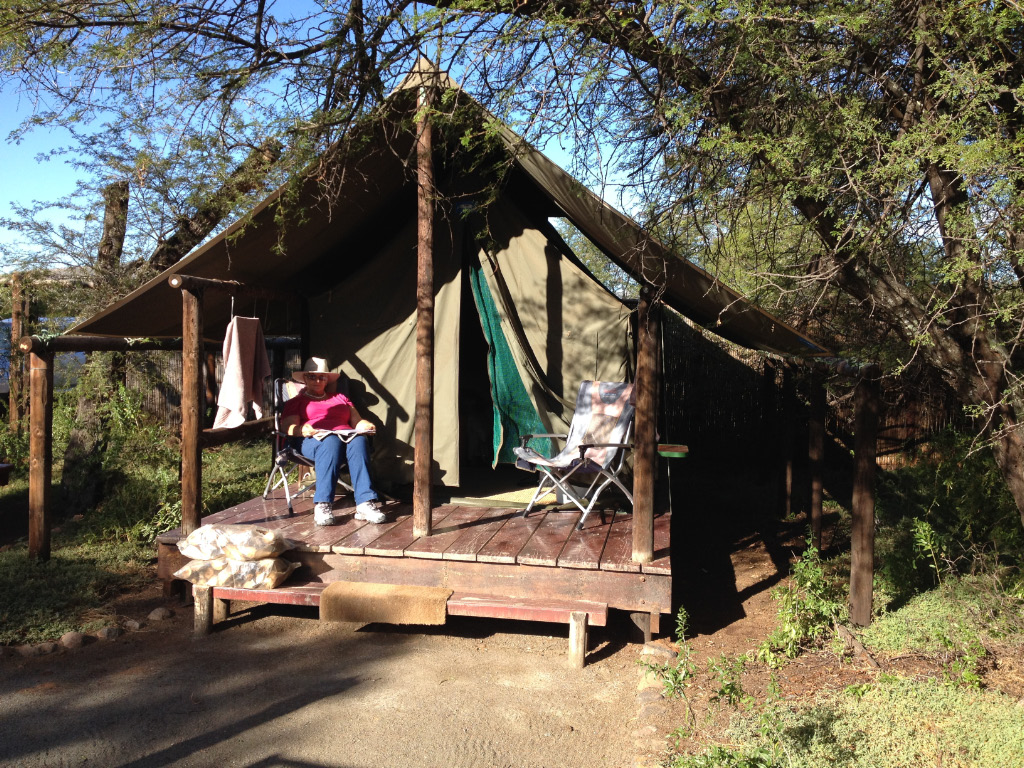
Camdeboo tent
Camdeboo tent – on a sunny autumn afternoon
Camdeboo - Lakeview tented camp
Camdeboo – Lakeview tented camp
Camdeboo - the neat abluions
Camdeboo – the neat abluions
Camdeboo - the showers
Camdeboo – the showers

The walk produced a number of species with Cape Robin-Chat, Karoo Scrub-Robin and Familiar Chat most prominent, drawn by the quite dense bush surrounding the camp.

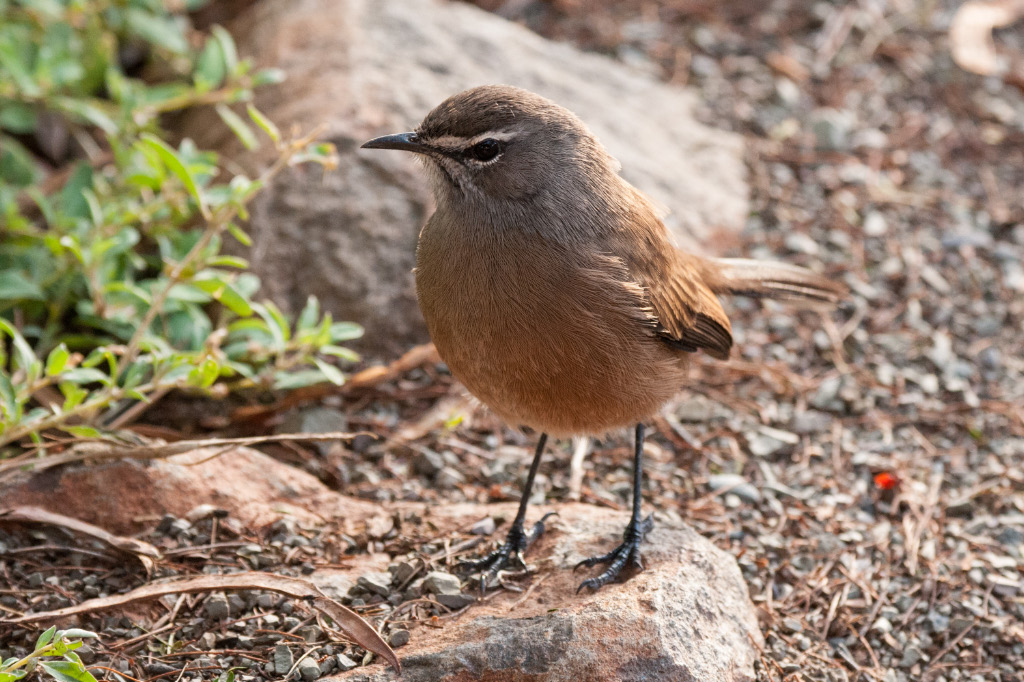
Karoo Scrub-Robin, Camdeboo NP

The call of a Pririt Batis resounded through the camp and I was able to track it down for a snatched photo.

Pririt Batis, Camdeboo NP

Yellow-fronted Canary (at the edge of its range by the looks of it), Chestnut-vented Titbabbler and Southern Double-collared Sunbird (phew those are long names) were all nice additions to the growing list. Not to be outdone by the birds, Striped Mice and Karoo Bushrats inhabit the undergrowth, the latter occupying large rambling nests built of hundreds of dry sticks – as you walk around they pop up to have a look and then scurry off or dart back into their nests.

Striped Mouse (Rhabdomys pumilio), Camdeboo NP
Karoo Bushrat (Otomys inisulcatus), Camdeboo NP

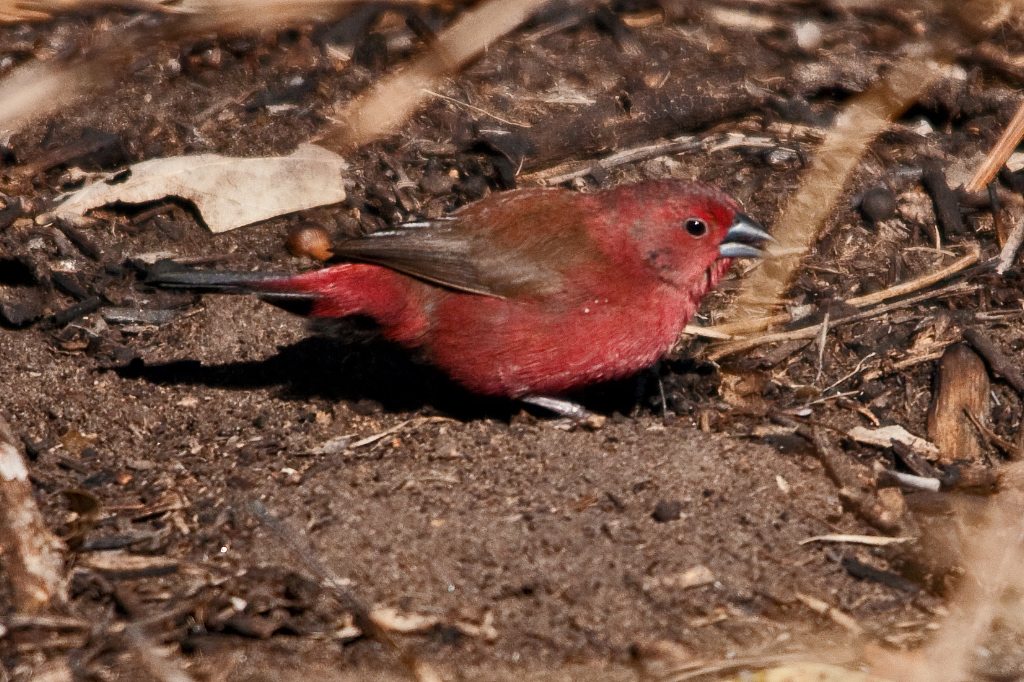
After tea it was time to explore the Park by car and we soon came across Anteating Chat, Fiscal Flycatcher and Red-billed Firefinch on the way to the bird hide which is not far from the camp.

Anteating Chat, Camdeboo NP

The neat hide sits at a distance from the water’s edge, which probably moves closer when the Nqweba dam is fuller. It still provided the chance to ID the few visible water birds such as Yellow-billed Duck, Cape Shoveler, Darter and SA Shelduck while the surrounding grass / bush had Black-throated Canary, Amethyst Sunbird and Bronze Mannikin to keep things interesting.

Back at the camp, Greater Flamingo were just visible through a gap in the tall reeds that block most of the view of the dam (making the name of the camp “Lakeview” a tad misleading).

Camdeboo NP - Nqweba Dam
Camdeboo NP – Nqweba Dam viewed from the camp


I was not entirely satisfied with my bird list up to then and took a late afternoon drive to the far side of the dam, ticking Ostrich and Hamerkop along the way as I crossed a stream, with Kudu browsing nearby.

Camdeboo NP
Camdeboo NP
Vervet Monkey, Camdeboo NP
Kudu, Camdeboo NP
Kudu, Camdeboo NP
A river runs through Camdeboo

At the viewpoint at the last stop on the road I had a good view across the water, which held Black Stork and Black-winged Stilt in the shallows and  Kittlitz’s Plover and the ubiquitous Three-banded Plover at the muddy edge.

Camdeboo NP - Nqweba Dam
Camdeboo NP – Nqweba Dam

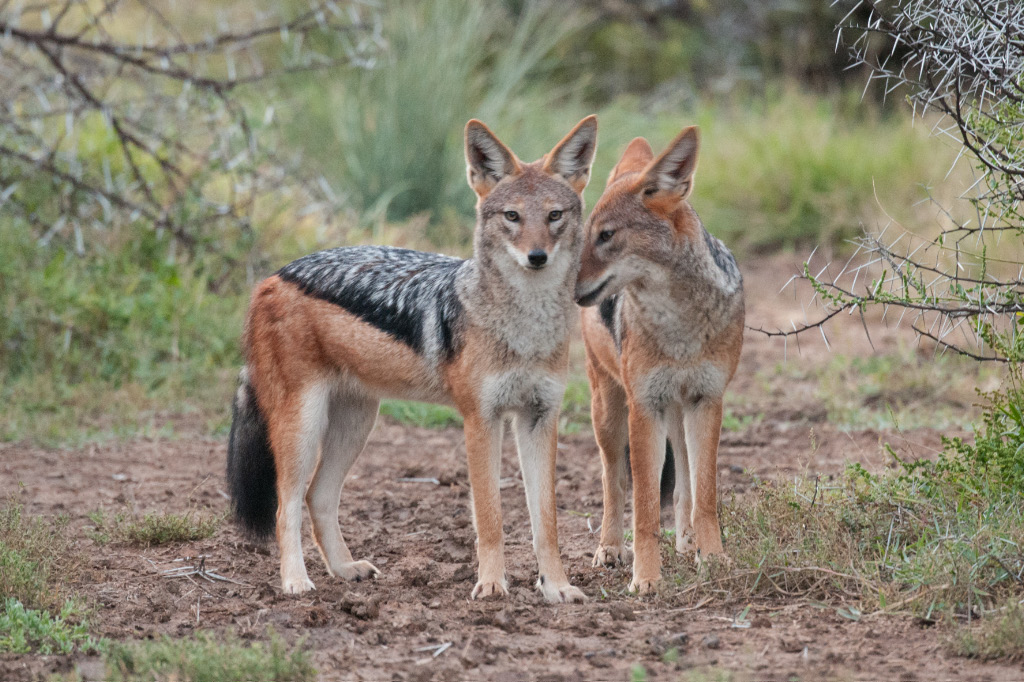
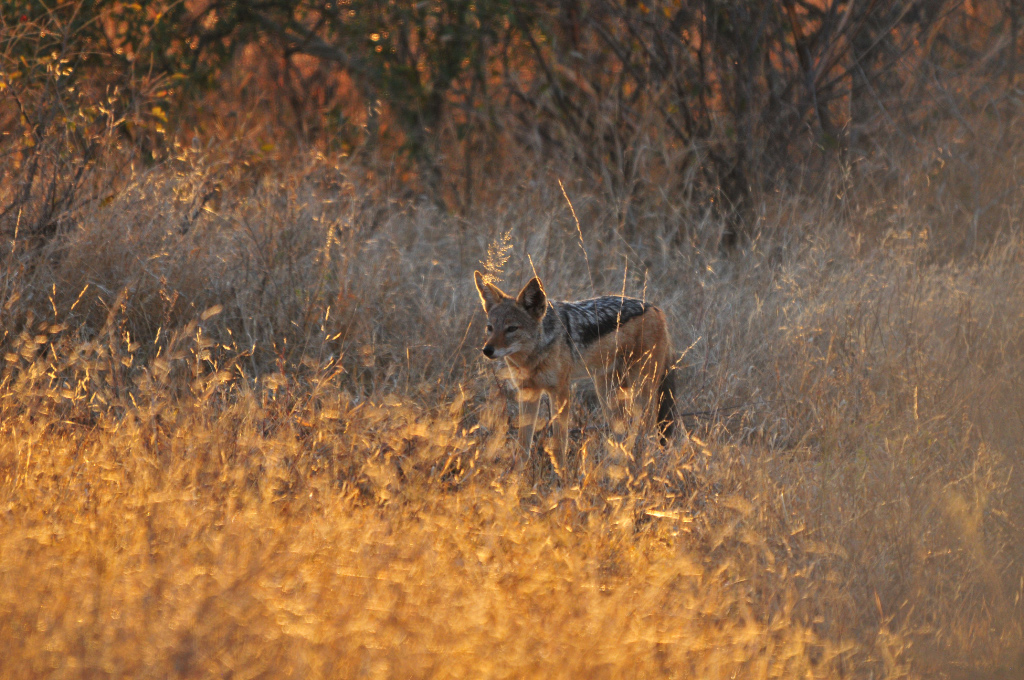
Heading back to the camp in the dusk, I came across a pair of Black-backed Jackals, the one nuzzling the other as I took some photos of this beautiful species. A few minutes later the sky turned a spectacular orange-red colour as the sun set.

Black-backed Jackal, Camdeboo NP
Camdeboo NP - Sunset deluxe
Camdeboo NP – Sunset deluxe

With just 2 nights booked, we made the most of the facilities on our second evening, braai-ing in the boma and eating out under the stars, wrapped up against the cold early winter air. That night it was colder in the tent and we slept with our woollen hats pulled down over our ears.

Monday 28 April

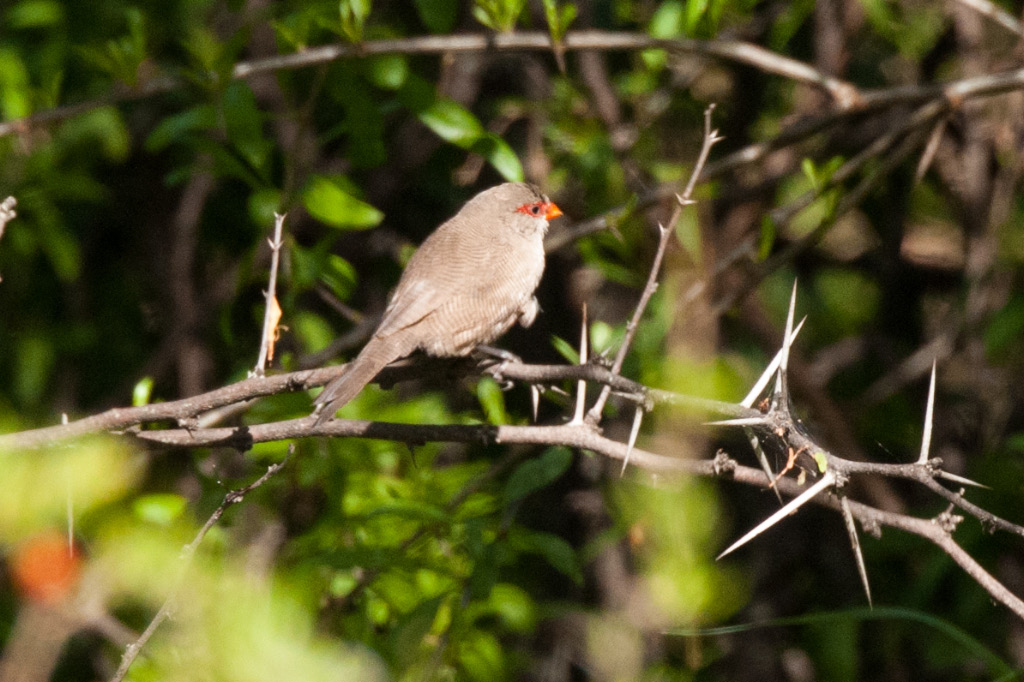
Our short stay was over and we set about packing the vehicles while still enjoying the surroundings, as a Fish Eagle called in the distance, a pair of Cardinal Woodpeckers made their way through the camp followed by a flock of Common Waxbills. A trilling call jogged my memory but it took me a while to realise it was a Namaqua Warbler, who remained well hidden in the denser bush.

Common Waxbill, Camdeboo NP
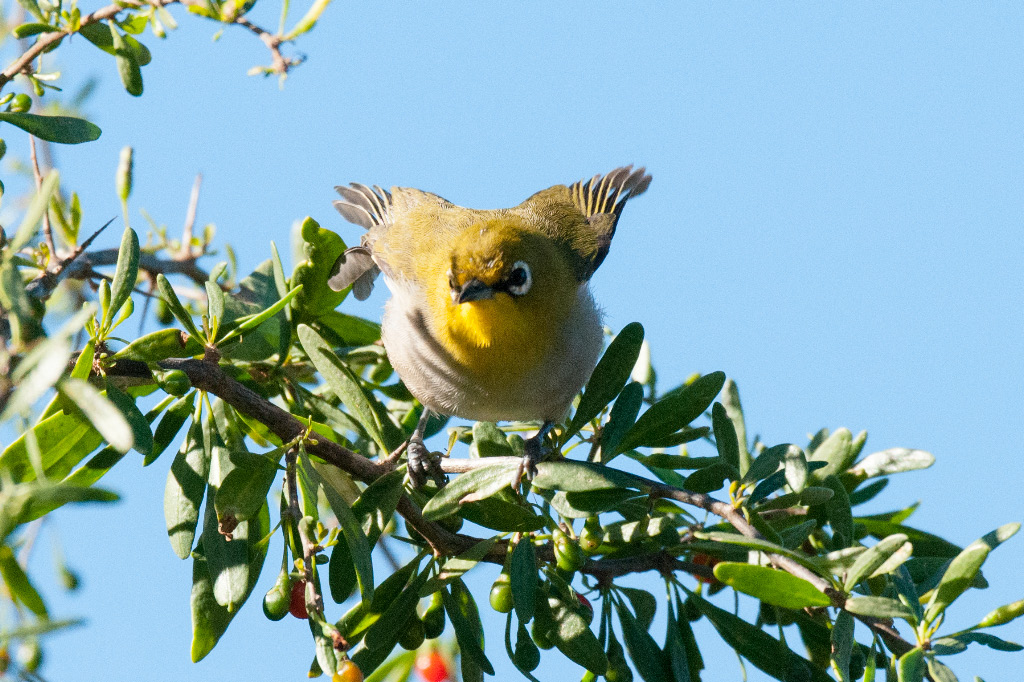
Cape White-Eye, Camdeboo NP
Lesser Air-Piper, Camdeboo NP

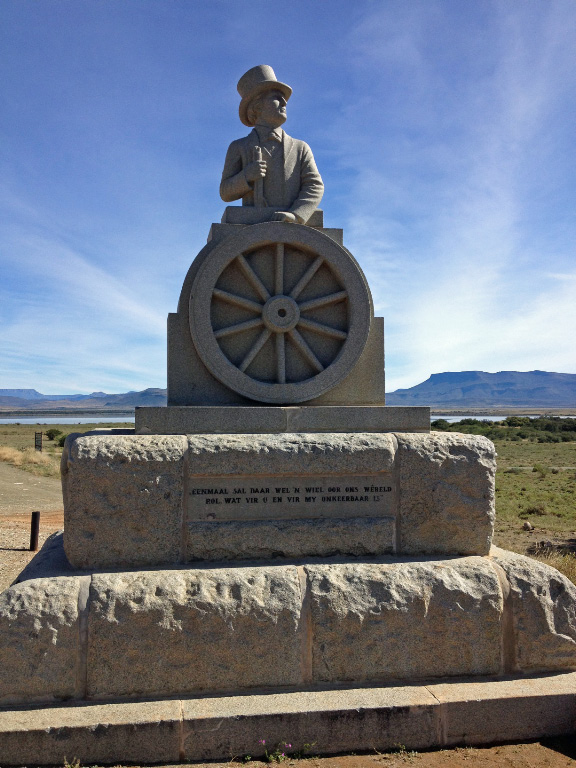
On the way out of Camdeboo, we visited the Andries Pretorius monument near the entrance –

Andries Pretorius monument, Camdeboo NP
Andries Pretorius monument

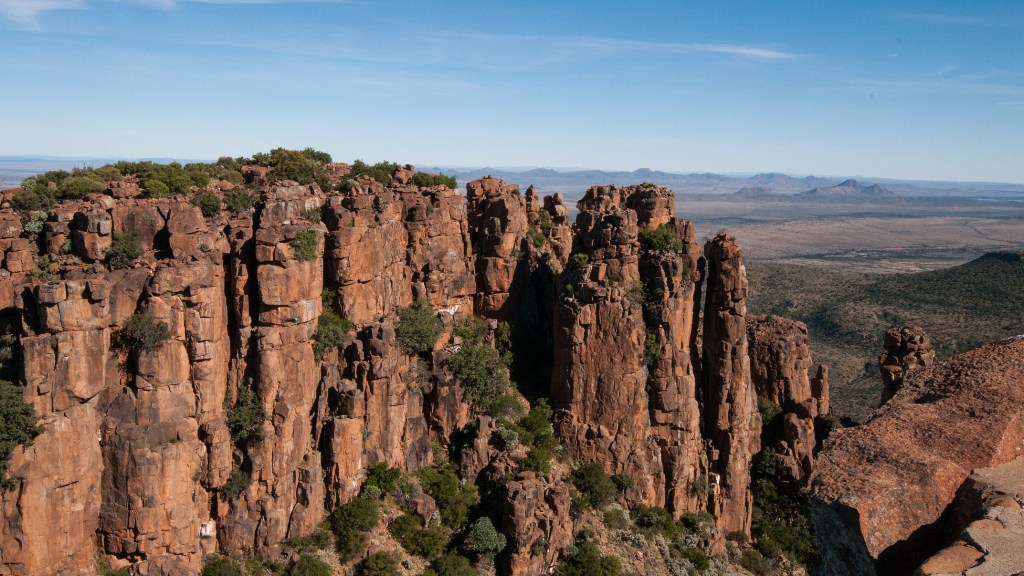
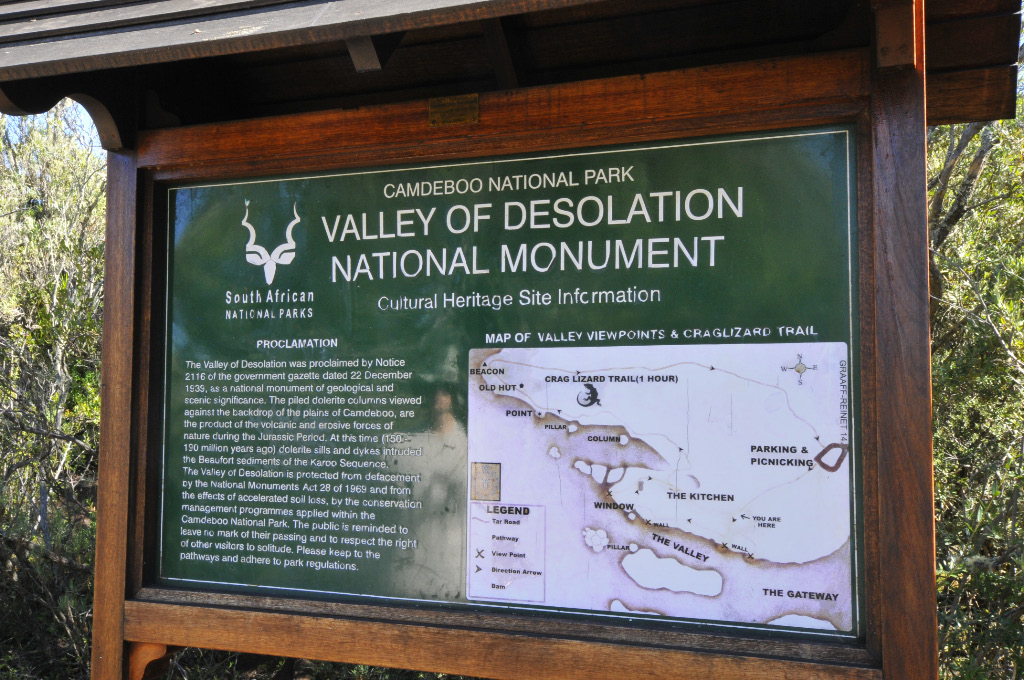
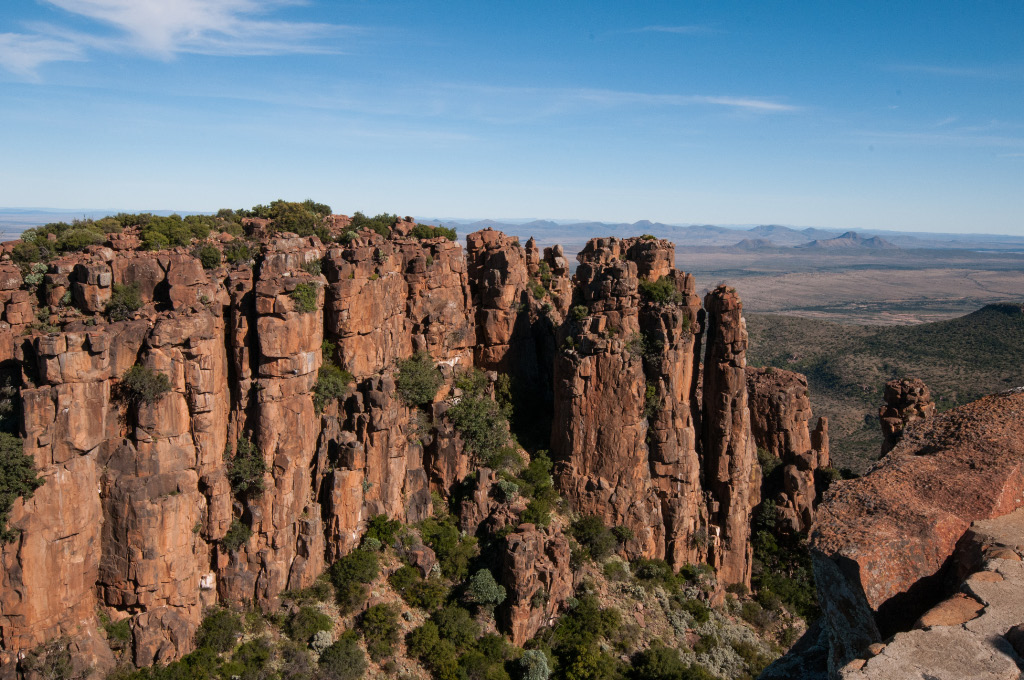
On the road at last, we stopped briefly to check out a Rock Kestrel before heading into town for a coffee stop at Polka cafe, then on to the other, very different, part of Camdeboo which harbours the Valley of Desolation, with its steep access roads through beautiful landscape, culminating in viewing spots that provide quite breathtaking views. The first of these looks down over the town of Graaff-Reinet way below and the second provides sweeping views across the flat plains of the surrounding Karoo, framed by the craggy peaks of the nearby mountains.

Camdeboo NP - Valley of Desolation

Valley of Desolation - approach road
Valley of Desolation – approach road
Camdeboo NP - Valley of Desolation
Valley of Desolation – Graaf-Reinet far below
Leonards at the viewpoint
Camdeboo NP - Valley of Desolation
Gerda at the Valley of Desolation viewpoint
Camdeboo NP - Valley of Desolation
Camdeboo NP – Valley of Desolation
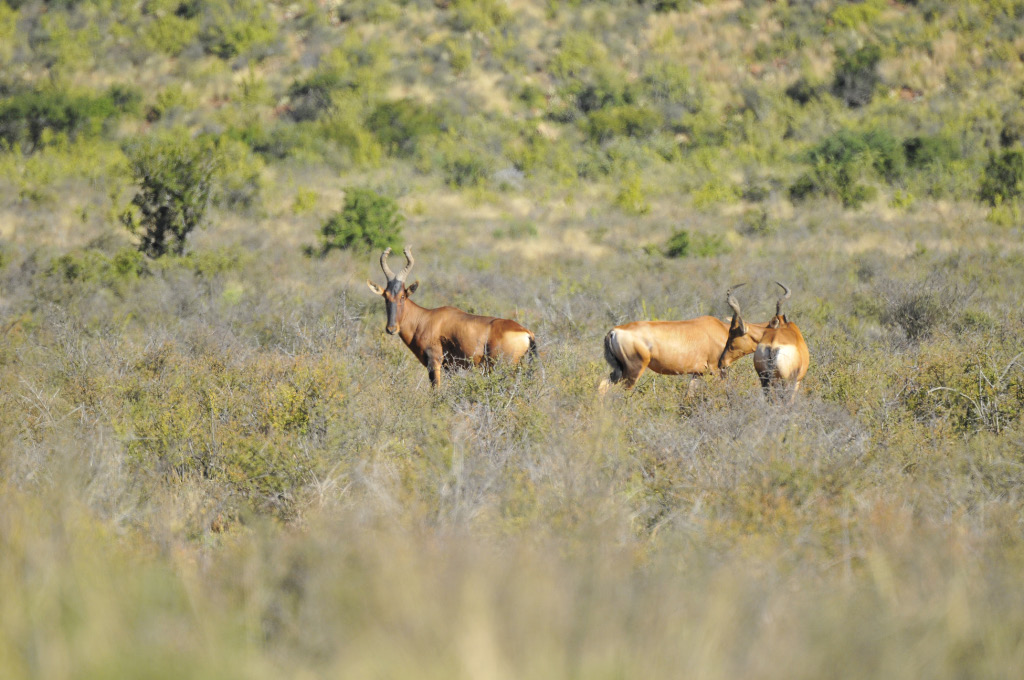
Red Hartebeest, Camdeboo NP

This was also a good spot to enjoy our padkos burgers before heading back down the mountain road and on to our next destination near Cradock – Mountain Zebra National Park – which turned out to be a lot more impressive than we had expected. More of that in Part 3 of this series.


Four Parks and a Wedding (Part 1) – De Hoop

Where to this time?

The thing about being “semi-retired” is that it gives you lots of time to travel and Gerda and I tend to make the most of it while we are able. With our second home being in Mossel Bay, we do like to spend as much time there as we can afford, without abandoning our Pretoria ties completely.

And so it happened that we decided to spend the Easter period this year in Mossel Bay – then, fortuitously, we received an invite to a wedding at De Hoop Nature Reserve over the weekend before Easter, and on top of that our daughter and son-in-law suggested we do a week’s touring through the Eastern Cape during the school break at the end of April, with 2 or 3 night stays at three National Parks – Camdeboo near Graaf-Reinet, Mountain Zebra a bit further east near Cradock and Addo Elephant Park not far from Port Elizabeth. Now that’s an offer that was difficult to refuse. We had been to Addo before – just last year for the first time – but the other three parks would all be first-time visits, which is something we are looking forward to.

Starting off – overnight in Springfontein

As often happens, we were loaded to the hilt when we left Pretoria (actually our VW Touareg was) – there are always surplus items from our main home which need transporting to Mossel Bay and this time was no different, plus our normal baggage. The trip to Mossel Bay is a two-day affair for us, so an overnight stop around halfway is always part of the planning. We have tried various B&B’s in the stretch between Bloemfontein and Colesberg / Hanover and they have all been quite acceptable – all you want is a comfortable bed, a clean shower that works properly and a decent dinner and breakfast and most have perfected those simple requirements. This time around we decided to try Prior Grange, a guest farm near Springfontein, as I had read that there was a Blockhouse from the Anglo-Boer war on the property and I was interested to see it.

Prior Grange, Springfontein
Prior Grange cottage - our home for the night
Prior Grange cottage – our home for the night


Having left Pretoria a bit later than we had hoped, knowing we had over 600 km to travel, we nevertheless reached Prior Grange in good time and, after settling in, I drove the further 4 km to the hill on which the blockhouse was perched. According to Blackie de Swardt from Prior Grange, there were some 8000 of these block houses built by the Brits across South Africa, approximately 1000 yards apart so that they were visible to the next one, of which only 50 or so originals remain – he went to the trouble of rebuilding this one on the old foundations and well done to him, as it gives you a feel for what it would have been like to man these structures, watching over the railway line and the surrounding veld well into the distance.

British Block house, Anglo-Boer War
View from the blockhouse

At the same time I worked on a bird list for the pentad, which proved to be quite productive – Wattled and Pied Starlings were plentiful and a Desert Cisticola posed on the fence, while Cliff Swallows wheeled overhead near a culvert before settling in for the night. Common Waxbills twittered as they passed by in a flock and Barn Swallows swooped past, perhaps readying themselves for the long journey back north.

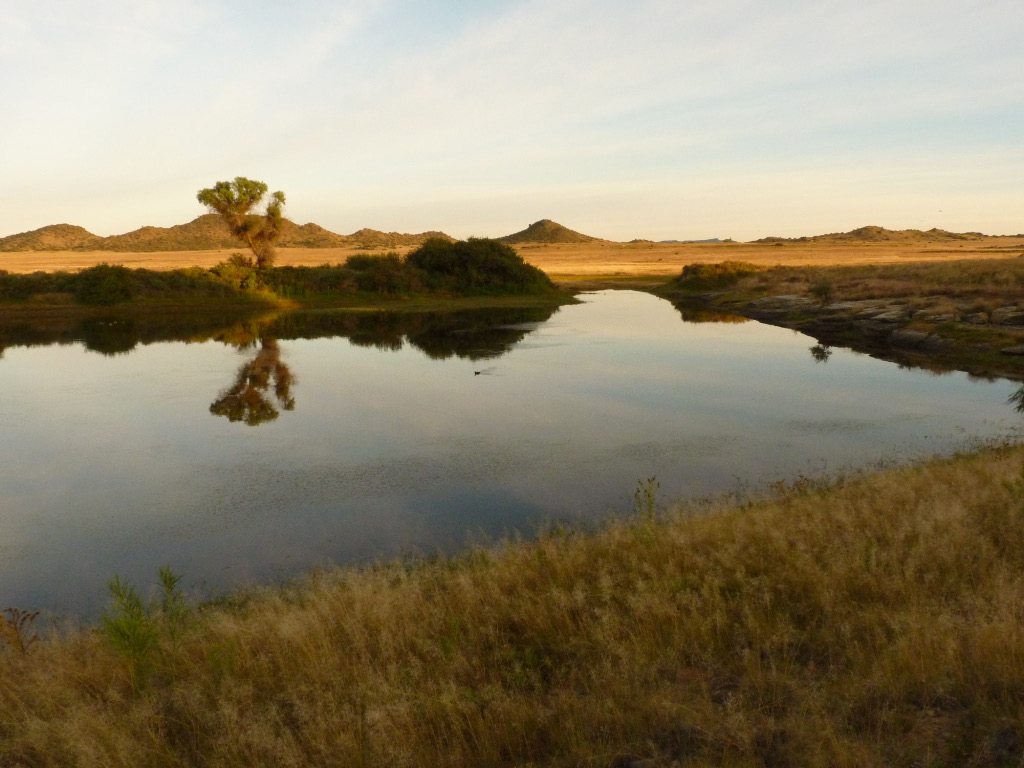
Next morning I was up at dawn to complete the 2 hours atlasing and walked to the dam just behind the main house. There I was met by a beautiful scene of dead still water in the soft morning light, reflecting the surrounding trees and disturbed only by the V-shaped ripples of the water birds enjoying the first light of day – I listed Red-billed Teal, Little Grebe, Cape Shoveler and a few handsome SA Shelducks.

The dam at Prior Grange

White-throated Swallows skimmed the water and a group of Spotted Thick-Knees flushed like magic from the grassy verge when I got close. Then it was time for breakfast and the second leg of the long drive to Mossel Bay.

De Hoop Nature Reserve

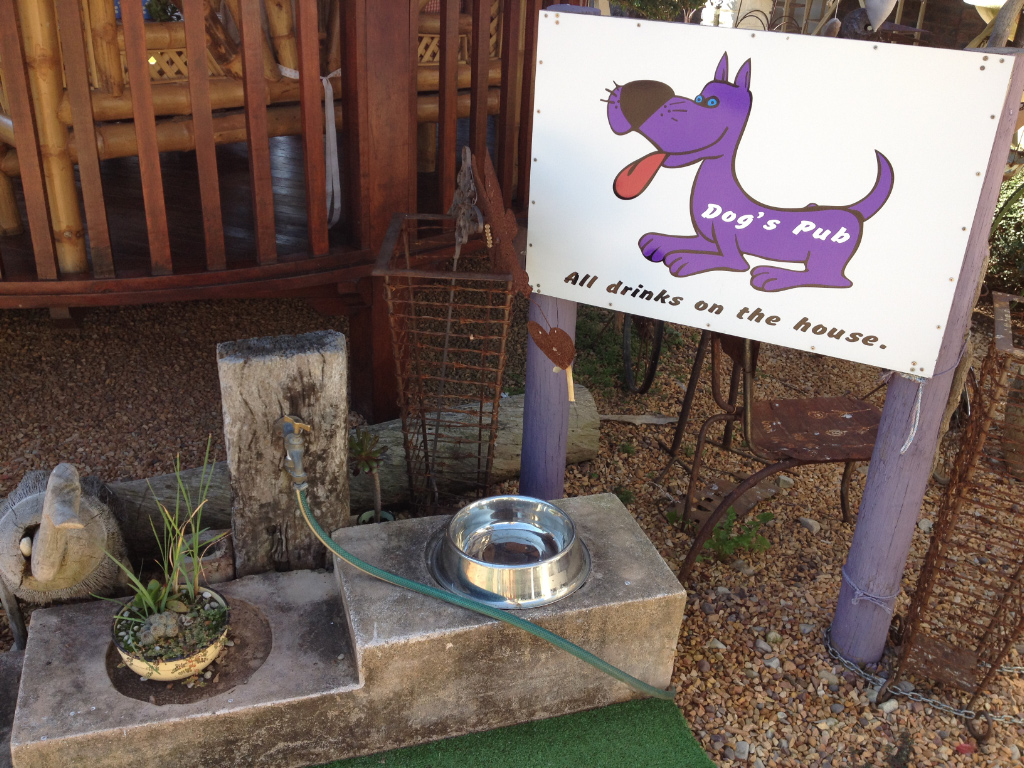
We had just two days at our home in Mossel Bay before it was time to travel again – to De Hoop for the “Wedding Weekend” of Louis and Amelda (Rossouw). De Hoop lies south-west of Swellendam and less than 200 km from Mossel Bay so we didn’t rush to get away and stopped at Riversdale for lunch on the way at a farm stall, which has the only “dog pub” I’ve come across.

IMG_1088

The last 50 km or so were on gravel and just before getting to the entrance gate to De Hoop we stopped for a photo of a pair of Blue Cranes which were mingling with some cattle at a watering hole – so intent was I on getting a good photo with my new lens that I didn’t notice I had stepped into …… (no, fortunately not what you were thinking) ….sticky yellow mud at the side of the road which immediately rendered my sandals unwearable. After checking in barefoot, Gerda kindly rescued my sandals by washing them and leaving them in the sun to dry – good as new again!

Blue Crane
Blue Crane


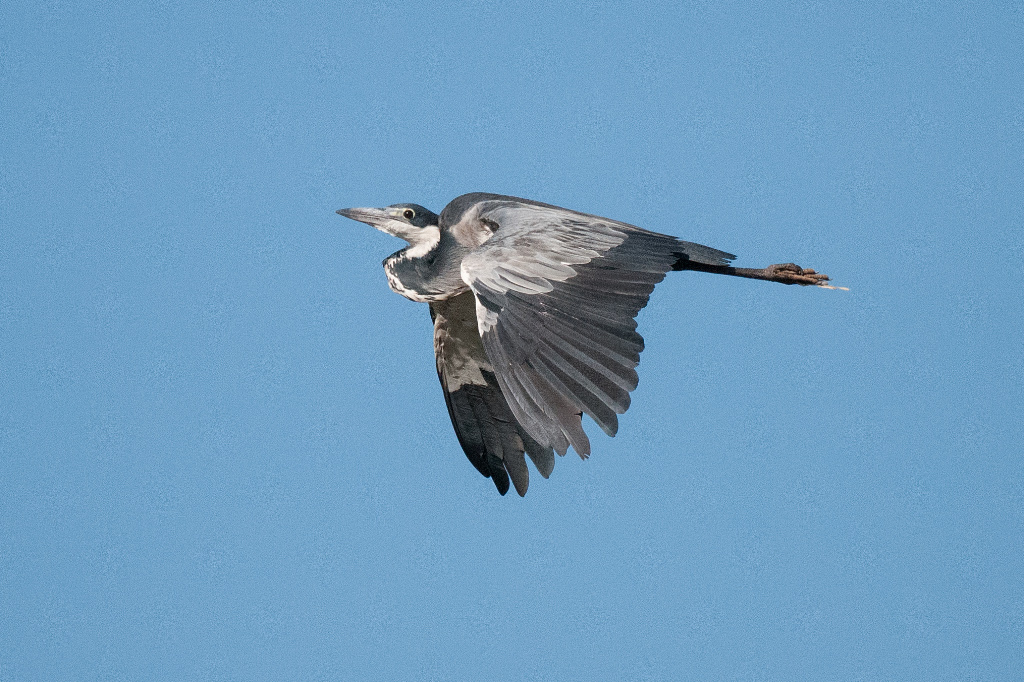
A Black-headed Heron flying off proved to be a good time to test my new lens’ ability to handle a Bird-in-flight – I was quite pleased with my new purchase.

Black-headed Heron
Black-headed Heron

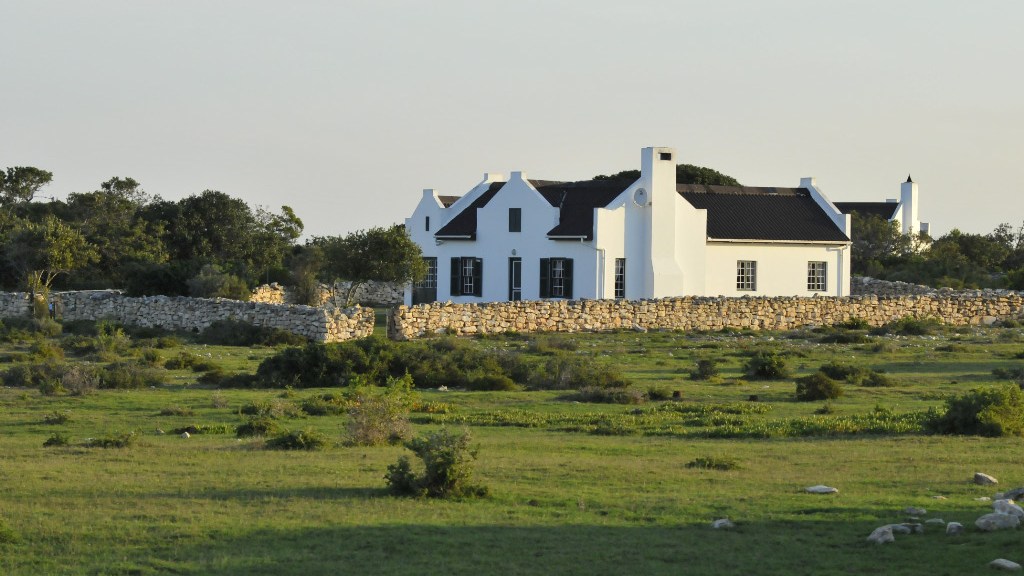
From the entrance gate it was a short drive to the “Opstal” and by 5pm we were settled into our spacious and comfortable cottage – Black Oystercatcher cottage – which we would enjoy for the next three days. Birding started as we approached the complex of white-painted buildings and once we were settled in I took a walk to the Vlei, which I discovered is a large body of water trapped for centuries by the dunes bordering the nearby coastline and which has dried up completely in dry years, but right now seemed massive and full to the brim. On the walk to the vlei I came across some relaxed birds all of the “Cape” variety – Cape Robin-Chat, Cape Spurfowl and Cape Weaver – basking in the late afternoon sun.

Cape Robin-Chat, De Hoop NR
Cape Robin-Chat
Cape Spurfowl, De Hoop NR
Cape Spurfowl


Cape Weaver, De Hoop NR
Cape Weaver

At the vlei I found tens of Egyptian Geese, Coots and Great Crested Grebes back-lit by the fast setting sun, and a Grey Heron or two keeping watch at the edge of the vlei. Walking along the cliffs that border long stretches of the vlei, I noted a number of Rock Martins preparing to roost for the night, while a flock of Glossy Ibises flew overhead on their way to their preferred roosting site. All of the while I was aware of the biting horse flies which made it difficult to stand still for any length of time. The sun set in a blaze of red-orange reflected across the water.

Sunset over De Hoop Vlei

Later on we enjoyed a fine dinner in the Fig Tree restaurant at the Opstal, which augured well for the rest of our short stay.

Exploring De Hoop

I had booked an extra day to allow time for some relaxed birding and atlasing, so only ventured out on Friday after a good lie-in to recover from an energy-sapping few days, starting with a slow drive past the short-grassed fields where several Capped Wheatears were showing and a flock of Pied Starlings were moving about in chattering fashion. Also present were Bontebok which are plentiful in the reserve and some colourful butterflies.

Bontebok
Bontebok
False dotted-border (Belenois thysa thysa)

Heading towards the coastal dunes I was really pleased to come across a group of Cape (there it is again) Penduline-Tits, which I have only seen a handful of times in all my years of birding – as a bonus I was able to get a distant photo or two before they moved off again.

Cape Pendiline-Tit, De Hoop NR
Cape Penduline-Tit

Further on, the vlei had encroached onto the road and, as the Opstal manager had told me last evening, there were a lot of birds taking advantage of the shallow water with plenty of  food for all types. Spoonbills were prominent along with Darter, White-breasted Cormorant, Cape Teal, Little Grebe and a family of Cape Shovelers. Also in the scene were Pied Kingfishers hovering and diving now and then, Purple Heron flying in and landing gracefully near some Little Stints and Wood Sandpipers. On the opposite shore a few Great White Pelicans pottered about.

De Hoop Vlei - over the road
De Hoop Vlei – over the road
Vlei at De Hoop
Vlei at De Hoop
Spoonbill, De Hoop NR
Spoonbill
Cape Shoveler, De Hoop NR
Cape Shoveler

Carrying on along the road to the “Melkkamer”, a quiet inlet held Great Crested Grebe, Little Grebe and an African Darter stretching its wings, while the roadside bush was quite productive with the customary fynbos species such as Grey-backed Cisticola and Cape Grassbird, as well as Bar-throated Apalis noisilycompeting with Karoo Prinia for attention – if the latter two were schoolkids they would be the ones always being scolded for talking too much.

Great Crested Grebe, De Hoop NR
Great Crested Grebe
Little Grebe, De Hoop NR
Little Grebe
African Darter, De Hoop NR
African Darter
Karoo Prinia, De Hoop NR
Karoo Prinia

I turned around at the gate to the protected area and headed the opposite way to Koppie Alleen where I took a brief walk on the high dunes – the pentad ended just short of the parking area at Koppie Alleen, but not before I had seen a beautiful Black Harrier floating low above the dunes in their typical butterfly like way.

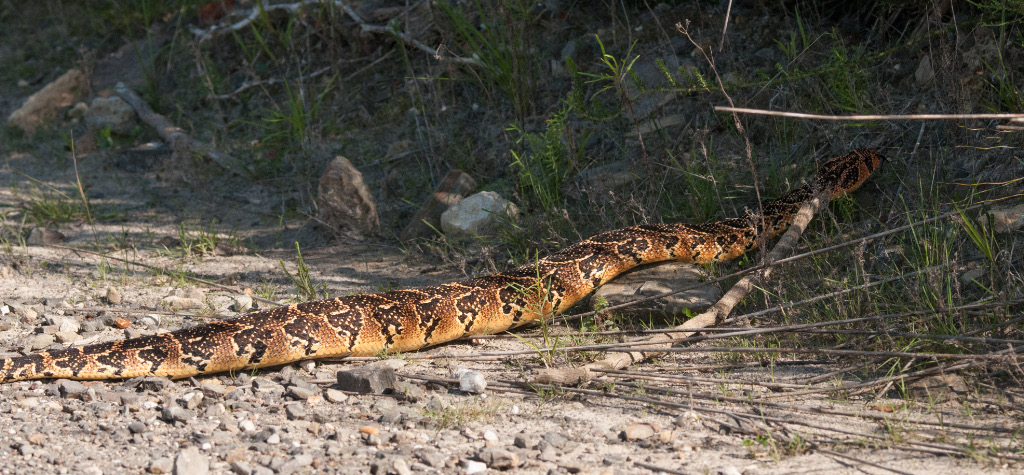
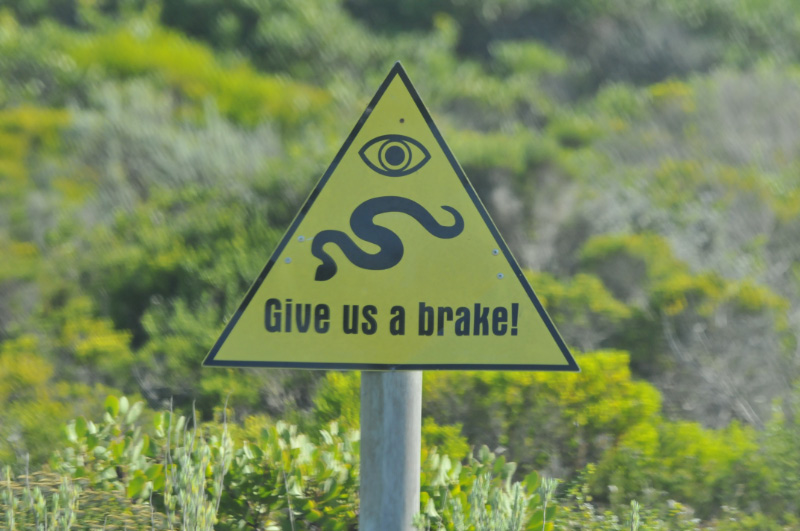
On the way I had an interesting sighting when I spotted a Cape Bunting in the road, only to discover it was “chasing” a large Puff Adder across the road and into the thick bush. Not for nothing then that signs have been erected warning visitors to brake in time for snakes in  the road.
Puff Adder
Puff Adder

101_7340


Wedding Day!

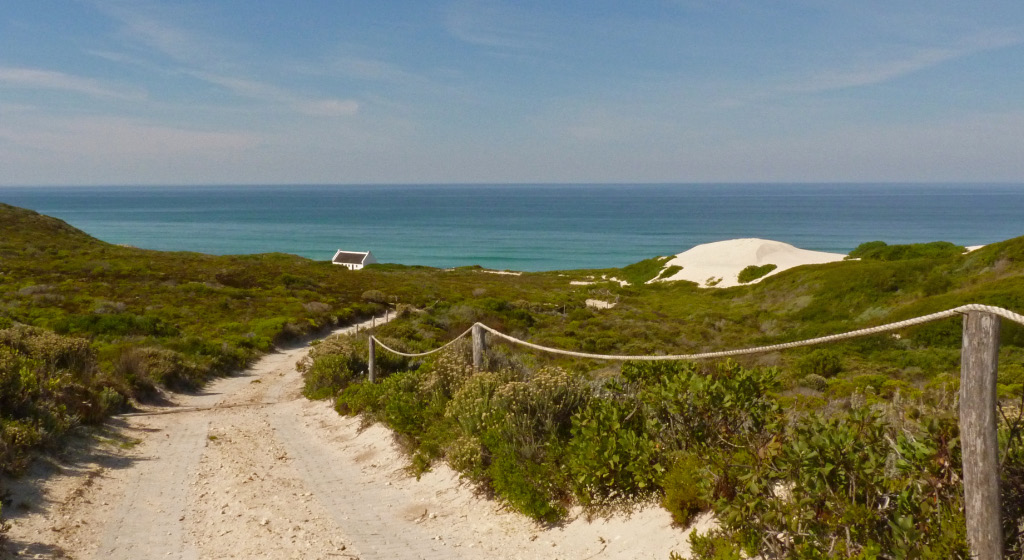
Saturday dawned bright and sunny – and warm for this time of year. The ceremony was only at 4 pm so there was time for further birding and I decided to return to Koppie Alleen to explore the beach which had looked enticing from high up on the dunes. The 15 km from the cottage took about 45 minutes with a brief stop at the vlei and I began to atlas the pentad at Koppie Alleen by 8.30 am, with Cape Bulbul featuring prominently in the fynbos on the long walk from the parking area down to the beach.

De Hoop NR - Koppie Alleen
De Hoop NR – Koppie Alleen
Cape Bulbul, De Hoop NR
Cape Bulbul

Southern Double-collared and Malachite Sunbirds flitted about busily and vociferously while a few Barn Swallows proved that they hadn’t begun their long trek northwards just yet. Maybe they’d heard about the long cold European winter and were holding out as long as possible.

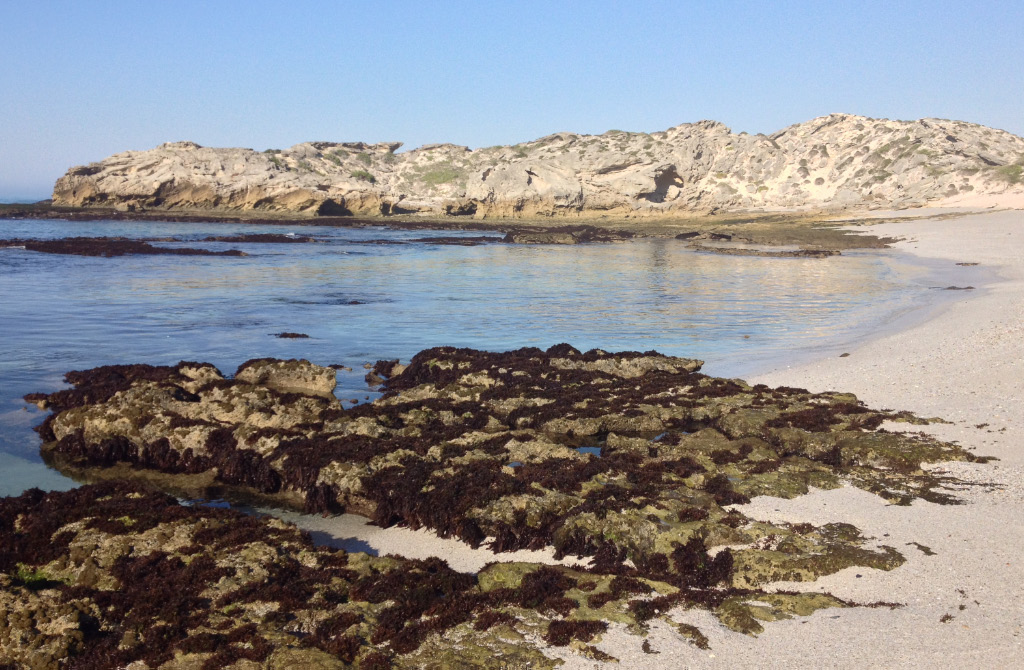
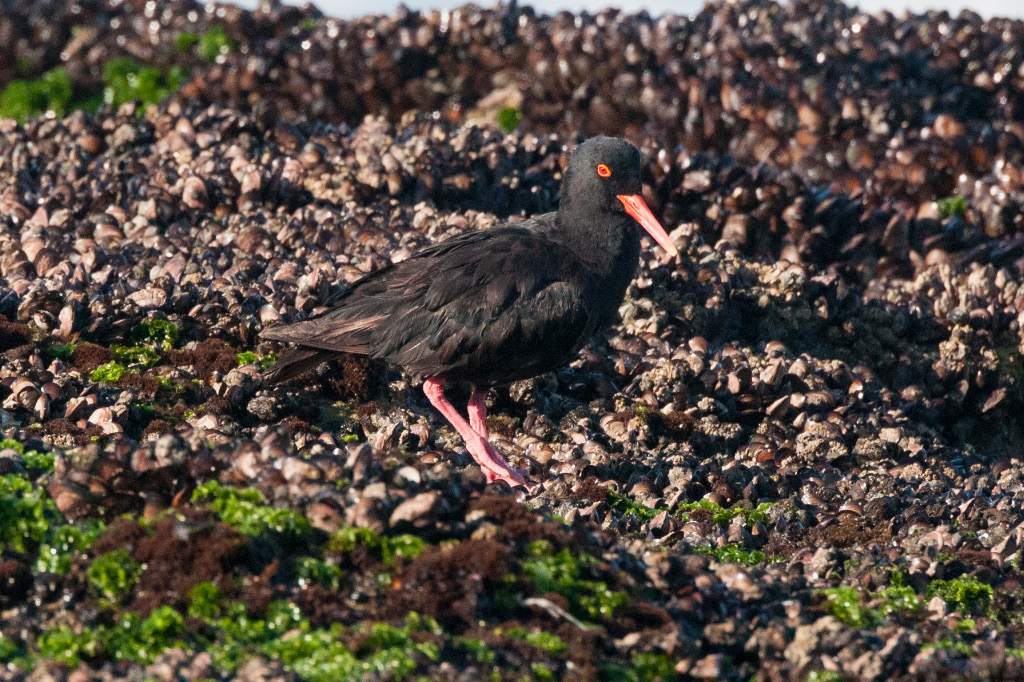
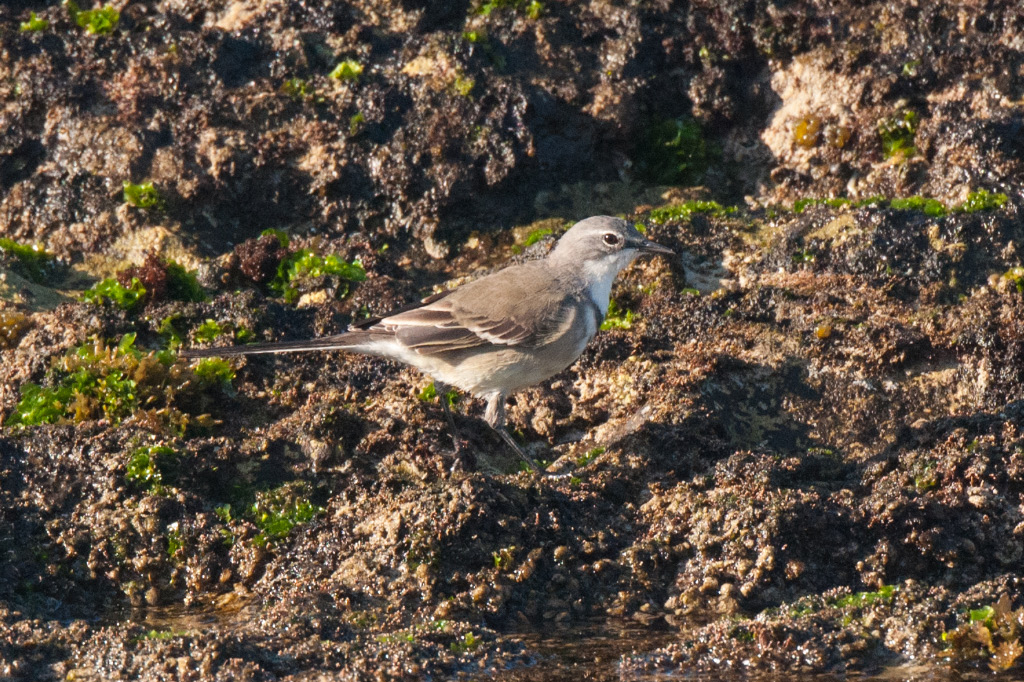
The beach, once I got there, was deserted except for a few Kelp Gulls, White-breasted Cormorants, African Black Oystercatchers and a few Cape Wagtails – later on the beach would see a handful of visitors but right now it was just me and the wide expanse of sand and rocks. It seemed to be low tide,as the rocks in the inter-tidal zone were exposed, some with crystal clear pools of water trapped between them. It was nice to see no sign of the plastic litter that is a feature of much of the coastline nowadays, just thousands of pristine seashells left behind by the tides.

Beach at Koppie Alleen
African Black Oystercatcher
Cape Wagtail, De Hoop NR
Cape Wagtail

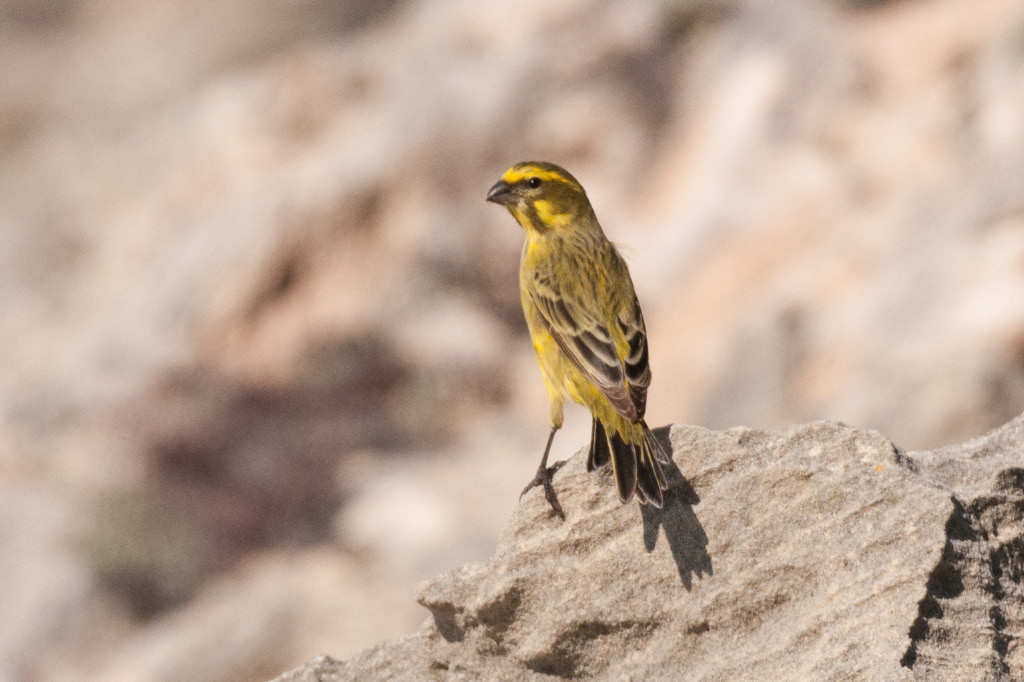
A little unexpectedly, a Yellow Canary and Familiar Chat joined me on the beach, then a small flock of waders flew past which I was able to ID as Sanderlings based on their small size, tail pattern and call.

Yellow Canary, De Hoop NR
Yellow Canary
Familiar Chat, De Hoop NR
Familiar Chat

A boardwalk over the dunes and higher rocks was very welcome in getting past the rocky barriers between the beaches.

Beach at Koppie Alleen
Just me and the birds
Just me, my Hi-tecs and the birds

Trekking back up the long and sandy road (time to hum the similar-titled Beatles song), a Jackal Buzzard and a Black Harrier helped to close out the pentad before I made my way back to the cottage, then on to lunch. The wedding ceremony was held out in the open overlooking the vlei – I had to wonder where else you can carry on birding during a wedding, as I watched a Bokmakierie close by and the waterfowl on the vlei in the distance.

Louis and the minister (his dad Johan)
Louis and the minister (his dad Johan) await the arrival of Amelda

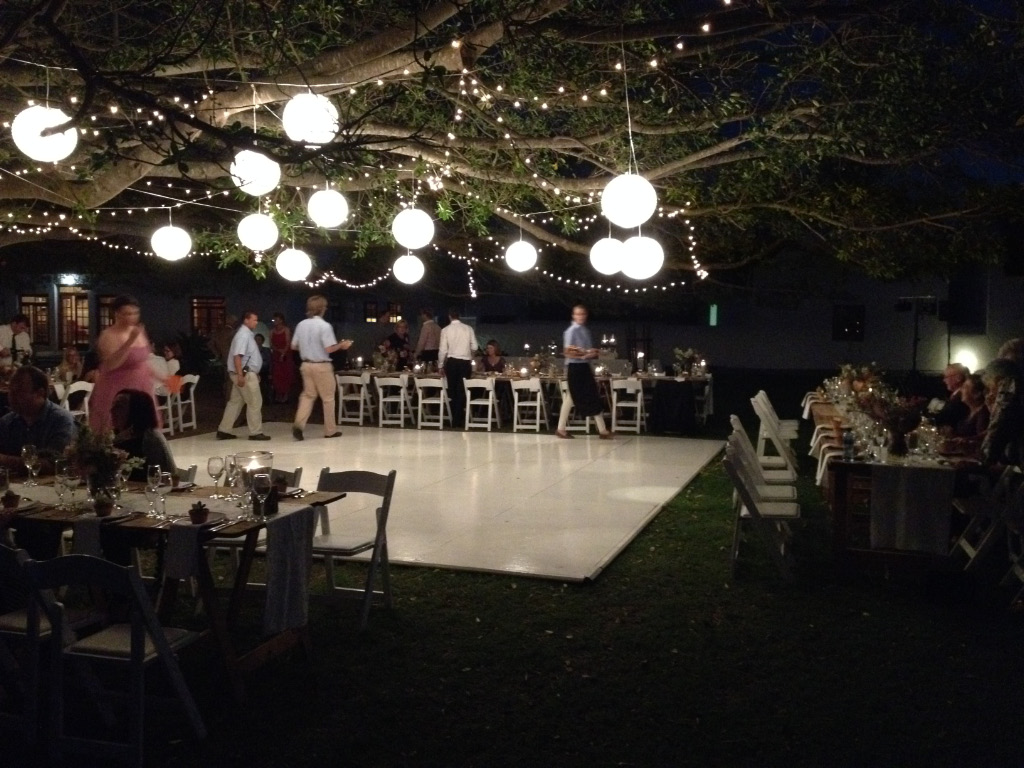
The reception was equally “cool” being held under the massive Fig tree near the restaurant and as darkness fell the lights strung around the branches turned it into a veritable fairyland – with fairy princess and all. Needless to say the evening was enjoyed by all and the younger set danced till the early hours. The perfect weather was made for partying outdoors.

Louis and Amelda - all over bar the dancing
Louis and Amelda – all over bar the dancing
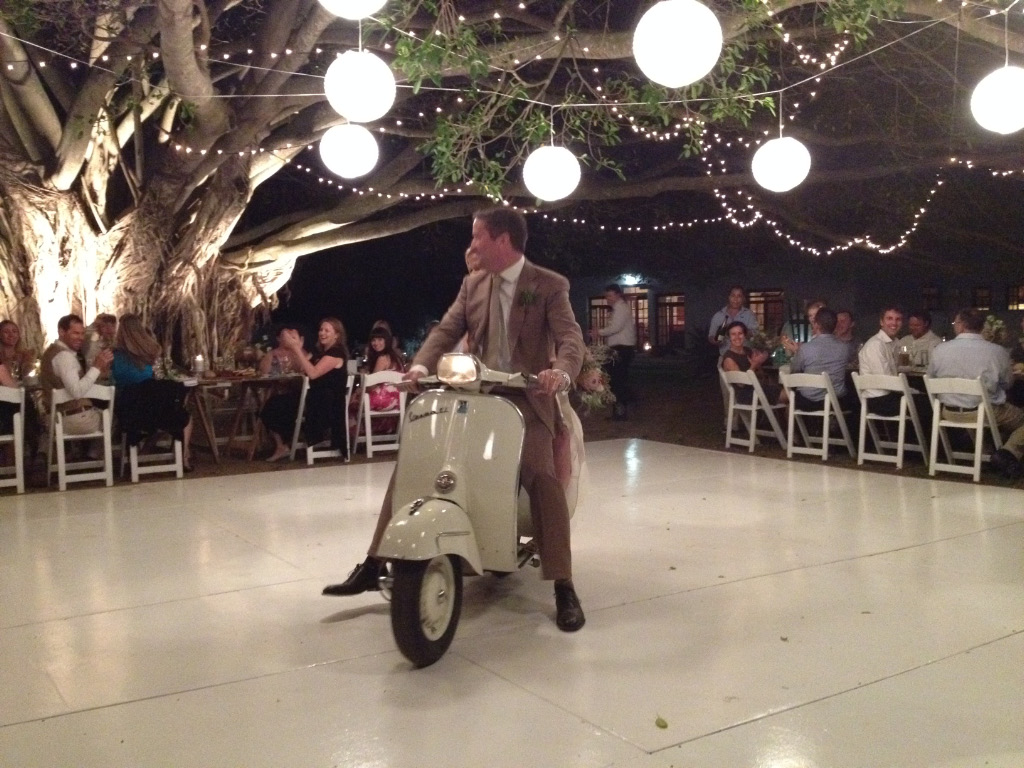
Louis and Amelda arrive at the reception in style
The reception under the grand old Fig tree

After breakfast on Sunday morning and goodbyes, we set out for our next stop – Stellenbosch with a quick look-in at De Mond Nature Reserve. More on that at another time.

This Saturday 26 April will see us starting the next leg of our Four Parks tour – starting with Camdeboo National Park at Graaf Reinet


Potchefstroom – Bird Sanctuary surprise

Why Potch?

Potchefstroom and the surrounding area does not immediately spring to mind when considering where to go birding, however it is one of those parts of South Africa that is quite rewarding if you “dig a little deeper” and the good thing about atlasing is it can be done anywhere.

Our son Stephan and his family – wife Liesl, kids Jocelyn and Christopher –  have been resident in Potch for a few years now and we tend to visit them on a fairly regular basis, especially when one of the grandkids is having a birthday, as it’s an easy 2 hour’s drive from our home in Pretoria. When we visit it is usually for at least a weekend, so I always try and fit in some early morning atlasing and have atlased a number of pentads (5 x 5 minutes if measured by coordinates, about 8 x 8 km’s in actual size) over the past few years, most of which do not attract atlasers, making the effort seem that much more worthwhile.

So what’s Potch got?

It has a University (which my wife Gerda attended back in the late 1960’s so clearly a top university) and a nice “small town” feel – you don’t have to go very far for anything and traffic is not really an issue. It also has a Bird Sanctuary – the OPM Prozesky Bird Sanctuary – which I was aware of but didn’t get around to visiting until March 2013, probably because my experience of bird sanctuaries in general has been mixed.

OPM Prozesky Bird Sanctuary

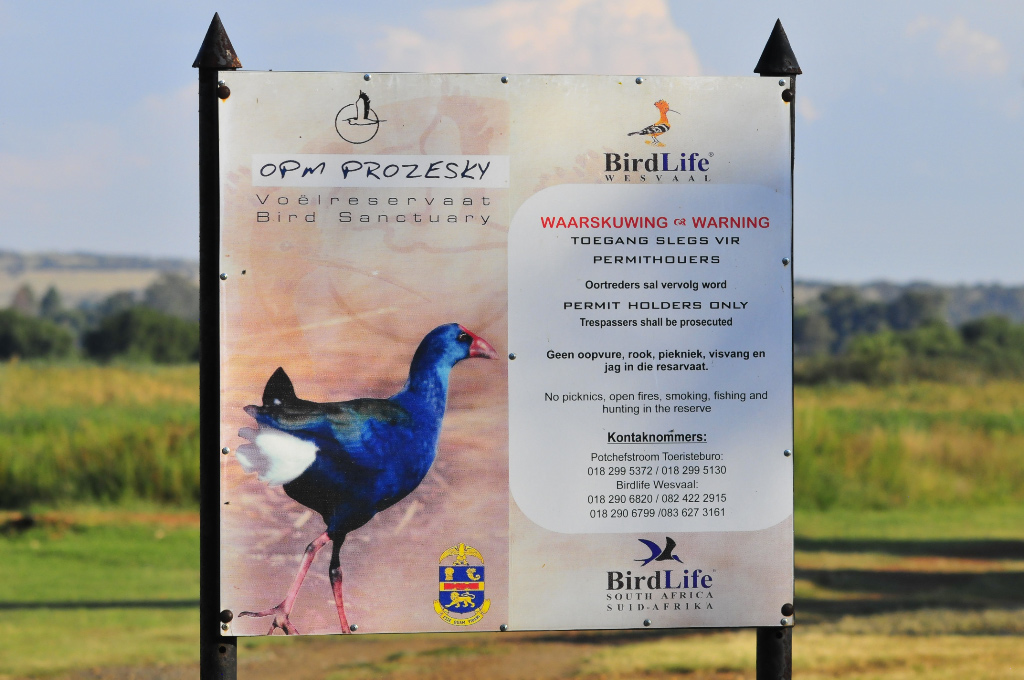
I was glad that I ignored my better judgement and the lukewarm response of a few Potchers when I enquired about the bird sanctuary, and paid it a late afternoon visit. The sanctuary borders the suburbs on the southern side of Potch and adjoins the sewerage treatment works so the smell may be a problem for some but I found it entirely bearable during my 2 hour visit. I parked at the entrance where there is a small office, but as there was no one in sight I proceeded to walk towards the ponds. Encouragingly, there was a signboard erected by Birdlife Westvaal which provided some info on the sanctuary.
OZM ProZesky Bird Sanctuary Potchefstroom
OPM Prozesky Bird Sanctuary, Potchefstroom

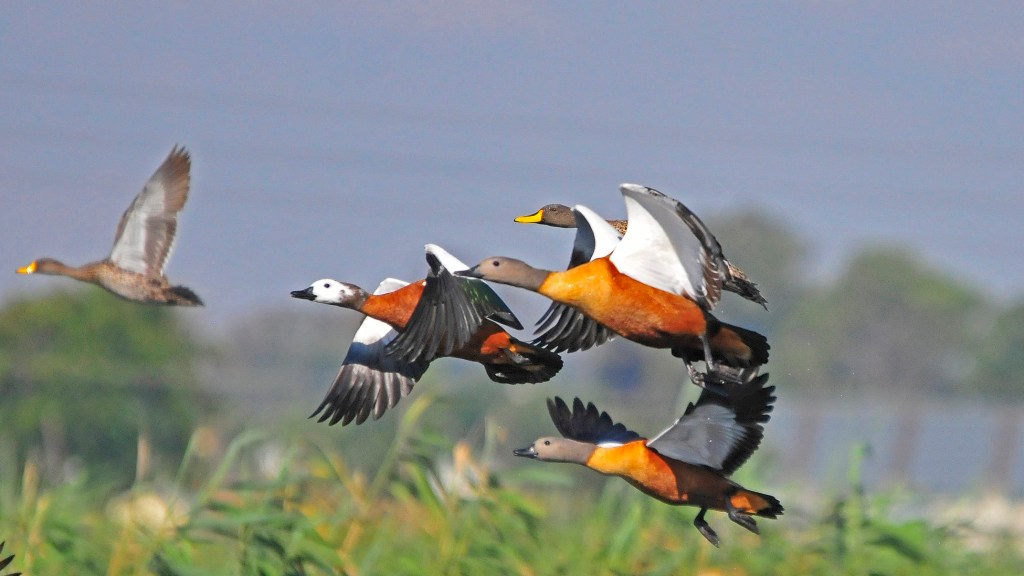
The sanctuary comprises a number of large ponds, some with neat bird hides, with wide pathways around and between the ponds which make for a pleasant walk, while keeping an eye out for birds in the sometimes dense undergrowth along the pathways. Where there are gaps in the vegetation you can look over the ponds which were well populated with Ducks (Yellow-billed Duck, South African Shelduck) and Teals (Cape Teal, Red-billed Teal). As I got too close for their comfort the Ducks and Teals took to the air and wheeled around, landing on a more distant part of the same pond or moving to an adjoining one.

SA Shelducks and Yellow-billed Ducks

As they flew past I was able to get photos of the Shelducks, Male and female showing how they differ in plumage, particularly from the neck up.

SA Shelduck, male following female (so what else is new?)

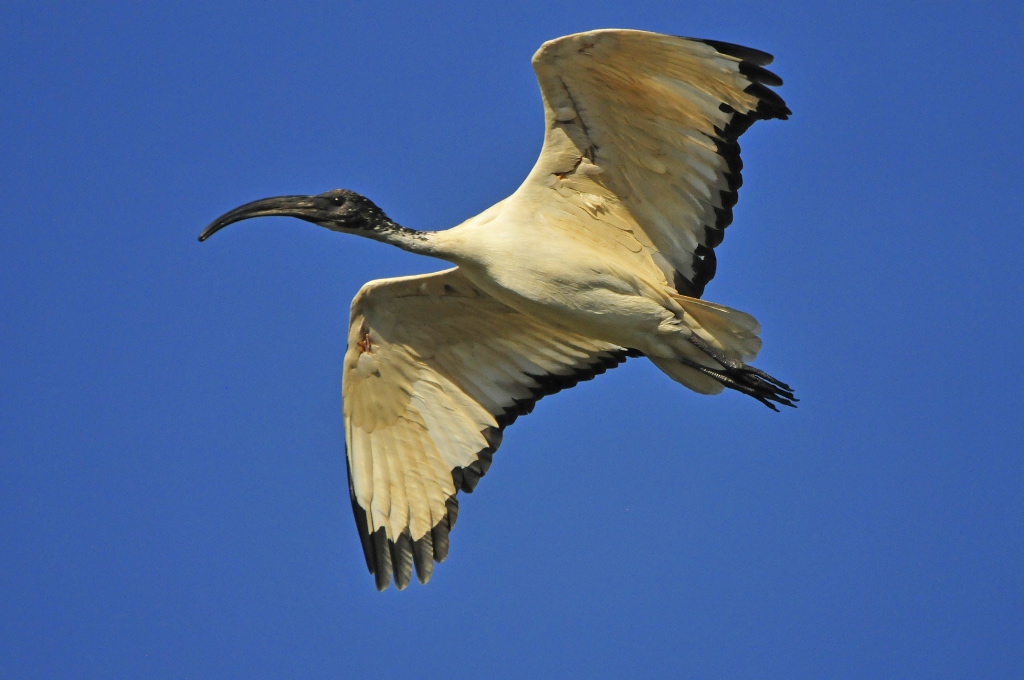
Sacred Ibises were also plentiful and doing their best to look elegant as they flew up and past me, though not quite managing it. The Afrikaans name Skoorsteenveër translates literally to “chimney sweep”  – clearly from images of chimney sweeps in Europe of old, getting ready to wash after a day’s work, blackened by soot on the face, neck and arms, otherwise lily-white over their body.

Sacred Ibis
Sacred Ibis (Skoorsteenveër)

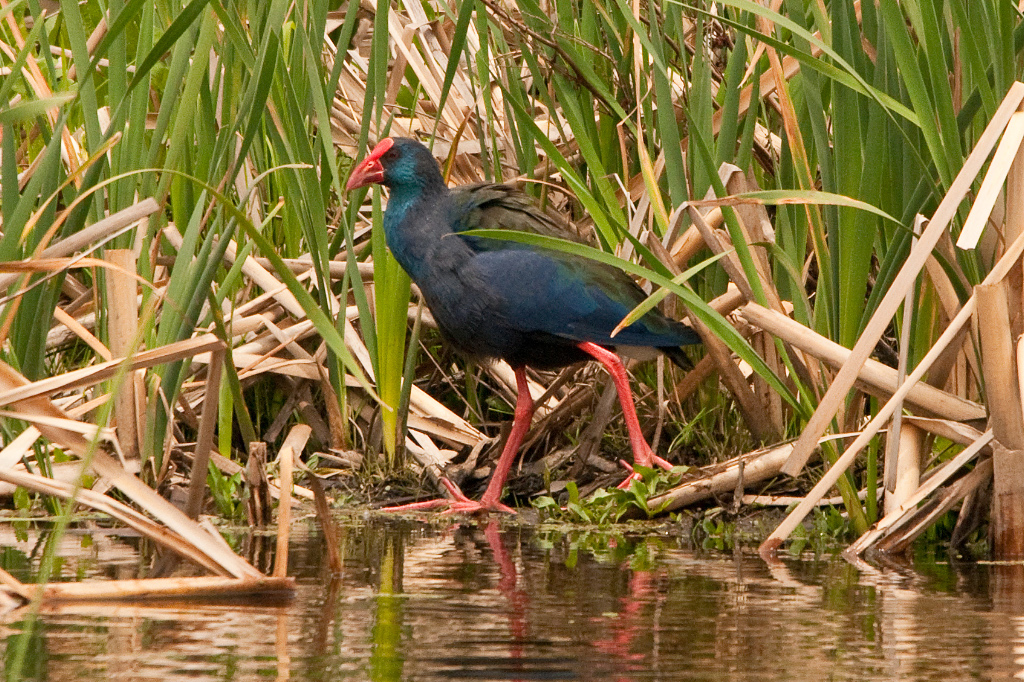
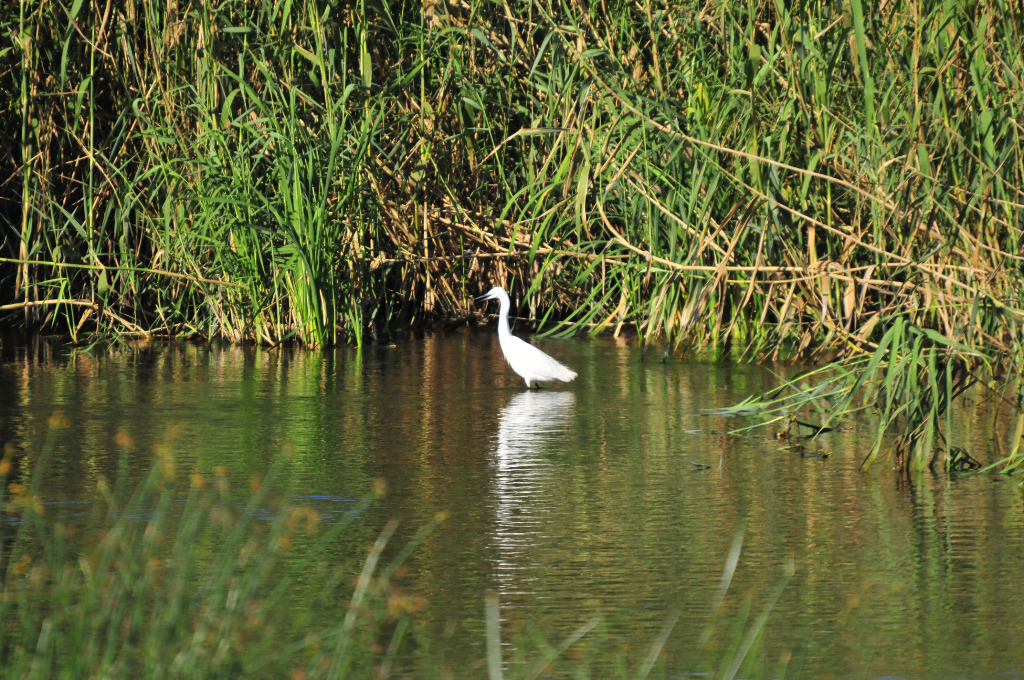
There were not many waders present as suitable wading territory is limited, but the ubiquitous Three-banded Plover was present, not far from an African Purple Swamphen making his way carefully through the reed fringes. On a smaller pond, a hide allowed me to observe a Little Egret in action without disturbing it.

African Purple Swamphen
Little Egret
Little Egret

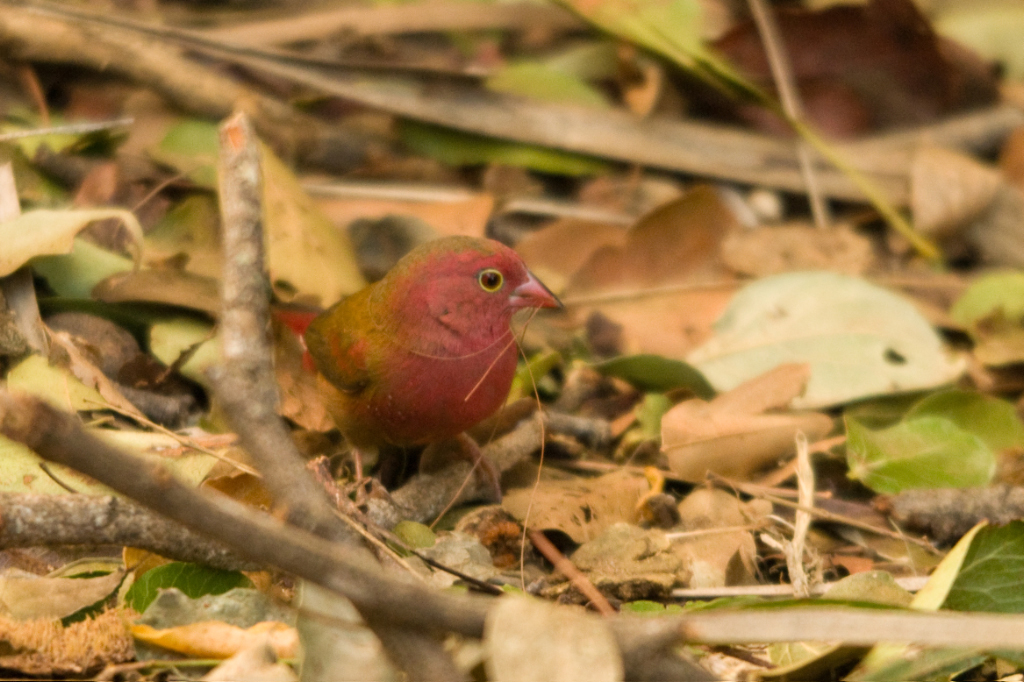
Moving away from the ponds, the bush and long grass held numbers of birds, among them Red-eyed Bulbul, Red-billed Firefinch and Black-throated Canary.

Red-eyed Bulbul
Red-eyed Bulbul
Red-billed Firefinch
Black-throated Canary

On the way back to my car I spotted Wattled Starlings high up in the trees, while a mixed flock of swallows entertained me with their swooping fly pasts – I noted Barn, Greater-striped and SA Cliff Swallows all enjoying each other’s company.

Back in the car I reflected on how pleased I was that I had taken the time to explore this worthwhile sanctuary – the fact that I was the only person there (as far as I could tell) during the 2 hours, attests to the fact that not many people know about it or frequent it. On the plus side I’m sure the birds enjoy the peaceful habitat for feeding and breeding opportunities and that’s surely what a sanctuary is all about.

Potch has some fine birding in the surrounding areas, but more about that later.


Mostly Battlefields – Kwazulu-Natal (Part 3)

The background

My earlier Post on “Paardeberg (Finding the Canadians)” covers our trip with Sheila (Sam) and John Denner to Kimberley and the Paardeberg Battlefield. The follow-on trip took us to Kwazulu-Natal where we visited a number of battlefield sites, some of which were described in the similarly captioned Posts, Parts 1 and 2. This post takes up the next leg of the trip,  covering more of the battlefield sites identified by John over the northern and central parts of Kwazulu-Natal (KZN) province, which lies in the north-east quadrant of South Africa.

We continued to enjoy the wonderful hospitality of Pieter and Anlia Genis , family of my wife Gerda, who farm near Vryheid and who had offered their farm as a base for us to visit the various battlefield sites. They went far beyond normal hospitality in driving us around and providing meals and a place to sleep for four days – they surely deserve a medal!

Next on our agenda were the well-known sites of Rorke’s Drift and Isandlwana, where fierce battles took place between the British and the Zulu nation. To close out our KZN visit we tracked across the province to visit the Ulundi battlefield and the nearby sites of Piet Retief’s grave and the mock-up of Dingaan’s Kraal. Lastly we visited the site of the Battle of Khambula, just a couple of km’s from where we were staying on the farm.

A tour of the farm was in order before making our way back to Pretoria

Battle of Rorke’s Drift (23 January 1879)

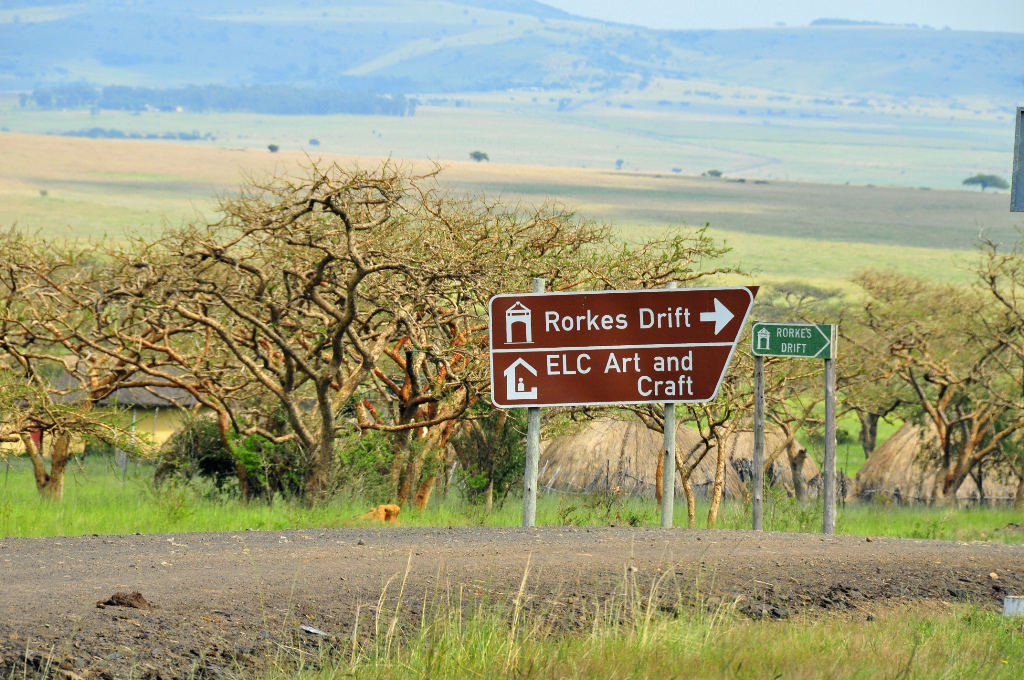
Following an early farm breakfast, we traveled via Dundee to Rorke’s Drift, arriving just after 10h00.

Rorke's Drift Battlefield (23 January 1879)

Rorke's Drift Battlefield
Rorke’s Drift Battlefield

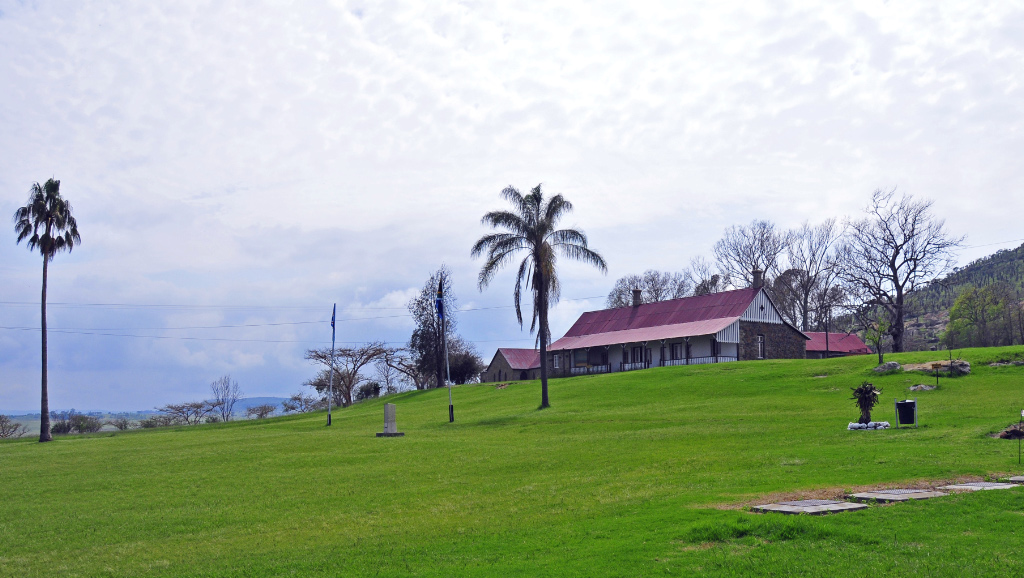
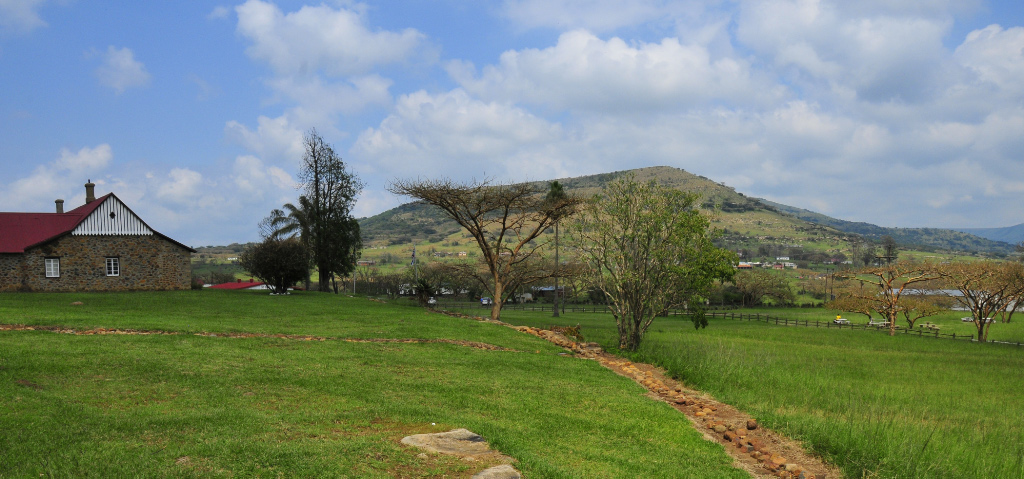
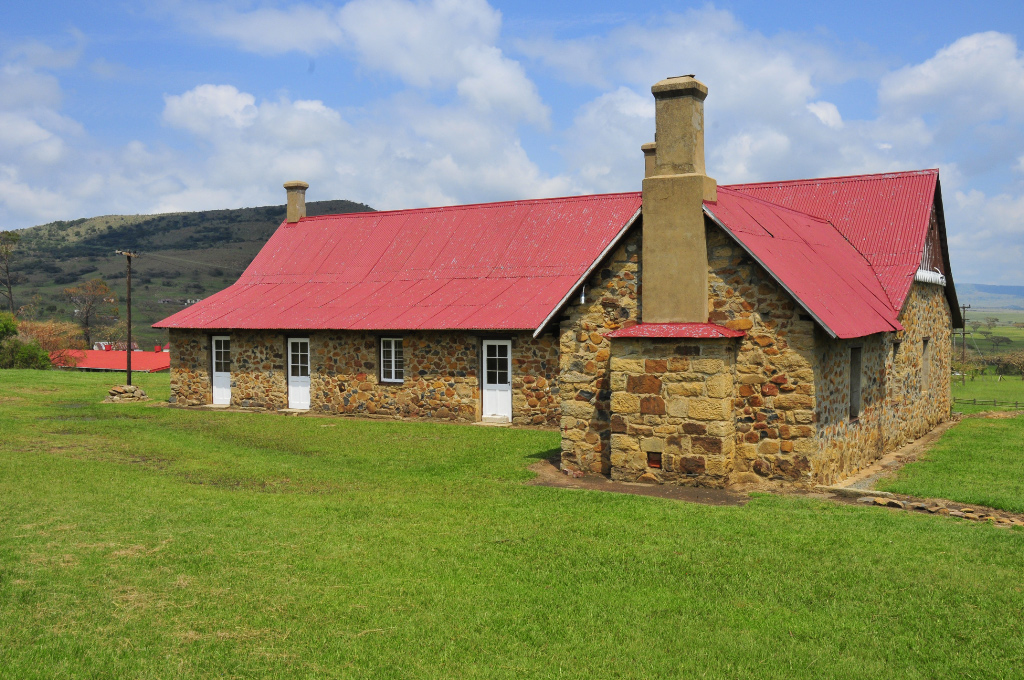
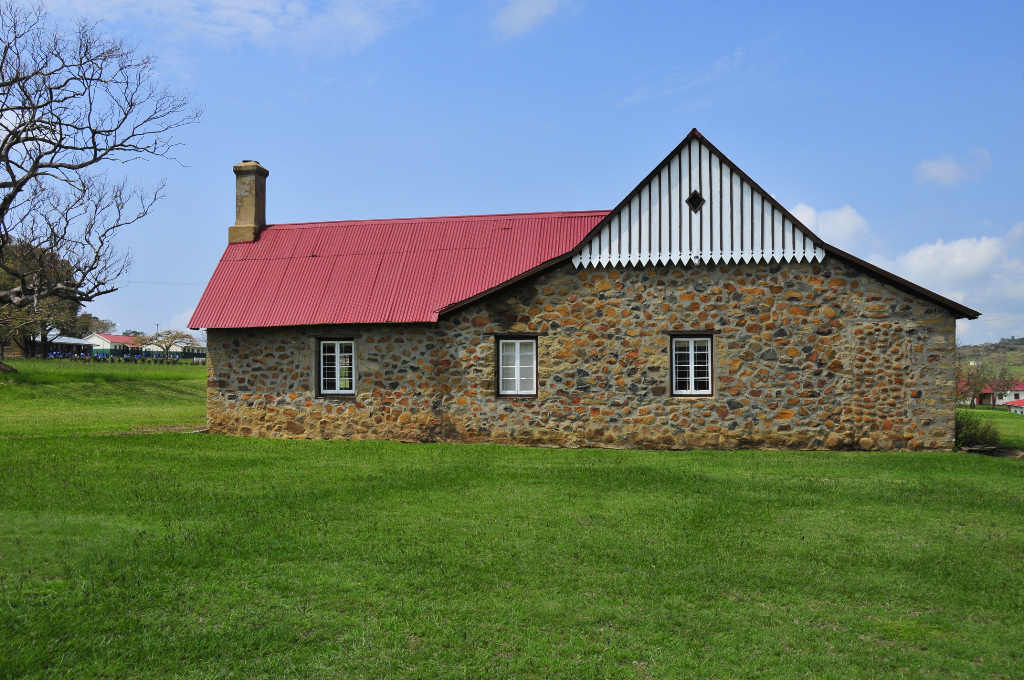
This was the site of a heroic defence, by around 100 men, of the hospital and surrounds against thousands of Zulus. The house used as a hospital has been reconstructed on the old foundations and acts as a museum, while the immediate area that was successfully defended is marked out with white stone lines, making it easy to picture just how the battle progressed and where the main lines of defence were positioned.

Rorke's Drift Battlefield
Rorke’s Drift Battlefield
Rorke's Drift - the house used as a Hospital
Rorke’s Drift – the museum on the site of the original Hospital
Rorke's Drift - side view of house used as hospital
Rorke’s Drift – side view of the museum
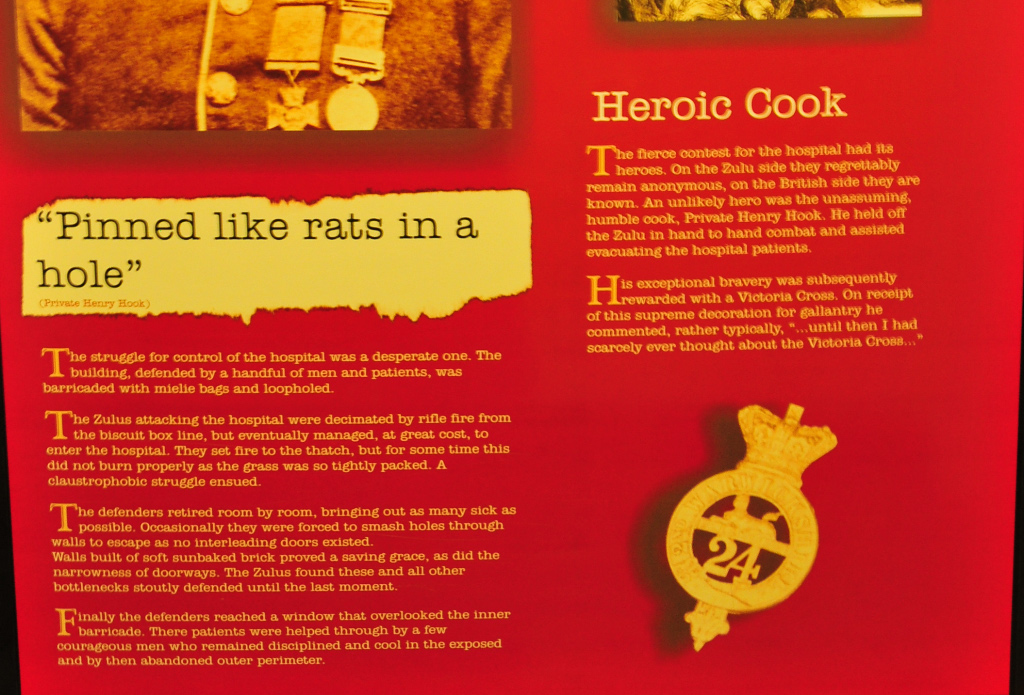
Rorke's Drift - one of the heroes
Rorke’s Drift – story of one of the heroes
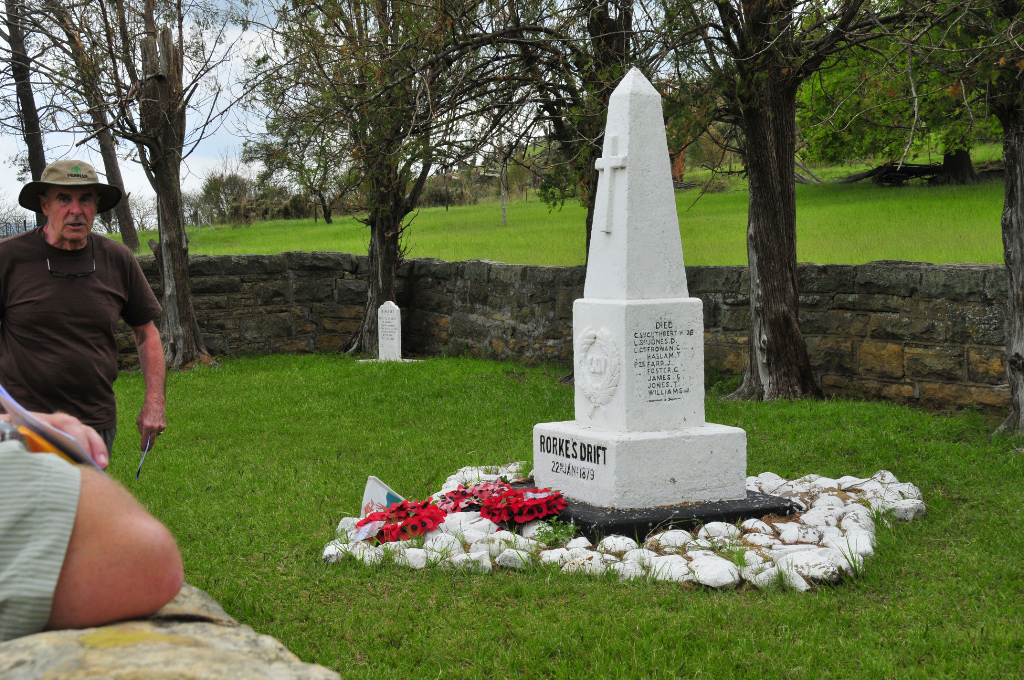
Rorke's Drift Battlefield Cemetery
Rorke’s Drift Battlefield Cemetery

Rorke's Drift Battlefield (23 January 1879)

Rorke's Drift - inside the small chapel
Rorke’s Drift – inside the small chapel, used as a storehouse at the time of the battle

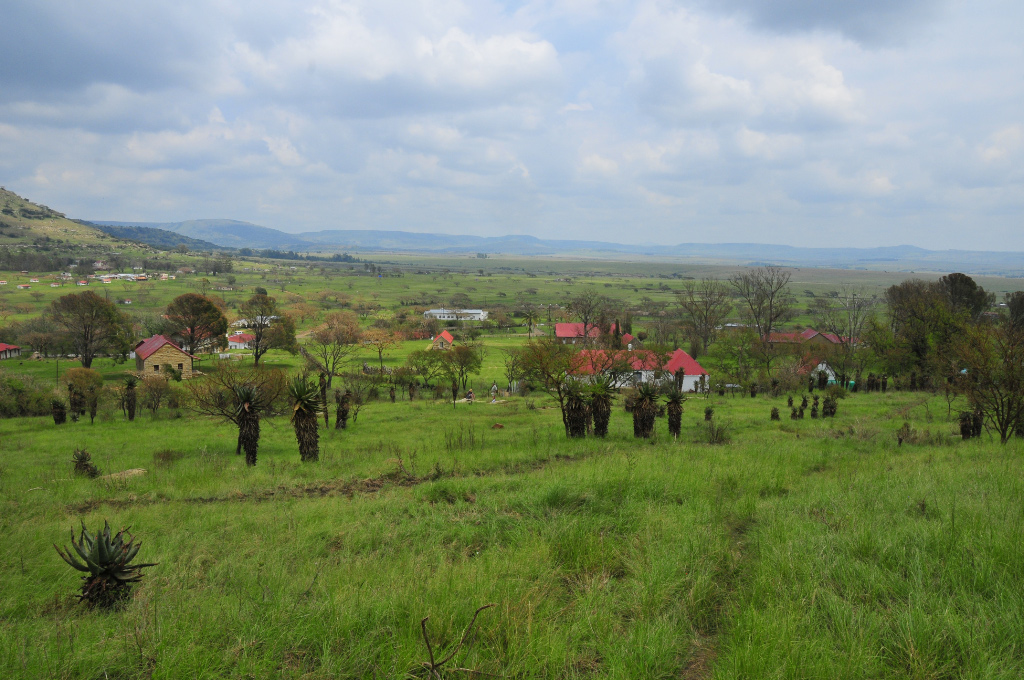
We walked up to the ridge where numbers of Zulus hid in caves and fired downwards at the British defenders – now one looks down on the local school grounds and some scattered dwellings, which seems a waste of an opportunity to turn the site into a significant attraction, famous as it is throughout the world.

Rorke's Drift Battlefield
Rorke’s Drift Battlefield – view from the ridge behind the house where Zulus hid in caves
Rorke's Drift - a recent monument
Rorke’s Drift – monument to the fallen Zulus

The Battle

This battle started on the same day as the Battle of Isandlwana, continuing to the next day, and it soon became clear that the two battles are inextricably linked.

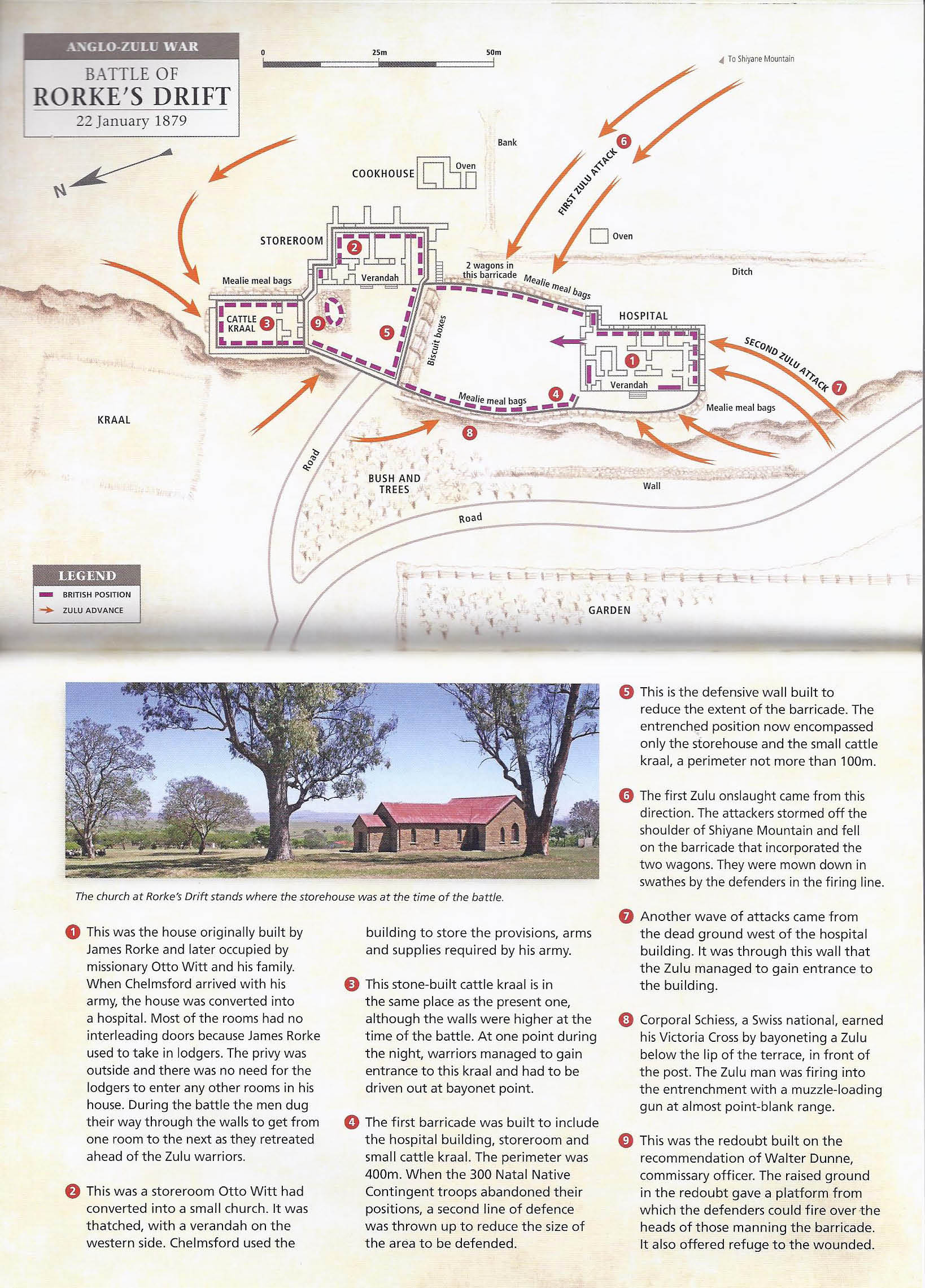
With the main British column being involved in the invasion of Zululand, just 104 men were left at the camp at Rorke’s Drift, on the border between Natal and Zululand, at a point where a drift provides a crossing point across the Buffalo River. The hospital was looking after 39 sick men. Hearing of the battle at Isandlwana and receiving reports of Zulu warriors heading in their direction, the men left at Rorke’s Drift set up barricades close to the hospital using biscuit tins and bags of mealie meal and prepared for the onslaught, which came in waves of Zulu warriors numbering about 4000 in all. Eventually some of them gained access to the hospital and the British broke holes in the walls to escape to the outside barricaded area, taking the hospital patients with them. The Zulus continued to attack throughout the night and managed to set fire to the thatched roof of the hospital, but were repulsed each time – at first light the Zulus withdrew when they saw some of the remaining forces who had managed to escape from Isandlwana returning to Rorke’s Drift.

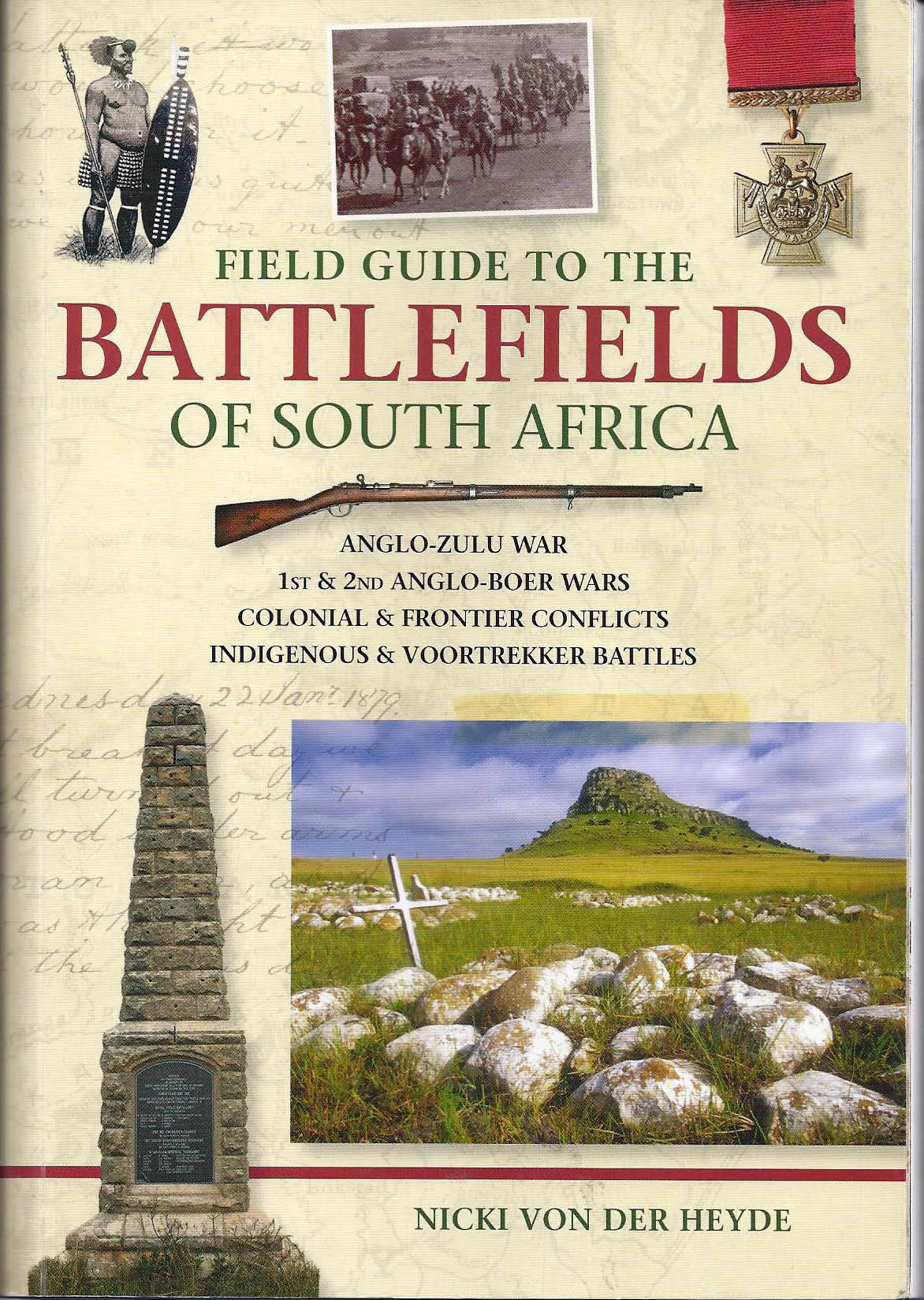
The map below is taken from the book Field Guide to Battlefields of South Africa

Battle of Rorke's Drift

Where is it?

 Travel on the R 68 to Nqutu, turn right after about 26 km to Rorke’s Drift and turn left after a further 6 km at a T-junction and travel to the entrance gate. The gate is at 28º 21′ 28.3″ S , 30º 32′ 06.3″ E

Battle of Isandlwana (22 January 1879)

Isandlwana was our next stop, not too far along the road. A number of monuments commemorate the battle and tens of stone crypts are dotted across the vast site, marking the spots where the fallen soldiers were buried. The battle took place on the same day as Rorke’s Drift, when a massive Zulu force wiped out about 1300 British soldiers, making it one of the most disastrous battles for the British and a major triumph for the Zulus.

Isandlwana Battlefield
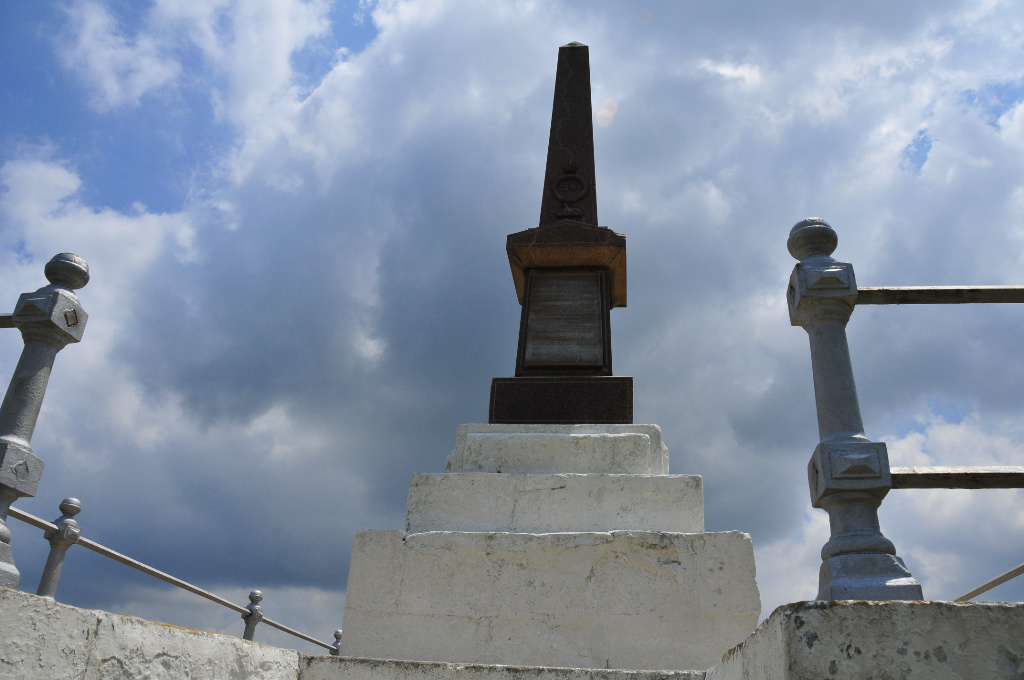
Isandlwana Battlefield - one of several monuments
Isandlwana Battlefield – one of several monuments
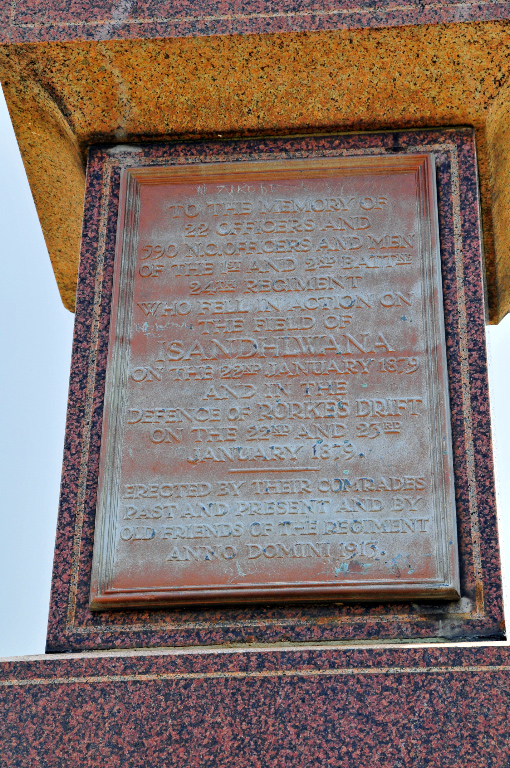
Detail of the monument
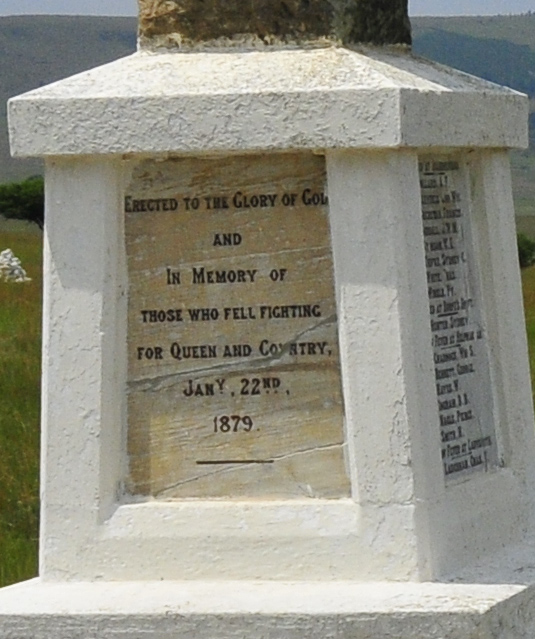
Isandlwana Battlefield - another of the monuments
Isandlwana Battlefield – another of the monuments
Monument detail
Monument detail

The Battle

The British army invaded Zululand in 3 separate columns, of which the central column consisted of some 4500 men under Lord Chelmsford, who were headed in the direction of Ulundi, the seat of the Zulu king, Cetshwayo. At the same time the Zulu army of some 22000 warriors had left Ulundi and were heading towards Rorke’s Drift with orders to engage the British forces. The Zulus employed an attack strategy known as “the horns-of-the-buffalo” formation and eventually surrounded the depleted British forces who began to retreat. The battle ended in disaster for the British, as all men who stayed to the end were killed, with 1329 British dead in total. The Zulus also suffered around a 1000 dead, making it an expensive victory, which turned out to be short-lived when the British came out victorious some 5 months later at the final battle of the war at Ulundi.

The map below is taken from the book Field Guide to the Battlefields of South Africa

Battle of Isandlwana

Where is it?

The site is south-east of Dundee in KZN – travel on the R 68 to Nqutu where you turn right in town then take the R 68 further to Melmoth – the turn-off to the site is about 14 km out of Nqutu.

Battle of Ulundi (4 July 1879)

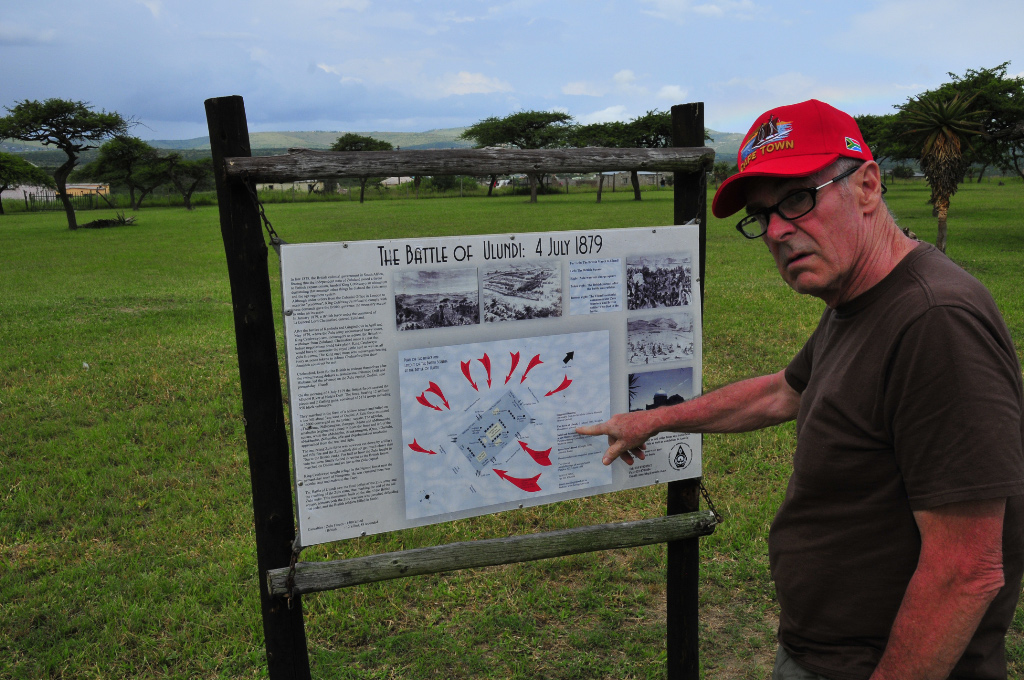
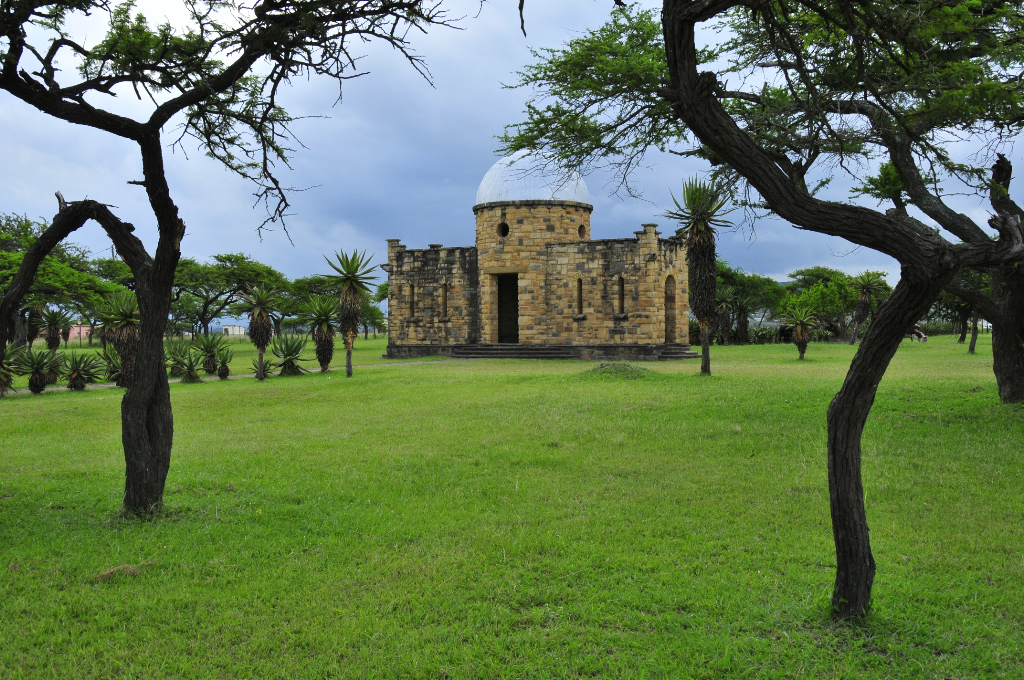
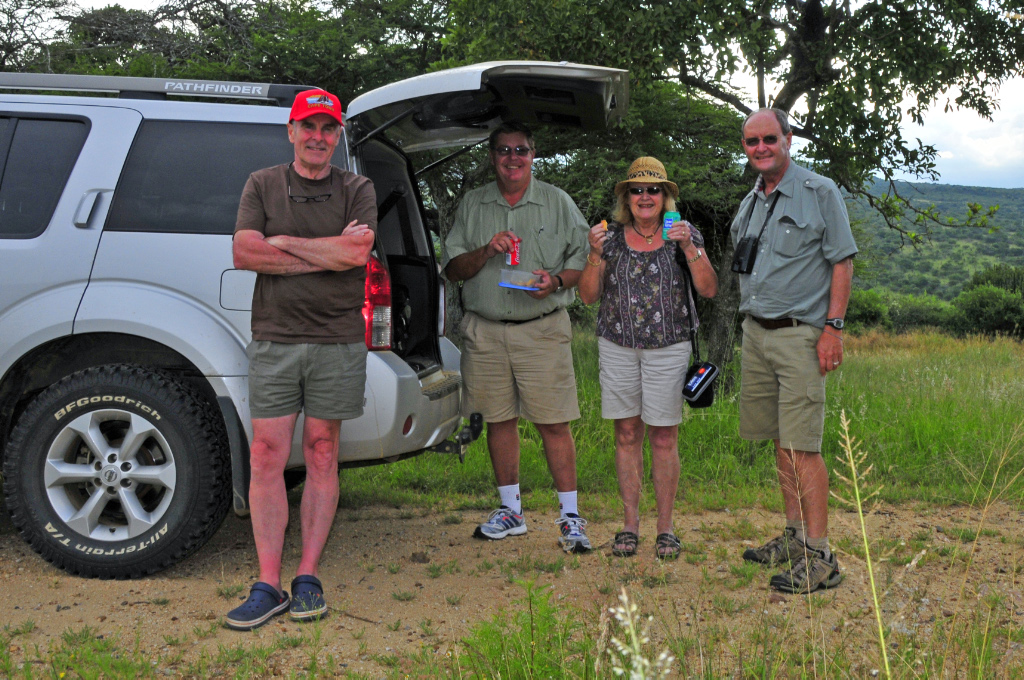
From Isandlwana it was a long drive along some very rough back roads, expertly negotiated by Pieter in his Nissan Pathfinder, via Babanango to Ulundi where the final battle of the Anglo-Zulu War took place. The site is well-preserved and presented, with a commemorative domed building in the middle of the site and pathways radiating out from the centre, delineating the area where about 5500 British soldiers were formed in a “fighting square” and managed to keep some 15000 Zulu warriors at bay.

Ulundi Battlefield
Ulundi Battlefield
John checking the facts
Ulundi Battlefield - the stone building serving as monument
Ulundi Battlefield – the stone building serving as monument

Ulundi Battlefield (4 July 1879) Ulundi Battlefield (4 July 1879)

The Battle

This was the final battle of the Anglo-Zulu war. The British forces, numbering about 5500 men, were advancing on Ondini, home of Cetshwayo the Zulu king, formed into a fighting square with companies of fighting men on four sides with guns and wagons alongside them, covering an area of some 3.5 hectares. The Zulus employed their famous “horns-of-the-buffalo” formation and began to attack the British formation, but suffered huge casualties and were beaten back and subsequently pursued with many being killed, probably as a brutal revenge for the British losses at Isandlwana. The British dead amounted to 12 men.

Where is it?

Travel to Ulundi town and take the airport road turn-off – shortly after you pass the airport the site is visible on the left. The GPS position at the monument in the middle of the site is 28º 18′ 39.3″ S , 31º 25′ 32.2″ E

Piet Retief’s Grave (Murdered on 6 February 1838)

By this time it was getting late and we were all tiring after a long day’s drive – not surprisingly, we were wavering about whether to look for the site where Piet Retief was buried, but John was adamant that we should “pay our respects to old Piet”. After a further short drive from Ulundi and a couple of wrong turns, we found the site at the end of a dirt road. The grave of Piet Retief and the monument to him and the 70 burghers who were all murdered, was well-kept and quite moving to visit, knowing some of the history leading to this tragic event.

Monument and cemetery - Piet Retief's murder
Monument and cemetery – Piet Retief’s murder
Piet Retief's grave
Piet Retief’s grave
Monument and cemetery - Piet Retief's murder
Monument and cemetery – Piet Retief’s murder
The Burghers who were murdered along with Piet Retief

The Murder

The Trekkers under Piet Retief were seeking permission to settle south of the Tugela River and he and his entourage entered into negotiations with the Zulu king Dingane at his homestead, but were all executed on Dingane’s orders.

Where is it?

We had some difficulty finding the site due to poor signposting – the GPS position is 28º 25′ 37.7″ S , 31º 16′ 12.6″ E

Dingaan’s Kraal

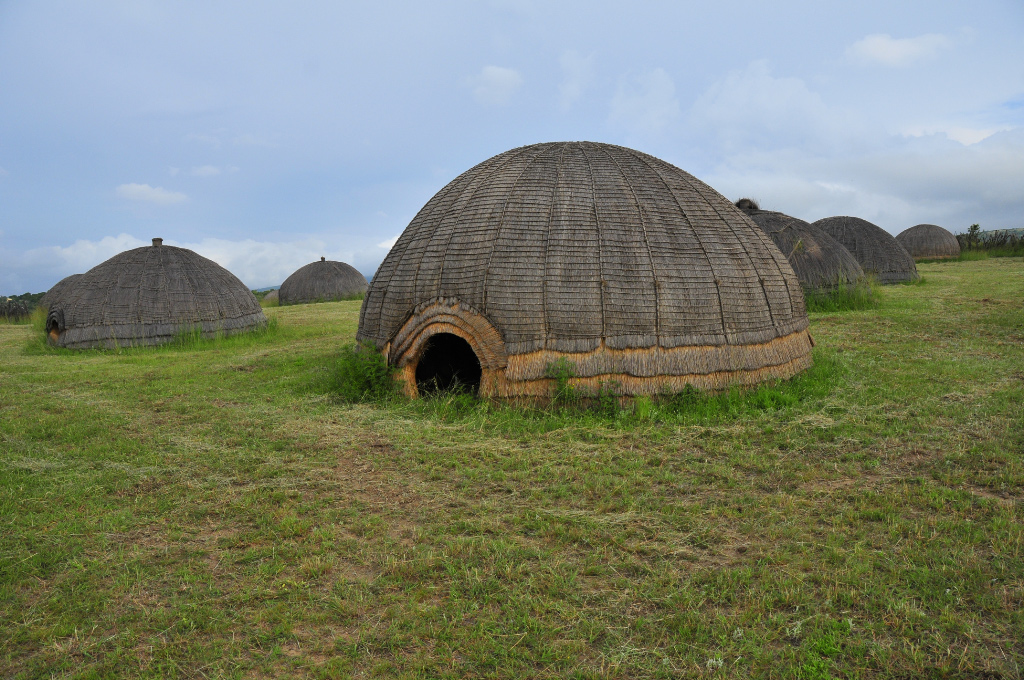
We followed this up with a look-in at the nearby mock-up of Dingaan’s Kraal which has been re-created in the same position that it was at the time of the murder.

John Pieter Sam and Donald at Dingaan's Kraal
John Pieter Sam and Donald at Dingaan’s Kraal
Dingaan's Kraal re-created
Dingaan’s Kraal re-created

Where is it?

Very close to the grave of and monument to Piet Retief and his entourage – best to visit both in one trip.

Battle of Khambula (29 March 1879)

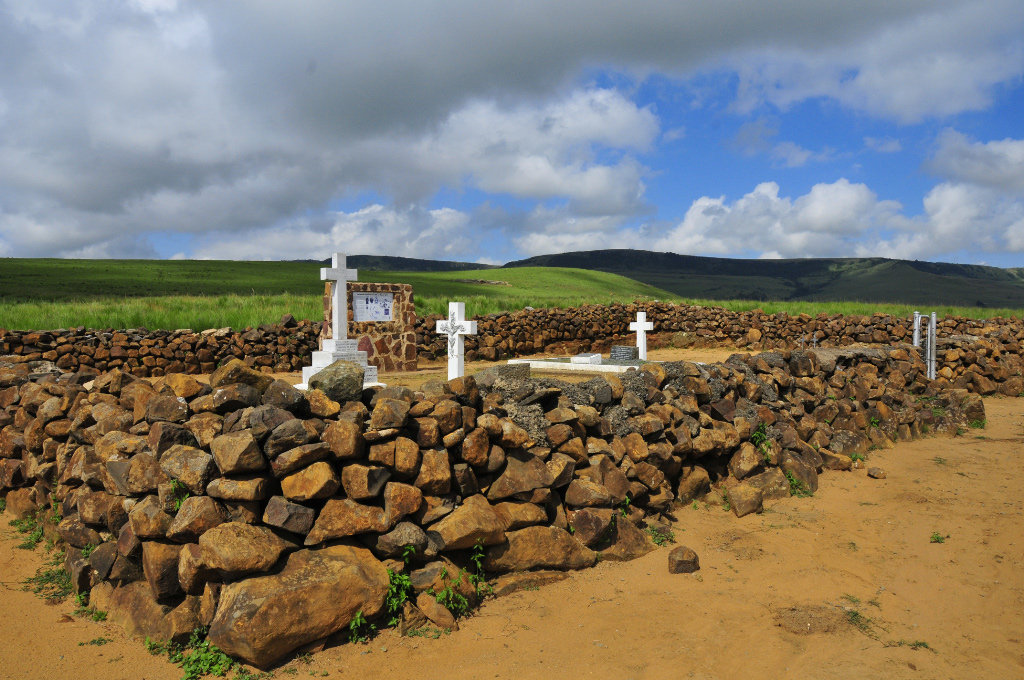
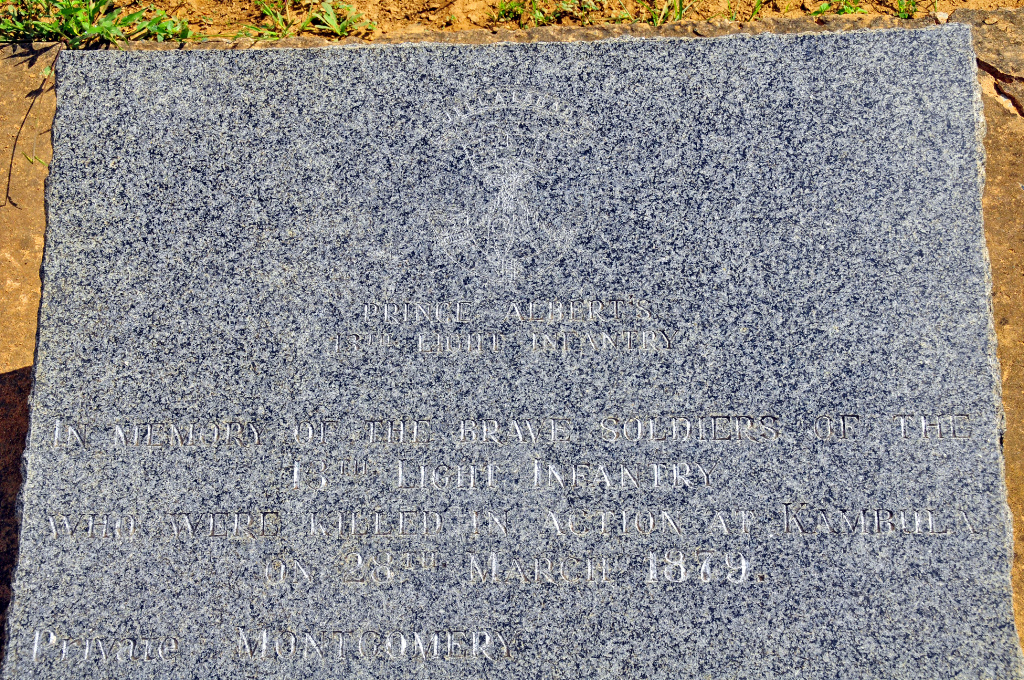
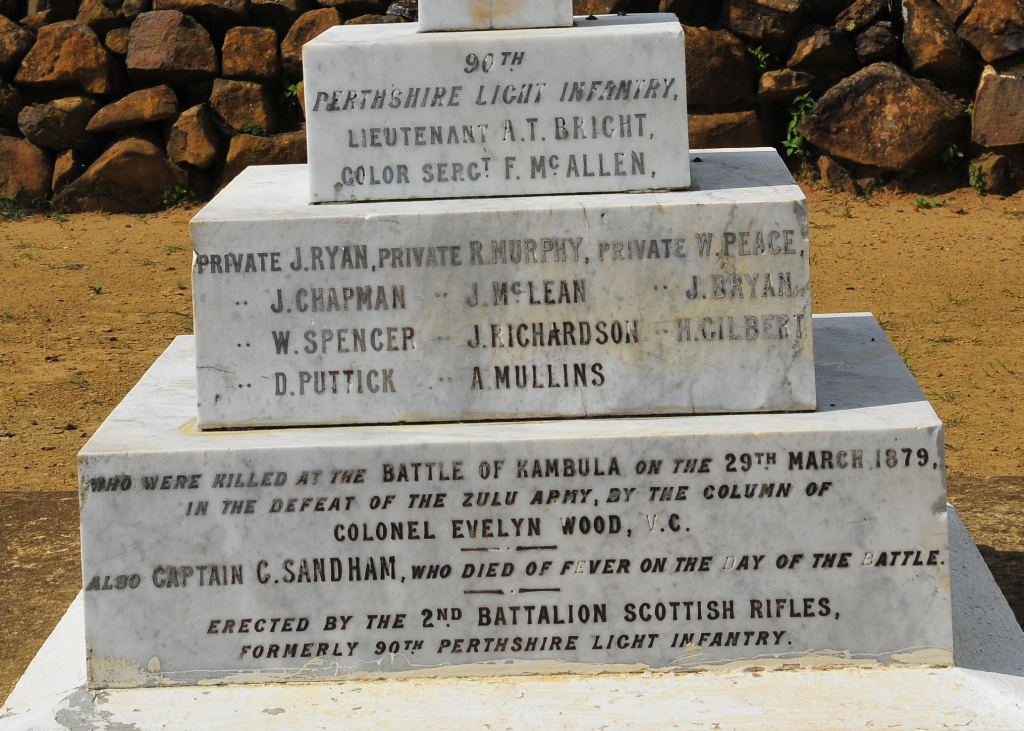
The closest battlefield site to the farm, just a few km’s away, is that of the Battle of Khambula, which Pieter took us to view before returning to Pretoria. Once again we were pleasantly surprised to find the cemetery and monuments well-kept,  despite it being on private ground and not being one of the “popular” sites, so probably visited very infrequently.

Battle of Khambula
Battle of Khambula
Khambula Battlefield - cemetery
Khambula Battlefield – cemetery
Khambula Battlefield
Khambula Battlefield - monument
Khambula Battlefield – monument
A lizard keeps watch at the cemetery

The Battle

This battle followed some 3 months after the disastrous loss for the British at Isandlwana and just a day after the Battle of Hlobane on a nearby mountain the previous day where further losses were suffered. The battle of Khambula took place at the British encampment which housed the northern British column of the forces that had set out to invade Zululand. The 1800 British soldiers successfully defended their position against up to 20000 Zulu warriors and inflicted heavy casualties on them while suffering 18 dead and 65 wounded

Where is it?

Turn off the R33 between Vryheid and Paulpietersburg about 5 km outside Vryheid and follow the dirt road for a further 5 km to the site. There is no gate to the site so use the GPS positions to find the cemetery at 27º 41′ 15.5″ S , 30º 40′ 04.4″ E

The Farm

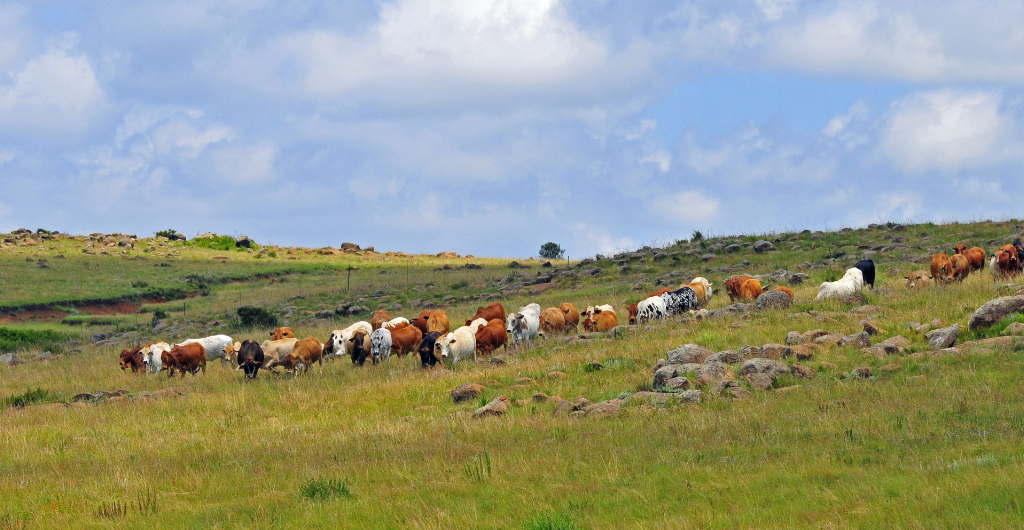
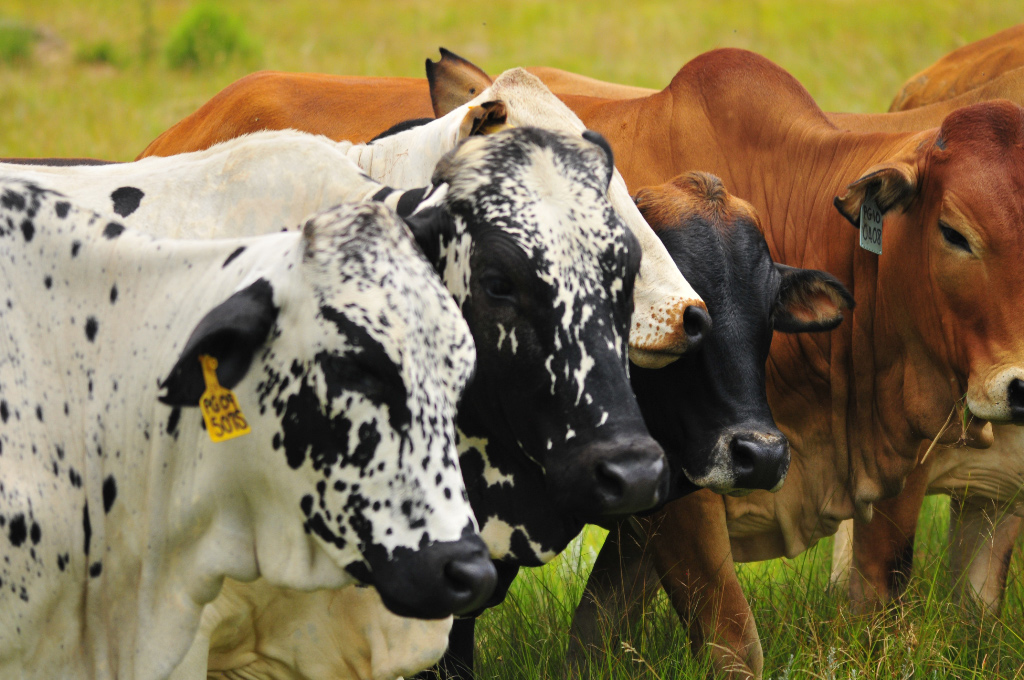
In between travelling to the sites we continued to enjoy the hospitality of Pieter and Anlia – before departing for Pretoria, Pieter took us on a tour of the farm, including the grazing land for his herd of fine Boran cattle high up on the plateau, accessed by a mildly hairy dirt road that switchbacks up the side of the mountain.

101_2159_edited-1
The herd up on the plateau

101_2160

John getting up close and personal with a friendly bull
John and Pieter getting up close and personal with a friendly bull

Having seen a lot of KZN in the few days at our disposal and having covered almost all of the battlefield sites on John’s “wish list”, we returned to Pretoria quite tired but well satisfied. Next on the itinerary was a couple of days to take it easy, perhaps explore the Pretoria and Joburg area a bit and get ready for our trip to Kruger Park and the other attractions of Mpumulanga province, followed by a flight to George to “do” the Garden Route.

Special note : much of the detail info is taken from the excellent book Field Guide to the Battlefields of South Africa and summarised in my own words – the cover is reproduced below. It is highly recommended for anyone seeking more info and intending to visit some of the sites.

Scan0005_edited-1

Flowering Aloe time in Kruger – continued

Tamboti Tented Camp

At the end of our 4 nights in Letaba, we headed south towards Orpen and the nearby Tamboti Tented camp for the next 7 days of our Kruger Park visit. Tamboti lies a couple of km’s off the main Orpen – Satara tarred road, along a river course which is dry for most of the year. All of the units are tented, with some having their own private bathrooms and others sharing an ablution block – we had chosen one with a bathroom and an outside kitchen, more like a chalet with canvas walls than an actual tent. The whole unit is raised above the ground and has a deck which overlooks the river bed – really comfortable as long as you realise that in winter canvas walls  provide very little insulation from the cold nights, so warm blankets and a warm body next to you are highly recommended for a good night’s sleep.

Early morning coffee and rusks on the patio is all part of our ritual when visiting Kruger and Tamboti was no different once we had dragged ourselves out of the warm cocoon of the bed and onto the deck to get the kettle boiling in the chilly morning air – it took some cajoling to get a slightly reluctant Gerda to join me but once we had a steaming mug to hand, the sights and sounds of the awakening bush and the crisp, fresh air made it all worthwhile.

Tamboti Tent camp - view from the deck
Tamboti Tent camp – view from the deck

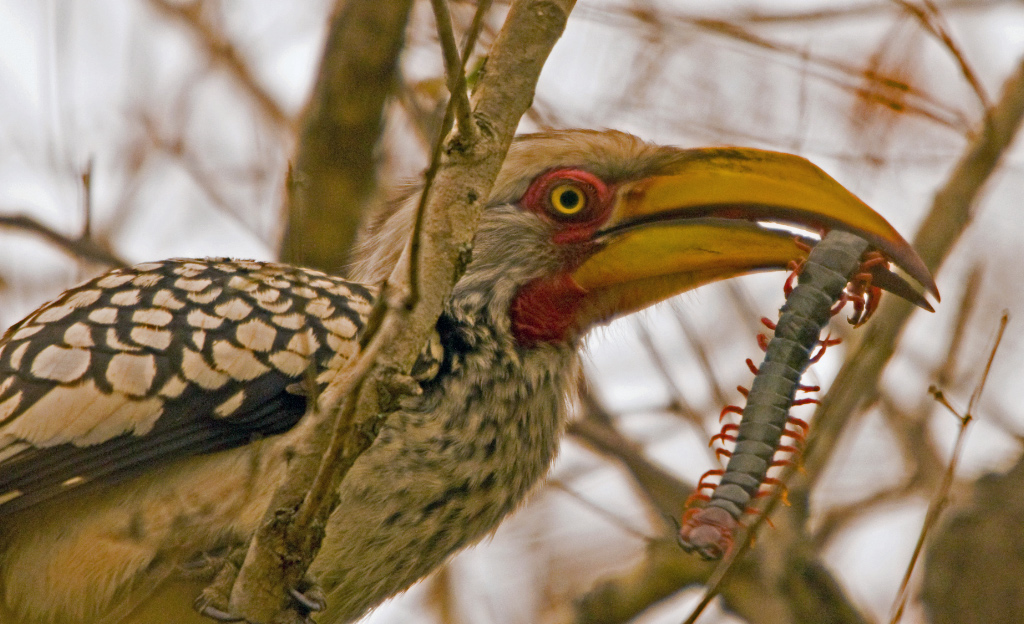
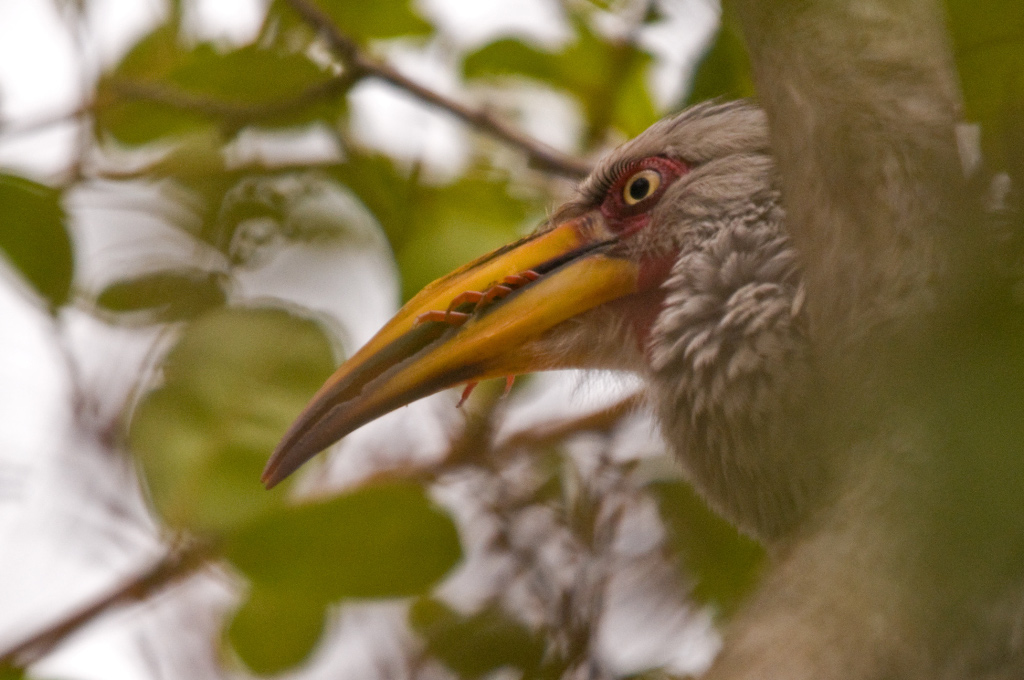
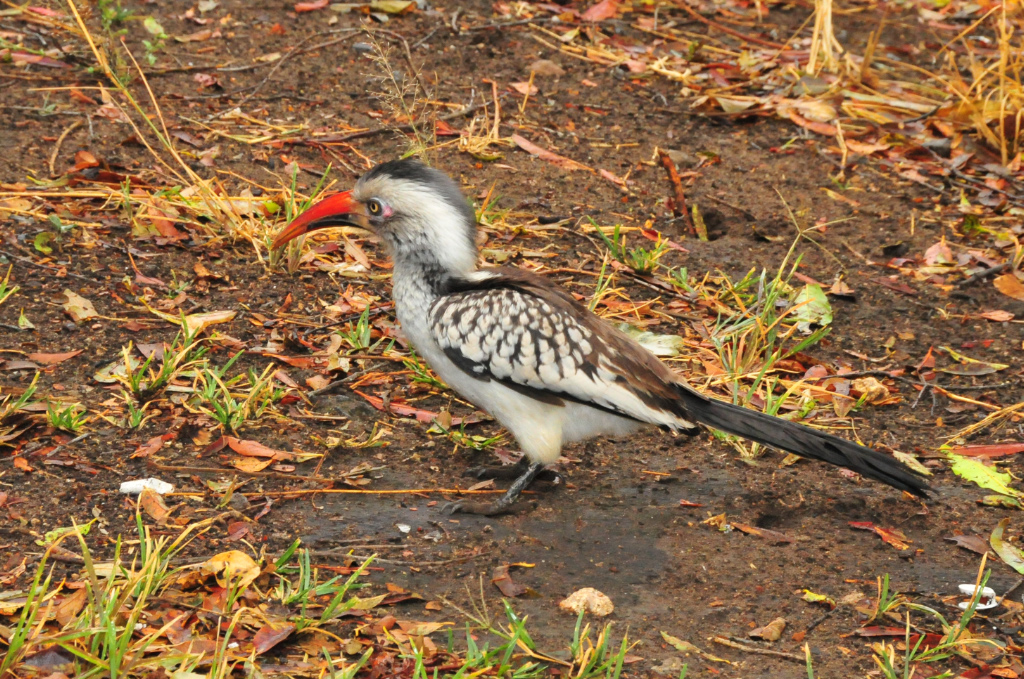
A slow walk around the camp with binos and camera was next on the schedule and it was soon evident that there was plenty of bird life working their way through the dry bush – Southern Boubou was particularly prominent and vocal, while both Red-billed and Yellow-billed Hornbills showed themselves, the latter having caught a large centipede which he deftly worked into his long curved bill until just the legs were showing and soon disappeared altogether.

Southern Boubou, Tamboti
Yellow-billed Hornbill with doomed centipede
Yellow-billed Hornbill finishing breakfast
Red-billed Hornbill, Tamboti

The bush between the units, set well apart, was home to many other species, some of which I was able to capture digitally –

Black-crowned Tchagra, Tamboti
Burnt-necked Eremomela, Tamboti
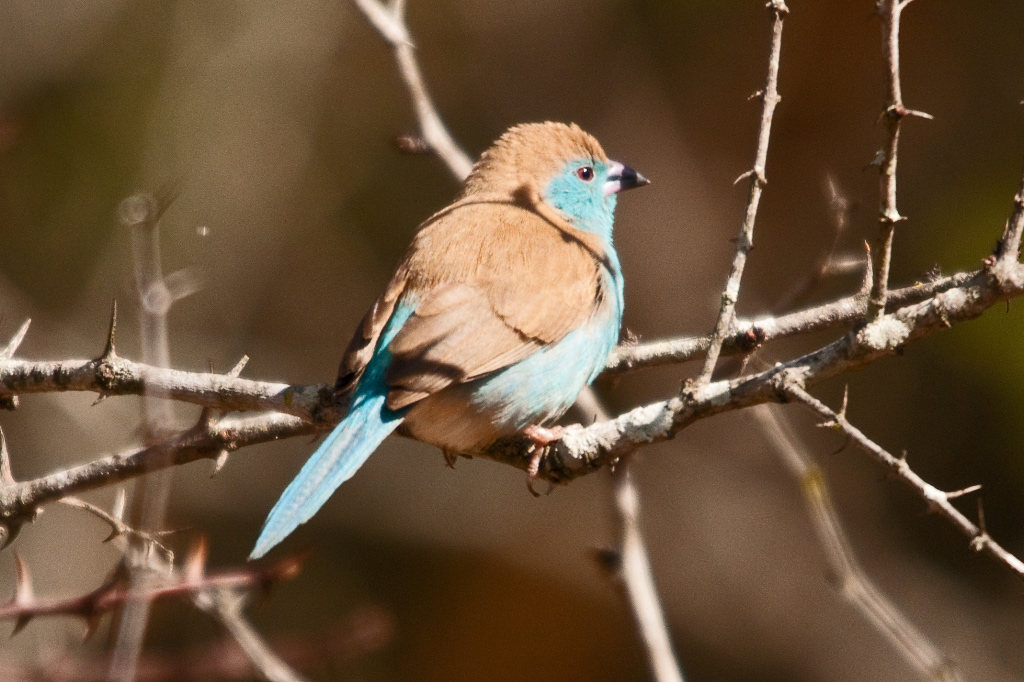
Blue Waxbill, Tamboti
White-browed Robin-Chat, Tamboti
Jameson's Firefinch, Tamboti
Jameson’s Firefinch, Tamboti
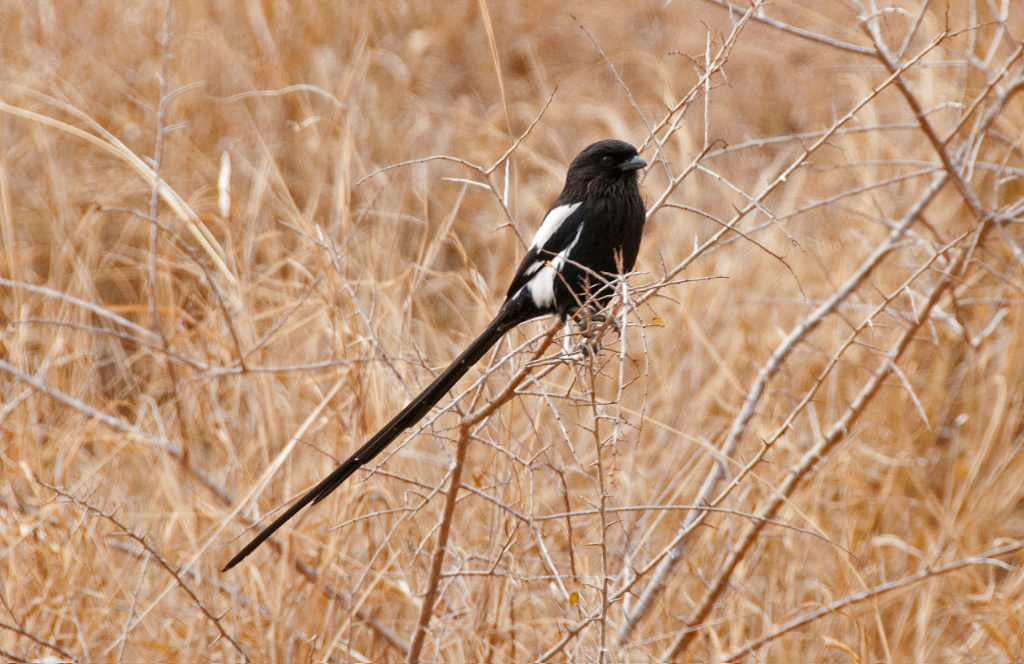
Magpie Shrike
Magpie Shrike
Golden-tailed Woodpecker, Tamboti

Besides the numerous birds, other visitors to our unit included the usual mischievous Vervet Monkeys, which you always have to keep an eye on if you value your fruit and bread, which they will grab in a flash and jump onto the nearest branch. An unexpected “robber” in the guise of a Tree Squirrel gained access to our tented unit via a tiny gap in the canvas and got into one of the biscuit tins while we were out one morning so after that we kept all our food in crates, weighed down with heavy items. A few Dwarf Mongooses (Mongeese? No, don’t think so) were also regulars around the tent, looking for food amongst the leaf litter and there is often a Gecko or Lizard to observe, in and around the tent.

Tent visitor
Tent visitor
Dwarf Mongoose, Tamboti

Once we had spent a day or so relaxing in camp we were keen to get out on the road for a game and birding drive – the road to Satara is usually good for a variety of game, especially as you get closer to Satara and was fully up to expectations –

Zebra - Most photogenic animal in Kruger?
Burchell’s Zebra – surely the most photogenic animal in Kruger
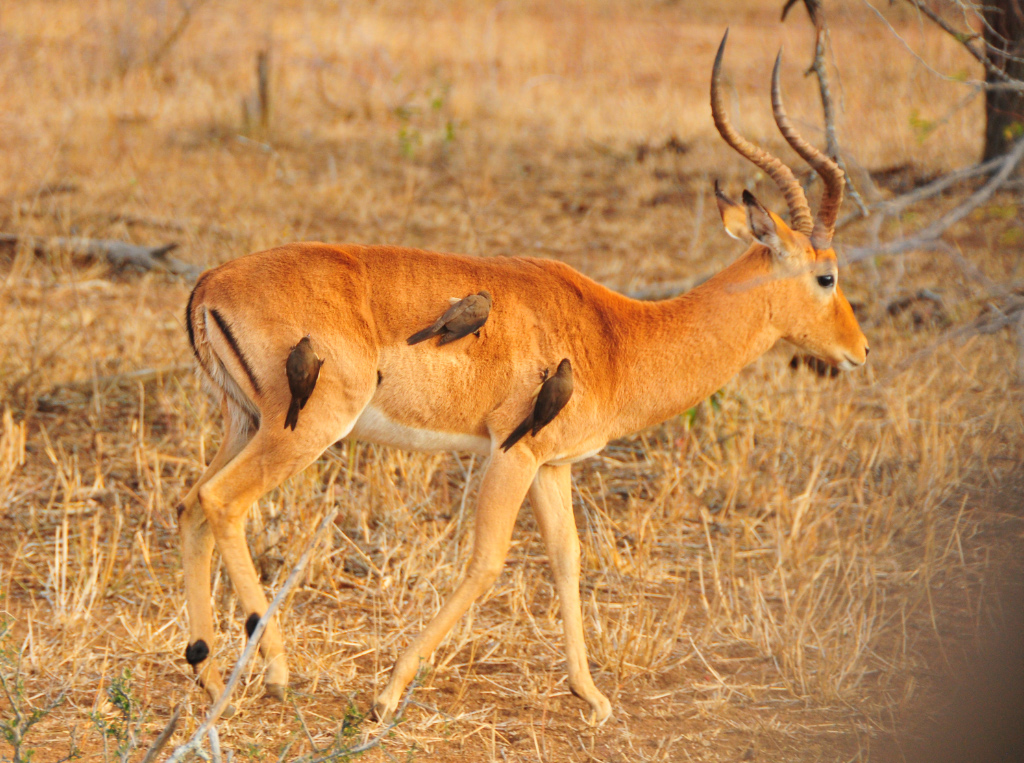
Another Oxpecker take-away
Kudu
Kudu
African Buffalo
African Buffalo
Black-backed Jackal
Black-backed Jackal

The nice thing about being a birder in Kruger is that whenever you stop for a bird, as often as not an animal is spotted and vice versa, so there is never a shortage of interesting  sightings. The area close to Satara is also one of the best for spotting Ostrich – yes, you can see hundreds at a time on farms around Oudtshoorn and every second farm across SA has a few in the fields, but there is just nothing like seeing the real thing in one of the National Parks – they just look more handsome and genuine than the farm-raised Ostriches.

Ostrich near Satara
Ostrich near Satara

Then a group of White-crested Helmet-Shrikes drew our attention – I have this theory that says these birds must be able to count, as you always see them in a group of 7 or 8 – how else would they know when to allow a newcomer to the group or get rid of an unwanted member? Anyway that’s a theory that probably needs some more work to make it believable.

White-crested Helmet-Shrike

Satara Camp

Satara camp is one of the Kruger camps that has managed to retain a lot of its old-style atmosphere, despite being the second busiest camp and very popular with tour groups. The restaurant doesn’t serve those glorious burgers  and pies that were worth looking forward to, but the stoep and the view across the lawns with the grand old trees in the middle, full of Buffalo-Weavers and like-minded species, is still there. Fortunately, the aloes in Satara were also in full bloom and attracted a variety of birds –
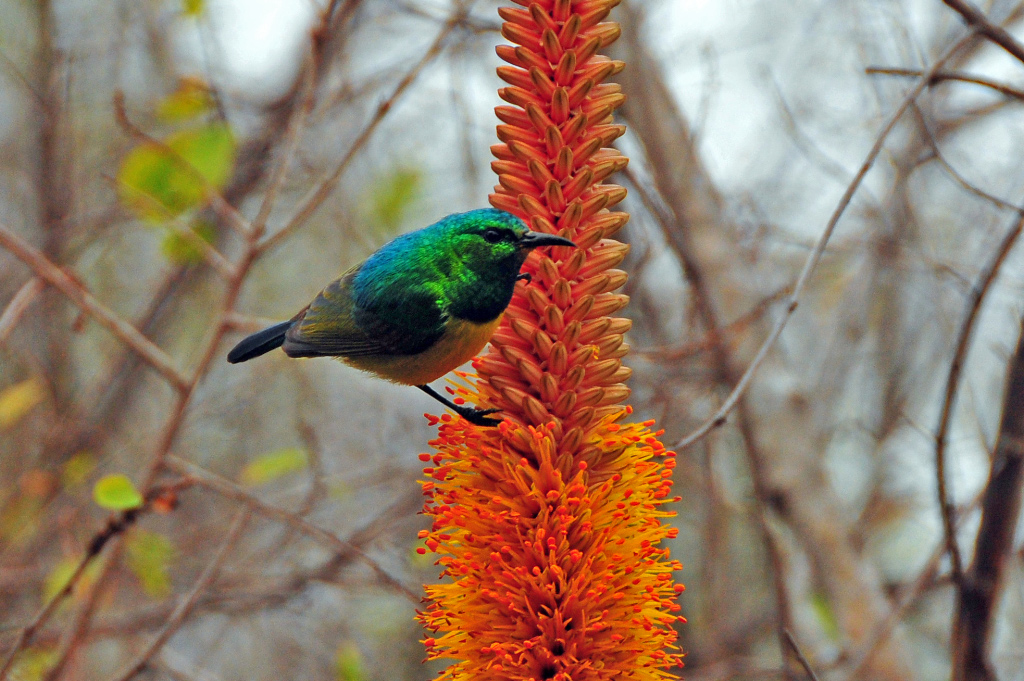
Collared Sunbird, Satara
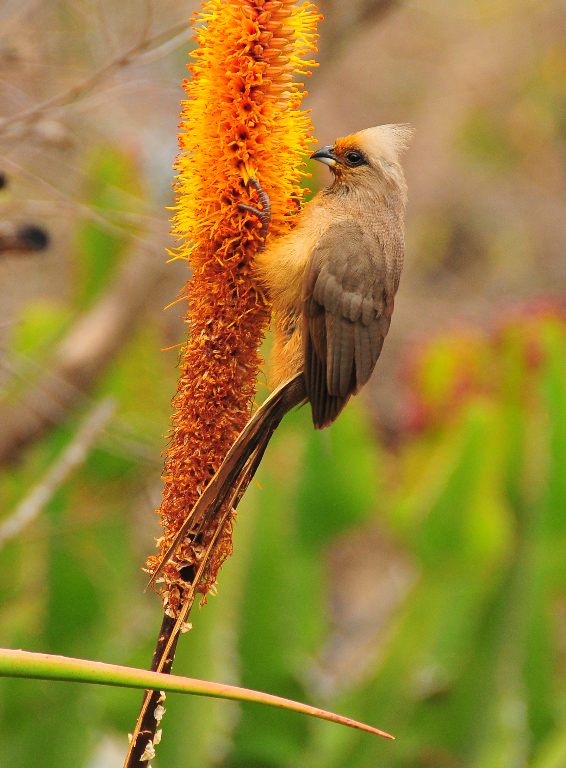
Speckled Mousebird, Satara
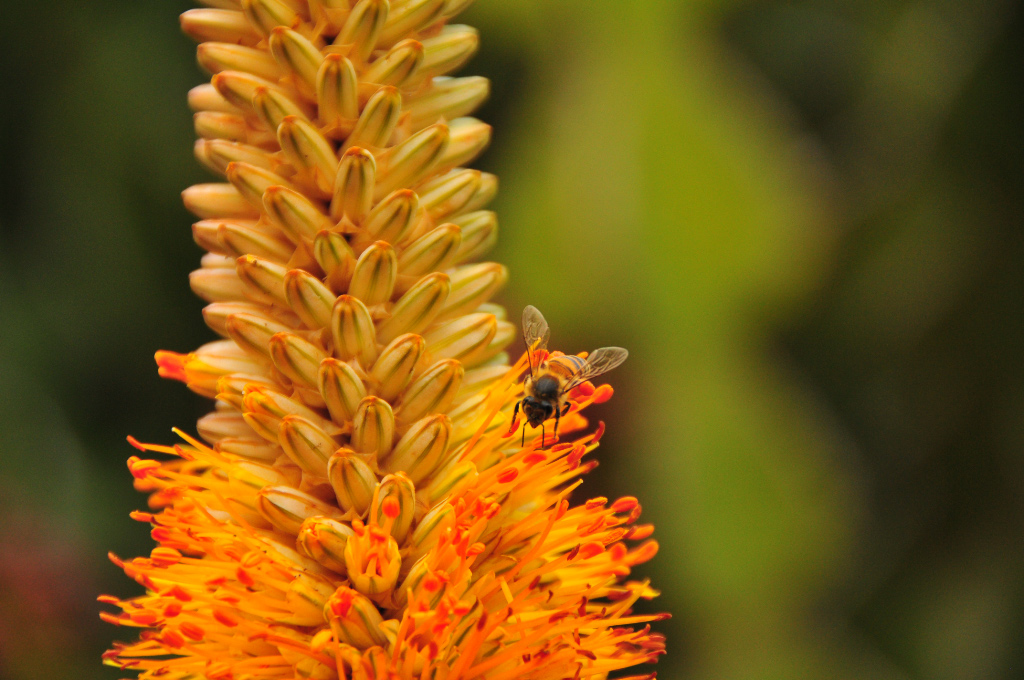
Bee on Aloe
Bee on Aloe

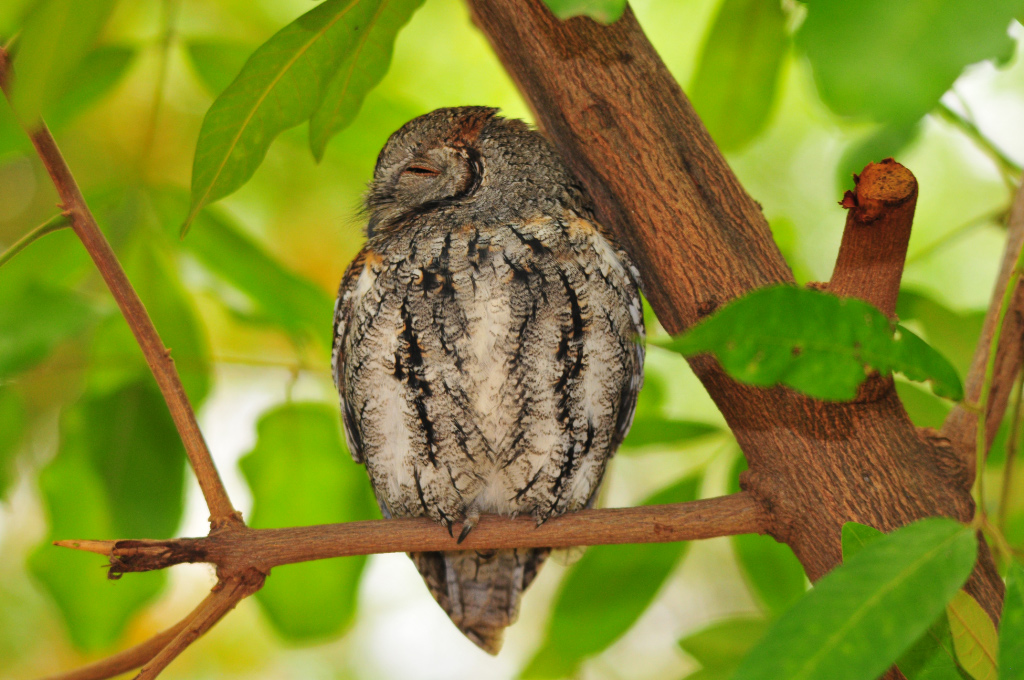
Near the reception the resident African Scops-Owl was still attracting knots of tourists and is probably one of the most photographed birds in Kruger but maintains a rather disdainful attitude towards his fame –

African Scops-Owl, Satara

The picnic spot for day visitors is set to one side and attracts a steady stream of avian and butterfly visitors to entertain while you picnic –

Red-billed Buffalo-Weaver, Satara
Orange-tip Butterfly
Orange-tip Butterfly (Colotis evenina evenina)

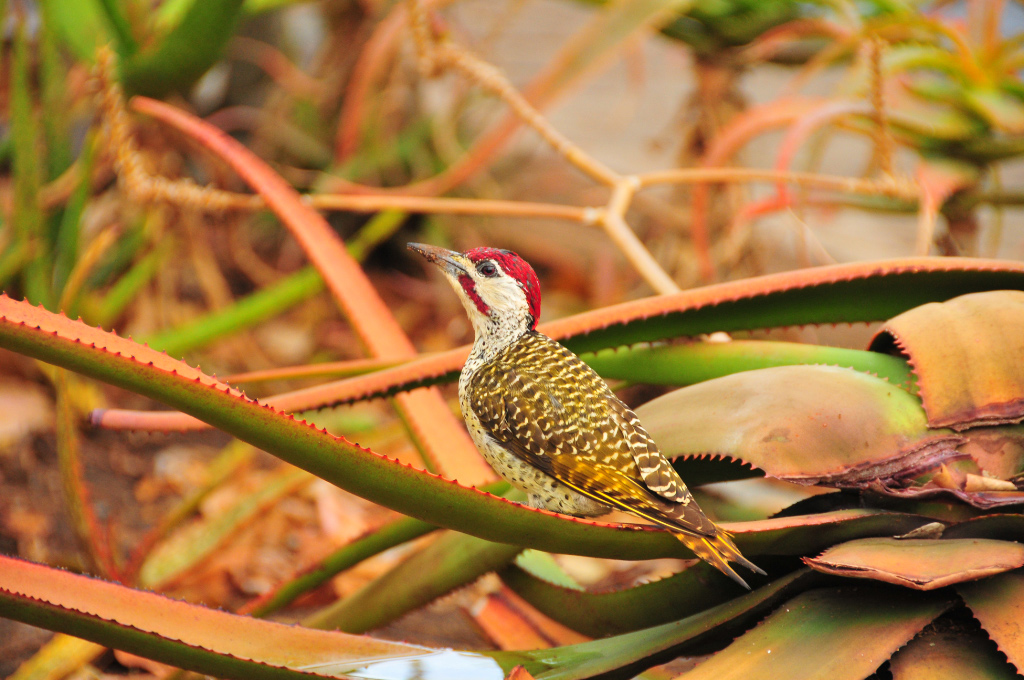
During a walk around Satara I came across a couple of species which allowed a close approach  – a Bennett’s Woodpecker  was so engrossed with inspecting the lower leaves of a large Aloe that he paid no attention as I crept closer to get some nice sharp photos and a Black-headed Oriole was equally unconcerned when I got up close and personal.

Bennet's Woodpecker, Satara
Bennet’s Woodpecker, Satara
Black-headed Oriole, Satara

Destination Muzandzeni

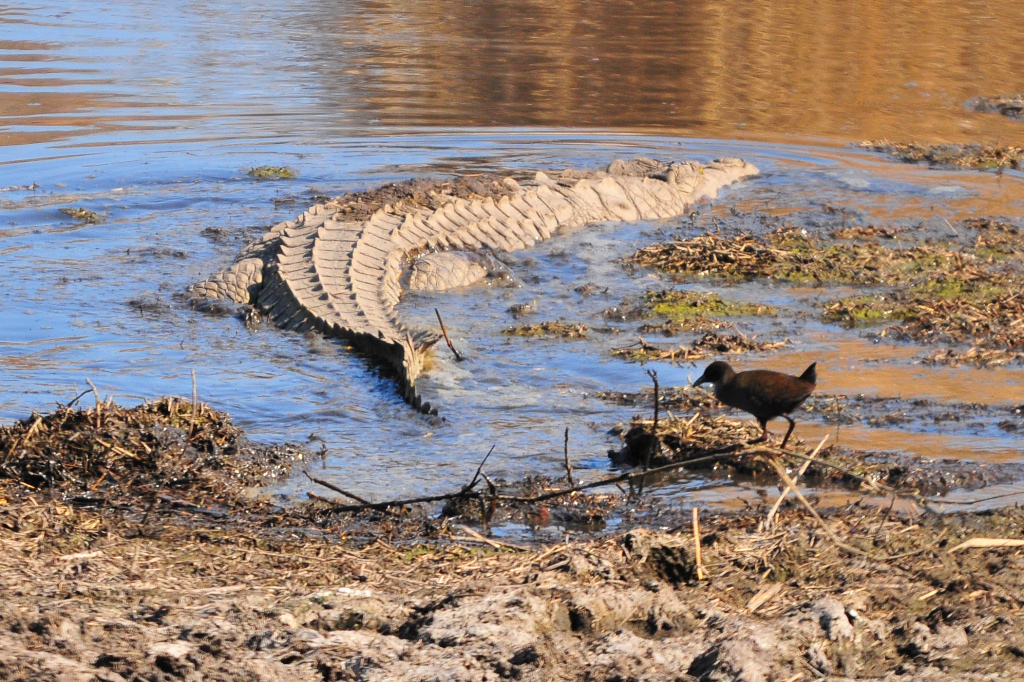
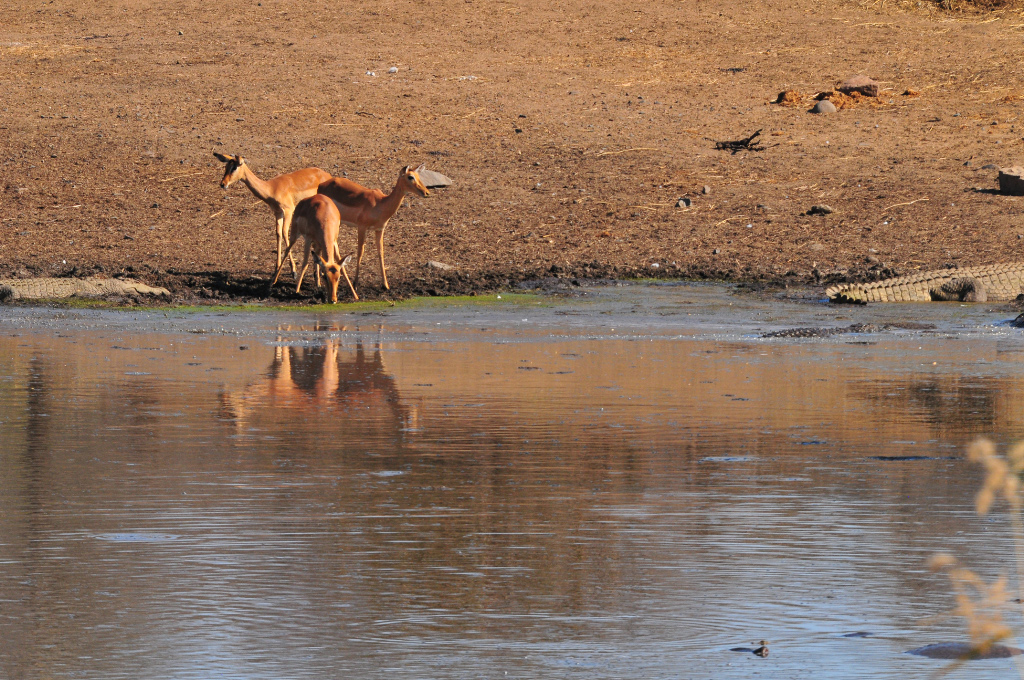
The loop that lies south of the Orpen-Satara road is good for a morning’s drive, bypassing Talamati Bushveld camp and with Muzandzeni picnic spot ideally placed for a brunch break. On the way there is a good chance of spotting game and at the picnic spot there is always a gathering of birds and Tree-squirrels to keep the grandkids busy.

Croc and Crake
Croc and Crake
Impala at waterhole
Impala at waterhole
Buffalo with Oxpeckers
Red-billed Oxpecker on Buffalo
Crested Barbet, Muzandzeni
Muzandzeni picnic spot - brunch being prepared
Muzandzeni picnic spot – time for brunch

Late afternoon in the camp is time to get the evening meal together, rounding off another day in our private paradise –

Preparing a meal in the outside kitchen
Spotted again - Maia and Megan (Leonardii Mosselbayi)
Spotted again – Maia and Megan (Leonardii Mosselbayi)
Rear view of Leonardii Mosselbayi just as pretty
Rear view of Leonardii Mosselbayi –  just as pretty

Flowering Aloe time in Kruger – bird magnets

Firstly, how’s the blog doing?

Time to look back at the 7 months since I started the blog in July 2013 ……

Well, I’m loving it simply because it brings some of my favourite pastimes together – birding, keeping journals of our travels, and photography. I’m also happy to report that “views” passed the 1000 mark last week and are averaging 10 per day, with people from almost 40 countries having visited the blog (some by chance, such as the one looking for a wedding venue at Gosho park in Zimbabwe). These figures are quite unimpressive compared to many blogs, but I’m encouraged that the numbers seem to be growing steadily. Anyway enough of that and on with this fortnight’s episode :

Kruger Park in the winter 

Winter is widely acknowledged as the best time for game viewing in Kruger and I wouldn’t disagree, but having made as many summer visits I find each season has its pros and cons. Summer from a birding aspect is tops, as the migrants are present and generally birds are at their most colourful, being in breeding plumage. Winter is often better for game viewing as the animals are more easily seen and are tempted to spend more time near water in the dry season.

Winter is also the time when many of the aloes are flowering, making for attractive displays and, most importantly for birders, attracting a variety of bird life. Some of the best flowering aloe displays are in the camps and at their peak are crowded with birds feeding on the nectar.

When we visited Kruger in August 2011, it seemed to be prime time for flowering aloes and we came across many beautiful flowering specimens, especially in the camps, which were often buzzing with activity as various bird species, bees and other insects made the most of the nectar bonanza. We stayed in 2 camps : Letaba in the middle of the park for 4 days and in Tamboti, which is a tented camp close to the Orpen camp and gate on the western side of Kruger, for a further 7 days. We also visited some of the other camps on our day trips, including Satara, Olifants and Skukuza and we spent time at a couple of the wonderful picnic spots where we made our customary brunch stop, cooking up a storm on the gas-fired  “skottels” (a large concave metal frying pan, based on the old plough disks that were used for this purpose in days gone by) that are hired out.

Our little “group” was made up of myself and Gerda, Andre and Geraldine (Son-in-law and daughter), their 2 daughters Megan and Maia and Andre’s parents (and our Brother and Sister-in-law of course) Tienie and Pieta Leonard. We have spent many a pleasant time with them in Kruger over the years we have known each other, Tienie being an Honorary Ranger and all of us being keen “Kruger Park-ers”

Letaba and surrounds

This is one of our favourite camps in Kruger, with its lush gardens and large old trees providing lots of shade, and the added bonus of bordering the Letaba River with views across to the distant bank and a good chance of seeing game as they make their way to and from the river. There is almost always an elephant or two (or more) in view near the river, along with buffalo and various other game.

It was mid-afternoon as we entered the park through the Phalaborwa gate and on our way to Letaba we were very lucky to come across a pack of Wild Dogs – seen very infrequently and such special animals.

Wild Dogs on patrol near Letaba
Wild Dog heads off into the bush

Along the same stretch we spotted two well-camouflaged terrestrial bird species – Double-banded Sandgrouse and a Red-crested Korhaan, both close to the road and quite confiding. Both have colouring that blends in with the surrounding bush and soil, particularly in winter.

Double-banded Sandgrouse
Red-crested Korhaan
Red-crested Korhaan

We settled into our bungalow accommodation at Letaba, while the others in our group went for the tented units a short walk from where we were. Over the next few days we followed our usual Kruger Park routine – some mornings we opted for a relaxing day in camp with an optional short game drive later on, other mornings we set out early for a game/birding drive with a brunch stop at one of the picnic spots and a lazy drive back to the camp for an afternoon siesta.

Letaba is well-suited to spending time in the camp, walking the gardens and along the river where many bird species have their own established routines :

On the lawns and amongst the leaf litter, Arrow-marked Babblers and Kurrichane Thrushes allow a close approach, hardly noticing as I fired away with my camera

Arrow-marked Babbler, Letaba
Kurrichane Thrush, Letaba

In the trees, there was plenty of action ranging from Bearded Woodpeckers to Tree Squirrels and even a couple of charming granddaughters :

Bearded Woodpecker, Letaba
Tree Squirrel (Paraxerus cepapi) , Letaba
Tree Squirrel (Paraxerus cepapi)
Maia and Megan (Juvenile Leonardii mosselbayi)

Other birds around the bungalows and tents were Blue Waxbills and the ubiquitous Greater Blue-eared Starlings, found throughout the park and mostly habituated to humans.

Blue Waxbill, Letaba
Greater Blue-eared Starling, Letaba
Yellow-throated Petronia

Not to mention the bird with the funky hairstyle –

Dark-capped Bulbul, showing off its modern hairstyle

The beautiful Impala Lily is a feature of the northern camps in Kruger in the winter months –

Impala Liliy, Letaba

But to get back to the main theme of this post, the array of flowering Aloes is a magnet to many bird species, more than I had imagined, as I thought they would attract only the nectar-loving species such as sunbirds and perhaps a Bulbul or two. The following photos are a selection of the birds I came across enjoying the Aloes, by no means comprehensive :

Red-winged Starling, Olifants
Yellow-bellied Greenbul, Olifants
Red-headed Weaver, Letaba
Black-headed Oriole, Letaba
Black-headed Oriole, Olifants
White-bellied Sunbird, Olifants
Butterfly in on the act
Butterfly in on the act as well

The area around Letaba and up to Olifants camp, where we drove on one of the days, is rich in game with Elephant and Buffalo being regular sightings. The viewpoint from Olifants camp overlooking the River is always a treat and brings home the value of preserving natural areas such as Kruger – the view of the river far below and the open bush beyond, with Elephants, Giraffes and other game making their way slowly to the river, has not changed in the more than 40 years we have been visiting the park.

African Buffalo, Letaba
Elephant at water hole
Crocodile, Letaba River
Impala
Impala
Letaba River
Letaba River
Giraffe, Letaba
Giraffe, Letaba
Pod of Hippos on Olifants River

On our drives we came across some of the more spectacular bird species – Kori Bustard, which is a ground-dwelling bird which can fly and is renowned as the largest bird in the world capable of flight, the colourful and lanky Saddle-billed Stork which is usually found in shallow rivers but which we saw in flight, a regal looking Fish Eagle and a Temminck’s Courser, not common and always exciting to see.

Kori Bustard, Letaba
Saddle-billed Stork
Saddle-billed Stork
African Fish-Eagle, Letaba
Temminck's Courser, Olifants
Temminck’s Courser, Olifants

At the end of our 4 nights in Letaba, we headed south towards Orpen and the nearby Tamboti Tented camp for the next part of our Kruger Park holiday, but that’s another story….

Mostly Battlefields – Kwazulu-Natal (Part 2)

The background

My earlier Post on “Paardeberg (Finding the Canadians)” covers our trip with Sheila (Sam) and John Denner to Kimberley and the Paardeberg Battlefield. The follow-on trip took us to Kwazulu-Natal where we visited a number of battlefield sites, a few of which were described in Part 1. This post takes up the next leg of the trip, which was to cover more of the battlefield sites identified by John over the northern and central parts of Kwazulu-Natal (KZN) province, which lies in the north-eastern quadrant of South Africa.

We continued to enjoy the wonderful hospitality of Pieter and Anlia Genis , family of my wife Gerda, who farm near Vryheid and who had offered their farm as a base for us to visit the various battlefield sites. They went far beyond normal hospitality in driving us around and providing meals and a place to sleep for four days – they surely deserve a medal!

We decided to do the Ladysmith area next, with a number of battlefield sites in the area and the Ladysmith Siege museum on the agenda. We left the farm after an early breakfast, to give us enough time to explore the area thoroughly and  headed to Ladysmith via Dundee.

Battle of Elandslaagte (21 October 1899)

Our first stop for the day was just off the main road at Elandslaagte, where we found the by now familiar, well-kept cemetery commemorating the fallen soldiers.

Well-kept cemetery at Elandslaagte
The cemetery at Elandslaagte
Fallen soldiers commemorated at Elandslaagte Battlefield

The Battle

Second War of Independence 1899-1902. After the Boer ultimatum to the British, to withdraw troops from the Transvaal and Orange Free State, had expired, the Boers invaded Natal and in the process took Elandslaagte station between Ladysmith and Dundee. The battle ensued when the British sent troops to recapture the area and resulted in high casualties on both sides, with the British regaining control of the area.

Where is it?

Signposted off the R 602 between Dundee and Ladysmith, cross the railway line and follow signs to the sites.

Ladysmith – Siege Museum

After a brief stop at the Information centre, we found the Siege Museum in Murchison Street – it turned out to be a very informative museum, not just about the Siege of Ladysmith but also about some of the battles in KZN and the circumstances leading up to them – it was well worth the visit.  

Siege Museum, Ladysmith

The museum has a number of displays consisting of “newspaper cuttings” which set out some of the history in a concise way

Siege Museum, Ladysmith

There are also historical photos and displays which give a feel for the time

Siege Museum, Ladysmith
Typical Boer uniform
Siege Museum, Ladysmith

The Siege

From early October 1899 the British had a garrison stationed at Ladysmith, which was swelled to 13000 by the garrison in Dundee after the Battle of Talana on 20 October and their withdrawal to Ladysmith. On 30 October the combined garrisons took on the Boers in the Battle of Ladysmith but failed to rid the area of the encroaching Boers – by November 1899 Ladysmith was surrounded and besieged and was only relieved 3 months later after much suffering.

Battle of Wagon Hill (Platrand) (6 January 1900)

Our next stop was the Wagon Hill Battlefield and Cemetery, after once again having to contend with minimal signage and going on “gut feel”. Reading through the names on the commemorative monuments, I came across Lance Sergeant R Reid of the Gordon Highlanders – not any direct relation but just brought it a bit closer to home, as did the others with our surname that we were to come across at other battle sites.

Wagon Hill Cemetery
Wagon Hill Cemetery
Wagon Hill Cemetery
Wagon Hill Cemetery
Lance Sergeant R Reid commemorated

The Battle

Second War of Independence 1899 – 1902. This was the Boers attempt to take this strategic hill, during the long siege of British occupied Ladysmith. After a lengthy engagement the British managed to hold the hill, but suffered 183 men killed and 249 wounded while the Boer casualties were 68 men killed and 135 wounded.

Where is it?

Take the R 103 to Colenso and on the outskirts of town turn off at Platrand Lodge. Follow this road past the hotel and continue up the hill until you reach a crossroad from where it is signposted. The GPS position I recorded was 28º 35′ 15.12″ S , 29º 45′ 54.68″ E

Battle of Spioenkop (24 January 1900)

Moving on, our next stop was the well-known site of the Battle of Spioenkop, sited on a hill with magnificent views all round of the green landscape and the overflowing Spioenkop dam far below – we can enjoy the views today but on that day in 1900 it was the site of massive losses of young soldiers on both sides as the British forces tried to defend the hill against the attacking Boers.

Spioenkop Battlefield (24 January 1900)

Spioenkop Battlefield
Spioenkop today - a beautiful spot
Spioenkop today – a beautiful spot with magnificent views
You can see for miles around from Spioenkop

Spioenkop Battlefield (24 January 1900) Spioenkop Battlefield (24 January 1900)

Many British dead were buried in the trenches that were dug before the battle
Many British dead were buried in the trenches that were dug before the battle for defensive purposes
John contemplating the battle - an overflowing Spioenkop dam far below
John contemplating the battle – an overflowing Spioenkop dam far below

As with Wagon Hill, I came across the Reid surname 3 times amongst those who perished – interestingly, two Reid’s appear on the British memorial while one was listed with mostly Afrikaans surnames on the Boer memorial, which was also the first time we had come across a formal Boer memorial at a battlefield site – apparently the Boers tended to remove their casualties to be buried elsewhere, even taking them home again. The Reid’s commemorated were Private PL Reid and Sergeant R Reid on the British side and CK Reid from Pretoria on the Boer side.

One of the British memorials at Spioenkop
Another memorial at Spioenkop

Spioenkop Battlefield (24 January 1900) Spioenkop Battlefield (24 January 1900)

Monument to the Boers at Spioenkop
CK Reid from Pretoria commemorated on the Boer memorial

The Battle

This was the climax of a week’s fighting on the north bank of the Tugela river, with the British attempting to break through the Boer line. The battle began after midnight with the British taking the hill early morning, but they were subjected to heavy artillery fire from the Boers below, followed by a day long battle that ended with neither side claiming a decisive victory. There were massive casualties on the British side, less so on the Boer side.

Where is it?

Take the Bergville / Exit 230 offramp from the N3 National road between Jo’burg and Durban and head towards Bergville. After 4 km turn off at the signposted gravel road and follow this road to the entrance. The GPS position at the entrance is 28º 38′ 19.83″ S , 29º 30′ 52.57″ E

Train Incident – Winston Churchill capture (15 November 1899)

The next stop entailed a lengthy search for the site of the train derailment and capture of Winston Churchill, at the time a journalist for a London newspaper. Poor signage caused us to miss a turnoff and we drove for an hour in the wrong direction before some local people took us to the site with its not very prominent plaque on a small stone base. This was a good opportunity to take a tea break and have a look around – we discovered the train line still passes nearby when a long goods train came rumbling past.

Churchill capture site - found after a few wrong turns
Churchill capture site – found after a few wrong turns
Churchill capture site

The Capture

Anglo-Boer War 1899-1902. With Ladysmith under siege and Boers occupying Colenso, the British needed to know where the Boers were heading and part of their reconnaissance was done by sending an armoured train part way  up the line from Estcourt to Colenso. On one of these recces Winston Churchill accompanied the soldiers on the train, being a young reporter for a London newspaper and out for adventure. That morning the train got as far as Chievely before starting the return journey in reverse – however the Boers had spotted the train and placed rocks on the track at the bottom of a slope, then opened fire on the train as it approached, causing it to speed up to escape the fire. This resulted in the train derailing massively at the point where the rocks had been placed and fighting ensued. A number of British withdrew after getting the engine going again but Churchill was captured and taken to Pretoria, where he later planned and executed a dramatic escape to Mozambique.

Where is it?

Take exit no 194 / Bergville/Colenso from the N3, travel on the R 74  then turn onto the R 103 towards Colenso – almost immediately turn left at a gravel road and drive a short distance to the memorial

Bloukrans (16/17 February 1838)

Finally, for the day, we stopped at this moving site, where a number of Boer families, men women and children, were camping and were attacked by Zulu Impis, leaving most of them dead

Monument to Burgers attacked by Zulus at Bloukrans (17 February 1838)
Monument to Burgers attacked by Zulus at Bloukrans

The Plaque reads :

“When the Trekkers entered Natal in November 1837 a large number of family groups camped in this valley. Only a few laagers were formed. During the night of 16 / 17 February 1838, Zulu Impis which had left Dingane’s kraal shortly after the murder of Retief attacked these groups killing 41 men 56 women 185 children and about 200 retainers besides destroying wagons and encampments and driving cattle away”

Where is it?

From the train incident site take the R 74 and turn off a short distance further, then follow the gravel road for about 8 kms to the monument

A Bit of Birding

Birding was a side issue on this trip, limited to some snatched sightings while travelling and when investigating the battlefield sites.

The Farm

In between travelling to the sites we continued to enjoy the hospitality of Pieter and Anlia and much lively discussion happened at mealtimes The next day was set aside for a visit to two of the best-known sites, Isandlwana and Rorke’s Drift – the subject of the next Post

Western Cape Quickie – Coast to Karoo

Background to our January 2014 Trip

We love Cape Town and the surrounds and take every opportunity to visit – so it was an easy decision when Gerda suggested we “pop down” from Mossel Bay, where we spend the December/January holidays, to say ‘hello’ to the fairest Cape and visit family at the same time. It’s just less than 400 kms with lots of pleasant scenery on the way along good roads and we tend to stop often so 4 hours turns into a comfortable and non-taxing 6 hours for us. Always on the lookout for birding and bird atlasing opportunities, I was eager to start the new year with a Western Cape outing or two……. or even three as it turned out.

We didn’t have too many fixed plans for the 4 days but Gerda wanted to visit her ex-Pretoria hairdresser, now resident in Kommetjie, which would give me a couple of hours to atlas the area. Kirstenbosch is always part of our itinerary and we would surely spend at least 2 hours there, enough to complete a “full Protocol” atlas card. Our last stop was to be Worcester for a couple of days with the family and I was sure I could fit in a pentad or two in the early mornings, knowing how hot it can get in that part of SA in January – not conducive to middle of the day birding.

It almost worked out that way …..

Kommetjie (Pentad 3405_1815)

Having dropped Gerda off at the hairdresser, I set off to explore the pentad covering Kommetjie (a pentad being 5 x 5 minutes in degrees latitude/longitude or about 8 x 8 kms in extent) – about 90% of this pentad is in fact in the sea, so atlasing is limited to a part of Kommetjie jutting into the pentad in the south-east corner. I stopped at the first beach area I came across and was immediately struck by the numbers of seabirds flying past and, looking for their source, noticed huge colonies of them further out on the exposed rocks. Swift Terns and Hartlaub’s Gulls were especially abundant, numbering in the hundreds if not a thousand or more and making quite a sight.

Kommetjie Kommetjie
Kommetjie Kommetjie
Kommetjie Kommetjie
Kommetjie Kommetjie
Kommetjie Kommetjie

Walking along the sandy paths towards the next-door bay, I noticed other seabirds in between the massed Terns and Gulls, including African Black Oystercatchers and Little Egrets – the latter not strictly a seabird but I have often found them in this type of habitat. A number of Cormorants were in attendance, mostly  Cape and White-breasted Cormorants but also a few Bank Cormorants with their all black faces – I looked for the white in their rumps but it was not showing, so checked my Roberts bird book (on my Ipad) which confirmed that it only shows when Bank Cormorants are breeding.

Swift Tern Swift Tern
Hartlaub's Gull Hartlaub’s Gull

Both African Sacred and Hadeda Ibises were foraging amongst the seaweed-littered rocks, while Barn Swallows swooped low overhead probably catching flying insects attracted to the seaweed litter – never an opportunity missed!

A few White-fronted Plovers were exploring the rocks and seaweed as well, running to the white sandy areas when I approached – I was struck by how amazingly well camouflaged they are against the bright sand when they stand still – I had to look twice to find them even though they were just 5 to 10 metres away.

White-fronted Plover White-fronted Plover

A short distance down the road I stopped at a vlei which the board informed me was called Skilpadsvlei (Tortoise Vlei) but found it was undergoing rehabilitation and had no water. It’s apparently home to the Western Leopard Toad (Amietophrynus pantherinus) which occurs in restricted parts of the Western Cape. However a short walk around the vlei did produce Red-winged Starlings and Rock Martins doing fly-bys plus a Cape Canary in the long grass.

Skilpadsvlei - home to the Western Leopard Frog Skilpadsvlei – home to the Western Leopard Toad

By this time Gerda was done and I joined her for coffee and a light lunch at a very pleasant outdoor restaurant. From there I closed out the 2 hours minimum time required for a “full protocol” atlas session with a drive to the nearby Slangkop lighthouse and through the suburbia of Kommetjie, adding a few of the regulation western Cape birds in the process and stopping to admire the great views. I ended with a list of 30 species for the pentad – not a large number compared to other pentads, but a stunning area to go atlasing.

Slangkop lighthouse, Kommetjie Slangkop lighthouse, Kommetjie
A street name in Kommetjie - named for the flower and not the users A street name in Kommetjie – named for the flower and not the users

Kirstenbosch (Pentad 3355_1825) ….. well almost

The next day we had planned an excursion to Kirstenbosch Botanical Gardens, one of our favourite places to visit, with a walk and lunch in mind. That morning I woke up to a very upset stomach and flu-like aches and pains and wasn’t up to doing much at all. We did go to Kirstenbosch hoping to catch a “golf cart” guided tour, but our timing was out so we just sat in the restaurant and had tea – no scones for me this time!

Saturday was spent getting to Worcester via Tokai (to visit my brother and sister-in-law) and along the coastal road past Strandfontein, where there were Kelp Gulls by the hundred along the beach and kite surfers enjoying the windy conditions that pulled them at high speed across the breaking waves – what a spectacular sport! Then we proceeded through Stellenbosch to Helshoogte on the way to Franschoek for a lunchtime stop at our other favourite venue – Hillcrest Berry farm. There we enjoyed a light lunch and tea with magnificent views of the mountains across the valley and the vineyards spread like patchwork over the lower slopes.

Worcester / Karoo Desert National Botanical Gardens (Pentad 3335_1925)

In complete contrast to Kommetjie, the area around Worcester, just 110 kms from Cape Town, presents typical Karoo habitats, although not as stark and barren as further inland in the “real” Karoo, as well as suburbia and farms with extensive vineyards.

I started out at 6h30, still too early for the Botanical Gardens which I discovered only open at 7h00, so I drove around suburbia and up a lonely road which dead-ended at a quarry. Once I gained entry to the Gardens, I drove to the upper parking area and took a walk through the various desert-like biomes represented there, with displays of desert and semi-desert plants – fortunately there is enough signage to inform you on what you are seeing – a good thing when your knowledge of trees and plants is as limited as mine. I do know Quiver trees from our trip to Namaqualand last year and there were a number of magnificent specimens to admire.

Karoo Desert Botanical Gardens, Worcester Karoo Desert Botanical Gardens, Worcester
The bugs are big here - actually the work of a local artist The bugs are big here – actually the work of a local artist
Quiver trees in the botanical Gardens Quiver trees in the botanical Gardens

The Gardens have an interesting history, having been established at a site near Matjiesfontein in 1921 but due to serious water supply problems it was moved to its current site in Worcester in 1945, along with many of the unique plants, some of which are still present in the gardens, including the Quiver trees mentioned above.

Birds are plentiful throughout the Gardens but restricetd in the number of species, with the feature birds being Bokmakierie calling vociferously in the early morning, White-backed Mousebirds and Red-faced Mousebirds flying about in groups between the larger bushes and trees, Southern Double-collared and Malachite Sunbirds enjoying the flowering aloes. Common Fiscals and Acacia Pied Barbets added to the mix with their distinctive calls, the Barbets outdoing all the others with their piercing, nasal call heard at a distance.

Southern Double-collared Sunbird Southern Double-collared Sunbird

Overhead White-rumped Swifts and Greater-striped Swallows competed for flying insects. Exiting the gardens, a winding road took me up the hill to Brandwacht which is mainly vineyards with large farm dams, the latter quite productive around the fringes with the likes of Yellow bishop, Common Waxbill, Stonechat and Familiar Chat helping to boost the pentad list to 43 for the 2-3 hours spent atlasing.

Paths meander through the various biomes Paths meander through the various biomes
Quiver trees are a special sight Quiver trees are a special sight

Worcester / Hex River Valley (Pentad 3330_1930)

Just north of Worcester lies the Hex River valley and the pentad I had targeted for my third and last atlasing outing of the trip, comprising mostly mountains with the N1 national road bisecting them through the valley, with the flat sections along the river taken up by vineyards and the lower slopes of the mountains covered in fynbos. This is a very attractive part and some of the last vineyards before getting into the flatter and drier  Karoo further down the N1.

Hex River Hex River
Hex River Hex River
Aloe Aloe

My first stop was at the Seekoeigat Padstal (Farm stall) where I kicked off with some regulation birds such as Red-winged Starling, Steppe (Common) Buzzard and White-rumped Swift amongst others. At the first opportunity I turned off, glad to get off the busy N1 with large trucks thundering past each time I slowed and pulled over to check out a bird seen fleetingly. This was a far more peaceful birding environment and quickly produced Pied Barbet, African Stonechat, Bar-throated Apalis, African Hoopoe and several Southern Double-collared Sunbirds.

Returning reluctantly to the N1 and continuing cautiously through the cutting that makes its way through the mountains, I spied a pair of White-necked Ravens. Further on a broader verge allowed a safe roadside stop with a view down the slopes to the river below, where I spotted Cape Rock-Thrush, Cape Spurfowl, Cape Robin-Chat and Cape … sorry Karoo Prinia. A bit further on I was able to get closer to the river where an unexpected Giant Kingfisher was watching over one of the deeper pools in the river and not far from him a Cape Bunting was hopping about on the railway tracks.

Hex River Hex River
Cape Bunting Cape Bunting

The next turnoff took me into prime farming area with vineyards on both sides of the road – nice to look at with bunches of grapes just about ready for harvesting but quite a sterile environment for birding so I didn’t dawdle too long and returned to the N1 for the last stretch before reaching the northern boundary of the pentad. There I found a large dam some way off the road but close enough to make out a few cormorants and coots plus a good old “gyppo” or Egyptian Goose. Turning back, I spotted a raptor soaring high above and was able to ID it as a Booted Eagle, which seems to have a fondness for the Western Cape as I have seen several in my trips around this province.

All in all a nice variety of birding and habitats about as far removed from each other as you can get, each one with its own beauty and attraction.

Adventurous Birding, Atlasing and Travel