All posts by Don Reid

South African nature enthusiast with a passion for Birding, Photography and Travelling to interesting places to discover more about Southern Africa and the World

Kruger unplanned – Skukuza to Lower Sabie

Continuing the story of our unplanned week in Kruger in early September this year ……..

Skukuza

Our preference would have been to spend the entire week in Olifants camp in the northern part of Kruger, but last-minute booking meant we were limited to a maximum of 5 nights in Olifants and had to find accommodation in one of the other camps for the remaining 2 nights. We chose  Skukuza, the largest camp in Kruger and also a bit of a trip down memory lane as some of our first trips to Kruger had included stays in this  camp, which is geared to cater for large numbers of tourists and even boasts a conference centre nowadays.

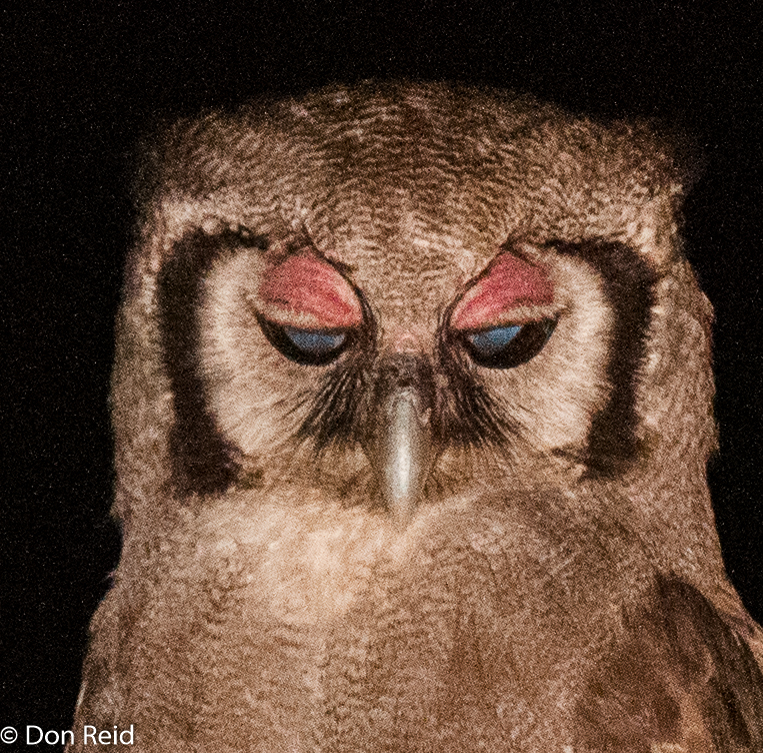
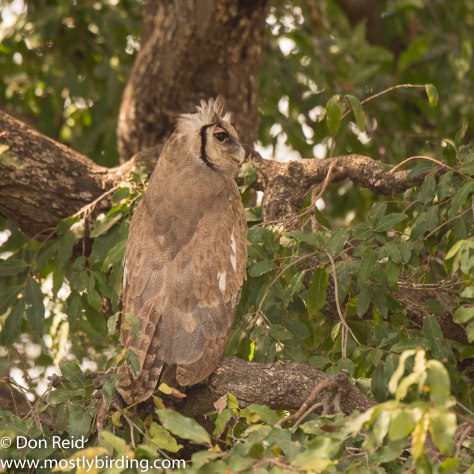
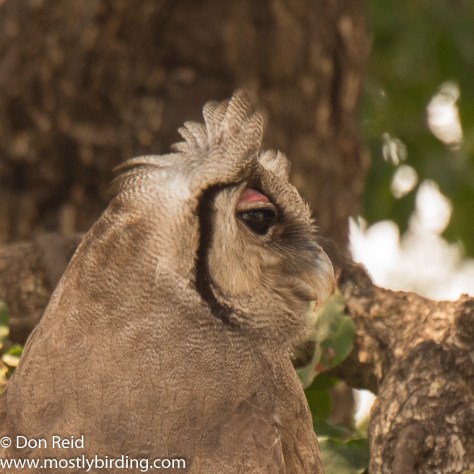
On the way to Skukuza from Olifants we had a few interesting encounters, including a stately Verraux’s Eagle Owl, perched amongst branches in a roadside tree and peering from under those famous pink eyelids at the few cars that had stopped with a rather disdainful expression.

Verraux's Eagle-Owl, Kruger Park
Verraux’s Eagle-Owl, initially not terribly interested in our presence
Verraux's Eagle-Owl, Kruger Park
Verraux’s Eagle-Owl, deigning to look vaguely in our direction
Verraux's Eagle-Owl, Kruger Park
The famous pink eyelids

As we drove further, I spotted a soaring raptor high above and braked to get a view of it and rattle off some photos to help with the ID – it turned out to be a handsome Black-chested Snake-Eagle, probably out on the hunt for its next slippery meal.

Black-chested Snake=Eagle, Kruger Park
Black-chested Snake-Eagle

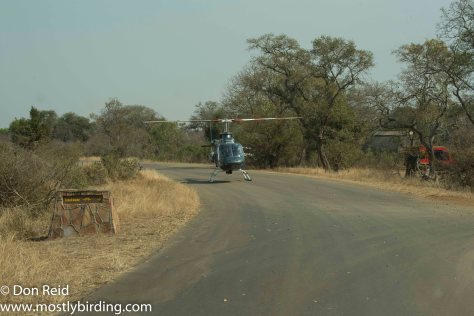
Then a bird of a different kind landed loudly in the road ahead of us just as we were approaching Tshokwane picnic spot – a “whirly bird” helicopter with a team of the anti-poaching unit on board, who had also stopped for a cold drink to boost them on their mission. May they be successful in curbing the atrocity of Rhino poaching!

Whirly bird, Kruger Park
Whirly bird at Tshokwane

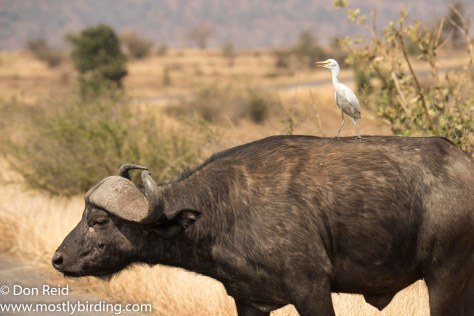
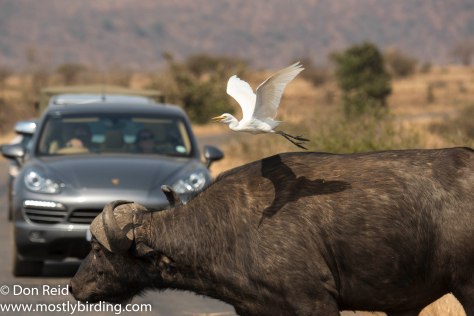
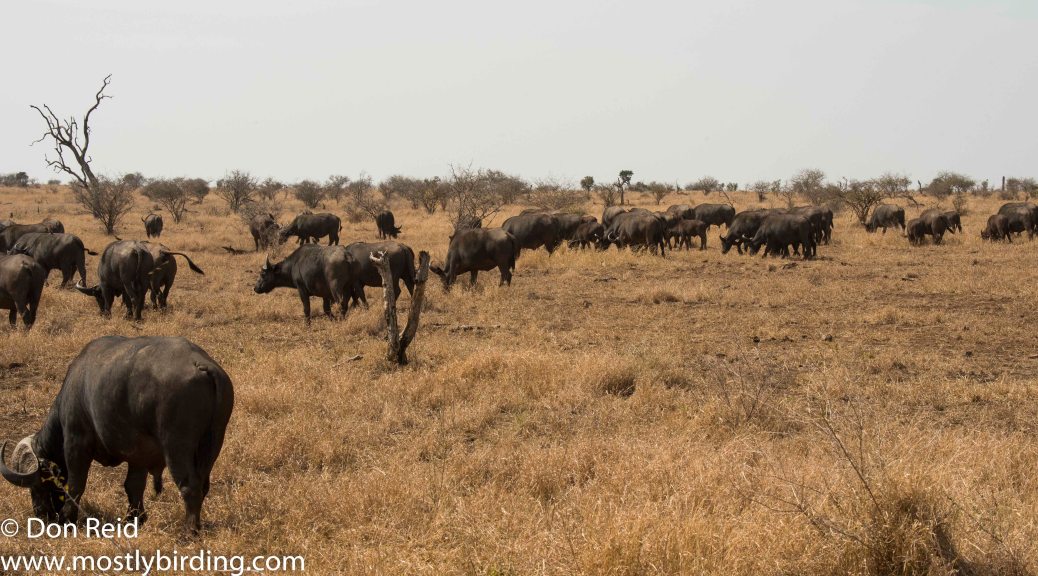
Further on, a large herd of Cape Buffalo was grazing on both sides of the road, with some crossing the road to join the main group – I noticed some Cattle Egrets around and one hopped on the back of a Buffalo to hitch a ride as he crossed over in front of us, comically balancing like a surfer riding a wave, then flying off as the buffalo became too wobbly for its liking.

Buffalo herd, Kruger Park
Cattle Egret on Buffalo, Kruger Park
Cattle Egret hitching a ride on Buffalo
Cattle Egret on Buffalo, Kruger Park
Cattle Egret decides its safer to fly

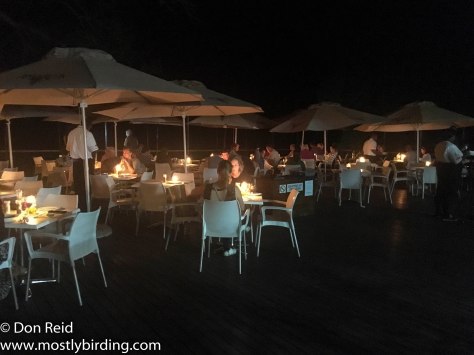
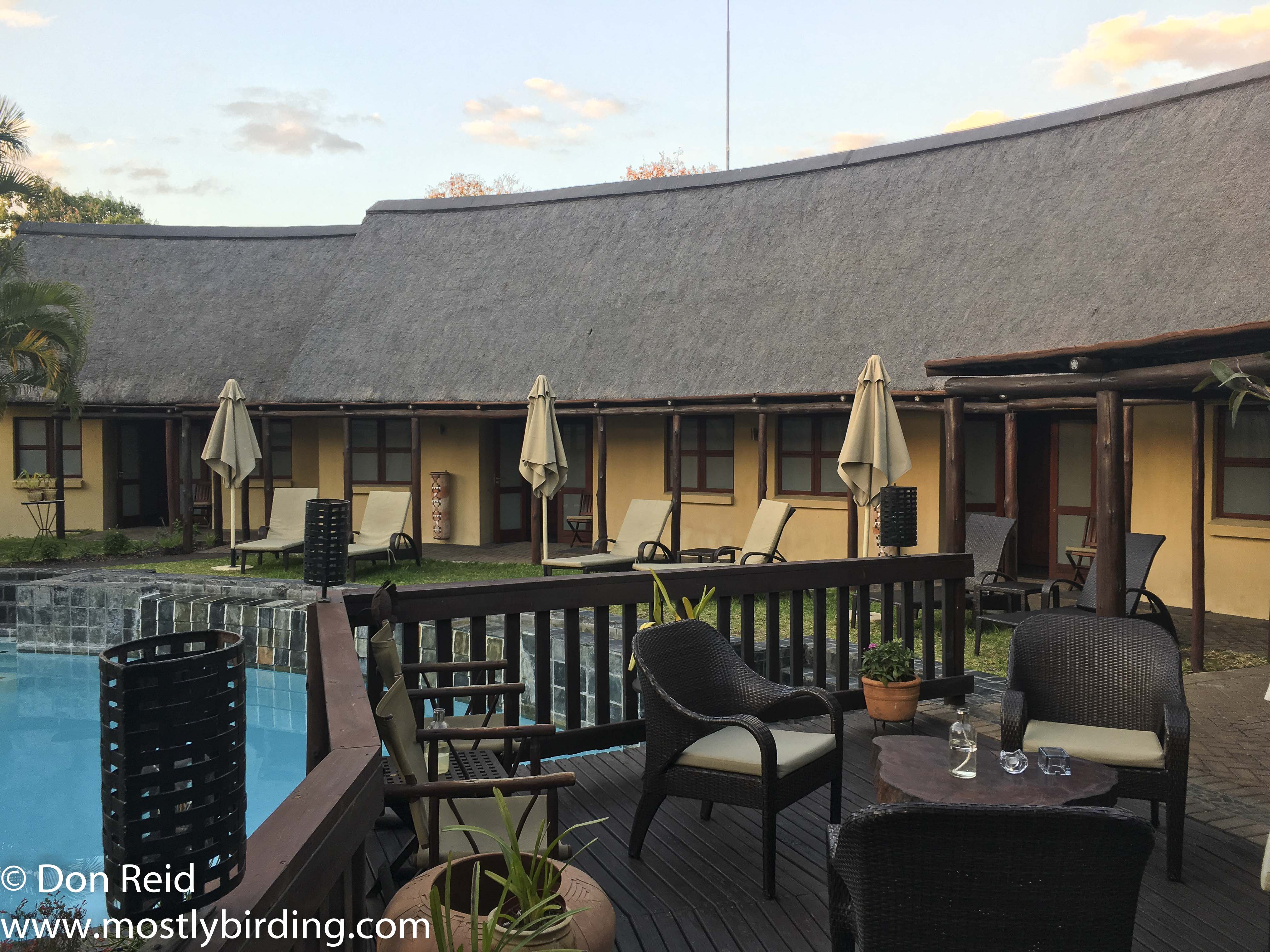
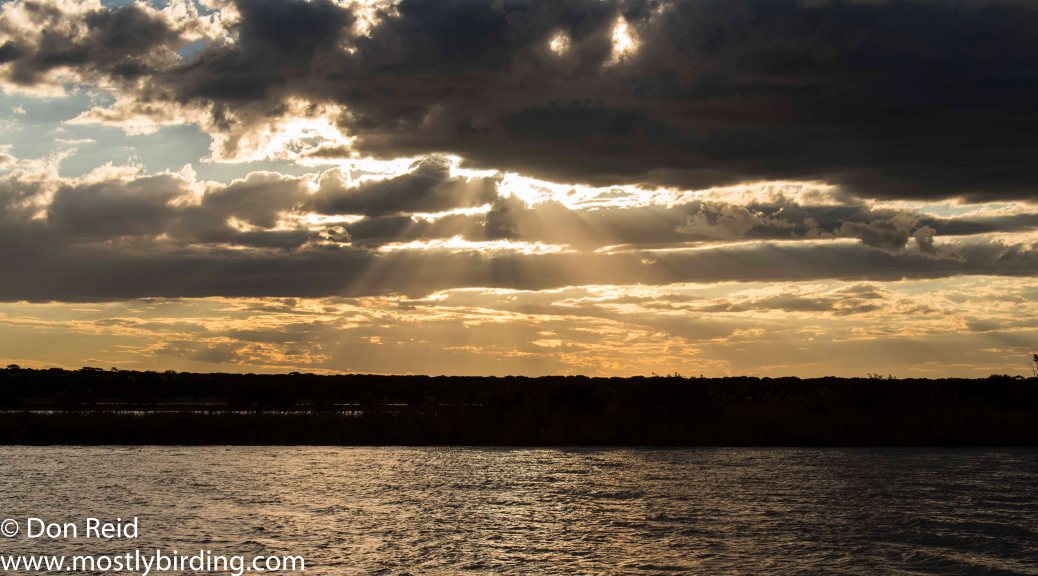
One feature we enjoyed after self-catering for the first 6 nights, was a candlelight dinner on the newly constructed deck overlooking the Sabie River and with a view of the iconic steel railway bridge in the background (as shown in the heading photo above). Admittedly not quite in keeping with the quintessential Kruger experience, but for us it made a nice change and the meal turned out to be excellent. The visit to the river below us of a small herd of elephants when we were halfway through our meal added some excitement to the unique location of the restaurant.

Skukuza deck, Kruger Park
Skukuza deck at night

Skukuza to Lower Sabie

When it came to deciding on a game drive for the one full morning we would be there, we settled on doing the drive that we knew would be busy but hopefully filled with good sightings, and we were not disappointed. The road between Skukuza and Lower Sabie camps is renowned for its big cat sightings, making it a drawcard for tourists who often spend just a couple of days in Kruger.

We set off from Skukuza well after gate opening time, hoping to avoid the early morning scramble and found the road to be reasonably quiet and devoid of other vehicles for the first stretch, allowing us to stop frequently for game and birds, without much disturbance.

Kudu, Kruger Park
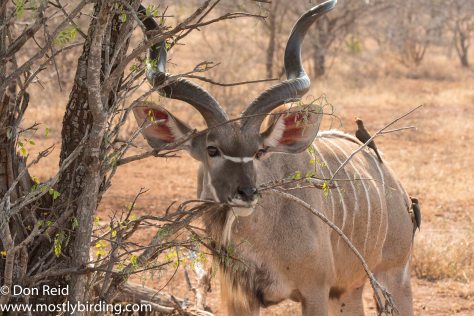
Kudu with Red-billed Oxpeckers hanging on

Mkhulu picnic spot is located about halfway along the road to Lower Sabie and is the ideal spot for a brunch, positioned as it is on the banks of the Sabie river and shaded by grand old trees which seem to have been there forever. While preparing our meal on the skottel, a female Cardinal Woodpecker entertained us and our fellow picnickers as it hammered away at a cavity in a nearby overhanging tree, not letting up despite a growing audience just metres away beneath the tree, all pointing cameras at her.

Cardinal Woodpecker (female), Mkhulu,  Kruger Park
Cardinal Woodpecker (female), Mkhulu

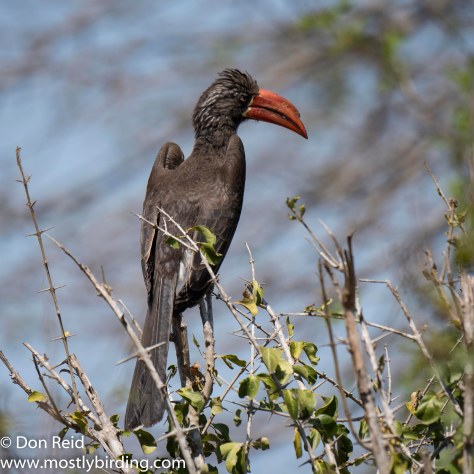
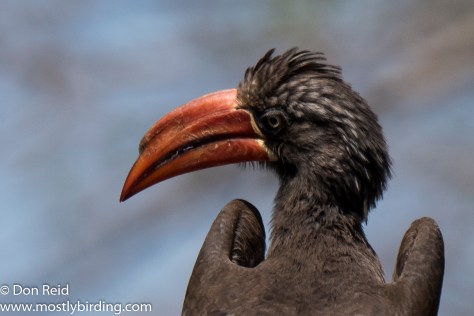
Further avian entertainment was provided by Paradise Flycatchers and Purple-crested Turacos in an enormous Wild fig tree and as we packed up to venture further a Crowned Hornbill, unusual for this part of Kruger, flew in and promptly lay flat on the dusty ground for a minute or so, dust-bathing. Many birds do this to maintain their plumage – the dust absorbs excess oil and keeps the feathers from becoming too greasy. I was just too late to capture this behaviour on camera so had to be content with a few conventional “bird on a stick” poses.

Crowned Hornbill, Mkhulu, Kruger Park
Crowned Hornbill, Mkhulu
Crowned Hornbill, Mkhulu, Kruger Park
Crowned Hornbill, Mkhulu

Leaving Mkhulu, the road seemed busier and the way a couple of full safari vehicles passed us at speed (relative to our slow pace of course) suggested that they were on a mission – probably involving a “big cat” or two, at a guess. So we speeded up a tad while making sure we stayed within the 50 km/hour limit and followed the other vehicles. It wasn’t long before we came upon the first “scrum” of vehicles which told us there was something of interest.

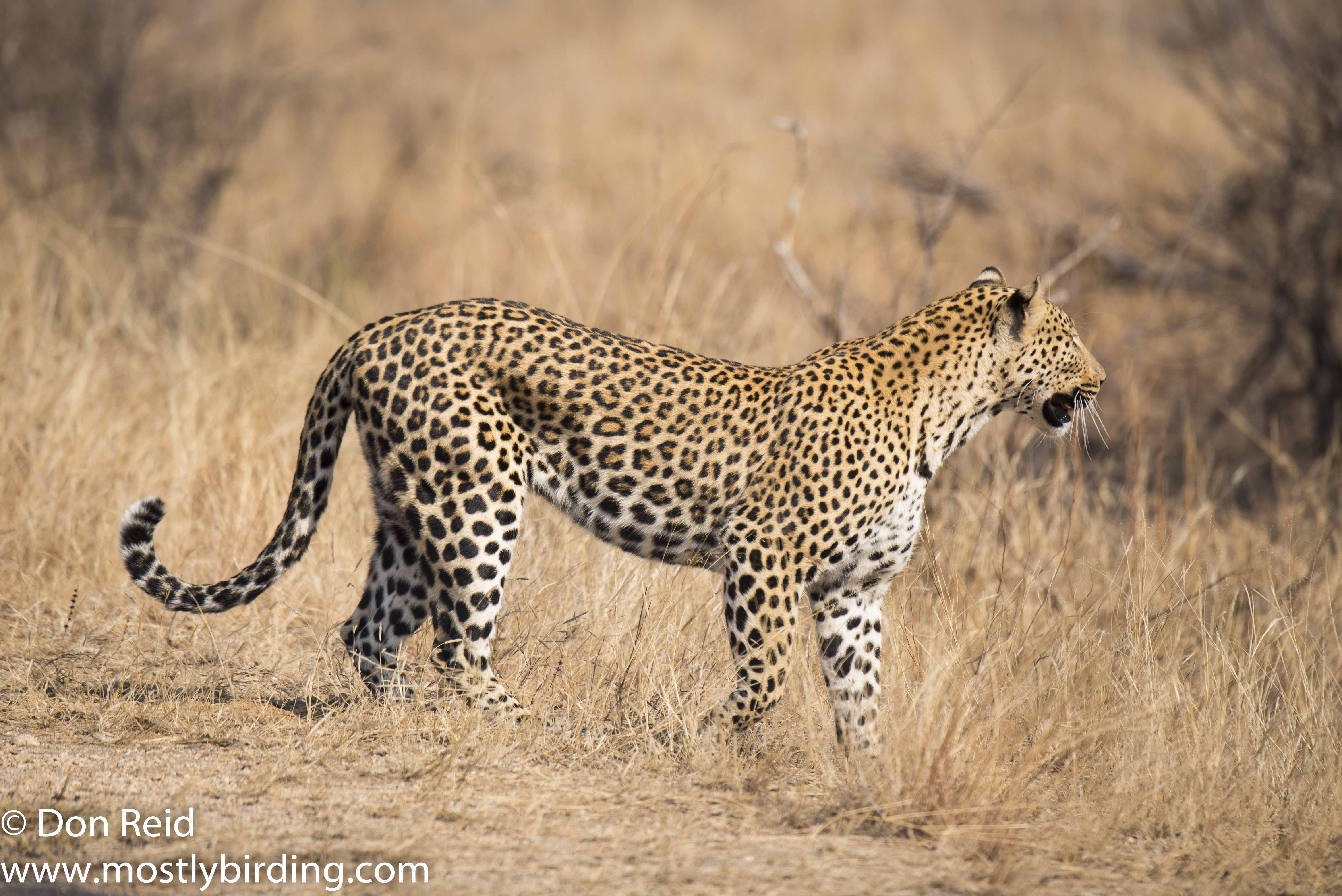
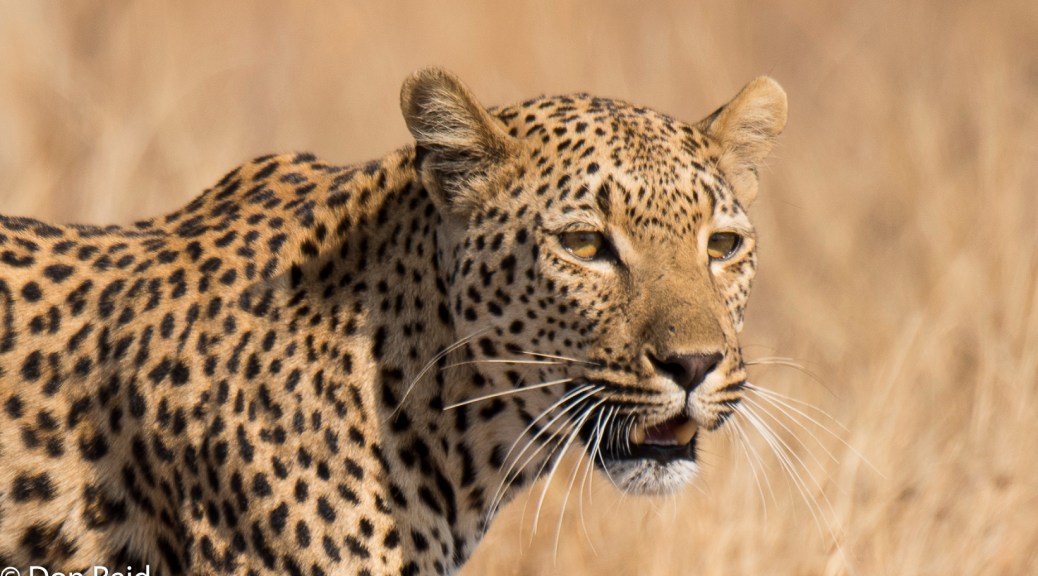
The object of their interest turned out to be a Leopard, just visible on the far side of the river, resting in the shade of the riverside vegetation.

Leopard, Sabie River, Kruger Park
Leopard, Sabie River

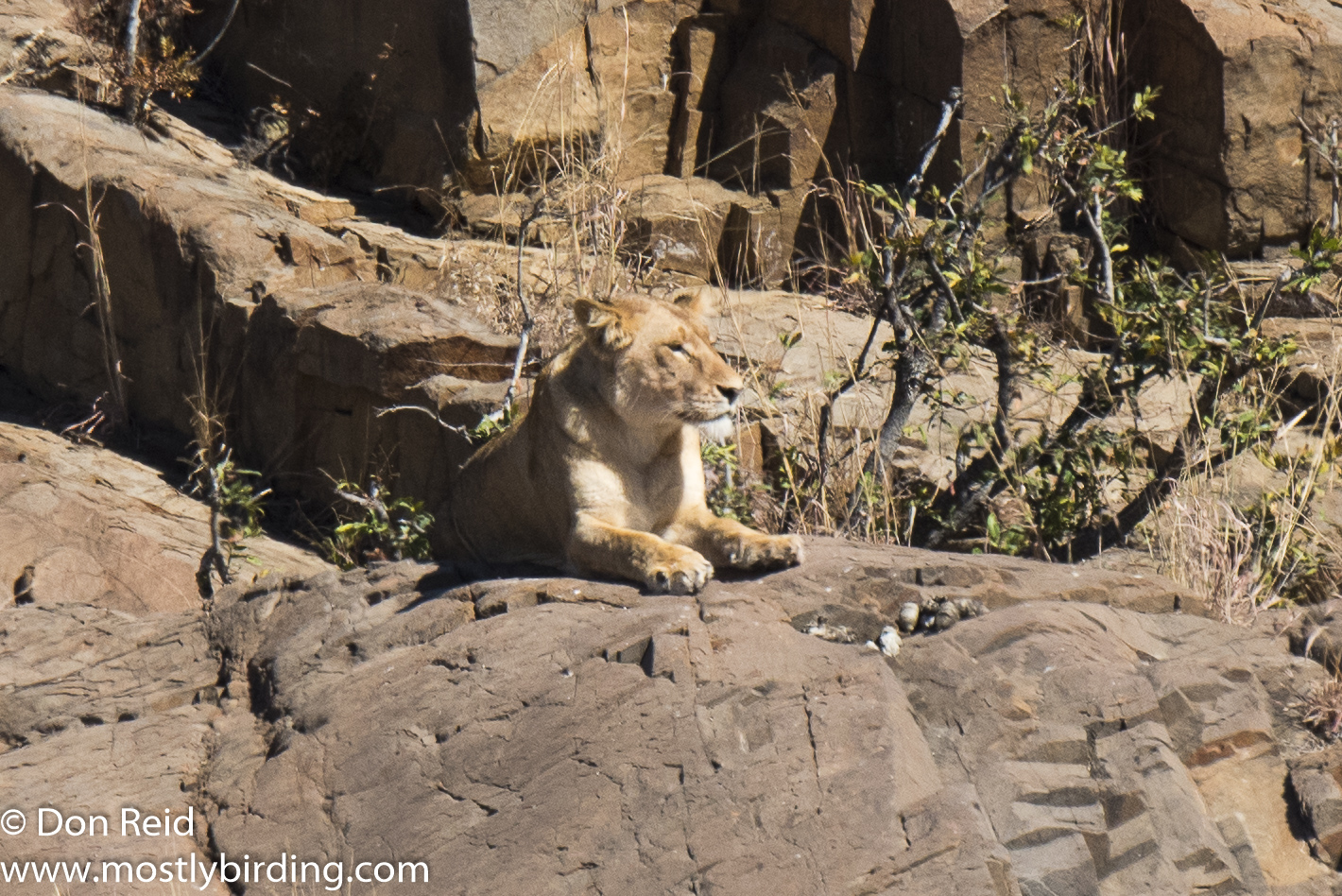
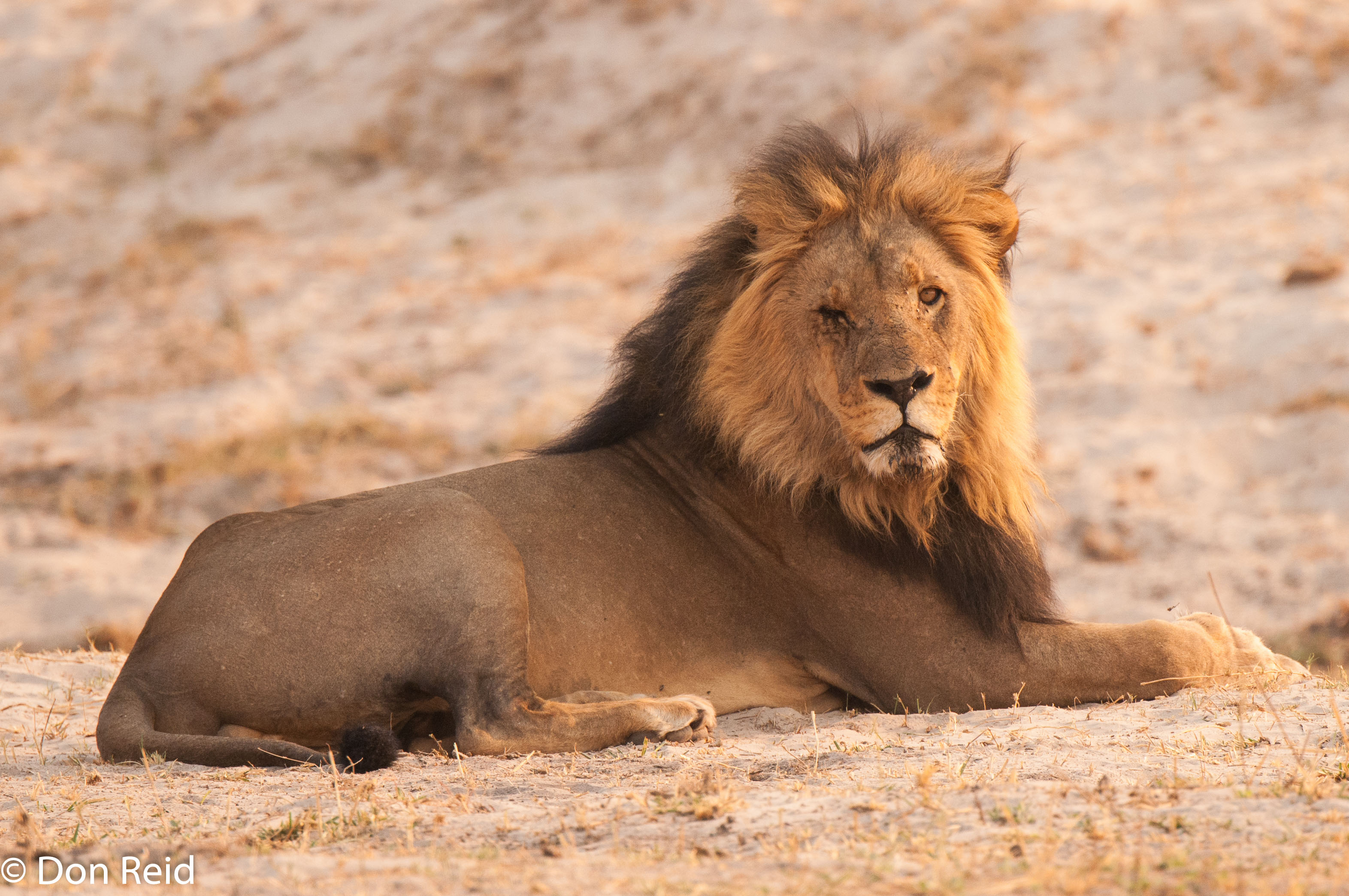
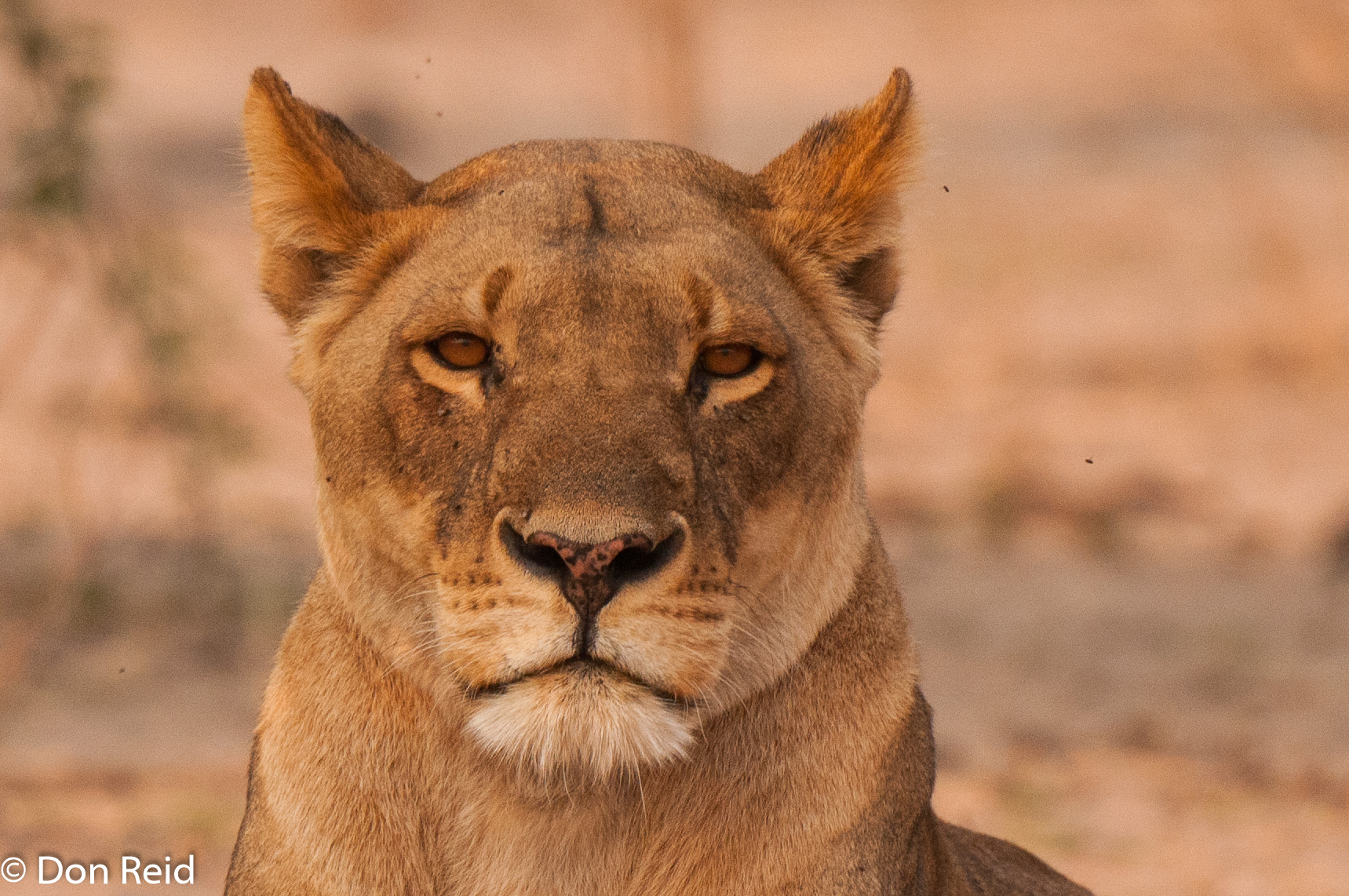
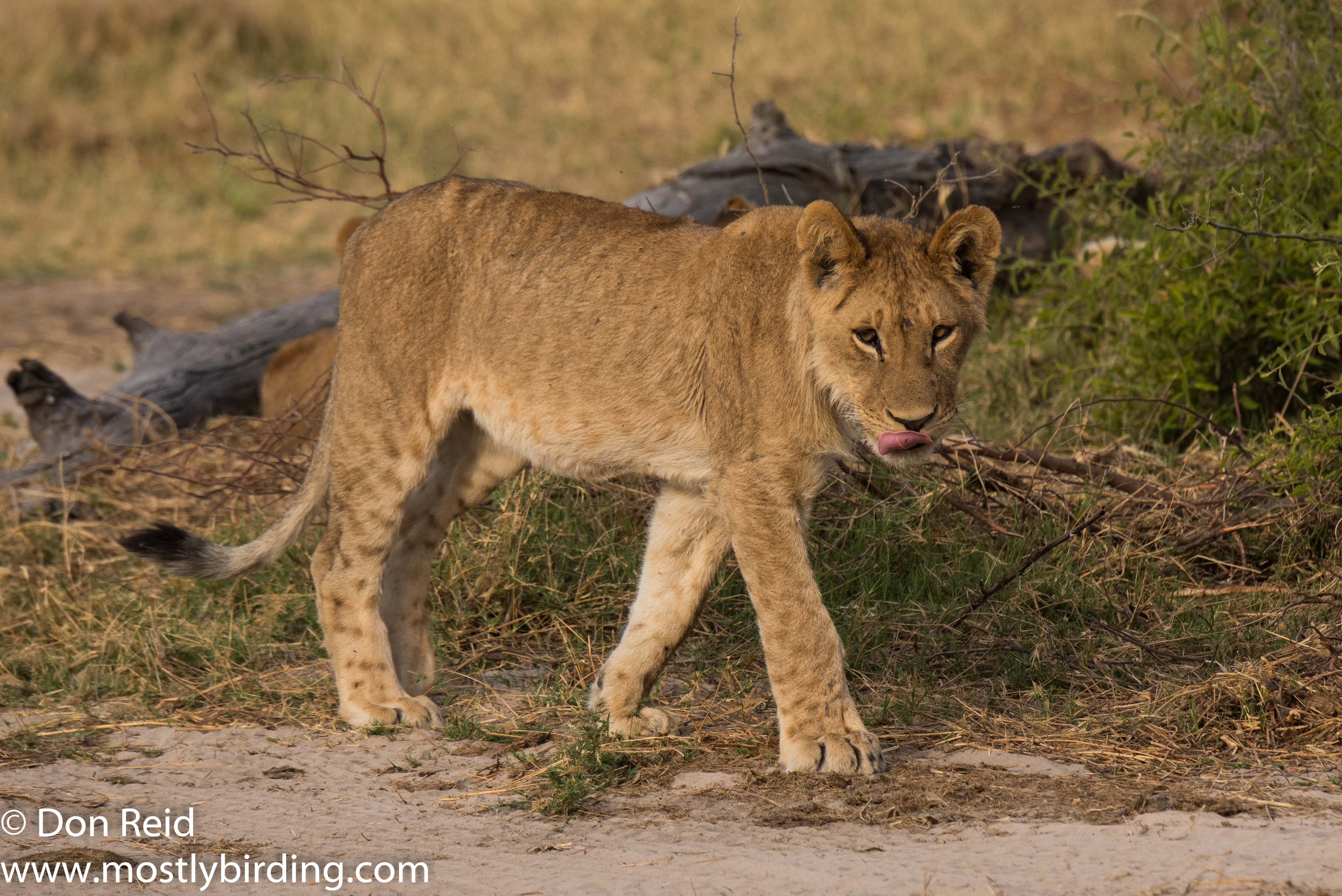
A couple of kms further along the road, Lions were using the rocky outcrop next to the river as a vantage point and we endured another scramble of vehicles, manoeuvring to try to get a decent view.

Lion, Kruger Park
Lion, Kruger Park

Last stop before Lower Sabie was a brief one at the Sunset dam to view the resident hippos and the many birds lining the shore and wading in the shallows.

After enjoying coffee on the deck at Lower Sabie, we headed back to Skukuza without further stops to give us time for some relaxation on the stoep of our rondawel, more than satisfied with our morning’s outing.


Kruger unplanned – Olifants to Timbavati

Kruger has more Leopards than Warthogs – or that’s what the statistics are telling me, and statistics don’t lie ……….  do they?

So where on earth did that statistic come from?

Well, we spent a week in Kruger without seeing a single Warthog, yet we had two Leopard sightings during that same week, so on the face of it there is a better chance of seeing Leopard – and Lion which we saw several times – than Warthog.

Actually, as the week wore on, I became progressively more amazed that Warthogs were somehow eluding us – surely one of the animals that rate just below Impala on the “likely to see” list. It was quite bizarre that we did not find a single one and I still don’t know if there is a reason behind it – some sort of late -winter, early spring strike on their part perhaps?

Continuing the story of our unplanned week in Kruger in early September this year – there are several parts that make up the quintessential Kruger trip and without doubt the most important for all visitors is the wildlife encounters.

In between just enjoying the ambience of the camp and  a couple of bird atlasing trips, we did two specific and very contrasting game drives which were both filled with interesting sightings. The first of these was –

Olifants to Timbavati

We were into a pleasant routine of getting to bed early and waking early – something we don’t seem to be able to manage in our “normal” life. After coffee and rusks on our little stoep  with a view, we headed out and along the tar road, initially to the viewpoint high above the Olifants river, then further on to the bridge over the same river, where perhaps 100 or more Little Swifts were swooping back and forth under the bridge. It makes a pleasant change to be able to watch these aerial magicians from above rather than craning your neck to follow them in the air. It made me wonder why they fly under the bridge in this fashion – perhaps the goggas (bugs) gather in greater numbers there or are easier to catch, whatever it is the swifts carry on in this way all day.

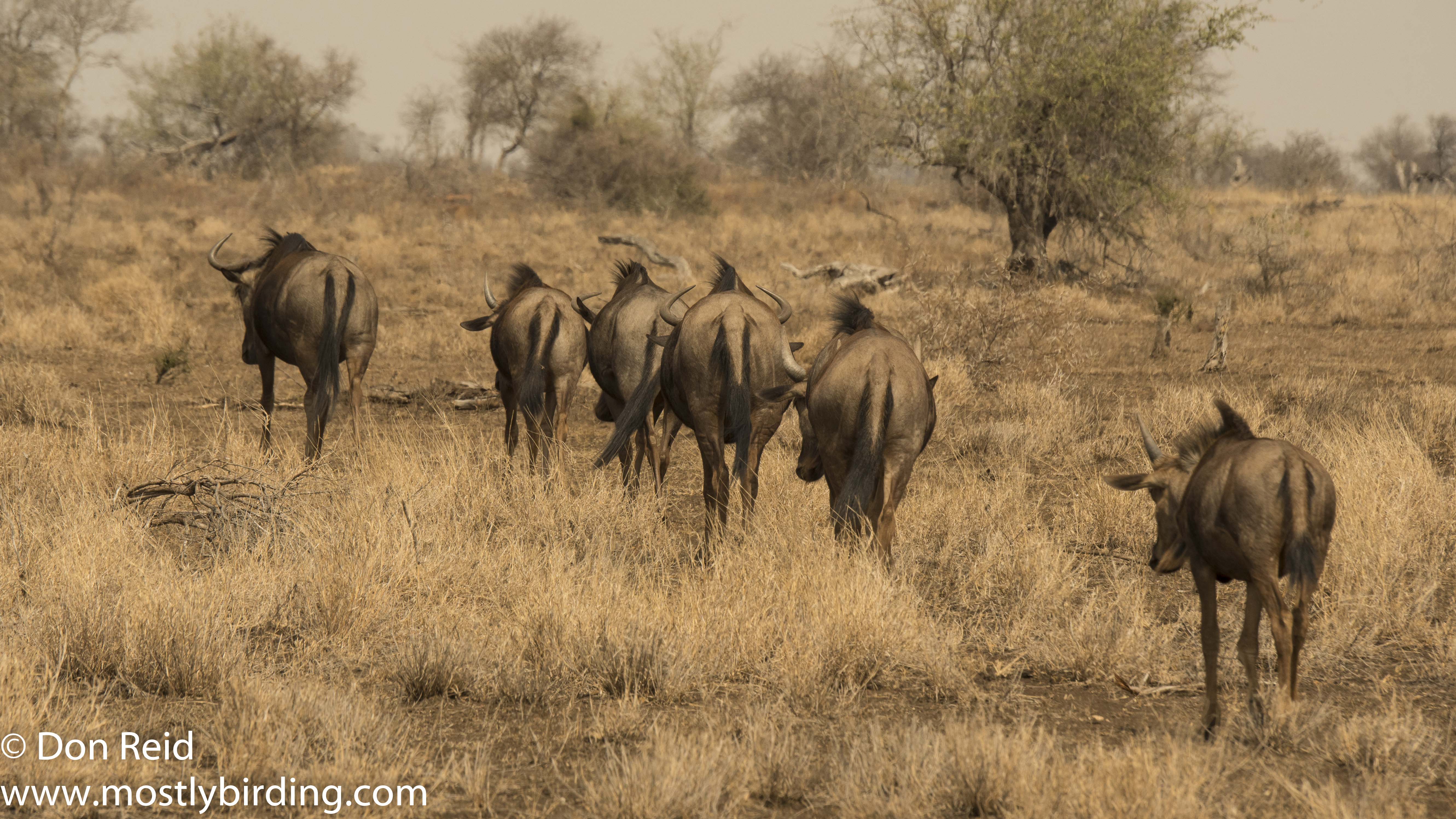
Some way further on we turned right onto the S39 gravel road, which roughly follows the Timbavati river for about 28 kms. Suddenly the game proliferated with hundreds of Impala in places, a few Steenbok, typical plains game such as Zebra, Giraffe, Wildebeest and Buffalo, all of  which were quite relaxed and going about their daily routine.

Steenbok
Giraffe
Wildebeest

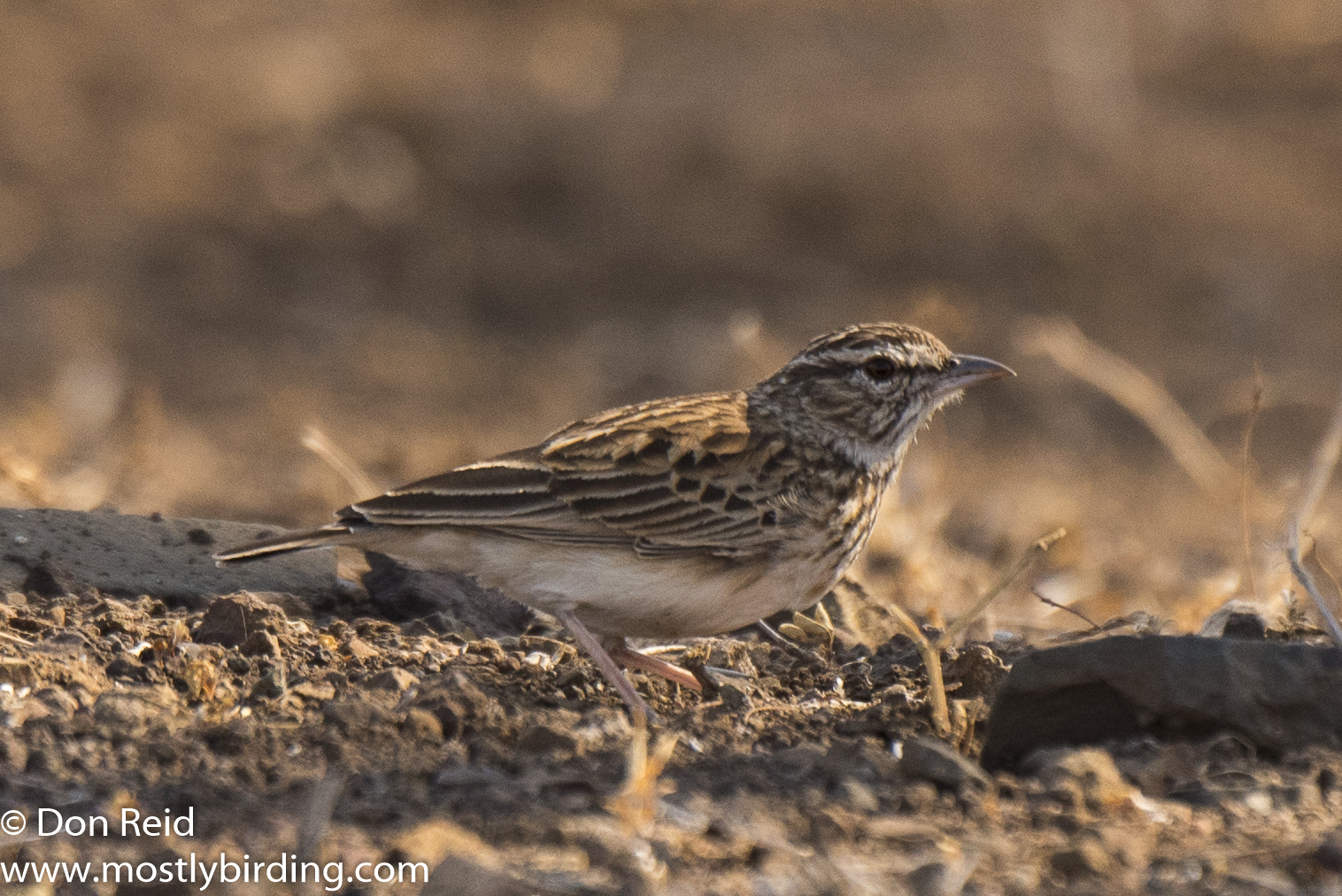
Small bird parties at regular intervals were reason to stop and identify the species – curiously the bird parties seemed to form each time we saw Sabota Lark with the likes of Blue Waxbill, Red-billed Queleas, Brown-crowned Tchagra, Long-billed Crombec, Black-backed Puffback and others close by.

Sabota Lark, Timbavati
Rattling Cisticola, Timbavati

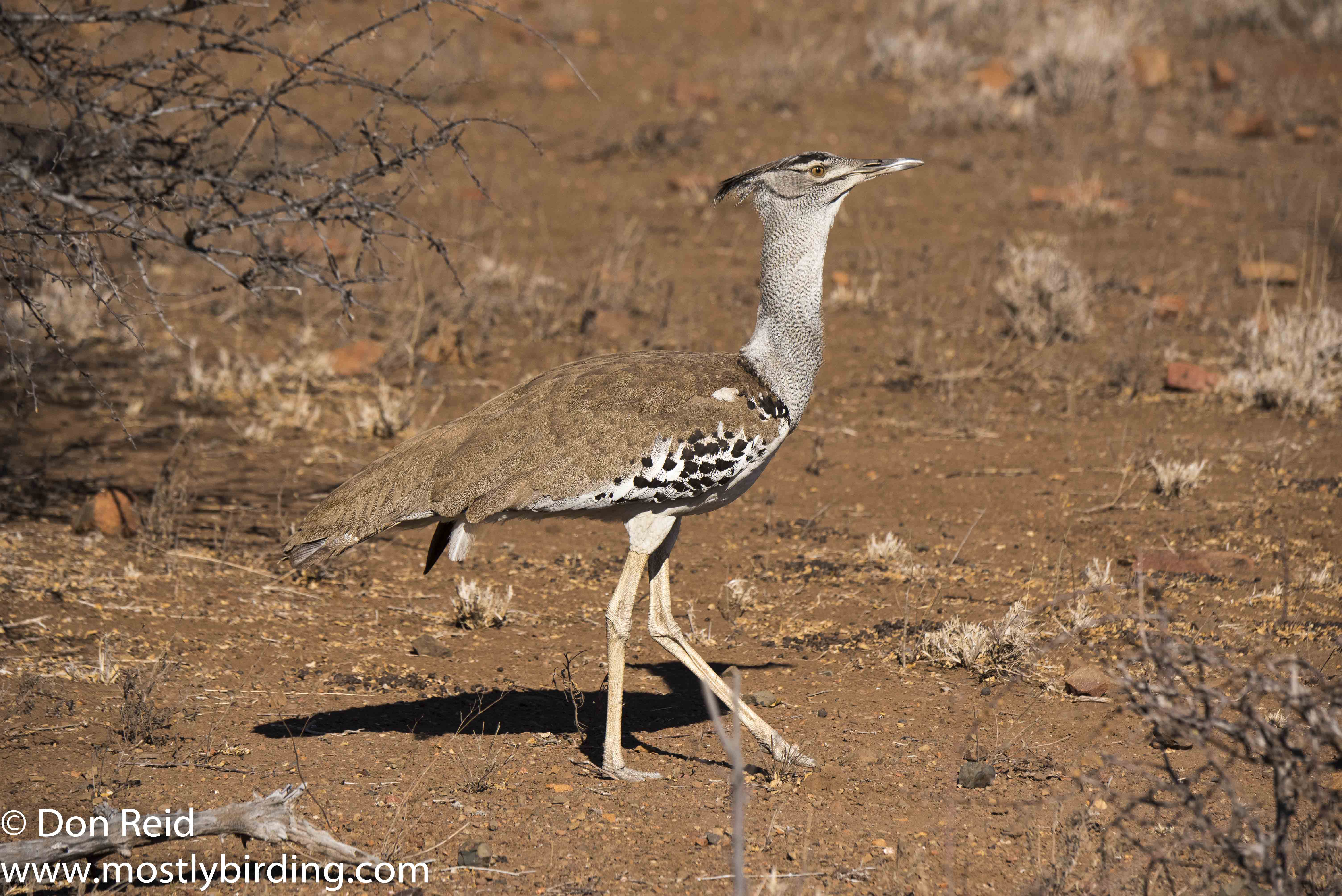
Best of all, we came across an elegant Kori Bustard right next to the road, strutting about rather imperiously with head held like an aristocrat viewing the rabble. Two cars passed by without stopping and with no idea that they had missed viewing one of the most impressive birds in South Africa – also the heaviest flying bird in the world – so limiting when all that matters is the “big cat” sightings

Kori Bustard, about 1,35m tall, weighing around 12 kg
Kori Bustard

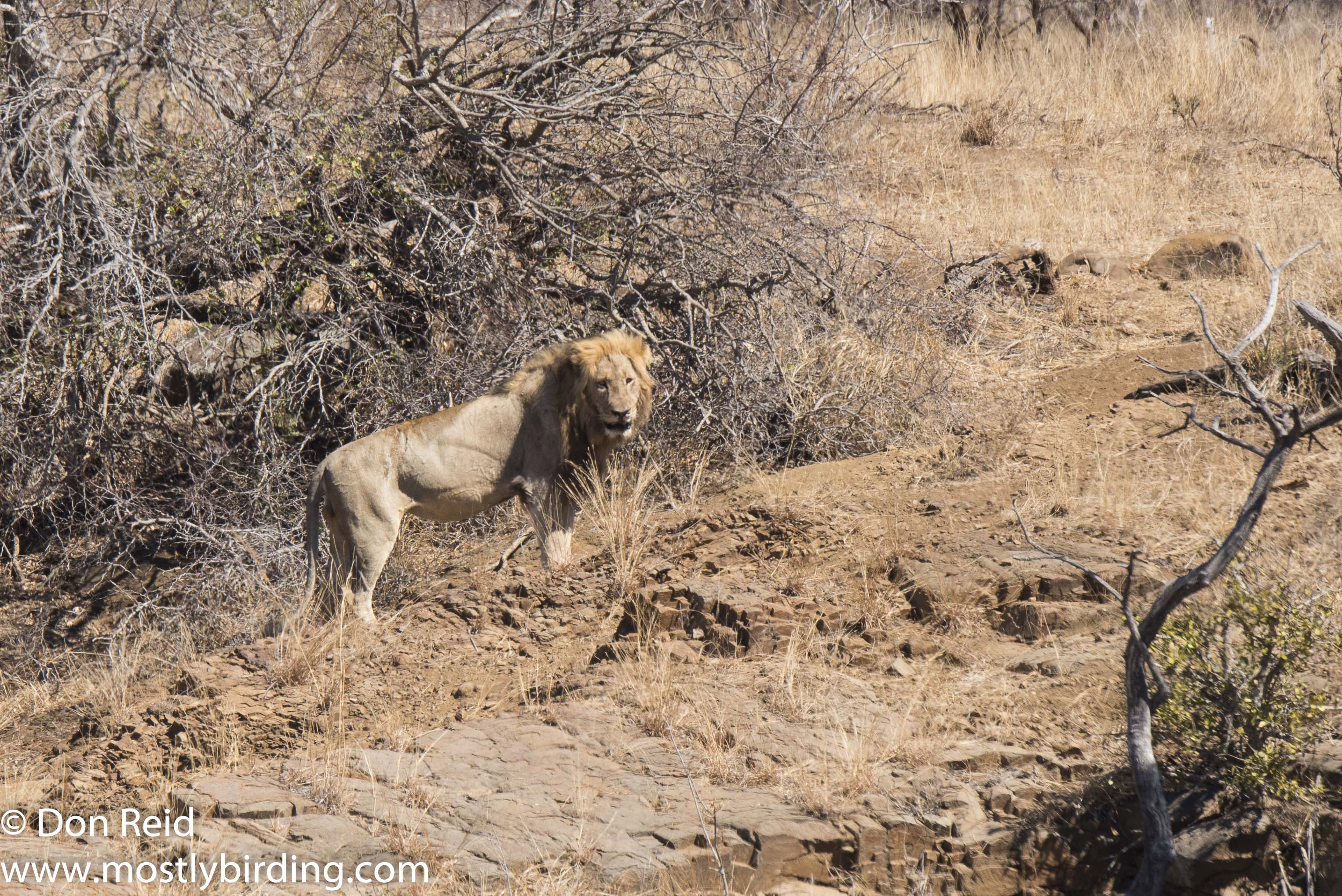
Not long after, a chatty guy in a Land Cruiser with family on board stopped us to ask where we had hidden all the lions. We chuckled and carried on, only to be stopped again by the same chap, now parked at the side of the road and gesticulating towards a nearby tree, where we soon saw the object of their excitement – a male lion resting not far from the road.

Lion, Timbavati

He was lazing with his back mostly towards us, so we could not get a good view of his features but we took this in for a while, then continued past the Piet Grobler dam and the hide overlooking the river ( no water so we did not bother to stop) and turned off at a viewing spot when we spotted a herd of elephants approaching from further up the dry river bed.

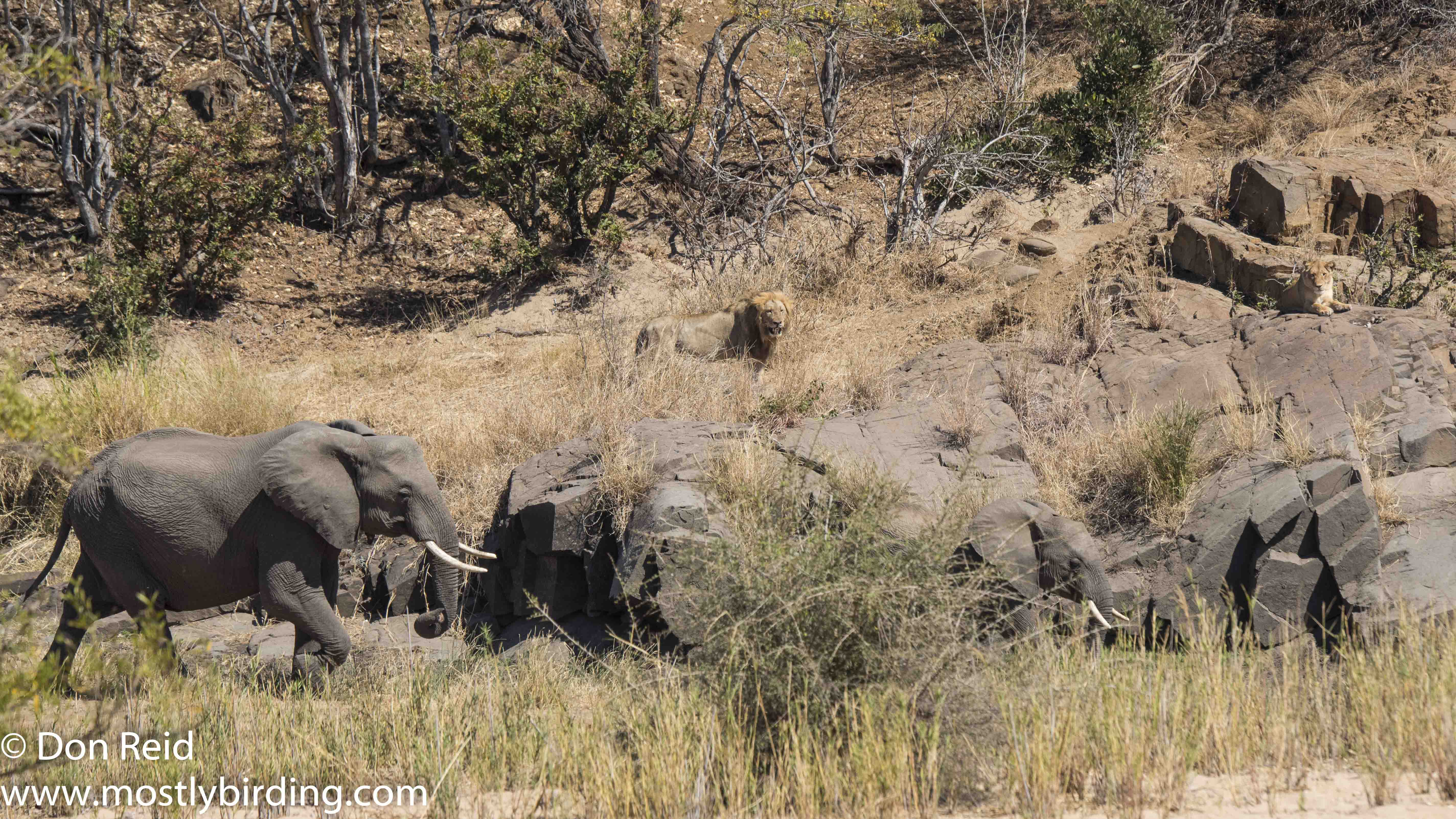
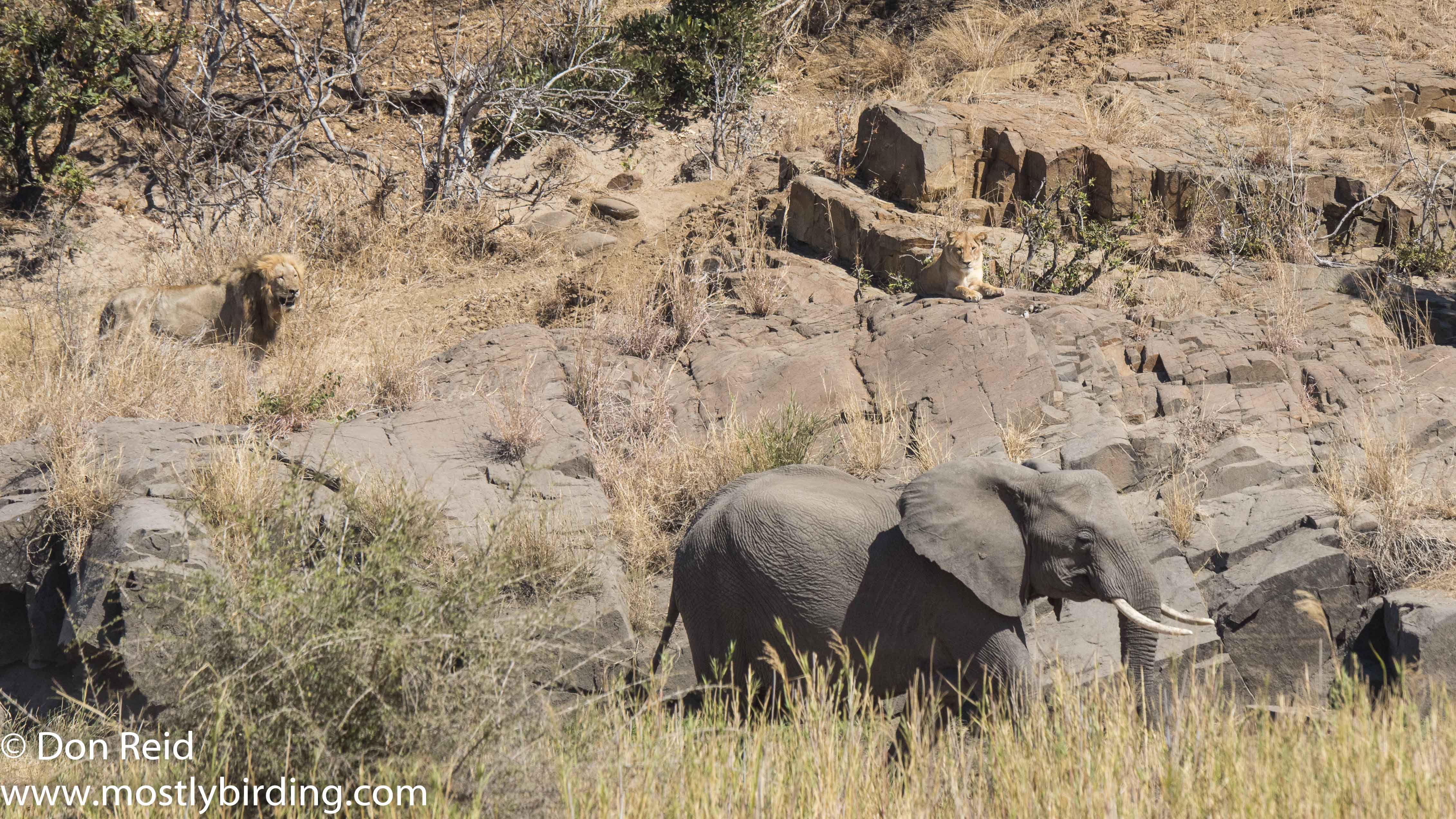
We watched as they came closer, ambling along the river bed in their slow, measured fashion one by one. Just then Gerda exclaimed “lions” and there they were, a male and two females further up on the opposite bank of the river, looking magnificent against the backdrop of the rocky bank and watching carefully as the elephants passed by below them.

Lions and Elephants, Timbavati

One of the younger elephants decided to show the lions who’s the boss and momentarily turned towards them and made as if he was going to chase them up the river bank – the lions retreated and the satisfied elephant carried on following the herd, which had by now veered off and over the opposite bank. Another of those magic moments of interaction between the dominant species, which we were fortunate to enjoy with just one other couple in a sedan.

Lions, Timbavati
Lions, Timbavati

More than pleased with this sighting we proceeded to nearby Timbavati picnic spot for a slap-up brunch of paw paw with yoghurt and a “full english” breakfast done on the skottel. On the way back along the S127 Ntomeni road, White-crowned Shrikes suddenly featured, usually a sign that the habitat has subtly changed, while a pair of Gabar Goshawks flew across the road directly in front of us, one of them a  dark morph, entirely black except for white barred flight feathers, the other a pale morph, with mostly dove grey  colouring.

Back on the tar road H1 – 4, the only further interest was at the bridge where we had stopped earlier – a large group of vultures had gathered on the sand some way up the river, so I set up the scope and was able to identify White-backed, Lappet-faced and Hooded Vultures plus a Marabou Stork looking like a mournful gate-crasher.

That was enough action for the day so we took it easy back at the camp with tea, a snooze and an evening wors braai (sausage barbeque) to see out the day.

Birding for absolute beginners

I came across this article on one of the birding sites on facebook and thought to share it here. It is a wonderful and inspiring read for beginners and experienced birders alike.

BIRDING FOR ABSOLUTE BEGINNERS
Module 1 – Learning to be Observant
© Jill Masterton
Edited by Ian Grant of EverythingBirding.co.za

WELCOME TO THE WORLD OF BIRD WATCHING!

It’s very easy to do bird watching – you just need to sit somewhere quietly and any number of birds will turn up, or fly past, or perch in a tree nearby. Then all you have to do is look at them. Simple!

You don’t have to know which birds you are looking at, it’s fun just to watch their antics and to hear them communicating with each other and watch them feeding, preening or collecting nesting materials.

But being nosy humans, we have to spoil the simple fun of just bird watching by HAVING to know what kind of bird we are looking at. Crazy, isn’t it? And then, when we get better at this bird identification thing, we start trying to tick off all the birds in our books, and adding to the list at every opportunity. We are our own worst enemies!

So, in order to do bird identification, we actually have to learn the powers of observation. We need to really LOOK at the birds, LISTEN to the birds and LEARN to understand the different behaviours of birds.

One important factor to remember when starting or enjoying a hobby such as birding is that it is NOT a competition. Many ‘birders’ spoil their own enjoyment of just watching birds by having to go around aimlessly (almost manically) ‘ticking’ off yet another bird to add to their list. What enjoyment is there in that? To brag to your friends (who probably couldn’t give a continental anyway) that you now have seen and identified over 400 species INCLUDING the rare double-breasted mattress flapper! I often imagine these types as skulking along try to find a rare bird – eventually seeing it and immediately ticking it off in their books – and off immediately to find another – without even spending some time watching and enjoying the bird itself. Rather spoils the whole idea behind bird watching, doesn’t it?

So, enjoy yourselves, go at your own pace and share your experiences with others – don’t push your new-found hobby down other people’s throats – especially your family and friends. Enjoy birding for yourself. (And you may find, as I have, that even those who laughed at you will soon be joining you in your pursuits!)

LEARNING TO BE OBSERVANT

With birds, even if you have the best binoculars in the world, you will find that you’ve just got the bird sighted and it will fly off!

Therefore you usually only have a few seconds to take in a whole load of detail. Don’t despair, it is difficult for all of us, and with patience you will learn to quickly take in the following points and make positive identifications.

A good way to start is to try doing it in pairs (buddy system) – one looks at the bird through the binoculars and the buddy asks the questions below, and takes notes. Swap around, so that both buddies get to look and ask the questions.

1. WHAT SIZE IS IT?

I don’t know about you, but I was born on the cusp of the metric and imperial measuring systems. I know 30cms is about one foot, because the rulers are that size, but other than that, I find something like 17cms in length from beak tip to tail tip difficult, if not impossible, to comprehend.

So – I see a bird and I ask myself….

Is it smaller than a sparrow? Same size, or slightly bigger?

This is because I can visualise the size of a House Sparrow, because sparrows are familiar birds that I have known all my life.

The metric size of a House Sparrow as measured in a bird guide is 14-15cm.

What other birds do you know that are about the same size? Masked Weaver, perhaps? Yup – same size!

Then go up a step. Common Mynas (were called Indian Mynas) – pesky aliens, but also very familiar – 25 cms – about the same size as a Cape Glossy Starling – and a member of the Starling family.

Rocks Doves (Feral Pigeons) are familiar birds, measuring 33cm. Is the bird you are looking at about the same size as a pigeon? Black-shouldered Kite? Okay, just slightly smaller at 30 cms.

Interestingly enough, all the familiar birds I have mentioned are not indigenous birds but were introduced in to South Africa, and all are common in cities and suburbia, that’s why we know them so well.

You can choose your own list of familiar birds – and the trick is to type or write them and their measurements down on a piece of card and use this as a bookmark in your bird guide.

2. WHAT SHAPE IS IT?

Learn to distinguish the different shapes or outlines of the birds you are looking at. Does the bird have long legs or short legs, a long, medium or short tail? And what shape is its beak?

This is not easy, and it takes a bit of time, but with practise you’ll soon be able to see that different bird families have different-shaped beaks, or short sturdy legs or long thin ones. Some birds have short tails some birds have long tails. Some birds are tiny, some are large, and it’s the in-between birds that are the problem, so leave those until you are feeling more confident.

Nobody can miss the Long-tailed Widowbird (Longtailed Widow) with his flowing tail plumes, but he is much more difficult to identify in winter when he’s not in breeding plumage. Or the tiny sunbirds that look a bit like humming birds, but we don’t get humming birds in South Africa, so if it looks like a humming bird, it most likely is a sunbird.

No-one can really tell you how to learn to recognise outlines of birds. For myself I find it helpful to actually draw the outlines to get a feel for the shape of the birds. Ornithologists have the luxury of having stuffed birds to look at and touch. If you really do become more interested in birding, there is always the opportunity to learn how to do bird ringing – where you catch wild birds and ring them for research purposes. This will give you the opportunity to literally have a bird in the hand – and not in the bush! Visits to bird parks, zoos and museums are also very helpful places to familiarise yourself with the various bird families and sizes, and beaks, etc.

3. WHAT COLOUR IS IT?

There is now a helpful field guide available that actually groups the birds together using colours as the identifying criteria, as opposed to the standard guides that split the birds into waders, ocean-going birds, seed-eaters or insect-eaters, for example.

One thing that is very important with colour is to try and also note the colour on the beak, legs and feet. This can be a critical tool in identifying even a seemingly easy bird. For instance, look at the egrets. Most of us know what a Cattle Egret (often called a Tick Bird) looks like, but how would you distinguish a juvenile from a Little Egret? Apart from the Little Egret’s crest – LOOK at those feet! Bright yellow on the Little Egret – black on the Cattle Egret.

So, colour is more than the overall picture, it is detail that you are going to have to learn to see.

4. DOES IT HAVE A DISTINCTIVE PATTERN OR MARKINGS?

Now, I know you are probably perplexed by this – patterns on birds? Well some of them DO have patterns – look at the francolins, the Thick-knees (Dikkops) and the Guineafowl, the various species have different patterns from one another – look at the differences.

Look at the Woodpeckers. Now, it’s absolutely no use saying that you saw a woodpecker with a red head – most of the little blighters have red heads! So, what sets them apart, size, yes, location – mmm maybe, but pattern certainly? Look at their breast feathers and the patterns on the sides of their heads.

4. WHERE IS IT?

A great help to the fledgling birder is the distribution maps in the standard field guides. I find the guides that have the picture of the bird with the written description and the distribution map all together on the same page the easiest to deal with. If you see a Bulbul in Cape Town, it’s not a Dark-capped (Black eyed) Bulbul, they don’t occur there. It’s a Cape Bulbul – see how similar the bulbuls are, and how subtle the differences?

Habitat is another great help. If you’re looking at birds on the seashore they are often waders or ocean-going birds. Birds found in grasslands are usually seed-eating birds or terrestrial insect/rodent/reptile eaters. Birds hovering above grasslands are often raptors on the lookout for smaller birds or rodents for lunch.

Dams and rivers attract more waders and weavers and some kingfishers. But don’t let the names of birds dupe you – more kingfishers eat insects than they do fish! Therefore, you’ll probably see more kingfishers in woodland, hawking for insects from a branch, than you will see at a dam in a grassland biome. And I have seen more than one seagull strutting along an inland playing field in Gauteng, I can tell you!

5. WHAT TIME DID YOU SEE OR HEAR IT?

Learn the terms below

DIURNAL – Active during the day

NOCTURNAL – Active at night

CREPUSCULAR – Active at dusk and dawn – or in the half-light hours.

Therefore, if you see or hear a bird at night, look out for nocturnal birds in your bird book to help you with identification. Again, don’t be fooled into thinking that all owls are strictly nocturnal, African Scops-Owls (Scops Owls) and Pearl-spotted Owlets (Owls), for example, are not and are often heard calling by day!

6. WHAT IS THE BIRD DOING?

Is the bird hopping, walking, running, soaring, swimming, wading or climbing about in a tree?

Is it swooping, pecking the ground like a chicken, probing in the mud, catching insects, feeding in a tree or gathering nesting material?

7. WHAT SOUND IS IT MAKING?

This is possibly the hardest of all to learn, but the easiest way to positively identify a bird because they all have their own unique voices.

For me the easiest way to learn calls is to actually hear something calling and try and find the bird – I USUALLY remember it then. I also find videos of birds with their calls much easier than listening to tapes or CD’s – as you can actually see which birds are making which calls.

Start by learning the calls of birds in your own garden, or if you don’t have a garden, go to your nearest park or similar. By being observant and going out and looking at who is prattling away, you will find that very soon you will be able to identify quite a number of birds just by their sound.

Don’t be put off – you can probably already identify quite a number of birds by their call. How about the Hadeda Ibis? The African Hoopoe, the Red-chested Cuckoo (“Piet my vrou”) or the Crowned Lapwing (Plover) – so you are already on your way!

Another way to learn to identify birds by their calls is to put a verse to the call if you can, as in the Red-chested Cuckoo with its distinctive “Piet My Vrou” call. You’ll hardly ever see this bird – but you’ll hear him calling all the time in summer – even at night! How about the Grey Go-Away-Bird (Lourie) – shouting at you or your cat to “Go Awaaaay!”? Feel free to make up your own verses to calls!

Anyway, it’s not a train smash if you can’t learn calls, but it does help quite a lot with identification, and there are a few species of birds that are really only identifiable by their call, e.g. the nightjars/ pipits and larks.

BECOME ACQUAINTED WITH YOUR BIRD FIELD GUIDE

Look through your field guide often. Look particularly at the different groups of birds which are all conveniently located in the books close to each other.

Try and see the differences and the similarities, you will find identification a lot easier once you have managed to recognise what group a bird is in just from

a quick glance. I am afraid there are no short cuts to this process – you just have to keep on looking and looking and looking.

READ ABOUT BIRDS

Develop more than just a passing interest in birds. An excellent publication is Africa, Birds and Birding that has wonderful in depth articles about birds – breeding biology, behaviour, status and migration – as well as articles on great birding spots. It is such an attractive and informative magazine that it will soon pique your interest in birds even further so that your learning becomes enjoyable and not onerous.

GO BIRDING WITH A BUDDY

Try and go birding with somebody – preferably at about the same stage of birding as yourself. Try not to go with one of those know-it-all types as they will loudly proclaim what bird it is before you’ve even got it in your sights, and you will never learn to identify birds for yourself. Some bird guides are excellent and will let you try out your skills and help you along the way – pointing out the critical points for identification. If you have a friend who is knowledgeable about birds, ask them to take you along on a bird outing – you can always learn a lot, but ask them to let you try and identify the birds first.

Never be afraid to make a mistake or to ask for help. As I said in the beginning – bird watching is a hobby to be enjoyed wherever you are and for the rest of your life. It is not a competition to see how many species you can tick off!
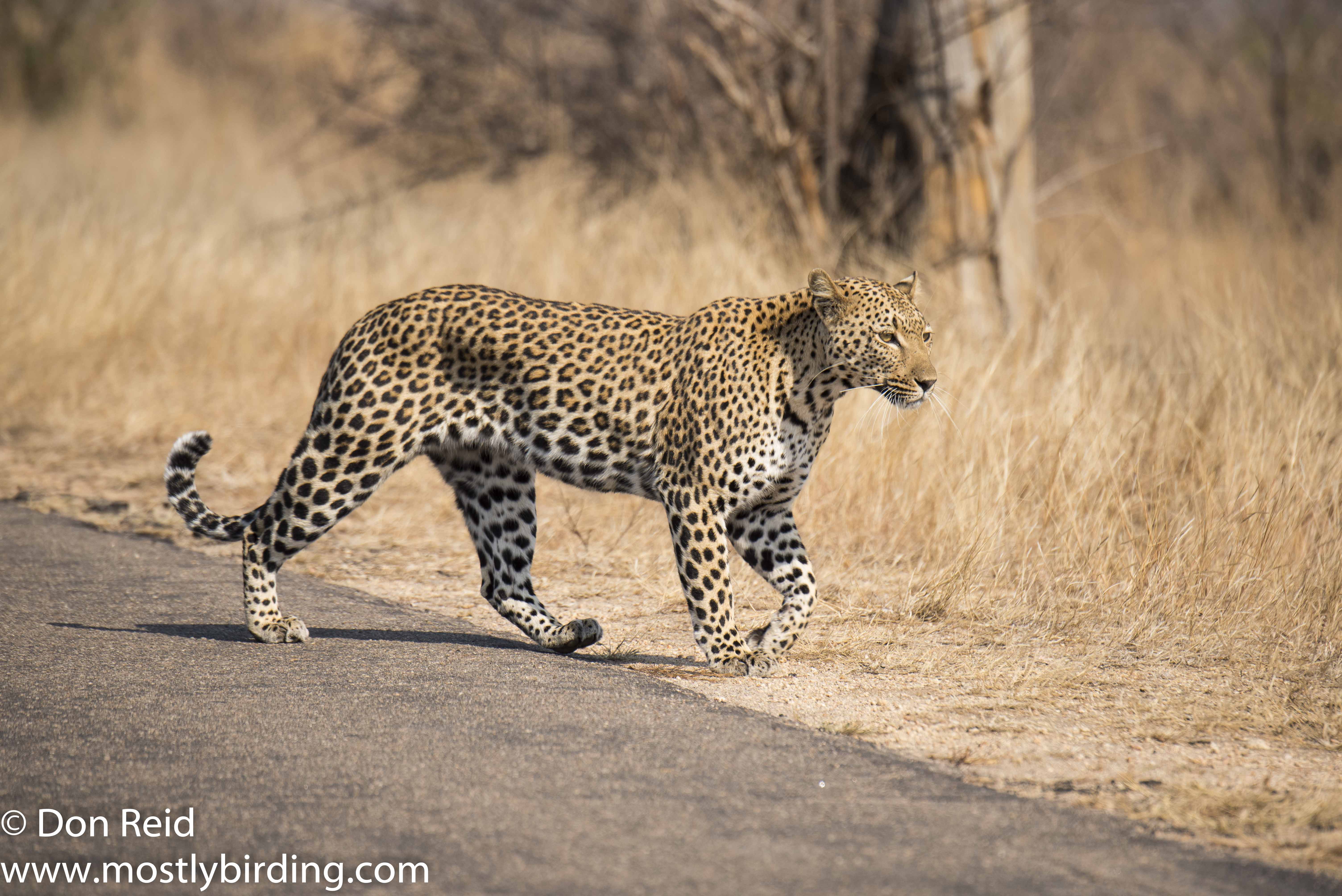
Kruger unplanned – The Journey

It was a different Kruger trip in several ways …….  

(Yep, here come the bullets – I can’t help it, I’m a QS, we like things to be ordered) –

  • The booking was a last-minute one instead of the usual micro-planned, 6 to 12 months ahead booking we have always stuck to – I suddenly had this desire to wake up in Kruger on my birthday and scanned the availability of the camps, ending up with 5 nights in Olifants and a further 2 in Skukuza, starting in the last week of August this year
  • It was just Gerda and myself – the first time we have been on our own in Kruger, going back to our first visit with Gerda’s parents as newly weds in 1972. Since then we have made umpteen visits with our kids, with friends, with birding groups, even with clients and latterly with our grandkids adding to the delight.
  • We had no fixed plans other than to enjoy ourselves and take it at a relaxed pace
  • Ummmm that’s it with the bullet points……..

So what is it about a visit to Kruger National Park that makes it so special to ordinary South Africans like us, who keep going back for more, year after year, literally for decades?

With time to think about it during our week in Kruger, I can put it down to the several parts that make up the quintessential Kruger trip, starting with –

Getting There

For us, any holiday starts with the road trip which, if you tackle it in the way that we prefer, becomes an integral part of the holiday. We could have travelled to our Kruger destination, Olifants camp, in one day, but including an overnight stop at Phalaborwa, close to the entrance gate, meant we had a full day to get organised and travel at a relaxed pace.

It also means there is time to stop for coffee and lunch and to slowly ease into holiday mode. At our first stop at Kranskop on the road north, Gerda’s enthusiasm in identifying the weavers we spotted there helped to shift the focus from the “must do’s” that dominate life to the ” do what you feel like’s”. They were Village Weavers and for the next half hour on the road Gerda grilled me on the main differences between the most common genus Ploceus  Weavers, covering Southern Masked, Village, Lesser Masked and Cape Weavers.

There is also enough time to take in the character of the surroundings and the road being travelled on, which changed as we progressed –

N1 highway all the way to Polokwane – predictably smooth and comfortable, not requiring much effort beyond maintaining concentration

Polokwane east to Moria and beyond – busy double road through end to end built up area, the road requiring utmost concentration even at low speeds with a stream of pedestrians crossing, taxis stopping unexpectedly (although we have long learnt to expect it), wandering dogs and goats. Beyond Moria, which accommodates an estimated 1 million people during the Easter pilgrimage, the road enters rolling countryside for some relief

Through Magoebaskloof and down to the lowveld, the road twists and turns and drops all at the same time for perhaps half an hour until it flattens out as you approach Tzaneen

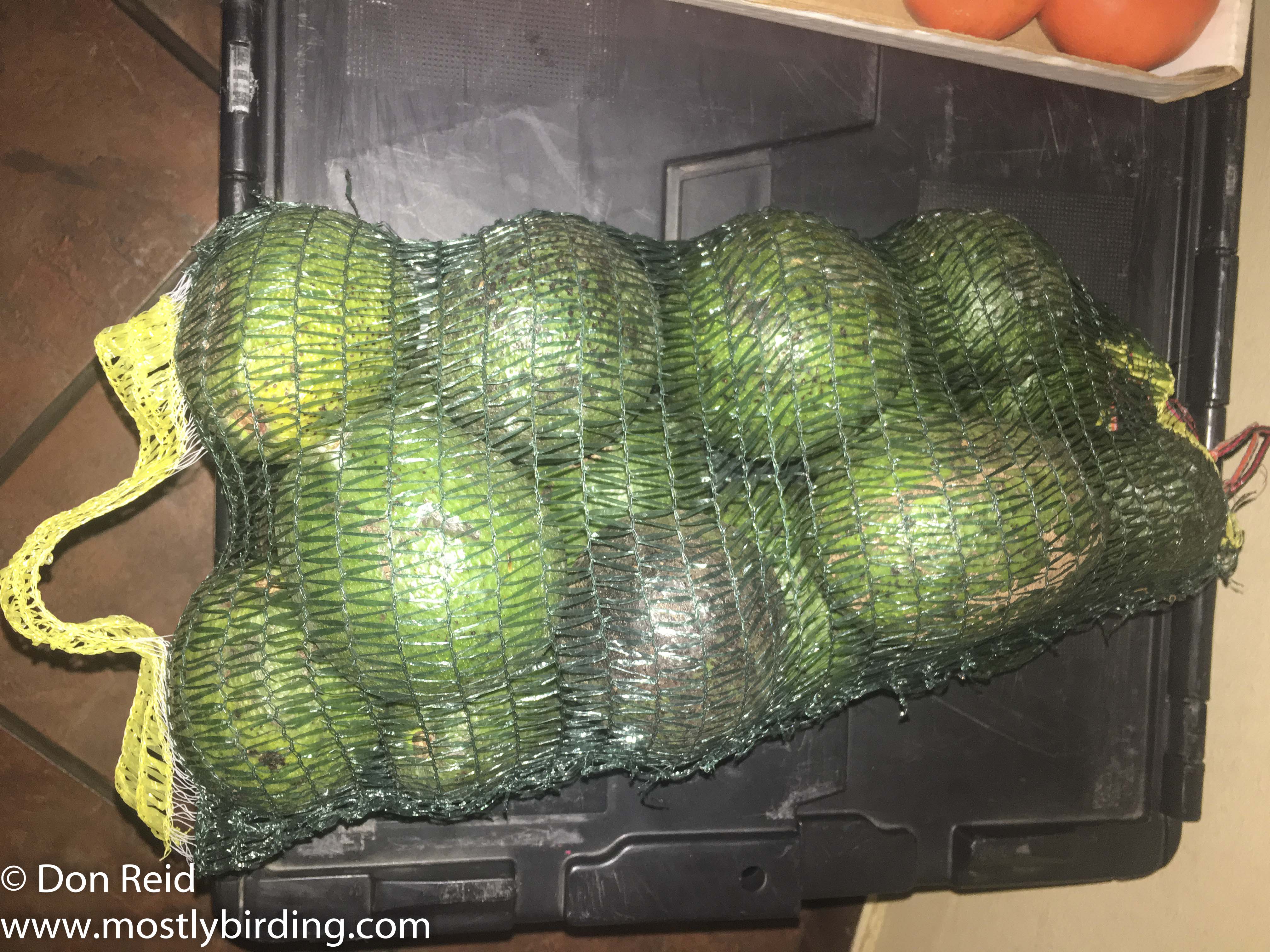
Suddenly it is fruit and veg growing area with roadside stalls offering produce at prices way below the city supermarkets – avos galore (bag for R50 / $3.50 ), sack of potatoes (R30 / $2 ), tray of tangerines (R30 / $2 )

The last stretch to Phalaborwa gradually changes to game farms and bushveld, the road down to a single lane with no shoulders.

The overnight stop in Phalaborwa was at La Lechere guest house in the suburbs – a good choice with neat, comfortable rooms and a full English breakfast to set us on our way the next morning.

La Lechere guest house Phalaborwa
The cosy room

Entering Kruger

We entered Kruger before 11 am and made our way slowly to Letaba camp, where we planned to lunch.

Phalaborwa gate

The route from Phalaborwa to Olifants camp

Kruger route

I tried to think what entering Kruger means to me and the only comparison I could come up with was that of entering one of the great cathedrals of Europe – the sudden calmness that spreads over you, the splendid surroundings that seem to envelope you, the happy thought that it’s been like this for a long time and is not likely to change.

We explored the side roads around Masorini on the way, stopping for a while at Sable Dam, which has a bird hide that can be booked for overnight stays.

Sable Dam, Kruger Park

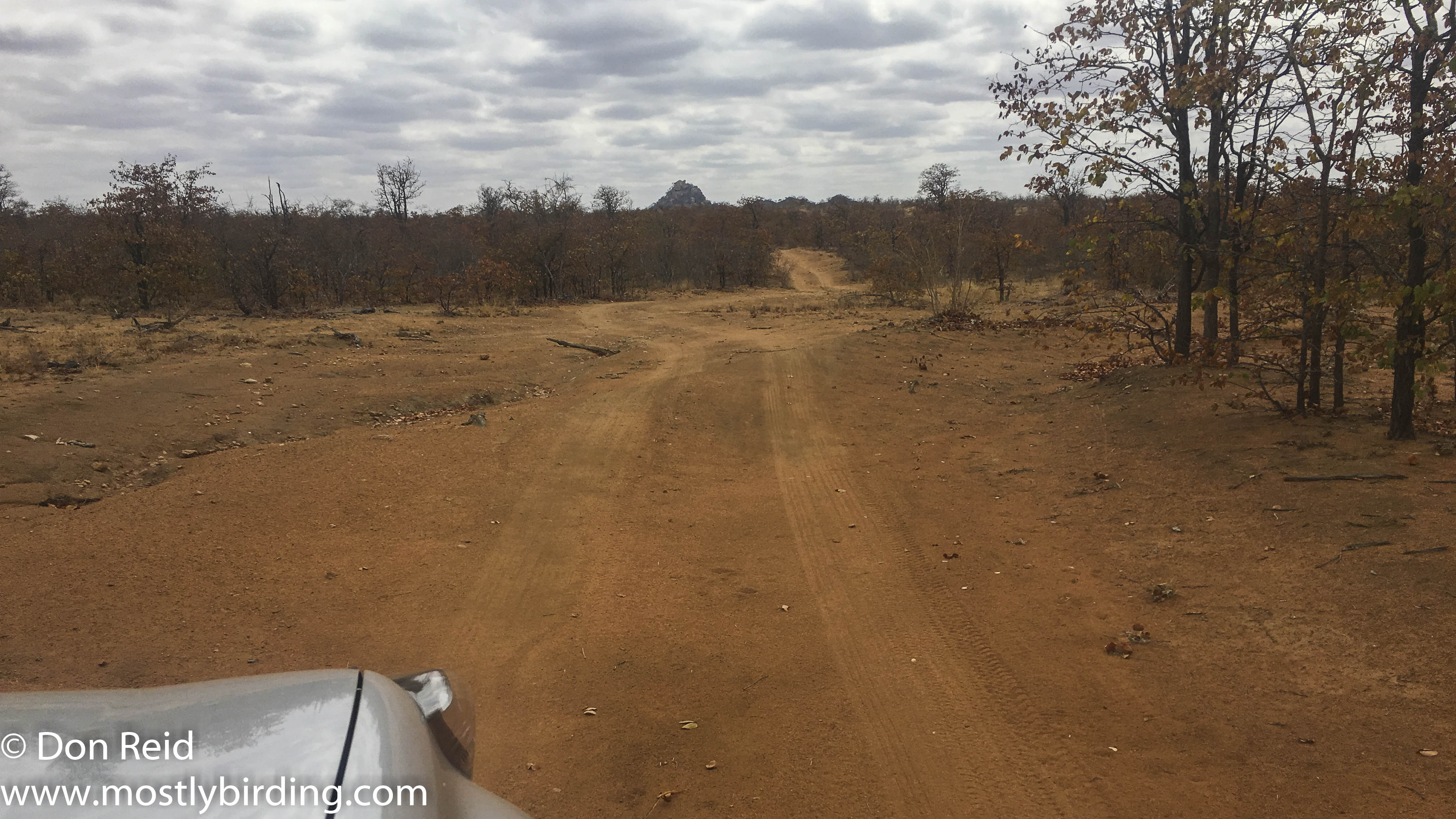
On the way back we could not resist a “short cut” road signposted Track for high clearance vehicles only, low maintenance , which was true to its word – a unique experience, not having driven on a proper 4 x 4 track in Kruger before, except with rangers in their vehicles.

4×4 Track near Sable Dam

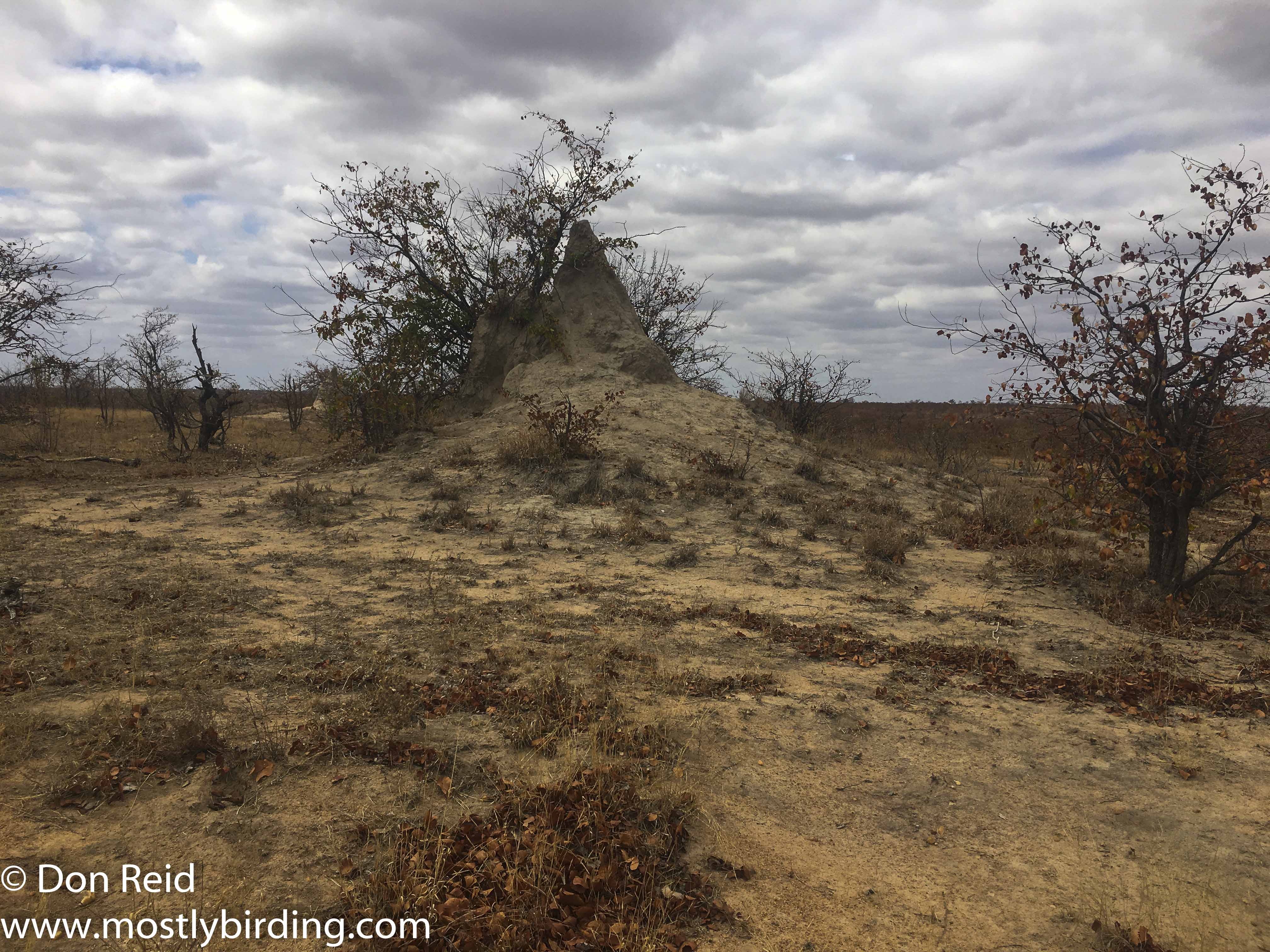
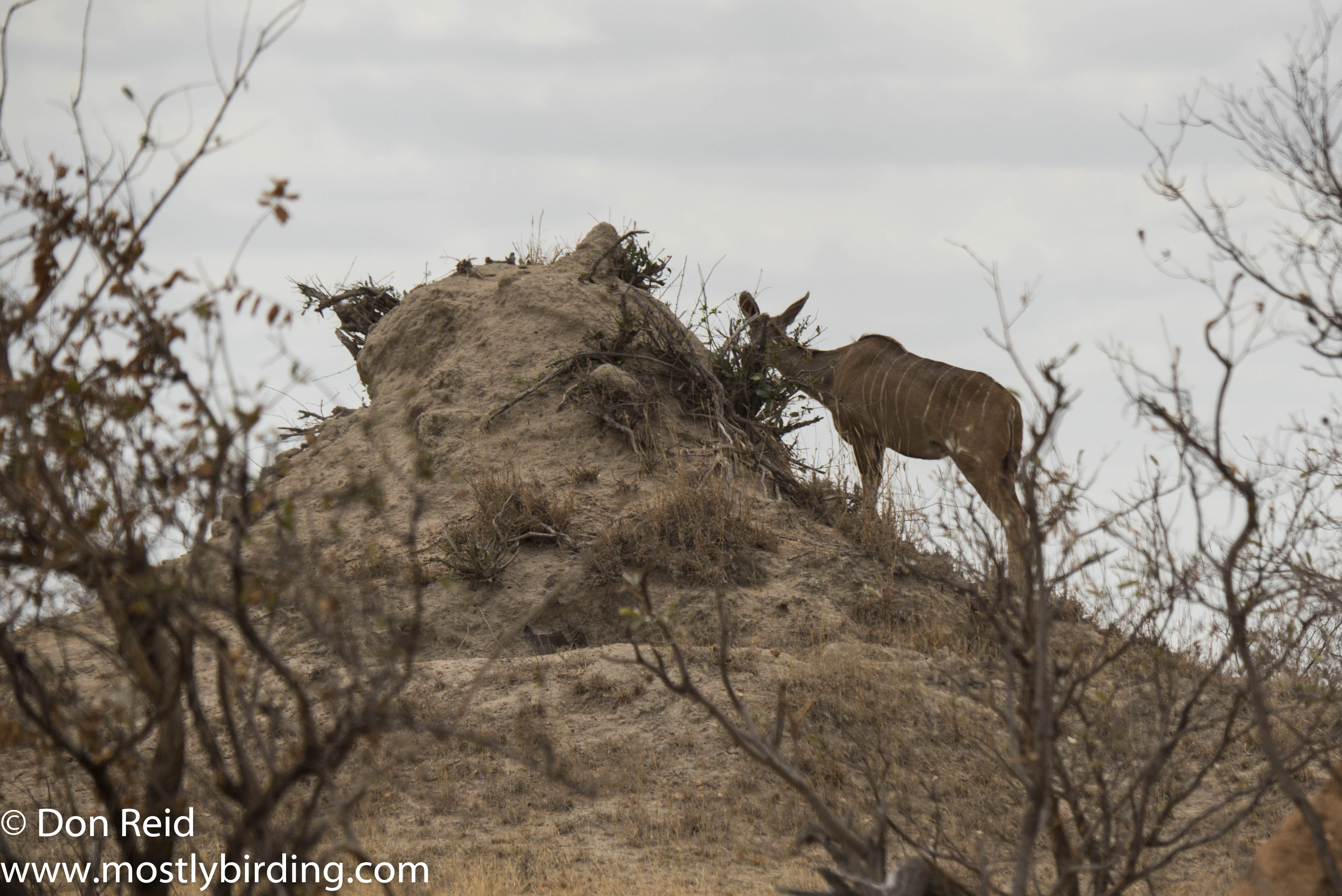
The track ran for 5 km and took us through an area dotted with exceptionally large termite mounds, some as tall as a double-storey house, with a pointy top giving them the appearance of rondawel roofs from a distance. I suspected the large size of these mounds – certainly larger than I have ever encountered – had something to do with the type of soil – white/grey in colour and very sandy.

Termite mound along 4×4 track, Kruger Park
Another termite mound, this time with a Kudu to provide some scale

Our route did not produce much in the way of special animal sightings, but as usual the bird life made up for it with several interesting encounters –

  • African Hawk-Eagle spotted by Gerda in a far-off tree
  • Yellow-fronted Canaries in a group, flitting from tree to tree
  • Various Swallows in one spot – Lesser-striped, Red-breasted and White-throated Swallows
  • Crested Francolin scurrying off when we stopped nearby
  • Groundscraper Thrush rather unexpectedly in the middle of the bush (you get used to seeing them on lawns in Suburbia so it comes as a surprise when they choose a more barren natural habitat)
  • A soaring African Fish-Eagle patrolling a dam
African Fish Eagle

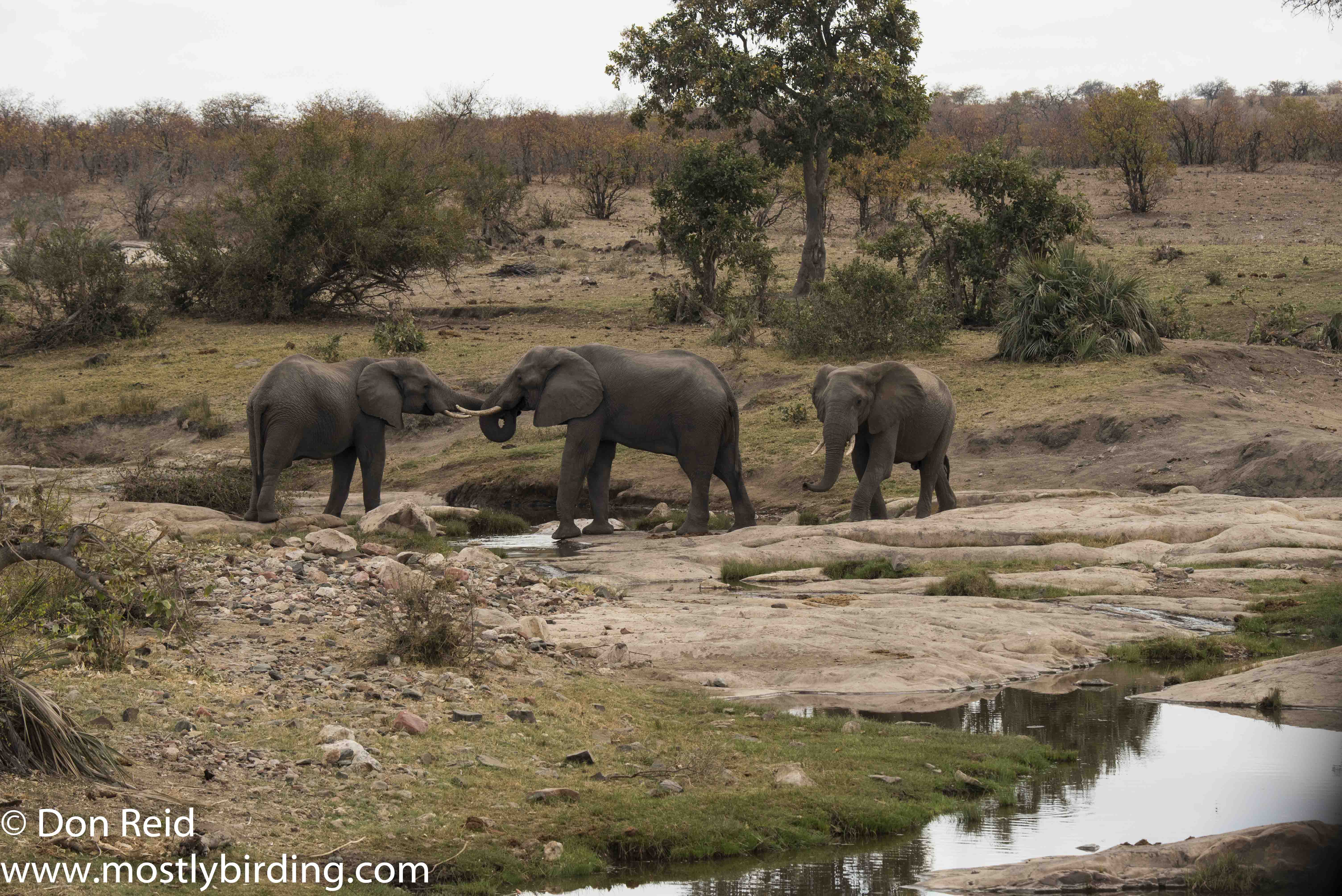
Elephants made an appearance as we crossed a bridge near Letaba, heading to small pools of water for a refreshing drink. They have a way of looking like they are enjoying every sip of water.

Elephants near Letaba, Kruger Park
Elephant drinking

Lunch at Letaba was fish and chips (there goes our credibility) and ahead lay the last stretch before Olifants, which went quite quickly.

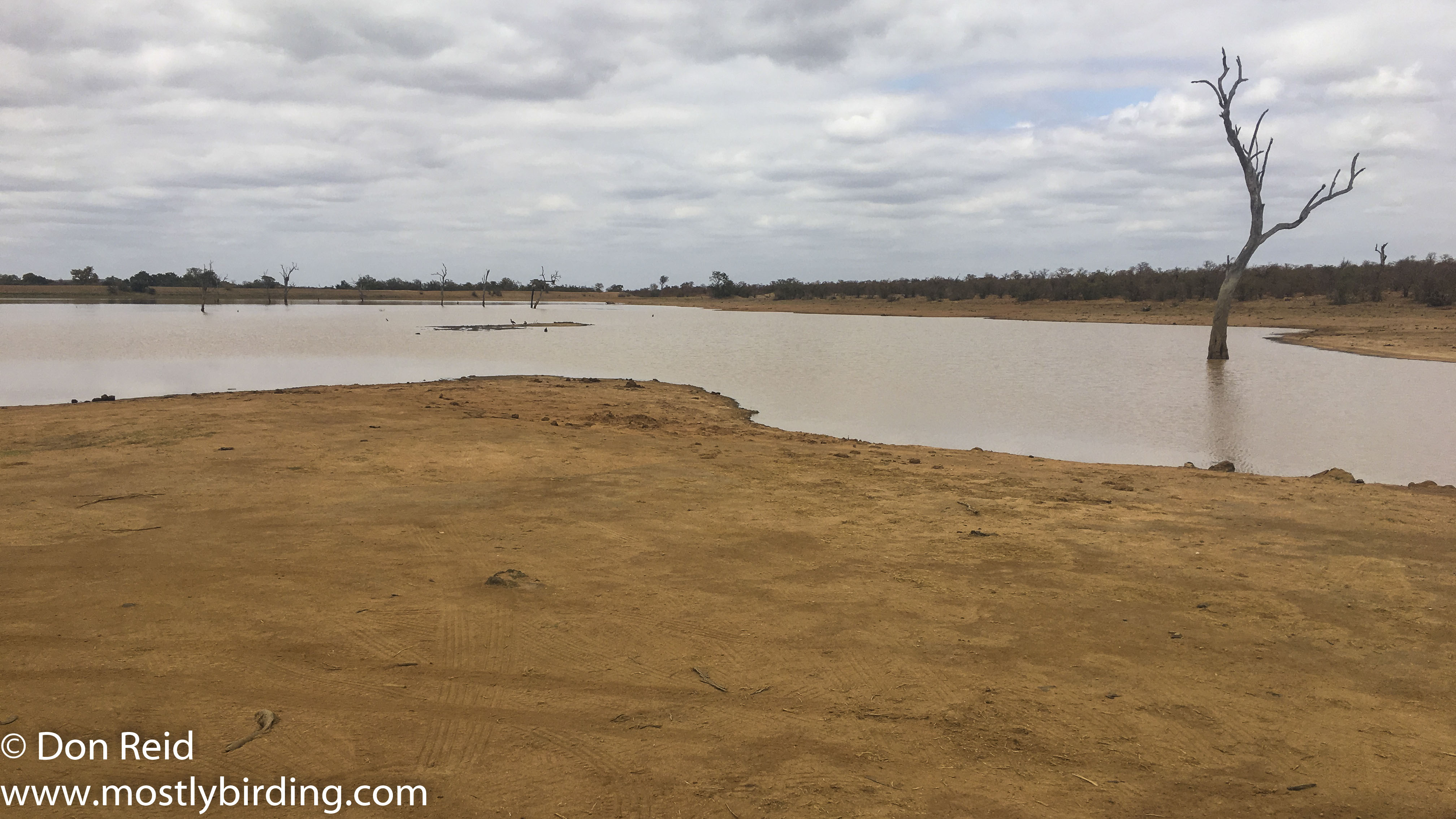
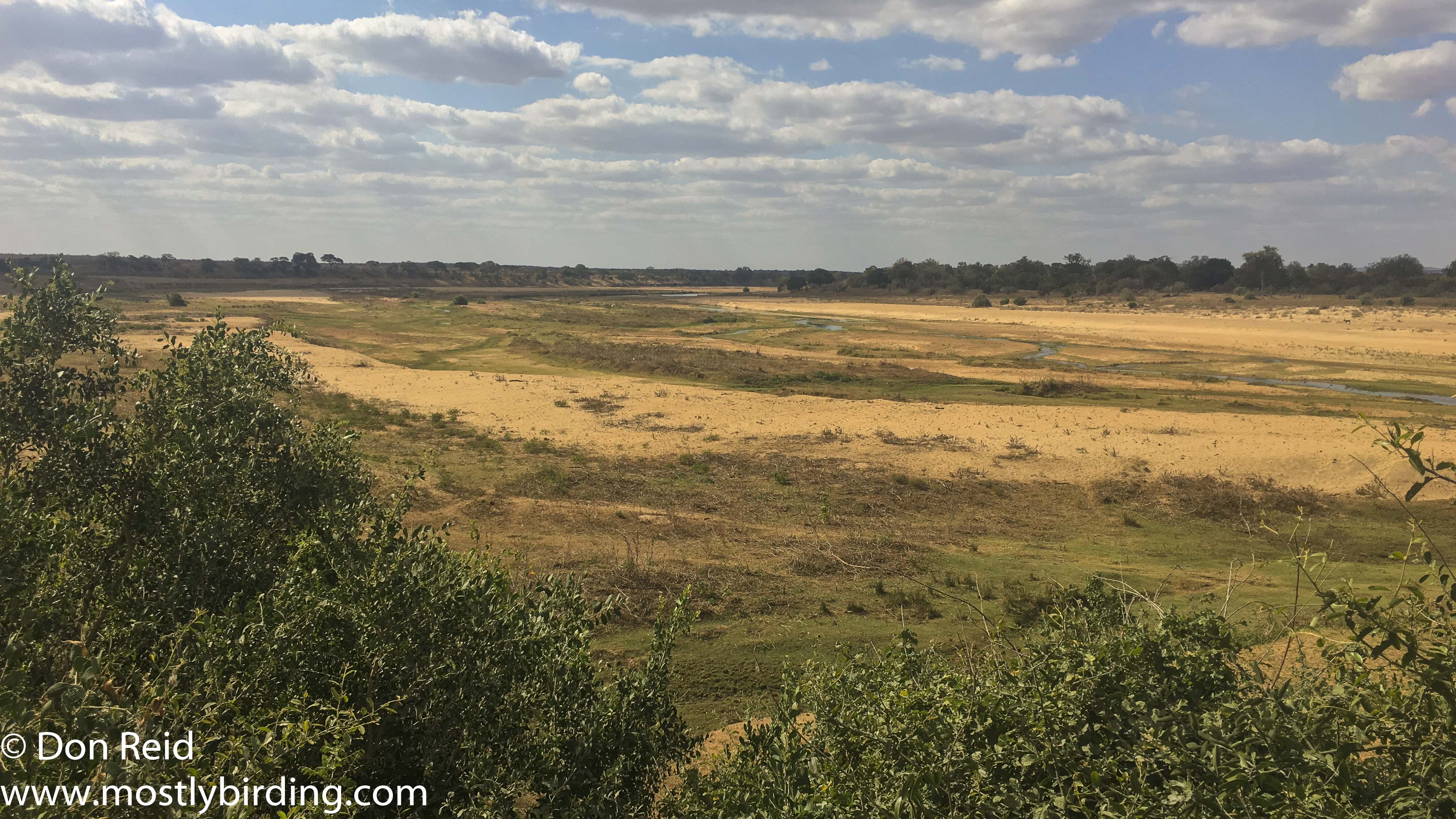
The state of the Letaba River was a bit of a shock as we could not recall having seen it so dry, even after the normal dry winter months – another sign of the severe drought that most of Kruger has experienced for the last few years.

Letaba River – end of winter, Kruger Park

The Accommodation

By 5 pm we were settled in our pleasant rondawel – we were prepared for the lack of kitchen facilities in the rondawel, knowing there would be a communal kitchen nearby, however we had not thought of bringing a kettle, so resorted to buying a cheap stove-top model that worked well, albeit slowly, on the communal hot plate.

We enjoyed tea while taking in the incomparable view from our small stoep – I patted myself on the back for choosing a perimeter rondawel which looks over the Olifants river far below.

Tea with a view, Olifants, Kruger Park

The rondawel is typical of the accommodation in many Kruger camps – hardly luxurious, in fact the kindest description would be basic, but I had already decided that this was part of the charm of Kruger, almost like camping but with solid walls around you, comfortable beds and a small bathroom at hand.

With no kitchen (I probably would have booked a rondawel with a kitchen if one had been available) cooking happens on the braai, washing up is done in the communal kitchen and the simple task of making tea and coffee becomes a drawn-out ritual of sorts, all at a much slower pace than home and in the pleasant surroundings of a well looked after camp.

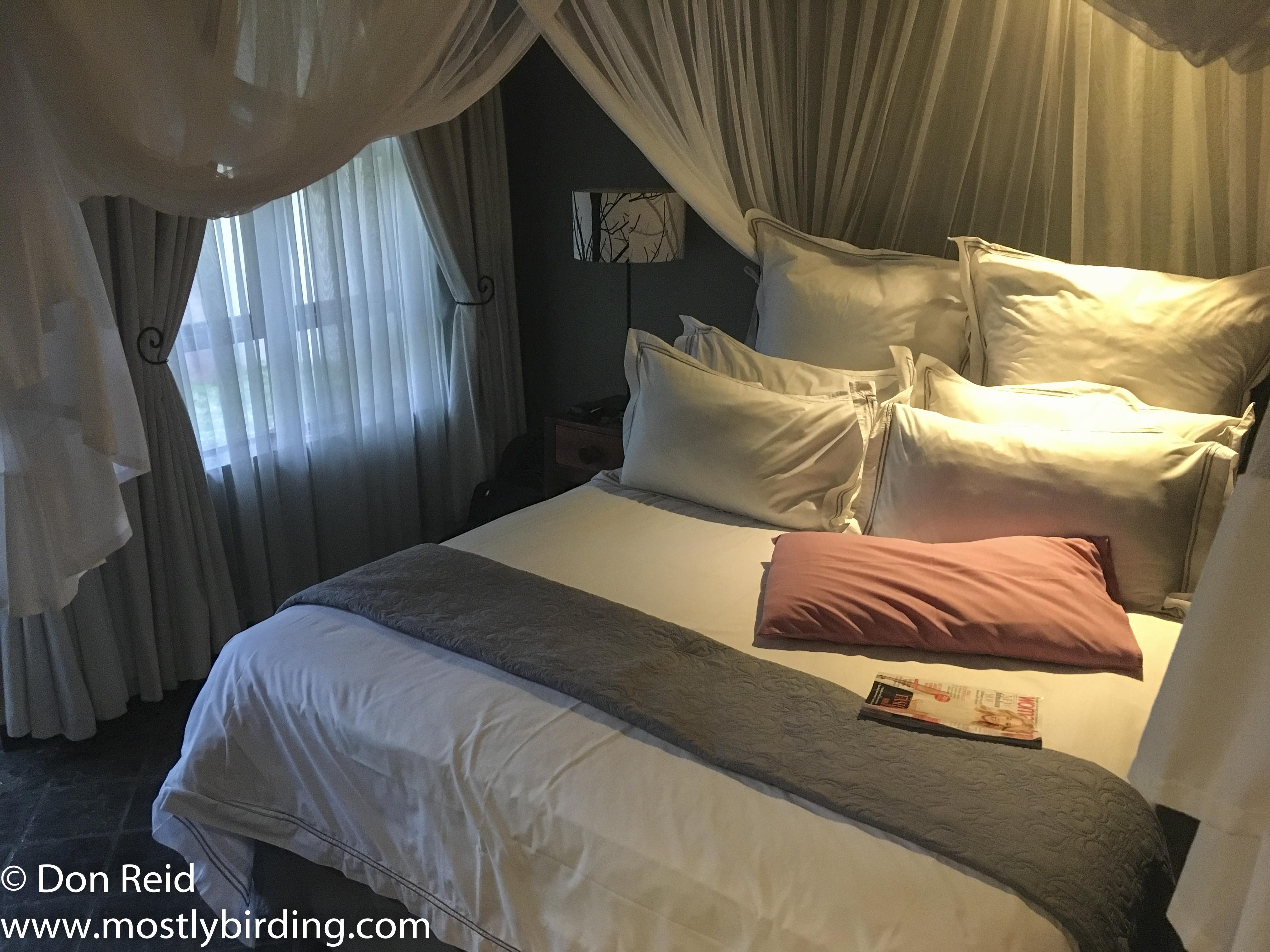
Even the view as you lie down to sleep is quite soothing (before the lights are off of course) …

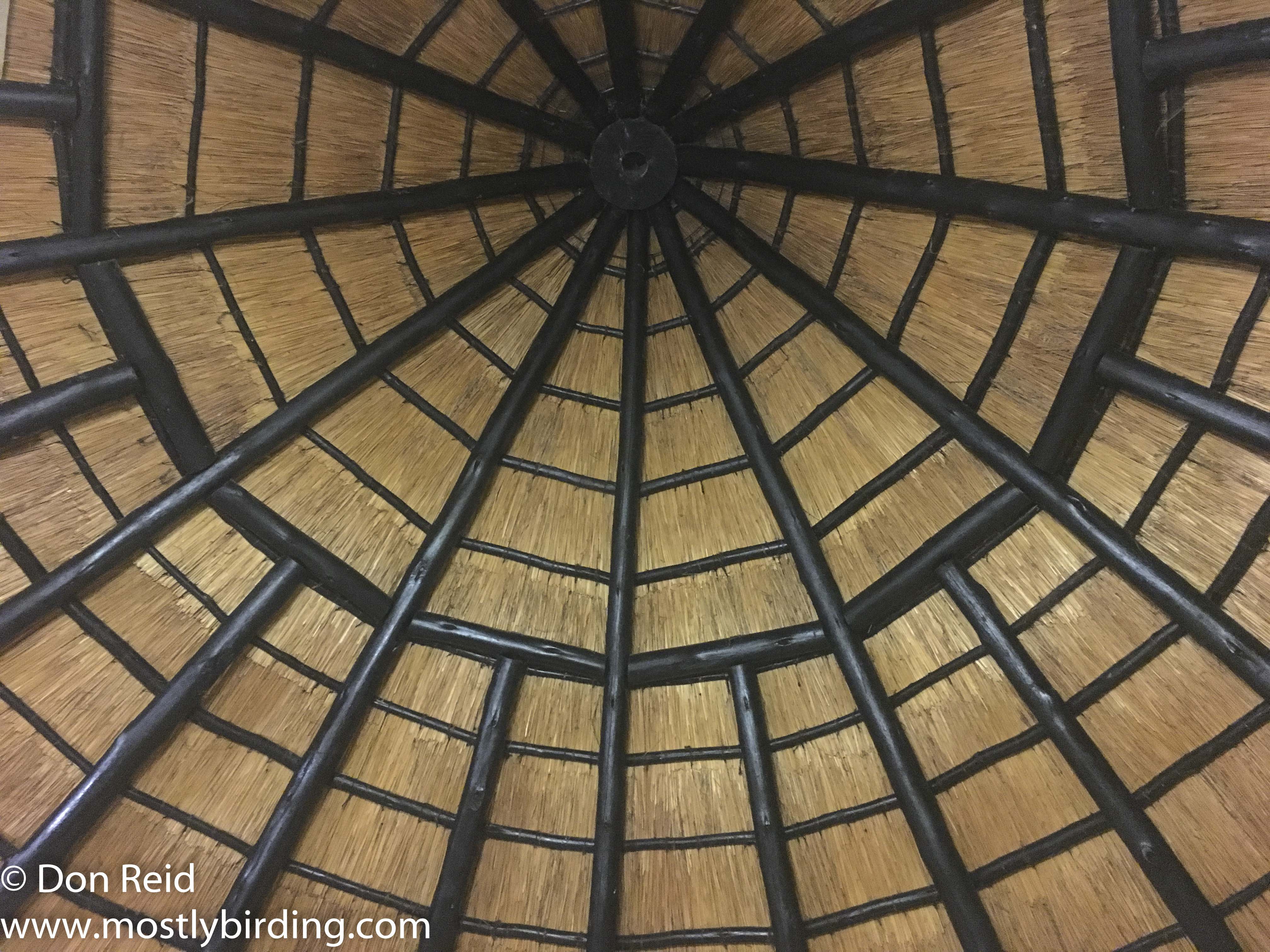
Bungalow roof

Still to come in “Kruger Unplanned” – more about the drives, the wildlife encounters, the birding highlights and just chilling


Kruger for a Day – Five minutes of Bird Photography heaven

“Skulking and inconspicuous”

“Shy and inconspicuous, keeping to dense cover”

“Fairly secretive”

Despite what some people close to me may suggest, none of these descriptions refer to me –

they are in fact extracts from Roberts Birds of Southern Africa, describing the habits of three bird species which are more often heard rather than seen. So, to be presented with an opportunity to photograph all three of them in quick succession, with another more conspicuous species thrown in for good luck, is a chance in a thousand and I took it with open arms……… and an open lens.

As is often the case, the opportunity arose unexpectedly – we were on a day trip through Kruger in April this year, wending our way slowly on a circular route from Phabeni gate via Skukuza to Numbi gate, and decided to stop at the Skukuza Day Visitors area for a picnic lunch. (See my previous post on “Painted Wolves and a Weary Lion” for more on the trip). The morning had gone well with a variety of birds seen and a rare sighting of a pack of Wild Dogs as the highlight, but by now we were looking forward to a break.

We chose a shady table in a bushy section and greeted the only other group using the area as we passed their equally secluded spot.

Skukuza day visitors area

While the provisions were being laid out, I pottered about to see what bird life was around at this time of day, usually a quieter time for birding. At the swimming pool several Barn Swallows, Rock Martins and Greater Striped Swallows were swooping about enthusiastically and I heard an African Fish Eagle call from the river – not seeing much else I was content to join the others for lunch. The refried boerewors from last night’s braai accompanied by traditional braaibroodjies went down a treat along with coffee.

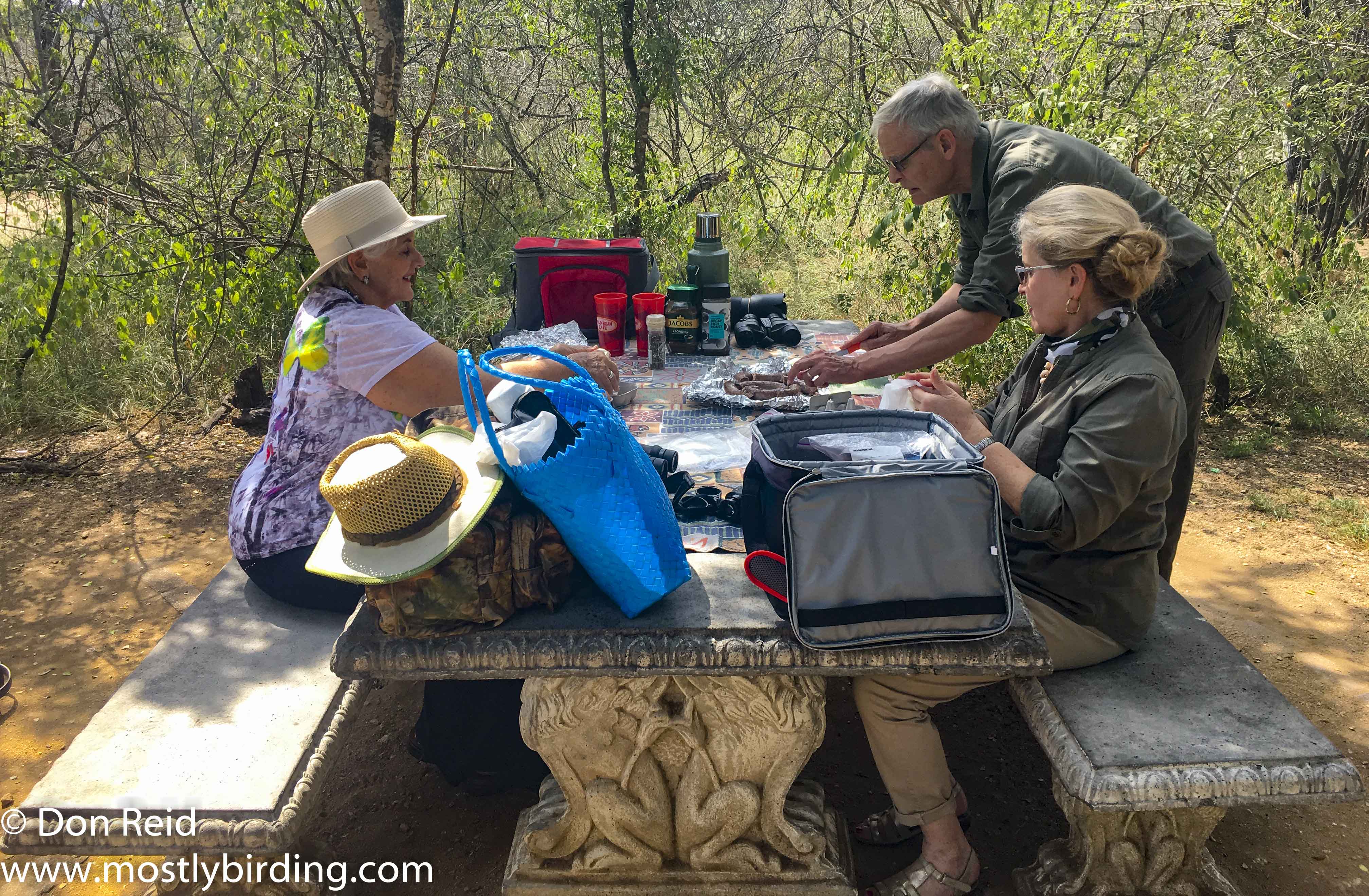
Skukuza day visitors picnic spot

When it came time to pack up, I wandered off to investigate some rustling and faint bird sounds that seemed to be coming from  nearby bushes and did a quick recce of the surrounding area. By this time our picnic neighbours – the only other people in the area – had left and as I passed their spot I saw some movement in the bushes close to their table.

Using the concrete table as a rather inadequate concealment, I crept closer and sat crouched on the bench, with my camera on the table and checked that it was set up for the shady conditions – aperture priority, high ISO setting for adequate shutter speed, white balance on shade.

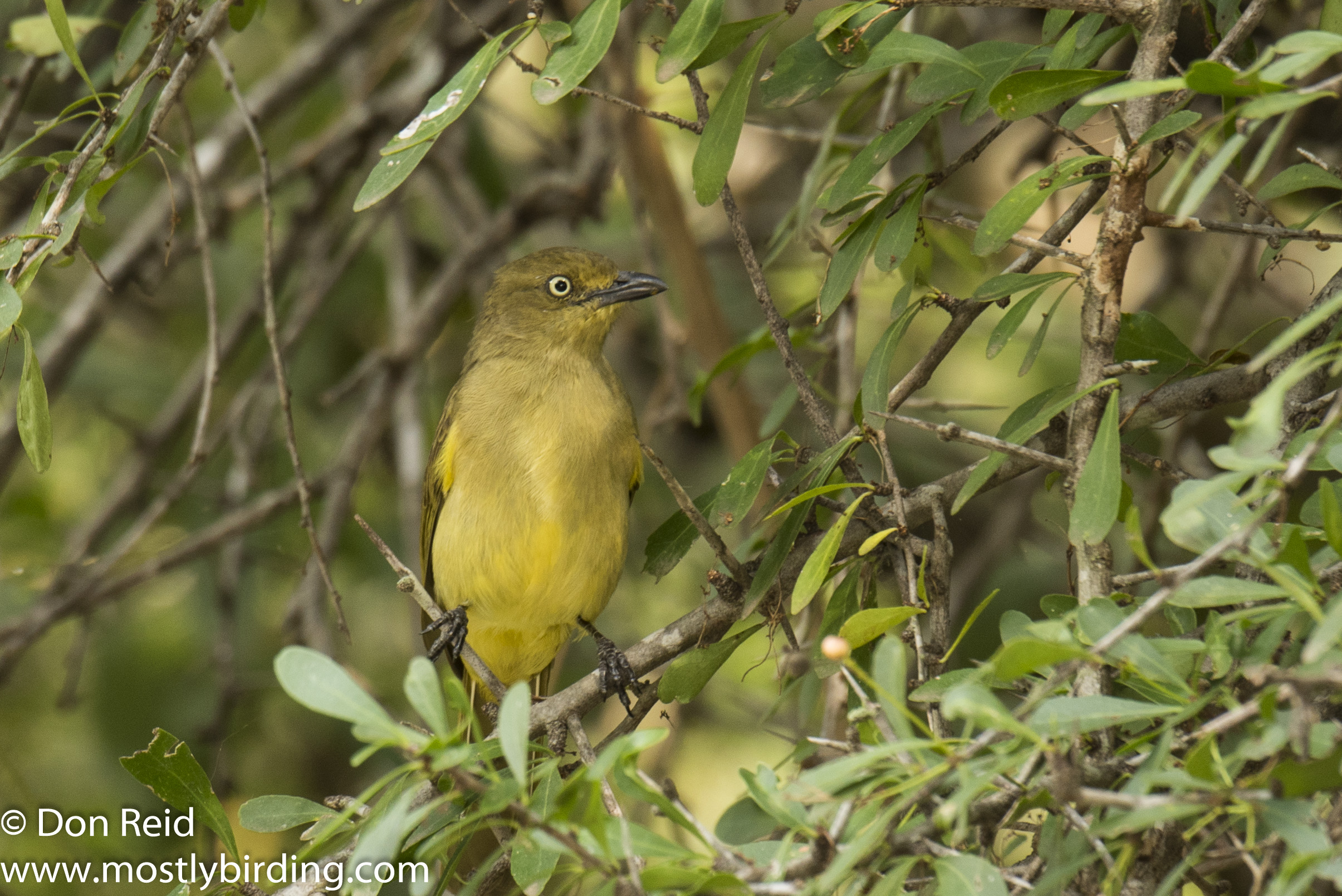
Almost immediately a Sombre Greenbul (Gewone Willie / Andropadus importunes) hopped onto an exposed branch and looked straight at me, while I whipped my camera into position and rattled off 3 or 4 shots before it moved on and out of sight – the time as recorded in the photo metadata was 12:24:47.

Sombre Greenbul
Sombre Greenbul

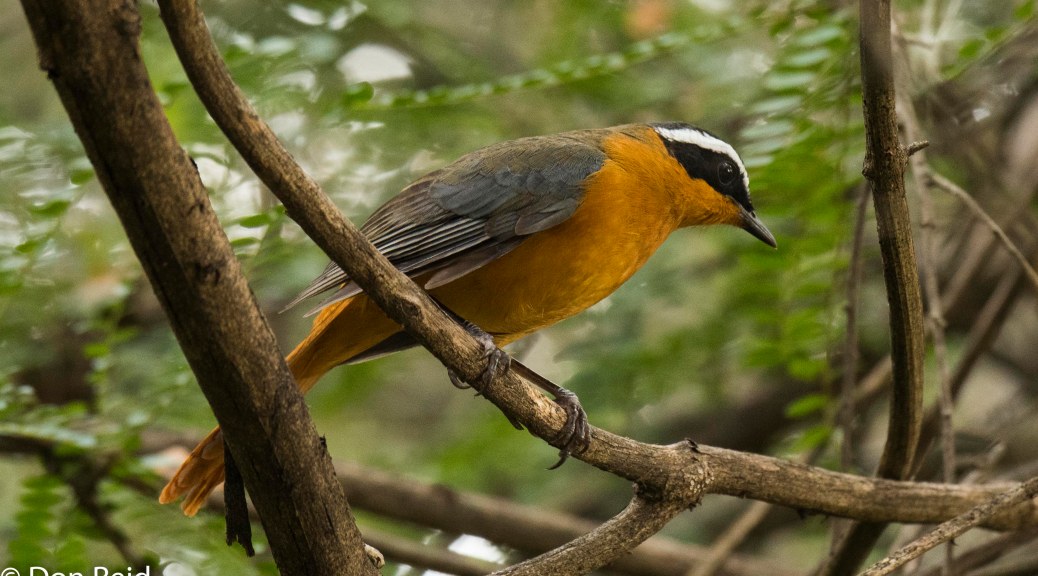
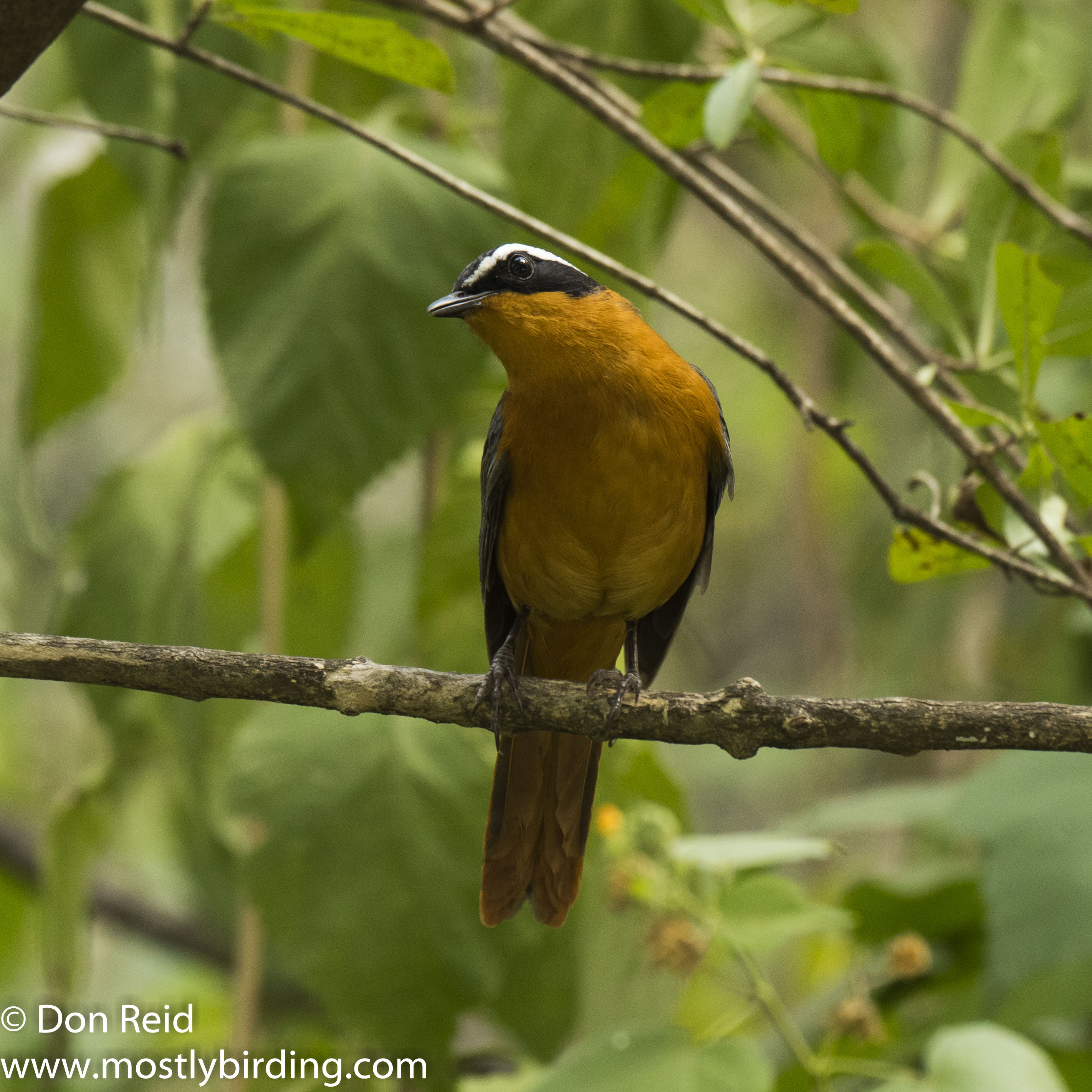
A minute later a White-browed Robin-Chat (Heuglinse janfrederik / Cossypha heuglini) popped out into view and I followed its progress through the foliage for the next two minutes, snapping it in different poses.

White-browed Robin-Chat

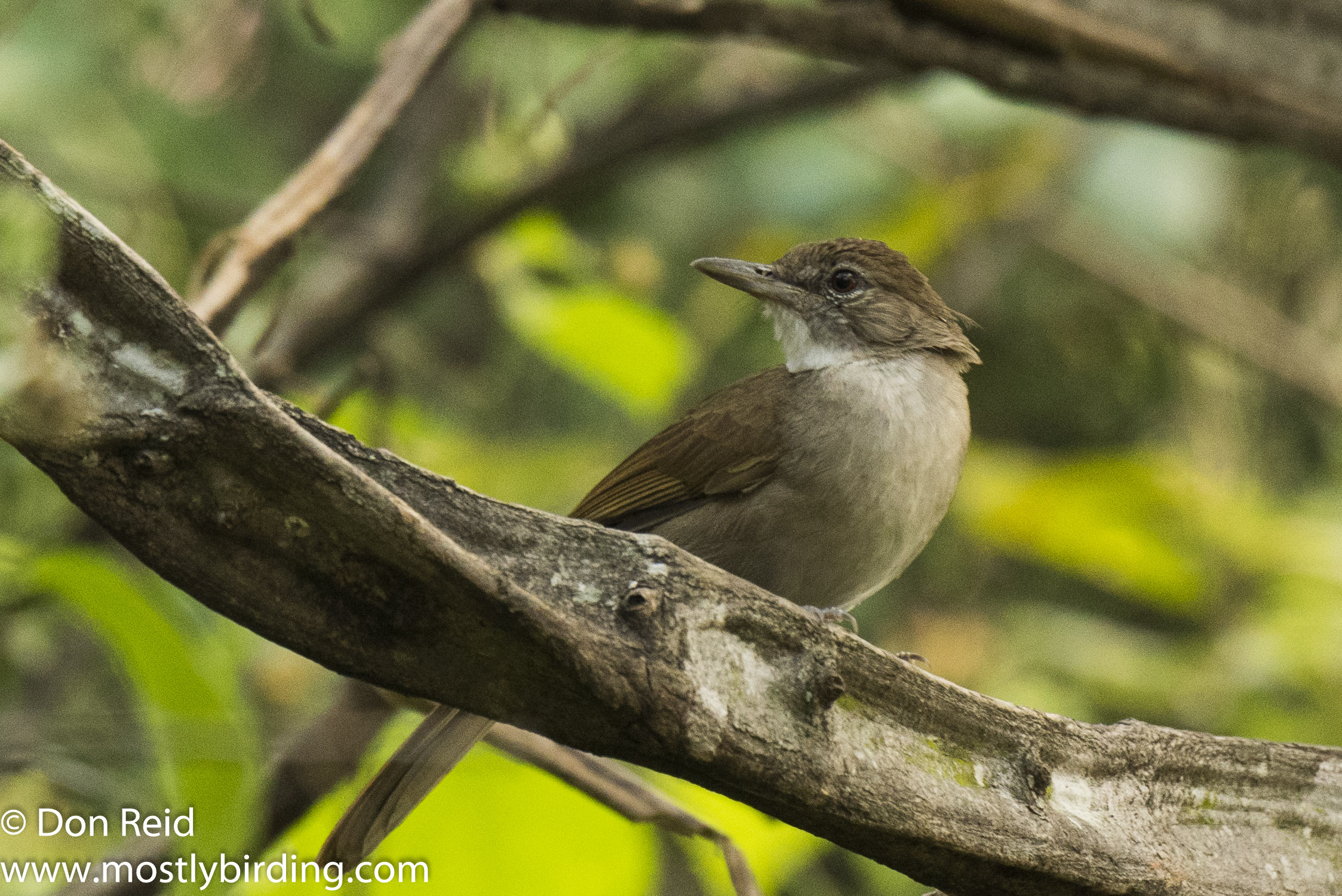
By now my adrenaline level was rocketing and I could not believe my luck when yet another skulker appeared in the form of a Terrestial Bulbul (Boskrapper / Phyllastrephus terrestris), a species that usually spends a lot of time scratching around in the leaf litter, but had now decided to pose in full view on a small branch – time 12:29:08.

Terrestial Brownbul
Terrestial Brownbul

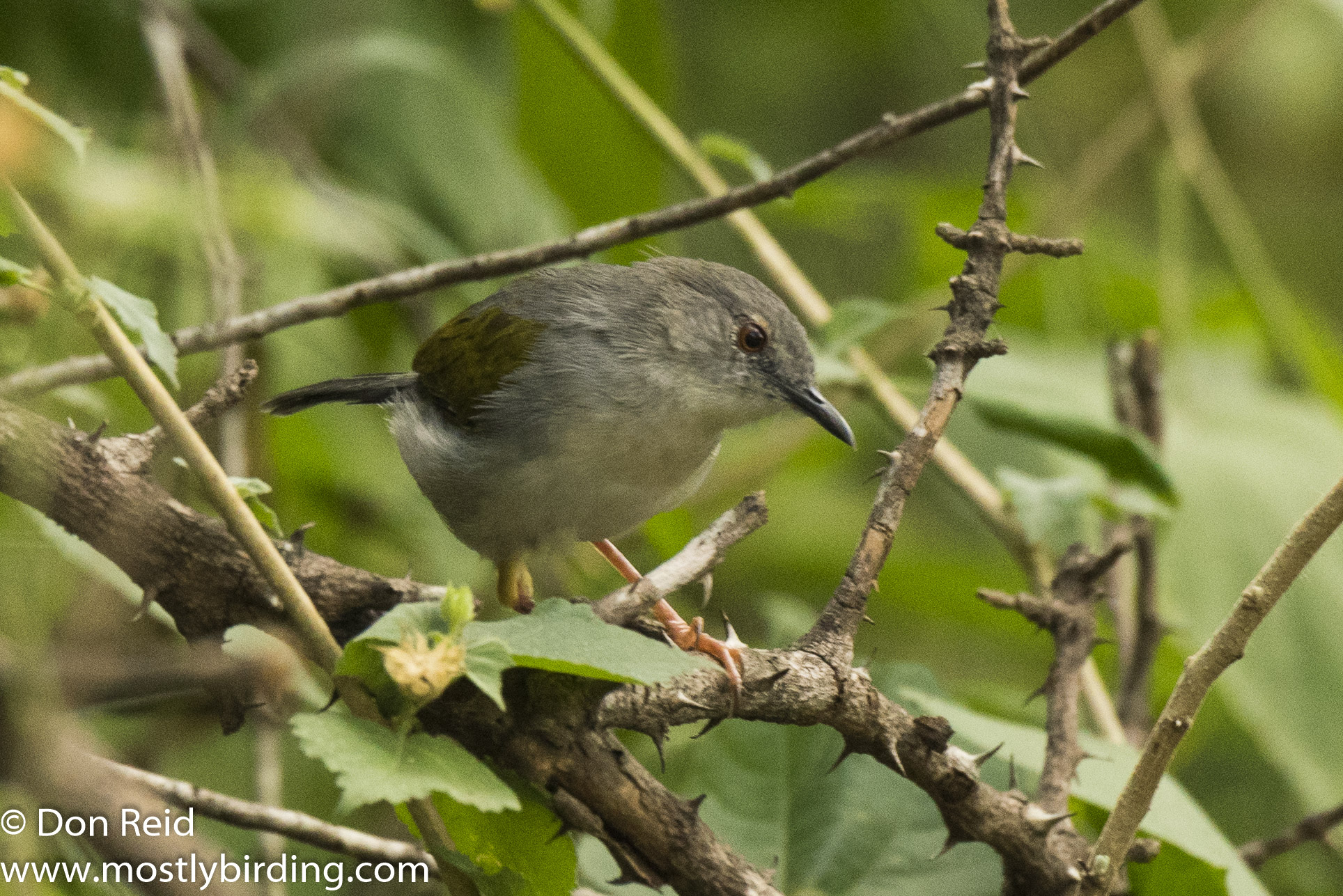
By this time I was battling to hold the camera steady as my hands were shaking from the excitement but the photography gods were really out to test my mettle when less than a minute later a Green-backed Cameroptera (Groenrugkwekwevoel / Camaroptera brachyuran) suddenly appeared from nowhere and did the same branch-walking act for my pleasure – time 12:29:50.

Green-backed Camaroptera

So in the space of 5 minutes and 3 seconds I had bagged pleasing photos of 3 skulkers and one other desirable bird and left me with a life-long memory of a very special birding moment.


Kruger for a day – Painted wolves and a weary Lion

Kruger National Park …………   just writing those words brings an immediate sense of anticipation ……

especially when you have made as many visits as we have and enjoyed such a diversity of wonderful bush experiences.

It was in April this year, while spending a week at Pine lake Resort near White River, that we decided to visit Kruger for one of the days. And as usual there were unexpected sightings, both on the animal front as well as the birds ……..

We started the day early, hoping to be at Phabeni gate as close to the 6.00 am opening time as possible – as it turned out we were a tad slow in leaving the resort and the drive there took longer than anticipated due to the nature of the road and some slow traffic. When we arrived at Phabeni we were met by a longish queue of vehicles and were told apologetically that “the computers are down and we are processing visitors manually” by the gate staff. This resulted in a long wait before we could at last enter Kruger and make our way along the Doispane road (S1).

We took all of four hours to travel the 40 or so Kms to Skukuza camp and then onwards to the day visitors picnic area just beyond the camp. There were lots of stops along the way to admire the wildlife and ID the birds seen and heard.

An early sighting was Retz’s Helmetshrike, always in a group of several and handsome as ever in their all black plumage and contrasting bright red bill and eye ring.

The usual Lilac-breasted Rollers, Magpie Shrikes and Red-billed Hornbills showed prominently at regular intervals to keep our spirits high. Raptors we saw included Bateleurs in numbers, Brown Snake-Eagles, African Fish-Eagles (5) and a pale form Booted Eagle.

African Fish Eagle, Kruger Day Visit
African Fish Eagle

About halfway along the road we stopped to have a look at the Nyaundwa Dam just off the road – this is always a good spot for the classic Kruger scene of animals coming to drink while keeping alert for the predators. Several shorebirds patrolled the dam edges – amongst them Wood Sandpipers, Black-winged Stilts, Common Greenshanks and Three-banded Plovers – while the resident Hippos had a few Red-billed Oxpeckers in attendance. Several Water Thick-knees viewed the proceedings from the sandy banks with what seemed to be disdain.

Kruger Day Visit
Nyaundwa dam
Kruger Day Visit
Nyaundwa dam

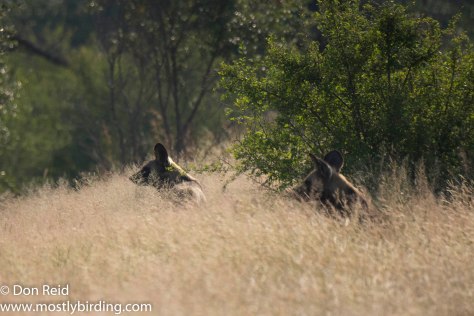
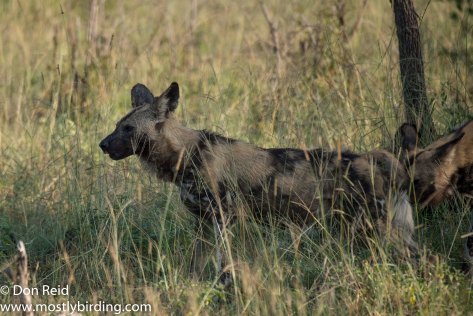
Shortly after we enjoyed one of the game highlights of the day when we came across a small pack of Wild Dogs, or “Painted Wolves” as they are sometimes known. One gave a display of territorial marking that we have not witnessed before, when he came right up to our vehicle and proceeded to urinate profusely several times while turning a full circle, so close I could have touched him with a broomstick – if I had such a thing handy. It crossed my mind that he may be just another Land Rover fan fed up with the superiority that us Toyota Land Cruiser owners tend to display …….. who knows.

Kruger Day Visit
African Wild Dogs in the long grass
African Wild Dog, Kruger Day Visit
African Wild Dog
African Wild Dog, Kruger Day Visit
African Wild Dog 

Our next sighting was a little further down the road where a knot of vehicles surrounded something lying at the edge of the road. It was an old Lion, looking as if he was on his last legs, his hips showing under his aged, battered looking skin. When he lifted his head to look at us, it seemed to be an effort and his eyes were dull with none of the fierce glint that he would have shown in his youth. I could have taken a photo but decided against it, simply out of respect for an old timer with not many days to live, at a guess.

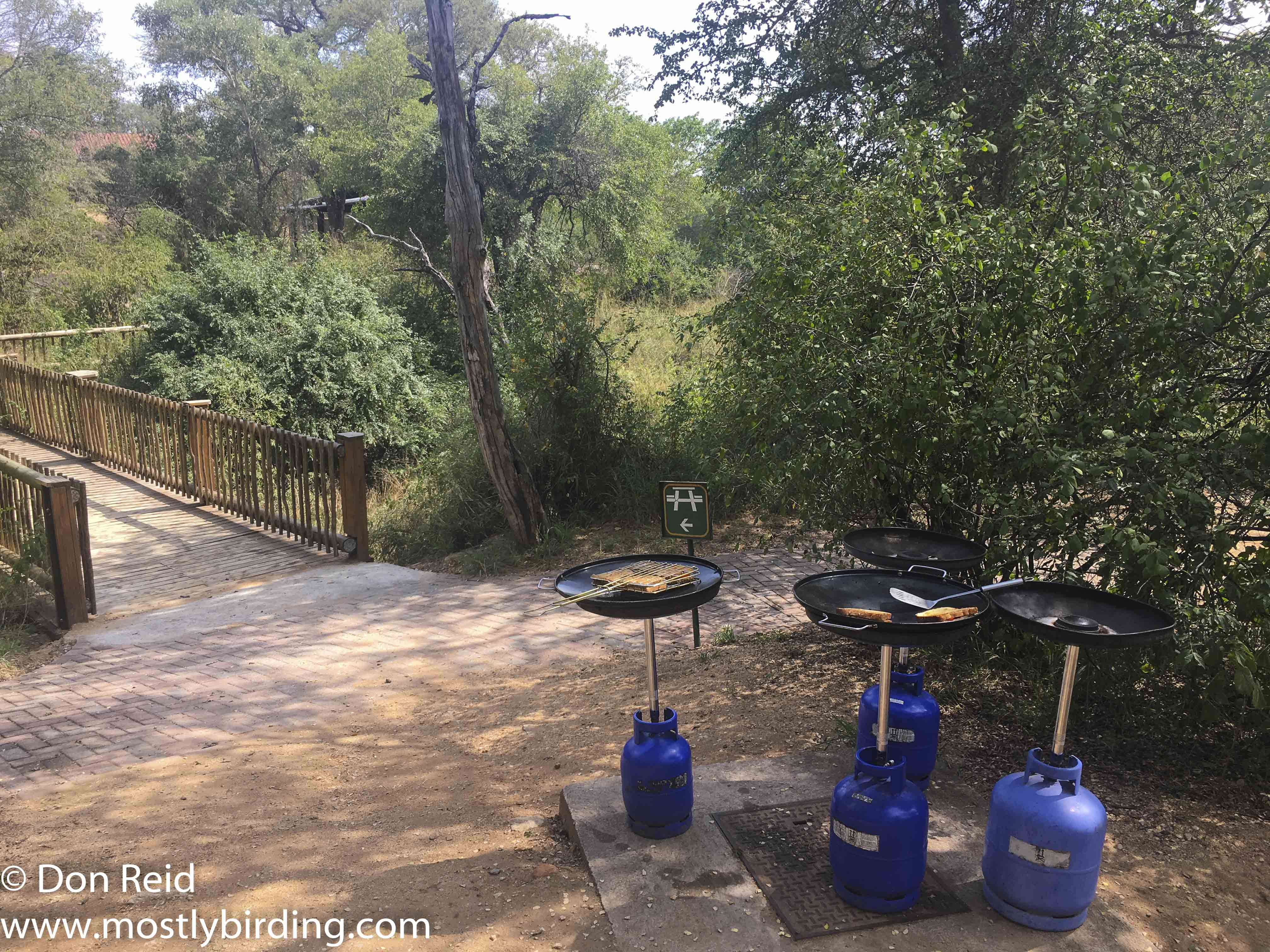
We arrived at the Skukuza Day Visitors picnic area which is a few kms beyond Skukuza itself and has a number of pleasant picnic sites set amongst the bushes. It was quiet, being a Monday out of peak season and we had the place to ourselves except for one other small group so we found a nice shady spot and enjoyed leftovers from the previous night’s braai, reheated on the skottel (like an old ploughshare and heated by gas)

In between I scouted around the area and found some very photogenic White-fronted Bee-eaters perched on some low branches – many bird photographer’s favourite because of their bright colouring and their habit of posing openly, without being too skittish.

I was very happy with the results ….

White-fronted Bee-eater, Kruger Day Visit
White-fronted Bee-eaters
White-fronted Bee-eater, Kruger Day Visit
White-fronted Bee-eater

The birding highlight of the day came my way as were packing up to leave the picnic area, when I spotted some movement in the bushes nearby – more about the incredible photographic opportunity in a follow up post (how’s that for keeping you in suspense?)

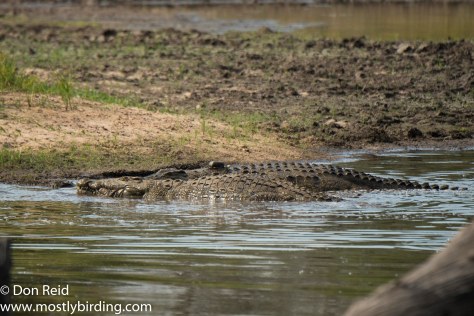
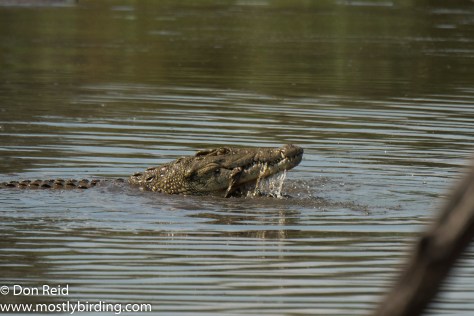
Our last stop before heading towards the Numbi gate was at the well known (amongst birders) Lake Panic hide overlooking the lake of that name, not far from Skukuza. Initially it looked quiet but we found out from the few people already there that we had missed the earlier drama of a crocodile taking an Impala which had ventured too close to the water as it came to drink. Two large crocs were still wrestling with the unfortunate Impala, presumably already dead, its horns projecting above the water every now and then as the crocs twisted and turned in the water.

Crocodiles after kill at Lake Panic, Kruger Day Visit
Crocodiles after kill at Lake Panic

Crocodiles after kill at Lake Panic, Kruger Day Visit

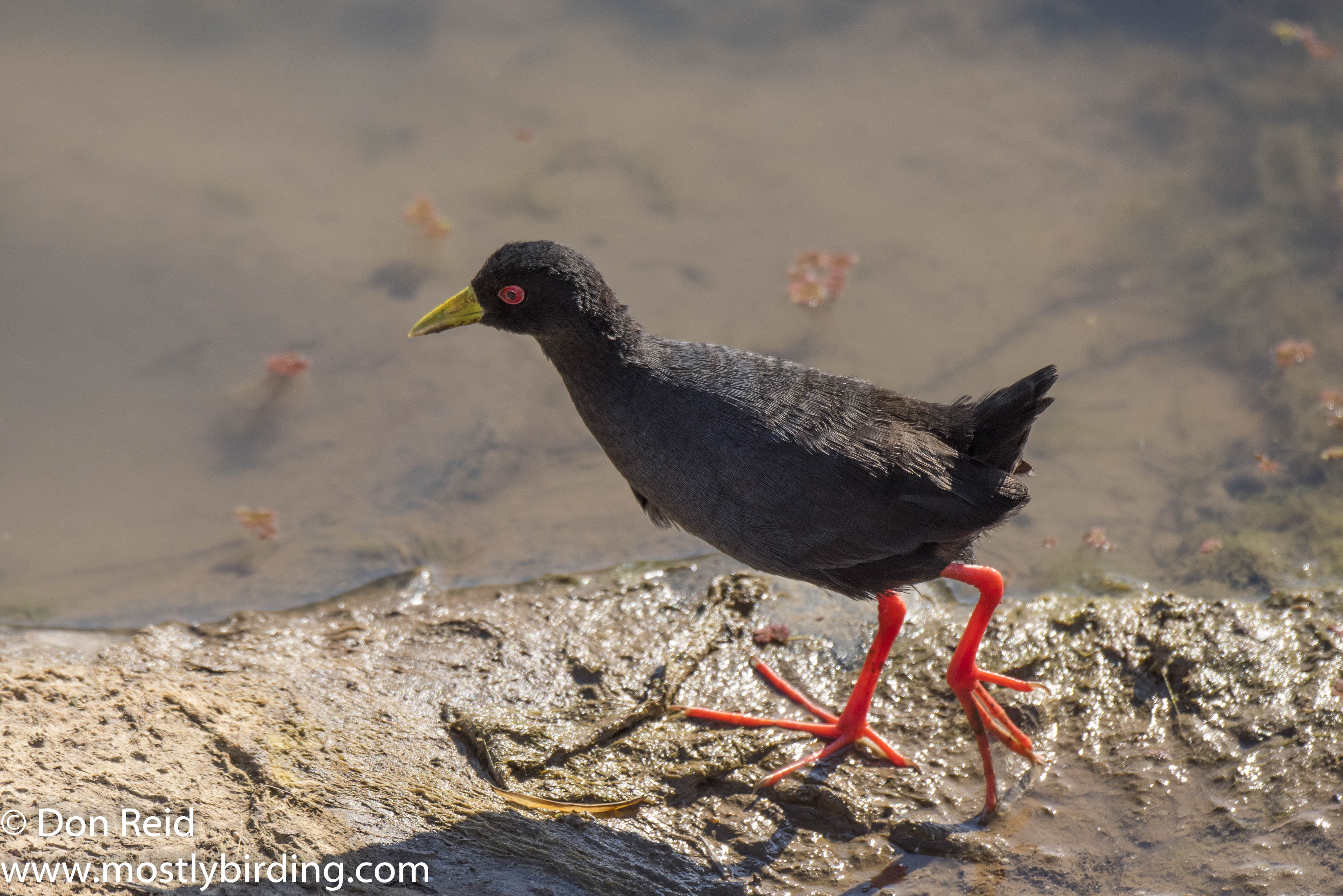
The water level was the lowest I have ever seen it at this spot, not even reaching the hide – bird life was limited to a couple of Pied Kingfishers, a Black Crake and a Burchell’s Coucal.

Our exit route was via Numbi gate then through busy rural villages for some 20 kms before reaching White River and the road back to Pine Lake Resort (which is also worth a post – watch this space)

Annasrust Farm – A River Outing

One of the highlights of our visits to Annasrust Farm, near Hoopstad in the Free State, is the river cruise that Pieter likes to lay on for us.  During our April 2018 weekend visit to their beautiful farm, Pieter and Marietjie once again arranged to take us out on a late afternoon cruise and we duly set off around 4.30 pm from the riverside landing spot and headed out onto the smooth waters of the Vaal River on their purpose-built raft – basically a large platform on pontoons with a roof over, driven by a large outboard motor.

The Vaal River forms part of the Bloemhof dam at this point – Wikipedia has the following to say on the dam : The dam was commissioned in 1970, has a capacity of 1,269,000,000 cubic metres and has an area of 223 square kilometres, the wall is 33 metres high. It is fed with the outflow from the Vaal Dam (located upstream in Gauteng) as well as rain collected in the Vaal, Vet, Vals and Sand River catchment areas.

Gerda and I sat right in front with glorious views of the river, the slowly setting sun and the varied bird life already into their end of day activities – flying about restlessly, perhaps watching the other birds to see where they’re heading, possibly even wondering what this bunch of humans on the raft are up to… that sort of thing.

Sundowner cruise – enjoying the view
Doing it in style

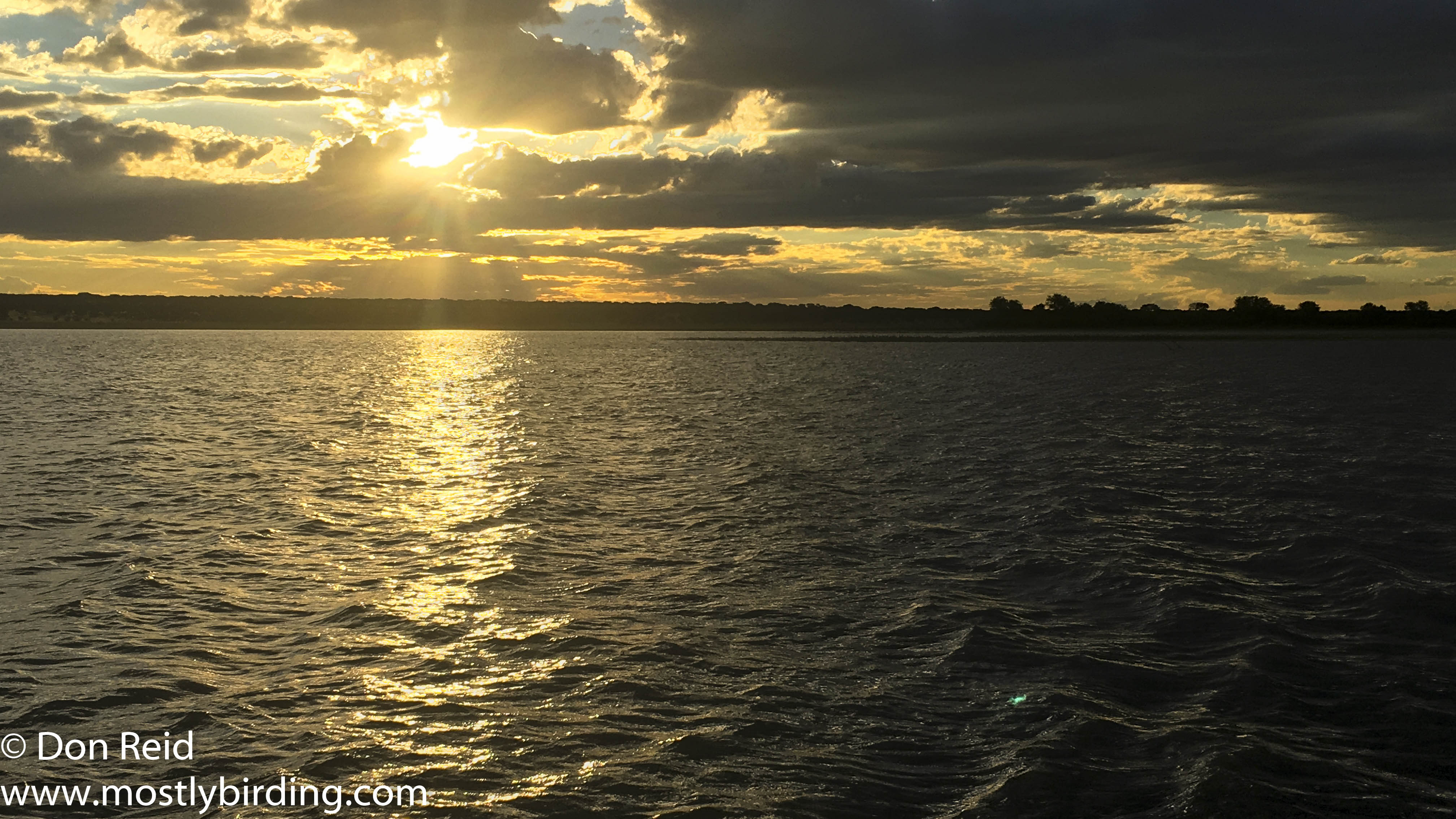
Some of this activity was along the shoreline – Cormorants aplenty, groups of Spur-winged Geese and solitary Goliath Herons standing sentry at regular intervals as we cruised smoothly along. The setting sun made for picture-perfect scenes as the rays created multi-coloured patterns from behind the clouds lining the horizon.

Sundown approaching as we glide out onto the mighty river

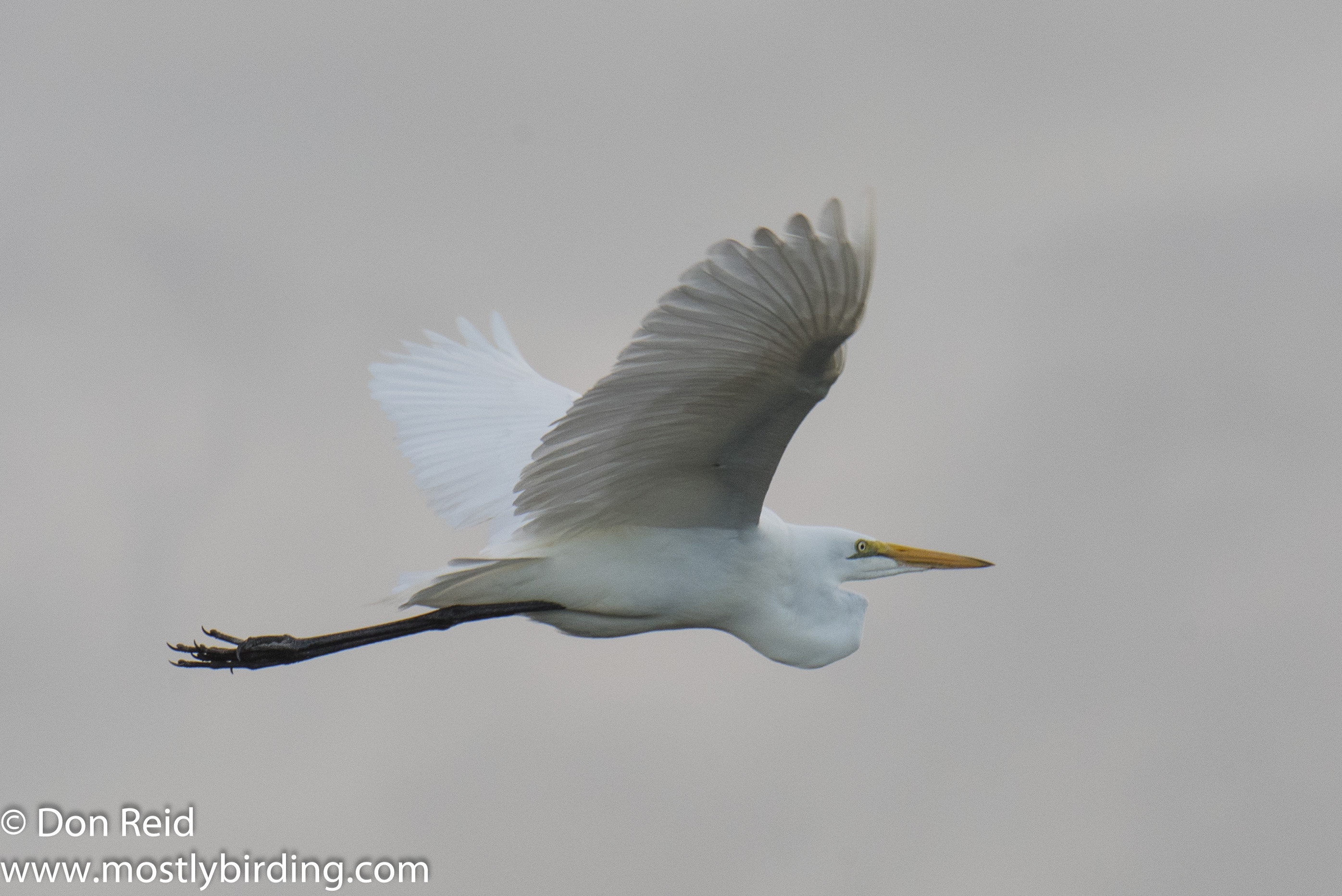
Several birds passed the boat in graceful flight

Great Egret
White-breasted Cormorant skimming the water
White-winged Tern (Transitional plumage)

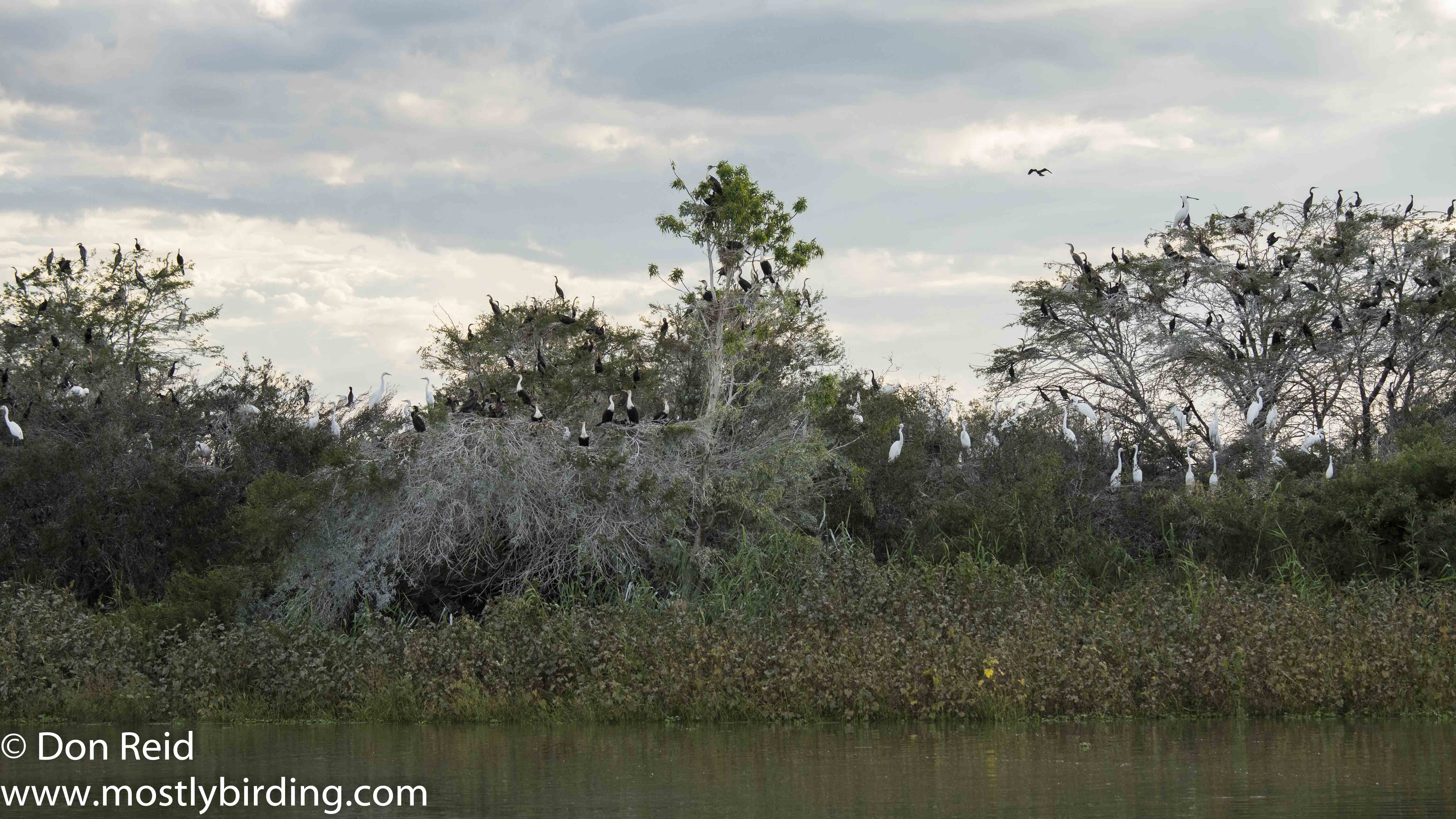
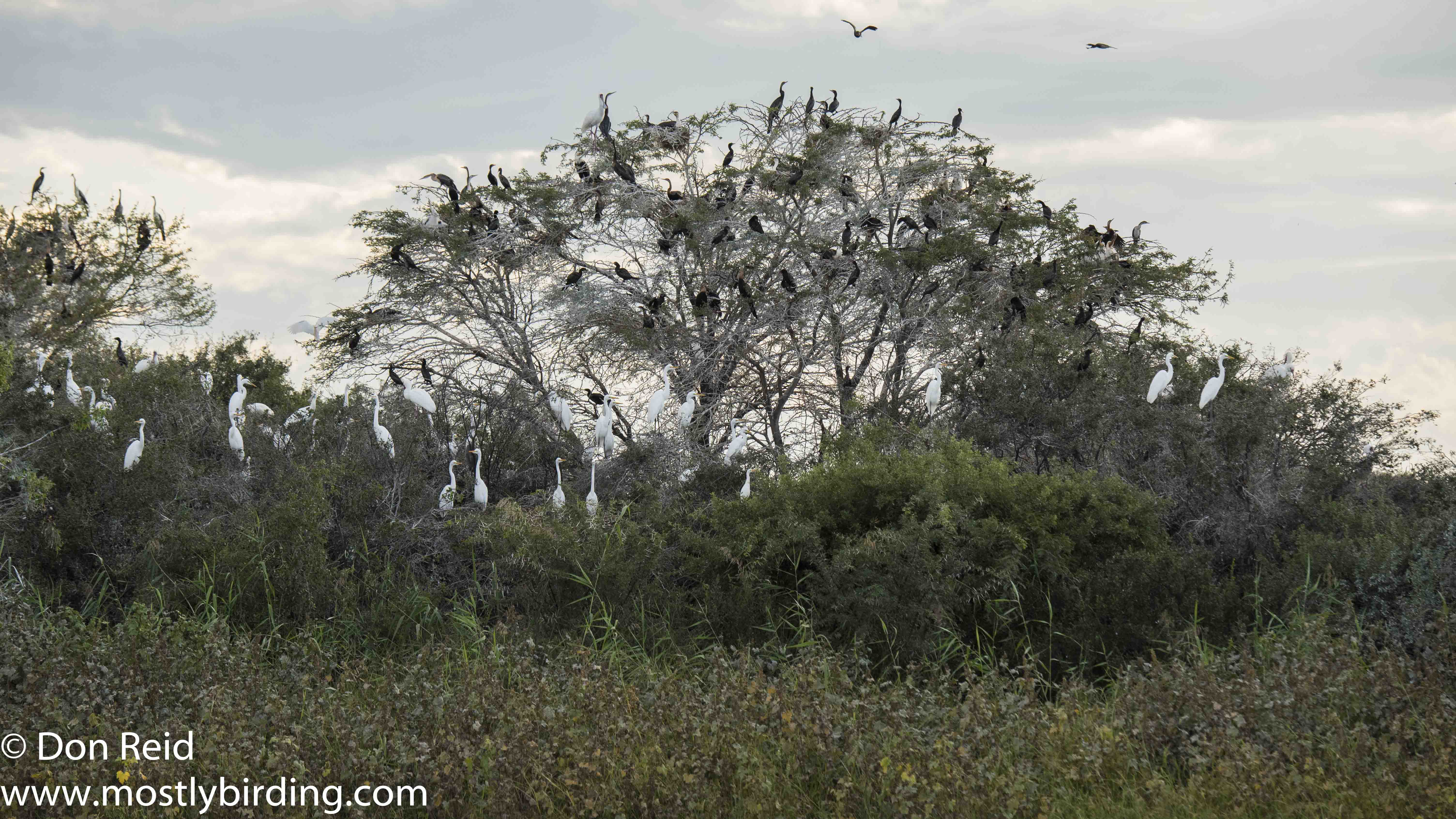
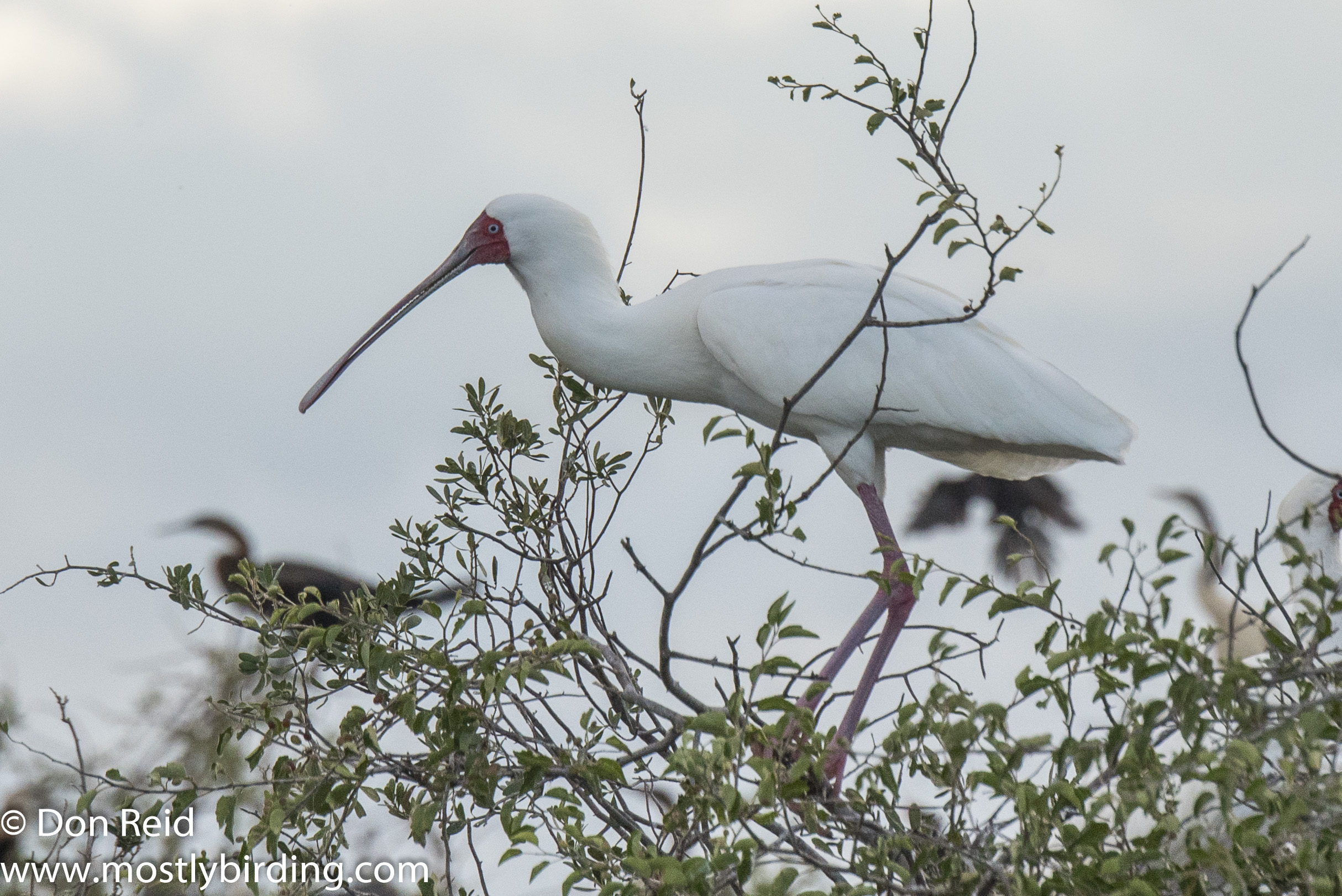
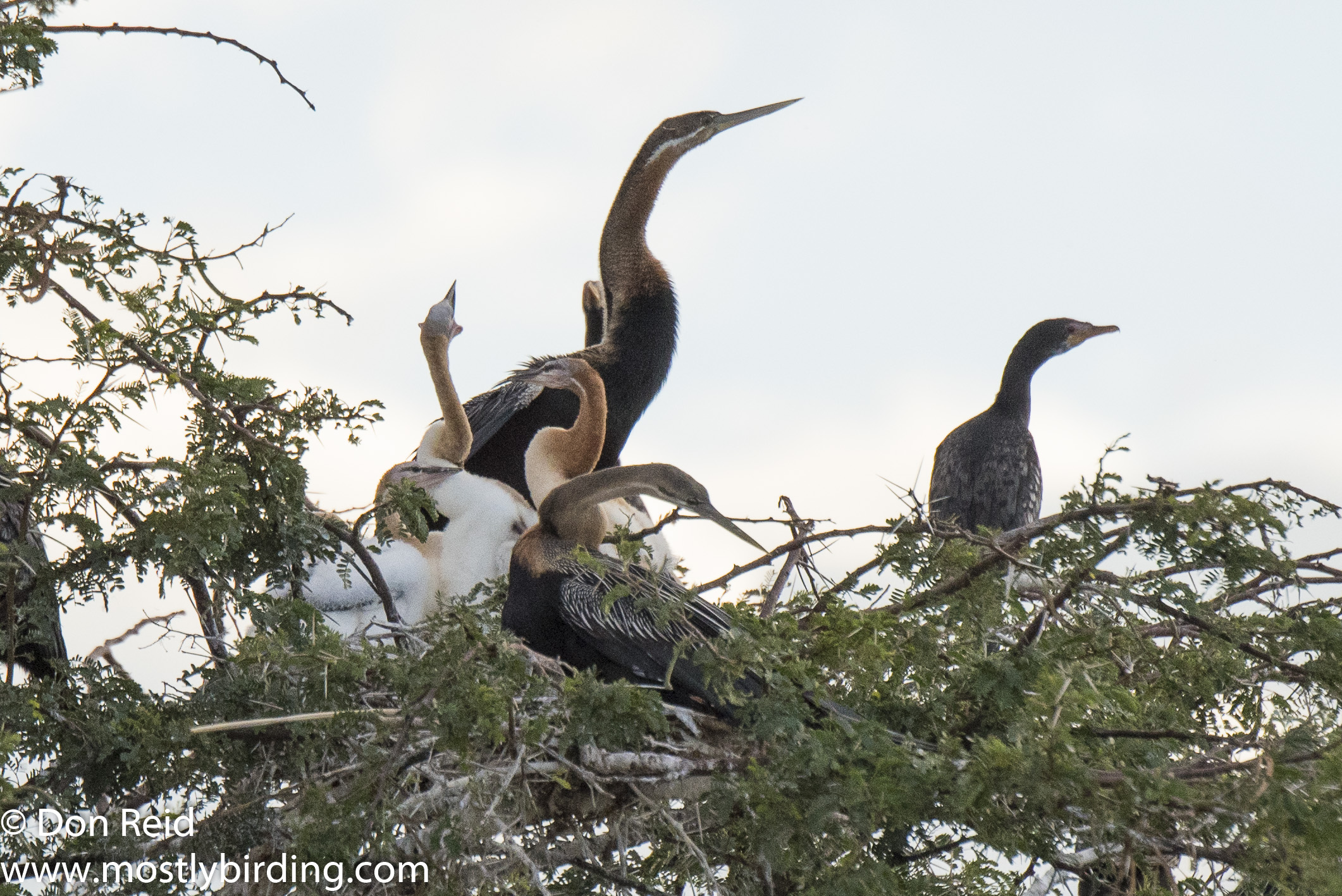
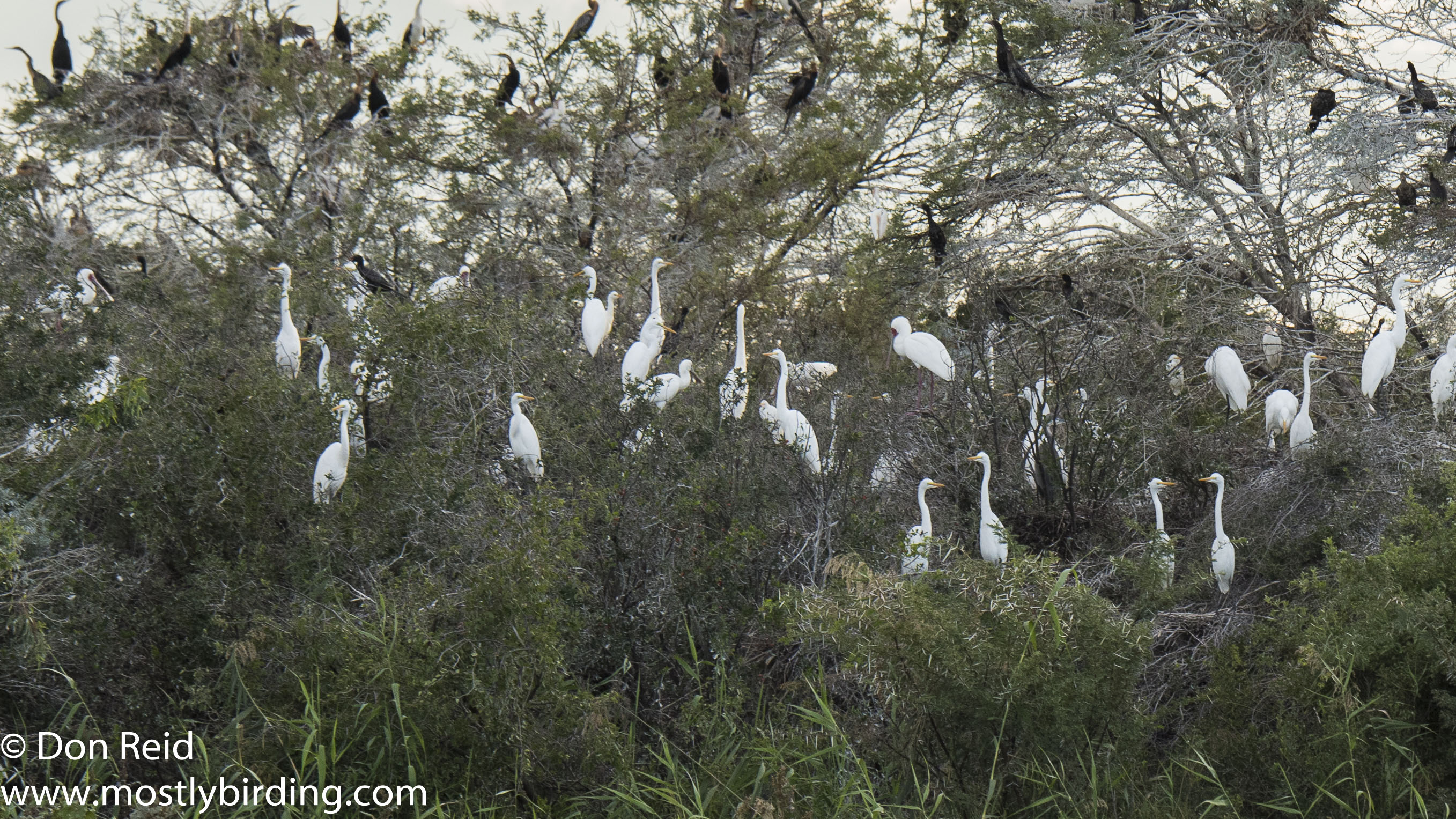
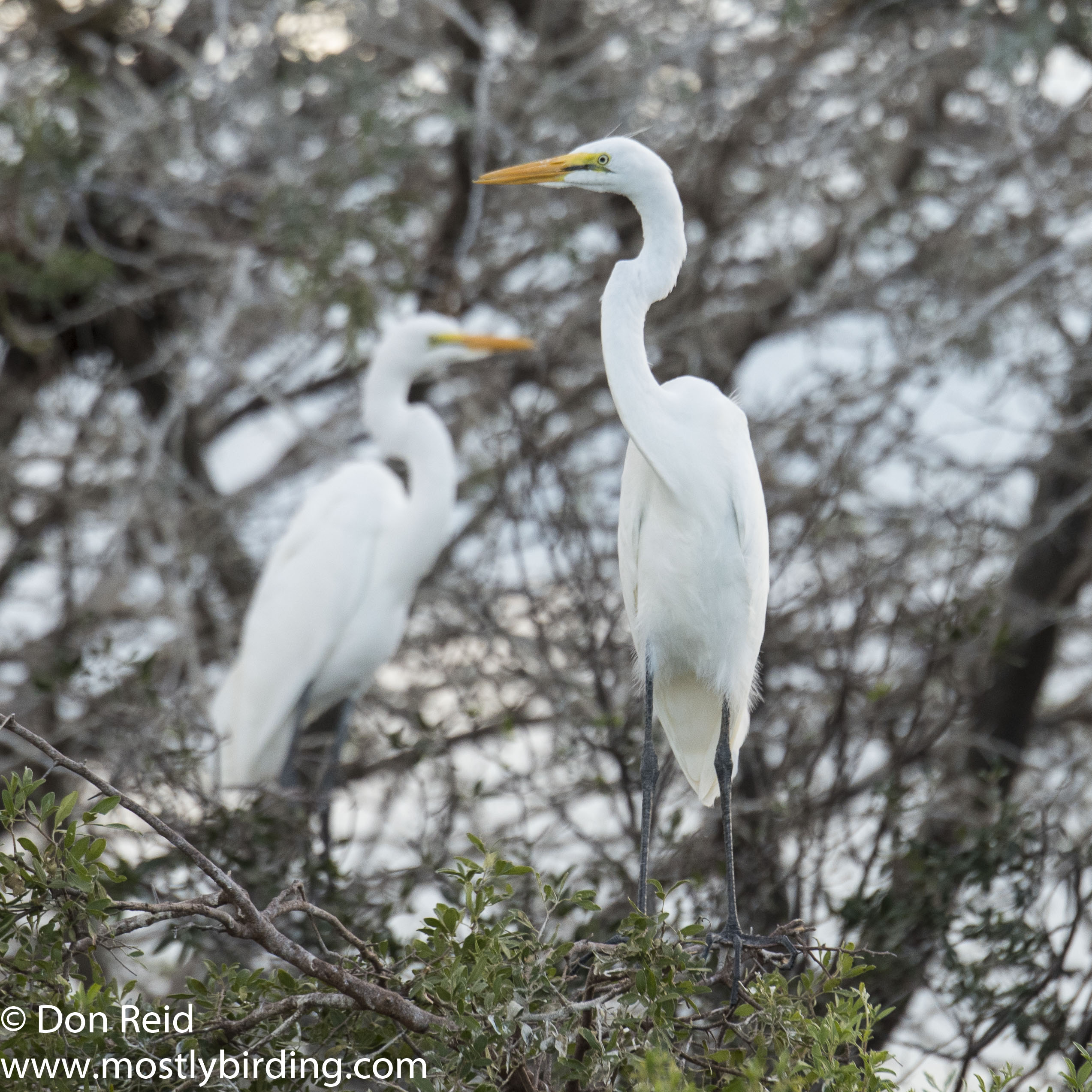
Passing a mid-river island, we saw signs of large colonies of various roosting and breeding bird species along its length. Approaching the colonies, the numbers of birds present were amazing – Darters, Cormorants, Spoonbills, Grey Herons, Yellow-billed Storks and, almost more than all the rest, Great Egrets.

Approaching a part of the massive mixed roost
Mixed roost
Mixed roost

I have seen individual colonies of most of these species at one time or another in the past, but never this variety in one place. The trees that made up the roosts were stained white from the bird’s presence and every available perch seemed to be occupied while numbers wheeled overhead, then dove down and pushed and shoved their way in with flailing wings and legs. Quite a sight to behold!

These photos give an idea of the extent of the colonies – just imagine the racket generated by all these birds to get an inkling of the full experience.

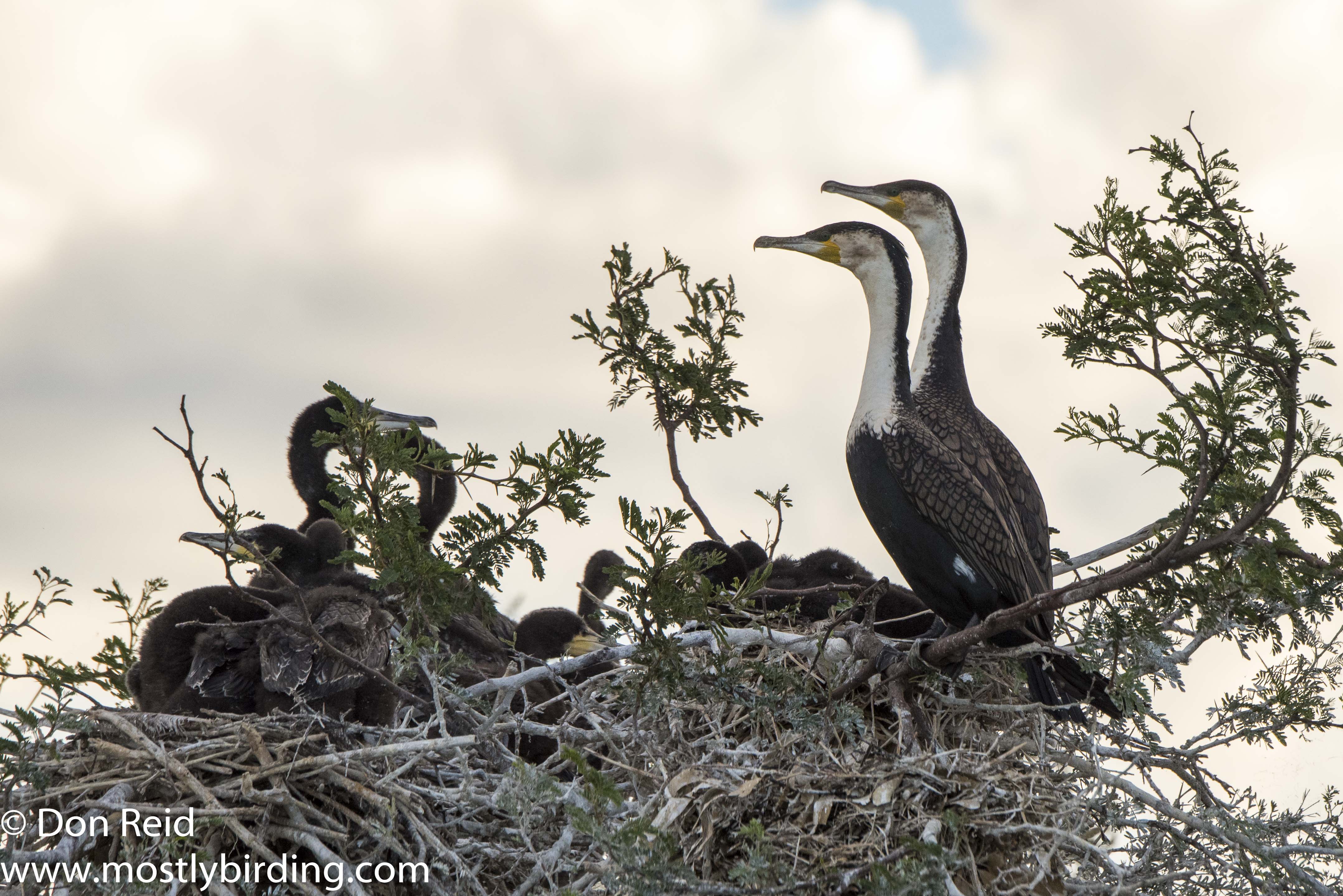
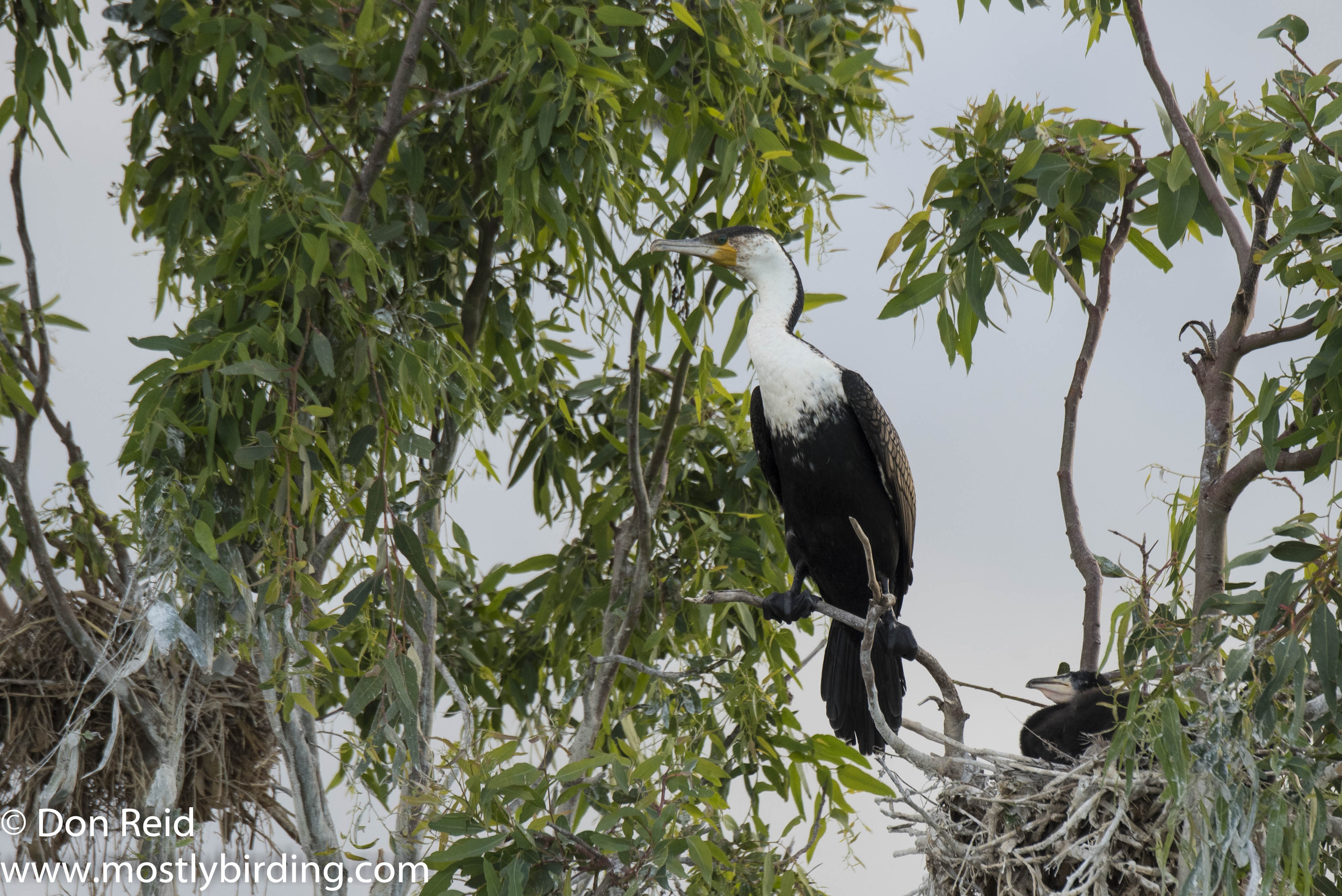
White-breasted Cormorants

At roost
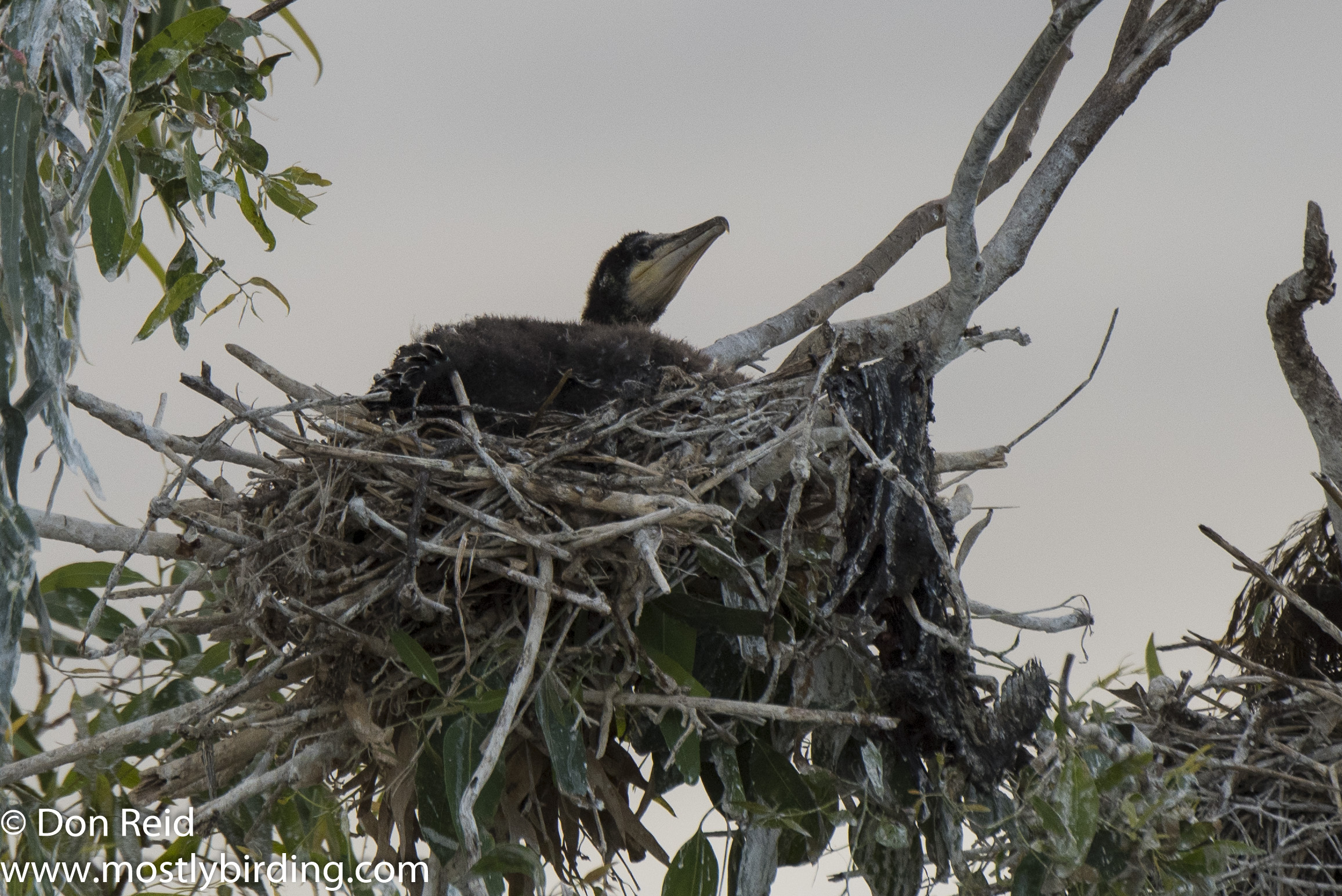
White-breasted Cormorant With young at nest
Youngster at nest
White-breasted Cormorant

African Spoonbills

African Spoonbill
African Spoonbill (Juvenile)

African Darters

African Darter (with young)

Great Egrets

Mixed roost
Great Egrets
Great Egret

By now the sun was heading inexorably to its meeting with the horizon and Pieter took us back along the river to the spot where we had departed from (ooh, there I’ve done it again – the worst of english grammar crimes, ending a sentence with a preposition – but then, I love living on the edge)

Sundowner cruise

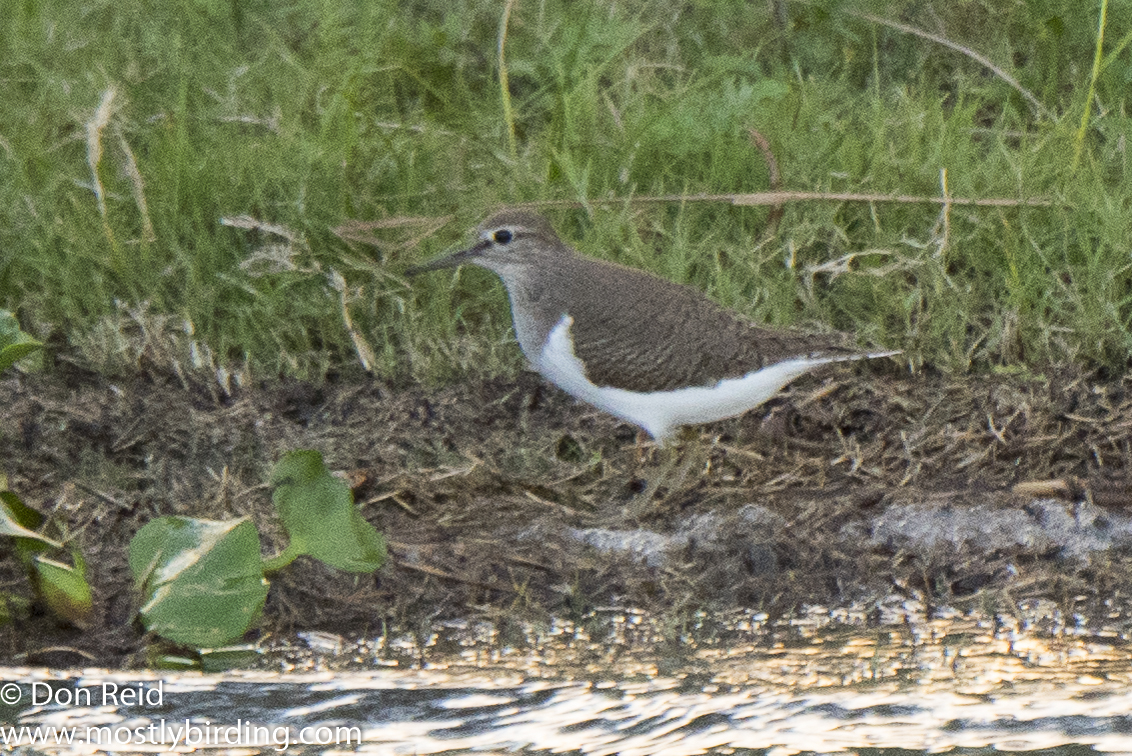
Close to the berth I spotted a Common Sandpiper at the water’s edge………

Common Sandpiper

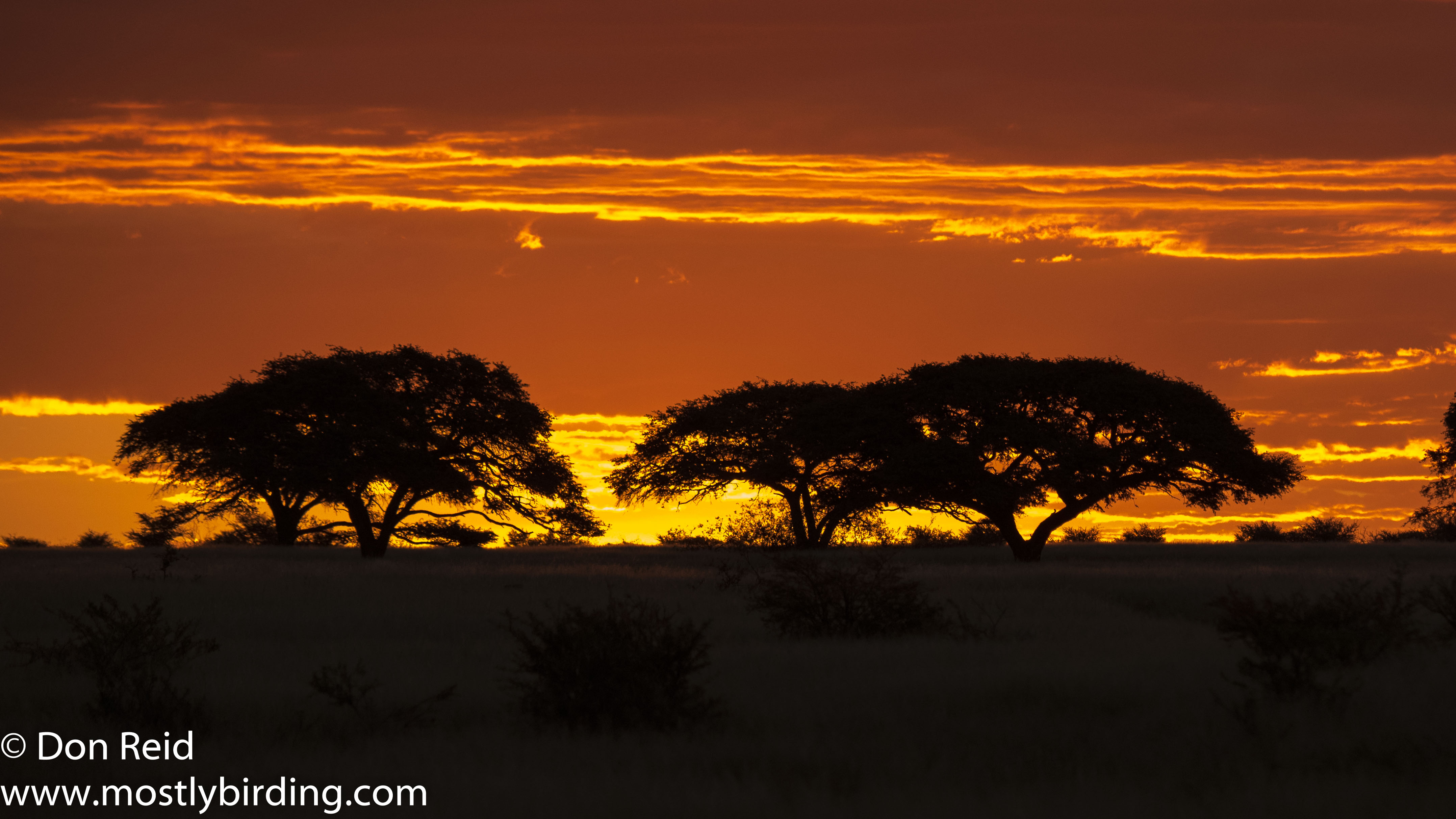
Just to round off a magnificent outing, Pieter took a detour on the way back to the farm-house to show us the deep orange sunset against a backdrop of some picturesque trees. Only in Africa ……

Sunset, Annasrust farm Hoopstad

Now, if only I can get a job as game ranger on the farm……….


World Lion Day

I would not have known it if National Geographic hadn’t sent an email notice, but it’s worth mentioning that today is World Lion Day!
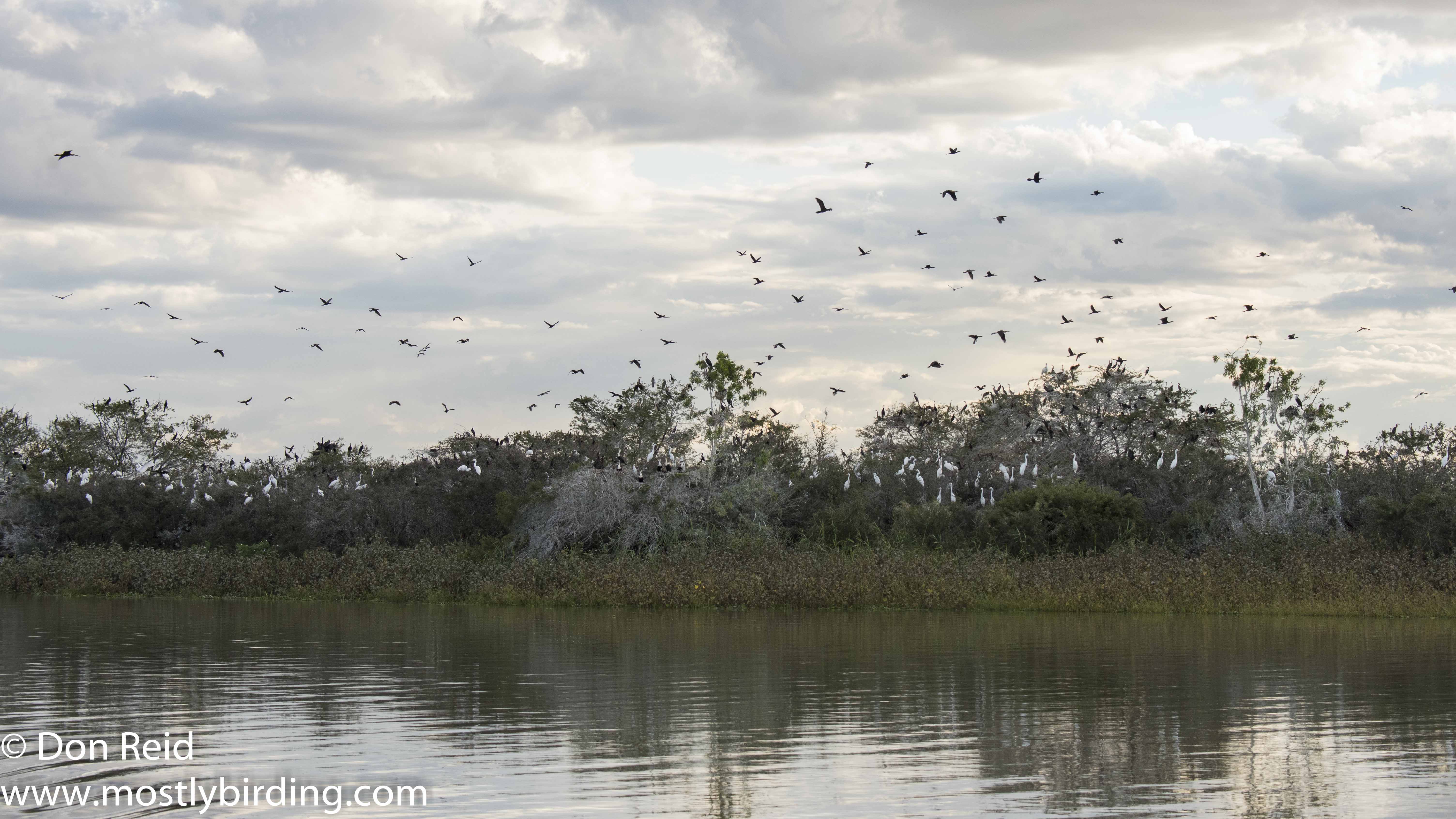
In their words…….

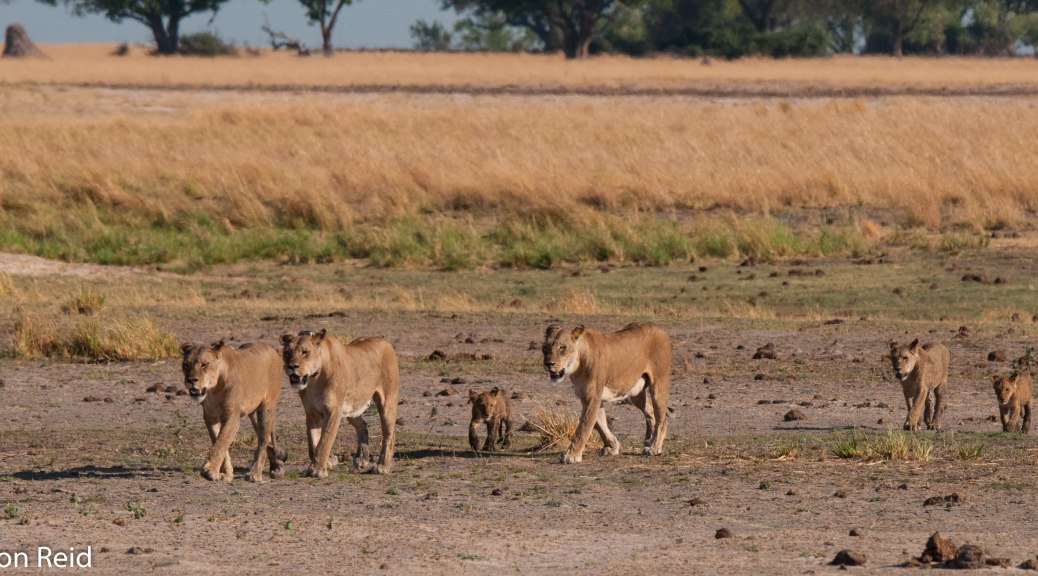
“Today is World Lion Day, a day of celebrating the fearsome roars, handsome manes, and adorable cubs of one of the most iconic animals in the world. Lions are incredible creatures: athletic powerhouses and apex predators.

They’re also facing dizzying declines in their population that they are powerless to stop.

Even one lion killed can destabilize an entire region’s prides. And these days, poaching, retaliatory killings, and habitat loss are killing off lion after lion.”

So in our brittle world even the king of beasts is under threat.

Time to go out and hug your local lion……

Chobe Riverfront
Chobe Riverfront
Kruger Park
Chobe Riverfront
Chobe Riverfront

Annasrust Farm – A Walk or Two

The north-eastern part of Free State Province is known as one of the major maize, sunflower and wheat farming areas with its deep sandy soils and seemingly endless vistas across the flat landscape.

By kind invitation of Pieter and Marietjie, part of Gerda’s extended family, we spent a glorious weekend on their farm Annasrust near Hoopstad in April this year, together with our son Stephan and family – pretty much the perfect venue for a relaxing yet stimulating stay, raised to an even higher level by the company, it has to be said.

Annasrust farm is not your average Free State farm, lying as it does on the southern shores of the Vaal River (which forms part of the Bloemhof dam at that point) and stocked with a variety of game which enjoy the largely undisturbed plains, making it more of a mini Game Reserve than a farm.

Morning walk, Annasrust farm Hoopstad

With its varied habitats, the farm presents plenty of exciting birding opportunities, which started as we drove from the entrance gate to the farmstead through grasslands interspersed with patches of woodland. Once we had greeted our hosts Pieter and Marietjie and had settled in our house – did I mention we had a house to ourselves? – I recorded the species seen on the way in –

  • several Northern Black Korhaan rising up out of the long grass and flying off in a wide circle, croaking their objection to being disturbed
Northern Black Korhaan
  • Ant-eating Chat perched on a termite mound
  • Sociable Weavers at their enormous communal nest (more fully described in my earlier post Sociable Weaver)
Sociable Weaver, Annasrust farm
  • the usual doves and Helmeted Guineafowl and a Spotted Thick-knee which seemed to be awaiting our arrival in the middle of the road, only giving way at the last moment

My plan was to do some early morning birding over the two-day stay, leaving the rest of the day for family activities and any ad hoc birding opportunities that may arise. The only decision needed was whether to head out on foot, limiting the area I could cover, or to take the Prado and explore further and wider. In the end I chose the walking option, one of my favourite forms of exercise and one that trumps any other way of getting close to nature in such beautiful surroundings

Saturday morning

Early morning at the farm house
Heading out for a morning walk

Sunrise was at 6.30 am and I was on my way a few minutes later – almost immediately I heard a soft piping call – vaguely familiar and I scanned the tall blue gum trees near the house. I soon found the responsible bird – a Gabar Goshawk which was seemingly agitated by a group of cackling Green Woodhoopoes who had dared to trespass in his territory.

The more familiar call of Rufous-naped Lark – a clear, plaintive “tswee – twooo” – accompanied me as I walked along the sandy track lined with long grass both sides, wet with morning dew.

Rufous-naped Lark

A bushy tree some way ahead drew my attention – the whitish blob did not fit the pattern of the rest of the tree and through my binos it turned almost magically into none other than a Pearl-spotted Owlet – I had scarcely begun my walk and already had a highlight of the morning. I cursed the fact that I hadn’t taken my camera and turned to go and get it, just as the Owlet disappeared.

This tiny member of the Owl family has to rate as one of the cutest birds around – all fluffy and round with those penetrating yellow eyes and if you’re lucky it will perform its party trick of turning its head 180 degrees to show you the back of its head, complete with false “eyes”.

I found these photos in my archive from 2007 which show the front and back “eyes”

Pearl-spotted Owl
Pearl-spotted Owl

The walk continued with regular sightings of some less common arid bushveld species –

  • Kalahari Scrub-Robins calling, but difficult to spot amongst the foliage
  • Barred Wren-Warbler emitting its trilling call that can be heard at a distance despite its small size
  • Groundscraper Thrush perched high up in a tree and calling melodically for minutes on end
  • Pririt Batis with its descending, drawn out series of short whistles, heard initially then seen later

An isolated outbuilding which seemed not to be in use, had attracted a pair of Ashy Tits, not seen by me in a few years, while Scaly-feathered Finches occupied a nearby tree along with an excited pair of Neddickys.

Morning walk, Annasrust farm

And being a game farm there were other sightings of a few of the animals that roam the grasslands ………….

Giraffe, Annasrust farm
Springbok, Annasrust farm
Nyala, Annasrust farm

By now I had been walking for an hour and a half and could feel breakfast and coffee beckoning so turned back and headed for the farmstead, where I took off my shoes which were wet through from the dew and caked with the sand from the tracks and left them in the sun to dry out.

Breakfast was duly enjoyed with the family – a feast of fruit platters conjured up by Gerda and Liesl, followed by a baked egg and bacon dish which really hit the spot. The rest of the day was given over to long chats, a midday snooze and a stunning late afternoon river cruise (more about that in the next post)

Sunday morning

I was up early and out again for another extended walk, this time my plan was to do a circular route past the old house, down to the river and back along the riverside fence where I would look for the most direct route homewards.

Morning walk, Annasrust farm Hoopstad
Camelthorns – they make good toothpicks
Spot the butterfly!

Initially the birds I encountered were mostly the same as the previous morning, then Zitting Cisticola showed, fluttering over the long grass and Cape Penduline Tit made a welcome appearance, moving restlessly among the bushes.

Zitting Cisticola, Annasrust farm

Before reaching the river I added White-browed Sparrow-Weavers to the list and at the river the shallow flats were a moving feast of birds with Yellow-billed and Little Egrets and Cape Teals prominent amongst many others and White-winged Terns flying in elegant fashion just above the water, turning and retracing their path every 50 metres or so.

The river, Annasrust farm
Dragonfly, Annasrust farm

Walking along the fence, two grazing horses followed me on the other side – hoping for a treat perhaps? I don’t usually have an affinity for horses, so tried to ignore them but they followed me all the way to where I turned for home.

Reluctant Horse whisperer!

Two hours of walking had left me quite weary and caffeine deprived, so I took the shortest route back to the house where the family were slowly emerging and I was in good time to join them for much-needed coffee.

Later that day we reluctantly left this bit of paradise and headed back to Pretoria – the slow drive out of the farm and along the first stretch of road past Hoopstad was good for a few interesting species  to round out a memorable weekend –

  • Shaft-tailed Whydah
  • Long-tailed Paradise Whydah
  • Lesser Kestrels in numbers on the overhead wires
  • Namaqua Doves
  • A lone White Stork

I can recall reading an article many years ago on a visit to the Free State in which the writer suggested a weekend in the Free State is like a week in the country – I would tend to agree.


Atlasing Tales 6 – An Owl and a hungry Swift

The Atlasing* destination

Work and other commitments had kept me from any regular atlasing,  other than our Drakensberg escapes, since January 2018, so I welcomed the Human Rights holiday on 21st March, bang in the middle of the working week and I just had to get out and do some atlasing.

Looking at the 2018 pentad map for Gauteng the previous evening, the closest pentads that met my criteria (not atlased in the current year) and fell south of the N4 highway (my arbitrary dividing line when deciding whether to venture north or south from Pretoria) were in an area south of Delmas and I selected two as my target for the next day. The first was :

Pentad 2610_2840

Indicated by the blue rectangle on the map –

Pentad 2610_2840 south of Delmas, about 70 Km from Pretoria

I set off from our home in Pretoria in light rain at about 5.30 am, hoping the rain would dissipate, which it fortunately did, and was into the first target pentad an hour later. I initially stayed on the R50 main road which was quite busy with coal-hauling lorries despite the holiday (the coal mines and the power stations they feed obviously don’t get to close down) so whenever the opportunity presented itself I pulled off onto the gravel margin and drove slowly but bumpily along to keep out of their way.

The Cosmos flowers along the road verges made for an attractive background, interrupted by the coal mining activities that have despoiled large tracts of land in this part of SA. For more on the Cosmos flowers go to my earlier post – Cosmos time

Cosmos time, Delmas south
Not exactly a warm welcome – coal mining and roadworks ahead!

After recording what I could in the first few kms, I was glad to reach the R548 turn-off and proceed south along this far quieter road. I soon passed Leeuwpan, a large pan which in previous years was filled with water and teeming with water birds, but was now bone dry with no visible birds other than a few Spur-winged Geese (Wildemakou / Plectropterus gambensis) half hidden by the long grass. Good rains had fallen in Gauteng over the last few weeks to make up for the relatively dry summer, but clearly not enough to make much of an impact on these pans.

My pentad list grew slowly with species mostly typical of the limited habitats – grassveld patches between cultivated lands with near fully grown maize and soya crops, elsewhere restricted mining areas blocked any thoughts of exploring further.

My first surprise sighting of the morning came in the form of a lone White Stork (Witooievaar / Ciconia ciconia).

White Stork, Delmas south

This was followed soon thereafter by an even bigger surprise when I explored a sandy side road and spotted something in the middle of the road far ahead, which turned into an owl as I raised my binoculars to my eyes. I approached as quietly and cautiously as my vehicle would allow and was able to confirm my initial thought that it was a Marsh Owl (Vlei-uil / Asio capensis) – on the basis of it being the most likely owl in the area and the moist grassland habitat surrounding us at that point.

Marsh Owl

Thankfully no other traffic came by to interfere with my attempt to photograph this species – contrary to other species which are usually easier to photograph at rest than in flight, the only photos I have of Marsh Owl are in flight, so I was pleased to add these photos to my collection.

Unfortunately their habit of sitting in the road, especially after dark, can be this owl’s undoing – they are often victims when the lights of an oncoming vehicle blind them and they don’t fly off in time. Many are killed in this way, particularly during harvesting of the maize when they tend to feed on spilled corn kernels along the roads in the maize areas. It’s pleasing to see signs erected on some of the busier roads warning against this danger (to the owls) – if only more people would respond by being more vigilant while driving at night.

Reaching the southern boundary of the pentad with some time still left to atlas before reaching the two hour minimum time required for “Full Protocol” status, I decided to carry on along the same road into the adjoining pentad and complete the first one later on my way back. This pentad was directly south of the first one and numbered :

Pentad 2615_2840

Indicated by the red rectangle on the map –

Pentad 2615_2840

Being of similar habitat, the species mix in the second pentad was mostly similar for the first stretch, however I soon added Orange-breasted Waxbill (Rooiassie / Amandava subflava) and Wattled Lapwing (Lelkiewiet / Vanellus senegallus) to the morning’s list.

Then I came across the first decent body of water for the morning in the form of a farm dam some distance from the road and with the help of my scope was able to spot Greater Flamingo (Grootflamink / Phoenicopterus roseus) , SA Shelduck (Kopereend / Tadorna cana), a flock of Spur-winged Geese and a sprinkling of Yellow-billed Ducks ( Geelbekeend / Anas undulata). Another dam further on was closer to the road and held a single Goliath Heron (Reusereier / Ardea goliath).

Greater Flamingo

I completed a circuit of the pentad by heading west near its southernmost boundary, then north again – not much was added until I reached a bridge I had visited years before and which had what seemed like the same large flock of White-rumped Swifts (Witkruiswindswael / Apus caffer) circling above it. Stopping, I peered over the edge of the low bridge and immediately an African Spoonbill (Lepelaar / Platalea alba) flew up and away, followed a second later by a Green-backed Heron (Groenrugreier / Butorides striata) (first record for the pentad). Across the road I spotted a Malachite Kingfisher (Kuifkopvisvanger / Alcedo cristata) (2nd record) before it too flew off and disappeared into the reeds.

White-rumped Swift

I spent a while trying to photograph some of the fast-flying Swifts with some success – what I found later on scanning through my attempts was that one swift had a full crop, evidenced by the bulging white throat patch.

White-rumped Swift – with very full crop

It was time to head home – along the way I came across a rare photo opportunity in the form of a female Amur Falcon so engrossed in her grasshopper meal that I was able to approach much closer than usual. To see the photos I took, go to my earlier post titled Mongolian take-away

The Atlasing statistics

Pentads 2610_2840 and 2615_2840

I added the 19th and 26th Full Protocol cards overall and the 1st and 3rd for 2018 for the respective pentads, The combined tally for the morning was 51 species of which 2 were new records.    Total species for the pentad now 156 and 157

Some of the new/notable species added:

Green-backed Heron 

Red-faced Mousebird

Goliath Heron

SA Shelduck

White Stork

Malachite Kingfisher

* Atlasing

Simply put, it is the regular mapping of bird species in a defined area  called a “pentad”. Each pentad has a unique number based on its geographical position according to a 5 minute x 5 minute grid of co-ordinates of latitude and longitude, which translates into a square of our planet roughly 8 x 8 kms in extent.

As a registered observer / Citizen scientist under the SABAP2 program (SA Bird Atlas Project 2), all of the birding I do nowadays includes recording the species for submission to the project database at the ADU (Animal Demography Unit) based in Cape Town.

Atlasing has brought a new dimension and meaning to my birding as it has to many other birders. The introduction a couple of years ago of the “Birdlasser” App has greatly simplified the recording and submission of the data collected.

This series of “Atlasing Tales” posts sets out to record some of the memorable experiences and special moments that I have enjoyed while atlasing.