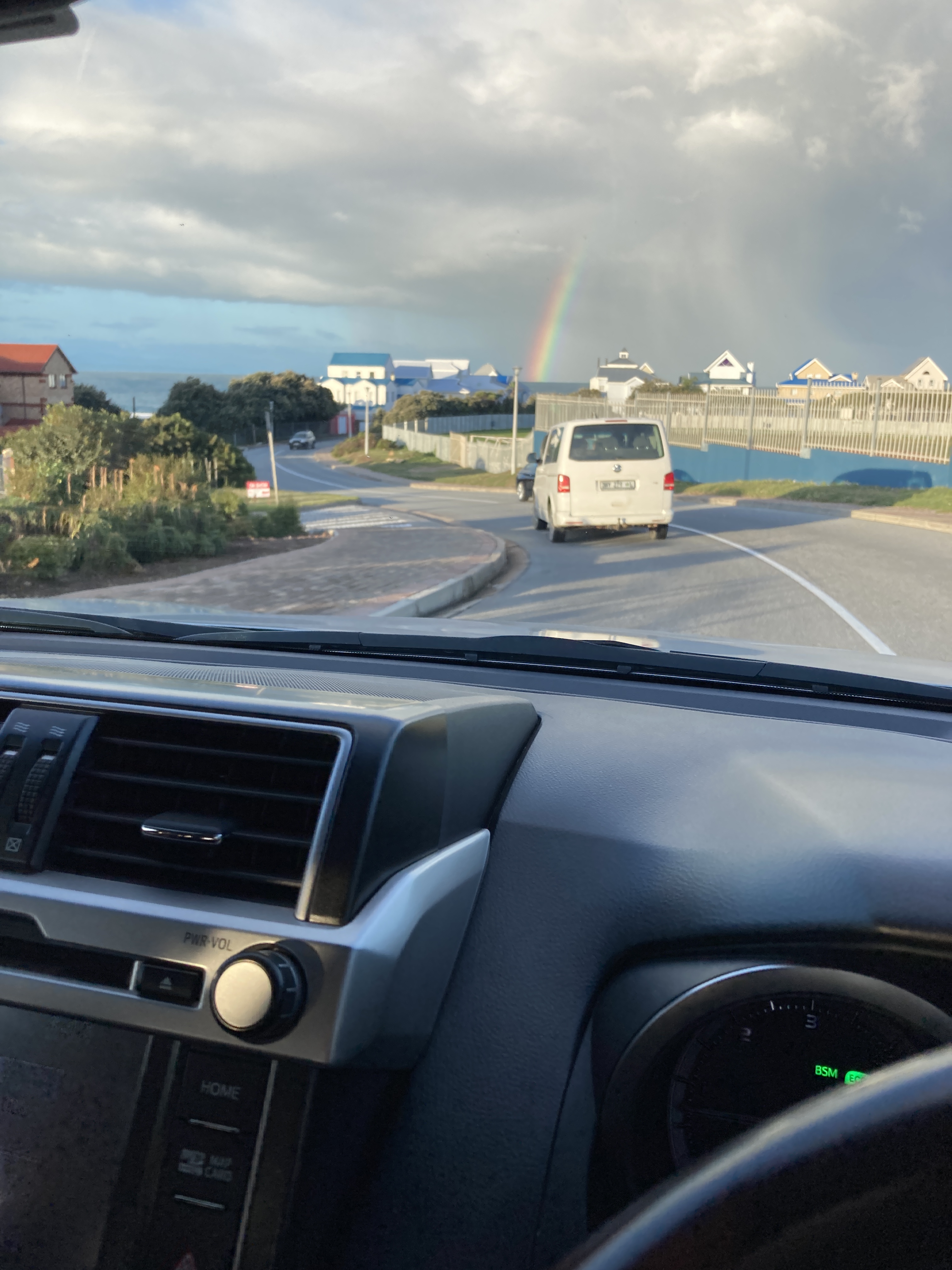
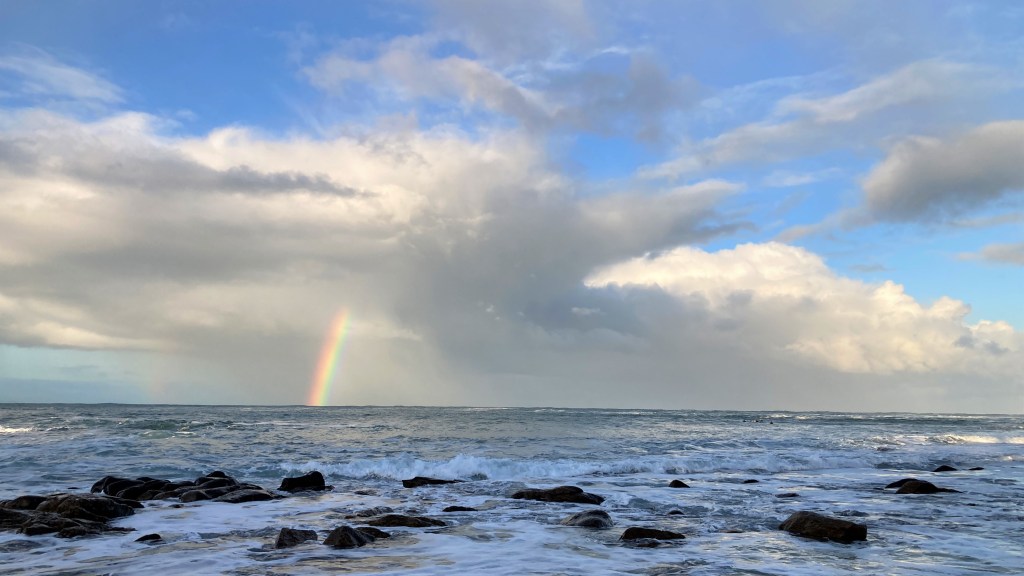
On one of our recent outings to The Point, just 10 minutes away from our Mossel Bay home, we spotted a rainbow forming over the sea in the distance.
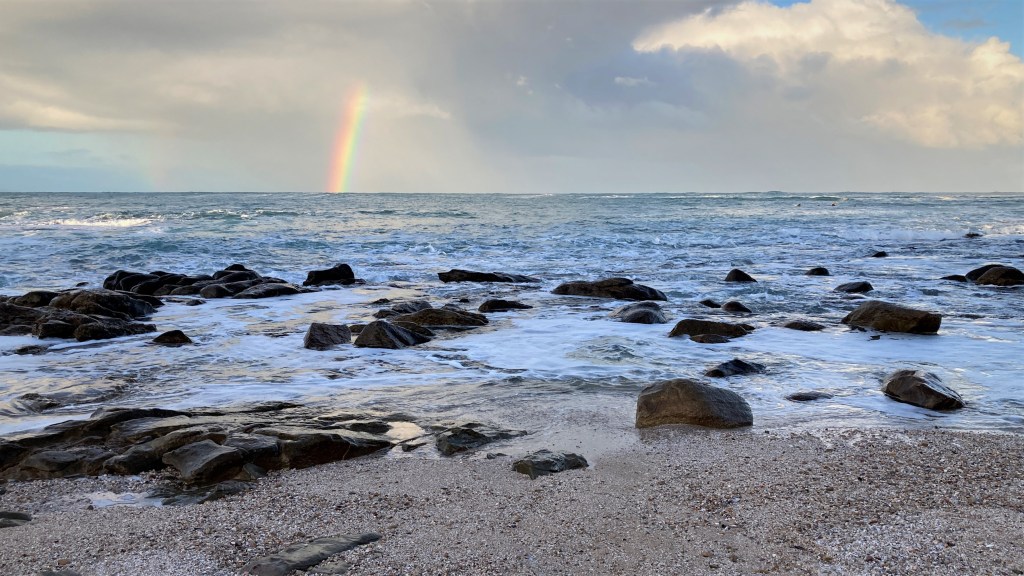
I snapped a shot while driving (very slowly) and hastened to find a spot to capture the rainbow before it disappeared. It did not have the full bow of a ‘proper’ rainbow but formed an almost vertical column disappearing into the low clouds hanging over the sea – quite unusual.
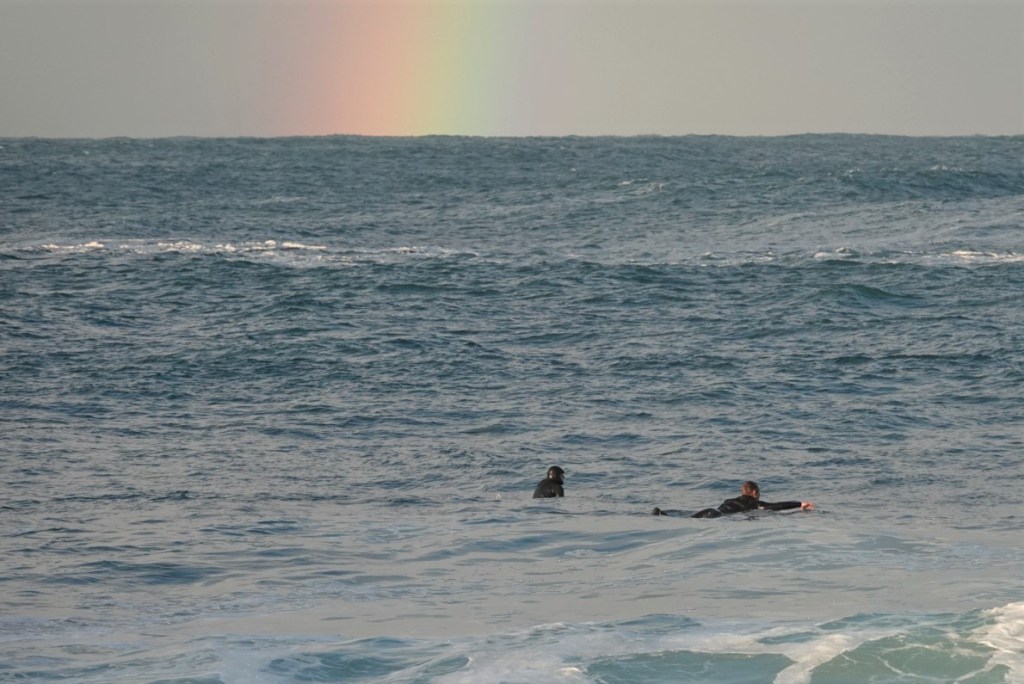
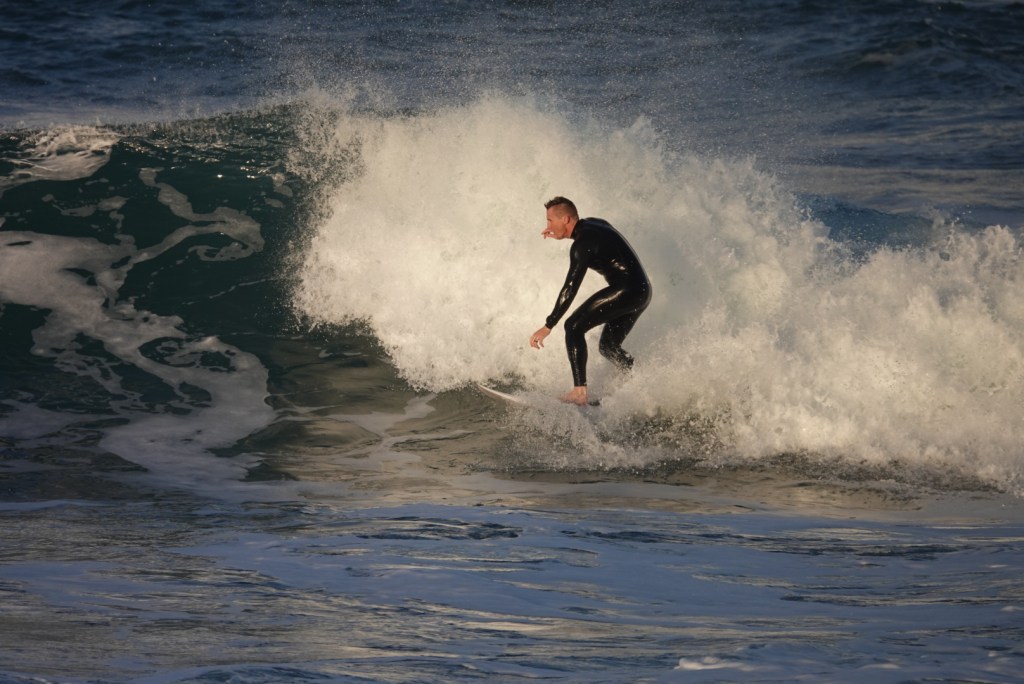
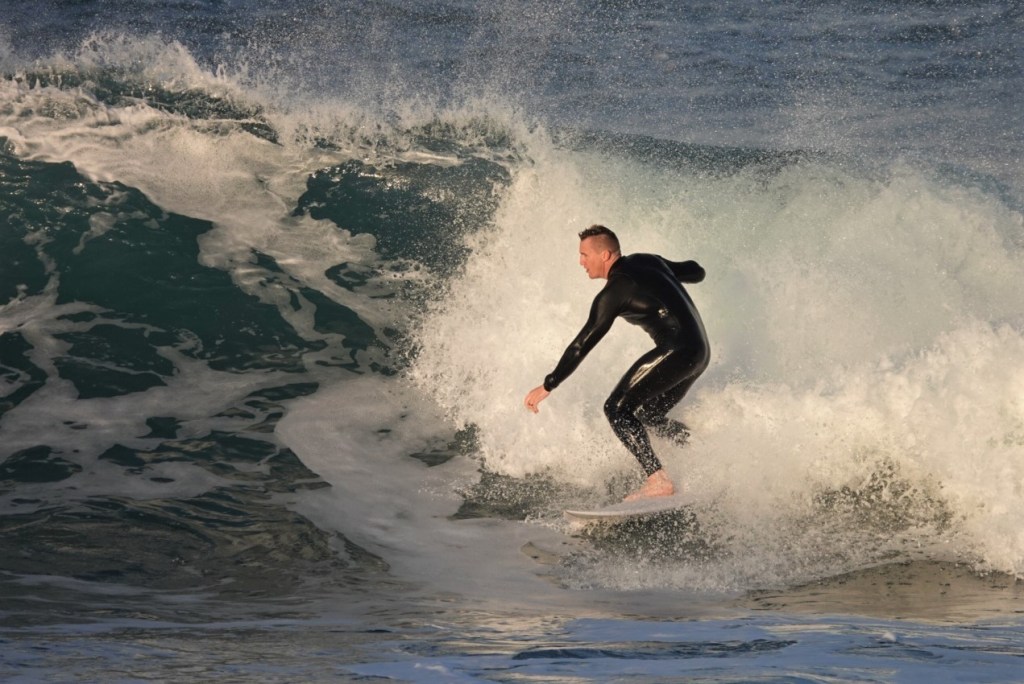
Once satisfied with the images I noticed a number of surfers in the sea – not unusual as this is a favourite surf spot, but the light was so perfect for photography that I could not resist trying my hand at some “surf’s up” images.
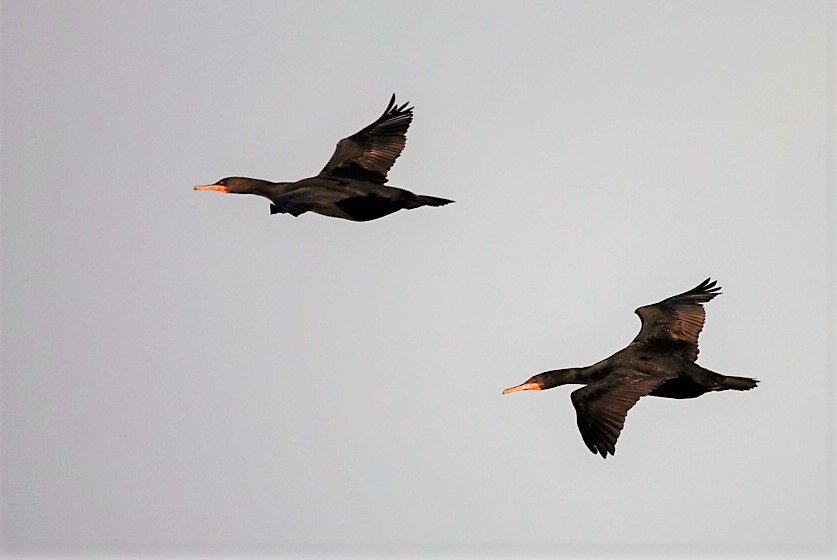
Further on we found a parking spot to enjoy our tea and watch the passing birds – the Cape Cormorants are regulars at the Point and once again the light was still good enough to capture a couple in flight, on their way to their roost somewhere further up the coast.
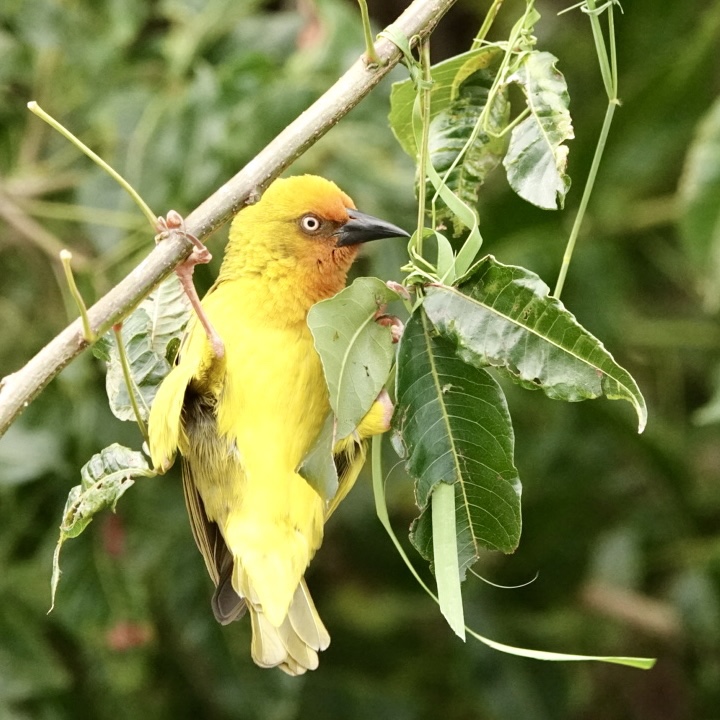
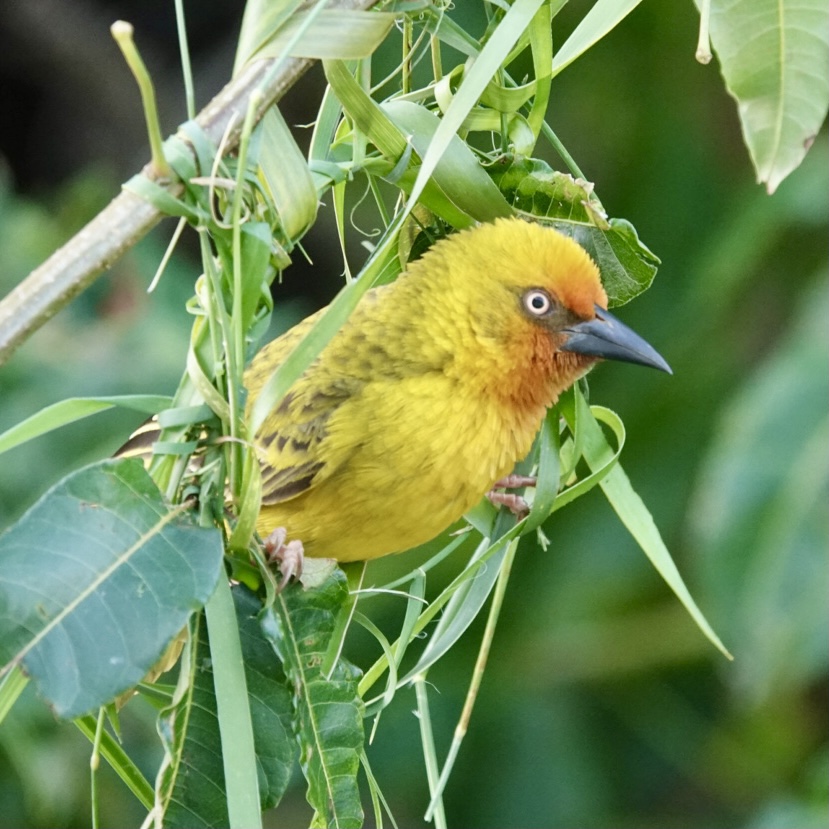
When we returned to our Mossel Bay home recently we were thrilled to find the Cape Weavers (Ploceus capensis/ Kaapse wewer) hard at work building nests right outside our upper floor living area. They provide endless entertainment with their constant activity, never stopping from dawn to dusk.
The post has been updated to include an image of the chicks being fed – they are growing fast
Male – just starting on the nestMale – initial nest frame in progressMale building nest – at an advanced stageFemale feeding two chicks
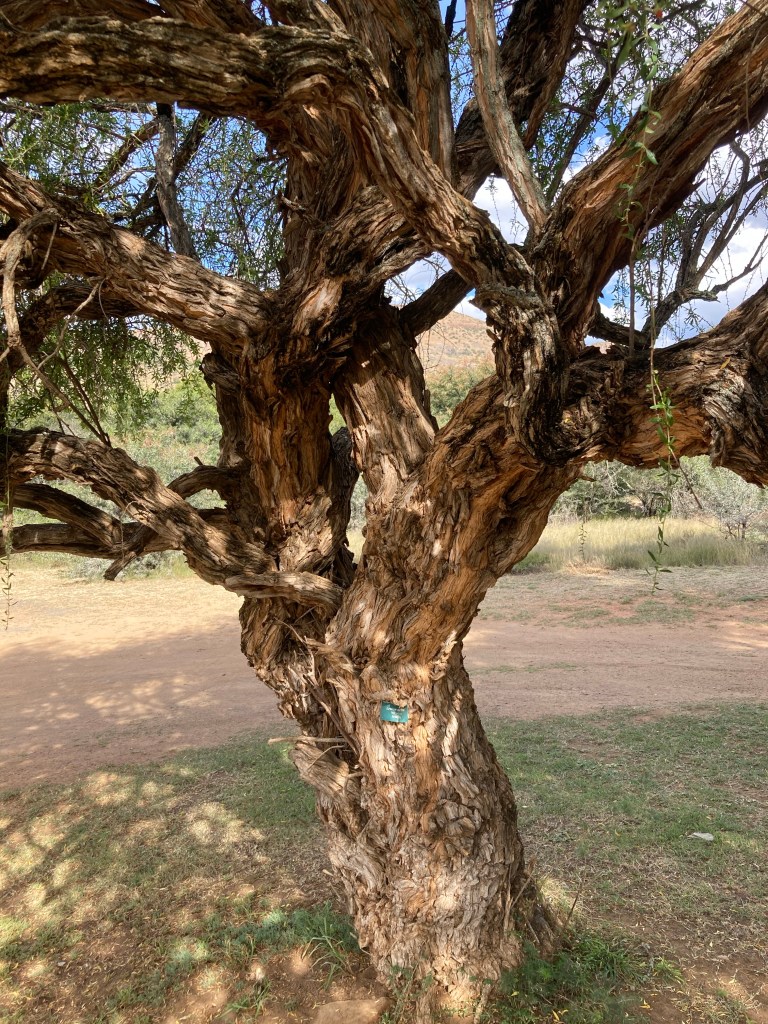
During our visit to Mountain Zebra National Park in March this year, we stopped at the main picnic area on the way to one of our drives and were drawn to have a closer look at the striking tree in the middle of the area.
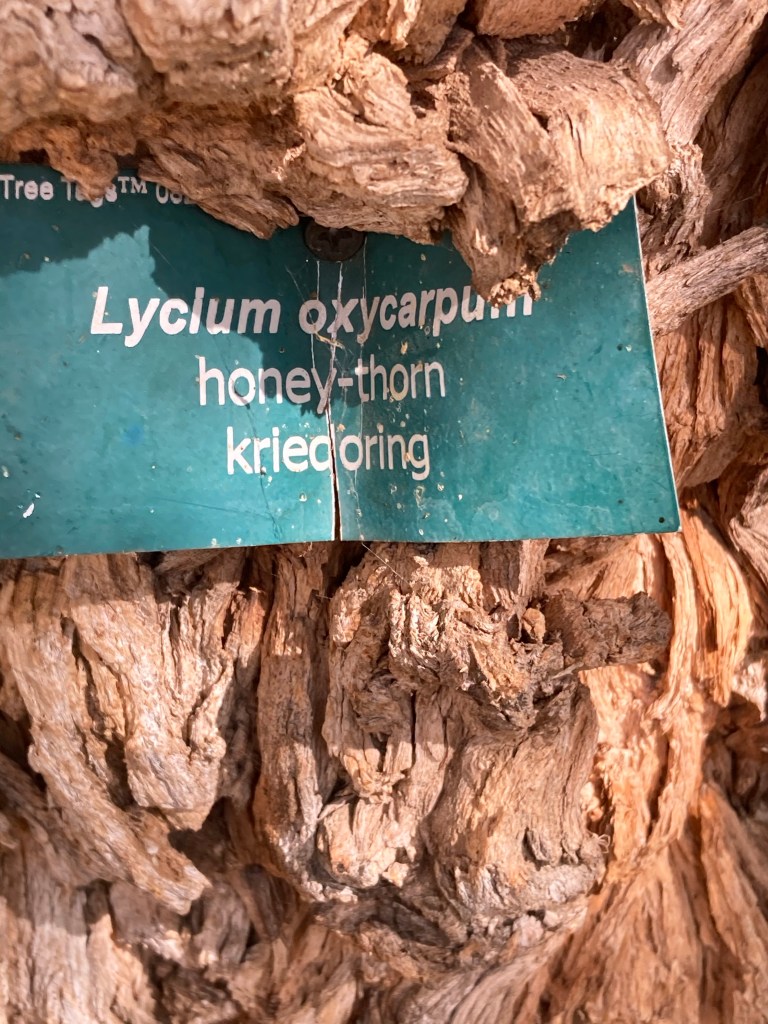
Closer inspection showed just how unique this tree is and the Parks Board had wisely thought to provide a name plate for this impressive example
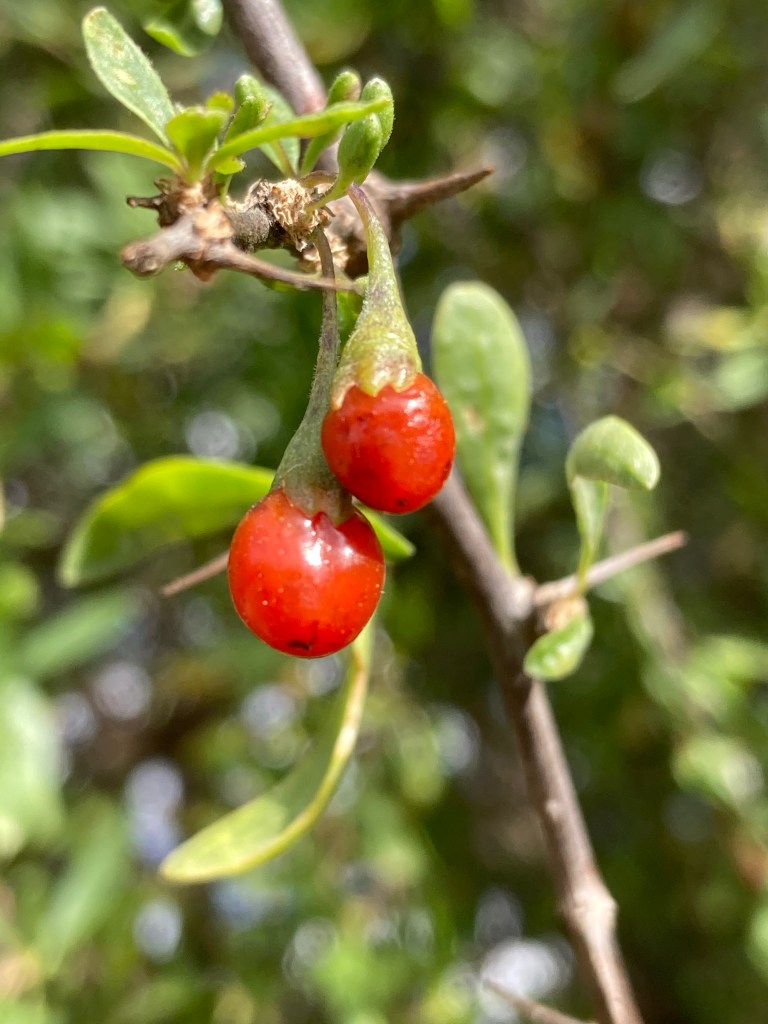
The tree dominates the middle of the picnic area The bark has a unique rough texture Close-up of the bark and the name plate (being gradually engulfed by the looks of it)The fruit of the Honey-thorn are vivid in colour The flowers are small and delicately beautiful
All in all a striking example of this tree species, I’m sure you will agree
Actually it was on a Wednesday – but all will become clear as you read on…..
Road Trip to Eastern Cape
Our Road Trip from Mossel Bay to the Eastern Cape was into the third day, after spending the first two nights in the Nature’s Valley area, where we explored a few places we had last visited many years ago.
Our next stop was Addo Elephant National Park, half a day’s drive further east, so there was no need to rush, except ……. well, there was the small matter of a possible rarity in the back of my mind …..
Now, some readers may know by now that I am an opportunistic twitcher rather than an obsessive one – if a rare bird is reported at a spot which is within reach of where I happen to be, I will consider making an attempt to see it, as long as it does not entail extensive travel and there is a reasonably good chance of actually finding the rarity.
So what rare bird was in the back of my mind?
Well, for some time before this trip, in fact since the end of November 2020, there had been reports of a Sooty Gull that had been spotted at various places along the eastern coast of South Africa, a species never recorded before in the region, so classified as a “Mega Rarity” by those who are driven by such things.
I had been following its gradual progress southwards with interest, secretly hoping that 1) it would remain in the area long enough until our road trip began and 2) it would settle at a spot which was within ‘twitching distance’ of our planned route to the Eastern Cape. After the initial sighting in Northern Kwazulu Natal, the gull was spotted at Kei Mouth in the Eastern Cape and spent some weeks there.
I became more interested when the bird was spotted at the Sundays River Mouth, east of Port Elizabeth, early in March 2021 and remained there for the couple of weeks prior to our road trip. That was just what I had been hoping for, as I estimated that the detour to its location would fit into our travel plans with time to spare.
Extract from the SA Rare Bird News of 8 March 2021 with a report of the Sooty Gull
Sooty Gull
Now where had this rarity come from? No one can tell for sure but it is thought it had somehow ‘drifted’ far south of its usual territory, which is the Middle East and southwards to Tanzania, Kenya and the northern most reaches of Mozambique. Also known as the Aden Gull or Hemprich’s Gull, it was a couple of thousand kms outside its normal range when first spotted in SA. It is partially migratory, moving southwards after breeding, so perhaps its internal ‘GPS’ went awry and took it much further south than intended.
Being a coastal bird and a scavenger, it is most often found near ports and harbours, inshore islands and the intertidal zone.
The Journey
My journal tells the story ……
We left Nature’s Valley around 11 am with a drive of some 330 kms ahead of us – which took us all of 6 hours as it turned out! A quick stop at the Bread and Brew shop for pies to take to Addo and we were on our way. Initially the N2 National Road proved to be a good road with a broad shoulder, but from halfway it became more challenging with heavier traffic, several of the ubiquitous “Stop and Go’s” (one side of road closed at a time to allow construction work) and many slow heavy vehicles to get past.
The route (in blue) from Mossel Bay to Sundays River Mouth
I had discovered that morning that I had contrived to forget my camera’s battery charger at home and was desperately thinking how to find one for my particular camera in Port Elizabeth (PE) in a short space of time. Fortunately the first camera shop I phoned said they could help, but this meant a long, slow detour deep into the suburbs of PE to the shop. An hour or so and R700 (about $50) later I was the proud owner of a nifty universal battery charger and we set our sights on getting to Colchester, the town near the Sundays River Mouth.
Sundays River Mouth
After confirming the location on Google Maps, I had imagined driving through Colchester to the river mouth on a reasonable road, parking there and finding the Sooty Gull nearby – none of that happened!
We found Colchester some 30 kms east of PE, drove through to where the road to the mouth supposedly began and found ourselves on a road marked ‘Private’ and a locked gate blocking any further progress. I parked and went to enquire at the nearby Pearson Park office where I found a couple who confirmed that we were at the right place and told us “the entrance fee is R100”. It seemed odd that the river mouth had been privatised in this way but there was no time for a discussion and R100 seemed like a good investment for what I imagined to be a guaranteed lifer, so I paid the amount and, clutching the entrance ticket, returned to our car.
The gate opened and we proceeded along the road, initially tarred but soon it became gravel, very corrugated and worn, which had our small but fully loaded car bouncing along while I winced inwardly. The office couple had simply told us to “drive until you see parked cars”, which we did for several kms.
Some distance from the sea we found a parking area in between the low dunes, with two vehicles parked, one of which was about to leave, so I stopped them to enquire if they knew about ‘the bird’. They absolutely did as they were returning from a day’s fishing and they explained how I would find it on the beach “where those fishermen are, see?”. I didn’t want to admit that said fishermen were so far away that I couldn’t see them, thanked them as they drove off and set off myself on foot, munching on a take away chicken burger (there had been no time to stop for lunch), along the sand in the direction they had pointed.
Heading towards the beach
Looking back to where the car was parked, in the distance (my footprints show my progress)
At this stage it was already 3.30 pm and with the last stretch of road to Addo still ahead and of unfamiliar route and distance, I was becoming rather tense. I walked as quickly as the soft sand would allow, quickly seeking out the firmer sand along the edge of the estuary. After some 15 minutes of strenuous walking/ trotting I found myself closer to the beach. I could already see a few gulls pottering about on the sand – through the binos I could make out numbers of Kelp Gulls but of the Sooty Gull there was no sign and my heart sank just a tad.
Then, as I approached the last ridge in the sand before the beach and peered over it I spotted more gulls, one of which had a darker appearance. Lifting the binos to my eyes I let out a shout of “bingo!” or something similar – it was the Sooty Gull!
First glimpse of the Sooty Gull
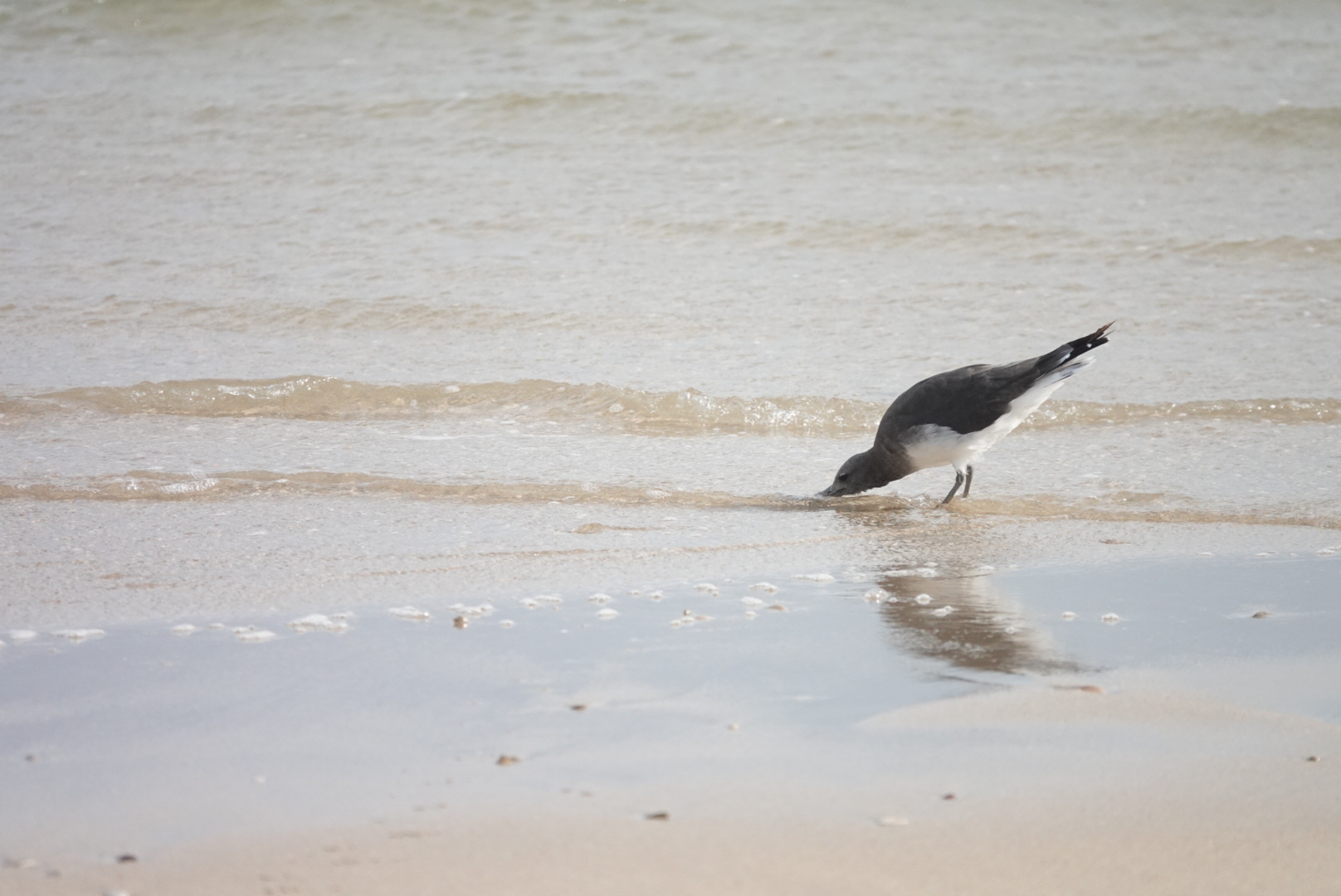
Relieved, I spent the next 10 minutes slowly approaching and photographing the gull as I went, until I was 10 to 15 metres away and felt that I was close enough, not wanting to spook the bird, which seemed quite accepting of my slow approach, only once lifting into the air for a few seconds before carrying on with its foraging.
When seen with a Kelp Gull, the size and plumage differences are obvious
A closer view shows the red tip to the bill and the dark grey colouring which gave it the name “Sooty”
Sooty Gull, briefly in flight
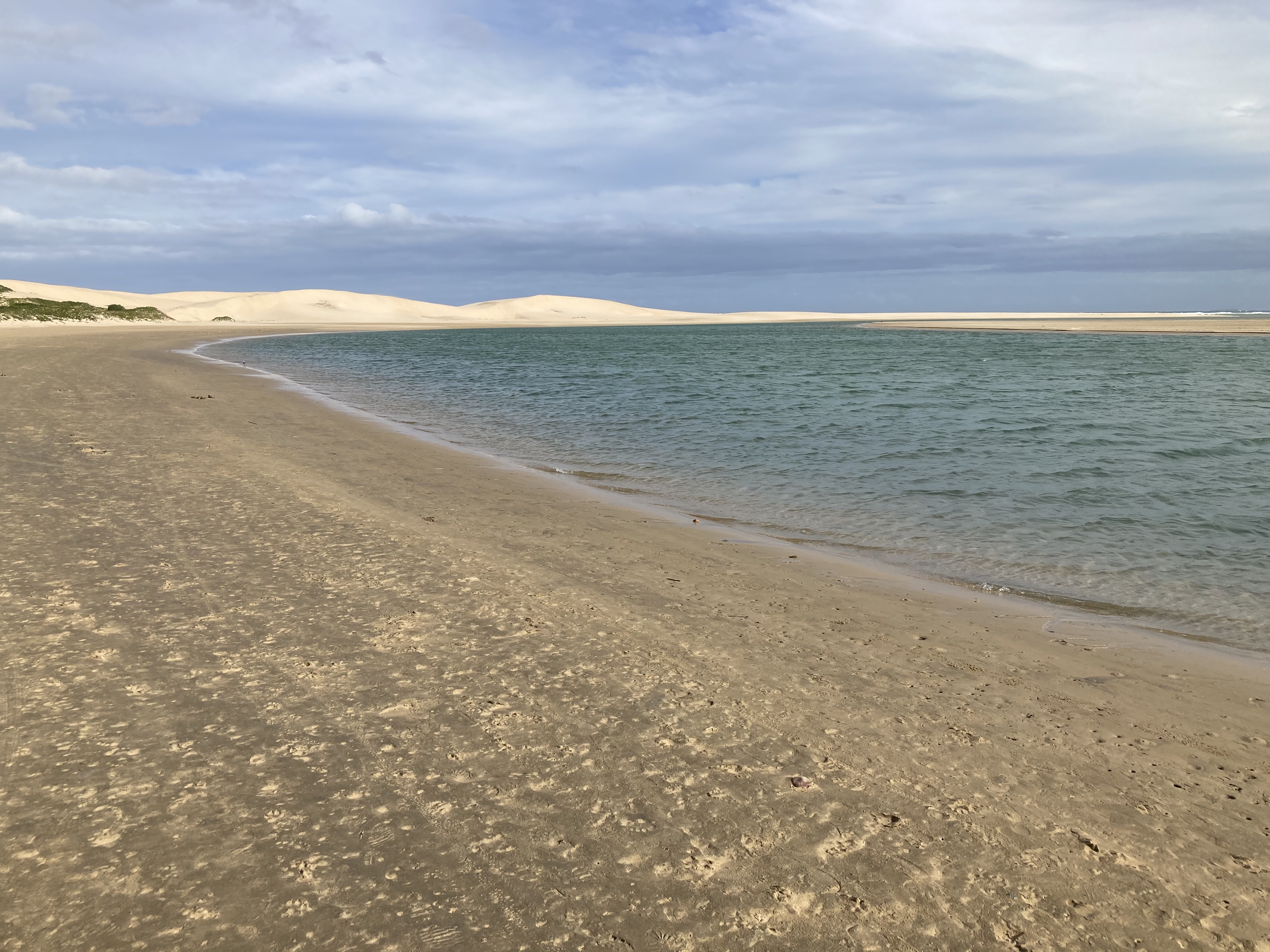
This is the location where the gull was hanging out
Most satisfied with how things had turned out, I returned as hastily as possible to the parked car and my patient wife, sweating from the exertion but happy about the outcome. The rest of the trip to Addo was uneventful, but slow on the poor, bumpy and narrow roads and we were glad to arrive safely and in time before the gates closed, book in and find our chalet. Accompanied by a typical bush sunset, we could relax and savour a glass of red wine and the new lifer in beautiful surroundings.
What a challenge birding can be sometimes, yet what joy and satisfaction it brings.
How to find out about rarities
Just a footnote on news of Rarities in Southern Africa – for up to date news of rarities I highly recommended that you subscribe (at no cost) to the SA Rare Bird News by simply sending an email to hardaker@mweb.co.za and asking to be added to the subscriber list












 Mostly Birding