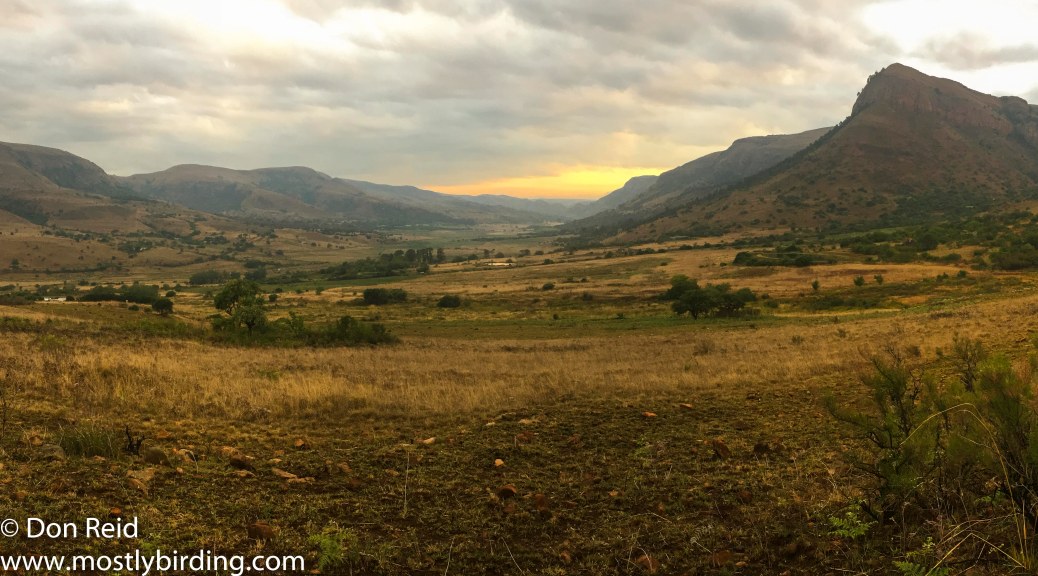
My Atlasing Month – March 2020 (Part 1 )

Continuing the monthly look at where Atlasing, or Birdmapping as it is also known, took me in March 2020 …..

Another busy atlasing month during which planned – and unplanned – trips saw us travelling across South Africa, initially to Mpumulanga province for a midweek breakaway, followed not long after by a lengthy trip through Gauteng, Free State and Western Cape provinces on our way from Pretoria to Cape Town and then eastwards to eventual lockdown in Mossel Bay, a trip of some 1850 kms spread over 4 days.

Verlorenkloof – 2 to 6 March

Expiring timeshare points were put to good use with a last-minute midweek booking at Verlorenkloof, between Macahadadorp and Lydenburg, our favourite resort which we have been visiting since 2004. Over the years we have got to know the resort intimately, which helps when it comes to birding and atlasing, as you tend to know what to expect before actually seeing it.

Pentad 2525_3015

The pentad covers the resort, adjoining farmland, trout fishing dams, a river that meanders through the lower part of the resort and grasslands. Habitats are varied, as covered in some detail in previous posts such as https://mostlybirding.com/2016/05/04/verlorenkloof-birding/ and are centered around the croft, which for this break was No 6.

Grasslands, Verlorenkloof

Birding began, as usual, in the vicinity of the spacious croft with species coming and going while we enjoyed the ambience of the patio with good friends Koos and Rianda, bathed in just enough sunlight to keep the late summer temperatures at a comfortable level. The comers and goers included African Paradise and Spotted Flycatchers, Red-winged Starlings in abundance, a lone Grey Cuckooshrike – too quick for a photo – and in the evening a Fiery-necked Nightjar.
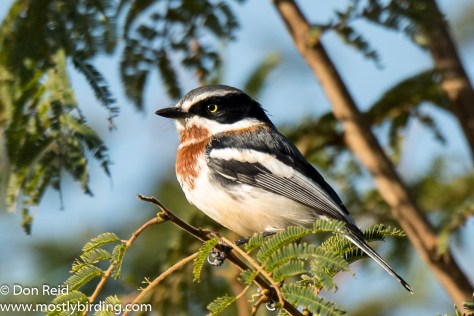
Chinspot Batis, Verlorenkloof

The Fiery-necked Nightjar displayed an uncanny sense of time, starting to call at the same time, give or take a couple of minutes, for 4 evenings in a row, usually just after we had started our braai fire. Perhaps it was the flames of the fire that inspired it – being a Fiery-necked Nightjar after all!

The birding highlight of our stay, initially spotted by Koos, was the colony of Cape Vultures which appeared late on the first afternoon high up against the escarpment, cruising slowly and effortlessly in a long lazy loop, utilising the warm updraft to good effect before settling on projecting ledges.

I took this photo at a distance of possibly a kilometre, using my spotting scope at its maximum 60 x zoom and holding my iphone over the viewing lens. The resulting photo needed some editing and manipulation but gives a reasonable idea of the craggy mountain top and the roosting vultures (those whitish blobs)
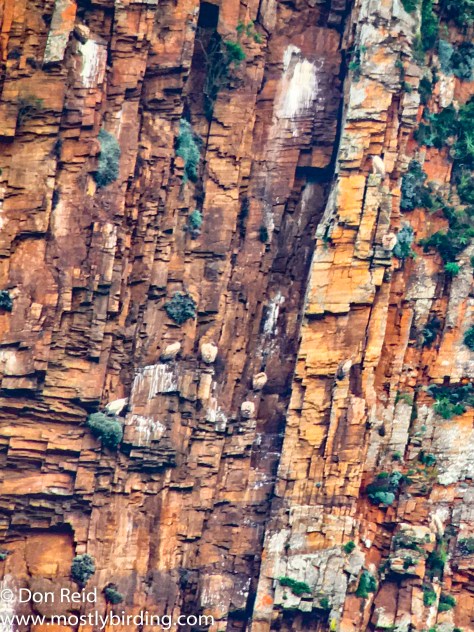
Cape Vulture roost, Verlorenkloof

With the help of the spotting scope we were able to estimate the colony at some 60 individuals, so it is clearly a significant colony of this endangered species. During previous visits we have spotted Cape Vultures in flight on a couple of occasions, but never in these numbers and never roosting within view, so we came to the conclusion that this was a newly formed colony.

Our late afternoon walks and short drives to the reception building for coffee were opportunities to bird the woodland and grassland, the latter producing regular sightings of Broad-tailed Warbler, a scarce and desirable species for many a birder. When logging the species on Birdlasser I found that it had undergone a name change, now being known as Fan-tailed Grassbird.
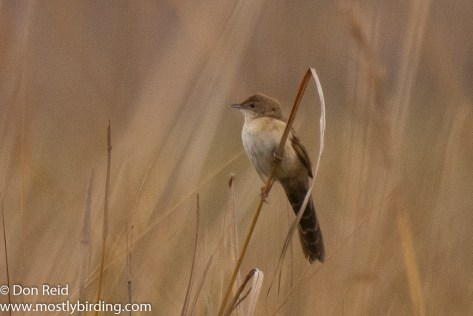
Fan-tailed Grassbird (Schoenicola brevirostris)

Other species included Lazy Cisticola and Croaking Cisticola which, true to its name, sounds like a frog with laryngitis. Tall reeds held tens of Widowbirds – Red-collared, Fan-tailed and White-winged – and Bishops – Red and Yellow-crowned.
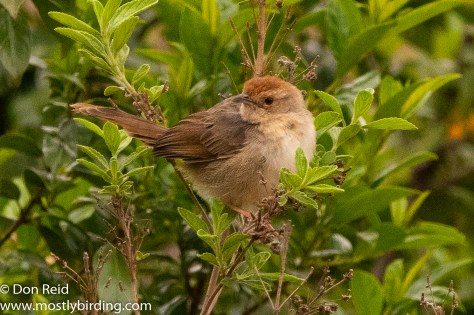
Lazy Cisticola (Cisticola aberrans / Luitinktinkie), Verlorenkloof

The fishing dams (it’s a trout fishing resort as well) were fairly barren at first but with some patience we found Yellow-billed Duck, Moorhen and Little Grebe.
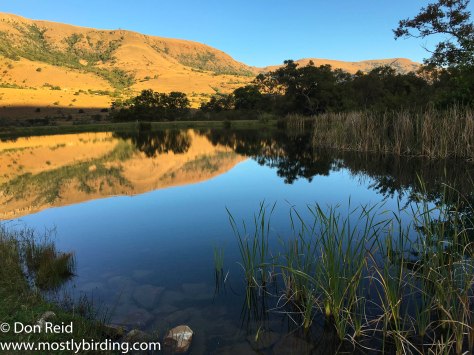
One of the dams

Aerially, it was as busy as always with Rock Martins, White-rumped Swifts and Greater Striped Swallows never far from view around the croft. Further afield, Barn Swallows, White-throated, Lesser-striped, Pearl-breasted (8%) and Grey-rumped Swalows patrolled their preferred patch, ever searching for the next feed.

The gravel access roads to and from the resort are best for the bush and tree species with the likes of Southern Black Flycatcher, Brubru (5%), Yellow-fronted Canaries, Mousebirds and others.

Southern Black Flycatcher, Verlorenkloof

One lazy afternoon a family group of Red-necked Spurfowl weaved through the longer grass around the croft, affording glimpses of their main features.
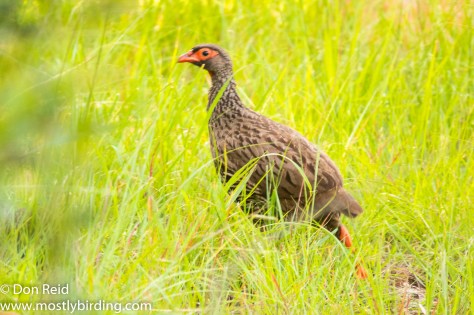
Red-necked Spurfowl (Pternistis afer / Rooikeelfisant) (Race castaneiventer), Verlorenkloof

Koos and I dedicated one morning to atlasing the northern reaches of the pentad on the way to another pentad further afield – another 19 species were added in about two hours of frequent stops, with highlights being Willow Warbler, the tiny Orange-breasted Waxbills that move around in flocks, Dusky Indigobird (4%), Giant Kingfisher, a calling Red-winged Francolin – too furtive to spot and Yellow-crowned Bishop. All very pleasing additions to my already advanced list.
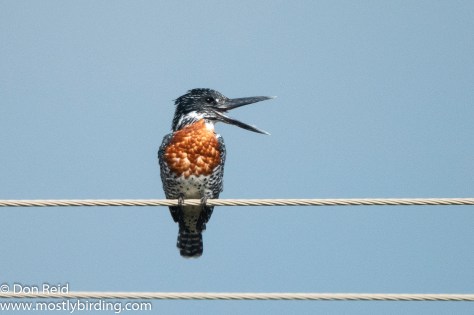
Giant Kingfisher (Megaceryle maxima / Reusevisvanger) Verlorenkloof

A handful of birds (if you have just 4 fingers) on our last morning on the way home took my total for the pentad to 97 including a lone Amur Falcon (7%) – not my highest 5 day total for this pentad but quite satisfying for late summer when many of the migrants have either left or are not calling.

This was my 16th atlas card for the pentad and took my personal total for the pentad to 191 species (out of a total for all atlasers of 292 species), which illustrates the amazing diversity of bird life in the area, bearing in mind a pentad covers around 8 x 8 kms of the planet.

The Other Stuff

Verlorenkloof is not just about birding, being a botanist’s delight as well as a haven for many other of nature’s treasures – here’s a selection of photos which touch on the variety of flora and fauna to be found –

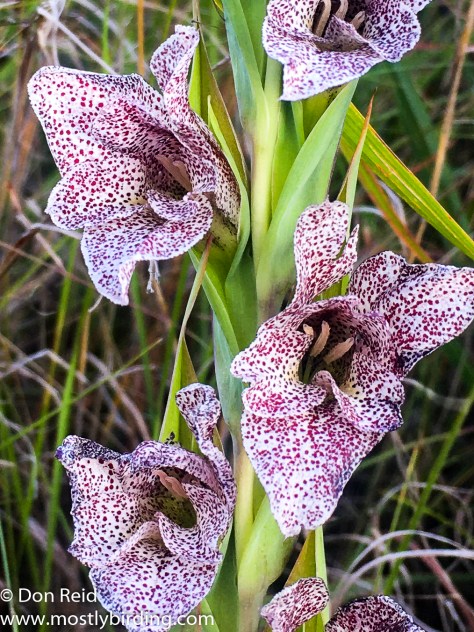
This beauty I would guess is a type of wild Iris of sorts


Just look at this delicate flower, found in long grass near one of the paths
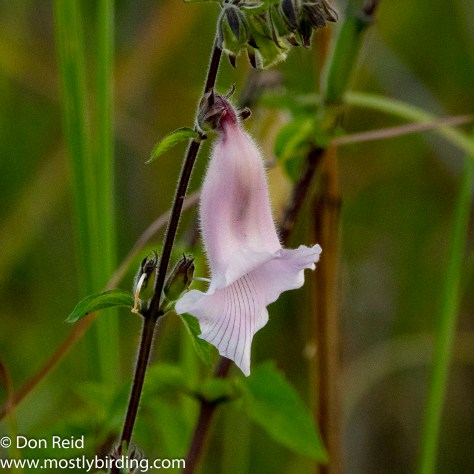
Wild flower, Verlorenkloof

Even an ordinary moth looks delicate and special
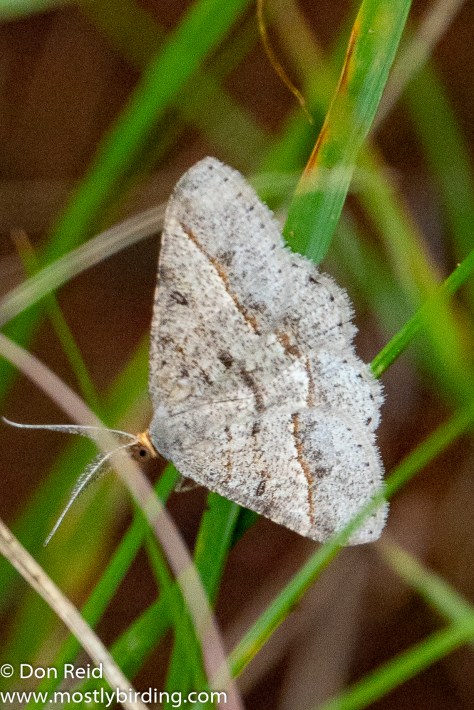
Moth, Verlorenkloof

Kiepersol trees are plentiful

Kiepersol, Verlorenkloof

Verlorenkloof has wild life too – but don’t expect a Big 5 experience
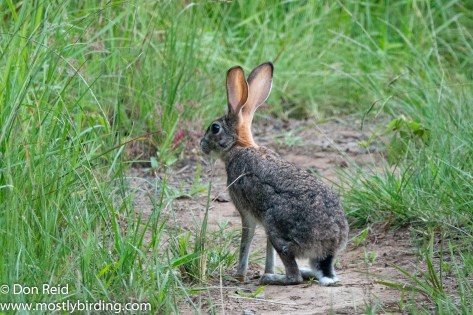
Scrub Hare (Lexus saxatillis), Verlorenkloof

Even a reptile or two – this one brought home to me once again just how well wild life can blend into its environment – a raptor would have great difficulty seeing this reptile from above as it matches the colours of the rock to a tee

Rock Agama (I beieve) Verlorenkloof
Rock Agama, Verlorenkloof

And to finish, here’s another example of a spotting scope / iphone combination to take a photo of a three-quarter moon
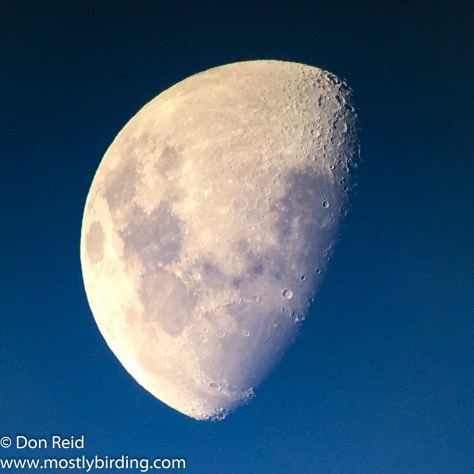
Verlorenkloof

Footnote : Where I show percentages in brackets, these refer to the relative scarcity of the species according to the pentad surveys completed to date over the ten years that the project has been running. So if 100 pentad surveys have been done to date and a species has been recorded 5 times by the observers, it will be shown as 5%. Notable species in my book are those with a % of less than 10%
Fun in the Forest – Fungi, Frogs and Fangs

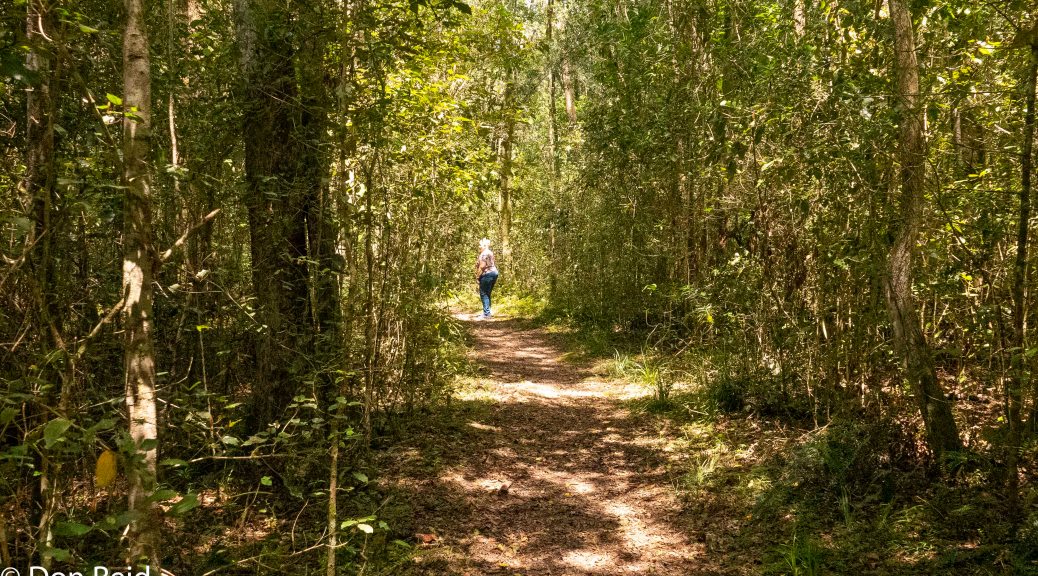
You would think that a walk in the forest, with the intent to do some casual birding, would be a safe, relaxing pursuit …. despite having grown up with fairy tales such as Little Red Riding Hood and the like where all kinds of monsters lurked among the trees. Well, that’s what I thought when we went on a day trip in January this year to the Woodville “Big Tree”, near Hoekwil in the southern Cape and I persuaded Gerda to walk the trail through the pristine forest that surrounds the Tree.

Alert readers (that’s all of you, I’m sure) may remember my story of the ghostly dove in this same forest -(https://mostlybirding.com/2018/02/06/into-the-wilderness-a-forest-a-big-tree-and-a-ghostly-dove/) – I was expecting a similar experience of secretive birds with soft calls, but as it turned out, the birds were scarce. And yet there were plenty of other interesting, even exciting things that had us stopping frequently along the trail ……

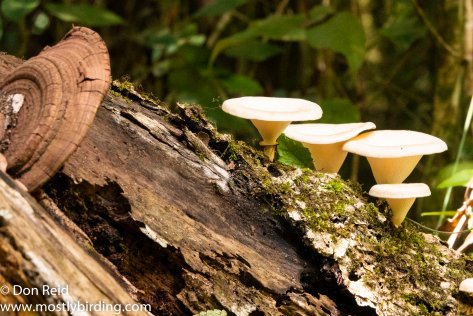
Fungi

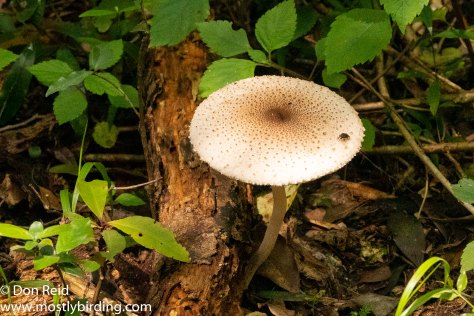
The forest holds a remarkable variety of fungi of different shapes and colours, some of which I photographed – unfortunately I have no idea of their names as this is one part of nature that I have no expertise in at all (and I don’t own a field guide). Nevertheless I was fascinated by their variety

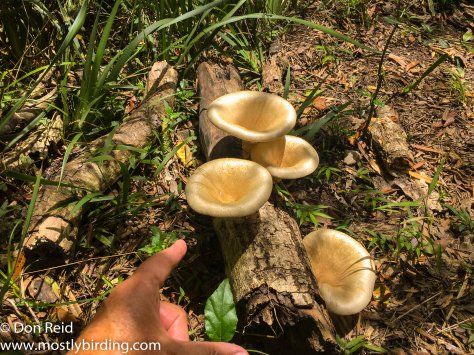
Here are two in one photo – the whitish ones shaped like funnels and the large flat brown one to the left of the photo.

Another photo of the whitish funnel shaped fungi, this time with my hand included to give an idea of size

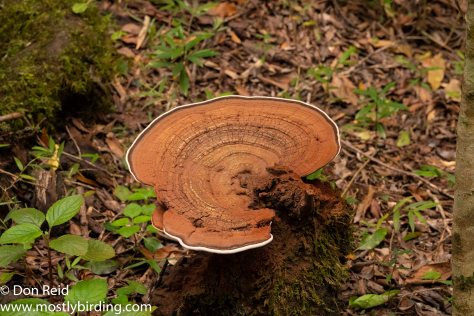
Another example of a large disc shaped fungus – about the size of a large dinner plate

And lastly this delicate umbrella shaped fungus – it has the appearance of the mushrooms we eat, but this one could easily be of the poisonous variety. It was about the size of a large mug

Frogs

Well, frog singular, actually – it leapt into the undergrowth as we approached and I was just able to get a partly concealed photo as it did its best to remain hidden from view. I am hesitant to put a name to it (but we can call it Freddie the Frog if you like) as my frogs reference book is under lockdown in Pretoria while we are likewise under lockdown, but in Mossel Bay. However an App that I downloaded points to it being a Raucous Toad (Sclerophrys rangeri) based on colour, markings and distribution

(Possible) Raucous Toad

Fangs

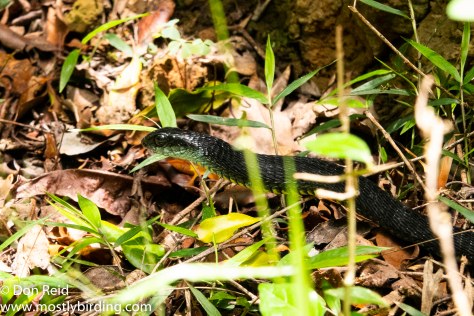
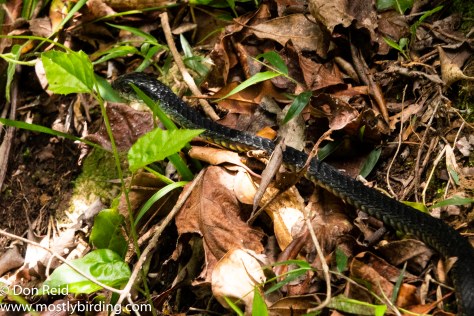
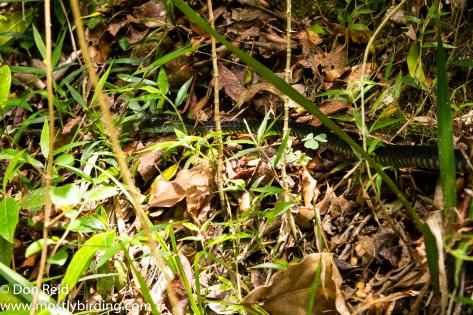
The major excitement of the day was provided by none other than a dark green, almost black, snake that slithered across the track a few metres in front of us. It was a Boomslang – known to be docile rather than aggressive – but scary nonetheless. It was around 1,5m long and I was happy to grab a photo or two from what I felt was a safe position on the opposite side of the track to where it was weaving its way through the leafy green undergrowth. After a couple of heart-pumping minutes trying to follow its progress, it disappeared from view and we continued on our way along the forest path, now a tad more alert for any movement around us.

Feathered friends

Birds were scarce, other than in the vicinity of the Big Tree itself and, as expected in forest habitat, it was all about the calls – as we commenced the walk, there were some calls that I could not immediately identify, but I eventually decided it had to be Olive Bushshrikes, which have a variety of calls.

On the other hand, the shrill “Willie” calls of Sombre Greenbuls were more obvious, their calls following us all the way along the walk. Black-headed Oriole and Terrestial Brownbul each called once during our walk and the cry of a distant African Fish-Eagle confirmed its presence – probably at a dam beyond the forest perimeter. On the way out, at last, a Cape Batis hopping about in the branches actually showed itself, making our day in the forest just a little more pleasurable.

Flora

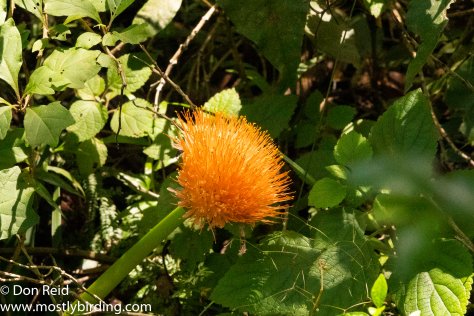
And for good measure (and the chance for one more alliterative heading) this flower caught my eye – I believe its name is Scadoxus puniceus, commonly known as the paintbrush lily

Which all goes to show that birding just has to be the best pastime – you never know what is around the next corner.

I hope that the current lockdown period finds you in a safe and comfortable place …….

Marievale – An Unexpected Sighting

In my most recent post ( https://mostlybirding.com/2020/03/31/my-atlasing-month-february-2020-part-three/) I mentioned my encounter with an unusual mammal while atlasing / birding at Marievale Bird Sanctuary, but thought I would dedicate a special post to this most exciting sighting. If you have seen an Otter close up in the wild before, read no further – for those that have not ….. well, read on.

Marievale Bird Sanctuary

Just as a reminder, Marievale, with its extensive, shallow open waters and wetlands, reed beds and surrounding grasslands, is well known among birding enthusiasts as a place where you are pretty much guaranteed to see an excellent variety of waterfowl, wetland and grassland species in a morning’s birding.

I was atlasing (bird-mapping) along the “power line road” – a maintenance track below the main overhead power lines that run through a section of the wetlands. The track is narrow and lined with reeds in places, affording views of the ponds and small lakes, most of which have abundant bird life. After heavy rains the track becomes inundated and impassable, but at most times of the year it is drive-able as long as your vehicle has reasonably high clearance and you don’t mind the potential light scratches that may be caused as you squeeze your vehicle between the reeds and vegetation on both sides.

Once committed to the track, the only places to turn around are where the track has been widened at each of the pylons and I used one such spot for a coffee break, after which I headed back along the track toward the paved main access road. Still alert for any new bird species to record for atlasing purposes, I was passing a smaller pond when I noticed movement in the water and a glimpse of a dark shiny body. Dismissing it as a fish I was about to proceed when suddenly a small head popped up out of the water and looked at me – I knew immediately what it was and let out a gasp of excitement – an Otter!

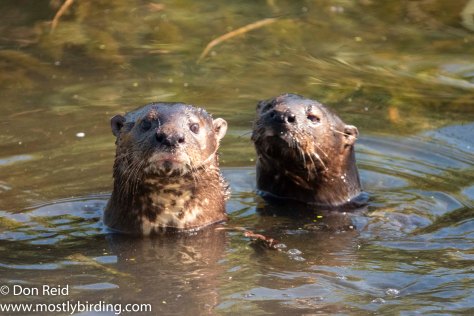
As I watched, I saw that there was more than one otter, but they surfaced for just a second or two then dived below the surface, disappeared for a half minute, then popped up again in a different part of the pond. I got out of the car and carefully crept around the back to where I could watch their antics and hopefully get a photo or two. This game of cat and mouse – or man and otter – went on for a good ten minutes or more as one or both otters popped up to look at me curiously then slithered off below the surface only to pop up metres away, with me trying to anticipate where they would appear.

My only previous sighting of an otter was a distant one many years ago, while birding a farming area not far from Marievale, so this was for me a very unexpected and special moment.

Initially when I wrote this post I identified the otter as a Cape Clawless Otter, but was prompted by a comment (see below) to research a bit further and came to the conclusion that this was the much smaller Spotted-necked Otter. Wikipedia provides the following info :

The spotted-necked otter (Hydrictis maculicollis), or speckle-throated otter, is an otter native to sub-Saharan Africa.

The spotted-necked otter is a relatively small species, with males measuring 71 to 76 cm (28 to 30 in) from nose to rump, and weighing 5.7 to 6.5 kg (13 to 14 lb), while females are 57 to 61 cm (22 to 24 in) and 3.0 to 4.7 kg (6.6 to 10.4 lb). The tail is long and muscular, measuring 39 to 44 cm (15 to 17 in) in both sexes. Like many other otters, it is sleek and has webbed paws for swimming.

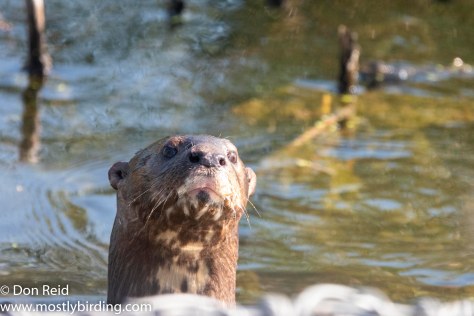
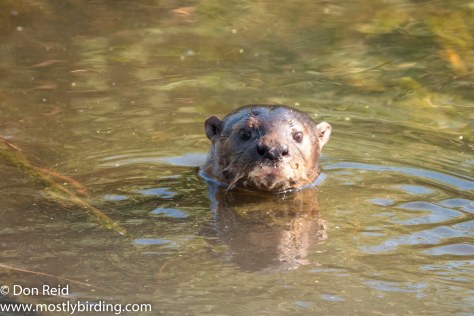
Although considerable variation exists among individuals, their fur is usually reddish to chocolate brown and marked with creamy or white blotches over the chest and throat. The head is broad with a short muzzle, small rounded ears, and a hairless nose pad. The teeth are adapted for consuming fish, with large sharp upper canine teeth, curved lower canines, and sharp carnassial teeth.

Below is a selection of the photos I was able to take of this endearing animal.

Spotted-necked Otter (Hydrictis maculicollis),, Marievale Bird Sanctuary