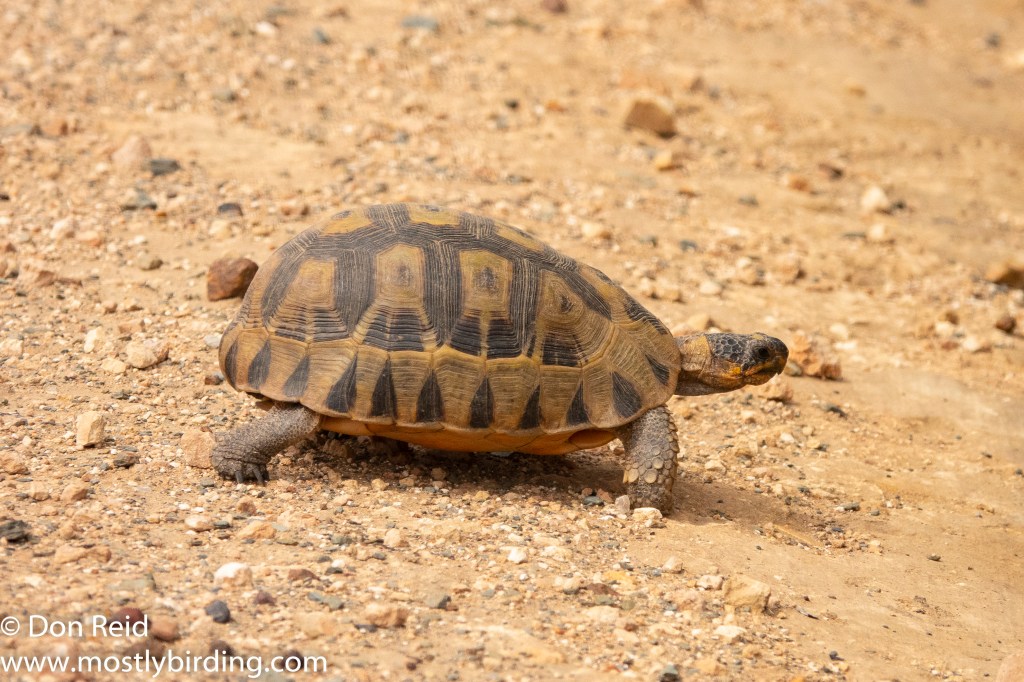
My name is Shelldon and I’m a tortoise who loves travelling – slowly, it has to be said, but I get there in the end.
This past holiday season I managed to get to a few places, mostly in the Western Cape – funny thing though, I kept bumping into an older human who seemed to be following me around, but I guess that was just a coincidence. I knew it was the same person because of the binoculars he had around his neck every time – I mean, who walks around with binos hanging from his neck all day?
Anyway here are a few of my holiday photos ……
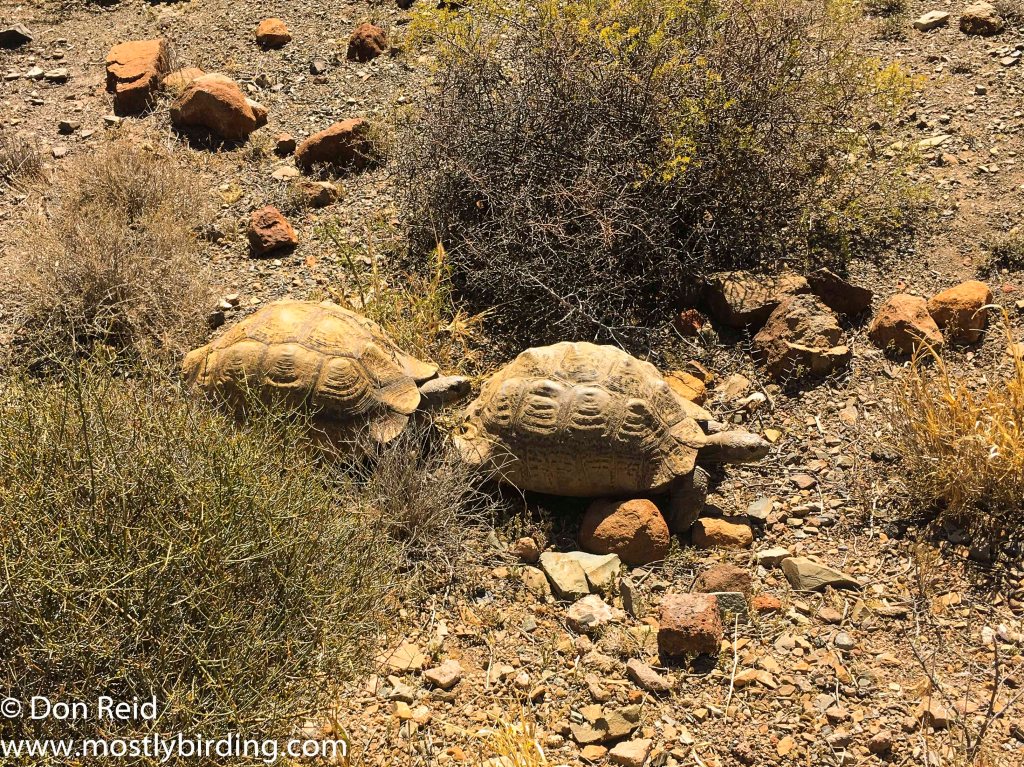
Here I am in Karoo National Park, on my way to have nap. Not sure who this is following me ……
Karoo National Park
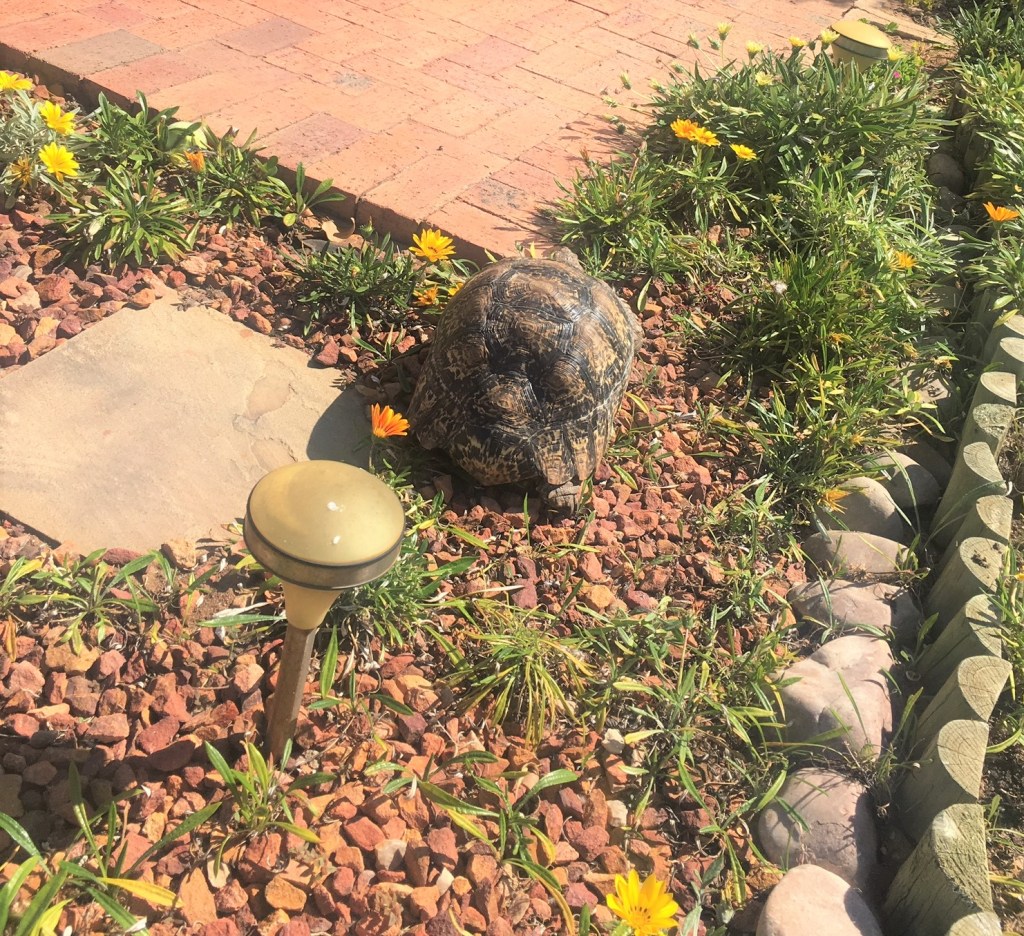
I made it to Mossel Bay after a long trip and was pleased to find a tasty and colourful lunch laid on – very considerate of these humans to plant such delicious fare
Mossel Bay
I found my way to Gamka Eco-Estate near Calitzdorp and took a late afternoon walk alongside the river, albeit dry at that time
Calitzdorp
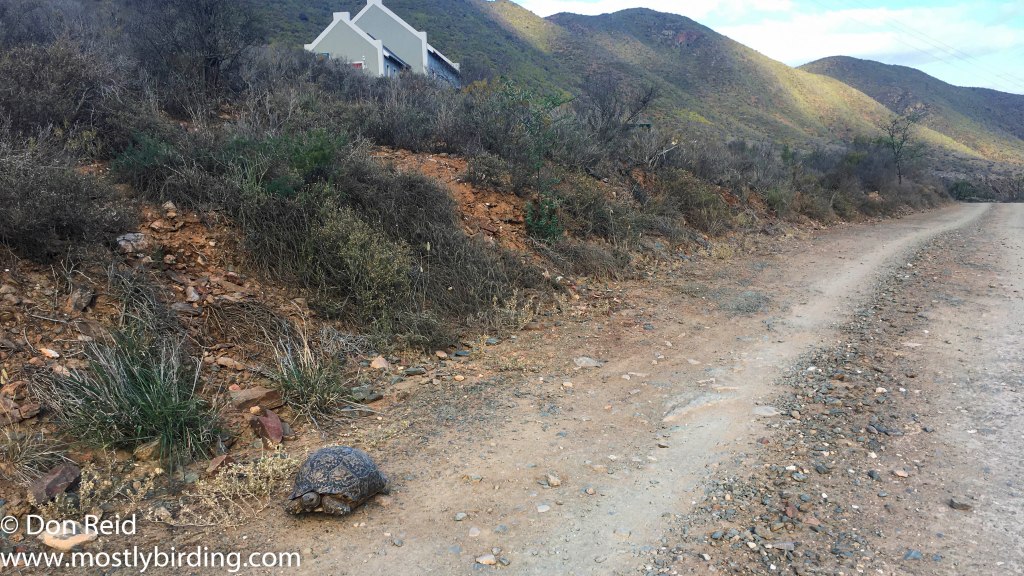
And here I am west of Mossel Bay, just pottering about at the side of the road
Mossel Bay west
Same spot and there’s the car of that older human with the binos that I mentioned earlier – guess he was looking for something as he wandered around for a while aiming his binos at goodness knows what. I mean what could be more interesting than a lively tortoise?
It was going to be just another late afternoon swim at Santos beach, a favourite in Mossel Bay for the visitors that stream into the town over the holiday season, stretching its resources to the limit. Late afternoon is usually when the crowds have thinned out, the sun is less fierce and you can actually swim without bumping into others.
By the time we got to the beach on this particular afternoon, it was cloudy with a cool breeze and a light spatter of rain – driving there, the usual comments of “it’s raining, we are going to get wet” were being bandied about, raising a few chuckles. It all worked in our favour as, by the time we had parked and walked across the cool sand to deposit our towels and gear near the water, there was but a handful of people in the water and we joined them eagerly.
The sea was calm, quite chilly, but we were soon in and enjoying the refreshing conditions, not expecting the natural extravaganza that was to unfold before us.
I noticed some terns gathering further out and plunge diving, so I guessed that there were fish around. Soon a few gulls joined the terns, settling on the sea in the same spot. Then we saw dark forms in the water quite close to where we were swimming, the forms changing shape as we watched, moving about like black ghosts.
Kelp Gull
Suddenly, a large, black, shiny seal surfaced nearby, causing a missed heartbeat or two….. it’s well known that these waters are favoured by large sharks which have a predeliction for these meaty creatures. We watched it move about nearby, then swim into deeper waters, half expecting a shark to rise out of the water and grab it with mighty jaws.
There was clearly food available for predators and seabirds alike – the numbers of terns and gulls was increasing by the minute, literally as we watched from our waist-deep position in the water. Moving closer to shore, until we felt a tad safer, we watched enthralled as the bird numbers grew further. Terns were plunge diving less than 10 metres from us and when the dark shapes we had seen earlier rose to the surface and magically turned into a mass of tiny silver fish, the terns took it in turn to fly in, dip down gracefully to scoop a fish or two, then fly off and let the next bird in line repeat the process.
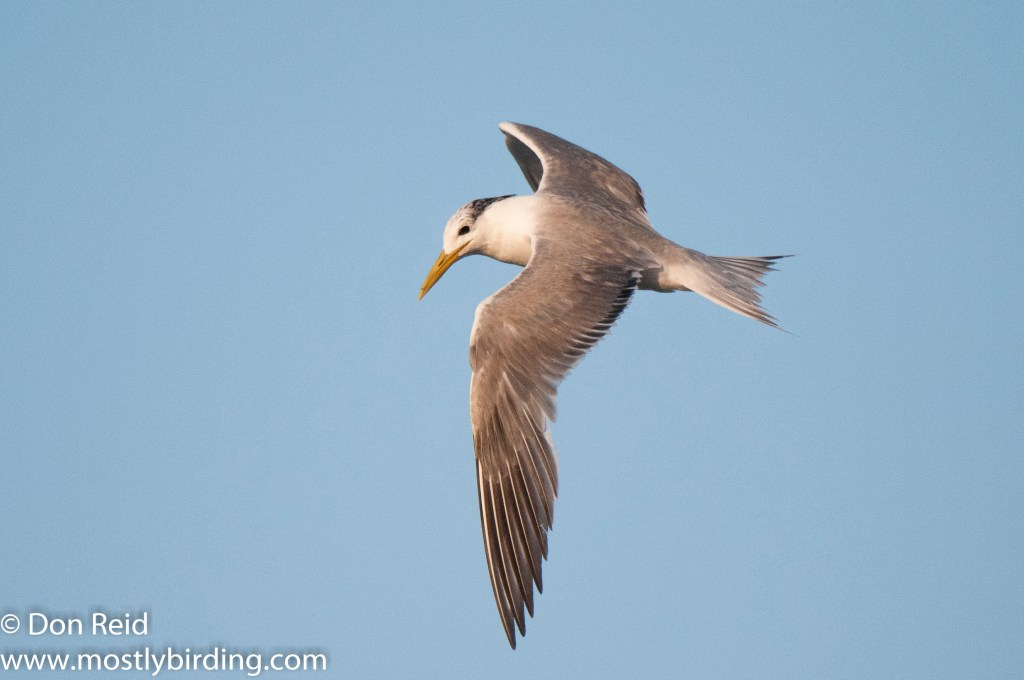
Swift Tern (Thalasseus Bergii)
The Swift (Greater Crested) Terns were so adept at this that many emerged with 3 or 4 of the fish held sideways in their bills – much like the famous Puffin images that one sees. A fisherman informed us that the fish were anchovies – something was causing them to rise to the surface, creating a brief maelstrom of silver bodies and turning the surface of the sea into a frothy jumble. The terns were queueing up to take part in the bonanza, like tiny planes coming in to land on an aircraft carrier.
Swift Tern (Thalasseus Bergii)
By now the shoals of anchovies were so close to shore that some were being caught by the small waves and washed up onto the sand, where they were left in tiny desparation until kids came to scoop them up and throw them back in the water – their lucky day, except if they were taken in the seabird feeding frenzy of course.
As we slowly left the water, picked up our belongings and headed to where the car was parked, there were perhaps a couple of hundred seabirds filling the sky above the sea. More proof, if needed at all, that amazing experiences happen when least expected – this one will remain with me for ever.
Footnote : I did not have my camera with me, something which I initially regretted as I could have taken some memorable shots, but thinking about it I decided it was for the best – not everything has to be recorded digitally – that’s why we have a brain…
Atlasing, or Birdmapping as it is also known, is the mapping of distribution and relative abundance of birds in a given area, using data gathered by a group of several hundred volunteer “citizen scientists” across southern Africa. Volunteers select a geographical “pentad” (roughly 8 x 8 km and based on co-ordinates) on a map and record all the bird species seen within a set time frame. This information is uploaded to the database managed under the Southern African Bird Atlas Project (SABAP2) and is used for research and analysis. I have been a volunteer Citizen Scientist since 2010.
That’s the formal description of what takes up most of my birding time nowadays and I thought it is time that I included more of my atlasing activities in this blog. I have previously made the mistake of being over-optimistic about the frequency of posting on a particular subject, so I won’t fall into that trap – the title of this post may provide a clue to my intentions but let’s see how it goes….
So, let’s have a look at where atlasing took me in the first month of 2020…
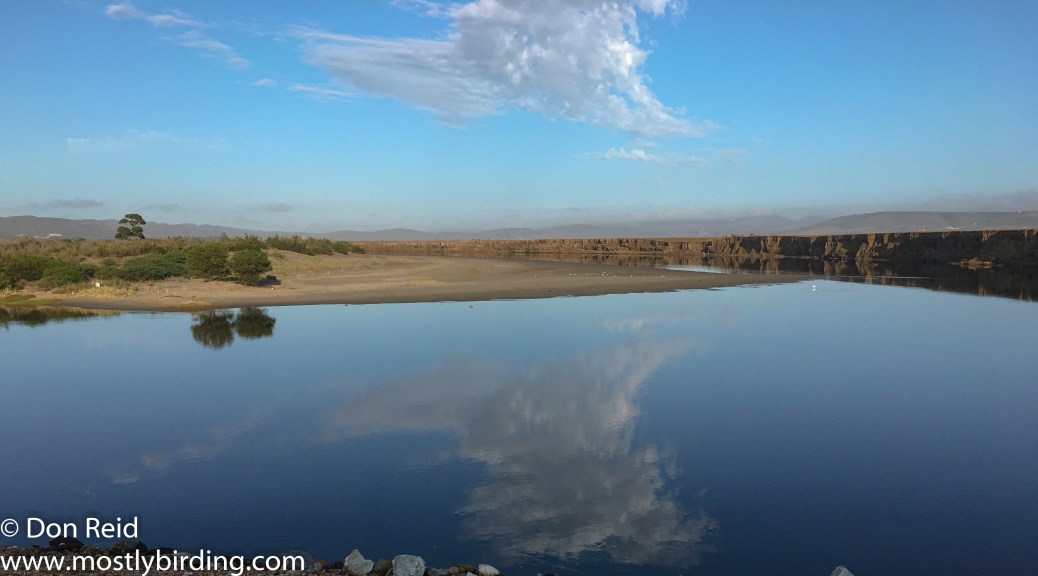
Klein Brak River
Klein Brak River is a small village close to Mossel Bay in the Southern Cape and was my choice for my first formal atlasing outing for the year on 8th January, given the luxury of having an open pallete of pentads not yet atlased in 2020 to choose from. The pentad includes the village, the road to Botlierskop game farm and the Geelbeksvlei road, all of which had provided good birding in the past.
Starting in Klein Brak village at 6 am, my list grew rapidly in cool conditions, ideal for both bird and man (armed with binos). I drove through the residential area checking out the gardens and ended up at a wide section of the river which gives the town its name – there I set up my scope and scanned the river. Birds were not plentiful but those that were visible were interesting waders and waterbirds with Cape Teal, Common Greenshank, Common Ringed Plover, Little Egret and a Grey Plover that, for a while, had me hallucinating about Golden Plovers until I came to my senses.
Grey Plover / Pluvialis squatarola / Grysstrandkiewiet, Klein Brak River
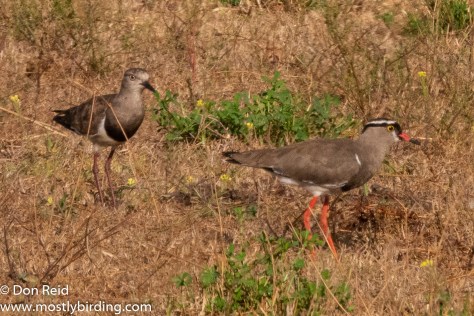
A Pied Kingfisher was active over the water and his Brown-Hooded land-based cousin could be heard nearby in a garden. Moving on, I left the village behind and passed through cultivated farmland, where a short grassed area held both Crowned and Black-winged Lapwings moving about together. Both are Vanellus species and share looks and habits, seeming to enjoy each other’s company.
Lapwings – Black-winged and Crowned, Klein Brak RiverAfrican Stonechat / Saxicola torquatus / Gewone bontrokkie (Juvenile), Klein Brak River
The road led to the Gannabos road where I turned right towards Botlierskop and spent some time stopping at every shady tree (it was heading over 30 degrees C) to explore the surroundings and the bush, as this stretch has proven to be good for forest birds. Olive Bushshrike and Paradise Flycatcher obliged by calling first then showing themselves fleetingly, Common Waxbills twittered in the roadside bush and even an African Fish-Eagle called from somewhere close by.
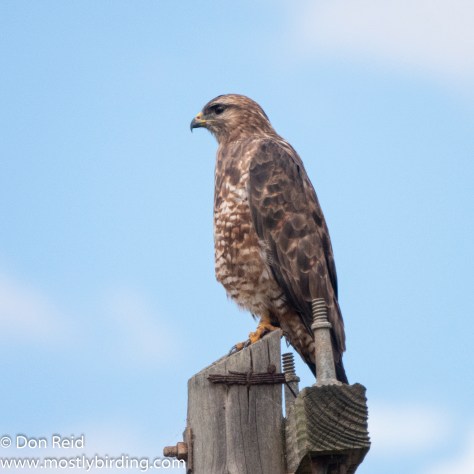
The road to Botlierskop – welcoming shady spots to stop and birdCommon Buzzard / Buteo buteo / Bruinjakkalsvoël, Klein Brak River
At the Botlierskop farm dams I found a lone Spoonbill and several White-faced Ducks and heading back a handsome Jackal Buzzard watched me pass by. The Geelbeksvlei road was fairly quiet except for a popular fishing spot where I used the scope to ID a Little Stint and Kittlitz’s Plover, while a Yellow-billed Kite did its low-flying thing overhead. taking my total to a pleasing 67 species for the pentad.
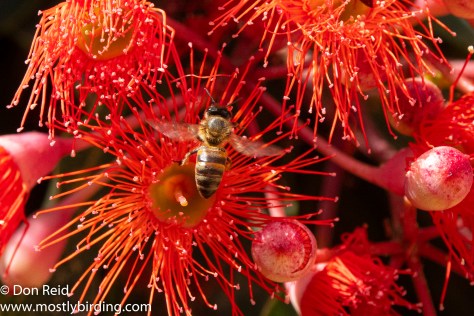
Bee on red flower, Klein Brak RiverFiscal Flycatcher / Sigelus silens / Fiskaalvlieëvanger, Klein Brak River
Gouritsmond Area
When I checked my pentad map, I noted that I had never atlased the pentad west of the town of Gouritsmond at the mouth of the Gourits River, so it became my main target for the day.
Gouritsmond lies south-west of Mossel Bay and I set off early on the 24th January – the journey was slowed by several “not to be missed” birding and photo opportunities along the road, including –
ponds alongside the road formed by recent rains – my first stop to view one was opposite the PetroSA refinery plant and attracted a grave looking official who stopped behind me, got out and walked to my car to enquire as to what I was doing while checking what I had in the car, and “did I know PetroSA is a National Key Point so no photography is allowed”. I responded that I was observing the birds and he looked me over and walked off again, presumably happy that my profile was not that of a threat to the National Key Point. Many Gulls and Sacred Ibises were present and a Little Stint was pottering about amongst them.
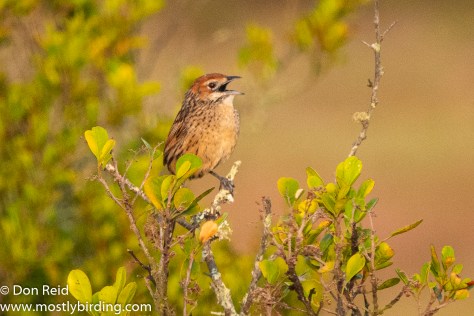
.Cape Grassbird on top of a roadside bush, singing away near a small pond before the Vleesbaai turnoff.
Once I entered Gouritsmond I drove along the Beach road to the start of pentad 3420_2145 and followed the coastal road, bounded on the one side by wide stretches of rugged rocks, lapped by the green ocean beyond, and on the other side by coastal bush and grassed fields.
Scene along the Beach Road west of Gouritsmond
Seabirds were few – Kelp Gull, African Black Oystercatcher and Ruddy Turnstone (just visible through the scope), the balance were birds of the bush, fields and sky. It was slow going and with the minimum 2 hours done and no prospect of adding many more to my modest total of 32 species, I proceeded back to the town to pentad 3420_2150 and commenced atlasing once again.
Scene along the Beach Road west of Gouritsmond
I made a good start along the coastal road with similar species to the first pentad, them made my way slowly through the town’s residential area and out to the waste water treatment works, which has been upgraded with neat ponds and easy viewing from the surounding fence. Numbers of waterbirds had made this their home and Cape Teal, Yellow-billed Duck and Egyptian Goose were all prominent.
My next and final stop was the boat launch site up river from the mouth and I set up the scope to scan the distant banks for waders, coming up with Whimbrel, White-fronted Plover, Ruff and Common Ringed Plover.
My last chance for atlasing out of Mossel Bay, before returning to Pretoria, came up on the 29th January and I targeted two pentads directly west of Mossel Bay, both never atlased by me before.
I started with pentad 3410_2155 which is bordered by PetroSA on the north side and stretches to the sea on the south side, although various private estates block access to the coastal area itself and I had not made any arrangements for such access so I was limited to the inland areas. I started along the N2 National road which runs east-west through the pentad and was predicably busy but has a wide tarred shoulder which allowed me to stop with relative safety.
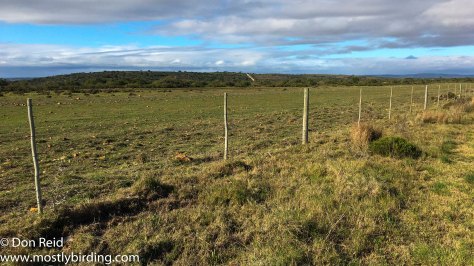
Mossel Bay west
After the recent good rains there was enough water in farm dams and shallow pans, especially on the south side of the N2, which had attracted a variety of waterbirds – Yellow-billed Duck, Red-billed Teal, Spurwinged Goose, Cape Shoveler and Little Grebe.
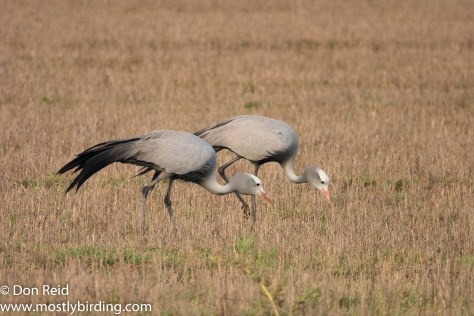
Shortly after, I turned south onto the Gouritsmond road, which had less traffic but the road is a narrow one with a gravel shoulder sloping off at an angle that makes it difficult to pull off comfortably, so I had to look for farm gate turn-offs to be able to stop safely. There was enough to see at each stop to keep my list growing and at one stop my attention was drawn to a pair of Blue Cranes walking in a grassy field and, for a change, close enough to the road to allow for some reasonable quality photography of these elegant birds.
Blue Cranes, Mossel Bay west
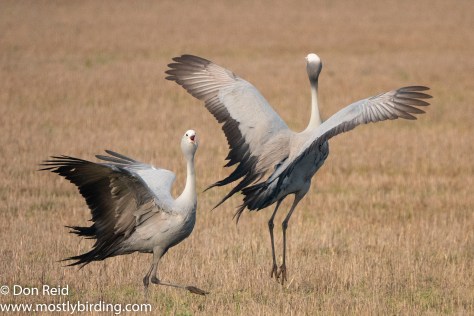
Suddenly they started a courtship dance that left me entranced but determined to record as much of it on my camera – it was so special that it deserves a separate post, suffice to say it was a birding highlight of our lengthy stay in Mossel Bay!
Blue Crane courtship dance, Mossel Bay west
Further on, where the road bends away to the west, I stopped to view a small pond and the surrounding bush and found a variety of birds such as Yellow Canary, White-throated Canary, Red Bishops and Levaillant’s Cisticola, Red-capped Lark in the road (as is their habit) was my 3rd Lark for the day, after Large-billed and Agulhas Long-billed.
Back on the N2, I proceeded further west to pentad 3410_2145, where I turned off at the first gravel road heading south – the road cuts through the pentad and reaches its southern bounday at the bone-dry Voelvlei, which last had water a number of years ago – when it does have water it is a spectacular birding spot but in times of drought is a rather depressing sight.
The route there proved to be less bird friendly with farmland and hills and I worked hard to get to a modest list of 26 without a single waterbird, but a trio of Denham’s Bustards flying over was an exciting highlight.
Denham’s Bustard
What makes birding/atlasing special is coming across other wild life in the process – these beetles were attracted to a flowering bush and caught my eye with their tan colouring –
Brown Monkey Beetle
All in all, a satisfying start to my atlasing for the year…..











 Mostly Birding