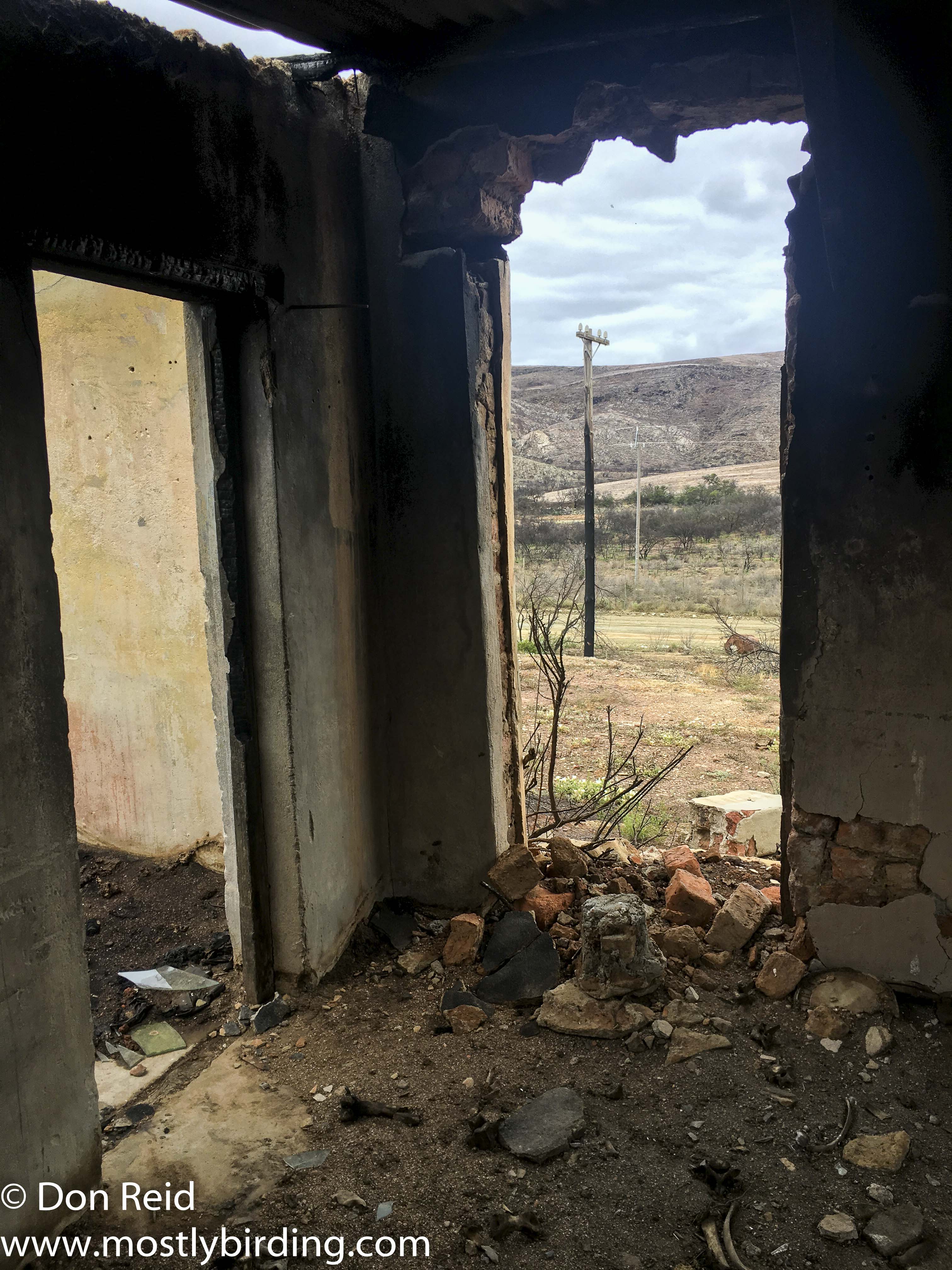
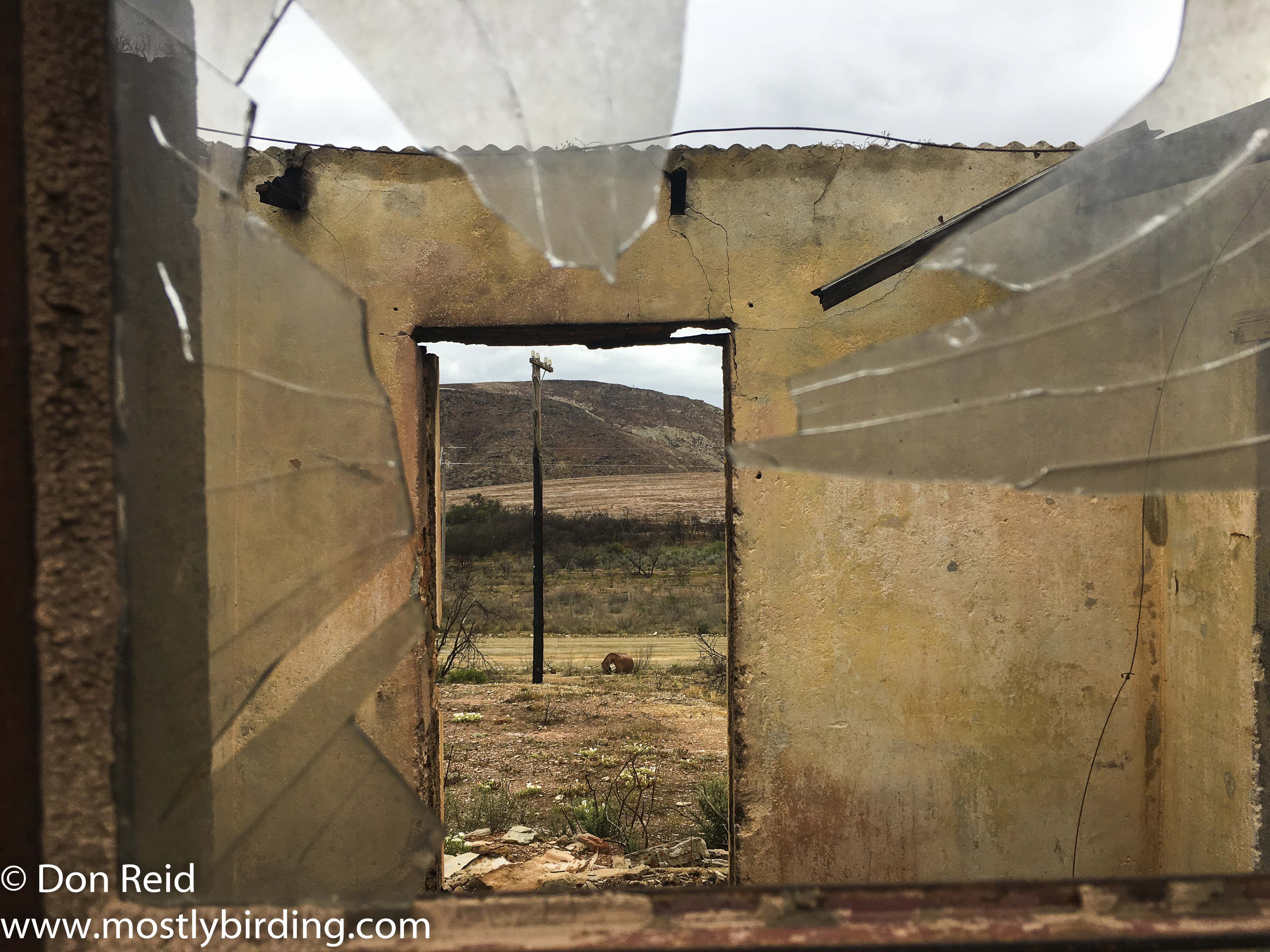
While atlasing along the back roads of the Little Karoo south of the small town of Van Wyksdorp, I was drawn to an abandoned house not far from the gravel road, all on its own and looking picturesque in the soft, filtered light of a cloud-covered sky.
I just could not resist taking a few photos with my iPhone and walked up the short slope to where the house stood, picking my way through low bushes and across the stony ground.
All went well as I carefully made my way around the old house, choosing my angles while stepping around the rubble, bent wire and various other remnants of a once simple but proud home, which was probably occupied by workers on a nearby farm.
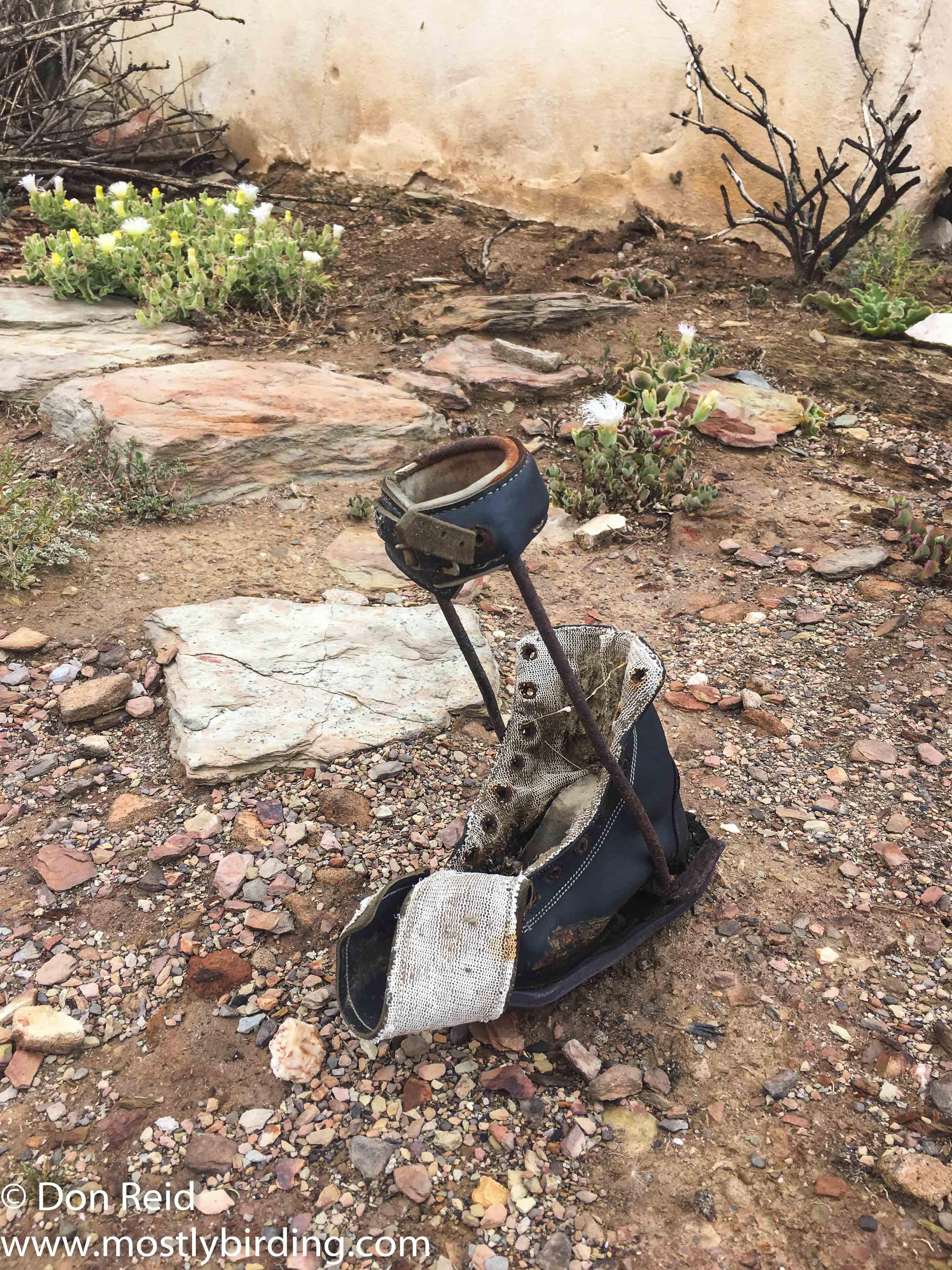
I had done a full circuit of the house and was rounding the last corner when I was stopped in my tracks by what lay on the ground, the only real sign of the previous habitants. I picked it up to make sure it was what I thought it was – indeed, a small child’s orthopaedic shoe with steel leg brace, left behind as a poignant reminder of whoever had lived and played here. At a guess the shoe would have fitted a child of no more than 3 or 4 years old.
I could hardly concentrate on my birding for the next while as my mind conjured up all kinds of questions on what I had found – who did the shoe belong to, why did they leave, where are they now, why did they leave this one shoe and nothing else?
I’ll leave you to ponder these and other questions yourself.
An easily identified wader or shorebird compared to others of its ilk, darn difficult to find in Southern Africa if my experience is anything to go by.
It’s been on my list of “birds to get” for far too long and I have tried to find it on a couple of occasions, without success. So, when a message appeared on the Mossel Bay Birding WhatsApp group – “Terek Sandpiper at Great Brak“ – I made a quick decision to see if I could find it.
Being a summer migrant and occasional winter migrant (non-breeding) to the southern Cape town of Mossel Bay from our home in Pretoria, I was just a half hour’s drive from Great Brak River, so that would make it an easy decision, you would think. However, I had been bird atlasing since 5.30 am that morning in the Oudtshoorn area, returning home at 2.30 pm, so I already had 9 hours of driving/atlasing under my belt. This was followed by some domestic chores and a trip to the shops so by the time I read the message I was ready to put my feet up and relax for the rest of the late afternoon and evening.
The Terek Sandpiper message changed all that and after a quick reviving coffee I was off to beat the sunset, which was still an hour and a half away, but light was fading…..
By 6.30 pm I was at the spot along the Suiderkruis road which skirts the Great Brak river mouth and ends at a parking area adjoining a picnic spot where several groups seemed to be celebrating the end of their working year in loud style – not quite the accompaniment you want when searching for a lifer but I did my best to ignore the raucous goings on and remain focused on my mission.
Once parked, I got out to scan the sand banks in the middle of the river and could immediately see dozens of Terns and Gulls, but more importantly many smaller shapes moving about in the subdued light. Checking these with my binos made my heart sink momentarily as all I could make out were many groups of small shorebirds which all looked pretty much the same in the less than ideal light.
Even at full zoom, there was not much to be seen
I had to get closer, so I set off along the sandy edge of the river until I could get a better view of the sand banks – this turned out to be the right move and I carefully scanned the gathered hordes of small shorebirds, mostly Common Ringed Plovers, for something different.
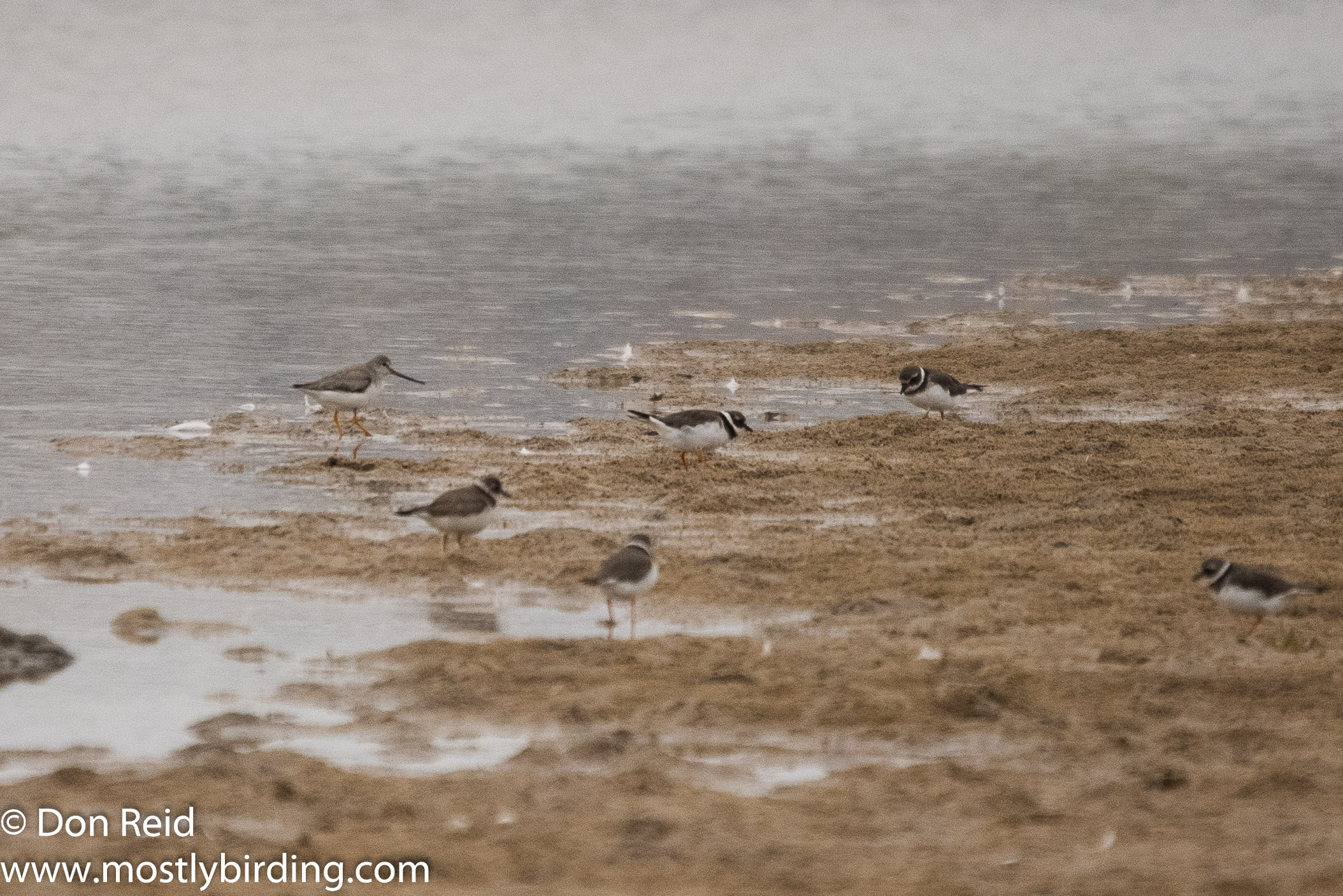
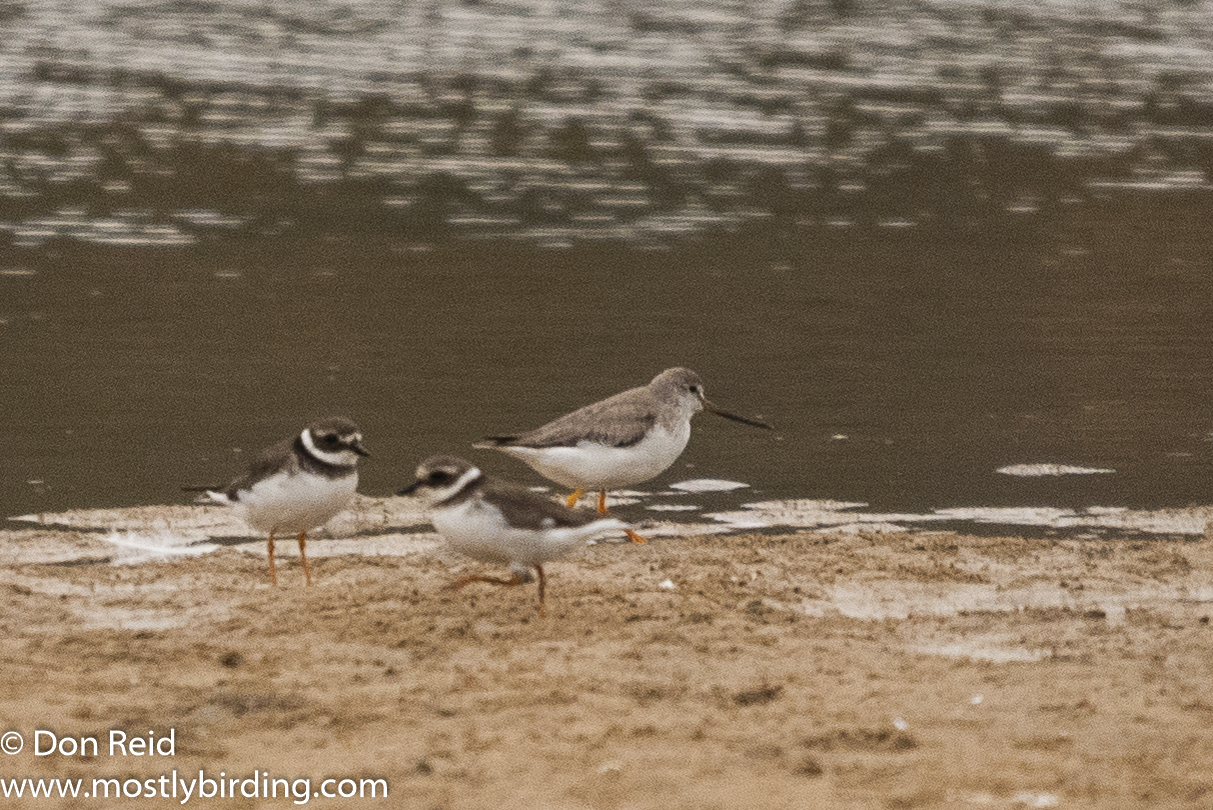
Full zoom and cropped as far as I could push it, at least separated the Terek Sandpiper from the Plovers
I gasped audibly when I spotted it – the low-slung body on short, bright orange legs and with a long slightly upturned bill stood out like a beacon amongst the more rounded, upright Ringed Plovers with short bills.
Savouring the moment, I waded cautiously into the shallow, wide stream separating the sand bank from the shoreline to try to get a little closer for a photo, but the birds were on to me and promptly moved further away.
So I had to be content with a long-distance photo, which was quite a challenge in itself. The Terek was moving in unison with groups of Ringed Plovers and just getting it vaguely into the camera viewfinder was all but impossible at the distance I was.
So I resorted to getting a lock on its position through my binos then quickly swopping over to the camera, pointing it at the same spot and rattling off a few shots. This worked up to a point but the best of the shots was well below my usual standard, so I crept a bit closer and repeated the process.
At one point the Terek moved slightly away from the Plovers and I rapidly got in some shots while it was more or less isolated –
This was the closest I was going to get so I had to be content with a “record shot”
Deciding that this was about the best I could do and with the light conditions now very poor I trudged back to the car and set off homewards, very pleased with this long-awaited sighting.
If there were Oscars for birds, I would propose a category called “Best performance by a bird defending its nest from a predator”
“And the winner is ……….. Kittlitz’s Plover” (cue loud applause)
So on what do I base this award?
Well, I was atlasing the area known as Gouritsmond, a small coastal town at the mouth of the Gourits River about a half hour’s drive from Mossel Bay. The Gourits River has its origin at the confluence of the Gamka and Olifants rivers, south of Calitzdorp in the Klein-Karoo and winds its way to the Indian Ocean across plains and through mountains.
Approaching the sea it widens into a broad estuary which is humming with activity in the holiday season, when the town expands its population by about 80%, but was dead quiet when I visited it on a weekday in October 2018 and I had the whole parking area at the boat launch site to myself, other than a waste van which came to empty the rubbish bin.
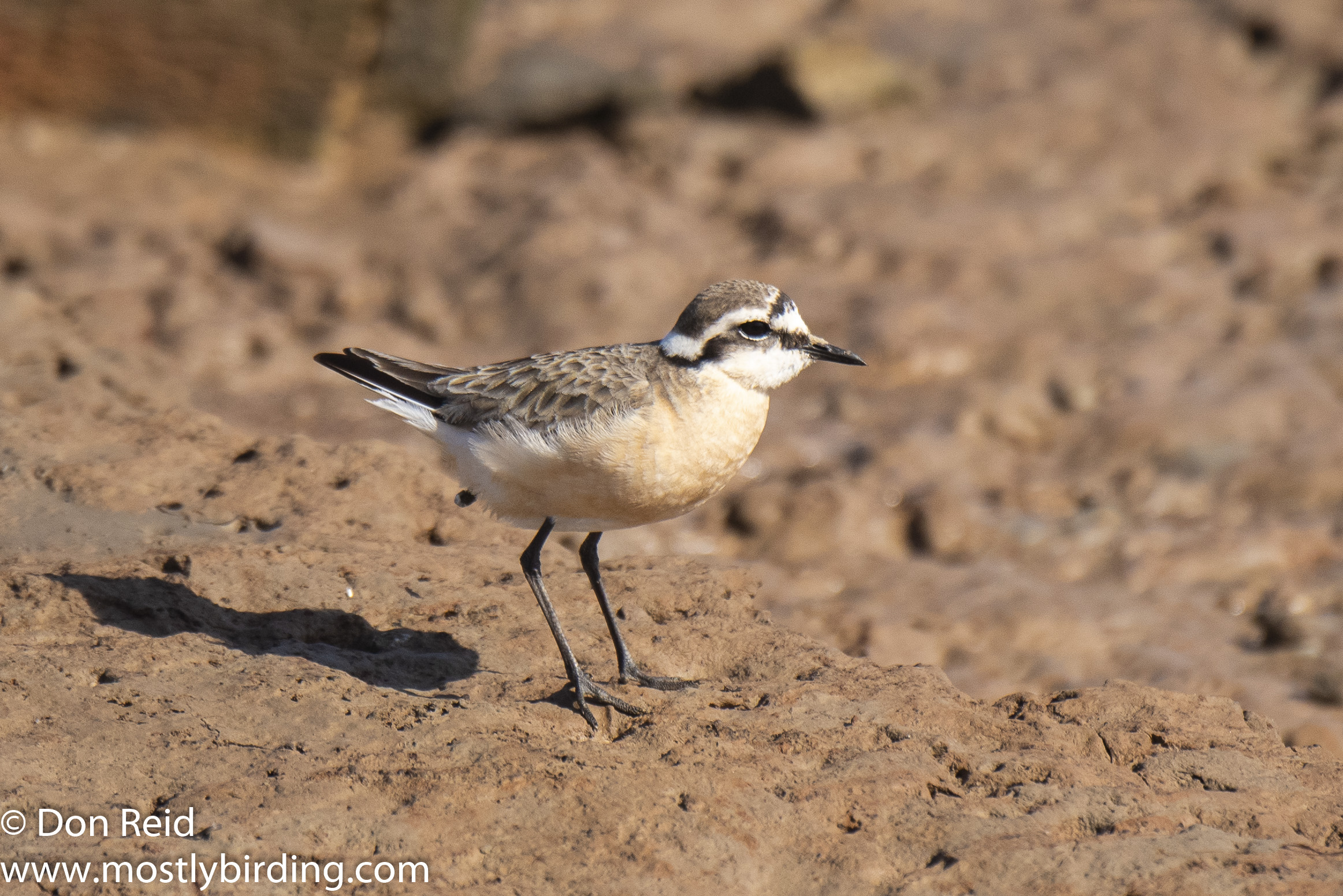
Braving the strong cold wind, seemingly unseasonal but those who live along the southern Cape coast will tell you to expect 4 seasons in one day, I ventured up and down the river’s edge with its wide muddy margin and took the opportunity to photograph the Plovers and other shorebirds present, of which the Kittlitz’s Plover was the least shy.
Kittlitz’s Plover, Gouritzmond
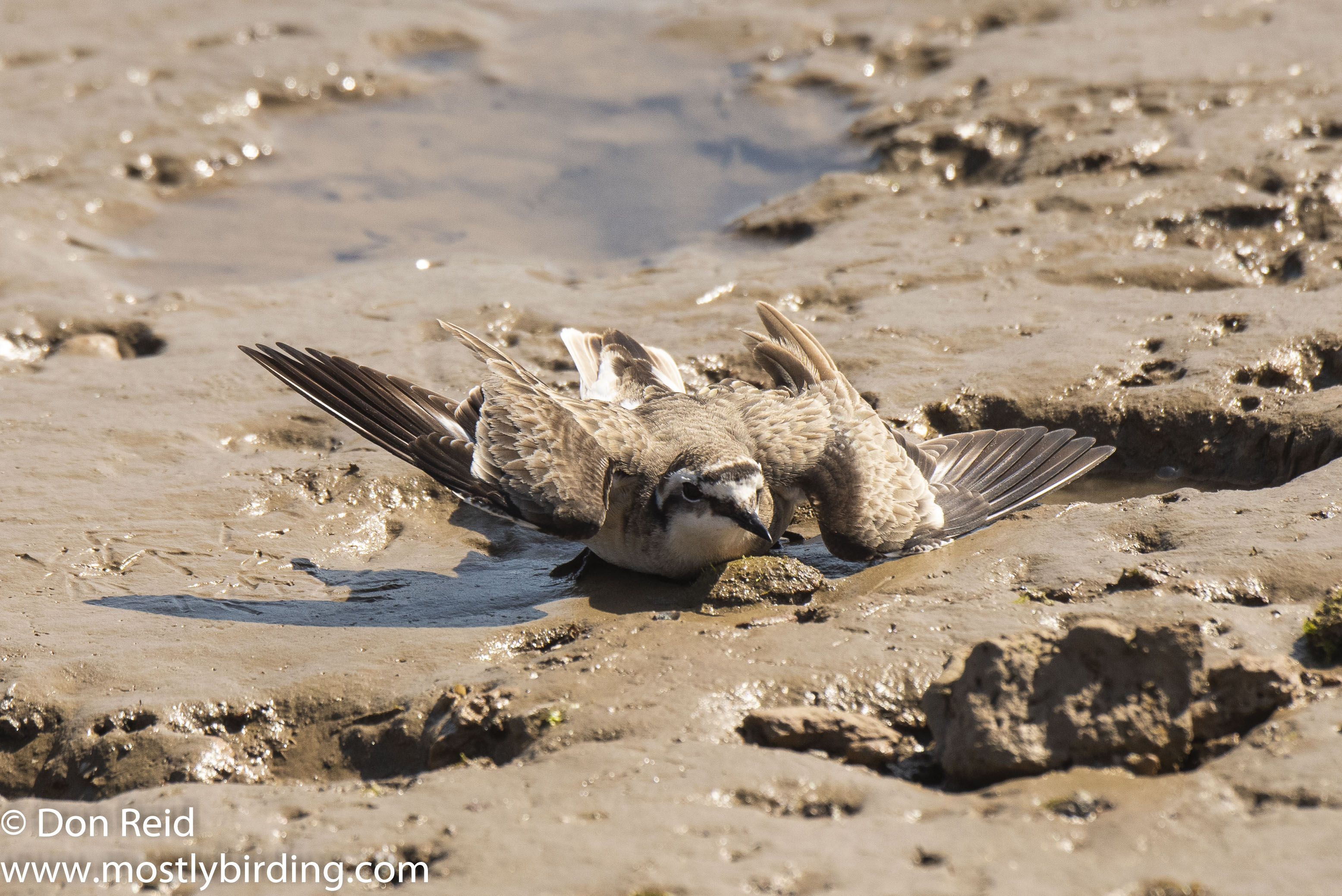
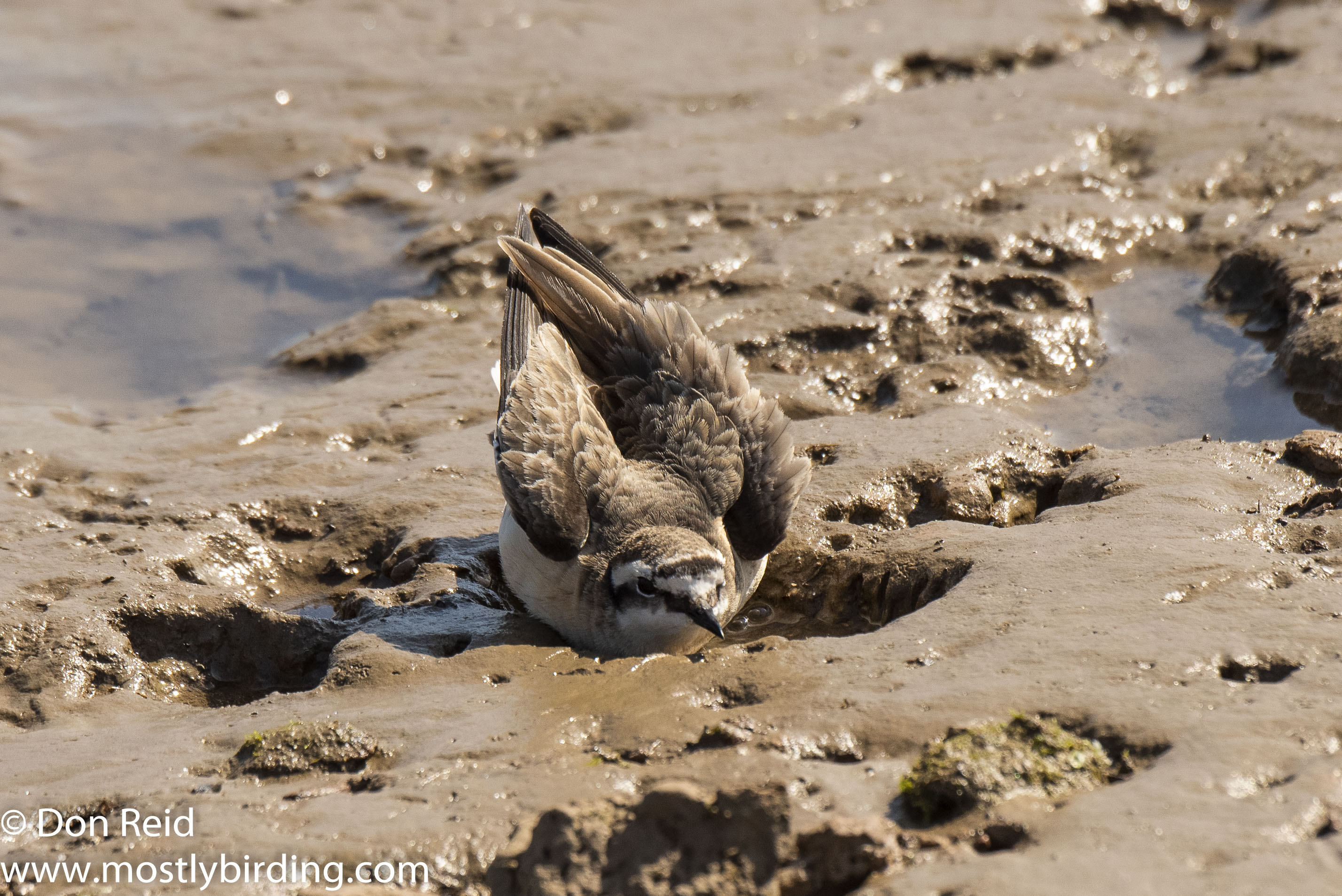
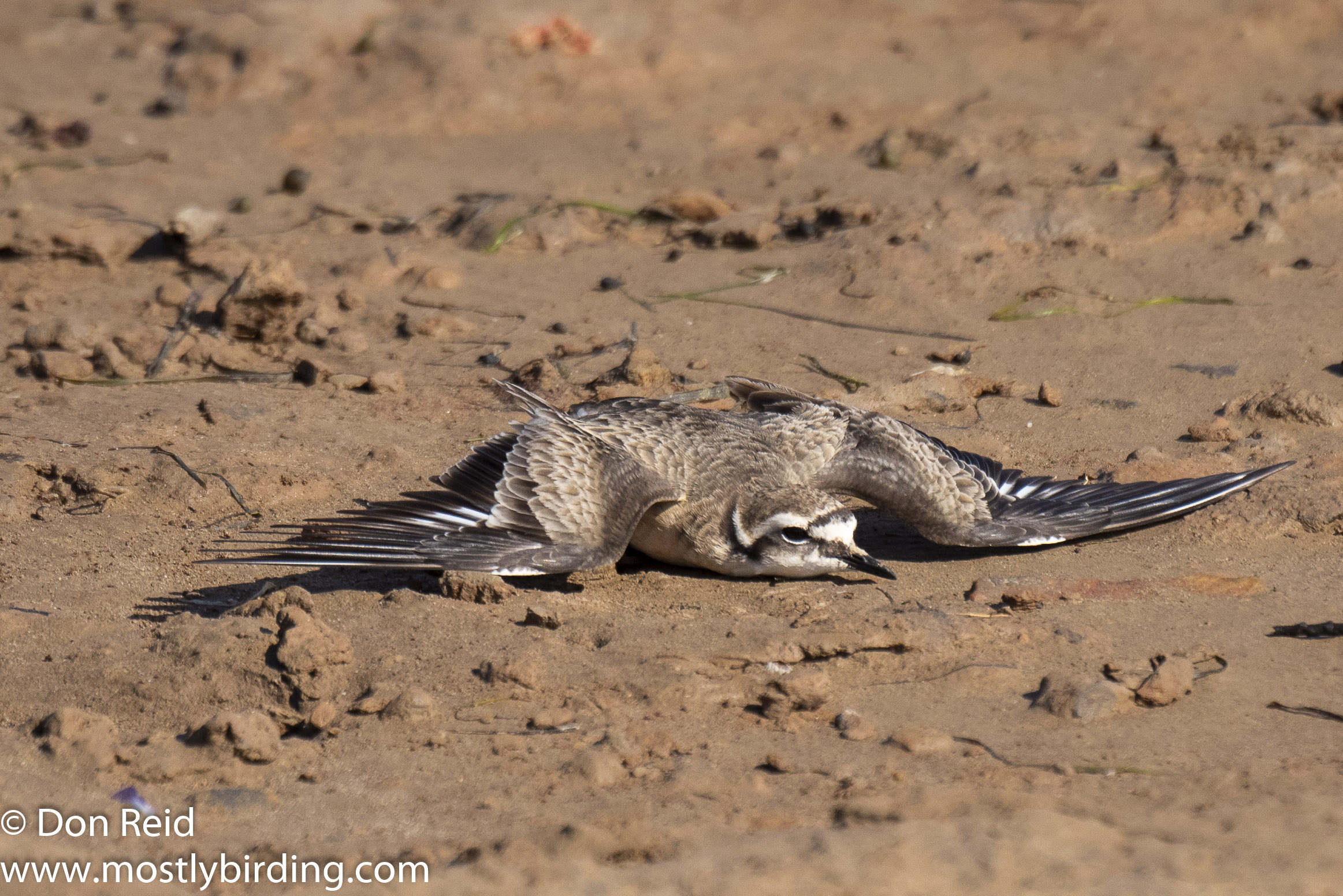
Every now and then I popped back to my car to escape from the cold wind, which my 3 layers of clothing were battling to defend. On one of my forays along the shoreline, a Kittlitz’s Plover’s curious behaviour caught my attention – it ran off as I approached, then suddenly dropped flat on its belly, wings spread wide and flapping about as if mortally injured.
Kittlitz’s Plover in anti-predator mode, GouritzmondKittlitz’s Plover in anti-predator mode, Gouritzmond
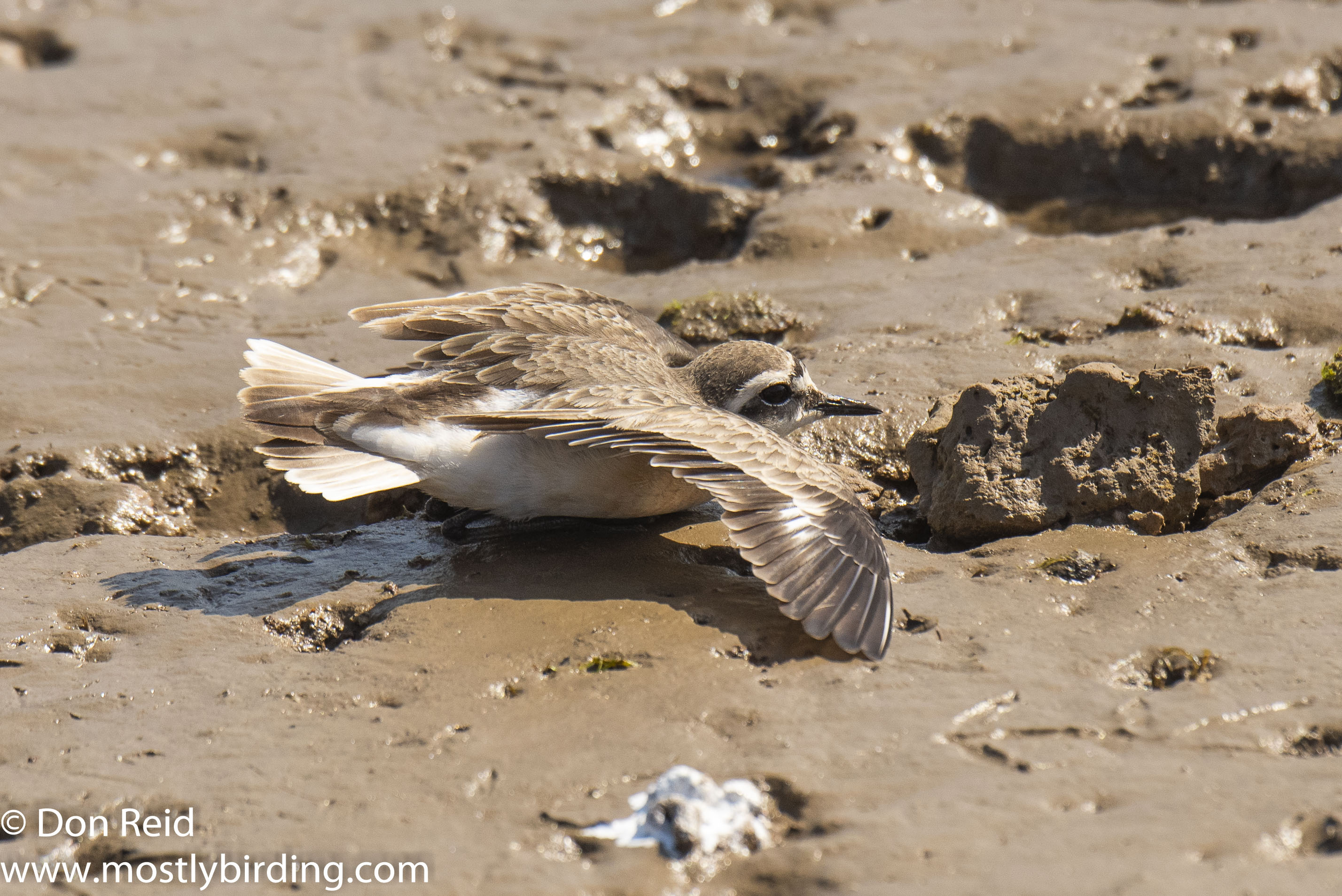
Stepping closer, I was about 3 metres away when it miraculously recovered, ran further and repeated the dramatic death scene while watching me with beady eyes. All the while it was leading me away, presumably from a nest which was not apparent, and I did not try too hard to find it for fear of giving the Plover a heart attack.
Kittlitz’s Plover in anti-predator mode, GouritzmondKittlitz’s Plover in anti-predator mode, Gouritzmond
The Plover repeated this act each time I approached and the drama of its performance had me chuckling in delight and admiration for the ingenuity of the species.
Kittlitz’s Plover in anti-predator mode, Gouritzmond
In this way the Kittlitz’s led me for a way down the river margin, until I turned and retraced my steps towards the parking area, whereupon the Plover also turned and flew back so that he was just ahead of me and repeated the act once more.
That was enough teasing for the day and I returned to the car, with the Plover watching me go – I imagined he had a look of “why go now, we were just starting to have some fun”
The Roberts app describes this behaviour thus : “When predator present, performs distraction displays including injury feigning, waving one or both wings and fanning tail to attract predator’s attention, sometimes flopping forward along ground..”
Other Birds
Apart from the dramatic Kittlitz’s Plover, the shoreline was occupied by several other species who favour this habitat –
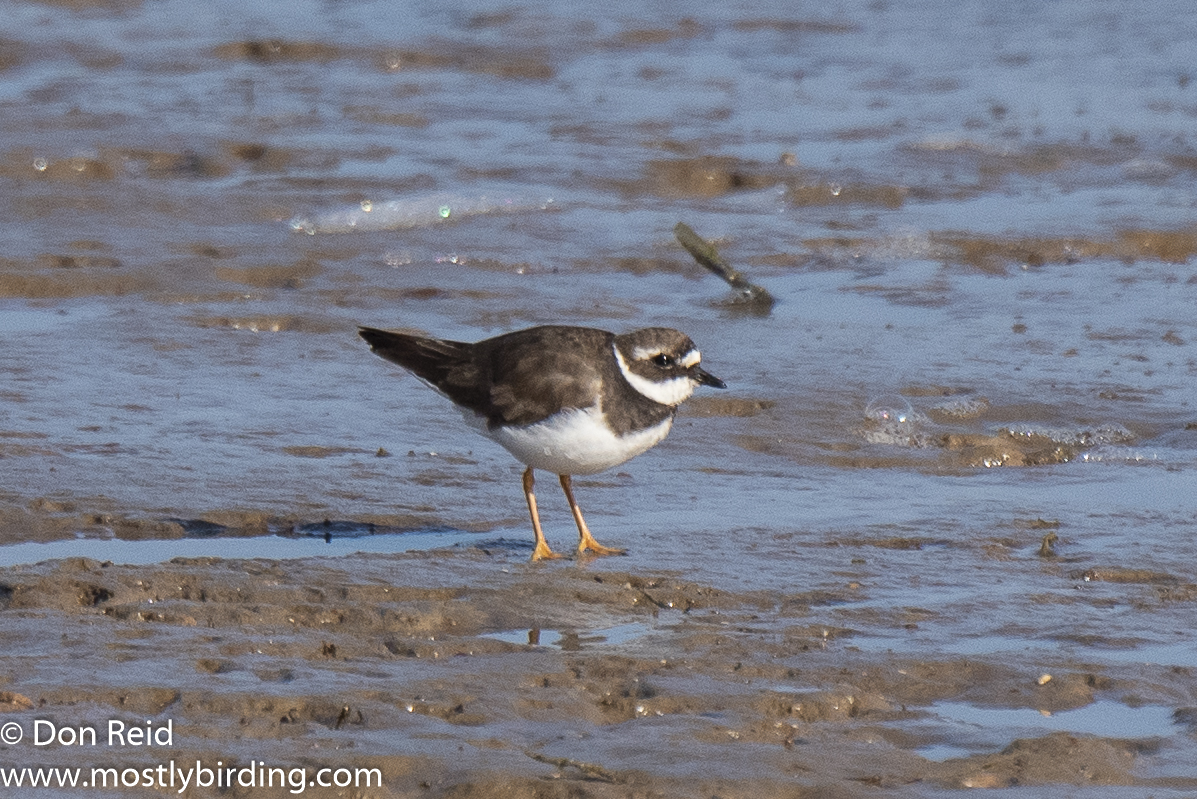
Common Ringed Plover, a polar migrant which is present in Southern Africa from September to April
Common Ringed PloverCommon Ringed Plover
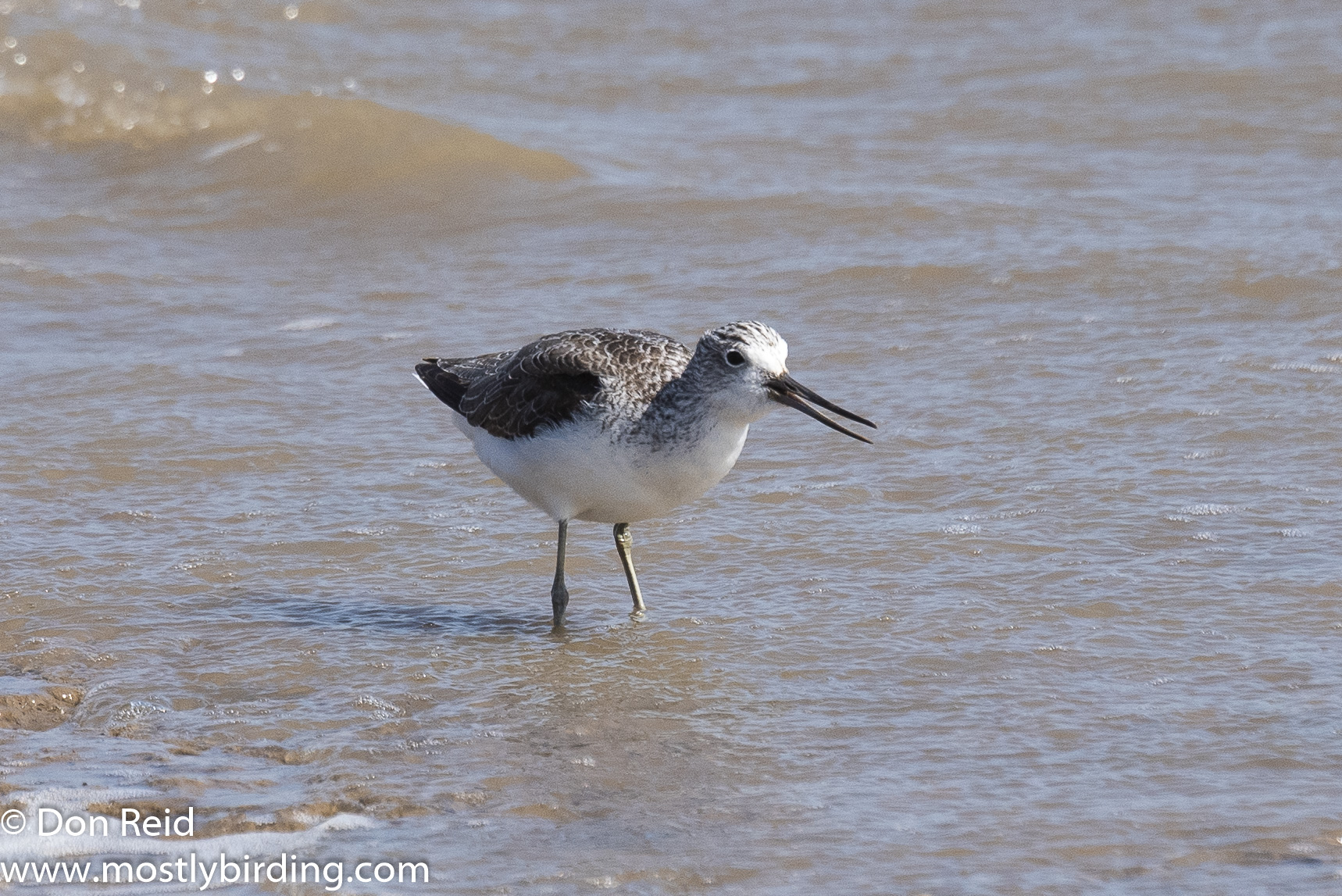
Common Greenshank, a Palaearctic (Europe, Asia north of the Himalayas, North Africa) summer visitor, mainly from August to April
Common Greenshank, Gouritzmond
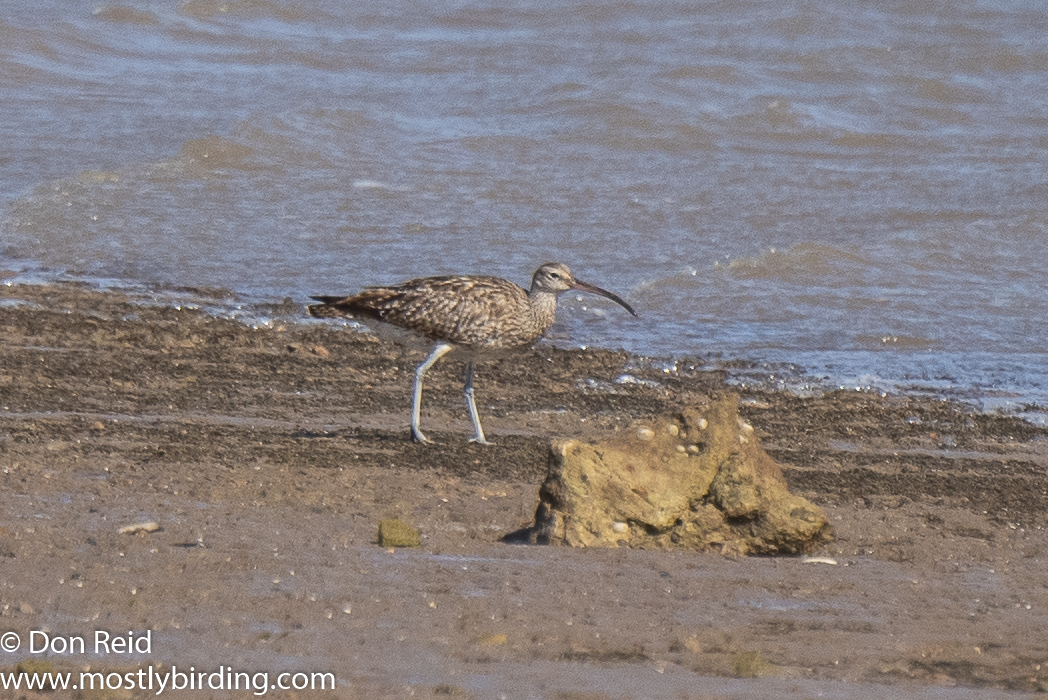
Common Whimbrel, non-breeding migrant with circumpolar origin, present from August to March
Common Whimbrel, Gouritzmond
Sanderling, non-breeding migrant from the arctic tundra, present from September to April
Sanderling, GouritzmondSanderling, Gouritzmond
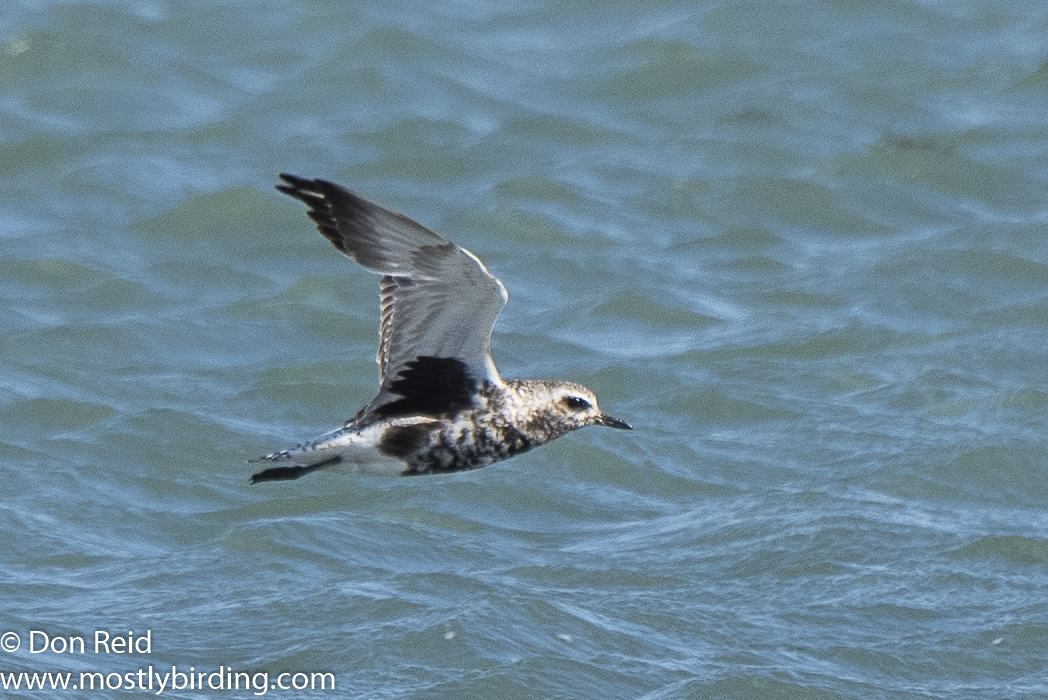
All of the above are long-distance migrants, whereas the Blacksmith Lapwing is a local resident, one that is found in most parts of Southern Africa – this individual is a good example of a juvenile, lacking the very distinctive markings of the adult, which often leads to incorrect ID such as Grey Plover and others
Blacksmith Lapwing (Juvenile), Gouritzmond
Another morning’s atlasing, another unique birding encounter
The final chapter on our unplanned week in Kruger in early September this year…..
Like others, we visit Kruger in the hope of having some interesting sightings of the multitude of animals that live in this superb park and being birders we love the variety of bird life that we encounter.
But there is another, simpler side to spending time in Kruger and the title of this post says it all – sometimes you just want to relax and not be out on the roads looking for the next big sighting
Time in the Camp
There’s a certain luxury to just sitting on the verandah of the rondavel, preferably with your choice of liquid refreshment, taking in the passing show of small wild life.
Early mornings are often the best time, when it’s cool and small animals and birds are most active, but mid to late afternoon can also be very productive and pleasant.
We spent one such afternoon fascinated by what was going on in the patch around our rondavel in Olifants camp, as many of the “regulars” put in an appearance during the afternoon :
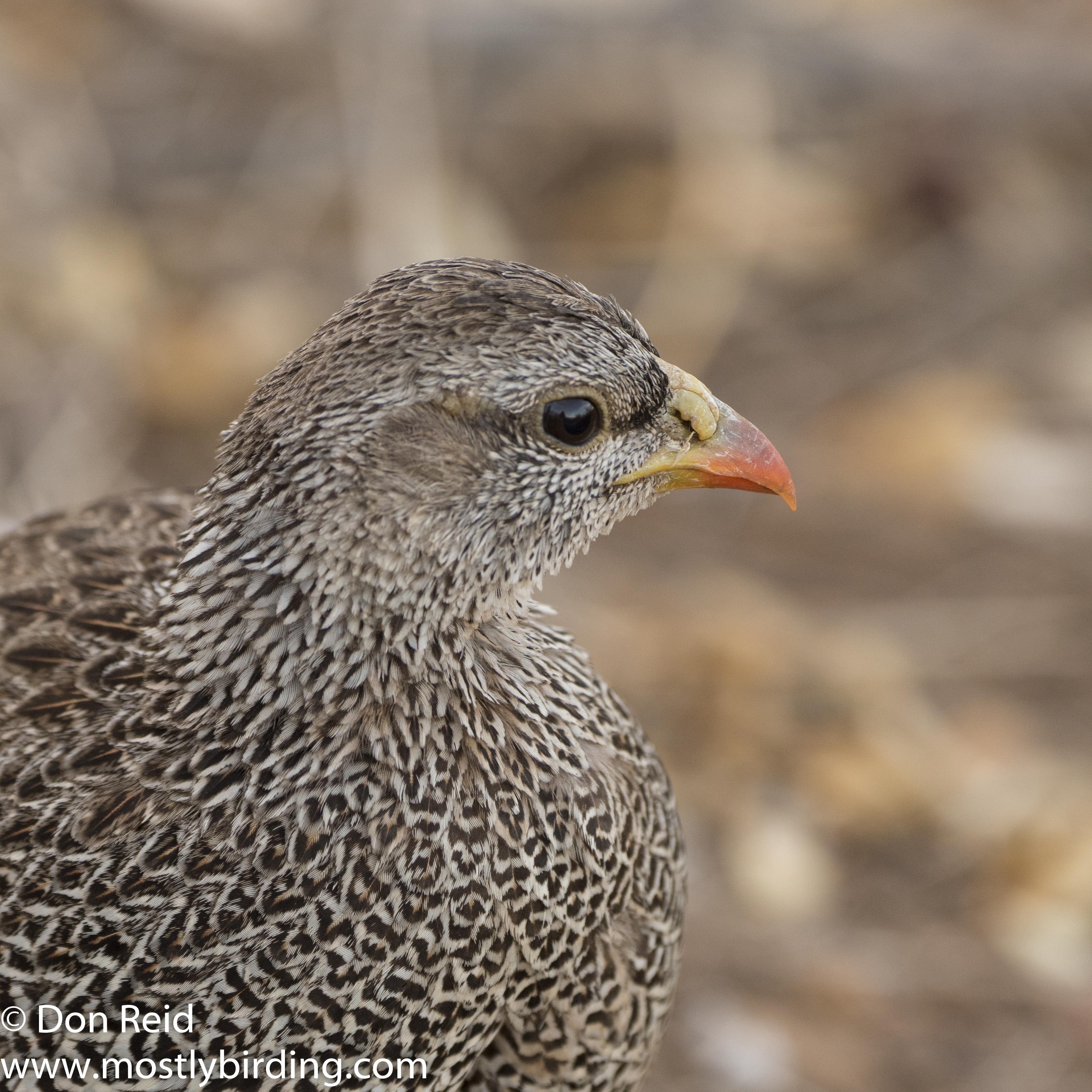
a Natal Spurfowl mommy with 4 teeny bopper youngsters spent time scratching in the dry leaf litter and dust bathing
Natal Spurfowl, OlifantsNatal Spurfowl
Red-winged Starlings turned up hoping for handouts,
Red-winged Starling, Olifants (in case some sharp individual queries this, the photo was taken on another trip at the time of year when the Aloes are in flower)
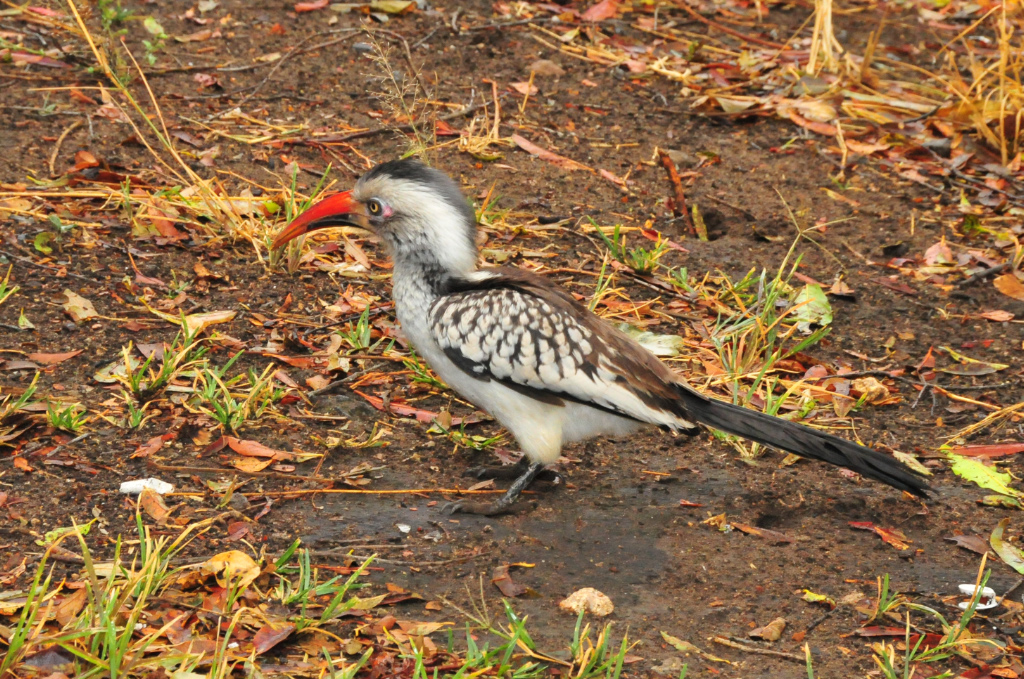
as did some Red-billed Hornbills
Red-billed Hornbill
Tree Squirrels joined the Spurfowls in the leaf litter, finding titbits to eat, then cutely holding it with two tiny paws while nibbling
Tree Squirrel
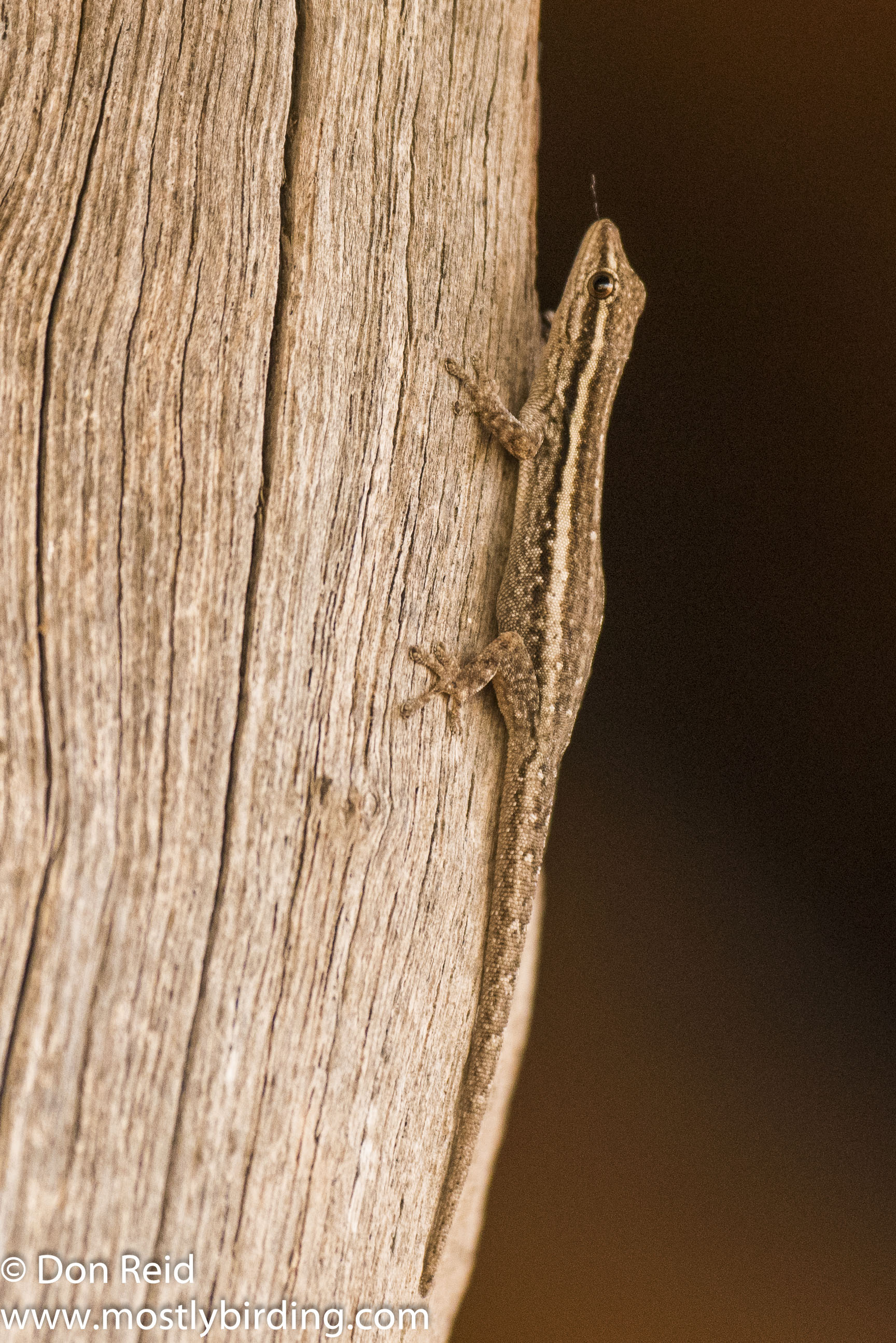
The resident Striped Skink entertained us with its antics on the verandah wall – another skink passing by got the treatment as it dared to intrude on skink no 1’s territory – backs were reared and skink no 2 skirted widely around and made haste to get away. Thoughts of soccer’s “the Special One” crossed my mind for some reason.
Striped Skink, Olifants
Banded Mongoose in small groups, foraging in the soil and leaf litter, keeping in contact with each other with their continual high-pitched twitter.
Banded Mongoose
All of this action was played out to the accompaniment of background calls of Pearl-spotted Owlet, Brown-headed Parrot, White-browed Scrub-Robin and others as the afternoon wore on. Just another day in Olifants….
Tree Spotting
Another good way of whiling away the late afternoon as it gets cooler, is to take a slow walk around the camp. Olifants is ideal for tree spotting, aided by the nameplates on many of the trees, essential for tree dummies like us. Many years ago Gerda and I did a course on trees over a few evenings – very pleasant but not much of it stuck as we did not pursue the hobby thereafter, so we decided to refresh our memories from long ago in the hope that some of it would stick.
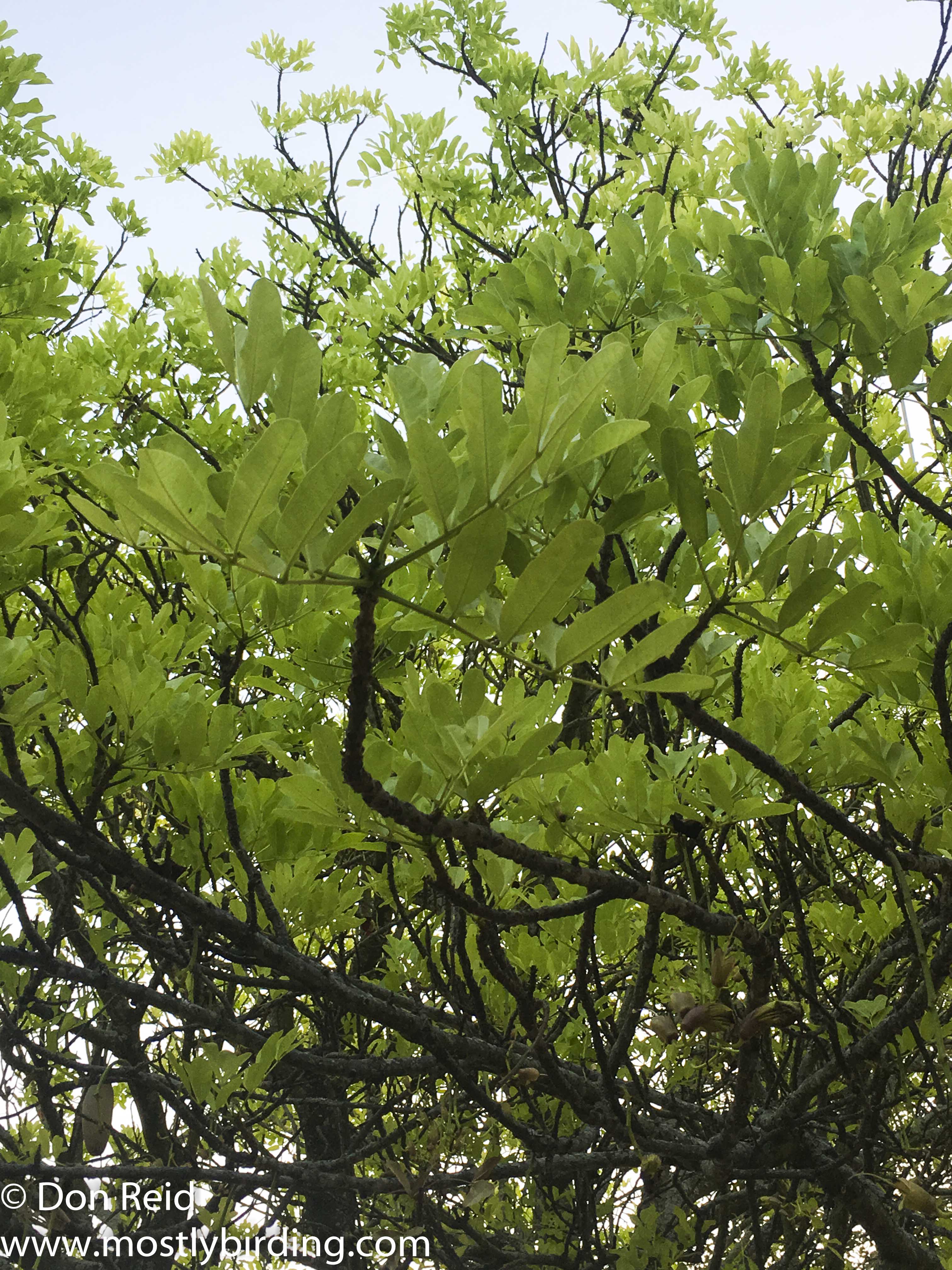
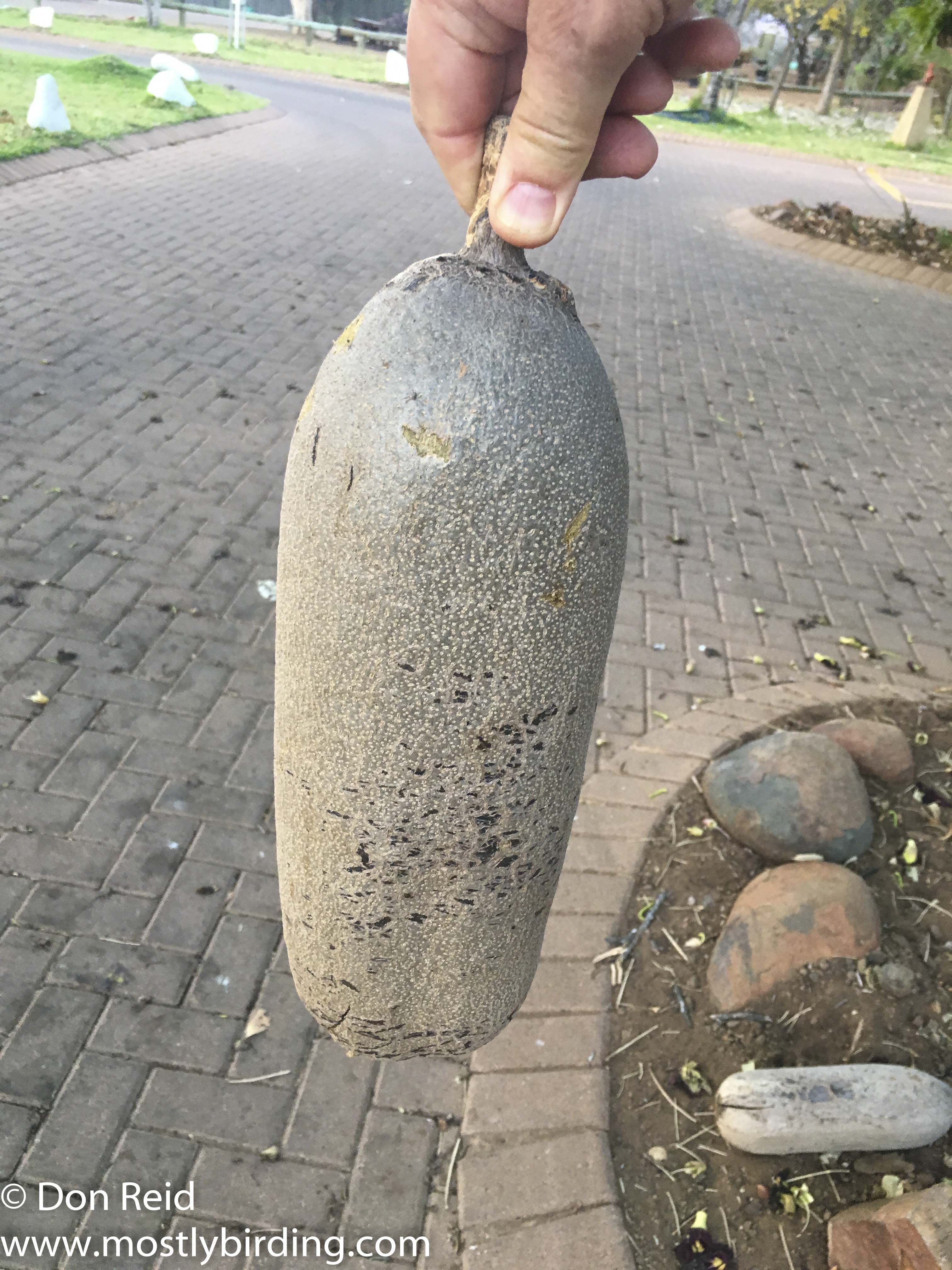
Some trees don’t need much in the way of serious observation to know what they are – one such is the famous Sausage Tree of which a good example stands outside the Olifants camp reception. We also saw large Sausage Trees in several spots during our drives and they stand out for several reasons, besides the obvious large pods shaped like enormous sausages which hang from its branches – the bright green foliage and purple flowers are further standout features of this unique tree, in case there is any doubt about the ID.
Trees 101 : Sausage Tree, Olifants
The bright green foliage is visible from a distance
The pods are potential killers if you happen to be hit by one when they drop – up to half a metre long and weighing up to 7 kg they can deliver a lethal blow or do some serious damage to you or your vehicle
The flowers of the Sausage tree have a pungent fragrance which attracts bats, insects and sunbirds, all of which help to pollinate it. They bloom at night on long rope-like stalks
Several other trees caught our attention while on our Trees 101 walk around the camp –
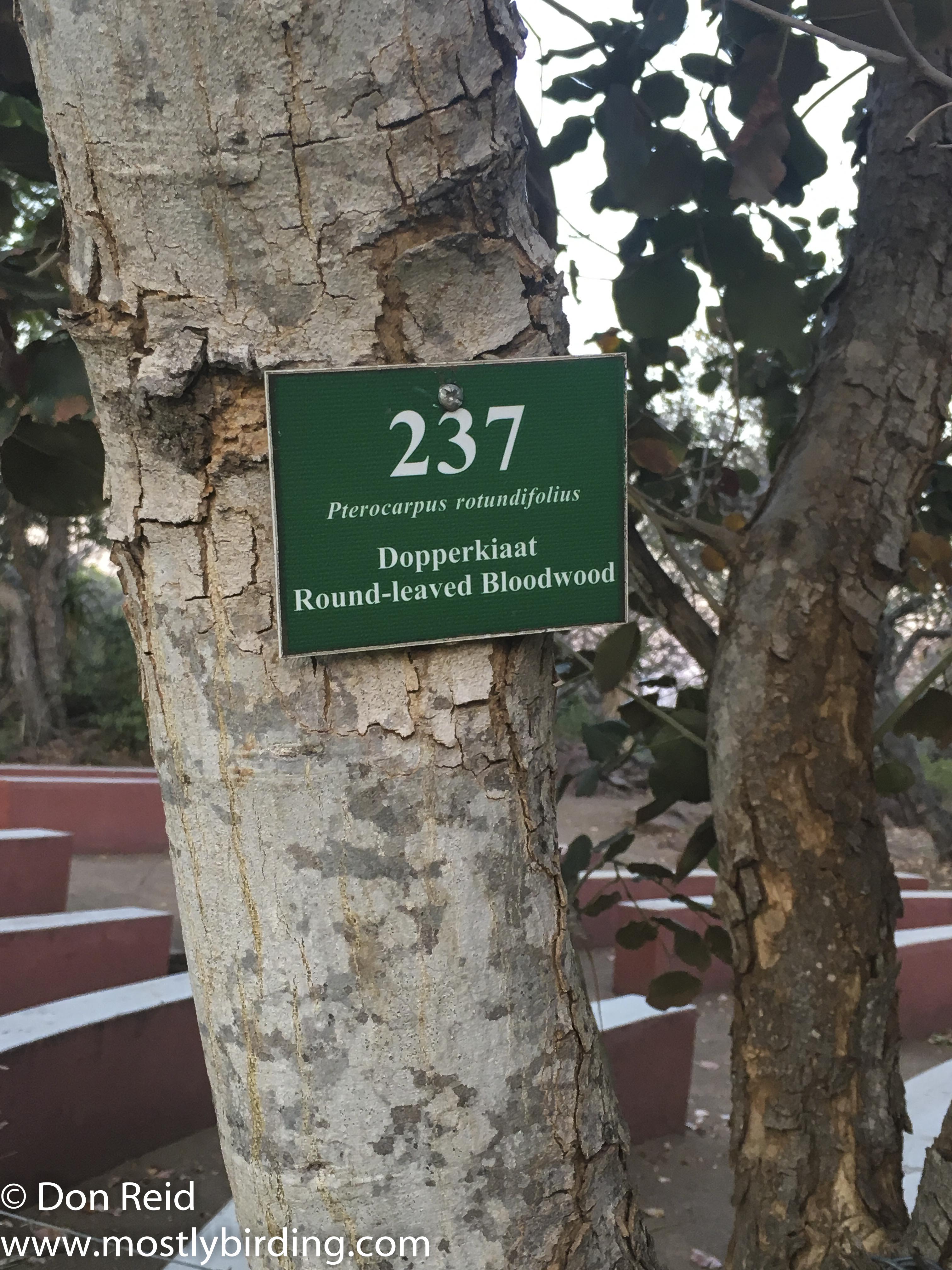
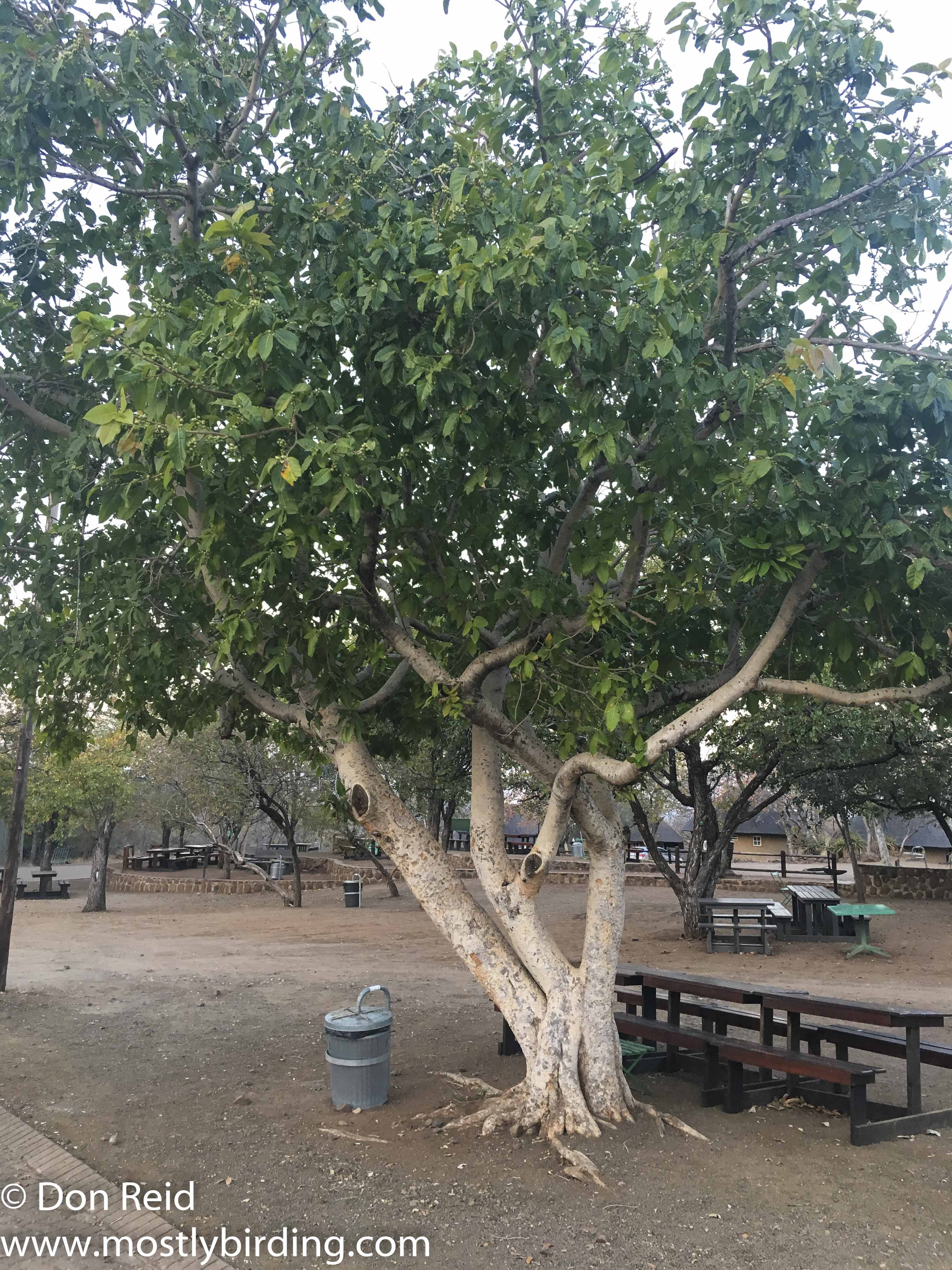
Trees 101 : Round-leaved Bloodwood, Olifants
This medium-sized deciduous tree occurs in bushveld in the northern parts of SA. This example is to be found in the picnic area
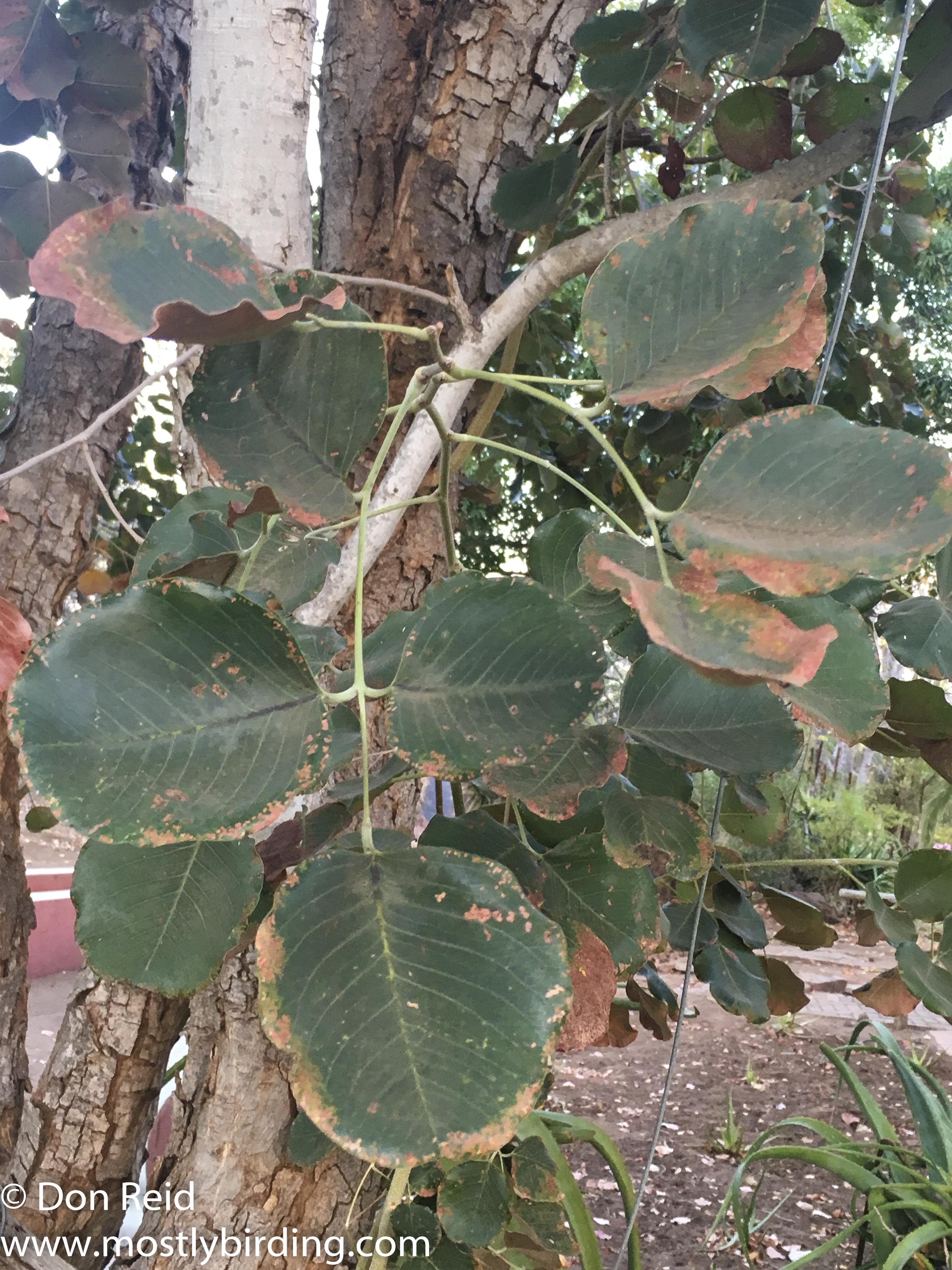
As the name suggests the leaves are unusually round
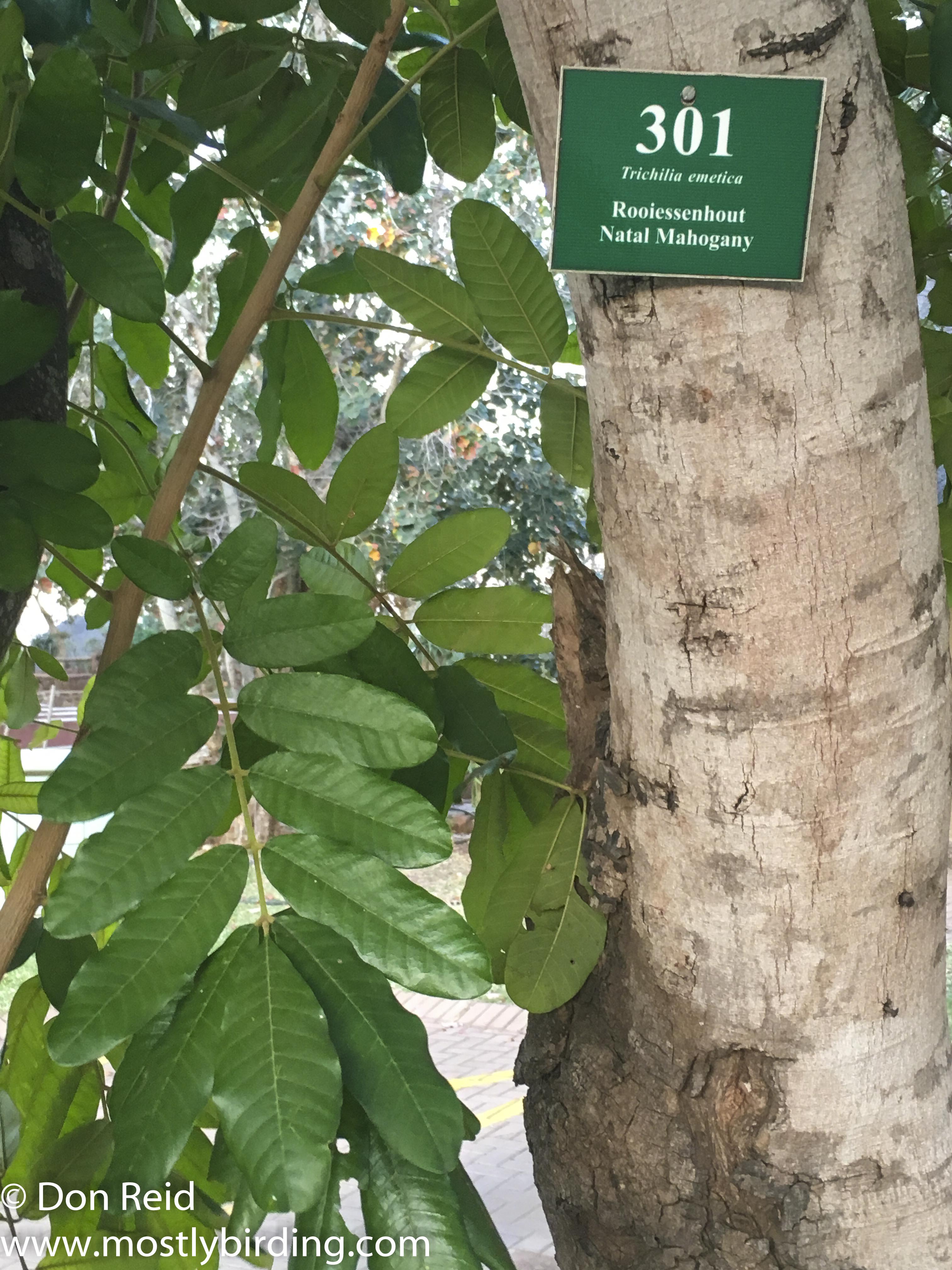
Natal Mahogany trees are one of the more handsome trees in Kruger – large evergreen trees with a dense spreading crown of deep green leaves. They are mostly found in riverine forest but also occur in bushveld
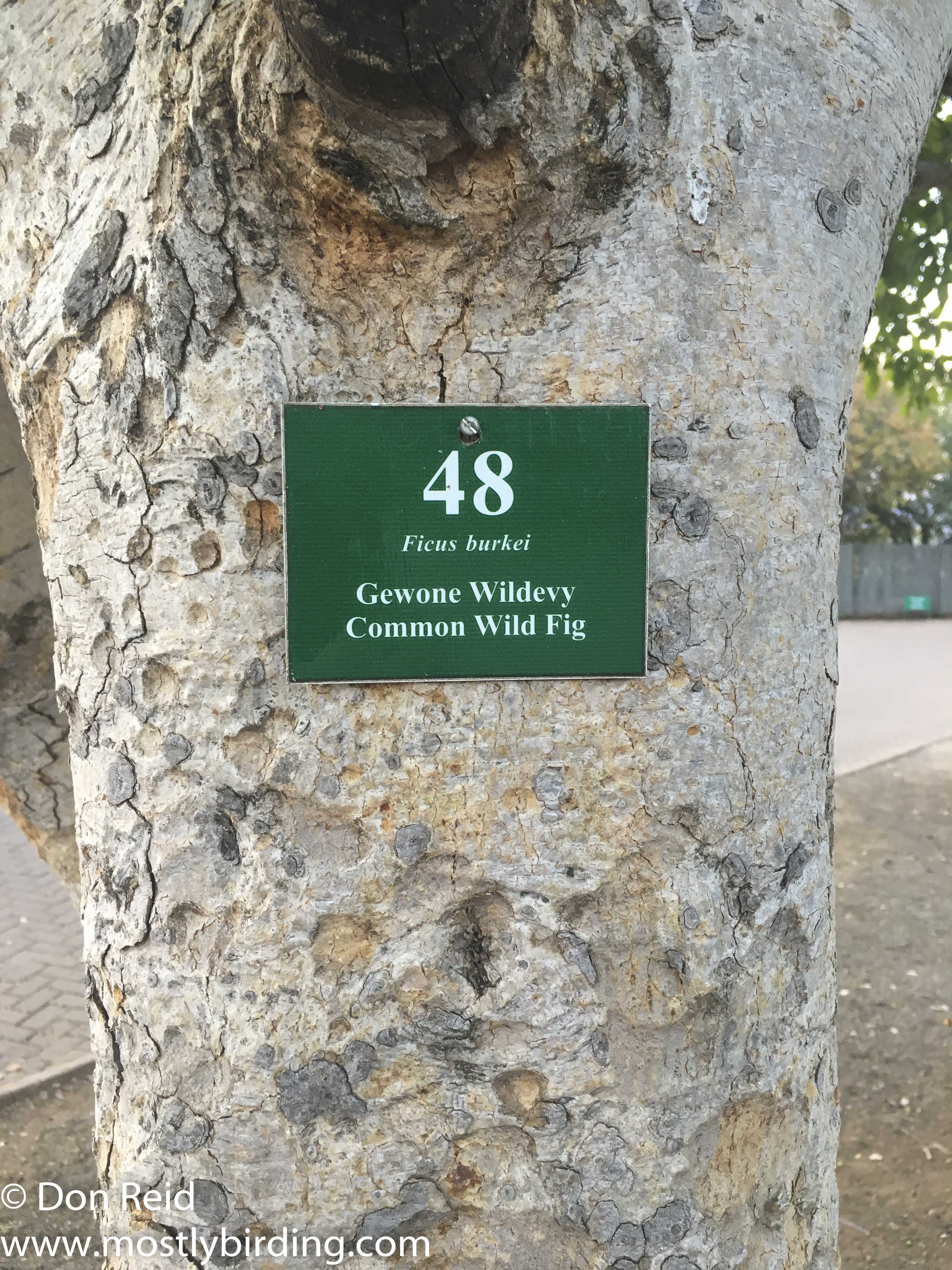
The Wild Fig tree is another prominent tree that is fairly easy to spot as it attracts many fruit-eating birds, bats and even antelope.
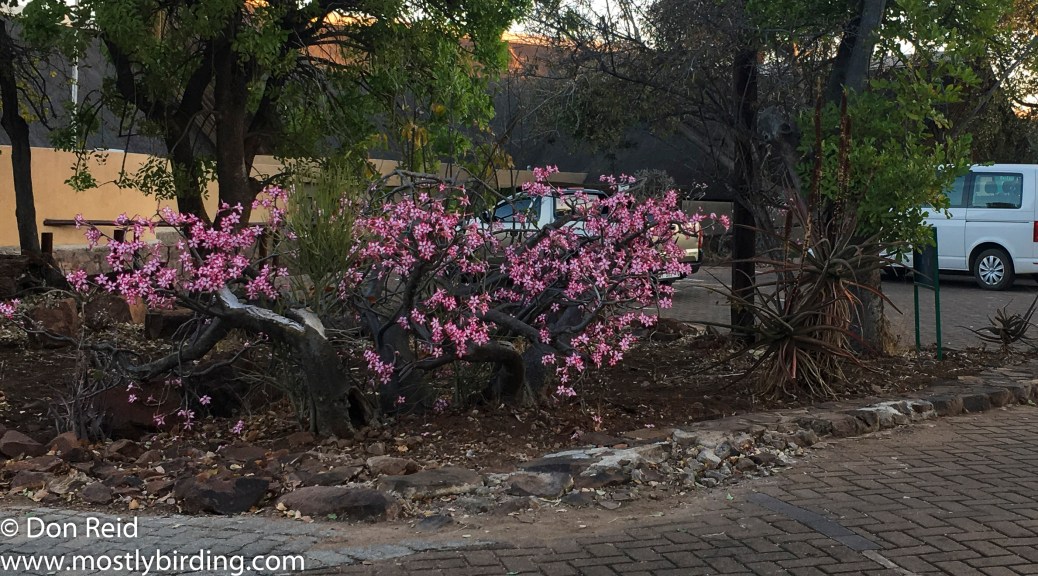
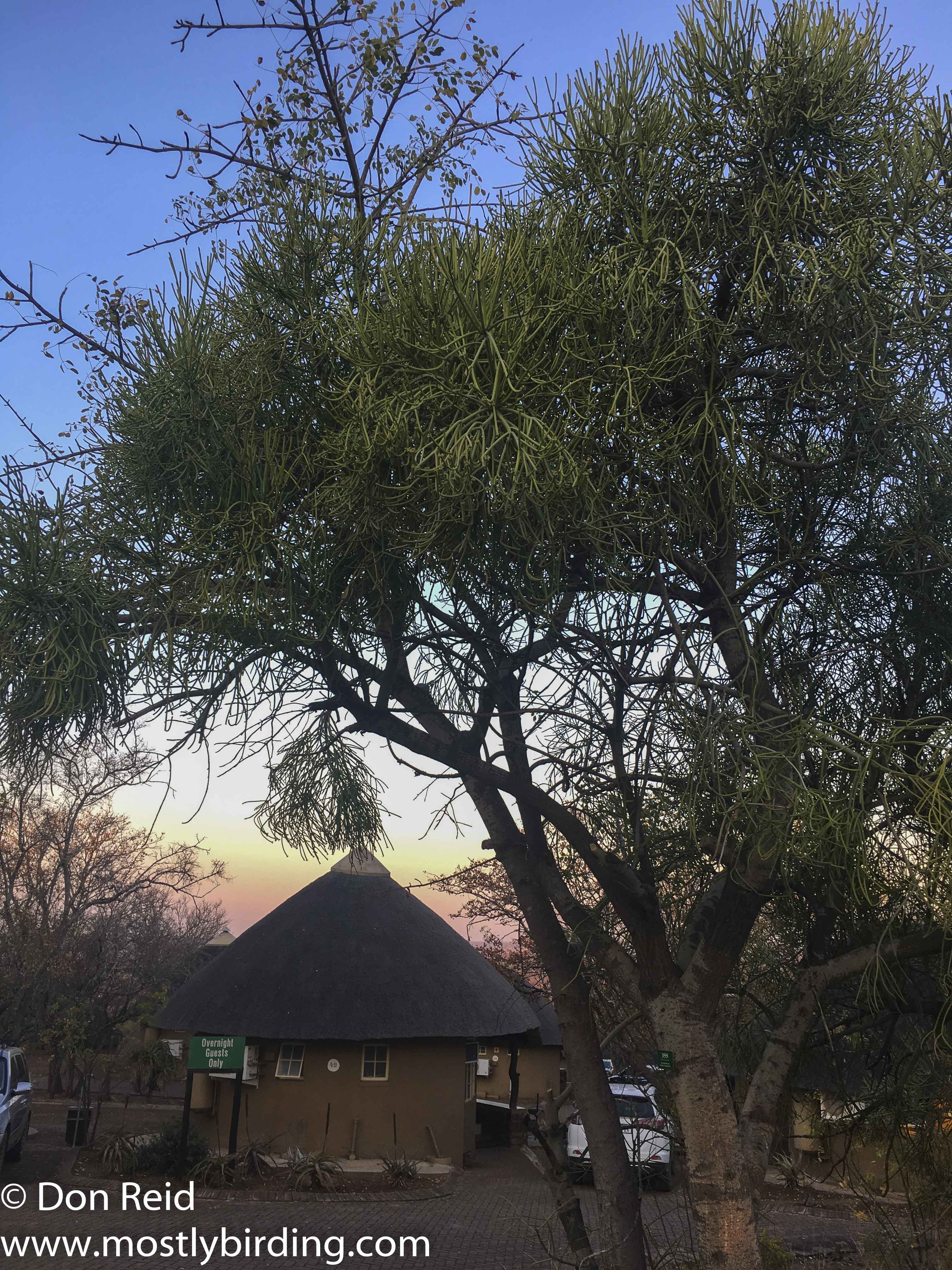
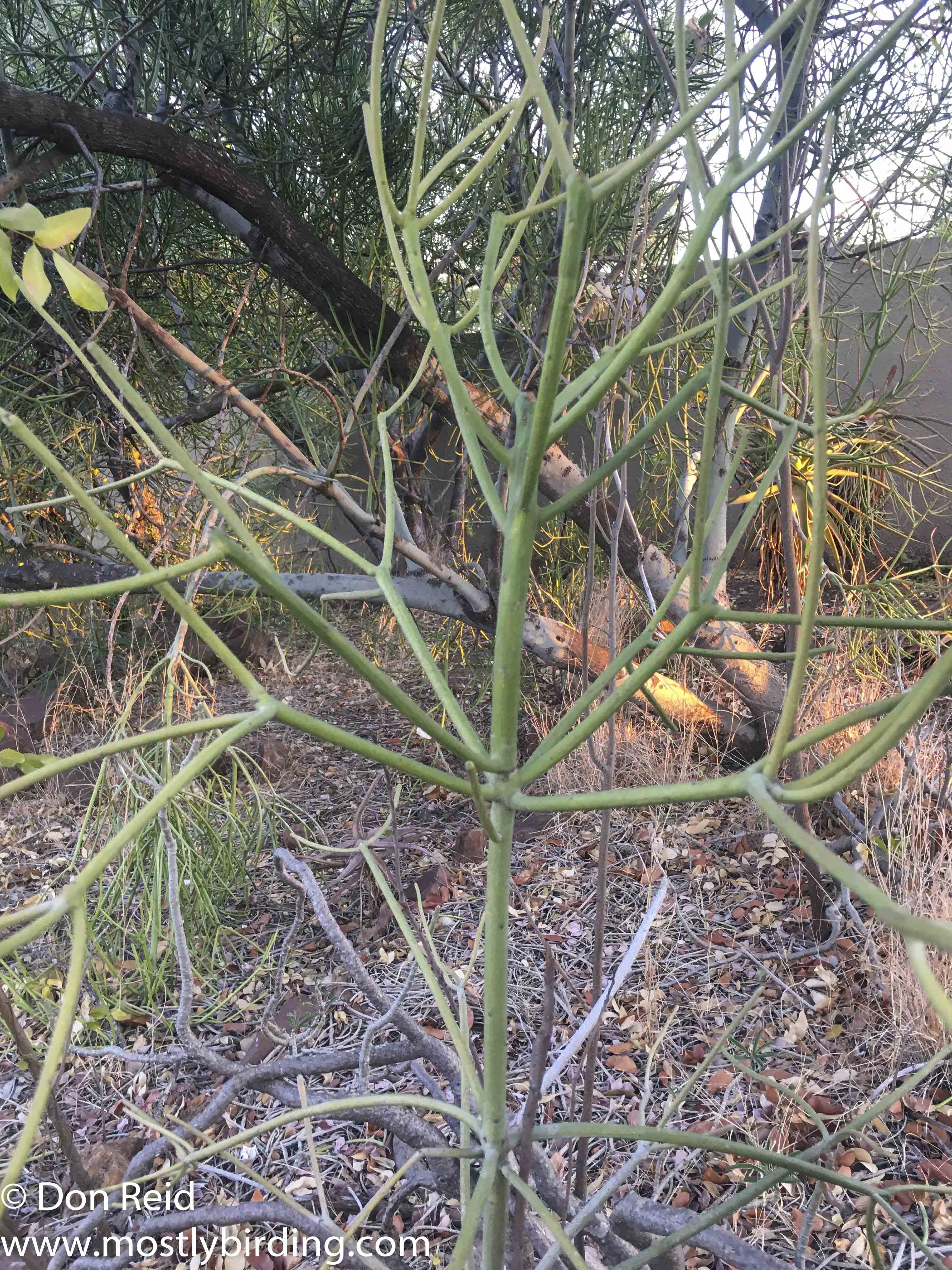
An unusual and quite distinctive tree – small to medium-sized succulent tree occurring on rocky hill slopes. The leaves fall very early so the long thin branchlets are left bare creating a spider’s web effect
Interstingly the latex is toxic, used to repel or kill insects, nevertheless it is browsed by Black Rhinoceros
Trees 101 : Hedge Euphorbia, Olifants
And there ends Trees 101 as well as our unplanned Kruger visit – until next time




















 Mostly Birding