“Ernesto was proud to mention that a species of Gecko he discovered there was named after him and he was able to find it for us”
Nature Reserve at Varadero
TheReserva Ecológica Varahicacos protects a 3 km2 remnant of xeromorphic coastal scrub and mangrove at the tip of the 20 km. Hicacos Peninsula. Much of the peninsula, also known as the sun destination ‘Varadero’ to hundreds-of-thousands of international tourists, has been modified to accommodate scores of sprawling, all-inclusive resorts. It is also home to the newly described (2009) Cuban Croaking Gecko (Aristelliger reyesi), the only Aristelliger known from Cuba. Dίaz and Hedges (2009) named the species after its discoverer, local biologist and bird guide Ernesto Reyes. (Source : http://northshorenature.blogspot.com/2012/03/some-cuban-lizards.html)
Ernesto works most days as a conservation officer at this nature reserve, which was a short taxi-ride from our hotel, and he was only too happy to include a walk through the reserve at any time during our stay. Andre and I took him up on the offer a few days after Geraldine and I visited Zapata Swamps with Ernesto and were glad we did, as it added another dimension to the Cuban birding experience and a number of lifers to the trip list.
Ernesto was proud to mention that a species of Gecko he discovered there was named after him and he was able to find it for us :
Ecological Reserve at VaraderoCamouflaged Cuban Croaking Gecko (Aristelliger Reyesi) named after its discoverer and our bird guide, Ernesto Reyes
Ernesto took us along a few of the paths that run through the wooded part of the Reserve and found a number of forest birds, many of which turned out to be Warblers of various combinations of black, brown, yellow and white. The new ones for our trip list and all lifers for me were :
Black-throated Blue Warbler
Prothonotary Warbler (Interesting name)
Yellow-rumped Warbler
Hooded Warbler
Black-and-white Warbler
All of them were too furtive and quick to get a photo for the record, so I took some photos of the Reserve’s other interesting features instead
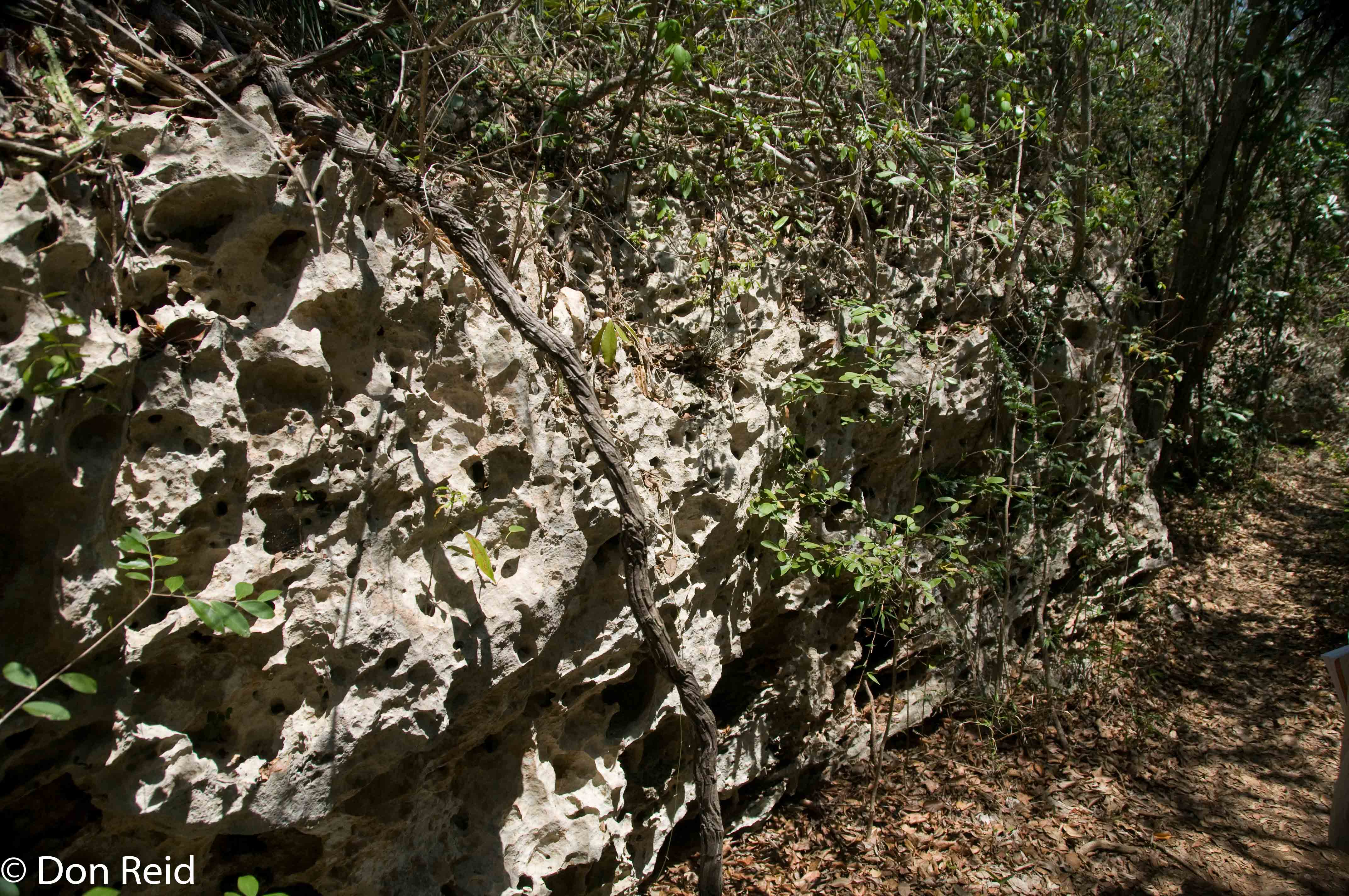
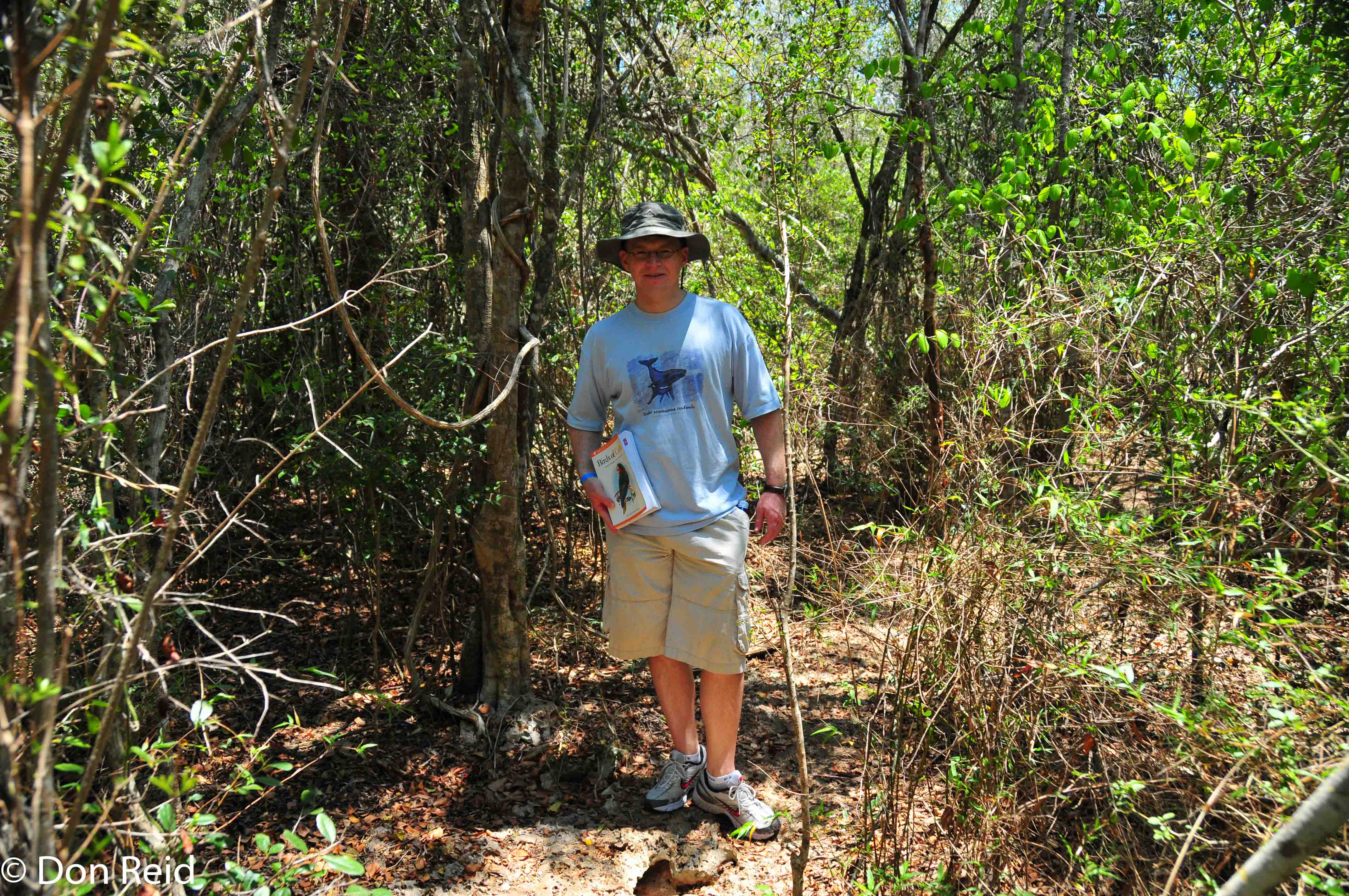
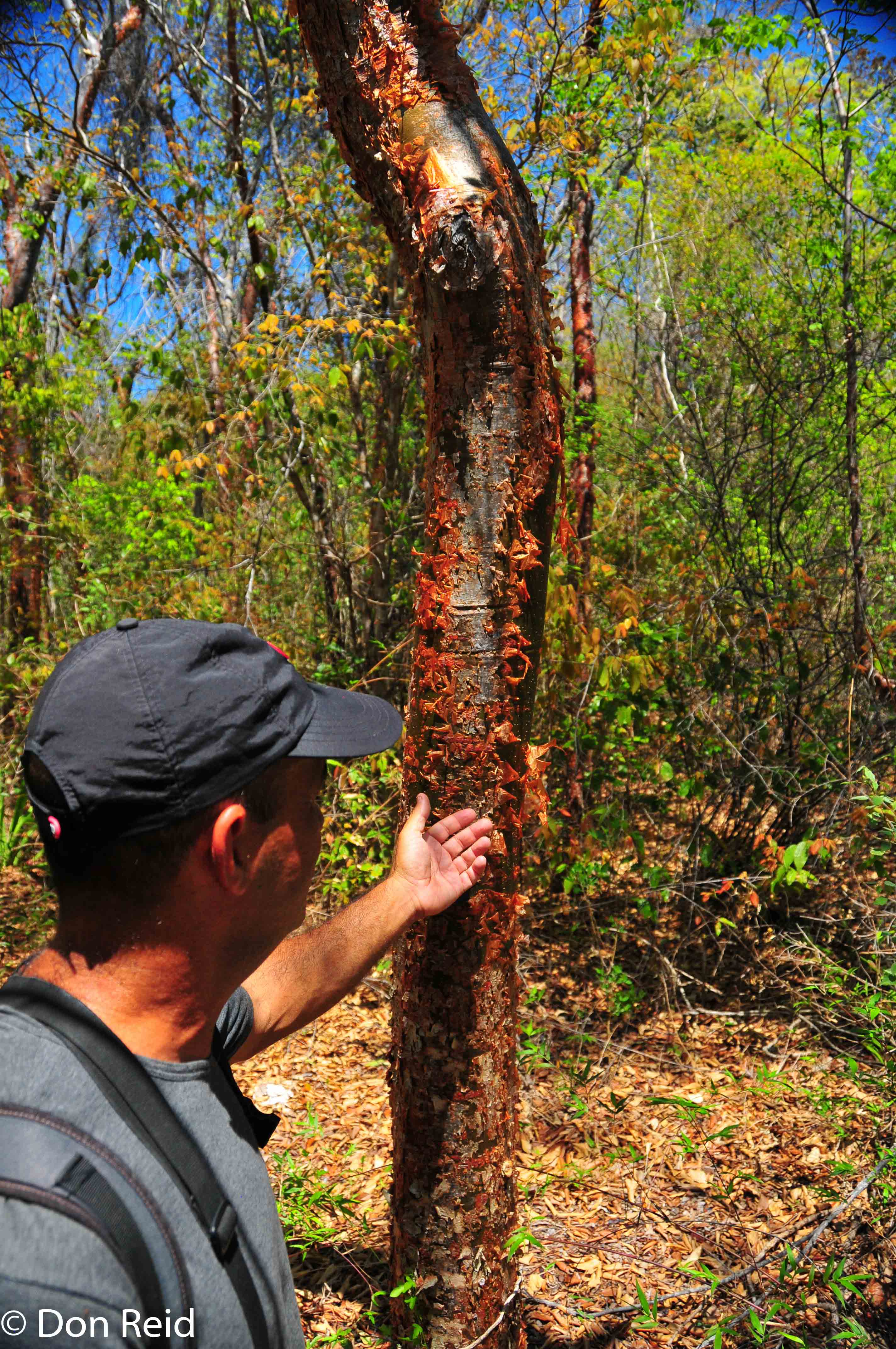
Rocks are actually ancient coral reefsCuban Brown Curlytail (Leiocephalus cubensis)My lovely assistant, Andre (someone had to carry the bird book – but note this is not a dumb blonde, he’s a Neurologist)“Tourist Skin” tree – so called because its thin red bark peels – just like the European tourists do after a few days in Varadero’s sun (Actual name is West-Indian Birch, I believe)
Ponds at Varadero Water Treatment Works
For good measure Ernesto took us to the nearby Varadero water treatment works the same day, where we clambered through a gap in the fence and found a number of exciting birds in the network of ponds.
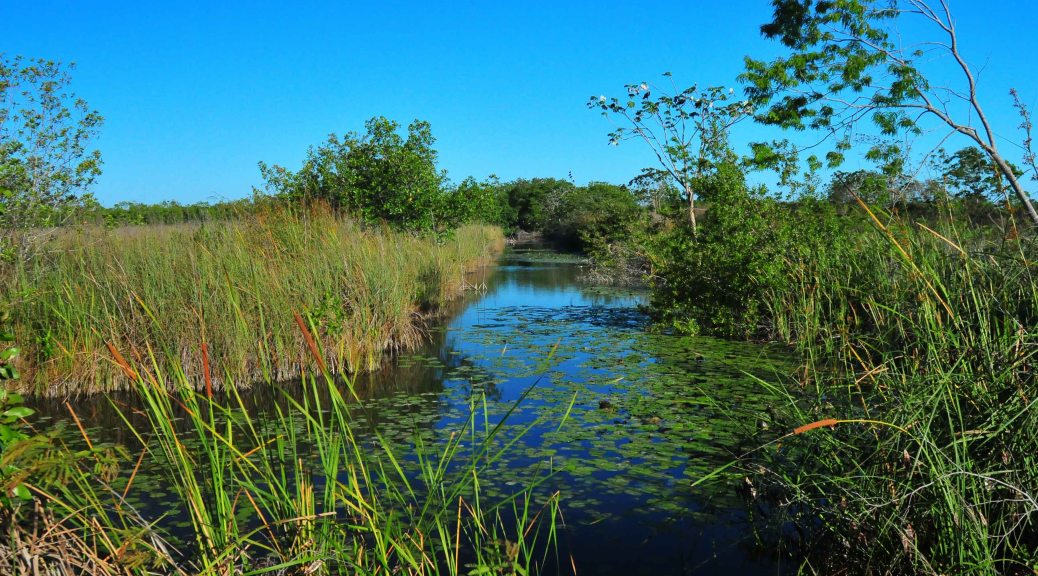
Ponds at the Varadero Water treatment works
Tri-coloured Heron
White-chinned Pintail
Northern Shoveler
Northern Shovelers take to flight
Blue-winged Teal
Common Moorhen (for a change, an “ordinary” bird)
Laughing Gull
White Ibis
American Coot
American Coot and White Ibis sharing a patch next to one of the ponds
Well-satisfied with our “bonus” trip to the Nature Reserve and Water Treatment works, we thanked Ernesto for his wonderful assistance, bade him goodbye and got a taxi back to our hotel, where we continued our lazy existence for the rest of our 11 day stay. When our memorable holiday came to an end, we were taken by bus back to Havana (all part of the package) where we caught the Virgin Atlantic flight back to Gatwick near London, followed by a taxi shuttle (which you can pre-book) to Heathrow for our overnight flight to Johannesburg.
” Ernesto did everything else extremely well and made sure that we had an incredible and fruitful day as he showed us one new bird species after another and knew exactly where to find the specials, including a number of Cuban endemics that birders would give their eye teeth to see”
Finding a Bird Guide
While planning our trip to Cuba in early 2011, I searched the internet (well, Google did all the work) for any birding opportunities in the 2 areas we were to visit, namely Havana and Varadero. In the process I came across a reference to Ernesto Reyes, who did bird guiding from the Varadero area, and sent him an email. He soon responded with suggestions and this led to me booking him for a day during our stay at Sol Palmeras resort hotel on the Varadero peninsula.
I looked forward to the chance to do some birding in Cuba, which was likely to be a once in a lifetime opportunity in such an exotic location, but wasn’t really sure what to expect. I purchased a Cuba bird guide which I had a good look at before leaving for Cuba, so that I would have an idea of what birds could be found in the various habitats, and this helped a lot.
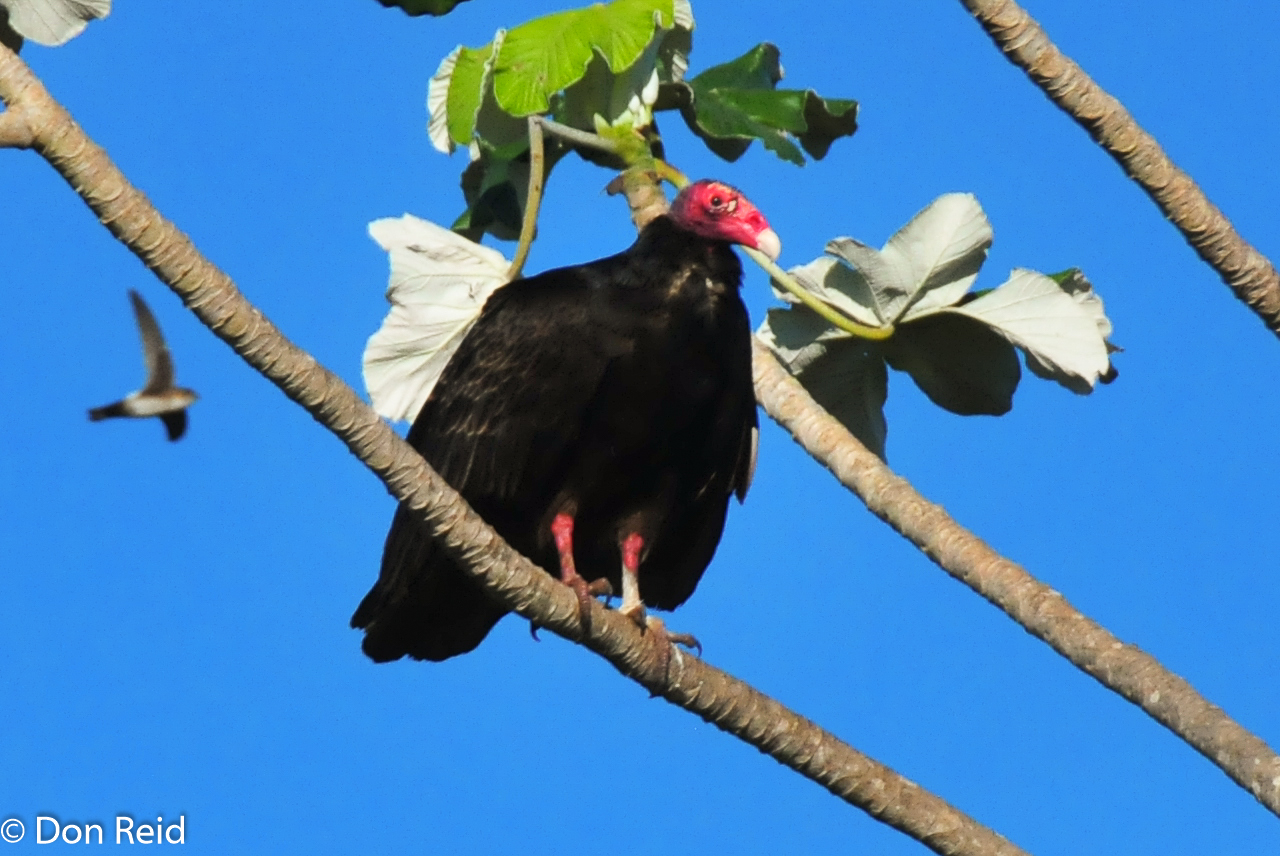
Turkey Vultures are everywhere – and a Martin caught flying by!
The Trip
Our main destination for the day was the Parque Nacional Cienaga de Zapata – the Zapata Swamps National Park, which is located south-east of Havana and south of Varadero where we were staying in a fine resort hotel. The Zapata peninsula is bordered on the east side by the infamous Bay of Pigs, the site of the failed attempt by American-backed forces to invade Cuba back in 1961. Along the way Ernesto had planned stops at various spots to find some of the Cuban specials.
My daughter Geraldine agreed to accompany me and we were ready in the early hours outside the hotel main entrance, breakfast packs in hand, waiting for Ernesto and his driver to collect us. It seems that very few Cubans have driving licences because so few are allowed to own cars and Ernesto, married with kids, was not a driver, although he did take over on some of the back roads and showed us how not to pull away and change gears. Ernesto did everything else extremely well and made sure that we had an incredible and fruitful day as he showed us one new bird species after another and knew exactly where to find the specials, including a number of Cuban endemics that birders would give their eye teeth to see.
Zapata peninsula lies south east of Havana
From Varadero we headed to the southern side of Cuba, passing through small villages on the way, one of which had a main street with more horses and old-fashioned horse-drawn cabs than motor cars
Country scenesCountry transportCountry scene
An hour or two later we entered the Zapata National Park area where our first stop was at a forested area alongside the road – we walked a short distance along a wooded path before Ernesto stopped and started pointing out bird species.
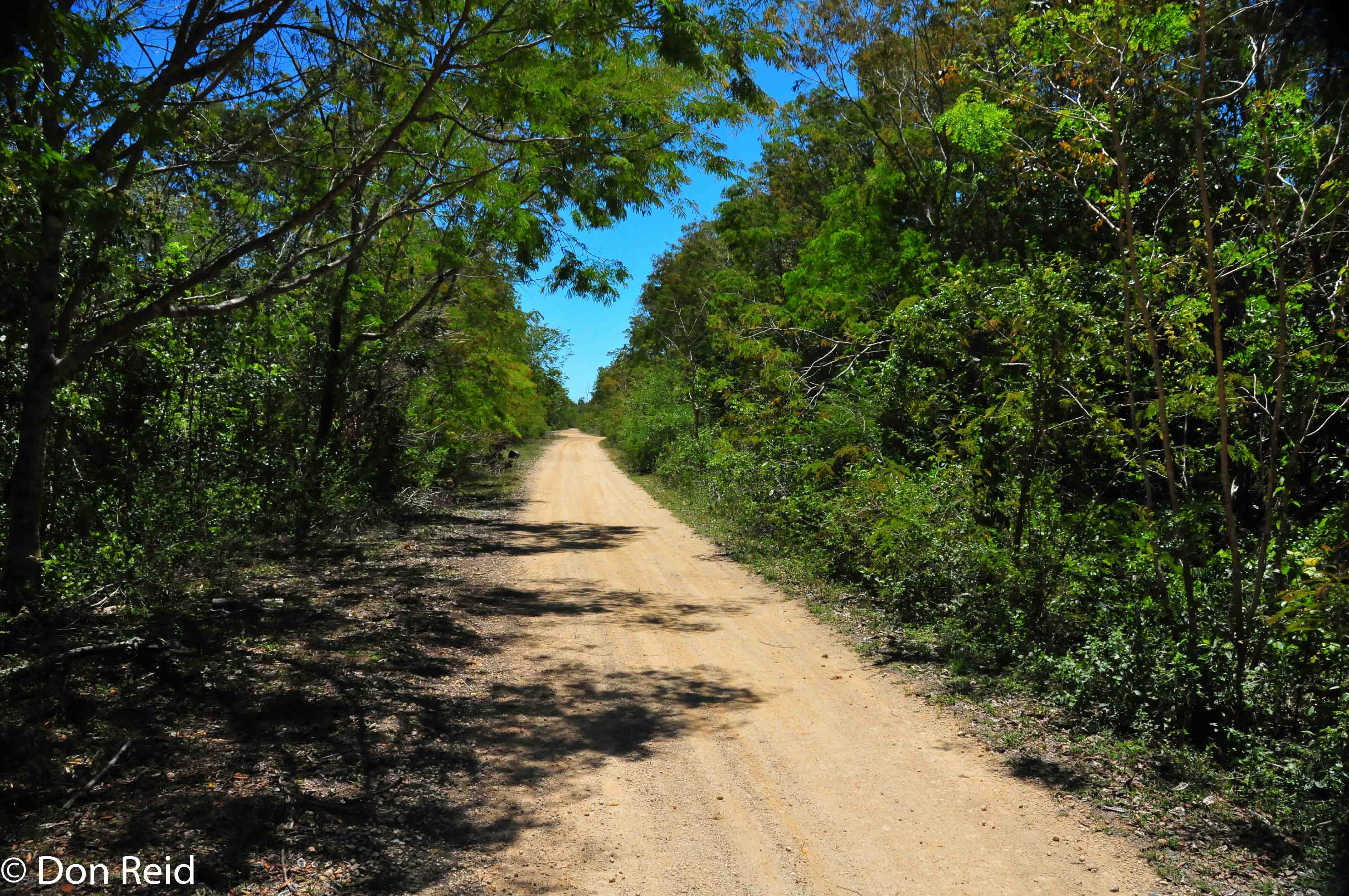
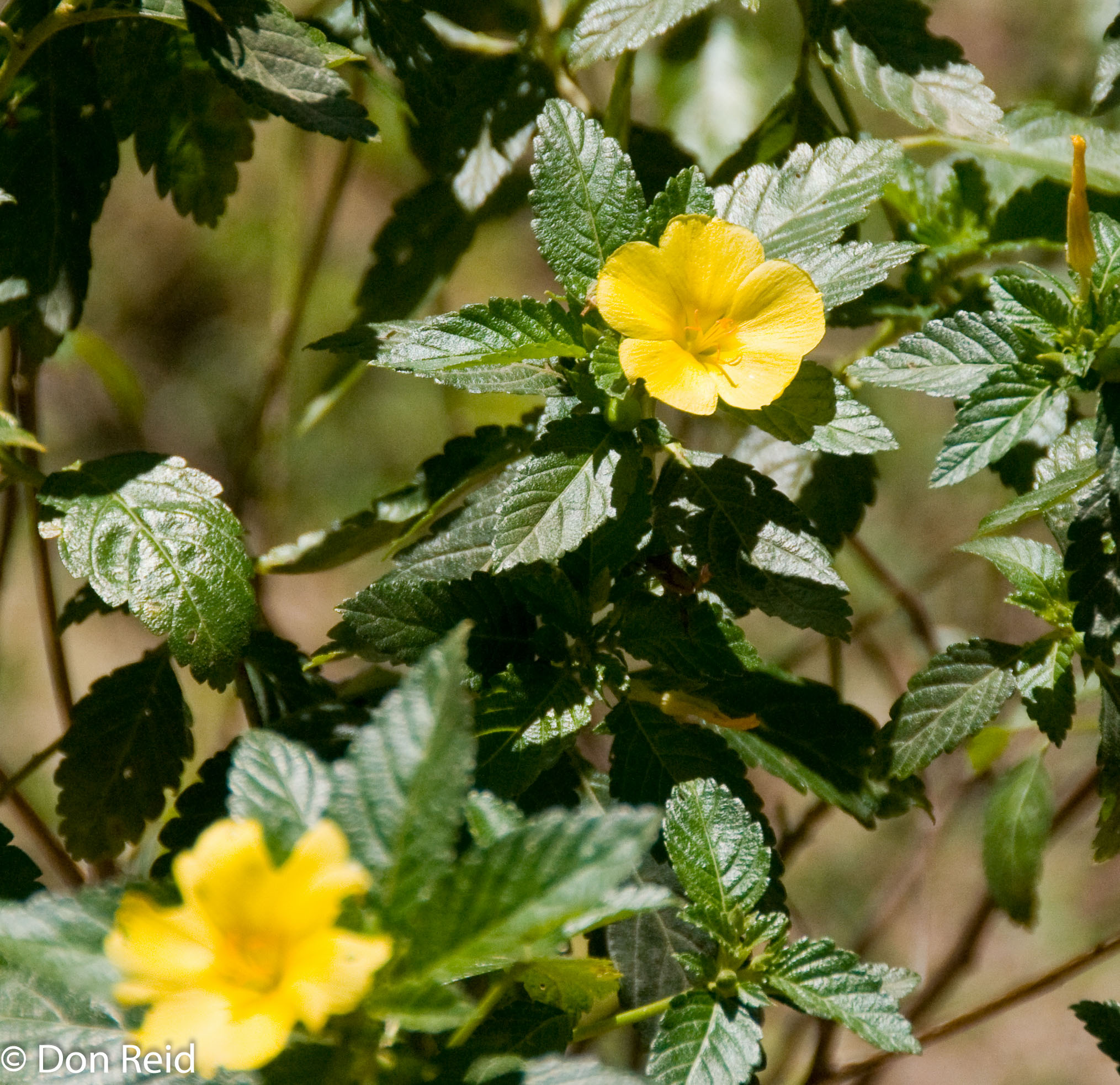
Forest roadForest flowers
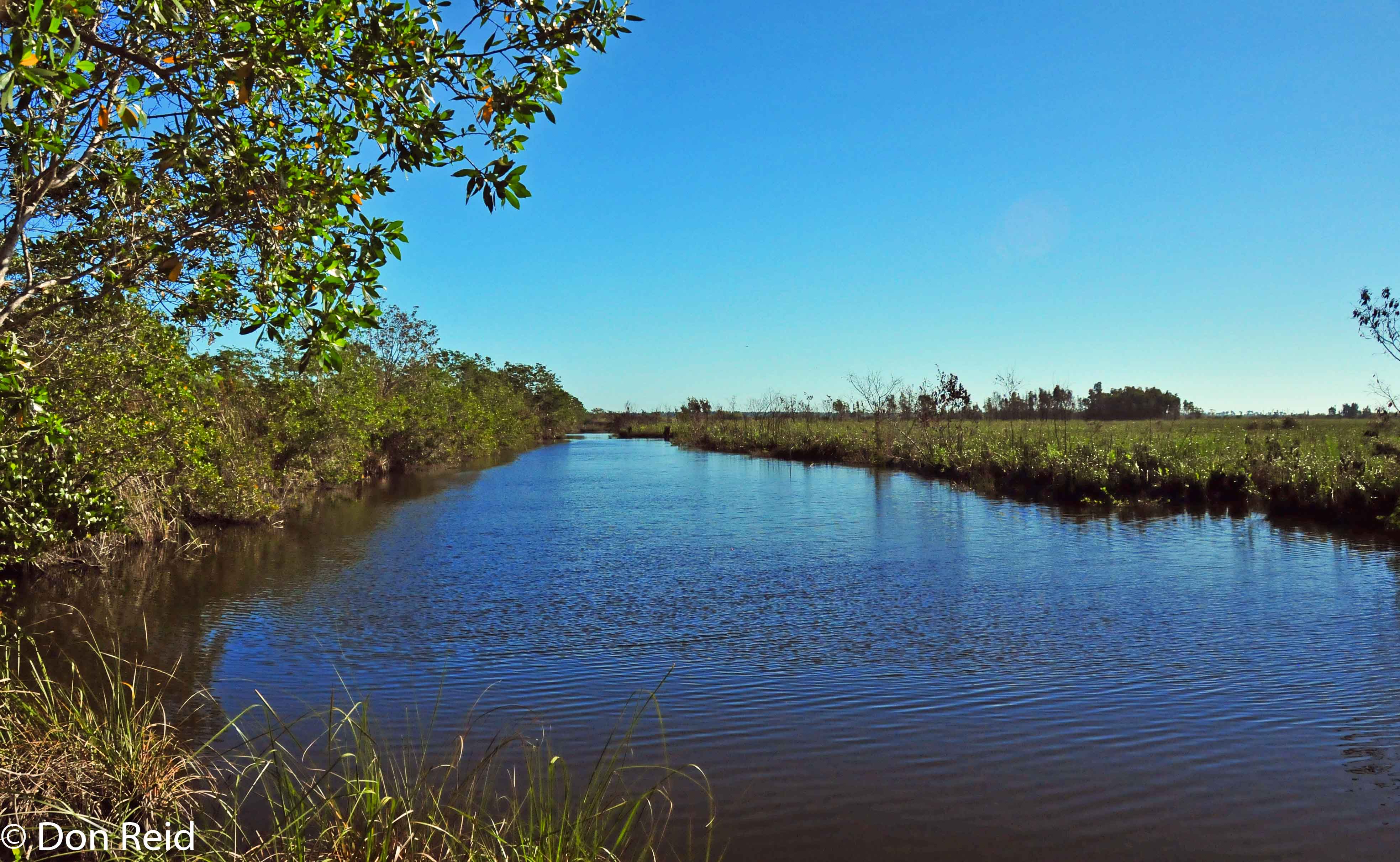
This happened a few more times until we reached the Zapata swamps, where we drove to various points then walked further along paths between the waterways, pausing to greet fishermen who were catching supper.
Zapata SwampsZapata SwampsJust to prove I was there
At one point we came across a group of American birders who were touring in a large luxury bus and they immediately called us over to view a very special bird, the Zapata Wren, through their scopes. We were surprised to find Americans in Cuba, knowing of the frosty relationship that exists and sanctions applied by the US on Cuba – apparently they are able to get permission for special trips
Ernesto and Geraldine about to meet up with an American group of birders in the Zapata Swamps
Their guide was one Arturo Kirkconnell, who happened to be co-author of the Cuban field guide I had bought, Birds of Cuba and he was kind enough to sign it and write a short message, which made the day extra-special.
Lunchtime with the locals
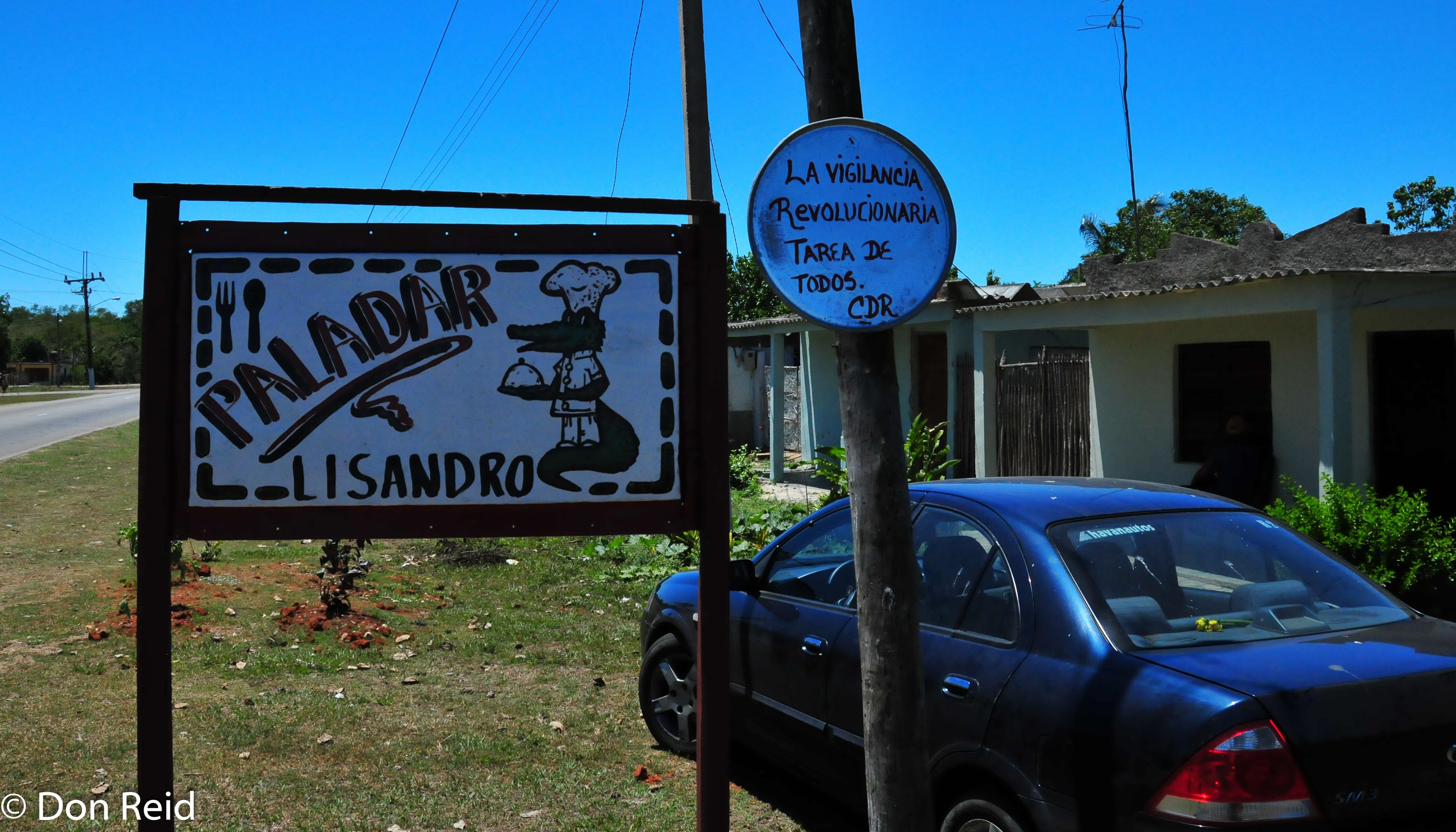
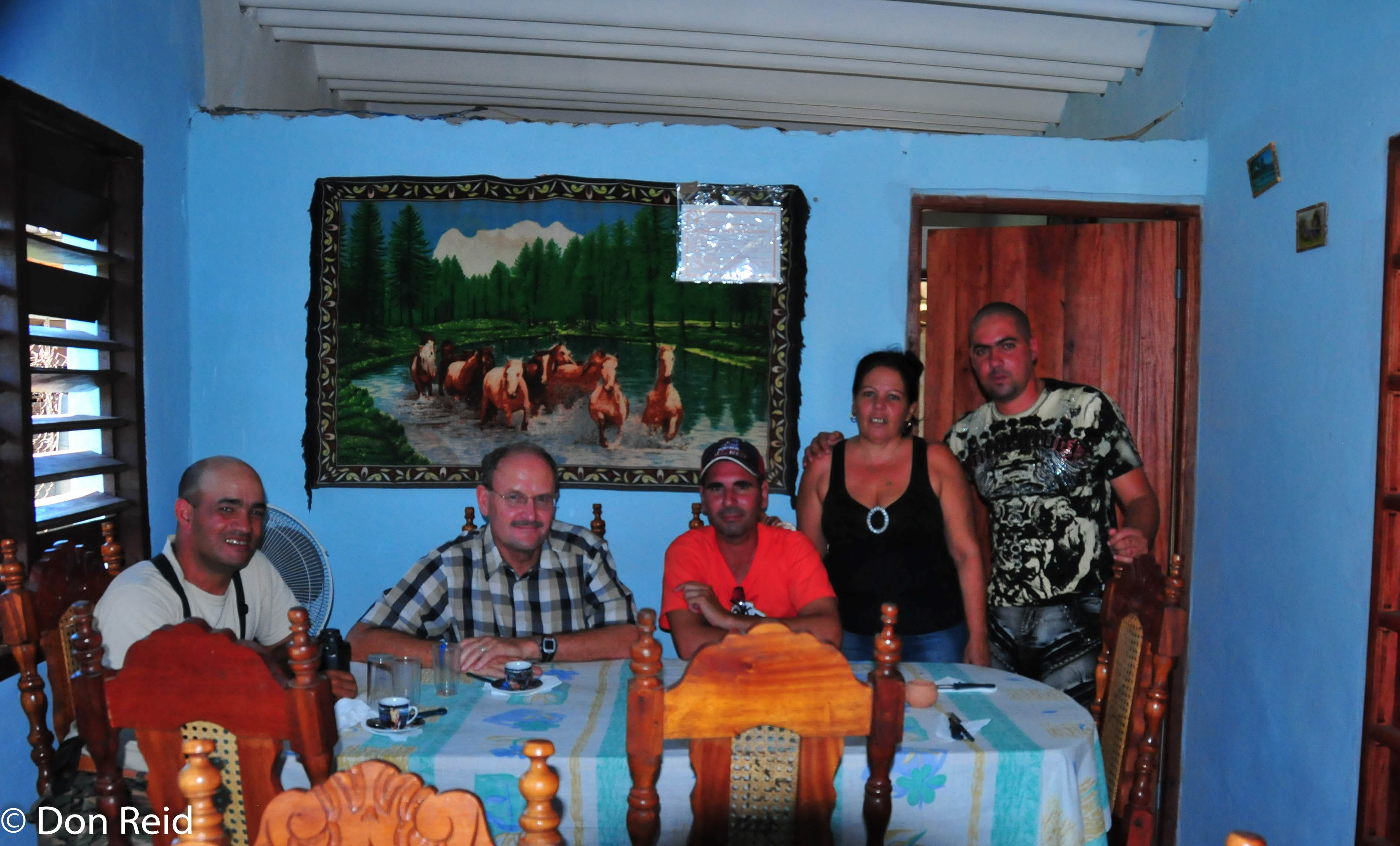
Ernesto offered a choice of a “Tourist Stop” standard lunch or he could arrange with some local people who, like a growing number of Cubans, have small restaurants in their homes. We chose the latter and it was a very special experience, eating in humble surroundings and served Cuban fare by the family – nice to be able to support them.
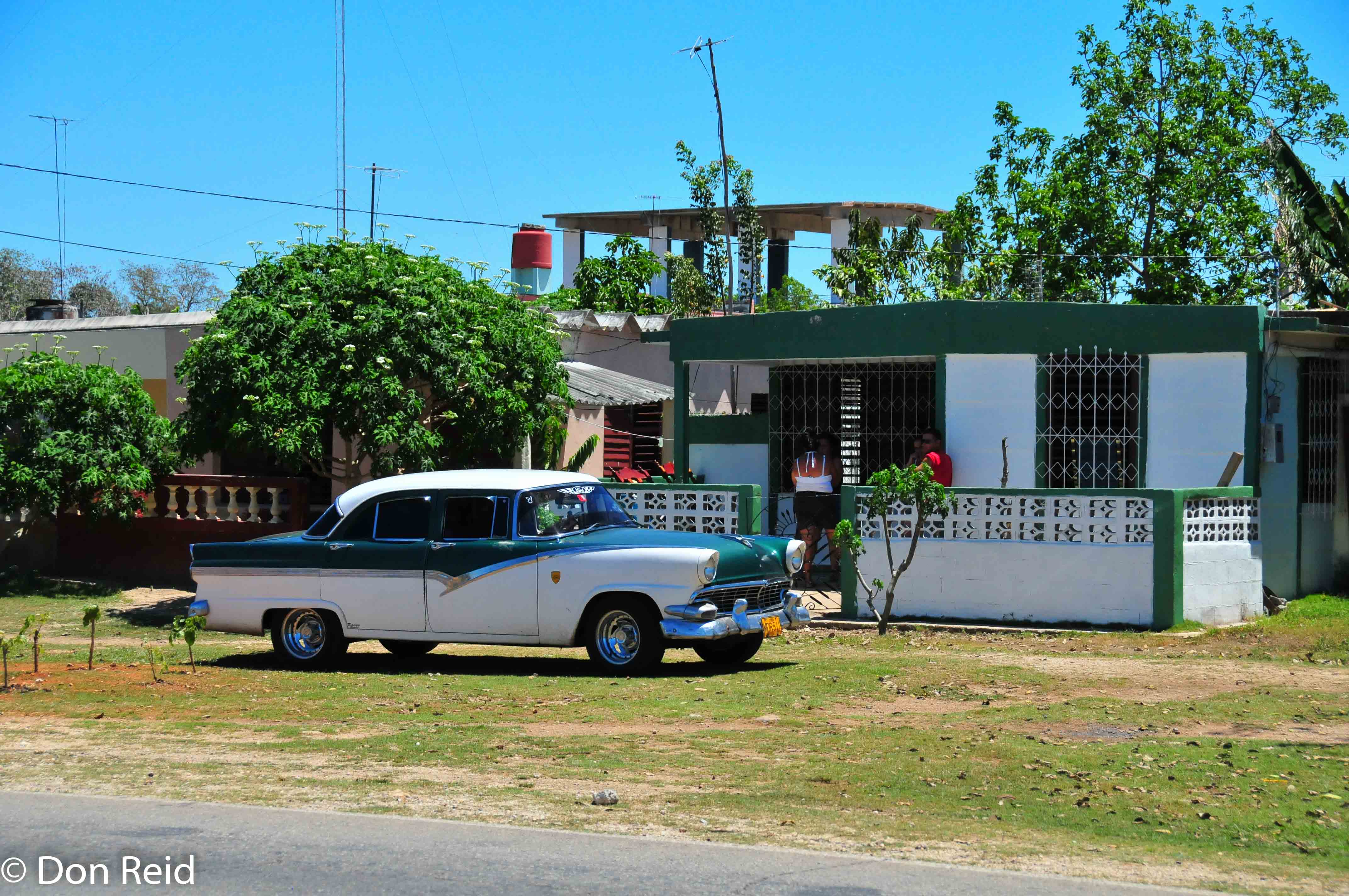
The “home” restaurant, the sign confirms they are approved by the governmentErnesto and Don with the driver and the husband and wife who run the home restaurantClassic in the country
Zapata Swamps
One source describes it thus:
The Zapata Swamp is a mosaic of mangrove swamps and freshwater and saltwater marshes that form the largest and best-preserved wetland in the Caribbean. The swamp was designated a Biosphere Reserve in 1999 and forms a vital preserve for Cuban wildlife, a spawning area for commercially valuable fish, and a crucial wintering territory for millions of migratory birds from North America. More than 900 plant species have been recognized in the swamp, and all but three of the 25 bird species endemic to Cuba breed there
Also a feature of the Zapata Peninsula is the system of caves along the coast, some of which have caved in creating small lakes. We visited one such flooded cave in a small reserve a short distance from the beaches of the Bay of Pigs – the largest flooded cave in Cuba, 70m deep and crystal clear
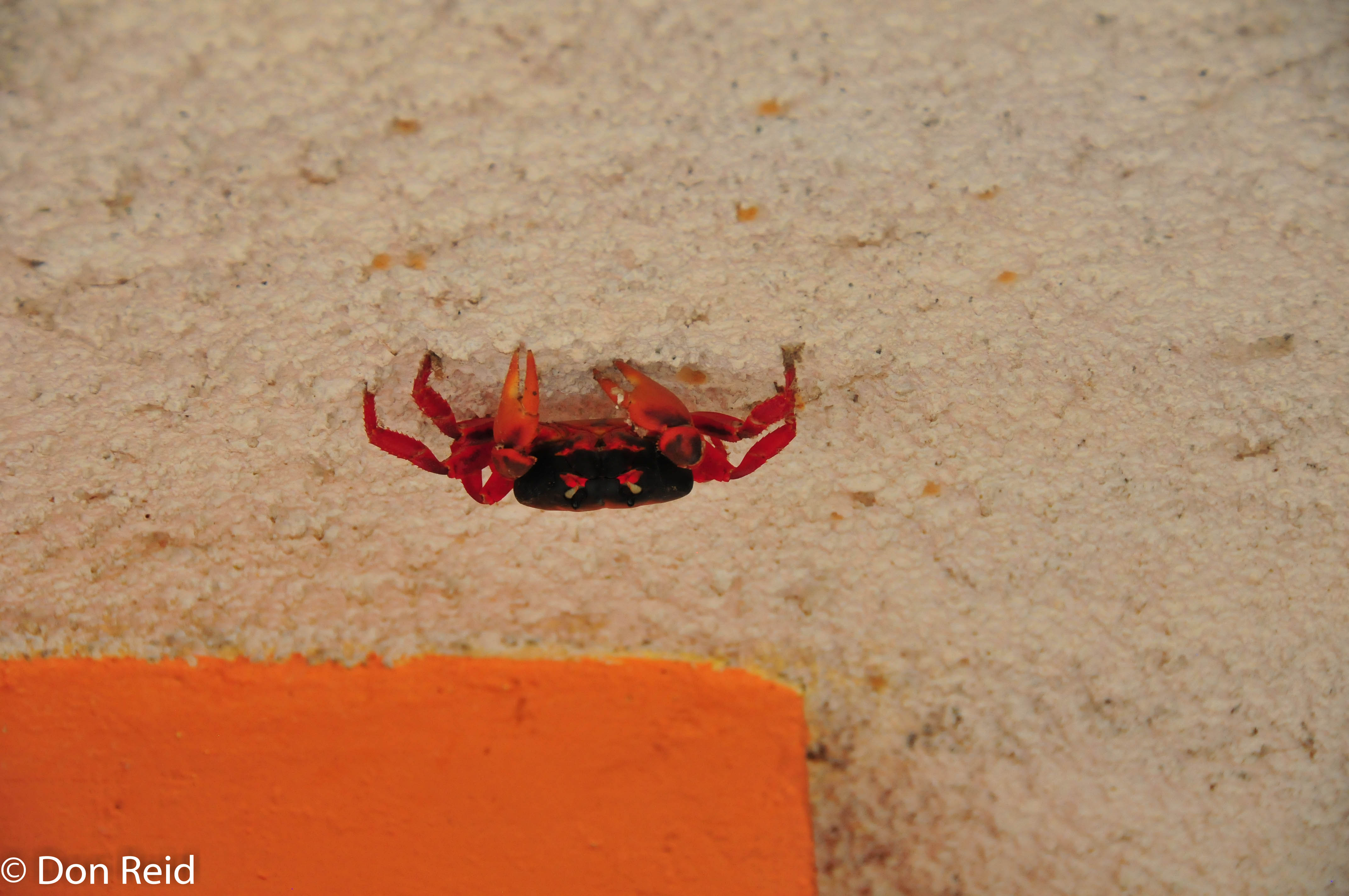
The flooded caveGeraldine braves a rickety bridgeCrystal clear water allows you to see the fish quite easilyThese red crabs migrate to the beaches by the thousand at certain times
The birds
It was a veritable feast of ‘lifers’ for me – no less than 49 during our one day trip to Zapata National Park and a further 14 in the space of a couple of hours spent at the Varadero Nature Reserve – but it’s not all about numbers, more about the experience of birding in such exotic and amazing locations.
The birds seen included the following – short descriptions are taken direct from my field notes :
Once again, where I was able to get a photo, the quality of the photos is very ordinary due to not having my “birding” lens on the trip (I won’t make that mistake again) so I had to make do with a standard zoom lens.
Zapata Forest:
The forest was not as dense as some I’ve experienced – it was not too difficult to see the birds which Ernesto found. The rock underfoot looked volcanic or could be ancient coral.
Cuban Tody – small round colourful bird with a long thin bill
Yellow-faced Grassquit – male and female pair, small sparrow-like bird
Red-legged Honeycreeper – dark purple plumage, turquoise cap and red legs make it a very distinctive bird. Top of tree
Red-legged Honeycreeper
Common Yellow-throated Warbler – the first of many warblers, all in combinations of yellow, black and brown
Stripe-headed Tanager – colourful small bird in the mid-stratum
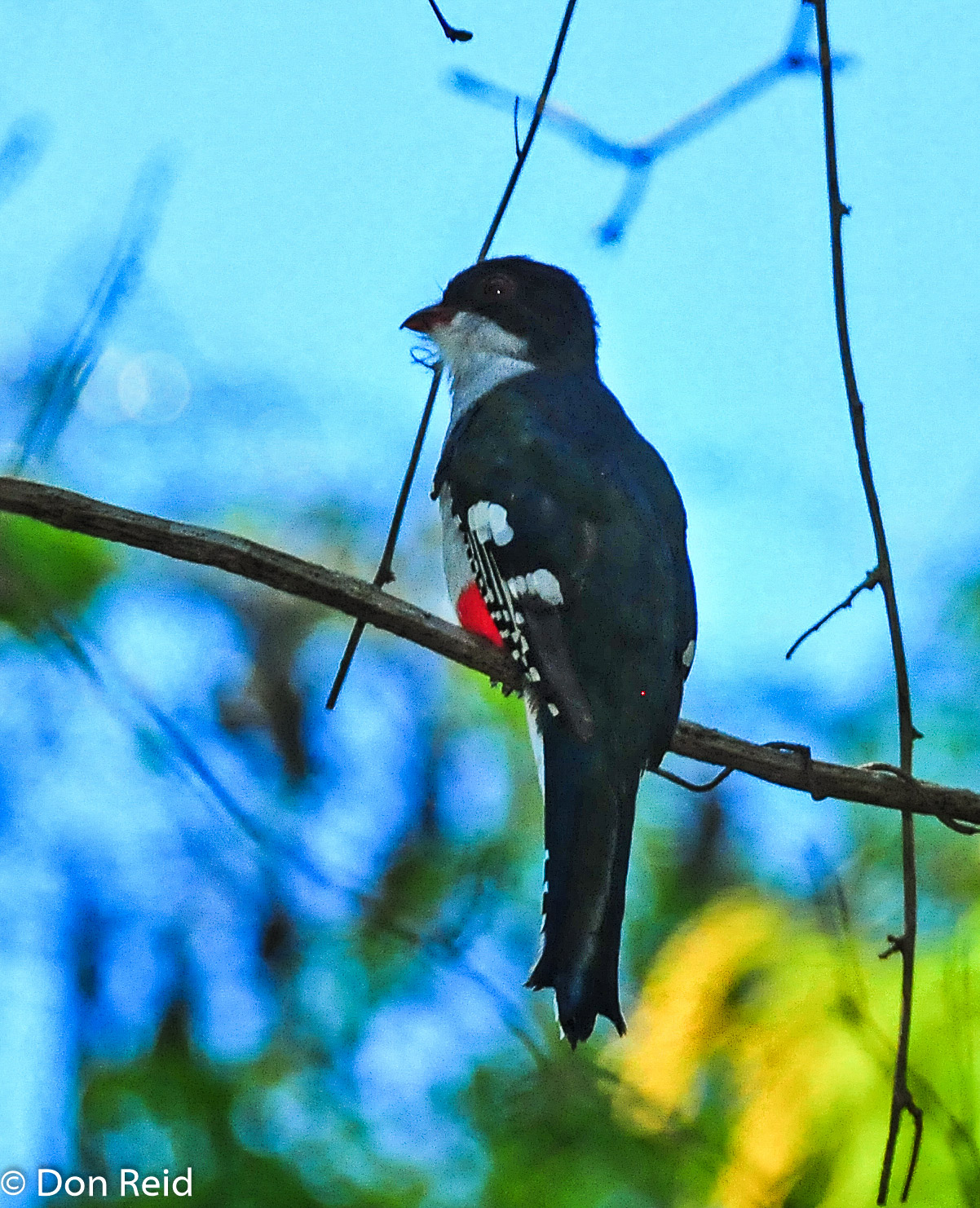
Cuban Trogon – signature bird for Cuba and their National Bird. Loud call, easily seen, 5 sightings during the day
Cuban Trogon
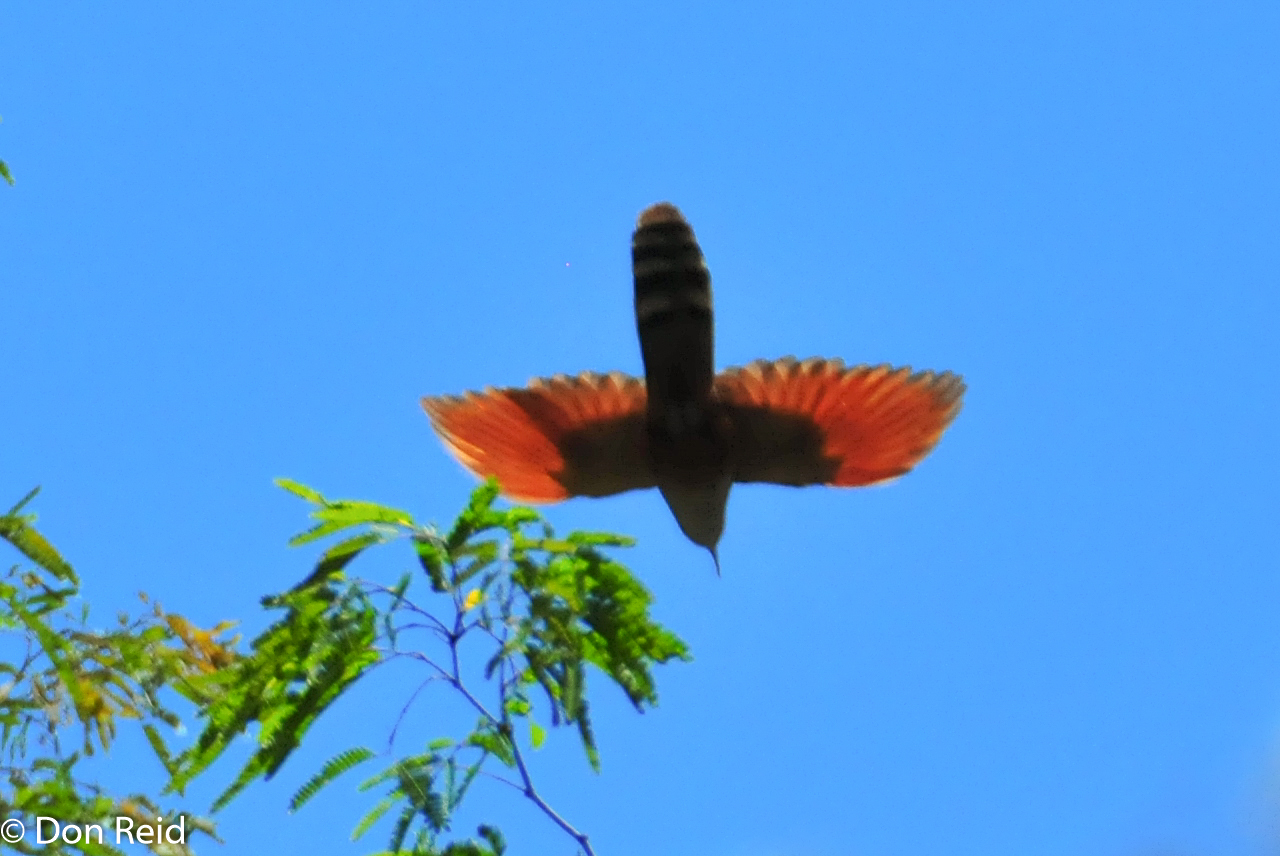
Great Lizard Cuckoo – secretive, large bird (Coucal size), light brown in colour. I just caught it on camera as it flew off.
Great Lizard Cuckoo disappearing over the forest
More Warblers in quick succession (we would have had no chance of ID-ing them without Ernesto) – Yellow-headed Warbler, Black-throated Green Warbler, Prairie Warbler, Magnolia Warbler. Cuba lies on the migration route between North and South America for many of the Warblers and we happened to be there when many of them are visitors to this Caribbean island.
Northern Parula – another Warbler
Cuban Vireo – looks like our White-eyes, just 2m from us in the tree
Cuban Vireo
Black-whiskered Vireo
Black-whiskered Vireo
Zenaida Dove – forest path, pair on the ground amongst leaf litter
and then, a surprise sighting………..
Surprise in the forest
Zapata Swamps
Barn Swallow – just like home
Zapata Wren – the US visitors were very excited about finding this rare endemic – brownish barred bird with long tail, singing vigorously in the reeds
Indigo Bunting – blue all over, short bill
La Sagra’s Flycatcher – mid stratum, crested appearance
La Sagra’s Flycatcher
American Redstart – male, mid stratum
Yellow-crowned Night-Heron – Flying overhead
Tawny-shouldered Blackbird – group of 5 – all black except for orange patches on shoulders, tree tops
Loggerhead Kingbird – large, flycatcher-like, crested appearance, low in branches
Double-crested Cormorant –
Double-crested Cormorant
Pygmy Owl – much like our Pearl-spotted, similar in size, low in tree next to channel
Northern Waterthrush – mid stratum, most resembles our Prinias
Roadside Stops
Ernesto stopped at various spots along the way, often at places known to be home to some of the specials. We also stopped at one of the government-run “Tourist Stops” where you can have snacks and meals
Tourist Stop – Ernesto in conversation with a birding personality
Smooth-billed Ani – large, all-black Coucal-like bird – on the way to Zapata
Black-cowled Oriole – ponds near Tourist Stop, top of tree
American Kestrel – roadside pole
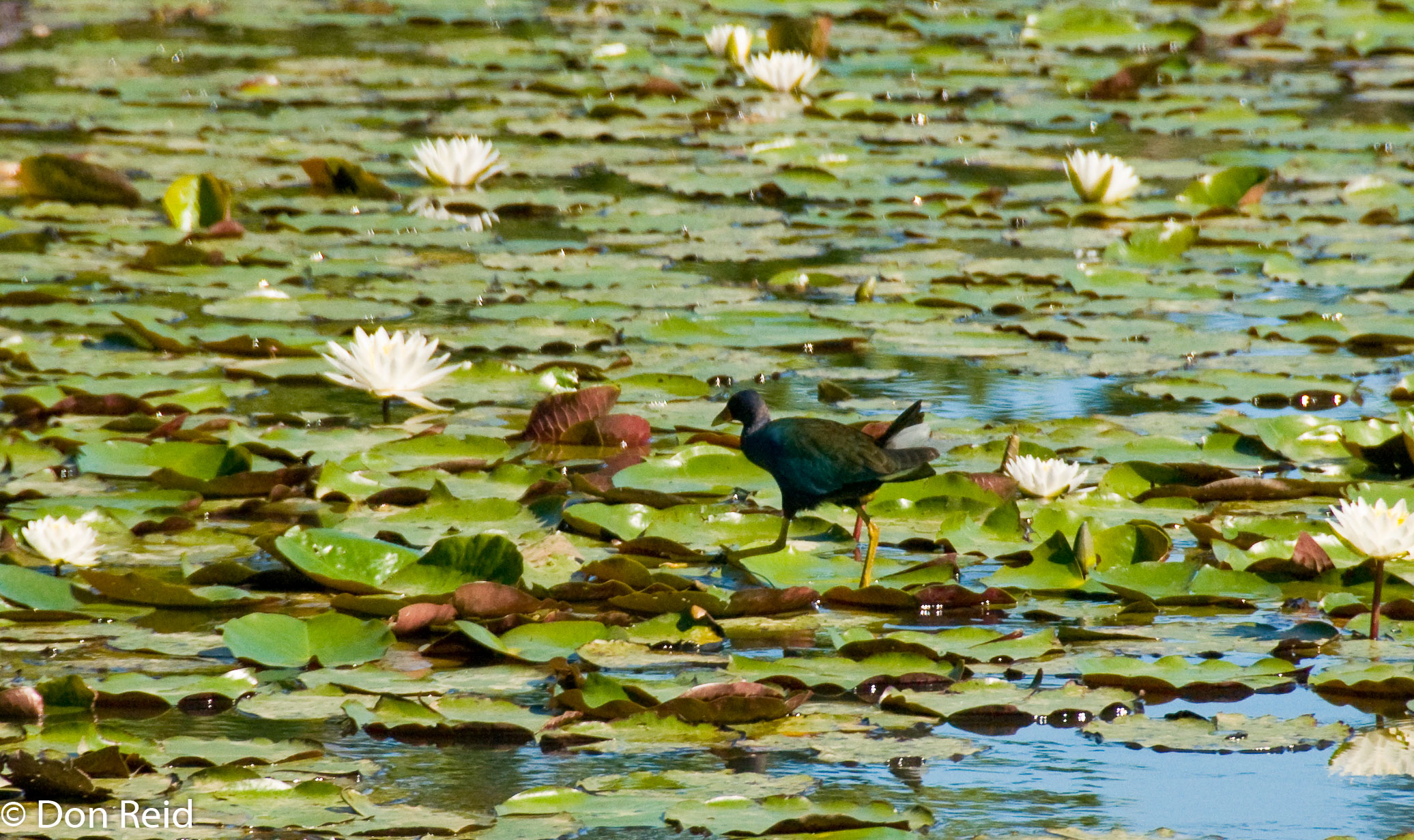
Purple Gallinule – ponds near Tourist Stop, walking on lilies
Purple Gallinule
Purple Martin – overhead
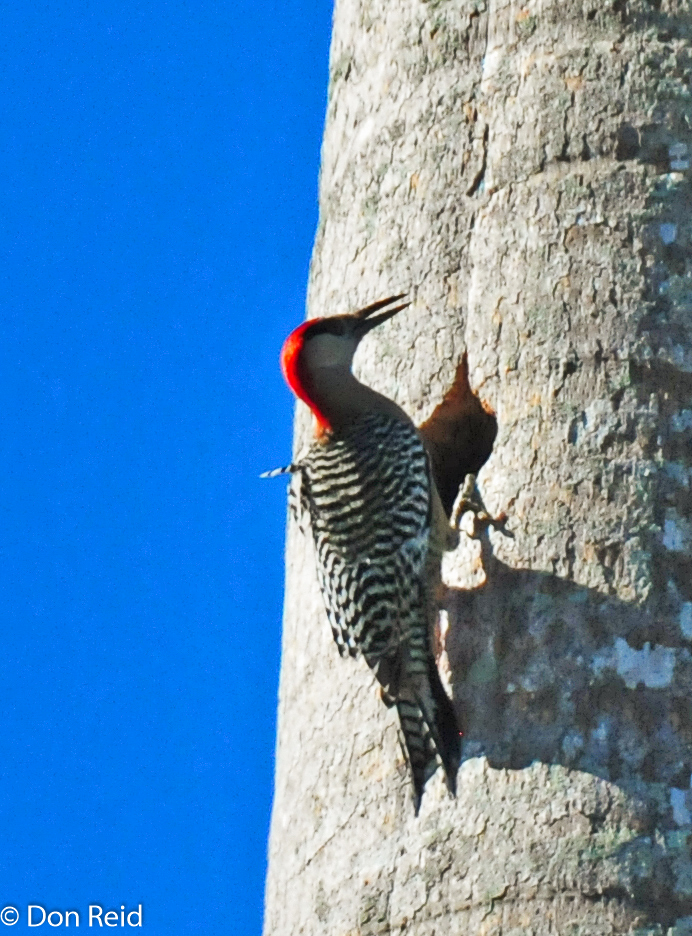
West Indian Woodpecker – near Tourist Stop, pecking at nest-hole in Palm tree
West-Indian Woodpecker at a nest-hole
Cuban Crow – scavenging in road
Cuban Crow
Cuban Parrot – near Tourist Stop, top of tree
Great Egret – probably same as Southern African species – ponds near Tourist Stop
Great Egret
Great Blue Heron – ponds near Tourist Stop
Osprey – flying over ponds near Tourist Stop
Red-legged Thrush – dirt road, on ground, wary
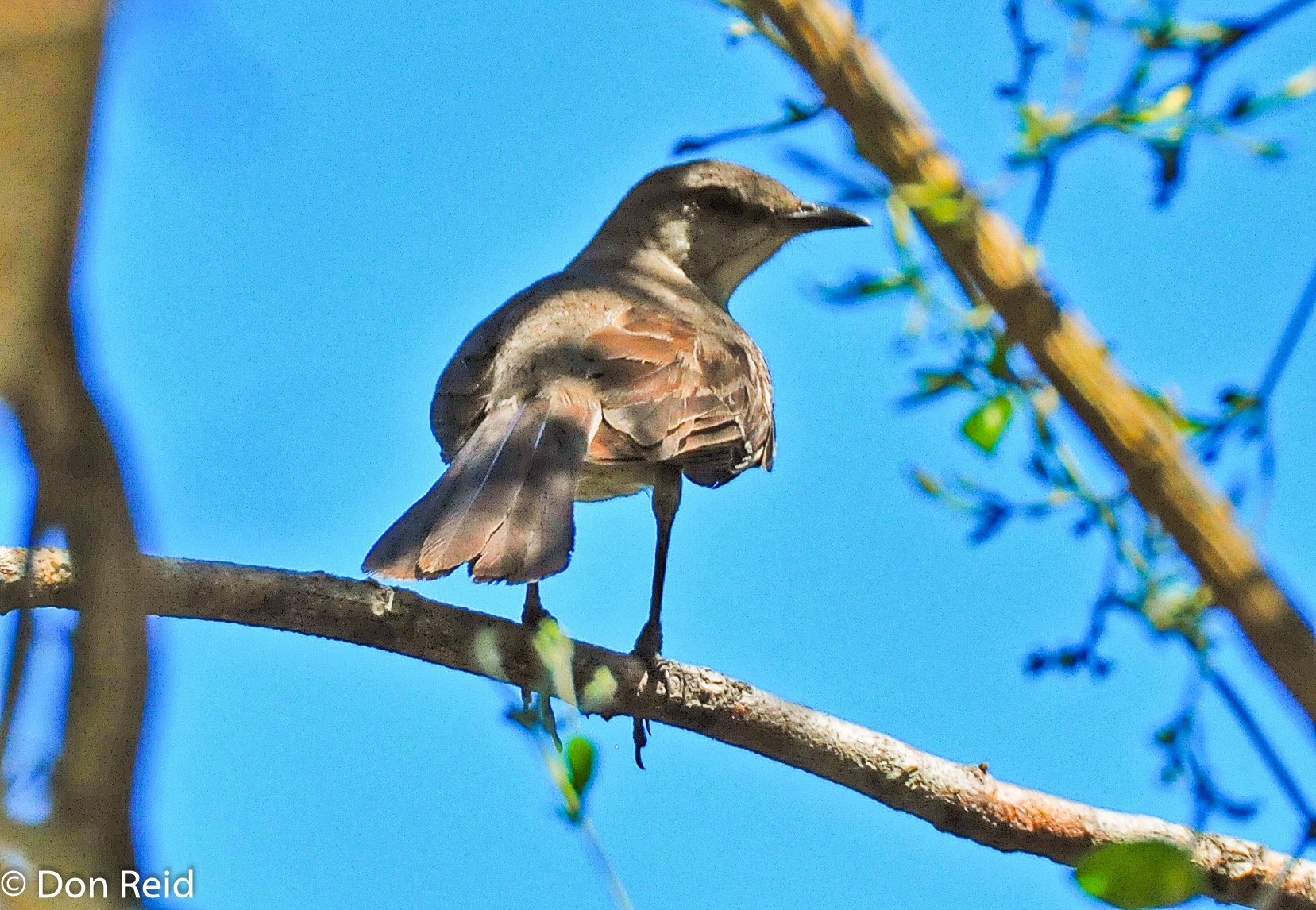
Northern Mockingbird – dirt road
Northern Mockingbird
Smallest Bird in the World !
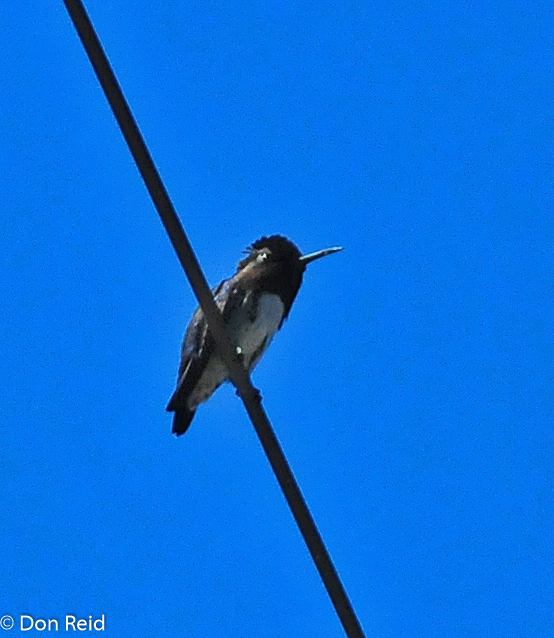
The bird we desperately wanted to see, since realising it was a possibility – the amazing Bee Hummingbird – found by Ernesto on a dirt road off the main road. We watched, mesmerized, as it zipped from telephone wires to sparse trees across the road, almost quicker than the eye could follow, looking like a large bumble-bee. Sensational sighting! But I couldn’t get a decent photo…
The sensational Bee Hummingbird – 5 to 6cm long
Open Savannah with many palm trees
Open Savannah with palms
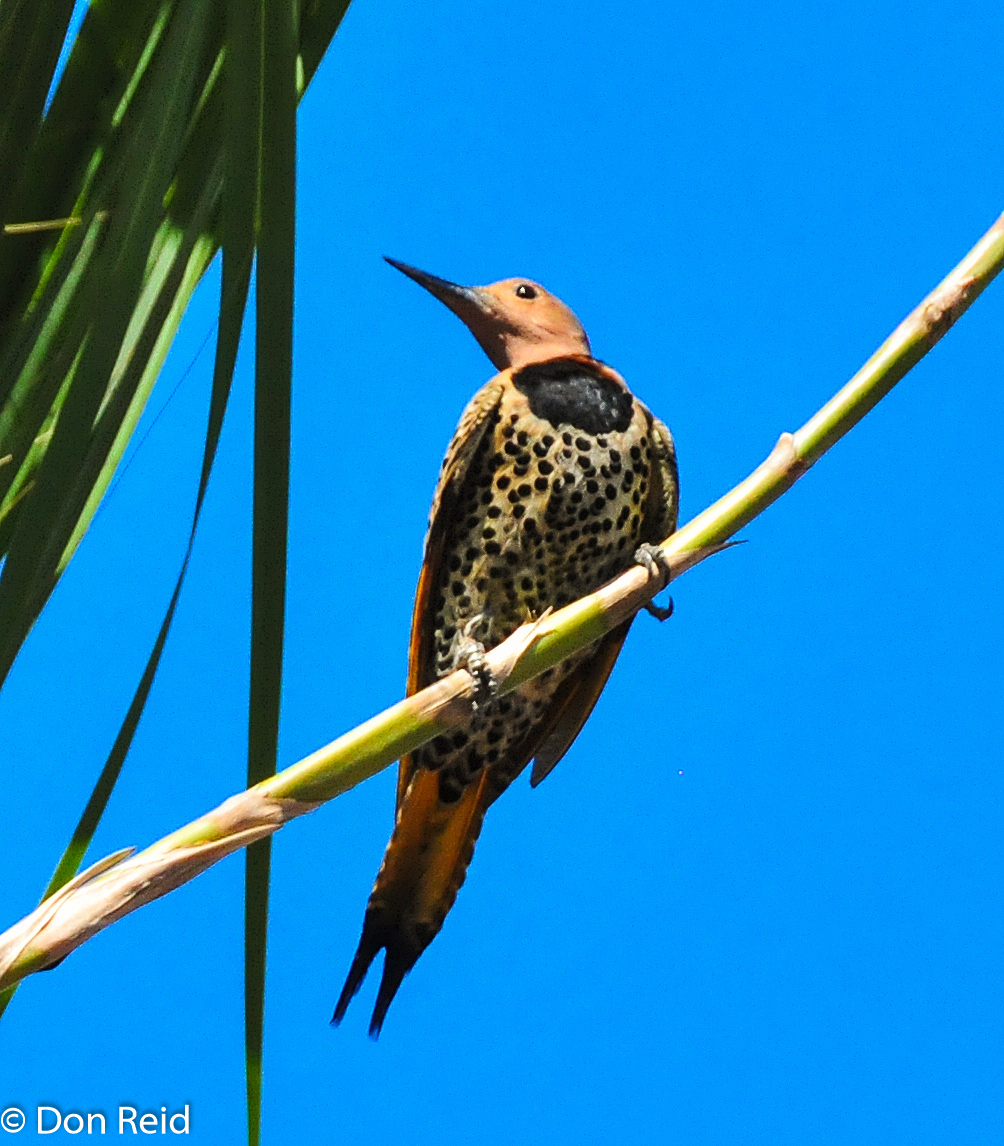
Northern Flicker – Woodpecker-like bird in top of palm tree
Northern Flicker (Female)Northern Flicker (Male)
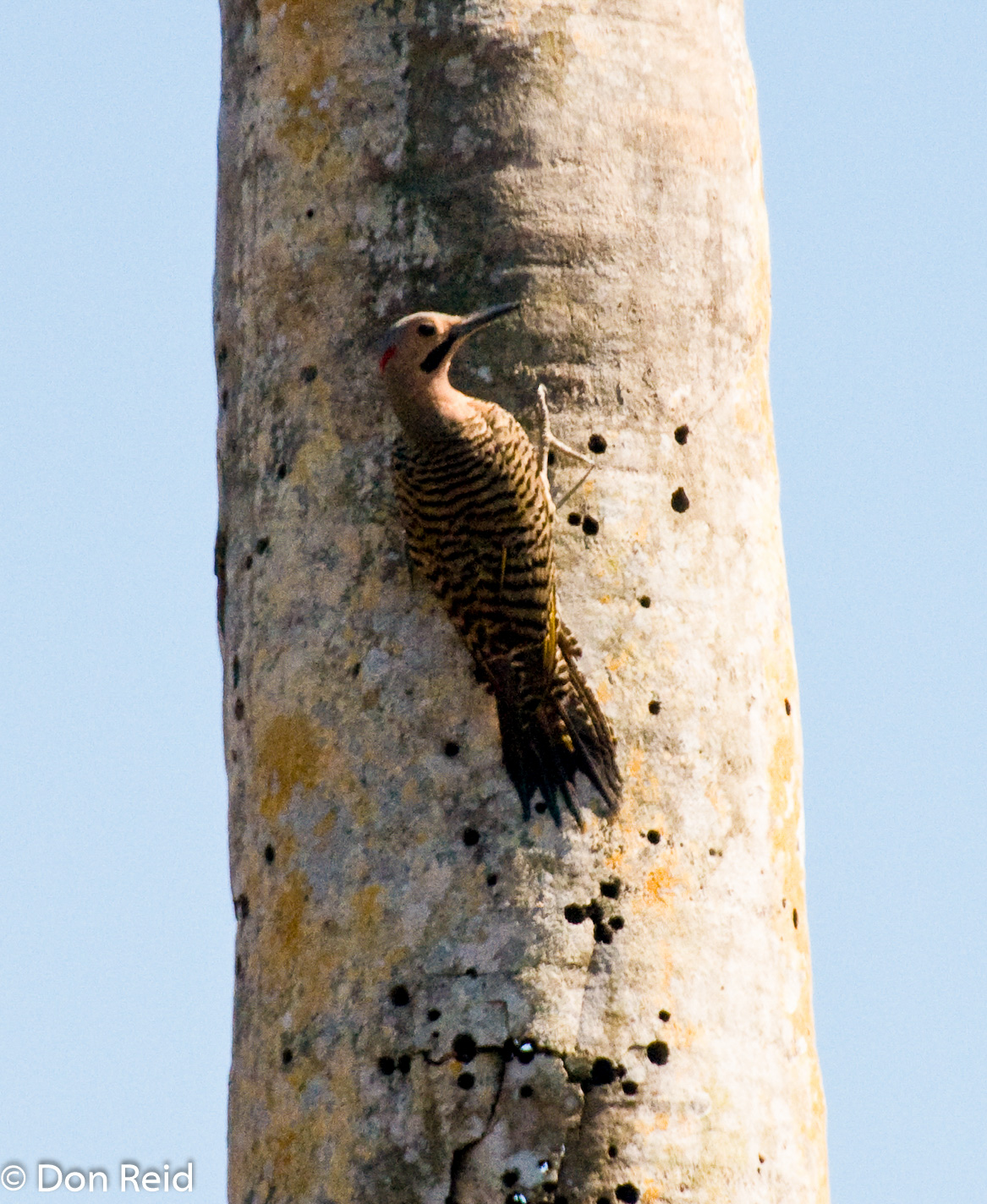
Fernandina’s Flicker – (just love the name!) Rare endemic in bare palm tree
Roadside Farm with a number of large trees
Killdeer – Lapwing-like, in short grass
Common Ground Dove – open ground
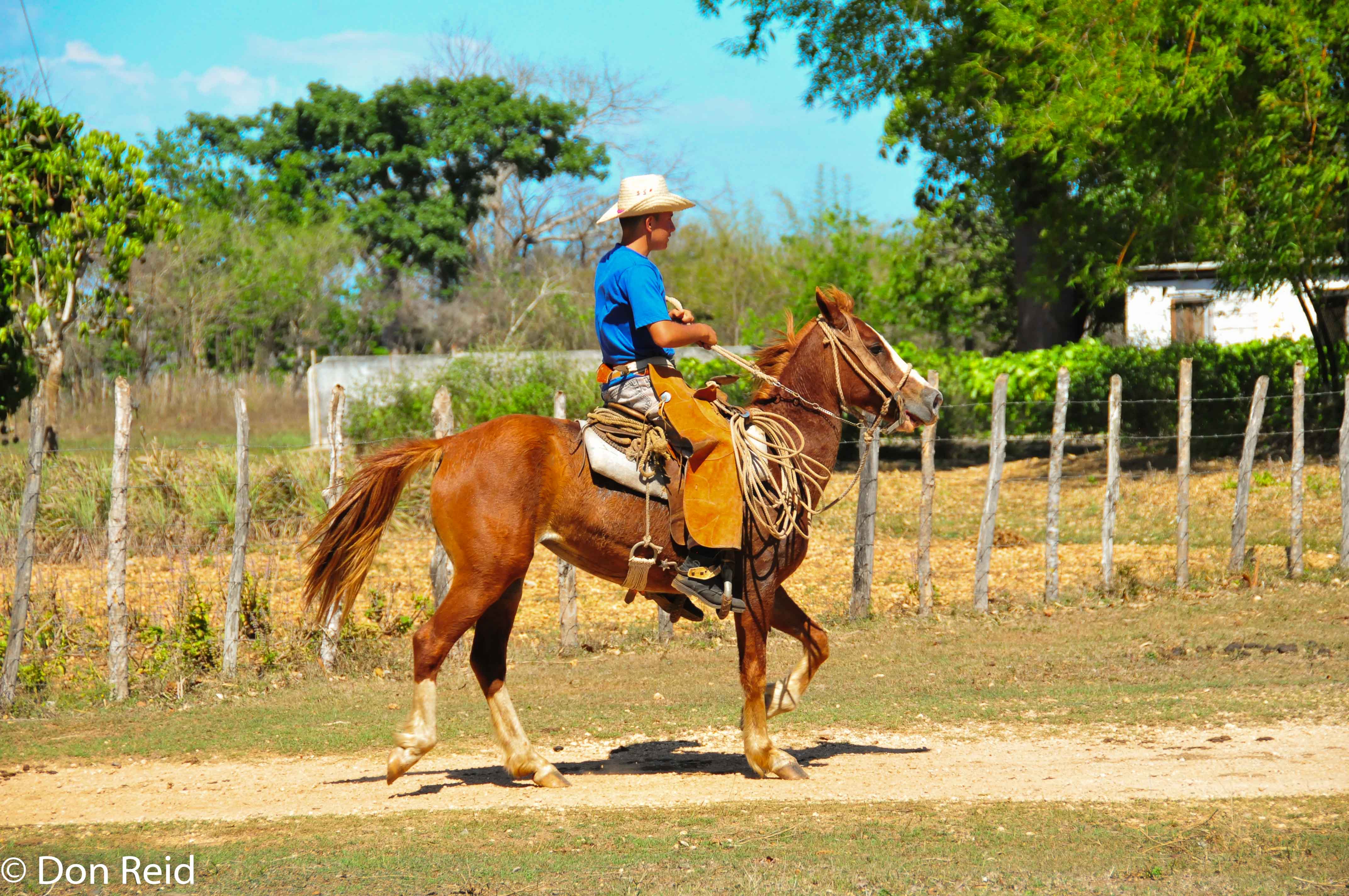
Cowboys are alive and well in Cuba
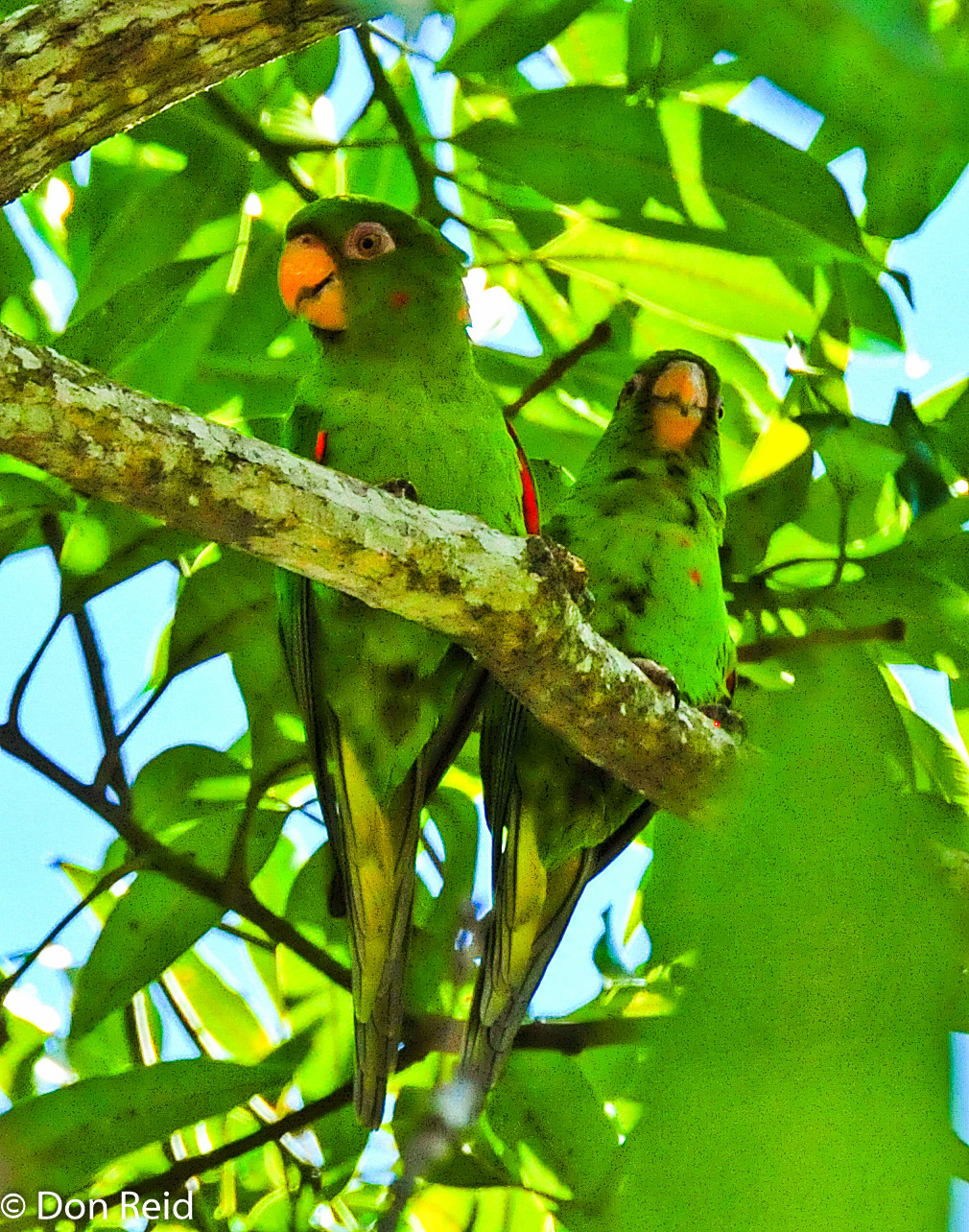
Cuban Parakeet – flock of up to 20 in large fig tree, most flew off at our approach, some returned for viewing and photo opportunities
Cuban Parakeet
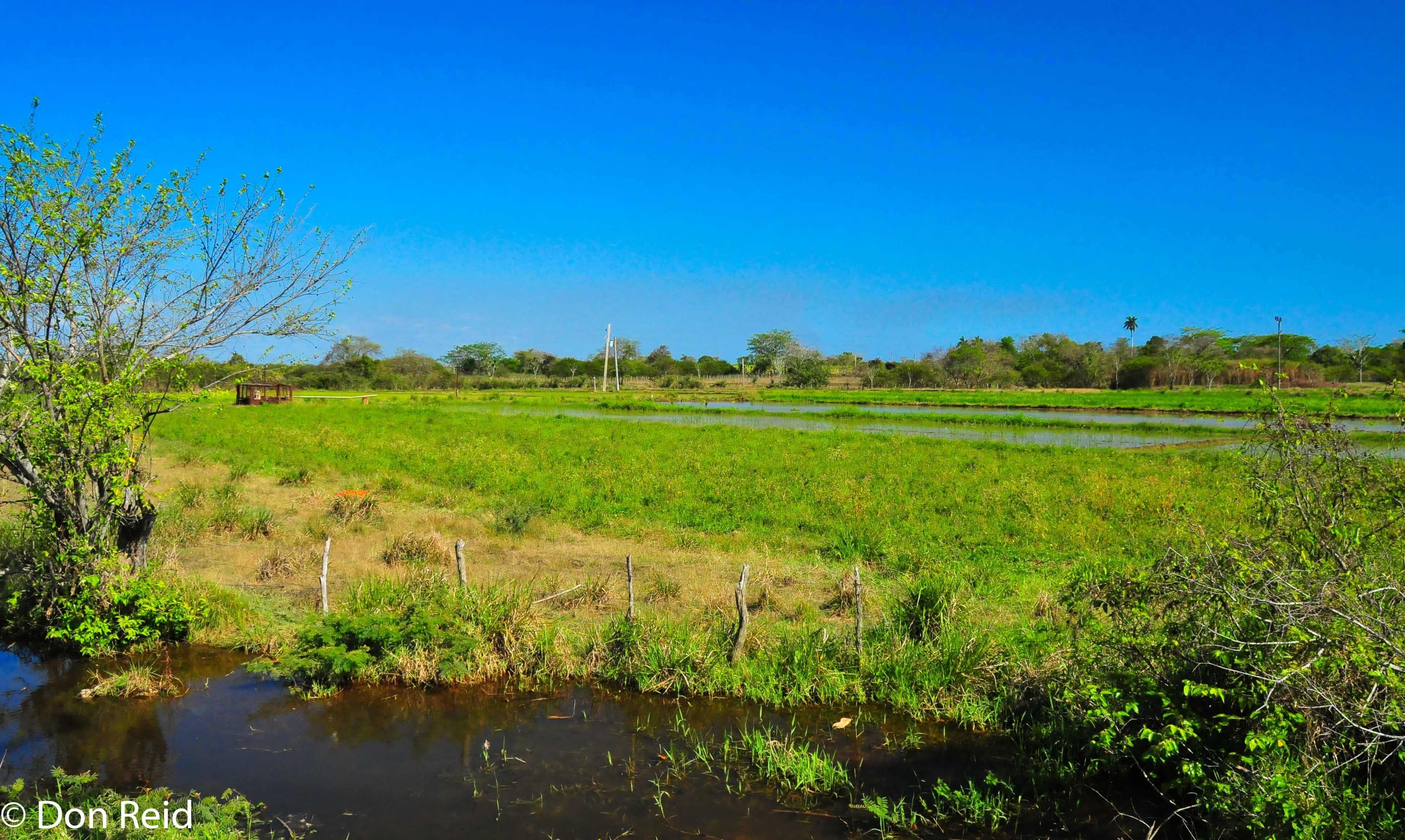
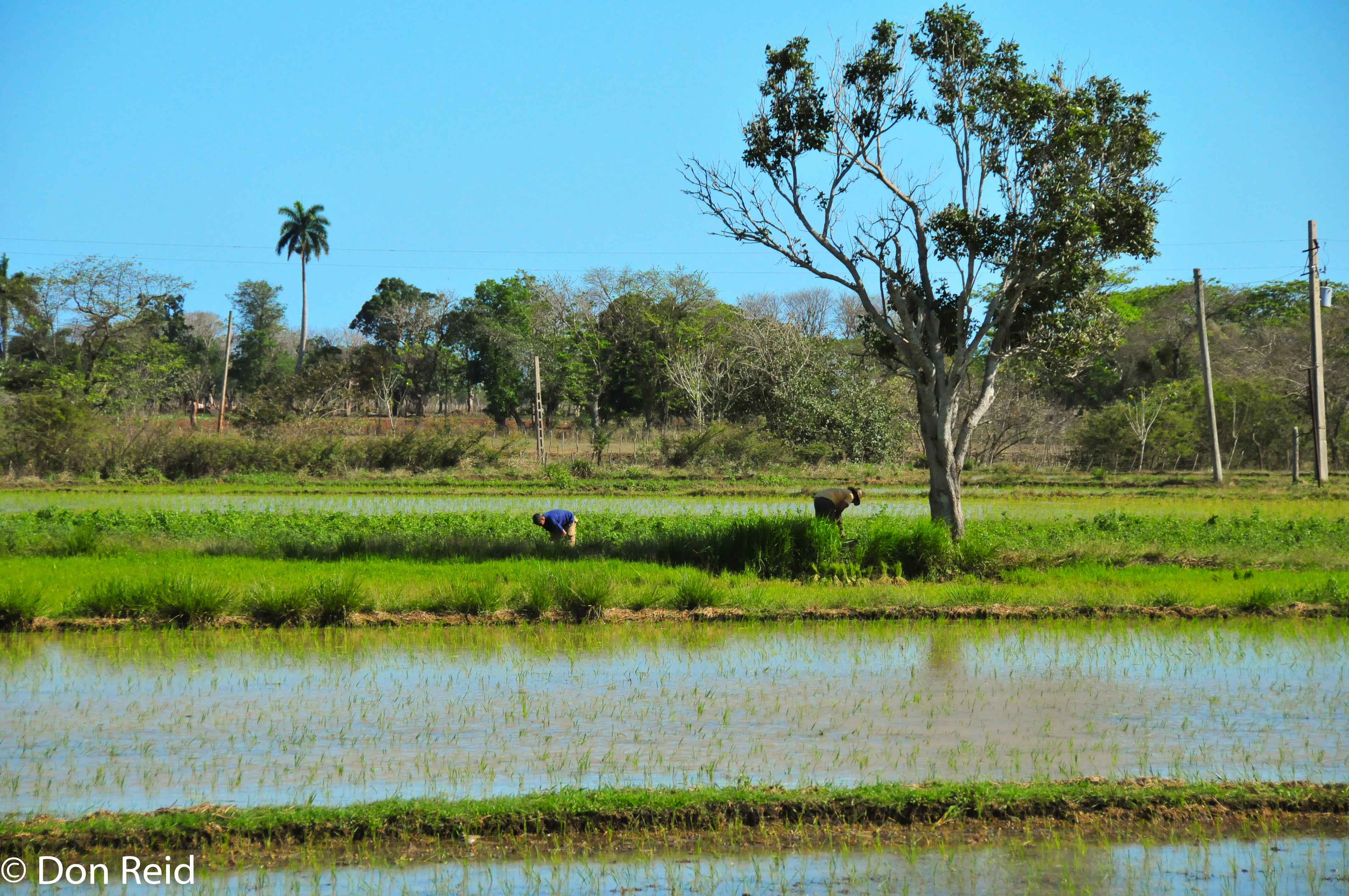
Rice paddies
Rice paddies
Lesser Yellowlegs – very much like a Greenshank in size and appearance, yellow legs conspicuous
Little Blue Heron – pair at edge of paddies
Rice paddies
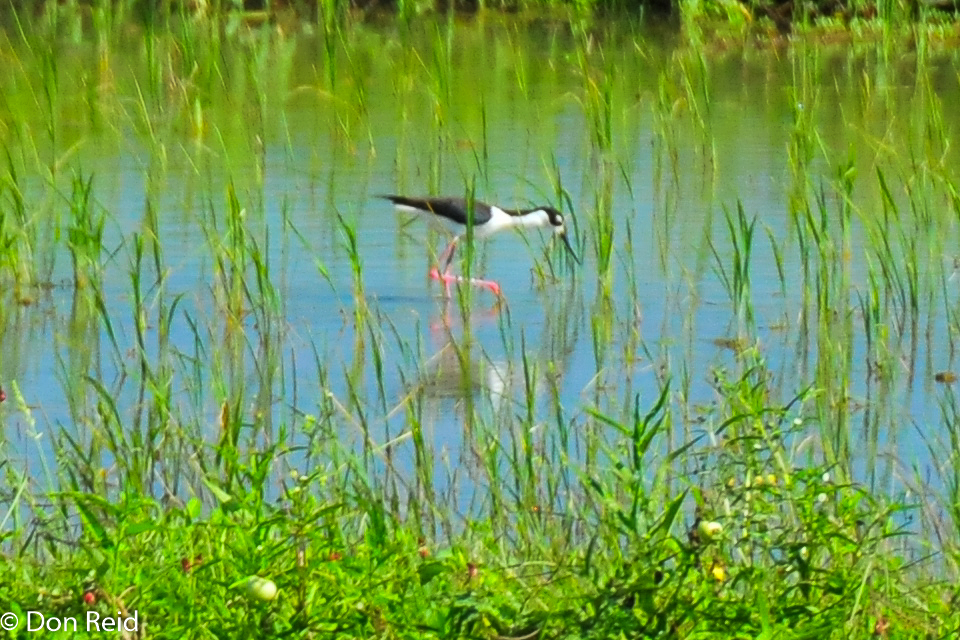
Black-necked Stilt – much like our Black-winged Stilt
Black-necked Stilt
Crested Caracara – in distant tree – large raptor reminiscent of a Harrier-Hawk
Glossy Ibis – presumably same species as ours, flying overhead
Limpkin – on bank of paddy, large bird, long decurved bill
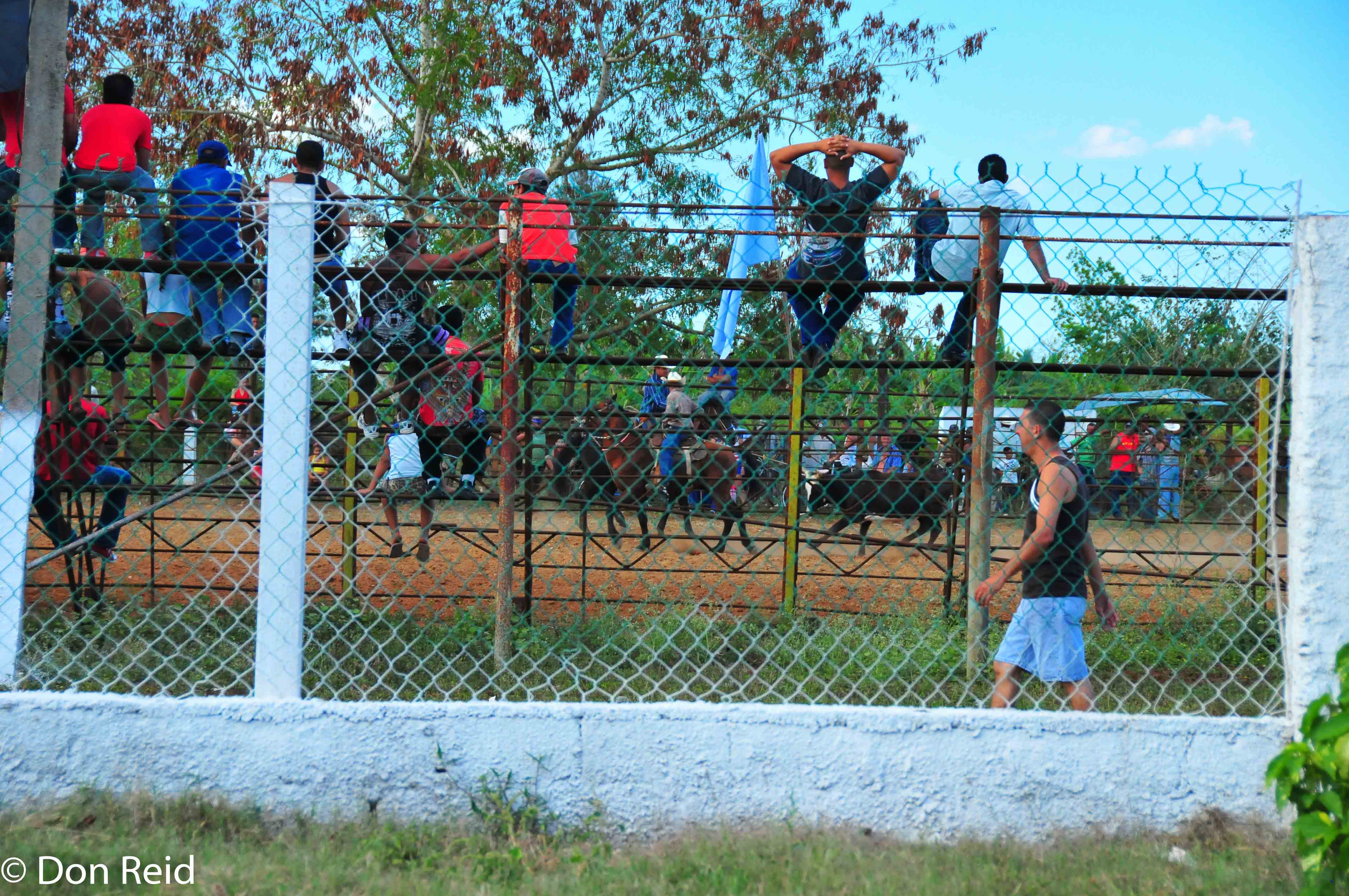
On the way back to Varadero we passed a country rodeo in progress – looked exciting
A rodeo was on the go
Ernesto and the driver dropped us off at the hotel in the evening, after a brief stop at his home in a nearby town to meet his wife and daughter who tried their best to converse in broken English and charmed us in the process.
For days after we reflected on an amazing day spent birding an area that I never in my wildest dreams thought I would see and experience for myself. It brought a lesson home to me – when it comes to birding (or anything else that grabs you) one should have no boundaries and take the chances when they arise, there is just so much out there to see and do!
Note : Thanks to Ronald Orenstein for his guidance on a couple of mis-identifications in my photos, now corrected

















 Mostly Birding