Category Archives: Special Sightings

Laughing Gull in Mossel Bay – a Week to Remember

Some two years ago I posted about a memorable swim at Santos Beach in Mossel Bay, the coastal town that is our home for a large part of the year. On that occasion it was a unique spectacle of nature as hundreds of terns and gulls gathered to feast on shoals of anchovies that had come so far inshore that swimmers could literally scoop them from the sea. (https://mostlybirding.com/2020/02/18/a-swim-to-remember/)

In early February this year we witnessed an even rarer happening in Mossel Bay, which started on Sunday 6th February 2022 on that same beach – Santos – and continued throughout the week, spreading to the harbour area and as far as the Point.

The Story Begins

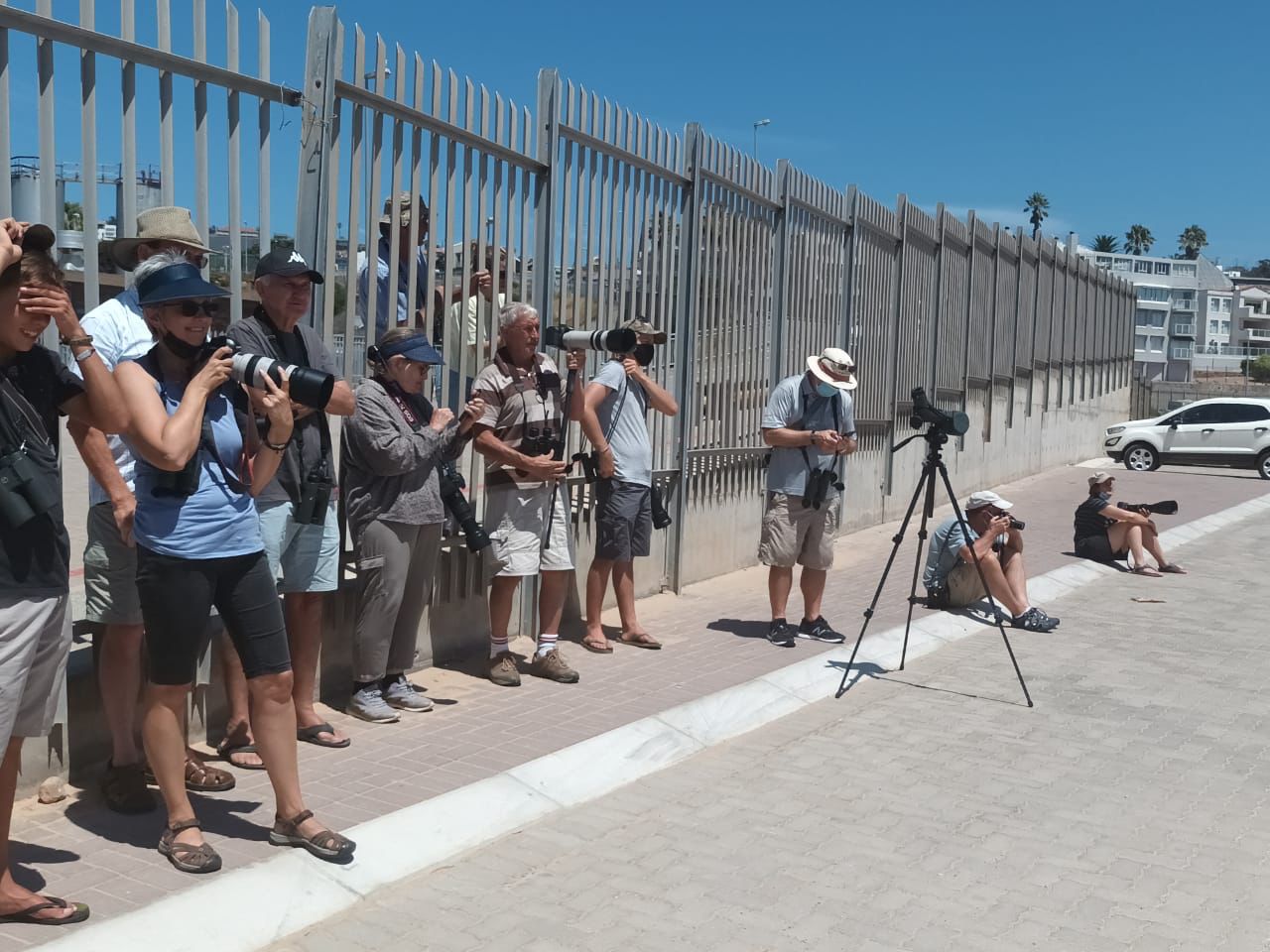
From sunrise on Monday morning, small knots of people could be seen gathering at strategic spots along the shoreline of Mossel Bay, many dressed in bush clothing, with binoculars draped around their necks and carrying ‘weapons’ of varying size, the latter often covered in camouflage material designed to conceal them.

Their actions were strange – one moment they would be gazing out to sea or scanning the beach and harbour with their binoculars, the next moment they would be on the run to a nearby vantage point, hiding behind anything they could find and pointing their ‘weapons’ at the object of their interest.

At other times they would stand around talking animatedly, checking their phones constantly, then at some signal rushing to their vehicles and driving anxiously to another of the favoured spots, there to repeat the procedure.

At the harbour, a designated National Key Point in South Africa, the gathered groups encountered some resistance to their endeavours, as security personnel approached menacingly, ordering them to refrain from entering the harbour area and from pointing their ‘weapons’ in the direction of the harbour.

This led to several verbal skirmishes and the mood of the increasing number of ‘attackers’ seemed to take a turn for the worse. However a message, possibly from a ‘Central Command’, had the groups heading off to one of the other points and calm returned to the harbour once again.

This continued throughout the day and for the rest of the week, with the initial groups of ‘attackers’ being replaced on a daily basis by new groups arriving from all over South Africa.

What was Going on?

It could only be one of two things –

  • the start of an armed insurrection, or
  • twitchers gathering to see and photograph the latest addition to the Southern African list of birds

I’m glad to say it was the latter, especially as I was initially responsible for starting the scramble to see this first time vagrant to our shores!

And the ‘weapons’ referred to in the story above are, of course, the long-lensed cameras favoured by birders (the ‘attackers’) trying to capture an image of the bird for their records.

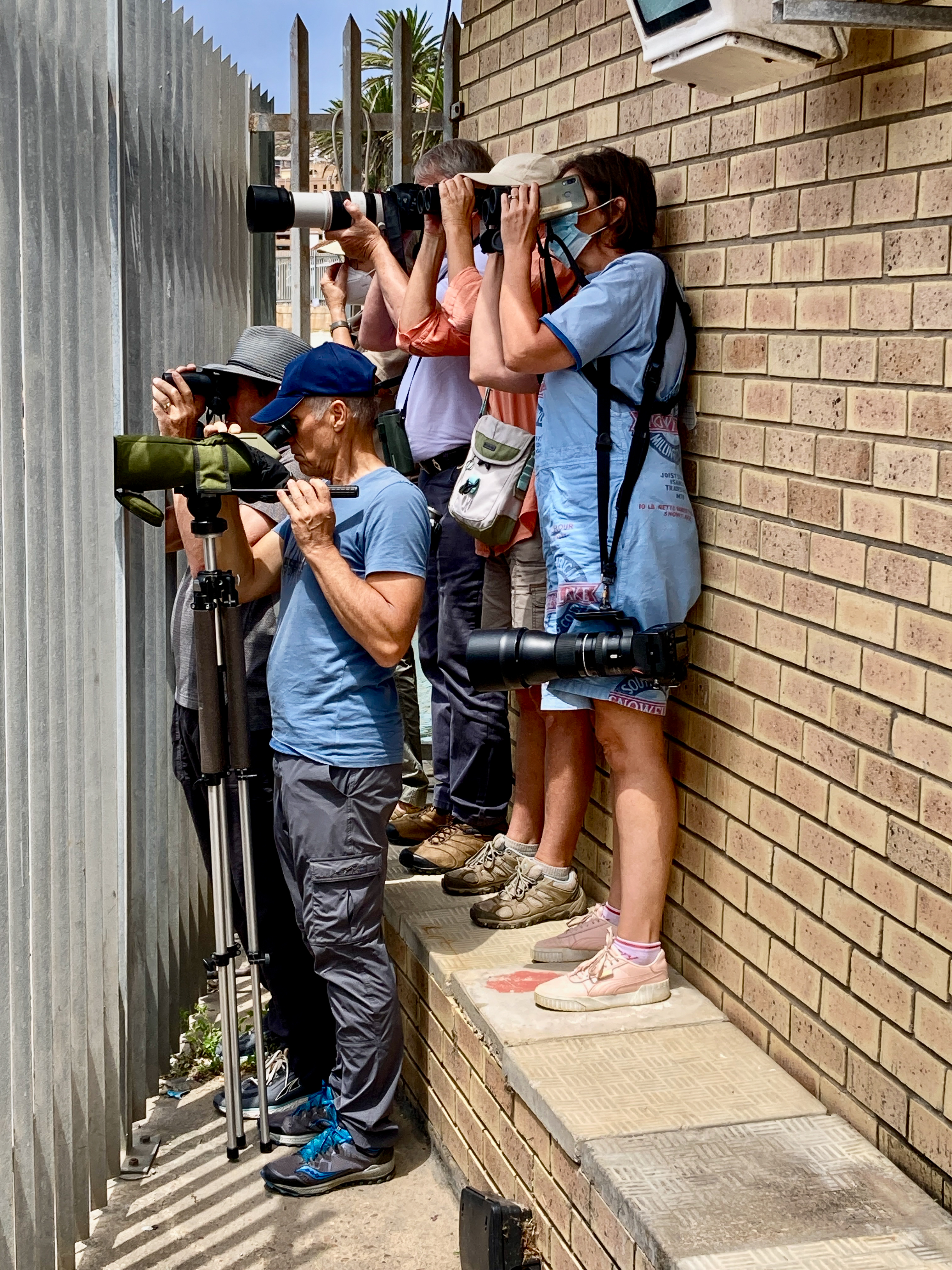
Twitchers outside the harbour (I’m the hidden one with the hat) (Image by Renette Furstenburg)

How it Happened

It all started with a trip to Santos beach with my daughter Geraldine and son-in-law Andre, for a late afternoon swim just after 6 pm on Sunday 6th February 2022. We parked and walked down the steps and across the grassy embankment towards the beach – ever on the lookout for birds, I noticed that there were about a dozen gulls in the fresh water pond that forms in the middle of the beach at the stormwater outlet, drinking and bathing at the end of a no doubt busy day of scavenging and resting.

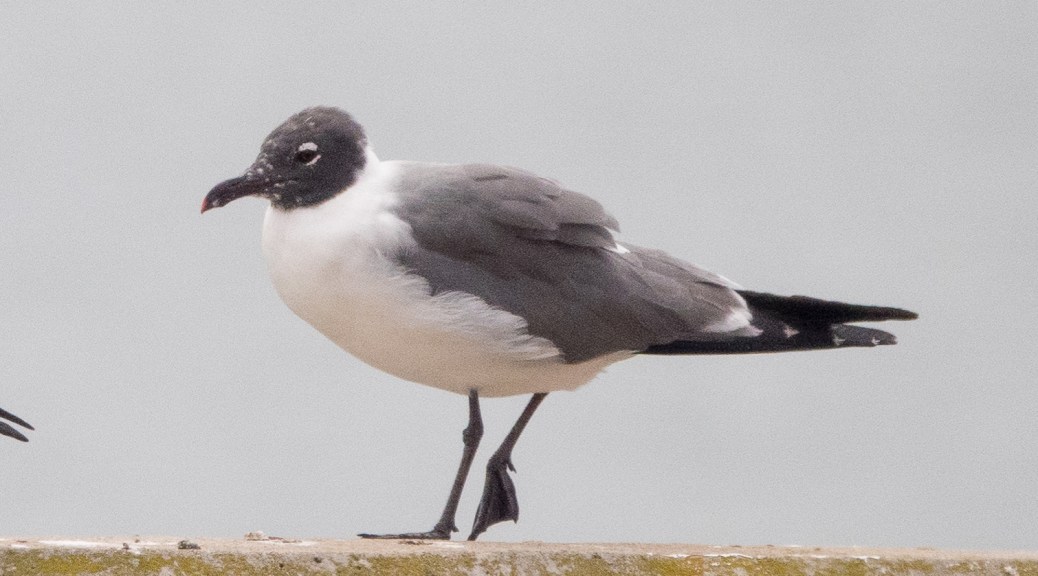
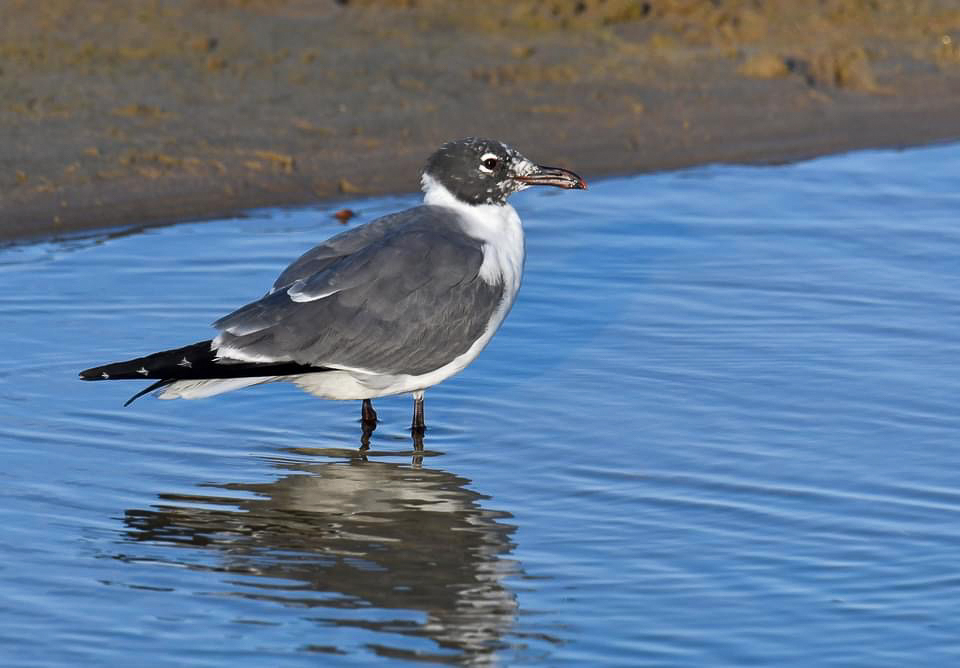
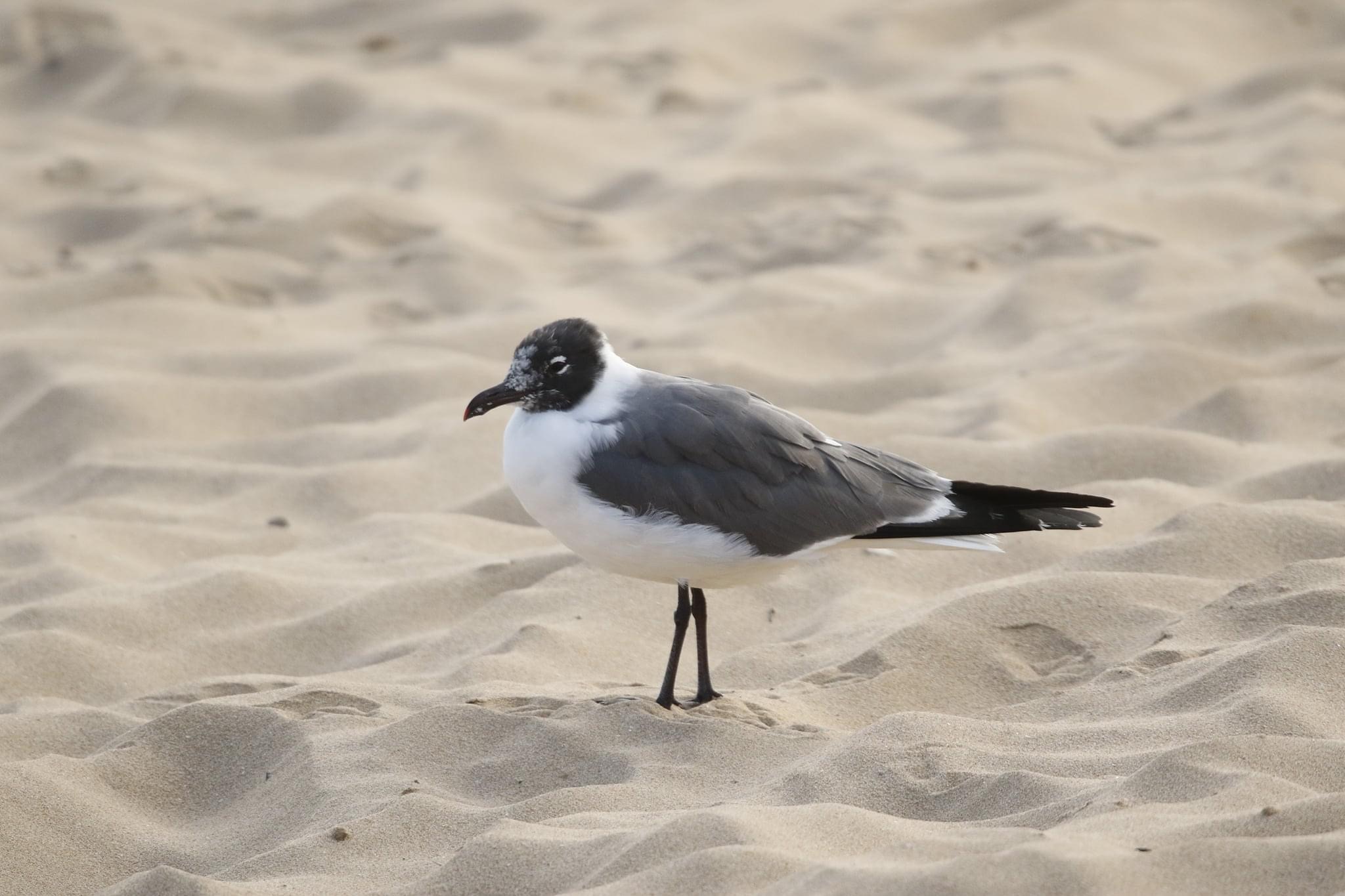
As we got closer to the pond I stopped dead in my tracks, let out a mild expletive and said to Andre and Geraldine “That’s a Franklin’s Gull!” – it stood out like a sore thumb amongst the similar sized Grey-headed Gulls lined up at the pond, with its black hood and dark, slate grey wings contrasting with the mostly white head and pale grey wings of the similar sized gulls normally encountered in Mossel Bay.

This excellent photo (by Estelle Smalberger the next day) best represents the view we had of the gull at the pond

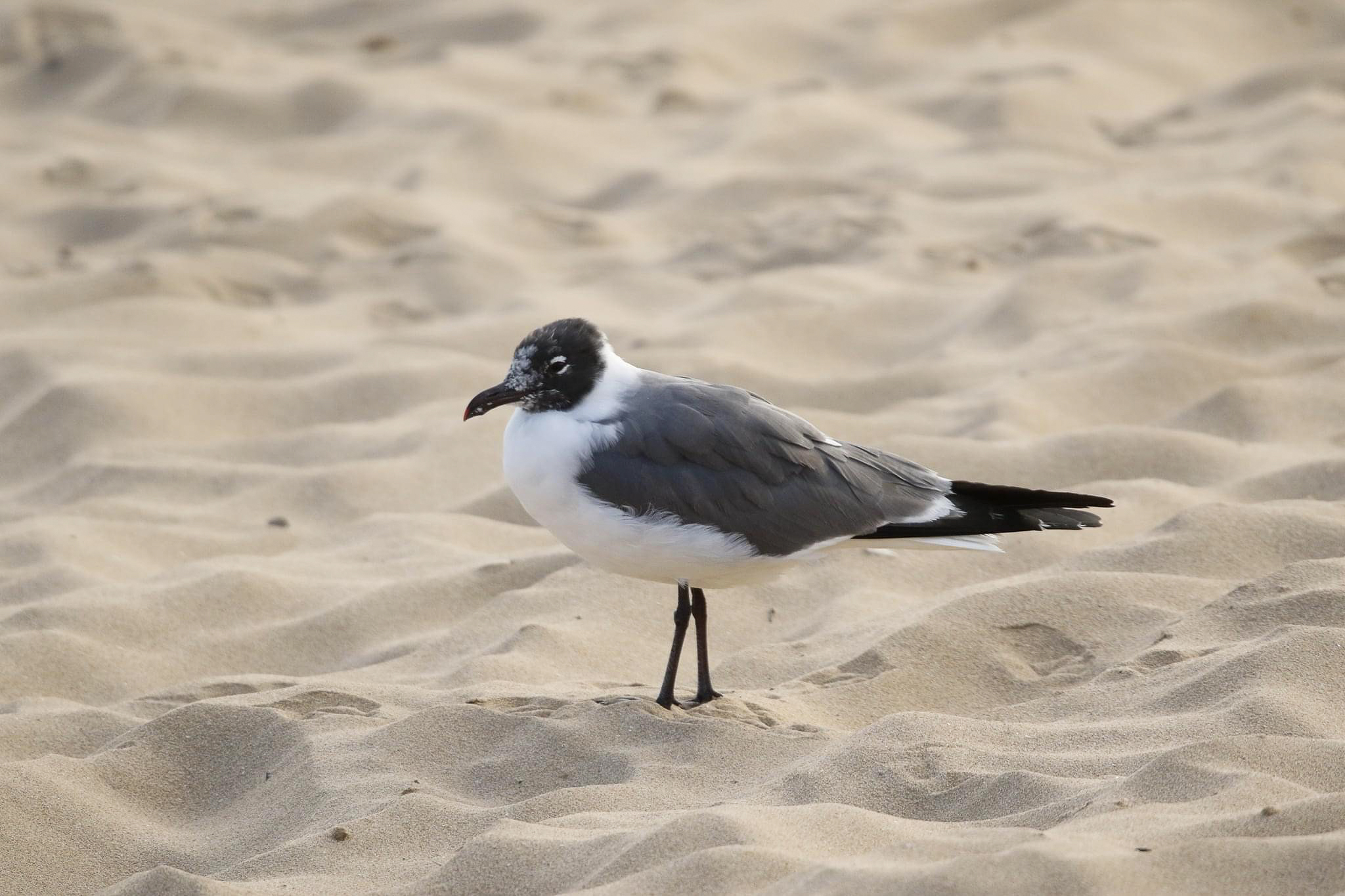
Laughing Gull, Mossel Bay (Image by Estelle Smalberger 7 Feb)

I had come to the beach for a late afternoon swim, so had none of my usual birding paraphernalia – no binos, no camera, not even my otherwise ever-present phone, so Andre dashed back to the car to get his phone. Geraldine and I stood and watched the gull intently while we waited but, as luck would have it, the gull finished drinking and bathing a few seconds before Andre got back and it flew off in the direction of the harbour.

I buried my head in despair for a few seconds, then shrugged it off and we enjoyed the swim we had come for.

Fortunately the gull had been quite relaxed and allowed us to approach within a few metres of its spot alongside the pond, so I was able to confirm in my mind the instinctive first ID of the gull as a Franklin’s Gull.

This was without any of the usual aids, simply based on having seen the species in Canada some years ago – the breeding plumage with full black hood and white eye crescents were what clinched it for me, without considering other possibilities……..I mean, no other gulls with a fully black hood occur in Southern Africa, so what else could it be ……. ?? (The Black-headed Gull, also an occasional vagrant, looks similar but its hood is a chocolate brown colour)

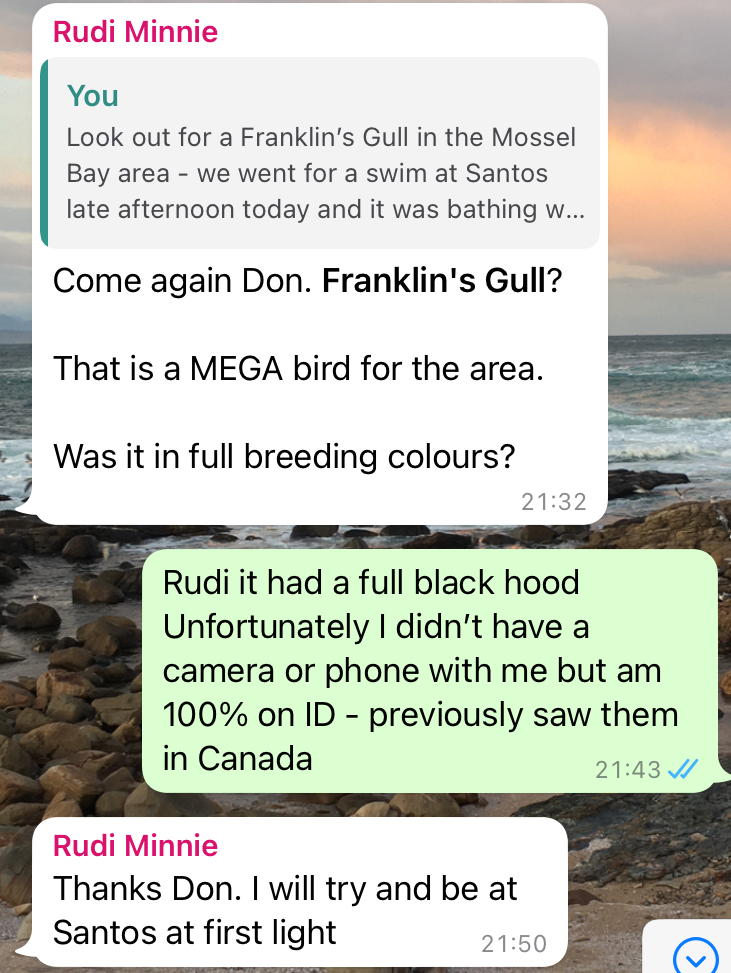
Once I got back home, I posted a message on the local birding whatsapp group, at 8.13 pm to be precise, suggesting that all keep a lookout for a “Franklin’s Gull” in the Mossel Bay area.

At the same time I recorded the sighting on my Birdlasser app which shows the location of the sighting on a map (this shows the corrected species name)

Some time later, at 9.32 pm, Rudi Minnie responded with some amazement and undertook to be at Santos beach at first light on Monday morning.

And there I left it, happy that I had spotted a rarity, one that is recorded only sporadically along the west and east coasts of South Africa and one that would no doubt be of interest to a few birders ……

Monday dawned sunny and warm and I headed out early to the Vleesbaai area where another rarity – a Baillon’s Crake – had been reported, my plan being to hopefully find it and atlas the pentad at the same time. While waiting patiently for the crake to put in an appearance (one juvenile popped out briefly, too quick for a photo) I kept an eye on the messages from those looking for the “Franklin’s Gull”.

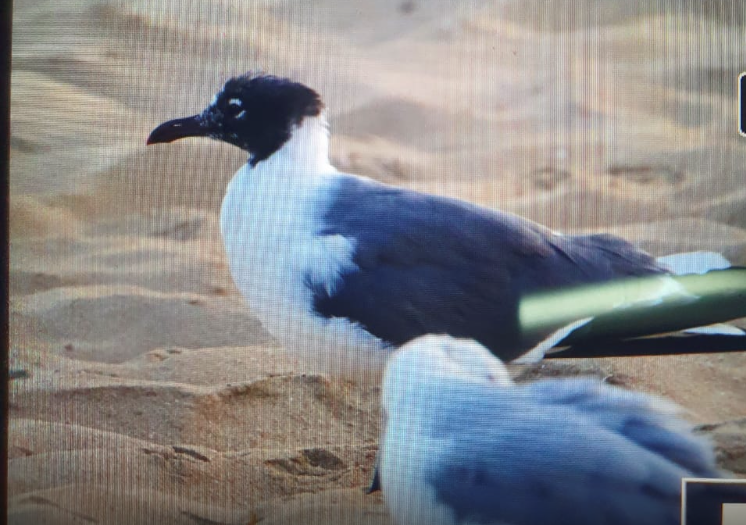
First to confirm it was Edwin Polden at 6.42 am and Rudi Minnie shortly thereafter, followed by the first photos at 7.01am.

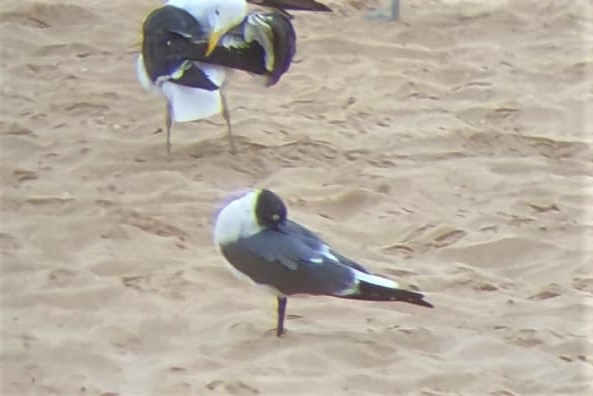
Laughing Gull, Mossel Bay (“Back of camera” Image by Edwin Polden 7 Feb)
Laughing Gull, Mossel Bay (Image by Rudi Minnie 7 Feb)

Some other Mossel Bay birders followed up with their own photos, providing more detail of the gull’s features

Laughing Gull, Mossel Bay (Image by Tersia Marais 7 Feb)

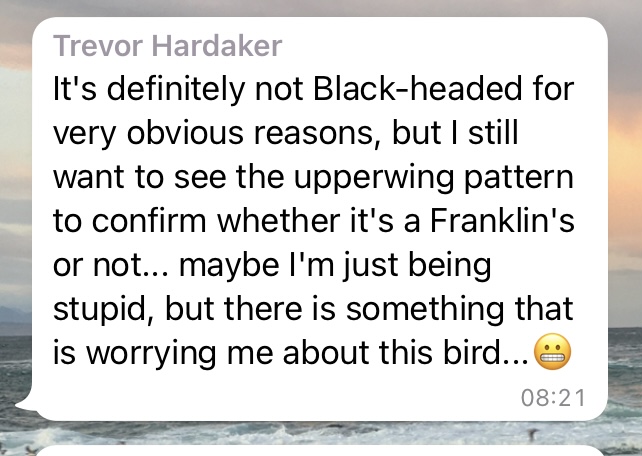
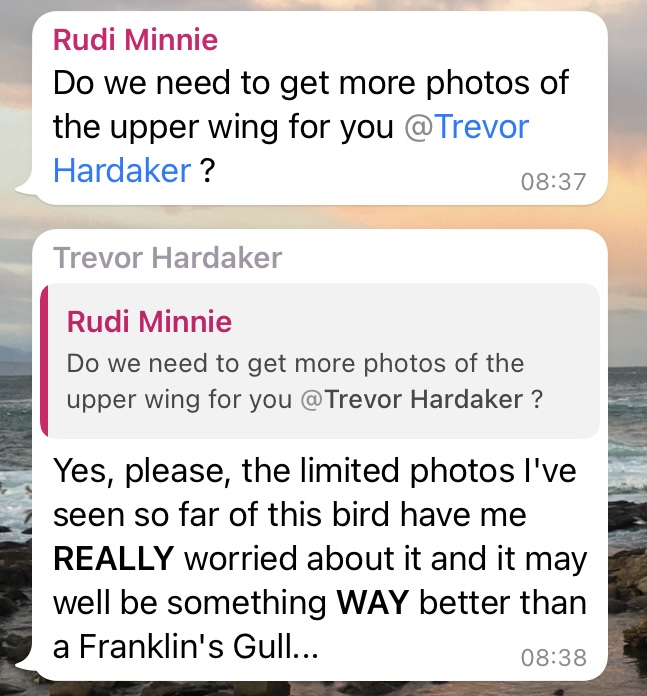
Trevor Hardaker, chair of the SA Rarities Committee and the undisputed ‘king’ of rarities in Southern Africa joined in the discussion, expressing his concern about the initial ID and imploring photographers to send a photo of the gull’s upper wing colouring. There was some speculation about his reason for this request, which became more urgent as the minutes ticked by.

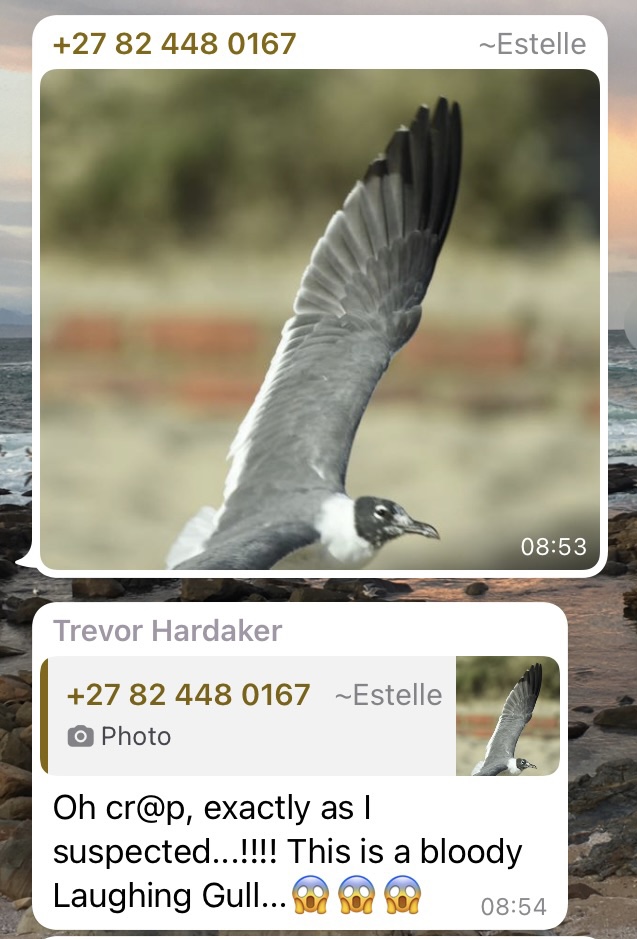
Fortunately Estelle Smalberger was able to post a photo showing the upper wing of the gull with all-black wingtips –

Laughing Gull, Mossel Bay (Image by Estelle Smalberger 7 Feb 08.53am)

and the reaction from Trevor was instantaneous :

Some 7 minutes later Trevor sent an email alert to the thousands of subscribers around Southern Africa to let them know about this ‘Giga’ rarity, a new species record for the sub-region, which had many of them, including Trevor himself, re-arranging their lives to get to Mossel Bay without delay and hopefully see the gull.

Laughing Gull vs Franklin’s Gull

It took the expertise of Trevor Hardaker to correctly ID this gull and it was based on the differences in upper wing pattern which are nicely illustrated in these excerpts from a guide book which he posted

This is the Laughing Gull – (in non-breeding plumage so without the black hood)

Laughing Gull Illustration

And this is the Franklin’s Gull

Franklin’s Gull Illustration

The Reaction

The reaction after Trevor sent out the alert was not unexpected – there are a number of birders in the region who will go to any lengths to add a species to their lists for the southern African sub-region and this new species presented a golden opportunity for the ultra keen twitchers. Some must have literally upped and rushed to the airport and found a seat on a flight to George, as the first arrivals from Gauteng were in Mossel Bay that same afternoon.

Others made quick arrangements and drove long distances to Mossel Bay from all over SA. This continued throughout the week, with clutches of anxious twitchers staking out the favourite spots and sharing messages until they too were able to ‘tick’ this new species and get a photo or two.

Laughing Gull twitchers near the tidal pool in Mossel Bay (Image by Justin Ponder 8 Feb)

The gull became a celebrity visitor overnight and by far the most photographed bird in SA that week as several hundred birders descended on the town over the 6 days it remained there.

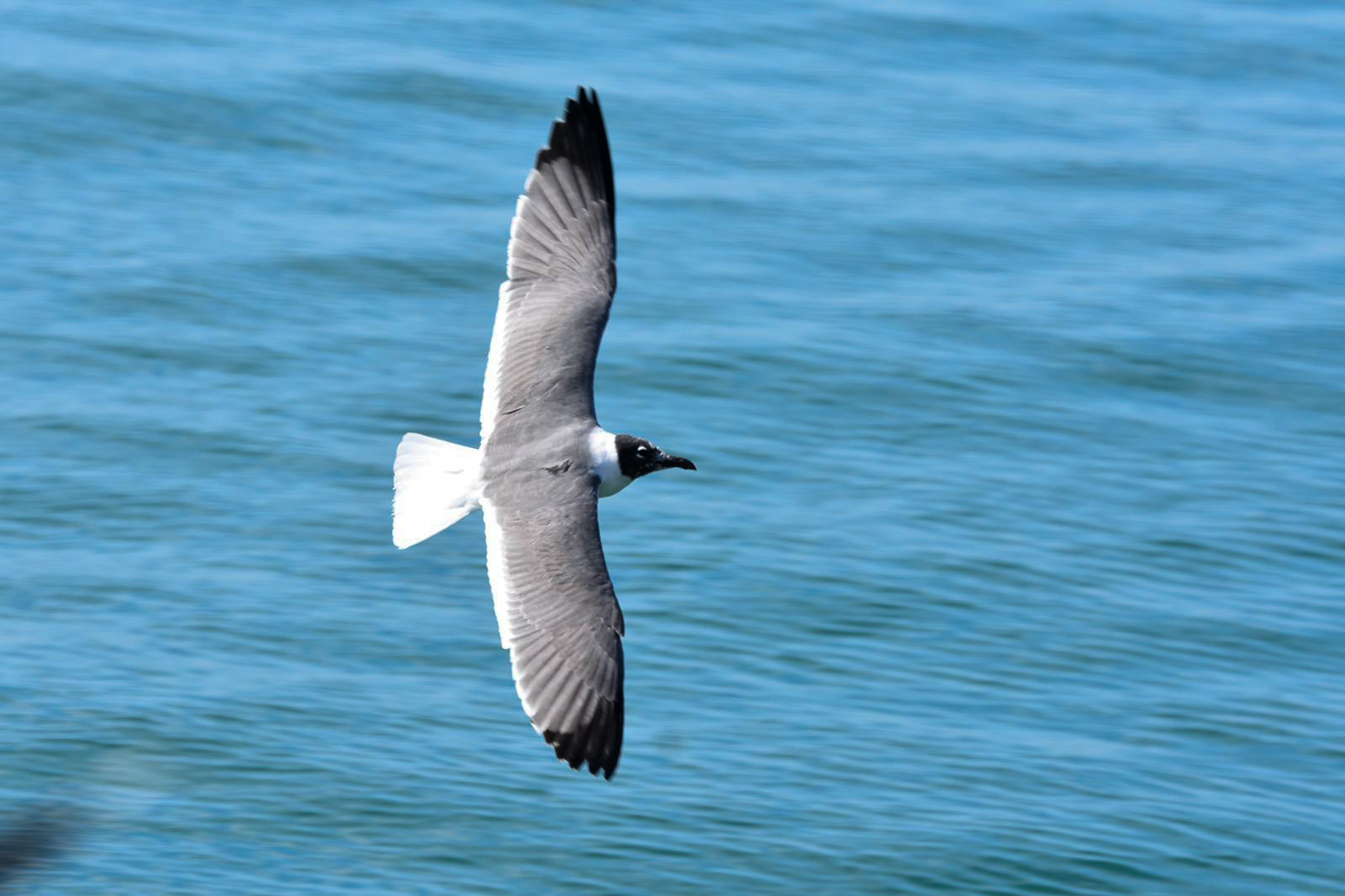
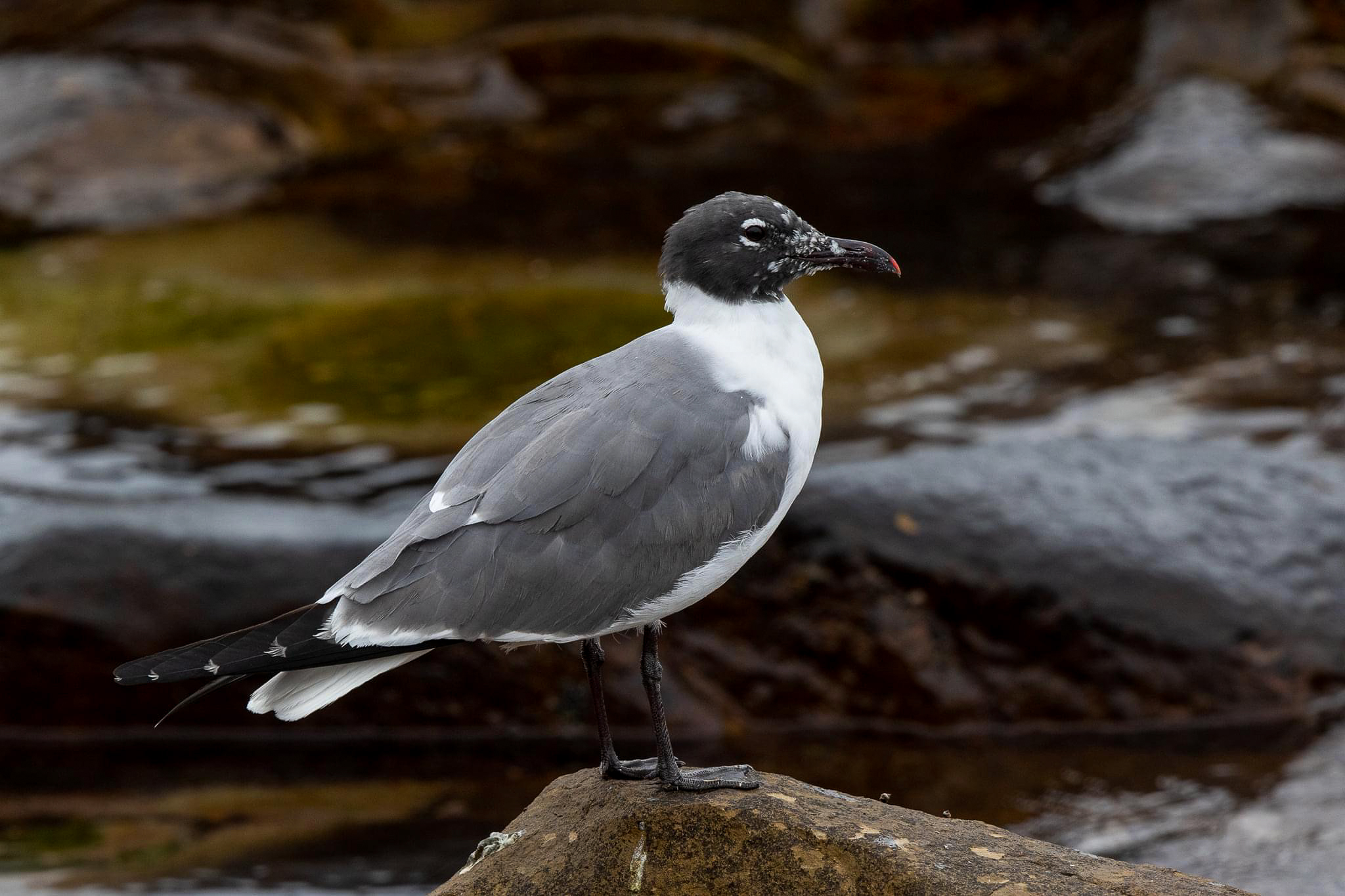
Here is a selection of photos posted on Facebook and Whatsapp groups –

Laughing Gull, Mossel Bay (Image by Justin Ponder 7 Feb)
Laughing Gull, Mossel Bay (Image by Barry Scott 9 Feb)
Laughing Gull, Mossel Bay (Image by Elmarie Brits 7 Feb)
Laughing Gull, Mossel Bay (Image by Johan Grobbelaar)
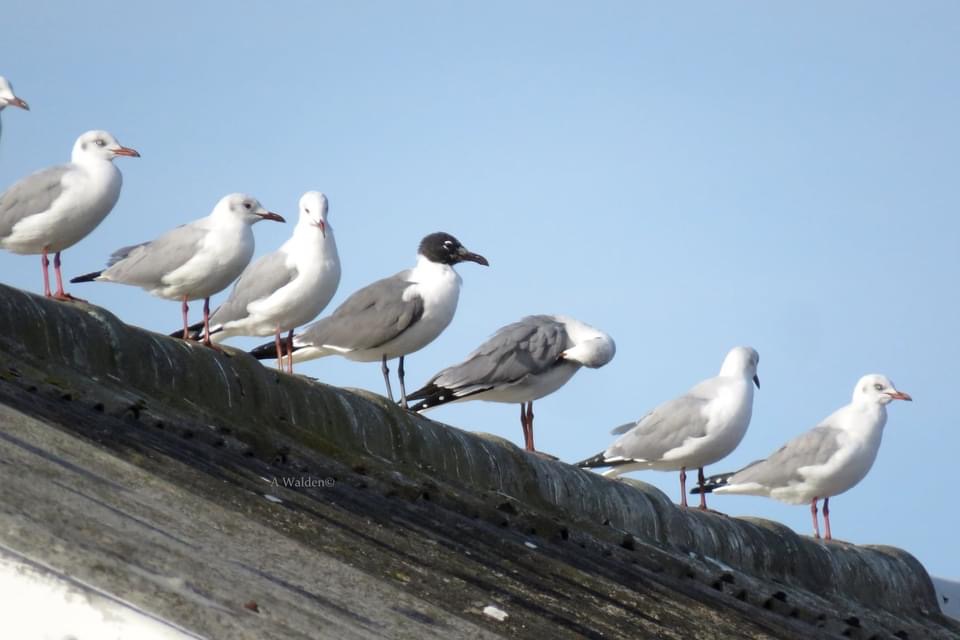
Laughing Gull amongst a group of Grey-headed Gulls (Image by Amanda Walden)
Laughing Gull, Mossel Bay ‘behind bars’ – actually inside the restricted harbour area (Image by Amanda Walden)

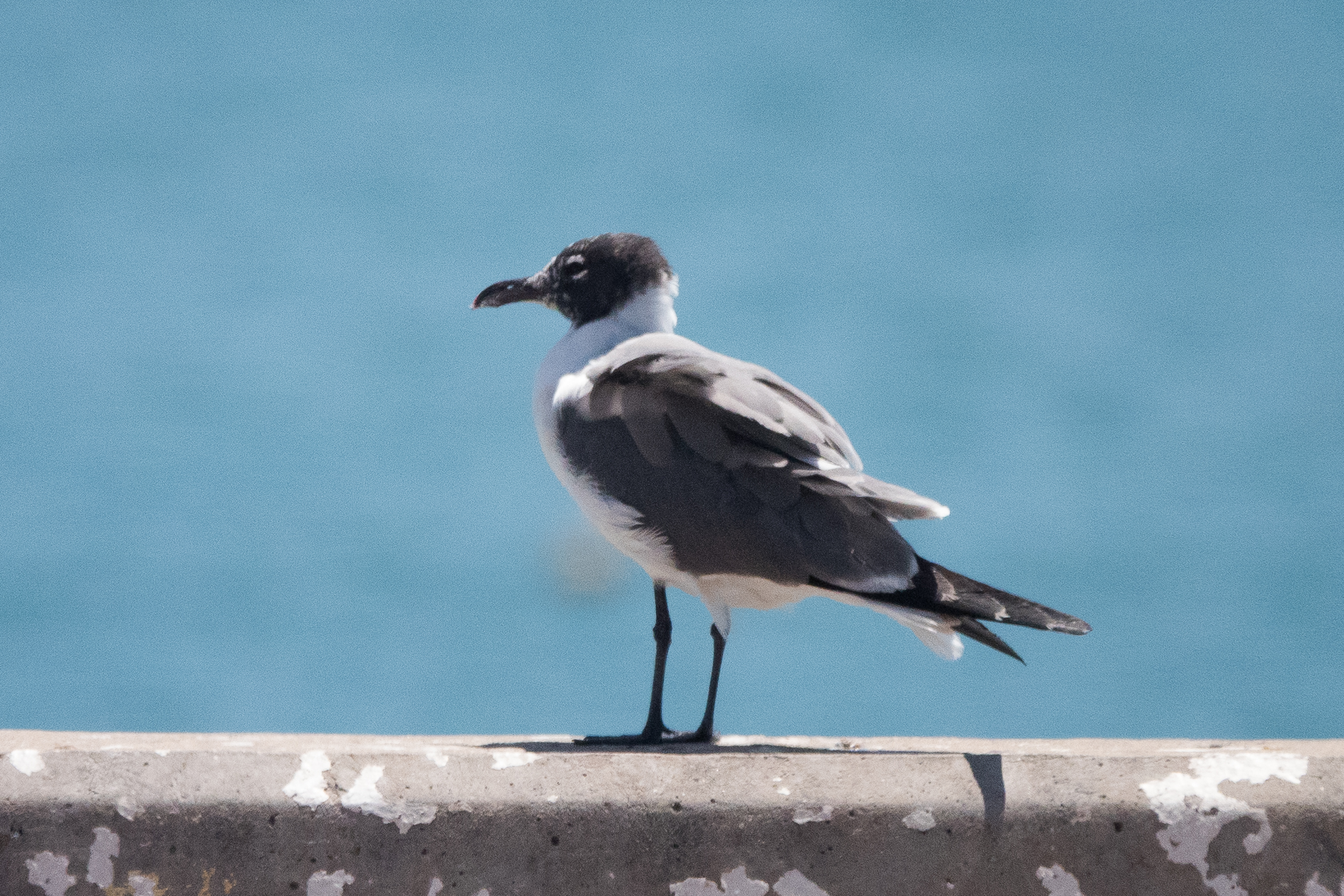
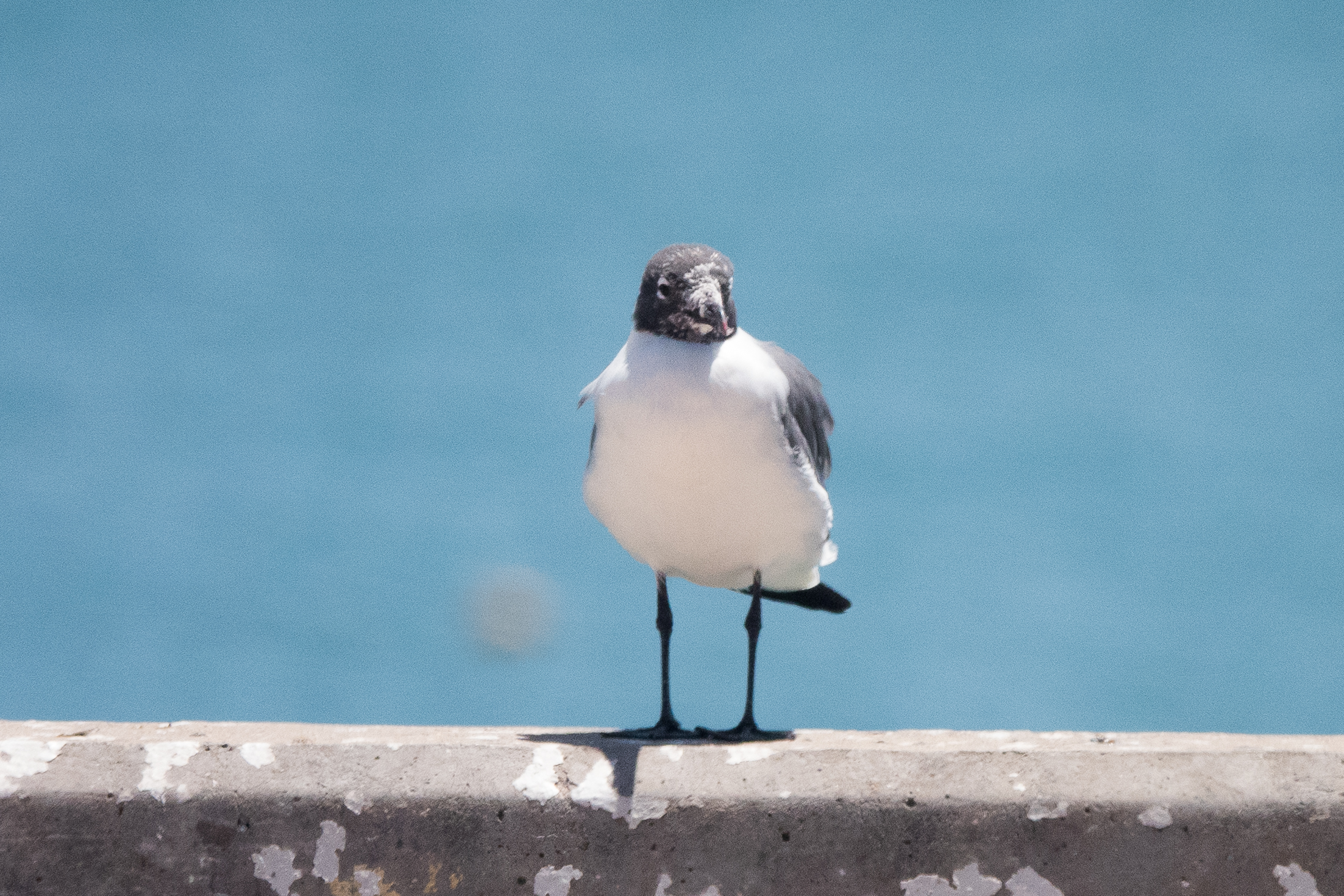
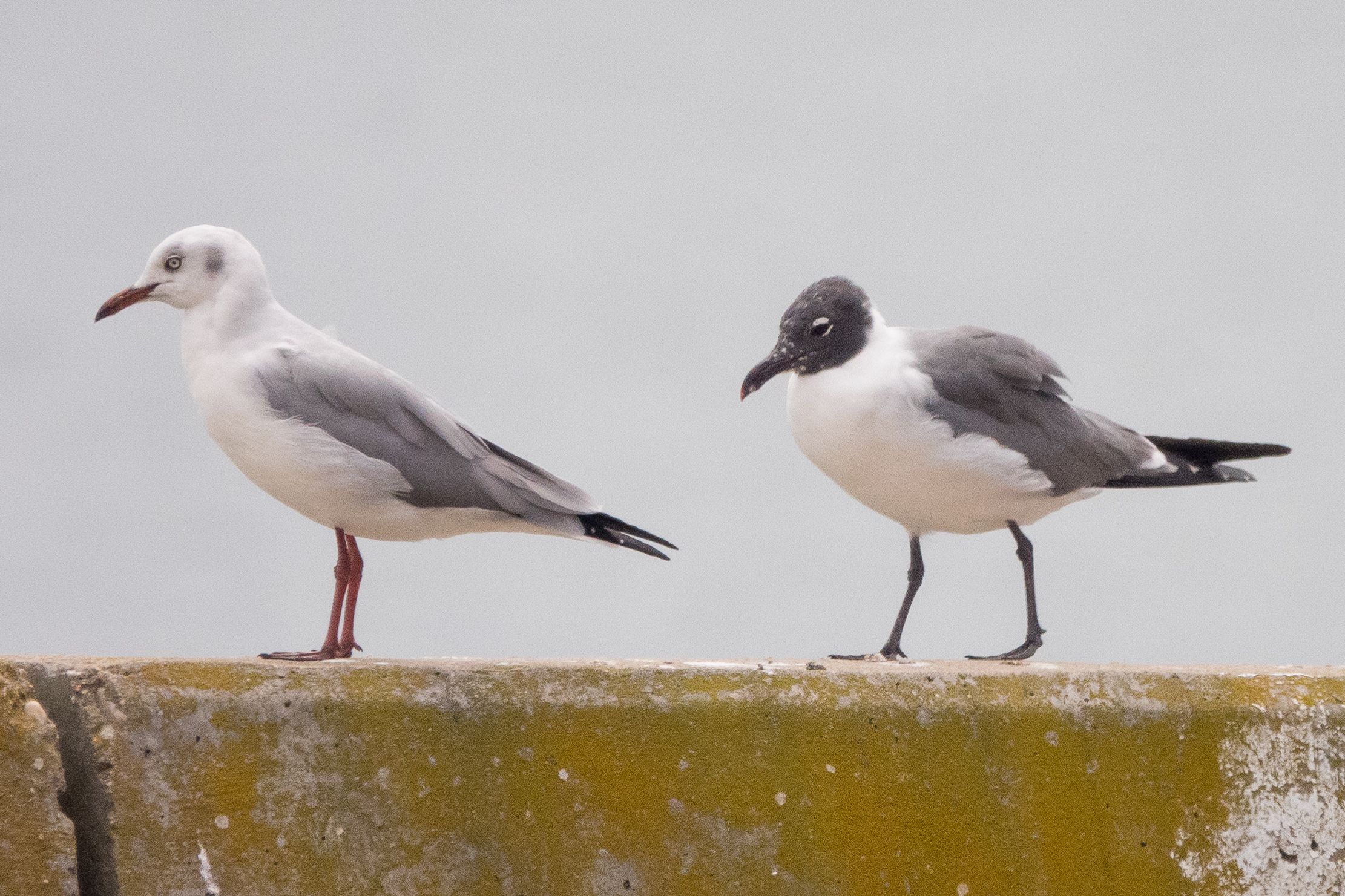
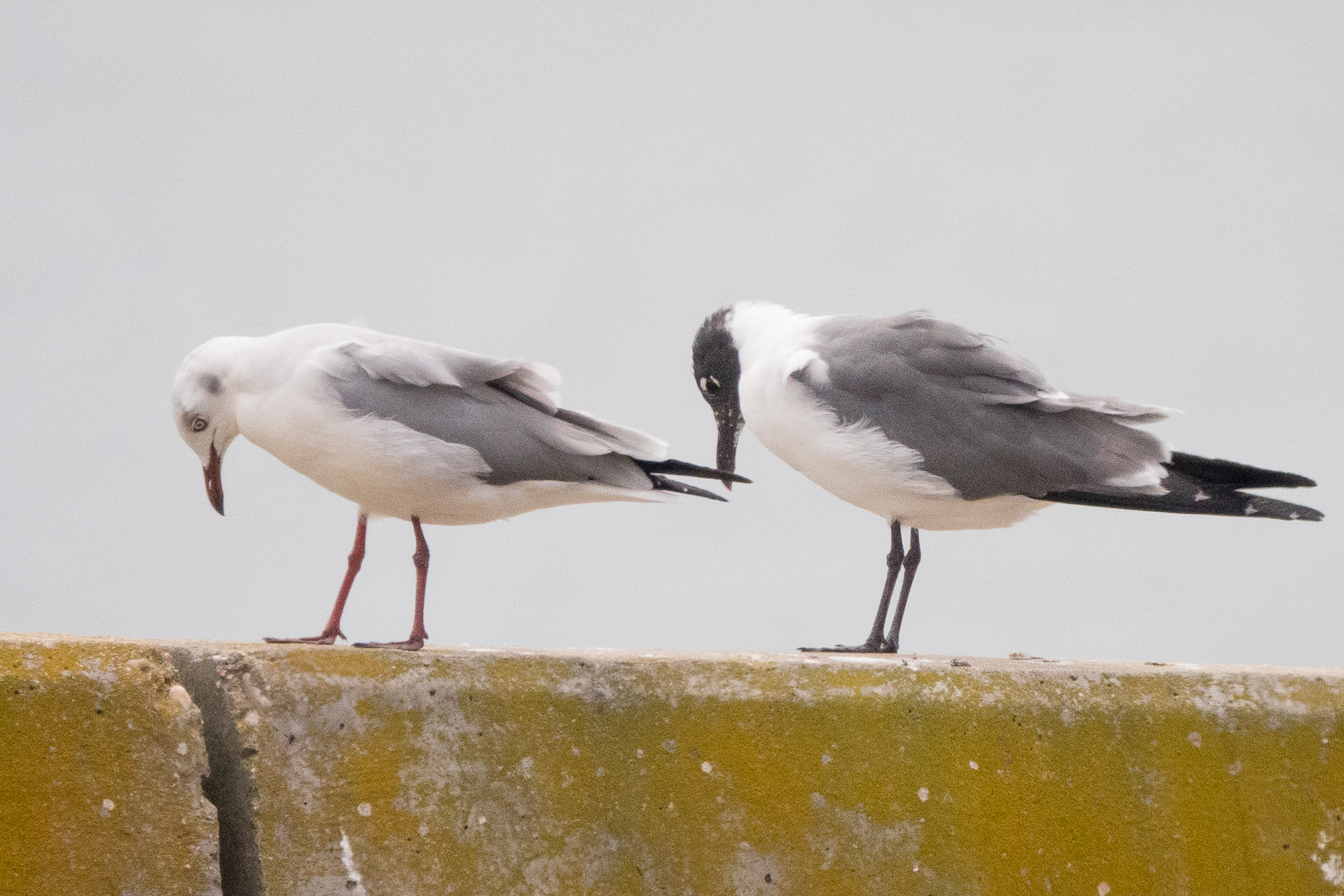
I managed to get a few images of the gull when it was perched on the wall near the harbour

Laughing Gull, Mossel Bay (Image : Don Reid)

In The News

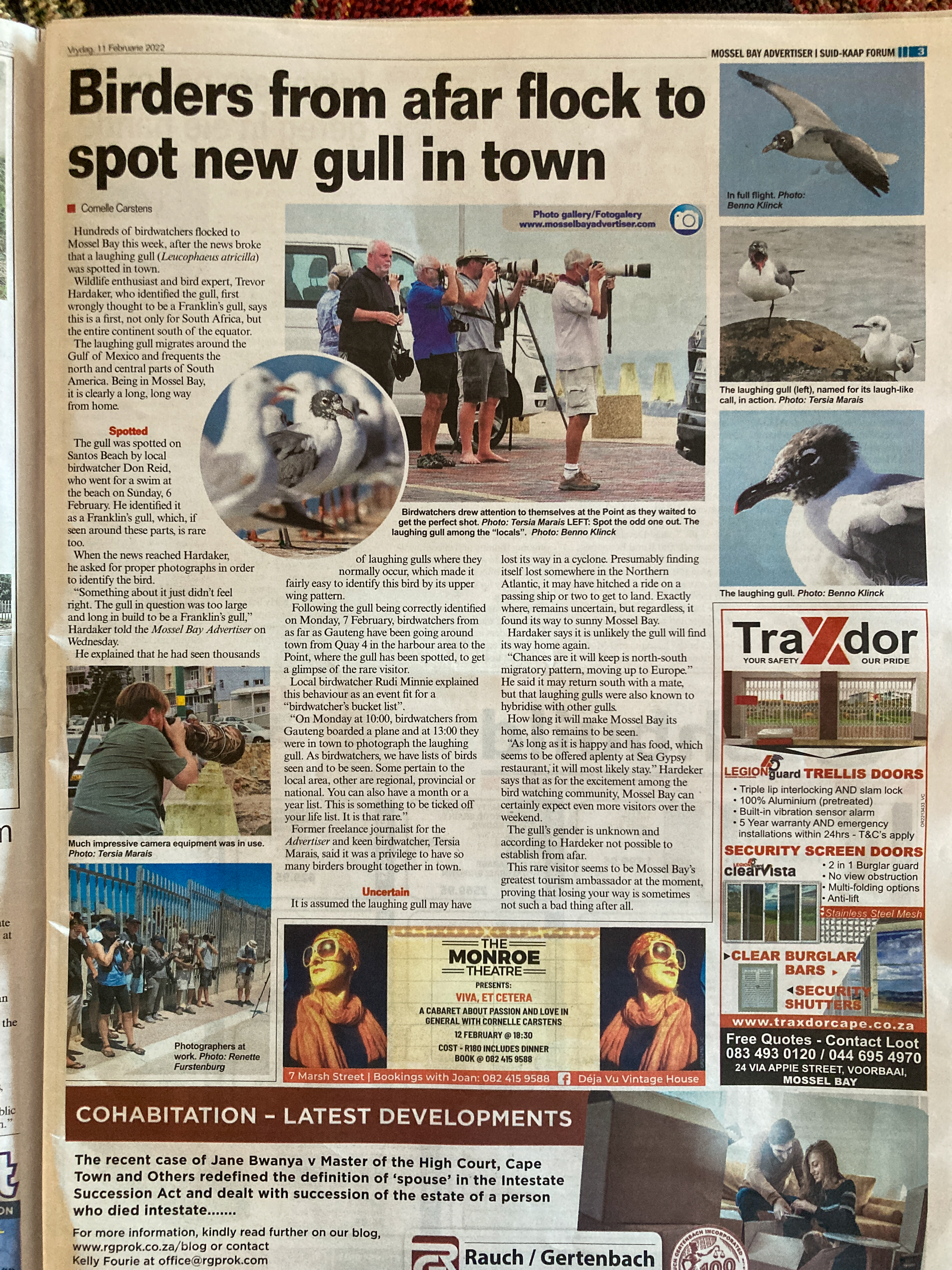
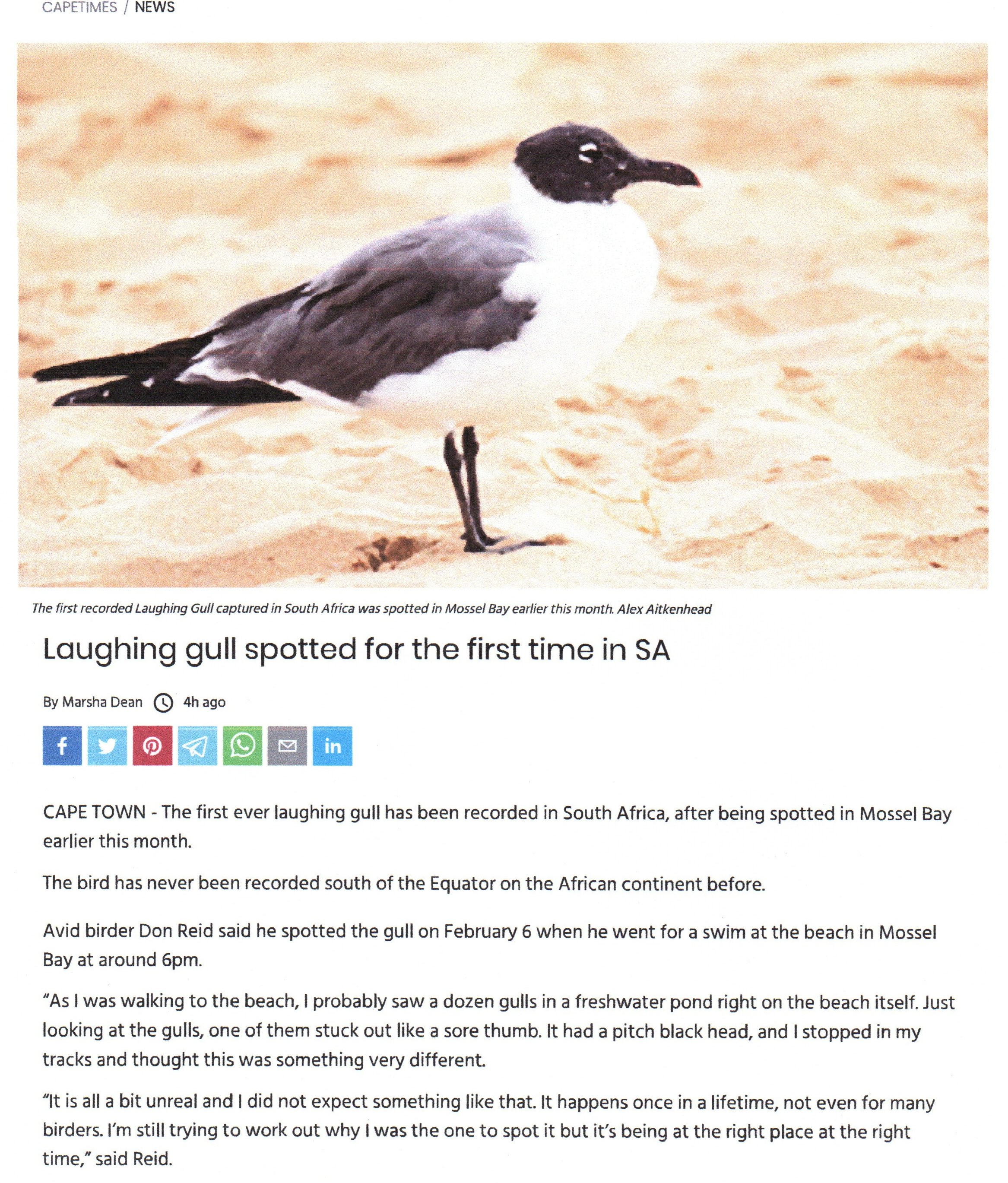
The presence of the celebrity gull soon spread to the newshounds and articles were published in several newspapers – at first the local Mossel Bay and George papers carried the story which then spread to the Cape Town newspapers. It even made the national SABC newscasts.

Mossel Bay Advertiser

Laughing Gull Leucophaeus atricilla (Roetvlerkmeeu)

Laughing Gulls, named for their raucous call which sounds like a high-pitched laugh, are monogamous and form long-term pair bonds. They breed in large colonies from April to July on the Atlantic coast of North America, the Caribbean and northern South America.

They are coastal birds found in estuaries, salt marshes, coastal bays, along beaches (where I first found it) or on agricultural fields near the coast. My previous (only) sighting of Laughing Gull was on the Varadero Peninsula on the north coast of Cuba during a memorable visit some years ago.

Laughing Gulls are gregarious birds, noisy and aggressive in nature and don’t hesitate to steal the prey of other birds.

Illustrations from Collins Bird Guide app

Topmost in many birder’s minds was the question “How did it get to Southern Africa?”. That’s an impossible one to answer but several ideas were postulated such as –

  • there have been numerous previous vagrant records in the UK and western Europe so perhaps this was another which then proceeded to migrate south as it would normally do in its home territory and only stopped when it reached the southern end of Africa
  • ship-assisted vagrants are not unknown so perhaps it hitched a ride on a ship that passed Mossel Bay, from either east or west and thought, as we do, that it looked like a rather nice place to spend some time

And that sums up the newest addition to the Southern African bird list. Trust Faansie Peacock to be the first to add it to his brand new birding app called Firefinch, due to be fully launched this year, already partly available

New page added to Faansie Peacock’s “Firefinch” birding app

What a shame that the handsome Laughing Gull stayed in Mossel Bay for just a week – the following Sunday it was nowhere to be found…… who knows where it went next and whether this species will ever be seen in the Southern African region again.

Image from animalia.bio

But it had provided a lot of excitement for the birding community during its short stay!

An Ostrich Encounter

My last post (“Birds on the Beach”) highlighted one of Southern Africa’s most iconic birds, the African Penguin. This time the spotlight falls on another iconic species, this one being about as far removed from penguins as it is possible to imagine. Not that I had intended to write about this species at this juncture, but it drew attention to itself in ways that I simply could not ignore…..

Here’s how it happened –

I was on an atlasing trip out of Mossel Bay, which I try and do once a week, and was heading along a minor gravel road north-west of the town. After many years I have found that the most efficient way of atlasing (recording species in a defined area called a pentad) requires a combination of very slow driving, with windows open to pick up bird calls, combined with regular stops to get out of the car and scan the habitat all around.

Just as an aside, the ‘window open’ part had already paid huge dividends when I picked up a call which sounded warbler-like, emanating from roadside bush. I stopped and got out to listen carefully and when the bird carried on its warble I recorded it on my Iphone, knowing that it would probably not show itself and I would have to ID it on call alone.

This was fortunate as I realised that it could be a Marsh Warbler, considered a rarity in the Western Cape, which I duly reported to the SA Rare Bird News along with my recording. It was confirmed by Trevor Hardaker who runs the news service and he included it in that evening’s emailed report.

Anyway, back to the main theme of the post –

At one of my stops next to a wide field, I noticed a lone male Common Ostrich on the far side and, as I did so, he began trotting in determined fashion towards where I was standing alongside my SUV.

‘Hello’, I thought, ‘this could be interesting’ – but my camera was in the car and the ostrich was approaching quickly so I grabbed my phone, set it to video and started filming. Halfway across the field the ostrich stopped and called, a deep booming call that has been likened to that of a lion in the distance.

Turn your sound up to maximum to hear the call….

The ostrich continued coming towards me until it was just a few metres away, then suddenly went down onto its haunches and performed its courtship display, swinging its neck from side to side with wings spread wide. At that stage I was glad of the fence separating us – who knows what he might get up to next!

Still not satisfied that he had attracted my attention, it seems, the ostrich came even closer, just a metre or two from where I stood amazed, with just a flimsy fence separating us, and once again performed the courtship display.

This is when I believe the ostrich started having second thoughts about my suitability as a partner and he went behind the bushes for a minute or so then reappeared, giving me the once over and, I imagined, showing signs of mild doubt, even confusion as he eyed me from behind the bushes. That final tail flip is very telling…

I decided not to confuse the misguided bird any further and drove on….

However, I couldn’t help wondering about this strange encounter for the next day or two and came up with a few possibilities to explain it –

  • It was a very short-sighted ostrich
  • It was very lonely in that field all on its own
  • It was trying to prove its ‘wildness’ so that I might be persuaded to add it to my records for the pentad list*

* This last one probably needs some explanation for those not familiar with atlasing protocols and the status of the Common Ostrich in the southern Cape. Ostriches in this part of South Africa have been farmed for well over 100 years and most ostriches encountered are in fact of the ‘domesticated’ type, although not distinguishable from ‘wild’ ostriches which are generally only found in game and nature reserves. Atlasing protocols allow for recording of ‘free flying’ birds only which translates to ‘wild’ birds in the case of ostriches which of course are flightless, so none of the ostriches in the farming areas will be eligible.

  • Oh, and there’s one more possibility – perhaps I look more like a female ostrich than I had previously imagined….. Here’s a recent photo of me to let you decide

Blue Crane Breeding

At the end of a memorable year which has left many of us with a somewhat negative feeling about 2021 and hopeful for a better experience in 2022, it seemed appropriate to write about something which holds promise for the future. and what is more promising than the sight of an iconic bird in breeding mode.

We were recently privileged to view a Blue Crane Anthropoides paradiseus (Bloukraanvoel) on its nest, something we have never seen before and our short ‘stay’ with this National Bird of South Africa was truly uplifting.

It happened purely by chance, as is often the case with special bird sightings, and only a few days into our latest stay in Mossel Bay over the December/January summer ‘season’

We had travelled to Plettenberg Bay from our Mossel Bay home (both part of the famous Garden Route of South Africa and some 150 kms distance from each other) to follow up on a sighting of a rarity that had been located at the Keurbooms River Estuary (more about that in a future post) and were on the road from the estuary back to the N2 National Road for our return trip home.

Gerda spotted a bird in a field and I duly stopped on the quiet road to see what it was. A car going in the opposite direction had also stopped almost alongside us and I wondered if they were also birding, whereupon one of the occupants got out and told us “There’s a Blue Crane on a nest if you are interested” and proceeded with a description of where we could find it. I didn’t pick it all up but thanked him and we set off in search of the spot he had described.

Fortunately between Gerda and myself we had understood enough of this thoughtful birder’s directions to find our way to the road along the Bitou River just outside Plett (which is how most South Africans refer to this Popular town) and after carefully scanning the river and vleis for a few kms we came to the spot he had described, with a pair of Blue Cranes in attendance a short distance from the road.

One was clearly on a nest and this was confirmed moments later when he/she stood up so that we could see at least one egg, which turned into two when I later studied the photos.

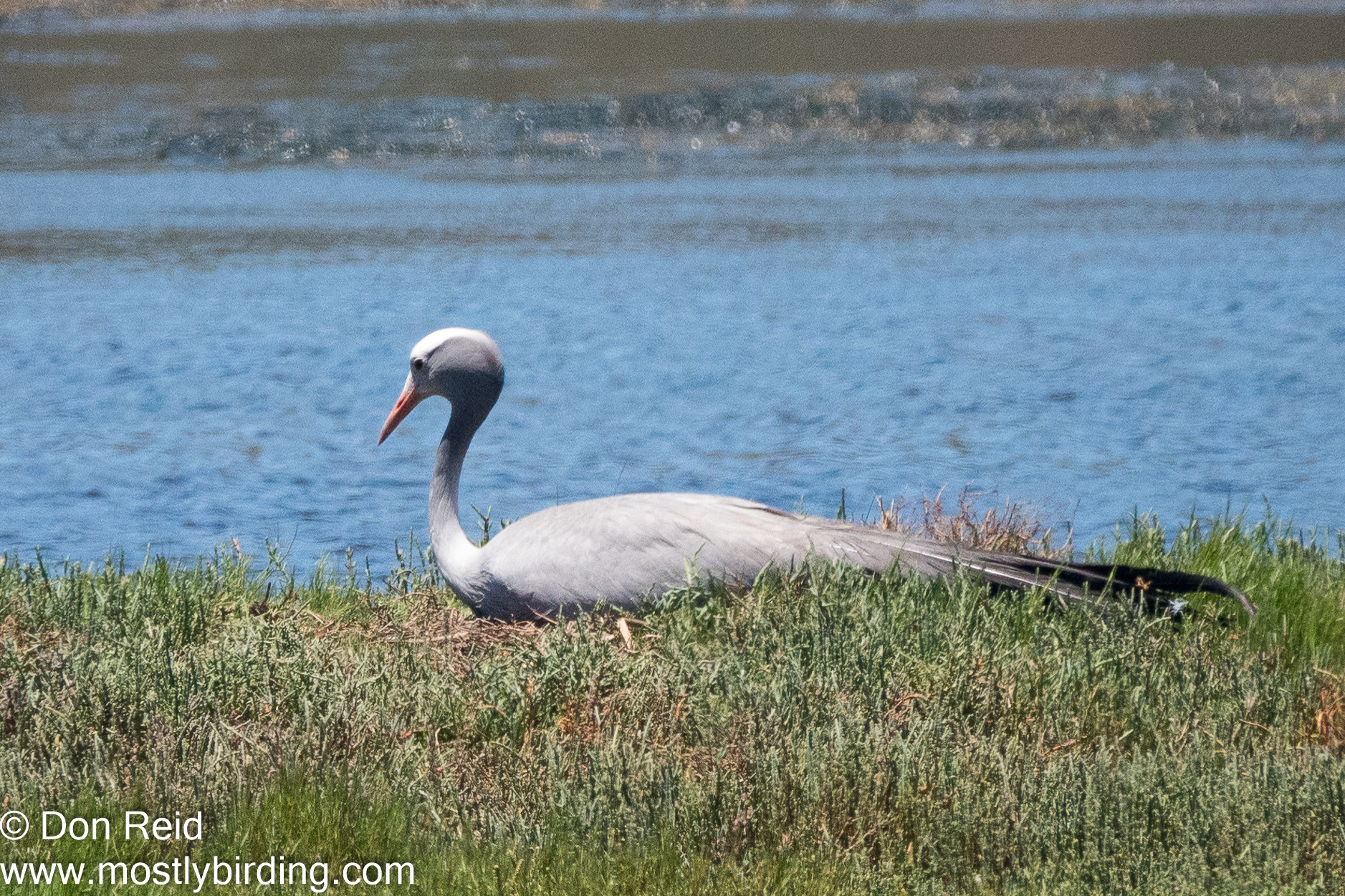
Blue Crane on nest
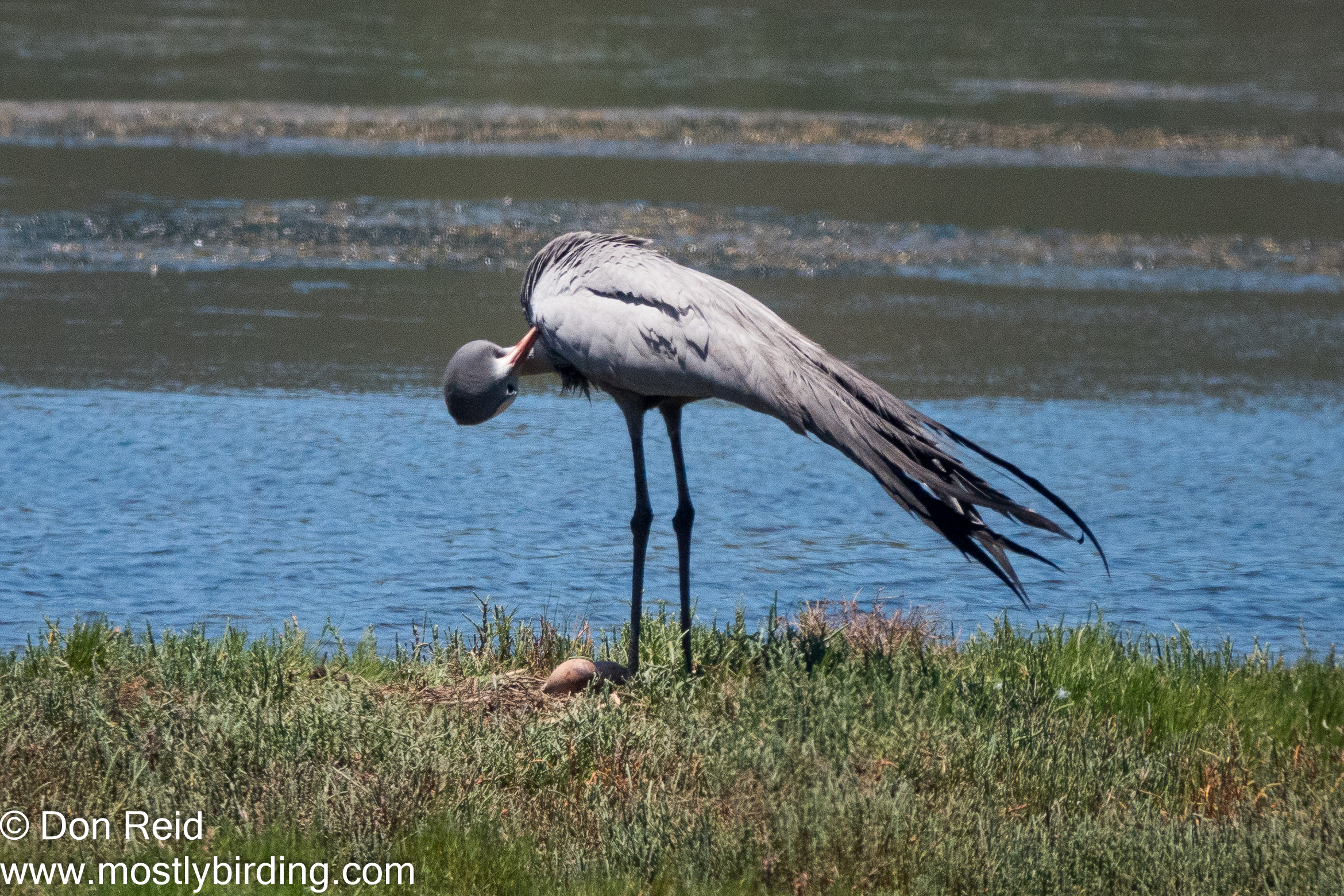
Blue Crane at nest, two eggs visible
The Blue Crane fussing over the eggs

The other Blue Crane was a short distance away in shallow vlei water, seemingly keeping an eye on the situation. According to Roberts VII the male and female spend almost equal amounts of time incubating the eggs over a period of around 30 days.

We had no way of knowing how long they had been incubating so it’s impossible to say when they may hatch – perhaps we will travel that way in a couple of weeks time and see if there has been a change in status.

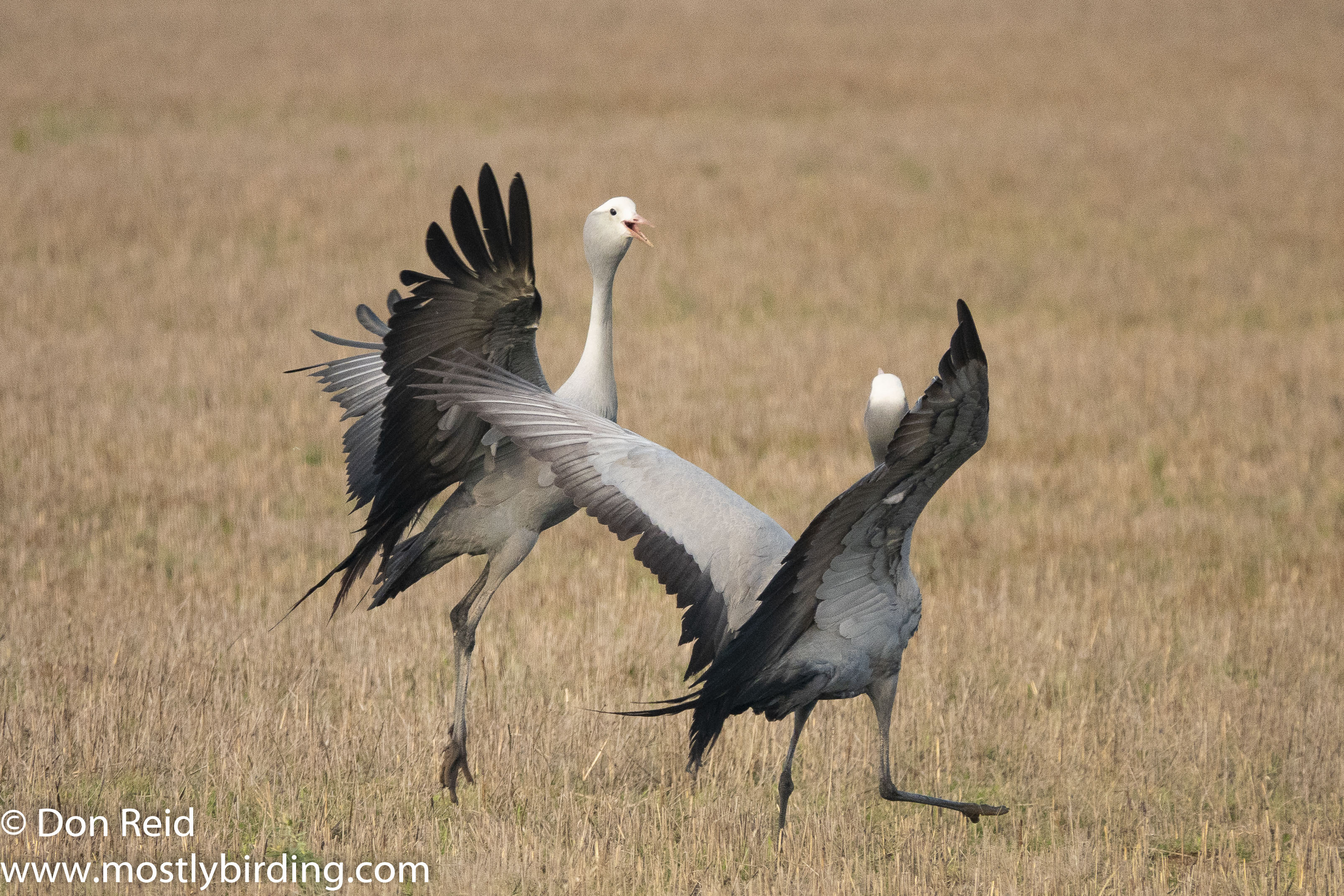
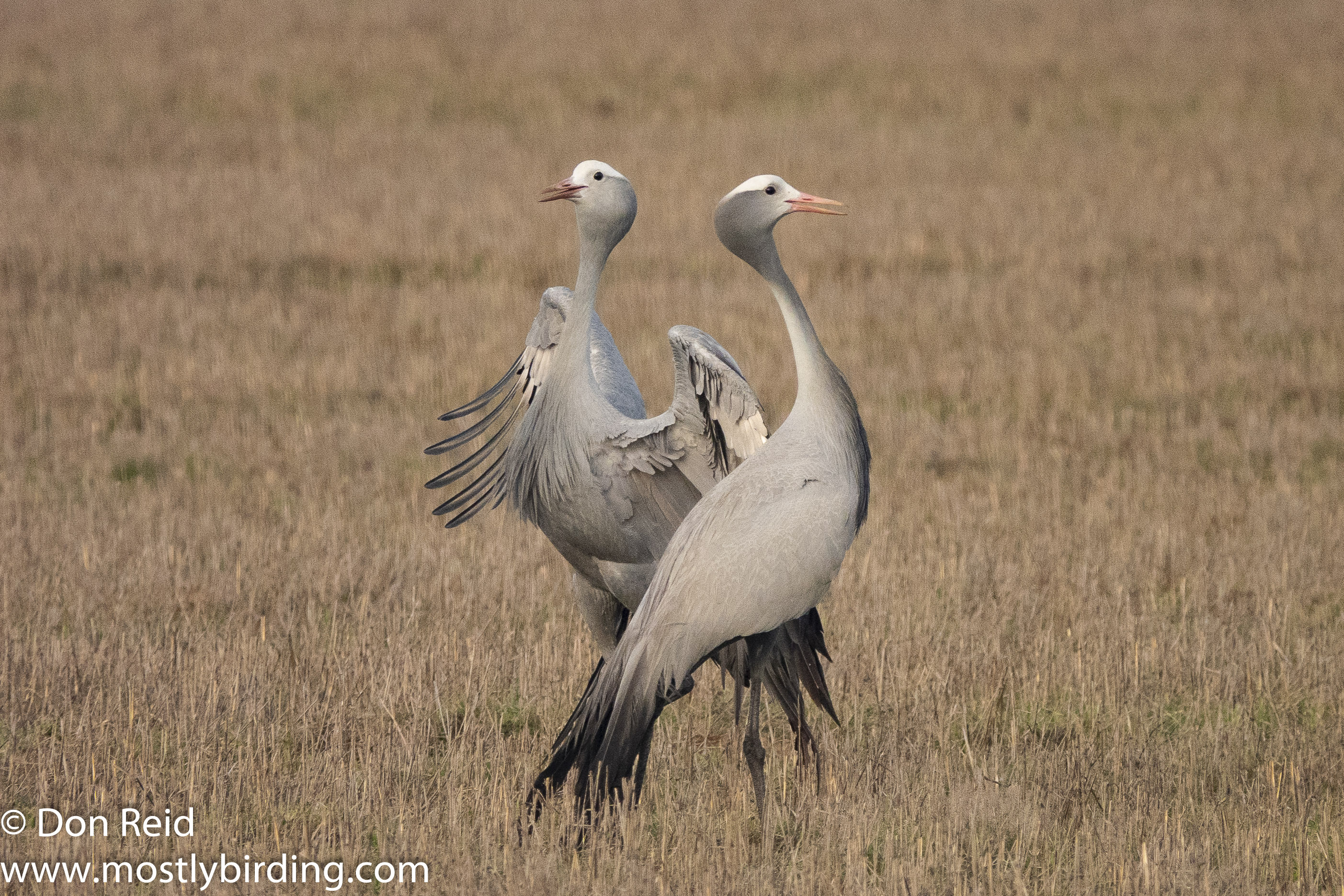
Blue Cranes form monogamous pairs when breeding and are well known for their spectacular pairing and courtship displays, which we were fortunate to witness some time ago and which I featured in an earlier post – a couple of the images from that post are repeated below

Blue Crane courtship dance, near Mossel Bay

My last post for 2021 comes with best wishes for a peaceful and healthy New Year

Sweet little Sugarbirds

Observing birds going about their daily business is often fascinating – when that business involves raising youngsters it becomes really special.

We were treated to a very special “show” during the late winter / early spring months of August and September this year while resident in our Mossel Bay home, which started with a casual comment from our neighbour (a non-birder who happens to be our brother-in-law).

My journal chronicles it as follows :

Day 1 : (1st August 2021)

Brother-in-law – let’s call him Tienie (mainly because that’s his name) – posed a question “what’s that bird in the garden with the long tail that likes the Protea bushes ?”. Well, there weren’t too many options so I surmised immediately that he was talking about the Cape Sugarbirds that frequent our garden almost year round.

So I eagerly followed up with “why do you ask?” and it turned out he had noticed a nest in one of the Protea bushes in his garden, with said Sugarbird in attendance and when he investigated further he was able to spot what he thought were “two fluffy babies” in the nest. My guess is that the chicks had been born in the last day or so.

Day 2

Tienie’s comment had sparked my interest more than he could realise, even though he knows I am a keen birder, and Gerda and I commenced a daily check from our bedroom balcony, which has a good view of the Protea bush in his garden.

The nest was quite well concealed among the stems and leaves and it was not always easy to pick up details, so I started by doing a recce from Tienie’s garden, carefully approaching the bush on foot to confirm for myself that there were chicks in the nest.

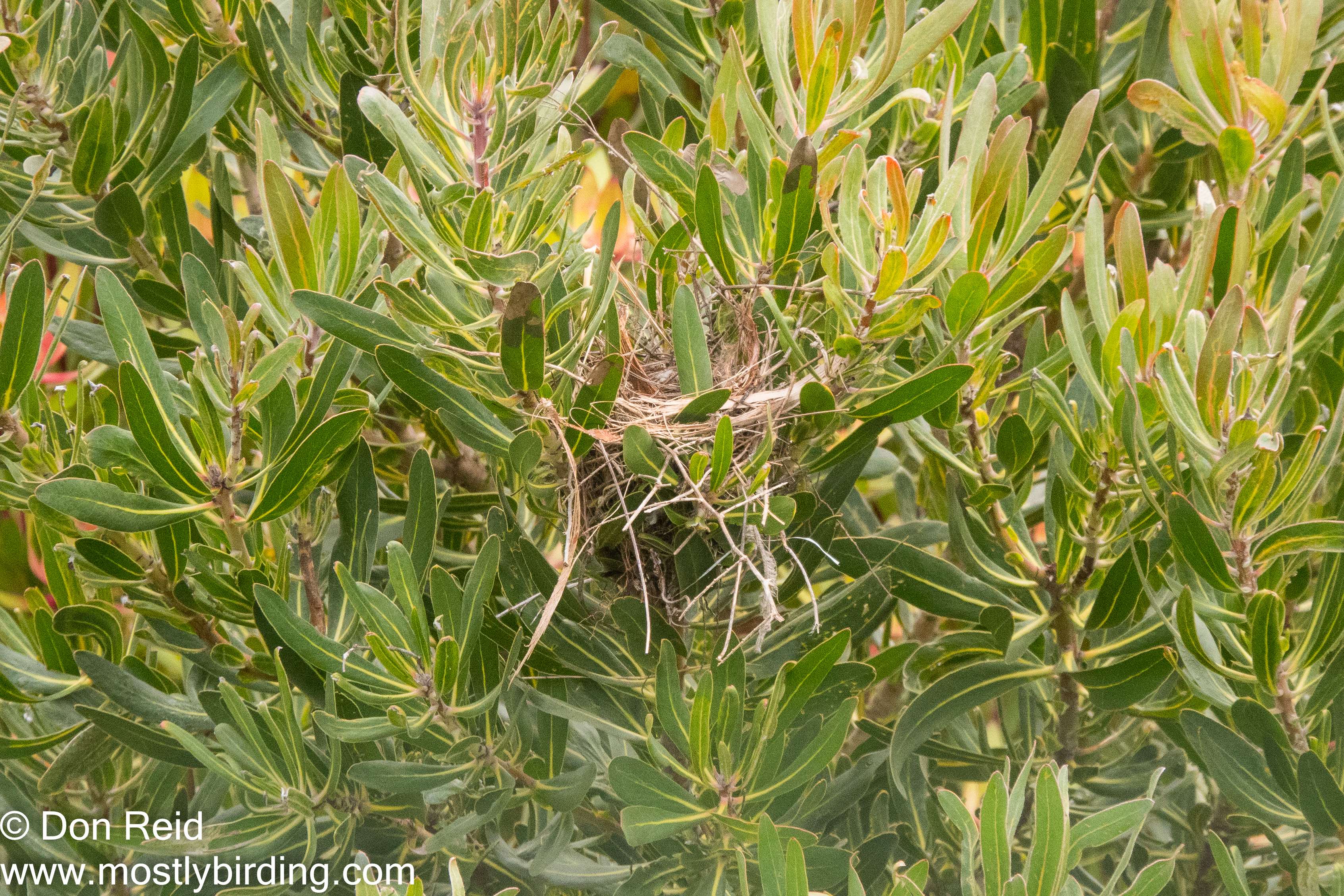
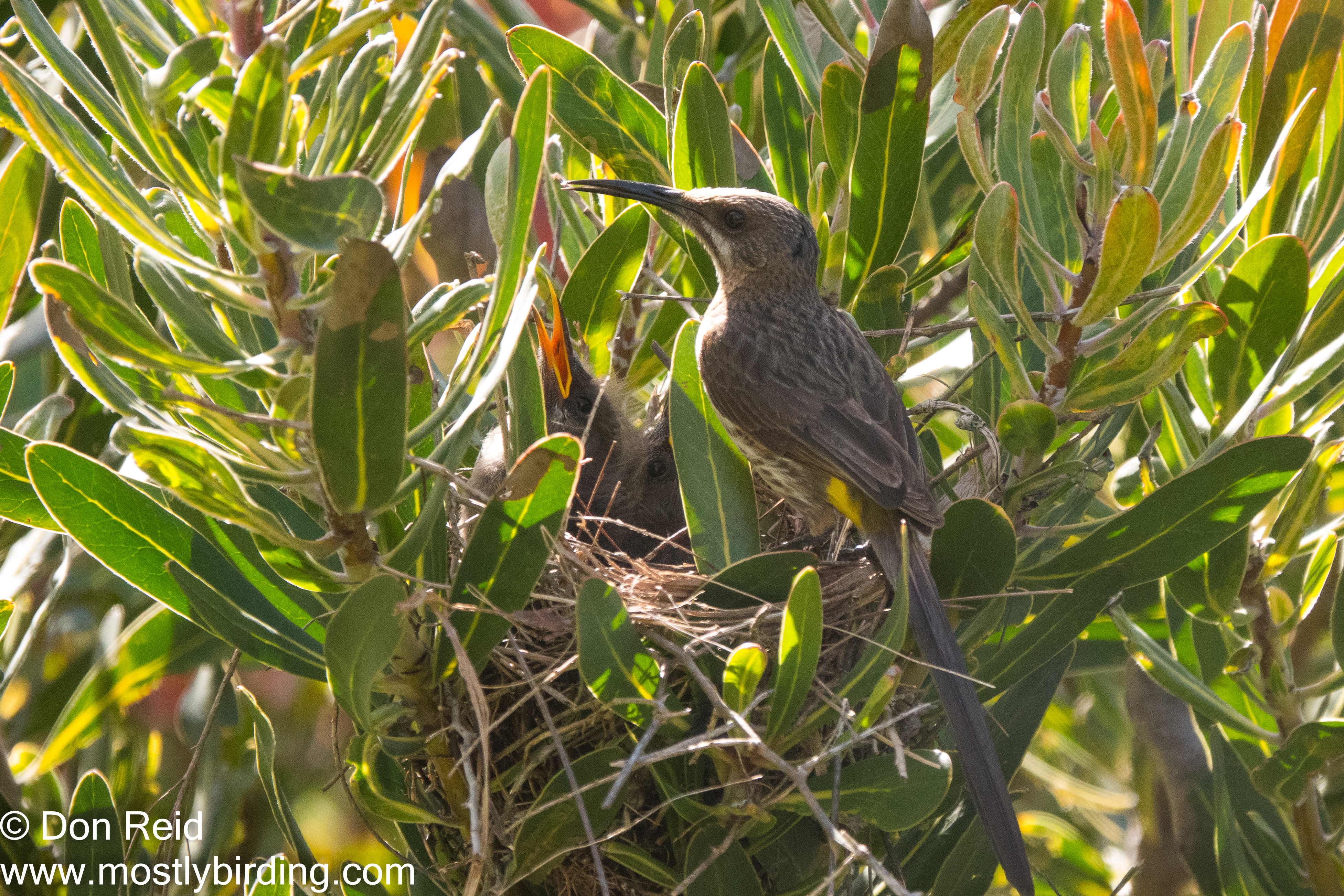
The nest

The only evidence I could pick up was an adult female apparently feeding the chicks which I could not see, while the adult male stayed in the vicinity, occasionally going to the nest himself.

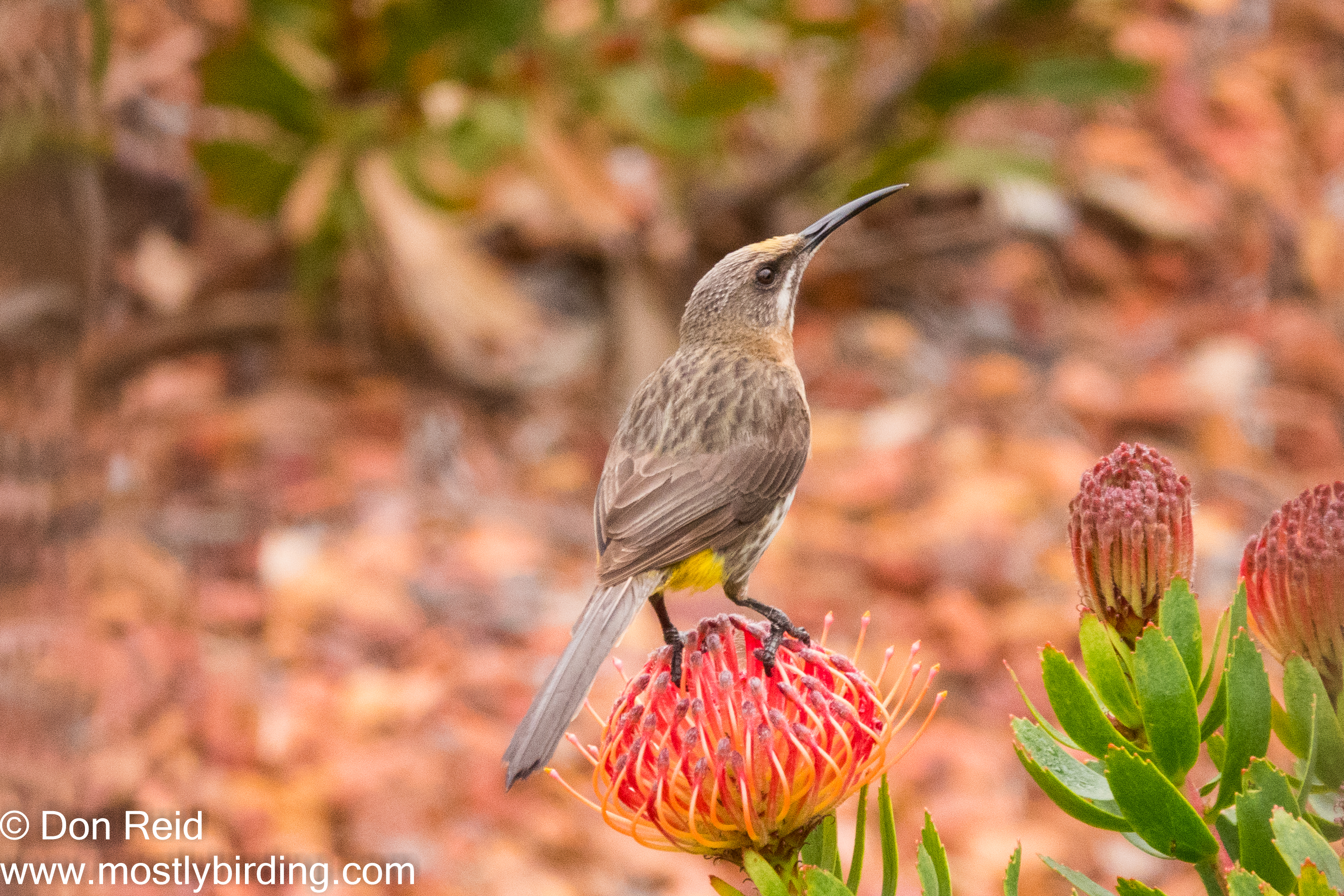
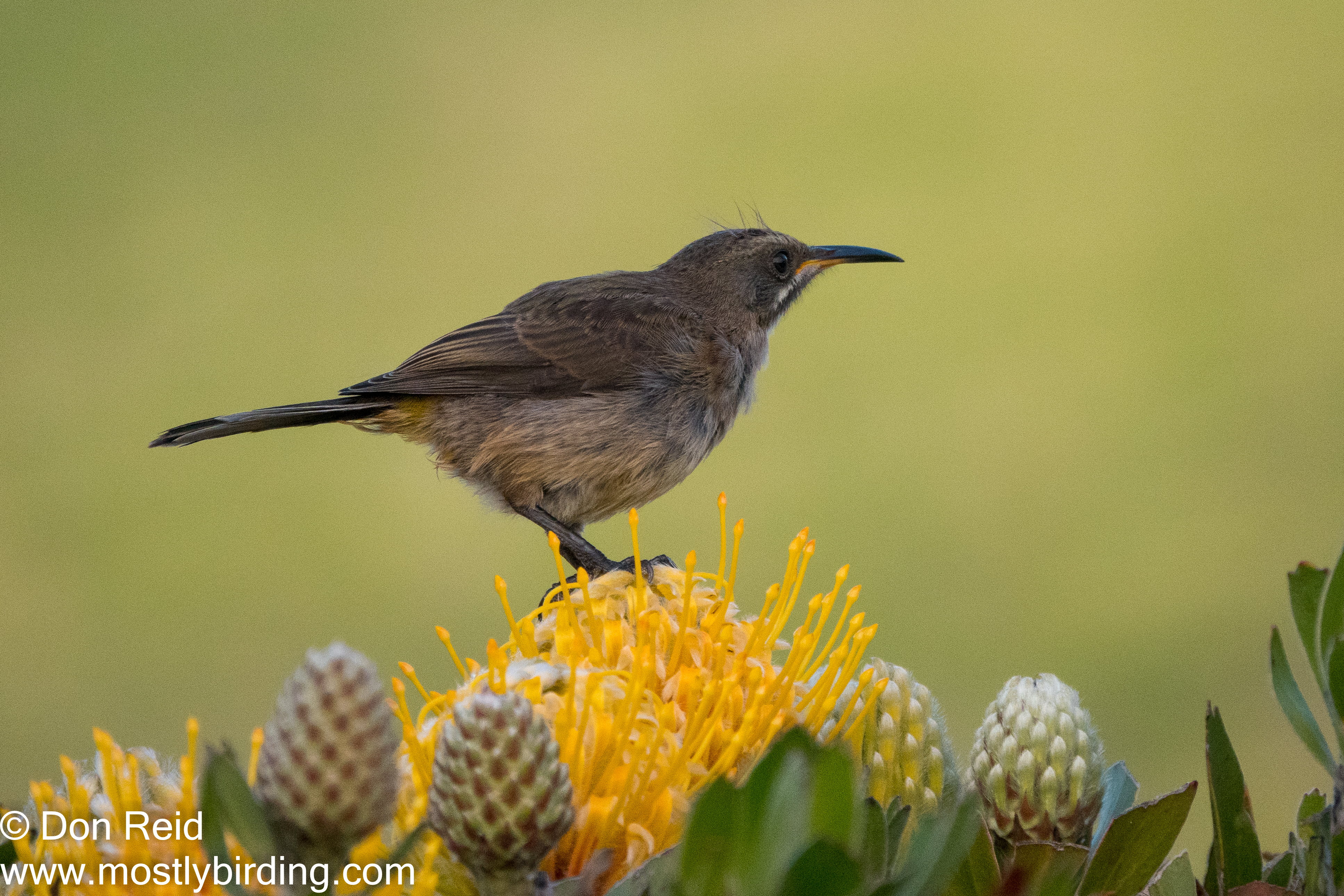
Cape Sugarbird adult
Cape Sugarbird adult at the nest

We continued to monitor their progress at various times during the following days, but had to interrupt our observations as we had booked a trip to Franschhoek from 6 to 11 August, after which we resumed keeping an eye on the activities around the nest.

Day 19

I was thrilled to see that the chicks were preparing to fledge as they were clearly visible in the nest and spent time perched on top of the nest, presumably working up the courage to explore the world around them.

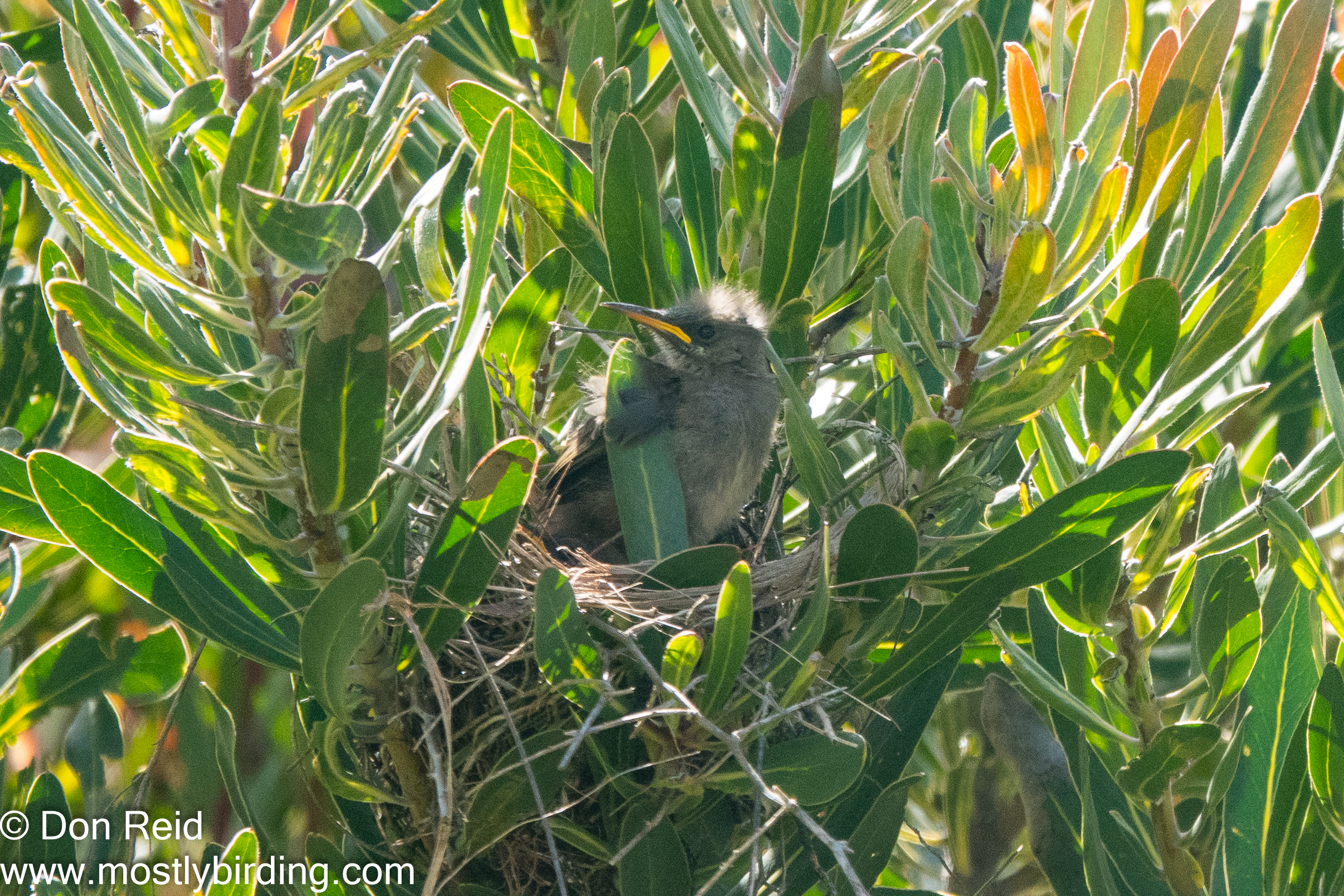
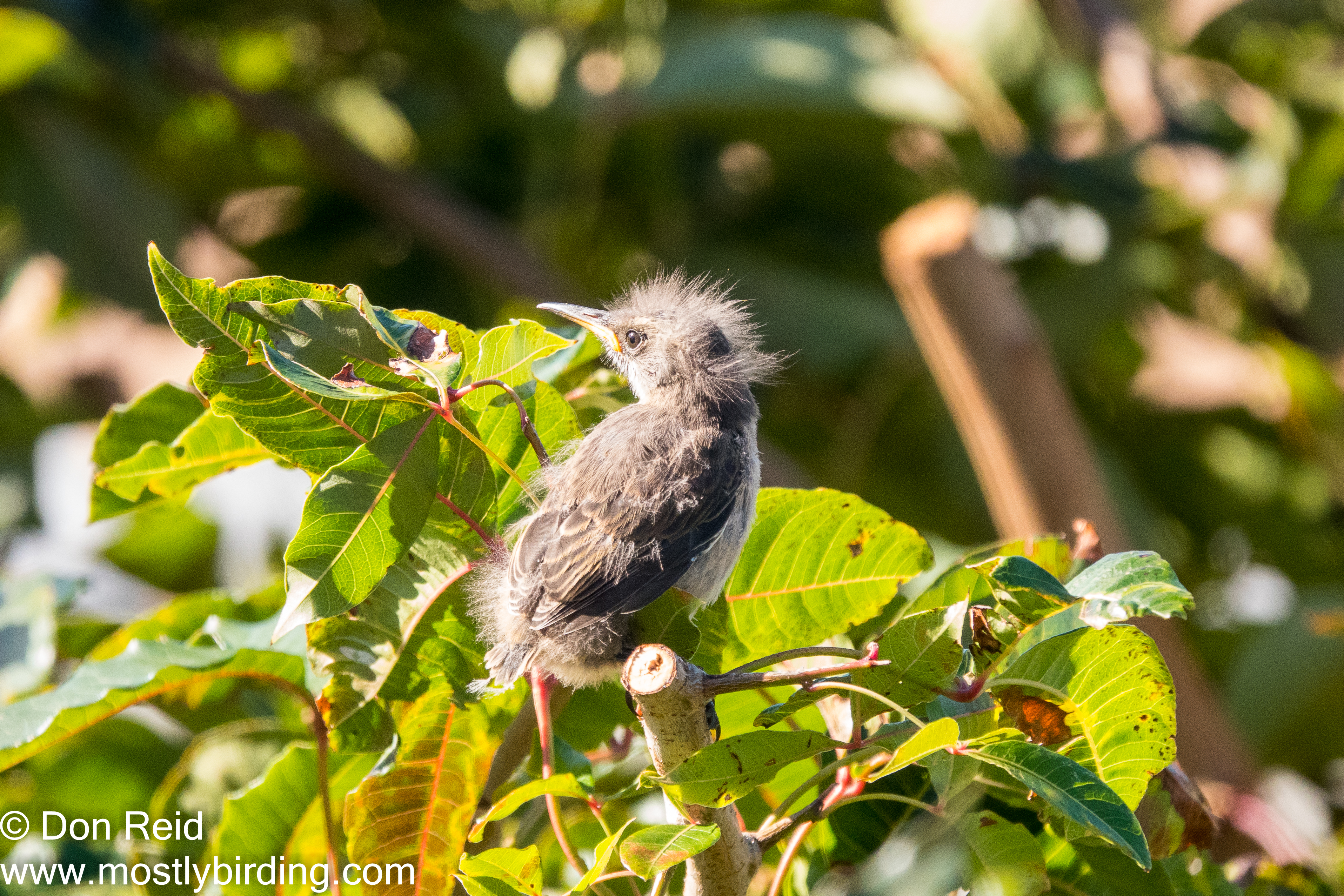
Cape Sugarbird chick
Cape Sugarbird chicks
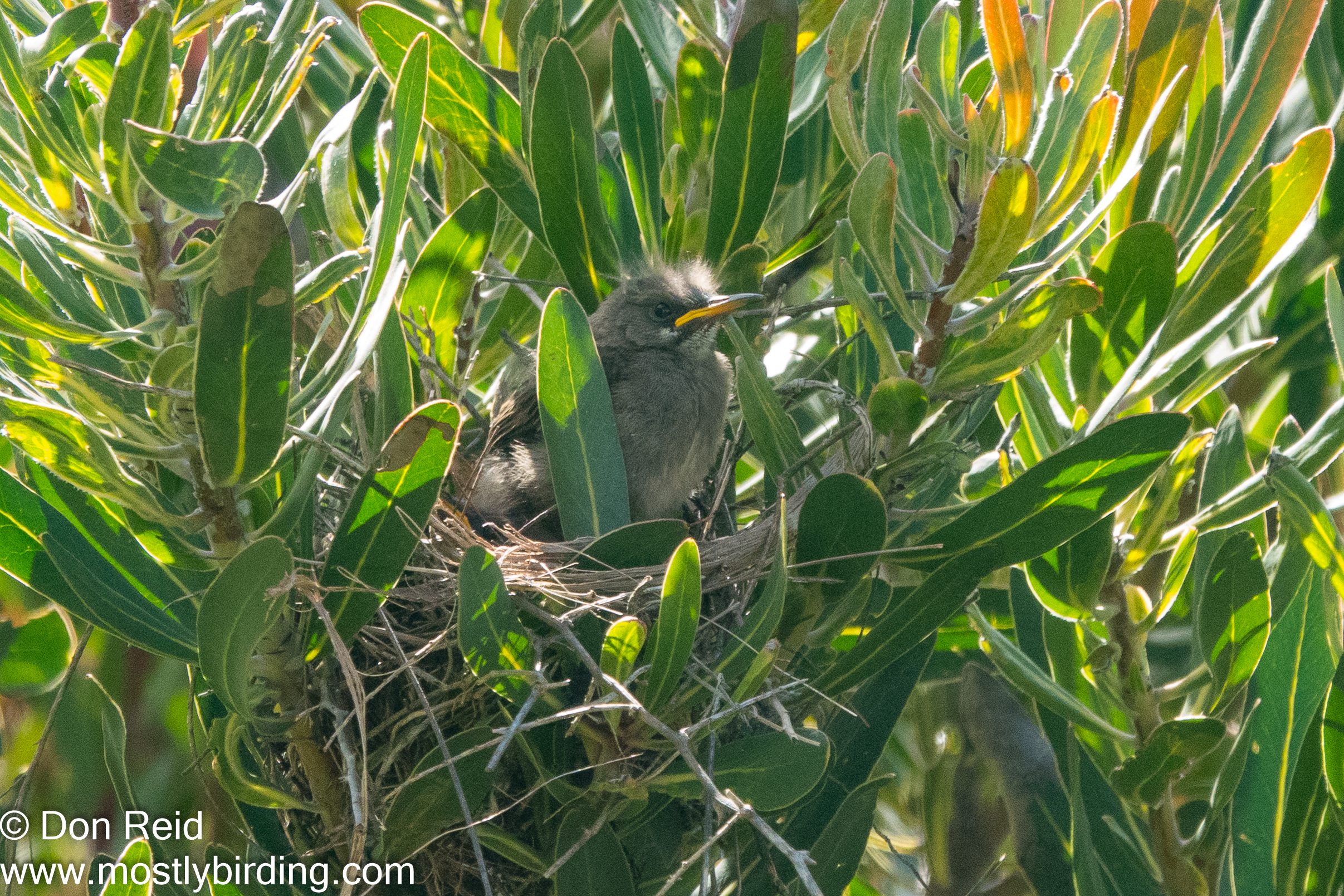
Cape Sugarbird chick

Both adults were never very far from the nest, venturing out to forage for something and taking turns to feed the chicks, whose appetite had by now increased exponentially.

Cape Sugarbird adult
Cape Sugarbird adult with insect ready to feed chick
Cape Sugarbird adult feeding chicks

Day 20

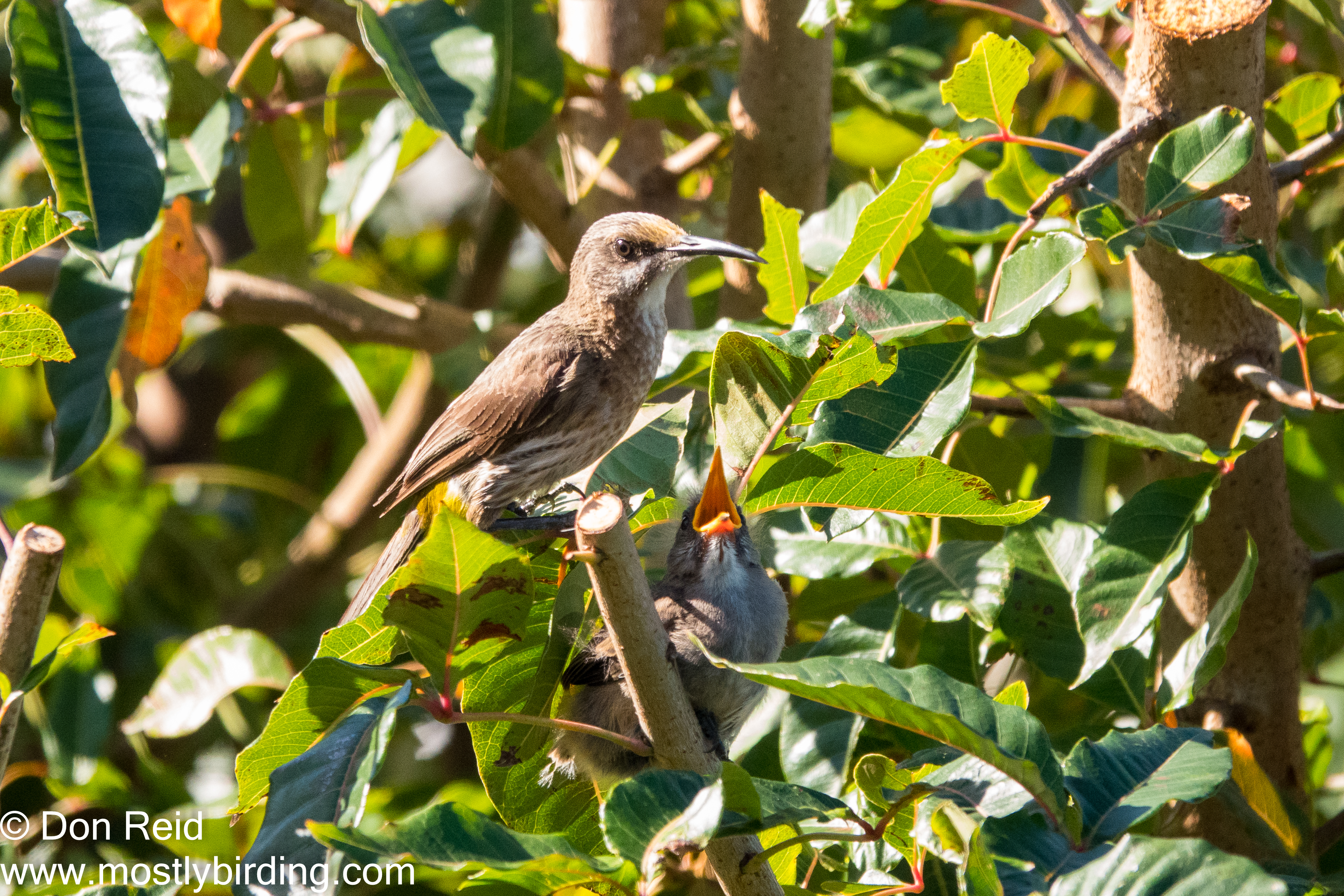
As I had suspected, the chicks had fledged and the great news was that they had chosen to spend their day in the trees right in front of our enclosed braai room which is almost level with the canopy of the trees, so we had the best views of the two young Sugarbirds.

Cape Sugarbird fledgling

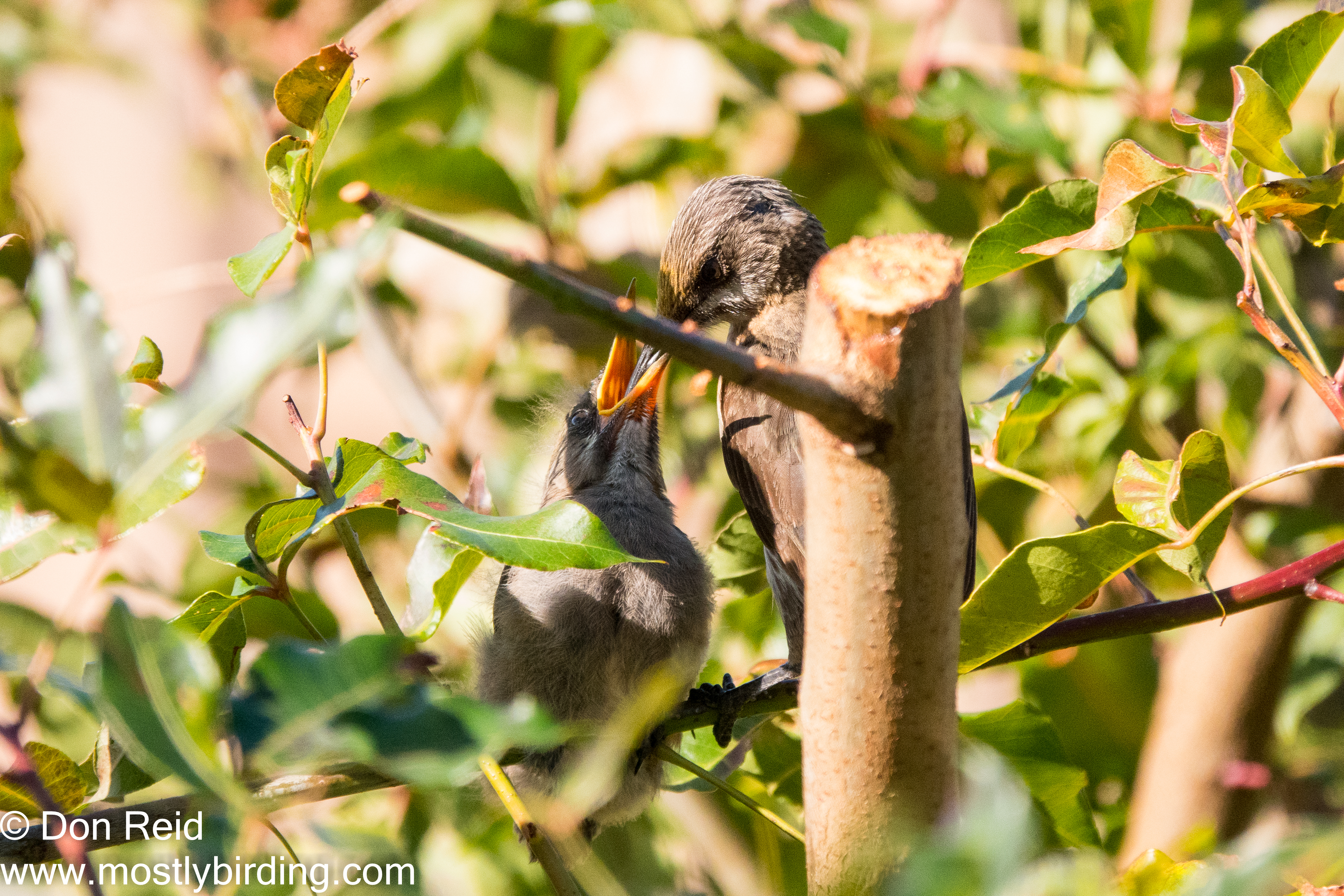
They were still being fed by both adults and were moving about now and again, but chose to spend most of their time on a small but sturdy branch, as the wind was strong and was testing their ability to balance themselves to the utmost.

Cape Sugarbird adult
Cape Sugarbird adult feeding fledgling

Day 22

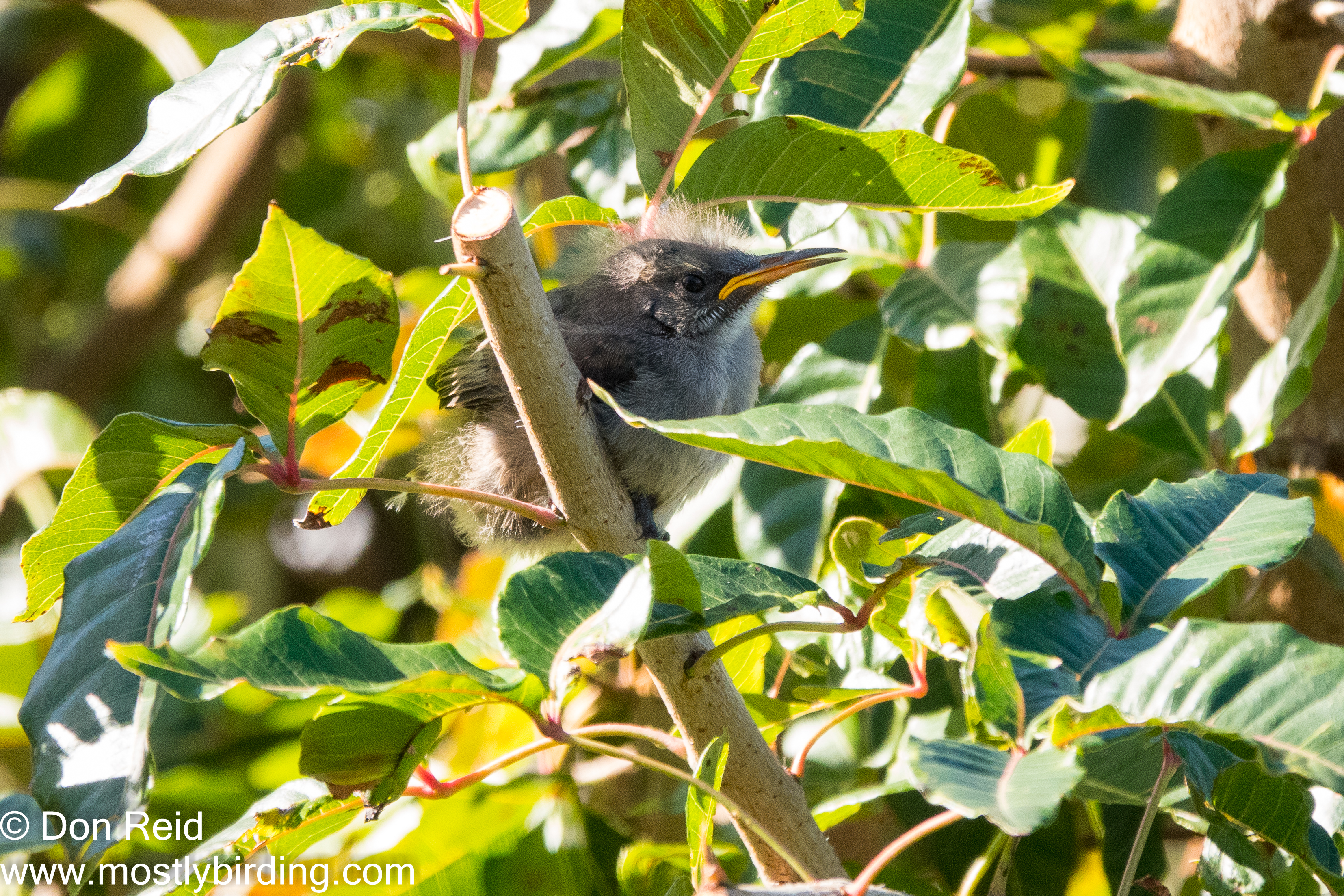
The fledglings were getting stronger by the day and starting to lose their “baby fluff” but had no tail to speak of and were still dependant on the adults for food

Cape Sugarbird fledgling

They hung around for another day or two and soon we were not able to find them at all, so presumed they had moved elsewhere in the vicinity. We didn’t spot them again until –

Day 35

What a nice surprise to find one of the youngsters feeding itself on a Protea flower in our front garden, its tail now well developed and the young bird now confident and strong, which it displayed by flying quickly and directly from one bush to the other with none of the hesitancy of an inexperienced bird.

Cape Sugarbird juvenile

It was a real privilege to see these Sugarbirds develop from new-born chicks to their juvenile independence and to be able to observe them at such close quarters

It’s a Shore Thing – The Sequel (Part 2)

Continuing the story of our trip to Bronkhorstspruit Dam Nature Reserve not far from Pretoria, where we were fortunate to find the rare vagrant Baird’s Sandpiper with relative ease ….

After locating the Baird’s Sandpiper and spending some time admiring this tiny adventurer all the way from the Arctic, we spent the next couple of hours driving slowly as close to the dam shoreline as we could, scanning every metre of it as we went.

This paid off with several more good sightings of waders and other birds, many of them the same species as I had recorded during an atlasing trip a few weeks prior, but with some exciting new additions –

Starting with an uncommon species which we found in the short grass which covers most of the open ground between the track and the shoreline of the dam …..
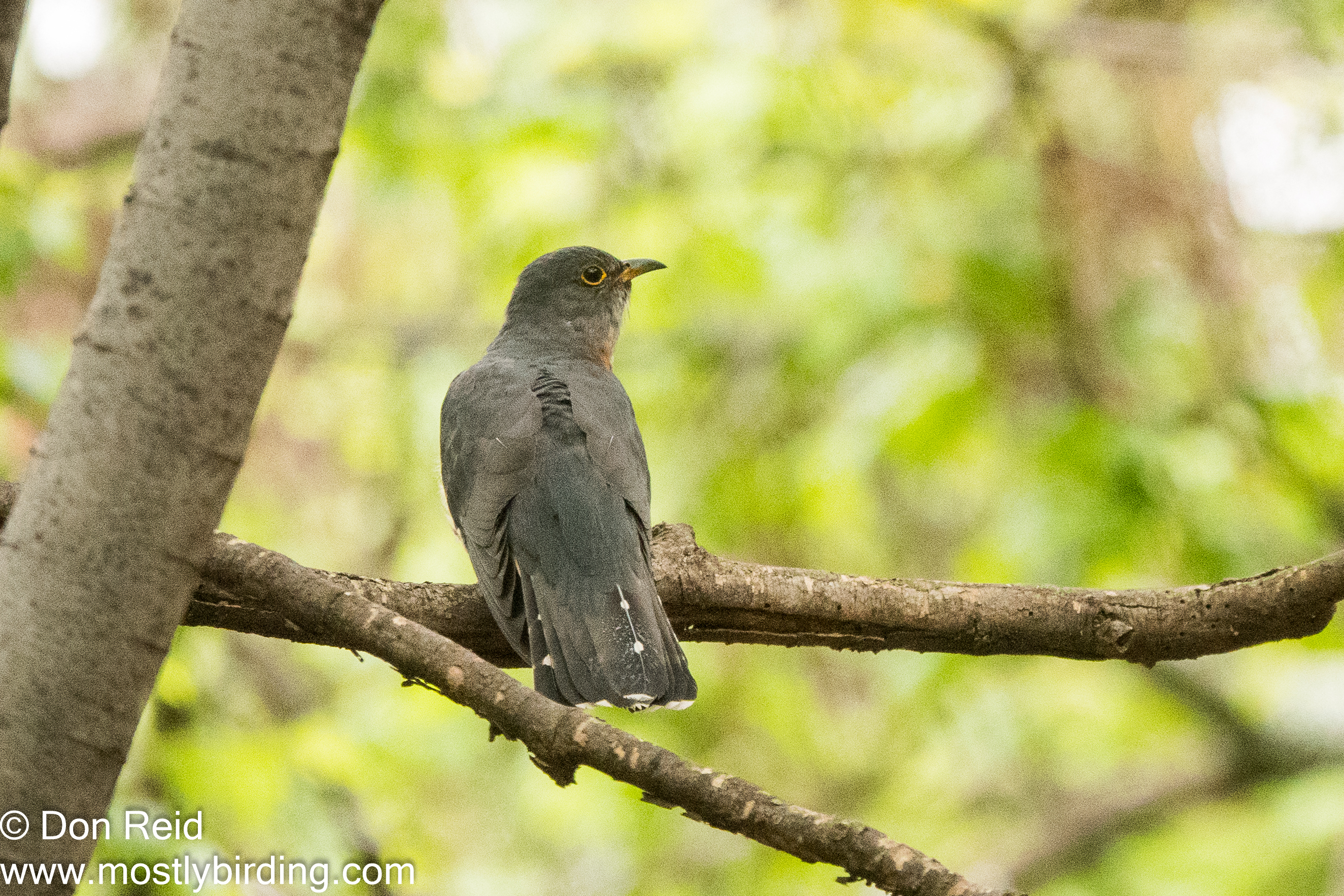
Western Yellow Wagtail Motacilla flava (Geelkwikkie)

Western Yellow Wagtail Motacilla flava (Geelkwikkie), Bronkhorstspruit Nature Reserve

The Yellow Wagtail is not a wader as such, but it favours similar habitat to some of the waders, particularly fringes of dams with short grass. It is not unusual to find the far more common Cape Wagtails pottering about in their perky fashion among small waders, but during the summer months it pays to check out all the wagtails as they could include this uncommon non-breeding migrant, which arrives in small numbers from its breeding grounds in eastern Europe and western Asia

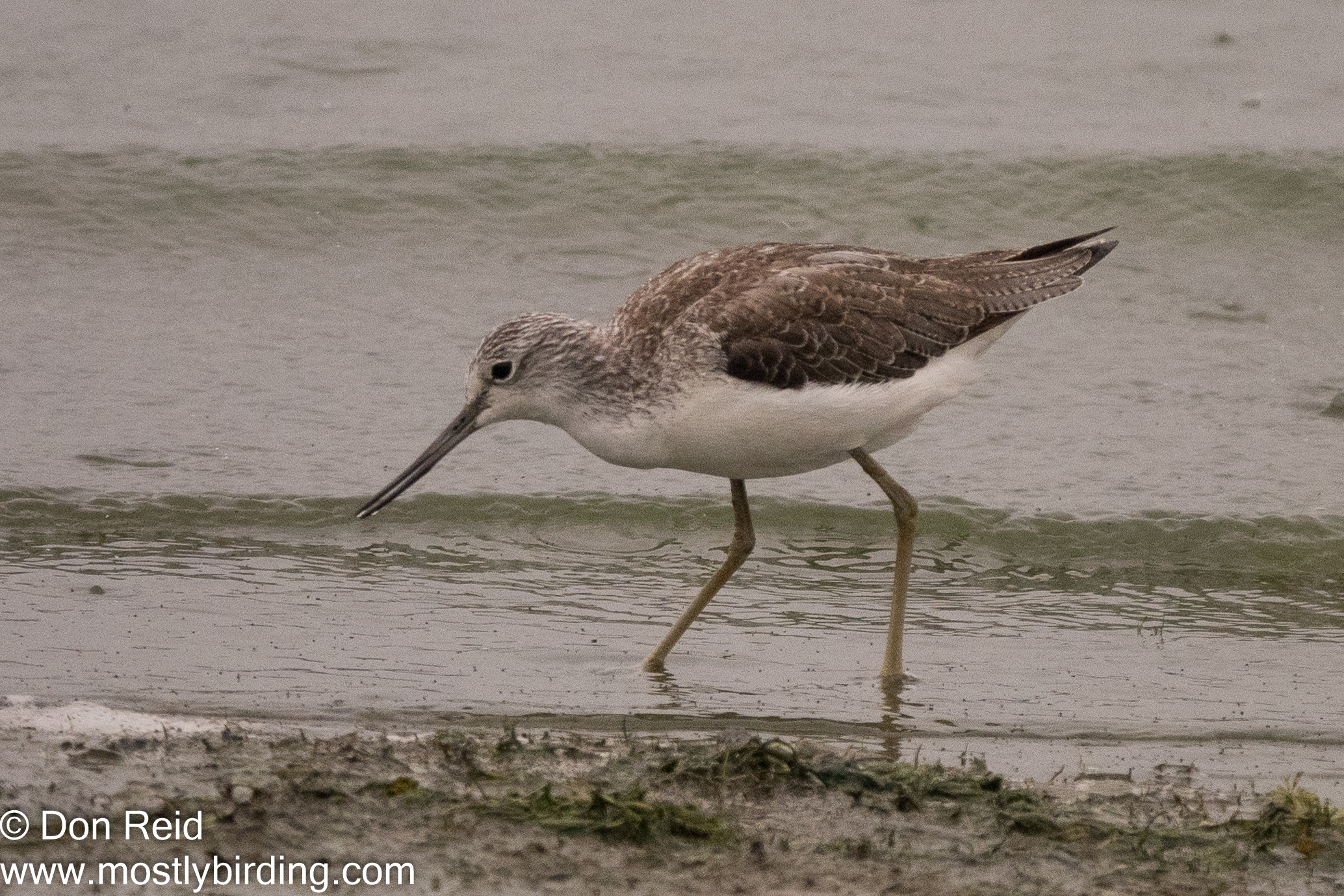
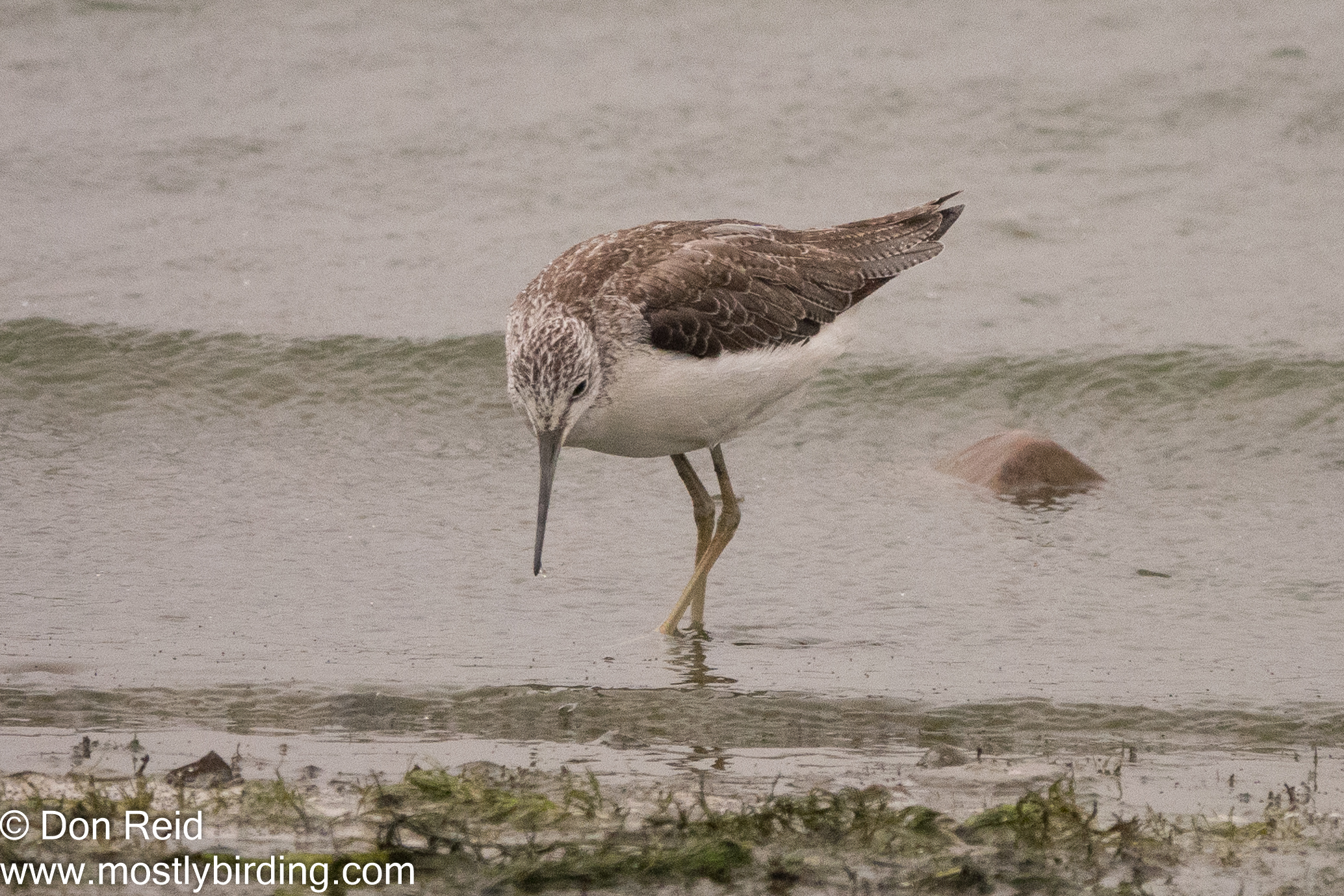
Common Greenshank Tringa nebularia (Groenpootruiter)

We also came across this fairly common wader which can be found right across southern Africa at inland and coastal waters, but seldom in numbers, often alone – we saw just the one during our couple of hours of careful scanning

Common Greenshank Tringa nebularia (Groenpootruiter), Bronkhorstspruit Nature Reserve

Generally one of the easier waders to identify and get to know, even at a distance, due to its long-legged appearance, relatively large size and slightly upturned bill

Common Greenshank Tringa nebularia (Groenpootruiter), Bronkhorstspruit Nature Reserve

The Greenshank is one of the longer-staying Palaearctic migrants, arriving from its “home” in European Russia and eastwards from as early as August and departing again between February and April

Common Sandpiper Actitis hypoleucos (Gewone ruiter)

Another wader that belies its name by not being particularly common, this was one of just a couple that we came across

Once you are “into” the intricacies of identifying waders, the Common Sandpiper soon becomes familiar, with its standout features being its uniform brown upper colouring contrasting with a clear white underside. The white gap between shoulder and breast band (not clearly visible in my photo) is often a clincher

Common Sandpiper Actitis hypoleucos (Gewone ruiter), Bronkhorstspruit Nature Reserve

It prefers firmer surfaces than other waders and can often be found alongside wagtails on rocks, firm sand and gravel rather than wading in the water itself

It is also a long-staying migrant from its “home” which stretches from Europe to Japan, arriving in southern Africa from August and departing from January to April

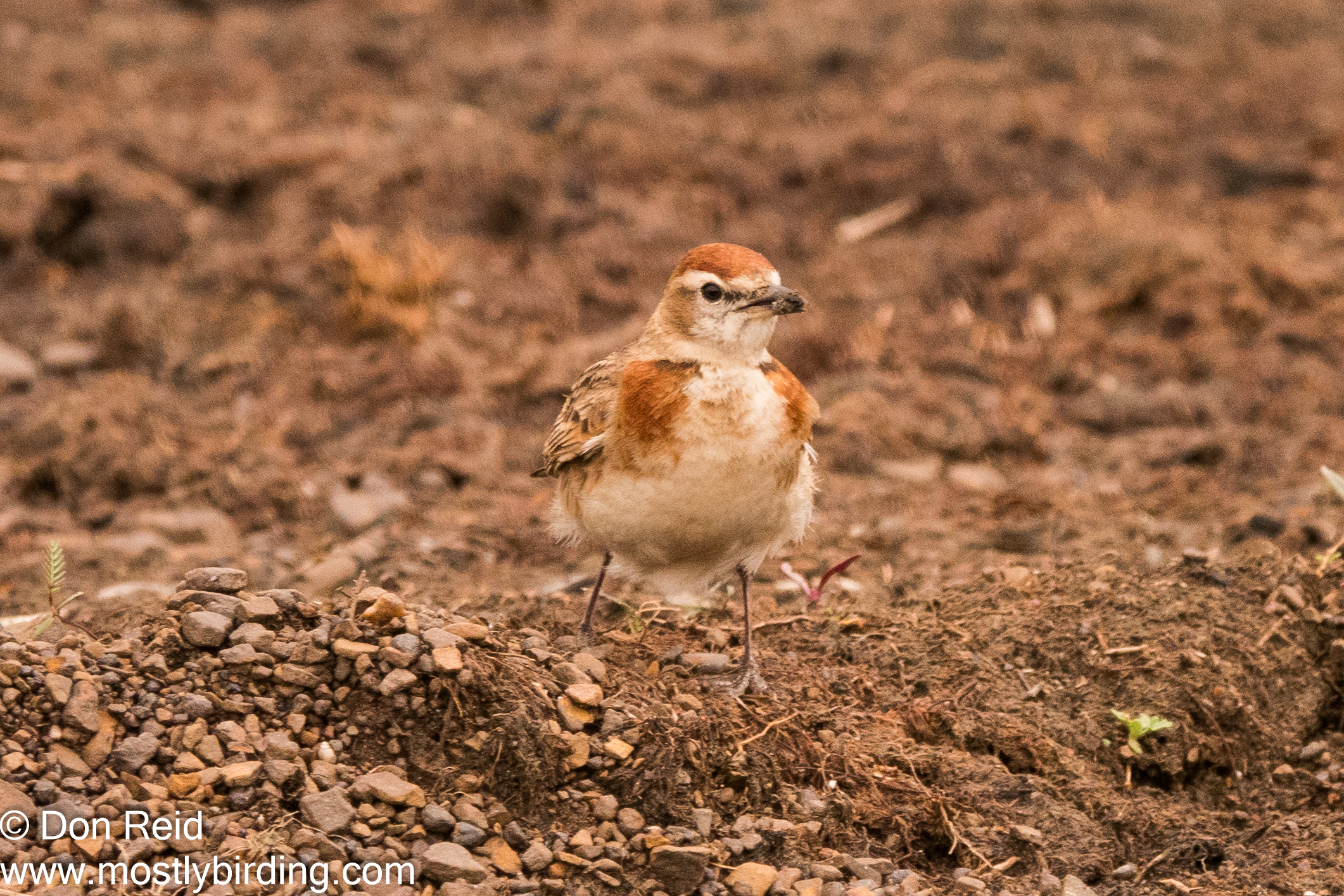
Red-capped Lark Calandrella cinerea (Rooikoplewerik)

And now for something completely different ……

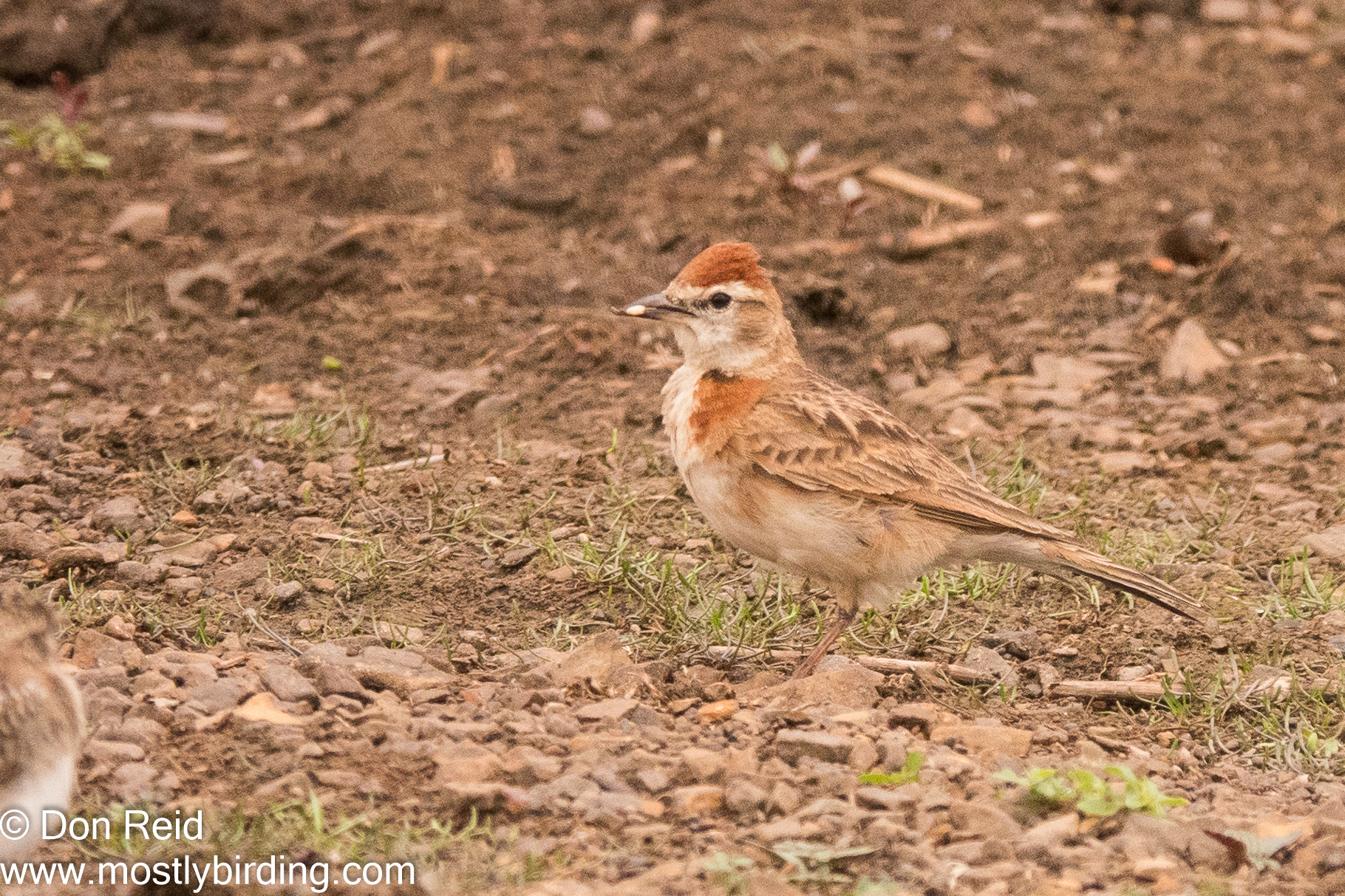
Arguably one of the better known larks, which otherwise get a lot of bad press by being called “little brown jobs” or LBJ’s by those new to birding, this one is hard to confuse with any other lark species due to its distinctive rufous crown and breast side patches

Red-capped Lark Calandrella cinerea (Rooikoplewerik), (Adult) Bronkhorstspruit Nature Reserve

Their preferred habitats include bare ground and edges of wetlands so it wasn’t too much of a surprise to find one not far from the dam edge, nevertheless we were most pleased to find this individual with a tiny morsel in its beak.

Red-capped Lark (Adult)

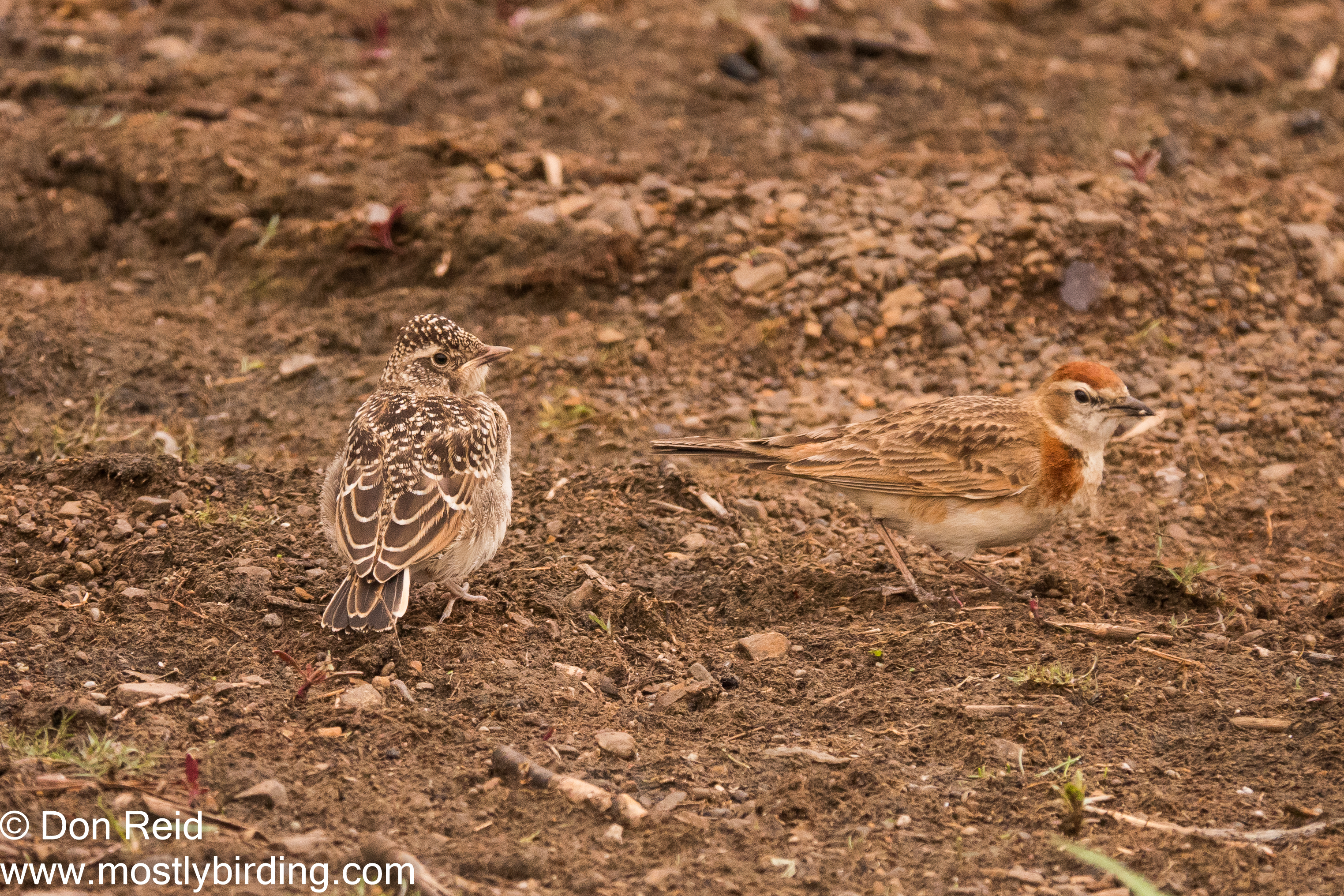
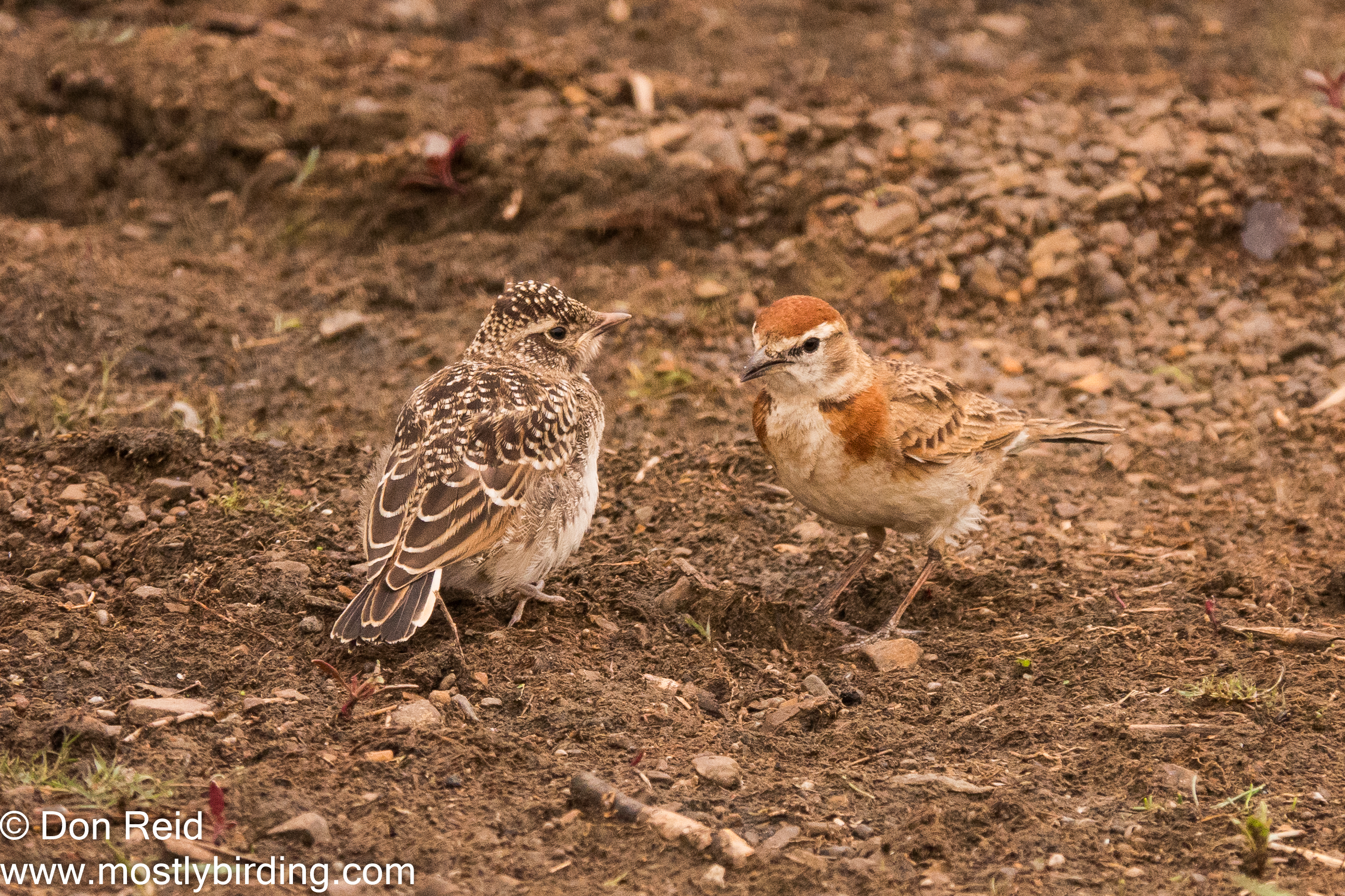
We immediately guessed that the morsel was intended for a juvenile being fed by the adult, and looked around – nearby was a well-camouflaged, inconspicuous bird with no matching features but there was no doubt of its lineage as we watched the adult feeding the morsel to it then rushing off to find more. Lovely to watch and a unique sighting!

Red-capped Lark (Juvenile with Adult)

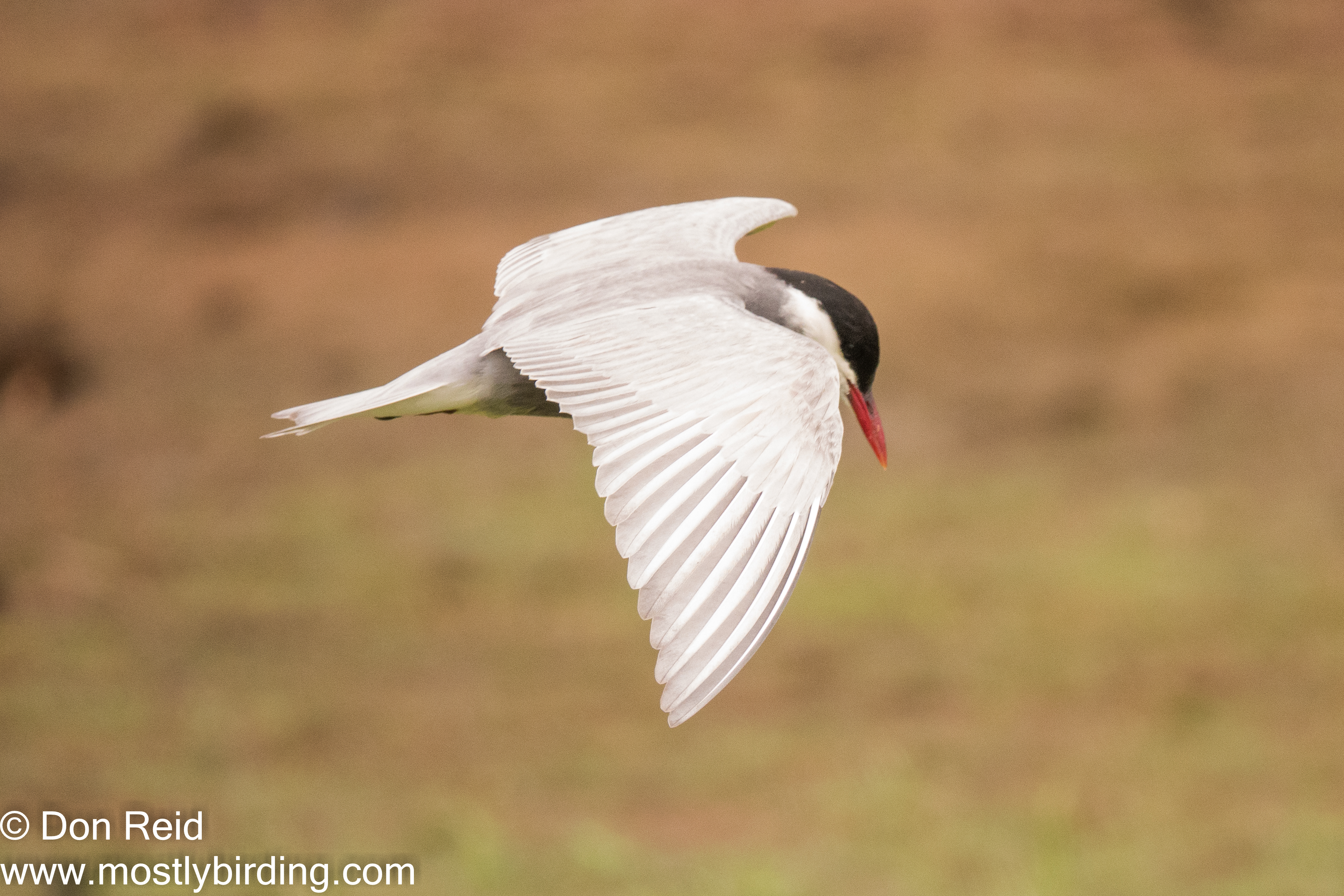
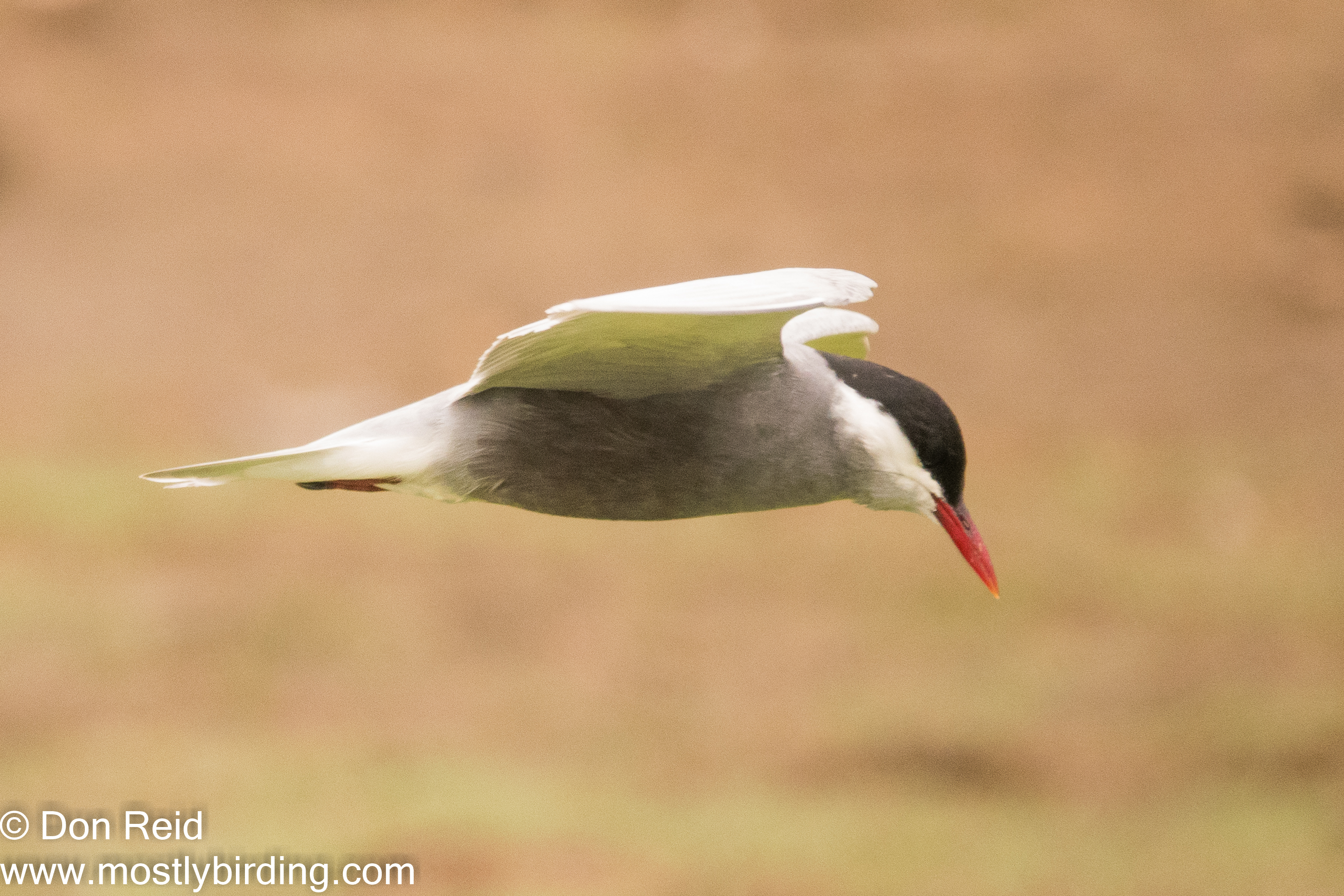
Whiskered Tern Chlidonias hybrida (Witbaardsterretjie)

Now, sharp readers will quickly realise that terns are not waders – but I have other reasons for including these images …..

Firstly, terns commonly roost at water’s edge in between sorties over the dam close to the shoreline, floating in the wind, looking for prey and dipping down to grab it.

As we drove slowly along the shoreline at one point, I noticed a flock of about a dozen Whiskered Terns flying low in their usual fashion, heads down, floating in the light wind, looking for prey and dipping down to grab something then joining the flock again.

Whiskered Tern Chlidonias hybrida Witbaardsterretjie, Bronkhorstspruit Nature Reserve

What was different was that they were flying above solid ground rather than the water, something I have not seen before – clearly there were enough small insects in the short grass or flying about just above it to persuade the terns to hunt away from their usual habitat.

They presented a beautiful sight as they flew towards our vehicle, veering away at the last moment, flying away for a distance, then turning back to repeat the circuit. They are such elegant birds in flight …..

Whiskered Tern Chlidonias hybrida Witbaardsterretjie, Bronkhorstspruit Nature Reserve

It’s a Shore Thing – The Sequel (Part 1)

A couple of weeks ago I posted about a selection of Waders (Shorebirds) and other water birds that I had encountered during an atlasing trip to Bronkhorstspruit Dam Nature Reserve not far from Pretoria.

Well, I wasn’t expecting to visit this nature reserve so soon again, but an alert received this past Saturday from SA Rare Bird News run by Trevor Hardaker (the second item in his alert below) had me reconsidering fairly quickly – a Baird’s Sandpiper would be a lifer for me and, having been spotted just 45 minutes drive from my home in Pretoria, it was an irresistible twitch.

The Twitch

I was not keen to join what I expected to be a twitcher scramble on the Sunday so I waited for Monday morning, when I picked up Koos Pauw at 6.30 am and we headed east along the N4 highway, then took the R25 and R42 turnoffs to take us to the nature reserve access road.

The many twitchers making their way to the dam the previous day combined with heavy overnight rain had turned the gravel access road and the nature reserve tracks into a muddy jumble in places – no problem for my Prado but we felt for the hardy twitchers in small sedans who we saw later in the reserve – no one got stuck while we were there but the road was worse on our way out, so those drivers would have had to use all their skills to get out without a problem.

More of a quagmire than a road – there’s already an ‘escape road’ forming on the right

We couldn’t help chuckling when we saw two Yellow-billed Ducks swimming in one of the larger puddles in the bumpy nature reserve track – how opportunistic, but it left us wondering why they chose a muddy puddle instead of the vast expanse of dam just 50 metres away.

From previous experience of twitches at popular, accessible birding spots such as this, I knew the best way of finding the target rare bird after an alert is to drive to the area where you expect to find it, then look for parked cars – this was my strategy and it worked, but only just!

As we approached the approximate position along the dam edge given in the alert, a vehicle was heading towards us – we stopped to chat and the friendly driver offered to show us “the Baird’s” as they had just come from its location, with no one else around at the time. We accepted with alacrity and a couple of minutes later we were at the right spot and watching the Baird’s Sandpiper ourselves – success! (cue the Beatles “With a little help from my friends”)

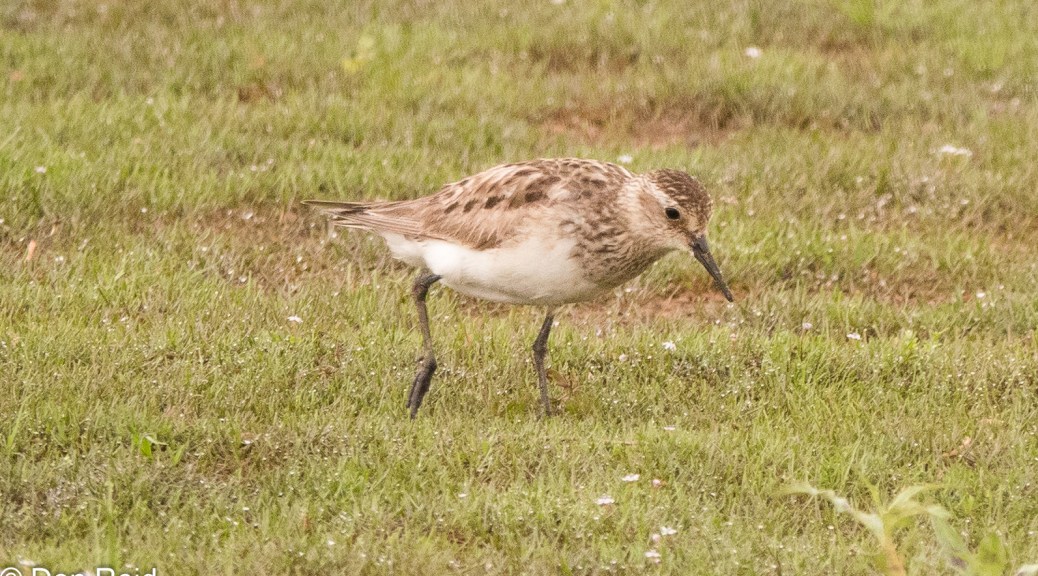
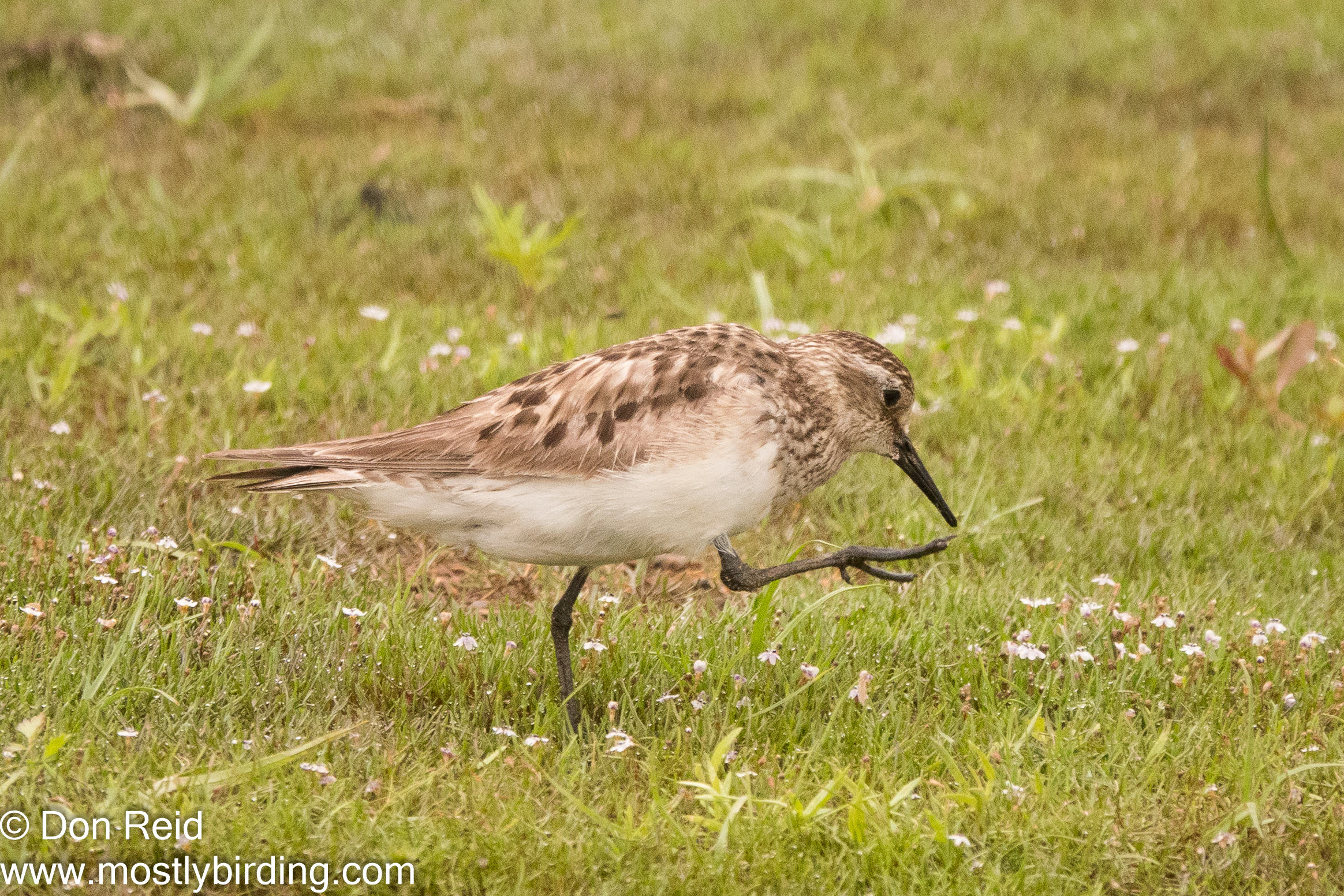
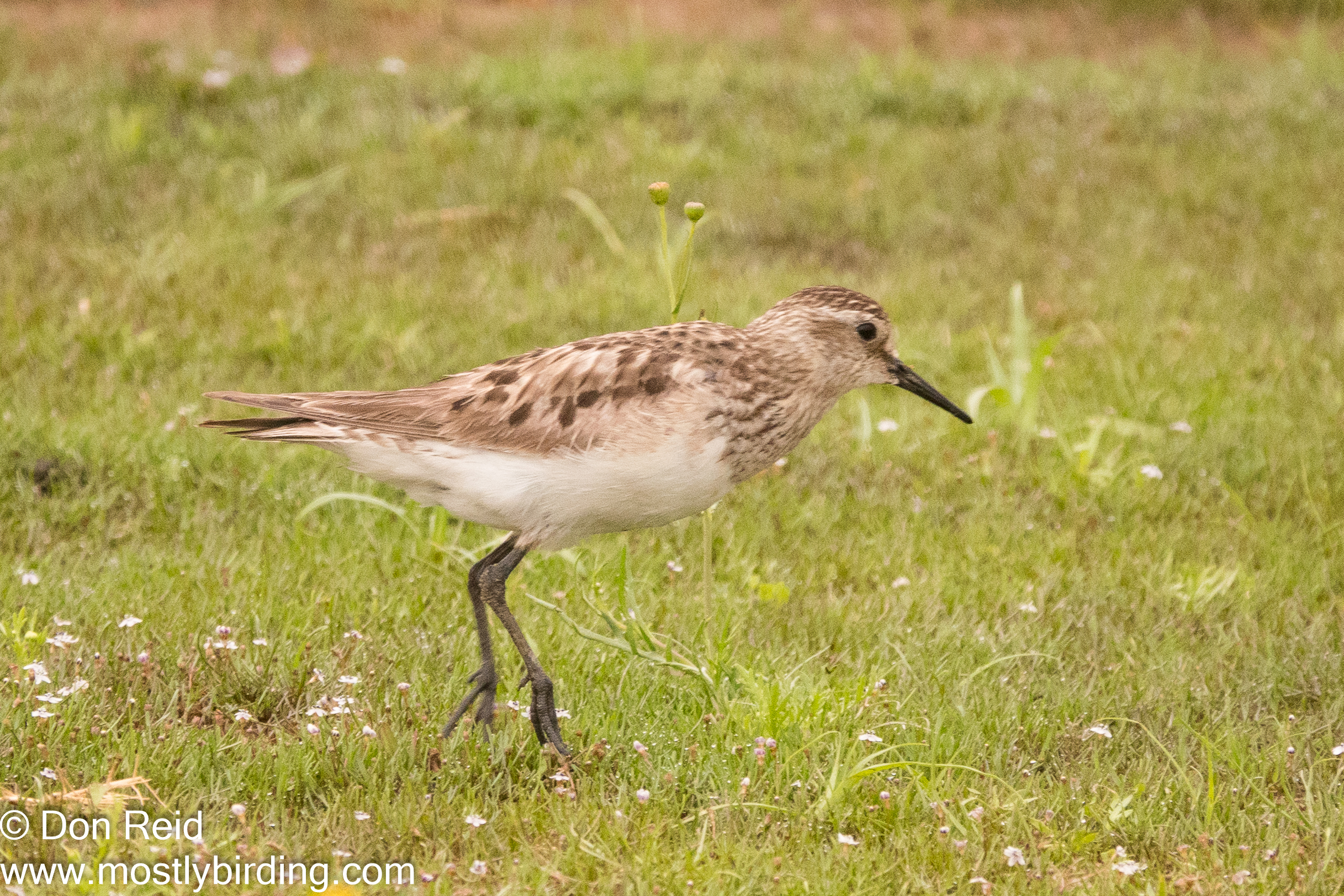
Baird’s Sandpiper Calidris bairdii Bairdse strandloper, Bronkhorstspruit Nature Reserve

We had nevertheless armed ourselves with some knowledge of the species and its main identifying features, in case we were faced with finding and identifying it ourselves – but our newfound friend quickly informed us that we only had to look out for the ‘small wader with a limp’ as it seems it had injured its leg, so the task of picking it out among the other small waders was very simple. The video clip below shows just how pronounced its limp was

Baird’s Sandpiper Calidris bairdii (Bairdse strandloper)

The Baird’s Sandpiper falls into the wader family known as the Calidrids, breeding at Arctic latitudes of Alaska and Canada and usually migrating to South America during the austral summer.

Occasionally, as with this one in all probability, a single bird is blown off course by adverse weather conditions, or its ingrained directional instinct goes slightly awry and they end up in southern Africa instead. Not without an almost unfathomable effort of course, for its journey would have taken it across the Atlantic Ocean at some stage.

Baird’s Sandpiper Calidris bairdii Bairdse strandloper, Bronkhorstspruit Nature Reserve

Less than 20 records exist of sightings of this species in the southern African region, since 1984 – prior to that there is just one record from 1863! So its status is rightly given as a very rare vagrant

Each red dot represents an individual record over the last 37 years

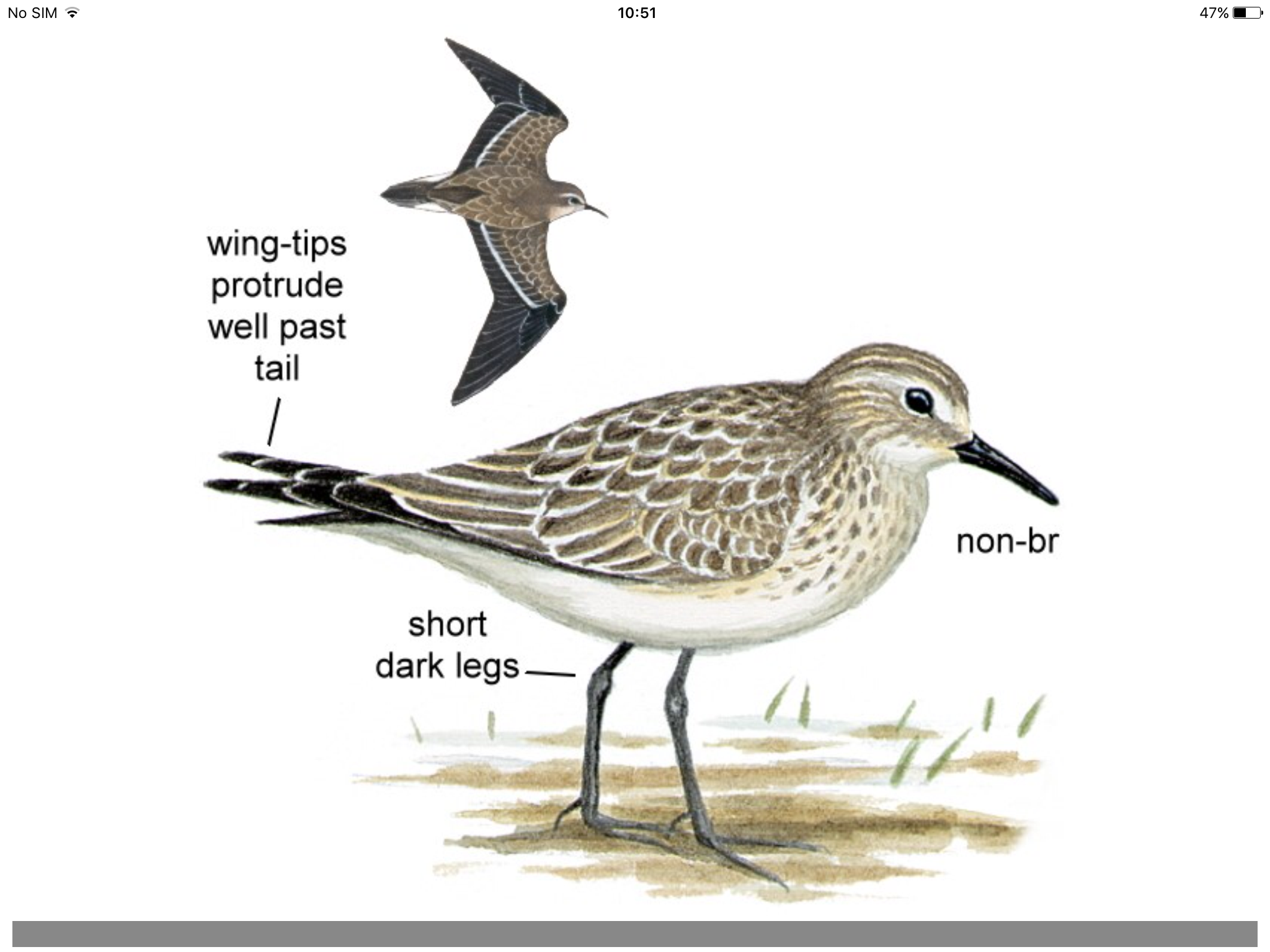
Waders without clear features which set them obviously apart from other similar sized waders can present a real challenge to birders and the Baird’s Sandpiper falls into that category. If it hadn’t had the distinct limp we would have had to resort to looking for the features given in the illustration below from the Roberts app

So that’s how I added the latest lifer to my Southern African list – simple really …….

As with my previous visit we spent the next couple of hours driving slowly as close to the dam shoreline as we could, scanning every metre of it as we went. This paid off with several more good sightings of waders and other birds, many of them the same species as I had recorded before, but with some exciting new additions – more about these in a follow up post

References

Finally, just a mention of the two outstanding sources that I have used for the information in this post :

Firstly, Roberts VII Multimedia Birds of Southern Africa – the go-to guide for detailed information on all of Southern Africa’s birds

Secondly, the more focused Chamberlain’s Waders – The Definitive Guide to Southern Africa’s Shorebirds by Faansie Peacock (No, that’s not a made up name!)

The Call of Summer

There are numbers of migrant birds to southern Africa that herald the start of the Austral (Southern Hemisphere) summer from September each year, but two stand out as the icons of summer’s arrival and become the subject of excited messages on the various birding chat groups as they are spotted or heard for the first time in the early summer months

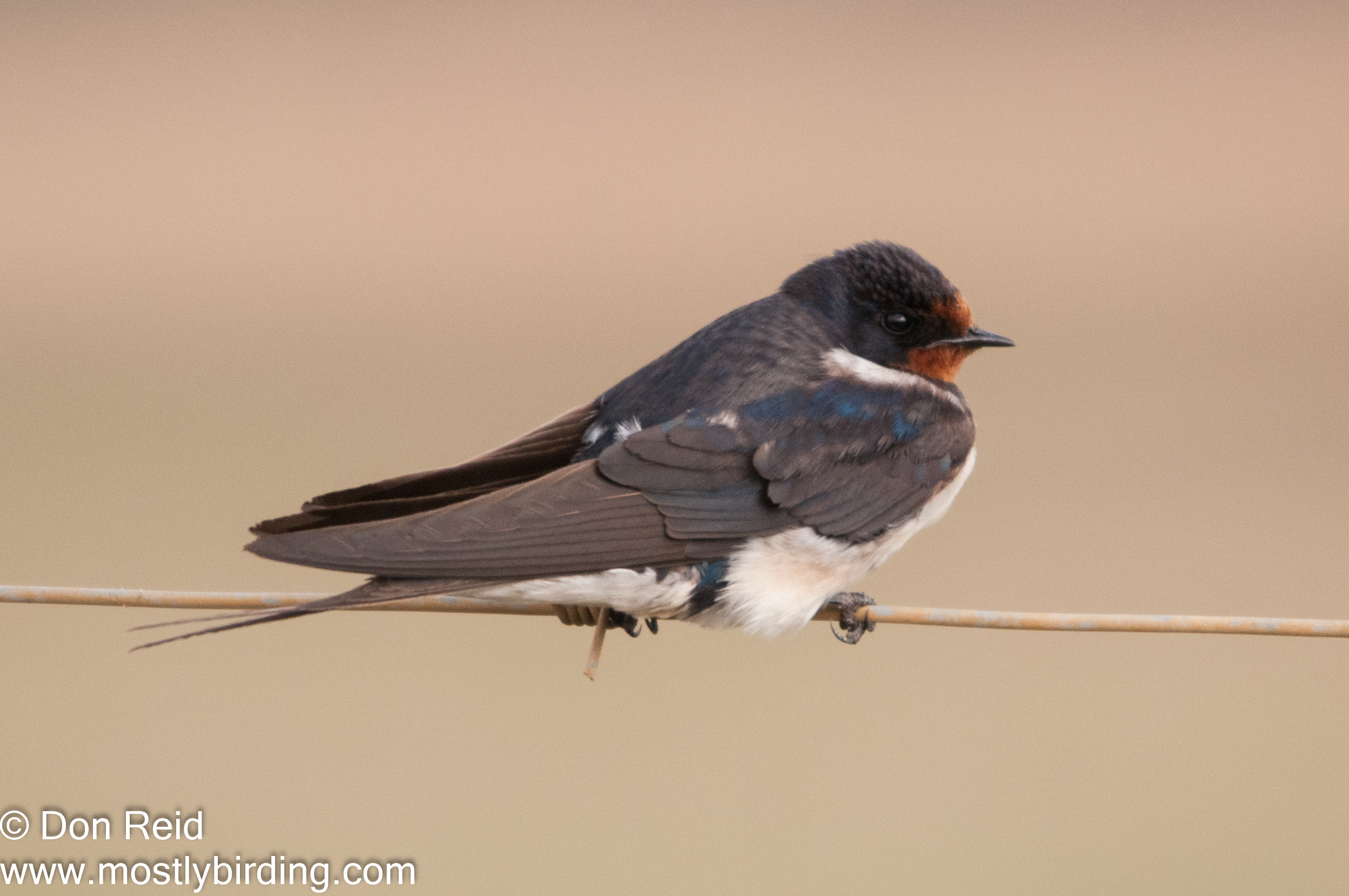
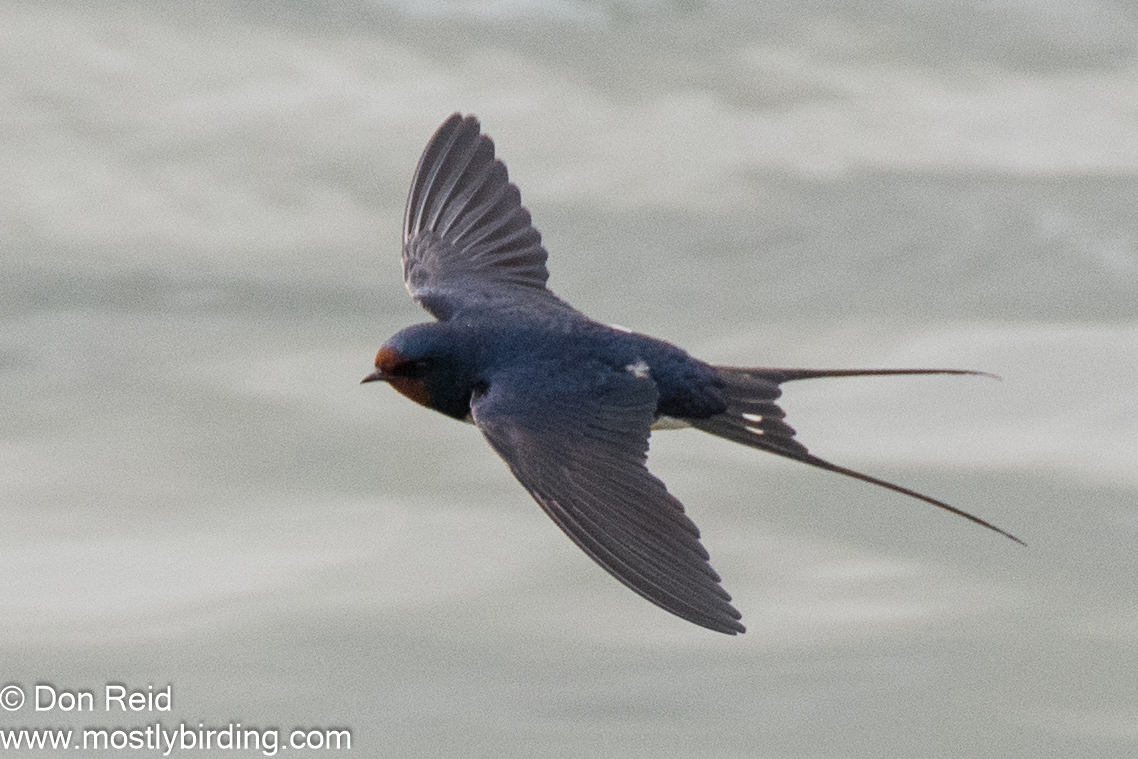
Barn Swallow Hirundo rustica (Europese Swael)

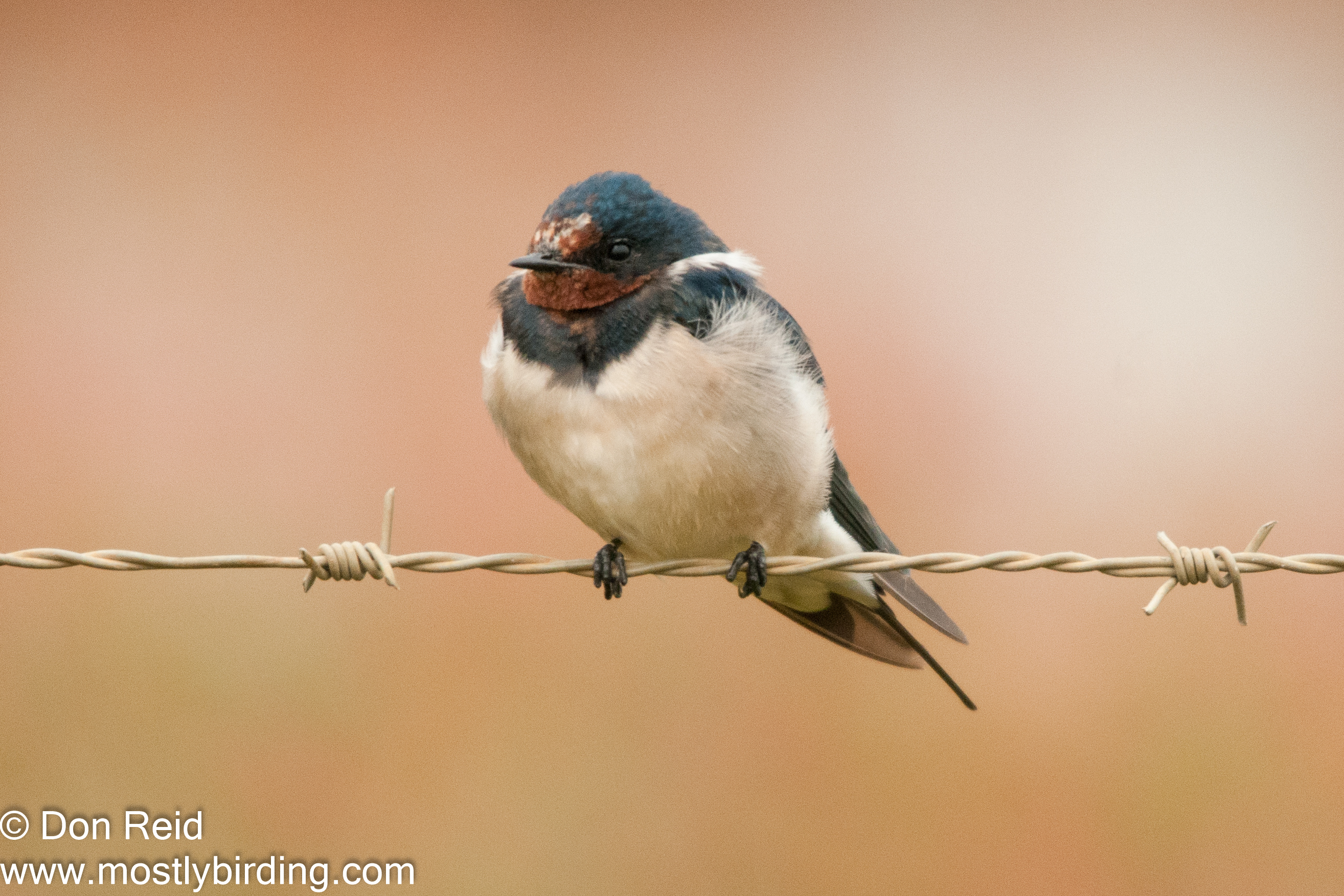
One is the Barn Swallow, which has become the best-known of the migrant swallows, certainly because it outnumbers the others, is highly visible and occurs virtually across southern Africa.

Barn Swallow, Kendal area, Gauteng, South Africa

A staggering, estimated 20 to 40 million “Barnies” (as they are known to birders who like nicknames) migrate to Africa from western Europe and another 40 to 80 million from eastern Europe and Asia annually on their southward migration, many of which end up in southern Africa.

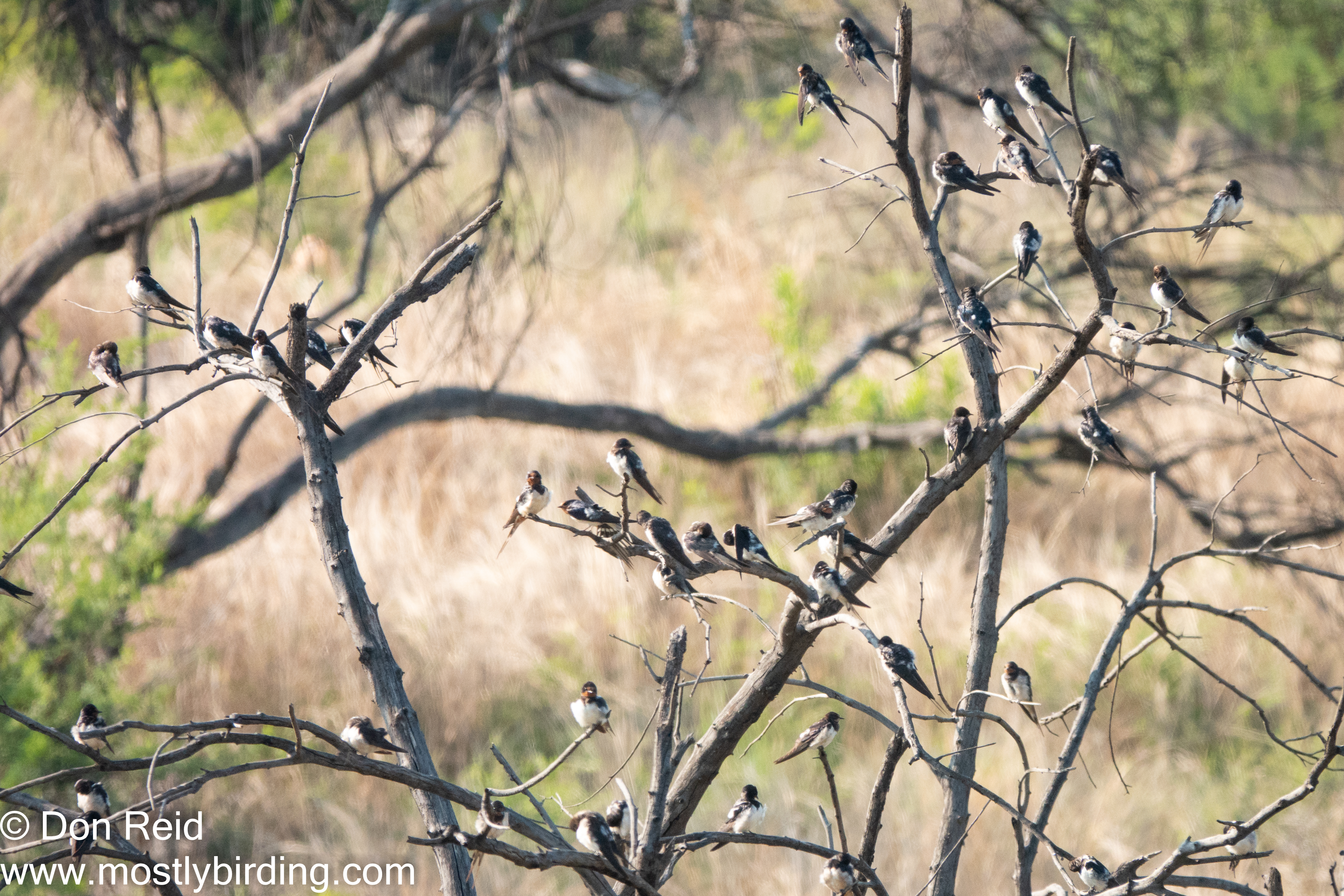
Barn Swallows, Roodeplaat Dam near Pretoria, South Africa

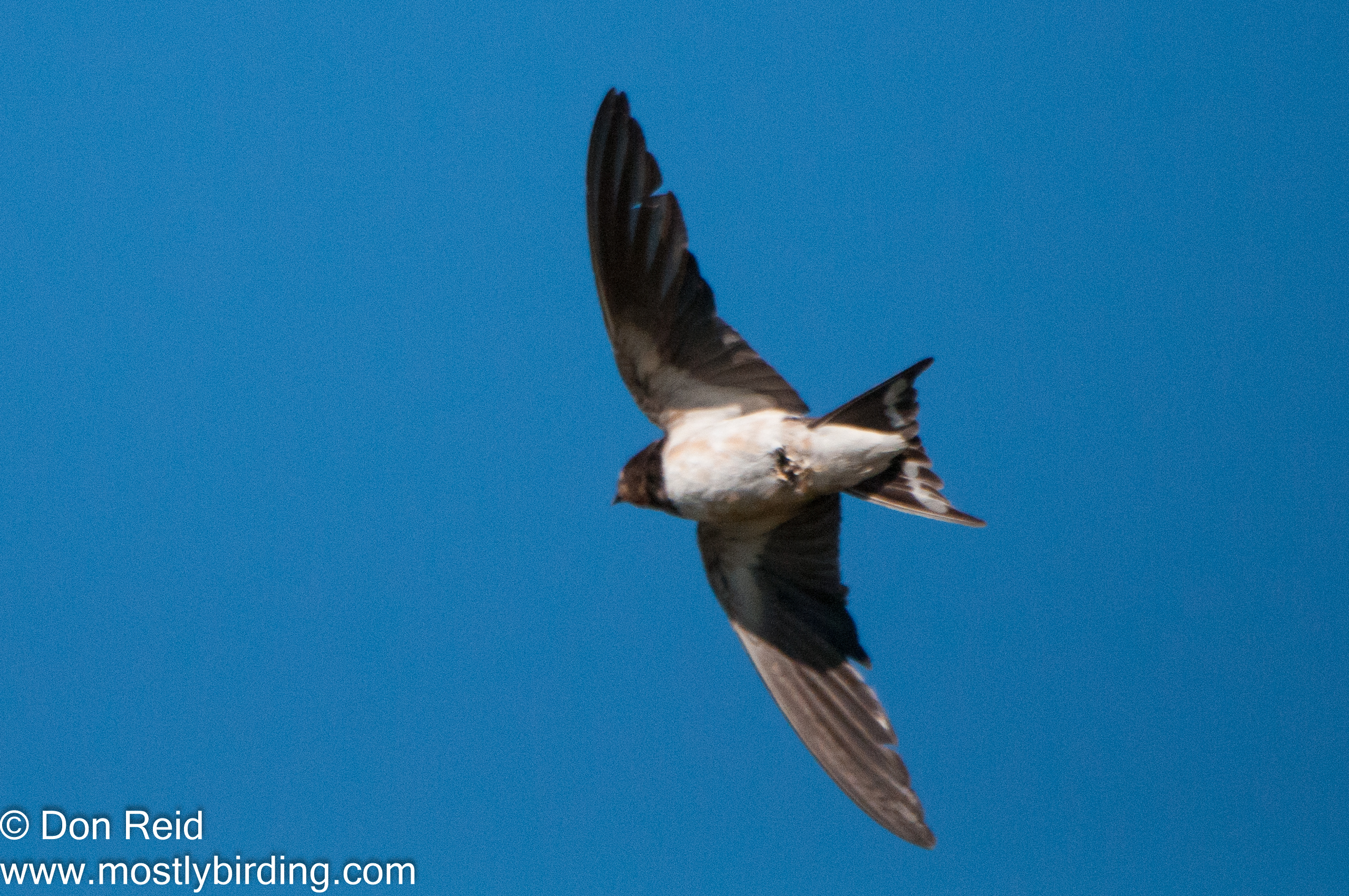
In southern Africa, during the summer months, they can be found just about anywhere outside the built up areas of cities, preferring moister, open areas such as grassland, pastures, cultivated fields and vleis and occurring in loose flocks of varying numbers.

Barn Swallow, Devon near Johannesburg , Gauteng, South Africa

Anyone who has witnessed Barn Swallows settling in their thousands into their roost at the end of the day, as we did many years ago near Umhlanga, will not forget this amazing sight.

I have been fortunate to see Barn Swallows in other parts of the world during our travels in the northern hemisphere summer, including Europe, Canada, Malaysia, Cuba and Egypt.

Barn Swallow, Annasrust farm Hoopstad, Free State, South Africa

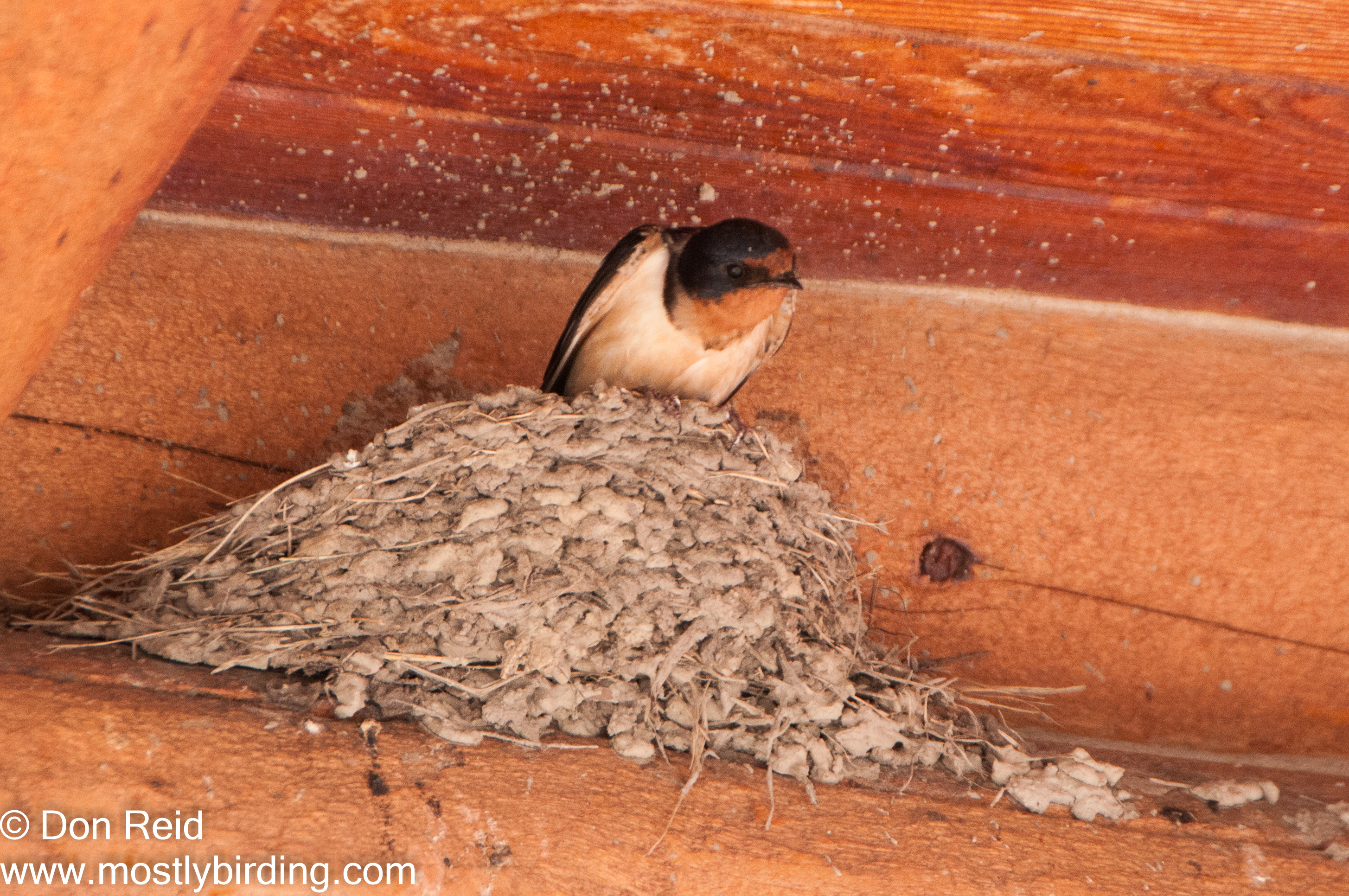
Their status in southern Africa is ‘non-breeding Palaearctic migrant’ which means they breed ‘at home’ in the northern hemisphere, so we do not see any nesting behaviour, which is why I was particularly excited to find a nest tucked under a roof overhang during a trip to western Canada some years ago.

Barn Swallow on nest, Bow Lake, Alberta, Canada

Interestingly, these Barnies looked a little different to what we are used to seeing in SA – clearly these particular swallows would not be seen in our country as their migration path southwards would take them to South America.

Another encounter on a different continent, during a cruise on the Danube River, had me equally excited – it was April and Barn Swallows were flying above the river right next to our river cruise boat and I realised that they must have just arrived back from their return migration at the end of the Austral summer, with anything up to 10,000 kms ‘under their belt’.

Barn Swallow, Danube River at Linz, Austria

Which brings me to what inspired this post ……

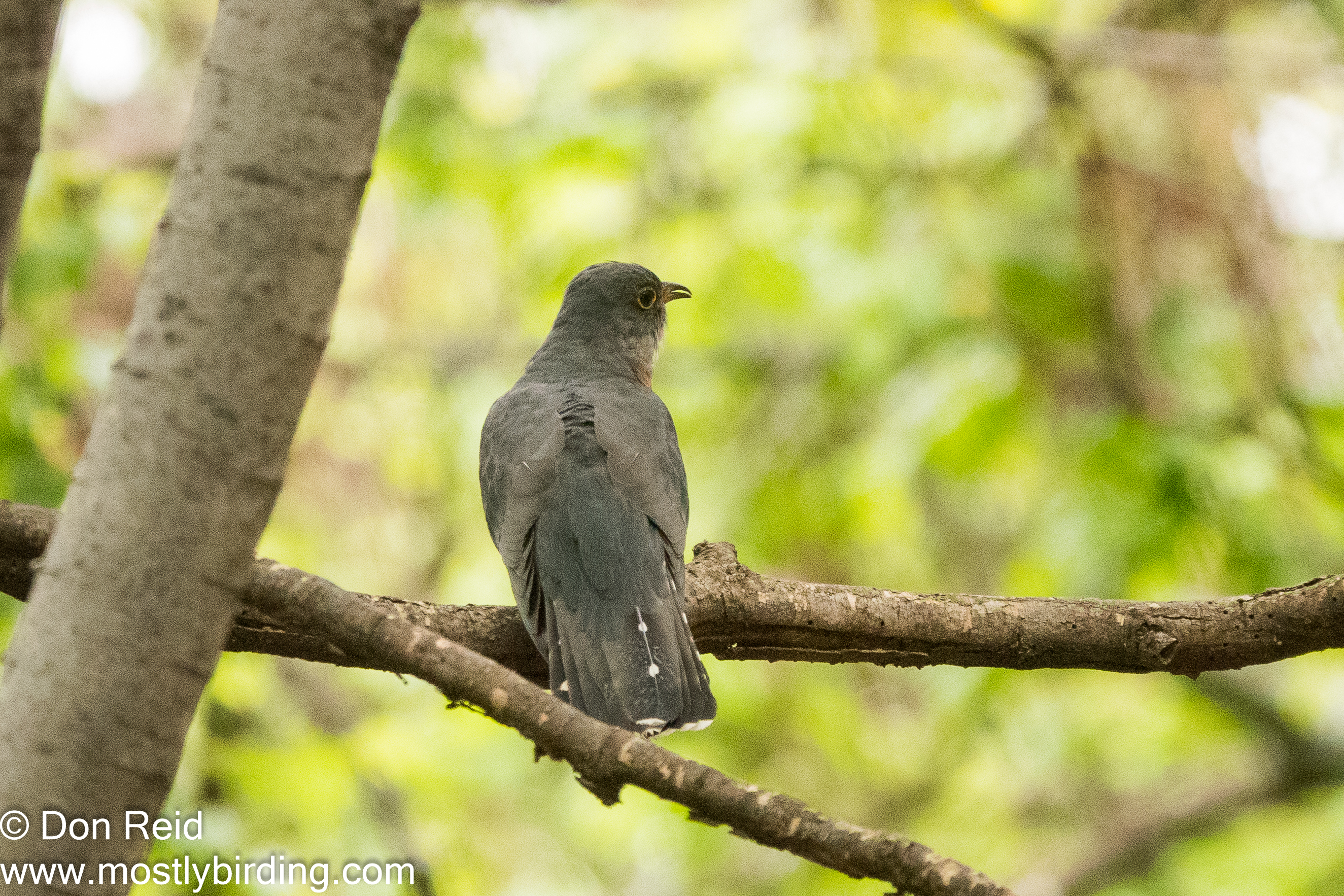
Red-chested Cuckoo Cuculus solitarius (Piet-my-vrou)

First some background –

My bird atlasing trip this past week took me to Ezemvelo Nature Reserve some 70 kms north-east of Pretoria, a small nature reserve comprising mainly rolling grasslands. Before arriving at the entrance gate at the entry time for day visitors, I had managed to complete 2 hours of atlasing in the pentad immediately west of Ezemvelo and was looking forward to spending time in the reserve, which I had last visited in 2013.

After completing the gate formalities, I headed to the Reception a few kms from the gate, paid for my day visit and parked at the nearby picnic spot, nicely located under large trees near a low tree covered hill and overlooking a small dam.

I literally had the whole place to myself – I’m sure it gets busier over weekends but on a weekday the only visitors are probably keen nature lovers such as myself, of that rather pleasant age when you, rather than others, decide how you are going to spend your day.

As I enjoyed coffee and rusks, I heard the familiar summer sound of a Red-chested Cuckoo – or Piet-my vrou (pronounced piet-may-frow) as most South Africans know it, a name based on the 3-syllable call which carries long distances and is often difficult to trace.

Red-chested Cuckoo Cuculus solitarius (Piet-my-vrou), Ezemvelo

I would hazard a guess that, doves aside, this is one of the best known calls of all birds in South Africa, with farmers often referring to it, somewhat hopefully, as the “Rain Bird” because it’s arrival coincides with the hoped for start of the summer rains in large parts of SA.

The call I heard suddenly sounded very close and I walked to the nearby trees, camera in hand, to see if I could find it. This is a bird not easily seen as they tend to choose a branch in the depth of well-foliaged trees to perch on and call. I followed the call and was thrilled to find the Cuckoo after a short search and approached carefully, not wanting to scare it away.

Red-chested Cuckoo Cuculus solitarius (Piet-my-vrou), Ezemvelo

I took a couple of photos, thrilled at getting this rare chance to photograph the species, but mildly disappointed that it refused to turn around and show its front. With a few photos under the belt I decided to try to get a video while it was calling and managed to complete a short clip before the bird flew off, leaving me very pleased with my first reasonable images of a Red-chested Cuckoo in 40 or so years of birding!

Here’s the video –

Red-chested Cuckoo (Piet-my-vrou)

Knock knock …… who’s there?

We are getting back into our Pretoria routine after 3 months in Mossel Bay, and I decided to go out atlasing in Roodeplaat Nature Reserve one morning this week. Heading into summer the weather in Pretoria is already warm with temperatures in the low 30’s and the skies are clear – some rain has fallen but the ‘big’ summer rains accompanied by the typical highveld thunderstorms have not yet arrived – hopefully they are not far off.

It was a good morning’s atlasing with 71 species logged on the Birdlasser app, including one which put on a brief display for me (well that’s what I like to think) ….

I was out of the car listening to a Lesser Honeyguide calling near the nature reserve offices, when I saw what looked like a woodpecker fly from a tree to a bare wooden utility pole. I could not make out what it was as it seemed to be purposely hiding from me so I approached carefully until I had a partial view and took a few record photos.

It then started pecking at the pole in a rhythmic fashion creating a loud drumming sound and I immediately wondered why, as there was no hope of anything edible to be found and the pole was completely unsuitable for nesting or similar purposes.

Here’s the short clip I filmed of the woodpecker, which I later identified as a Bearded Woodpecker, in action – do excuse the shakiness of the images – I had to film it at a distance on full zoom so as not to scare it away and the wind blowing didn’t help matters.

Best viewed in full screen mode ….

Bearded Woodpecker (Female) ‘drumming’ (Baardspeg / Dendropicos namaquus)

A read through of the species habits on the Roberts app on my phone provided the following insights into this behaviour – nothing to do with food or nesting it seems –

Presence often given away by loud, distinctive call, or by loud tapping (while foraging), or drumming.

Moves out of sight behind a branch in response to danger.

Both sexes drum frequently, mostly early morning; used in territorial advertisement and to establish contact with partner.

Drums in bursts of ca 1 sec at ca 12 strikes/sec, beginning fast, then slowing; usually on a high dead branch (same branch often reused); audible to 1 km.

Roberts VII Multimedia Birds of Southern Africa

It flew off after a while and I continued with my atlasing, pleased at having witnessed this behaviour and at having everything one wants to know about birds available on my iphone.

Hornbills in Lockdown

Stoepsitter Birding

Sticking with the “stoepsitter” mode of birding as described in my recent post on the ‘Lawn Raiders’ of Verlorenkloof, here’s another version in a somewhat different location – Satara Rest Camp in the Kruger National Park.

(For the benefit of international readers “stoepsitter” is an Afrikaans term that translates roughly as one who spends much time on the stoep or verandah – but you knew that anyway, I’m sure)

It’s a well known fact amongst birders that, when visiting Kruger’s camps, time spent relaxing with binos on the stoep of your accommodation is bound to be rewarded with views of a variety of birds as they go about their daily business, on the grass, in the bushes and in the trees that most of the camps have in abundance.

That’s not to say one shouldn’t spend time getting out and about on game drives, exploring this national treasure of our wildlife, it’s just that when you want to relax in the rest camp, there’s no better place to do so than on the stoep of your rondavel or other accommodation.

Satara Rest Camp

During our December 2020 visit to Kruger, we spent four nights in Satara Rest Camp, one of which was in a fully equipped rondavel close to the perimeter fence, the other three in a more basic rondavel facing onto an expanse of grass with well established trees in close proximity.

This meant there was ample time for some serious stoepsitting, in between forays into the surrounding areas on game and birding drives and to visit the picnic spots for our traditional Kruger brunches (ooh, just typing that makes my mouth water and my nose prickle with the imaginary smell of a tasty brunch braai-ing on the pan).

The first afternoon and morning produced a fair sprinkling of interesting birds, before we changed rondavels, some of which I managed to photograph –

Spotted Flycatcher (Muscicapa striata / Europese vlieëvanger

A Spotted Flycatcher, a non-breeding Palaearctic migrant, was quietly going about its business on an outer branch with a view over an expanse of lawn, which in some camps has been allowed to grow “wild”, as you will see in the featured image at the top of this post.

Just a note on these “wild” lawns : it was initially jarring to see the lawns in such a wild state, having been used to manicured lawns in the camp for so many years, but I will admit that I now find this quite appropriate to the surroundings, as the contrast between the camp gardens and the natural habitat of the surrounding veld has been reduced – the ‘line has been blurred somewhat’. I like to think this was a conscious decision by the Park authorities.

Spotted Flycatcher (Muscicapa striata / Europese vlieëvanger), KNP – Satara

Violet-backed Starling (Cinnyricinclus leucogaster / Witborsspreeu

Another migrant, the stunning Violet-backed Starling, but this one hasn’t got as far to migrate, being an intra-African migrant from tropical Africa.

Violet-backed Starling (Cinnyricinclus leucogaster / Witborsspreeu) (Male), KNP – Satara

And the missus was there, no doubt keeping an eye on handsome hubby to make sure he didn’t attract any competition. One of a number of species with significant, even dramatic, differences in plumage between male and female (known as dimorphism)

Violet-backed Starling (Cinnyricinclus leucogaster / Witborsspreeu) (Female), KNP – Satara

Woodland Kingfisher (Halcyon senegalensis / Bosveldvisvanger

The Woodland Kingfisher is also a breeding intra-African migrant, strikingly coloured and always a joy to find. Although they were present in the camp, this photo was taken on one of our drives.

Woodland Kingfisher (Halcyon senegalensis / Bosveldvisvanger), KNP – Satara – Muzandzeni

Moving home

On the second morning we had to move to another rondavel, this time without a kitchen, but we had come prepared with a fold-up table, little gas cooker for the all-important boiled water for our tea and coffee and our picnic hamper that always accompanies our trips to Kruger. The camp has communal kitchens close by for the washing up etc .

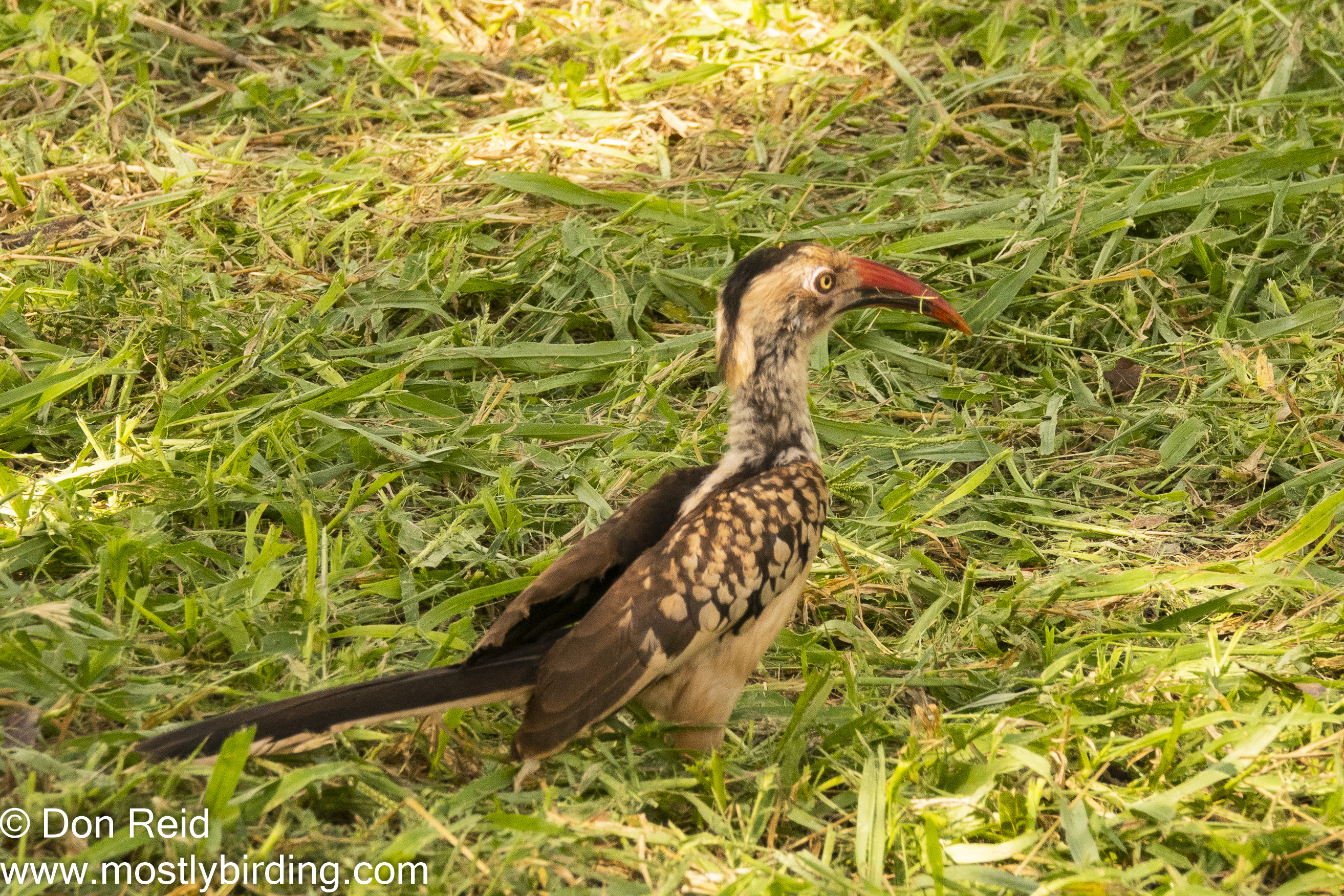
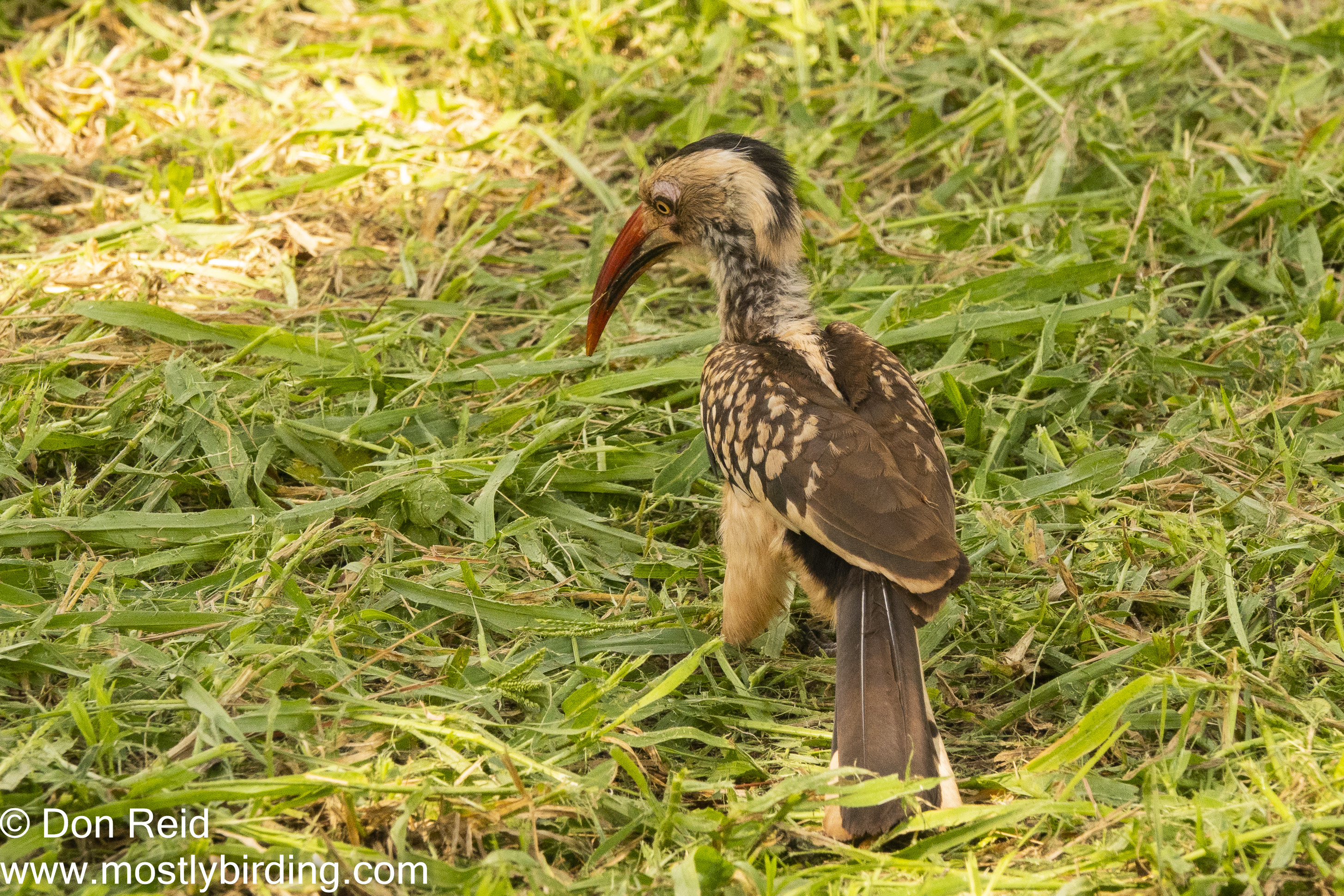
Southern Red-billed Hornbill (Tockus rufirostris / Rooibekneushoringvoël

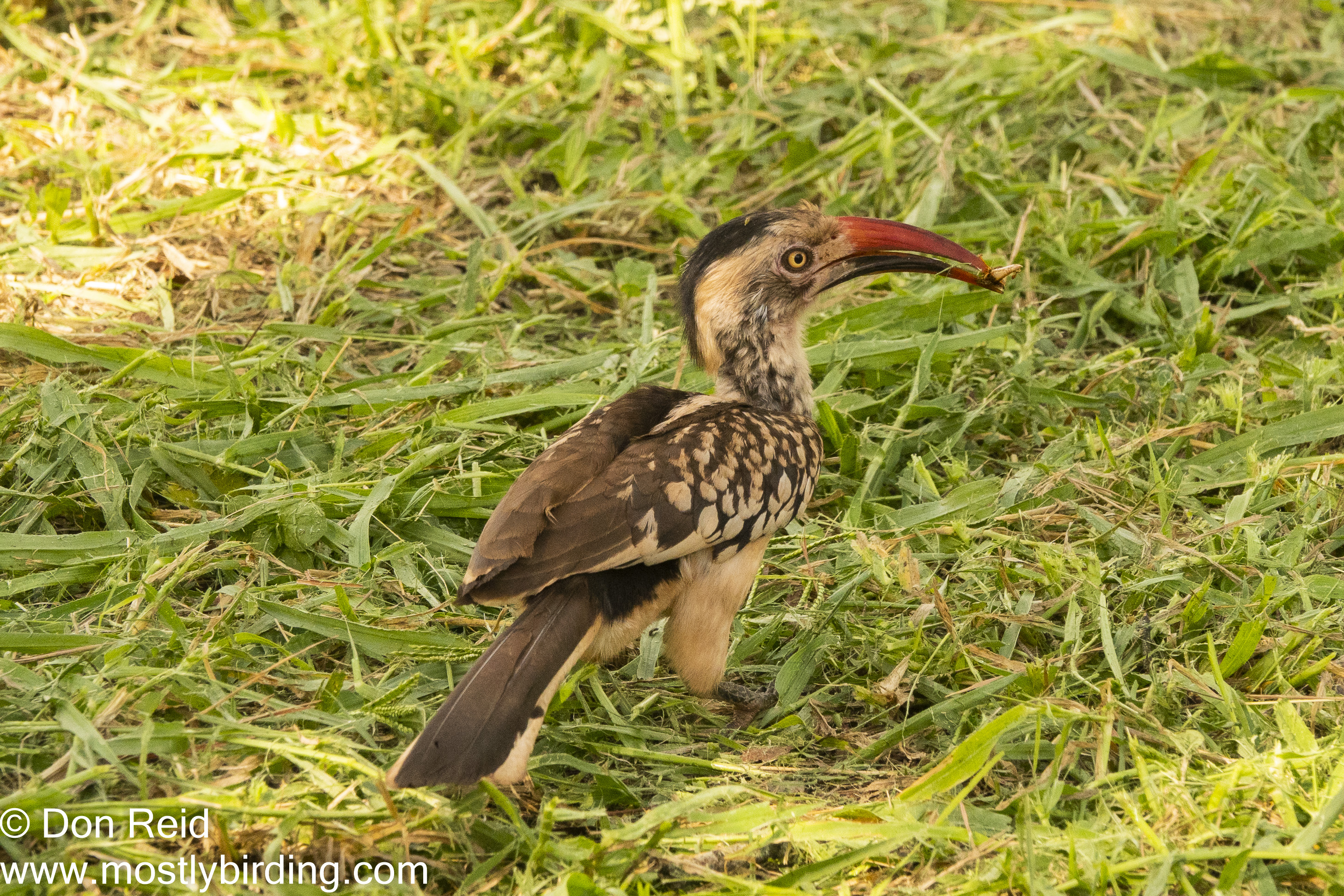
Once settled in to the new accommodation, I continued with stoepsitter birding and soon noticed that one particular bird was almost constantly present on the stretch of grass in front of the rondavel. It was a Red-billed Hornbill, a common species found throughout Kruger. I assumed it had found a good spot to find the small insects that make up most of its diet and did not pay too much attention to it as it came and went at regular intervals.

Southern Red-billed Hornbill

Hornbills look ungainly with their huge bills, but they have an admirable ability to find and pick up insects with some precision

Southern Red-billed Hornbill

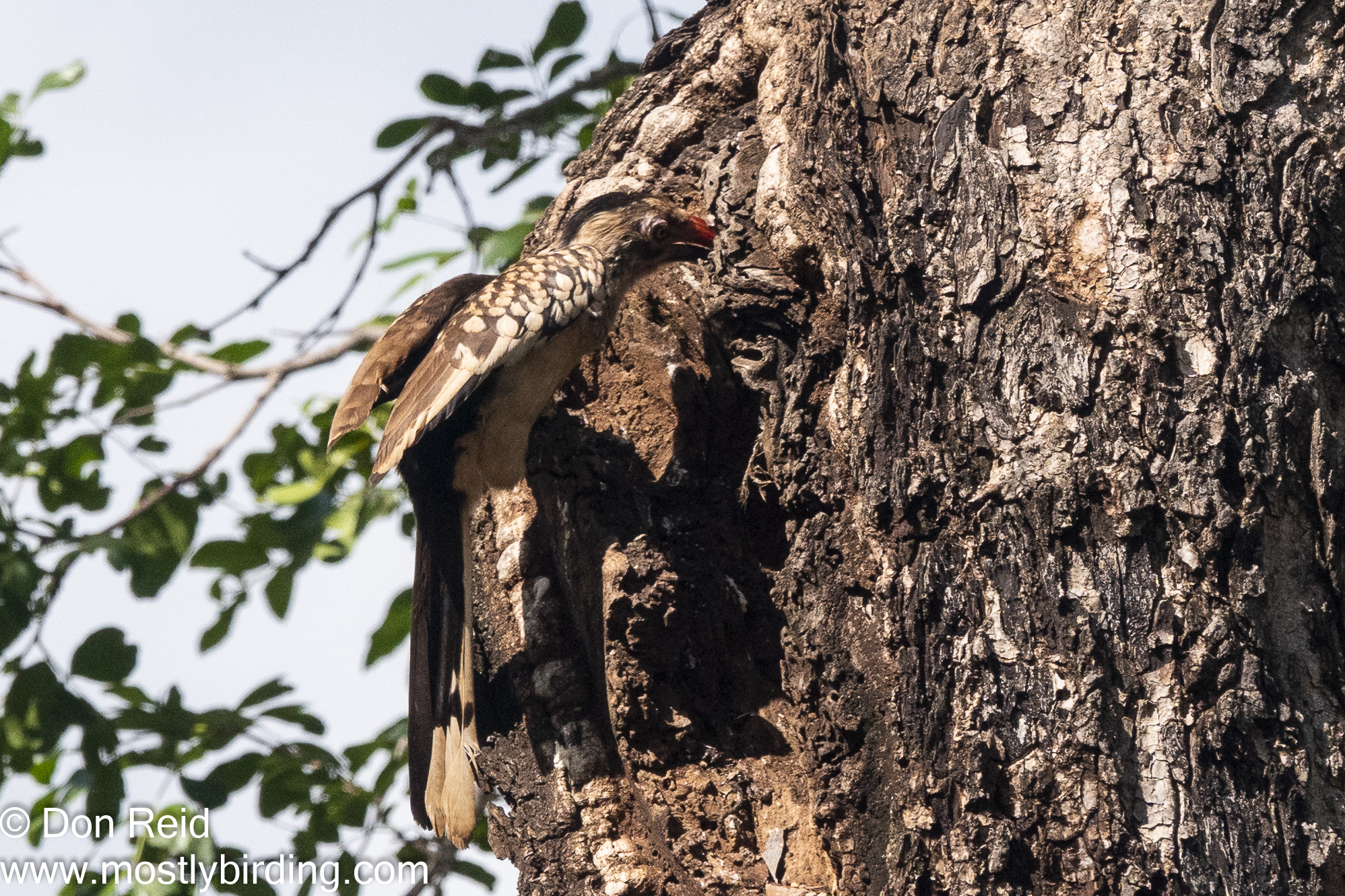
At one stage I kept watching the Hornbill after it had found an insect but not swallowed it, which led me to think it was feeding its young. It flew up to a large tree nearby and settled on the trunk where a branch had probably broken off years earlier as there was a large scar, visible about halfway up the left hand trunk in the image below.

Satara Rest Camp
Southern Red-billed Hornbill

The Hornbill then poked its bill through a small hole in the trunk and that’s when I realised what it was doing.

Southern Red-billed Hornbill

Red-billed Hornbills nest in natural cavities in trees, which the female inspects before selecting one. The entrance is usually just wide enough to allow entry and is then sealed from the inside by the female, using own faeces, leaving just a narrow slit and effectively holding her prisoner during the laying and incubation of the eggs.

Cavity sealed from inside with small hole for feeding

Once eggs are laid, incubation takes up to 25 days, followed by another 16 to 24 days during which the female cares for the young, all the while being fed by the male. Then the female breaks her way out leaving the youngsters in the nest and joins the male in providing food for the chicks, while the youngsters then re-seal the opening until they in turn are ready to take on the world at the ripe old age of around 50 days.

That’s quite a partnership! I felt privileged to have been able to see them in action.

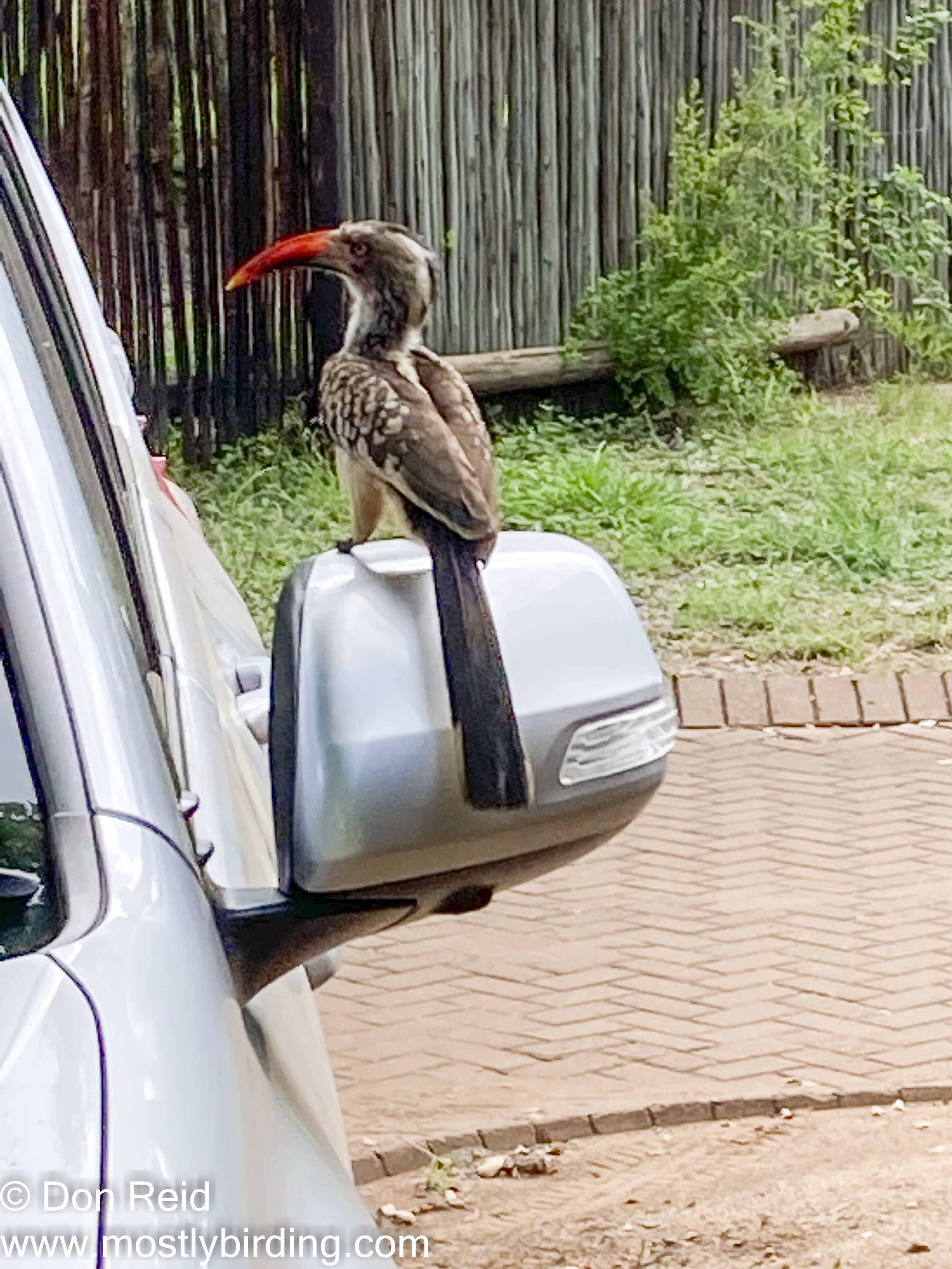
All of this kept the male busy the whole day, but he still found time to go and see his reflection in my car’s window and frustratingly shadow box with what he thought was a possible intruder.

Red-billed Hornbill seeing his reflection

Millions of Birds

Let me start by saying : “I saw millions of birds this past weekend” – now I know what you’re thinking ….. just a bit of harmless hyperbole on my part, not unusual in these attention-seeking times. But what if I really did see millions of birds? What kind of bird gathers in those sort of numbers?

There is only one possible answer to that question and that is – the Quelea, or to be more precise in this case, the Red-billed Quelea.

Some background to this latest exceptional birding experience –

We were travelling back to Pretoria after a long stay in Mossel Bay and arrived in Hoopstad, Free State for our second overnight stop, primarily to pay a short visit to Gerda’s family. It was just after 3 pm when we arrived in the small town, the centre of the farming community in that part of the Free State. Piet and Marietjie kindly accommodated us and Piet invited me to join him on a quick trip to their farm some way out of town.

The farm lies on the southern side of the Vaal river, which forms one of its boundaries, and is a well-stocked game farm with a variety of game in a bushveld setting to rival the best that Southern Africa can offer, so for a lover of nature such as myself it is always a special treat to visit this piece of paradise, albeit briefly.

Annasrust farm, Hoopstad
Nyala, Annasrust farm Hoopstad

The day was waning as we approached the farm and our progress along the dirt road was punctuated by flocks of Queleas rising up out of the roadside grass at regular intervals, each flock numbering a couple of thousand at a guess. Piet remarked that he had seen many more flocks of larger size that same morning, so we were on the lookout for more Queleas, without realising what we would experience a bit later.

We did a quick tour of the farm, marveling at the numbers of game, ranging from Antelope to Zebra, with the standout animals for me being the incomparable Sable Antelope with their dark brown bodies and graceful, curved horns. (The photo below is from one of my Chobe trips as I did not have my camera with me)

Sable Antelope (Chobe Game Reserve)

After a brief stop at the farm house, occupied for the week by a group of hunters, we headed back to the main road, but hadn’t gone far when Piet pointed out what looked like a distant cloud of smoke stretching across the horizon. He stopped and we got out to have a better look and realised immediately that this was not smoke of course, but a huge flock of Queleas, visible against the rapidly darkening skyline, moving like a giant serpent across the horizon.

Queleas across the horizon

For the next ten to fifteen minutes – I didn’t time it so it could have been longer – the enormous flock grew in length and made its way to some distant, unknown roosting spot, probably along the river. There is no way of beginning to estimate numbers of birds in a flock of this magnitude, suffice to say “millions” is not an exaggeration.

At one stage the flock moved in an elongated tube-like formation directly over our heads and as we gazed up the sound of several thousand small wings filled the silence with an eerie soft humming, like nothing I had heard before.

As it was rapidly getting darker, we left the farm and headed back to Hoopstad, mulling over the impact that birds in these numbers could have on the area, which is one of the prime maize and wheat-producing areas in our country. Piet mentioned that some farmers had already decided not to plant their usual winter crops due to the risk of the crops being devastated by the Queleas.

Suddenly I realised that birds are not always to be regarded as “Threatened” by human behaviour but can also be “Threatening” to some of our food sources – a sobering thought.

Roberts VII Birds of Southern Africa has the following to say about Red-billed Queleas under Population and Demography :

  • Perhaps the most abundant bird on earth
  • The major pest of cereal crops in Africa
  • Population estimate post-breeding is 1 500 billion (so about 200 Queleas for every person on earth!)
  • Most abundant bird in Kruger National Park at 33.5 million
  • More than 100 million birds killed annually in control operations in South Africa – methods used are aerial spraying and explosions at roosts (but the latter is not favoured as other species get killed in the process)
  • Prey of Peregrine and Lanner Falcons
  • Drinking birds taken by predators including pelomedusid turtles (!), crocodiles, Marabou Storks and Striated Herons

All in all, this is an interesting bird, often for the wrong reasons. Despite this I always enjoy seeing them in small numbers as they are quite variable in appearance, some drab, others colourful.

Here are a few photos of those I have come across while atlasing –

Red-billed (Quelea quelea / Rooibekkwelea), Balmoral north
Red-billed Queleas, Calitzdorp area
Red-billed Queleas, Satara-Nwanetsi (Kruger National Park)
Queleas, Mkhombo Dam